IV · Sharing it · The compendium

An encyclopedia of ancient Cyprus

Live

The compendium is our encyclopedia of ancient Cyprus: 254 entries in 13 sections on pottery, sculpture, jewellery, weapons, tools, architecture, burial, daily life, materials, the environment, the chronology and the antiquities trade. Each is written for a reader new to the subject, and its statements rest on the published scholarship, cited by number and page.

A section opens with a page that groups its entries. A typical entry carries an infobox, a timeline strip, a contents list, figures of real objects, its references in full, and links to the sites, people, excavations and catalogue objects it names. Read end to end, the compendium is about 52 hours of reading.

The courses take a reader through Cypriot pottery and architecture lesson by lesson, with drawings, maps, models and quizzes; the articles are longer pieces of research.

entries
254
entries
sections
13
sections
words
712,000+
words
references cited
3,935
references cited
figures in the text
704
figures in the text
courses · lessons
2 · 29
courses · lessons

What is in it

The compendium as a map of its sections

Each block is a section, sized by its share of the whole. Pottery is the largest, with 79 entries, and the Antiquities Trade follows with 74; size the blocks by references instead and Chronology grows, its entries the most heavily cited at 35 references each on average. Choose a section to see its entries, grouped by sub-section, each block a link to the entry.

The sectionsSize by entries, words, references or figures · choose a section

Point at a section to see its numbers; choose it to see its entries.

The sections in numbers

Counted from the entries themselves; the sub-sections are listed under their section.

The compendium’s sections in numbers
SectionEntriesWordsReadingReferencesFiguresObjects linked
PotteryWares · Motifs · Shapes79217,19015 hr 45 min1,058269867
The Antiquities TradeThe occupied north · People and networks · Before 1974 · Reading the evidence · The trade since 1996 · Law and provenance · The south after 1974 · The state as buyer74176,22712 hr 45 min8772734
Statues2056,2604 hr 5 min35573152
Daily Life1550,4623 hr 40 min21268136
Chronology1446,2333 hr 20 min48857129
Architecture1346,3023 hr 20 min1625843
Tools and Technologies1238,5932 hr 50 min19145122
Cultures1031,7192 hr 20 min3254362
Weapons and Armour413,7931 hr841824
Burial and Religion415,3271 hr 5 min801726
Environment410,23344 min321420
Materials34,84721 min28946
Jewellery25,21523 min43610
All sections254712,40151 hr 35 min3,9357041,671

Words are counted in the running text, without headings’ marks, tables’ code or link addresses; reading time at 230 words a minute. Figures are the pictures set in the text. Objects linked are the catalogue objects whose pages an entry’s text links to, counted once in each entry.

What is in it

Periods, topics and links

Entries are filed under the periods they cover and the topics they touch, and each period and topic has a page that gathers its entries. Inside the text, names link to their own pages: counted once in each entry, 3,297 links lead to other entries, and 4,628 to the rest of the site.

Entries by period

Entries covering each period, besides the period’s own entry. An entry can cover several.

Where the links lead

Links written into the text of the entries, by the kind of page they open, each counted once in each entry, and how many different pages they reach.

References and the register of publications

The entries cite 3,935 references between them. 3,101 of them (79%) open the publication’s page in our register of publications, 1,146 different works in all, where every page on the site that cites a work is listed together.

  • References cited3,935
  • Linked to the register3,101
  • Different works1,146

The topics with most entries

32 topics cut across the sections; each gathers its entries on one page.

Every topic →·Every period →

Did you know

The whole deck: 241 facts from the entries

Many entries give a short fact or two to lead a reader into them. They appear a few at a time on the compendium’s pages; here is every one, by section. Step through them, shuffle them, and follow the one that catches your eye to the entry it comes from.

Did you knowChoose a section · arrow keys step through

Loading the deck…

All of them on one page →

How it is made

One entry taken apart

Entries are built from the same parts. Here is White Slip Ware, part by part, each as it appears on the entry’s page.

White Slip Ware

Compendium · Pottery · Types of Ware

White Slip Ware

The hand-made Late Bronze Age tableware with a thick white slip and dark painted decoration, mostly hemispherical bowls, widely exported from Cyprus.

4,512 words · 20 min read · 47 references · 6 figures

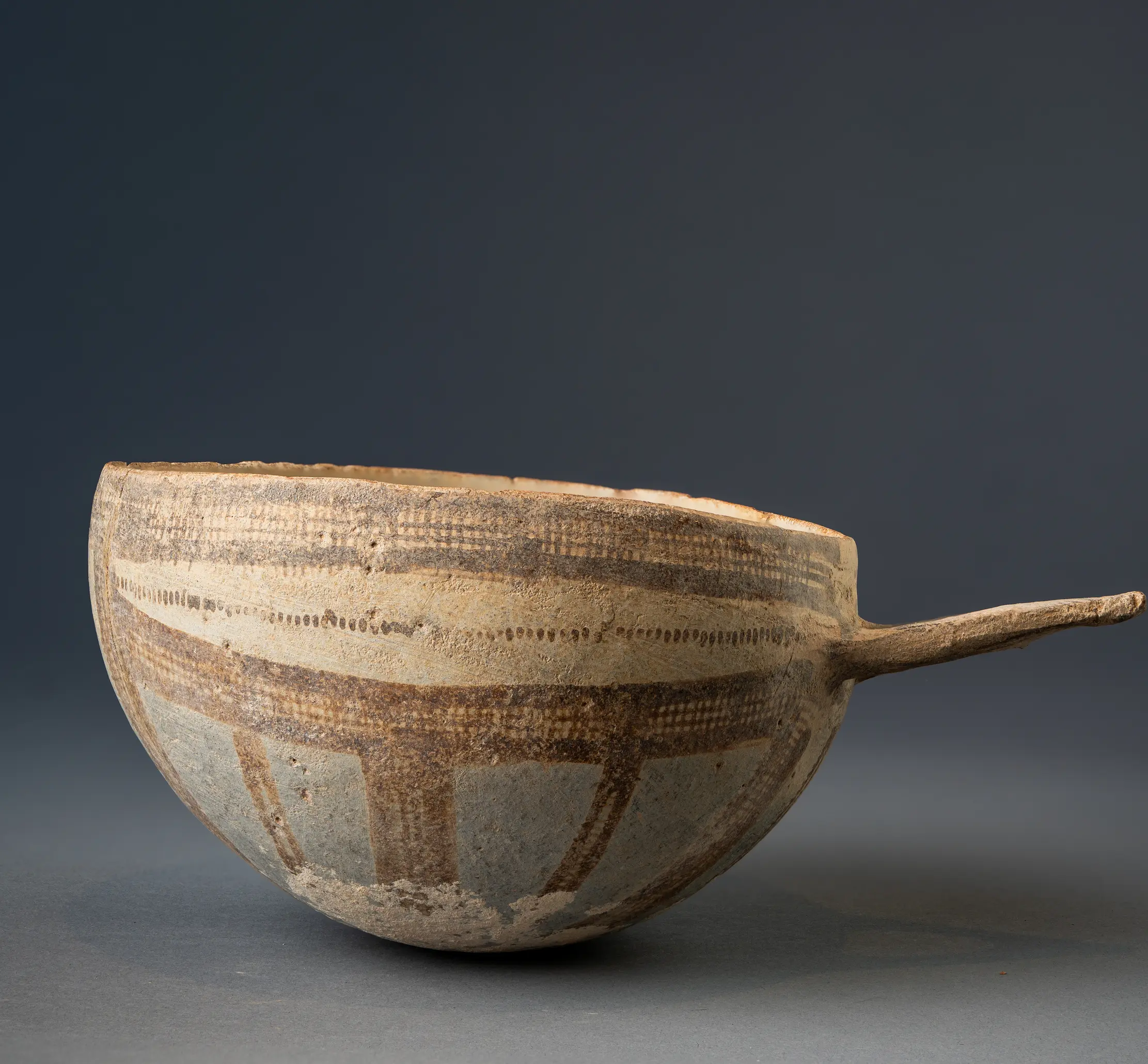
  • White Slip bowl with lattice ladder pattern on a thick greyish white slip over green-grey clay, c. 1425–1200 BCE, from Maroni, British Museum 1898,1201.154
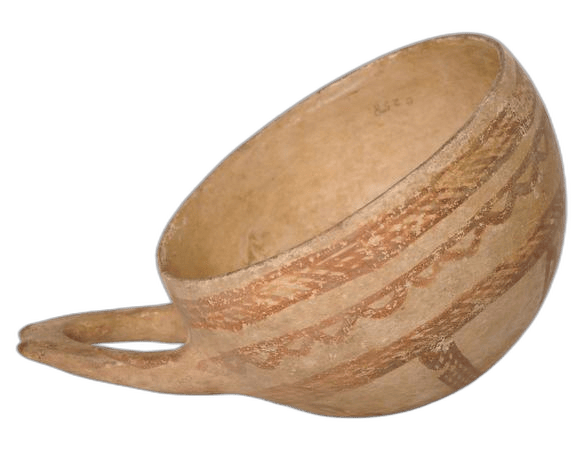
  • White Slip I hemispherical bowl with wishbone handle and framed wavy-line decoration, c. 1600–1450 BCE, British Museum 1897,0401.1327
  • White Slip II hemispherical bowl with wishbone handle, painted with a row of dots above a lattice and pendent ladder and lattice patterns, c. 1450–1200 BCE, from Enkomi, British Museum 1897,0401.954
  • Late White Slip II small hemispherical bowl with wishbone handle and pendent bands of four lines on a buff micaceous slip, c. 1250–1200 BCE, from Enkomi, British Museum 1897,0401.1233
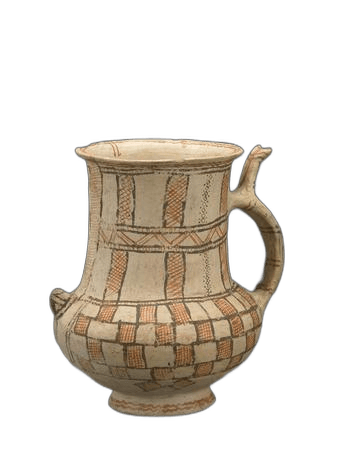
  • White Slip II tankard with double-horned handle, c. 1550–1200 BCE, from Cyprus, Ashmolean Museum AN1911.332
  • White Slip II sherd with ladder pattern and dotted row friezes, c. 1375–1200 BCE, from Tell Atchana (Alalakh), British Museum 1977,0704.5

Read the entry →

  1. 1

    Summary and description

    One sentence that defines the subject, shown under the title and in previews, and a longer description for search results.

    The hand-made Late Bronze Age tableware with a thick white slip and dark painted decoration, mostly hemispherical bowls, widely exported from Cyprus.White Slip ware, the handmade tableware of Late Bronze Age Cyprus (c. 1650 to early 12th c. BCE): bowls with a thick white slip and dark paint, exported widely.
  2. 2

    The infobox: ware

    The facts a reader looks up first, beside the text: dates, period, how it was made, what it is related to, where it went.

    Date
    c. 1650 BCE to early 12th century BCE
    Period
    Late Cypriot IA to IIC
    Fabric/Surface
    Dark ferrous fabric under a thick white slip
    Technique
    Handmade; fired at 900–1100 °C
    Subdivisions
    Proto White Slip, WS I, WS II, WS II-Late (WS III)
    Preceded by
    White Painted ware (source of Proto White Slip)
    Exported to
    Levant, Egypt, Anatolia, Aegean, Italy
    See it at
    British Museum, Museum of Archaeology and Anthropology, Cambridge, Ashmolean Museum
  3. 3

    Periods, topics and other names

    The periods put the entry on the timeline strip and on each period's page; the topics file it with its neighbours; the other names find it in the A to Z index and in search.

    Periods · Late Bronze AgeTopics · Pottery, Craft Production, Trade, Foreign Contacts, Chronology and DatingAlso called · WS, Proto White Slip, Proto-White Slip, PWS, White Slip I, WS I, White Slip II, WS II, White Slip IIA, WS IIA, White Slip II-Late, Late White Slip II, White Slip III, WS III, Milk bowls
  4. 4

    The text, in parts

    Main parts with their sub-headings, which make the contents list beside the text.

    1. The Craft of White Slip Ware: Materials and Manufacture
    2. Typology and ChronologyProto White Slip · White Slip I · White Slip II · White Slip III
    3. The Function of White Slip Vessels
    4. A Cypriot Export: Distribution and Economic Significance
    5. Conclusion
  5. 5

    6 figures

    Each picture captioned with what the object is, its date, where it was found when that is known, and where it is now with its museum number.

    • White Slip bowl with lattice ladder pattern on a thick greyish white slip over green-grey clay, c. 1425–1200 BCE, from Maroni, British Museum 1898,1201.154
    • White Slip I hemispherical bowl with wishbone handle and framed wavy-line decoration, c. 1600–1450 BCE, British Museum 1897,0401.1327
    • White Slip II hemispherical bowl with wishbone handle, painted with a row of dots above a lattice and pendent ladder and lattice patterns, c. 1450–1200 BCE, from Enkomi, British Museum 1897,0401.954

    and 3 more.

  6. 6

    47 references

    Statements in the text carry numbered markers, most with the page (108 of them here); the numbers lead to the references at the foot, and 47 of the 47 works open their page in the register of publications.

    1. 1.Cline, E. H. (Ed.). (2010). The Oxford handbook of the Bronze Age Aegean. Oxford University Press.
    2. 2.Bachhuber, C., & Roberts, R. G. (Eds.). (2009). Forces of transformation: The end of the Bronze Age in the Mediterranean. Oxbow Books.
    3. 3.Steel, L. (2013). Cyprus during the Late Bronze Age. In The Oxford handbook of the archaeology of the Levant: c. 8000–332 BCE (pp. 571–585).
  7. 7

    Links into the rest of the site

    Names in the text link to their own pages: other entries, objects, sites, people, excavations and the catalogue's wares.

  8. 8
  9. 9

    Did you know, and reading paths

    Short hooks that lead into the entry from the compendium's front pages, and the reading paths it is a step of.

    • … that residue analysis shows the so-called "milk bowls" of White Slip ware served meat-and-vegetable meals and pine-resin-flavoured wine?
    • … that potters may have shaped their near-perfectly hemispherical White Slip bowls by using a gourd as a mould?
    • … that the patterns on White Slip pottery have been compared to decorated linen garments shown in 15th-century BCE Egyptian tombs?

    Step 7 of 10 in Reading Cypriot pottery

  10. 10

    Pages that link here

    Shown at the foot of the entry, so a reader can go back the other way.

    36 other compendium entries and 17 articles link to it.

How entries are written and checked

An entry is written in our own words from the published scholarship on its subject: excavation reports, catalogues of museums and collections, monographs and articles. Statements carry numbered markers with the page they rest on, and the works are listed in full at the foot. Where the authorities disagree, the entry sets out the positions and says who holds them.

Names, dates, places and figures are checked against the publications they come from. Pictures show real objects and sites, objects from the catalogue first, and an object’s caption is taken from its own record.

How we source, credit and correct what we publish is set out in our editorial standards. To report an error, write to us with the address of the page and what you believe is wrong.

Around the entries

Ways into the compendium besides its sections.

Start here

Entries to start with, and reading paths

A handful of entries, one from each corner of the compendium, each with its own summary. For a longer route, the reading paths below take a few pages in a sensible order, with a note on what each adds.

10 reading paths

Each path lists its pages in order, with the time it takes to read them all.

  1. Introductory · 10 pages · 2 hr 35 min

    Start here: Cyprus in ten pages

    One page per period, from the island's first human visitors to the last Cypriot kings.

    1. 1 The Chronology of Ancient Cyprus
    2. · 2 Cyprus Before Humans: Dwarf Hippos, Dwarf Elephants and the First Visitors
    3. · 3 Neolithic Cyprus
    4. · 4 Chalcolithic Cyprus
    5. · 5 Early Bronze Age Cyprus
    6. · 6 Middle Bronze Age Cyprus
    7. · 7 Late Bronze Age Cyprus
    8. · 8 Cypro-Geometric Cyprus
    9. · 9 Cypro-Archaic Cyprus
    10. · 10 Cypro-Classical Cyprus
  2. Intermediate · 10 pages · 2 hr 40 min

    Copper island

    How the Troodos ores shaped Cyprus, from hammered native copper to oxhide ingots and Roman mines.

    1. 1 Chalcolithic Cyprus
    2. · 2 Copper Metallurgy in Ancient Cyprus
    3. · 3 Gold, Silver, Tin, Arsenic and Iron in Ancient Cyprus
    4. · 4 Weapons of Bronze Age Cyprus
    5. · 5 Late Bronze Age Cyprus
    6. · 6 Ugarit and the Levant
    7. · 7 Egypt
    8. · 8 Hittite Empire and Cyprus
    9. · 9 Seafaring and Ships in Ancient Cyprus
    10. · 10 Roman Cyprus
  3. Introductory · 10 pages · 2 hr 50 min

    Reading Cypriot pottery

    How to tell the island's main wares apart, from Red Polished to Black-on-Red.

    1. 1 The Pottery of Ancient Cyprus
    2. · 2 Types of Ware
    3. · 3 Red Polished Ware
    4. · 4 White Painted Ware
    5. · 5 Pottery Kilns and Firing in Ancient Cyprus
    6. · 6 Base Ring Ware
    7. · 7 White Slip Ware
    8. · 8 From Bronze to Iron: Cypriot Pottery c. 1300–950 BCE
    9. · 9 Bichrome Ware
    10. · 10 Black-on-Red Ware
  4. Intermediate · 10 pages · 2 hr 15 min

    Shapes and motifs

    Bowls, jugs and amphorae, and the circles, lotuses and single figures painted on them.

    1. 1 Pottery Shapes
    2. · 2 Bowls
    3. · 3 Tulip Bowls and Cult Vessels
    4. · 4 Jugs and Juglets
    5. · 5 Amphora
    6. · 6 Motifs of Cypriot Pottery
    7. · 7 Triple Crossing Lines
    8. · 8 Circles
    9. · 9 Lotus Flowers and Lotus Friezes on Cypriot Iron Age Pottery
    10. · 10 Free-Field Style: Birds, Bulls and Lotus on Cypro-Archaic Jugs
  5. Intermediate · 10 pages · 2 hr 20 min

    Gods, graves and offerings

    How Cypriots buried their dead and what they gave their gods, from house burials to sanctuaries.

    1. 1 Society, Ritual, and Identity in Ancient Cypriot Mortuary Practice
    2. · 2 Neolithic and Chalcolithic Burial in Cyprus
    3. · 3 Bronze Age Chamber Tombs
    4. · 4 Vounous and Early Bronze Age Burial
    5. · 5 Tulip Bowls and Cult Vessels
    6. · 6 Base Ring Figurines (Astarte Type)
    7. · 7 Architectural Transformations in Ancient Cyprus
    8. · 8 Archaic Limestone Statues
    9. · 9 Horse and Rider Figurines
    10. · 10 Temple Boys
  6. Intermediate · 10 pages · 2 hr 20 min

    Cyprus and its neighbours

    Egypt, Ugarit, Crete, Mycenae, Phoenicia and the empires, in the order Cyprus came to know them.

    1. 1 Neighboring Cultures
    2. · 2 Egypt
    3. · 3 Ugarit and the Levant
    4. · 4 The Minoans
    5. · 5 Hittite Empire and Cyprus
    6. · 6 The Mycenaeans and Cyprus
    7. · 7 The Philistines
    8. · 8 The Phoenicians
    9. · 9 Neo-Assyrian Empire and Cyprus
    10. · 10 Achaemenid Persia
  7. Introductory · 10 pages · 2 hr 30 min

    Everyday life

    Houses, food, cloth and health in the farming villages where most Cypriots lived.

    1. 1 Subsistence, Craft, and Community in Prehistoric and Archaic Cyprus
    2. · 2 Architectural Transformations in Ancient Cyprus
    3. · 3 Village Life in Early Bronze Age Cyprus
    4. · 4 Village Life in Middle Bronze Age Cyprus
    5. · 5 Village Life in Late Bronze Age Cyprus
    6. · 6 Food and Diet in Ancient Cyprus
    7. · 7 Food Storage in Ancient Cyprus: Pits, Pithoi and Storerooms
    8. · 8 Spindle Whorls and Textile Tools in Ancient Cyprus
    9. · 9 Clothing and Dress in Ancient Cyprus
    10. · 10 Medicine and Healing in Ancient Cyprus
  8. Introductory · 10 pages · 2 hr 15 min

    Figures and statues

    From small Neolithic stone figures to the painted limestone votaries of the Archaic sanctuaries.

    1. 1 The Statues of Ancient Cyprus
    2. · 2 Neolithic and Picrolite Figurines
    3. · 3 Cruciform Figurines
    4. · 4 Plank Figures
    5. · 5 Red Polished Zoomorphic Vessels and Animal Figurines
    6. · 6 Base Ring Figurines (Astarte Type)
    7. · 7 Snowman Figurines
    8. · 8 Archaic Limestone Statues
    9. · 9 Painted Stone: Colour on Cypriot Limestone Sculpture
    10. · 10 How Cypriot Figurines Are Classified
  9. Intermediate · 10 pages · 2 hr 40 min

    Kingdoms of the Iron Age

    How the Cypriot city-kingdoms rose, wrote, fought, paid tribute and finally lost their kings.

    1. 1 Cypro-Geometric Cyprus
    2. · 2 Writing and Literacy in Ancient Cyprus
    3. · 3 The Phoenicians
    4. · 4 Neo-Assyrian Empire and Cyprus
    5. · 5 Cypro-Archaic Cyprus
    6. · 6 Arms and Armour of Iron Age Cyprus
    7. · 7 Fortifications in Ancient Cyprus: From Khirokitia to the Siege of Paphos
    8. · 8 Achaemenid Persia
    9. · 9 Cypro-Classical Cyprus
    10. · 10 Hellenistic Cyprus
  10. Intermediate · 6 pages · 1 hr 30 min

    Collecting, looting and the law

    How Cypriot antiquities left the island, what changed in 1974, and what can be owned today.

    1. 1 The Antiquities Trade and Cyprus
    2. · 2 The Legal Export of Cypriot Antiquities
    3. · 3 Looting in Occupied Northern Cyprus after 1974
    4. · 4 Stone Plank Figures
    5. · 5 How Cypriot Figurines Are Classified
    6. · 6 Collecting Cypriot Antiquities Today: Law, Provenance and Due Diligence

The courses and the articles

Courses, lesson by lesson

A course is a sequence of lessons, each teaching one thing and then letting the reader use it at once: questions on real objects, drawings, maps, 3D models and short games. Progress and quiz results stay in the reader’s own browser; there are no accounts.

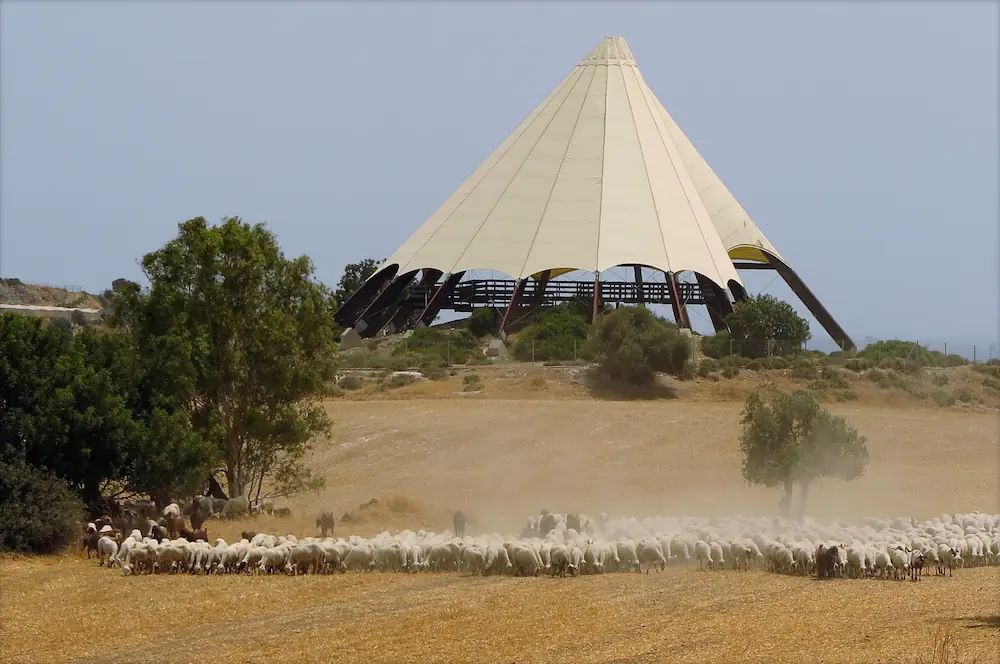
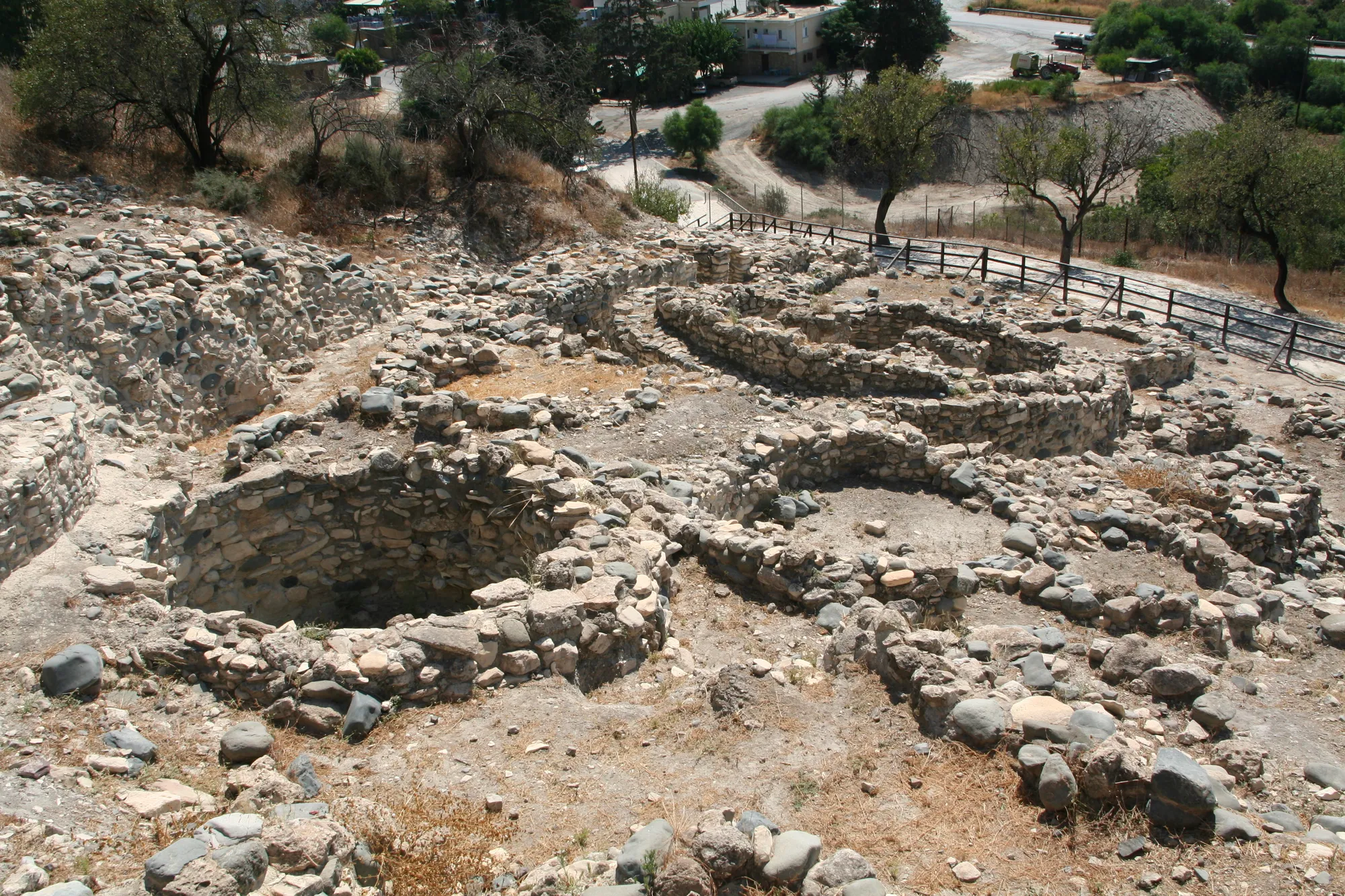
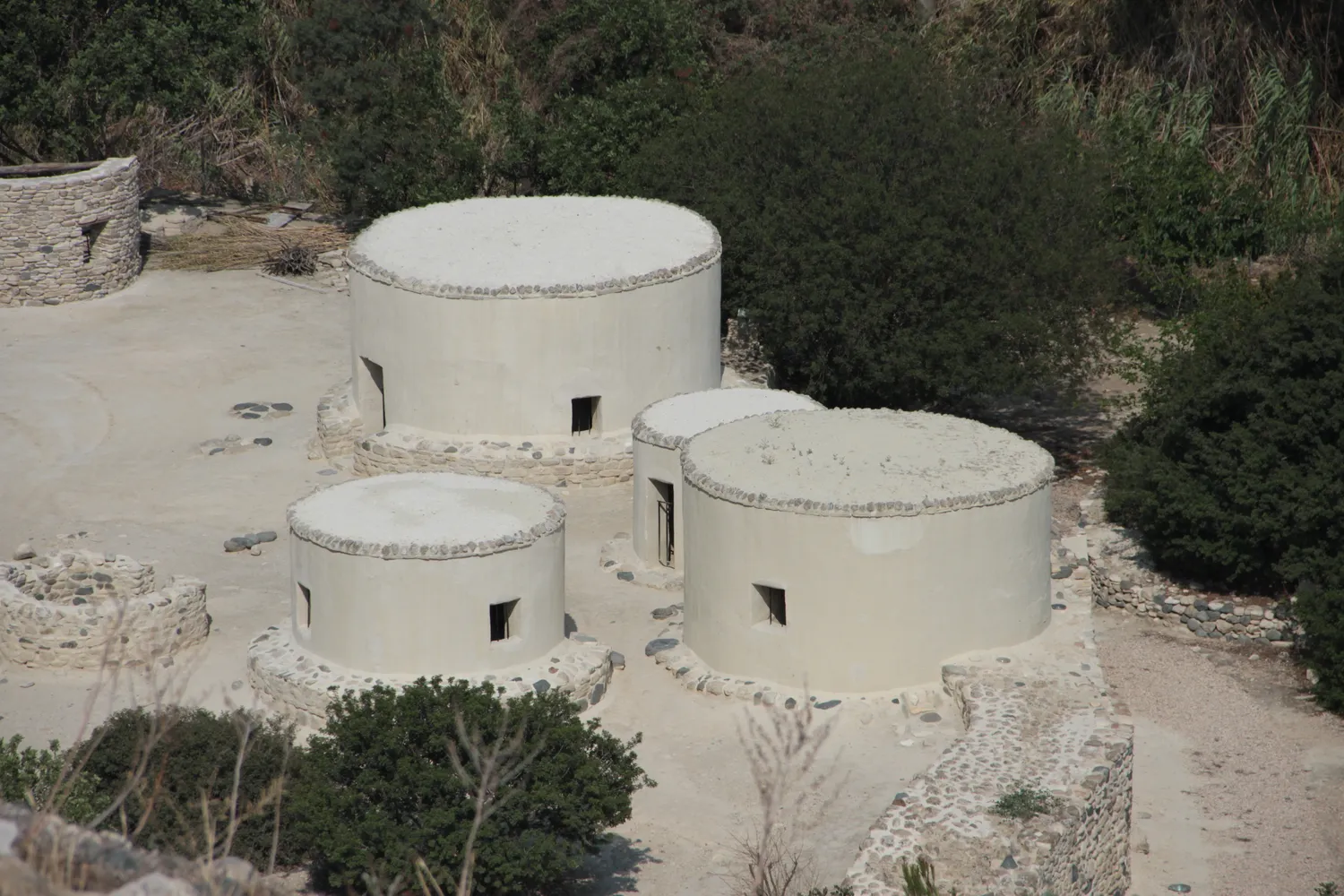
The replica houses at Khirokitia seen from above: round plastered buildings on stone bases with flat earth roofs edged by a rim of pebbles, built in the 1990s from the excavators' evidence after the old picture of domed huts was set aside.

Course · 14 lessons · 3 hr 15 min of reading

Ancient Cypriot Architecture: A Course from the First Villages to the Roman Earthquake

Fourteen lessons on how the people of ancient Cyprus built, from the round houses of Khirokitia to the theatres and mosaic houses of Roman Paphos and Kourion: what the walls and roofs were made of, how to read an excavation plan, and how to tell ancient stone from modern restoration.

quiz questions
103
quiz questions
maps
6
maps
3D models, plans and reconstructions
38
3D models, plans and reconstructions
games to play
1
games to play
references
257
references
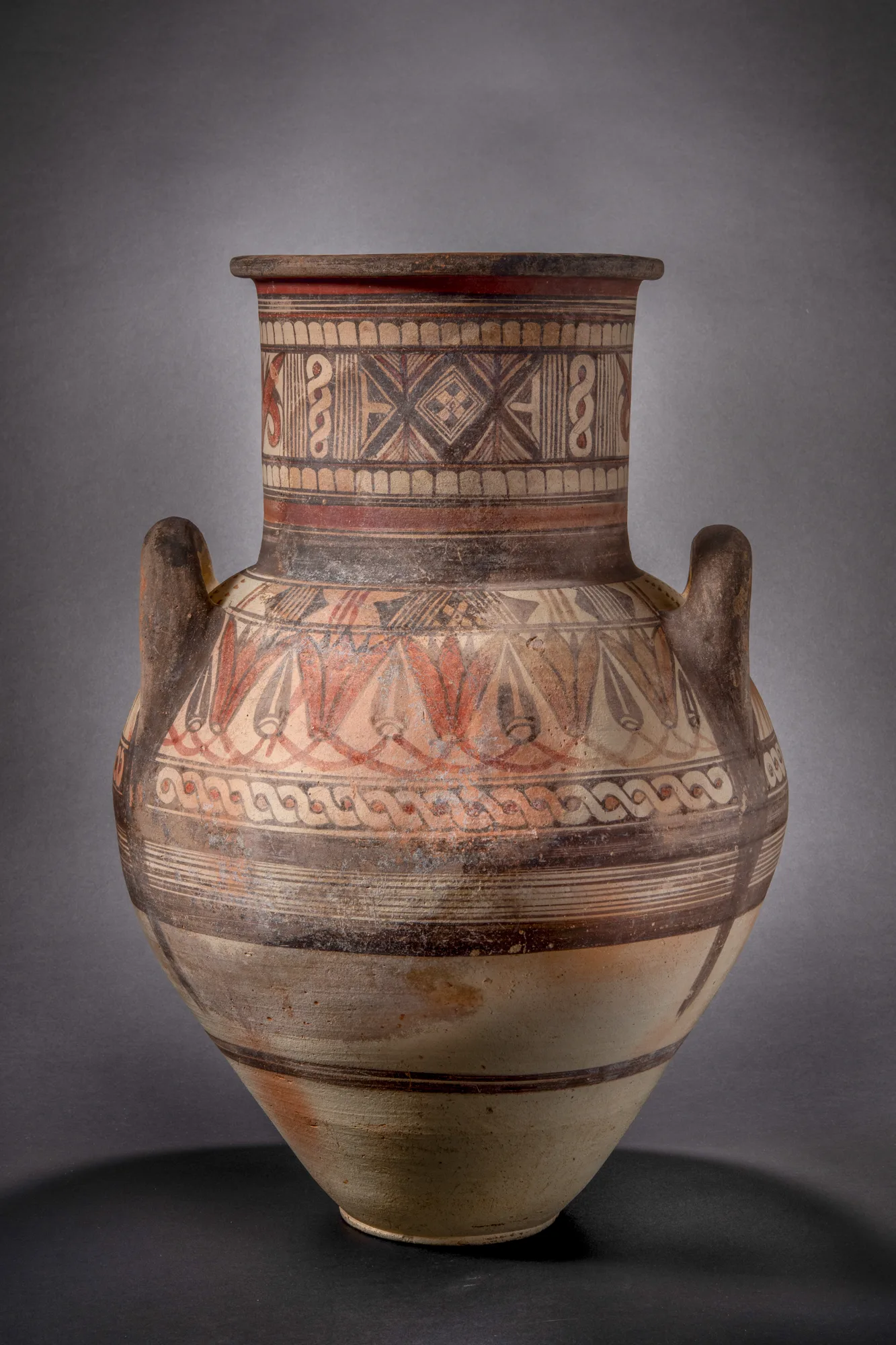
A large two-handled Bichrome IV amphora of the 7th century BC, its pale buff body painted in matt brown-black and brick red, with a frieze of lotus flowers and buds hanging from the shoulder and panels of crosses and spirals on the tall neck.

Course · 15 lessons · 3 hr 30 min of reading

Ancient Cypriot Pottery: A Course from the First Pots to the Classical Kingdoms

Fifteen lessons on reading a Cypriot pot, from Neolithic combed bowls to Hellenistic oil bottles: how each ware was made, how to tell them apart, what the Roman numerals on a museum label mean, and how to date a pot yourself. Illustrated with 112 pieces from the Drakopoulos collection and 44 from museums.

quiz questions
117
quiz questions
hands-on drawings and labs
32
hands-on drawings and labs
maps
11
maps
3D models, plans and reconstructions
3
3D models, plans and reconstructions
games to play
13
games to play
references
279
references

Using it

Reading, citing and reusing the compendium

Reuse

The compendium is free to read. Its text may be reused for personal, educational or research purposes, with attribution to us, the page’s address and the date you read it, as our terms set out. The site is non-commercial.

Photographs of objects in museum collections name the museum and its number in their captions and on the object’s page in the catalogue; keep that credit with any reuse.

How to cite an entry

“White Slip Ware”, Compendium, Ancient Cyprus, https://www.ancientcyprus.com/compendium/pottery/types/white-slip-ware, accessed [date].

To cite a statement, cite the publication the entry gives for it: the reference beside the statement names the work and the page.

Owners and collectors

Own a Cypriot antiquity like one an entry describes, or inherited a collection? Get in touch: our advice is confidential, unless the law requires us to share it. Our guide what to do with Cypriot antiquities is a place to start, and the antiquities trade section sets out the law and its history.

What comes next

What comes next

The compendium is growing towards a complete encyclopedia of ancient Cyprus. The next subjects we plan to cover:

New sections and entries

  • Religion and sanctuariesthe great sanctuaries, votive practice, and myth set against the evidence
  • Writing and languageCypro-Minoan, the Cypriot syllabary, Eteocypriot, Phoenician in Cyprus and the key inscriptions
  • The city-kingdomsa page for each kingdom and what is known of its kings
  • Economy, coinage and tradeoxhide ingots, weights and measures, the Cypriot mints, the trade routes
  • Landmark objectsa page for each of the island's most famous pieces
  • Myth and ancient textsCyprus in Homer and the epic cycle, the foundation legends, Alashiya in the Amarna letters
  • People and the landhealth and diet from the bones, farming and animals, the industries of perfume, oil, wine and salt, shipwrecks
  • The Hellenistic and Roman islandin more depth, to the end of the Roman period

Courses

  • A final test for the pottery courseidentify ten pots drawn from the catalogue
  • A printable field card for each lessonthe lesson's essentials on one sheet
  • More coursesburial and the afterlife; figurines and sculpture; copper and the kingdoms; ships and the sea; collecting, provenance and the law; writing and languages

Have photographs, a publication or a correction for an entry? Tell us.