
Contents
Cypriot limestone sculpture was painted. The soft white stone that sculptors at Golgoi, Idalion and Kition carved into votaries, heads and incense stands was finished with red, black and yellow, and on some pieces with green and blue [1, p. 155; 2, p. 530]. Very little of that colour survives. Most heads now in museums and private collections are bare stone, and what remains on the rest is usually a trace of red on the lips or a smear of black in the hair. This entry collects what the published evidence says about that lost surface: which colours were used and where, how they were put on, what the one systematic pigment study of Cypro-Archaic limestone heads found in the laboratory, and how a royal monument such as the Amathus sarcophagus differs from ordinary votives [2, p. 543]. It is a companion to the main entry on Archaic limestone statues, which covers the sculpture itself, its workshops and its stone.
Colour Was Normal, and It Rarely Survives
Derek Counts, in his 2001 survey of Cypriot sculpture studies, credits Myres as "among the first to underline the importance of paint in Cypriote sculpture", and states the working assumption plainly: "As is the case with Greek stone statuary, we should assume colored surface decoration" [1, p. 155]. The difficulty is preservation. In Counts's words, "the archaeological record does not always convey the extent of polychrome decoration", so the better preserved painted terracottas, "as well as the occasional limestone example", have to stand as reminders of what the stone once looked like [1, p. 155].
Some of what was once seen has since gone. Vassos Karageorghis, cataloguing the Cesnola collection at the Metropolitan Museum in 2000, notes of a large statue from Golgoi (Met 74.51.2460) that traces of red paint "once were present on both the drapery and the lips": the colour was recorded, and is no longer there to see [3, p. 110].
Excavated evidence comes from Palaepaphos. When the Persian army attacked the city in 498 BC, its troops took statues and votive monuments from a sanctuary outside the walls and built them into a siege ramp at the Northeast Gate. Excavators working there since 1951 have recovered over 1000 limestone objects from this siege mound, and F. G. Maier and Vassos Karageorghis report that "on a number of fragments traces of the original red, blue and black paint were still preserved" [4, p. 186]. That observation was made by eye. No pigment analysis is reported for it. It and Counts's list below are the only statements of blue on ordinary Cypriot limestone sculpture. The context links this group to the Persian campaigns described under Achaemenid Persia.
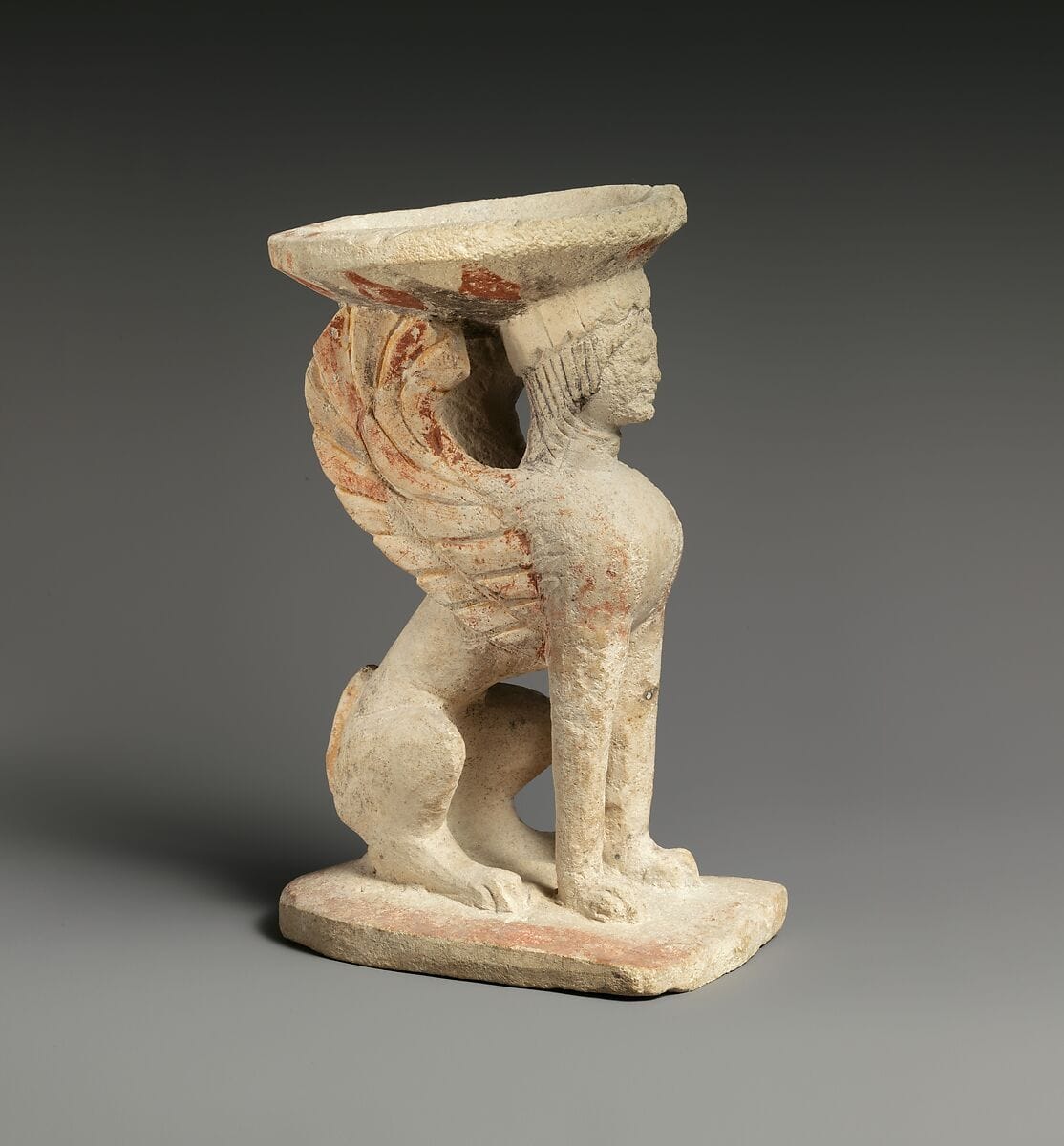
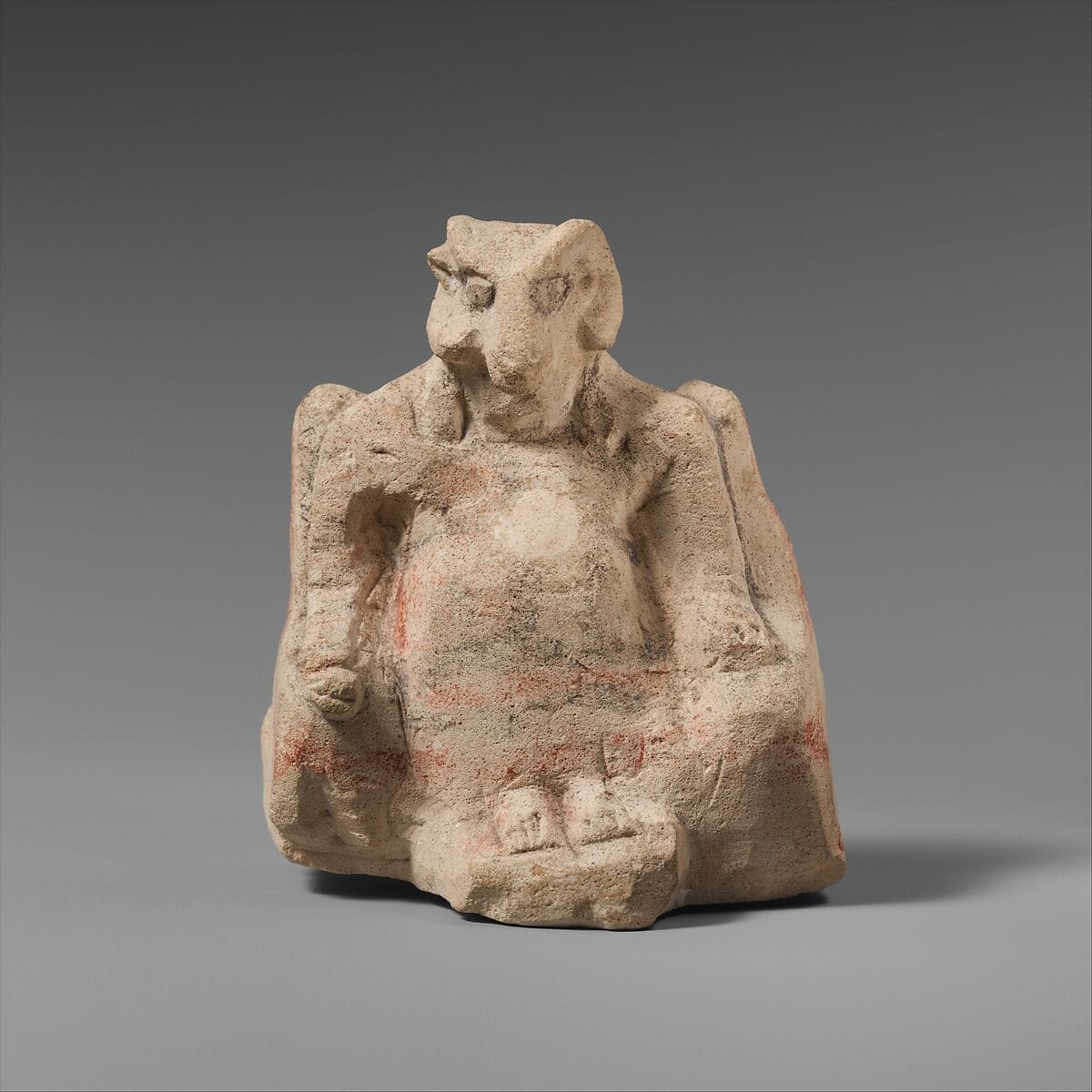
A limestone incense burner held up by a seated sphinx, from a tomb at Kythrea, early 5th century BC (Met 74.51.2814). The Met's catalogue text records "abundant traces of red, yellow, and black pigment" on it.
The incense burner shown here is a good example of colour that did survive. It is a small piece (22.9 cm high) from a tomb at Kythrea, dated by the Metropolitan Museum to the first half of the 5th century BC, and its catalogue entry records red, yellow and black pigment still visible (/artifact/1546). The same entry opens with a broader claim: "Like all ancient stone sculpture, the work was brightly colored." How much of a Cypriot statue was covered, and with what, is a separate question, taken up below.
Where the Paint Went
Counts gives the clearest summary of which colours were used on Cypriot sculpture and for what. The colours "included: red (e.g., lips, eyes, hair, clothing borders and patterns, some accessories), black (e.g., hair and beard), yellow (e.g., gold and bronze objects/attributes), and blue (e.g. textiles, leather, and silver objects/attributes)" [1, p. 155]. Colour, on this reading, was a code for materials as well as for anatomy: yellow for metal that shone gold, blue for silver and for dyed cloth and leather.
The laboratory record agrees for the colours it found. Gasanova and colleagues recorded by eye, before any instrumental work, where colour survived on seven heads in the Bank of Cyprus Cultural Foundation, Nicosia [2, pp. 529–530]. Red appeared on lips, hair, eyes and pupils, nostrils, the string of a wreath, a garment near the neck, a sakkos, earrings, and in one case an "arrow at the middle of the forehead". Green was on wreaths and wreath leaves. Yellow was on the centre of a flower and on the pupils of one head (G.C.349). A large terracotta head from Idalion (G.C.242), included in the study for comparison, had black on the eyes, eye contours, eyebrows and hair, and red over the whole face [2, p. 530]. On one limestone head (G.C.454) yellow had been laid over red at the centres of the earrings, "perhaps, to attain a reddish hue to imitate jewellery" [2, p. 541].
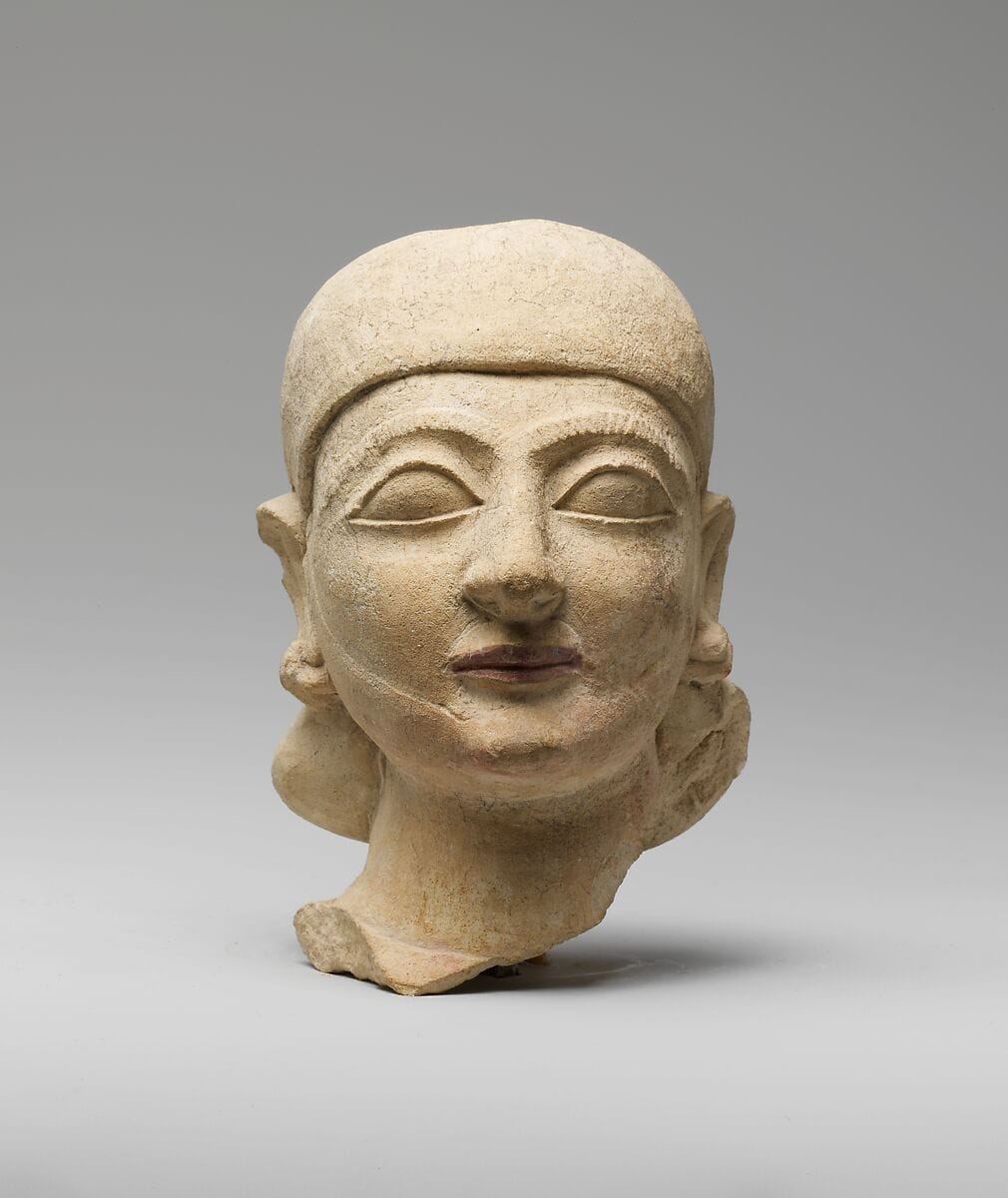
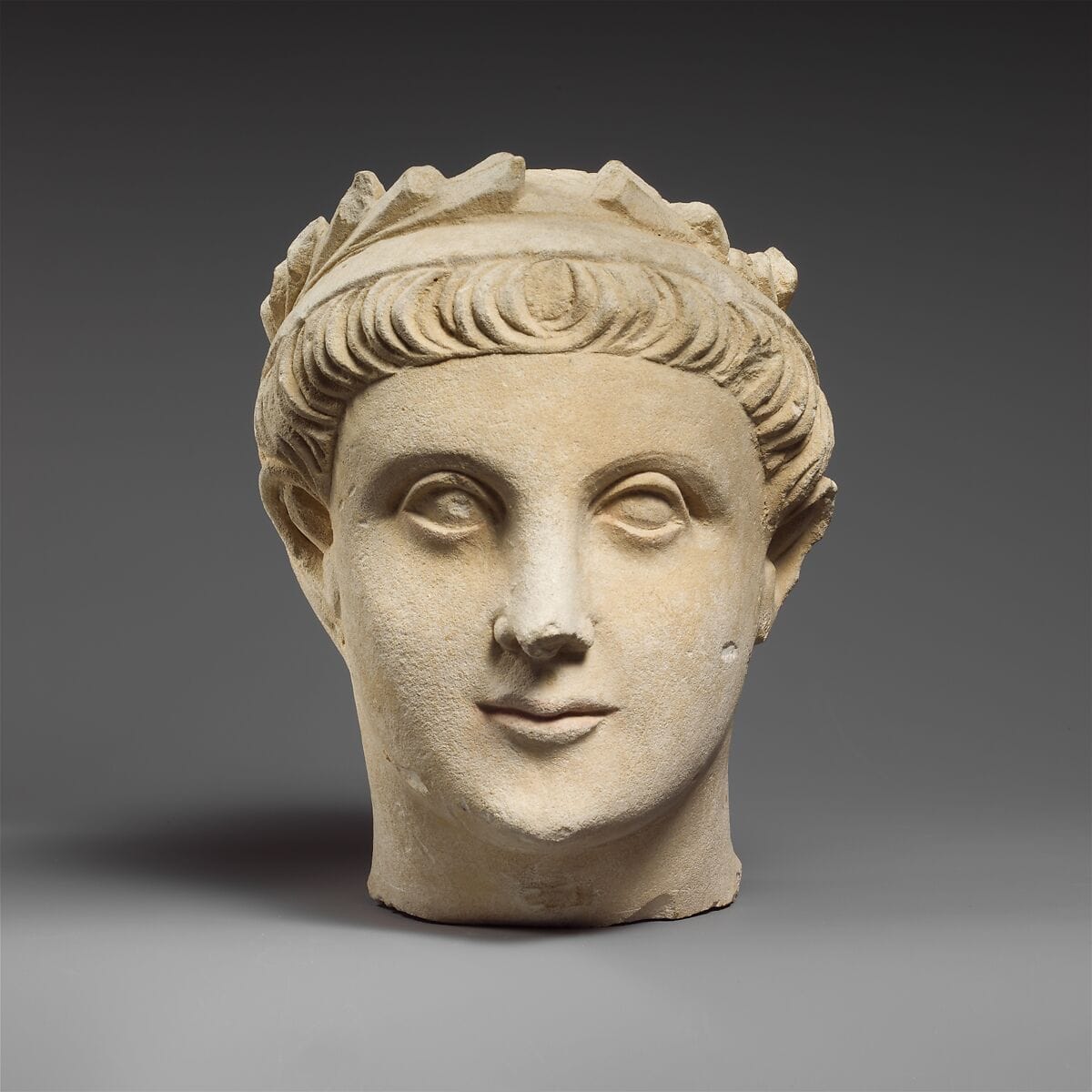
Museum records repeat the pattern of red on the mouth and dark colour in the hair. The British Museum's votary head from Kition-Bamboula (BM 1880,0710.48, 500–475 BC) keeps "traces of red on lips and black on hair". The colossal head in a lion skin from the Sanctuary of Apollo at Idalion (BM 1873,0320.7, 475–450 BC) has "traces of red paint". Karageorghis records red on the drapery of a Golgoi votary in a pointed cap of the end of the 6th century BC (Met 74.51.2599) [3, p. 122]. At the Met, the lips of a limestone head of a man with a plain headdress and of a wreathed youth still carry red, according to the museum's catalogue text, and a statuette of Zeus Ammon of 575–550 BC keeps traces of red and black.
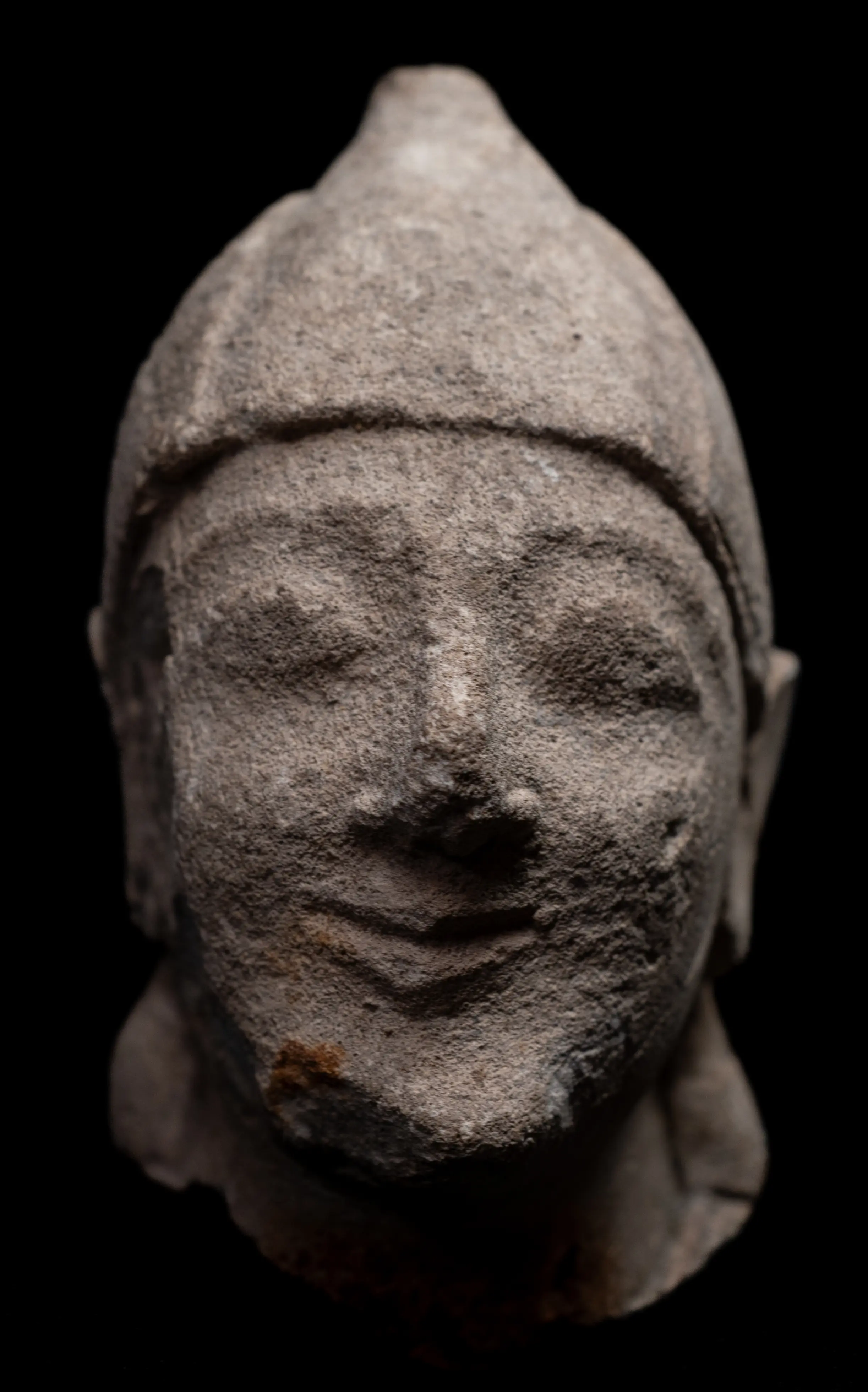
A smiling male votive head in a pointed cap, about 10 cm high, formerly in the Chevallier–Verel collection in Paris before 1969 (Archaic limestone head, Drakopoulos collection). Today it is bare stone.
The small head from the Drakopoulos collection illustrated here is the common case. It is a Cypro-Archaic male head, about 10 cm high, smiling, wearing a pointed cap with a raised rim over the brow and flaps over the ears. No paint can be confirmed on it. There is one small rust-orange patch at the chin and lower left jaw, visible from the front and in profile, but it does not follow the lips, the eyes or the hair, where painters put their red and black, and it looks like iron staining from burial rather than pigment. The cap type is the one worn by the Kition-Bamboula head BM 1880,0710.47 (c. 550 BC), whose record notes "traces of red paint", and by the Golgoi votary Met 74.51.2599 cited above, with red on its drapery. Heads of the same type, then, were painted, and most of them have lost it.
Paint in Place of Carving
Colour could also stand in for carving. Counts argues that "colored decoration could also replace relief versions, perhaps reducing the labor and hence lowering the price" [1, p. 155]. Following Pryce, he suggests that the plain diadems or "frontlets" that elsewhere carry rosettes in relief "probably had painted rosettes instead", and that "the same case should be made" for the so-called Cypriote shorts, which are sometimes plain and sometimes carved with rosettes. His conclusion is that "the majority of diadems and Cypriote shorts originally had rosettes, some sculpted, some painted" [1, pp. 155–156].
The flute players give a concrete case. Their mouth band (phorbeia) could be carved in relief or simply painted. Karageorghis notes this alternative for the Golgoi flute player Met 74.51.2508, of the first half of the 6th century BC, whose phorbeia "has traces of red paint" [3, p. 132]. A plain surface on a Cypriot votive, then, is not proof that the area was plain in antiquity. A cheap statue may have had in paint what an expensive one had in relief. For the sculptors' workshop practice more broadly, see "The Craft of the Cypriot Sculptor" in the entry on Archaic limestone statues.
How the Colour Was Applied
Counts identifies two methods. "Certain statues received a limewash coating (as is the case for Attic poros sculpture such as that found on the archaic Acropolis in Athens), while others were painted directly on the surface" [1, p. 155]. The colours were then "interchanged and combined for elaboration". Counts gives this as a descriptive observation with an Athenian comparison. It does not rest on laboratory analysis of Cypriot pieces.
The Gasanova study tested the question of a white ground on its own sample and found a narrower picture. White was detected only on the terracotta head, where it was read as a preparation layer of calcium carbonate, "but not gypsum ... or anhydrite" (no sulphur was present). Because calcium carbonate decomposes at around 600 °C, its presence on fired clay "suggests unfired decoration": the colour was put on after firing [2, p. 543]. On the limestone heads, no lead lines appeared at the other colour spots, which rules out lead white as a preparation layer on the tested pieces [2, p. 541]. The published results do not say whether any of the limestone heads had a limewash of the kind Counts describes.
What the Laboratory Found: Gasanova et al. 2017
The one systematic pigment study of Cypro-Archaic limestone heads is by Gasanova, Pagès-Camagna, Andrioti, Lemasson, Brunel, Doublet and Hermon, published in Archaeometry in 2017. The authors describe it as "one of the first systematic studies of the ancient pigment palette on Cypro-Archaic statues" [2, p. 543]. It was carried out by the C2RMF laboratory in Paris with The Cyprus Institute [2, p. 528].
The sample was seven heads, two female and five male, of the 6th and 5th centuries BC, displayed at the Bank of Cyprus Cultural Foundation Museum in Nicosia [2, p. 529]. The limestone heads come from the Demetrios Pierides collection, "collected more than a century ago" and given to the Foundation in 1999; the history of that family collection is told in The Savant of Larnaca. The one terracotta, a large head from Idalion, served as a comparison [2, p. 530]. The selection was not random: "All items of this collection bearing traces of green colour were analysed" [2, p. 529]. The paper is not fully consistent about its sample: Table 1 lists seven heads, the conclusions speak of "the six studied objects", and the section on red pigments cites a head (G.C.449) that does not appear in the table [2, pp. 530, 540–541, 543].
The method was layered: non-invasive techniques first (ultraviolet imaging, visible-induced luminescence or VIL, fibre-optic reflectance spectroscopy, X-ray fluorescence, digital microscopy), then micro-samples where needed [2, p. 529]. The results were consistent across the heads.
| Colour | Pigment identified | Where it was used | Source |
|---|---|---|---|
| Red | Iron red: pure hematite; hematite with a silica compound; red earth on one head | Lips, hair, eyes and pupils, nostrils, wreath strings, sakkos, earrings, garment at neck | Gasanova et al. 2017, pp. 530, 540–541 |
| Yellow | Iron yellow (clay-rich yellow earth); orpiment and jarosite excluded | Centre of a flower, pupils (G.C.349), over red on earrings (G.C.454) | Gasanova et al. 2017, pp. 530, 541 |
| Green | Green earth (celadonite), with fossil coccoliths | Wreaths and wreath leaves | Gasanova et al. 2017, pp. 530, 541, 543 |
| Black | Iron-manganese black (terracotta head) | Eyes, eye contours, eyebrows, hair | Gasanova et al. 2017, pp. 530, 543 |
| White | Calcium carbonate ground, not gypsum (terracotta head only) | Preparation layer | Gasanova et al. 2017, p. 543 |
| Blue, royal monument | Azurite with a paler Egyptian blue | Amathus sarcophagus: architecture, horses; bands, ground-lines, chariots | Brecoulaki 2014, after Hendrix 2001 |
| Blue, seen by eye | Not analysed | Fragments from the Palaepaphos siege mound | Maier and Karageorghis 1984 |
Every red was an iron red. Three heads had pure hematite, two had hematite mixed with a silica compound, and one had a red earth containing silicon and aluminium. Lead white, lead yellow and red lead were all excluded as additions; the small amount of lead detected is taken as a natural impurity of local hematite [2, pp. 540–541]. The yellow was an iron yellow, a clay-rich yellow earth, with orpiment and the jarosite minerals ruled out [2, p. 541]. The green was made of very fine iron-bearing particles (under 1 µm), a "green earth" [2, p. 541]. The black on the terracotta head was an iron-manganese black [2, p. 543].
Two negative results matter most. No luminescence appeared under VIL and no pink-orange fluorescence under ultraviolet, "thus excluding the use of Egyptian blue or madder dye" on the heads studied [2, p. 540]. A single deep-blue crystal about 10 µm across was found on G.C.454, but it did not luminesce as Egyptian blue does, and the authors treat it as possible contamination [2, p. 541]. And "no copper-containing compounds were detected ... despite the wide availability of copper minerals in Cyprus" [2, p. 543]. On these votive heads, the island's copper did not go into the paint box.
The authors argue for local sources. The green earth is celadonite, and the shape of its crystals and the "fossilized micro-organisms, cocoliths" in it point to a Cypriot origin. The lead traces found both in Cypriot geological iron reds and in the red paint on the statues are, in their words, "a strong argument" for local sourcing [2, p. 543]. Their geological reference samples came from the Skouriotissa and Kokkinopezoulas mines and from the Geological Survey of Cyprus [2, p. 530]. The conclusion is that "the paints on all of the tested sculptures are made of pigments that might have been sourced locally on the island" [2, p. 543], the same local sourcing as the limestone and clay the heads were made from.
The study's methods were elemental and mineralogical. It did not look for the organic binder that held the pigments to the stone.
The Royal Exception: The Amathus Sarcophagus
The picture changes at the top of the social scale. The limestone sarcophagus from Amathus in the Metropolitan Museum (Met 74.51.2453) is a hard-limestone chest of the second quarter of the 5th century BC from the Cesnola collection, 157.5 cm high, 228.6 cm long and 109.2 cm wide, weighing 1227 kg. Karageorghis writes that "its polychrome decoration give[s] this work a particular place in the repertoire of Cypriot sculpture of the fifth century B.C.", and that "much additional polychromy came to light during conservation at the Metropolitan Museum in 1999". He considers that it may have been made for a king of the city [3, p. 201].
Its blues are unlike anything found on the votive heads. Brecoulaki, reviewing "precious colours" in Greek painting and drawing on Hendrix's 2001 study of the sarcophagus in the Metropolitan Museum Journal, writes that "the most extensive use of azurite in the late Archaic period is on the famous Amathus Sarcophagus" [5, p. 16]. Azurite was used for architectural elements and for figure details, "in particular on the horses". Alongside it the painters used "a paler hue of Egyptian blue" for "the vertical bands and the horizontal ground-lines beneath the scenes, and other details, mainly on the chariots" [5, p. 16]. Brecoulaki calls the use of two blues together "very unusual in ancient Greek polychromy" and suggests azurite may have been chosen because of "high-quality deposits of this mineral on Cyprus" [5, p. 16]. She also notes that blue turning to green is attested on the sarcophagus [5, p. 9].
So the sarcophagus carries two blues, azurite and Egyptian blue, where the Gasanova heads have none, and Egyptian blue is the pigment that imaging ruled out on those heads [2, p. 540]. The sarcophagus dates to the second quarter of the 5th century BC, early in the Cypro-Classical period, and was made for the court of a city-kingdom if Karageorghis's suggestion of a royal owner is right [3, p. 201].
Two Palettes? A Reading of the Evidence
Setting these results side by side suggests a pattern, though no source we know of draws this conclusion directly.
On one side are the ordinary votive heads of the Cypro-Archaic period, painted with local earths: iron reds and yellows, a green earth, an iron-manganese black, with no copper pigment and no Egyptian blue [2, pp. 540–543]. On the other is a royal monument painted with azurite and Egyptian blue, two of the "precious colours" of Brecoulaki's title [5, p. 16]. That would fit a two-tier palette: local earth colours for the mass of dedications, and costly blues for royal monuments.
The evidence for this is thin in both directions. The laboratory sample is seven heads from one collection, chosen because they had green on them, and it is not a random cross-section of Cypriot votives [2, p. 529]. Maier and Karageorghis saw blue by eye on siege-mound fragments at Palaepaphos [4, p. 186], and Counts lists blue among the ordinary colours of Cypriot sculpture, for textiles, leather and silver [1, p. 155]. Neither was tested for what that blue was made of. If those blues turn out to be azurite or Egyptian blue on ordinary votives, the two-tier reading fails; if they turn out to be something else, or not blue at all, it gains support. Until then it is a hypothesis.
A second open question is how much of a statue was painted. The Met's text for the Kythrea incense burner speaks of stone sculpture that "was brightly colored". Counts's evidence points more toward selective painting: lips, eyes, hair, borders, jewellery and attributes, painted rosettes standing in for carved ones, some statues on a limewash and others painted directly [1, pp. 155–156]. The Gasanova heads show colour on the same features, not across the whole face, except on the terracotta head, which was red all over [2, p. 530]. We know of no source that argues explicitly that Cypriot limestone statues were painted over their entire surface.
What Remains to Be Tested
Three gaps stand out. We know of no published analysis of the binder used on Cypriot limestone sculpture; the Gasanova study was not designed to detect one. Nor do we know of a painted reconstruction of a Cypriot limestone statue. Counts mentions only a reconstruction of Phrasikleia, a Greek statue, as an analogy for how much colour a statue could carry [1, p. 155]. And the blue on ordinary votives remains unidentified: seen at Palaepaphos, listed by Counts, absent from the only tested sample.
Any head that keeps its paint, whether in a museum or a private collection, adds to a very small body of evidence, and one useful next step would be instrumental analysis of the red and black already recorded on museum heads such as those from Kition-Bamboula and Golgoi. The bare head in the Drakopoulos collection is the more typical survivor: a surface that was probably painted in part, with nothing left to test.
Objects on this page
References
- 1.Counts, D. B. (2001). Prolegomena to the study of Cypriote sculpture. Cahiers du Centre d'Études Chypriotes, 31, 129–181. https://doi.org/10.3406/cchyp.2001.1388 (open access: https://www.persee.fr/doc/cchyp_0761-8271_2001_num_31_1_1388)
- 2.Gasanova, S., Pagès-Camagna, S., Andrioti, M., Lemasson, Q., Brunel, L., Doublet, C., & Hermon, S. (2017). Polychromy analysis on Cypriot Archaic statues by non- and micro-invasive analytical techniques. Archaeometry, 59(3), 528–546. https://doi.org/10.1111/arcm.12257
- 3.Karageorghis, V., Mertens, J. R., & Rose, M. E. (2000). Ancient art from Cyprus: The Cesnola collection in The Metropolitan Museum of Art. The Metropolitan Museum of Art.
- 4.Maier, F. G., & Karageorghis, V. (1984). Paphos: History and archaeology. A. G. Leventis Foundation.
- 5.Brecoulaki, H. (2014). "Precious colours" in ancient Greek polychromy and painting: Material aspects and symbolic values. Revue archéologique, 2014(1). https://doi.org/10.3917/arch.141.0003