
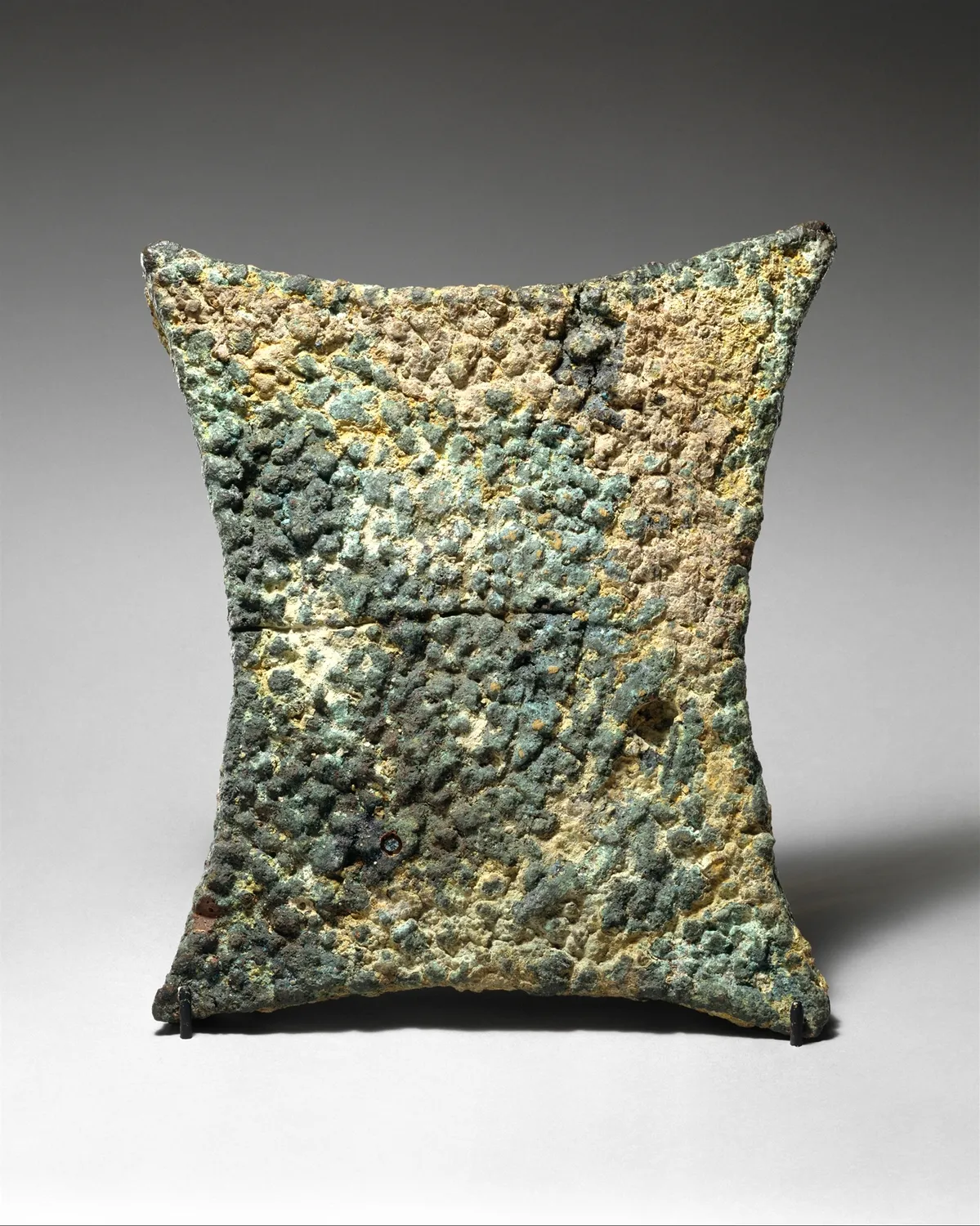
The nearest mainland to Cyprus is the Syrian coast, visible from the Karpass on a clear day, and the nearest great city of the Bronze Age was Ugarit, the kingdom whose capital lies under the tell of Ras Shamra north of modern Latakia, roughly 100 km from the island's eastern tip. No relationship in the island's Bronze Age is better documented. Ugarit's archives name Alashiya, its king and its governor in letters that pass between near-equals; its port at Minet el-Beida holds more Cypriot pottery than any site outside Cyprus; tablets written in the island's own undeciphered script were found in the houses of its merchants; and the last letters exchanged before the city burned around 1185 BCE are about enemy ships sighted off both coasts. The wider Levant, from Byblos and Sidon south to Tell el-Ajjul, supplied Cyprus with cylinder seals, ivories, Canaanite jars and the idea of the warrior burial, and took in return the Base Ring juglets and White Slip bowls that occur at virtually every Late Bronze site on the coast. This entry follows the traffic in both directions from the Middle Bronze Age to the collapse, and then to the Iron Age question of whether the island's Black-on-Red ware was a Syro-Anatolian import or a Cypriot invention.
Ugarit: a kingdom across the water
Ugarit was a coastal kingdom of perhaps 2,000 square kilometres, its capital a walled city of some 20 hectares with a royal palace of about ninety rooms, temples of Baal and Dagan on the acropolis, and a residential quarter of substantial merchant houses [1]. Its harbour town, Minet el-Beida (ancient Ma'hadu), lay a kilometre away on a sheltered bay, and a second port with a royal residence stood at Ras Ibn Hani. Claude Schaeffer began excavating in 1929 after a farmer's plough struck a tomb at Minet el-Beida, and the tablets that emerged from the palace and the private archives, in Akkadian, Ugaritic, Hurrian, Hittite and other languages, made the site the best-documented city of the Late Bronze Levant [1]. Yon's synthesis of the city and Knapp's 2024 monograph on its Cypriot connection, reviewed on this site, are the two starting points; Knapp is candid that Schaeffer's early seasons recorded context and quantity so poorly that ware frequencies at Ugarit can never be fully reconstructed [2].
Ugarit was a vassal of the Hittite king from the fourteenth century, obliged to supply troops and ships, but its wealth came from trade, run by elite families whose houses on the tell held both the goods and the correspondence: Rap'anu, Yabninu, Rashap-abu and, latest and richest, Urtenu, whose archive was found in the 1990s and 2000s and holds the bulk of the Cypriot texts [2]. The city fell early in the twelfth century, within the same horizon of destruction that ended the Hittite Empire and disrupted the Cypriot coastal towns; see the Late Bronze Age chronology entry and the leaf on the Hittite Empire.
Middle Bronze Age beginnings
The earliest indisputable references to Alashiya are Levantine and Mesopotamian, not Egyptian, and they are about metal. Tablets from Mari on the Euphrates in the reign of Shamshi-Adad I (c. 1813-1781 BCE) and after record imported Alashiyan copper and bronze, one distinguishing "copper," "mountain copper" and "refined, quality copper," another recording 34 2/3 minas of Alashiyan bronze as a 7:1 alloy; a Babylonian text of about 1743 lists twelve minas of purified Alashiyan copper; and at Alalakh on the Orontes, Alashiya appears in a silver record and Alashiyans in grain-distribution lists [3, pp. 17-20]. These notices coincide with the first Levantine imports at the southeast-Cypriot sites nearest the copper.
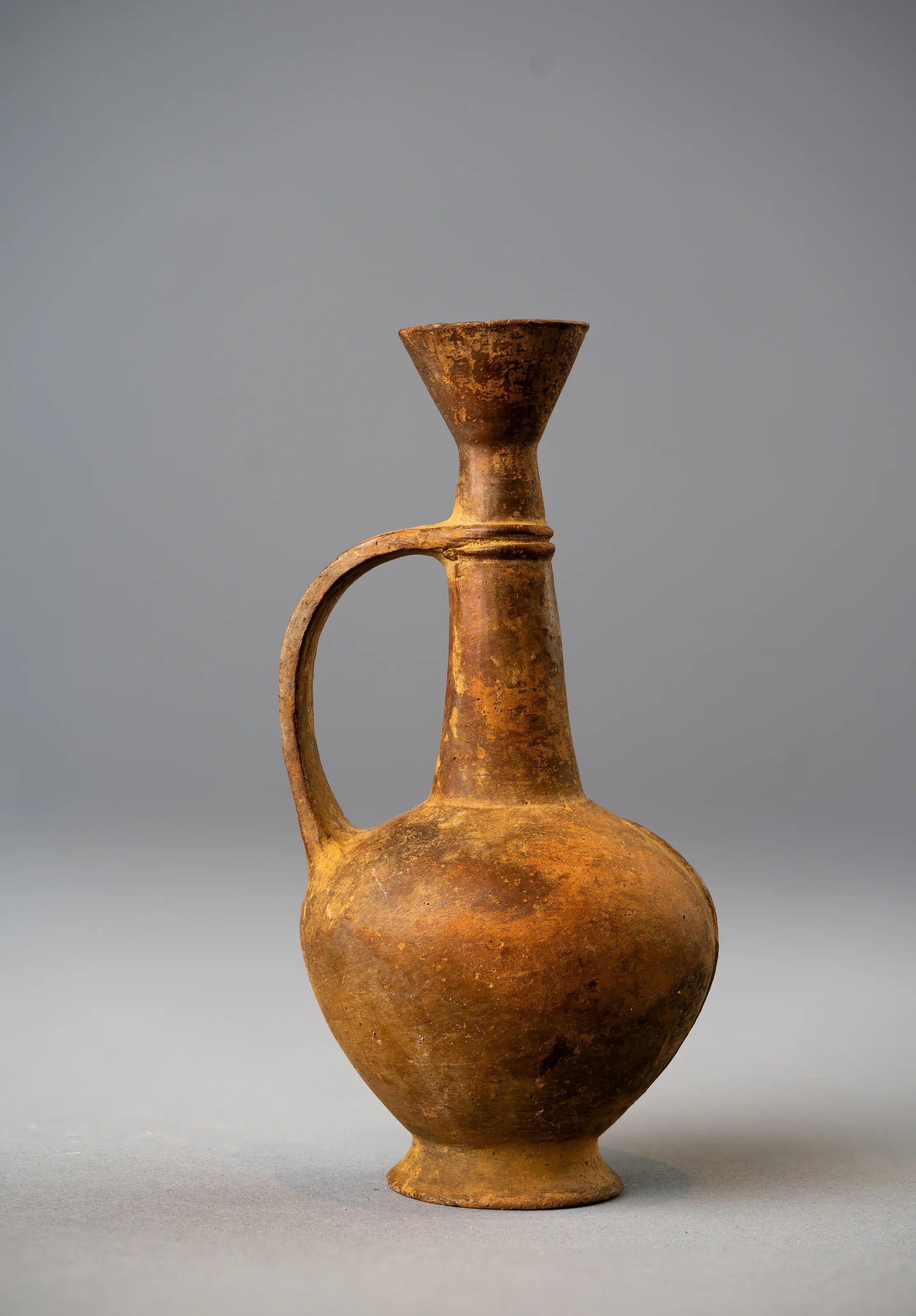
The Levant of the period was a mosaic of fortified city-states, Byblos, Ugarit, Tell Arqa, Sidon and Tyre on the coast, Hazor, Megiddo, Lachish and Tell el-Ajjul inland and to the south, sharing a recognisable material koine: red-burnished and black-burnished juglets, the standardised transport amphora that archaeology calls the Canaanite jar, duckbill and fenestrated axes, scarabs and cylinder seals. Cyprus reached this world with small handmade White Painted jugs and juglets of the Pendent Line and Cross Line styles, products of the east of the island around Kalopsidha. The largest concentration is in the tombs of Tell Arqa in the Lebanese Akkar plain, with more than a hundred vessels; others come from Sidon, Byblos, Sarepta, Tyre, Megiddo and the Rishon le-Zion cemetery, and the style straddles Middle Cypriot III and Late Cypriot IA rather than ending earlier, as Åström established and Merrillees repeatedly insisted [4]. A White Painted jug in the Drakopoulos collection shows the class: a narrow-necked container for a small quantity of something valued, whose contents have never been scientifically identified. The White Painted ware and Middle Bronze Age entries treat the setting.
The return traffic is visible in Cypriot tombs of Middle Cypriot III to Late Cypriot I: Syrian red and black burnished juglets, Tell el-Yahudiyeh ware from the Delta or the Levant, whose island distribution shadows the copper route through the eastern Mesaoria to Enkomi, and a package of Levantine "warrior burial" equipment, notched and socketed axes, belts, maceheads and equid burials, at Politiko, Kalopsidha and Lapithos, which Steel reads as the appropriation of a Near Eastern status ideology by the island's emerging elites [2]. The first stratified cylinder seals on Cyprus belong to Late Cypriot IA, and locally made seals appear in Late Cypriot I contexts at Toumba tou Skourou and Ayia Irini.
The texts: Alashiya in the Ugarit archives
The Ugaritic dossier on Alashiya, assembled in full by Knapp, runs from the fourteenth century to the final days of the city [2]. At the top it is royal. In RS 94.2475 King Kushmeshusha of Alashiya sends thirty-three copper ingots, together about thirty talents or a little under a tonne, to Niqmaddu III of Ugarit as a shulmanu, a greeting gift, in the late thirteenth century, and addresses him as "my son"; in RS 20.168 and RS 20.238 the king of Ugarit calls his Alashiyan counterpart "father," a usage read either as hierarchy or as diplomatic kinship [2, pp. 63-64]. The governor of Alashiya, the rabisu (Eshuwara, Shinash, Shangiwa are named), corresponds directly with Ugarit as he does with Egypt in Amarna letter EA 40 [2, p. 63]. Commerce fills the middle: 660 measures of oil for "Abrm the Alashiyan" (RS 18.42), a ship from Alashiya docking with copper (RS 18.119), Alashiyan copper transhipped inland to Emar on the Euphrates (RS 34.153), the possible sale of ships by the Ugaritic harbourmaster to an Alashiyan merchant subject to royal approval, and a letter (RS 94.2561) asking the prefect Uzzinu to stop taxing Cypriot merchants on arrival [2, pp. 65-66].
The texts also show people, not only goods. A list (RS 11.857) records twenty-nine men with their families tagged as from Alashiya; ration and census texts place Cypriots in crafts, administration and cult at Ugarit; a scribe from Ugarit stationed at the Alashiyan court writes home for furniture (RS 94.2177+2491); a letter of accreditation seeks the release of Cypriots detained at Ugarit; two disgraced sons of a Ugaritic queen were exiled to the island; and a Hurrian ritual text in Ugaritic script (RS 24.274) lists offerings to "the father, god of Alashiya" [2, p. 66]. Two Akkadian legal tablets (RS 17.36 and 17.149) bear impressions of Cypriot-style cylinder seals, and four clay tablets and two labels in Cypro-Minoan were found in the houses of Yabninu, Rashap-abu and Urtenu, made in Ugarit for use in Ugarit, perhaps by scribes trained in both traditions [2, p. 66; 3]. The languages of Bronze Age Cyprus are discussed elsewhere on this site; Ugarit is the only place outside the island with confirmed Cypro-Minoan tablets.
| Text | Content | Date |
|---|---|---|
| RS 94.2475 | Kushmeshusha of Alashiya sends 33 copper ingots to Niqmaddu III as a greeting gift | late 13th century BCE |
| RS 18.42 | 660 measures of oil for Abrm the Alashiyan | 13th century BCE |
| RS 34.153 | Alashiyan copper transhipped from Ugarit to Emar | 13th century BCE |
| RS 94.2561 | Request that Cypriot merchants not be taxed on arrival at Ugarit | 13th century BCE |
| RS 17.36, RS 17.149 | Legal tablets sealed with Cypriot-style cylinder seals | 13th century BCE |
| RS 24.274 | Hurrian offering list naming the god of Alashiya | 13th century BCE |
| RSL 1 | King of Alashiya warns Ammurapi of enemy ships; clay is Cypriot | c. 1190 BCE |
| RS 20.238 | Ugarit replies: seven enemy ships have already burned its towns | c. 1190 BCE |
| RS 20.18 | Eshuwara, senior prefect of Alashiya, reports twenty enemy ships | c. 1190 BCE |
The final cluster is the famous one. RSL 1, a letter to Ammurapi, the last king of Ugarit, warns that enemy ships have been sighted and urges him to wall his cities and garrison them; it was long attributed to Carchemish, but the tablet's dolerite-derived clay matches the southeastern Troodos and it is now assigned to the king of Alashiya [5; 3]. RS 20.238 is Ugarit's reply: seven enemy ships have already come and burned towns, and the city's infantry is in Hatti and its fleet in Lukka. RS 20.18, from Eshuwara, reports twenty more ships that approached "the mountain" and moved on, and RS 34.129 names the enemy as the Shikila "who live on ships" [2, pp. 64-65]. The petrographic study that relocated RSL 1 is the same one that placed the Amarna letters of Alashiya in the south of the island, near Kalavasos and Alassa, and it is the pivot of the search for Alashiya [5]. Eshuwara's "mountain" has been read literally as an inland seat, and the whole correspondence has been enlisted on both sides of the argument over whether Late Bronze Age Cyprus was one kingdom or several.
Cypriot pottery at Ras Shamra and Minet el-Beida
Schaeffer wrote of "an exceptional quantity of pottery from the neighbouring island of Cyprus," and the material bears him out even through the gaps in his records. Knapp's tally across Ras Shamra, Minet el-Beida and Ras Ibn Hani reaches about 670 Cypriot vessels, of which 226 are Base Ring and 216 White Slip, the two wares together making up roughly two-thirds of the total, with Monochrome, White Shaved, Red-on-Black, White Painted, Bucchero and the Lustrous Wheelmade wares filling out the rest [2, pp. 43-47]. The Base Ring includes bowls, cups, jugs, flasks and bilbils, concentrated in the tombs of Minet el-Beida (Deposit 213 alone held fifty-one Base Ring vessels and has been read as a merchant's warehouse) and in the merchant houses on the tell [2, pp. 43-47]. The imports sit beside the machinery of trade: a stack of about eighty Canaanite jars at Minet el-Beida ready for shipment, and in the houses of Urtenu, Yabninu and Rap'anu both the Cypriot wares and the cuneiform records of exchange with Cyprus [2, pp. 67-68]. Ugarit was not a passive consumer but the principal Levantine hub through which Cypriot goods, and on Hankey's old model much Mycenaean pottery too, were redistributed inland.
Two Drakopoulos pieces show the shapes that travelled. A handmade Base Ring jug, thin-walled and dark, and a White Slip milk bowl with its wishbone handle represent the two exports that occur, in Schreiber's phrase, at virtually every excavated Late Bronze site on the Levantine coast. They were consumed differently. White Slip travelled essentially as bowls and turns up mostly in domestic contexts, implying daily use as tableware; Base Ring, dominated by the juglet, occurs more often in tombs, and the bilbil is the single most common Cypriot import in Canaan and Egypt [6]. The logic is that of contents against container: the open bowls were the goods themselves, prized in part because they were handmade at a moment when the Near East had adopted the wheel, while the small closed juglets carried something, scented or medicinal oil on the safe reading, opium on Merrillees' still unproven one [4]. The Base Ring and White Slip entries treat the wares and the residue debate.
Southern Canaan is the other great market, and there the proportions invert: Base Ring II outnumbers Base Ring I, bowls and jugs are well represented, and burials with two or three Cypriot vessels are common, whereas Egyptian tombs rarely held more than one [6]. Tell el-Ajjul near Gaza produced the largest store of Middle and Late Cypriot imports recorded anywhere outside the island, about 1,100 vessels including an unmatched series of Proto White Slip and White Slip I that makes the site a chronological anchor, and a contested one, for the start of the Late Cypriot sequence. Bergoffen's comparison of assemblages showed that the Cypriot pottery in the New Kingdom forts of northern Sinai matches southern Canaan, not Egypt, and so came overland from Canaan on the Egyptian military supply route [6]. Levantine potters copied the shapes almost as soon as they arrived: a local Base Ring-shaped juglet occurs at Alalakh in Late Bronze IA, at Lachish at least sixty-eight jugs of Base Ring shape were made in local clay, white-slipped or plain with painted lines, and on the Akkar plain around Tell Kazel a red-burnished, wheelmade version has been petrographically sourced to the Syro-Lebanese coast. The imitations are recognisable by their departures from Cypriot technique: they are wheelmade, their handles are laid on the surface rather than pushed through the wall, and their fabric is local rather than the dense metallic Cypriot ware. Imitation and import ran side by side rather than in sequence, and a "Base Ring" juglet from a Levantine context is not Cypriot until its fabric says so.
The Uluburun wreck off Kaş, of the late fourteenth century, gives the only view of this pottery in transit. Hirschfeld counted about 130 Cypriot vessels aboard, mostly fine bowls and juglets with lamps and wall brackets: at least twenty-two Base Ring II bowls, some thirty-five White Slip milk bowls, forty White Shaved juglets and three Bucchero jugs, packed into pithoi cushioned with matting [7, pp. 147-151]. The assemblage is diverse and unassuming, evidently the work of many potters, and Hirschfeld concluded that it was collected at one or several entrepots in Cyprus or on the Levantine coast rather than acquired at a manufacturing centre [7, p. 152]. Beside the ship's ten tons of Cypriot copper in oxhide ingots the pottery was a sideline; the ingots, of the kind pictured at the head of this entry, were the cargo that mattered.
Levantine things in Cyprus
The most conspicuous Levantine export to the island is the Canaanite jar. Knapp documents around 350 examples from twenty-one Cypriot sites, from Middle Cypriot III onward, in tombs and settlements alike, with the largest groups at Kalopsidha, Enkomi, Kition, Hala Sultan Tekke, Pyla-Kokkinokremos and Maa-Palaeokastro [2]. At Maa alone 5,022 jar fragments, a minimum of eighty-four jars, were recovered from the twelfth-century settlement, petrographically sourced mainly to southern Palestine and the central Levant with some local copies. The point is chronological as much as economic: after the supposed collapse of the fine-pottery trade at the end of the thirteenth century, bulk exchange of wine and oil between Cyprus and the Levant went on.
Luxury goods increase through Late Cypriot I and II in the elite tombs of Enkomi, Kition, Hala Sultan Tekke and Ayios Iakovos: Syrian and Old Babylonian cylinder seals, some recut on the island (a Syrian seal of the eighteenth or seventeenth century recut at Kition), worked bone and ivory, ostrich eggs, gold, semi-precious stones, faience ornaments and glass vessels; a faience cylinder from Enkomi (Schaeffer's no. 201) was linked by him to a Ugaritic faience workshop [2; 3]. Cylinder seals are the class that binds the two coasts most tightly. Porada's foundational classification divided the Late Cypriot cylinders into an Elaborate style, cut in imported hard stones with Near Eastern and Aegean motifs, and a Derivative style of simpler local work [8]. Ugarit has yielded more Cypriot-style cylinders than any other Levantine site, nineteen on Knapp's revised count, from contexts tied to the merchants Rap'anu and Rashap-abu, and Cypriot-style impressions on Ugaritic administrative documents and labels point to Cypriots, or Cypriot administrative habits, inside the city's bureaucracy [2]. On the island itself the cylinder was used less for sealing than as adornment and emblem of status, and in one idiosyncratic Cypriot practice large wooden cylinders up to 7 cm high were rolled on the shoulders of storage pithoi before firing to produce friezes of chariot hunts and goats at a tree, as at Maa-Palaeokastro; Georgiou reads the marked jars and their contents as set apart from the unmarked, and the practice is described in an article on this site [9].
Knapp's monograph adds three shared traits that older comparisons missed. Ashlar masonry, the dressed-stone technique of the palace and elite houses at Ugarit and of Enkomi, Kition, Maroni, Kalavasos and Alassa on Cyprus, has been derived from Mycenaean, Minoan, Syrian and local sources in turn; Knapp allows multiple influences but notes that the Syrian parallels, and Ugarit's above all, are the closest. Built tombs beneath houses in the urban fabric of Enkomi and Ugarit share placement and construction, and Keswani's work raised the possibility that some belonged to expatriate Syrians or to an international merchant class linked by kinship and trade. Composite stone anchors with three holes, the type Votruba argues was a Cypriot innovation and which sometimes carries Cypro-Minoan signs, are found outside the island chiefly at Ugarit and Minet el-Beida [2]. Each of these is a resemblance rather than a proof, and Knapp is careful to say so; together they describe two coasts whose builders, sailors and merchants worked from a shared repertoire.
After the Bronze Age: the Syro-Anatolian question and Black-on-Red
The Levantine relationship did not end with Ugarit. The Phoenician cities that succeeded the Canaanite ports are treated under the Phoenicians; one ceramic argument belongs here because it turns on Syria rather than Phoenicia. Black-on-Red ware, the fine wheelmade Iron Age fabric with a lustrous red slip and small compass-drawn concentric circles, whose signature form is the perfume juglet, is the most debated Cypriot ware in terms of origin and date [13]. Gjerstad, who coined the descriptive name to avoid a cultural label, held that Syro-Palestinian Black-on-Red was imported in small quantities during Cypro-Geometric I and II and that the ware became native only at the start of Cypro-Geometric III, when it appeared in great numbers with "a new technique, new shapes, and new ornaments"; he explained the change by an "influx of Syro-Anatolians into Cyprus and their gradual fusion with the Cypriotes," tied to the turmoil in Syria under Shalmaneser III and dated about 850 BCE, and he expressly denied any Phoenician connection [10, pp. 258-260]. Levantine excavators, working from biblical-period stratigraphy, pushed the other way, arguing for a tenth- or even eleventh-century mainland origin and coining the label "Cypro-Phoenician."
The modern consensus reverses Gjerstad on origin while keeping his non-Phoenician point. Bikai, publishing the Tyre sounding, found Cypriot Black-on-Red there "clearly an import" in the heart of the Phoenician homeland and declared herself "mystified by the suggestion that Black-on-Red is Phoenician" [13]. Schreiber's monograph then dismantled the supposed early mainland contexts one by one, showed that Gjerstad's criteria for non-Cypriot manufacture (grey cores, flaked surfaces, paint over burnish) do not separate mainland from island pieces, and concluded that the ware "is Cypriot in origin, manufactured in Cyprus and exported from the island to the regions of Cilicia, Syria, Phoenicia, the southern Levant and Egypt," with production beginning around 950 BCE and export from its early stages [11, pp. 303-338]. Brodie and Steel's atomic absorption study of 158 Black-on-Red and 109 White Painted sherds with mainland controls found all of it Cypriot, while allowing that "the initial stimulus for manufacture of Black-on-Red ware was probably provided by imported Phoenician pottery" [12]. Georgiadou has since proposed that the ware was invented in the workshops of Paphos at the transition to Cypro-Geometric III. Three seams remain open: the relationship of orthodox Black-on-Red to the coarser red-and-black painted material on the mainland, the provisional character of the raised Cypriot chronology, and the Paphos attribution itself. A Black-on-Red juglet in the Drakopoulos collection is the exported form in miniature; the Black-on-Red ware entry and an article on its origins go further.
What the relationship was
Two models compete for the Bronze Age traffic, and the Cyprus-Ugarit case is the best place to test them. Panagiotopoulos distinguished "closed" networks of elite gift exchange from "open" mercantile ones; Knapp places the Cyprus-Ugarit link in the second, on the strength of the named merchant houses, the resident Cypriot community, the tax complaint and the stockpiled transport jars, while allowing that the royal greeting gifts of copper belong to the first [2]. The Uluburun cargo, assembled at successive ports and shipped beside ten tons of ingots, suggests both modes on one deck. What Ugarit never supplies is the Cypriot side of the correspondence: no Cypriot archive survives, the Cypro-Minoan tablets cannot be read, and the political shape of Alashiya, one kingdom or several, is argued from letters written to and about it rather than by it. The Levant is where Cyprus is most visible in the Bronze Age precisely because the island itself is, in this one respect, silent.
References
- 1.Yon, M. (2006). *The city of Ugarit on the tell of Ras Shamra*. Eisenbrauns.
- 2.Knapp, A. B. (2024). *Cyprus and Ugarit: Connecting material and mercantile worlds*. Sidestone Press. https://doi.org/10.59641/g5j1d2e3f4
- 3.Knapp, A. B. (2008). *Prehistoric and protohistoric Cyprus: Identity, insularity, and connectivity*. Oxford University Press.
- 4.Merrillees, R. S. (1968). *The Cypriote Bronze Age pottery found in Egypt* (Studies in Mediterranean Archaeology 18). Paul Åströms Förlag.
- 5.Goren, Y., Bunimovitz, S., Finkelstein, I., & Na'aman, N. (2003). The location of Alashiya: New evidence from petrographic investigation of Alashiyan tablets from El-Amarna and Ugarit. *American Journal of Archaeology, 107*(2), 233-255.
- 6.Bergoffen, C. J. (1991). Overland trade in northern Sinai: The evidence of the Late Cypriot pottery. *Bulletin of the American Schools of Oriental Research, 284*, 59-76.
- 7.Hirschfeld, N. (2011). The Cypriot ceramic cargo of the Uluburun shipwreck. In W. Gauß, M. Lindblom, R. A. K. Smith, & J. C. Wright (Eds.), *Our cups are full: Pottery and society in the Aegean Bronze Age. Papers presented to Jeremy B. Rutter on the occasion of his 65th birthday* (pp. 115-120). Archaeopress.
- 8.Porada, E. (1948). The cylinder seals of the Late Cypriote Bronze Age. *American Journal of Archaeology, 52*(1), 178-198.
- 9.Georgiou, A. (2016). Cylinder-seal impressions on storage vessels at Maa-Palaeokastro: Elucidating an idiosyncratic Late Cypriot mechanism. In J. Driessen (Ed.), *RA-PI-NE-U: Studies on the Mycenaean world offered to Robert Laffineur for his 70th birthday* (pp. 111-127). Presses universitaires de Louvain.
- 10.Gjerstad, E. (1948). *The Swedish Cyprus Expedition, Vol. IV, Part 2: The Cypro-Geometric, Cypro-Archaic and Cypro-Classical periods*. Swedish Cyprus Expedition.
- 11.Schreiber, N. (2003). *The Cypro-Phoenician pottery of the Iron Age* (Culture and History of the Ancient Near East 13). Brill.
- 12.Brodie, N. J., & Steel, L. (1996). Cypriot Black-on-Red ware: Towards a characterization. *Archaeometry, 38*(2), 263-278.
- 13.Bourogiannis, G. (2012). Pondering the Cypro-Phoenician conundrum: The Aegean view of a bewildering term. In M. Iacovou (Ed.), *Cyprus and the Aegean in the Early Iron Age: The legacy of Nicolas Coldstream* (pp. 183-205). Bank of Cyprus Cultural Foundation.