
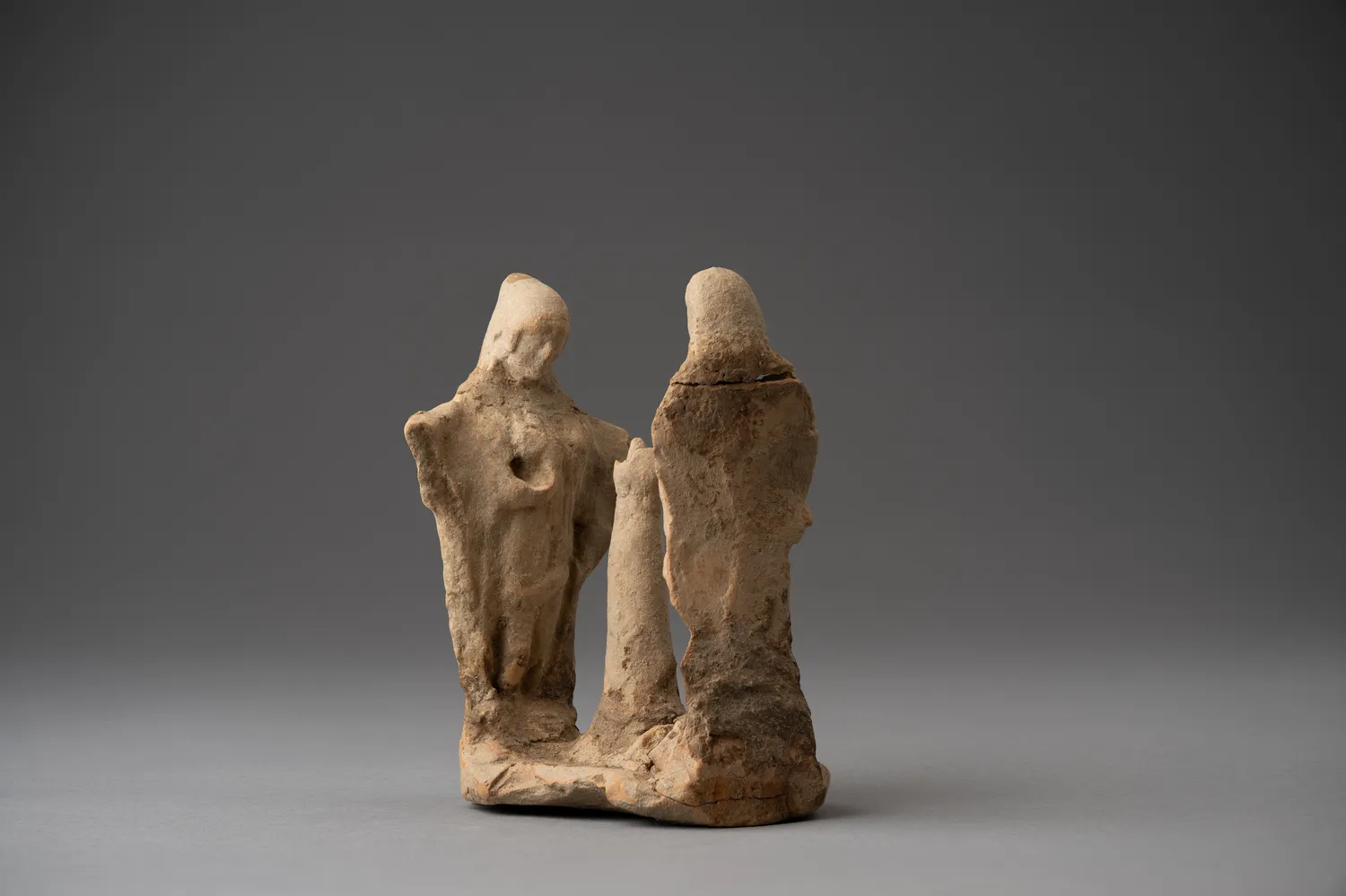
The small clay people of Iron Age Cyprus are, by count, the island's commonest sculpture. Between the end of the Bronze Age and the arrival of Greek-style moulded figurines, Cypriot coroplasts built tens of thousands of standing figures by hand from a columnar lump of clay, pinching out a beaked nose and pressing on pellets for eyes, ears and breasts. Archaeologists call the method the snowman technique, and the figures it produced, votaries and musicians for the most part, were bought cheaply and left in sanctuaries by the hundred. This entry covers the technique, the chronology from the Cypro-Geometric through the Cypro-Classical period, the typology of the standing votary, the musician figures, the sanctuary deposits that preserved them (Ayia Irini above all), and the main interpretive debates. The equestrian figures that share the technique are treated separately under horse and rider figurines, and the mould-made female plaques of Levantine derivation under Base Ring and Astarte figurines.
Definition and the snowman technique
The term belongs to Einar Gjerstad, who set it out in the fourth volume of the Swedish Cyprus Expedition. Describing the Cypro-Geometric figurines, he wrote that "the body of the human and semi-human figurines widens towards the base. They are made in the so-called snow-man technique. The whole structure of the body is abstract; the feet are never indicated; the arms are projecting, curved stumps; the eyes and nipples are marked by pellets; the nose is thick and projecting; the face has often a bird-like, beaked appearance and the heads are sometimes extremely large in comparison with the body" [1, p. 263]. His classification of the smaller statuettes restates the recipe: a cylindrical body, solid or hollow, widening to the base; no feet; arms as curved stumps, usually raised; a roughly shaped head with a thick projecting nose, pellet eyes and pellet ears; details of face and dress painted in matt black and red [1, pp. 100–101]. The image is of a figure built upward from a lump, the way a child stacks a snowman, rather than carved or cast.
Two cautions follow from the definition. First, "handmade" does not mean "solid throughout". Young and Young, publishing the figurines from the sanctuary of Apollo Hylates at Kourion, distinguished four manufacturing modes: wheel-made (entirely or in part), handmade, handmade with a mould-made face, and wholly moulded [2, p. 204]. The earliest votaries at Kourion were made in the potter's way, thrown hollow "like a pot", then transformed at the leather-hard stage by hand-applied arms, a drawn-out beard, a pellet nose and ears [2, pp. 31, 205]. Gjerstad's rule of thumb still holds: the solid body is always handmade [1, p. 101]. So the safe phrase for a small figure whose interior cannot be inspected is "hand-modelled", not "entirely handmade". Second, the snowman idiom is a pole on a continuum. Gjerstad graded his material from "pure" snowman through "modified" and "more advanced" forms toward sculpture proper, so a single piece can be more or less snowman-like without ceasing to belong to the class.
The face is the diagnostic. On the hand-built figures the nose is a pinched projection, the ears small pellets, the beard a flattened extension of the chin; on more developed pieces the eyes, mouth and hair are also added as pellets or incisions [1, p. 101]. Because these applied morsels were often poorly luted, they break away easily, which is why so many excavated examples survive as trunks with a nose and little else. On some figures the face is drawn rather than modelled, with eyes and brows in black paint and red circles on the cheeks. The beaked profile is a long Cypriot habit: the Late Bronze Age Base Ring nudes have it too, and they should not be confused with the Iron Age class.
Fabric, paint and size
Decoration follows contemporary pottery because the same workshops and pigments were involved. Young and Young observed that black alone corresponds to White Painted ware and black with red to Bichrome, and that the red slip of Black-on-Red pottery is not used on figurines, even though the natural red of the clay often gives that impression [2, p. 31]. Paint was applied either directly to the clay, the earlier and commoner practice, or over a thick white ground, which at Kourion becomes regular only after about 600 BC and is therefore a rough marker of a later date [2, pp. 33, 204]. The painted scheme is conventionalised clothing: a black neckband, shoulder bands, a girdle of one to three lines at the waist, a broad band at the base, black lines separating the fingers; eyes, brows, beard and hair in black; ears, nose and lips in red. Paint survives badly, and any published reconstruction of the scheme is a composite drawn from many pieces [2, p. 31].
Sizes run from about 8 to 20 cm for the ordinary votary, with the Cesnola pieces clustering between 8.6 and 17.5 cm [4, cats. 69, 136], through statuettes of 20 to 50 cm [1, p. 101], up to genuinely large hollow terracotta sculpture approaching life size, a scale of clay statuary no other Iron Age region of the eastern Mediterranean matched [3, pp. 27–28]. The flaring base is a structural solution: with no feet modelled, the widest diameter is placed at the bottom "for greater security in standing them up" [2, p. 205]. Small solid figures need no vent; larger hollow ones usually have one. Mat impressions on the undersides of some bases record the reed mats on which they dried before firing [2, p. 206].
Chronology
The class runs from the Cypro-Geometric period through the Cypro-Archaic floruit and into the Cypro-Classical, when it fades. The table gives the working frame; absolute dates for the Archaic subdivisions remain conventional, and the 750 BC start date for Cypro-Archaic I is Coldstream's revision of Gjerstad's 700.
| Period | Approximate dates BC | What the figurines look like |
|---|---|---|
| Late Cypriot IIIB to Cypro-Geometric I | c. 1125–950 | Wheel-made Goddess with Uplifted Arms; a few handmade males, bottle-shaped figures, earliest ring dances |
| Cypro-Geometric II–III | c. 950–750 | Handmade snowman votaries emerge; warriors, vase-carriers, riders; production still small |
| Cypro-Archaic I | c. 750–600 | The floruit: hollow wheel-thrown and solid handmade votaries dedicated by the hundred; mould reaches Cyprus c. 650 |
| Cypro-Archaic II | c. 600–480 | Handmade and mould-faced figures coexist; white ground regular; East Greek influence from mid-century |
| Cypro-Classical | c. 480–310 | Mould-made and Greek-style types dominate; snowman idiom survives at some sanctuaries but declines |
The one genuine bridge from the Bronze Age is the wheel-made Goddess with Uplifted Arms, which appears at the LC IIIB to CG I transition at the sanctuary of the Ingot God at Enkomi and at Kition, and continues through the Geometric period [6, p. 318]. More than a hundred fragmentary examples came from the Enkomi sanctuary alone, most of them small and deliberately broken, with only a handful of larger, finer pieces that might be images of a divinity rather than of worshippers. The Bronze Age plank figure tradition, by contrast, was replaced rather than continued; a smooth "three-thousand-year Cypriot figurine tradition" is a rhetorical framing, not an archaeological one.
Cypro-Geometric figurines are scarce. Production grows through CG II and III, when new male types multiply (helmeted warriors, men in conical caps, vase-carriers, horse-and-riders), and by the end of CG III the figures' primary function "seems to be for dedication at newly established sanctuaries" [6, pp. 322–324]. The explosion comes in the Cypro-Archaic period, when "figurine production increases dramatically" and terracottas are dedicated in the hundreds at sanctuaries newly founded in urban, suburban and rural settings, a change usually connected with the consolidation of the city-kingdoms [6, p. 325]. Karageorghis compared the purchase of a snowman votary or an Astarte figurine to what one pays in a church today for a candle: a cheap offering open to every class, unlike limestone sculpture [4, p. 14].
The mould is the technical watershed, and its date needs stating carefully. Reyes summarises the evidence: the earliest secure use of the mould in Cyprus comes from Ayia Irini, where Gjerstad found mould-made terracottas in contexts of around 650 BC [3, p. 28]. Karageorghis puts the general adoption at the end of the seventh century [4, p. 14]. At Kourion, however, the first face-mould for the small solid horsemen is fixed by stratigraphy at about 510 BC, with fully handmade riders dwindling and disappearing by the mid-fifth century [2, p. 206]. These are not contradictory statements: the mould as a technology arrived in the seventh century, and its adoption for one particular product class at one sanctuary is a later, local event. The mould did not kill the snowman mode. The two coexisted through the Archaic period, and even in the Classical period some sanctuaries still received hand-built figures. What changed after 480 BC was the model: moulds were now imported from Greece or copied from Greek types, and Cypriot coroplasts, in Karageorghis's estimation, "could not fully attain the high standards of Greek artists" [4, p. 14].
Typology of the standing votary
Both Young and Young and Karageorghis organise the anthropomorphic figures by gesture first and headdress second. Karageorghis's six-volume Coroplastic Art of Ancient Cyprus is the standard reference: Volume II covers Late Cypriot II to Cypro-Geometric III, Volumes III to VI are all Cypro-Archaic (large and medium statuary, small male figurines, small female figurines in a handmade and a mould-made part, and monsters, animals and miscellanea), and the series stops at about 475 BC [5]. For Cypro-Classical figures one has to go to site reports and museum catalogues. The series is a curated selection rather than a complete corpus, and it mixes excavated with unprovenanced material, a choice reviewers criticised at the time.
The recurrent attitudes are these. The outstretched- or uplifted-arms figure, sometimes called the psi type after the Aegean silhouette, descends from the Geometric goddess and runs through the Archaic period; without breasts it is sex-indeterminate, and museums label examples as votaries or as goddesses depending on their inclination. The arms-akimbo figure, hands on hips, is rare before the Archaic period. The hand-to-breast or arms-folded figure, and the offering-bearer holding a kid, a dove, a flower, a cake or a phiale, are common at both male and female sanctuaries. Female figures are marked by applied pellet breasts and by a fan-shaped, rectangular or trapezoidal headdress that Gjerstad read as a polos; male figures usually have a pointed top indicating a conical cap or helmet, often with a beard [1, p. 100]. Warriors and shield-bearers, kourotrophoi (mother with child), and the later temple boys complete the roster. The Cesnola catalogue's standard formula for the solid type is worth quoting because it describes thousands of pieces at once: "The flaring cylindrical body is handmade and solid, with a concave base" [4, cat. 136].
A boundary matters here. The enthroned goddess, the nude female holding her breasts, the dea gravida and the kore plaque are mould-made types of Phoenician introduction, and although they were dedicated in the same sanctuaries they are not snowman votaries. The handmade versus mould-made split in Karageorghis's Volume V doubles as an indigenous versus Levantine axis.
Musicians and ritual-action figures
Musicians are the most distinctive subject the technique produced, and the instrument repertoire is well defined. The small frame drum or tambourine is the commonest, first attested on a Late Cypriot III Base Ring figure and continuing through the Iron Age; Kolotourou distinguishes three holding positions, of which the drum held perpendicular to the body and struck with one hand is the usual one, while the drum held flat against the chest and played with both hands is characteristic of the Amathus workshop [10, pp. 9–11]. The double pipe, called a double flute in the older literature and better glossed as the aulos, is the standard wind instrument: both arms raised to hold the pipes to the mouth, the head tilted back, usually a conical cap. The lyre is the third staple, held out in one hand and plucked with the other; at Kourion it was the most popular instrument in the sanctuary, and one figure preserves a bridge and three separately made strings [2, p. 231]. Cymbals are the subject of a live dispute: Kolotourou argues that more than a dozen male figures of the eighth to sixth centuries, catalogued by Karageorghis as tambourine players, hold their disc symmetrically in both hands and are therefore cymbal players, the symmetric grip being the Near Eastern marker of cymbal playing [10, p. 16]. At Kourion the cymbal players clash deeply concave discs together, while the flat tympanon "was apparently not used" [2, p. 231]. A trumpet is recorded once, on a fragmentary rider. The syrinx or pan-pipe does not occur as a Cypriot coroplastic type; it belongs to the Cyclades and to later Greek Pan imagery, and attributing one to a Cypriot figure would be an error.
The consistent curatorial reading is that these figures were placed in the sanctuary to provide music for the divinity in perpetuity, the clay musician being the affordable equivalent of a limestone one. Kolotourou goes further, arguing that percussion carried the religious load because rhythm structures both music and ritual, that the tambourine belongs to the goddess complex (Aphrodite and Astarte on Cyprus), and that beaten bronze, cymbals and bells, had purifying and protective force [10, pp. 4–13]. Whether a given player is a worshipper, a performer or the goddess is genuinely unresolved; for the mass-produced Amathus, Lapithos and Kition-Kamelarga players the lack of attributes points to mortal worshippers.
The musician also appears at the centre of ring-dance groups, in which two or three figures on a common base join hands around a central player or a stylised tree. The type runs from the Cypro-Geometric period to the fourth century BC. The British Museum's group of three women dancing round a tree (1903,1215.6), catalogued by Thomas Kiely as probably from Idalion and dated c. 500 to 400 BC, has mould-made figures on a handmade base and tree, the later mode of the class [13, no. 077]. This site's own damaged example, two hand-modelled figures facing each other across a broken central shaft, is discussed in Two Figures and a Tree. Alongside the dancers sit the genre groups, bread-makers, grain-grinders, potters, water-carriers, bathing scenes, banqueters on a cart with a piper on their laps, read as votive snapshots of activities in and around the sanctuary.
Find contexts: the sanctuary deposits
Almost everything survives because of the way sanctuaries were cleared. When a temenos filled with offerings, broken and superseded votives were buried inside the precinct in a pit, a favissa or bothros, as the god's inalienable property. This is why the figurines survive in quantity and why they are so often broken.
Ayia Irini, on the Morphou bay in the north-west, is the type-site of deposition in place. The Swedish Cyprus Expedition excavated it in the winter of 1929 to 1930 under Erik Sjöqvist and published it in 1935. The site had a Late Bronze Age cult phase and then a sequence of purely religious phases through the Geometric and Archaic periods to abandonment around 500 BC; the layout was an open-air temenos with an altar inside an enclosure wall. About 2,000 terracotta statues and statuettes, not counting fragments, were found standing in arcs around the altar, ranging from small figurines to near life-size statues, dating mainly to 650 to 500 BC, with earlier bulls and hybrid bull-men; the later majority are male figures in helmets or conical caps, with chariot groups, horsemen, ring-dancers, musicians and offering-bearers [7, p. 63; 8]. The finds were divided between the Medelhavsmuseet in Stockholm and the Cyprus Museum. Bourogiannis's 2025 re-examination of the unpublished material and the site's stratigraphy qualifies the famous image of tidy semicircles, noting evidence for circular platforms and for figures found intermixed, and stresses that the sanctuary lies in the occupied north and has been inaccessible since 1974 [8]. The predominance of male dedications suggests a male divinity, but no inscription names him. See The Swedish Expedition and its Legacy for the expedition itself.
Kourion's sanctuary of Apollo Hylates is the best stratified case and must not be confused with Ayia Irini. The University of Pennsylvania expedition found two great concentrations: the Archaic Precinct Fill, in which no votive can be dated later than about 480 BC, and the Votive Deposit discovered in 1936, a favissa about four metres across, "tightly packed with broken figurines", from which some sixty excavation baskets of fragments were removed and whose joins showed the whole fill was dumped at one time [2, p. 20]. Young and Young examined close to ten thousand pieces and published some three thousand. The hollow snowman votaries were dedicated from the late eighth century to the late sixth, and had lost their vogue by 600; horsemen arrived no earlier than about 625 BC and then took over [2, pp. 32, 233]. See Iron Age Cities: Kourion.
The other named deposits each have a character. Arsos, excavated by the Cyprus Museum in 1917, is the goddess's sanctuary, rich in mould-made female tambourine players, and the source of most Cypriot-style terracottas found at the Samian Heraion, some struck from the same moulds. Achna, dug by Ohnefalsch-Richter in 1882 for the British Museum, yielded over a thousand figures, all female save one, many holding a bird. Meniko-Litharkes, excavated by Karageorghis in 1953, is one of the few controlled Archaic deposits, with a seated Baal Hammon found in the cella. Kition, Tamassos, Golgoi, Salamis, Polis-Peristeries (with both a favissa inside the temenos and a bothros outside it) and Amathus, which gives figurines from tombs as well as sanctuaries, fill out the map. Idalion is the cautionary case: dug by Cesnola, Lang and Ohnefalsch-Richter in the nineteenth century, it supplied European museums with figurines whose exact provenance, as Fourrier puts it, is unknown [9, p. 33]. On the collectors see Max Ohnefalsch-Richter.
Fourrier's 2007 monograph is the leading model of production. Working only from provenanced pieces, she identifies major workshops aligned with the city-kingdoms, Salamis, Idalion, Kition, Amathus, Kourion, Paphos, Marion, Soloi and the Lapithos region, and traces how each centre's products diffused to its hinterland and frontier sanctuaries, so that coroplastic style becomes a proxy for political territory [9]. This redirects attention away from rural sanctuaries such as Ayia Irini, Achna and Arsos, once assumed to be producers. The argument is interpretive and rests on stylistic attribution; petrographic confirmation of the attributed centres is incomplete. The class is largely insular, but Cypriot figures and moulds travelled to Samos, Rhodes and Naukratis.
Function and the naming of gods
The governing idea of the whole Iron Age corpus is the votary: the figure that stands in for its dedicant. Connelly's thesis of the votive as a "perpetual prayer", argued for limestone statuary and extended by later writers to terracotta, holds that the figure remained before the god after the worshipper went home [11]. Most anthropomorphic figurines are therefore worshippers, and images of deities are a small minority.
Naming the deity of an uninscribed sanctuary is now done cautiously. That a sanctuary receiving mostly female votives belonged to a goddess is a reasonable inference; that many male votaries imply a male god is weaker, since male figures probably depict real dedicants. Counts reads the male votive material as a single untheonymed divinity with hybrid animal traits, the Master of Animals or Herakles-Melqart type, rather than a roster of named gods. The older "fertility goddess" framing is heavily qualified, and the "sacred prostitution" reading of Cypriot Aphrodite, revived in the early 2000s, has been dismantled by Budin [12]. The toys-versus-votives question, raised by figures with movable legs and wheeled horses, remains open and probably has no single answer.
Gjerstad omitted the small figurines from his chronological system, and figurines are dated externally, by associated pottery and sealed deposits, not on their own typology. The great majority in museums are unprovenanced. Cesnola's find-spots ("said to be from Idalion", "from the temple of Apollo at Kourion") are unverifiable, and the Feuardent libel trial of 1883 to 1884 exposed his restorations, including wrong heads and plaster noses, which is the origin of the modern caution about composite figures. The contrast between the few scientifically excavated deposits and the mass of context-less market material is the central evidential problem of the class.
Examples in this site's collection
This site's own collection holds a small group of hand-modelled votaries of the class, all sitting in the Cypro-Archaic band of c. 750 to 480 BC, with the raised-arm types possibly reaching back into the Geometric period. There is a male figure with arms akimbo, hands set on the hips, a rounded head with a long pinched nose under a heavy cream slip; three outstretched-arms figures, one with an elongated domed head, one with a tall flat-topped cap and an old repair across the shoulders, one with a flaring trapezoidal polos and two splayed feet modelled at the base instead of a plain foot; a female outstretched-arms figure with applied pellet breasts and a flaring headdress, the type Fourrier associates especially with Paphian workshops and dates from Cypro-Geometric I onward [9, pp. 73–74]; and a musician, a columnar figure with the head tilted back and both hands clasped at the chest, from which a single long pipe with a flared open end rises to one side. The musician was first taken for a double-aulos player, but the gesture does not match the two short pipes held symmetrically to the lips; it corresponds instead to the single long pipe of the Metropolitan Museum's limestone flute-player, and a horn or trumpet reading is kept open. The Met's hand-modelled male flute-player 74.51.1083, Cypro-Archaic I, is the closest type-parallel. None of the group has a recorded find-spot, which is the normal condition of the class and the reason such pieces illustrate types rather than contexts. For the broader picture see The Terracotta Figurines of Ancient Cyprus.
Summary
The snowman figurine is a technique before it is a type: an additive, hand-built mode of making standing figures, with a pinched beak face and pellet features, that Cypriot coroplasts used from the Geometric period until Greek moulds displaced it after 480 BC. Its products are overwhelmingly votaries and musicians, cheap enough for anyone to dedicate, preserved because sanctuaries buried their clearances, and datable only through the pottery found with them. Ayia Irini shows the figures as they stood; Kourion shows how the deposits were made and when they closed; Fourrier's workshops show where the figures came from. What the figures meant is mostly recoverable at the level of gesture and dedication, and only rarely at the level of the god who received them.
References
- 1.Gjerstad, E. (1948). *The Swedish Cyprus Expedition, Vol. IV:2: The Cypro-Geometric, Cypro-Archaic and Cypro-Classical Periods*. Swedish Cyprus Expedition.
- 2.Young, J. H., & Young, S. H. (1955). *Terracotta Figurines from Kourion in Cyprus*. University Museum, University of Pennsylvania.
- 3.Reyes, A. T. (1994). *Archaic Cyprus: A Study of the Textual and Archaeological Evidence*. Clarendon Press.
- 4.Karageorghis, V., Merker, G. S., & Mertens, J. R. (2004). *The Cesnola Collection of Cypriot Art: Terracottas*. The Metropolitan Museum of Art.
- 5.Karageorghis, V. (1991–1999). *The Coroplastic Art of Ancient Cyprus* (Vols. I–VI). A. G. Leventis Foundation.
- 6.Darby, E. D., & de Hulster, I. J. (Eds.). (2021). *Iron Age Terracotta Figurines from the Southern Levant in Context* (Culture and History of the Ancient Near East 125). Brill.
- 7.Brown, A. C., & Catling, H. W. (1980). *Ancient Cyprus*. Ashmolean Museum.
- 8.Bourogiannis, G. (2025). *The Sanctuary of Ayia Irini Reconsidered: A Quest for Gods and Territories* (Studies in Mediterranean Archaeology 158). Åström Editions.
- 9.Fourrier, S. (2007). *La coroplastie chypriote archaïque: Identités culturelles et politiques à l'époque des royaumes* (Travaux de la Maison de l'Orient 46). Maison de l'Orient et de la Méditerranée.
- 10.Kolotourou, K. (2005). Music and cult: The significance of percussion and the Cypriote connection. In V. Karageorghis, H. Matthäus, & S. Rogge (Eds.), *Cyprus: Religion and Society from the Late Bronze Age to the End of the Archaic Period* (pp. 183–204). Bibliopolis.
- 11.Connelly, J. B. (1989). Standing before one's god: Votive sculpture and the Cypriot religious tradition. *The Biblical Archaeologist, 52*(4), 210–218.
- 12.Budin, S. L. (2008). *The Myth of Sacred Prostitution in Antiquity*. Cambridge University Press.
- 13.Bombardieri, L., & Panero, E. (Eds.). (2021). *Cyprus: Crossroads of Civilizations* (exhibition catalogue, Musei Reali, Turin). DeArtcom.