
Ancient Cypriot Pottery·Lesson 4
Painted Again in the Middle Cypriot
White Painted, the pale line-painted pottery that names the Middle Cypriot, and the plainer wares beside it. Learn to tell the Lapithos and Kalopsidha manners apart, read the Roman numerals with caution, and spot the juglets that dated the period abroad.
Alexis Drakopoulos·Period by period·14 min read
Share


Lesson 4·Course contents, 15 lessons
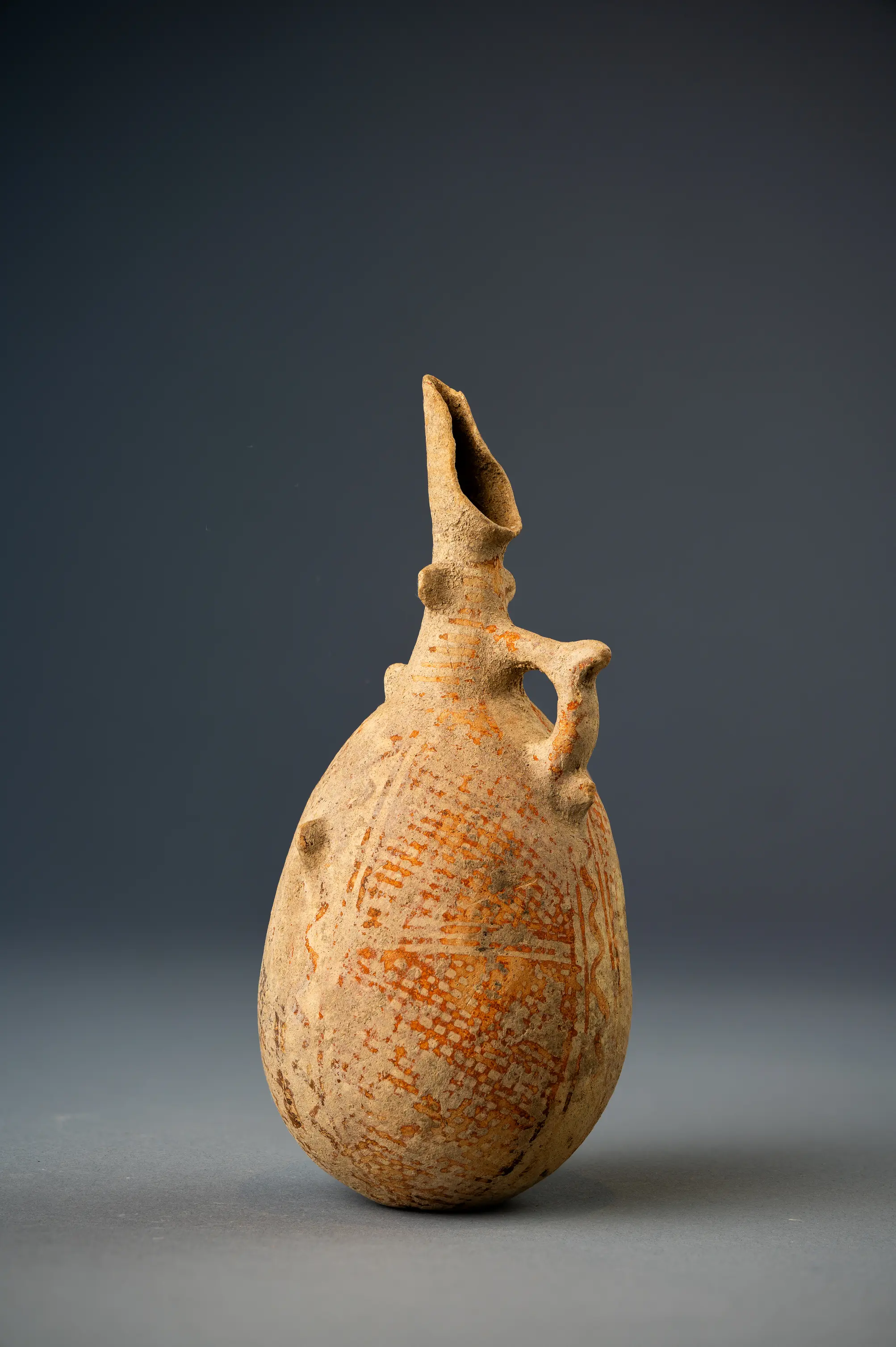
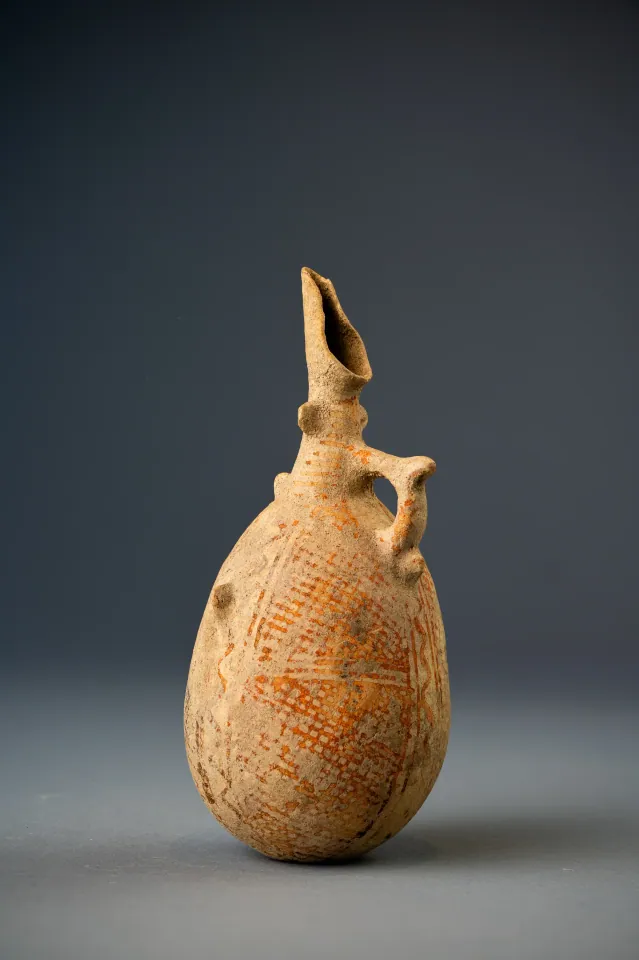
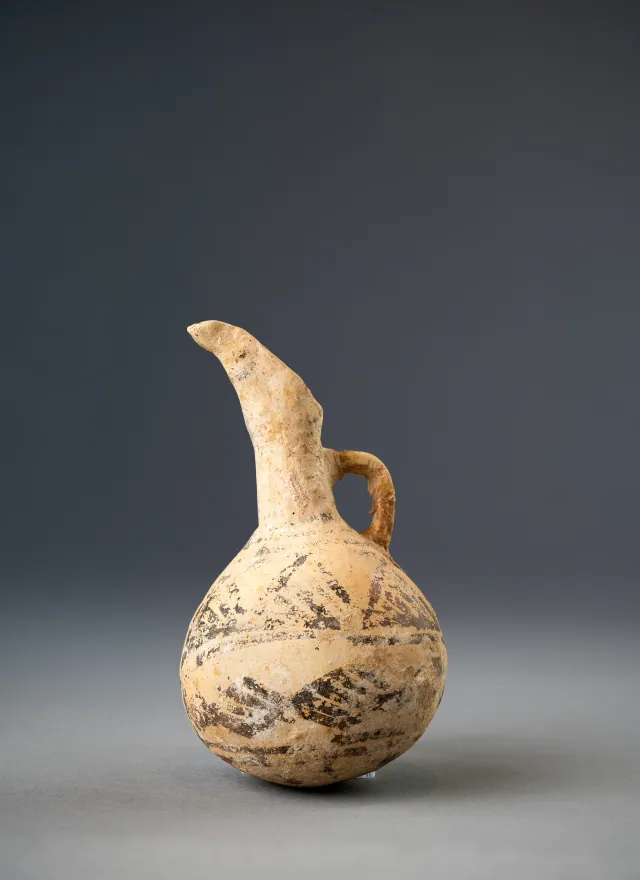
The jug beside this paragraph has a beak. Its narrow neck is cut away at a slant into a long spout, the handle springs from the neck, and the egg-shaped body comes down to a rounded base that only just lets it stand. An Early Cypriot potter would have known all three from Red Polished, the burnished red pottery of Lesson 3. The surface would have been new: a pale buff slip (a coat of fine liquid clay), divided into panels of quick, slightly uneven lattice in orange-red paint. Nobody on Cyprus had painted pots in quantity since the end of the Chalcolithic, several centuries earlier.
The jug, in the Drakopoulos collection, is White Painted II, an early stage of the ware that defines the Middle Cypriot period (MC). White Painted is a fine, pale, handmade pottery decorated with brushed lines in red, brown or black. Archaeologists have long drawn the line between the Early and the Middle Cypriot at the spread of White Painted II, because very little else marks it: there is no destruction level and no clean break in houses or burials [1]. This course dates the Middle Cypriot to c. 2000 to 1650 BC. Many handbooks start it at c. 1900 BC, a figure Paul Åström reached by working back from a single Minoan jar found in a tomb at Lapithos; radiocarbon dates now favour the earlier figure [3][4]. The end of the period, c. 1650 BC, is fixed by a different method, and the pots that fix it appear later in this lesson.
The ware that names the period was a minority ware. At Alambra, a village in the centre of the island, 99 per cent of the excavated pottery was locally made Red Polished; White Painted and everything else made up the last one per cent [1]. In the south-west the ware seems hardly to have been made at all, a gap that once led archaeologists to conclude, wrongly, that the region had been abandoned [2]. Where White Painted is plentiful, as in the great cemetery of Lapithos on the north coast, it tends to sit in the richer tombs [1]. The period is named after a pot that most of its people may never have owned.
Where the brush came back
The earliest White Painted turns up in the tombs of Bellapais-Vounous on the north coast, late in the Early Cypriot period, among vessels that are still mostly Red Polished. Porphyrios Dikaios, who excavated Vounous in 1931 and 1932, thought the potters "could not have lost all recollection" of Chalcolithic painted pottery and found the early Vounous pieces "quite reminiscent of the Red on White pottery found in Erimi" [5]. The resemblance is real; a memory carried across several centuries is harder to prove. The fabric (the fired clay body) of the earliest White Painted is close to that of Red Polished III, and some of its painted motifs also appear incised on Red Polished pots, so the same workshops, or close neighbours, were making both [1].
The surface changed over the following three centuries, and the change is a rough clock. Early White Painted has a lustrous light slip with glossy red paint, as on the jug above. Later pieces are duller, with red-brown or grey-brown paint, and by the end of the period the paint is dark and matt on an off-white ground [6].
Why "White Painted III to IV" is not a date
White Painted is divided into Roman-numeral classes, I to VI, which look like a sequence of dates. Einar Gjerstad, who set up the first scheme in 1926, separated the classes partly by region: his White Painted III, painted all over on a soft chalky fabric, was mainly northern, and his White Painted IV, painted in zones on a hard thin one, mainly eastern [7]. Åström reorganised the ware by decorative scheme, kept the numbers as a loose chronological frame, and added named styles that run across them [4]. A label such as "White Painted III to IV Pendent Line Style" therefore mixes a stage, a region and a pattern in one phrase.
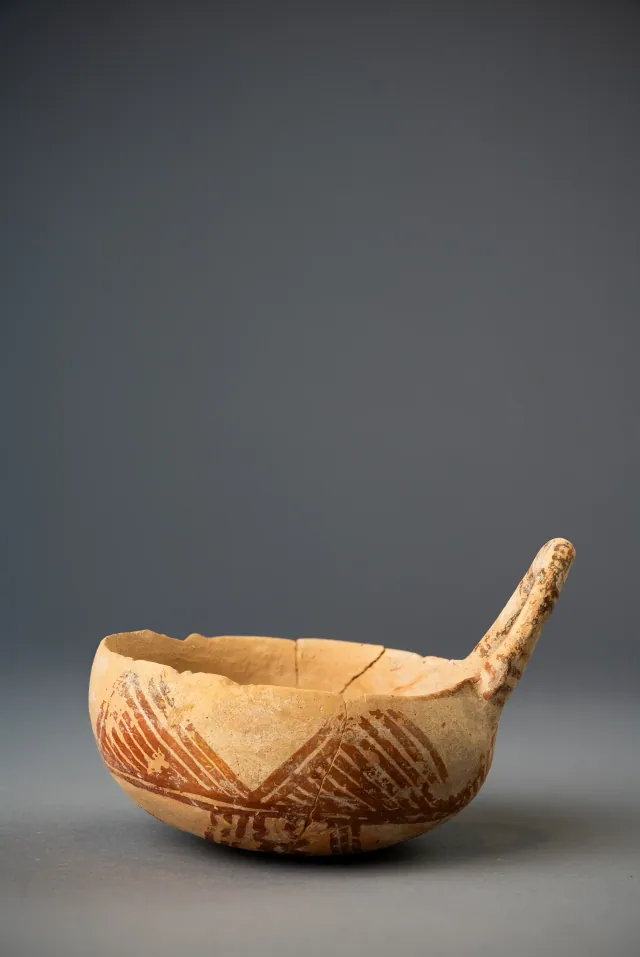
The bowl beside this paragraph shows the problem. It is a deep, round-based bowl with a solid handle rising steeply from the rim, painted outside with large hatched triangles and underneath with a quartered pattern of straight and wavy lines. Its closest parallels come from Lapithos Tomb 315, excavated by the Swedish expedition. One of those Lapithos bowls appears as White Painted III in the excavation report and as White Painted IV in the Stockholm museum's catalogue [8][9]. Louise Maguire, after studying the Middle Cypriot pottery found abroad, concluded that the numerical dividers were "largely irrelevant, as they mask regional variation and imply a non-existent chronological relationship" [10]. The two ends of the sequence are distinct in time; the middle is a tangle, which is why this bowl, and the amphora below, are best called "White Painted III to IV".
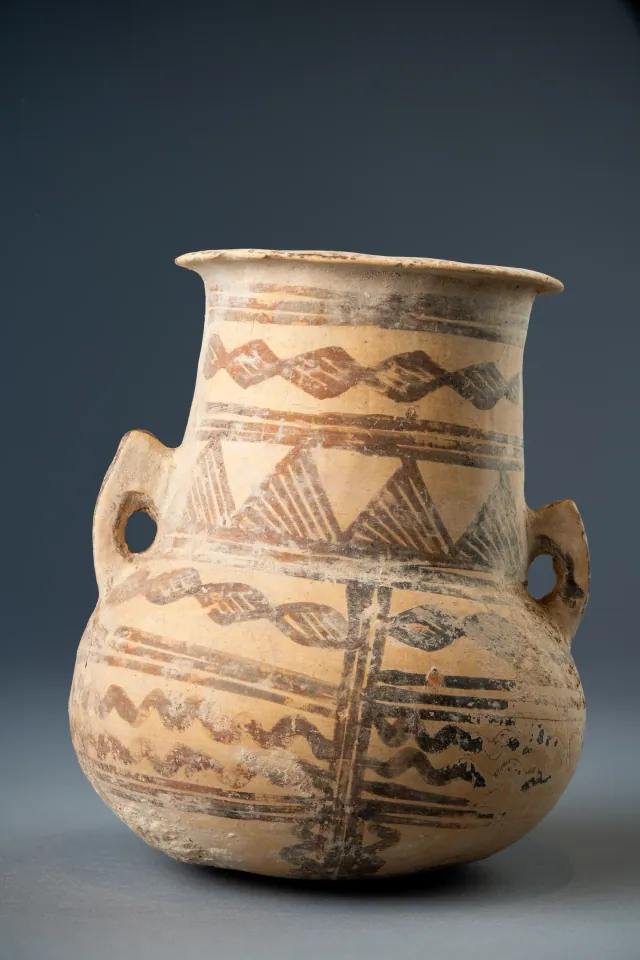
Region tells you more than the numeral. Vassos Karageorghis put it in one line: the White Painted of Kalopsidha, "the 'capital' of the east, is linear, while that of Lapethos, the capital of the west, is geometric" [11]. Åström called the western manner "tectonic", meaning built up from framed zones, and set beside the two a wavy-line manner of the Karpas peninsula in the far north-east. David Frankel's analysis of 81 motifs confirmed the divide [12]. The small amphora beside this paragraph is the Lapithos manner at work: stacked horizontal zones of hatched lozenges, standing hatched triangles and wavy lines, with a vertical ladder of lines cut down the front. It is easy to call it a jar, but in Frankel's glossary a jar has no handles and a closed vessel with two small handles on its neck is an amphora [12].
Three eastern styles to recognise
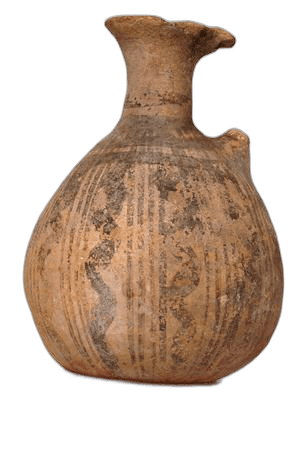
Åström and his successors named more than a dozen styles; three eastern ones cover much of what a visitor sees in a museum case, and they are the ones that travelled. The Pendent Line Style decorates round or ovoid jugs and small bottles with alternating groups of straight vertical lines and wavy bands, hanging from horizontal bands round the neck and shoulder; the paint is a single colour, red or black [13]. The British Museum juglet beside this paragraph, from Phoenikiais, has wavy-line pendants enclosed by sets of four vertical lines. At Tell Arqa in Lebanon, 27 Pendent Line jugs were painted red and 18 black: the same style came in either colour [13].
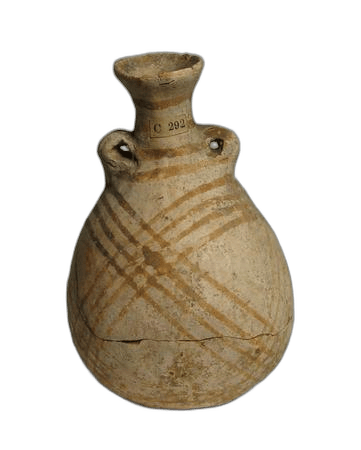
The Cross Line Style uses the same shapes and fabrics and changes only the decoration: groups of parallel straight lines cross each other obliquely over the body, with bands at the neck [13]. It is the commonest style at Kalopsidha in the eastern Mesaoria, where it was probably invented, and its earliest examples, in the words of L.A.C. Gagné's study of the ware, "resemble net bags wrapped around the small jugs" [1]. The bottle illustrated, from Enkomi, has the two string-hole projections at the neck typical of these small eastern containers. Åström read the eastern styles as a family line, Pendent Line giving rise to Cross Line, on the evidence of jugs that carry both crossed lines and stray wavy ones; Frankel thought the two partly contemporary, which would explain the mixture as well [12].
The third, the Framed Broad Band Style of White Painted V, belongs to larger pots: tall-necked ovoid jars with two vertical handles, painted with broad bands framed by one or two thin lines in red or black on a yellowish or beige clay. It began in eastern Cyprus late in the period, and Enkomi alone has yielded dozens [13]. Åström's excavations suggested that Kalopsidha itself made the Pendent Line and Cross Line styles, and two minor ones a reader will meet in catalogues, the Tangent and Eyelet styles [14].
Put the two capitals on the map: Lapithos on the north coast, the home of the framed, geometric manner, and Kalopsidha in the eastern Mesaoria, where the linear styles that travelled were probably made. Then find the places the rest of the lesson visits, from Deneia in the north-west to Enkomi on the east coast and Korovia-Nitovikla out on the Karpas.
Map of Cyprus
Middle Cypriot regional styles
- Ground above 200, 500, 1,000 m
The rest of the shelf
Most Middle Cypriot pots were unpainted. Red Polished, the ware of Lesson 3, carried on as the everyday pottery in its late classes, III and IV, whose numbers are even less of a date than White Painted's: Red Polished III runs from the start of the Early Cypriot to the end of the Middle Cypriot, and Red Polished IV from the start of the Middle Cypriot into the Late Bronze Age [10].
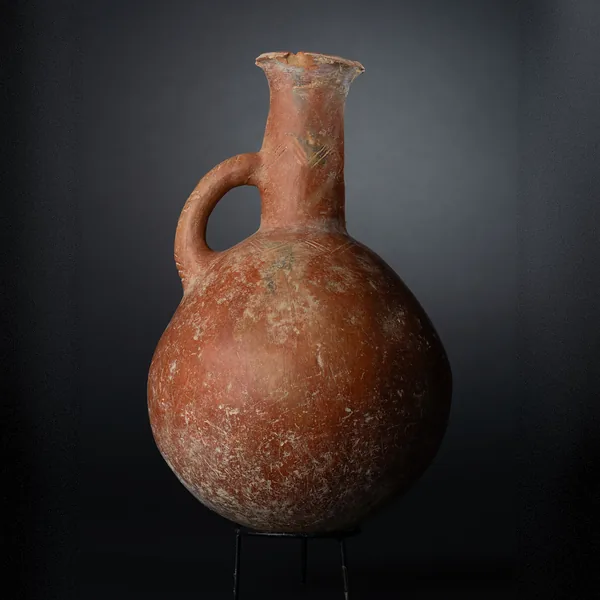
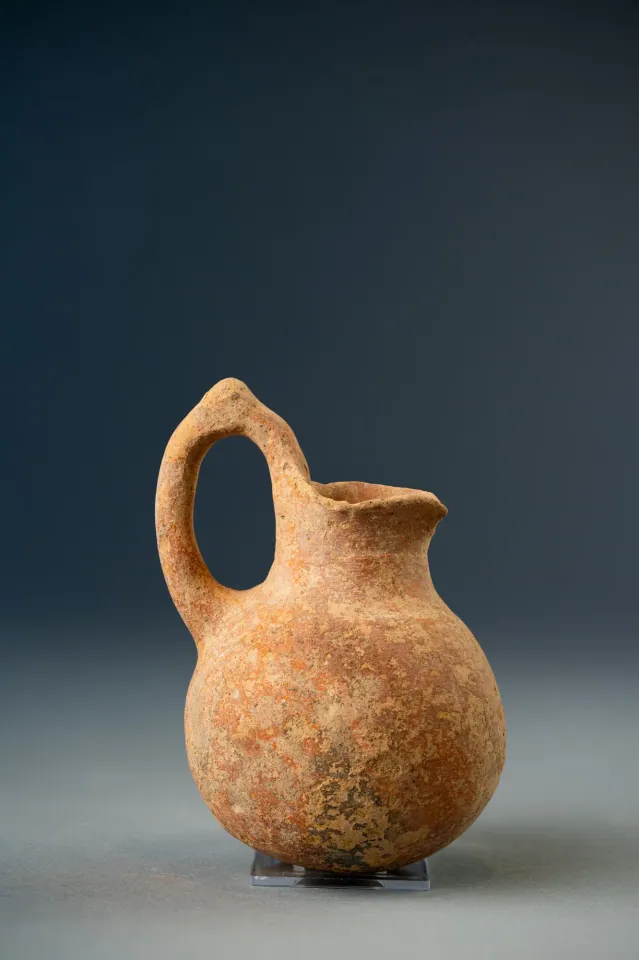
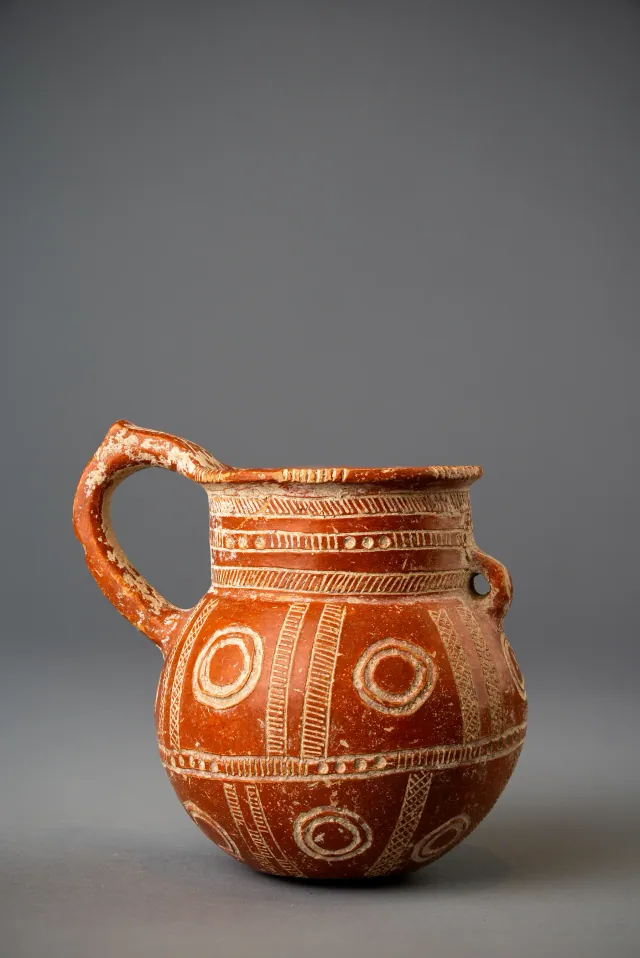
The three late Red Polished pots above, all in the Drakopoulos collection, show how wide the range was. The large jug is of a kind known from the tombs of Lapithos around the turn of the Early and Middle Cypriot, its incised decoration held back to zigzag collars on the neck and slashes on the handle. The small juglet beside it has no decoration at all: an orange-red slip worn through to buff in places, a grey firing cloud low on the body, and a thick handle that swings up well above the rim before dropping to the shoulder. Plain juglets like it changed so little that its date of c. 2000 to 1850 BC, taken from a close match in the British Museum, could as easily be c. 2100 to 1750. Through the Middle Cypriot, most pots looked more like these two than like the White Painted jug at the top of the lesson.
The third pot is the opposite case. It is a wide-mouthed one-handled jar with a small pierced lug at the base of the neck, opposite the handle, and its glossy orange-red slip is covered with incised double rings alternating with ladder and cross-hatched bands, the incisions and rows of small impressed dots filled with white paste. A closely matching vessel in the Louvre is assigned to the Deneia style, after Deneia, inland in the north-west of the island, whose Bronze Age cemeteries are the most extensive in Cyprus. Jennifer Webb lists heavily drawn concentric circles and multiple pierced lugs among the motifs largely confined to Deneia's Red Polished, an assertive local style she reads as a community declaring who it was, even though its potters shared the general manner of Lapithos [21, p. 175]. Generations of looting have scattered an enormous number of Deneia pots across the world with no tomb records [21, p. 175], so "Deneia style" names a manner of decoration; whether this jar was made at Deneia itself or at a neighbouring village cannot be shown.
In the west and south the potters had their own tradition. Drab Polished, a name Åström coined, is a hard, high-fired ware whose broken edges often show a thick blue-grey core; the surface, despite the name, can be buff, grey or red, so a core exposed at a break is the better guide [2]. At the cemetery of Kissonerga-Ammoudhia near Paphos it makes up 68 per cent of all the pottery [2].
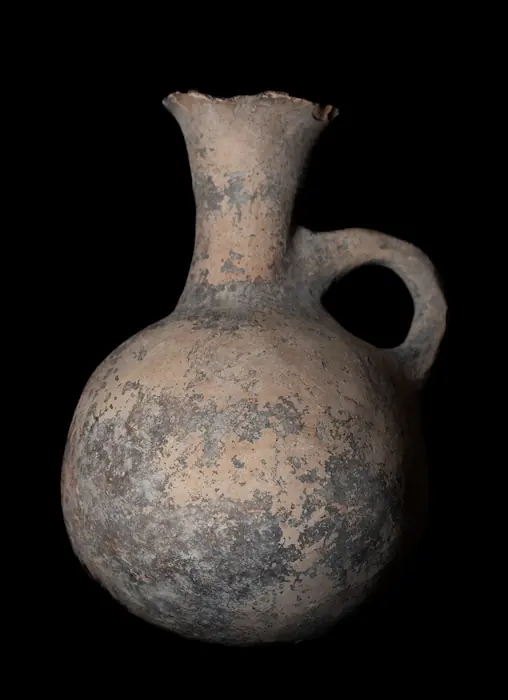
In the north and east, a dark relative of Red Polished took hold. Black Slip is a handmade ware coated in a brown to black slip, usually decorated with thin incised lines, zigzags and punctures; its latest class, Black Slip III, has thin walls and a metallic look that Karageorghis saw as a forerunner of Base Ring [6]. At Deneia almost every Black Slip II vessel has a counterpart in local Red Polished IV, made at the same time and probably by the same potters [15]. The jug beside this paragraph, its grey-black coat flaking off a pinkish clay, is probably Middle Cypriot Black Slip; dark-slipped jugs of similar outline were also made in the Iron Age, and its base, not shown, would settle the question.
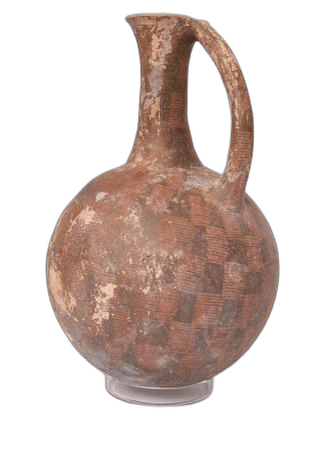
The Karpas peninsula went its own way again. Red-on-Black reverses the White Painted formula: matt red lines painted over a dark polished slip, often with a brush of several points, so that each group of lines has the same count all over the pot [16, p. 27]. Red-on-Red is the same tradition on a red ground; on a single vessel the two can shade into each other, an effect of the firing [10]. Robert Merrillees mapped the ware in 1979 and defined from it a Karpas "cultural zone", reaching from Phlamoudhi on the north coast down to Enkomi [10]. The British Museum jug beside this paragraph, 32.5 cm high, is covered from neck to base in a chequerboard of short red strokes. The ware lasted about three hundred years in the north-east and rarely travelled to the rest of the island [17].
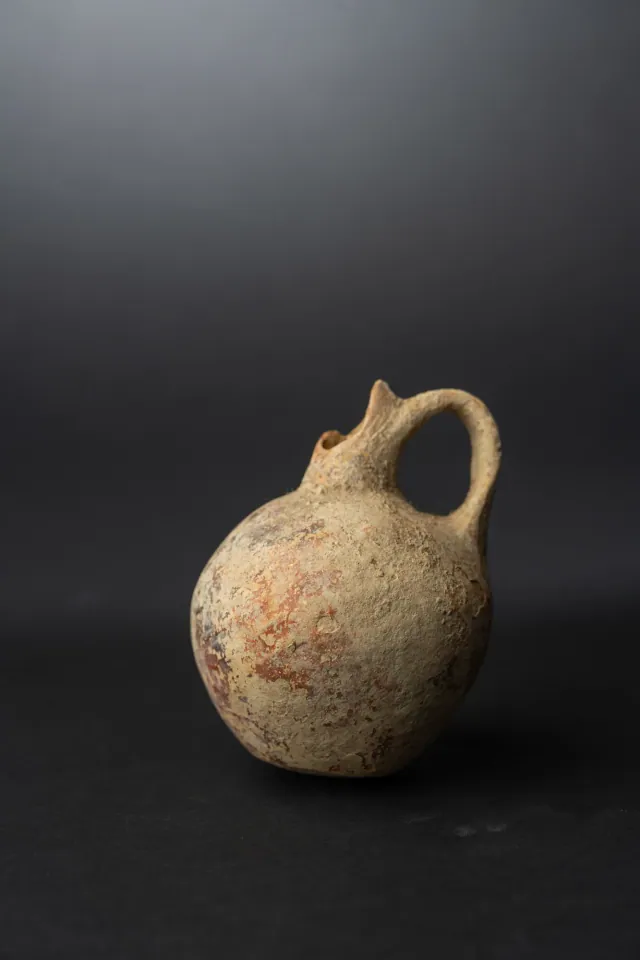
These dark and red wares are where honest identification runs out. The small juglet beside this paragraph shows a red slip wherever its lime crust has lifted. Red Slip (the red version of Black Slip), Red-on-Red with its paint gone, or a Black Slip pot fired red in patches would all look like this under burial deposit, and the question stays open until the fabric at the broken spout is examined.
Set the whole shelf against the period. Tap each ware for where and when it was made. White Painted, the ware the period is named after, is one row among several, and most of the others were never painted at all.
Chronology
What was made in the Middle Cypriot
Each bar is a ware, placed by the dates the lessons give it. Drag the red line, or use the arrow keys on its year, to see what was being made in any year; choose a bar for its cues and lesson.
Handmade Bronze Age
In use around
1800 BCMiddle Cypriot I to III
1800 BC: 5 wares in use.
Juglets in the Delta
The small eastern jugs are the pots that left Cyprus, mostly in the last phase of the period, Middle Cypriot III (MC III). Pendent Line and Cross Line jugs and bottles turn up in Middle Bronze Age tombs and towns along the Levantine coast, at Tell Arqa, Sidon, Sarepta and Megiddo, and in Egypt [13][19]. Their narrow necks suggest a precious liquid, scented oil being the usual guess, but no Middle Cypriot juglet's contents have yet been identified by analysis [13].
Choose a find-spot to see what was found there. Most lie along the Levantine coast; the two that matter most for dating are the farthest apart, a stratified town in the Nile Delta and a single juglet in central Anatolia.
Cypriot pottery abroad
Middle Cypriot juglets abroad
Find-spots (6)Show the listHide the list
- 1Tell el-Dab'a (Avaris)Egypt
- White Painted (Middle Cypriot). Large quantities of Middle Cypriot pottery in a well-stratified town; Merrillees gave Pendent Line Style a span there of about 1725 to 1575 BC. Lesson 4
- 2Tell ArqaLebanon
- White Painted (Middle Cypriot). Pendent Line jugs, 27 painted in red and 18 in black. Lesson 4
- 3SidonLebanon
- White Painted (Middle Cypriot). Pendent Line and Cross Line jugs and bottles in Middle Bronze Age tombs and towns. Lesson 4
- 4SareptaLebanon
- White Painted (Middle Cypriot). Pendent Line and Cross Line jugs and bottles in Middle Bronze Age tombs and towns. Lesson 4
- 5MegiddoIsrael
- White Painted (Middle Cypriot). Pendent Line and Cross Line jugs and bottles in Middle Bronze Age tombs and towns. Lesson 4
- 6Kültepe (Kanesh)Turkey
- White Painted (Middle Cypriot). A single incomplete juglet in a level no later than 1796, 1740 or 1676 BC: the most important occurrence abroad for dating. Lesson 4
Egypt gives them a date. At Tell el-Dab'a in the eastern Nile Delta, the Hyksos capital Avaris, Manfred Bietak's excavations recovered large quantities of Middle Cypriot pottery from a well-stratified town [19]. Pendent Line Style first appears there just before Stratum F, peaks in Stratum E/1 and is gone after the middle of Stratum D/3. Weighing Bietak's dates for those levels against higher ones, Merrillees gave the ware a maximum span there of c. 1725 to 1575 BC [18]. Merrillees called a single incomplete juglet from Kültepe in Anatolia, in a level dated, depending on which Mesopotamian chronology is used, no later than 1796, 1740 or 1676 BC, "the single most important occurrence" abroad [18]. Putting these together, he argued that Middle Cypriot III ran from about 1750 to 1650 BC and the first phase of the Late Cypriot period (LC), LC IA, from 1650 to 1550 [18].
Louise Steel points out the catch. The exported styles were made in the south-east of the island and were rarely traded within it, so they are scarce in the northern cemeteries of Lapithos and Vounous, where the relative sequence of the whole period was built [19]. The clock was made in the east; the calendar it is meant to set was drawn up in the north.
Forts and the hinge to the Late Bronze Age
At the end of the period fortified sites appear for the first time in Cypriot history, scattered across the north, centre and east. The type-site, Korovia-Nitovikla on the Karpas, was excavated by the Swedish expedition in 1929 [8]. The older reading saw them as refuges against raiders; later work ties them to competition between Cypriot communities over copper and the new trade with the Levant [20]. They are usually dated to Middle Cypriot III and the early Late Cypriot, but Merrillees moved their beginning into LC IA and their end to before the next phase, LC IB, which leaves them a life of at most a hundred years [20].
The pottery of these decades is a hinge. White Painted V, with the Framed Broad Band jars, belongs to Middle Cypriot III, and White Painted VI is already largely a Late Cypriot fabric [10]. Two new handmade wares appeared, Proto White Slip and Proto Base Ring, ancestors of the Late Cypriot fine wares of Lesson 5; Proto Base Ring grew partly out of Drab Polished around Episkopi on the south coast and partly out of Black Slip in the north-west [10]. At the same threshold the potter's wheel arrived, and the first wheel-made White Painted was produced in the east [10].
Its painters kept their old habits. The earliest wheel-made White Painted is decorated with the same crossed lines as the late handmade Cross Line jugs, and Gagné notes that the two are often hard to tell apart [1]. The net bag is the same; only the pot inside it was now shaped on a wheel.
Quiz
Check yourself
Question
Which ware is this juglet, and where does its paint place it in that ware's sequence?
Question
Put these White Painted surfaces in order, earliest first.
Tap an item, then tap its place. Or use the arrows
Question
A museum label reads “White Painted III to IV”. What does the numeral tell you?
Question
A small jug is covered all over with groups of parallel straight lines crossing each other obliquely, like a net. What is it?
Question
A plain handmade jug from the west of the island has a buff to grey surface, and its broken edge shows a thick blue-grey core. Which ware is most likely?
Question
Why do the White Painted juglets found at Tell el-Dab'a in the Nile Delta matter so much?
Question
This course ends the Middle Cypriot period at about what date? Give a year BC.
What to look for
- A pale, cream to buff surface with thin brushed lines in red, red-brown or black, on a handmade pot with a rounded base: White Painted, most likely Middle Cypriot.
- Bright, glossy red paint on a lustrous light ground points early (White Painted II); dull, matt dark paint on off-white points late (White Painted V to VI).
- Panels of lattice, hatched triangles and lozenge chains stacked in framed zones are the northern and western manner (Lapithos); a whole small jug covered with one repeated pattern of lines is eastern (Kalopsidha).
- Vertical line groups alternating with wavy bands on a small jug or bottle is Pendent Line; groups of straight lines crossing like a net is Cross Line; broad bands edged with thin lines on a large two-handled jar is Framed Broad Band.
- Red lines on a dark polished slip, applied with a multiple brush, is Red-on-Black, a Karpas ware.
- A plain or incised red, brown or black burnished jug with a rounded base is late Red Polished, Black Slip or, in the west, Drab Polished; a blue-grey core at a break favours Drab Polished.
- Heavily drawn concentric circles and pierced lugs on white-filled Red Polished point to the Deneia style of the north-west.
- Treat Roman numerals on a label as a stage and a style, with a margin of a century or more.
Go deeper
The compendium's White Painted ware page covers production, regional centres and export in depth, and Drab Polished ware the western tradition and its link to Base Ring; Red Polished follows the late classes. For shapes named in this lesson see jug, bottle and amphora, and for the patterns lattice and chequerboards and wavy lines.
References
- 1.Gagné, L. A. C. (2012). Middle Cypriot White Painted Ware: A Study of Pottery Production and Distribution in Middle Bronze Age Cyprus. PhD dissertation, University of Toronto.
- 2.Graham, L. (2013). The Necropolis of Kissonerga-Ammoudhia: Techniques of Ceramic Production in Early-Middle Bronze Age Western Cyprus. PhD dissertation, University of Edinburgh.
- 3.Manning, S. W. (2013). Appendix: A new radiocarbon chronology for prehistoric and protohistoric Cyprus, ca. 11,000–1050 cal BC. In A. B. Knapp, The Archaeology of Cyprus: From Earliest Prehistory through the Bronze Age (pp. 485–533). Cambridge: Cambridge University Press.
- 4.Åström, P. (1972). The Swedish Cyprus Expedition, Vol. IV, Part 1B: The Middle Cypriote Bronze Age. Lund: The Swedish Cyprus Expedition.
- 5.Dikaios, P. (1940). The Excavations at Vounous-Bellapais in Cyprus, 1931–2. Archaeologia 88, 1–174.
- 6.Karageorghis, V., Mertens, J. R., & Rose, M. E. (2000). Ancient Art from Cyprus: The Cesnola Collection in The Metropolitan Museum of Art. New York: The Metropolitan Museum of Art.
- 7.Gjerstad, E. (1926). Studies on Prehistoric Cyprus. Uppsala: Uppsala Universitets Årsskrift.
- 8.Gjerstad, E., Lindros, J., Sjöqvist, E. and Westholm, A. (1934). The Swedish Cyprus Expedition I: Finds and Results of the Excavations in Cyprus 1927–1931. Stockholm: The Swedish Cyprus Expedition.
- 9.Stockholm, Medelhavsmuseet, L. 315B-C:049. White Painted IV bowl from Lapithos Tomb 315 B–C, Middle Cypriot II, H. 6.1 cm, D. 12.0 cm. Collection record.
- 10.Crewe, L. (2007). Early Enkomi: Regionalism, Trade and Society at the Beginning of the Late Bronze Age on Cyprus. BAR International Series 1706. Oxford: Archaeopress.
- 11.Karageorghis, V. (1982). Cyprus: From the Stone Age to the Romans. Ancient Peoples and Places 101. London: Thames and Hudson.
- 12.Frankel, D. (1974). Middle Cypriot White Painted Pottery: An Analytical Study of the Decoration. Studies in Mediterranean Archaeology 42. Göteborg: Paul Åströms Förlag.
- 13.Charaf, H. (2010–2011). Cypriot imported pottery from the Middle Bronze Age in Lebanon. Berytus 53–54, 147–165.
- 14.Åström, P. (1966). Excavations at Kalopsidha and Ayios Iakovos in Cyprus. Studies in Mediterranean Archaeology 2. Lund: Paul Åström.
- 15.Frankel, D. and Webb, J.M. (2007). The Bronze Age Cemeteries at Deneia in Cyprus. Studies in Mediterranean Archaeology 135. Sävedalen: Paul Åströms Förlag.
- 16.Morris, D. (1985). The Art of Ancient Cyprus, with a Check-list of the Author's Collection. Oxford: Phaidon.
- 17.Smith, J.S. (ed.) (2008). Views from Phlamoudhi, Cyprus. Annual of the American Schools of Oriental Research 63. Boston: American Schools of Oriental Research.
- 18.Merrillees, R.S. (2002). The relative and absolute chronology of the Cypriote White Painted Pendent Line Style. Bulletin of the American Schools of Oriental Research 326, 1–9.
- 19.Steel, L. (2004). Cyprus before history: From the earliest settlers to the end of the Bronze Age. London: Duckworth.
- 20.Monahan, B. and Spigelman, M. (2019). Negotiating a new landscape: Middle Bronze Age fortresses as a component of the Cypriot political assemblage. In Kearns, C. and Manning, S.W. (eds), New Directions in Cypriot Archaeology. Ithaca: Cornell University Press.
- 21.Webb, J.M. (2010). The ceramic industry of Deneia: crafting community and place in Middle Bronze Age Cyprus. In D. Bolger and L.C. Maguire (eds), The Development of Pre-State Communities in the Ancient Near East: Studies in Honour of Edgar Peltenburg. BANEA Publication Series 2. Oxford: Oxbow Books, 174–182.