
Ancient Cypriot Pottery·Lesson 11
Shapes, a Field Guide
Three questions about handles, neck and mouth name any simple Cypriot pot, and its base and spout then help to date it. A field guide to jugs, bottles, flasks, jars, bowls, askoi and composite vessels, and to the features that tell Bronze Age from Iron Age.
Alexis Drakopoulos·Across the periods·17 min read
Share


Lesson 11·Course contents, 15 lessons
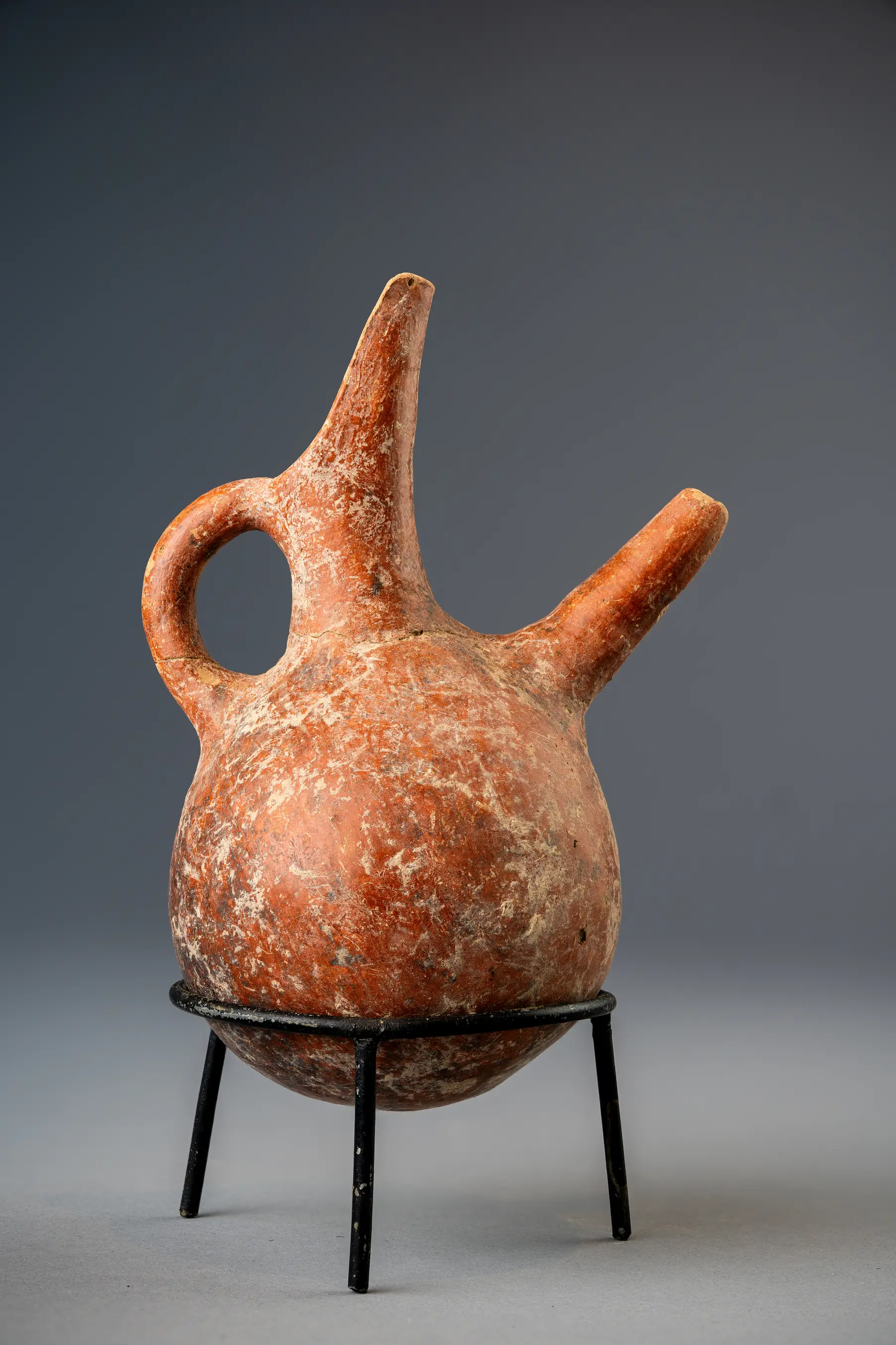
Before the Philia phase, conventionally dated from about 2400 BC, nobody on Cyprus made a jug, so far as the excavated record shows. The Chalcolithic villages had bowls, holemouth jars, a few bottles and flasks, and big storage pithoi. The Philia facies brought in the jug with a whole set of new closed shapes (Lesson 3), and Jennifer Webb and David Frankel found only one Philia shape with clear antecedents in the Chalcolithic: the bowl with a tubular spout [1, p. 39].
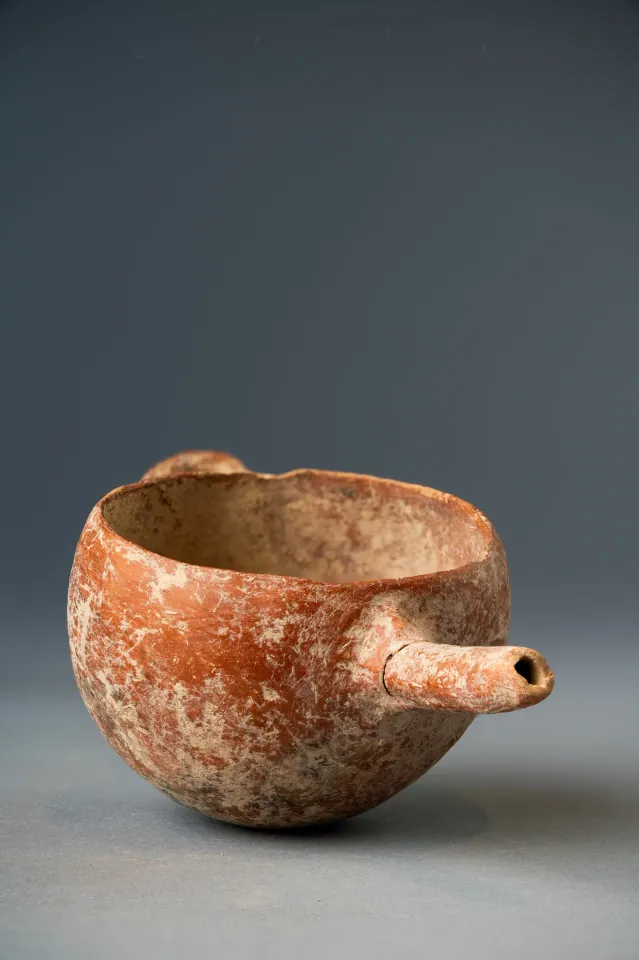
The bowl beside this paragraph is that survivor, several centuries on. It is Red Polished, the burnished red ware of the Early Bronze Age: deep and nearly globular, on a rounded base, with a tube of clay set just below the rim and a knob lug on the far side, made between Early Cypriot (EC) II and Middle Cypriot (MC) I, c. 2200 to 1900 BC. Beside a Philia jug it stands for a shape older than the Bronze Age, the jug for one that marks its start. A shape can carry a date. It also carries a name, usually a modern one, and the name is where most mistakes begin.
Ten plain words
In 1985 Desmond Morris, whose shape vocabulary Lesson 0 introduced, reduced every simple Cypriot shape to ten types defined by structure alone: jug, bottle, flask, jar, bowl, dish, box, dipper, basket and strainer, definitions that "do not depend upon or rashly imply any kind of function." His warning case was the melon-shaped box of Early Bronze Age tombs, "automatically called a pyxis" after the Greek cosmetic box, for which he found "not a scrap of evidence" [2, p. 48].
Naming a pot by Morris's scheme takes three questions, in order. How many handles? How wide is the neck? Is the mouth the widest part of the vessel? One handle and a neck make a jug, and that includes the juglet, which is simply a small jug; no agreed height divides the two. A narrow neck with no handle, or with two, makes a bottle. A body squashed flat from side to side makes a flask, whatever its handles. A symmetrical body with a wide neck is a jar, and an amphora is a jar with two opposed handles. If the mouth is the widest part, the pot is a bowl, unless it is flat enough to be a dish [2, p. 48].
The questions need only a few parts of a pot, and those parts have plain names. On the Red Polished jug drawn below, tap the handle, the neck and the mouth, the three that name a pot, then the base, which with the mouth helps to date it, and the spout, a second opening on the shoulder.
Hover over, or tap, a term to see the part on the drawing and what it means.
Red Polished Beak-Spouted Jug with Side-Spout, c. 2100 to 1850 BC. In the Drakopoulos collection.
Exterior outline traced from the photograph; the wall thickness is not known, so no section is drawn. Its height has not been recorded, so the drawing has no scale. Dashed: the lower body, hidden by a display stand in the photograph, reconstructed as a plain round base that continues the visible curve. Parts are placed at heights measured on the traced outline.
- Mouth: The opening. Bronze Age jugs often have a mouth cut away or pulled up into a beak; a mouth pinched into three lobes, a trefoil, is an Iron Age habit.
- Rim: The edge of the mouth. Catalogues describe its profile: flaring, everted, thickened into a ring, or cut flat.
- Neck: The narrowing between body and mouth. Its width helps name the shape: a narrow neck makes a jug or bottle, a wide one a jar.
- Shoulder: The upper body, where the wall turns in towards the neck; handles are often joined and painters often decorate here.
- Body: The container itself, named for its shape: globular, ovoid (egg-shaped), biconical, or squashed flat into a flask.
- Base: What the pot stands on. Round bases dominate the Early and Middle Bronze Age, ring bases the Late Bronze Age, flat or ring bases the Iron Age.
- Handle: A loop of clay to lift and pour with. Count them first: one handle and a neck make a jug, two opposed handles on a wide neck an amphora.
- Spout: Where the liquid leaves. Desmond Morris uses the word for any pouring mouth, cut-away or beaked; here it marks a separate tube set on the shoulder or wall, a side-spout.
One handle and a neck make it a jug, whatever its mouth does. Its round base and its beaked mouth put it in the Bronze Age, for reasons the section on jugs explains.
| Family | Morris's test | Not to be confused with | Bronze Age (handmade) | Iron Age (mostly wheel-made) |
|---|---|---|---|---|
| Jug, juglet | one handle, a neck | bottle (no handle, or two) | round bases; cut-away and beaked spouts | flat or ring bases; trefoil mouths; barrel jugs |
| Bottle | narrow neck, no handles or two | jug | small round-based bottles with string holes or lugs | small two-handled bottles on flat bases |
| Flask | body flattened sideways | bottle (round in section) | lugged flasks (Middle Bronze Age); "pilgrim" flasks (Late Bronze Age) | circular two-handled flasks |
| Jar, amphora | symmetrical, wide neck; amphora has two opposed handles | bottle (narrow neck) | round-based jars with vertical handles | large jars; belly-handled and vertical-handled amphorae; jars on three legs |
| Bowl | mouth is the widest part | dish | hemispherical; spouted "milk bowls"; wishbone handles (Late Bronze Age) | shallow, deep and footed bowls, two horizontal handles |
| Dish, plate | flat | shallow bowl (narrow base) | no true plate | two-handled plates from early in the Iron Age |
| Dipper | squat, with a tall handle | cup with a large handle | Red Polished and White Painted dippers | Plain White dippers in drinking sets |
| Strainer | a group of holes | Base Ring strainer "in tankard form" | strainer jugs; pierced bowls | |
| Basket | open-work bowl | none known | a few White Painted and Bichrome bowls |
The table draws on Morris [2, pp. 48-76], Gjerstad's Iron Age shape lists [4] and Iacovou on the plate [8].
Jugs: read the base, then the spout
Morris named the two parts of a jug that date it: the base and the spout [2, p. 48]. Round bases dominate the Early and Middle Bronze Age, ring bases take over in the Late Bronze Age, and the Iron Age jug stands on a flat base or a ring. The Philia jugs, on their separately made flat bases, are the early exception [1, p. 39]. The mouth follows a parallel rule. A plain round mouth occurs in every period. The beaked spout and the cut-away spout belong to the Bronze Age and do not outlive it, while the pinched or trefoil mouth, pressed in from both sides so that the rim makes three lobes, belongs to the Iron Age [2, p. 48]. A round-based Red Polished jug cannot stand on a flat surface, and Louise Steel wonders whether the flat and ring bases of the Late Bronze Age mean people had begun eating round a table [3].
The jugs and juglets below, from the Early Bronze Age to the Cypro-Archaic, are drawn to one height and set in date order. Read along the bottoms first, then along the tops.
Point at, or tab to, a pot for its name and date; select it to open its page.
The handmade jugs on the left sit on round bases and pour from beaks or cut-away spouts. The two Base Ring jugs of the Late Bronze Age stand on ring feet, and the wheel-made Iron Age jugs on the right stand on ring bases, with mouths pinched into trefoils.
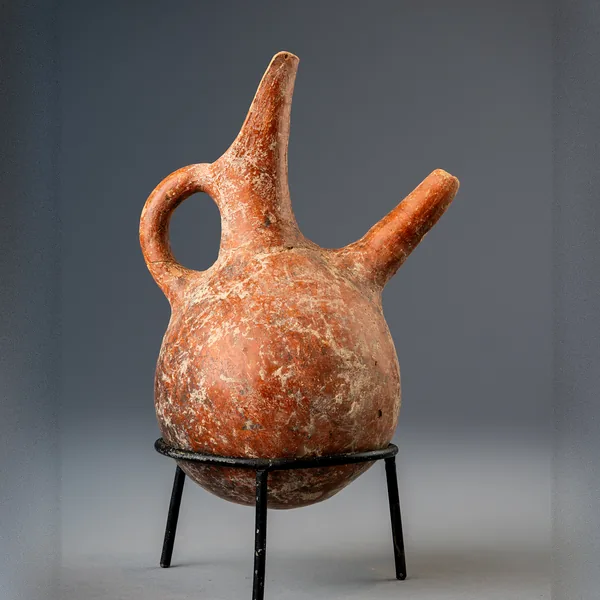
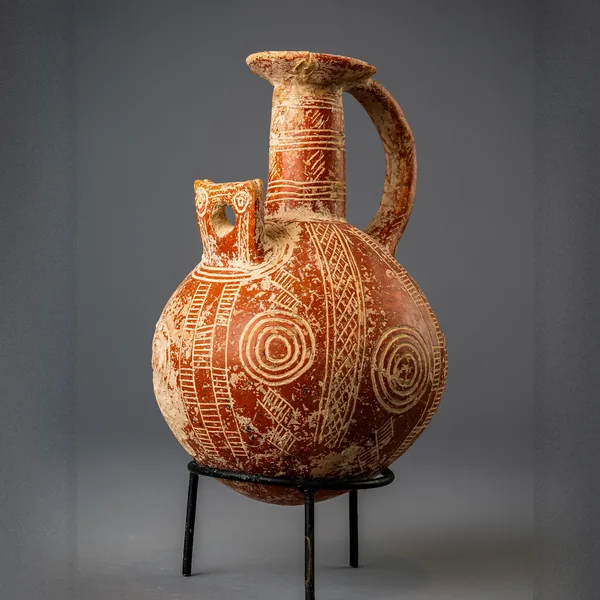
The two Red Polished jugs above show how freely Bronze Age potters treated the mouth. Both sit on round bases and both date to EC III or MC I, c. 2100 to 1850 BC. The plain one has a neck that narrows into a tall beak, cut away obliquely to a point, and on the opposite shoulder a second opening, a tubular side-spout angled upward, so that its silhouette forks. The other keeps a round mouth with a wide flat rim and puts its second opening on the shoulder as a hollow squared attachment pierced through the front, probably a side-spout of unusual form; its body carries large incised concentric circles between ladder and cross-hatched bands. Morris illustrates a jug that has both features, a cut-away beak and a side-spout, under deeply incised circles "typical of the Dhenia region" [2, pl. 10a], the potters of Deneia whom Lesson 4 follows. Why a jug needed two openings is undocumented; one reading is that one filled it and the other poured.
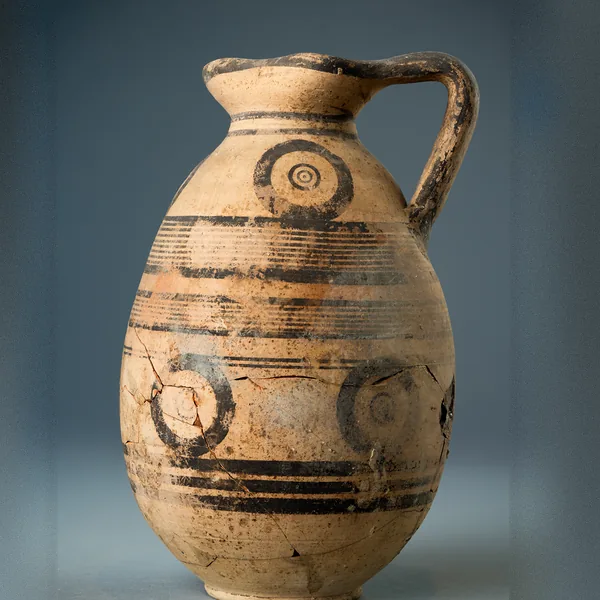
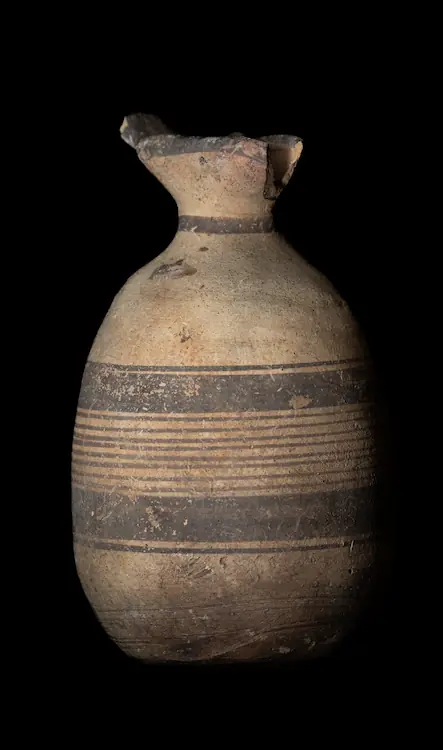
Iron Age jugs are also named by the body. Gjerstad's Cypro-Archaic jugs include an oval jug with a pinched mouth and a sack-shaped jug, its body sagging so that the widest point is low down [4]. The taller jug above, about 23 cm high and White Painted, is the oval kind: an egg-shaped body on a narrow ring base, a short neck, and a wide mouth pinched deeply into a trefoil, painted in zones with large thick-ringed concentric circles, c. 750 to 600 BC. The smaller one, 15 cm high and painted only with bands, is sack-shaped, of Cypro-Archaic I or II, c. 750 to 480 BC. Its rounded base is flattened just enough to stand. It has lost its handle, and only two breaks, at the rim and on the shoulder, show where a strap ran between them; without those scars Morris's first question would make it a bottle. Gjerstad found the later sack jugs "slacker" than the earlier [4], and this jug's low, heavy profile suits the later end.
Lesson 7 lets you make the oval jug yourself: throw its egg-shaped body on the wheel, pinch the mouth into three lobes, set the handle and paint the zones of circles.
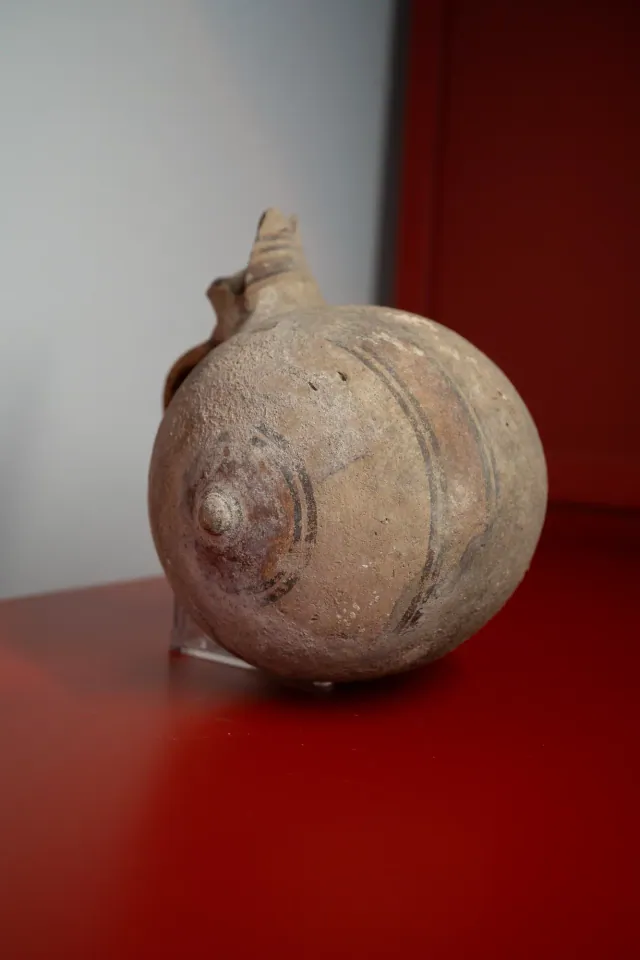
Morris added one base found only in the Iron Age, the barrel [2, p. 48]. The barrel jug illustrated here is Bichrome, a wheel-made ware painted in black and red, and it shows how the shape was built: the body was thrown on the wheel, closed at both ends with a small knob at the centre of each, and laid on its side, with a neck set into the upper face. Within the shape, proportion keeps time. In Einar Gjerstad's typology the body grows longer stage by stage, until in his Type V it is "still more elongated," almost a spindle [4]. This jug's short, full body sits early in the sequence: it was probably made in Cypro-Geometric (CG) III, between about 850 and 750 BC. The wheel "did not allow the freedom of handmade pottery," as Vassos Karageorghis put it [6, p. 78], so Iron Age potters varied proportion instead. Small barrel juglets of the same family travelled to the Levant in numbers, and there they mark Cypriot contact in the 10th and 9th centuries BC [5].
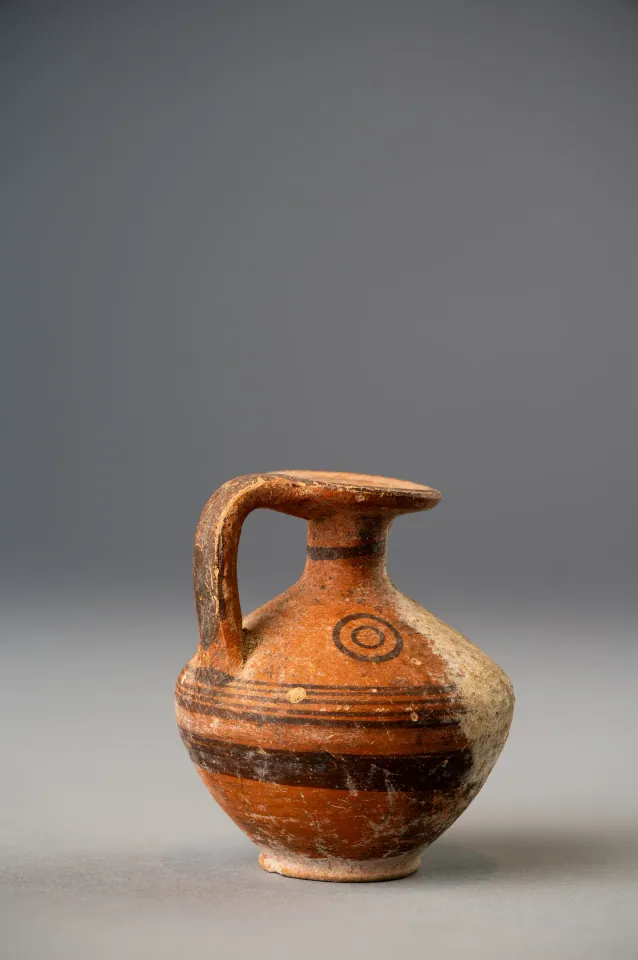
The juglet beside this paragraph is a jug in miniature. It is Black-on-Red, black paint on a polished red surface, and its squat body is two shallow cones joined at the widest point (biconical, in the catalogues), with a narrow neck, a flat disc mouth and one handle from rim to shoulder, a type Gjerstad placed in the ware's Cypro-Archaic (CA) II stage [4]; the juglet is most safely dated c. 700 to 475 BC. One handle makes it a jug. Take the handle off, or add a second, and the same body becomes a bottle.
Bottles and flasks
Early Bronze Age bottles are small and usually handleless, with two holes pierced near the mouth for a cord or a stopper. Middle Cypriot bottles in White Painted, the handmade ware with dark matt paint on a pale surface, carry two small pierced lugs, and Iron Age bottles normally have two handles and a flat base [2, p. 64]. Here the vocabularies clash: a narrow-necked pot with two handles is a bottle for Morris and an amphoriskos, a little amphora, in many catalogues.
A flask has been flattened sideways. Morris kept the word apart from "bottle" because flasks were traditionally carried about, and a squashed body travels better. On that definition he found none in the Early Bronze Age, though excavators use the word for some round-based Philia pots. Flasks became common in the Middle Bronze Age, "festooned with pierced lugs" for a cord, returned in the Late Bronze Age as pilgrim flasks, and in the Iron Age took the form of a flat circular body with two handles [2, p. 65], a lentoid shape Gjerstad traced to Syria and Palestine [4].
Jars and amphorae
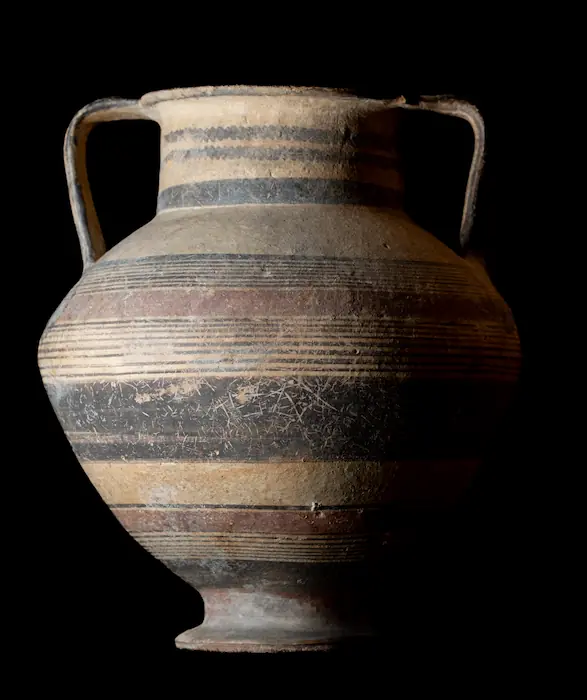
Morris's jar covers the amphora and anything else symmetrical with a wide neck. The Early Bronze Age jar is usually round-based with two vertical handles; jars grow rare in the Late Bronze Age and return in the Iron Age in numbers and at size, on ring bases [2, p. 66]. An Iron Age amphora is named by where its handles sit. The belly-handled amphora, with two horizontal loops on the widest part of the body, was "a very common shape of all Cypriot workshops"; the second series has two vertical handles from rim to shoulder [7, pp. 85-87]. The Bichrome amphora beside this paragraph, 25 cm high, belongs to the second series, with flat strap handles from rim to shoulder, and it adds a third feature to read: in place of a ring base it stands on a tall, splaying pedestal foot. Its painting is all horizontal, two wavy lines round the neck and a wide black belt across the belly, so the date rests on the shape and on footed amphorae of the same size in Stockholm and New York: CA I, c. 750 to 600 BC, or just possibly late CG III. The foot itself is older than that: an amphora of Bichrome III, the stage before, in the Severis Collection already stands on one.
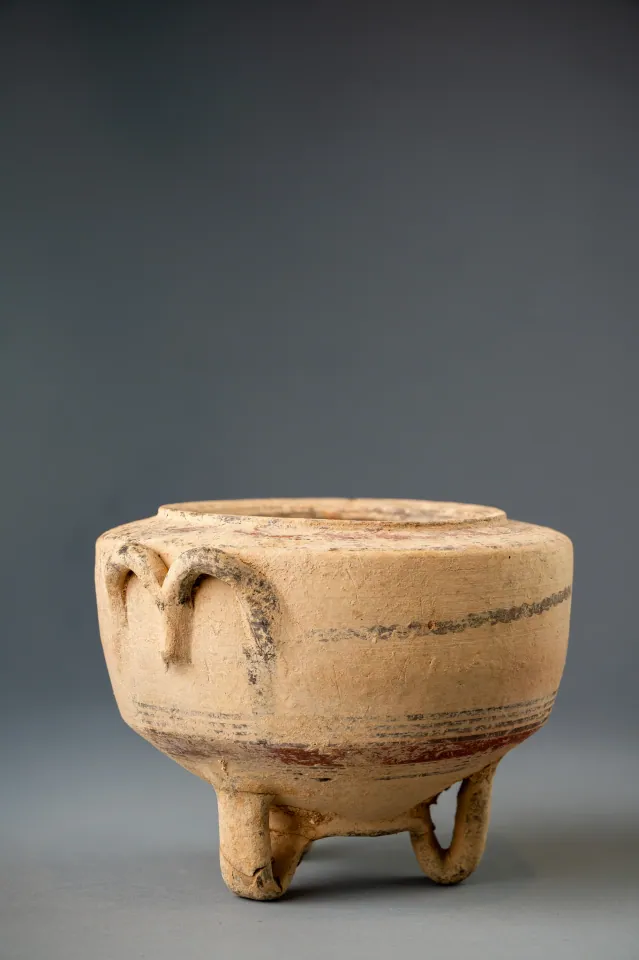
Gjerstad's Archaic jars include a squat relative, almost neckless, on a low foot or on three loop legs, often with double handles shaped like a pair of horns [4]. The Bichrome jar illustrated here has all three features: a broad flat shoulder, a short collar mouth, three legs each made from a strip of clay bent into an arch, and on each side two arched rolls of clay that meet and drop into one stem. It dates between CG III and CA I, c. 850 to 600 BC; comparable jars stand under 20 cm, too small for storage.
Three legs mean different things in different millennia. Morris found tripod jugs, round bases sprouting "three short stumpy legs," only in the Early and Middle Bronze Age [2, p. 48]. Gjerstad traced the Iron Age bowl on three loop legs to Syro-Palestinian models in metal or wicker [4].
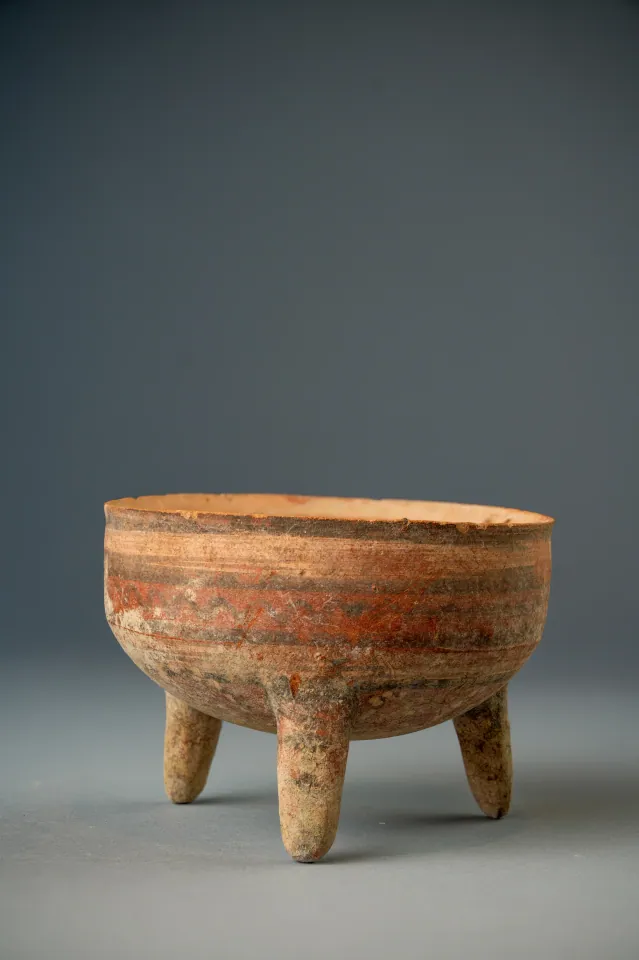
The Bichrome tripod bowl beside this paragraph, of the jar's date (CG III to CA I, c. 850 to 600 BC), stands instead on three solid legs, roughly cylindrical and tapering to rounded tips. Its deep, round-bottomed body was thrown on the wheel and painted like any table bowl, a dark band at the lip and a broad red band framed by dark lines. The legs belong to a plainer tradition. Their nearest match is a coarse cooking pot of CA I from a tomb at Kourion-Kaloriziki, standing on "three tall thin legs tapering toward the feet" [16], and stone bowls on three legs had been made on the island since the end of the Middle Bronze Age [17].
Bowls and dishes
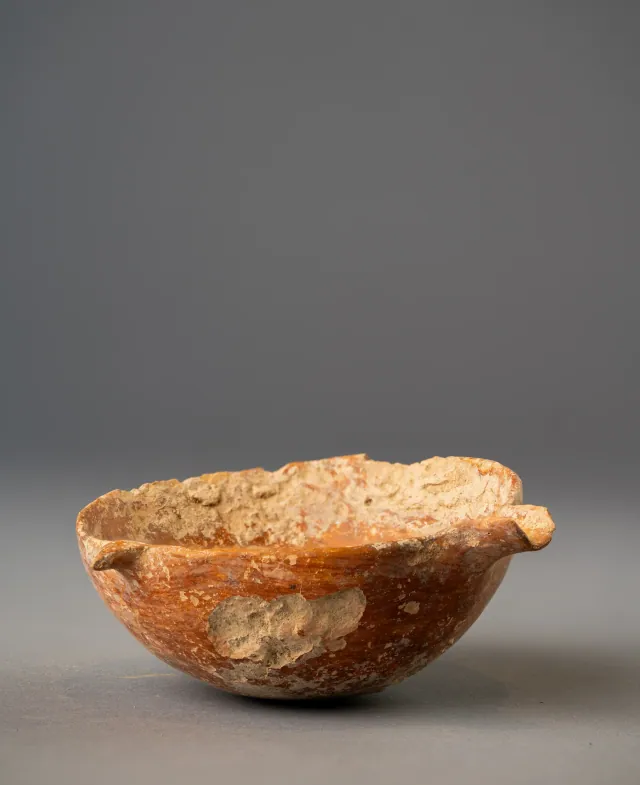
The typical Bronze Age bowl is a small hemisphere. In the Early Cypriot it has no handles, and the grip is a lug, a knob or flat tab of clay on the rim, usually single and often pierced. The Red Polished bowl illustrated here, of EC II to MC I, c. 2200 to 1900 BC, has the less common pair: two short tabs pulled out from the rim on opposite sides, each thickened and turned slightly up at the tip, so that the bowl could be lifted in both hands. True handles, loops of clay that the fingers pass through, arrive in the Middle Cypriot, and in the Late Cypriot the bowl turns them into the wishbone handle of White Slip and Base Ring bowls, the two handmade fine wares of the Late Bronze Age. Larger spouted bowls with pierced lugs, Morris's "milk bowls", run through the whole Bronze Age [2, p. 69]; the spouted bowl at the top of this lesson is a small cousin. His name comes from the vessel modern Cypriot shepherds milk into and says nothing about what the ancient bowls held; the same nickname is given to White Slip bowls for the colour of their slip (Lesson 5).
Follow the grip, and then the base, along the bowls below, drawn to one height in date order.
Point at, or tab to, a pot for its name and date; select it to open its page.
The handmade Bronze Age bowls keep their round bases and deep, rounded bodies while the grip changes, from the Early Cypriot lug, too small to show in these outlines, to the long wishbone handle of White Slip. The wheel-made Iron Age bowls stand on a ring foot or on legs; the deep Black-on-Red bowl also has a horizontal loop handle set below the rim, which does not show in its outline.
The dish, like the jug, has a datable birth (Lesson 7). The flat plate does not occur in Proto-White Painted, the last ware of the Bronze Age; it appears in advanced Cypro-Geometric I groups, soon after 1050 BC, and Maria Iacovou calls it a shape "of local inspiration" [8]. Morris thought it arrived "as a Greek import" [2, p. 73], and the disagreement is unresolved. Gjerstad told a dish from a shallow bowl by its wide flat floor [4]; later excavators admit that no ratio of base to rim has made the line sharper [9, Tomb 199].
Askoi: animals that pour
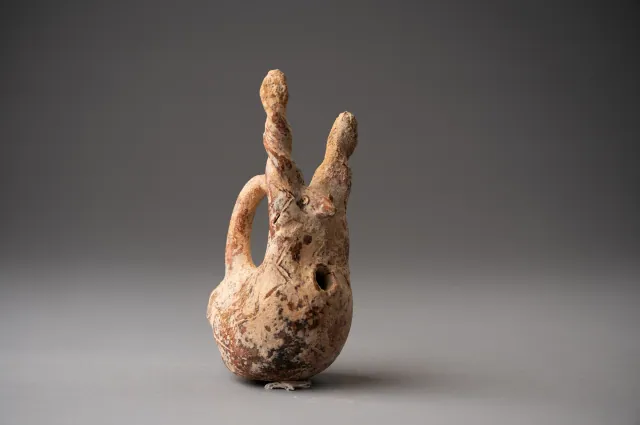
An askos, in Nota Kourou's definition, is "a closed shape with a basket handle and a cylindrical spout" [10], a basket handle being one that arches over the top of the vessel. In Cyprus the body was often an animal and the spout its head. The small vessel beside this paragraph has a globular body, a stub of a tail and a neck rising into a horned head, with a thick strap handle from the back of the head to the rear. It is probably Red Polished, of EC III or MC date, c. 2100 to 1750 BC. Animal askoi are absent from Late Cypriot (LC) IIIA and reappear in LC IIIB, which Kourou connects with renewed Aegean contact [10]; a small bird askos in the Metropolitan Museum shows the form still made in Cypro-Archaic I [15].
Composite vessels: shapes that breed
Morris sorted 279 composite vessels into three themes: rings carrying small pots (57), "multi-unit" vessels that repeat one element of an ordinary pot (188), and full-size pots with miniatures sprouting from them (34). His one-line definition of the class: "keep faith with the old, simple shapes, but let them breed" [2, pp. 77-79]. Most are Early and Middle Bronze Age Red Polished, and nearly all come from tombs, above all at Vounous and Lapithos on the north coast.
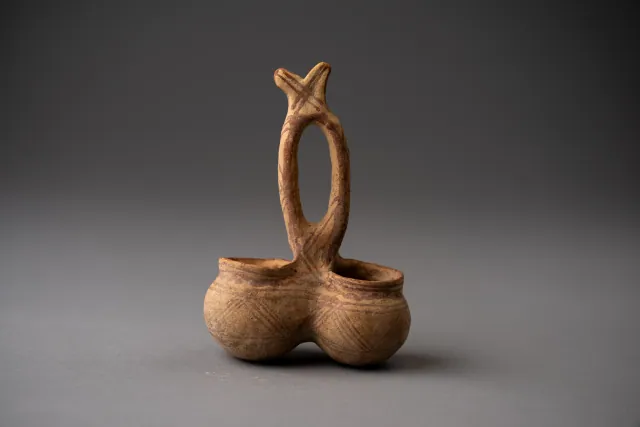
The simplest multi-unit vessel is two bowls joined side by side, and Morris traced only six, three in Red Polished and three in handmade White Painted [2, p. 85]. The White Painted double bowl illustrated here, of MC II to III, c. 1850 to 1650 BC, joins two small globular bowls, and from the point where their rims meet rises one tall, narrow loop handle ending in a forked finial.
Doubling the neck of a jug gave the twin-necked jug, 42 of them in Morris's count, all Early and Middle Cypriot [2, pp. 84-90]. The Red Polished jug drawn below, made on the north coast between about 2300 and 2000 BC, stands about 57 cm high. Two tall necks rise side by side from one round-based body, each ending in an obliquely cut mouth, and a single handle joins them at the back; between them at the front stand two flat modelled birds. Morris's first question still names it: one handle and a neck, twice over, make a jug.
Red Polished Double-Necked Jug with Two Modelled Birds, c. 2300 to 2000 BC. In the Drakopoulos collection.
Exterior outline traced from the photograph; the wall thickness is not known, so no section is drawn. Drawn to scale from the recorded height, about 57 cm. Dashed: the lower body, hidden by a display stand in the photograph, reconstructed as a plain round base that continues the visible curve.
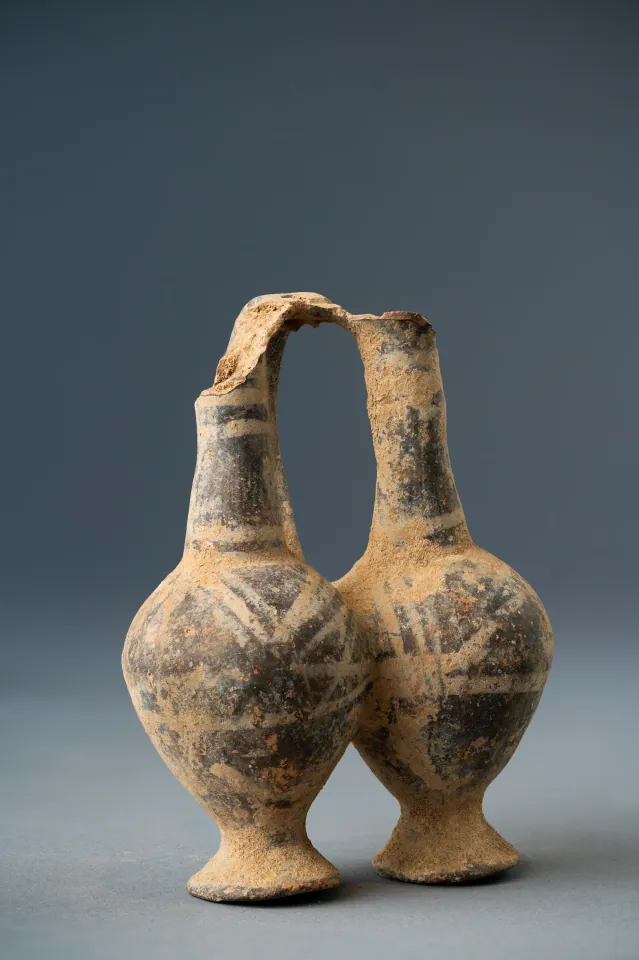
The habit outlived Red Polished. The Base Ring double juglet beside this paragraph, of the 15th to 13th century BC, is two juglets made as one: each has its own globular body and splaying ring foot, the bodies pressed together at shoulder and belly, and the long necks lean in and meet at the top in an arching bridge, now broken. Each half is a separate container; what either held is unknown.
Two names attach to these vessels and both overreach. A Greek kernos was a vessel of many little cups that kept different first-fruits apart. No Cypriot composite exceeds nine units, and the Red Polished rings are often hollow, so that liquid poured into one bowl finds its level in all; they "cannot be given the name of kernos" [2, p. 78]. "Cult vessel", a label from the excavations of the 1930s, assumes a use nobody has demonstrated; Lesson 13 asks whether such pots were made for the grave.
The rarities: baskets, strainers, dippers
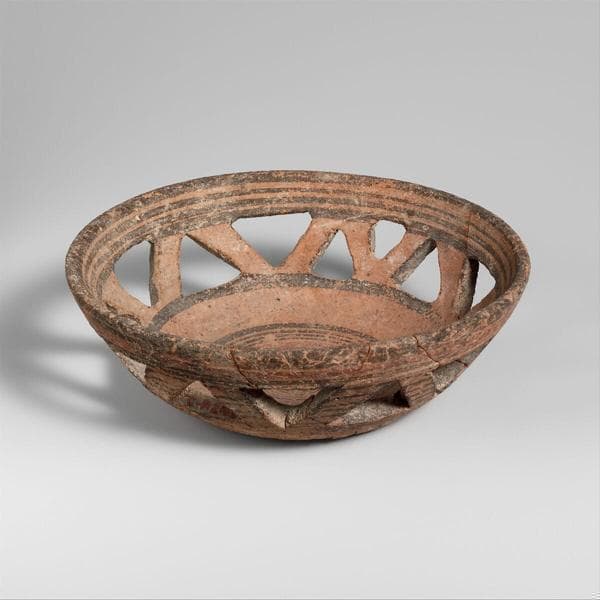
Morris's basket is an open-work bowl. He knew only a few, all Iron Age, in White Painted and Bichrome [2, p. 76]. The CG III bowl in the Metropolitan Museum illustrated here, 14.3 cm across, has triangles cut through its wall and bands of black and red; John Myres in 1914 saw it as imitating "openwork in wood or basketry" [11, nos. 586-587]. A bowl full of holes holds very little, and Morris put the pottery basket under "display" in his list of possible functions [2, p. 47].
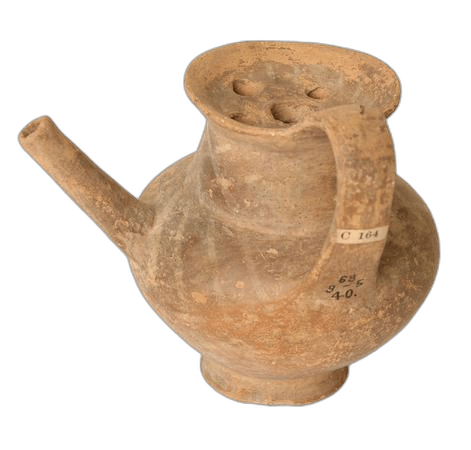
A strainer is any vessel with a group of holes, and Morris found three forms [2, p. 76]. The earliest is the Late Bronze Age "side-spouted strainer in tankard form," with the holes in a flat top. The Base Ring strainer jug from Dhali in the British Museum, 9.7 cm high, is that form: a tankard body, a solid top pierced by five holes, a tubular spout. The others are a shallow bowl pierced in the floor and a jug with a perforated plate inside its spout. That strainer jug was extremely popular in Cyprus and Philistia in the 12th century BC, and Jeremy Rutter links it to the Levantine "beer jug," its holes keeping floating barley kernels out of the drinker's mouth [12]. We know of no residue analysis of a Cypriot strainer jug, and the bronze strainers of the Palaepaphos warrior tombs belonged to wine sets [9].
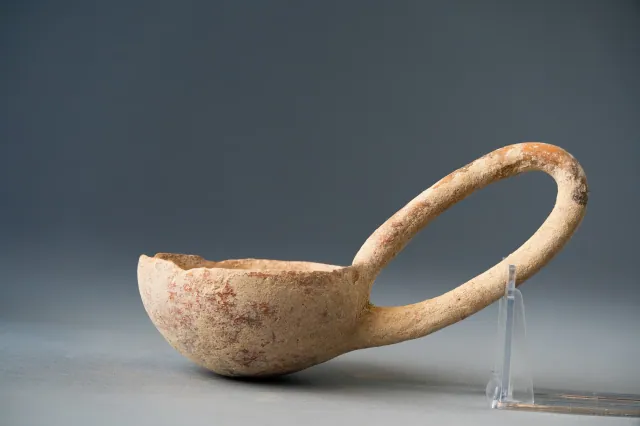
A dipper is a squat vessel with a tall handle, made to be lowered into a larger container and lifted out full. Morris preferred the word to "ladle" because some are too big for one, and thought they dipped into liquid or perhaps stored grain [2, p. 75]. The Middle Cypriot dipper illustrated here is the small kind: a thin-rimmed hemispherical bowl on a round base, with a loop handle that springs from the rim, arches out and returns to the lower body. Such dippers are rare even where they should be common: at Marki, Andrew Sneddon recorded one possible example in the cemetery and found them "similarly rare in the settlement assemblage" [13]. The clearest context for a true dipper comes later. At Palaepaphos-Skales the undecorated Plain White dipper "always occurs" with the drinking sets of LC IIIB and Cypro-Geometric I [14, p. 46], and one from a Cypro-Geometric chamber tomb, 15.5 cm to the top of its handle over a bowl only 8.7 cm wide, lay among the tomb's White Painted cups [9, Tomb 199].
Quiz
Check yourself
Question
Ask Morris's three questions of this handmade Red Polished pot. What is it?
Question
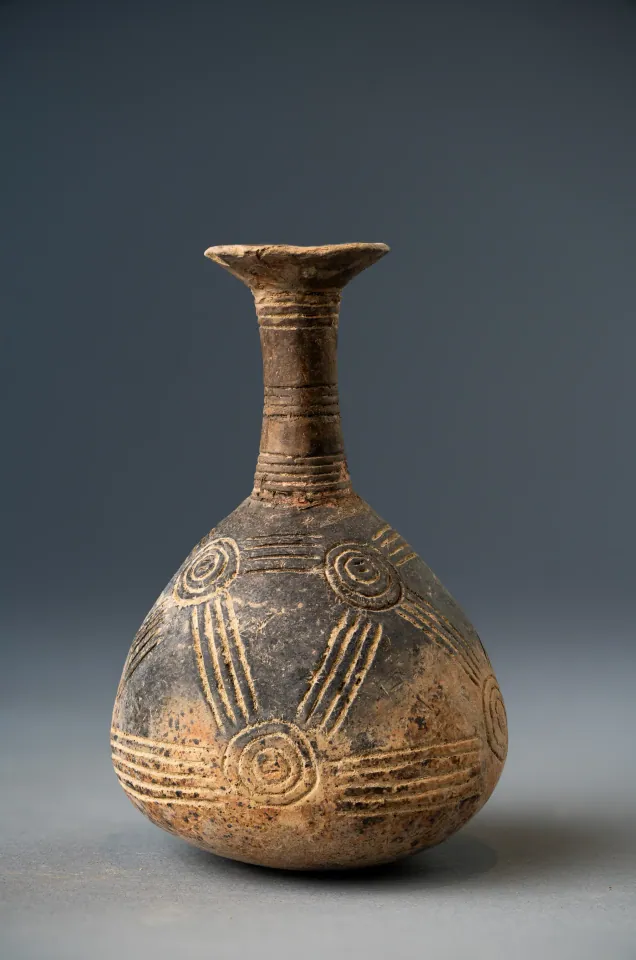
Read the base, then the mouth. When was this small handmade juglet made?
Question
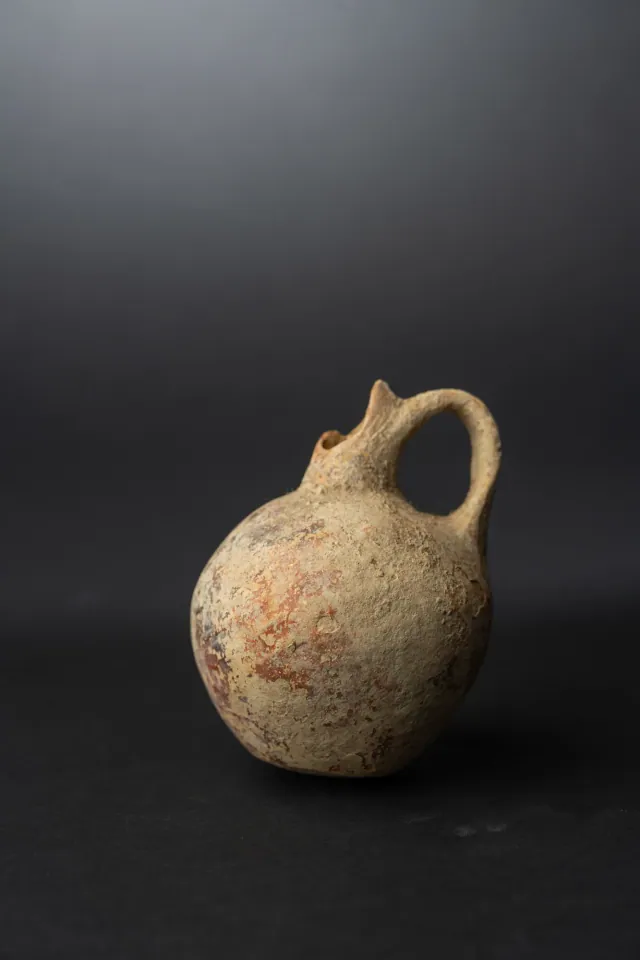
A pot has a narrow neck and two handles. What does Morris call it?
Question
Put these jugs in date order, oldest first.
Tap an item, then tap its place. Or use the arrows
Question
Two Bichrome barrel jugs: one short and full-bodied, the other drawn out almost into a spindle. Which is probably later?
Question
A handmade, round-bottomed jug stands on three short, stumpy legs. When was it made?
Question
When was the first flat plate made on Cyprus?
Question
Why did Morris refuse to call the Red Polished ring vessels kernoi?
What to look for
- Count the handles first. One handle and a neck is a jug or juglet; a narrow neck with no handle or two is a bottle; two opposed handles on a wide-necked body make an amphora.
- Check the base. Round bases are Early and Middle Bronze Age, ring bases Late Bronze Age, flat or ring bases Iron Age. A body lying on its side with knobs at the ends is an Iron Age barrel jug, and the longer the barrel, the later it is.
- Check the mouth. A cut-away or beaked spout is Bronze Age; a mouth pinched into three lobes (trefoil) is Iron Age.
- A flat two-handled plate is Cypro-Geometric or later; the Bronze Age had no true plate.
- Look under the pot. Three stumpy legs under a handmade round-bottomed jug are Bronze Age; three loop or tapering legs under a wheel-made painted bowl or jar are Iron Age.
- Joined bowls, twin necks and animal-headed askoi are mostly Early and Middle Bronze Age; paired juglets carry the habit into Base Ring. Read a "kernos" or "cult vessel" label as a museum convention.
- A Greek name on a museum label (oinochoe, pyxis, kylix) records a resemblance and nothing about use.
Go deeper
The compendium has a reference page for each family: jugs, bottles, flasks, jars, amphorae, bowls, dishes, dippers, strainers, baskets, complex vessels and tulip bowls and cult vessels, all gathered under Pottery Shapes. For single shapes at length, read the Cypriot oinochoe, Cypriot bowls, the two-headed askos and the Vounous double-necked bird jug.
References
- 1.Webb, J. M. and Frankel, D. (1999). Characterizing the Philia facies: material culture, chronology, and the origin of the Bronze Age in Cyprus. American Journal of Archaeology, 103(1), 3-43.
- 2.Morris, D. (1985). The Art of Ancient Cyprus, with a Check-list of the Author's Collection. Oxford: Phaidon.
- 3.Steel, L. (2016). Kitchenalia in Bronze Age Cyprus. Gastronomica: The Journal of Critical Food Studies, 16(3), 79–90.
- 4.Gjerstad, E. (1948). The Swedish Cyprus Expedition, Vol. IV, Part 2: The Cypro-Geometric, Cypro-Archaic and Cypro-Classical Periods. Stockholm: The Swedish Cyprus Expedition.
- 5.Gilboa, A. (2012). Cypriot barrel juglets at Khirbet Qeiyafa and other sites in the Levant: Cultural aspects and chronological implications. Tel Aviv, 39, 5–21.
- 6.Karageorghis, V., Mertens, J. R., & Rose, M. E. (2000). Ancient Art from Cyprus: The Cesnola Collection in The Metropolitan Museum of Art. New York: The Metropolitan Museum of Art.
- 7.Georgiadou, A. (2019). Aspects of pottery production of the workshops of Lapithos during the Early Iron Age. In D. Papanikola-Bakirtzi (Ed.), Αγγείων τέχνη από τη γη της Λαπήθου / Ceramic Art from the Soil of Lapithos (pp. 77–104). Nicosia: Leventis Municipal Museum of Nicosia and Lapithos Municipality.
- 8.Iacovou, M. (1991). Proto-White Painted pottery: A classification of the ware. In J. A. Barlow, D. L. Bolger, & B. Kling (Eds.), Cypriot Ceramics: Reading the Prehistoric Record (University Museum Monograph 74, pp. 199–205). Philadelphia: The University Museum, University of Pennsylvania.
- 9.Karageorghis, V., & Raptou, E. (2016). Palaepaphos-Skales: Tombs of the Late Cypriote IIIB and Cypro-Geometric Periods (Excavations of 2008 and 2011). Nicosia: The Cyprus Institute.
- 10.Kourou, N. (1997). Cypriot zoomorphic askoi of the Early Iron Age: A Cypro-Aegean interplay. In V. Karageorghis, R. Laffineur, & F. Vandenabeele (Eds.), Four Thousand Years of Images on Cypriote Pottery. Nicosia: A. G. Leventis Foundation.
- 11.Myres, J. L. (1914). Handbook of the Cesnola Collection of Antiquities from Cyprus. New York: The Metropolitan Museum of Art.
- 12.Rutter, J. B. (2006). Neopalatial and later Minoan pottery. In J. W. Shaw & M. C. Shaw (Eds.), Kommos V: The Monumental Minoan Buildings at Kommos. Princeton: Princeton University Press.
- 13.Sneddon, A. C. (2002). The Cemeteries at Marki: Using a Looted Landscape to Investigate Prehistoric Bronze Age Cyprus (BAR International Series 1028). Oxford: Archaeopress.
- 14.Karageorghis, V. (1983). Palaepaphos-Skales: An Iron Age Cemetery in Cyprus (Ausgrabungen in Alt-Paphos auf Cypern 3). Konstanz: Universitätsverlag.
- 15.New York, Metropolitan Museum of Art, 74.51.818. Askos in the form of a bird, Cypro-Archaic I. Collection record.
- 16.Benson, J. L. (1973). The Necropolis of Kaloriziki (Studies in Mediterranean Archaeology 36). Göteborg: Paul Åströms Förlag.
- 17.Bailey, D. M. (1968). The village priest's tomb at Aradippou in Cyprus. British Museum Quarterly, 33(1/2).