
Contents
Iron came into general use in Cyprus slightly earlier than in the Aegean, and the island's first iron weapons were flange-hilted daggers and swords placed in rich tombs of the eleventh and tenth centuries BCE. This entry follows Cypriot arms and armour from that point, about 1100 to 1050 BCE, through the Cypro-Geometric and Cypro-Archaic periods to the end of the Cypro-Classical kingdoms around 310 BCE. The bronze weapons that came before, including the origins of the bayonet spearhead and the Naue II sword, are covered under Bronze Age weapons. Most of the evidence comes from tombs, some from sanctuaries and figurines, and one group from a battlefield: the Persian siege mound at Palaepaphos, whose earthworks are described under fortifications. The record is weighted to the eighth to sixth centuries; evidence for the Cypro-Classical period itself is thin.
From bronze to iron
Iron knives with bronze rivets are the commonest iron objects in Late Cypriot IIIA and IIIB. Christopher Pare's 2025 synthesis dates the earliest Cypriot examples to the start of the twelfth century BCE; Aegean ones appear only after the middle of that century and in smaller numbers, so "it is certain that knife production started first in Cyprus". Iron "was apparently unknown in the island before the 12th century BC", and the technology "must have been transferred to Cyprus from somewhere in the Near East during the Crisis Years". Following Sherratt, Pare treats the knives as a new Cypriot export to the Levant and the Aegean, and concludes that "Cyprus was probably the sole producer of utilitarian iron implements in the 12th century BC" [1, p. 116]. Eric Cline lists bimetallic knives at Tylissos on Crete, Lefkandi on Euboea, Naxos and Thasos: "They all appear to have been made on Cyprus and were exported from there" [2, p. 122]. Waldbaum and Palermo argued for an earlier start in the Aegean, which Pare rejects as "based on an uncritical treatment of the contexts and chronology" [1, p. 116]. The trade is followed in Early Iron Age trade networks and the metals in metal in ancient Cyprus.
Snodgrass divided the adoption of iron into three stages: iron for display, iron in practical use but rarer than bronze, and iron more common than bronze. Cyprus reached the third stage around 1050 BCE, slightly ahead of the Aegean, and Pare concludes that it "was therefore the first region of the Ancient World to make the full transition from the Bronze Age to the Iron Age" [1, p. 117]. They disagree on why. Snodgrass tied the move to utilitarian iron to deliberate steel-making by carburization, quenching and tempering. Pare, reviewing the evidence from Cyprus and the Levant, finds this "unfounded: there is little evidence for intentional carburization and heat treatment in the early stages of ironworking" [1, p. 117]. After the mid-eleventh century the "warrior graves" of central Greece, Crete and Caria "exhibit very close relations with Cyprus" [1, p. 117].
Daggers and swords in the Early Iron Age tombs
Christian Vonhoff's 2013 study of Early Iron Age elite burials calls the flange-hilted iron dagger "the most prominent weapon during the LC III B/CG I periods" [3, p. 205]. Its type piece comes from Tomb 40 at Kourion-Kaloriziki (Late Cypriot IIIB), with a bronze spearhead of the rare "Kaloriziki" type, one of only three known in Cyprus [3, pp. 198, 204]. The daggers have "no immediate forerunners" in the Late Bronze Age and resemble the Naue II swords of Hector Catling's group IV [3, p. 198]. Many had hilts faced with ivory or bone, and Vonhoff suggests that "in certain cases" the dagger was "a ceremonial object rather than a weapon designed for actual combat" [3, p. 205].
The usual pairing in a rich Cypro-Geometric I tomb is an iron dagger with a bronze bayonet-shaped spearhead, as in Palaepaphos-Skales Tomb 76 and Amathus Tomb 523 [3, pp. 201, 204–205]. Skales Tomb 76, with at least three inhumations, also held jewellery, bronze bowls, tools, six iron knives and an iron long sword [3, p. 201]. The sword is 63 cm long, with a leaf-shaped, double-edged blade and broad midrib for cut and thrust, and a rounded hilt with a single oblong pommel spur. "The sword's point is broken and the blade was intentionally bent before its final deposition." Vonhoff calls it "a new feature of EIA weapon equipment not attested throughout LC III B" [3, p. 202].
Swords stayed rare. In 2013 Vonhoff added to the Skales sword an 81 cm sword from Nicosia Old Municipality Tomb 1 (Cypro-Geometric III), two short swords from Amathus Tombs 321 and 366, and eight fragments from Amathus and Lapithos, concluding that flange-hilted swords "including fragments do not exceed more than twelve specimens in total" and were "accessible only for an elite circle" [3, pp. 202, 205]. His paper on the Salamis royal tombs, given in 2015 and published in 2019, supersedes that count. It lists five complete iron swords of group IV, dated Cypro-Geometric I to III: Skales Tombs 76 and 210, Palaepaphos-Plakes Tomb 145, Amathus-Loures Tomb 964 and Nicosia Tomb 1. The Amathus Tomb 366 sword, with a fish-tail hilt and no pommel spur, is the one that resembles Naue II type A [4, p. 183]. Both papers derive the Iron Age swords from Naue II and argue for "cultural continuity" from the Late Bronze Age [3, p. 202; 4, pp. 183–184].
Rarer finds include an iron spear butt-spike of 17.35 cm from Amathus Tomb 311 (Cypro-Geometric II), "a formal revival of a genuinely bronze type in iron", and "the status symbol of an iron mace-head" in Skales Tomb 74 (Cypro-Geometric III), with bronze bowls, gold plaques and a Senet-type gaming stone [3, p. 203]. From Amathus comes a seventh-century iron cut-and-thrust sword, 51.5 cm long, which Veronica Tatton-Brown called "the longest example of this particular type known at present"; the type was popular on Crete but had Cypriot ancestors [5, p. 67].
Spears and arrows
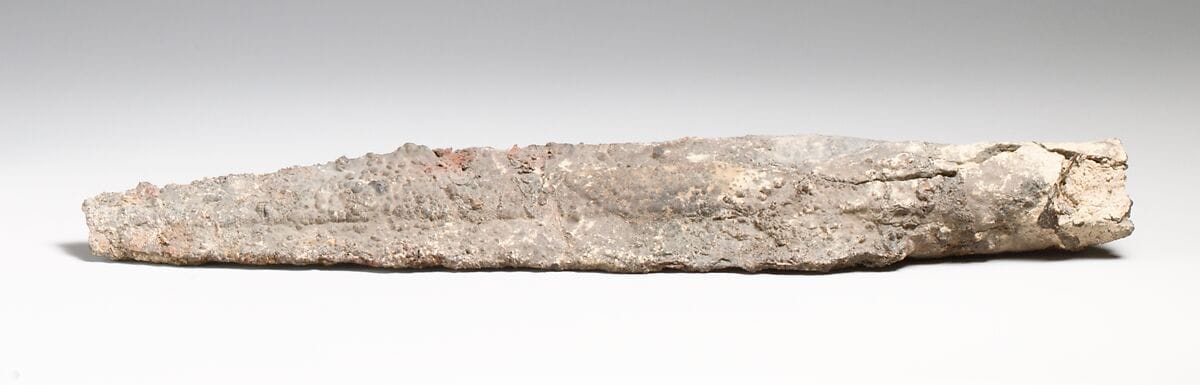
The bayonet-shaped spearhead, with a narrow blade, a midrib running to the tip and a tubular socket, "continued to be in use constantly until the Cypro-Archaic period when iron already long had replaced bronze". The largest bronze example, from Amathus Swedish Tomb 13, is 53.7 cm long, and the type also reached Crete, at Fortetsa and Knossos [4, pp. 185–186]. The Metropolitan Museum's Early Iron Age spearhead, 28.1 cm long, is a Cesnola piece without a find-spot.
The largest iron example is from Salamis Tomb 3: 59.5 cm, of bayonet type [4, p. 184]. The impression of its shaft survived in the soil, and the whole weapon reconstructs to 2.18 m [6, pp. 73–74; 4, p. 186]. Vassos Karageorghis's report suggested that it was hurled from the chariot beside which it lay. Vonhoff thinks it too large to throw with one arm and reads it as "a large thrusting weapon" for use from a chariot, on shipboard or hand to hand, comparing the pike of Aias in Homer [4, p. 186].
The bolt-shaped arrowhead is a heavy four-sided pyramidal head of rectangular section on a short tang, built for "armour breaking" [4, p. 187]. It was first made in Hittite contexts at Hattusha, Yazılıkaya and Alişar in the mid-second millennium, "probably designed for chariot combats" [4, p. 188]. The first Cypriot example is a bronze head of 8.9 cm from Skales Tomb 74 (Cypro-Geometric III) [3, pp. 203–204; 4, p. 187]. Later ones come from Idalion, Tamassos, Ayia Irini and the Palaepaphos siege mound (Cypro-Archaic I–II), and iron examples continue at the Athena sanctuary of Vouni in the fifth century and in Marion Tomb 43 in the fourth [4, p. 187]. Vonhoff reads the late arrival of the type as "a response to a changed military habit", when chariot fighting "suddenly seems to have become a more prominent and prestigious proclivity among Cypriot elites" [4, p. 188]; in 2013 he also allowed an introduction by Aegean migrants [3, p. 204].
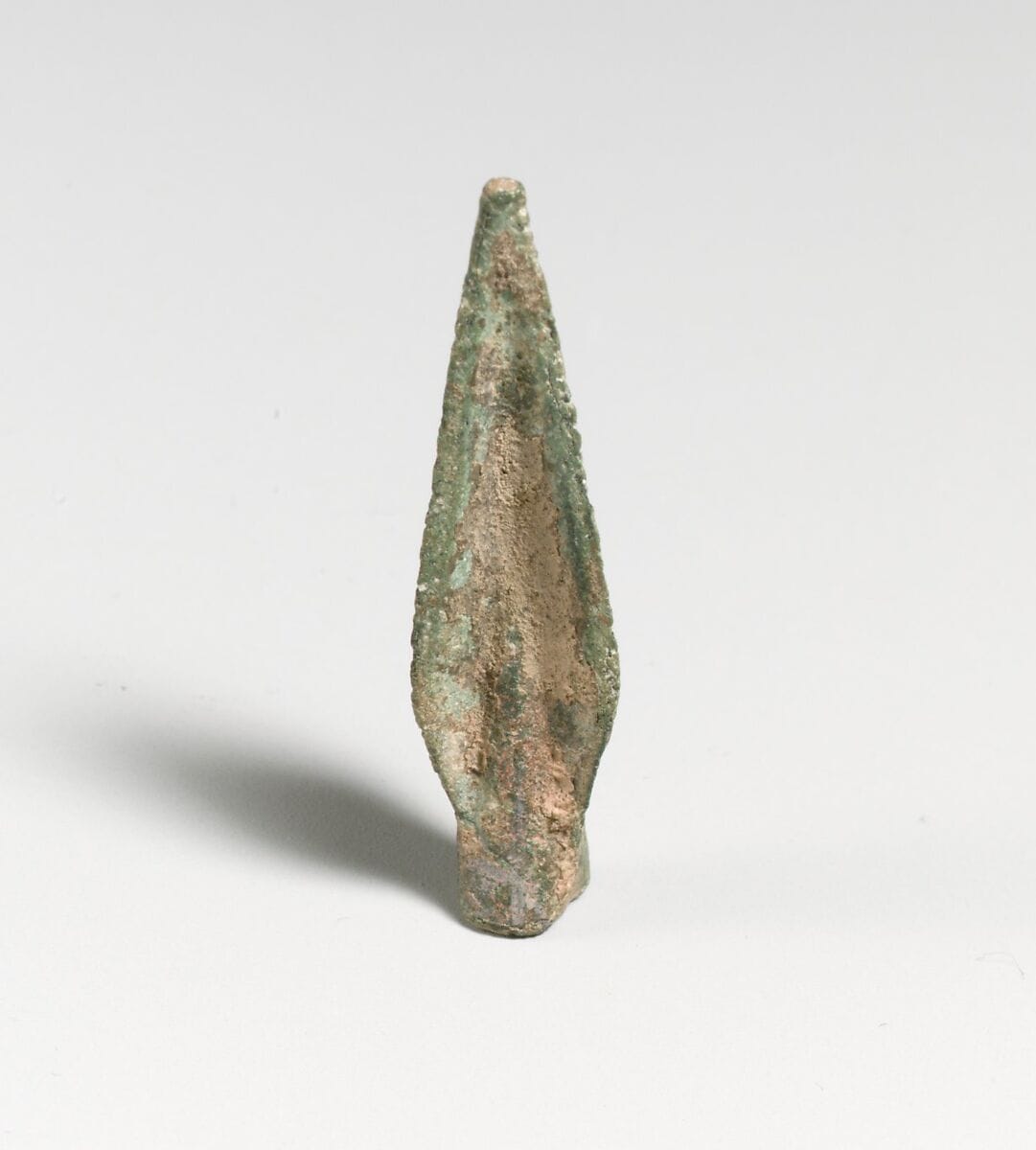
Salamis Tomb 3 held two bundles of arrowheads from quivers of perishable material: bolt-shaped heads of 7 to 12.5 cm, and flat willow-leaf heads with a small tang and no midrib, up to 16 cm, a widespread form with Cypriot forerunners at Dhima, Lapithos and Enkomi in the Late Bronze Age [4, pp. 186–189]. Vonhoff notes "a steady increase of arrowheads in tombs" in Cypro-Geometric III [3, p. 205]. A 4 cm Classical arrowhead in the Met is an unprovenanced example of the later series.
| Type | Material | Date in Cyprus | Key examples |
|---|---|---|---|
| Bimetallic knife | Iron with bronze rivets | From early 12th c. (LC IIIA–B) | Many; exported to Crete, Euboea, Naxos, Thasos |
| Flange-hilted dagger | Iron, often with ivory or bone hilt | LC IIIB to CG | Kourion-Kaloriziki T. 40 |
| Flange-hilted long sword (group IV) | Iron | CG I; revival in CG III | Skales T. 76, 63 cm, bent; Nicosia T. 1, c. 81 cm |
| Fish-tail sword (type A lineage) | Iron, silver-studded | CG III/CA I to CA II | Amathus T. 366; Salamis T. 3, 92 cm; Tamassos T. 12, 71 cm |
| Bayonet spearhead | Bronze, later iron | LC IIC/IIIA to CA | Amathus T. 13, 53.7 cm; Salamis T. 3, iron, 59.5 cm |
| Spear butt-spike | Iron | CG II (rare) | Amathus T. 311, 17.35 cm |
| Mace-head | Iron | CG III | Skales T. 74 |
| Bolt-shaped arrowhead | Bronze, then iron | CG III to 4th c. | Skales T. 74, 8.9 cm; Salamis T. 3, 7–12.5 cm |
| Willow-leaf arrowhead | Iron (bronze forerunners) | LC IIA to CA | Salamis T. 3, up to 16 cm |
| Scale cuirass | Iron, bronze borders | c. 500 BCE | Idalion sanctuary, c. 6,800 scales |
| Corinthian helmet | Bronze | c. 500 BCE, lost in the siege | Palaepaphos siege mound |
The Salamis chariot burials
Tomb 3 at Salamis, one of only two tumuli in the necropolis [4, p. 181], held a single burial dated by its pottery to about 600 BCE, and had been robbed by tunnelling, including a tunnel of 1896. Its first vehicle had wheels 85 cm across with eight spokes and no metal tyres, and Karageorghis wrote that "there is no doubt that it was a war chariot" [6, pp. 73–75]. A quiver stood on each side of the box, and part of a bronze circular shield and the iron spearhead lay beside it; an impression by one quiver "suggests a double curved wooden bow" [6, pp. 73–74]. Vonhoff calls it "the only known war-chariot from the Royal Tombs of Salamis so far" [4, p. 183].
Inside the box lay an iron sword, 92 cm long, with traces of a wood-and-leather sheath and silver-headed bronze rivets on the tang. Karageorghis identified it as "the type of 'silver-studded' sword described by Homer, several other examples of which are known from Cyprus", and compared its ivory sheath toggle with those on Assyrian reliefs [6, p. 74]. Vonhoff places its leaf-shaped blade and fish-tail tang in the Naue II type A line [4, pp. 181, 183]. The closest parallel is from Tamassos Tomb 12 (Cypro-Archaic II), now in the Fitzwilliam Museum: 71 cm long, with an ivory hilt and six silver-covered bronze rivets. Others come from Tamassos Royal Tombs 4 and 11, the "Royal tomb" at Kourion and a family tomb at Mari [4, pp. 181–182].
The second vehicle was a hearse. Its horses wore iron bits and bronze blinkers, head-bands, breastplates and side-pendant discs "such as appear ... on Assyrian reliefs and on terracotta chariot groups from Cyprus", with bells and bronze standards 54 cm high on the yoke, "obviously used for the funerary ceremony alone" [6, pp. 74–75]. The Assyrian background of this harness is followed under the Neo-Assyrian Empire.
George Papasavvas reads Tomb 79 differently. Two bronze warriors on the lynch-pins of its chariot wheels are "fully armed in a Near Eastern fashion, with an Assyrian-type helmet, a corselet with scale decoration, and a sword", "the closest that Cypriot art came to the explicit association of military prowess with royal power". Yet "Salamis Tomb 79 is not a warrior tomb, not least because none of the chariots found there could have been used for combat", and "very few weapons were found in the dromos" [7, p. 173]. Karageorghis's verdict on Tomb 3 and Papasavvas's on Tomb 79 concern different tombs, so both can stand; they differ on what the Salamis burials say about how kings fought.
Weapons in the grave: heroes or display?
Papasavvas stresses how few weapons the rich tombs contain: "several of the rich-in-metals tombs at Palaepaphos-Skales did not contain any weaponry at all, or a few pieces at best. Those that did, contained only one, or two at the most (mainly spearheads, and rarely any swords)", and most were multiple burials [7, p. 160]. The so-called warrior tombs at Tamassos, Palaepaphos and Idalion, with swords, shields, helmets and spearheads, place weapons beside feasting equipment such as iron obeloi and bronze cups, "traditionally associated with high status individuals and a heroic lifestyle" [7, pp. 160–161]. Cypriot weapon burials begin in the eleventh and tenth centuries, "but most date from the end of the 8th down to the early 6th century BC", while in the Aegean they "almost disappear after the middle of the 8th century BC" [7, p. 161].
The two scholars read this differently. For Vonhoff, weapons "attained a special meaning for noble men all over Cyprus", and their "international" range brings these men "closely into line with the ruling class of the Homeric basileis" [3, p. 206]. Papasavvas concludes that Cyprus "seems to have refrained not from war, but from its use as a visual mark of social power" [7, p. 172].
Helmets, shields and body armour
Tatton-Brown describes shields of perishable material "reinforced with iron or bronze bosses, both rounded and spiked", an all-metal spiked shield in the seventh century, later modification under the influence of the Greek hoplite shield, and shields with animal-head protomes through much of the Archaic period [5, pp. 66–67]. "Helmets in the earlier Iron Age were generally of Near Eastern varieties", modified under Greek influence in the later seventh and sixth centuries with the noseguard and projecting cheekpieces of the Corinthian type, which itself "was probably adopted, if not universally, towards the end of the sixth century BC" [5, pp. 67–68]. From the late seventh century leather or linen armour with metal additions "began to replace the older scale body-armour", and she argues that "Cypriot warriors played a part in the development of the Greek 'composite corslet'" [5, p. 68]. Her main witness is a three-bodied terracotta warrior from Pyrga, late seventh century and 24 cm high, whose breastplates are "among the earliest of an innovative type combining metal ... with linen or leather" [5, p. 67].
One scale cuirass survives. The Swedish Cyprus Expedition found it in the sanctuary deposit at Idalion, thrown into a pit with pottery; Marie-Louise Winbladh dates it to about 500 BCE and calls it "one of the few scale armours from such an early period" still preserved. It had about 6,800 overlapping iron scales, each with a longitudinal projection and holes, and a few bronze scales probably used as borders. No nails were found, so the scales "must have been laced or sewn on a lining of cloth or leather". The cork-model reconstruction "is not technically exact", its shoulder pieces copied from cuirasses on sculpture [8, p. 5].
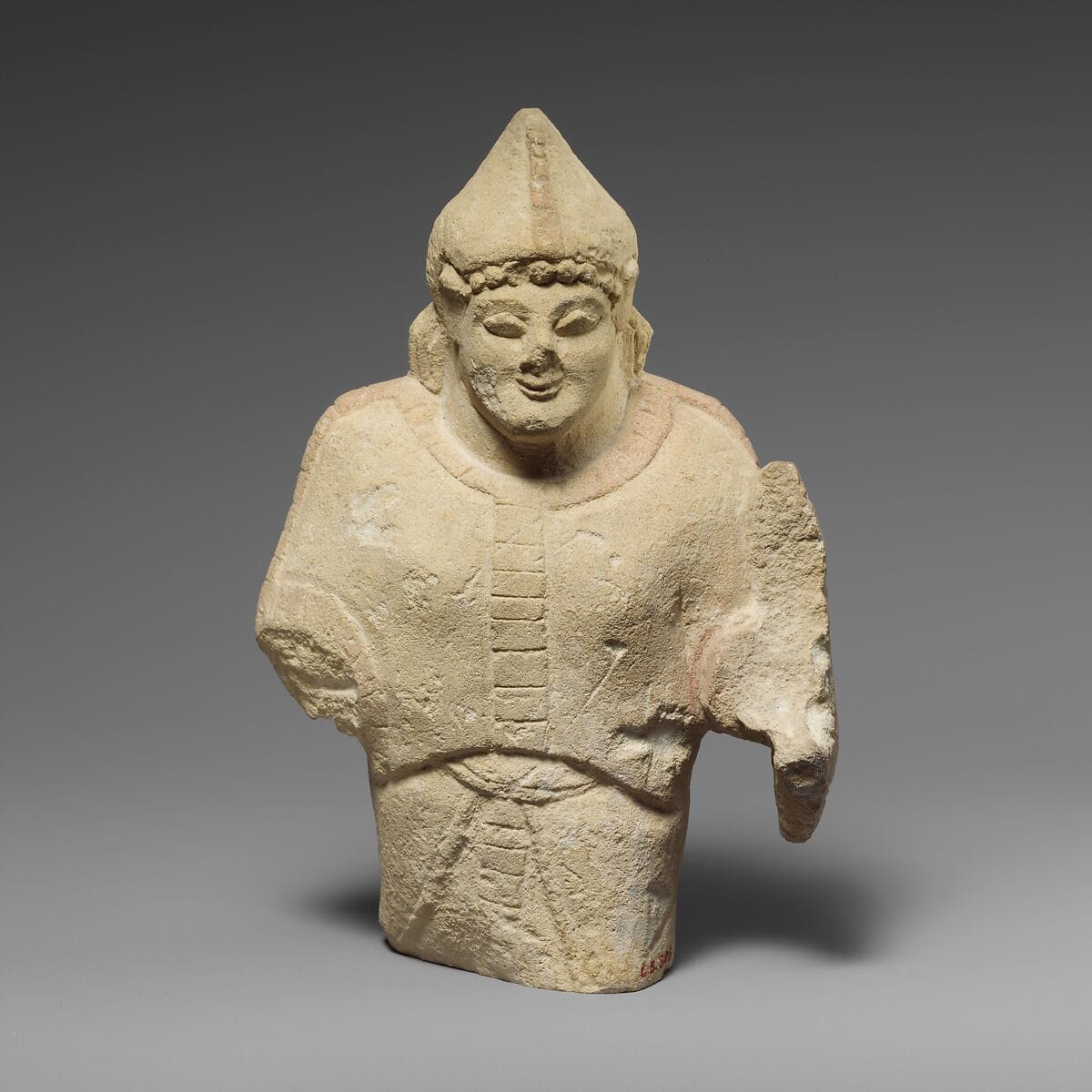
Sculpture adds a little. Tatton-Brown describes the warriors on a limestone sarcophagus from Golgoi of about 470 to 460 BCE as Greek hoplites with Corinthian helmets, composite corslets, greaves, hoplite shields and long spears [5, p. 68]. The Metropolitan Museum's Golgoi sarcophagus (74.51.2451), dated about 475 to 450 BCE, is probably the same piece, though her length (239.4 cm) does not match the museum's 202 cm. Stone warriors "of any kind are extremely rare", according to Papasavvas, who lists a helmeted head with a relief falcon from Golgoi-Ayios Photios and two warrior statuettes from the same sanctuary, one of the mid-sixth century with a Greek-style helmet and sword, one of about 500 BCE with a shield and conical helmet [7, pp. 163–164]. The Met's limestone warrior holding a shield, also from Golgoi and 16.2 cm high, is catalogued as wearing an Assyrian helmet, a loose tunic and an Egyptian loin-cloth. The wider series is covered under Archaic limestone sculpture.
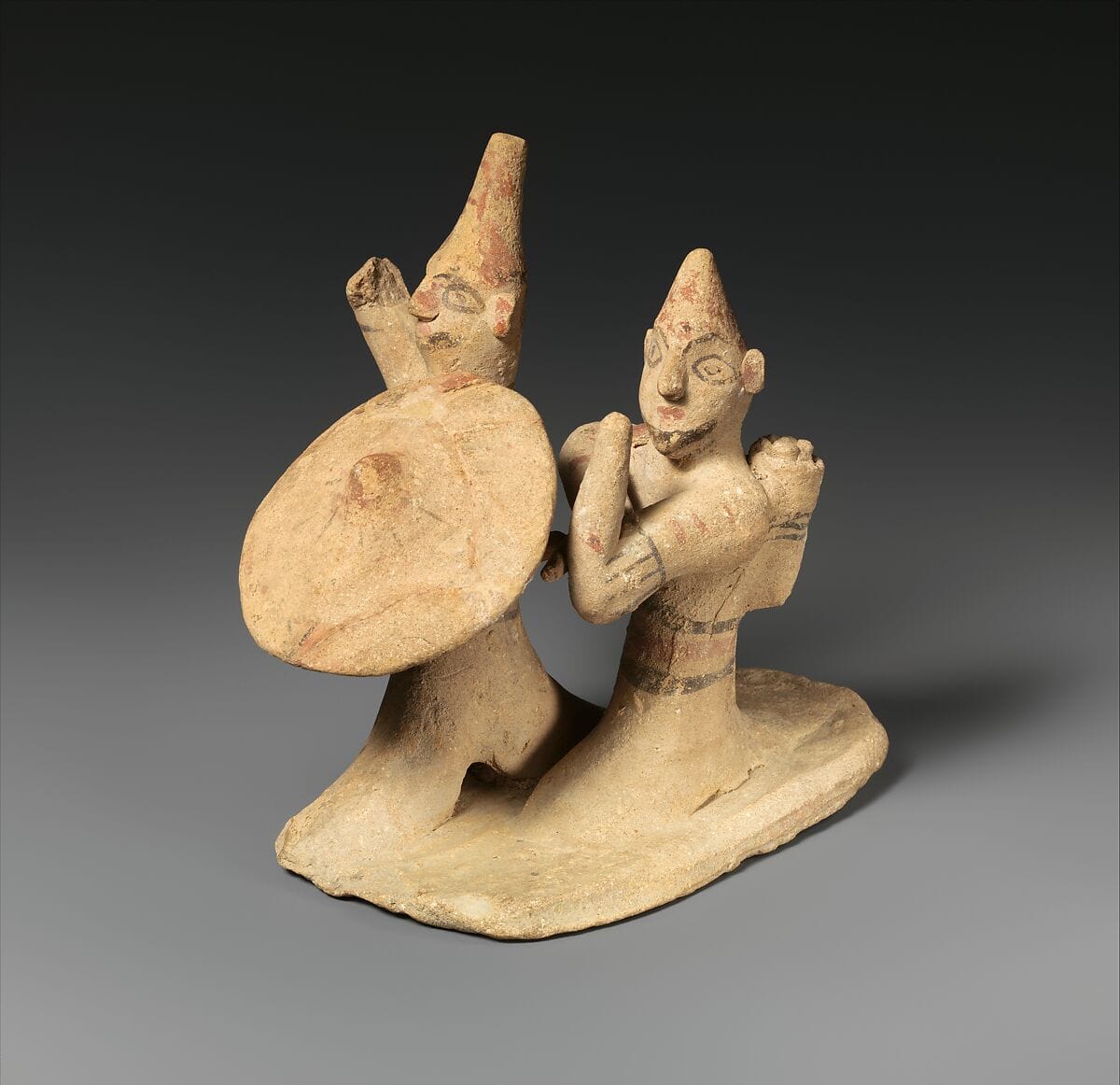
Terracottas are far more numerous. Horse riders, "by far the most popular genre of the Archaic Cypriot coroplastic art", sometimes carry a sword, dagger or shield and wear crested helmets, but "none of these riders is actually shown in action" [7, pp. 161–162]; the class is described under horse-and-rider figurines. Their conical headdress "was not necessarily a helmet", and some of these figures are "clearly designated as votaries, rather than warriors" [7, p. 162]. Standing warriors usually carry a round shield and sword; there are large examples from Ayia Irini and Kazaphani, but most are small seventh-century snowman figurines, some read "as toy soldiers" [7, p. 162]. Among the 2,000 terracottas from Ayia Irini, some wear "helmets, corselets and swords in scabbards suspended from their shoulders", yet no consistent insignia of rank appears: "no kind of standardized artwork related to warfare was established on the island" [7, p. 163]. The Met's Cypro-Archaic II terracotta warriors (74.51.1644, 15.1 cm) pairs a foot soldier in a conical helmet and round shield with an archer carrying bow and quiver (museum record).
Chariots in battle?
Herodotus (V.113) mentions Cypriot war chariots in the battle fought at Salamis in Cyprus in 498 BCE, and the passage has been taken to show that fighting chariots survived in Cyprus into the early fifth century, long after they had lost importance in the Near East. Papasavvas accepts that Cypriot kings probably rode to battle in chariots, "but that they actually fought standing on their chariots is far from credible". "There is no undeniable testimony that chariots ever played an active role in battle in Cyprus"; the terrain did not suit them, and they were probably "a conveyance for warriors who fought on ground, combining prestige with swiftness" [7, p. 164]. A fifth-century stone chariot group from Tamassos (Cyprus Museum 1955-C 3395) carries an unarmed man in a long tunic, "an aristocratic charioteer" in his description [7, pp. 165, 189]. The Met's Cypro-Classical charioteer in a long chiton is a figure of the same kind, and its Cypro-Archaic II chariot group, said to be from Amathus, has a box for a single driver.
Vonhoff argues the other side from the weapons. For him the bolt-shaped arrowheads were chariot-fighting heads, and the Tomb 3 chariot, with two quivers, a bow, a shield and a thrusting spear, was equipped for combat [4, pp. 186–188]. Papasavvas's case rests on the lack of reliable images or texts of Cypriots fighting from chariots, Vonhoff's on what was buried with them.
The siege of Paphos, 498 BCE
The Persian siege mound at Palaepaphos is the one group of weapons in this entry found where they were used. At the north-east (Marcello) gate the attackers buried the glacis, ditch and berm under "a vast pile of stones, rubble and earth", 4.50 m above the edge of the counterscarp and more than 7 m above the bottom of the fosse, filled in part with sculpture from a destroyed Archaic sanctuary [9, pp. 199–200]. The defenders dug counter-mines: a roofed passage through the berm and four tunnels under the wall [9, p. 202]. The earthworks are described under fortifications.
The mound produced "more than 500 javelin points, spearheads, and arrowheads, of both iron and bronze", fragments of an iron helmet, and "an exceptionally well-preserved Late Archaic Greek bronze helmet of the Corinthian type", with striding lions on the cheekpieces and "eyebrows" ending in snakes' heads. Maier and Karageorghis called it "the only Greek bronze helmet found so far in a battle context, as opposed to votives or grave-gifts" [9, p. 200]; Maier's later Guide dates it to about 500 BCE [10, p. 69]. Tatton-Brown observed that it "was apparently already a generation old when it was lost" and suggested that it "may have been worn by a Greek mercenary fighting on the Persian side, rather than by a Cypriot defender" [5, p. 68].
The mound also held "more than 450 roughly shaped rounded limestones with one flattened side" [9, p. 200], and the excavator gave two readings of them. In 1984 Maier and Karageorghis took them as probably "ammunition for some kind of stone-throwing engine", so that the belief that catapults were first used by Dionysios I at Motya in 399/398 BCE "may have to be reconsidered" [9, p. 202]. Maier's later Guide withdrew this: "according to our literary sources catapults were not used before 399 BC ... Thus we must assume that the defenders threw these missiles by hand from the parapet" [10, p. 69]. The Guide calls the ramp and the mine "the most formidable weapons of siegecraft borrowed by the Persians, and later by the Greeks, from the Assyrians" [10, p. 69]; the Persian side is covered under Achaemenid Persia.
What remains open
The sword corpus is small enough that new tombs change the count, as the gap between Vonhoff's 2013 and 2019 lists shows [3; 4, p. 183]. Whether Cypriot elites fought from chariots, and whether weapon burials express a Homeric warrior ideal or occasional display, still divides Vonhoff and Papasavvas [4, p. 188; 7, pp. 164, 172]. Who wore the Paphos Corinthian helmet, and how the siege stones were thrown, are open. The Cypro-Classical period is the thinnest part of the record: the Idalion cuirass, the Golgoi sarcophagus, the iron arrowheads from Vouni and Marion and the Tamassos charioteer are nearly all that survives. Most Cesnola weapons and figurines in the Metropolitan Museum have no recorded context and can be dated only by type.
Objects on this page
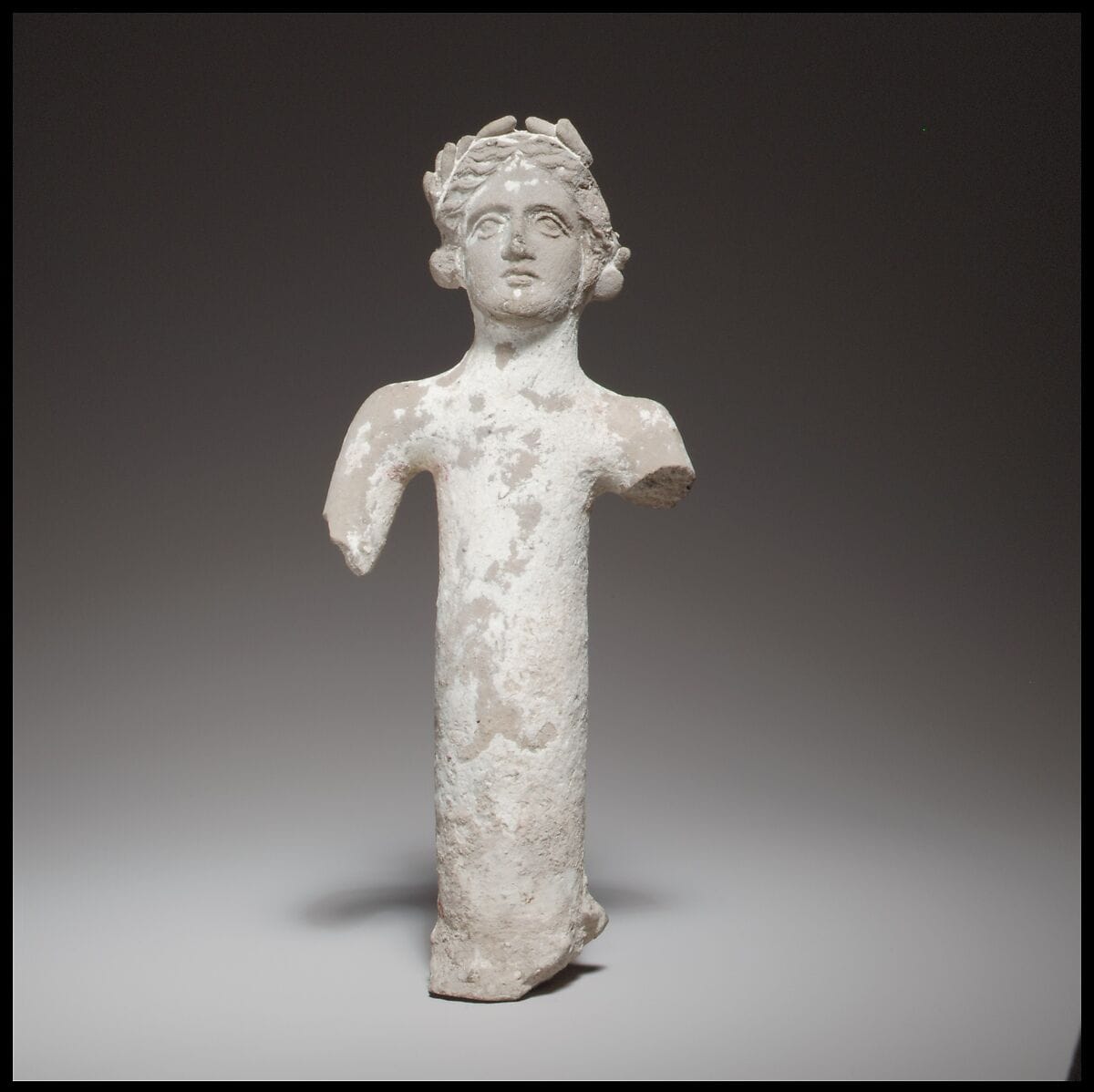
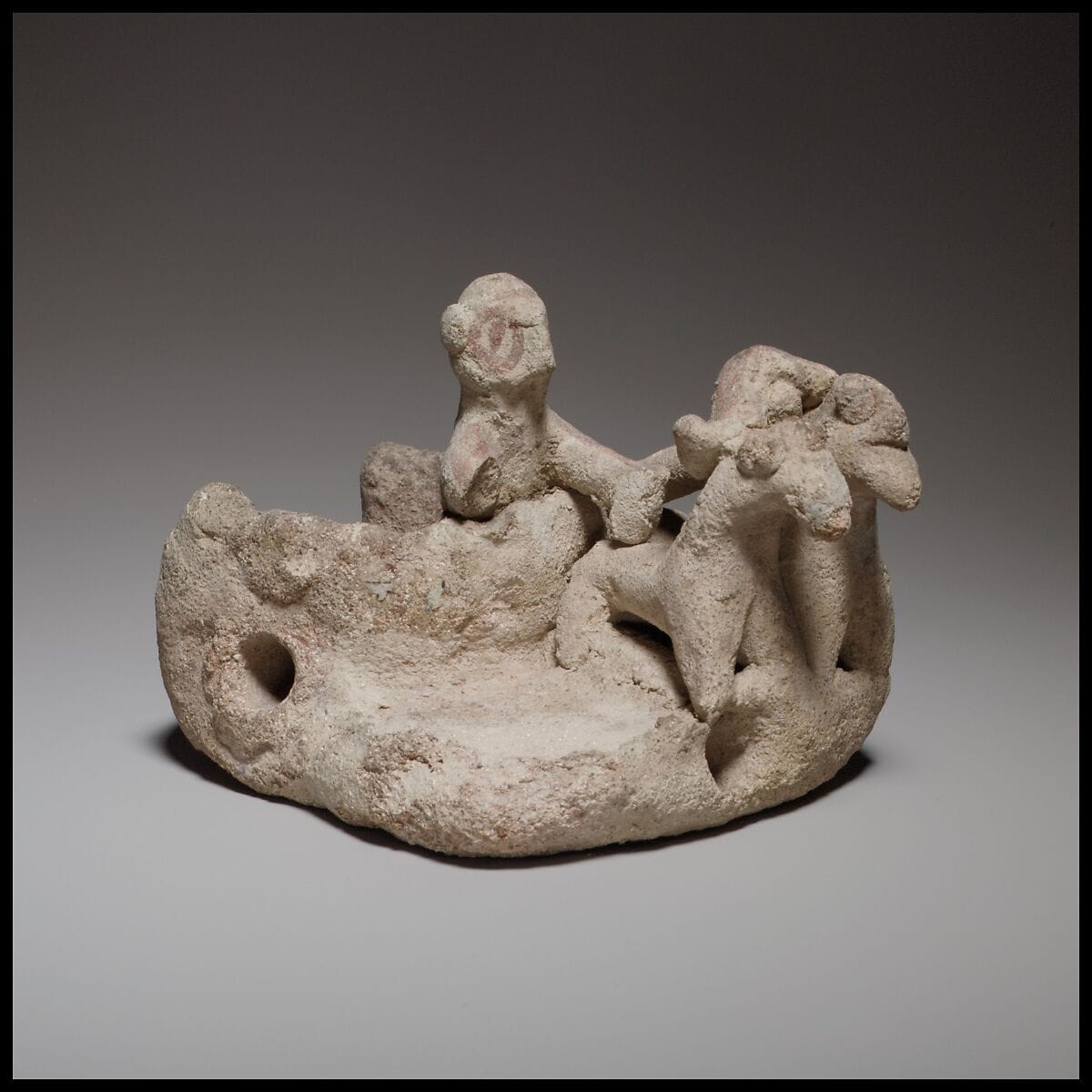
References
- 1.Pare, C. (2025). Iron and the Iron Age: The introduction of iron in Europe and Western Asia. Archaeopress. Open access (CC BY-NC-ND 4.0).
- 2.Cline, E. H. (2024). After 1177 B.C.: The survival of civilizations. Princeton University Press.
- 3.Vonhoff, C. (2013). Offensive weapons in Cypriot Early Iron Age elite burials (LC III B/CG) as indicators for autochthonous traditions and external cultural influences. Pasiphae: Rivista di Filologia e Antichità Egee, 7, 193–204.
- 4.Vonhoff, C. (2019). Iron weapons from the Archaic royal tombs at Salamis. In S. Rogge, C. Ioannou, & T. Mavrojannis (Eds.), Salamis of Cyprus: History and archaeology from the earliest times to late antiquity. Conference in Nicosia, 21–23 May 2015 (pp. 177–194). Waxmann.
- 5.Tatton-Brown, V. (1987). Ancient Cyprus. British Museum Publications.
- 6.Karageorghis, V. (1969). Salamis in Cyprus: Homeric, Hellenistic and Roman. Thames and Hudson.
- 7.Papasavvas, G. (2014). Warfare and the Cypriot kingdoms: Military ideology and the Cypriot monarch. Cahiers du Centre d'Études Chypriotes, 44, 153–190. https://doi.org/10.3406/cchyp.2014.1546
- 8.Winbladh, M.-L. (n.d.). Idalion: Abode for the goddess of love and war.
- 9.Maier, F. G., & Karageorghis, V. (1984). Paphos: History and archaeology. A. G. Leventis Foundation.
- 10.Maier, F. G. (n.d.). Guide to Palaipaphos (Kouklia).