
Contents
Cloth almost never survives in Cyprus, so the history of spinning and weaving on the island is written from the tools: bone needles, perforated discs, clay and stone spindle whorls, loom weights, the vats of dye-works, and a single metal spindle with its thread still wound on the shaft. Joanna Smith put the chronological problem in one sentence: the earliest evidence for a woven textile on Cyprus dates to the Neolithic, but the earliest evidence for spinning and weaving tools dates to the Early Cypriot period [1, p. 295]. Between those two points lie several thousand years in which people made cloth without leaving any tool that can be securely identified as a spinning implement. This entry follows the tools from the Neolithic to the Cypro-Archaic period. The garments these tools made are treated under clothing and dress.
Identifying a spinning tool
A spindle whorl is a weight threaded onto a wooden shaft to act as a flywheel: it keeps the spindle turning long enough to put twist into drawn-out fibre. Because any small pierced object can look like one, the modern literature applies explicit tests. Smith's checklist asks for wear around one end of the hole (the other end is protected by the spun thread), a diameter of at least about 2 cm (anything smaller is more likely a bead), symmetry about the perforation, a hole generally no wider than 1 cm, and a weight of up to about 150 g; whorls of 10 g or less were probably too light for wool or flax [1, p. 291]. The Cesnola catalogue uses a simpler rule of thumb, that an object with a perforation under 4 mm is probably a bead [7, p. 254]. A diameter matters as well as a weight. A whorl with a small diameter turns faster than a broad one and produces a more tightly spun thread with more twists per unit of length [6].
Applied to Late Cypriot material, Smith found that many terracotta "whorls" pass, but most of the stone objects and all of the bone and ivory ones fail on wear, weight or perforation, and are better called beads, buttons or parts of pins [1, pp. 291–292]. The British Museum's catalogue shows the problem in its wording: a polished steatite biconical piece from Hala Sultan Tekke, 1.9 cm across, is recorded as a "spindle whorl or bead". The Metropolitan Museum's Late Cypriot III chlorite whorl 74.51.5000 (museum record) and its bone "spindle whorl" 74.51.5186 sit on either side of the same line.
Neolithic and Chalcolithic: textiles without secure whorls
The Aceramic Neolithic village of Khirokitia produced an unusually large bone-needle assemblage, 624 needles in all, together with mat and basket impressions and a fragment of fabric [2]. Alexandra Legrand's use-wear study of 155 of them found that the great majority (84.5 per cent of those she could determine) had been used on soft plant fibres and a few on bark; her experiments sewed and wove flax, which is attested at other early Cypriot sites although not at Khirokitia itself. She found no sign of craft-scale production and left sewing, weaving, basketry and embroidery as the plausible uses [2]. No spindle whorl is part of this picture.
In the Ceramic Neolithic, perforated clay discs appear in quantity. Edgar Peltenburg counted 132 pierced or partly pierced clay discs and over 250 bone needles at Ayios Epiktitos-Vrysi on the north coast, against five stone and one clay disc at Sotira. He framed the textile reading as a conditional: if the discs were spindle whorls, Vrysi could be argued to be a centre of sewing in wool, given its high proportion of sheep and goat bone [3]. The Chalcolithic excavators at Kissonerga were less willing. Of 55 pottery discs from Kissonerga-Mylouthkia, the report concludes that "it seems unlikely that discs were used as spindle whorls": most weigh under 10 g, many have hourglass perforations that would not sit securely on a spindle, 36 per cent are unpierced or only partly pierced, and some have bevelled edges from use as smoothers [4, p. 241]. At the larger settlement of Kissonerga-Mosphilia the objects classed as spindle whorls number six, all of pottery, and "some are so small they might have been used as beads" [5, p. 252]. Jennifer Webb notes that pierced discs of pottery and stone have often been published as whorls and that wooden whorls have been suggested for the Chalcolithic; neither has been demonstrated [6].
The Philia horizon and the Early Cypriot whorl
Shaped terracotta whorls appear for the first time at the beginning of the Early Bronze Age, in the Philia facies of about 2500 BCE. They are biconical with incised linear decoration and have clear antecedents in Early Bronze II Anatolia [6]. Clay loom weights in the earliest Bronze Age deposits at Marki-Alonia show that the vertical warp-weighted loom arrived at the same time [6]. Vassos Karageorghis's commentary on the Cesnola whorls states the consensus: terracotta spindle-whorls first appear in the Philia phase, "their introduction to the island may have been the result of contacts with Anatolia through an immigrant population", and they are found mostly in tombs but also in settlements [7, p. 254]. They were made in the main fabrics of the day, Red Polished above all and Black Polished to a lesser degree, with a few in Black Slip, Red Slip, Drab Polished and unslipped wares [7, p. 254].
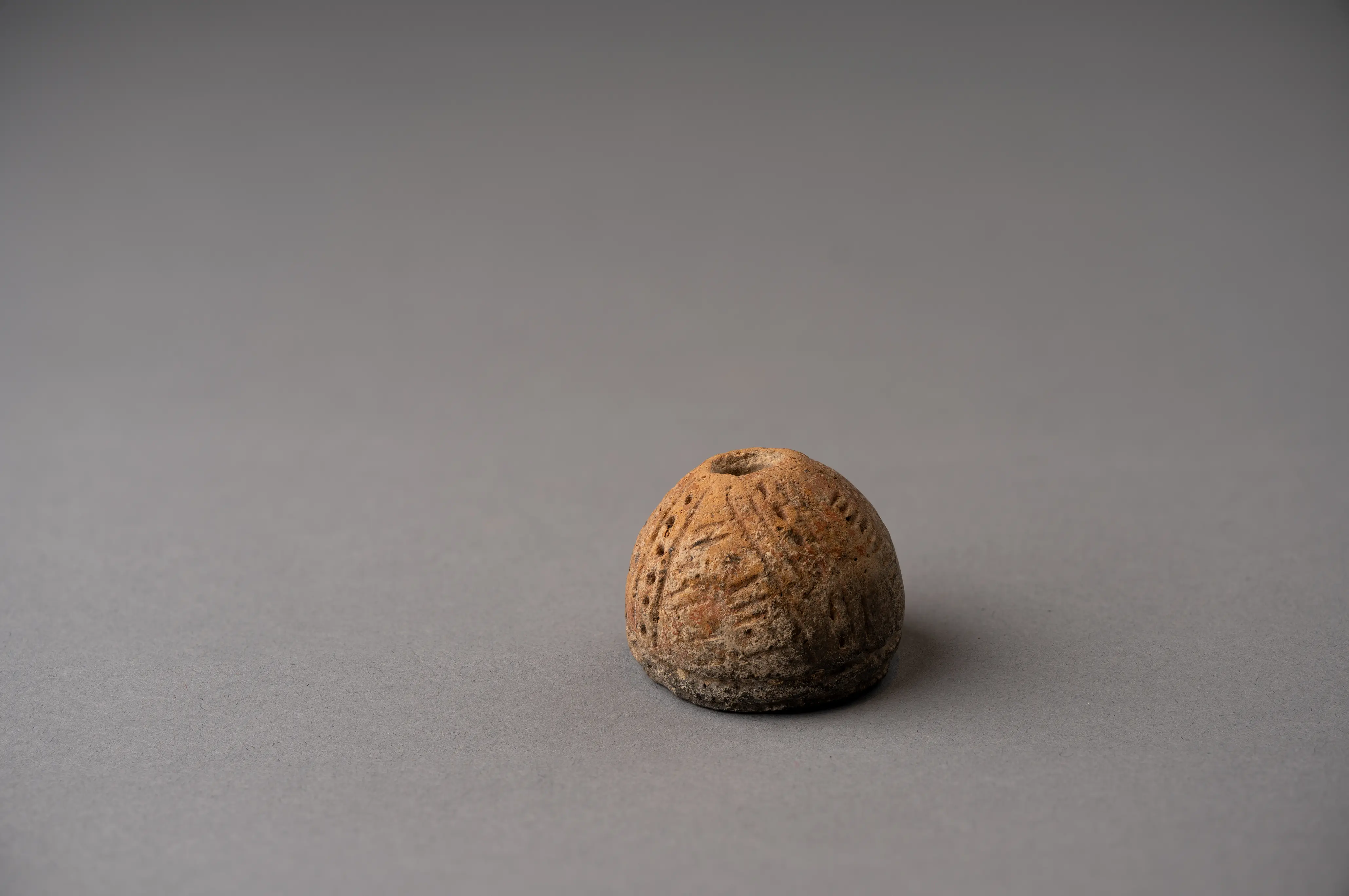
Why an Anatolian introduction should imply people rather than trade alone is the argument of David Frankel and Jennifer Webb. Frankel's paper on "technology as habitus" notes that Bronze Age spinners used specially made clay whorls whose form and decoration closely recall those of western Anatolia [8], and Webb stresses that whether a whorl is mounted high or low on the shaft makes little difference to efficiency but is culturally determined [6]. Webb quotes Elizabeth Barber's hypothesis that "when we see non-prestigious textile equipment suddenly invading an area, not only men but also women have moved", and reads the whorls, the loom weights and the new hearth and cooking equipment of Philia sites as the kit of self-sufficient migrant communities [6]. The Anatolian source of the technology is common ground; the mechanism is not. The migration model is the Webb and Frankel position, set against the older readings of the Philia horizon as indigenous restructuring prompted by limited contact, which Webb herself summarises [6].
The typology rests on shape: conical-hemispherical, biconical-spherical, truncated-biconical and cylindrical in the Cesnola catalogue, which refers readers to Lindy Crewe's island-wide study of 1998 as the standard treatment [7, p. 254]. Shape is a weak dating tool, with one exception: truncated biconical and spherical whorls became popular in Early Cypriot III, about 2100 BCE, and stayed so until Middle Cypriot II, about 1800 BCE [6]. Decoration is incised and often filled with white paste: sets of three parallel lines, dashed lines framed by parallel lines, triangles filled with dashes, concentric arcs with dots, and on the broad end, lines radiating from the hole [9; 10]. Webb observed that Cypriot whorls are "almost invariably decorated on the broad terminal and never on the narrow terminal", which only makes sense if the broad face was the one the spinner saw [6].
Museum examples show the range. The Metropolitan Museum's Cesnola series includes a biconical whorl with a flat top, 74.51.940, whose catalogue entry suggests it could be Early Cypriot I; a truncated-biconical whorl, 74.51.911 (museum record); a conical-hemispherical whorl, 74.51.938; and a 4.6 cm whorl, 74.51.931, all dated Early Cypriot III to Middle Cypriot II. The Pitt Rivers Museum holds a Black Polished whorl, 44 mm across and incised with lines and triangles (1884.104.40), and Medelhavsmuseet in Stockholm has a Red Polished whorl from Lapithos Tomb 702 excavated by the Swedish Cyprus Expedition in 1927, dated Middle Cypriot II to III (L. 702:141).
The Drakopoulos collection holds three terracotta whorls of this family, catalogued as Early to Middle Cypriot (about 2000 to 1725 BCE) and ex-Goodman collection since the 1960s; their findspots, weights and diameters are unrecorded. One, TOL-BA-002, illustrated here, is a squat hemispherical whorl with a flattened broad face, its body incised with oblique line groups and rows of short strokes between them. TOL-BA-001, pictured at the head of this entry, has a dark, mottled surface cut with vertical bands of herringbone incision. The third, TOL-BA-003, is plain, reddish and globular.
How Bronze Age Cypriots spun: the low-whorl spindle
Until Frankel and Webb's first Marki-Alonia report of 1996 it was assumed that ancient Cypriots used the high-whorl spindle, with the whorl near the top of the shaft, because that is how modern Cypriot spinners work [1, p. 291; 6]. Two terracotta spindle models from tombs at Bellapais-Vounous, one of Early Cypriot I and one of Early Cypriot III date, 20 and 20.7 cm long, were read the same way [6]. Frankel and Webb's study of the Marki-Alonia whorls turned the question around. Almost all of them, and most of those Crewe examined island-wide, carry a zone of worn slip and fabric extending 6 mm or more around the hole on the narrow end, wear best explained by a whorl mounted low with its narrow end striking the ground [6]. Webb then showed that the Vounous Tomb 29 model has a small horizontal perforation at its tapering end, the place where a thread or hook is attached at the top of a spindle, so the model had been displayed upside down for decades [6].
The best evidence is Z.776 in the Zintilis Collection, published by Webb in 2002: a copper or bronze spindle 29 cm long, tapering to both ends, with a spiral thread-groove near the top and a truncated-biconical clay whorl, 35 mm across and dark-slipped, corroded onto the shaft below its midpoint with the broad face upward. Fine fibre is wound around the middle of the shaft, and thread survives beneath the whorl as well as above it, so the whorl cannot have slipped down from a high position [6]. Webb concluded that Z.776 "may, therefore, be identified unequivocally as a low whorl spindle", which places Cypriot spinning with the low-whorl traditions of Anatolia, the Aegean and Europe and apart from the high-whorl traditions of Egypt and Mesopotamia [6; 1, p. 291]. The metal shaft is about three times heavier than the whorl, which led Webb to suggest it was used as a supported spindle resting on the ground or in a container. She left open whether supported spinning was normal, since most spindles would have been of wood [6]. The groove runs in the direction for S-spun thread, which suggests either flax or a left-handed spinner [6]. The object was bought over forty years before publication and is only thought to come from a tomb in the southwest of the island [6].
Direct fibre evidence is thin. The few Early and Middle Cypriot textile fragments that have been formally identified are flax; decayed material beneath a whorl in Lapithos Tomb 302 is believed to have been wool [6]. The inference from whorl weight to fibre, heavier whorls for coarser yarn, runs through most of the literature [1, p. 291], but the Erimi excavators note that recent work finds "no univocal correspondence between the weight of whorls and fibre types" and that the spinner's hand shapes the yarn as much as the tool [10].
Loom weights and the warp-weighted loom
The only loom that survives archaeologically on Cyprus is the vertical warp-weighted loom, whose clay weights keep the warp threads taut [11]. Pyramidal weights of terracotta or unbaked clay were in continuous use from the Early Cypriot period into the Iron Age [1, p. 293]. The early weights are heavy. Those from Marki-Alonia exceed 1000 g each, which the excavators read as few weights and dense, heavy cloth; fragments from Middle Cypriot Alambra suggest weights up to 340 g; and the Late Cypriot I site of Episkopi-Phaneromeni has three groups of about 220, 550 and 1000 g [11]. Through the Late Cypriot II and III periods weights became lighter and more varied, most between 50 and 150 g from the fourteenth century on, and a new flat "donut" weight of low-fired or unbaked clay appeared in the thirteenth century [11]. Smith reads the donut weight, quicker to make than a fired pyramid, as possible evidence for a larger scale of production [11]. A pair of Late Cypriot IIIA loom weights from Enkomi bears a ring impression of a motif that may itself show a warp-weighted loom [1, p. 292].
Needles continue alongside. Smith also lists clay "reels", possibly for making belt cords, and pointed bone tools once classed as styli among the implements found consistently in Late Cypriot contexts [1, p. 292]. The "spinning bowl" with interior loops, which Barber renamed the fibre-wetting bowl and associated with flax, is known from Egypt and from Early and Middle Minoan Crete [12]; we know of no published Cypriot series.
Settlements, tombs and workshops in the Middle and Late Bronze Age
At Marki-Alonia the whorls weigh from 20 to 30 g up to 95 g, and at Alambra mainly 14 to 48 g, with outliers to 169 g; all the pre-Late Cypriot IIC evidence comes from domestic contexts [11; 1, pp. 295–297]. The Middle Bronze Age settlement at Erimi-Laonin tou Porakou, excavated by a team under Luca Bombardieri, is the exception. Its hilltop workshop complex had plastered basins, drainage channels and a room (SA I) with a hearth and a basin containing more than a hundred nutlets of Echium and Lithospermum, plants whose roots can give a red or purple dye; the excavators interpret the room as a dye-works and the complex as organised around textile production. Sixteen terracotta whorls came from the workshop in the 2009 to 2014 seasons, with wear at the narrow end in the low-whorl pattern, and a group of nine unperforated clay cones that copy the common Early and Middle Cypriot loom weight [10].
Whorls are also among the commonest grave goods of the Early and Middle Bronze Age. Twenty-two came from five of twelve excavated tombs in Erimi's southern cemetery clusters in 2009 to 2014, seven of them from Tomb 231, where one is a double whorl of two joined spheres; the later Tomb 429 alone produced twelve [10]. Chamber B of Lapithos Tomb 322, excavated by the Swedish Cyprus Expedition, held a cluster of fifteen whorls, fourteen Red Polished and one Black Polished, weighing from 20 to 117 g, in the centre of the floor with nine copper-based objects including knives, tweezers and a needle, and a plank figure [9]. The Erimi and Lapithos whorls show use-wear, so they were working tools that went into the grave with their users [9; 10].
The Late Bronze Age brought a change of scale. At Kition, Area I (Chrysopolitissa) was domestic housing, where sets of loom weights lay in courtyards and weaving was probably part-time and outdoors. In Area II (Kathari), beside the ashlar temples, a "western workshop" had permanent vats and pits and yielded 80 per cent of all the whorls and loom weights from the area; Smith identified it as a textile and dye workshop and suggested it was a site of workshop or large-scale industry [1, pp. 299–302]. Kition produced 242 loom weights, most between 40 and 110 g, and sixteen whorls from 14 to 120 g; the heavy and very heavy whorls came only from Area II [1, p. 301]. In the mining village of Apliki-Karamallos, excavated by Joan du Plat Taylor, Smith catalogued twelve whorls and fifty loom weights in three sets, found in House A. Seven of the whorls weigh 40 to 45 g, suited in her reading to thick woollen thread, two about 105 g for flax, and one 145 g, probably for twine; she places this production at household scale [11].
Purple dyeing is the finishing trade that marks the end of the period. Crushed murex shells were found at Hala Sultan Tekke [1, p. 295], and at Kition-Bamboula a jar fragment of the late twelfth or early eleventh century carries a purple residue that biochemical analysis traced to murex, with plant residue, probably vine, that would have helped the fermentation vat [13].
| Period | Approx. date BCE | Spinning | Weaving and finishing | Key evidence |
|---|---|---|---|---|
| Aceramic Neolithic | 7th–6th millennium | No identified whorl | Bone needles; mat, basket and fabric impressions | Khirokitia: 624 needles, mostly used on soft plant fibre |
| Ceramic Neolithic and Chalcolithic | c. 5000–2500 | Perforated discs of uncertain use; a handful of small pottery whorls | Bone needles | Vrysi 132 clay discs; Kissonerga-Mylouthkia discs judged unlikely whorls |
| Philia and Early Cypriot | c. 2500–2000 | Shaped terracotta whorls, biconical at first; low-whorl spindle | Heavy clay loom weights; warp-weighted loom | Marki-Alonia; Vounous spindle models |
| Middle Cypriot | c. 2000–1650 | Truncated-biconical and spherical whorls in RP and BP; heavier whorls | Loom weights; dye-works | Erimi workshop and tombs; Lapithos T.322B; Zintilis spindle |
| Late Cypriot | c. 1650–1050 | Plainer terracotta whorls, some stone; bone and ivory pieces mostly not whorls | Lighter pyramidal weights; donut weights from 13th c.; fulling and dyeing vats; murex purple | Kition Area II workshop; Apliki House A; Enkomi |
| Cypro-Geometric and Cypro-Archaic | c. 1050–480 | Terracotta and stone whorls in tombs | Donut weight sets in sanctuary rooms | SCE whorl types; Kition-Bamboula |
The Iron Age
The evidence thins after 1050 BCE, and most of it comes from tombs. Einar Gjerstad's Swedish Cyprus Expedition typology records terracotta whorls from the Cypro-Geometric period through the Cypro-Archaic into the Cypro-Classical, and stone whorls of two types from Cypro-Geometric I to the end of Cypro-Archaic II [14, pp. 149–150]. Georgiadou and Georgiou stress that, for the Early Iron Age, Kition is unusual in giving settlement and sanctuary evidence where other sites offer only funerary finds. At the Bamboula sanctuary, founded in the Cypro-Geometric period, several sets of heavy donut-shaped loom weights were found in one room of the Cypro-Archaic I period, close to the sanctuary's metallurgical workshop, repeating the pairing of cloth, metal and cult seen at Kathari several centuries earlier [13].
Who spun?
The most repeated claim about Cypriot whorls is that they belong to women. It has three roots. The first is comparative: Barber's argument that women did most of the spinning and weaving in early Europe and the Near East, and nineteenth- and twentieth-century Cypriot ethnography in which spinning and weaving were women's work at home while fulling, dyeing and heavy loom-weaving were often done by men [1, pp. 287–288]. Smith records the exceptions: men appear as spinners in census lists, and men made twine and rope [1, p. 287]. The second root is mortuary. Peter Fischer found in 1986 that the Early and Middle Cypriot whorls in his sample of sexed tombs lay only with female skeletons, and on that basis Smith judged it reasonable to hypothesise that pre-Late Cypriot IIC textile production was "mostly, if not wholly" women's work [1, p. 297].
Sarah Douglas and Giulia Muti re-examined the mortuary case in 2019. Two decades after Fischer only nineteen whorls could be attributed to seven sexed tombs, five of them multiple burials. Whorls do occur with women, as at Erimi Tomb 230 and Lapithos Tomb 322B, but also in Ypsonas-Vounaros Tomb 35 with a probable male, and next to weapons and tools in Erimi Tomb 428 (beside a copper dagger or spearhead), Galinoporni Tomb 1 and Vounous Tombs 110 and 155. Since not every female burial had whorls, they conclude that whorls were "not buried to allude to the female status tout court", and read them as the personal tools of skilled spinners, placed close to the body like metalwork and ornaments [9]. The Erimi whorls within a single tomb often form one or two groups of the same type and decoration, which Douglas and Muti relate to the owner's kin or community affiliation [9].
For the Late Bronze Age, Smith's view is that household spinning and weaving stayed largely women's work, but that in workshops such as Kition's men "probably began to play a major part in textile arts, not only as fullers and dyers, but also perhaps as weavers", producing cloth for sails and decorated textiles for elite consumption [1, p. 304]. At Apliki she suggests the 145 g twine whorl may indicate male involvement in spinning [11]. Both readings lean on analogy with recent Cypriot practice and with the Aegean, and Smith presents them as hypotheses.
Open questions
Three problems stay unresolved. The first is the gap before 2500 BCE: cloth, needles and flax are attested from the Aceramic Neolithic, but no spinning tool, so either spinning was done without a whorl or the whorls were of wood and have perished [6]. The second is fibre. Almost no Bronze Age textile has been identified, and the translation of whorl weight into wool or flax is now questioned [10]. The third is scale: the Kition workshop and the Erimi dye-works show textile production organised beyond the household, but how much cloth left the island cannot be measured from tools. The workshops' metallurgical neighbours are covered under copper metallurgy, and the period under the Late Bronze Age.
Objects on this page
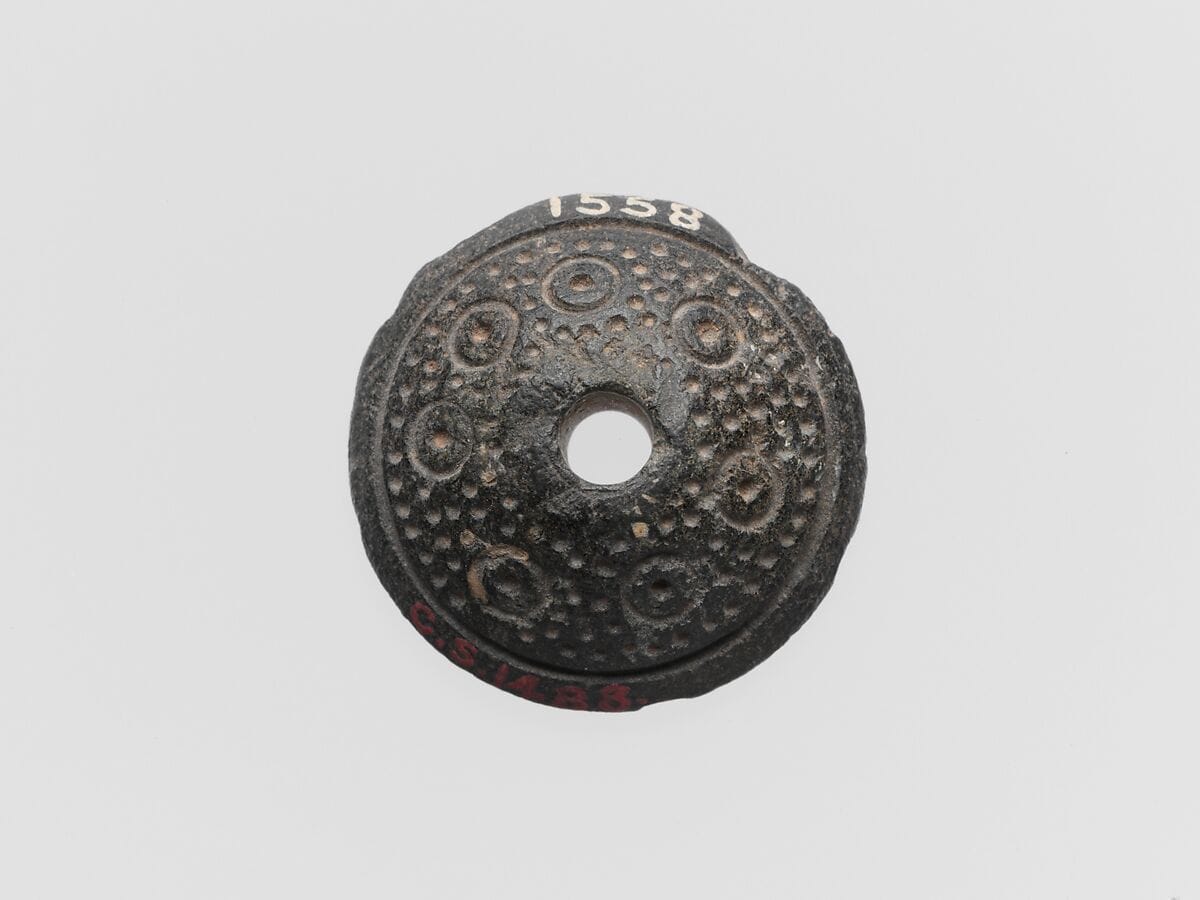 Chlorite spindle whorlLate Bronze Age III · 1200–1050 BC
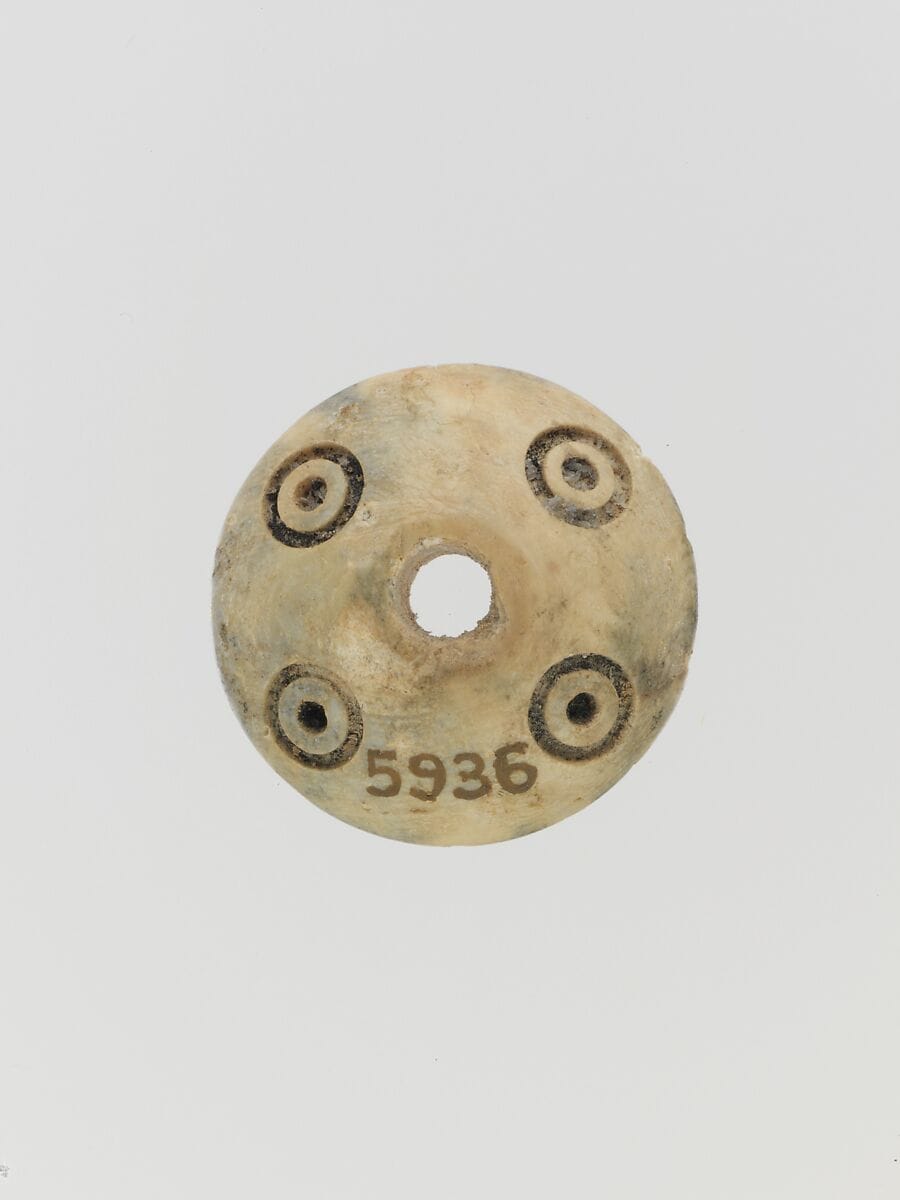 Bone spindle whorlLate Bronze Age II · 1600–1050 BC
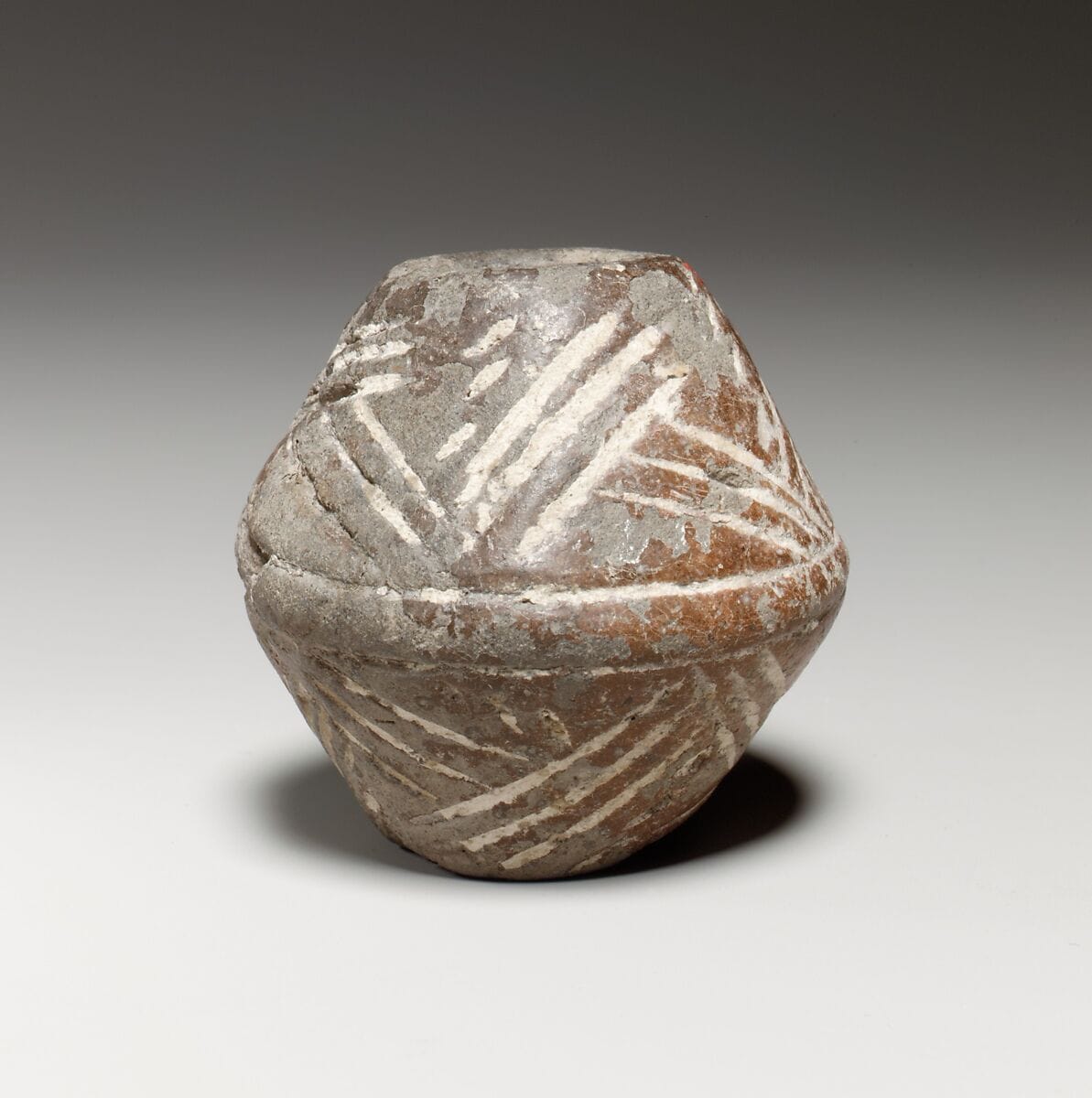 Terracotta biconical spindle-whorl with flat topEarly Bronze Age I · 2500–2075 BC
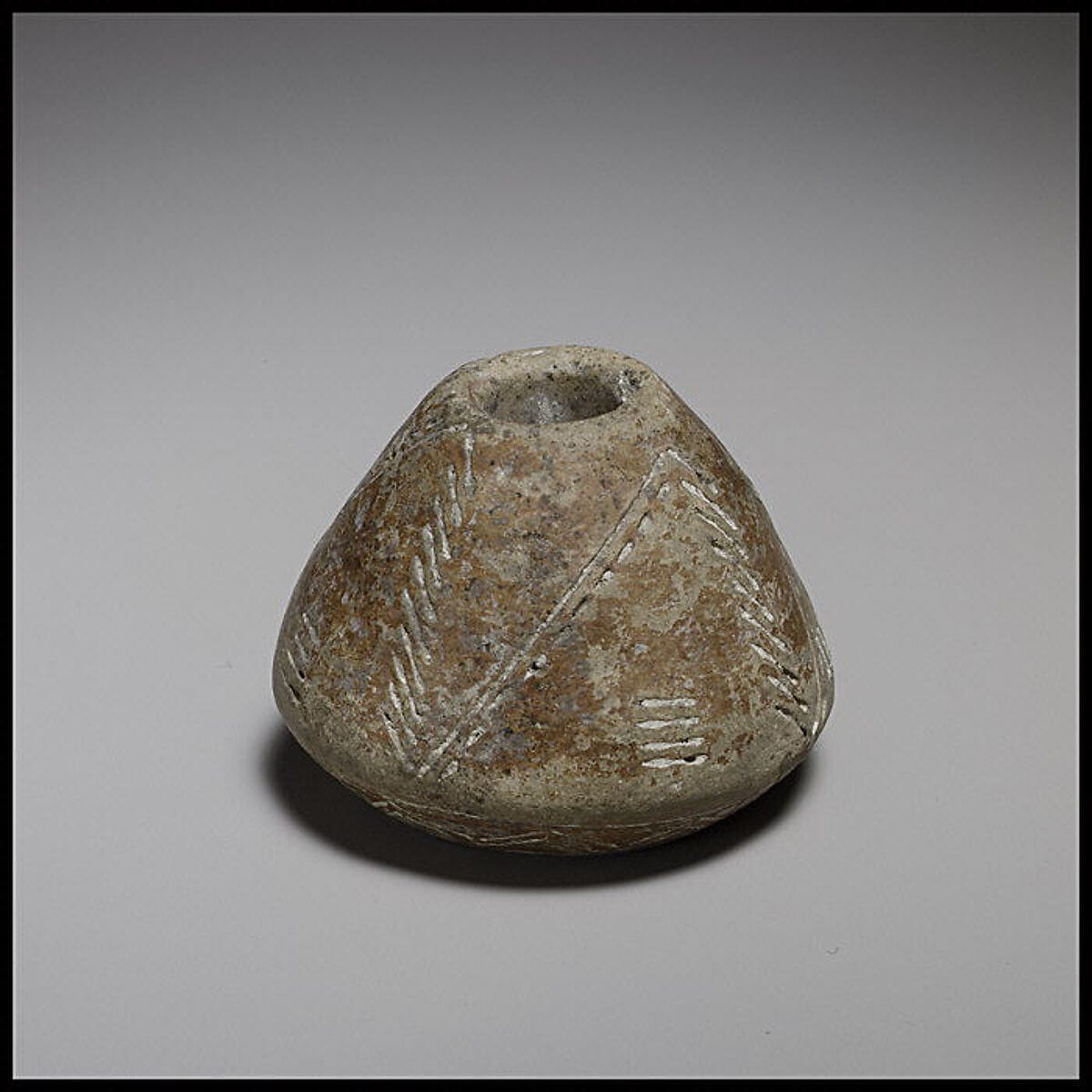 Terracotta truncated-biconical spindle-whorl with angular baseMiddle Bronze Age I · 2000–1725 BC
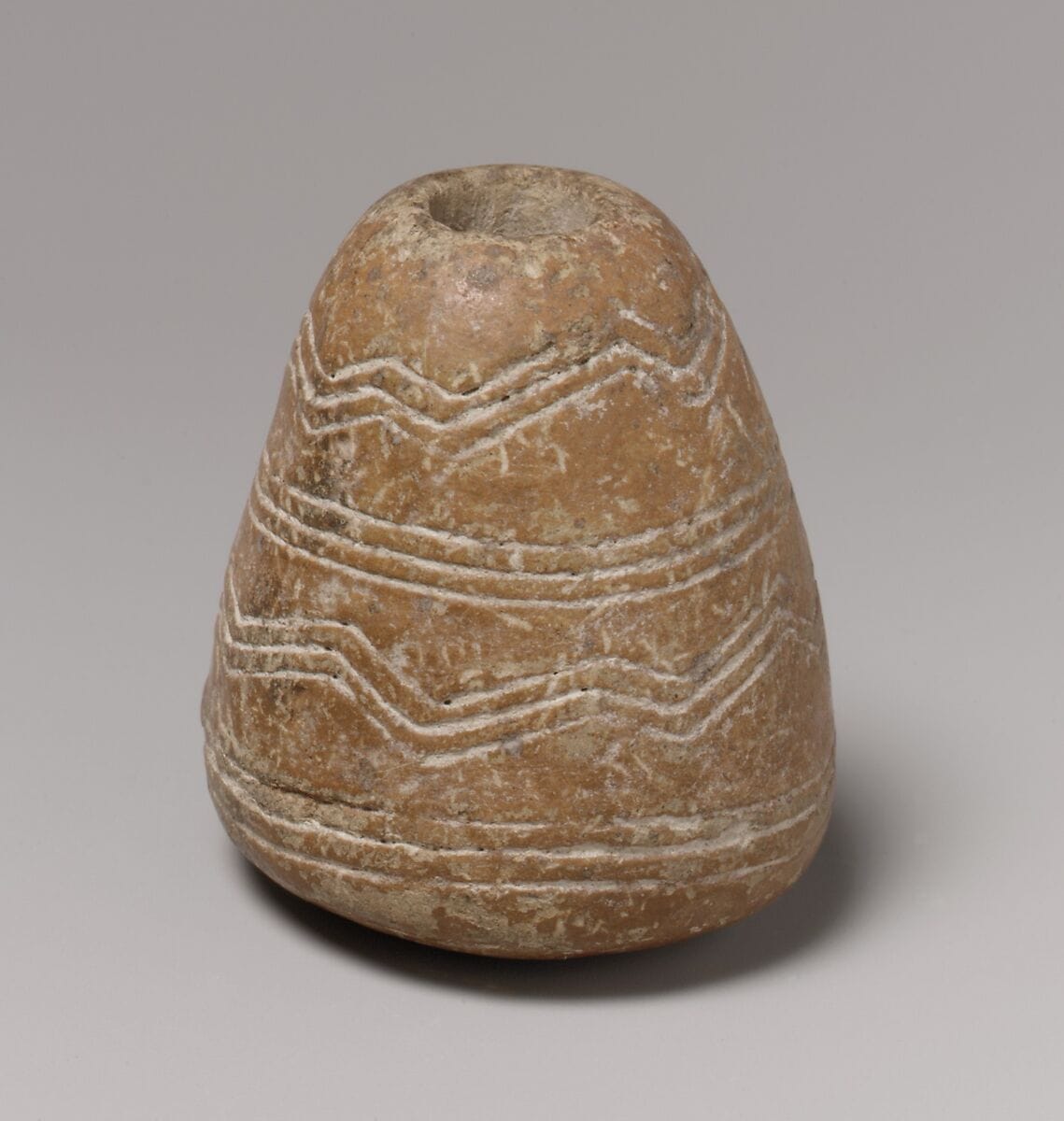 Terracotta spindle whorlMiddle Bronze Age I · 2000–1725 BC
- Red Polished Spindle Whorl with Incised Lattice and Dotted BandsMiddle Bronze Age I · 2000–1725 BC
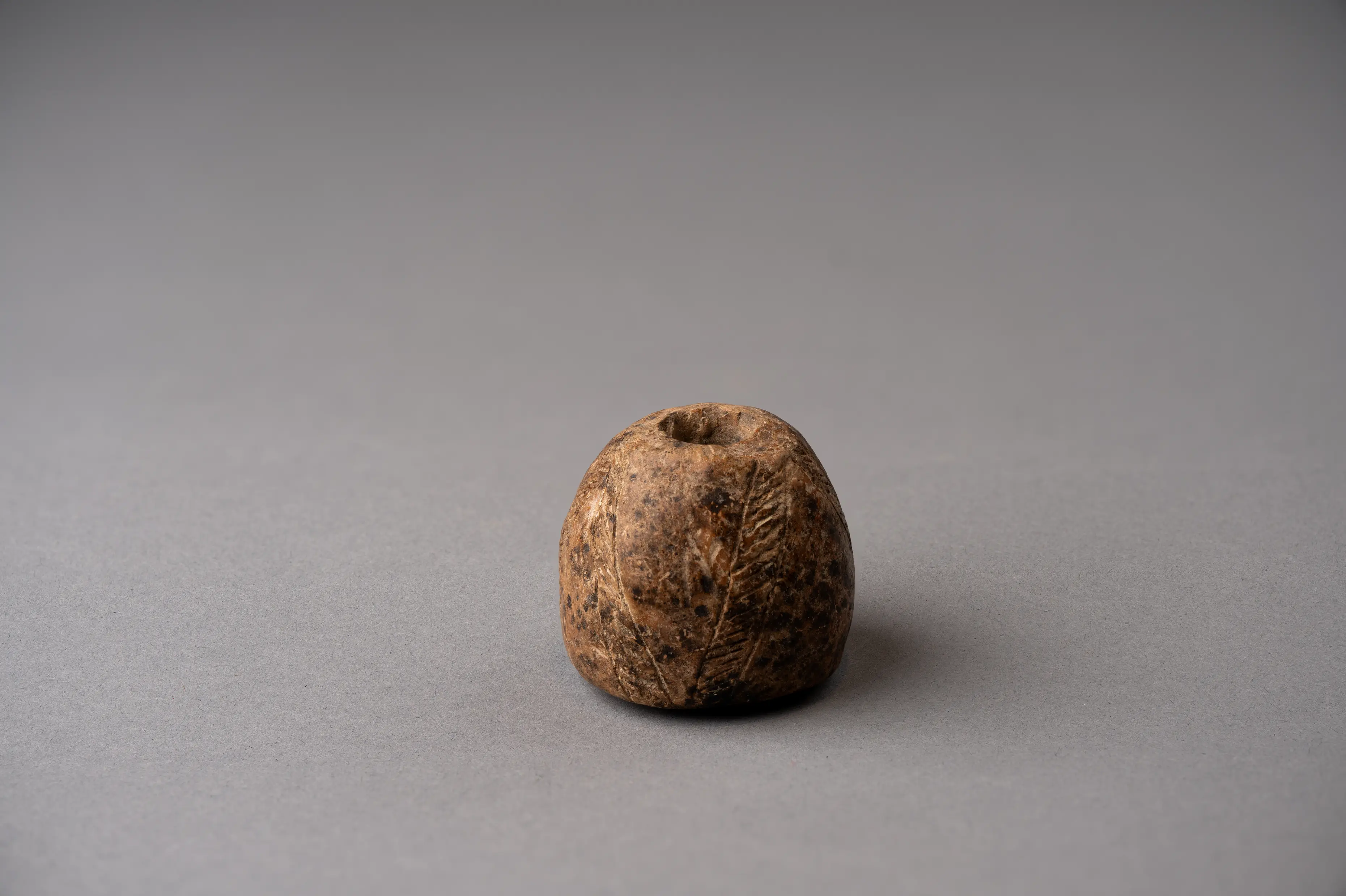 Spindle Whorl with Incised Herringbone BandsMiddle Bronze Age I · 2000–1725 BC
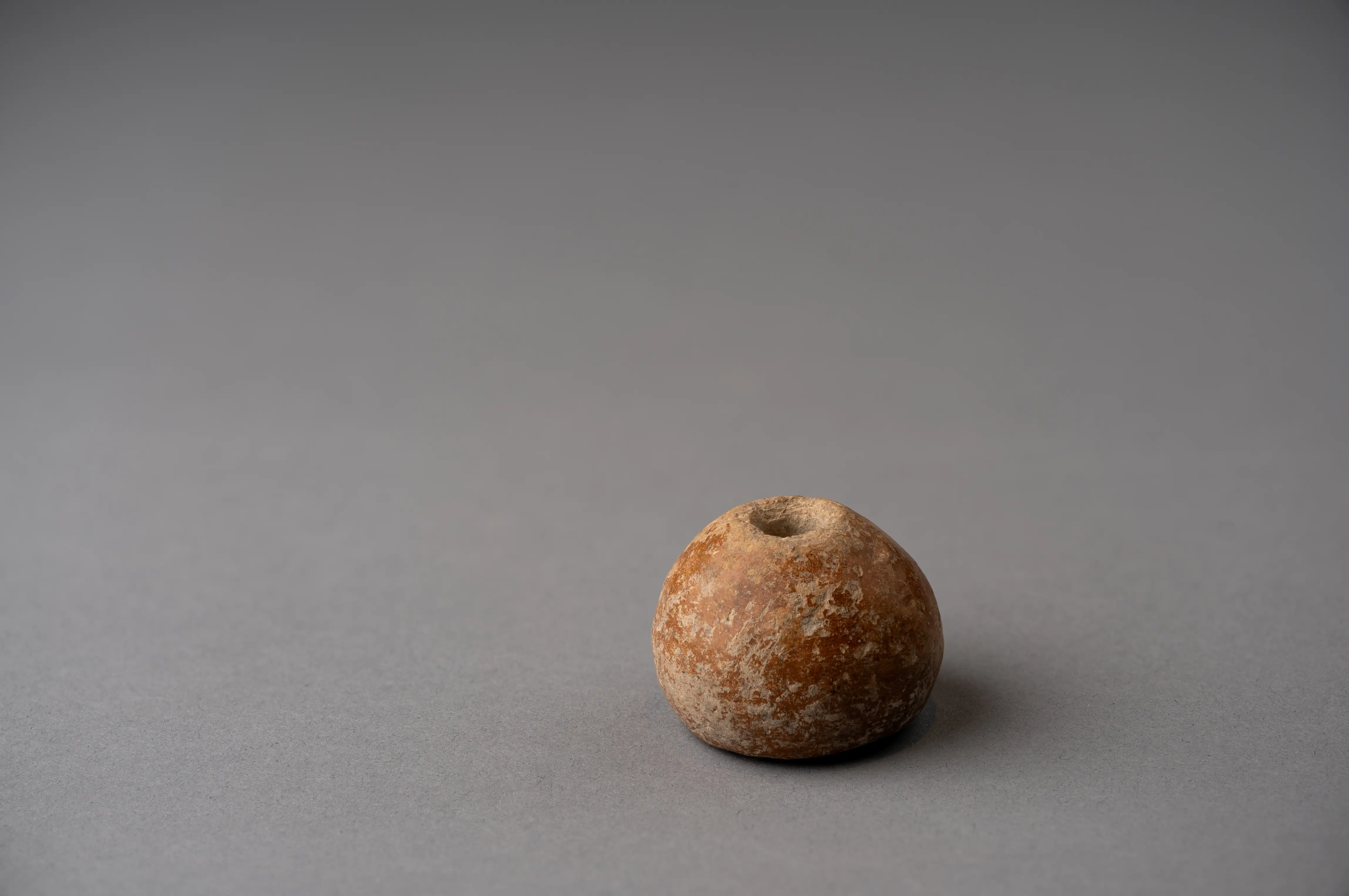 Plain Red Polished Spindle WhorlMiddle Bronze Age I · 2000–1650 BC
References
- 1.Smith, J. S. (2002). Changes in the workplace: Women and textile production on Late Bronze Age Cyprus. In D. Bolger & N. Serwint (Eds.), Engendering Aphrodite: Women and society in ancient Cyprus (ASOR Archaeological Reports 7; CAARI Monographs 3, pp. 281–312). American Schools of Oriental Research.
- 2.Legrand, A. (2008). Neolithic bone needles and vegetal fibres working: Experimentation and use-wear analysis. In L. Longo & N. Skakun (Eds.), Prehistoric technology 40 years later: Functional studies and the Russian legacy. Proceedings of the international congress, Verona (Italy), 20-23 April 2005 (BAR International Series 1783, pp. 445-450).
- 3.Peltenburg, E. J. (1975). Ayios Epiktitos Vrysi, Cyprus: Preliminary results of the 1969–1973 excavations of a Neolithic coastal settlement. Proceedings of the Prehistoric Society, 41, 17–45. https://doi.org/10.1017/S0079497X00010884
- 4.Peltenburg, E., et al. (2003). The colonisation and settlement of Cyprus: Investigations at Kissonerga-Mylouthkia, 1976–1996 (Lemba Archaeological Project III.1; Studies in Mediterranean Archaeology 70:4). Paul Åströms Förlag.
- 5.Peltenburg, E., et al. (1998). Lemba Archaeological Project II.1A: Excavations at Kissonerga-Mosphilia 1979–1992 (Studies in Mediterranean Archaeology 70:2). Paul Åströms Förlag.
- 6.Webb, J. M. (2002). New evidence for the origins of textile production in Bronze Age Cyprus. Antiquity, 76(292). https://doi.org/10.1017/S0003598X00090451
- 7.Karageorghis, V., Merker, G. S., et al. (2004). The Cesnola Collection of Cypriot art: Terracottas. The Metropolitan Museum of Art.
- 8.Frankel, D. (2000). Migration and ethnicity in prehistoric Cyprus: Technology as habitus. European Journal of Archaeology, 3(2), 167–187.
- 9.Douglas, S., & Muti, G. (2019). A case of identity: Investigating the symbolism of spindle whorls in Early and Middle Cypriot tombs. In K. Żebrowska, A. Ulanowska & K. Lewartowski (Eds.), Sympozjum Egejskie: Papers in Aegean archaeology, Vol. 2. University of Warsaw.
- 10.Bombardieri, L., & Muti, G. (2018). Erimi Laonin tou Porakou: A textile community of practice in Middle Bronze Age Cyprus. Fasciculi Archaeologiae Historicae, 31, 25-38.
- 11.Smith, J. S. (2007). Loom weights and spindle whorls from Apliki Karamallos. In B. Kling & J. D. Muhly (Eds.), Joan du Plat Taylor's excavations at the Late Bronze Age mining settlement at Apliki Karamallos, Cyprus, Part 1 (Studies in Mediterranean Archaeology 134:1, pp. 229–251). Paul Åströms Förlag.
- 12.Andersson Strand, E., & Nosch, M.-L. (Eds.). (2015). Tools, textiles and contexts: Investigating textile production in the Aegean and Eastern Mediterranean Bronze Age (Ancient Textiles Series 21). Oxbow Books.
- 13.Georgiadou, A., & Georgiou, A. (2019). Spinning, weaving and purple dyeing at Kition: New evidence for the textile industry at the settlement of Bamboula during the Late Bronze–Early Iron Age. Cahiers du Centre d'Études Chypriotes, 49, 103–128.
- 14.Gjerstad, E. (1948). The Swedish Cyprus Expedition, Vol. IV, Part 2: The Cypro-Geometric, Cypro-Archaic and Cypro-Classical periods. Swedish Cyprus Expedition.