
Ancient Cypriot Pottery·Lesson 14
How to Date and Identify a Cypriot Pot
Six questions, asked from the making to the decoration, that take a Cypriot pot to a ware, a period and an honest date range, with how to read a museum label, spot old repairs and tell lime fill from burial crust.
Alexis Drakopoulos·Across the periods·16 min read
Share


Lesson 14·Course contents, 15 lessons
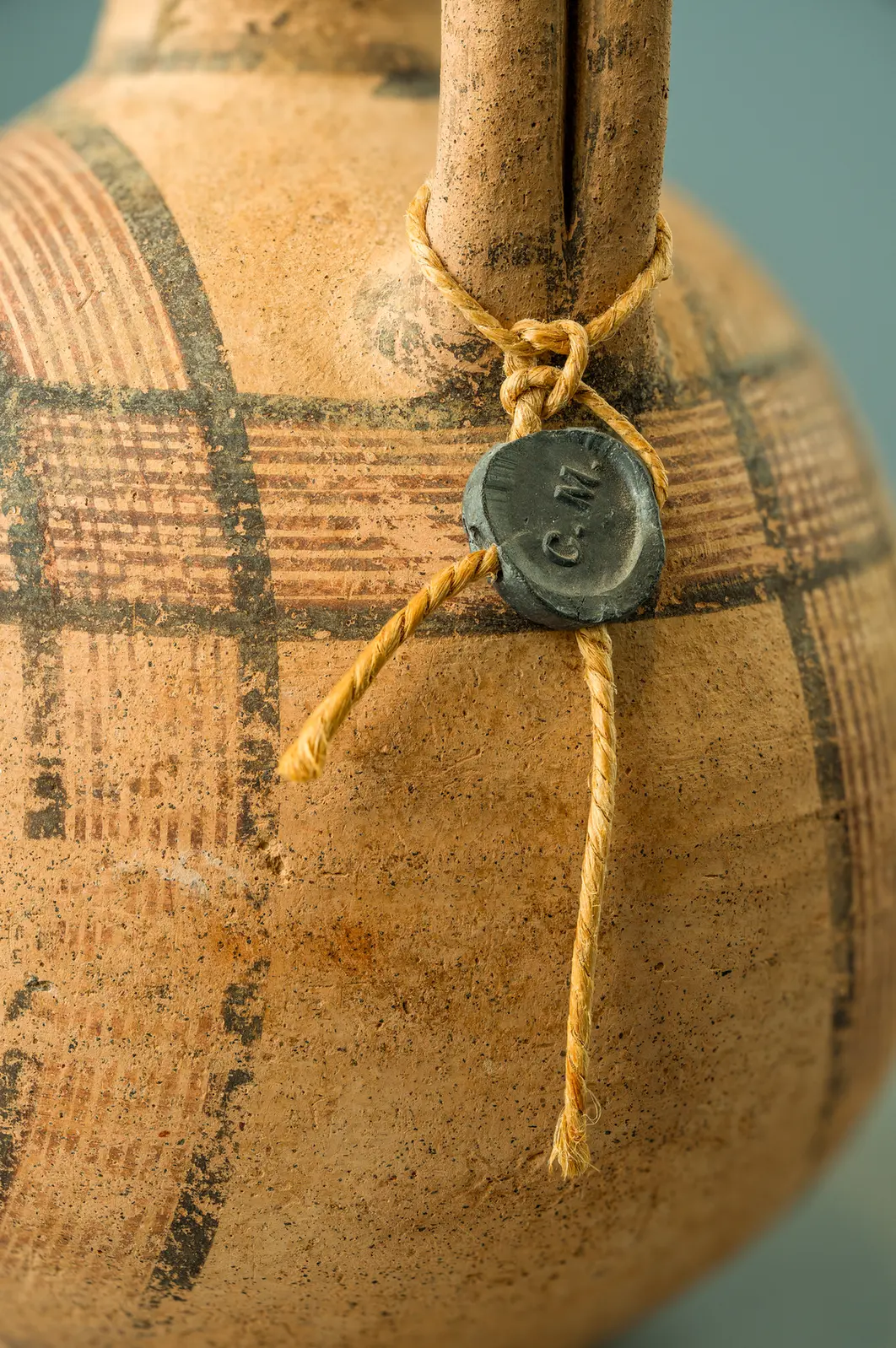
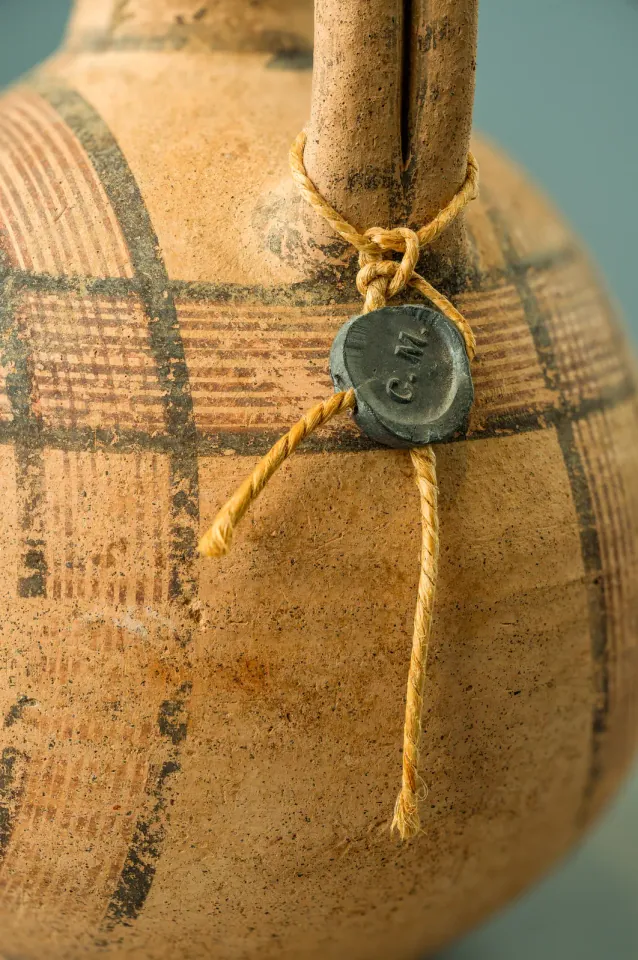
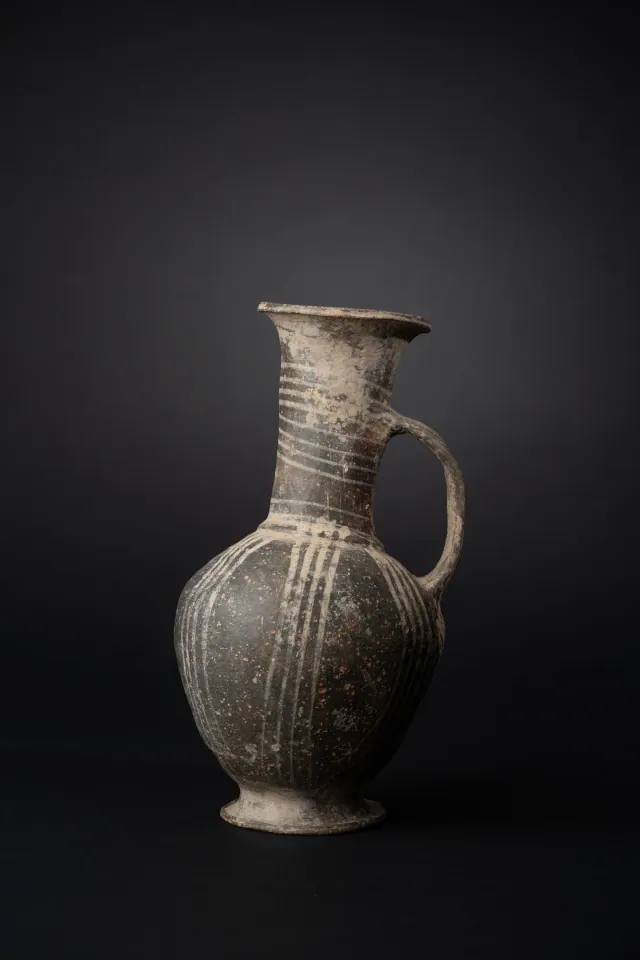
A small lump of lead hangs from the handle of the jug beside this paragraph, threaded on a length of twine and stamped with two letters, C.M. Everything else about the jug has to be argued: that its ware is Bichrome IV, that it belongs to the first phase of the Cypro-Archaic period (CA I), that it was made somewhere between about 750 and 600 BC. The seal is the only thing on the pot that someone attached as a record, and what it records is something other than the date.
A museum label such as "White Painted IV, CA I, c. 750 to 600 BC, wheel-made" reads like a measurement. It is the short form of an argument that starts with the clay and ends in a period, and each step can be checked. Here the argument runs in a fixed order, first on a pot that cooperates and then on three that do not: a jug whose red has faded, a plain juglet, and a bowl under burial crust.
Six questions, in order
Ask them in this order, without skipping ahead to the decoration:
- Handmade or wheel-made? Throwing ridges, the fine horizontal grooves left by fingers on a spinning pot, and a body that is round in plan mean the wheel. A rim that rises and dips, lugs pinched from the wall and a rounded base mean hands.
- Fabric and surface. What colour is the clay at a chip? Is the surface polished to a sheen, coated with a slip (a thin wash of liquid clay), or left plain? Is any paint matt or lustrous?
- Colour scheme. Red all over; dark paint on pale; black and red on pale; dark paint on a thick white coat; a dark, metallic-looking skin.
- Base and mouth. Rounded, flat or ring base; plain, beaked, cut-away, funnel or trefoil mouth.
- Decoration system. Incised lines filled with white; matt geometric painting; ladder and lattice; large circle systems; a single motif floating on the shoulder.
- Only now, the call: a ware, a period, and a date range wide enough to be honest.
The order runs from the evidence that survives burial best to the evidence that survives it worst: the marks of making are in the body of the pot, while paint fades, flakes and hides under deposits. The first question also does the most work. Every Cypriot pot made before the Late Cypriot I period (LC I, from about 1650 BC) was built by hand, and the painted tablewares of the Iron Age were thrown on the wheel. The reverse inference fails: Base Ring and White Slip, the great Late Cypriot export wares, stayed handmade long after the wheel arrived (Lesson 5).
Robert Merrillees called the names that question six produces "titles of academic convenience", and observed that almost all of them describe surface finish or decoration: Red Polished, White Painted, Black Slip, Bichrome, White Slip [4]. That is why surface comes before shape. The same jug shape turns up in half a dozen wares.
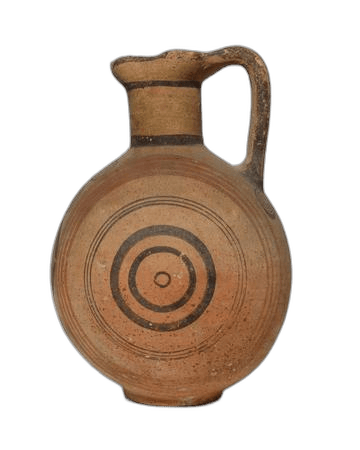
Run the questions on the sealed jug. Wheel-made: the body is evenly round on a low ring base. A pale orange-buff surface painted in black and red, which defines Bichrome. A trefoil mouth, pinched into three lobes with a pouring lip at the front. On each side a circle system of fine red lines inside a broad black ring, crossed at the shoulder by a belt of the same lines, so that the two schemes interlock like the hoops of a basket. Einar Gjerstad, whose 1948 volume of the Swedish Cyprus Expedition (SCE) fixed the Iron Age sequence, listed "encircling intersecting lines" among the ornaments of his Western circle style, and the globular body with pinched mouth is his Type IV jug [3]. Bichrome, Type IV: Bichrome IV, which in his system means CA I. The Bichrome IV oinochoe (Greek "wine-pourer", a trefoil-mouthed jug) shown here, excavated at Kourion for the British Museum, has a related scheme of vertical circles round a bull's eye.
Now run the questions yourself, on a pot in front of you or one from these lessons. Answer only what you can see, and say you are not sure wherever you cannot tell. Each answer rules out the wares that cannot match; a worn or plain pot will leave several in play, as it should.
Field key · Cypriot pottery wares
Which ware is it?
Answer one question at a time about what you can see. Each answer rules out the wares that cannot match; choose Not sure whenever you cannot tell, and change any answer as you go.
When the red has gone
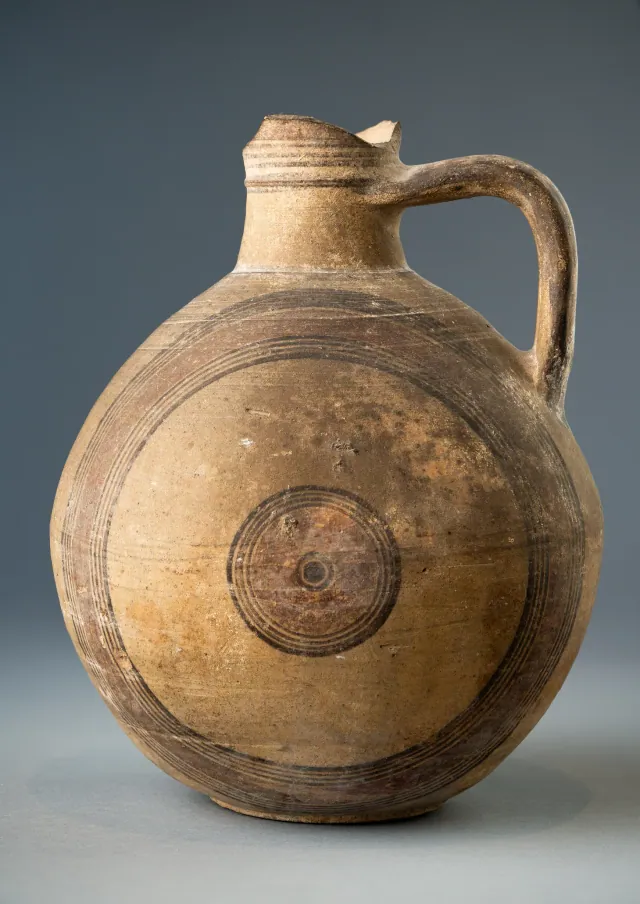
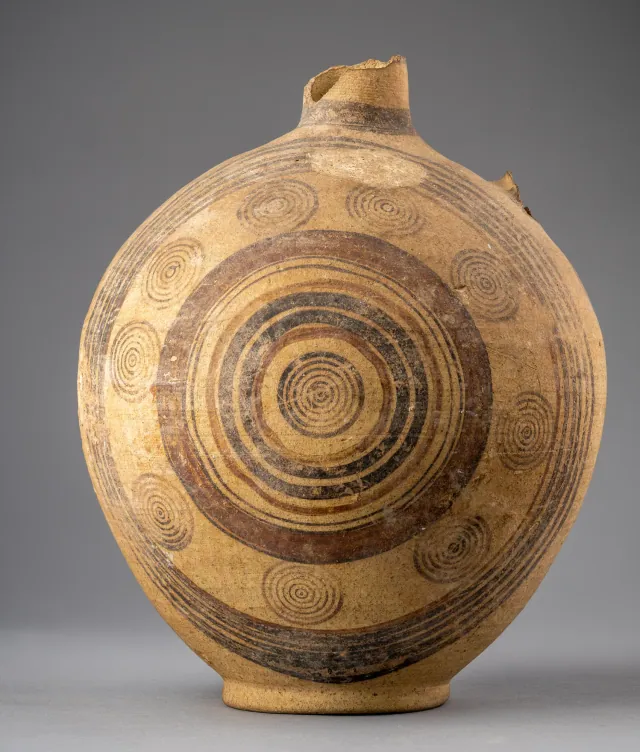
The globular jug illustrated here answers the first five questions with little trouble, though part of its rim is broken away and the shape of its mouth is uncertain. Strong throwing ridges run round the shoulder of a pale buff body. On the side sits one large vertical circle system: broad bands alternating with thin black lines, a wide plain field, and a small target round a brown-filled disc.
Question six then splits. The broad bands read purplish or reddish brown against the black lines, which suggests a red paint that has faded or discoloured in the ground; if so, the jug is Bichrome IV. If raking light finds no red pigment, it is White Painted IV, in which the same circle scheme also occurs. Red is the fragile colour: John Myres, writing on a painted amphora in New York, noted that it "always adhered less strongly than the black to the clay surface" [6, p. 42]. A warm patch between black lines can also be burial staining, which is why careful catalogues write "White Painted, possibly Bichrome".
Turn the jug under the light and follow the broad bands round the circle, comparing them with the thin black lines beside them. Where they read warmer than the black, and where they do not, is the whole of the argument.
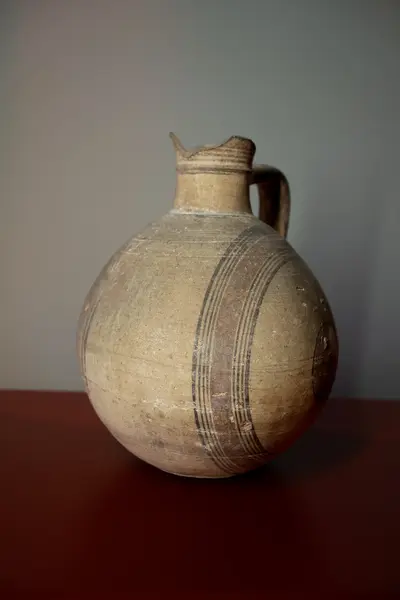
Globular Jug with a Vertical Circle System, Bichrome IV or White Painted IV
Open the full 3D viewDrakopoulos collection
A photogrammetry model, made from many photographs of the real object. Nothing loads until you press the button.
The ware stays open; the date does not. Gjerstad's numeral IV is a period before it is anything else, so White Painted IV and Bichrome IV both fall in CA I, c. 750 to 600 BC. An excavated Bichrome IV globular jug from a tomb at Stylli, with "black and red vertical circles on body", gives the type a context [5, p. 201].
Why a plain pot dates badly
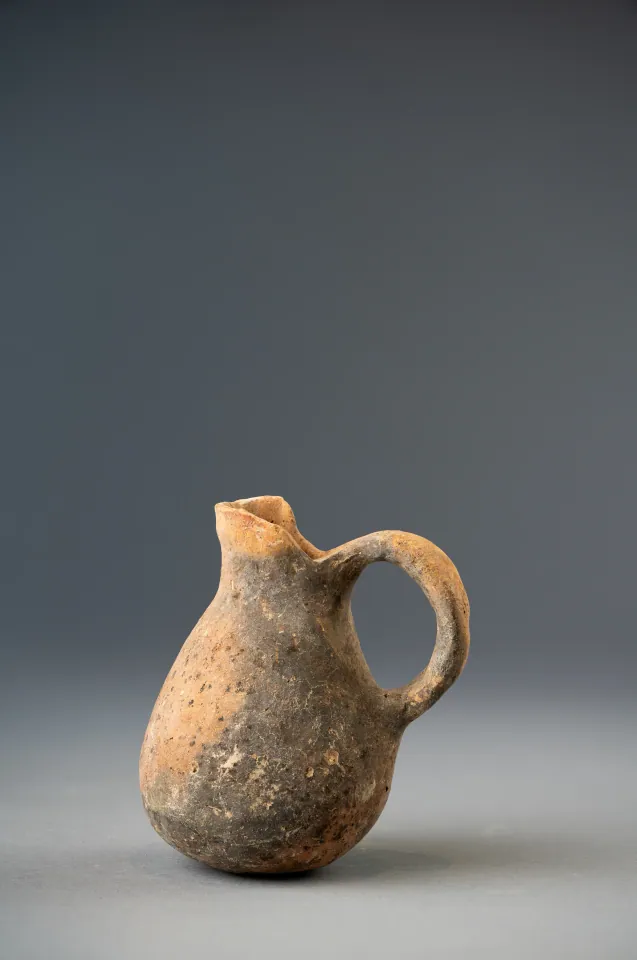
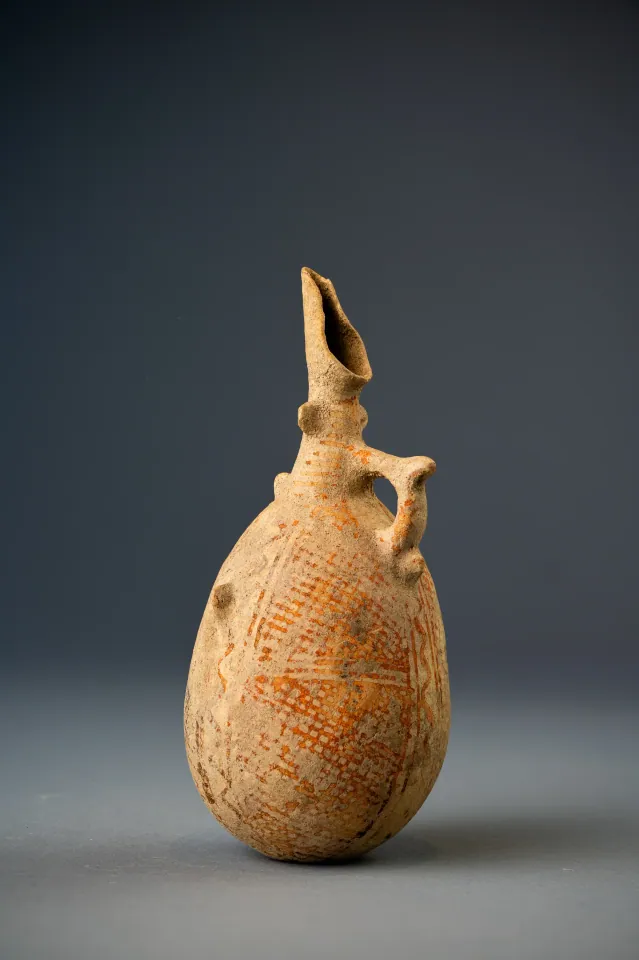
The small juglet beside this paragraph defeats the method more thoroughly. It is handmade and pear-shaped, with a rim pinched into a low open spout, a loop handle and a rounded base. Its mottled surface, buff and pale orange shading to grey-black near the handle, is the colour of an open firing, and no clear trace of a burnished slip survives.
Every answer points to the Bronze Age before the wheel; none narrows it. If the juglet once carried a red slip, it may be a worn Red Polished juglet of the mottled south-coast kind; if the slip was always thin, it sits nearer the Red Slip jugs of the later Middle Cypriot period. Either way it falls between Early Cypriot III and the end of the Middle Cypriot, about 2100 to 1650 BC: four and a half centuries for one small pot. Only handling can narrow it: a slip under the deposits, the colour of the clay in a break, or a handle whose lower end is pushed through the wall, a Red Polished habit.
Plain pots date badly because Cypriot pottery typology was built from complete tomb vessels sorted largely by ornament [4]. A shape that potters kept making unchanged gives seriation, the ordering of pots by gradual changes of style, nothing to grip.
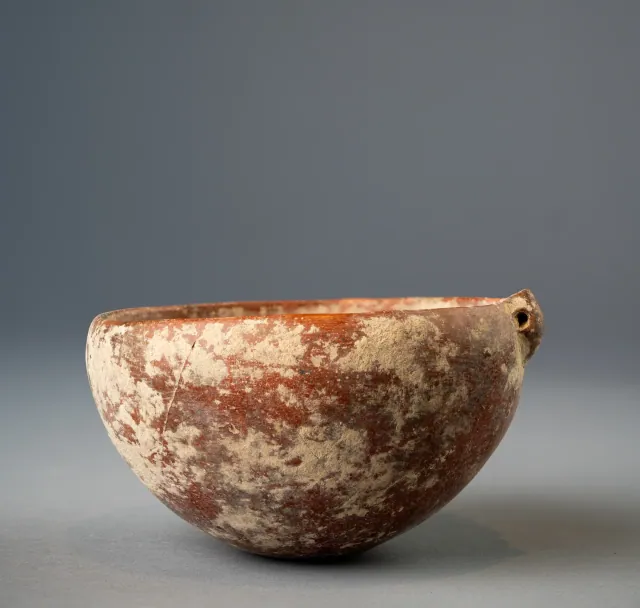
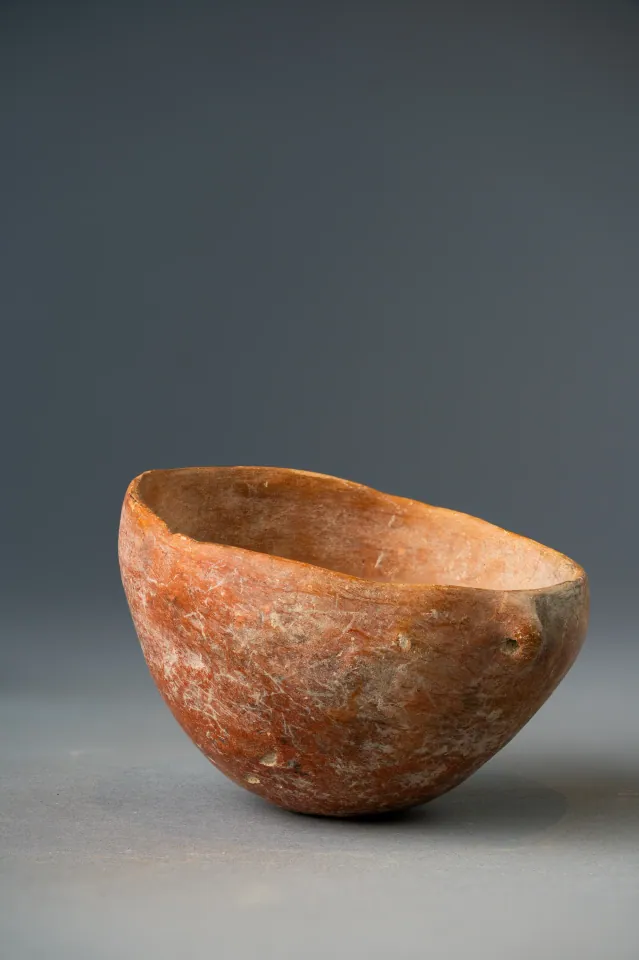
The hemispherical bowl here is the commonest vessel of the Early Cypriot, the knob-lug bowl of Stewart's Class XIII F, with a single rim lug pierced for a cord [7]. Kehrberg counted 43 plain bowls of this kind in one tomb at Vounous and 59 in one at Lapithos [8]. The type runs from Early Cypriot II to the end of the Middle Cypriot [4, p. 239]. Made by the thousand and barely changing, a plain bowl like this one is conventionally dated Early Cypriot II to Middle Cypriot I, about 2200 to 1900 BC, and without its tomb group, the full set of objects buried with it, it cannot be dated more closely.
It carries a second problem. A heavy whitish-buff crust, deposited by groundwater during burial, covers much of the outside; where it has flaked away, the red slip beneath is still glossy from the burnishing pebble. Beginners often mistake that white for decoration. The black-topped tulip bowl in Lesson 12 has white of the other kind, lime paste pressed into its incised lines. Lime fill sits inside cut lines and follows a pattern; burial crust lies over the surface, thickest on the side the pot lay on.
Why every date is a range
A ware and a period are relative statements: this comes after that. Style puts the pottery in order, tomb groups show which types were in use together, and chambers reopened for later burials show which came after. None of this gives a year.
For the Iron Age, Gjerstad took his years from the first appearance of each new Type of Cypriot pottery in dated contexts abroad. He placed the start of Type IV at about 700 BC because Type IV pottery appeared at Tarsus above destruction debris he attributed to Sennacherib's campaign of 696 BC [3]. Modern tables, Lesson 0's included, begin CA I around 750. The Late Bronze Age is tied the same way to the Mycenaean sequence, itself pinned to Egyptian history [10].
Radiocarbon came late. In 1994 the only radiocarbon dates for the Early Cypriot came from one excavated settlement, Sotira-Kaminoudhia, and the Middle Cypriot rested on seven more [11; 14, p. 390]. Only in 2013 did Sturt Manning publish a single modelled radiocarbon framework for the island, from about 11,000 to 1050 BC [12]. Radiocarbon, which dates the charcoal, seed or bone in the layer a pot lay in, can correct the cross-dates: stratified levels at Megiddo placed the earliest Black-on-Red there around 900 BC, earlier than Gjerstad had allowed [13]. Even then a find dates its burial, and its making may lie decades earlier. "C. 750 to 600 BC" is the span of a phase with soft edges, and a pot assigned to it could have been made in any decade inside.
Old repairs, fills and repainting
Pots that left Cyprus long ago have usually passed through restorers' hands. Desmond Morris, whose 1985 book catalogued his own collection, listed what his conservator met on the several hundred pieces she treated [9, p. 363]. Floodwater in rock-cut tombs had rubbed pots against each other, leaving many a "good side" and a "bad side". Ancient repairs, pairs of holes drilled along a crack, turned up on only four vessels. Saleroom repairs were commoner: excess glue and three "tricks of the trade". Fake encrustation was smeared over fractures to suggest a perfect pot beneath; a small flaw was left in view to draw the eye from a large one that had been hidden; and "hybrid" vessels married the body of one broken pot to the neck of another, the join buried under artificial crust.
Paint can be added as well as lost. Myres showed that the New York amphora, collected in Cesnola's day, had been "restored" with a figure scene painted over its worn reverse, praised in print as "one of the most precious relics of Cypriote art" and later scoured away. That repainting, he wrote, was "not so heinous an offence in Cesnola's generation as in our own" [6, p. 44].
On an old collection piece the eye can catch a patch whose colour or texture differs from the clay round it, paint running unbroken across a join, or a neck and body that differ in clay or wall thickness. Conservators commonly add ultraviolet light, which can show up modern fills and retouching the eye misses. A declared restoration is nothing to fear: the British Museum's record for the Kourion oinochoe states plainly that part of its lower body has been restored from sherds.
Reading a label and a catalogue tombstone
Take the opening label field by field. "White Painted" names the surface. "IV" is the stage, and in the Iron Age also the period. "CA I" and "wheel-made" earn their place, because Paul Åström's handmade Middle Cypriot White Painted series also has a IV, about a thousand years earlier. Where a ware began later than the rest, Gjerstad gave it two numerals, its own stage and the period in brackets: Black-on-Red II (IV) is the second stage of Black-on-Red, in Type IV, CA I [3]. The date range is borrowed from a chronology table and moves when the table moves, as Gjerstad's 700 became today's 750.
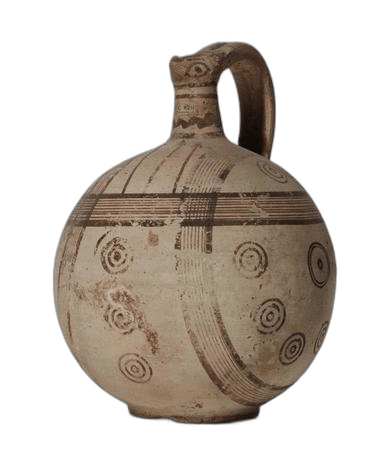
A catalogue adds a tombstone, the entry's header line, and a few fields worth reading closely. "Cf. SCE IV.2" with a figure number means "compare with" Gjerstad's type drawings. The provenance line separates an excavated pot from a collected one: the Amathus oinochoe beside this paragraph comes from the British Museum's Turner Bequest excavations, so its find-place is a fact, while "said to be from" reports a seller's word. A query mark, as in the Kourion record's "self-slip (?)", is a cataloguer being careful.
The Amathus jug also shows the limits of decoration. Its large vertical circles are crossed at the shoulder by a horizontal band, the scheme of the sealed jug, yet the museum files it as White Painted V, one phase later. Schemes ran on across the numerals; shape, ware and the whole ornament, read together, decide a pot's stage.
A sale catalogue is the other place a pot's history is written down. Find a Bichrome IV amphora in a real 1926 Sotheby's catalogue, match it to its plate detail by detail, and record the lot.
What the lead seal records
C.M. stands for the Cyprus Museum. Under the Antiquities Law of 1935, antiquities could leave Cyprus lawfully only under an export licence. The Department of Antiquities licensed a few dealers and inspected their stock to approve pieces for sale and export [1, pp. 46-47]. Objects exported this way survive with the Department's lead tag still attached, and its officers have matched such tags against licences in their own archive [2]. Licensed export of privately held antiquities ended with the amendment of the law in 1996 [2].
The seal on the Bichrome IV jug therefore points to a lawful export. It does not say when, and no permit is known to travel with the jug. The back of the seal has yet to be examined for a number or a second stamp, and that small face of lead is where the date of the jug's departure could narrow.
Quiz
Check yourself
Question
Put the six questions in the order this lesson asks them.
Tap an item, then tap its place. Or use the arrows
Question
Run the six questions on this bowl. What is the honest call?
Question
Paint in lines on a pale ground. Which label fits this jug?
Question
Run the questions on this jug. Which ware, and when?
Question
Look closely at the broad rings of the circle system. Which label fits?
Question
On a Red Polished bowl, whitish patches lie over the slip, thickest on one side, following no pattern. What are they?
Question
A label reads “White Painted IV, CA I, c. 750 to 600 BC, wheel-made”. Why are “CA I” and “wheel-made” worth writing down?
Question
Why does a careful label give “c. 750 to 600 BC” and never a single year?
What to look for
- Start with the making: throwing ridges and a body round in plan mean the wheel (from LC I, about 1650 BC, onward); uneven rims, pinched lugs and rounded bases mean hands, which in Cyprus can mean any date up to the end of the Late Bronze Age.
- Read the surface before the shape: polished red, matt dark paint on pale, black and red on pale, dark paint on a thick white coat, or a dark metallic skin each point to a different ware family.
- On Iron Age jugs, the Roman numeral after White Painted or Bichrome is the period: IV is Cypro-Archaic I, c. 750 to 600 BC, whichever of the two wares it is.
- Brownish or purplish bands beside black lines on a pale jug may be faded red; check in raking light before choosing between Bichrome and White Painted.
- White inside incised lines is lime fill; white lying over the surface in patches, thickest on one side, is burial crust.
- On old collection pieces, look for fills of a different colour or texture, paint crossing a join, crisp paint on a worn surface, and crust that follows a line.
- A plain handmade pot without its tomb group rarely dates to better than three or four centuries; a label that claims more should say why.
Glossary of terms used in this course
| Term | Meaning |
|---|---|
| askos | A closed vessel with an off-centre spout, often shaped as an animal or bird. |
| Base Ring | Late Cypriot handmade ware with thin, hard walls and a dark brown to black surface, named for the ring foot nearly every piece stands on. |
| Bichrome | Pottery painted in black and red on a pale ground: Bichrome Wheel-made of LC I, and the Iron Age series Bichrome I to VII. |
| bilbil | The small Base Ring juglet with a tall narrow neck and funnel mouth, a trade nickname from the Arabic for nightingale; exported to the Levant and Egypt. |
| Black-on-Red | Iron Age wheel-made ware with black paint on a red slip, often polished; it begins in CG III, about 850 BC in Gjerstad's scheme and about 900 BC on the radiocarbon dates from Megiddo, and was widely exported as small juglets. |
| black-topped | Red Polished pots whose rim zone and interior fired black where air was kept from them in the firing; one proposed way is to set them mouth-down in ash or smouldering fuel. |
| burial crust | A whitish calcareous deposit that forms on a pot in the ground. It lies over the surface and is no part of the decoration. |
| burnish | To rub a leather-hard or slipped surface with a pebble or tool until it shines. |
| circle system | A set of concentric circles painted as one unit, often a large vertical one on each side of an Iron Age jug. |
| CG, CA, CC | Cypro-Geometric (c. 1050 to 750 BC, divided I to III), Cypro-Archaic (c. 750 to 480, I and II), Cypro-Classical (c. 480 to 310, I and II): the Iron Age periods. |
| dromos | The sloping passage cut down to the door of a rock-cut chamber tomb. |
| EC, MC, LC | Early Cypriot (c. 2250 to 2000 BC), Middle Cypriot (c. 2000 to 1650) and Late Cypriot (c. 1650 to 1050): the Bronze Age periods, each divided I to III. |
| fabric | The fired clay body and its inclusions, best seen in a break. |
| free-field | The style in which a single motif, often a bird, floats on the bare shoulder of a jug opposite the handle; at its height in Bichrome IV of the Cypro-Archaic. |
| juglet | A small jug, often for oils or perfume. |
| lime fill | White paste, usually lime, pressed into incised lines after firing to make them stand out against a polished surface. |
| Monochrome | Late Cypriot handmade ware in a thin, plain brown to black slip, without paint. |
| mottling | Patchy colour on a pot's surface left by uneven open firing. |
| oinochoe | Greek "wine-pourer": on Cypriot labels, a jug with a trefoil mouth, the standard Iron Age pouring jug. The name records a resemblance and says nothing of use. |
| Philia | The facies that opens the Cypriot Bronze Age, c. 2400 to 2250 BC, with the first Red Polished pottery and flat-based jugs. |
| pithos | A large storage jar (plural pithoi). |
| Plain White | Undecorated pale ware of the Late Bronze Age and Iron Age, made both by hand and on the wheel; the first Cypriot ware to go on the wheel. |
| Proto-White Painted | The wheel-made, matt-painted ware of LC IIIB, c. 1125 to 1050 BC, the bridge into Iron Age White Painted. |
| Red Polished | The handmade, red-slipped and burnished ware of the Early and Middle Bronze Age, numbered I to IV and often incised. |
| Roman numerals | Stages within a ware; in the Iron Age, Gjerstad's Types, which are also periods (IV = CA I). A bracketed numeral gives the period for a ware that started late. |
| SCE | The Swedish Cyprus Expedition (fieldwork 1927 to 1931), whose volumes fixed most ware names and numbers still in use. |
| self-slip | A slip-like skin produced from the vessel's own clay as it is smoothed wet, without a separate coat. |
| slip | A thin coat of liquid clay applied before firing to change a pot's colour or finish. |
| throwing ridges | Horizontal ridges left by the potter's fingers on a pot turning on the wheel. |
| tomb group | Everything found together in one burial deposit; the basic unit for dating Cypriot pottery. |
| trefoil mouth | A rim pinched into three lobes, giving a pouring lip at the front. |
| tulip bowl | A deep Early Cypriot Red Polished bowl whose sides flare over a small pointed base, usually black-topped and incised. |
| ware | A class of pottery defined by fabric, making and surface finish. Shape is a separate question. |
| wheel-made | Thrown or shaped on the potter's wheel, in Cyprus from LC I onward. |
| White Painted | Dark matt paint on a pale ground: a handmade Bronze Age series (I to VI) and a wheel-made Iron Age series (I to VII). |
| White Slip | Late Cypriot handmade ware with a thick white slip and dark painted decoration, chiefly round bowls with a wishbone handle. |
Go deeper
The ware and motif families met in this lesson have full entries in the compendium: Bichrome, Iron Age White Painted and its handmade Bronze Age namesake White Painted, Red Polished and circles and circle systems, with the period pages behind the dates. For the lead seal and the law behind it, read the legal export of Cypriot antiquities and how the Cyprus Museum sold antiquities; for what a laboratory can add, thermoluminescence dating and the surface of ancient ceramics under photogrammetry.
References
- 1.Powell, J. (2013). Love's Obsession: The Lives and Archaeology of Jim and Eve Stewart. Adelaide: Wakefield Press.
- 2.Alphas, E. (2017). From a Bronze Age tomb in Cyprus to the estate of a gentleman in Sussex: measures taken and problems faced in the investigations on the illicit trade of antiquities. In D. Pilides & M. Mina (Eds.), Four Decades of Hiatus in Archaeological Research in Cyprus: Towards Restoring the Balance. Vienna: Holzhausen, 30–43.
- 3.Gjerstad, E. (1948). The Swedish Cyprus Expedition, Vol. IV, Part 2: The Cypro-Geometric, Cypro-Archaic and Cypro-Classical Periods. Stockholm: The Swedish Cyprus Expedition.
- 4.Merrillees, R. S. (1991). The principles of Cypriot Bronze Age pottery classification. In J. A. Barlow, D. L. Bolger & B. Kling (Eds.), Cypriot Ceramics: Reading the Prehistoric Record (University Museum Monograph 74, pp. 237–240). Philadelphia: The University Museum, University of Pennsylvania.
- 5.Gjerstad, E., Lindros, J., Sjöqvist, E. and Westholm, A. (1935). The Swedish Cyprus Expedition II: Finds and Results of the Excavations in Cyprus 1927–1931. Stockholm: The Swedish Cyprus Expedition (Stylli tombs).
- 6.Myres, J. L. (1954). A painted Graeco-Phoenician vase from Ormidhia in Cyprus. American Journal of Archaeology, 58(1), 39–44.
- 7.Stewart, J.R. (1962). The Early Cypriote Bronze Age. In P. Dikaios and J.R. Stewart, The Swedish Cyprus Expedition IV.1A: The Stone Age and the Early Bronze Age in Cyprus. Lund: Swedish Cyprus Expedition, 205–401.
- 8.Kehrberg, I. (1982). Early and Middle Cypriote chronology again. Levant, 14, 59–72.
- 9.Morris, D. (1985). The Art of Ancient Cyprus, with a Check-list of the Author's Collection. Oxford: Phaidon.
- 10.Steel, L. (2004). Cyprus before history: From the earliest settlers to the end of the Bronze Age. London: Duckworth.
- 11.Manning, S. W. & Swiny, S. (1994). Sotira Kaminoudhia and the chronology of the Early Bronze Age in Cyprus. Oxford Journal of Archaeology, 13(2), 149–172.
- 12.Manning, S. W. (2013). Appendix: A new radiocarbon chronology for prehistoric and protohistoric Cyprus, ca. 11,000–1050 cal BC. In A. B. Knapp, The Archaeology of Cyprus: From Earliest Prehistory through the Bronze Age (pp. 485–533). Cambridge: Cambridge University Press.
- 13.Kleiman, A., Fantalkin, A., Mommsen, H. and Finkelstein, I. (2019). The Date and Origin of Black-on-Red Ware: The View from Megiddo. American Journal of Archaeology 123.4, 531–555.
- 14.Knapp, A. B., Held, S. O. & Manning, S. W. (1994). The prehistory of Cyprus: problems and prospects. Journal of World Prehistory, 8(4), 377–453.