
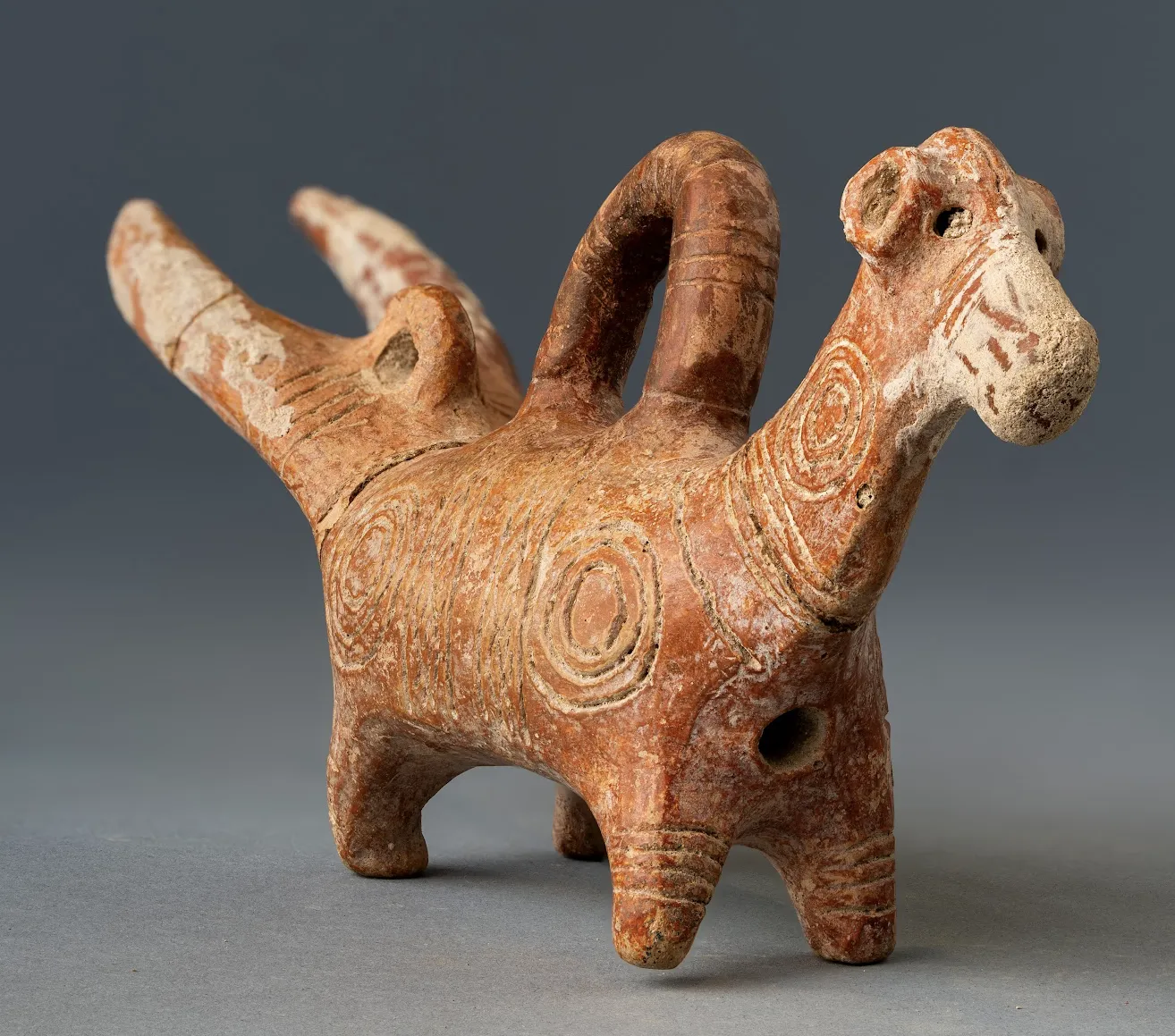
The potters of Early and Middle Bronze Age Cyprus put animals on and into their pots more often than they made animals to stand alone. Bulls' heads jut from the rims of bowls, birds perch on the bridges between the necks of jugs, whole vessels take the form of a quadruped with a spout in its muzzle and a basket handle on its back. All of it is Red Polished ware, handmade, slipped, burnished and usually incised with white-filled geometry, and almost all of it comes from tombs. This entry covers the free-standing animal figurines, the animals applied to vessels, and the animal-shaped askoi, with particular attention to the bull, to the double-necked bird jugs of Bellapais-Vounous, and to the rare two-headed askoi. The human counterparts, the flat incised plank figures, and the Late Bronze Age Base Ring bull vessels have their own entries.
Figurines, protomes and plastic vases
Three kinds of object share this material, and the first task is to keep them apart. A free-standing figurine is a solid modelled animal with no container function. A protome or applied figure is an animal, or an animal's head, modelled onto a vessel that is otherwise a normal bowl, jug or amphora. A plastic vase, of which the askos is the main type, is a hollow container whose whole body is animal-shaped.
Vassos Karageorghis drew this line deliberately in the first volume of The Coroplastic Art of Ancient Cyprus, the standard catalogue of the clay figures. He excluded "the large number of anthropomorphic and zoomorphic vases of the Early and Middle Bronze Ages" as "receptacles rather than coroplastic art", while admitting the figures modelled onto vases because they outnumber free-standing figurines and are "in most cases of greater significance than single figurines" [1, p. 7]. His catalogue groups follow: bull and ox figures attached to vases (Group VIII), stag and wild goat figures (IX), double-necked jugs (X), animal protomes on vases (XI), bird figures attached to vases (XII), and the scenic compositions with humans and animals together. Free-standing bulls are Class G, and Karageorghis lists only three with solid bodies, among them Cyprus Museum A475, a bull with long straight horns 15.5 cm long, while noting the many hollow bull-shaped vessels he left out [1, pp. 112–114].
The rule for the askos is the same in reverse. Hollow animal vases, Karageorghis writes elsewhere, "should be distinguished from similar examples in solid clay, which are terracottas and not vases"; a functional askos stands on legs, carries a basket handle so it can be lifted, and has a tubular spout so that liquid can be poured out [6, p. 261]. The Cesnola collection makes the distinction concrete in a single object: a miniature Red Polished piece of Middle Cypriot I date, 74.51.1336, has a horned protome at each end, a bull and a ram, but is solid, "because of the small size of this object"; had it been a working askos, "the two protomes would have served as spouts" [7, p. 35, no. 4].
The word askos is borrowed Greek for a wineskin, transferred by modern scholars to any pottery vessel that is partly or wholly animal-shaped. Kourou notes that the marked Cypriot preference for zoomorphic askoi suggests a cultic or ritual use "possibly involving some kind of symbolism related to animals" [11, p. 2]. Stewart preferred "askoides"; askos has stuck.
Chronology and the dating problem
Red Polished ware emerges in the Philia phase and dominates the island's ceramics until the Late Bronze Age. The plastic repertoire flowers in the mature Early Cypriot period and clusters, for its most elaborate pieces, at the transition from Early Cypriot III to Middle Cypriot I. Karageorghis dates the Fitzwilliam's bull-headed askos to a group that "appears at the end of the Early Cypriote period and continues into the beginning of the Middle Cypriote", and the Ashmolean dates its two-headed bull-and-stag vessel AN1971.856 to Early Cypriot III to Middle Cypriot I, c. 2100 to 1850 BC. The Louvre's catalogue observes that the askos type spreads above all in the Middle Bronze Age.
The absolute dates need correcting wherever the older literature is quoted. Dikaios, Schaeffer, the Stewarts and the Swedish Cyprus Expedition all wrote before radiocarbon dating, and their relative sequence (Philia, EC I to III, MC I to III) stands while their calendar dates run two to three centuries too high. Dikaios placed his Vounous Period II at 2500 to 2300 BC [4, pp. 146–164]; on the radiocarbon framework adopted in Knapp's synthesis the Philia phase falls about 2500/2400 to 2350 BC, Early Cypriot I to III about 2400/2350 to 2000, and Middle Cypriot I onward from about 2000 to 1700/1650 [5]. A fine incised animal askos of the EC III to MC I horizon therefore belongs around 2100 to 1850 BC, and a Vounous Period II bird jug around the twenty-third to twenty-first centuries, not the twenty-sixth. See the Early Bronze Age and Middle Bronze Age chronology entries.
Technique
Everything here is handmade; the wheel does not reach Cyprus before the Late Bronze Age. Bodies were built from coils and slabs, and legs, necks, heads, horns, ears and handles were modelled separately and luted on. The red slip was applied at the leather-hard stage and burnished with a pebble to produce the lustre, though on small, complex pieces the burnish is uneven around handle roots and appendages where a tool could not reach. Firing was low and imperfectly controlled, which is why sections are commonly black at the core and why some vessels have deliberately blackened tops. The incised decoration was cut before slipping and firing; lime was rubbed into the lines afterwards so that the geometry reads white on red [7, p. 42]. Concentric circles, hatched bands, zigzags, lozenges and herringbone are the stock motifs, and on the north coast they cover figurative vessels as densely as plain ones. A rare variant paints the ornament in white instead of incising it.
For the modelled birds there was a structural motive. Twin tall necks need bridging for stability, and the bridge invited a figure. Karageorghis observes that "the need for bridging the two tall necks gave the potter the opportunity to decorate the 'bridges' with figurines in the round" [1, p. 166]. He also gives the practical reason bird-shaped vases outnumber quadrupeds: the body of a bird "is easier to reproduce in clay" [6, p. 261]. The figure often sits where the pot needs reinforcing, which is a point against reading every modelled creature as theology.
The repertoire
| Class | Form | Type-pieces and find-spots | Date |
|---|---|---|---|
| Free-standing animal figurines | Small solid bulls, stags, birds, dogs; string-hole figurines | Cyprus Museum A475 (bull); Marki-Alonia P8455, P15432 (settlement finds) | EC II onward |
| Bucranial terminals and protomes | Bull's head on rim, neck or shoulder of a bowl or jug | Vounous Tomb 36 bull-and-snake bowl; Kotchati bowl with opposed bull and stag heads | EC II–MC I |
| Animal-rim bowls | Stemmed or deep bowls with protomes and miniature bowls around the rim | Vounous Tomb 160A bowl with stag and oxen | EC I–III |
| Double- and triple-necked bird jugs | Globular incised jug, two or three tall necks, bird between the necks | Vounous T.46A:23; Louvre jug from Tomb 54 | EC II–III into MC I |
| Animal-shaped askoi | Hollow quadruped or bird on short legs, basket handle, spout in the head | Fitzwilliam bull askos; Ayia Paraskevi bird askos A431; Cyprus Museum bull askos 1971/II-23/2 | EC III–MC II |
| Two-headed askoi | Quadruped body with a different animal head at each end | Ashmolean AN1971.856 (bull and stag); Met 74.51.1336 (solid, bull and ram) | EC III–MC I |
| Scenic and object models | Ploughing model, sanctuary models, the Vounous bowl, horn models | Vounous Tomb 22 bowl; Kotchati and Kalopsidha shrine models | EC III–MC I |
The animal-shaped askos has a consistent armature: a bulky body on four short legs, a basket handle arching from the back, a tubular spout on the back or shoulder, a short tail, sometimes string-hole lugs, and a modelled head at one end which alone tells you the species. Bull, ram or goat, stag, bird and "quadruped of uncertain species" are all recorded. The species problem is real: bodies are standardised and heads schematic, so cataloguers hedge between bull, stag, wild goat and donkey for the same piece. Morris noticed vessels carrying goats mixed with deer and concluded that "almost any powerful horned head will do and that the specific type of ungulate involved is almost irrelevant" [8, p. 192].
The two-headed askos is the rarest and most accomplished sub-type: a horizontal body with a head at each opposite end, facing away from each other, the arrangement French cataloguers call tête-bêche. The Ashmolean vessel, published by Brown and Catling as their no. 22, pairs a stag's head with a bull's head [9, no. 22]. It is the type-piece for the composite variant in which the two heads belong to different species; two heads of the same animal, or two whole animals applied antithetically to a shoulder, are commoner ways of doubling. The same doubling impulse produced the twin- and triple-necked jugs, the opposing-neck jugs whose necks rise from either end of a horizontal body, the multi-bowl vessels, and the multi-headed plank figures, which make up nearly a third of the free-standing plank sample. Morris counted 188 multi-unit vessels and called pluralisation a general trend of the period [8, pp. 84–85, 144].
The bull
Cattle lead the animal imagery. Karageorghis states that "the bull was an extremely popular motif during the EC/MC period for the decoration of vases" [1, p. 156], and Knox's corpus study confirms that bovine imagery accounts for the largest share of zoomorphic representation across EC I to MC II [3, pp. 144, 167]. Morris distinguished two cattle images: the standing bull, naturalistic and domesticated, rare as an isolated figurine but common in the ploughing scenes, and the bucranial terminal, a bull's head thrust from a rim or neck, which he read as the more aggressive of the two [8, p. 192]. Triple bucrania on poles appear as free-standing models from the Kotchati and Kalopsidha area and inside the Vounous bowl itself, and heavy ceramic horn models form a recognised class at Vounous.
The bull's economic basis is not in doubt. The Vounous ploughing model, a five-legged table 41 cm long with two pairs of yoked oxen followed by ploughmen and sowers, is the foundational evidence that cattle pulled the plough in Early Cypriot Cyprus, and Dikaios read it plainly as "a living picture of an important part of Early Bronze Age life" [4, pp. 127–128]. Keswani's study of mortuary ritual adds the graveside: cattle, sheep and goat bones occur in roughly a third of the Vounous tombs, in some cases substantial portions of an ox or calf with butchery marks, the joints offered to the dead and the rest consumed by the mourners [10, p. 82]. The bull image and the bull sacrifice belong to the same complex of herd wealth displayed at funerals.
What the bull meant beyond that is contested. Dikaios, from 1934 onward, read the bull-and-snake bowls and the Vounous enclosure model as evidence of "a cult of chthonian and fertility deities", the bull standing for fertility and the snake for death [4, p. 122]. Stewart suggested the EC I deities were given animal form. Karageorghis accepted a fertility origin but conceded that the symbolism "would not be applicable to all instances", that the bull "is frequently simply related to scenes from life and may even be used as a merely decorative motif" [1, p. 156]. Morris went further and read the Vounous bowl as a village scene, its oxen "penned up for the night", its bucrania ordinary protective superstition [8, pp. 280–282]. Knox declines to identify any figurine as a deity or to name a pantheon, because such attempts have failed to explain what the objects did [3, p. 199]. One caution overrides the rest: the well-documented Late Cypriot fusion of bull, copper and cult, the Ingot God on his oxhide ingot, belongs to a later and different economy and should not be read back into an EC vessel. Bull imagery even thins out in MC III to LC I before re-emerging.
Birds and the Vounous bird jugs
The bird is the commonest applied figure after the bull, perched on the rims of bowls as though about to drink from the miniature cups beside it, or set between the necks of the large incised jugs. Dikaios's own type-piece is Tomb 46A no. 23 at Vounous: "Jug, oval, with pointed rounded base, two tapering necks, and upper part of bird between the two necks in front. Incised. Type II c" [4, p. 91]. The same plate gathers the family, double-necked jugs with concentric-circle "tortoiseshell" ornament, a three-necked jug, and the triple-necked composite from Tomb 37 with a grain-grinding figure at the junction. The Louvre's jug from Schaeffer's Tomb 54, with a flat-bodied, long-necked bird at the base of the necks and incised ornament over the whole body, is Karageorghis's no. XII.15 [1, pp. 168–169]. Very large double-necked bird jugs in the Zintilis collection, up to 69 cm, are the work of a single south-coast potter [1, p. 171].
Bird and plank figurine were interchangeable in this slot. Karageorghis's Groups I and IV describe the very same jugs carrying a plank-shaped figurine where the bird would otherwise stand, and Knox defines a combined "plank/bird jug" type in which the standing element is "most commonly a limbless plank figurine but sometimes a bird protome" [3]. The site's own double-necked jug with two forward-facing birds is discussed in Two Birds, Two Necks.
Whether the bird meant anything is a question its excavator answered with unusual care. Dikaios built a fertility reading on one loaded jug, Tomb 19 no. 10, where a bird on the bridge between the necks drinks from a cup above an embracing couple and bucrania. For birds appearing alone, including "the upper part of the bird placed between the two necks of the incised jug", he wrote that there was no reason to attach any symbolic meaning: "It is quite possible that the different attributes developed into mere ornamental motifs" [4, p. 127]. Karageorghis reached the same conclusion half a century later: it is tempting to attribute a symbolic meaning to birds, "but there is no justification for such a concept during the prehistoric period" [1, p. 171]. The bird, in other words, is a convenient motif, and the soul-bird of the Cypro-Archaic period should not be projected back onto it. The Vounous bowl itself contains no bird.
Find contexts and distribution
The record is overwhelmingly mortuary and overwhelmingly north-coast. Vounous is the epicentre: Knox concludes that essentially all the decorated vessel types found there in EC I to II were exclusive to the site, and that the figurative vessels "show little or no use-wear", their "often elaborate and impractical shapes" suggesting production specifically for the funerary arena, in contrast to the ordinary grave goods, which had been used before burial [2, pp. 3, 5–6]. Lapithos-Vrysi tou Barba is the other great north-coast cemetery, and Lapithos tombs supply the askoi that bridge into the Iron Age [11, pp. 14–18]. Dhenia produced the celebrated two-headed plank. Inland and to the south the tradition thins and changes: Nicosia-Ayia Paraskevi yielded a bird askos and detached bull and stag protomes, the Marki and Kotchati area the horn models and shrine plaques, and a group of Red Polished South Coast multi-necked jugs with applied animals, one from Episkopi, marks a separate southern workshop [2, pp. 3–4]. At Sotira-Kaminoudhia, the most extensively excavated EC I to II settlement in the south, no figurines were found at all.
Settlement evidence is thin but decisive for interpretation. Two small, roughly modelled, undecorated animal figurines from EC II levels at Marki-Alonia are the only figurative objects known from a settlement context of that date, and prove a domestic tradition of simple animal figures distinct from the elaborate funerary vessels [2, pp. 3–4]. Knox's larger corpus study argues from this and from wear on later zoomorphic vessels that figurines "had lives before the grave" and that some vessels were used recurrently, in burial and non-burial settings alike, before deposition [3, pp. 55, 202–203]. The funerary dominance of the surviving material is a bias in the record, produced by a century of cemetery digging, and not proof that the objects were made only for the dead. On the society behind the tombs see Vounous: A Bronze Age Society Known Only from Its Dead and the mortuary practices entry.
Function and interpretation
The container function of the askos is structurally certain; what it contained is not. No organic-residue analysis has been published for an Early or Middle Cypriot animal askos. Libations, milk and scented oil are the usual proposals, and the related Red Polished "feeding bottles" show the form could serve as a practical pourer. Against this stands the museum tradition, well founded at Vounous, that the lively figurative vessels were largely non-utilitarian prestige gifts to the dead.
The doubling of heads has attracted more explanation than it can bear. Brown and Catling's remark on the Ashmolean bull-and-stag vessel, that "the combination of both bull and stag suggests an exceptional interest in potency", has dominated the literature; Morris developed it into the idea that the imported bull was added to, rather than replacing, the indigenous fallow deer as an image of power, the two heads carrying much the same message [8, p. 191]. Other proposals, none demonstrated, are protective doubling, twins magic for the multi-headed planks, sacred marriage, and the Near Eastern metaphor of completeness in which extra heads and eyes signify perfected sight. The most defensible modern position is deliberate multivalence: these were ambiguous symbols in a mortuary display economy, and a single decoded meaning is not available. Two-headed images occur independently in Anatolia, Syria, Crete and Jordan, and a shared idea is more likely than a borrowed motif.
Examples in this site's collection
This site's collection includes a Red Polished two-headed animal askos about 25 cm long: a quadruped on four conical legs with a basket handle rising from the back, a horned bovine head with a pale muzzle at one end and a long-eared head at the other, the flanks covered in white-filled concentric circles and hatched bands, with an old mended break across the body. It reproduces the Ashmolean bull-and-stag scheme closely enough to suggest the same north-coast workshop tradition of about 2100 to 1850 BC. The second head is the open question: its tall, blade-like, unbranched appendages read most easily as the ears of a donkey, the only equid securely present in EC to MC Cyprus (the horse is anachronistic before the Late Bronze Age), though worn antler stumps on the Ashmolean model cannot be excluded. The argument is set out in The Bull Was a Newcomer. Beside it is a small hollow horned quadruped with a loop handle, catalogued as a rattle, of the class of pellet-filled animal figures that are the earliest Cypriot sound-making objects. Neither has a find-spot, which is the normal condition of the class and the reason such objects illustrate types rather than contexts. The collection's Red Polished tableware is covered in Early Bronze Age Red Polished Bottles.
Summary
Red Polished animal art is mostly attached art: heads on rims, birds on bridges, whole vessels shaped as beasts, with free-standing figurines a small minority. It belongs to the north-coast cemeteries of EC II to MC I, to a handmade ware whose potters treated pluralisation and figuration as ways of making a pot special, and to a funerary economy in which cattle were both image and sacrifice. The bull is the dominant animal and the one whose meaning is most argued; the bird is the commonest and the one its own excavator declined to make symbolic. Karageorghis's catalogue, Dikaios's Vounous report and Knox's corpus study are the three works to read, and the corrected radiocarbon chronology is the frame in which to read them.
References
- 1.Karageorghis, V. (1991). *The Coroplastic Art of Ancient Cyprus I: Chalcolithic–Late Cypriote I*. A. G. Leventis Foundation.
- 2.Knox, D. (2013). Figurines and figurative vessels at Early Cypriot Bellapais Vounous. In A. B. Knapp, J. M. Webb, & A. McCarthy (Eds.), *J.R.B. Stewart: An Archaeological Legacy* (Studies in Mediterranean Archaeology 139, pp. 47–57). Åströms Förlag.
- 3.Knox, D.-K. (2012). *Making sense of figurines in Bronze Age Cyprus: A comprehensive analysis of Cypriot ceramic figurative material from EC I to LC IIIA (c. 2300 BC to c. 1100 BC)* [Doctoral dissertation, University of Manchester].
- 4.Dikaios, P. (1940). The excavations at Vounous-Bellapais in Cyprus, 1931–2. *Archaeologia, 88*, 1–174.
- 5.Knapp, A. B. (2013). *The Archaeology of Cyprus: From Earliest Prehistory through the Bronze Age*. Cambridge University Press.
- 6.Karageorghis, V. (2009). A Cypriot workshop of Middle Bronze Age askoi. In J. D. Schloen (Ed.), *Exploring the Longue Durée: Essays in Honor of Lawrence E. Stager* (pp. 235–241). Eisenbrauns.
- 7.Karageorghis, V., Mertens, J. R., & Rose, M. E. (2000). *Ancient Art from Cyprus: The Cesnola Collection in The Metropolitan Museum of Art*. The Metropolitan Museum of Art.
- 8.Morris, D. (1985). *The Art of Ancient Cyprus, with a Check-list of the Author's Collection*. Phaidon.
- 9.Brown, A. C., & Catling, H. W. (1980). *Ancient Cyprus*. Ashmolean Museum.
- 10.Keswani, P. (2004). *Mortuary Ritual and Society in Bronze Age Cyprus*. Equinox.
- 11.Kourou, N. (1997). Cypriot zoomorphic askoi of the Early Iron Age: A Cypro-Aegean interplay. In V. Karageorghis, R. Laffineur, & F. Vandenabeele (Eds.), *Four Thousand Years of Images on Cypriote Pottery* (pp. 89–105). A. G. Leventis Foundation.