
Contents
Edgar Peltenburg, writing about the first Cypriot villages, treats storage arrangements as indicators of either "communal claim to acquired food (cf. central storage) or the privatisation of produce (in-house storage)" [1, p. 82]. That observation organises this entry. Who kept the grain, the oil and the wine, and where, changed several times between the Neolithic and the Cypro-Archaic period: from storage that archaeologists cannot locate at all, to communal pits, to jars kept inside each house, to the great oil halls of the Late Bronze Age towns, and back to household jars once those towns were gone. What people ate is covered in Food and Diet in Ancient Cyprus, and the forms of the containers in the entry on the jar. This page covers the facilities, their scale, who controlled them, and what chemistry has shown about their contents.
Neolithic: storage that cannot be found (c. 9000–4500 BCE)
The houses of the Aceramic villages are round, single-roomed and small, "monocellular with little space for on-floor storage" [1, p. 82]. Only two buildings have been put forward as granaries: Structure 34 at Kalavasos-Tenta (Todd 1987) and Structure 99 at Khirokitia (Le Brun 1984) [1, p. 82]. Paula Jones notes that Todd's case for Tenta S.34 rests on "port-holes" in the walls, read as ventilation to keep the contents dry, and that "no botanical data are presented to confirm this function" [2]. The pits found on Neolithic sites do not help: at all sites they are "relatively small and shallow" and "unsuitable as silos" [1, p. 82]. The idea that abandoned houses were reused as granaries has "little evidence to support the claim" [1, p. 82].
A building without a hearth is not therefore a store. Dikaios estimated that 31% of his Khirokitia structures had no hearth, and Tenta had only three definite indoor hearths, because "much cooking occurred in public outside buildings" [1, p. 82]. Peltenburg considers two other places for the harvest. One is a loft or mezzanine inside the house, like the sendes of vernacular Cypriot houses, although if grain had been kept there more charred grain should turn up in excavation. The other is outdoors: "Given that animals were penned outside... granaries might have been outside too." His conclusion is blunt: "storage venues are difficult to isolate in the Cypriot Neolithic" [1, p. 82].
Chalcolithic Kissonerga: communal pits and their privatisation (c. 4000–2500 BCE)
The first clear storage facilities in Cyprus come from Kissonerga-Mosphilia in the Chalcolithic. In Period 2 (Early Chalcolithic) the excavators found "deep Period 2 pits of a type consistent with grain storage" among outdoor work areas and timber buildings [3, p. 73]. Large bottle-shaped pits of this kind are rare in prehistoric Cyprus; possible forerunners are smaller pits and underground galleries at Philia-Drakos A and Kalavasos-Ayious. The Kissonerga account describes them as "capacious features that very likely contained bulk quantities of grain far in excess of the requirements of nuclear families. Thus, they probably served as communal storage for settlements" [3, p. 73].
In Period 3A the pits disappear. Stone-founded Building 1547 was "placed directly over an open store zone", taking the shared storage space inside its own walls. "Communal, extra-mural storage was thus privatized with the introduction of stone-based buildings. Consumables were kept inside houses and storage became a prerogative of individual households." Without large pits inside small buildings, the harvest needed a container, and the answer was "the manufacture of storage pots, the first in Cyprus" [3, p. 73]. In this account the storage jar enters Cyprus as the tool of households that had taken over the stores.
By the Late Chalcolithic (Period 4) one building at Kissonerga had gone further. Peltenburg calls it the "Pithos House, named after the thirty storage vessels found inside"; it also held copper slag, metal and "a rudimentary oil press" [4, p. 351]. He reads it as "the concentration of storage and commodities" in one household, a moment when "power became identified more directly with control of subsistence". Metal and olive oil, he adds, "later... were the twin pillars of Cypriot Bronze Age political and economic power" [4, p. 351]. Related entries: Red-on-White ware and Lemba-Lakkous.
Early and Middle Bronze Age: storage in every house (c. 2400–1650 BCE)
The village of Marki-Alonia is described in the entries on Early Bronze Age and Middle Bronze Age village life, and only its storage is treated here. When a Marki house was abandoned, its occupants removed "almost all usable objects, including storage jars, foodstuffs", so storage has to be read from the fixed installations: "hearths, benches, storage bins and pot emplacements" [5, p. 108]. Two kinds recur. Jars or pithoi stood in "shallow plaster and pebble-lined floor depressions", set "in discrete rows along walls in rooms without hearths"; three-sided rectangular bins "lined with fired mudbrick" sat beside the hearths and "may have provided short-term storage for more immediate needs." The summary is unambiguous: "There is no evidence for communal, supra-household or external storage facilities, suggesting that economic risk and control of subsistence production and storage were maintained at the individual household level" [5, p. 108].
The jars themselves were handmade in Red Polished and related fabrics. Despina Pilides describes one from Marki about 1 m high whose walls do "not exceed a thickness of 1.3cm", "slab-built rather than coil-built" in a coarse, soft-fired fabric, with finger-impressed relief bands [6]. Jennifer Webb and David Frankel describe the Marki pithoi as having "deep ovoid bodies, flat bases, broad necks", a relief band where neck meets body, and coiled mat impressions on the bases, from "65cm to approximately 1m" high [7]. Pithos size did not simply grow over time. A Philia-phase pithos from Marki is 76.5 cm high, but EC I–II pithoi were small, with rims of 25–30 cm and "heights around half a metre"; Webb and Frankel suggest "a significant decrease in pithos size in EC I–II and a subsequent increase in late EC III and MC I–II" [7].
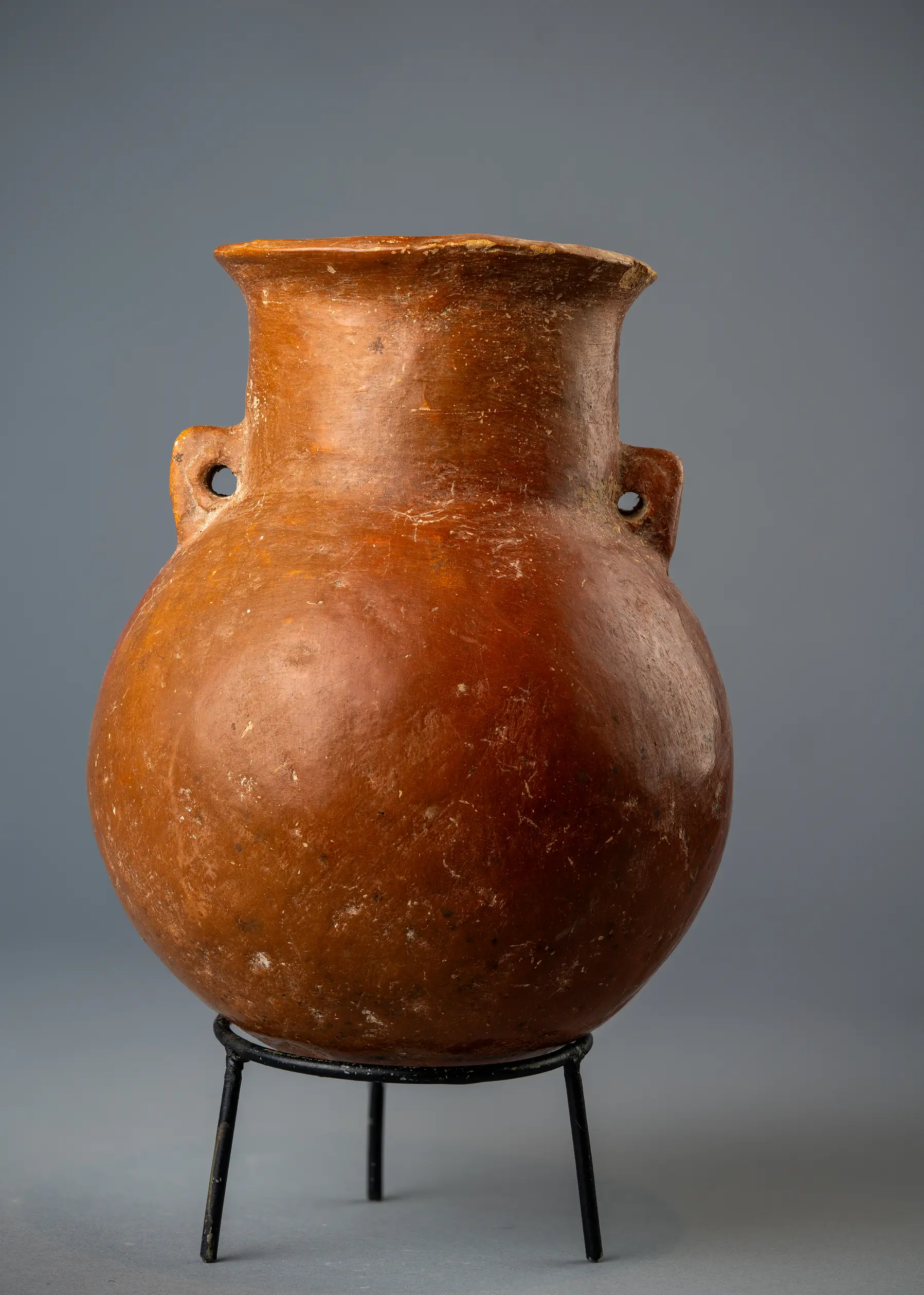
Most household containers were far smaller than any pithos. A Drakopoulos Red Polished jar of the Early Bronze Age belongs to that everyday range: a small household jar, not a pithos, whose contents are unknown. A Red Polished I "storage jar or amphora" from Vounous in the British Museum, 28 cm high, is a museum example of the same scale (BM 1939,0217.25). The British Museum also holds a Red Polished sherd from Alambra catalogued as "possibly from the neck of a storage jar" (G 1884,1210.73).
At Alambra the Middle Cypriot pithoi measured 75 cm to 1 m, two of them with horned-animal heads in relief, and "Five pithoi were found in a small storeroom, Unit 1, in Building II, where they stood on the floor supported by low circular stone and mud-plaster curbs" (Coleman et al. 1996) [7]. Pilides notes rope wear "around the widest part of the body and around the handle" on Alambra jars, and one jar lying upside down, "possibly deliberately placed in this position so as to allow it to dry before refilling" [6]. At Ambelikou-Aletri, an MC I workshop site, complete pithoi range from 78.8 cm to 1.09 m [7]. Merrillees concluded that the Ambelikou jars held water for the miners, "rather than for the storage of any metalliferous substances", since they carry no incrustation [6]. The largest pithos from Pyrgos-Mavroraki has "an estimated capacity of ca. 600 litres" (Belgiorno), and the Pyrgos and Ambelikou jars are "amongst the largest storage vessels known on the island" before the pithoi of LC II–III, up to 2 m tall [7].
Two older excavations complete the picture. At Episkopi-Phaneromeni large jars stood "in some concentration in areas where evidence indicated the preparation and storage of foodstuffs" [6]. In the MC III house at Kalopsidha three pithoi (nos. 1009, 1030, 1082) stood in Room 2 and two more in Room 1; no. 1082 "was assumed to have contained wine, since its interior was covered with a pitch-like substance that caused it to be impermeable" (Paul Åström, 1966) [6]. That lining is the only evidence for sealing a storage jar in these sources, and the wine is inferred from the lining; no residue analysis is reported. Pilides sums up the Middle Bronze Age as "small-scale storage facilities, possibly for domestic use" [6].
| Site and period | Storage vessels | Size or capacity | Source |
|---|---|---|---|
| Marki-Alonia, Philia phase | Pithos | 76.5 cm high | [7] |
| Marki-Alonia, EC I–II | Pithoi | c. 0.5 m high; rims 25–30 cm | [7] |
| Alambra, Middle Cypriot | Five pithoi in storeroom Unit 1 | 75 cm–1 m high | [7] |
| Ambelikou-Aletri, MC I | Complete pithoi | 78.8 cm–1.09 m high | [7] |
| Pyrgos-Mavroraki | Largest pithos | c. 600 litres (estimate) | [7] |
| Apliki-Karamallos, LC | Up to 15 pithoi; six in situ | c. 1.5 m, over 500 litres each; up to 7,500 litres | [8, p. 78] |
| Kalavasos-Ayios Dhimitrios, Building X, LC IIC | c. 50 pithoi in the pithos hall | Up to 2 m; hall c. 33,500 litres; building c. 50,000 litres (estimates) | [8, p. 77] |
Late Bronze Age: the storage halls (c. 1650–1100 BCE)
In the Late Bronze Age storage moved out of the house and into administrative buildings. The best-documented case is ashlar Building X at Kalavasos-Ayios Dhimitrios (LC IIC). Its west side is, in Priscilla Keswani's description, "a pillared storage hall 19.5 m long by 7.25 m wide, with approximately 50 massive pithoi of up to 2 m tall arranged in rows on stone blocks and in pits beneath the floor" [8, p. 77]. Pilides breaks the group down as "at least 6 pithoi of a height of over 2m. sunk in the floor and 47 smaller pithoi of about 1.6m" [6]. A second room, the North Pithos Magazine, is counted differently by different authors: Pilides records "46-50 large pithoi" there [6], while Ora Negbi writes that "space was available for 34 standing vessels" [9].
The capacities are estimates. "Preliminary calculations" by Alison South (1989) put the pithos hall at about 33,500 litres and Building X as a whole, with the North Pithos Magazine, at about 50,000 litres [8, p. 77]. Pilides gives the arithmetic behind such totals: "a pithos of 1.5m. holds about 561 litres, while a pithos of 2m. holds almost double this volume, 1,182 litres" [6].
On the "conservative assumption" that half the jars held oil, and at 15 litres per person a year, the hall held enough for "roughly 500 adults over a two-year period of alternating good and bad harvests"; if all held oil, "over 1000 people". With the town's population estimated at 750 to 1,250 (at most 1,500), "a very large proportion of the local population, not merely the elite, could have been provisioned with oil from the Building X storage hall, perhaps in return for labor devoted to the mining and processing of copper from the mines approximately 8 km north" [8, p. 78]. She frames this as "staple finance", in which subsistence goods are "collected as tribute, stored, and redistributed" (after D'Altroy and Earle) [8, p. 77].
The mining settlement of Apliki-Karamallos shows the other end of that system. One storeroom "may originally have contained up to 15 large pithoi set on limestone blocks"; six were found in place, about 1.5 m high and holding more than 500 litres each, so up to 7,500 litres in all [8, p. 78]. The plant remains (barley, bread wheat, horsebean, lentil, grape, olive and coriander) "could not have been grown on the rocky slopes", so "provisions... must have been supplied from outside" [8, p. 78]. The village is described in Late Bronze Age village life.
Building X had parallels. At Alassa-Paliotaverna, as published by Sophocles Hadjisavvas, the storeroom in the north wing of Building II is "roughly" the size of Building X, with two rows of pithoi "set on stone-slabs and in circular floor depressions", and Building I has a columned hall that "closely resembles the 'Pithos Hall'"; the total amount of oil stored there "has not yet been calculated" [9]. The Ashlar and West Buildings at Maroni-Vournes also had "facilities for the production and storage of olive oil" [9]. Large storerooms are missing at Enkomi and the other coastal emporia, which Negbi finds "difficult to explain" [9]. Some production stayed at household level: at Alassa-Pano Mandilares, strainer jugs "could be related to family-based wine production" [11, p. 160].
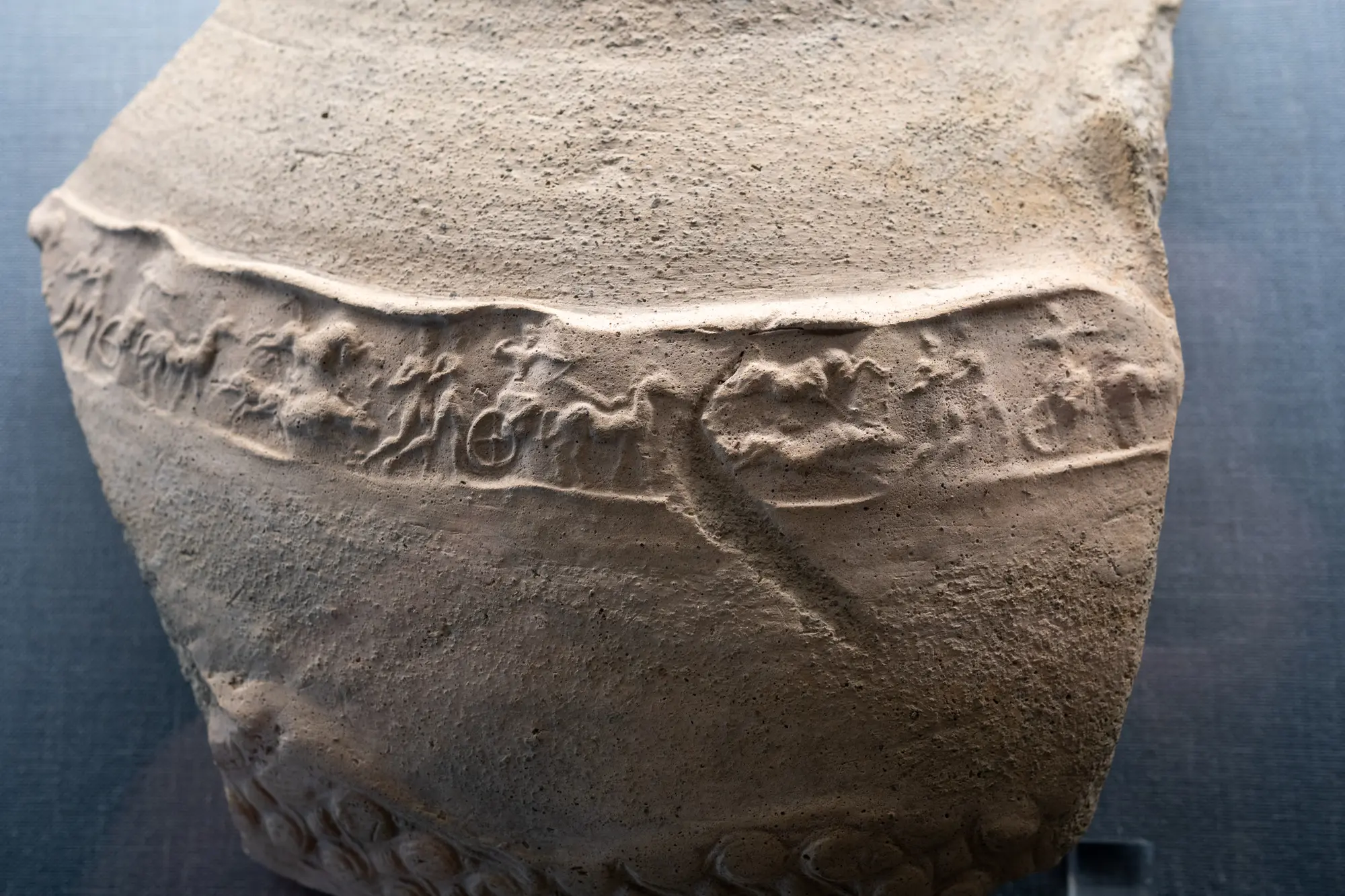
The big jars were also marked. Alassa has produced "some 200 fragments" of storage vessels with relief friezes, more than 150 of them impressed with cylinder seals; Maa-Palaeokastro has 26 and Episkopi-Bamboula 8 [10, p. 140]. One roller with a row of griffin heads impressed pithoi at both Alassa and Episkopi, "the only instance of the same cylinder-seal impression found at two different settlements". Kalavasos and Maroni show a "complete absence" of such pithoi and used Cypro-Minoan instead: five inscribed clay cylinders from Building X and "two gypsum pithos lids inscribed by several marks". Enkomi has only two impressed pithos fragments. The wooden rollers "appear to be a Cypriot invention" [10, p. 140]. A relief-frieze fragment with a chariot scene from a Late Bronze Age pithos in the Cyprus Museum (Relief Frieze, shown at the top of this page) is of this class; its find-site is not recorded. The practice is discussed further in the article on cylinder-seal impressions in Bronze Age Cyprus.
What the jars held: the residue evidence
Building X is the one Cypriot storage complex with a published residue result. Keswani reports that gas chromatography found "multiple methyl esters associated with olive oil in 15 of 19 samples", "suggesting that olive oil may have been the principal, if not the only, commodity stored there" (Keswani 1992) [8, p. 77]. Pilides gives the sample differently, as "20 samples", of which "most" contained olive oil [6]. Flotation in the building recovered "virtually no remains of cereal crops" but some olive and grape pits (Hansen 1989), and a stone tank about 2 m long in the building to the west held olive-oil traces [8, p. 77].
The 50,000-litre figure is a capacity estimate. Negbi's summary attributes to the gas chromatography the finding that "a total of about 50,000 liters of olive oil" could have been stored [9], but the analyses identified oil in the sampled jars; the volume comes from South's calculation of what the jars could hold [8, p. 77]. The Kalopsidha "wine" pithos rests only on its pitch-like lining [6]. We know of no residue or charred-grain evidence reported for the Neolithic pits, the Kissonerga pits or the Marki jars, so what those facilities held is inferred from their form and setting.
After the palaces: the pithos withdraws (c. 1100–750 BCE)
Pilides argues that "the disappearance of the pithos is as important as its appearance", since both are "strong indicators of economic and political circumstances" [6]. The Late Bronze Age pithoi were "concentrated in large storage areas within administrative buildings". Their successors were "smaller storage jars of smaller capacities, denoting short-term storage requirements and frequent accessibility for domestic purposes." The end of the big jars is hard to date because some stayed in use "until the Cypro-Geometric period, as observed at Kition", and the Iron Age pithos is closer in use to "modern-day pitharia" than to the Kalavasos giants [6].
David Rupp puts the change in economic terms. "The almost complete disappearance of large storage pithoi from the ceramic repertory after Cypro-Geometric IA (ca. 1050-1000 B.C.E.)" shows that "the quantity of food stuffs stored and the organization of the storage had changed dramatically", and "Until the mid-eighth century there is no evidence for communal or state storage facilities even in the major settlements" of the Cypro-Geometric period [12, p. 128]. When large storage vessels return to the record, they are found in tombs. At the end of CG III and the start of CA I (c. 775/725 BCE) large storage amphorae in White Painted III/IV, Bichrome III/IV and Black-on-Red appear "in (normally elite) funerary contexts", alongside Plain White IV transport amphorae [12, p. 128]. Rupp reads them through the idea of "social storage" (Halstead and O'Shea): surplus turned into durable valuables that create claims on other people [12, p. 128].
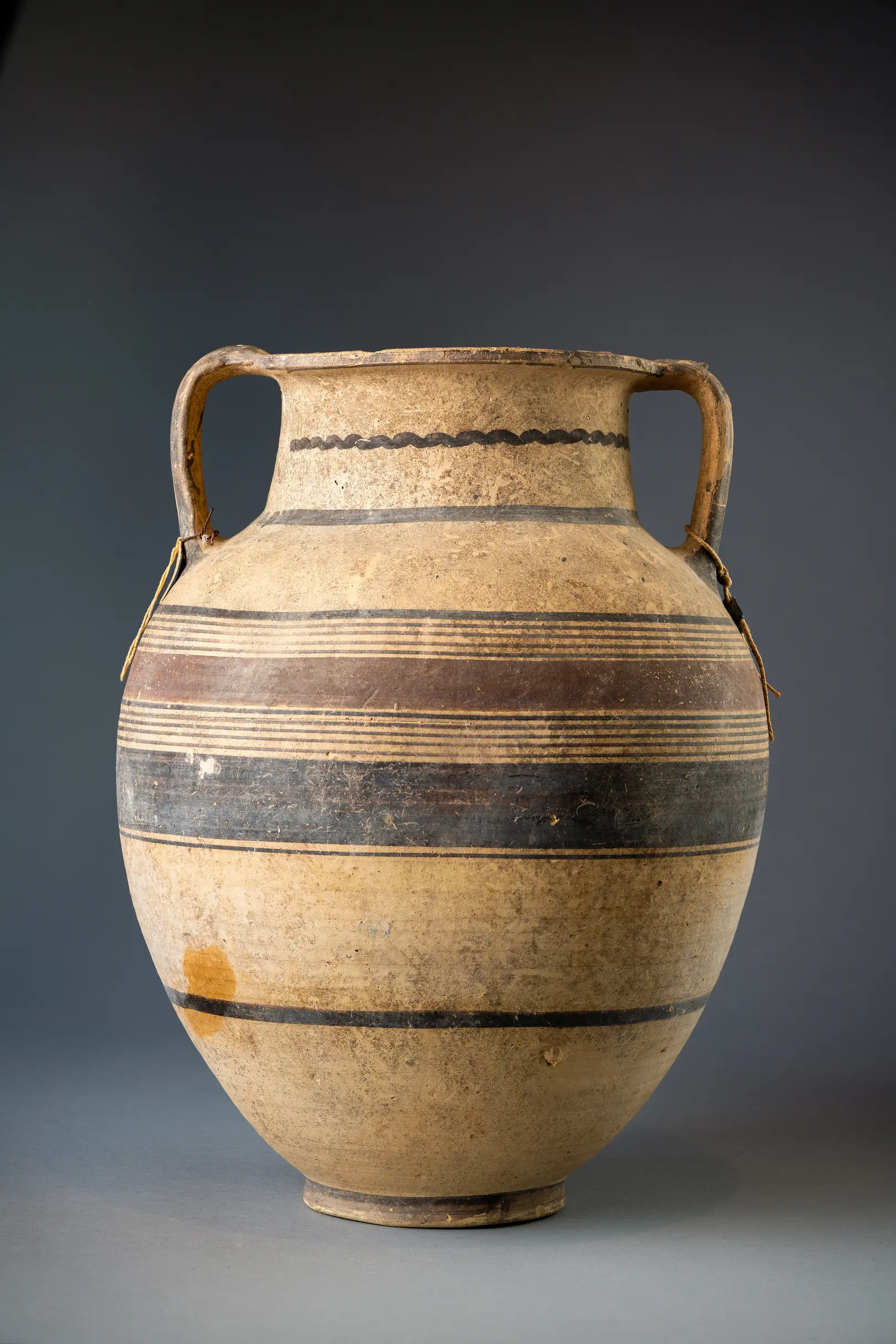
A Large Bichrome Amphora in the Drakopoulos collection is a storage amphora of the kind Rupp describes. It stands 42 cm high, has been repaired, and was sold through the Cyprus Museum's Sales Register (no. SR 3477/65) before its export in 1969; its find-spot is unknown, and its exact Bichrome stage has not been closely dated. A Bichrome amphora of Cypro-Archaic I (c. 750–600 BCE) in the Ashmolean Museum (AN2018.4) belongs to the same family. The shape is described under amphora.
Cypro-Archaic and after: oil amphorae and the kingdoms' storerooms (c. 750–310 BCE)
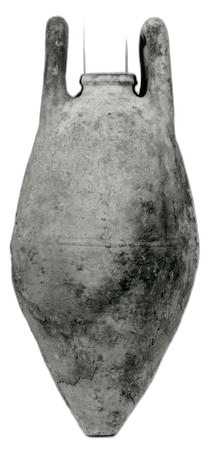
For the centuries between the Late Bronze Age and the Cypro-Classical period, Hadjisavvas and Chaniotis stress the "lack of direct evidence concerning wine and olive oil production"; most of the evidence comes from cemeteries [11, p. 160]. In the Cypro-Archaic royal-type tombs at Salamis and Kourion, Plain White "basket-handle" amphorae served as containers for oil or wine. One from Salamis Tomb 3 is inscribed in the Cypriot syllabary "'[of] olive oil'"; there is "little doubt" that it held oil, though wine is "not excluded" [11, p. 160]. These jars travelled: Tel Kabri produced fragments of at least 80 Cypriot basket-handle amphorae, identified by neutron activation analysis and petrography, while Phoenician storage jars reached Cyprus, mostly in rich burials [11, p. 160]. A wheel-made basket-handle transport amphora of Cypriot type, 82.5 cm high, found at Kamiros on Rhodes, is in the British Museum (BM 1864,1007.32). The transport side of these jars is the subject of the article on ancient Cypriot transport amphorae.
Storerooms reappear in the Cypro-Classical period, just beyond the end date of this entry. On the Ampileri slope at Idalion, excavations directed by Maria Hadjicosti uncovered a Phoenician administrative centre, from the time when the kingdom was under the Phoenician kings of Kition. "Adjoining these rooms are two parallel storerooms holding rows of large pithoi", and the inscriptions found there are "all of an economic nature" [11, p. 160]. An olive press found in 2000 is described as "the most impressive ever excavated on the island", and its circular crushing basin as a fourth-century innovation [11, p. 160].
Conclusion
Read as Peltenburg proposed, the sequence runs from Neolithic stores that cannot be identified, through communal pits at Kissonerga that houses absorbed, to jars kept in every Bronze Age household, the administrative oil halls of LC IIC, and a return to domestic-scale jars after about 1050 BCE. Keswani's reading ties the largest of those halls to the labour of the copper mines; Rupp's ties the next surplus to painted amphorae in elite tombs.
Several points remain open. The counts for the North Pithos Magazine (34 or 46–50) and for the Building X samples (15 of 19, or 20) differ between Negbi, Pilides and Keswani. The Alassa oil total has not been calculated. Building X remains the only storage complex in these sources where the contents have been tested chemically.
Objects on this page
References
- 1.Peltenburg, E. (2004). Social space in early sedentary communities of Southwest Asia and Cyprus. In E. Peltenburg & A. Wasse (Eds.), Neolithic revolution: New perspectives on Southwest Asia in light of recent discoveries on Cyprus (Levant Supplementary Series 1). Oxbow.
- 2.Jones, P. L. (2008). Moving heaven and earth: Landscape, death and memory in the Aceramic Neolithic of Cyprus (BAR International Series 1795). Archaeopress.
- 3.Bolger, D. (2002). Gender and mortuary ritual in Chalcolithic Cyprus. In D. Bolger & N. Serwint (Eds.), Engendering Aphrodite: Women and society in ancient Cyprus (ASOR Archaeological Reports 7, pp. 67–86). American Schools of Oriental Research. Chapter on Chalcolithic Kissonerga-Mosphilia, p. 73.
- 4.Peltenburg, E. (2004). Copper Age Cyprus. In P. Bogucki & P. J. Crabtree (Eds.), Ancient Europe 8000 B.C.–A.D. 1000: Encyclopedia of the barbarian world (Vol. 1). Scribner.
- 5.Webb, J. M. (2002). Engendering the built environment: Household and community in prehistoric Bronze Age Cyprus. In D. Bolger & N. Serwint (Eds.), Engendering Aphrodite: Women and society in ancient Cyprus (ASOR Archaeological Reports 7, pp. 87–116). American Schools of Oriental Research. Chapter on the households of Marki-Alonia, p. 108.
- 6.Pilides, D. (2000). Pithoi of the Late Bronze Age in Cyprus: Types from the major sites of the period. Department of Antiquities, Cyprus.
- 7.Webb, J. M., Frankel, D., et al. (2013). Ambelikou-Aletri: Metallurgy and pottery production in Middle Bronze Age Cyprus (Studies in Mediterranean Archaeology). Åströms Förlag.
- 8.Keswani, P. S. (1993). Models of local exchange in Late Bronze Age Cyprus. Bulletin of the American Schools of Oriental Research, 292, 73–83. https://doi.org/10.2307/1357249
- 9.Negbi, O. (2005). Urbanism on Late Bronze Age Cyprus: LC II in retrospect. Bulletin of the American Schools of Oriental Research, 337, 1–45. https://doi.org/10.1086/basor25066873
- 10.Georgiou, A. (2016). Cylinder-seal impressions on storage vessels from Maa-Palaeokastro: Elucidating an idiosyncratic Late Cypriot mechanism. In J. Driessen (Ed.), RA-PI-NE-U: Studies on the Mycenaean world offered to Robert Laffineur for his 70th birthday (pp. 125–144). Louvain-la-Neuve.
- 11.Hadjisavvas, S., & Chaniotis, A. (2012). Wine and olive oil in Crete and Cyprus: Socio-economic aspects. In G. Cadogan, M. Iacovou, K. Kopaka, & J. Whitley (Eds.), Parallel lives: Ancient island societies in Crete and Cyprus (British School at Athens Studies 20). British School at Athens.
- 12.Rupp, D. W. (1997). 'In fertility Cyprus is not inferior to any one of the islands': A prolegomenon to constructing the economy of Iron Age Cyprus. In D. W. Tandy (Ed.), Prehistory and history: Ethnicity, class and political economy. Black Rose.