
Egypt was the largest and most distant of the powers that dealt with ancient Cyprus, and the relationship ran on two separate tracks that are easy to confuse. The first is political and documentary: a copper-exporting island called Alashiya writes to the pharaoh as an equal in the fourteenth century BCE, a Saite king is said to have conquered the island in the sixth, and a Ptolemaic king abolishes its city-kingdoms at the end of the fourth. The second is material: Base Ring juglets in Nile valley tombs, scarabs and faience bowls in the tombs of Enkomi, and a class of sixth-century limestone statues in pleated kilts and broad collars that were once taken as proof of Egyptian rule. Modern scholarship has pulled the two tracks apart. The pottery trade was real and quantifiable, the diplomatic correspondence is petrographically Cypriot, but the Egyptian look of Archaic sculpture reached the island largely through Phoenician hands, and the conquest that supposedly produced it rests on a single sentence of Herodotus. This entry follows the relationship from the Middle Kingdom to the Ptolemies, keeping the objects and the politics in separate columns wherever the evidence allows.
The Middle Kingdom and the Hyksos horizon
The earliest Egyptian objects on Cyprus predate any documented contact. Calcite vessels of Egyptian type turn up in Early Cypriot tombs at Vasilia and Bellapais-Vounous, and small faience trinkets at Lapithos and Karmi, but these are best read as goods that passed through Levantine ports rather than evidence of direct exchange [1]. A scarab of Senusret I from Enkomi is regularly cited as proof of Middle Kingdom contact; it is not, because it comes from no stratified context, and all the stratified Egyptian scarabs and seal-rings at the site belong to the Eighteenth, Nineteenth and Twentieth Dynasties [2]. A Middle Kingdom object can enter the ground centuries after it was made, and at Enkomi it plainly did.
The first contact that can be measured belongs to the Middle Cypriot period and the Hyksos horizon in Egypt. Small handmade White Painted jugs and juglets of the Pendent Line and Cross Line styles, made in eastern Cyprus around Kalopsidha and Enkomi, were carried to the Levant and to the Nile Delta. At Tell el-Dab'a, the Hyksos capital Avaris, the Austrian excavations have produced the largest single assemblage of such pottery outside the island, mostly sherds of closed vessels from strata that Bietak tied to Egyptian regnal chronology, which is why Merrillees could call Cypriot Bronze Age pottery in Egypt "the best-dated category of objects from Pharaonic times" [3]. A jug of this class in the Drakopoulos collection, a White Painted Ware jug of the nineteenth to seventeenth centuries, shows the shape that travelled: a small narrow-necked container for a valued liquid, probably scented oil. The return traffic is visible in Tell el-Yahudiyeh juglets, Egyptian or Levantine products of the Delta, which reach Cypriot tomb groups in the transitional Middle Cypriot III to Late Cypriot IA phase and attest, in Merrillees' phrase, nothing more than commercial exchange [3]. See the Middle Bronze Age chronology entry for the internal setting.
Alashiya and the New Kingdom
With the New Kingdom the documentary record opens. The annals of Thutmose III at Karnak record the "chief of Asiya" supplying copper, and copper forms the bulk of what Egypt received from the island thereafter: 108.5 ingots and 2,400 deben in the king's thirty-fourth year, further amounts in years thirty-eight and thirty-nine, "the mountain of Alasa" sending metal under Ramesses II, and Papyrus Anastasi IV around 1200 BCE listing "many ingots of raw copper" brought on the necks of the "children of Alasa" [1]. The name Alashiya is the same one used in Hittite, Ugaritic and Akkadian texts, and its identification with Cyprus, contested for a century, is now effectively settled by clay science (see below and the article on the search for Alashiya).
The Amarna archive is the centre of the story. Eight tablets sent from Alashiya (EA 33-40) reached the court of Akhenaten around the middle of the fourteenth century: seven from the king, one from his governor, the rabisu [4, pp. 104-113]. The Alashiyan king addresses the pharaoh as "my brother," the form reserved for the great kings of Hatti, Mitanni and Babylon, and no Canaanite vassal writes that way [1]. Copper is the recurring subject. EA 34 sends 100 talents and asks for an ebony bed fitted with gold, a chariot, horses and linen; EA 35 sends 500 talents, roughly fourteen tonnes on the standard of the oxhide ingot, with the apology that the amount is small because "the hand of Nergal is now in my country; he has slain all the men of my country, and there is not a single copper-worker" [4, pp. 107-108]. EA 38 rebuts an Egyptian accusation that Alashiyans had joined seaborne raiders, complaining that "men of Lukki, year by year, seize villages in my own country," and EA 39 asks that the king's merchants and ship be allowed to pass duty-free [4, pp. 110-111]. The hieratic docket on the back of EA 39 reads "letter of the prince of Alasa," fixing the Egyptian form of the name.
The decisive modern contribution is petrographic. Goren, Bunimovitz, Finkelstein and Na'aman examined the fabric of the Alashiya tablets and found clays consistent with the southern flank of the Troodos, between Kalavasos-Ayios Dhimitrios and Alassa-Paliotaverna, and distinct from the east-Cypriot clay of the locally made Cypro-Minoan tablets at Enkomi [5]. The result located the correspondence inland, near the copper, and reopened the question of where the kingdom's seat lay and whether there was one seat at all. Knapp reads the external record as evidence of a single internationally recognised king, both at Amarna and a century later at Ugarit [1, pp. 357-362]; Keswani and others prefer several regional polities of roughly equal weight; Goren and his colleagues declined to choose and offered three models. The question is open. One older confusion should be closed, however: the tribute-bearers painted in Theban tombs of the early Eighteenth Dynasty, Rekhmire's among them, are labelled Keftiu, and Keftiu is the Aegean. Cyprus appears in Egyptian texts as Alashiya and in the copper accounts, not in the painted processions.
The New Kingdom relationship has a coda. The Report of Wenamun, set around 1075 BCE, has its Egyptian emissary blown onto the coast of Alashiya on the way home from Byblos, nearly lynched as a pirate, and brought before a queen named Hatiba through an interpreter [1]. It is the last Egyptian mention of the Bronze Age name.
Pots for the Nile: Base Ring and White Slip in Egypt
The material counterpart to the letters is pottery. Merrillees' catalogue of Cypriot Bronze Age pottery in Egypt, still the dataset on which discussion rests, listed 513 vessels from known contexts, about seventy per cent of them from tombs spread from Nubia to the eastern Delta [3]. The assemblage is narrow in a way that tells its own story. Base Ring I and II make up roughly two-thirds of the total and the great majority are juglets; at Amarna, where most of the Base Ring II came from the settlement rather than graves, closed vessels still account for about ninety-two per cent of the sample [6]. White Slip, the dominant Cypriot export in the Levant, is about two per cent in Egypt, and Monochrome ware is absent [6]. Egypt wanted the contents of small closed Cypriot vessels, not Cypriot tableware.
Two Drakopoulos pieces illustrate the exported shapes. A Base Ring jug and a Base Ring double juglet, both handmade with the thin dark metallic fabric that Egyptian potters copied in Nile silt and marl at Abydos, Gurob, Harageh, Sedment and elsewhere during the Eighteenth Dynasty, alongside copies in alabaster, faience and glass [3]. A White Slip milk bowl represents the ware that Egypt largely ignored, though the Tell el-Dab'a excavations have since shown that White Slip did reach the Delta in some quantity, so that the funerary record alone understated it [6]. The entries on Base Ring ware and White Slip ware treat the wares themselves.
What the juglets held is unresolved. Merrillees proposed in 1962 that the Base Ring "bilbil," with its inverted-poppy-head profile, advertised opium, and the residue science has swung back and forth for sixty years without a clean answer; scented or medicinal oil is the safe reading, opium a possibility in some cases. Bergoffen's comparison of assemblages showed that the Cypriot pottery in the northern Sinai forts matches southern Canaan rather than Egypt, so it arrived overland on the Egyptian military supply route as a tolerated private sideline, not as a managed state import, and the thin, wide spread of Base Ring across Egyptian cemeteries, rarely more than one vessel per tomb, marks it as a moderate-value commodity for what Merrillees called a "middle class" clientele [6]. The trade peaked under Thutmose III and his successors and thinned in the Nineteenth Dynasty; Merrillees connected the drop after the Amarna period with disruption in the northern Levant [3].
Egyptian things in Cyprus: scarabs, faience and the Horemheb sceptre
The reverse flow was thin in pottery and rich in small valuables, concentrated in the tombs of the coastal towns and above all at Enkomi. Smith's study of the 228 contextualised seals from the site traces a sequence: imported Egyptian scarabs, seal-rings and finger-rings deposited with the dead in Late Cypriot I to IIC, then, in Late Cypriot IIIA, Egyptianizing designs (lions, sphinxes, bulls, fish) cut afresh on Cypriot conoid stamp seals and cylinders while the scarab shape itself was abandoned until the Iron Age [2]. The catalogue of the island's Aegyptiaca is Jacobsson's [7]. Datable royal names anchor the horizon: a scarab of Queen Tiy and a silver ring of Akhenaten from British Tomb 93, a gold signet possibly showing Amenhotep III and Tiye, and a faience scarab of Ramesses III from Tomb 42, the latest closely datable piece at the site [2]. A pharaoh's name does not date a burial. Scarabs of Thutmose III and Ramesses II stayed in circulation for generations, and a commemorative lion-hunt scarab of Amenhotep III and a twelfth-century faience bowl from Kouklia surfaced in eleventh-century tombs [2].
| Object | Find-spot | Egyptian date | Cypriot context |
|---|---|---|---|
| Scarab of Senusret I | Enkomi | 12th Dynasty | Unstratified; deposition unknown |
| Scarab of Queen Tiy; silver ring of Akhenaten | Enkomi, British Tomb 93 | c. 1390-1336 BCE | Late Cypriot II tomb |
| Faience sceptre-head with cartouche of Horemheb | Hala Sultan Tekke | c. 1323-1295 BCE | Late Cypriot IIIA building, c. 1190-1175 BCE |
| Two scarabs of Ramesses II | Hala Sultan Tekke | 13th century BCE | Late Cypriot settlement |
| Faience scarab of Ramesses III | Enkomi, Tomb 42 | early 12th century BCE | Latest datable Enkomi scarab |
| Lion-hunt scarab of Amenhotep III | Kouklia | 14th century BCE | 11th-century tomb |
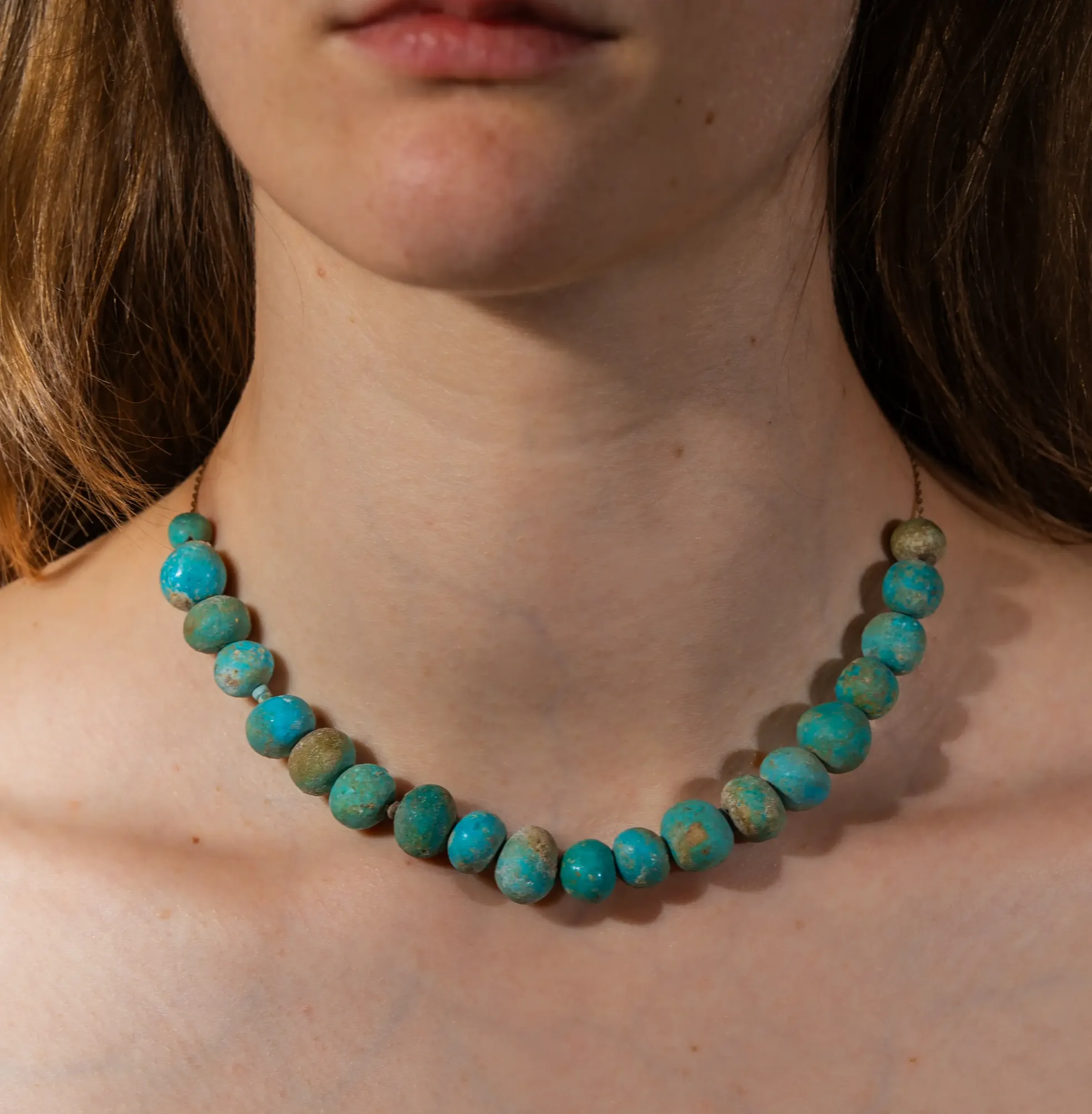
Faience is the second large class. The Egyptian New Kingdom blue-glazed bowls with line-drawn interior scenes of lotus, pond, fish and cattle are saturated with the symbolism of Hathor, and Cyprus holds an anomalous concentration of them: about seventy of some 145 known from non-Egyptian contexts in the Levant, against three or four at Ugarit, with Enkomi and Kition leading [8, pp. 381-386]. Peltenburg's explanation ties the goddess to the metal. Hathor was the Egyptian protectress of mining and of the acquisition of raw materials abroad, and her cultic faience clusters on the copper island because Egyptian partners furnished Hathor-related objects to the people who supplied their copper [8, pp. 384-388]. Most of the bowls are Egyptian imports on stylistic and chemical grounds, though a little local substitution cannot be excluded [8, pp. 388-390]. The small faience amulets of Bes, Hathor and Taweret found on the island are agreed imports, and no faience is thought to have been made on Cyprus before the Late Bronze Age; the Middle Cypriot bead necklaces, one of which is the subject of an article on this site, were almost certainly carried in by sea.
The single most cited Egyptian object from the island is the faience sceptre-head from Hala Sultan Tekke, now Larnaca District Museum N 1118: blue faience with white inlays, papyriform, the cartouche of Horemheb on top, and a square hole retaining traces of an ivory rod [9, p. 168]. It came from a Late Cypriot IIIA building of about 1190-1175 BCE, some 150 years after Horemheb's reign, and is read either as an heirloom or as a twelfth-century import [9, p. 168]. Hala Sultan Tekke as a whole yielded an unusually dense Egyptian assemblage: an amphora handle stamped with the cartouche of Seti I, two scarabs of Ramesses II, a signet ring inscribed with the personal name Nebuwy, and bones of Nile perch that suggest dried fish shipped from the Delta [1]. Egyptian transport amphorae proper only appear at the end of the period, their necks broken to get at the wine or beer, as at Malkata in Egypt.
Amasis and the Saite "conquest"
The Iron Age political episode rests on one sentence. Closing his Egyptian book, Herodotus writes that Amasis (r. c. 570-526 BCE) "seized Cyprus, the first man to do so, and compelled it to pay tribute" (2.182.2). Diodorus (1.68.6) adds that Amasis subdued the Cypriot cities and adorned their sanctuaries with offerings, and reports that his predecessor Apries defeated a combined Phoenician and Cypriot fleet [10, pp. 46-50]. Gjerstad placed the conquest at 569 BCE and built a "Cypro-Egyptian" phase of sculpture on it. Much of that has come apart.
Reyes mounted the sceptical case. Herodotus uses nearly the same words of Croesus of Lydia, "the first of the barbarians to subject Greeks to tribute," and deliberately pairs Amasis and Croesus as philhellene first-doers who showered Greek sanctuaries with dedications; the Cyprus notice may be a literary motif rather than a fact, and "historically, there need not have been any such phenomenon" [10, pp. 49-50]. Reyes then went through every class of object claimed for an Egyptian domination, from scarabs to the Amathus double-crown relief to the painted tomb at Salamis, and found none that requires it [10, pp. 50-53]. The Egyptian side offers no memory of the conquest. Edel read the Elephantine stele of Amasis as describing the cutting-off of "the island" that had furnished Apries with Greek mercenaries, but Leahy showed that the Egyptian word need not mean Cyprus and that naval operations in Amasis' insecure first year are implausible, so the anchor to 570 is gone [10, pp. 47-48].
Mehl holds the opposite pole and refuses to deny Egyptian supremacy "as a fact," on the ground that Reyes allowed only two categories, direct domination and equal alliance, and omitted indirect rule, the commonest form of ancient empire: local kings kept in office, obligations limited to loyalty, tribute and military help, and no garrisons or administrative imprint to be expected [11]. On that reading Herodotus' tribute is what a client would owe. Even so, the arrangement was short. On the minimal reckoning it began around 560 and ended when the Cypriot kings changed sides to Persia after the fall of Lydia, some fifteen years later; on the maximal it stretches back to Apries but was interrupted [11]. What it meant on the ground, in form, amount or regularity of tribute, is unrecoverable, and no Cypriot tribute-bearers appear in Saite reliefs as they do at Persepolis [11]. The next stage is covered under Achaemenid Persia.
The real channel of the sixth century was not conquest but Naukratis, the Greek trading town on the Canopic branch of the Nile that Amasis confirmed as the licensed port for Greek trade. A faience factory excavated there by Petrie mass-produced scarabs and amulets, mainly under Psamtek II and Apries, and its products reached Ayia Irini and Amathus [10, p. 50]. The traffic ran the other way too: 262 Cypriot stone and terracotta figures are catalogued from Naukratis, most dedicated in the sanctuaries of Aphrodite and Apollo before about 525 BCE, and it was a Cypriot alabaster figure that first drew Petrie to the site. Cypriot amphorae of about 650-520 BCE occur at Naukratis, Tell Defenneh and other Delta sites. Reyes explained the Egyptian faience and bronzes on Cyprus by this Cypriot enclave in the Delta rather than by occupation [10, p. 50], and the later influx of Greco-Egyptian faience aryballoi into the sanctuary of Apollo Hylates at Kourion belongs to the same commercial route along the island's south coast.
Egyptianizing limestone sculpture
The largest and longest-lived Egyptian strand in Cypriot art is a class of sixth-century limestone male votaries in Egyptian dress, found at sanctuaries across the east and south of the island: Golgoi, Idalion, Tamassos, Kazaphani, Palaepaphos. The costume is a pleated kilt to the knee with a central trapezoidal apron, or devanteau, bearing addorsed cobras and pendant ribbons; a broad ousekh collar over a bare chest or a tight short-sleeved tunic; spiral armlets; a wig or headcloth; on a subset, a composite double crown resembling the Egyptian pschent; and a pose with one arm at the side and the other bent across the chest [12]. Representative pieces from Golgoi are in the Cesnola Collection at the Metropolitan Museum [14].
Three findings dismantled the old equation of this class with Amasis. First, the prototypes are New Kingdom, not Saite. Markoe showed that the full pleated kilt with a cobra apron is a Ramesside fashion, whereas Saite royal statuary, contemporary with the Cypriot pieces, had reverted to a plain Old Kingdom loincloth without jewellery or double crown; the Cypriot style cannot derive from the Egypt of its own day [12]. Second, the transmission was Phoenician. The New Kingdom dress survived on the ninth-century Bar-Hadad stele, on Nimrud ivories and on sixth-century stone torsos from Sarepta and Tyre, and Markoe argued that the Cypriot vogue, in the last quarter of the sixth century and the early fifth, coincided with the growth of Phoenician sanctuaries on the island under Persian rule [12]. Third, the chronology is wrong for a Saite cause. Vermeule lowered the bulk of the limestone votives to about 520-480 BCE, and a fragmentary kilt statue from the fill of the Persian siege mound at Palaepaphos, crisply carved and unworn, dates around 515-500 with a terminus of 498 [12]. The floruit falls under Persia, not Egypt.
Faegersten's monograph refined the picture into what she calls a hybrid Cypriot creation. Only a couple of early sixth-century pieces reproduce a standard shendyt; the rest blend two kilt types and add non-Egyptian motifs, the cobras being the most constant element, while the aprons and belts carry Hathor heads, Bes, gorgoneia, sphinxes and scarabs [13]. The collar, belt and palmette details are Phoenician renderings of Egyptian motifs, already altered before they reached Cyprus, and the only kilt-wearing statue actually found at Naukratis follows the Cypriot version, so the Delta supplied no missing link [13]. What is Cypriot is the monumental scale and the limestone. Hermary adds a necessary distinction: works that are "naturally" Egyptianizing because they depict Egyptian-derived divinities, Hathor or the ram-headed Ammon, should be separated from votaries who merely adopt Egyptian dress and pose, and the double crown legitimises royal power under the goddess without being confined to Phoenician rulers [14, p. 24]. The class is a minority within a very large output; most Cypriot limestone votaries, like the small smiling male head in the Drakopoulos collection, wear nothing Egyptian at all. The wider medium is treated under Archaic limestone sculpture.
Allied forms complete the horizon. Limestone capitals crowned with frontal Hathor heads, known chiefly from Amathus and from the palace at Vouni, date around 500 BCE on Hermary's analysis, and the Hathor motif was assimilated to the Cypriot goddess whose cult image is carried in procession on an Amathus-style amphora. Stelai with Egyptian cavetto cornices topped by addorsed sphinxes begin in the later sixth century. A ram-horned enthroned god appears from the first half of the sixth century at Meniko, Golgoi and Athienou-Malloura, identified by Karageorghis as Baal-Hammon and by others as the Zeus Ammon of Siwa and Cyrene; the 2012 Brussels catalogue leaves the name open [9, p. 254]. Bes, present since the Bronze Age ivory plaque at Kition, runs through the Iron Age as a generic protector. Mehl's formulation is apt: Egyptian theology of royal power impressed Cypriot minds more than Assyrian, Babylonian or Persian ideas did, and did so "independent from the current political relation" with Egypt [11].
From Alexander to the Ptolemies
The relationship ends with Egypt absorbing the island outright. After Issus in 333 BCE the Cypriot kings, who had served Persia with their fleets, put in to Sidon with about 120 ships and joined Alexander, and their squadrons blockaded the northern harbour of Tyre during the siege of 332; a Tyrian sortie sank the flagship of Pnytagoras of Salamis and the ships of Androkles of Amathus and Pasikrates of Kourion before order was restored [15]. Alexander left the kings their thrones. His death in 323 made Cyprus the prize in the war between Ptolemy of Egypt and Antigonos, with Salamis, Paphos, Amathus and Soloi in the Ptolemaic camp and Kition, Kyrenia, Lapithos and Marion in the Antigonid. Ptolemy executed Pumayyaton of Kition in 312 for negotiating with Antigonos, ending the Phoenician dynasty; Marion was razed and its people moved to Nea Paphos; and around 310 the royal house of either Salamis or Paphos (Diodorus names Nikokles of Paphos, the Marmor Parium records Nikokreon of Salamis dying in 311/310, and the sources cannot be reconciled) destroyed itself, the queen killing her daughters and the king's brothers firing the palace [15]. Demetrios Poliorketes took the island after the sea battle off Salamis in 306, and Ptolemy I retook it in 294; it stayed Ptolemaic until 58 BCE.
The abolition of the kingdoms was gradual and disguised rather than decreed. Bagnall showed that the early titulature is murky, that Menelaos is already called strategos in 315 while Nikokreon holds the same title, and that a unitary provincial governor answerable to Alexandria is securely attested only under Ptolemy IV, with the first explicit evidence in 217 BCE [16, pp. 38-49]. The transitional coins of Nikokreon and Menelaos keep the title basileus, and Menelaos' issues even append the Cypriot syllabic sign for ba to the alphabetic legend, which Papantoniou reads as a covert Ptolemaic claim to continuity [15]. The capital moved from Salamis to Nea Paphos to shorten the crossing to Alexandria, and Cyprus became a source of copper, grain, timber and crews for the Ptolemaic fleet. The Isis cult, absent from the island under the supposed Saite domination, arrived only now. The Hellenistic chronology entry continues the story.
Reading the relationship
Two registers, then. At the level of states, Egypt and Cyprus dealt in copper and prestige: the "brother" letters of Amarna, the Hathor bowls sent to the metal suppliers, the disputed tribute of Amasis, the fleets at Tyre, the annexation by Ptolemy. At the level of objects and images, the Egyptian element in Cypriot culture was mostly indirect, filtered through Levantine merchants in the Bronze Age and Phoenician craftsmen in the Iron Age, and it flourished when Egyptian political power over the island was weakest. The one moment the two registers coincide is the twelfth-century sceptre of Horemheb in a Hala Sultan Tekke building: an Egyptian royal object, plausibly a gift, kept for a century and a half by people who valued the name on it.
References
- 1.Knapp, A. B. (2008). *Prehistoric and protohistoric Cyprus: Identity, insularity, and connectivity*. Oxford University Press.
- 2.Smith, J. S. (2013). From Egyptian to Egyptianizing in Cypriot glyptic of the Late Bronze Age. *Journal of Ancient Egyptian Interconnections, 5*(3), 10-43.
- 3.Merrillees, R. S. (1968). *The Cypriote Bronze Age pottery found in Egypt* (Studies in Mediterranean Archaeology 18). Paul Åströms Förlag.
- 4.Moran, W. L. (1992). *The Amarna letters*. Johns Hopkins University Press.
- 5.Goren, Y., Bunimovitz, S., Finkelstein, I., & Na'aman, N. (2003). The location of Alashiya: New evidence from petrographic investigation of Alashiyan tablets from El-Amarna and Ugarit. *American Journal of Archaeology, 107*(2), 233-255.
- 6.Bergoffen, C. J. (1991). Overland trade in northern Sinai: The evidence of the Late Cypriot pottery. *Bulletin of the American Schools of Oriental Research, 284*, 59-76.
- 7.Jacobsson, I. (1994). *Aegyptiaca from Late Bronze Age Cyprus* (Studies in Mediterranean Archaeology 112). Paul Åströms Förlag.
- 8.Peltenburg, E. (2007). Hathor, faience and copper on Late Bronze Age Cyprus. *Cahiers du Centre d'Études Chypriotes, 37*, 375-394.
- 9.Pilides, D., & Papadimitriou, N. (Eds.). (2012). *Ancient Cyprus: Cultures in dialogue* (Exhibition catalogue, Royal Museums of Art and History, Brussels). Department of Antiquities, Cyprus.
- 10.Reyes, A. T. (1994). *Archaic Cyprus: A study of the textual and archaeological evidence*. Clarendon Press.
- 11.Mehl, A. (2009). The relations between Egypt and Cyprus from Neo-Assyrian to Achaemenid rule (7th-6th cent. B.C.). In D. Michaelides, V. Kassianidou, & R. S. Merrillees (Eds.), *Egypt and Cyprus in antiquity* (pp. 60-66). Oxbow Books.
- 12.Markoe, G. E. (1990). Egyptianizing male votive statuary from Cyprus: A reexamination. *Levant, 22*, 111-122.
- 13.Faegersten, F. (2003). *The Egyptianizing male limestone statuary from Cyprus: A study of a cross-cultural Eastern Mediterranean votive type*. Lund University.
- 14.Hermary, A., & Mertens, J. R. (2014). *The Cesnola Collection of Cypriot art: Stone sculpture*. The Metropolitan Museum of Art.
- 15.Papantoniou, G. (2013). Cypriot autonomous polities at the crossroads of empire: The imprint of a transformed islandscape in the Classical and Hellenistic periods. *Bulletin of the American Schools of Oriental Research, 370*, 169-205.
- 16.Bagnall, R. S. (1976). *The administration of the Ptolemaic possessions outside Egypt*. Brill.