
Ancient Cypriot Pottery·Lesson 7
The Cypro-Geometric Repertoire
The first Iron Age pottery of Cyprus, c. 1050 to 750 BC: White Painted, Bichrome and fluted Black Slip, plates painted on their undersides, and the cues (red fill, compass circles, a jug's foot) that tell one stage from the next.
Alexis Drakopoulos·Period by period·13 min read
Share


Lesson 7·Course contents, 15 lessons
Tomb I at Salamis, on the east coast, held 182 pots in a single chamber. Sixty were Proto-White Painted, the last painted ware of the Bronze Age, where Lesson 6 ended. Eleven were its two-colour variant, six were imports, and 105 belonged to the first stage of the Iron Age, Cypro-Geometric I (CG I) [1, p. 699]. The tomb has been assigned to the transition between the two periods, and sorting its pots is harder than it sounds, because the shapes are mostly the same. The surest guide is the paint. The new ware, White Painted I, has in Maria Iacovou's description "a uniform dull, matte black washy decoration" [2, p. 200], without the patchy orange-brown of its predecessor. The date put on the change from one ware to the other, 1050 BC, goes back to John Myres, and Iacovou calls it "a conventional but unshakable absolute date" [2, p. 199].
A period named after its pots
The names in this lesson come from one book, volume IV:2 of the Swedish Cyprus Expedition, published by Einar Gjerstad in 1948. As Lesson 0 showed, its numerals are periods: White Painted I, Bichrome I and their companions are Type I, and Type I is CG I, Type II CG II, Type III CG III [3; 4, p. 3]. Gjerstad sorted the wares of tomb groups into a sequence, then fixed years to the joins from Cypriot pots found in datable contexts abroad. His figures were CG I 1050 to 950 BC, CG II 950 to 850, CG III 850 to 700 [12, p. 225]. The relative order has survived seventy years of testing; the years have fared worse. J. N. Coldstream argued that a century-long CG II could not be sustained [5], and the dates most specialists now use are CG I c. 1050 to 950, CG II c. 950 to 900 and CG III c. 900 to 750 BC, with the Cypro-Archaic beginning around 750 [4, p. 3].
Set Gjerstad's years against the ones used now and open the line between CG II and CG III: the order of the periods is the same in both, but the lines either side of CG III have each moved fifty years earlier, and CG II has shrunk to half its length.
Two chronologies
Gjerstad's Iron Age dates, and the dates used now
The order of the periods has survived seventy years of testing; some of the years under them have moved. Each line joins the same boundary in the two schemes. Choose a line, or a boundary in the list, to see why.
Gjerstad, 1948 · Swedish Cyprus Expedition IV:2
Used now · the dates in this course
CG II to CG III
850 900 BC
J. N. Coldstream argued that a century-long CG II could not be sustained. CG II is now c. 950 to 900 BC, half Gjerstad's length, and CG III starts c. 900.
Lesson 7: The Cypro-Geometric RepertoireA pot dated by Gjerstad's tables to "CG III, 850 to 700 BC" in an older book is the same pot a modern catalogue dates to c. 900 to 750 BC: the label holds, and the years under it have slid.
White Painted I to III
White Painted, the backbone of the period, shares only its name with the handmade Middle Cypriot ware of Lesson 4. Gjerstad defined White Painted I as wheel-made, of buff, brown or greenish clay under a buff or greenish slip, painted "in a black or brown mat colour" [3]. The wheel, which Lesson 1 watched arriving in Late Cypriot I, is now standard for every fine ware; only big storage jars and some cooking pots stayed handmade [4, p. 4]. In CG I and II, Gjerstad found, White Painted and Bichrome were the only decorated pottery on the island [3].
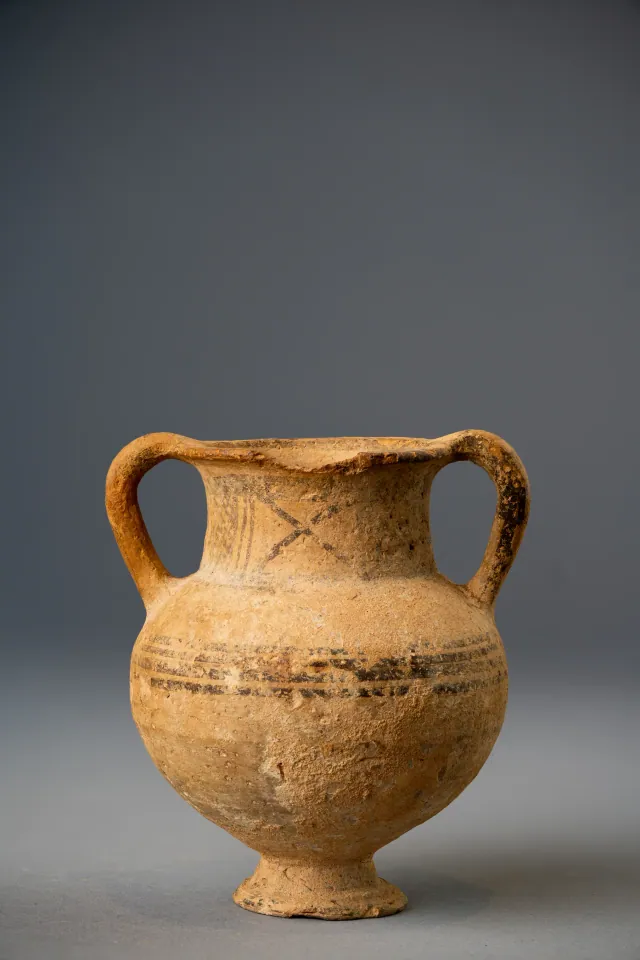
The amphoriskos beside this paragraph, a small two-handled jar on a short foot, shows the ware in its first stage. Its neck carries a quick saltire (a diagonal cross) beside a group of vertical strokes, and its squat body matches a series of twelve amphoriskoi from one Cypro-Geometric I tomb at Palaepaphos-Skales [6]. The shape descends directly from the Proto-White Painted amphoriskos. White Painted I decoration is rectilinear and drawn freehand: wavy lines, zigzags, latticed triangles and lozenges, the Maltese cross, arranged in horizontal zones or in framed panels [3]. The large amphora from the British Museum, nearly 40 cm high, carries hatched triangles on the shoulder and big wavy lines round the body.
Gjerstad thought the next stage a falling-off. In White Painted II "the fresh ornamental spirit and rhythmic sense of White Painted I has disappeared; the decorative elements are poorer, and their composition is more mechanical" [3]. White Painted III tightens again: shapes become "markedly restrained and elegant," the jugs slimmer, and the clay rougher under a paint that is "mat, but deeply black" [3].
White Painted III also brings the motif most people picture when they think of Cypriot Iron Age pottery. Concentric circles, fringed circles and pendent arcs are new at this stage, and the swastika becomes common [3]. The circles were drawn mechanically, with a compass [8]. The dense bull's-eye systems that cover so many museum jugs therefore belong to CG III and after; a pot covered in them is unlikely to be CG I.
To try the two tools of the Iron Age workshop, throw a White Painted jug on the wheel and set its circles out with the compass: one heavy-ringed system on the shoulder, then a row of them round the body.
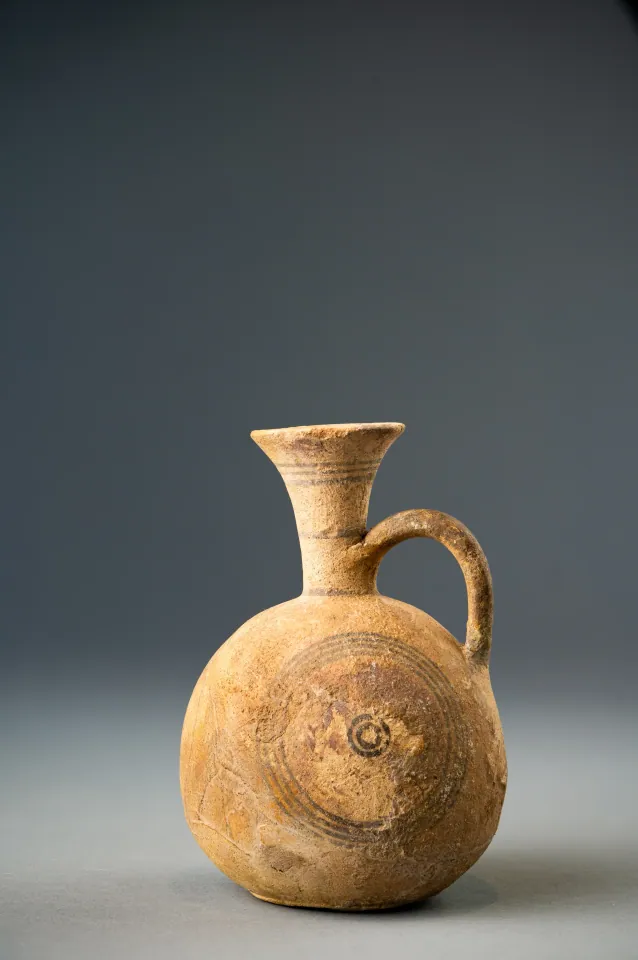
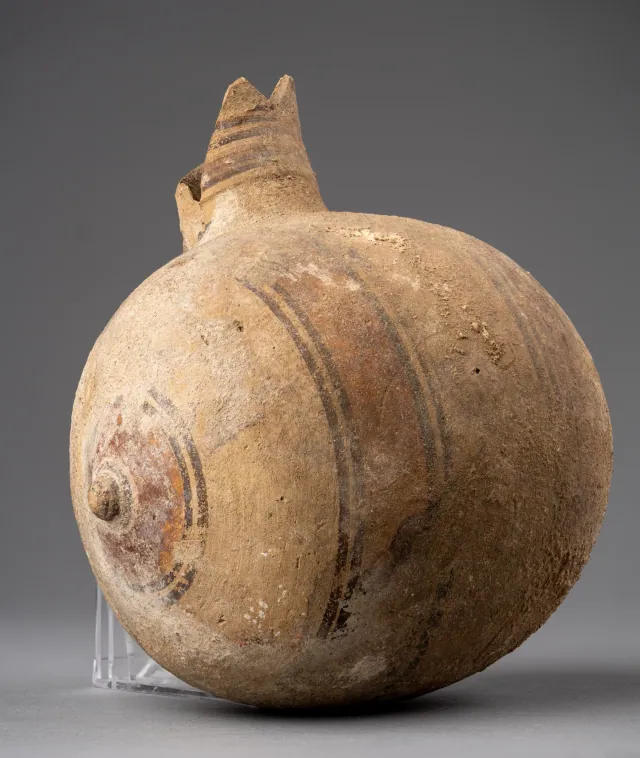
The juglet with a single large circle on its side shows where that development went. Its painter set one big circle system on the body of a round juglet of late CG III or early Cypro-Archaic I, centred where the handle meets the body, the layout of the barrel jug. A warmer patch inside the circle may be lost red paint, which would make it Bichrome; until the surface can be examined, White Painted is the safer name. The barrel jug itself, the shape most typical of the period, began as a Phoenician import: a globular jug with a ridge round the neck, brought to the island in CG I and soon remade by Cypriot potters with a horizontal, spindle-shaped body and a knob at each end [4, p. 5].
Bichrome: the second colour
Bichrome I needed only one line in Gjerstad's typology: "wheel-made; clay and slip are the same as those of White Painted I; the ornaments are painted in black and supplementary red colour" [3]. The word that matters is supplementary. Iron Age Bichrome, as Iacovou puts it after Vassos Karageorghis, "uses the red color as secondary to the black with which it is not meant to overlap. The red is used sparingly to fill solid areas which have been carefully delineated and often outlined in black" [2, p. 202].
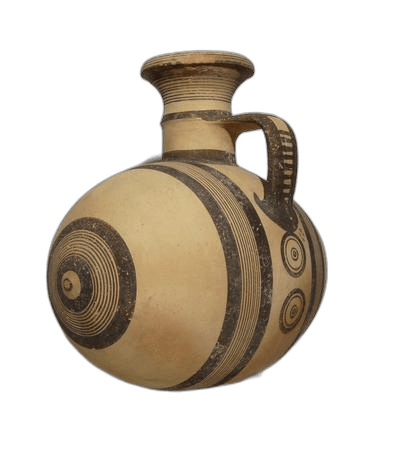
That rule separates it from the occasional two-colour Proto-White Painted vases, where black and purple-red alternate within one motif, and Iacovou rejects any descent from them. She traces the new technique to the imported Phoenician neck-ridged jug and its many local imitations [2, p. 202], which makes Bichrome I one of the first ceramic signs of renewed contact with the Levant. The barrel jug beside this paragraph, a Bichrome III piece 37 cm high, shows the mature shape: a boss at each end, a ridge halfway up the neck, concentric circles below the handle, and the purple-red kept to one band below the rim.
Bichrome is rare in CG I and grows steadily; by the Cypro-Archaic it outnumbers White Painted [3]. Its numbering keeps step with White Painted, Type for Type, from Bichrome I to Bichrome VII in the Cypro-Classical (Lesson 10) [3]. It was never evenly spread. The workshops of Salamis preferred the technique from the start of the Iron Age, and their potters used red more freely than anyone else, to outline designs as well as to fill them [7, p. 338].
Black Slip and the "bucchero" jugs
The third ware of CG I has no painted ornament at all. Black Slip is "wheel-made; buff or brown clay, well silted, with a black, mat or occasionally very slightly lustrous slip," made mostly as jugs with a pinched mouth and as small amphorae, and "most of the vases have parallel, vertical furrows round the body, imitating the ribbed surface of the metal models" [3]. The fluted versions are often called Black Slip Bucchero, a name borrowed from the black pottery of the Etruscans, with which they have no connection [8, p. 44]. Black Slip is common in the Cypro-Geometric and rare afterwards [3], so a fluted black jug is a good sign of the 11th to 9th centuries BC.
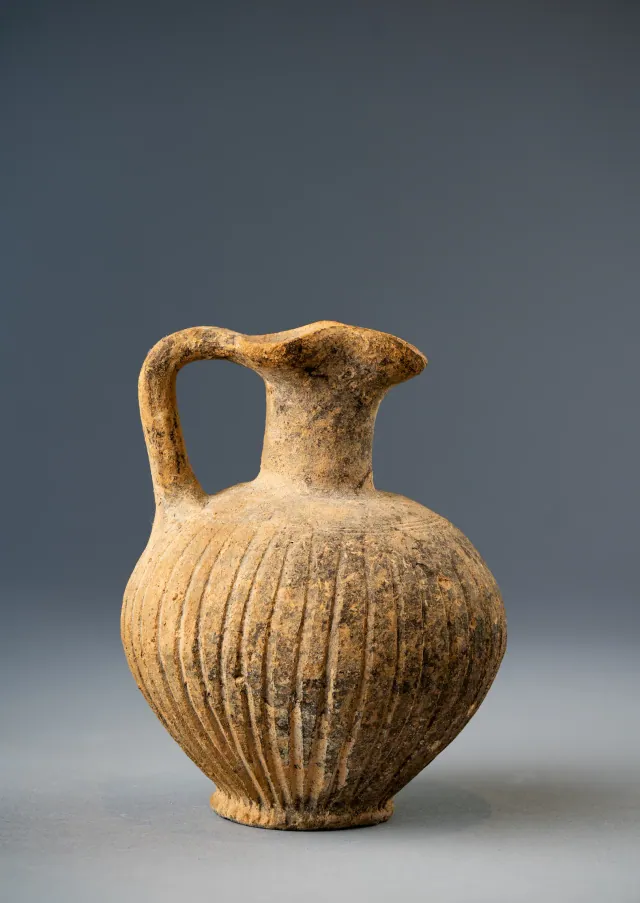
The jug beside this paragraph has a trefoil mouth, pinched into three lobes, fine grooves on the shoulder and close vertical channels cut down the whole body; its dark slip now survives mainly in the hollows. A handmade, ribbed "bucchero" also exists in Late Bronze Age Base Ring fabric, but those jugs have round mouths and raised ribs; the trefoil mouth and cut channels here belong to the Iron Age class. The stages of the ware show in the fluting itself: on Black Slip II the furrows are "more carelessly drawn," and Black Slip III is usually plain [3]. The foot can help too. At Palaepaphos-Skales the excavators gave jugs with a conical, splaying foot to Black Slip I and jugs with a ring base, like this one, to Black Slip II [9, Tomb 203].
Put the three wares of this lesson on one time scale. Pick a year around 1000 BC: beside the undecorated Plain White, the wares in use are White Painted, Bichrome and Black Slip. Move it past 750 BC and Black Slip fades while the two painted wares run on.
Chronology
The wares of the Cypro-Geometric
Each bar is a ware, placed by the dates the lessons give it. Drag the red line, or use the arrow keys on its year, to see what was being made in any year; choose a bar for its cues and lesson.
Late Bronze Age wheel-made
Iron Age and Hellenistic
In use around
1000 BCCypro-Geometric I
1000 BC: 4 wares in use.
Plates painted underneath
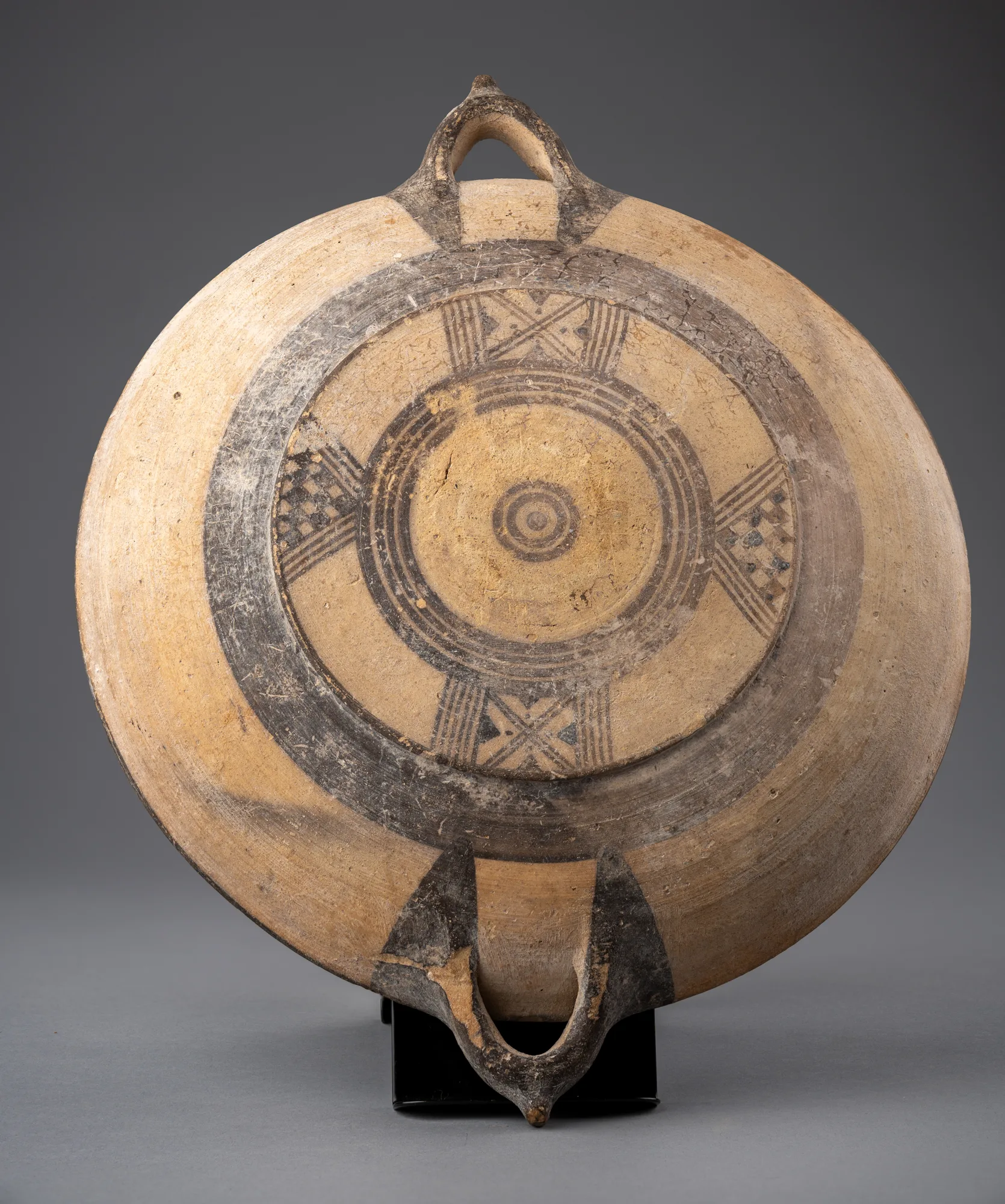
One Cypro-Geometric shape has a birth that can be dated. Iacovou showed that the flat plate does not occur in Proto-White Painted. It is "a shape of local inspiration that appeared first in the White Painted, Bichrome and even Black Slip Painted wares of advanced Cypro-Geometric I groups," and "its circulation is indeed limited to the Cypro-Geometric period" [2, p. 202]. Gjerstad's White Painted I dishes already have a wide flat base and, as a rule, two handles, "plain or knobbed" [3].
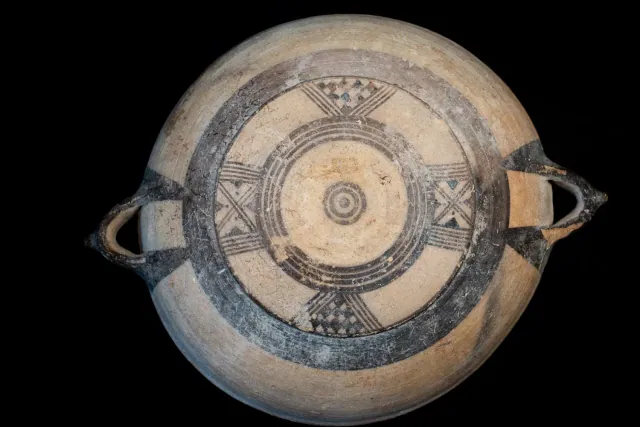
On these plates the painting is in an unexpected place. The interior usually carries a few rings and a dark rim; the main design goes on the underside. On the largest plate in the Drakopoulos collection, 40 cm across with its handles, four arms of parallel lines cross the base like the spokes of a wheel round a small target of circles, two of them framing chequered triangles. The excavators of the recent Palaepaphos-Skales tombs concluded that "these dishes must have been displayed, when not in use, since their main decoration is confined to the base" [9, Tomb 203]. That remains a hypothesis, and the pottery alone cannot settle it.
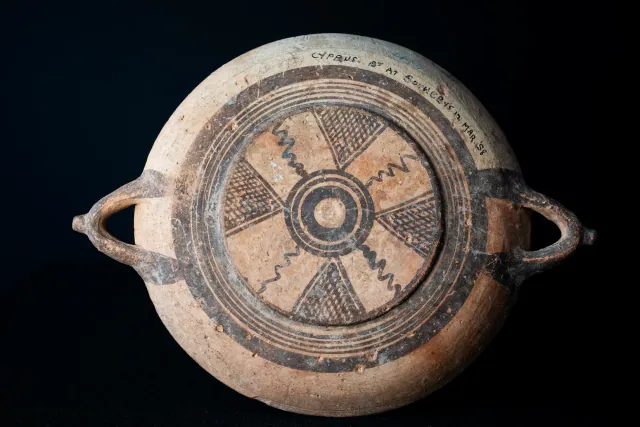
The second plate, 33 cm across, has four framed, cross-hatched triangles radiating from a ring of concentric circles, with four freehand wavy lines between them. The scheme appears in the Swedish excavators' catalogue of Lapithos Tomb 408, where a White Painted I plate 34.5 cm across has "four lattice triangles meeting in a circle on base" [11]. Older descriptions sometimes call plates like these "White Slip." White Slip is the handmade Late Bronze Age ware of Lesson 5; these plates are wheel-made White Painted.
Turn the second plate in the hand. From above it carries only a small painted spiral, one wide band and a dark lip; tip it over and the triangles and wavy lines fill the base.
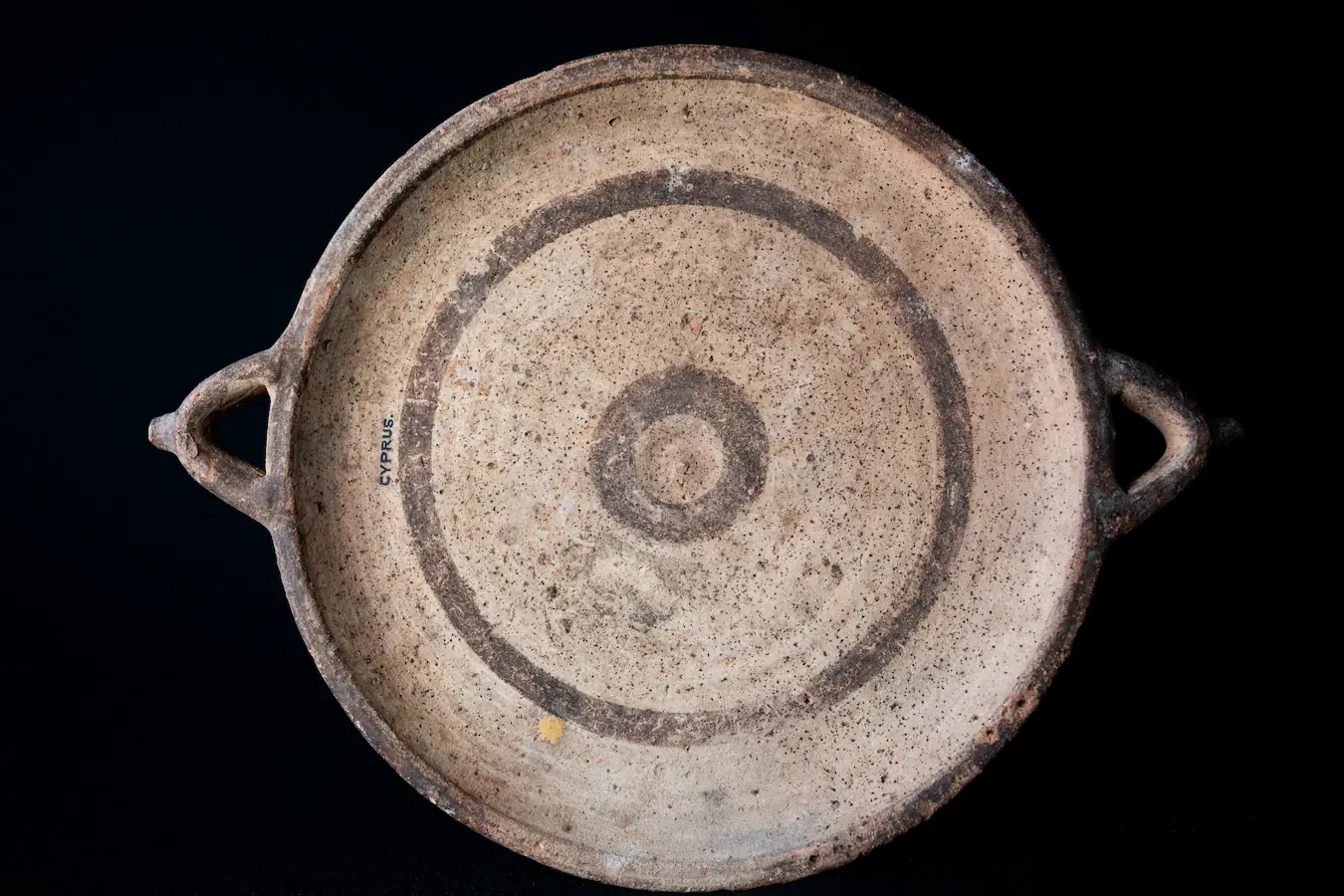
White Painted Plate with Latticed Triangles and Wavy Lines on the Underside
Open the full 3D viewDrakopoulos collection
White Painted plate, Cypro-Geometric, 33 cm across. The main design is on the underside.
A photogrammetry model, made from many photographs of the real object. Nothing loads until you press the button.
Numbers that overlap
Gjerstad's grid suggests that each numeral is a slice of time, so that a pot labelled White Painted II was made between 950 and 900 BC. Gjerstad knew better. He split each Type into an earlier and a later part, A and B, and as Joanna Smith notes, he "recognized that there was significant overlap among Types even as he equated them with specific date ranges" [12, p. 225]. Smith goes further. Gjerstad separated Type I from Type II mainly by the quality of workmanship, so that by his own definitions "Types I and II are one rather than two Types" [12, p. 225]. The system also treats Cyprus as a single site, as Lesson 0 noted [12, p. 225], and Anna Georgiadou has since picked out separate Cypro-Geometric productions at Paphos, Kourion, Amathus, Kition, Lapithos, Salamis and Kythrea, each with its own favourite wares, shapes and motifs [4, p. 4]. A stage reached at Salamis need not have been reached at Paphos in the same decade.
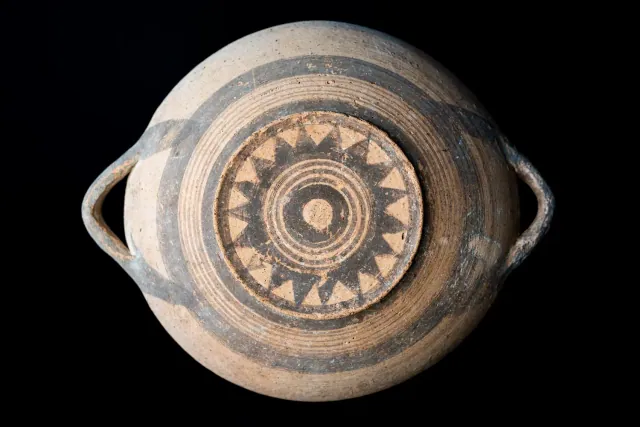
Read a numeral, then, as a family of fabric and style with a usual date and a range either side. The third plate, 25 cm across, has a closed ring of solid triangles pointing outward round a nest of circles, so that the underside reads as a star. Its shape and its weight of concentric circles suggest CG II to III, but its closest parallels, in the Hermitage and in Atlanta, are dated by their museums into the Cypro-Archaic, so the plate is best placed c. 950 to 750 BC.
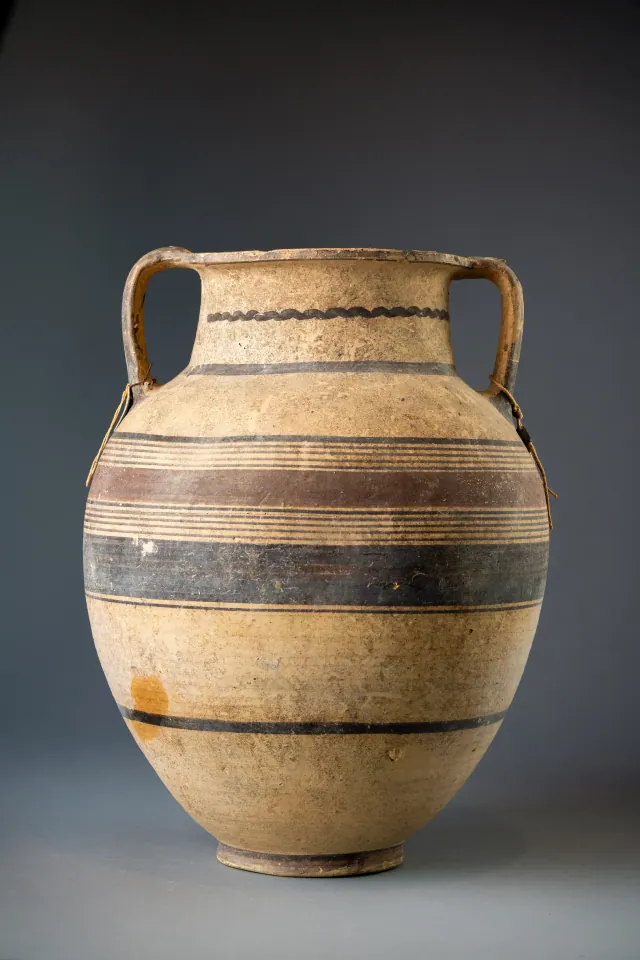
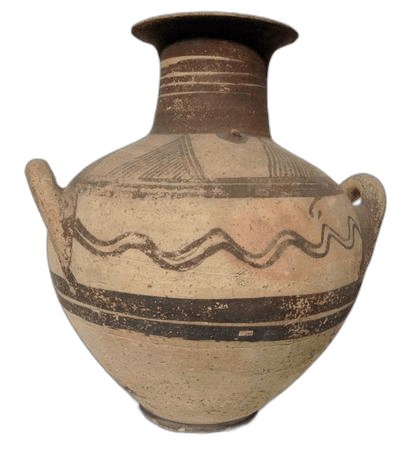
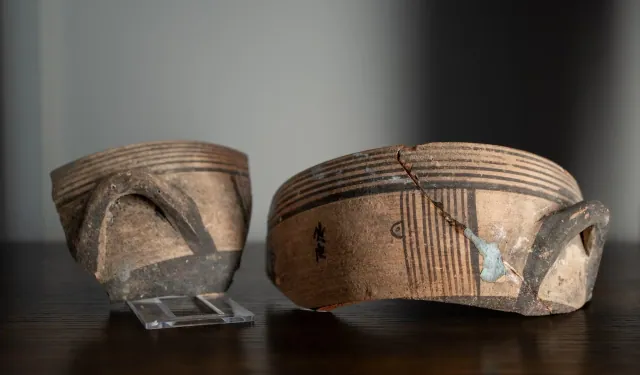
The Bichrome amphora beside this paragraph, 42 cm high and painted only with bands and a wavy line, has the same problem. Its handle type and banded scheme already exist in Bichrome III, but its closest parallel, in Stockholm, is classed as Bichrome IV, so it is dated c. 850 to 600 BC, with Cypro-Archaic I the more likely. For a deep bowl very like the panelled fragments illustrated here, specialists have proposed anything from White Painted I to III.
Cemeteries of the coming kingdoms
Almost every complete pot in this lesson comes from a tomb. The Cypro-Geometric towns lie under their later selves, and the period is known overwhelmingly from chamber tombs cut into the rock and reached down a long sloping passage, the dromos. Iacovou showed that the appearance of Proto-White Painted goes with "a most significant shift of settlement and cemetery sites" [2, p. 203]: new cemeteries opened beside the places that would become the kingdoms of the 1st millennium BC.
At Salamis the shift is plain. Enkomi, the great Late Bronze Age town, was given up in the 11th century as its successor grew on the coast 3 km to the north-east [13, p. 635]; Tomb I, with its 182 pots, belongs to the first generations of the new site. The Swedish expedition's tomb groups from Lapithos on the north coast, with those of Amathus, became the backbone of Gjerstad's sequence [11; 3]. At Kourion-Kaloriziki, in the south-west, tombs with the last Proto-White Painted run into the first Cypro-Geometric burials [10]. Amathus, on the south coast, has no Late Bronze Age precedent at all; it was settled in CG I [15, p. 154].
Find these cemeteries on the island. Each lies beside a place that would become one of the kingdoms of the 1st millennium BC, spread round the coasts from Salamis in the east to Palaepaphos in the south-west.
Map of Cyprus
Cemeteries of the coming kingdoms
- Cypro-Geometric cemeteries in this lesson
- Late Bronze Age town given up
- Ground above 200, 500, 1,000 m
Sites on this map
The richest record is at Palaepaphos-Skales, near the sanctuary of Aphrodite at Kouklia, which Karageorghis excavated in 1979 to 1981 after farm levelling had begun to destroy the tombs [6, p. 9]. Its CG I and II tombs are rich "both in pottery and metal objects" [6, p. 228]. Tomb 49, of CG I, held about a dozen imported vessels, seventeen bronze implements including bowls, strainers and a tripod, and a stone bathtub [14]. It also held three bronze spits, obeloi, used for roasting meat and probably buried as marks of rank [6]. One of them, 87.2 cm long, has five signs engraved beside its socket: o-pe-le-ta-u, "of Opheltas" [14, p. 71].
The genitive in -au belongs to the Arcado-Cypriot dialect of Greek, so the spit shows Greek being spoken and written on Cyprus around 1000 BC [13, p. 633]. It sits at the centre of Iacovou's case that Cyprus had no "Dark Age" of the kind that followed the fall of the Mycenaean palaces in Greece, where writing and the old states disappeared for centuries. "This sharp discontinuity finds no match in Cyprus," she writes, "where both the script and the state system survive into the next horizon" [13, p. 631]. In Tomb 49 the evidence lies together: a Greek name, written in a script descended from the one the island used in the Bronze Age, on a spit buried among White Painted pots whose shapes still followed the Proto-White Painted ones.
Quiz
Check yourself
Question
A pale wheel-made jug is painted in matt black, and a few solid areas, each first outlined in black, are filled with red. Which ware is it?
Question
Look at the knob on the end of this barrel jug. Which ware is it?
Question
A White Painted jug is covered in dense systems of compass-drawn concentric circles. Which date fits it best?
Question
Gjerstad began CG III in 850 BC. Where do most specialists now put the line between CG II and CG III?
Question
Put these fluted Black Slip jugs in order, earliest first.
Tap an item, then tap its place. Or use the arrows
Question
You turn over a two-handled flat plate and find its main design painted on the underside. What does that tell you?
Question
A label reads White Painted II. What is the best way to read it?
Question
Why does the bronze spit from Tomb 49 at Palaepaphos-Skales matter?
What to look for
- A pale buff or greenish wheel-made pot painted in matt black or brown with geometric patterns, and no red, is Iron Age White Painted. Its Middle Cypriot namesake is handmade.
- Red used only to fill areas already outlined or bordered in black means Bichrome. Look closely at warm patches inside outlined areas: worn red can leave only a stain.
- Rectilinear ornament alone (wavy lines, latticed triangles, Maltese crosses, panels) fits CG I and II. Dense systems of compass-drawn concentric circles, fringed circles and frequent swastikas point to CG III or later.
- A two-handled flat plate with its main design on the underside is most likely Cypro-Geometric; check the underside first.
- A dark-slipped jug or small amphora with vertical flutes running down the body is Black Slip "bucchero," most often 11th to 9th century BC. A conical, splaying foot suggests Black Slip I, a ring base and careless flutes Black Slip II, a plain dark body Black Slip III.
- The barrel jug, with its horizontal body, knobbed ends and ridged neck, is the period's signature closed shape; a globular jug with a ridge round the neck points to the Levantine contact behind it.
- Treat a Roman numeral as a style family with a usual date: give a range, and expect regional workshops to run ahead or behind.
Go deeper
The compendium's Iron Age White Painted page follows the ware from White Painted I to VII, its Bichrome ware page follows the second colour from the Bronze Age to the end of the Archaic, and the transition from Bronze Age to Iron Age pottery covers the threshold in detail. For the plates and their painted undersides, see the dish entry; for the period as a whole, the Cypro-Geometric chronology page; and for the circle ornament that arrives in CG III, the circles motif page.
References
- 1.Åström, P. (1972). The Swedish Cyprus Expedition IV:1D. The Late Cypriote Bronze Age: Relative and Absolute Chronology, Foreign Relations, Historical Conclusions. Lund: Swedish Cyprus Expedition.
- 2.Iacovou, M. (1991). Proto-White Painted pottery: A classification of the ware. In J. A. Barlow, D. L. Bolger, & B. Kling (Eds.), Cypriot Ceramics: Reading the Prehistoric Record (University Museum Monograph 74, pp. 199–205). Philadelphia: The University Museum, University of Pennsylvania.
- 3.Gjerstad, E. (1948). The Swedish Cyprus Expedition, Vol. IV, Part 2: The Cypro-Geometric, Cypro-Archaic and Cypro-Classical Periods. Stockholm: The Swedish Cyprus Expedition.
- 4.Georgiadou, A. (2016). Pottery of Geometric, Archaic and Classical Periods in Cyprus. In G. Bourogiannis and C. Panagiotopoulou (eds), Kyprios Character: History, Archaeology and Numismatics of Ancient Cyprus. Athens: National Hellenic Research Foundation (online).
- 5.Coldstream, J. N. (1999). On chronology: the CG II mystery and its sequel. In M. Iacovou & D. Michaelides (Eds.), Cyprus: The Historicity of the Geometric Horizon. Nicosia: University of Cyprus, 109–118.
- 6.Karageorghis, V. (1983). Palaepaphos-Skales: An Iron Age Cemetery in Cyprus (Ausgrabungen in Alt-Paphos auf Cypern 3). Konstanz: Universitätsverlag.
- 7.Georgiadou, A., & Dikomitou-Eliadou, M. (2022). The Iron Age pictorial pottery of Salamis within and beyond: An overview of ceramic styles, wares and fabrics. In G. Bourogiannis (Ed.), Beyond Cyprus: Investigating Cypriot Connectivity in the Mediterranean from the Late Bronze Age to the End of the Classical Period (AURA Supplement 9), pp. 335-348. Athens: National and Kapodistrian University of Athens.
- 8.Morris, D. (1985). The Art of Ancient Cyprus, with a Check-list of the Author's Collection. Oxford: Phaidon.
- 9.Karageorghis, V., & Raptou, E. (2016). Palaepaphos-Skales: Tombs of the Late Cypriote IIIB and Cypro-Geometric Periods (Excavations of 2008 and 2011). Nicosia: The Cyprus Institute.
- 10.Benson, J. L. (1973). The Necropolis of Kaloriziki (Studies in Mediterranean Archaeology 36). Göteborg: Paul Åströms Förlag.
- 11.Gjerstad, E., Lindros, J., Sjöqvist, E. and Westholm, A. (1934). The Swedish Cyprus Expedition I: Finds and Results of the Excavations in Cyprus 1927–1931. Stockholm: The Swedish Cyprus Expedition.
- 12.Smith, J. S. (2009). Art and Society in Cyprus from the Bronze Age into the Iron Age. Cambridge: Cambridge University Press.
- 13.Iacovou, M. (2008). Cultural and political configurations in Iron Age Cyprus: the sequel to a protohistoric episode. American Journal of Archaeology 112(4), 625–657.
- 14.Duhoux, Y. (2012). The most ancient Cypriot text written in Greek: the Opheltas' spit. Kadmos 51, 71–91.
- 15.Janes, S. (2013). Death and burial in the age of the Cypriot city-kingdoms: social complexity based on the mortuary evidence. Bulletin of the American Schools of Oriental Research 370, 145–168.