
Ancient Cypriot Pottery·Lesson 13
What Pots Were For
Nearly every intact Cypriot pot came out of a grave. Set beside house floors, storage halls, sanctuaries and a shipwreck, they show how to tell a pot used in life from one made for burial, and what residue analysis says the small juglets held.
Alexis Drakopoulos·Across the periods·14 min read
Share


Lesson 13·Course contents, 15 lessons
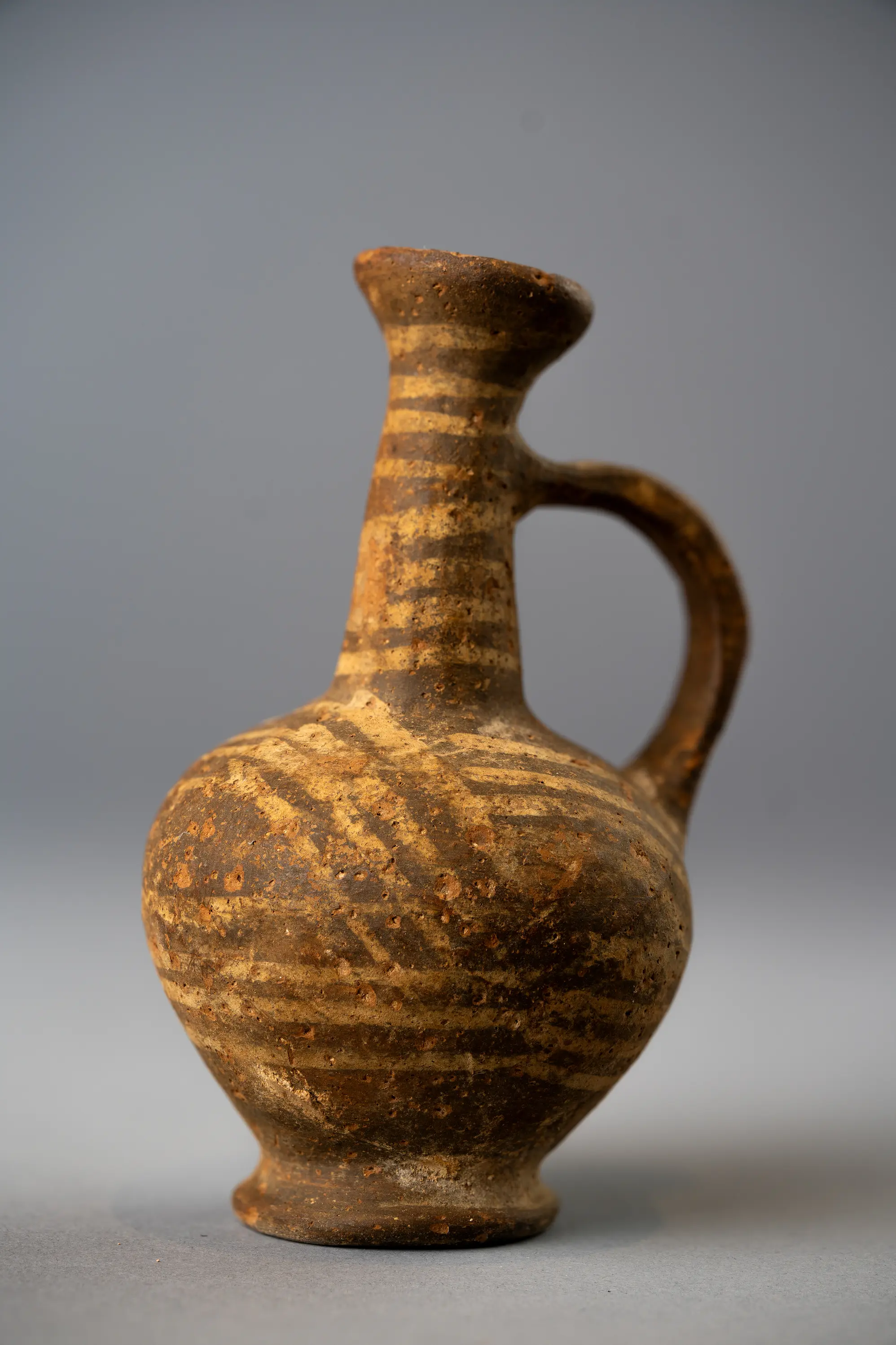
In a short report of 1956, the American archaeologist Saul Weinberg described trial trenches he had cut at Episkopi-Phaneromeni, on the south coast, into a settlement and into the cemetery beside it. The sherds from the houses were "well fired and in useful shapes". The pots from the tombs were "seldom well fired and ... often so poorly made that large cracks developed during firing", and many were "so large and so heavy that they can be moved only with difficulty even when empty". His conclusion was that most, if not all, Early Cypriot tomb pottery "was made specifically for offerings in graves" [1, p. 45].
Robert Merrillees quoted the passage in 1973 and added a complaint: "you could be forgiven for believing that the Bronze Age people were troglodytes" [1, p. 45]. Cemeteries, he noted, were dug because they could be relied on to give a good return for the money and effort [1, p. 44]. Most of the wares in this course, from Red Polished to Bichrome, were first classified from tomb groups, and nearly every intact Cypriot pot in a museum came out of a grave. The pots in the case are what Cypriots chose to bury. What they cooked in, stored grain in and threw away survives as a far more broken collection, and what the small pots held is mostly gone.
Chosen for the grave, made for the grave
Weinberg's verdict did not survive the excavation of a whole village. At Marki-Alonia, in the centre of the island, David Frankel and Jennifer Webb found that the pots in the tombs were the same forms, fabrics and decoration as the pots in the houses, and that many carried use-wear: they had been "removed from daily use and deposited in tombs" [2, p. 125]. Between eight and twelve pots went in with each adult at cemeteries of the period, and at Marki's peak more than a hundred vessels a year left the houses for the tombs [2, p. 125].
What left was a selection. Decorated pottery, spindle whorls, figurines and jewellery went into Early Cypriot graves, while the cooking pots and the food-preparation gear generally stayed behind [3, p. 141]. On top of that selection sat a smaller class that really was made for the grave: the elaborate Red Polished vessels with modelled figures (Lesson 3), which show little or no wear and are often too fragile or awkward to have been used [27]. Weinberg had a point; he had generalised from a single cemetery.
A double-necked jug in the Drakopoulos collection belongs to that smaller class: Red Polished, about 57 cm tall, on a rounded, pointed base, with two modelled birds set between its necks, of the kind laid among the offerings in the chamber tombs of Vounous. Build it, and count how many of the steps go into the necks and the birds, and how few into a vessel for holding a liquid.
A household jug needed a body, a neck and a handle. The second neck and the birds make this one fragile and awkward, the marks of a pot made for the grave.
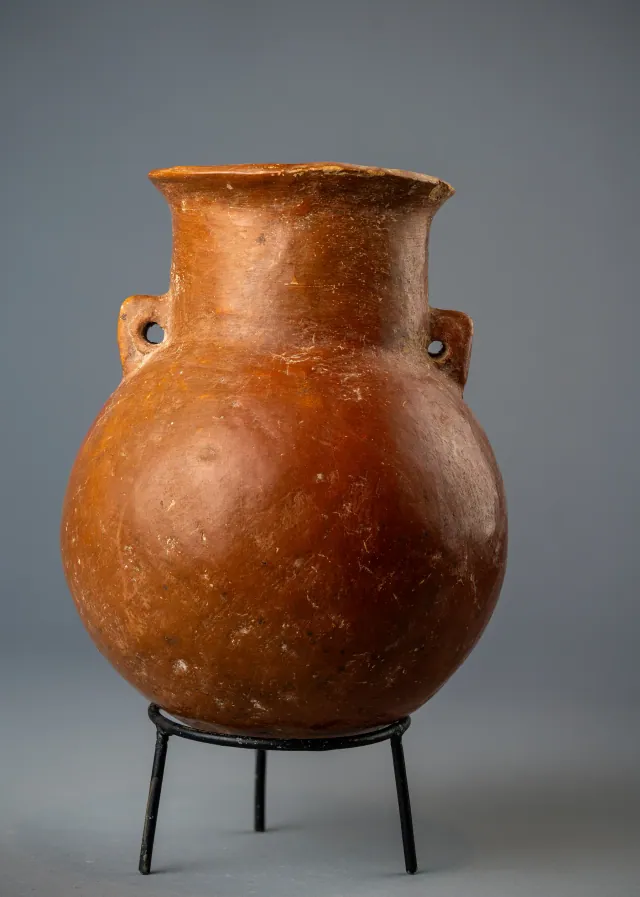
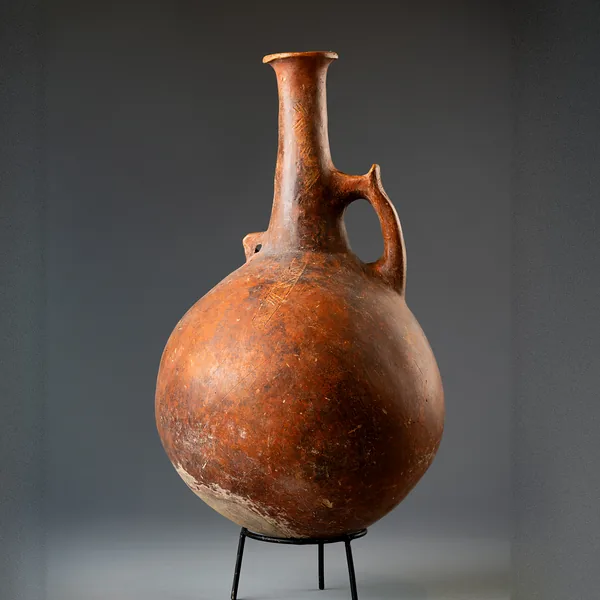
The jar beside this paragraph, in the Drakopoulos collection, is Red Polished, the burnished red ware of the Early Bronze Age: an ear-lug pot, a small jar with two pierced lugs at the neck for a cord, c. 2200 to 1900 BC. It is a storage vessel of the house, and the settlement at Sotira-Kaminoudhia produced the type, yet most complete ear-lug pots come from tombs. A pot like this survives whole because someone chose it for a burial.
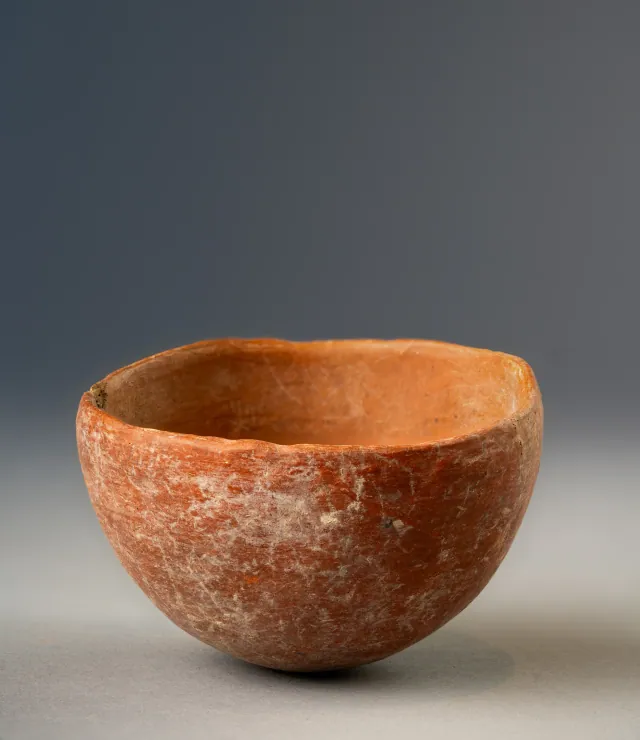
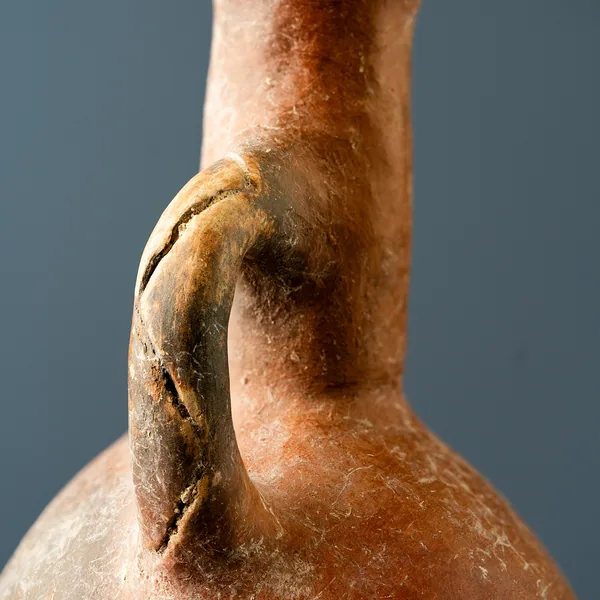
The bowl and two jugs above, also in the Drakopoulos collection, belong to the same everyday set: essentially undecorated Red Polished of c. 2200 to 1800 BC. The deep bowl, its rim wavering where the potter's fingers pressed the wall, is a shape the houses used every day. At Marki the small open vessels are generally hemispherical bowls, and they are so uniform that three quarters of them share one rim, incurved and thinning to a rounded end [28, p. 63]. The jugs were the household's liquid containers, spherical bodies on round bases under tall necks. A round base will not stand on a flat floor, so a jug like these rested in a hollow, in a stand or against other pots. The large jug has a short horn rising from the top of its handle and, opposite, a small lug at the base of the neck pierced for a cord, which probably hung the jug up or tied down a stopper. Both jugs carry grey fire-clouds, left where part of the pot sat in a smoky, oxygen-starved pocket of an open firing.
The pattern holds in the Late Bronze Age. Jugs and juglets of Base Ring, the thin, hard, handmade ware of the period, turn up in houses and tombs alike, but the tall Base Ring jugs with exaggerated spouts, made to put on a show when their contents were poured, appear in only a few tombs, and the bull-shaped askoi were mainly grave goods in wealthy burials [6, p. 187].
What the houses kept
At Marki the excavated area yielded enough fragments for at least 15,000 vessels, thrown away at a rate of 30 to 49 a year by between three and seven households [2, p. 124]. Cooking pots were replaced far less often than ethnographic comparisons would predict, which suggests they were looked after carefully or hard to come by [2, p. 125]. Broken bowls and basins were mended by drilling holes along the crack and lashing the pieces together. A laced bowl would no longer hold water, but it could still hold dry goods, and since Cypriot potters did not work through the winter, a pot that cracked in December had to be repaired [2, p. 125].
Storage at Marki has to be read from the floors, because when a family moved out it took "almost all usable objects, including storage jars" with it. What remains are the shallow plastered pits where jars stood in rows along the walls of rooms without hearths. Webb found "no evidence for communal, supra-household or external storage facilities": each house kept its own grain and oil [4, p. 108].
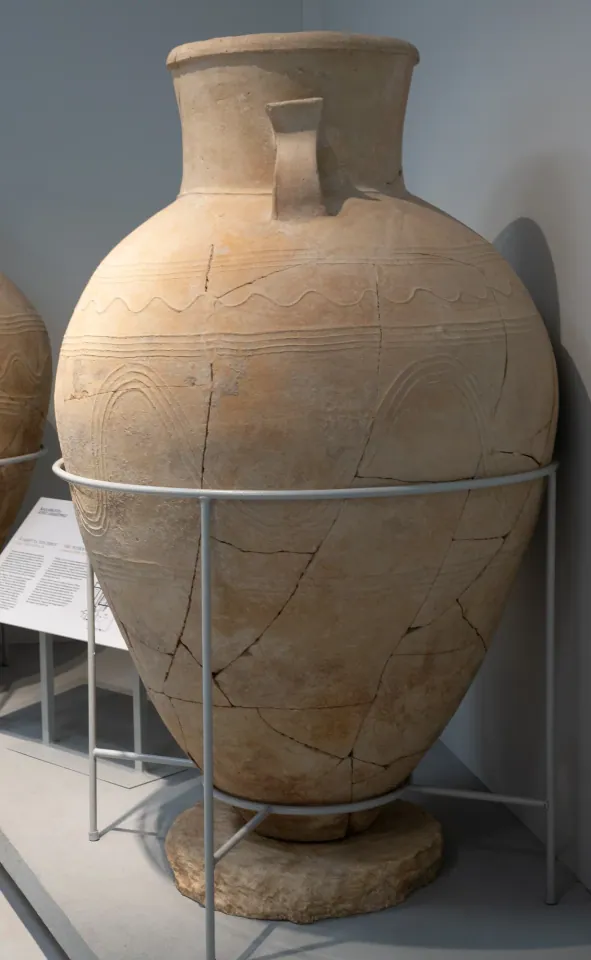
In the Late Bronze Age, storage moved into public buildings. At Kalavasos-Ayios Dhimitrios, Building X had a pillared hall 19.5 m long holding about 50 pithoi, the great storage jars, some of them 2 m tall, set in rows on stone blocks and in pits beneath the floor [5, p. 77]. A pithos 2 m tall, like the one in the Larnaca Museum illustrated here, holds almost 1,200 litres [26]. Chemical analysis of the Building X jars found the methyl esters of olive oil in 15 of 19 samples, so olive oil may have been the hall's principal commodity, perhaps its only one [5, p. 77].
Sanctuaries were a third destination. Louise Steel points out that the small Base Ring carinated cup, the everyday Late Cypriot drinking cup, was also used in sanctuaries for feasting and libations, and that the shape was so bound up with ritual that it went on being made in plain ware after Base Ring itself had ceased [6, p. 187]. For the Iron Age the imbalance is worse: its remains "derive mainly from funerary and sanctuary contexts", and settlements of even the Archaic period remain scarce [7, p. 77]. For most of the Iron Age pottery in this course, the alternative to a grave is an altar.
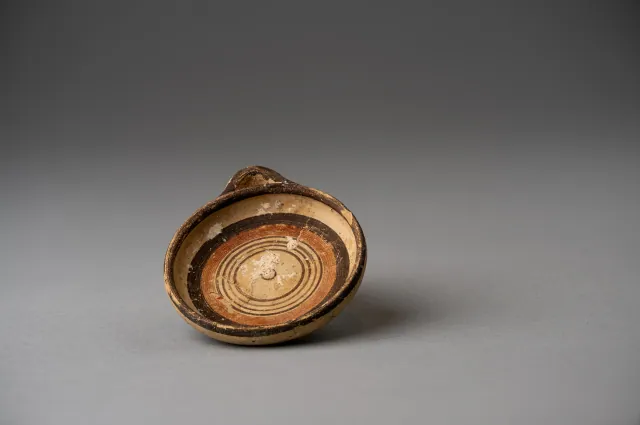
Some pots were made at a size that held almost nothing. The plate beside this paragraph, in the Drakopoulos collection, is a miniature in Bichrome, black and red paint on a pale ground: a broad red band inside the rim crossed by fine black concentric circles, more circles round the reserved centre, and a single small handle raised at the rim. The Swedish Cyprus Expedition found little Bichrome IV plates of this kind, with in-turned rims, red handles and diameters down to 10.5 cm, in Cypro-Archaic tombs at Stylli in the Famagusta district [29]; this one is probably of the same date, c. 750 to 600 BC. Plates this small lie in tomb groups beside full-sized vessels, and they may have carried a token portion of food or oil for the dead.
The royal tombs of Salamis, of about 700 BC, show the same habit on a grand scale: amphorae and dishes of food were stacked along the walls of the long open passage before it was filled. Dig one, and notice where the pottery lies and what else went down the passage with it.
Small pots, costly contents: the Base Ring juglet and opium
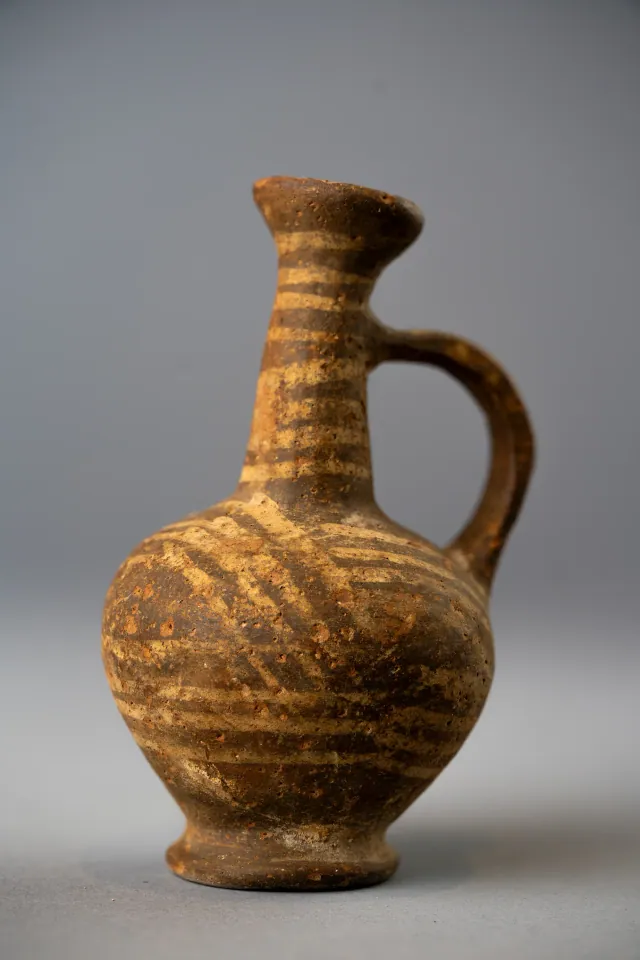
The juglet beside this paragraph, in the Drakopoulos collection, is a Base Ring II bilbil (the field's name for this small Base Ring juglet) of c. 1450 to 1200 BC: a squat body on a ring foot, a tall narrow neck, a flared lip, and white paint in bands on the neck and oblique groups of lines on the body. Its neck lets out a liquid a few drops at a time. In 1962 Merrillees proposed that the liquid was opium. Turned upside down, he argued, the juglet looks like the seed-head of the opium poppy: the ring foot is the crown of the capsule, the neck its stalk, and the relief ridges of Base Ring I the cuts made to bleed the latex. The shape, on this view, was a label for buyers who could not read [8]. Turn the juglet round and read it the way he did, from the lip down to the foot.
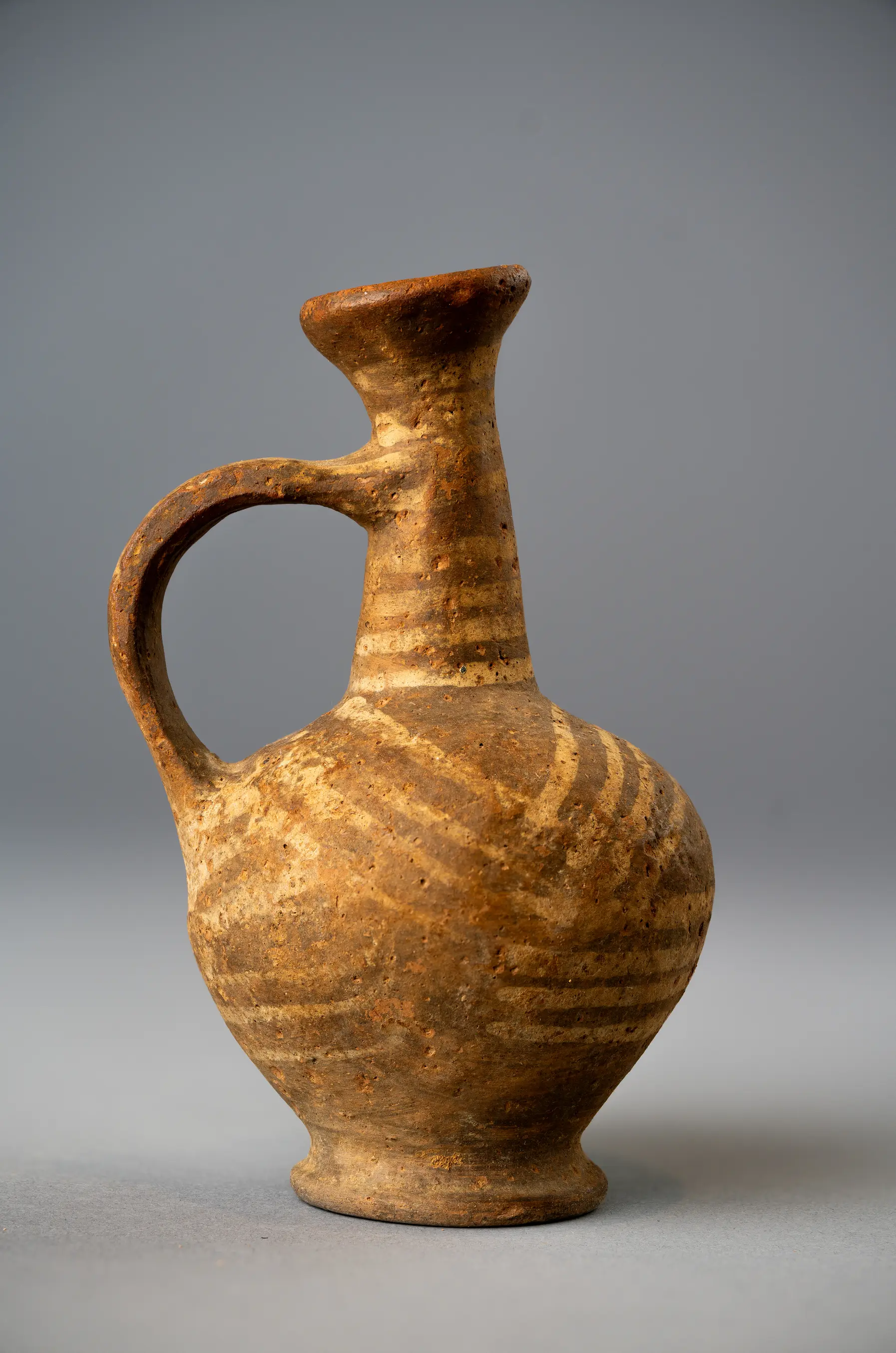
Tap a number on the photograph, or choose a note below, to look closer.
Looking closely
Base Ring II Bilbil Juglet with White-Painted Bands
c. 1450 to 1200 BC · Drakopoulos collection
Choose a number on the photograph or a note below. Arrow keys step through them.
An analogy of shape can suggest what a pot held; it cannot prove it.
Sixty years of chemistry have not settled the question. In 2015 Zuzana Chovanec, Shlomo Bunimovitz and Zvi Lederman tested 17 Base Ring vessels, including four juglets from a sealed 14th-century BC destruction layer at Tel Beth-Shemesh in Israel. None held opium. What they found was plant oil, scented with mint, sage, lavender or wormwood [9]. Bunimovitz and Lederman then pointed out that no cuneiform or second-millennium Egyptian text mentions opium, while the letters of the king of Alashiya, probably Cyprus, list jars of scented oil among his gifts [10].
Then a British Museum juglet (1981,1218.53), a Base Ring II piece still sealed with its contents, yielded traces of two opium alkaloids, papaverine and thebaine, in a residue that was mostly degraded plant oil. Its analysts were careful: the quantities were minute, and the residue could be poppyseed oil, opium as one ingredient of an oil mixture, or the leftovers of reuse [11]. In 2022 a team working on 14th-century BC graves at Tel Yehud, Israel, reported opium markers in eight of 22 vessels: four Base Ring jugs and juglets, and four local Canaanite pots [12]. Opium did travel in the Late Bronze Age Levant, in bilbils and in ordinary local jars alike. On present evidence Base Ring juglets mostly carried scented and perhaps medicinal oils, some held poppy products, and the opium hypothesis remains open.
Oil, wax and bitumen: Red Lustrous and Black-on-Red
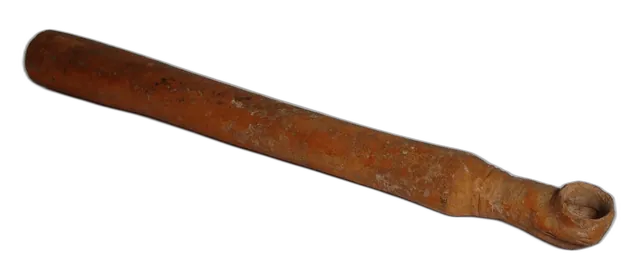
Red Lustrous Wheel-made ware, the hard, burnished red ware of spindle bottles and arm-shaped vessels (Lesson 5), has been tested more widely. Val Steele and Ben Stern analysed 101 sherds from Turkey, Cyprus, Egypt and Syria and found residues in more than half. They identified four substances: a fat, probably plant oil and in four cases castor oil; beeswax; bitumen; and pine-family resin. Oil turned up at every site. The vessels "did not always contain the same commodity", and the contents showed no link with vessel shape, but they varied with where a vessel ended up: beeswax came almost only from samples in Turkey, bitumen only from sites on Cyprus [13]. The arm-shaped vessel illustrated here, from Enkomi, is more than 60 cm long and ends in a hand holding a cup.
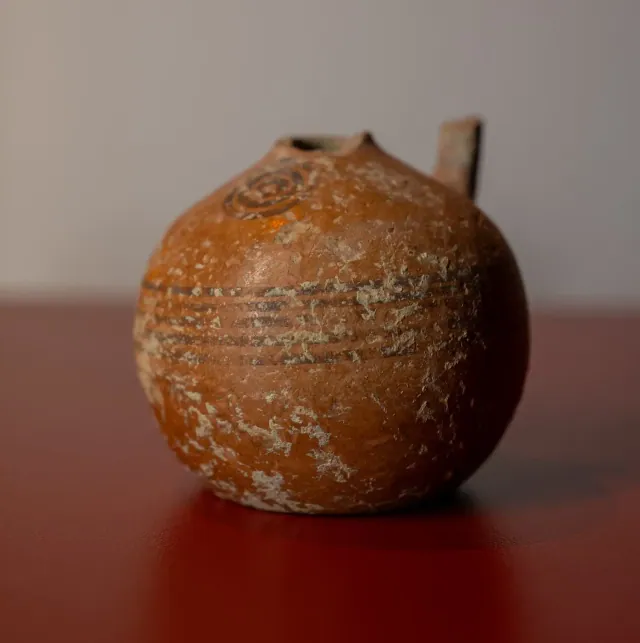
Five centuries later the small Black-on-Red juglet, black paint on a polished red surface (Lesson 9), became the Cypriot perfume bottle of the Iron Age. The miniature juglet beside this paragraph, in the Drakopoulos collection, is 6 cm high, with a squat globular body, a group of concentric circles on the shoulder and fine lines round the belly. Its neck is gone, but on complete examples it is narrow, a shape that slows the flow of perfumed oil, and the dense burnished fabric would not soak it up [14, pp. 65-72; 15, p. 224]. The perfume reading is well founded but rests on shape, size and distribution: we know of no published residue analysis of a Cypriot Black-on-Red juglet.
Clay that held nothing
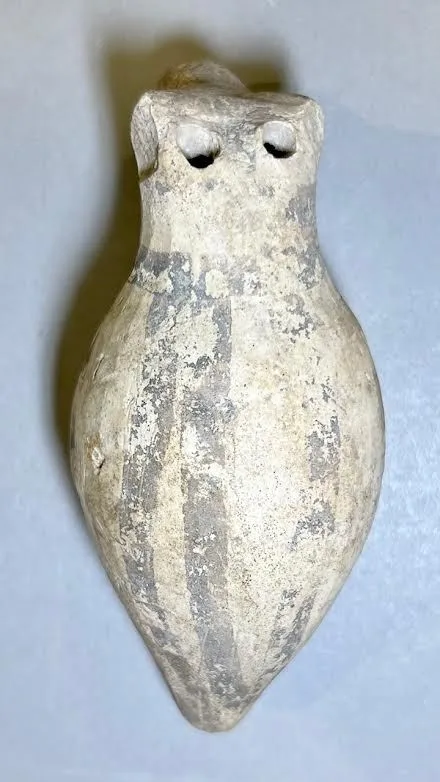
Some Cypriot clay objects were never containers. The rattle beside this paragraph, in the Drakopoulos collection, is a hollow White Painted VI body with a flat head, two pierced eyes and pointed ears, the class modern scholars call the owl rattle. Its body copies a pot, the small White Shaved dipper juglet of the Late Cypriot period, closed up and filled with pebbles. Daisy-Kate Knox catalogued 45 examples: 27 have no recorded find-spot, and 17 of the 18 that do come from tombs, mostly at Enkomi in eastern Cyprus, with a few in tombs in the Levant [16]. The old identification as a child's toy is now widely doubted, since thin fired clay would not survive hard play, and the tomb contexts suggest the sound had a funerary or protective use. Katerina Kolotourou counts clay rattles as the earliest musical instruments known from the island [17].
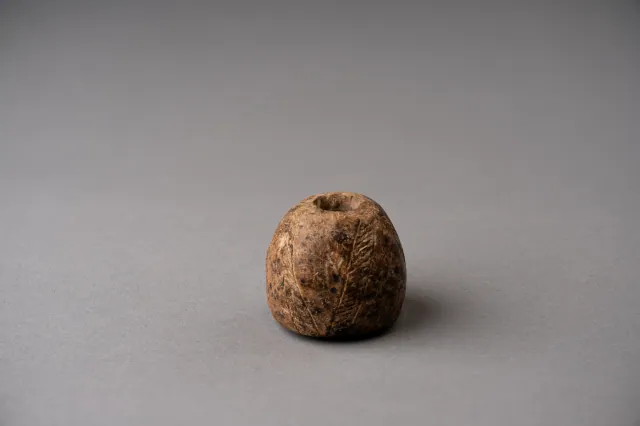
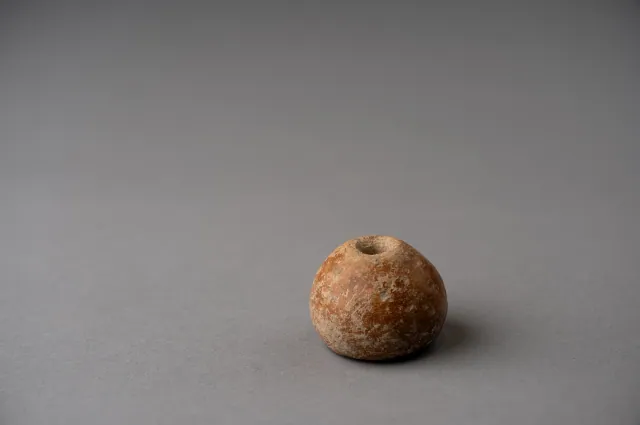
Spindle whorls were made from pottery clays and finished like pots. A whorl is the weight that keeps a spindle turning; Bronze Age Cypriots fixed it low on the shaft, broad end up [18]. Clay whorls arrive with the Philia phase, at the start of the Bronze Age, and flourish through the Early and Middle Cypriot periods [19, p. 254]. The bell-shaped whorl on the left above, c. 2000 to 1725 BC, carries incised herringbone bands in the Red Polished manner on its faceted sides, its surface mottled dark brown; whether it is burnished clay or a soft speckled stone is uncertain. Whorls turn up in houses and tombs alike, and we know of no evidence for the older idea that they were buried so the dead could go on spinning.
The whorl on the right, also in the Drakopoulos collection, shows the potter's finish on a tool more plainly. It is squat and rounded, flat underneath, with a wide hole at the crown and no incision on the side photographed, and patches of deeper red over its buff body look like the remains of a slip, perhaps once polished: Red Polished, in other words, applied to a spinning weight. Plain whorls are harder to date than decorated ones. Decorated examples belong mainly to the Early and Middle Cypriot periods, and undecorated ones tend to fall at the end of the Middle and in the Late Cypriot period, when clay whorls gave way to stone, bone and ivory [19, p. 254]. The rule has exceptions, and this whorl is placed broadly between about 2000 and 1650 BC.
Pots abroad: export as a dating tool
Once Cypriot pots left the island, they became clocks. A pot made in Cyprus and found in a stratified layer in Egypt or the Levant ties a Cypriot ware to a foreign sequence that can sometimes be dated by kings' reigns. The first ware to travel in quantity was the White Painted juglet of Middle Cypriot III; Lesson 4 follows its rise and fall in the stratified town of Tell el-Dab'a, in the Nile Delta [20, p. 4]. The Late Cypriot Base Ring juglets followed into Egypt and the Levant in large numbers; Merrillees built his opium argument on the bilbils found in Egypt [21]. Abroad the closed shapes dominate, and Steel's verdict is that "probably it was the contents rather than the container that was valued" [6, p. 187].
Choose a ware to see where this course has followed it abroad: the Middle Cypriot juglets to Tell el-Dab'a, the Base Ring bilbils to Egypt and the Levant, the opium tests at Tel Beth-Shemesh and Tel Yehud, Black-on-Red to Knossos and on to Lefkandi in Greece. Under the map, each place has what was found there.
Cypriot pottery abroad
Cypriot pottery abroad
19 places on the map. Choose a ware to see only its finds.
Find-spots (19)Show the listHide the list
- 1Tell el-Dab'a (Avaris)Egypt
- 2Tell ArqaLebanon
- White Painted (Middle Cypriot). Pendent Line jugs, 27 painted in red and 18 in black. Lesson 4
- 3SidonLebanon
- White Painted (Middle Cypriot). Pendent Line and Cross Line jugs and bottles in Middle Bronze Age tombs and towns. Lesson 4
- 4SareptaLebanon
- White Painted (Middle Cypriot). Pendent Line and Cross Line jugs and bottles in Middle Bronze Age tombs and towns. Lesson 4
- 5MegiddoIsrael
- White Painted (Middle Cypriot). Pendent Line and Cross Line jugs and bottles in Middle Bronze Age tombs and towns. Lesson 4
- White Slip. Proto White Slip, which travelled from the start. Lesson 5
- Bichrome Wheel-made. Bichrome Wheel-made, some of it made locally as at Ajjul. Lesson 5
- Black-on-Red. Black-on-Red from a level radiocarbon-dated to about 900 BC; the ten early sherds analysed were made in Cyprus. Lesson 9
- 6Kültepe (Kanesh)Turkey
- White Painted (Middle Cypriot). A single incomplete juglet in a level no later than 1796, 1740 or 1676 BC: the most important occurrence abroad for dating. Lesson 4
- 7Akrotiri, TheraGreece
- White Slip. A White Slip I bowl found in 1870 beneath the deposits of the great Bronze Age eruption. Lesson 5
- 8Alalakh (Tell Atchana)Turkey
- Base Ring. A Base Ring bilbil, catalogued by the British Museum as Base Ring II. Lesson 5
- 9Tel Beth-ShemeshIsrael
- Base Ring. Base Ring vessels tested for opium, including four juglets from a sealed 14th-century BC destruction layer. None held it. Lesson 13
- 10Tel YehudIsrael
- Base Ring. Four Base Ring jugs and juglets in 14th-century BC graves, among the vessels that showed opium markers. Lesson 13
- 11Tell el-AjjulGaza Strip
- Bichrome Wheel-made. The best-known finds of the ware, from Petrie's excavations; most pieces sampled were made in eastern Cyprus. Lesson 5
- 12Uluburun shipwreckTurkey
- Late Cypriot cargo. Some 130 to 155 Cypriot pots, mostly fine bowls and juglets, packed in three pithoi on a ship that sank in the late 14th century BC. Lesson 13
- 13Tarsus (Gözlükule)Turkey
- 14Tell Beit MirsimWest Bank
- Black-on-Red. The juglet Albright published in 1932 as Cypro-Phoenician. Lesson 9
- 15AchzivIsrael
- Black-on-Red. Only 20 Black-on-Red vessels from the main cemeteries of this Phoenician town. Lesson 9
- 16LefkandiGreece
- Black-on-Red. A juglet from a tomb, dated 875 to 850 BC: the first Black-on-Red in Greece. Lesson 9
- 17KnossosGreece
- Black-on-Red. Black-on-Red is the commonest Cypriot import here. Lesson 13
- 18CosGreece
- Black-on-Red. Cypriot imports from about the last quarter of the 9th century BC, and local copies. Lesson 9
- 19RhodesGreece
- Black-on-Red. Cypriot imports from about 800 BC, and local copies. Lesson 9
The best picture of that traffic is a wreck. The ship that sank off Uluburun, on the south coast of Turkey, in the late 14th century BC carried some 130 to 155 Cypriot pots, depending on who counts, mostly fine bowls and juglets with some lamps and wall brackets, packed inside three pithoi for the voyage: storage jars reused as crates [22, p. 115; 23]. The ship itself was probably not Cypriot. Petrography of its galley wares and stone anchors points to a home port between northern Israel and southern Lebanon, and it was sailing west towards the Aegean [23, p. 874].
In the Iron Age the Black-on-Red juglet took over the role. It reached the Levant in quantity and the Aegean in smaller numbers, and at Knossos it is the commonest Cypriot import [15, p. 223]. Lesson 9 follows the circular dating it was caught in, and the radiocarbon from Megiddo that broke the circle [24].
The White Slip I bowl found beneath the Thera pumice, whose part in the argument over the eruption's date Lesson 5 tells, carries a warning for all such dating. It had been used and mended in antiquity, so it may have been years old when the pumice covered it [25, p. 39].
Quiz
Check yourself
Question
Weinberg thought Early Cypriot tomb pottery was made for the grave. What did the excavation of the whole village at Marki-Alonia show?
Question
You are looking at an intact Early Cypriot jug. Which of these suggest it was used in life before it was buried?
Tick every answer that applies
Question
About how many pots went into the grave with each adult at Early Cypriot cemeteries of Marki's time? Any number in the range the lesson gives counts.
Question
On present evidence, what did Base Ring juglets such as the bilbil mostly carry?
Question
Steele and Stern found oil, beeswax, bitumen and resin in Red Lustrous vessels. What did the contents vary with?
Question
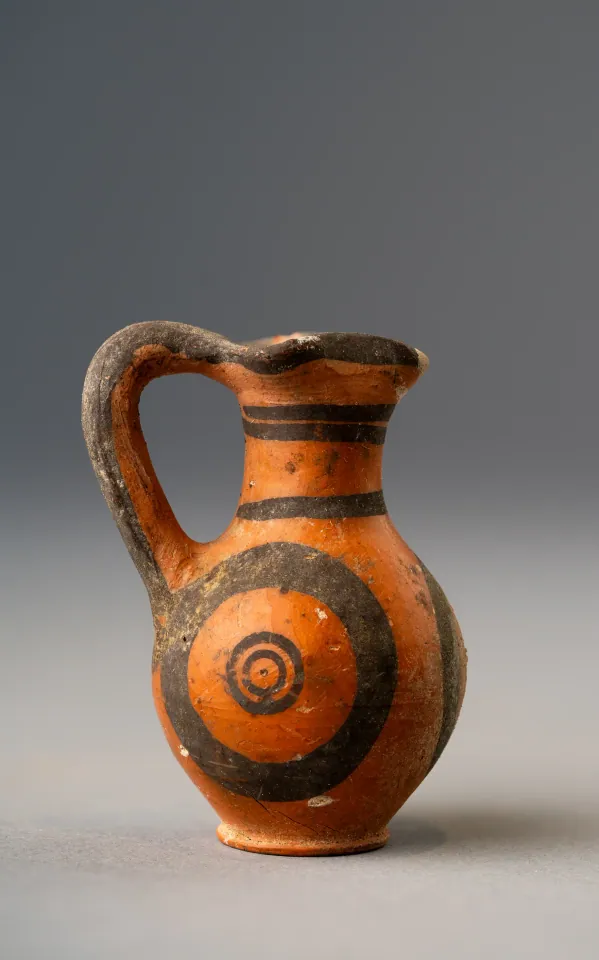
Which ware is this small juglet?
Question
Put these Cypriot exports in order, from the first to travel abroad in quantity to the last.
Tap an item, then tap its place. Or use the arrows
Question
A White Slip I bowl was found beneath the Thera pumice. Why is it a weak clock for the eruption?
What to look for
- Whole, unworn and elaborate probably means a tomb. Most intact Cypriot pots in museums are grave goods; look for wear on rims and bases to tell a vessel taken from the house from one made for the burial.
- Thick, coarse, cracked in firing, too heavy to lift full: Weinberg's signs of pottery made for the grave in the Early Cypriot south.
- Drilled holes along a crack are ancient mends. They mark a pot that was used, broken and kept.
- A small closed shape with a narrow neck (bilbil, Black-on-Red juglet, Red Lustrous spindle bottle) was made to carry and pour a valuable liquid, usually an oil. Only a residue analysis can say what that liquid was.
- Pithoi, cooking pots and plain bowls are the house pottery. They are rare in museum cases because they rarely went into graves.
- A hollow, closed clay body with a head and pierced eyes is a rattle; a small clay cone or dome with a wide central hole is a spindle whorl.
- A Cypriot pot found abroad in a dated layer dates the ware at home. A Cypriot pot on a wreck records a port of call; the ship may have been built elsewhere.
Go deeper
Storage jars, pithos halls and the residue evidence are covered in Food Storage, and the tombs these pots came from in Vounous and Early Bronze Age burial and Bronze Age chamber tombs. The juglets have their own pages: Base Ring ware and Black-on-Red ware. For what a tomb group looks like in full, read Tomb 66 at Enkomi.
References
- 1.Merrillees, R.S. (1973). Settlement, sanctuary and cemetery in Bronze Age Cyprus. In J. Birmingham (ed.), The Cypriot Bronze Age: Some Recent Australian Contributions to the Prehistory of Cyprus (Australian Studies in Archaeology 1). Sydney, pp. 44–57.
- 2.Frankel, D. and Webb, J.M. (2001). Population, households, and ceramic consumption in a prehistoric Cypriot village. Journal of Field Archaeology 28(1/2), pp. 115–129.
- 3.Steel, L. (2004). Cyprus before history: From the earliest settlers to the end of the Bronze Age. London: Duckworth.
- 4.Webb, J.M. (2002). Engendering the built environment: household and community in prehistoric Bronze Age Cyprus. In D. Bolger and N. Serwint (eds), Engendering Aphrodite: Women and Society in Ancient Cyprus (ASOR Archaeological Reports 7). Boston: American Schools of Oriental Research, pp. 87–116.
- 5.Keswani, P.S. (1993). Models of local exchange in Late Bronze Age Cyprus. Bulletin of the American Schools of Oriental Research 292, pp. 73–83.
- 6.Steel, L. (2013). Materiality and Consumption in the Bronze Age Mediterranean. New York and London: Routledge.
- 7.Smith, J.S. (1997). Preliminary comments on a rural Cypro-Archaic sanctuary in Polis-Peristeries. Bulletin of the American Schools of Oriental Research 308, pp. 77–98.
- 8.Merrillees, R.S. (1962). Opium trade in the Bronze Age Levant. Antiquity 36, pp. 287–292.
- 9.Chovanec, Z., Bunimovitz, S. and Lederman, Z. (2015). Is there opium here? Analysis of Cypriot Base Ring juglets from Tel Beth-Shemesh, Israel. Mediterranean Archaeology and Archaeometry 15, pp. 175–189.
- 10.Bunimovitz, S. and Lederman, Z. (2016). Opium or oil? Late Bronze Age Cypriot Base Ring juglets and international trade revisited. Antiquity 90, pp. 1552–1561.
- 11.Smith, R.K., Stacey, R.J., Bergström, E. and Thomas-Oates, J. (2018). Detection of opium alkaloids in a Cypriot base-ring juglet. Analyst 143(21), pp. 5127–5136.
- 12.Linares, V., Jakoel, E., Be'eri, R., Lipschits, O., Neumann, R. and Gadot, Y. (2022). Opium trade and use during the Late Bronze Age: organic residue analysis of ceramic vessels from the burials of Tel Yehud, Israel. Archaeometry 64. https://doi.org/10.1111/arcm.12806
- 13.Steele, V.J. and Stern, B. (2017). Red Lustrous Wheelmade ware: analysis of organic residues in Late Bronze Age trade and storage vessels from the eastern Mediterranean. Journal of Archaeological Science: Reports 16, 641–657.
- 14.Schreiber, N. (2003). The Cypro-Phoenician Pottery of the Iron Age. Culture and History of the Ancient Near East 13. Leiden and Boston: Brill.
- 15.Smith, J. S. (2009). Art and Society in Cyprus from the Bronze Age into the Iron Age. Cambridge: Cambridge University Press.
- 16.Knox, D.-K. (2012). Making Sense of Figurines in Bronze Age Cyprus: A Comprehensive Analysis of Cypriot Ceramic Figurative Material from EC I–LC IIIA (c. 2300 BC–c. 1100 BC). PhD thesis, University of Manchester.
- 17.Kolotourou, K. (2005). Music and cult: the significance of percussion and the Cypriote connection. In V. Karageorghis, H. Matthäus and S. Rogge (eds), Cyprus: Religion and Society from the Late Bronze Age to the End of the Archaic Period. Möhnesee: Bibliopolis.
- 18.Webb, J.M. (2002). New evidence for the origins of textile production in Bronze Age Cyprus. Antiquity 76, pp. 364–371.
- 19.Karageorghis, V. (2016). The Cesnola Collection of Cypriot Art: Terracottas. New York: The Metropolitan Museum of Art.
- 20.Merrillees, R.S. (2002). The relative and absolute chronology of the Cypriote White Painted Pendent Line Style. Bulletin of the American Schools of Oriental Research 326, 1–9.
- 21.Merrillees, R.S. (1968). The Cypriote Bronze Age Pottery Found in Egypt (Studies in Mediterranean Archaeology 18). Lund: Paul Åströms Förlag.
- 22.Hirschfeld, N. (2011). The Cypriot ceramic cargo of the Uluburun shipwreck. In W. Gauss, M. Lindblom, R.A.K. Smith and J.C. Wright (eds), Our Cups Are Full: Pottery and Society in the Aegean Bronze Age (BAR International Series 2227). Oxford: Archaeopress, pp. 115–120.
- 23.Pulak, C. (2010). Uluburun shipwreck. In E.H. Cline (ed.), The Oxford Handbook of the Bronze Age Aegean. Oxford: Oxford University Press, pp. 862–876.
- 24.Kleiman, A., Fantalkin, A., Mommsen, H. and Finkelstein, I. (2019). The Date and Origin of Black-on-Red Ware: The View from Megiddo. American Journal of Archaeology 123.4, 531–555.
- 25.Wiener, M.H. (2007). Times change: the current state of the debate in Old World chronology. In M. Bietak and E. Czerny (eds), The Synchronisation of Civilisations in the Eastern Mediterranean in the Second Millennium B.C. III. Vienna: Austrian Academy of Sciences, pp. 25–47.
- 26.Pilides, D. (2000). Pithoi of the Late Bronze Age in Cyprus: Types from the Major Sites of the Period. Nicosia: Department of Antiquities, Cyprus.
- 27.Webb, J.M. and Frankel, D. (2010). Social strategies, ritual and cosmology in Early Bronze Age Cyprus: an investigation of burial data from the north coast. Levant 42(2), pp. 185–209.
- 28.Frankel, D. (1993). Inter- and intrasite variability and social interaction in prehistoric Bronze Age Cyprus: types, ranges, and trends. Bulletin of the American Schools of Oriental Research 292, pp. 59–72.
- 29.Gjerstad, E., Lindros, J., Sjöqvist, E. and Westholm, A. (1935). The Swedish Cyprus Expedition II: Finds and Results of the Excavations in Cyprus 1927–1931. Stockholm: The Swedish Cyprus Expedition (Stylli tombs).