
Contents
The Early Bronze Age in Cyprus, roughly 2400 to 2000 BCE, was lived entirely in villages. There were no towns, no fortifications, and, in Jennifer Webb's summary of the evidence, "no evidence for writing, sealing systems, centralized storage, communal buildings, cult centres, or major inequalities in wealth or status" [1, p. 353]. Two settlements have been excavated on a scale that shows how households were arranged: Marki-Alonia, dug by David Frankel and Webb for La Trobe University between 1992 and 2000 [3, p. 75], and Sotira-Kaminoudhia, dug by Stuart Swiny. As Webb puts it, "these sites take on an importance beyond any they had in antiquity" [1, p. 356]. This entry covers the house, the household and the village: how compounds were built and used, what people grew and herded, which crafts were practised at home, how villages were linked, how many people lived in them and for how long, and where the tomb evidence runs out. Diet is treated in food and diet, dress in clothing and dress, and the dead in Vounous and Early Bronze Age burial.
A late Bronze Age that stayed rural
Cyprus entered the Bronze Age well after its neighbours. Webb dates the Early Cypriot period to about 2400 to 2000 BCE, "substantially later" than the Early Bronze Age of the Levant (c. 3500 to 2300 BCE), and notes that "while settlements elsewhere were progressing toward urbanization, those in Cyprus remained at the village level" [1, p. 353]. The absolute dates are approximate: there is "general agreement that the period began around 2500/2400 BCE", and Webb's working scheme gives the Philia facies 2400 to 2200, Early Cypriot (EC) I and II 2200 to 2100, and EC III 2100 to 2000 BCE [1, pp. 354–355]. At Marki, Philia deposits lie beneath EC I levels, which settled a long-running disagreement between Porphyrios Dikaios and James Stewart over the place of the Philia material in Dikaios's favour [1, pp. 354–355].
The Philia phase brought a whole domestic package. Webb lists "the first systematic exploitation of the island's copper resources and the introduction of cattle, donkeys, and probably new breeds of goats and sheep, agricultural technologies (including the sole-ard plough), rectilinear architecture, extramural burial, chamber tombs", new ceramic wares and "a range of domestic technologies" [1, p. 355]. Its likely source is south-west Anatolia or Cilicia. Whether the package came with migrants or through contacts adopted by the existing population is still debated; one reading, which Webb cites from Peltenburg and Bolger (2007), has contacts followed by the "arrival of settlers" [1, p. 355]. The pottery that marks the phase is described under Red Polished Philia ware; the Chalcolithic world it replaced is covered under the Chalcolithic.
Settlement numbers rose steeply by the end of the period. Georgiou's survey, as summarised by Webb, counted 44 sites of EC I to II against 345 of EC III to MC II, "suggesting very significant population growth toward the end of the third millennium" [1, p. 356]. The later figure spans into the Middle Bronze Age, so it does not measure EC III alone.
| Phase (Webb's dates) | Marki households | Pottery and region |
|---|---|---|
| Philia facies (c. 2400–2200 BCE) | Courtyards marked by light fences, pens and lean-tos; large courtyard ovens and freestanding storerooms shared between related households | A uniform island-wide set of handmade eating and drinking vessels and ornaments |
| EC I–II (c. 2200–2100 BCE) | Stone walls enclose courtyards on three sides; ovens in interior rooms from EC I | Regional styles from c. 2250 BCE (e.g. Red Polished South Coast ware in the south-west); Marki linked mainly with the south |
| EC III (c. 2100–2000 BCE) | Fully enclosed compounds with narrow entrances and more, larger interior rooms | North-coast Red Polished forms dominate across the island |
The table condenses Webb's account of Marki [1, pp. 357–361]. The phase dates are hers and are not universally accepted: Muti, for example, gives the Philia phase as c. 2500 to 2200 BC [5, p. 43].
Marki-Alonia: the village known best
Marki is a settlement of 5 to 6 hectares with cemeteries around it. About 2,000 m² were excavated, "the largest exposure and longest stratigraphic sequence of an Early to Middle Bronze Age settlement in Cyprus" [2, pp. 115–116]. The north-west part of the hill was occupied first and the village later spread south-east, through "complex sequences of building, renovation, abandonment, collapse, demolition, and rebuilding" [2, p. 116].
How long it lasted depends on which account is followed. Frankel and Webb wrote in 2001 of "some 500 years, from the Philia facies ... (ca. 2400 B.C.) until the early phases of the Middle Bronze Age" [2, p. 116], and Webb's 2013 synthesis treats Marki as occupied throughout the Early Cypriot period [1, p. 356]. Dikomitou-Eliadou, citing the excavators' 2006 final report, says the village was "founded around 2400 BCE" and occupied for "approximately seven hundred years" [3, p. 75]. The difference lies in the end date within the Middle Bronze Age; both accounts agree on a Philia foundation.
The site's floors are nearly bare, and that is a result of how it ended. The excavators judged the abandonment "gradual and pre-planned": people took usable things with them, so that "most objects recovered are broken, fragmentary, or exhausted" [2, p. 116]. What the rooms contained has to be reconstructed from fixed features, debris and discarded tools.
Frankel and Webb published 33 households. The standard compound had "a single entrance" giving access to a courtyard, informally enclosed in the earliest phases and formally later, and "toward the rear of the courtyard two or three inner rooms built of mud-bricks on stone foundations" [1, p. 357]. Short screen walls were set to block views of the hearths from outside [1, p. 357]. At least one interior room in each compound held "a hearth with a semicircular or rectangular plaster fender, set against a low wall bench"; rectangular bins against the walls held food for the short term, ovens appear in interior rooms from EC I, and there were stone work benches [1, pp. 357–358]. Courtyards had "floor emplacements, animal pens, and informal work stations" [1, p. 358].
The hearth room was where most of the household's work happened. Webb lists "processing and small-scale storage of cereals ..., spinning and weaving, chipped and ground stone tool production, and perhaps wood- and hide-working", as well as preparing, serving and eating food; the other rooms were "probably reserved for storage and sleeping" [1, p. 358]. Most compounds covered about 100 m², and "none is sufficiently larger or better built than others to suggest systemic differences in household function or in the wealth and status of the occupants" [1, p. 358].
From shared yards to closed compounds
The clearest change at Marki over the period is in how households related to one another. In the Philia phase, courtyards were defined only by "light fences" or by pens and lean-tos, and large courtyard ovens and freestanding storerooms seem to have been shared by kin-related households. By EC I, stone walls closed courtyards on three sides. By EC III, compounds were fully enclosed, with narrow entrances and more and larger interior rooms. Webb reads the sequence as "an increasing desire for household privacy, perhaps linked with a greater emphasis on private property, intergenerational inheritance" [1, pp. 358–359].
She connects the early cooperation to scale. Sharing ovens and stores "may have been a survival mechanism in a community numbering only a few dozen people", and "within a hundred years this was replaced by self-contained households" [1, pp. 358–359]. On her reading the household, rather than the cluster of related households, became the unit that stored food, cooked and passed property on.
Sotira-Kaminoudhia and the other villages
Sotira gives a different picture of the same period, in stone rather than mud-brick. Remains extend over at least a hectare, excavated in three areas, the largest exposure (Area A) covering 375 m² [4, p. 82]. The traditional houses of that region are built of stone, and although there is "some evidence of mudbricks at Kaminoudhia", the stone tradition holds for the Bronze Age too [4, p. 82]. The buildings are "roughly rectilinear rooms forming multiroomed houses, closely packed together, sharing party walls, and sometimes approached through narrow passages", and Frankel found it hard to define a "standard house" there [4, p. 82]. Webb calls the layout "agglutinative": "linked rooms lead off from one another and are sometimes accessed through narrow passageways", and courtyards have not been identified [1, p. 359].
Sotira's date is a problem. Its pottery is EC III, but its radiocarbon dates fall "generally ... between about 2400 and 2175 B.C.E." [4, p. 83], which is earlier than the 2100 to 2000 BCE that Webb's scheme assigns to EC III [1, pp. 354–355]. The cemeteries complicate it further: of 18 tombs in Cemetery A and 3 in Cemetery B, four contained Philia pottery, and many tombs are earlier than the excavated part of the settlement [4, p. 83]. Either the radiocarbon dates or the ceramic phasing needs adjustment, and neither source reviewed here resolves which.
Sotira also has the period's best-known human puzzle. The skeleton of a young woman lay in Unit 22. Swiny, as Frankel reports him, read the room as destroyed, citing fire and "projectile points". Frankel, reviewing the final publication, proposed that "a simpler explanation is that this represents a burial in an abandoned ruin, for which there are clear contemporary parallels at Marki" [4, p. 83]. Both readings are on record.
Crafts at Sotira point to household work linked to exchange. Picrolite from the Kouris riverbed was worked "throughout the excavated area, indicating widespread household production", and the excavators see the village as a place through which picrolite passed on to other communities [1, pp. 361–362]. Petrography showed that much of Sotira's pottery used clays from "at some distance (up to 20 km)", so many vessels were probably brought in from other villages [4, p. 83].
Alambra carries the same tradition into the Middle Bronze Age. Its excavated Area A represents "a single habitation episode" of about a century, c. 1900 to 1800 BCE, although other areas and tombs show occupation from at least EC II [3, p. 75]. Its houses belong with the Middle Bronze Age.
Fields, herds and the plough
"Most Early Bronze Age inhabitants of Cyprus were probably engaged in agricultural pursuits" [1, p. 361]. From its first phase Marki kept cattle, sheep, goats, pigs and donkeys and grew wheat, barley, olives, pulses and grapes, and the "high incidence of grain harvesting and processing equipment" shows heavy reliance on cereals [1, p. 361]. Cattle supplied over half the meat and, following Keswani, probably acted as "indirect storage" against failed harvests and as a way of making social ties through exchange [1, p. 361]. At Sotira emmer wheat was the main crop, with grape, almond, olive and pear, and the animal bones are mainly sheep, goat and cattle with fewer deer and pigs [4, p. 83]. The kitchen equipment, the ploughing models from Vounous and funeral feasting with beef are covered in detail in food and diet.
Frankel and Webb estimated that the cereal land around Marki could support "a maximum of 400 to 500 people", at 235 kg of grain per person per year; the sustainable population was lower than that ceiling [2, p. 117]. Clearance and grazing had degraded the surrounding maquis, and the valley and plains were cleared for wheat, barley, pulses and olives [2, p. 117].
Spinning, potting and copper
Textile work begins in earnest with the Philia phase. Muti describes "the first definite textile toolkit" appearing then, with whorls and loom weights that resemble Early Bronze Age Anatolian types and so support an introduction "by Anatolian people" [5, p. 43]. She adds that "the very first examples of spindle whorls appeared in Late Chalcolithic contexts at Kissonerga Mosphilia" [5, p. 43]. Alexandrou follows the usual account in dating the whorls' introduction to "the very beginning of the Bronze Age (Philia period)" [6, p. 185]. The question is whether the Philia toolkit was new or built on a small Chalcolithic precedent; the Kissonerga finds favour the second view, while the Anatolian parallels support the first.
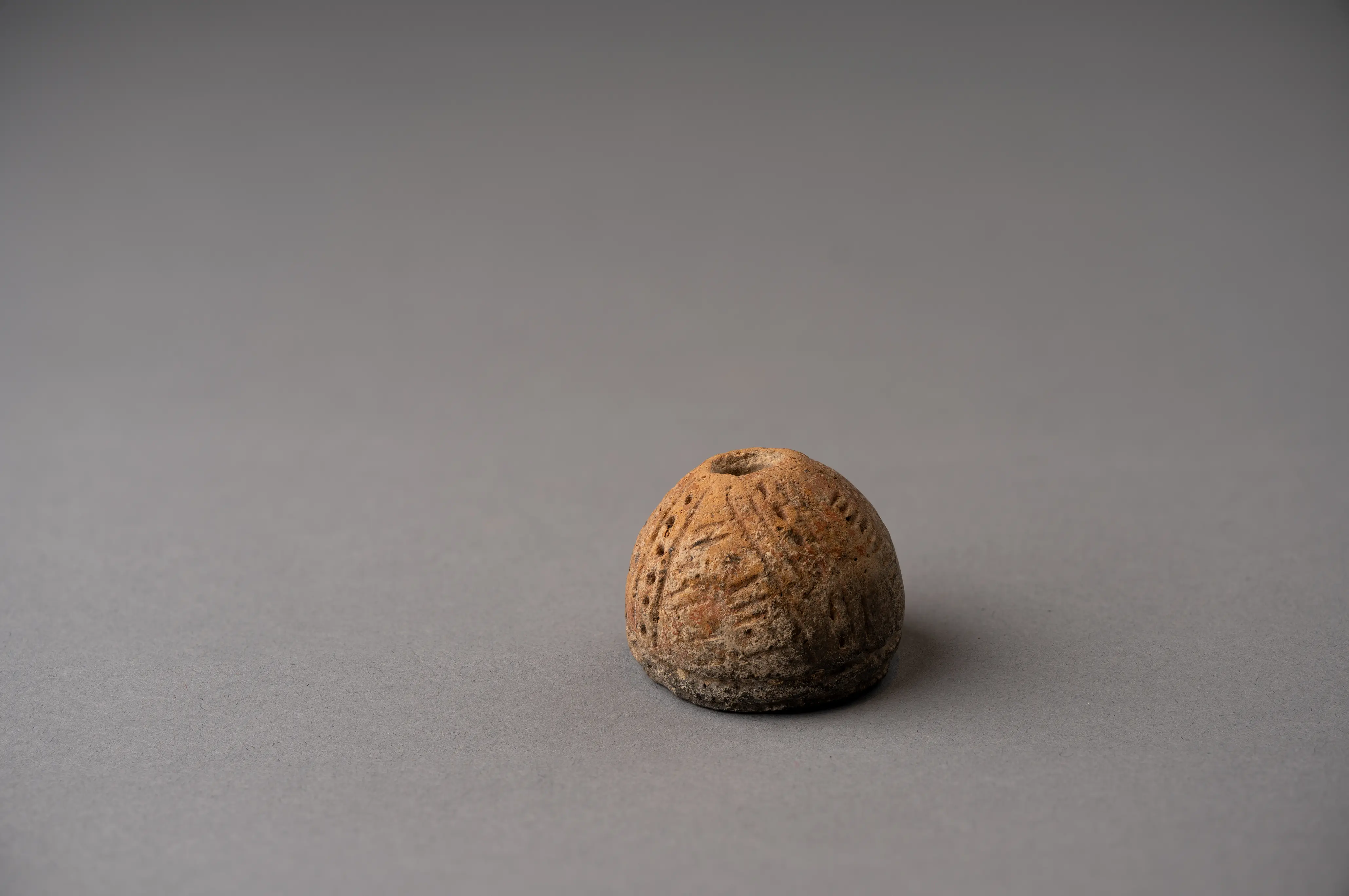
Whorls became, in Crewe's phrase quoted by Alexandrou, "an ubiquitous component of both settlement and cemetery sites" [6, p. 185]. At Marki spinning and weaving took place in the hearth rooms [1, p. 358]. In tombs whorls occur in about 30% of the burial chambers of the period, loom weights only rarely (a few possible examples at Vounous and Lapithos), and three clay models of spindles came from Vounous Tombs 92, 29 and 164b [6, p. 185]. The assumption that whorls marked women's graves has been used to sex burials; Alexandrou questions how far that association can be proven [6, p. 185]. The spindle whorls and textile tools entry treats the types.
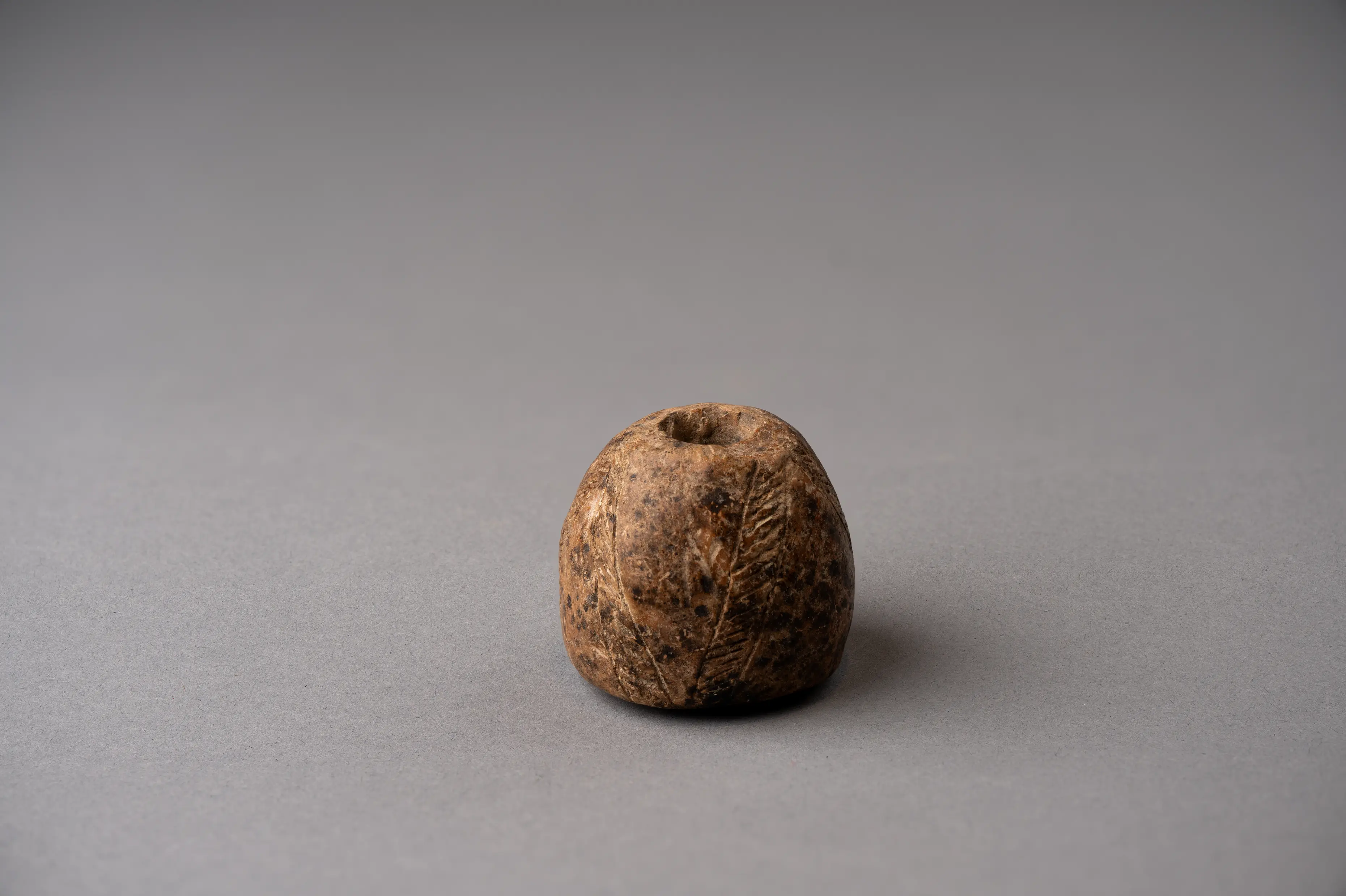
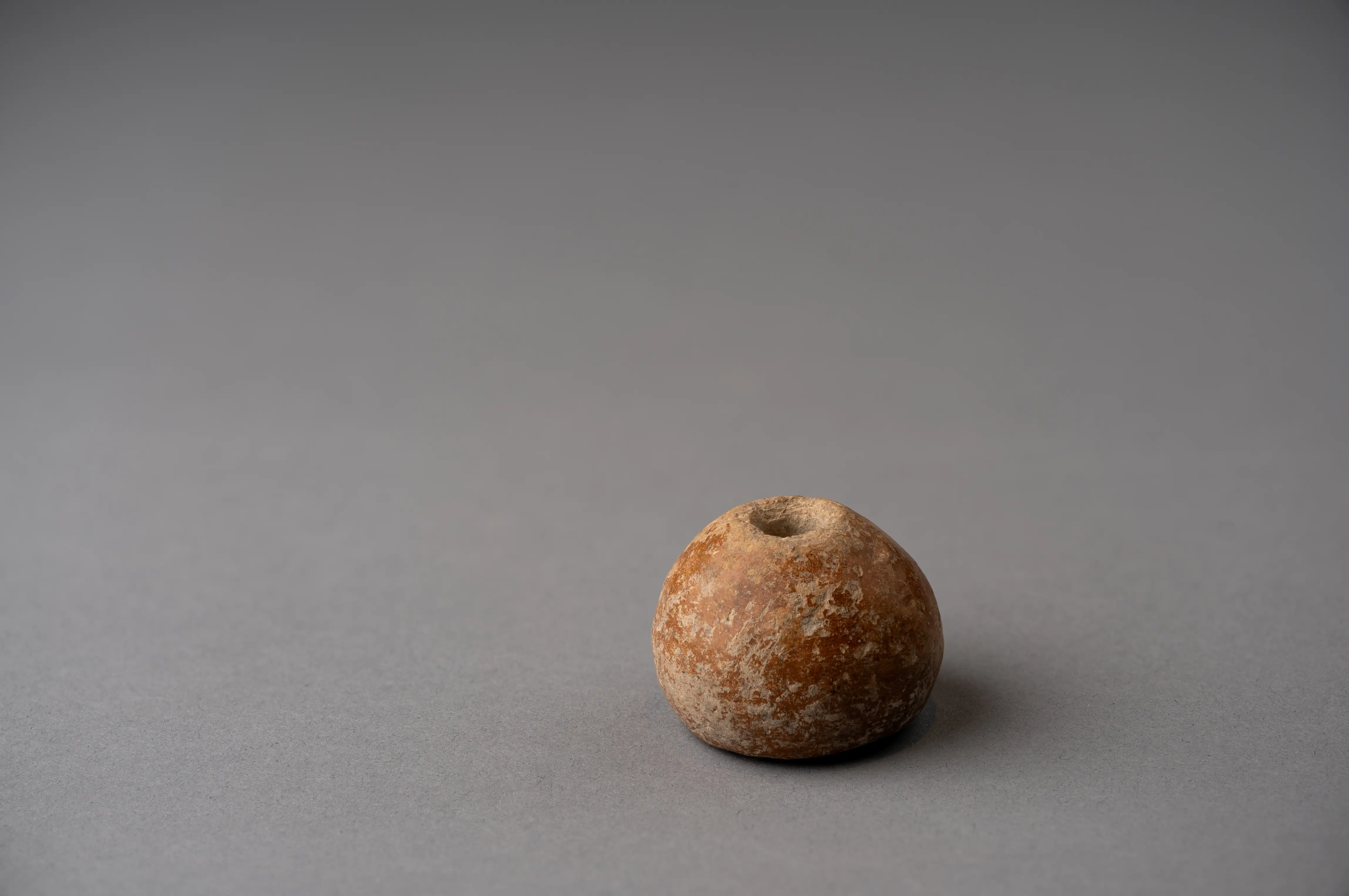
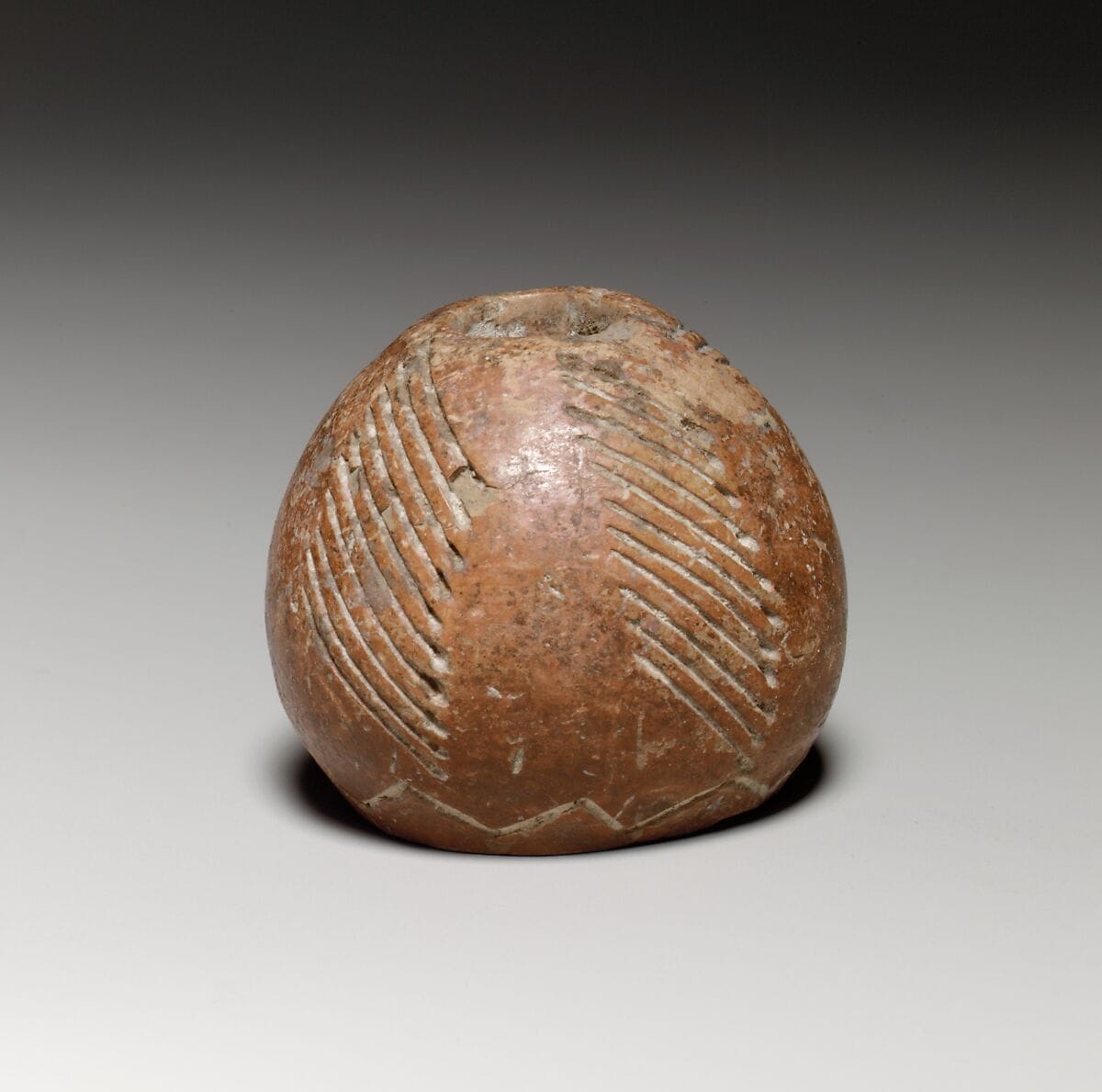
The Drakopoulos collection holds three terracotta whorls of this family. The first is globular to biconical with zones of incised herringbone; the second is conical-hemispherical with incised bands and herringbone; the third is globular and plain or worn. They are incised Early or Middle Cypriot terracotta whorls; their worn brown and buff surfaces do not allow the ware to be identified with confidence, and they have no recorded find-spot. Museum parallels include a Red Polished whorl from Lapithos Tomb 316, 3.6 cm across, found by the Swedish Cyprus Expedition and now in Stockholm, a double-conical whorl with an incised zigzag in the Peabody Museum at Harvard, and a conical-hemispherical Cesnola whorl at the Met.
Pottery is the other craft that can be traced. Handmade Red Polished was the dominant ware "for over half a millennium"; most was made locally, although some vessels moved between villages [2, p. 115]. Who made it is debated. An earlier model, associated with Frankel (1988), placed production in every household. Webb finds that "difficult to sustain" given the rates of breakage and replacement, since Marki households replaced fewer than a dozen vessels a year, and proposes "a small number of potting households engaged in part-time manufacture and exchange", an "elementary specialization" organised through kin or residence groups [1, pp. 361–362]. How the pots were fired is covered in pottery kilns and firing, and the wider question in the article on pottery production in Bronze Age Cyprus.
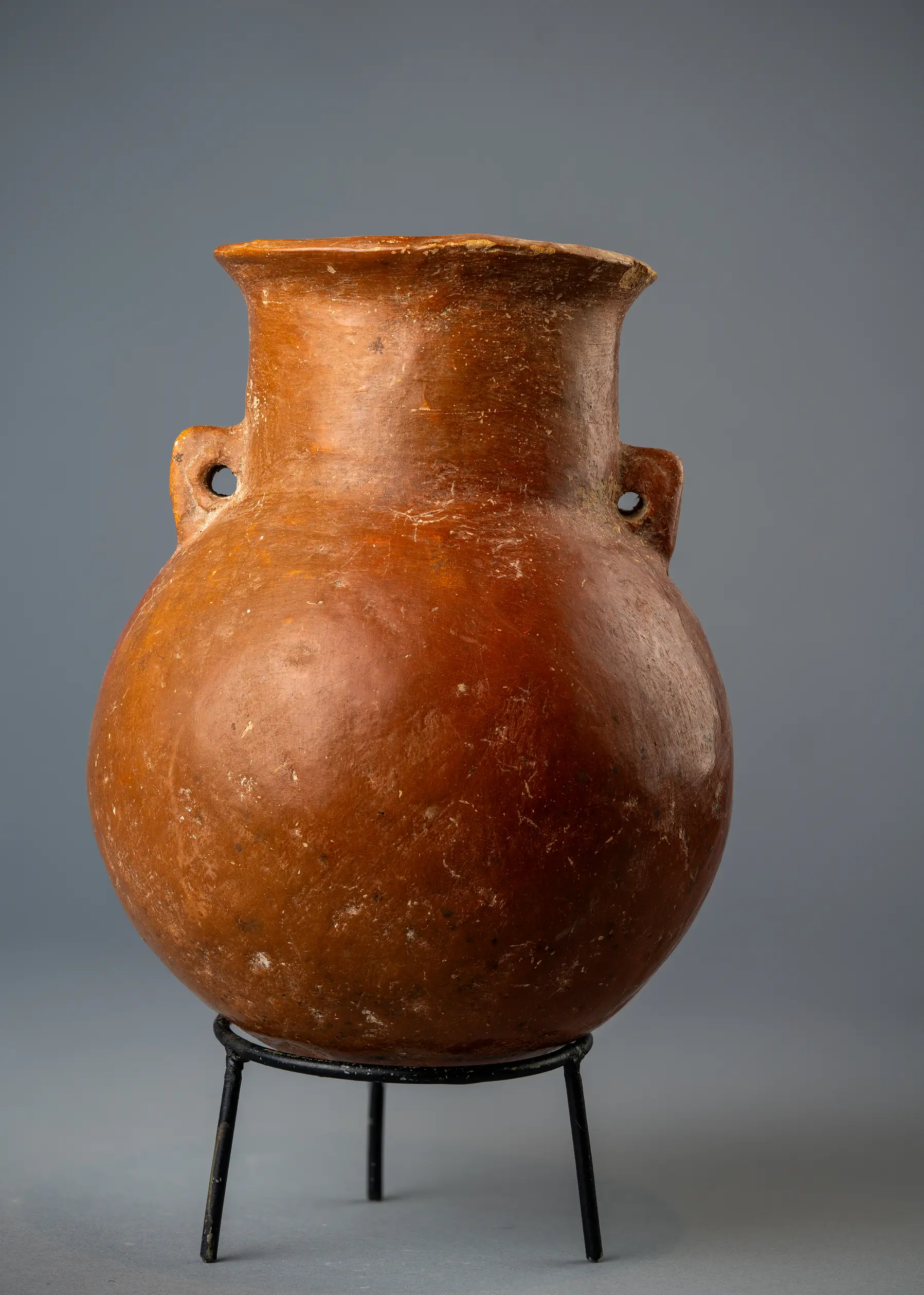
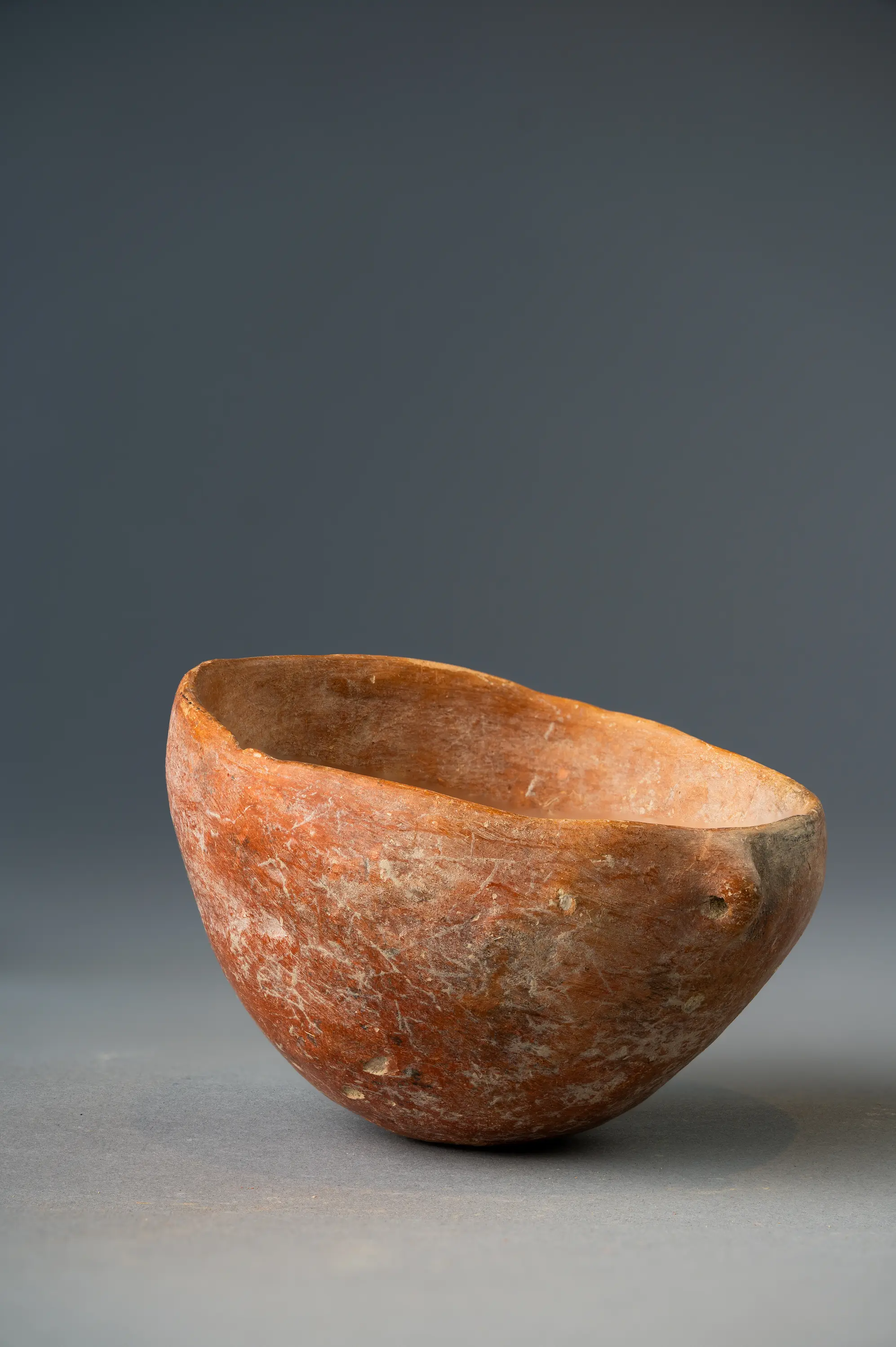
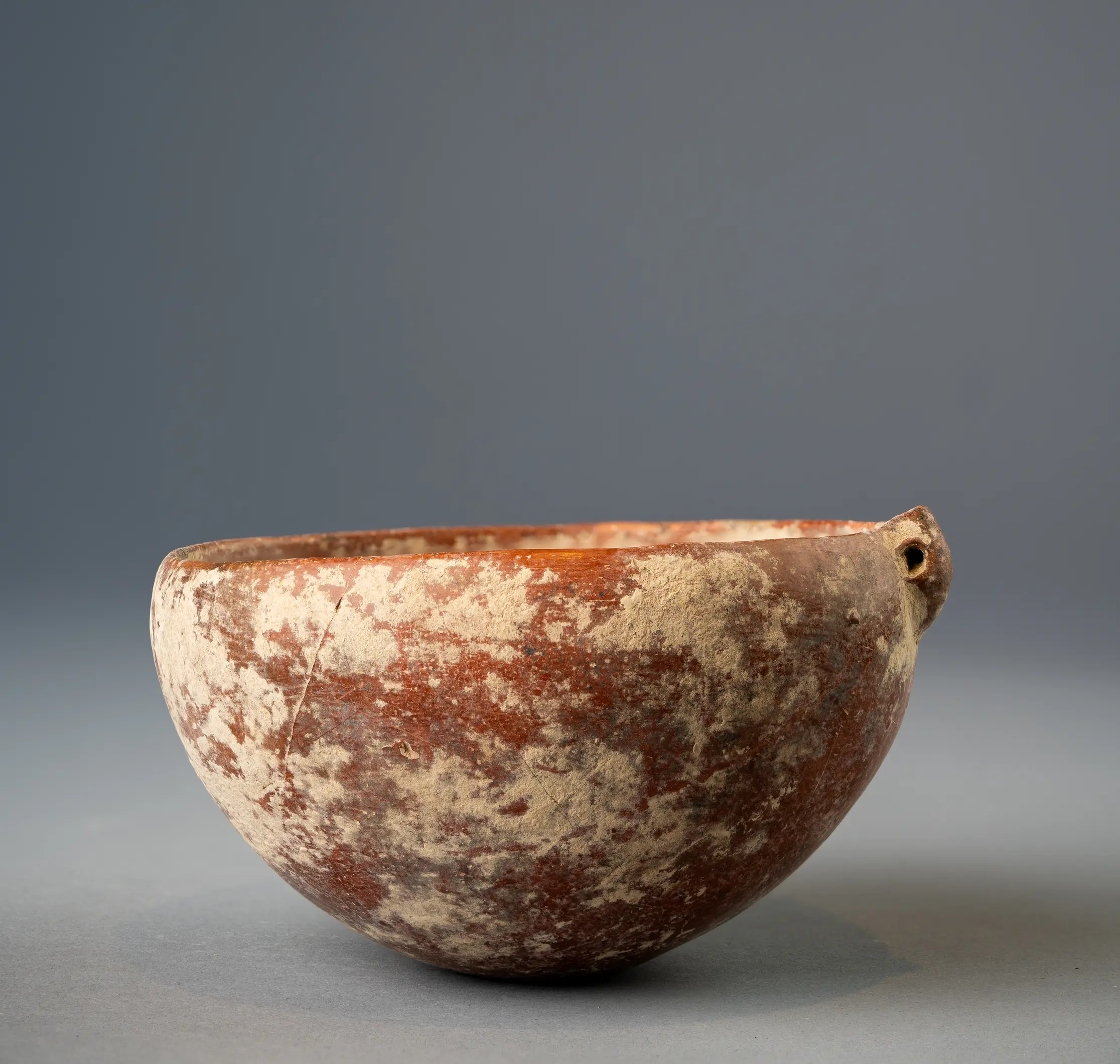
The hero image shows a Drakopoulos Red Polished jar with an ovoid body, flaring neck and two small pierced lugs on the shoulder; a storage use is plausible but unproven, and its find-spot is unknown. Two plain hemispherical Red Polished bowls in the collection, one with a single pierced lug at the rim (here), represent the everyday bowl, and an EC III to MC II Red Polished bowl from Deneia-Kafkalla, given by H. W. Catling in 1953, is in the Ashmolean. In the Philia phase a common set of handmade eating and drinking vessels occurs in all tombs and all Philia deposits at Marki, so their "use ... was not restricted": the whole community shared one table etiquette and one range of ornaments such as spiral earrings and annular pendants [1, p. 360].
Copper was worked throughout the period. Ingot moulds at Marki were used by metalsmiths "operating as autonomous individuals", and the largest casts, of about 1.25 kg, suggest "production beyond local needs"; yet "no metal-working locales have been excavated" [1, pp. 361–362]. Sotira produced about two dozen stratified metal objects, half from the settlement ("pins, needles, or small fragments") and the rest from tombs, including knives, daggers and Philia spiral earrings, one pair of electrum; all are unalloyed or arsenical copper [4, p. 83]. See copper metallurgy.
Kin, marriage and villages without chiefs
Webb describes Early Cypriot villages as "probably autonomous communities in which both the land and its products were owned by extended family units, rather than collectively or by outsiders" [1, p. 359]. That kind of village was, she notes, "relatively rare in the ancient Near East" but "likely to have been the norm" in Early Bronze Age Cyprus. Larger and smaller settlements existed, but there is no sign that villages paid "taxes, tribute, or agricultural surpluses" to any centre [1, p. 359]. Frankel and Webb call them "independent agro-pastoral villages" whose lack of differentiation in settlements, houses and grave goods "suggests an essentially egalitarian system" [2, p. 115]. Webb's summary is "networks of small, largely self-sustaining villages loosely grouped into non-centralized regional communities and organized along household and kin-based lines" [1, p. 359].
There are no defensive walls. Apart from "an enigmatic series of stone blocks on the edge of the Philia phase settlement at Marki", no boundary walls are known, weapons are rare until late EC III, and no settlement shows violent destruction "except as a result of earthquake" [1, p. 359].
Small villages could not stand alone biologically. Webb notes that few founder groups "are likely to have been viable as biological populations", so they depended on exchanging people and goods with larger centres such as Ayia Paraskevi and Vasilia [1, p. 357]. Regional ties were "necessary for the demographic viability of both human and animal populations" [1, p. 360]. Later population growth reduced the need to find marriage partners outside the village, but "kinship through intermarriage probably still served ... as the primary mechanism linking different sites" [1, p. 361]. The shifting pottery regions in the table above are one trace of those networks [1, pp. 357, 360–361].
Contact beyond the island fell away. Webb concludes that Cyprus dropped out of the interregional commodity network around 2300 BC, pointing to the lack of tin and of imported copper in EC I to III; a single Syrian jar at Vounous is one of the few imports, and tin bronze returns only around 2000 BC [1, p. 364].
How many people, and how long they lived
Marki grew "from a few dozen in the earliest phase to several hundred people in EC III" [1, p. 357]. Frankel and Webb reached their figures from the cemeteries. They surveyed 786 tombs and probable tombs and estimated a total of 750 to 800; chamber tombs probably held two to four adults each and pit graves one [2, p. 117]. That gives 1,500 to 3,200 burials over 500 years, or 3.2 to 6.4 deaths a year, and between 96 and 256 adults alive at any time [2, p. 118]. Applying Hassan's growth rate of 0.52% a year, "a founder population of 50 would increase to about 400 people", close to the carrying capacity of the fields [2, p. 119]. Dikomitou-Eliadou gives the same maximum of about 400, citing the excavators [3, p. 75].
Lives were short. Adult skeletons from other sites of the period are mostly young adults in their twenties and early thirties, and "it is unlikely that more than a very small number of people survived beyond 40" [2, pp. 118–119]. Occasional burials inside the settlements at Marki and Sotira are a reminder that not everyone ended up in the cemeteries [2, p. 118].
What the tombs can and cannot tell
Extramural pit graves and rock-cut chamber tombs were the norm, with occasional disposal inside the village; grave goods were mostly pottery, with less metal [1, p. 363]. Priscilla Keswani argues that funerals became "more protracted and elaborate" and sometimes involved secondary treatment and reburial, making them an arena for "prestige competition and the negotiation of social identity rather than the emergence of hereditary elites" [1, pp. 363–364]. The chamber tombs entry and the review of mortuary society in Bronze Age Cyprus cover the rites.
Keswani is also clear about the limits. Excavators "are most often presented with the latest or terminal stage of the ritual system" [7, p. 30]. Infants and young children are "significantly underrepresented" in Early and Middle Cypriot tombs, "most strikingly in the earlier era"; some may have been "exposed outdoors or placed in abandoned settlement contexts (as some recent examples from Marki Alonia suggest)", and others placed in pithoi, as with Philia burials at Kissonerga and Marki [7, p. 30]. Small samples of skulls from Vounous (15 adults and an adolescent from Stewart's excavations, 4 adults from Schaeffer's and Dikaios's) and from Lapithos (9 adults) suggest more men than women received chamber-tomb burial, though if the unsexed individuals were female the imbalance is slight [7, p. 30].
The Marki cemeteries add a second limit: many of the tombs had been opened before excavation, and Sneddon used those opened tombs themselves as evidence [8, p. 114]. Tomb type followed the rock, with chamber tombs in degraded limestone and pit tombs in layered limestone and fanglomerate. He found "no clear evidence to support models of higher social complexity"; vessel types and quality were uniform across the site, reuse of tombs was common, and graves held many large bowls and basins but few food-processing tools [8, p. 114].
Religion is equally hard to locate. There are no cult buildings. The Vounous clay enclosure model and three similar models from the Kalopsidha and Marki regions have been read as open-air sanctuaries, as funerary scenes or as secular, and Peltenburg's reading stresses males, bulls and transcendent power [1, pp. 362–363]. At Marki clay bull figurines appear from late EC II, mostly burnt and deliberately broken, and human figurines of women and infants occur from EC III in settlement deposits at Marki and Alambra as well as in tombs [1, pp. 362–363]. The plank figures and Red Polished zoomorphic vessels entries, and the article Vounous: a Bronze Age society known only from its dead, follow these objects.
Conclusion
Early Cypriot village life is known from two excavated settlements and many cemeteries, and the two kinds of evidence answer different questions. Marki shows households of a few rooms around a courtyard, each with its fendered hearth, bins and work benches, moving from shared ovens and fenced yards to walled, self-contained compounds. Sotira shows a denser, stone-built village without clear courtyards. Both show farming households with cattle, cereals and spinning at home, some part-time craft specialists, and no rulers, walls or temples. The tombs add funerary display and regional networks but leave out most children and record only the final stage of the rites. Several questions remain open: when Marki ended, how Sotira's radiocarbon dates fit the ceramic phasing, how the Unit 22 woman died, where the whorl began, and who made the pots. The next stage of the story, with the first forts and a denser settlement pattern, is in the Middle Bronze Age entry, and more Early Cypriot objects are in the Drakopoulos collection.
Objects on this page
- Spindle Whorl with Incised Herringbone BandsMiddle Bronze Age I · 2000–1725 BC
 Red Polished Spindle Whorl with Incised Lattice and Dotted BandsMiddle Bronze Age I · 2000–1725 BC
 Plain Red Polished Spindle WhorlMiddle Bronze Age I · 2000–1650 BC
 Terracotta conical-hemispherical spindle-whorl with flat baseMiddle Bronze Age I · 2000–1725 BC
 Red Polished Ear-Lug JarEarly Bronze Age II · 2200–1900 BC
 Red Polished Bowl with Pierced Knob LugEarly Bronze Age II · 2200–1900 BC
 Red Polished Bowl with Pierced Lug, under Burial CrustEarly Bronze Age II · 2200–1900 BC
References
- 1.Webb, J. M. (2013). Cyprus during the Early Bronze Age. In A. E. Killebrew & M. Steiner (Eds.), The Oxford handbook of the archaeology of the Levant: c. 8000–332 BCE. Oxford University Press. https://doi.org/10.1093/oxfordhb/9780199212972.013.024
- 2.Frankel, D., & Webb, J. M. (2001). Population, households, and ceramic consumption in a prehistoric Cypriot village. Journal of Field Archaeology, 28(1–2), 115–129. https://doi.org/10.1179/jfa.2001.28.1-2.115
- 3.Dikomitou-Eliadou, M. (2019). The fabric next door: A comparative study of pottery technology and composition at the Early and Middle Bronze Age settlements of Marki Alonia and Alambra Mouttes. In C. Kearns & S. W. Manning (Eds.), New directions in Cypriot archaeology (pp. 75–98). Cornell University Press.
- 4.Frankel, D. (2004). [Review of the book Sotira Kaminoudhia: An Early Bronze Age site in Cyprus, by S. Swiny, G. Rapp, & E. Herscher (Eds.)]. Bulletin of the American Schools of Oriental Research, 334, 82–83. https://www.jstor.org/stable/4150112
- 5.Muti, G. (2017). Spinning and weaving in Cyprus at the beginning of the Bronze Age: Re-defining the Philia textile technology between Early Bronze Age Anatolia and Late Chalcolithic Cyprus [Abstract]. In The 5th Young Researchers' Conference in Aegean Archaeology: Book of abstracts (p. 43). Institute of Archaeology, University of Warsaw.
- 6.Alexandrou, C. (2019). Symbols beyond work activity? Towards the evaluation of the significance of spindle whorls in Early and Middle Bronze Age south coast cemeteries. In D. Glörfeld, K. Kittig, B. Morstadt, & C. von Rüden (Eds.), The many face(t)s of Cyprus: 14th Meeting of Postgraduate Cypriot Archaeology (pp. 185–202). Verlag Dr. Rudolf Habelt.
- 7.Keswani, P. (2004). Mortuary ritual and society in Bronze Age Cyprus. Equinox.
- 8.Sneddon, A. C. (2002). The cemeteries at Marki: Using a looted landscape to investigate prehistoric Bronze Age Cyprus (BAR International Series 1028). British Archaeological Reports.