
Contents
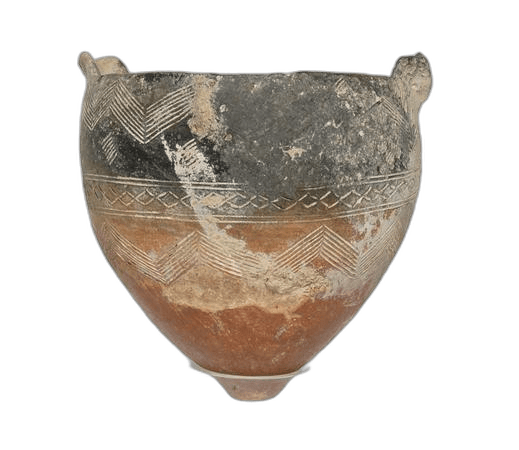
The tulip bowl is a deep, conical, handmade bowl in Red Polished ware, usually black on the upper body and inside and red below, with lime-filled incision over the outer surface and small lugs or a dagger-hilt handle at the rim. It belongs to the first half of the Early Bronze Age, Early Cypriot I and II, and almost every excavated example comes from the tombs of Bellapais-Vounous on the north coast. At its plain end the class shades into ordinary lugged bowls. At its elaborate end it becomes the so-called "cult vessel": a larger deep bowl with animal heads and discs standing up from the rim, which is where most of the scholarship has concentrated [1, commentary to cat. XI; 2, p. 48]. Recent work reads both as drinking and feasting equipment made for funerals [2, p. 52; 3, p. 65]. This entry covers the shape and the protome bowls. General Red Polished bowls are treated under bowls, the multi-bowl and ring vessels under complex vessels, and the animal heads and figurines as sculpture under Red Polished zoomorphic vessels.
The shape and its two names
The two names arrived together. James Stewart, who excavated at Vounous in 1937–1938, called these vessels both "cult-vessels" and "tulip-bowls" and classified them as Red Polished I of Early Cypriot I date; Vassos Karageorghis, summarising Stewart and Basil Hennessy in 1991, explains the second name simply: "the shape of the vase resembles a tulip" [1, commentary to cat. XI]. When there is a handle it "takes the form of the hilt of a knife or dagger, like the handles of the knife models found at Vounous" [1, commentary to cat. XI]. In Stewart's shape-based Corpus the elaborate bowls sit under Type XXV, as reported by Daisy Knox [2, p. 48].
Knox, who re-examined the figurative material from Vounous in 2013, drops both older labels and uses two neutral ones. Her "decorated deep bowls" are "large, deep bowls" that "stand an average of 19cm high on flat bases and support multiple, outward-facing zoomorphic protomes and discs around their rims"; some carry "a hilt-shaped projection (or handle), pointing diagonally upwards", and "all are covered with incised geometric decoration" [2, p. 48]. Her second type, "bowl/animal vessels", are bowls on long cylindrical stems with miniature bowls and animal figures alternating around the rim [2, p. 48]. Jennifer Webb and David Frankel use the older name for the shape as a whole, "conical vessels known as 'tulip bowls'" [3, p. 65].
The plain end of the class is better represented in museums than in the literature. The British Museum's tulip bowl 1939,0217.17 from Vounous, 12.7 cm high, has a pointed nipple base pierced horizontally, four vertical concave lugs, a red surface shading to black at the rim and inside, and white-filled incision. Manchester Museum 35161, from Vounous Tomb 96, has a flat nipple base, two vertical concave lugs, a black top and interior, and the same filled incision. The black top was a deliberate effect. The Fitzwilliam Museum catalogue describes its Vounous deep bowl as black polished on "the upper part of the bowl and the inside" and red polished below, a contrast "no doubt intentional and ... achieved with special methods of firing" [4, cat. 3].
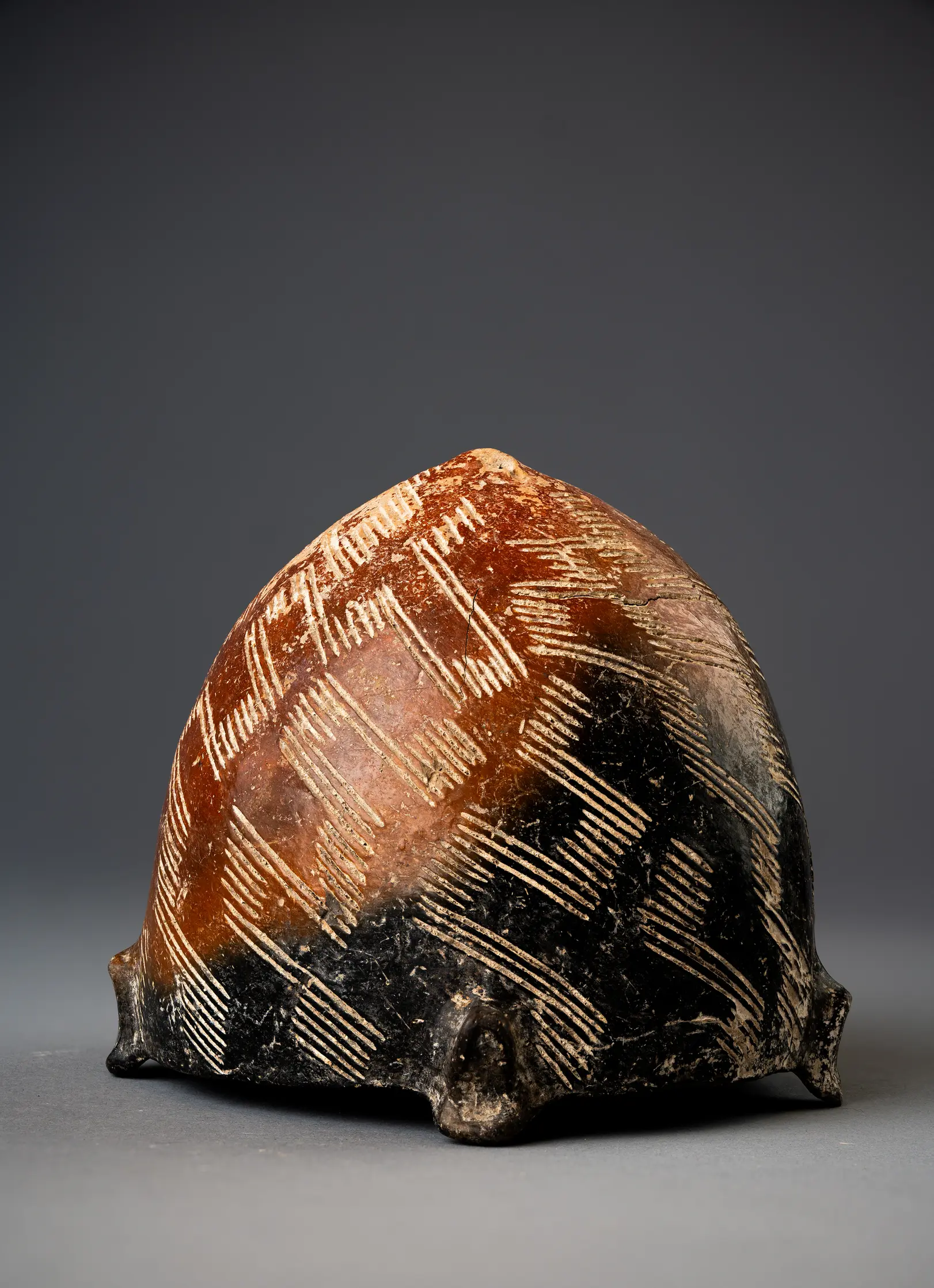
Two bowls in the Drakopoulos collection, both ex Goodman collection, belong to this plain lugged type. Both are photographed rim-down, which is why their catalogue pages still carry the working title "Incised Red Polished Bottle": the pointed base reads as a neck when the bowl is upside down. The first, eba_bwl_001 (shown here), is a deep conical bowl with a black top, a pointed base, small vertical lugs at the rim, and lime-filled bands of parallel lines and hatched lozenges; the same piece illustrates the triple crossing lines motif. The second, eba_bwl_002, is mostly black, with incised concentric circles and running spirals on the body, a horizontal line band, and concentric semicircles below the rim. Its scheme is close to the British Museum's Vounous tulip bowl 1939,0217.11, which has zigzags and circles on the body and semicircles at the rim. Neither Drakopoulos bowl has rim protomes, and neither has an excavated find-spot, so neither can be tied to a particular Vounous hand.
Dating: Early Cypriot I and II
Stewart placed the tulip bowls in Early Cypriot I [1, commentary to cat. XI]. Webb and Frankel say they "first occurred in EC I" [3, p. 65]. Knox dates the Vounous figurative vessels to Early Cypriot I and II, "ca. 2250–2100 BC", and notes that "at the end of this period, decorated deep bowls, bowl/animal vessels, knife/sheath models and spindle models appear to have fallen out of use" [2, pp. 47, 49]. Webb and Frankel describe the same break from the other side: after Early Cypriot I–II, "earlug pots, tulip bowls and earlier types of cult vessels have disappeared, and new complex vessels, comprised of multiple bowls or juglets, make an impressive appearance" [5, p. 292]. The successor forms are covered under complex vessels.
Museum records give absolute dates that do not quite agree with each other or with Knox, as the table shows.
| Source | Object or group | Phase | Date given |
|---|---|---|---|
| Knox 2013 | Vounous figurative vessels | EC I–II | c. 2250–2100 BC |
| Stewart 1962, as reported by Karageorghis 1991 | Tulip bowls and cult vessels | EC I (Red Polished I) | not given |
| British Museum 1939,0217.17 | Plain lugged tulip bowl, Vounous | EC I | 2300–2150 BC |
| British Museum 1939,0217.13 | Deep bowl with bulls' heads, Vounous | EC I | 2300–2100 BC |
| Fitzwilliam GR.5e.1939 | Tulip bowl with bulls' heads, Vounous T.153 | EC I | 2400–2201 BC |
| Fitzwilliam GR.5a.1939 | Bowl with bird protomes, Vounous T.141 | EC II | 2200–2101 BC |
A working bracket of about 2300 to 2100 BC covers every published figure except the Fitzwilliam's upper limit for Early Cypriot I. Hennessy's two master potters help with the relative order: the Fitzwilliam catalogue places "Stewart Artist no. 1" in "the early and middle parts of Early Cypriote I" and "Stewart Artist no. 2" in the "latter part of Early Cypriote I and the early phase of Early Cypriote II" [4, cats 3–4].
Where they come from: Vounous and a few other tombs
Karageorghis states that the cult vessels "are confined to the cemetery of Vounous and probably were the invention of an individual potter or a single workshop" [1, commentary to cat. XI]. Knox goes further and says that "all the decorated vessel types found at Vounous were exclusive to that site" [2, p. 49]. She also observes that "almost all the provenanced figurative objects known from the EC I–II periods" came from Vounous, and that "the vast majority were uncovered by Stewart's excavations" of 1937–1938 [2, p. 47]. Of the 45 Early Cypriot I–II figurative objects in her Vounous corpus, 29 are decorated vessels. Her Table 1 lists nine decorated deep bowls, from Tombs 81B, 87A, 90, 91, 105, 111, 160B and two from Tomb 161, and four bowl/animal vessels, from Tombs 111, 153 and two from Tomb 160A [2, pp. 47–48].
Other evidence qualifies the Vounous-only rule. Webb and Frankel record that, among the elaborately decorated Vounous types, "with the exception of a large jug and a tulip bowl ... from Palealona Tomb 2, none have been recovered elsewhere", Palealona being a cemetery at Karmi [6, p. 200]. Karageorghis's own catalogue includes a tulip bowl with two bird protomes "from Aghirda", now in the Cyprus Museum (inv. 1975/I-29/3, his cat. XII.29) [1, cat. XII.29]. The Fitzwilliam catalogue adds that the works of Stewart Artist no. 2 "have been found at Vounous but also at other sites along the northern coast" [4, cat. 4]. Knox herself lists a sheath model from Karmi Palealona Tomb 5 as the one object model found outside Vounous in this phase [2, p. 49]. The fairest summary is that the elaborate protome bowls are, on present evidence, a Vounous product, while the plain tulip shape and some of the same makers' work reached a handful of other north-coast tombs.
The makers: Stewart Artist no. 1 and no. 2
In 1974 Hennessy grouped the finest Vounous pottery by hand. Of the potter he named "Stewart Artist no. 1" he wrote: "This artist is responsible for perhaps the finest of all the Early Bronze Age ceramics. He appears to have been both potter and decorator" [7, p. 11]. The clay has "tiny grits and straw as temper", fires dark red, and is "polished and burnished to a high lustre" [7, p. 11]. The same hand made tulip bowls and horn-lug bowls, "and he appears to have been responsible for a majority of the ... cult vessels ... of the Early Cypriot I period"; his favourite motifs were "based on the circle, often referred to as sun discs on the cult vessels", with dots and stitch patterns [7, p. 14]. The Fitzwilliam catalogue reports that Hennessy gave this artist 79 pieces besides the museum's own deep bowl [4, cat. 3].
Karageorghis assigns his catalogue numbers XI.1–9, XI.13 and XI.15 to Artist no. 1, and the bird-protome bowl XI.10 to "Stewart Artist no. 2", "who favoured multiple zigzags and punctures" and "also specialized in making 'comb' figurines and models of knives and sheaths" [1, commentary to cat. XI]. He is more cautious than Hennessy about the principle: "Three vessels have been attributed to the same artist, but if instead they came from the same atelier this number could be increased to include most of them" [1, commentary to cat. XI]. One of his entries, the bull-headed tulip bowl from Tomb 153 now in the Fitzwilliam (his XI.11, GR.5e.1939, given by Stewart in 1939), he says "does not fit either of the two groups from the point of view of shape or decoration" [1, commentary to cat. XI; 4, cat. 5].
The numbers therefore depend on what is being counted. Knox counts 13 vessels of two defined types at Vounous. Hennessy's list for Artist no. 1 covers about 80 pieces of every kind. Karageorghis gives eleven bowls of his group XI to Artist no. 1 while warning that only three had been attributed to one hand and that the rest may be a workshop's output. None of these figures is a census of tulip bowls, and none should be read as one. The circles on eba_bwl_002 are the kind of motif Hennessy associated with Artist no. 1, but a shared motif on a bowl without a tomb context is not an attribution, and this entry makes none.
Rim figures, discs and incised figures
The animals on the rims are "bulls, goats, rams and ... other horned animals' heads more difficult to identify"; Karageorghis's XI.1 adds a bird, and XI.10 has only birds [1, commentary to cat. XI]. Knox finds that across the Vounous figurative material "images of cattle were most popular but other quadrupeds, especially horned animals, were also present", while birds are rare [2, pp. 51–52]. The British Museum's deep bowl 1939,0217.13, 23.8 cm high, carries bulls' heads and spoon-shaped attachments on its rim. The Fitzwilliam's deep bowl from Tomb 91 (GR.5y.1939, 22 cm high) has four pairs of rim ornaments, discs incised with "a 'wheel' motif with seven spokes" alternating with horned protomes, and three incised figures on the body who "seem to wear horns. Two appear to wear antlers, while the third wears curved ram's (?) horns" [4, cat. 3].
The discs have attracted the most speculation. Stewart took them as sun discs and inferred that "the sun was apparently worshipped in Cyprus"; Karageorghis, reporting this, asks what the real meaning of the discs is, "if any" [1, commentary to cat. XI]. Knox offers a more literal reading: given the Vounous habit of modelling objects, and because the discs usually come in pairs, "they might equally be identified as wheels". The hilt projections "might represent knife models or metal knives", and the "bird" on the Tomb 160B bowl "bears a resemblance to the upper end of a plough handle" like the one on the Vounous ploughing model [2, pp. 51–52].
The incised figures are read in several ways. Webb and Frankel note that a deep bowl and a large jug (79.4 cm high) show "incised upright antlered, bull- and ram- or mouflon-horned cloven-hoofed figures ... suggestive of dancing". Desmond Morris, as they report, read such figures as animals seen "in plan view"; Webb and Frankel suggest instead that they "may represent supernatural beings, humans dressed in animal skins and skulls or masks ... or the projected transformation of human actors into animals during ritual performances" [6, p. 200].
The class also quotes itself. Karageorghis's XI.17 is a large, rather shallow bowl whose rim carries miniature tulip bowls, "replicas of the real 'tulip-bowls'", complete with horned protomes and sun discs; he argues that this "strengthens the possibility that the 'tulip-bowls' constitute a well-known class, deemed worthy of decorating other vessels" [1, commentary to cat. XI]. Knox's bowl/animal vessel from Tomb 153 "has four miniature decorated deep bowls on the rim", which she thinks "may refer to the parent vessel and its part in mortuary activities" [2, p. 52]. On the large pedestal bowls, Webb and Frankel write, "animals alternate with decorated miniature tulip bowls" [6, p. 200]; the stemmed bowl from Tomb 160A, Karageorghis's VIII.4, is 52.9 cm high and carries complete animals [1, commentary to cat. XI]. For the protomes as modelled sculpture, see Red Polished zoomorphic vessels.
Made for the grave?
Every excavated example comes from a tomb, and Knox argues that the good condition of the unprovenanced examples "suggests that they also come from tombs" [2, p. 51]. On the decorated deep bowls she sees "no obvious wear to suggest use prior to burial", in contrast to "most other grave goods of the period, which were in long-term use prior to deposition". Their "awkward, fragile form" makes everyday use unlikely, and she concludes that "the figurative objects of EC I-II Vounous were created specifically for deposition in tombs" [2, p. 52]. Webb and Frankel reach a similar view of the model knives and spindles, "probably produced exclusively for burial" [3, p. 65].
The point needs some hedging. The Fitzwilliam's bird-protome bowl from Tomb 141 is described as having a worn surface [4, cat. 4]. Surface wear from soil and handling is not the same as wear from use, but it means "unused" should be taken as Knox's reading of the pieces she examined, not a property demonstrated for every bowl. Webb and Frankel also point out that tulip bowls, "many of which have small spouts at the rim, were certainly used for liquids" [5, pp. 290–291], and the British Museum's tulip bowl 1939,0217.3 from Vounous has one of its horn-like lugs pierced as a spout. The two positions can be reconciled if the bowls were used once, at the funeral, and then buried with the dead. For the tombs themselves, see Bronze Age chamber tombs.
From "cult" to funeral feasting
The word "cult" goes back to the excavator of the 1931–1932 Vounous campaigns. In 1940 Porphyrios Dikaios read the clay enclosure model from the cemetery as "a rite in honour of the chthonian deities" and as evidence for "a cult of chthonian and fertility deities of which the attributes were the snake and the bull" [8, pp. 123–125]. That model, the Vounous Bowl from Tomb 22, is later than the tulip bowls, and its interpretation is discussed under complex vessels. Louise Steel has argued that Dikaios's reading "was clearly influenced by his classical training" and treats the model as social communication instead of a religious scene [9, pp. 51–52].
James Stewart extended the religious reading to the discs (sun worship), and Hennessy framed the cult vessels as the work of a single master [1, commentary to cat. XI; 7, p. 14]. Webb and Frankel report that Stewart also linked spouted vessels to "the enjoyable evil of strong drink" [5, p. 291]. The 1999 Fitzwilliam catalogue keeps the religious vocabulary: the bull as "symbolizing fertility", the discs as possible "'standards' of ritual significance (sun discs?) not unlike some which appear in Anatolian iconography", and the incised figures as perhaps "wearing animal masks" [4, cats 3–4]. Vassos Karageorghis was sceptical: "There is no firm evidence to support the suggestion that such vases were used as ritual vessels" [1, commentary to cat. XI].
Since 2008 Jennifer Webb and David Frankel have moved the discussion from belief to consumption. On the north coast in Early Cypriot I–II they identify "specialised ritual vessels with elaborate incised and modelled decoration" and "an emphasis on individually distinctive vessels, particularly in the case of the so-called tulip bowls, which show deliberate 'additive' variability" [5, pp. 290–291]. They judge it "highly likely that the production and consumption of beer continued to play a critical role in funerary ceremonial", which they present as a probability, not a finding [5, pp. 290–291]. The tomb chambers held cattle bones "placed in the chambers as cuts of meat, in some cases whole sides of oxen". Drawing on Priscilla Keswani's tomb tables, they note that cult vessels occur in over a third of the tombs, which "implies widespread promotional feasting behaviour and creation of social debt at Vounous", and that the deliberate disposal of prime meat and "the destruction of unique items like cult vessels by permanent burial" are associated elsewhere with competitive feasting [5, pp. 290–291]. They contrast this with the preceding Philia phase, when shared drinking worked as a means "of horizontal integration rather than vertical differentiation" [5, pp. 290–291]; see Philia-phase Red Polished.
In 2010 they added a cosmological dimension. Cattle "were not present on the island" in the Late Chalcolithic, and at Vounous a "complex cosmology based on cattle and other horned species and symbols probably representing solar, lunar and other natural phenomena" appears to have been "a rapid sui generis development ... by mid EC I". The funerals "were theatrically charged, involving feasting, dancing and other performances focused on horned animals", and the horned heads on the vessels may reflect "the special treatment of the heads of slaughtered animals" [6, pp. 185, 200–203]. By 2013 they described the tulip bowls as "individualized (possibly single-draught) drinking cups" [3, p. 65]. Knox's reading runs parallel: the imagery "relates to the symbolism of burial", each animal and object on the vessels probably represents part of the rites around burial, and the dominance of cattle matches the animal bones found in the Vounous tombs [2, p. 52]. On drink and meat more generally, see food and diet; on the cemetery as a whole, the article Vounous: a Bronze Age society known only from its dead.
Examples in museums
Much of the class is outside Cyprus. The British Museum holds the plain lugged bowl 1939,0217.17, the bull-headed deep bowl 1939,0217.13, the spouted-lug bowl 1939,0217.3, the decorated bowl 1939,0217.11, and a black-topped tulip bowl with zigzag friezes, 1980,1126.2, all listed in the site's British Museum collection. The Fitzwilliam has the Tomb 91 deep bowl with wheels and horned figures, the Tomb 141 bird-protome bowl and the Tomb 153 bull-headed tulip bowl [4, cats 3–5]. The Louvre's AM 2732, from Vounous Tomb 67 (excavated by Schaeffer), has two bird protomes and a bucranium or ram's head [1, group XII, p. 161], and the Aghirda bowl is in the Cyprus Museum [1, cat. XII.29]. Manchester's Tomb 96 bowl is a good plain comparison for the Drakopoulos pair. Other Vounous vessels on this site include the double-necked bird jug.
Summary
The tulip bowl is a conical, black-topped Red Polished drinking bowl of Early Cypriot I–II, c. 2300 to 2100 BC. Its elaborate form, the deep bowl with animal heads and discs on the rim, is known almost entirely from Stewart's tombs at Vounous, while plain examples and a few decorated ones reached other north-coast cemeteries such as Karmi and Aghirda. Hennessy grouped much of the class under one potter, Karageorghis preferred a workshop, and the counts in the literature measure different things. The "cult vessel" label dates from the 1940s to 1960s; the current reading, led by Webb, Frankel and Knox, treats the bowls as individual drinking vessels made for funerals, used in feasting around cattle, and then buried. Both forms went out of use at the end of Early Cypriot II, when the multi-bowl complex vessels took their place in the tombs.
Objects on this page
- Black-topped Red Polished Tulip Bowl with Incised Hatched LatticeEarly Bronze Age II · 2300–2000 BC
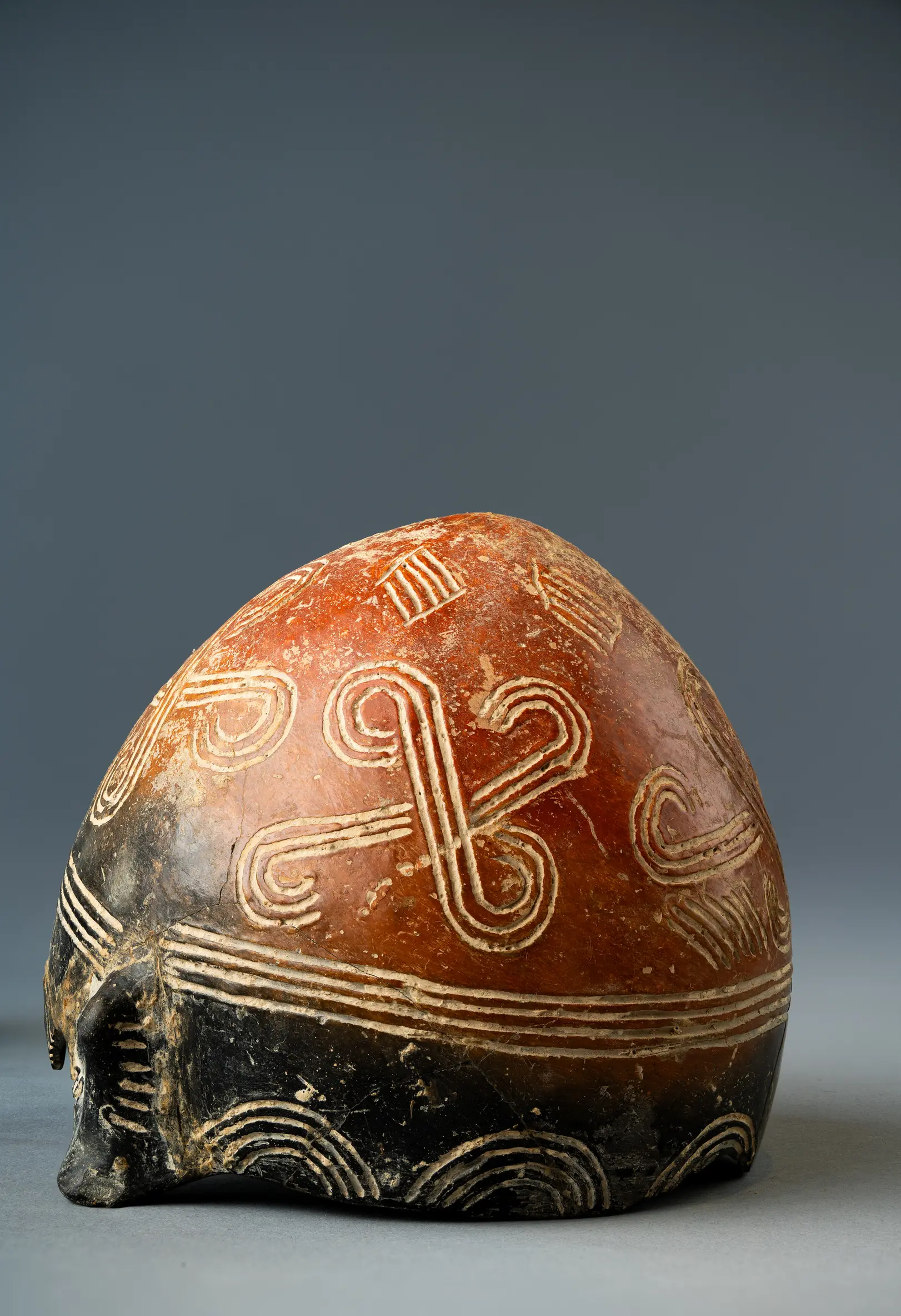 Black-topped Red Polished Tulip Bowl with Incised Spiral-armed Cross, Circles and ArcadesEarly Bronze Age II · 2300–2000 BC
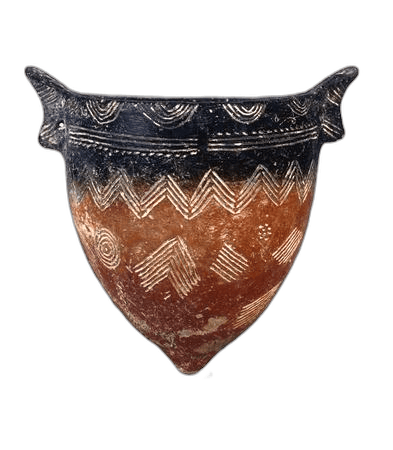 Red Polished 'Tulip' BowlEarly Bronze Age II · 2300–2100 BC
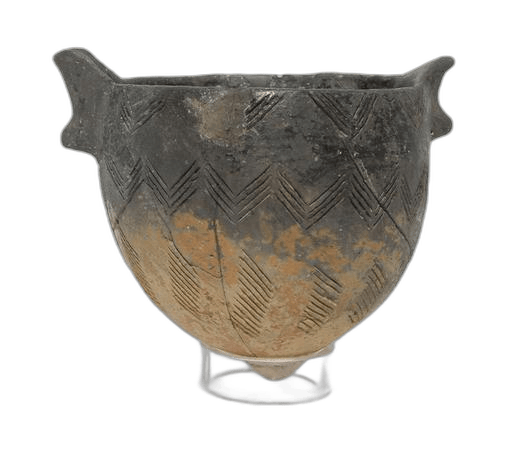 Red Polished Tulip BowlEarly Bronze Age II · 2300–2100 BC
 Red Polished Tulip BowlEarly Bronze Age II · 2300–2100 BC
References
- 1.Karageorghis, V. (1991). The Coroplastic Art of Ancient Cyprus I: Chalcolithic–Late Cypriote I. Nicosia: A. G. Leventis Foundation.
- 2.Knox, D. (2013). Figurines and figurative vessels at Early Cypriot Bellapais Vounous. In A. B. Knapp, J. M. Webb & A. McCarthy (Eds.), J.R.B. Stewart: An Archaeological Legacy (Studies in Mediterranean Archaeology 139, pp. 47–57). Uppsala: Åströms Förlag.
- 3.Webb, J. M., & Frankel, D. (2013). Cultural regionalism and divergent social trajectories in Early Bronze Age Cyprus. American Journal of Archaeology, 117(1), 59–81. https://doi.org/10.3764/aja.117.1.0059
- 4.Karageorghis, V., Vassilika, E., & Wilson, P. (1999). The Art of Ancient Cyprus in the Fitzwilliam Museum, Cambridge. Nicosia: The Fitzwilliam Museum and the A. G. Leventis Foundation.
- 5.Webb, J. M., & Frankel, D. (2008). Fine ware ceramics, consumption and commensality: Mechanisms of horizontal and vertical integration in Early Bronze Age Cyprus. In L. A. Hitchcock, R. Laffineur & J. Crowley (Eds.), Dais: The Aegean Feast (Aegaeum 29, pp. 287–295). Liège: Université de Liège.
- 6.Webb, J. M., & Frankel, D. (2010). Social strategies, ritual and cosmology in Early Bronze Age Cyprus: An investigation of burial data from the north coast. Levant, 42(2), 185–209.
- 7.Hennessy, J. B. (1974). Cypriot artists of the Early and Middle Bronze Age. In J. Birmingham (Ed.), The Cypriot Bronze Age: Some Recent Australian Contributions to the Prehistory of Cyprus (Australian Studies in Archaeology 1, pp. 10–22). Sydney.
- 8.Dikaios, P. (1940). The excavations at Vounous-Bellapais in Cyprus, 1931–2. Archaeologia, 88, 1–174.
- 9.Steel, L. (2013). The social world of Early–Middle Bronze Age Cyprus: Rethinking the Vounous Bowl. Journal of Mediterranean Archaeology, 26(1), 51–73.