
Ancient Cypriot Pottery·Lesson 3
The Red Polished World
Red Polished pottery from its Philia beginnings around 2400 BC to the tomb pots of Vounous: why its numerals I to IV do not date a pot, and how to tell glossy incised north-coast work from plain mottled southern ware.
Alexis Drakopoulos·Period by period·16 min read
Share


Lesson 3·Course contents, 15 lessons
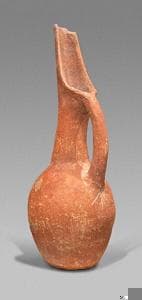
The jug from Philia is 28.3 centimetres tall and carries no decoration at all. It stands on a flat base. Its body is an egg of burnished red clay; from the shoulder a neck rises and keeps rising, then ends in a spout sliced off at a steep angle, like the cut end of a reed. A rod of clay runs from rim to shoulder as a handle. It was found at Philia, in the Ovgos valley of north-western Cyprus, and belongs to the Cyprus Museum.
A visitor could pass its case without a glance. The shape is the point. Potters on Cyprus had been making vessels for more than two thousand years, and they had never made a jug like it. When Jennifer Webb and David Frankel set the Philia shapes against everything that went before, only one, a deep bowl with a tubular spout, had a clear local ancestor. "Amphoras, narrow-necked beak-spouted jugs and juglets, bottles, round-based flasks, handled storage jars, and cooking pots are all novelties, along with rod handles and separately fashioned flat bases" [1].
From this jug onward, for some seven hundred years, nearly every pot on the island is red, burnished and made by hand. The names scholars gave the ware carry tidy Roman numerals that look like a sequence. A Red Polished pot is dated and placed by how it was fired, where its clay came from, and what it was made to do.
Who brought the jug
Porphyrios Dikaios excavated four tombs at Philia in 1942 and 1943, and they gave their name to the earliest phase of the Cypriot Bronze Age. Webb and Frankel call it the "Philia facies", a recognisable set of artefacts, a cautious term that says nothing about who made them or how long they lasted [1]. This course dates the Philia phase to c. 2400 to 2250 BC and the Early Cypriot period (EC), divided into EC I, II and III, to c. 2250 to 2000 BC, when the Middle Cypriot (MC) begins. The evidence is thin, and other schemes differ: Webb and Frankel put the first Philia settlements at about 2500 to 2400 BC, while Sturt Manning's radiocarbon modelling stretches the facies down to about 2200 BC [1][6].
Its pottery is Red Polished (Philia) ware: a fine, soft fabric under an even red slip (a coat of iron-rich liquid clay), burnished, that is rubbed with a pebble, to a lustre. Some pots were burnished in bands so that shiny and matt areas alternate; some were fired black inside. Incision is sparse, mostly zigzags and herringbone on flasks, juglets and amphorae, filled with white lime [1]. The ware looks the same in the north-west, the centre and the south-west, yet each site used its own local clay: one recipe, followed island-wide [1].
Dikaios thought Philia came first; James Stewart thought it a regional variant of the same date and gave it separate ware names [14]. At Marki-Alonia, a village excavated in the 1990s, deposits holding only Philia pottery lie beneath the Early Cypriot ones, and the order is settled [1].
The argument about origins has lasted longer. Einar Gjerstad, in 1926, judged the red burnished pottery of south-western Anatolia identical to the Cypriot ware, and Dikaios came to see the Philia changes as the work of newcomers from Anatolia [1]. Diane Bolger answered from the pots. The Philia jug, she pointed out, occurs only once at Tarsus in Cilicia, where its excavator thought it an import from Cyprus [2, p. 31]. Philia fabric matches clays near the Cypriot sites, and burnishing and two-colour firing had Late Chalcolithic forerunners on the island [2]. The one decorative habit with no local ancestor was lime-filled incision [2, p. 32].
Frankel shifted the ground in 2000 by looking past the pots to habits learned in childhood. Philia spinners mounted their clay whorls low on the spindle, as in Anatolia, and Philia cooks boiled food in pots set over small hearths [3]. Habits like these move when people move. Most specialists now accept that groups from Anatolia settled on Cyprus at the start of the Philia phase (around 2450 BC on Webb and Frankel's reckoning), while disagreeing about how many came and how they mixed with the islanders [4]; Bernard Knapp prefers to speak of a hybrid culture made by both [5]. None of this shows in a single pot. What shows is the outcome, in Desmond Morris's words: Red Polished "quickly became a uniquely Cypriot affair that left its Anatolian origins far behind" [7].
Numbers that are not a clock
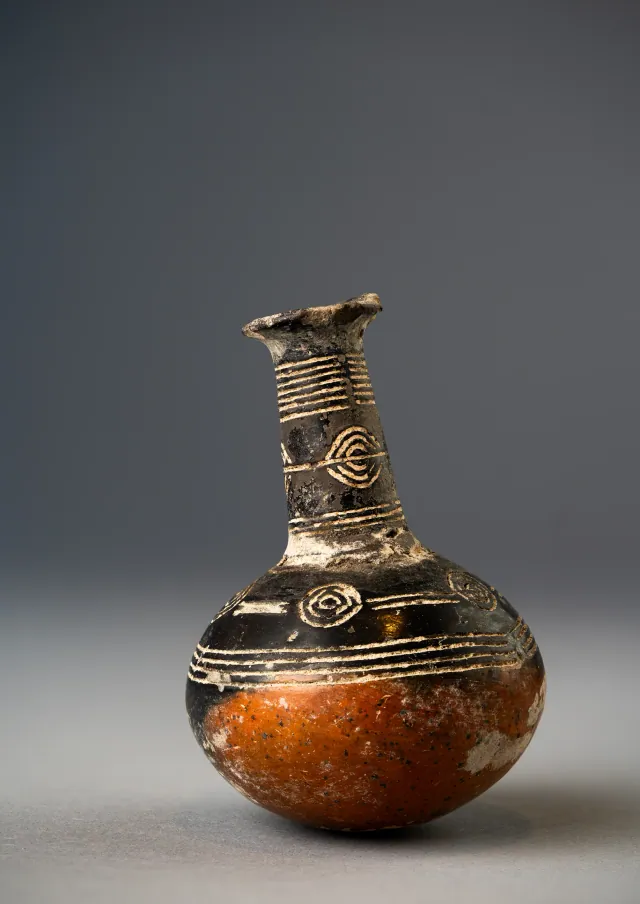
In 1926 Gjerstad split Red Polished into four classes, I to IV, and Stewart's corpus of 1962 kept the numerals while openly sorting by shape and date [8][14]. The small bottle beside this paragraph, in the Drakopoulos collection, shows what followed. Its upper half was fired black, its lower half red, and concentric circles threaded on an incised line run round neck and shoulder, every groove white with lime. Ellen Herscher recognised bottles of this kind as a north-coast product that travelled across the island, to Episkopi-Phaneromeni, Kalavasos, Marki and Sotira-Kaminoudhia, where one had been kept in a niche in a house wall [9][10]. The British Museum, following Stewart, catalogues its examples from Vounous as Red Polished I of EC I. Herscher and the Kaminoudhia report call the same type Red Polished III, of EC III.
Morris, quoting Lucy MacLaurin, wrote that Gjerstad's classes "for no apparent reason, came to be given chronological significance"; most people assume Red Polished II is later than Red Polished I, "and it is hard for some to believe that this was never intended to be the case" [7]. Lesson 0 gave Robert Merrillees's explanation of the drift, and he called one result "the silliest": the hemispherical knob-lug bowl, which runs from EC II to MC III, the end of the Middle Cypriot, is filed under Red Polished II, "when technically the majority belong to Red Polished III and some are Red Polished IV" [8, p. 239].
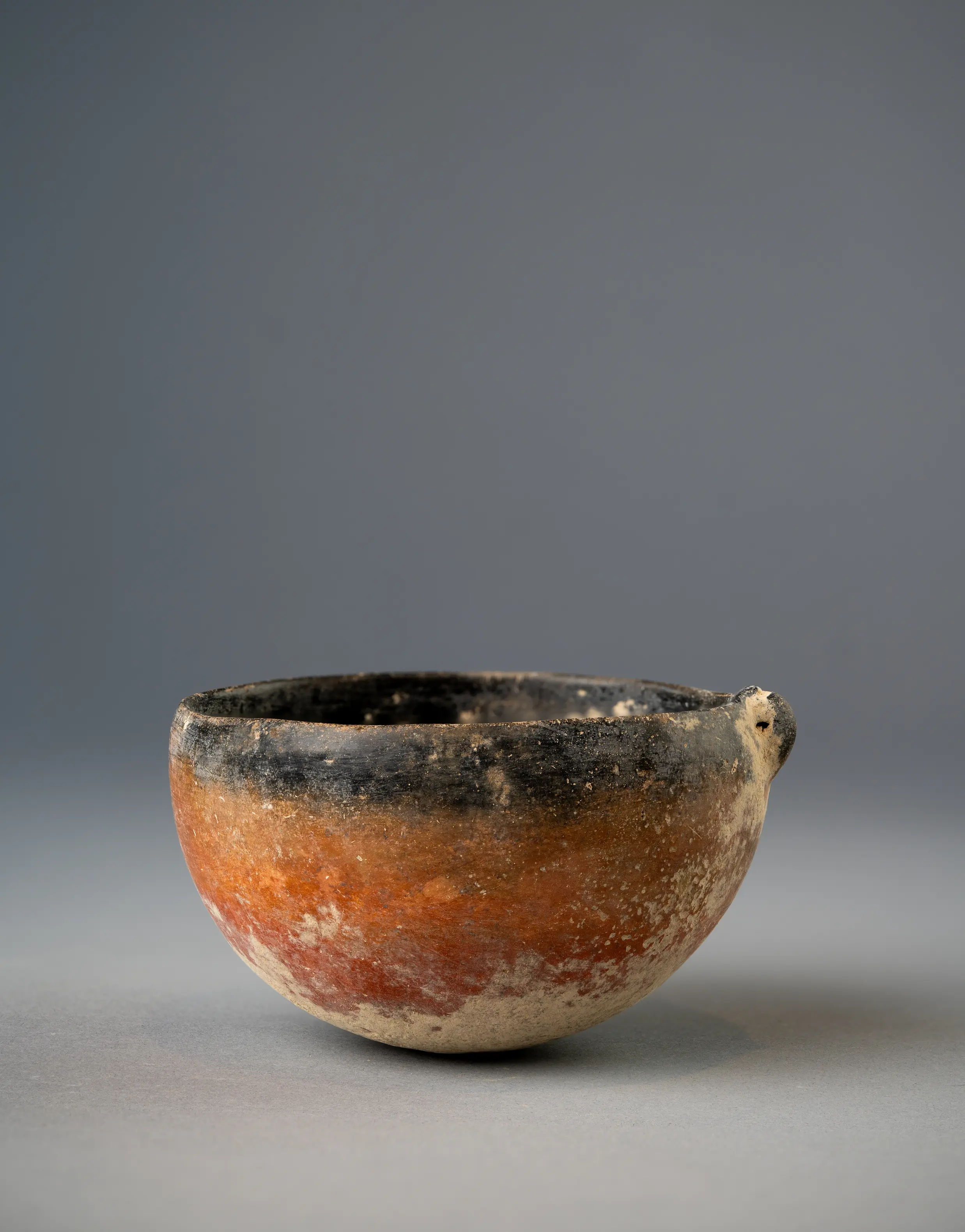
The black-topped bowl to the right is one of those knob-lug bowls: hemispherical, on a rounded base, with a single small knob at the rim pierced for a cord. Its numeral cannot date it closely, because the numeral was never measuring time. In practice, Merrillees noted, Red Polished I and II have become names for north-coast work, while the later classes turn up all over the island [8, p. 239]; Lesson 4 follows those late classes into the Middle Cypriot.
Read the four numerals first the way most people read them, one step each, then against the centuries their pots actually span, and pick a year: notice how many numerals one moment can carry, and how far the bowl's numeral II stretches.
Reading a label
Is the numeral a date?
Part 1 · Early and Middle Bronze Age
Red Polished I, II, III, IV
Einar Gjerstad split Red Polished into four classes in 1926. Do the numerals tell you when a pot was made? Move the red marker, then switch to the evidence.
A Red Polished pot of EC III would be Red Polished III: one numeral, one step, like the hand of a clock. Most people read the labels this way, and, as Desmond Morris put it, “it is hard for some to believe that this was never intended to be the case.”
The bottle and the bowl make the same point: the numeral names a region and a rough period, and the dating has to come from the shape, the fabric and the tomb group.
Colour made in the fire
Iron in clay fires red when air reaches it and grey to black when starved of oxygen. One way to black-top a bowl is to set it mouth-down in ash or fuel, so that the buried rim and interior turn black while the exposed body stays red; how Early Cypriot potters actually did it is still argued over. A Mössbauer study, which reads the chemical state of the iron, found the black of Early Cypriot black-topped pottery to be oxygen-starved iron with carbon, running below the surface: a product of firing, with no painted coat [11]. To starve and feed that fire yourself and watch a bowl change colour, go back to Lesson 1.
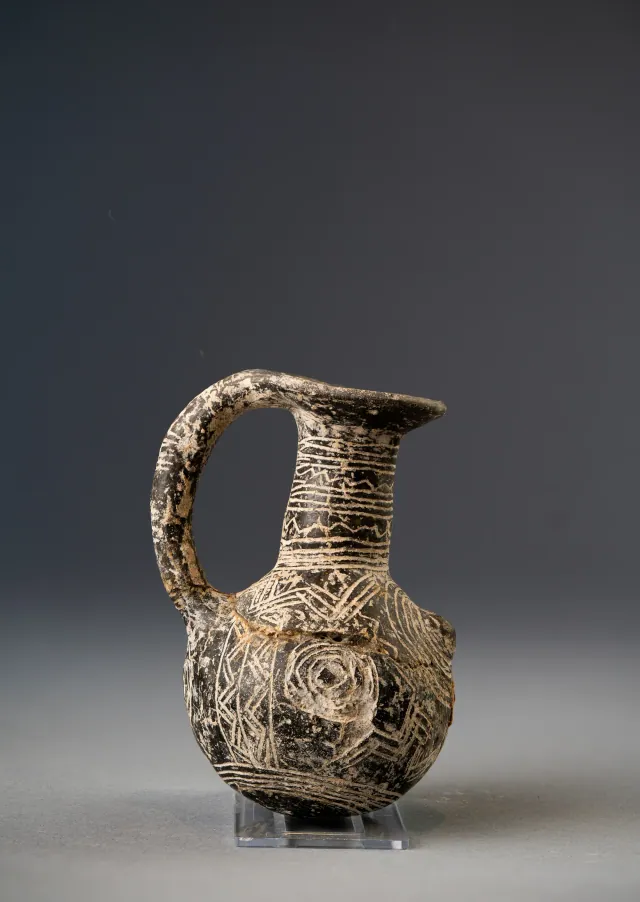
Fire the whole pot that way and the result is Black Polished ware, the dark relative of Red Polished. Brown and Catling describe a "completely black fabric", popular in EC III, used for vessels that are "nearly always small and invariably have incised patterns" [12]. The juglet to the left fits: a squat round body with no base at all, a burnished grey-black skin, white-filled zigzags and ladder bands, and small bosses at the widest point, each ringed by incised circles. Black Polished is commonest at Deneia, in the north-west [13].
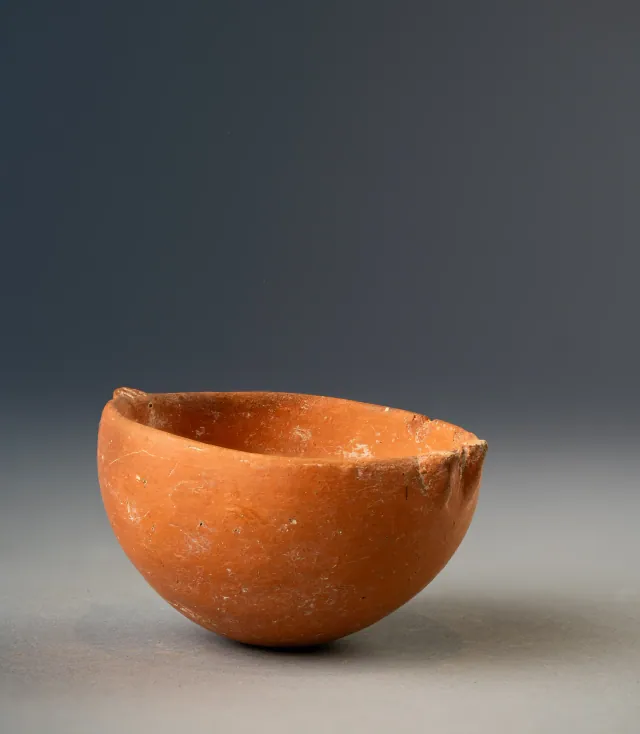
Let air reach the pot on every side for the whole firing and it comes out red all over. The hemispherical bowl to the right, in the Drakopoulos collection, is the plain version of the lugged bowl, and its slip is an even, saturated orange-red inside and out, with no black rim and no dark fire-clouds anywhere. The burnish has survived with little wear, and faint burnishing strokes still show inside below the rim. Most bowls of this shape have a single lug at the rim; this one has two at roughly opposite points, a low rounded nub and a larger tab pinched up from the rim, the two-lug variant that Morris illustrates beside the one-lug bowls [7].
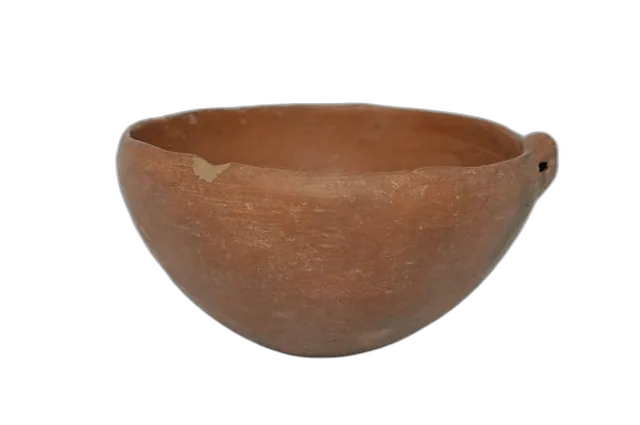
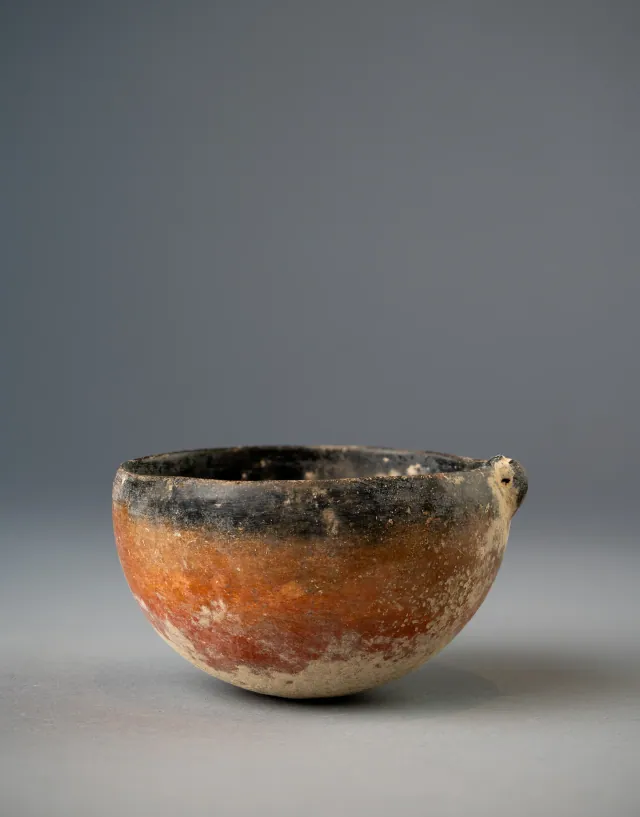
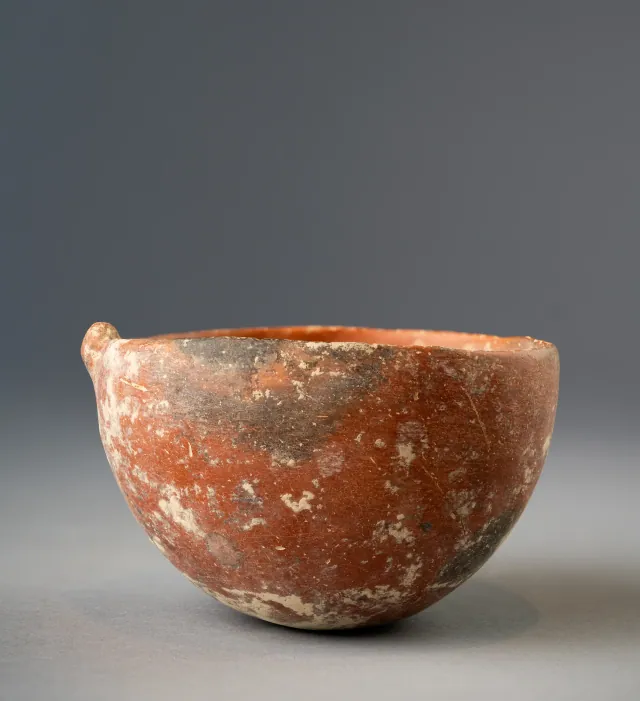
Mottling is the other colour effect: clouds of black, brown and red across a single surface, where fuel or neighbouring pots blocked the air. The two effects seldom meet. Crisp black-topping is a north-coast habit, and Stewart observed that none of the bowls in the mottled fabric have black tops [7]. In the centre and south, the excavators of the Psematismenos cemetery conclude, mottling was produced on purpose, as surface decoration [21]. The small British Museum bowl from Nicosia-Ayia Paraskevi, with one tiny pierced lug (a knob or ear of clay), is clouded red and black all over. Its ware, Red Polished Mottled, was defined by Herscher and Stuart Swiny in 1981, and it is the clearest evidence that Early Cypriot Cyprus had two ceramic worlds [21][4].
Two islands
In about 2200 BC a potter at Vounous, on the north coast below the Kyrenia range, and a potter at Psematismenos, near the south coast, both made what we call Red Polished. The pots have little else in common. On the north coast, Webb and Frankel write, the ware "was routinely burnished to a high luster"; the vessels were symmetrical, with even walls, fired under control, and their incisions were filled after firing with a white chalk paste mixed with calcined bone [4]. The north-coast clays were soft and fine, well suited to incision [22].
The southern pots were made from harder, grittier clays, lightly burnished and mottled, and many are lopsided. In the cemetery at Psematismenos, "incised decoration is not present on any of the 624 Red Polished Mottled I-II vessels", and relief appears on only 3.2 per cent of them, as small knobs and loops on jug necks [4]. The irregularity, Webb and Frankel argue, "implies a different conceptualization of acceptable outcomes": southern potters were not aiming at symmetry or ornament [4]. The two traditions ran side by side. Fine incision with crisp white fill points north; plain, hard, mottled red points south or centre.
Open the sites of each tradition in turn. The northern group is compact, Vounous and Lapithos below the Kyrenia range and Deneia inland to the west; the plain, mottled ware spreads across the centre and south, where north-coast bottles still turned up.
Map of Cyprus
Two Red Polished traditions
- North coast and north-west
- Centre and south
- Ground above 200, 500, 1,000 m
Sites on this map
- 1Vounous
- 2Lapithos
- 3Deneia
- 4Psematismenos (approx.)
- 5Nicosia-Ayia Paraskevi (approx.)
- 6Marki-Alonia
- 7Sotira-Kaminoudhia
- 8Episkopi-Phaneromeni (approx.)
- 9Kalavasos (approx.)
The north-coast grammar is easy to learn. Lines were cut into the leather-hard (half-dried) clay before slipping and firing, and filled with white after the pot came out of the fire [15][4]. The motifs are geometric: zigzags, hatched triangles and chevrons, lattice, rows of dots, and above all concentric circles, set in friezes and panels [7].
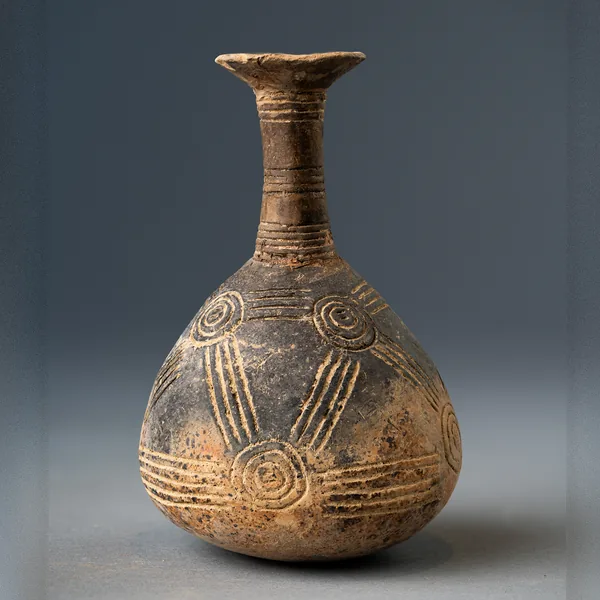
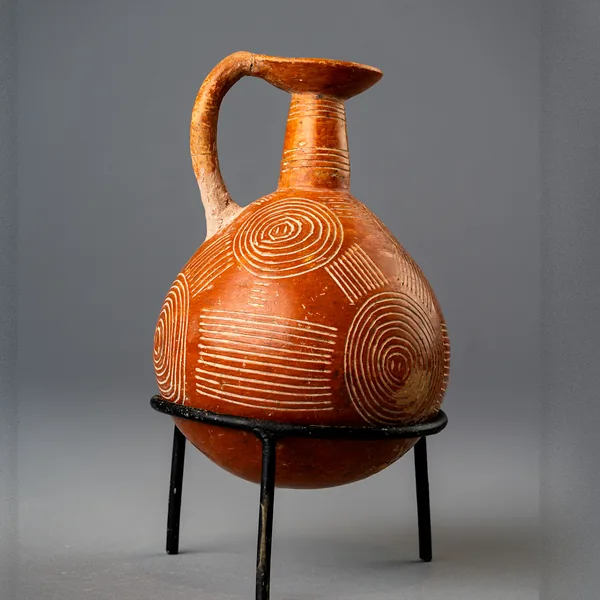
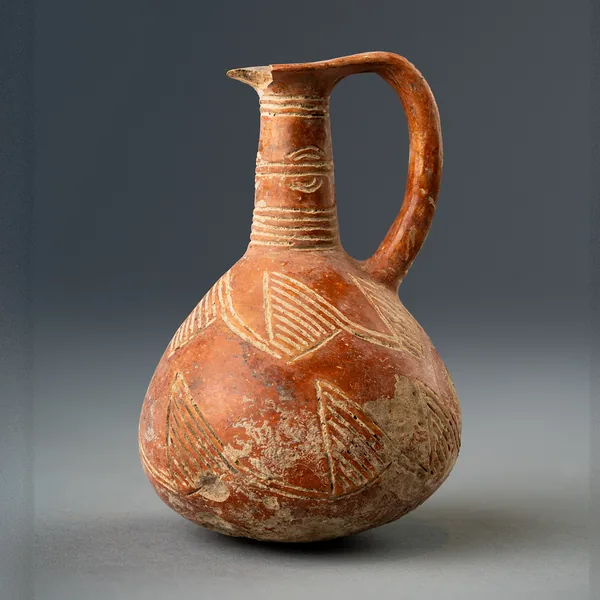
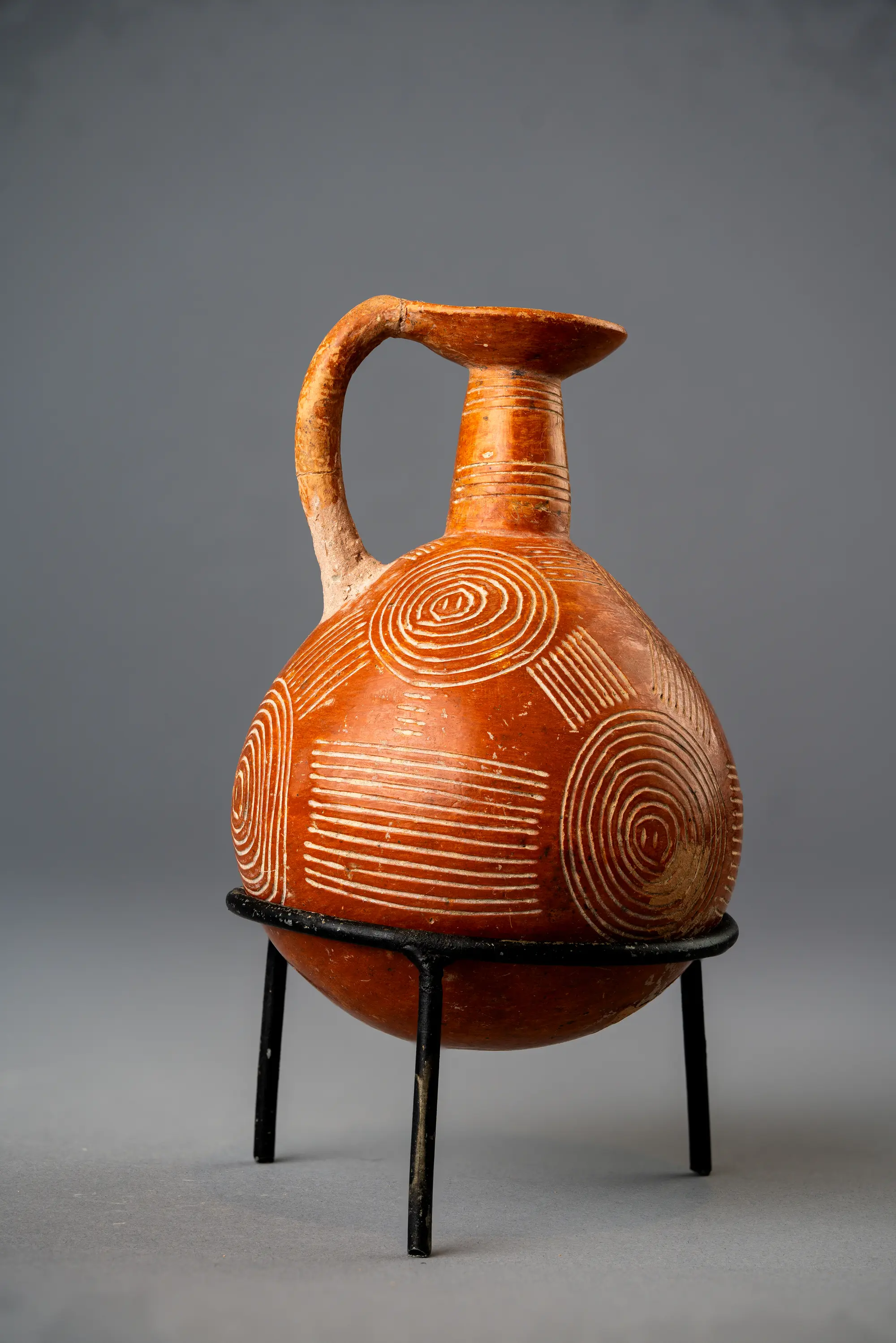
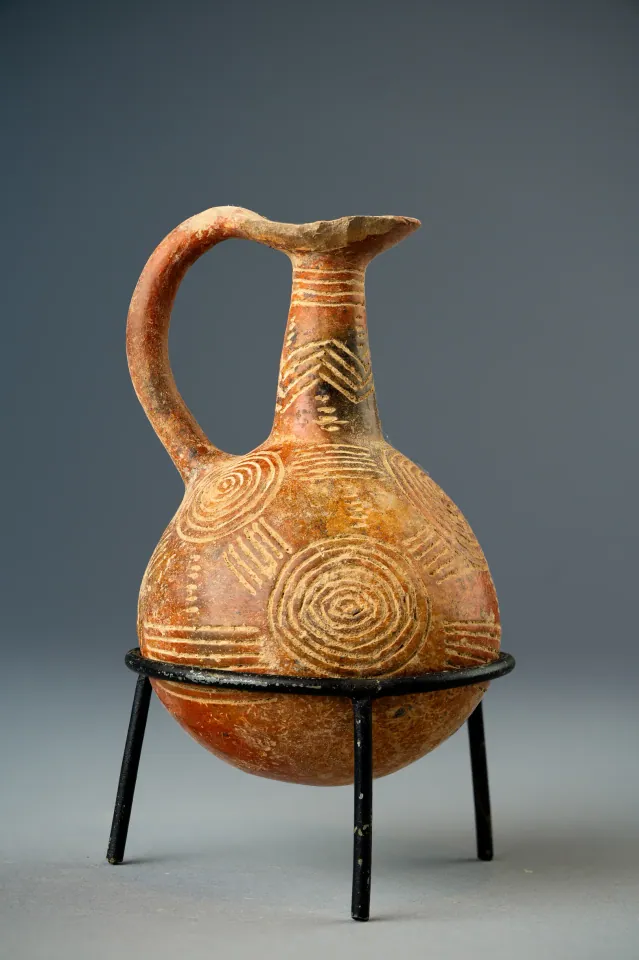
The three pots illustrated here, all in the Drakopoulos collection, show how far that short list of motifs could be stretched. On the pear-shaped bottle, large concentric circles sit in two tiers, one on the shoulder and one low on the body, and bands of four or five parallel lines run diagonally from each upper circle down to the lower ones, so that the circles become the knots of a net of triangles. The Teece Museum in Christchurch reads the same scheme on one of its flasks as a stylised carrying net; the idea suits this bottle too, though it cannot be proved. The jug with the flaring mouth uses the same circles with nothing to join them: they alternate with blocks of close parallel lines, some horizontal and some diagonal, so the pattern changes as the jug is turned, and the lower body is left plain. The British Museum has a juglet from Nicosia-Ayia Paraskevi, near the centre of the island, decorated on the same formula, a reminder that incision was used away from the north coast too, if more sparingly. The small beaked juglet drops the circles altogether for two registers of large hatched triangles, the upper row hanging from the shoulder and the lower standing upright. Between the bands on its neck sit two small lens-shaped marks; reading them as eyes would turn the neck into a face, but we know of no close parallel among published juglets of the type, and they may be no more than filler.
Look closer at the jug with the flaring mouth, the picture that opens this lesson. Follow its notes from the mouth down to the plain base, and look for the hand in the circles: they wobble, and one runs on as a spiral.
Tap a number on the photograph, or choose a note below, to look closer.
Looking closely
Red Polished Jug with Concentric Circles and Line Panels
c. 2100 to 1850 BC · Drakopoulos collection
Choose a number on the photograph or a note below. Arrow keys step through them.
Every mark on it records a step taken in order: shape the jug, cut the lines, slip and burnish, fire, and only then press in the white. Make it yourself, from the clay to the paste, and the order stops being a list.
Bowls, bottles and beaked jugs
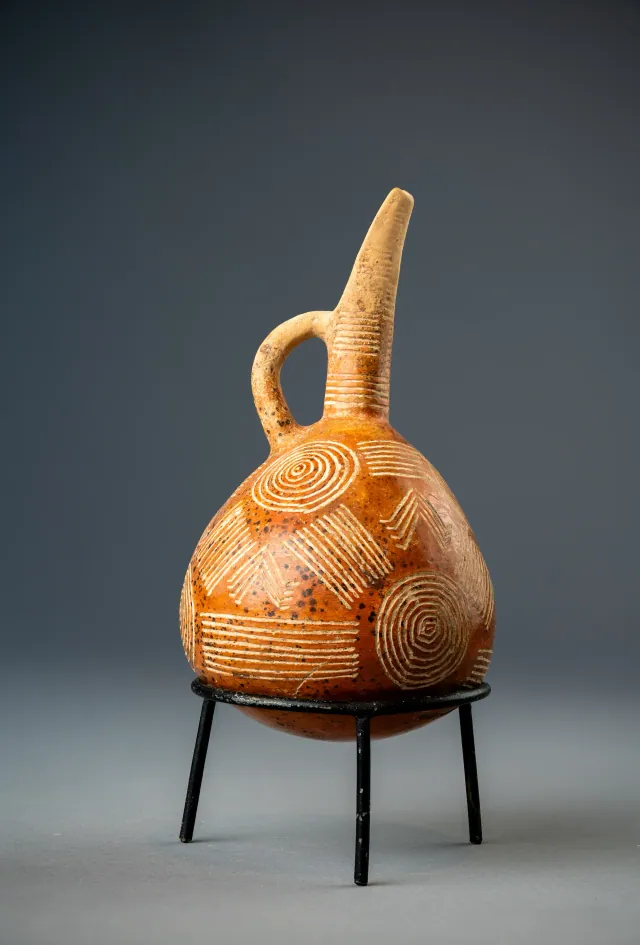
The everyday shapes are few, and the beaked juglet to the left shows most of their rules. Its pear-shaped body sits on a heavy rounded base, and its narrow neck runs up into a long beak cut away at the tip. The flat bases of Philia and early EC jugs gave way to fully round bodies by EC III [12], so a Red Polished jug that cannot stand is likely to be late. Beak and cut-away spouts, Morris notes, were Bronze Age fashions; the Iron Age preferred the pinched spout [7]. The juglet's concentric circles, line bands and hatched chevrons are the manner of the north-western workshops around Lapithos and Deneia [13].
Around the jugs stand hemispherical lugged bowls, which Morris declines to call cups since nobody can prove what was in them [7]; handleless bottles, often with two holes below the rim for a cord [7]; amphorae with paired handles; and wide-mouthed one-handled jars, like a Deneia-style example in the collection with incised double rings and impressed dots. All of these were used in houses as well as tombs: at Marki, Red Polished was a village's ordinary tableware [1].
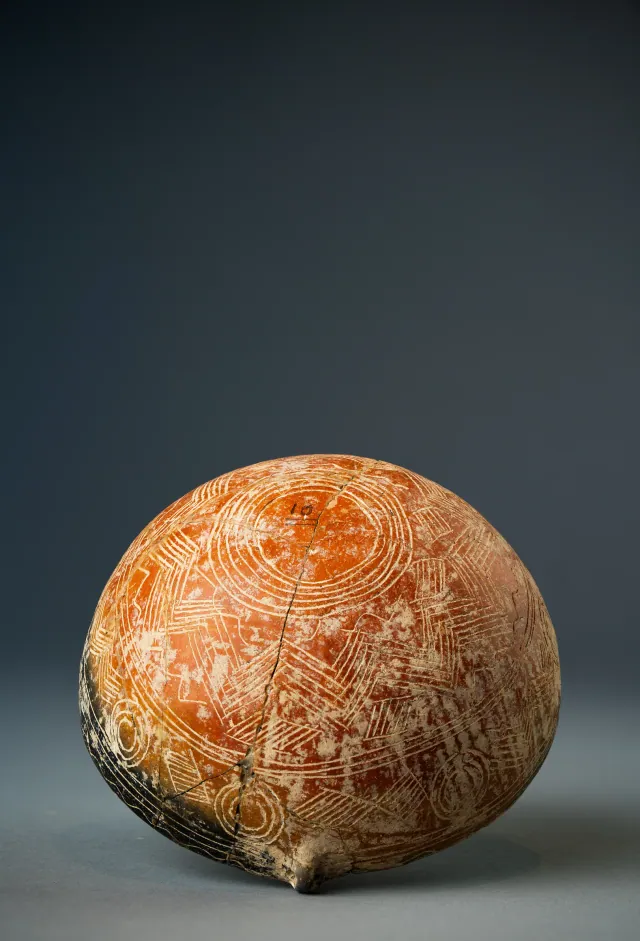
The lugged bowl was also the commonest vessel in the north-coast tombs. Kehrberg counted 43 in a single tomb at Vounous and 59 in one at Lapithos-Palealona, most of them plain; decorated bowls run from one to nine a tomb [23]. The deep bowl to the right, in the Drakopoulos collection, belongs to that decorated minority. A narrow band of black firing runs along its rim, and the whole outside is covered with white-filled incision: panels of hatched chevrons and bands of strokes on the body, small groups of concentric circles near the rim, and, centred on the rounded base, a target of five or six rings. The photograph shows it upside down, base uppermost. The target sits where it would be seen when the bowl was turned over or hung by its lug, which suggests the underside was meant to be looked at; how such bowls were stored or displayed is unknown.
Made for the grave
Almost every complete Red Polished pot in a museum came out of a tomb, most from the north-coast cemeteries of Vounous and Lapithos, and the most elaborate were made for burial and nothing else.
Open one of those tombs yourself: a family chamber at Vounous, used again for each burial, with the pottery of a funeral feast. Notice what lies with the dead before you read what it was made for.
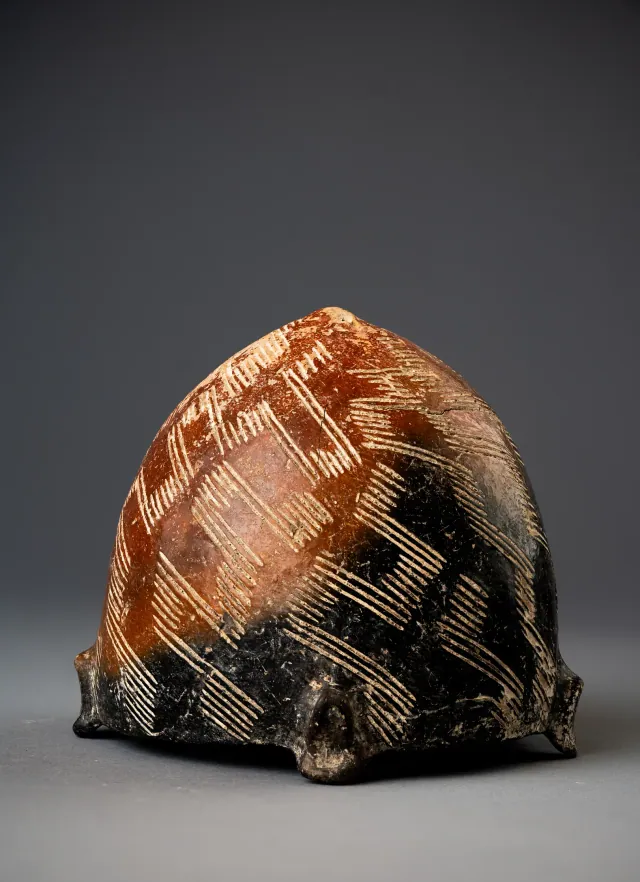
The tulip bowl is the clearest case: a deep bowl whose sides flare like a tulip's petals over a small pointed base, usually black-topped and covered in white-filled incision. The one illustrated here is photographed resting on its rim, because it cannot stand on its base; short lugs project from the rim, and diagonal bands of close strokes cover the body like basketwork. Of the 87 tulip bowls in Stewart's 1962 corpus, 84 come from Vounous [15]. Webb and Frankel take the plain ones for individual drinking cups [4]; the most elaborate, ringed with modelled heads of bulls, goats and birds, are another matter; J.B. Hennessy gave many of them to a single potter he called "Stewart Artist no. 1" [20]. Daisy-Kate Knox found that the figurative vessels from Vounous, though often broken after burial, keep their decoration fresh, with "no obvious wear to suggest use prior to burial" [16]. In the south, by contrast, Webb and Frankel found no vessel types that appear to have been made specifically for the grave [4].
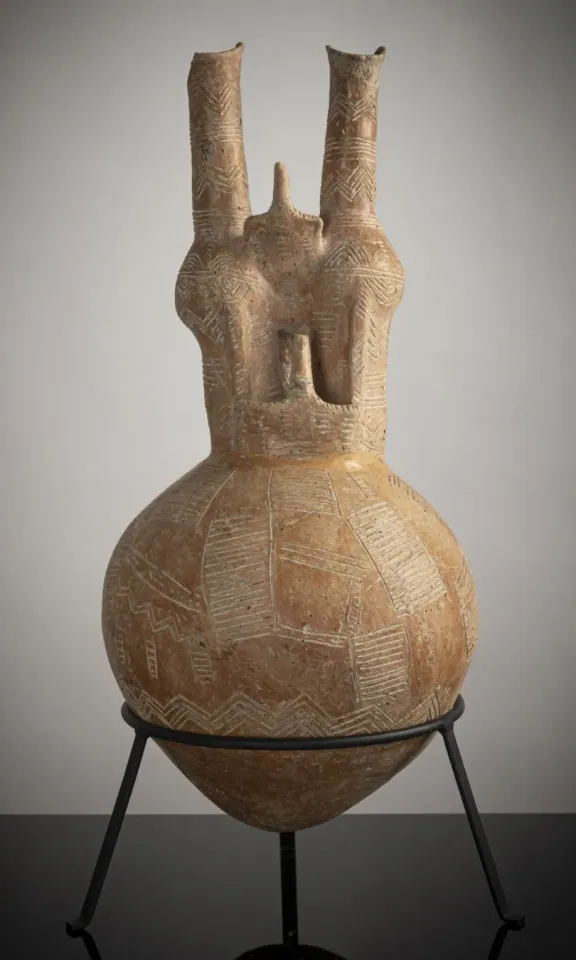
The north-coast potters also multiplied their necks. The jug to the right stands about 57 centimetres high: a round body on a pointed base, two tall necks side by side, each ending in an obliquely cut mouth, and two flat birds stacked between them. Dikaios published a double-necked jug with a bird between the necks from Vounous Tomb 46A [17]; another from Vounous Tomb 54, now in the Louvre, reaches 69.2 centimetres. South-coast double-necked jugs exist too, and they show the regional rule again: flat bases, mottled surfaces, and animals perched on cross-bars.
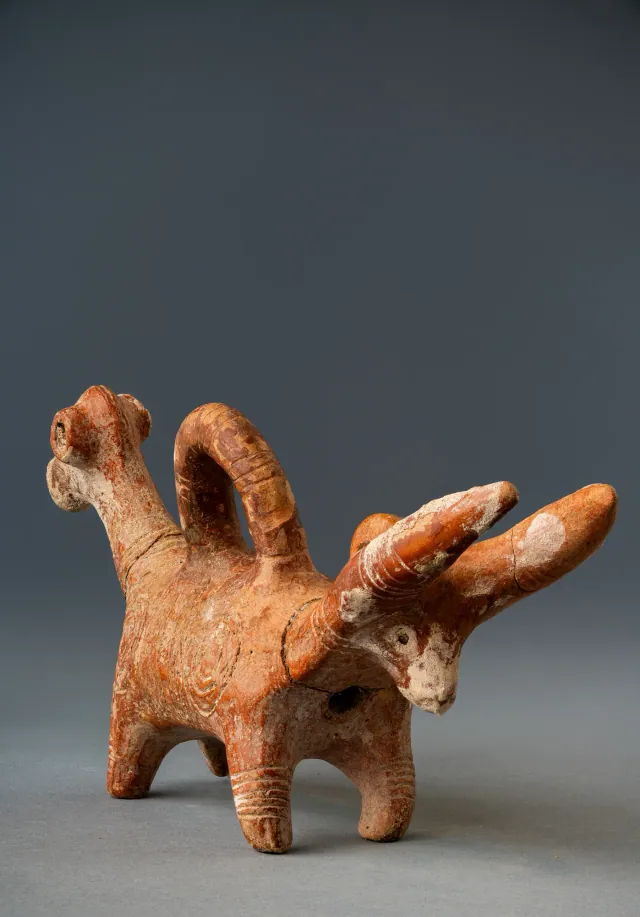
Animal-shaped vessels, called askoi, flourish at the end of the Early Cypriot and the start of the Middle Cypriot. The askos to the left is a hollow body on four stubby legs, with a basket handle over its back and a head at each end: a bull with long forward-thrust horns, and a narrower, long-eared head that may be a donkey or a deer. Its nearest relative, in the Ashmolean Museum, pairs a bull with a stag. Vassos Karageorghis drew the working line between vessel and figurine: hollow animals are vases, solid ones are terracottas [18]. Morris thought the species hardly mattered: "almost any powerful horned head will do" [7].
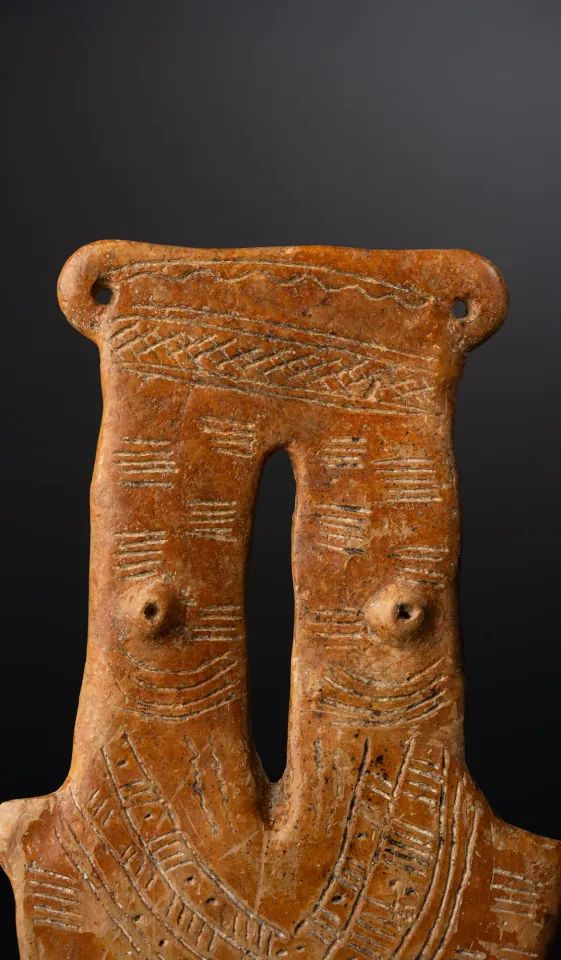
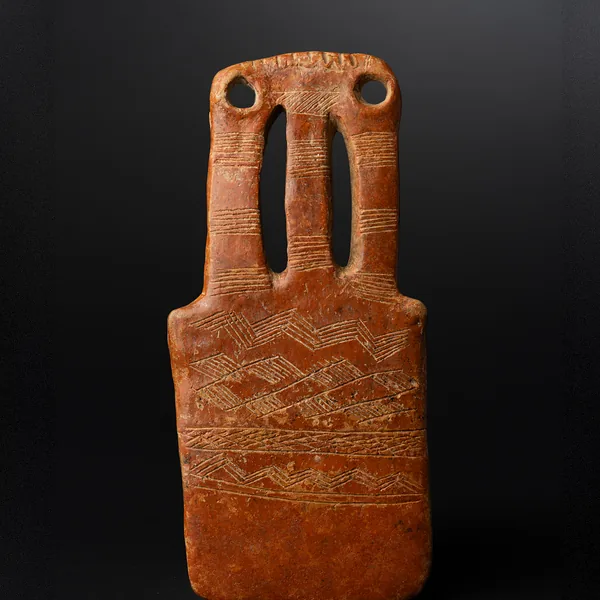
The same potters made people. Plank figures, flat slabs of clay shaped as stylised human bodies, are Red Polished in every technical sense: the same slip, burnish and white-filled incision. They appear in EC III and are the main figurine type of the period; about half come from the tombs of Lapithos, and of the forty complete or nearly complete figures in a Campo's study, ten have more than one neck: nine two and one three [19]. Karageorghis noticed that the maker of the two-necked figure in the first photograph "conceived the body as one, with one breast on each side of the chest" [18]. The second figure, its companion in the Drakopoulos collection, takes the idea further: three narrow necks rise from the shoulders, bridged across the top by a band nicked with short grooves, with a pierced ear at each upper corner and no face at all. Its right neck and the plain lower quarter of the body are modern restoration. Karageorghis placed it in a very small group of "shoulder figurines with three necks and two ears" [18]. The two share their decoration as well as their shape: rings of lines round each neck and chains of hatched lozenges across the shoulders.
What the planks meant is still argued over, and the three-necked figure shows the argument in miniature. One reading takes its central upright as the only true neck and the outer two as heavy locks of hair; Karageorghis found that "difficult to accept" and saw the third neck as an extension of the two-necked scheme, made "without having any specific iconographic intention" [18]. The surfaces of the planks are easier to read: the necklaces, the hatched garments and the zigzags down the back are cut and filled with white in the same way as the lines on the bottles and jugs buried beside them.
Quiz
Check yourself
Question
A museum label reads “Red Polished II”. What does the numeral tell you about the pot?
Question
This jug, in the Drakopoulos collection, needs a modern stand. From its shape alone, when was it made?
Question
A knob-lug bowl in the Drakopoulos collection. What made the dark cloud below its rim?
Question
The black on this bowl was made in the fire. Tap a part of it the air could not reach.
Tap the photograph to place your mark
Question
This course dates the start of the Philia phase, the beginning of the Cypriot Bronze Age, to about when?
Question
Put the making of an incised north-coast jug in order.
Tap an item, then tap its place. Or use the arrows
Question
Which of these point to a pot made on the north coast?
Tick every answer that applies
Question
What suggests that the figurative vessels of Vounous were made for the grave?
What to look for
- A red, burnished, handmade surface with white-filled incision and no paint: Red Polished, made from about 2400 BC into the Middle Cypriot. The painted pots that join it after about 2000 BC belong to Lesson 4.
- A flat base and a tall cut-away spout on a plain red jug point early (Philia or early EC); a fully round base that will not let the jug stand points to EC III or later.
- Black above and red below, with a clean line between them: deliberate black-topping, a north-coast speciality. Entirely black, small and incised: Black Polished.
- Fine, crisp incision with bright white fill on a glossy, symmetrical pot points to the north coast (Vounous, Lapithos, Deneia). Hard, gritty, lopsided, mottled and undecorated points to the centre or south.
- Read "Red Polished I", "II" or "III" on a label as a rough tag of region and period: I and II northern and early, III island-wide and later. The numeral alone will not date the pot.
- Tulip bowls, multi-necked jugs, scenic and animal vessels were mostly made for the grave; plain bowls, jugs and bottles were used in houses too.
Go deeper
The compendium pages on Red Polished ware and Red Polished Philia ware carry the technical and regional detail, and tulip bowls and cult vessels, bottles and complex vessels cover the shapes. The double-necked jug and the askos have their own articles, the Vounous double-necked bird jug and the two-headed askos; see also the incised Red Polished bottles and plank-shaped figures.
References
- 1.Webb, J. M. and Frankel, D. (1999). Characterizing the Philia facies: material culture, chronology, and the origin of the Bronze Age in Cyprus. American Journal of Archaeology, 103(1), 3-43.
- 2.Bolger, D.L. (1991). Early Red Polished Ware and the origin of the 'Philia Culture'. In J.A. Barlow, D.L. Bolger and B. Kling (eds), Cypriot Ceramics: Reading the Prehistoric Record. Philadelphia: University Museum, 29–36.
- 3.Frankel, D. (2000). Migration and ethnicity in prehistoric Cyprus: technology as habitus. European Journal of Archaeology 3(2), 167–187.
- 4.Webb, J.M. and Frankel, D. (2013). Cultural regionalism and divergent social trajectories in Early Bronze Age Cyprus. American Journal of Archaeology 117(1), 59–81.
- 5.Knapp, A. B. (2013). The Archaeology of Cyprus: From Earliest Prehistory through the Bronze Age. Cambridge: Cambridge University Press.
- 6.Manning, S. W. (2013). Appendix: A new radiocarbon chronology for prehistoric and protohistoric Cyprus, ca. 11,000–1050 cal BC. In A. B. Knapp, The Archaeology of Cyprus: From Earliest Prehistory through the Bronze Age (pp. 485–533). Cambridge: Cambridge University Press.
- 7.Morris, D. (1985). The Art of Ancient Cyprus, with a Check-list of the Author's Collection. Oxford: Phaidon.
- 8.Merrillees, R. S. (1991). The principles of Cypriot Bronze Age pottery classification. In J. A. Barlow, D. L. Bolger & B. Kling (Eds.), Cypriot Ceramics: Reading the Prehistoric Record (University Museum Monograph 74, pp. 237–240). Philadelphia: The University Museum, University of Pennsylvania.
- 9.Herscher, E. (1991). Beyond regionalism: toward an islandwide Early and Middle Cypriot sequence. In J.A. Barlow, D.L. Bolger and B. Kling (eds), Cypriot Ceramics: Reading the Prehistoric Record. Philadelphia: University Museum, 45–50.
- 10.Swiny, S., Rapp, G. and Herscher, E. (eds) (2003). Sotira Kaminoudhia: An Early Bronze Age Site in Cyprus. CAARI Monograph 4. Boston: American Schools of Oriental Research.
- 11.Makundi, I.N., Waern-Sperber, A. and Ericsson, T. (1989). A Mössbauer study of the black colour in Early Cypriote and Nubian C-Group black-topped pottery. Archaeometry 31(1), 54–65.
- 12.Brown, A.C. and Catling, H.W. (1980). Ancient Cyprus. Oxford: Ashmolean Museum.
- 13.Webb, J.M. (2010). The ceramic industry of Deneia: crafting community and place in Middle Bronze Age Cyprus. In D. Bolger and L.C. Maguire (eds), The Development of Pre-State Communities in the Ancient Near East: Studies in Honour of Edgar Peltenburg. BANEA Publication Series 2. Oxford: Oxbow Books, 174–182.
- 14.Stewart, J.R. (1962). The Early Cypriote Bronze Age. In P. Dikaios and J.R. Stewart, The Swedish Cyprus Expedition IV.1A: The Stone Age and the Early Bronze Age in Cyprus. Lund: Swedish Cyprus Expedition, 205–401.
- 15.Coleman, J.E., Barlow, J.A., Mogelonsky, M.K. and Schaar, K.W. (1996). Alambra: A Middle Bronze Age Settlement in Cyprus. Archaeological Investigations by Cornell University 1974–1985. Studies in Mediterranean Archaeology 118. Jonsered: Paul Åströms Förlag.
- 16.Knox, D. (2013). Figurines and figurative vessels at Early Cypriot Bellapais Vounous. In A.B. Knapp, J.M. Webb and A. McCarthy (eds), J.R.B. Stewart: An Archaeological Legacy. Studies in Mediterranean Archaeology 139. Uppsala: Åströms Förlag.
- 17.Dikaios, P. (1940). The Excavations at Vounous-Bellapais in Cyprus, 1931–2. Archaeologia 88, 1–174.
- 18.Karageorghis, V. (1991). The Coroplastic Art of Ancient Cyprus I: Chalcolithic to Late Cypriote I. Nicosia: A. G. Leventis Foundation.
- 19.a Campo, A.L. (1994). Anthropomorphic Representations in Prehistoric Cyprus: A Formal and Symbolic Analysis of Figurines, c. 3500–1800 BC. SIMA Pocket-book 109. Jonsered: Paul Åströms Förlag.
- 20.Hennessy, J.B. (1974). Cypriot artists of the Early and Middle Bronze Age. In J. Birmingham (ed.), The Cypriot Bronze Age. Australian Studies in Archaeology 1. Sydney, 10–22.
- 21.Georgiou, G., Webb, J.M. and Frankel, D. (2011). Psematismenos-Trelloukkas: An Early Bronze Age Cemetery in Cyprus. Nicosia: Department of Antiquities, Cyprus.
- 22.Frankel, D. and Webb, J.M. (2012). Pottery production and distribution in prehistoric Bronze Age Cyprus. An application of pXRF analysis. Journal of Archaeological Science 39(5), 1380–1387.
- 23.Kehrberg, I. (1982). Early and Middle Cypriote chronology again. Levant, 14, 59–72.