
Contents
The Metropolitan Museum's Bichrome IV amphora 74.51.972 stands 80.3 cm high. Round its shoulder hangs a frieze of lotus flowers alternating with buds, drawn in black and filled in red, and on its neck lotus flowers sit in panels between geometric lozenges. Vassos Karageorghis, cataloguing it, wrote that "large amphorae decorated in the Bichrome IV technique were common to the eastern part of Cyprus," that the shoulder zone "is usually ornamented with a frieze of lotus flowers alternating with buds," and that "the lotus motif is oriental in origin, and it appears frequently in the arts and crafts of the Cypro-Archaic period" [2, cat. 143].
The lotus is the plant motif of Cypriot Iron Age pottery. It came in during the late ninth century, dominated the painted wares of eastern Cyprus through the seventh and sixth, and outlived almost everything else in the repertoire. This entry covers the flower itself and the lotus-and-bud frieze; trees, date palms, leaves and other vegetation are treated in Plants.
How to recognise a Cypriot lotus
Einar Gjerstad, who built the typology still in use, described the Cypriot lotus as a family of simplified flowers: "The lotus ornament of Cyprus is not uniform. The varieties and modifications are many, but, in the main a twofold influence, from Egypt and from Syria can be noticed. The Cypriote lotus flower with three petals is evidently of Egyptian derivation, while the flower with two lateral petals and three inner ones corresponds to the Phoenician type." Between the two lie intermediate forms, and "the Cypriote preference of form manifests itself in the tendency towards a simplified and diagrammatic modification of the prototypes" [1, p. 183].
In practice four renderings recur:
- The single open flower on a stem, often springing from behind a bird's neck or offered to a human nose (below).
- The bud, a closed tear-drop or tongue, usually alternating with open flowers.
- The pendent frieze, a row of flowers and buds hanging from a shoulder band, the signature of the big Bichrome IV amphorae.
- The geometric lotus, reduced to lines and triangles. Gjerstad illustrated how the painters turned the flower into an abstract pattern "which bears a strong resemblance to the Mycenaean triglyph and half-rosette pattern, though they have nothing to do with each other" [1, p. 52].
The last point is a warning for identification. A row of half-circles and vertical strokes on a Bichrome IV shoulder may be a lotus frieze taken to its limit.
Chronology: from Cypro-Geometric III to the end of painted pottery
Gjerstad listed "lotus flowers" among the new motifs of White Painted III, alongside birds, quadrupeds and human figures, and added that "the floral and pictorial decoration is, however, mainly used in Bichrome III" [1, p. 47]. Elsewhere he placed the first lotus ornaments on pottery in Cypro-Geometric III B, before they became "common on the pottery from Cypro-Archaic I" [1, p. 183]. That puts the motif's arrival in the late ninth or early eighth century BCE on the chronology used in the Cypro-Geometric entry.
In Bichrome IV, the ware of Cypro-Archaic I, the lotus became one of the defining elements of Gjerstad's Eastern (rectilinear) style, with "lotus buds and flowers, rosettes, sacred tree, aquatic birds, quadrupeds, and human figures" [1, p. 52]. Even the circle-based Western style shows "the intrusion of lotus and rosette ornaments" [1, p. 52]. In Bichrome V (Cypro-Archaic II) the flower multiplied. In the Eastern style "there is a superabundance of the lotus decoration, so that the ornaments cover the whole surface of the vase in a carpet-like pattern," and in the West "lotus ornaments are commoner than in Bichrome IV, but they are more conventionalized" [1, p. 53]. The British Museum's Bichrome V spouted jug 1869,0604.19, with its basket handle over the mouth, carries a frieze of lotus flowers between bands.
The motif was among the last to go. When the old painted styles collapsed in White Painted VI (Cypro-Classical I), Gjerstad noted that "only the earliest specimens still preserve conventional ornaments of lotus flowers of the same kind as the later vases of White Painted and Bichrome V" [1, p. 49]. See the Cypro-Archaic and Cypro-Classical entries for the periods.
| Gjerstad type | Period | The lotus on pottery |
|---|---|---|
| White Painted III / Bichrome III | Cypro-Geometric III | Introduced; mostly in Bichrome |
| Bichrome IV / White Painted IV | Cypro-Archaic I | Core of the Eastern style: friezes on amphorae, single flowers on free-field jugs |
| Black-on-Red II (IV) | Cypro-Archaic I | Very infrequent |
| Bichrome V / White Painted V | Cypro-Archaic II | Carpet-like cover in the East; conventionalised in the West |
| White Painted VI | Cypro-Classical I | Survives only on the earliest pieces |
The table summarises Gjerstad's ware descriptions [1, pp. 47-55]. On Black-on-Red the influence of Bichrome IV "represented by lotus and rosette ornaments is very infrequent" [1, p. 55].
Shapes and wares: amphorae, kylikes and jugs
The lotus is above all a Bichrome motif, and the belly-handled or neck-handled amphora is its showpiece shape (see jar and amphora). Anna Georgiadou and Maria Dikomitou-Eliadou describe the Salaminian series of belly-handled amphorae in the "floral style," illustrated by a Bichrome IV amphora from Peristerona in the Famagusta district, 90 cm high, whose neck and shoulder zone are covered with "depictions of lotus flowers that vary in size and form, which are more or less elaborately designed and stylised and combined with recurrent zones of rosettes and guilloches, very densely arranged on the vessel surface" [3, pp. 341-342]. The same style appears on trefoil-mouthed jugs, large barrel jugs and footed deep bowls [3, p. 342].
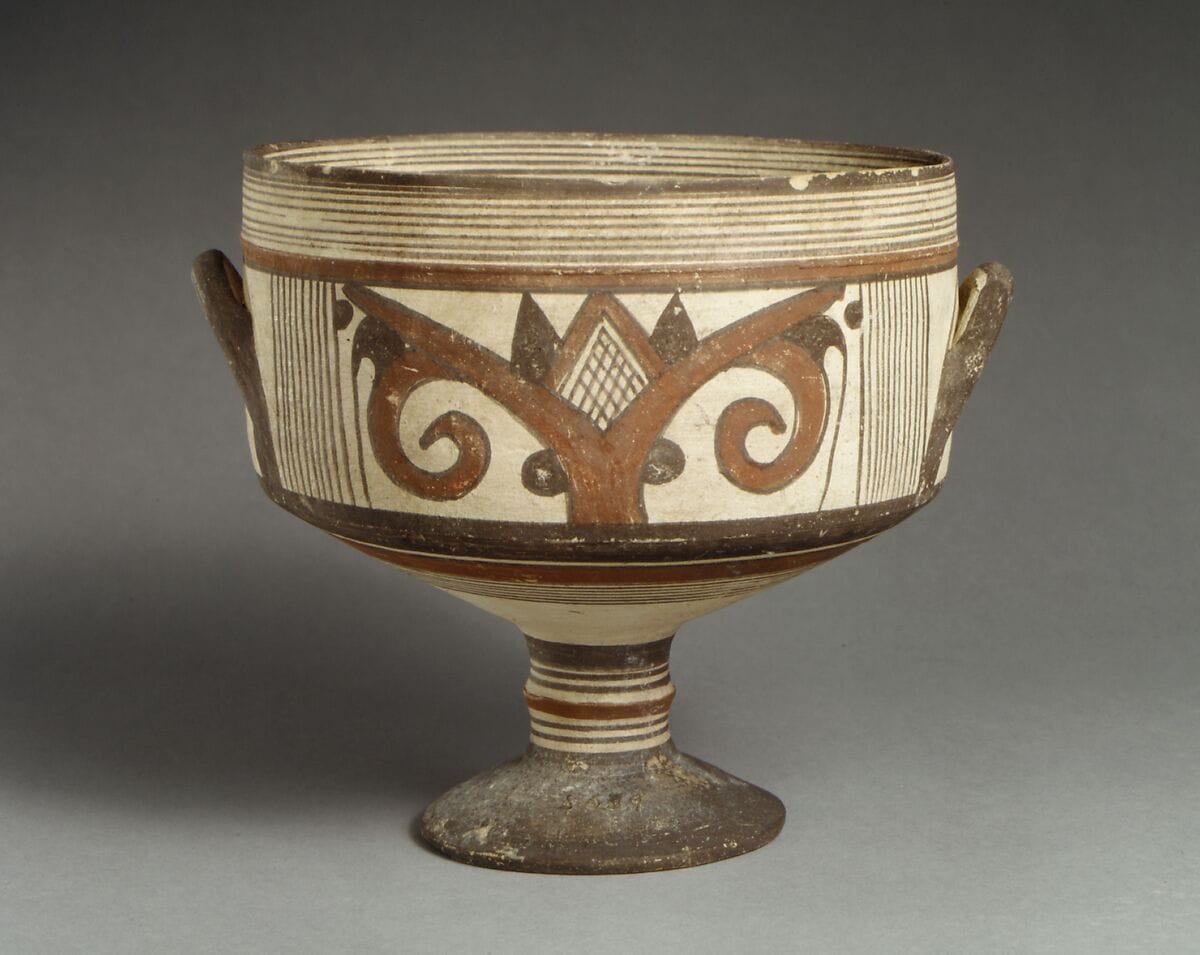
Open shapes carried it too. The Met's Bichrome IV kylix 74.51.467 has "a central rectangular panel containing a large stylized lotus flower" on each side between the handles [2, cat. 144]; see the bowl entry for footed bowls and kylikes. On jugs the flower more often stands alone, the free-field layout described in Free-Field Style.
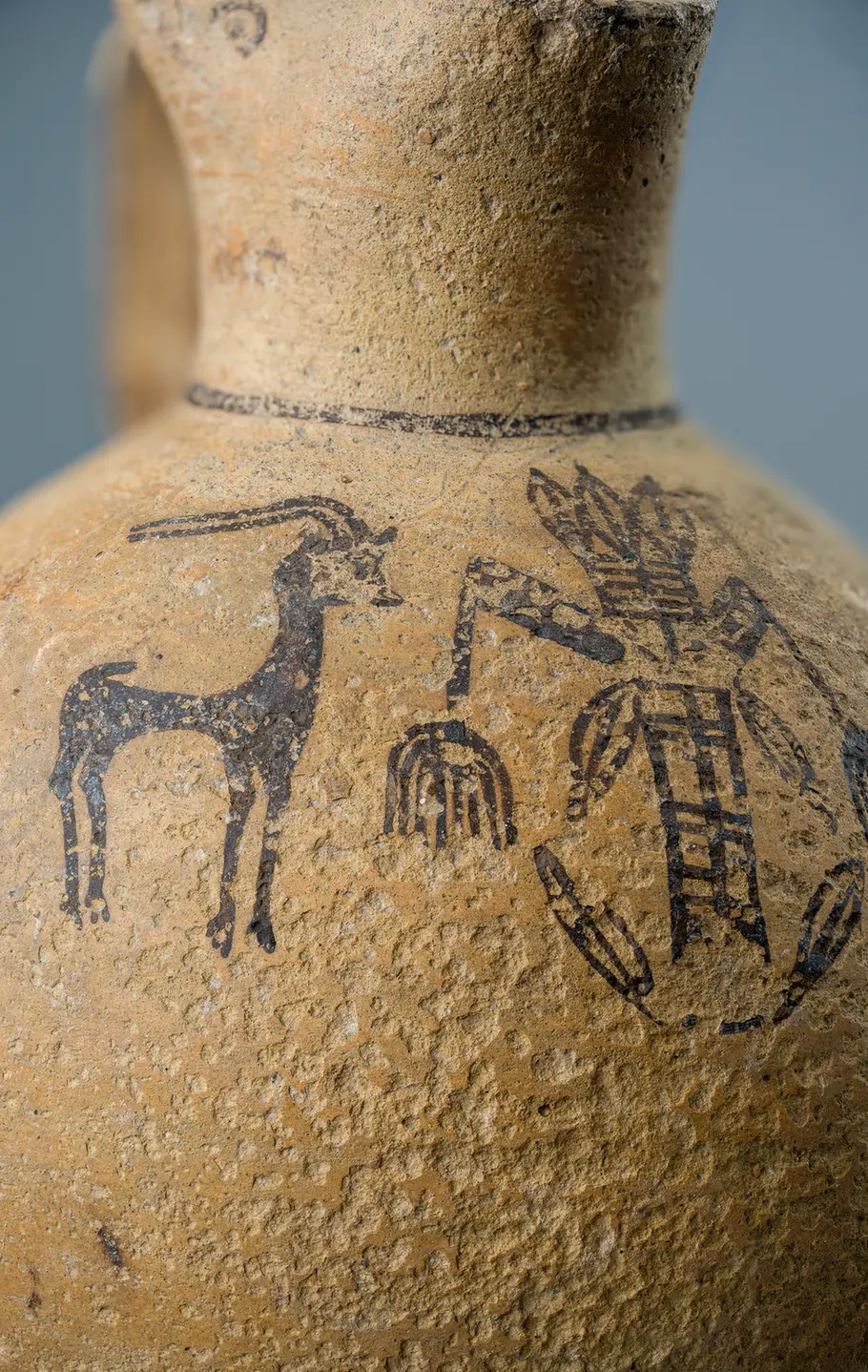
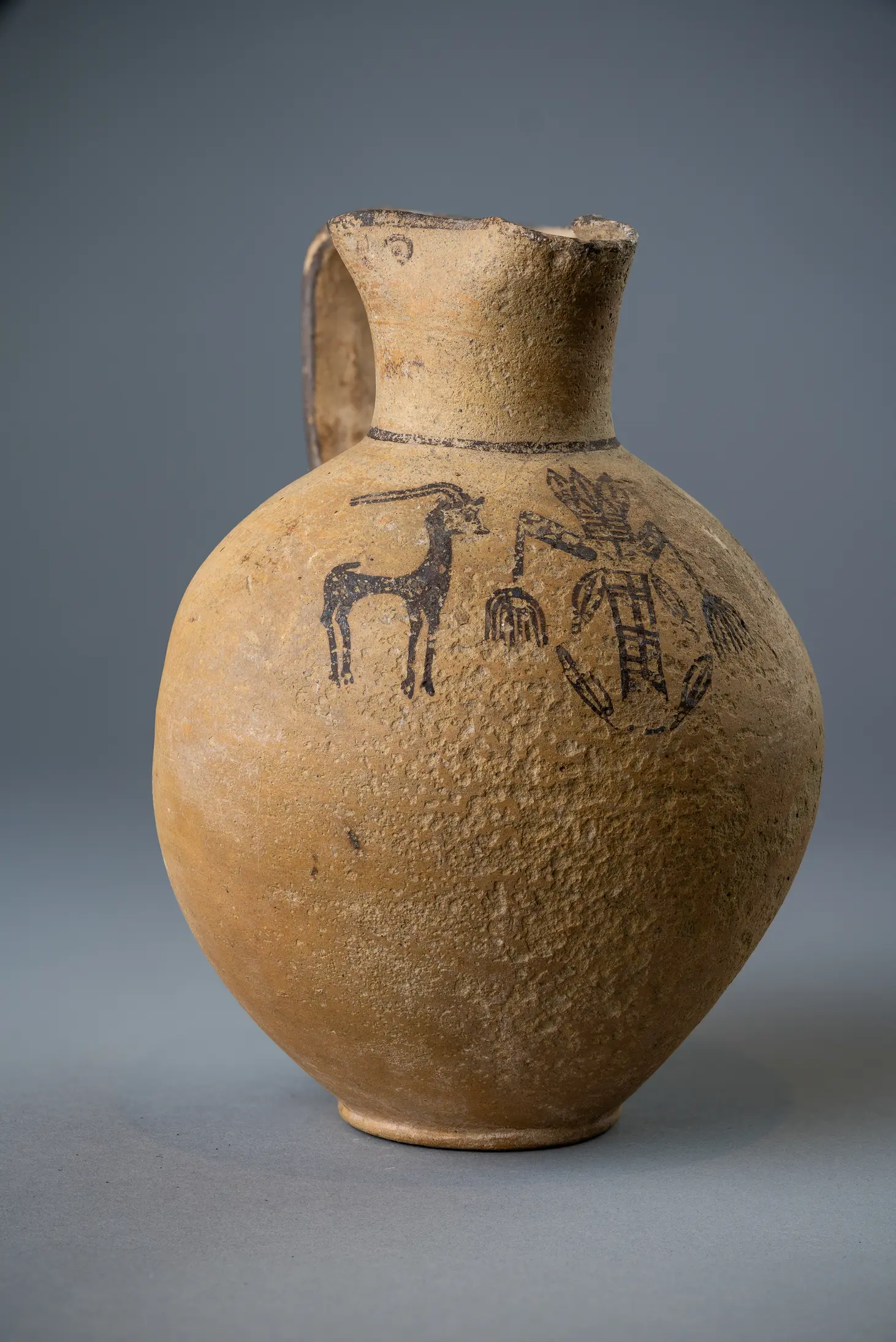
The Drakopoulos collection has no lotus-frieze amphora. The closest piece is the free-field jug with a goat, where a fan-shaped flower of vertical petals on a curving stem stands between the goat and a tall composite figure. Its form, a spray of petals from a cup-like base, is close to the simplified Cypriot flower Gjerstad describes, though whether the painter meant a lotus is not certain, and we know of no close published parallel for this flower. The goat-and-lotus pairing itself is well attested: a Bichrome IV jug in the Cyprus Museum (1968/VIII-23/1), probably from a tomb between Vatyli and Sinda, shows a leaping goat "flanked by a large stylized lotus blossom, with leaves painted in red," and is assigned to the workshops of Salamis [6, p. 99].
Lotus with birds, bulls and people
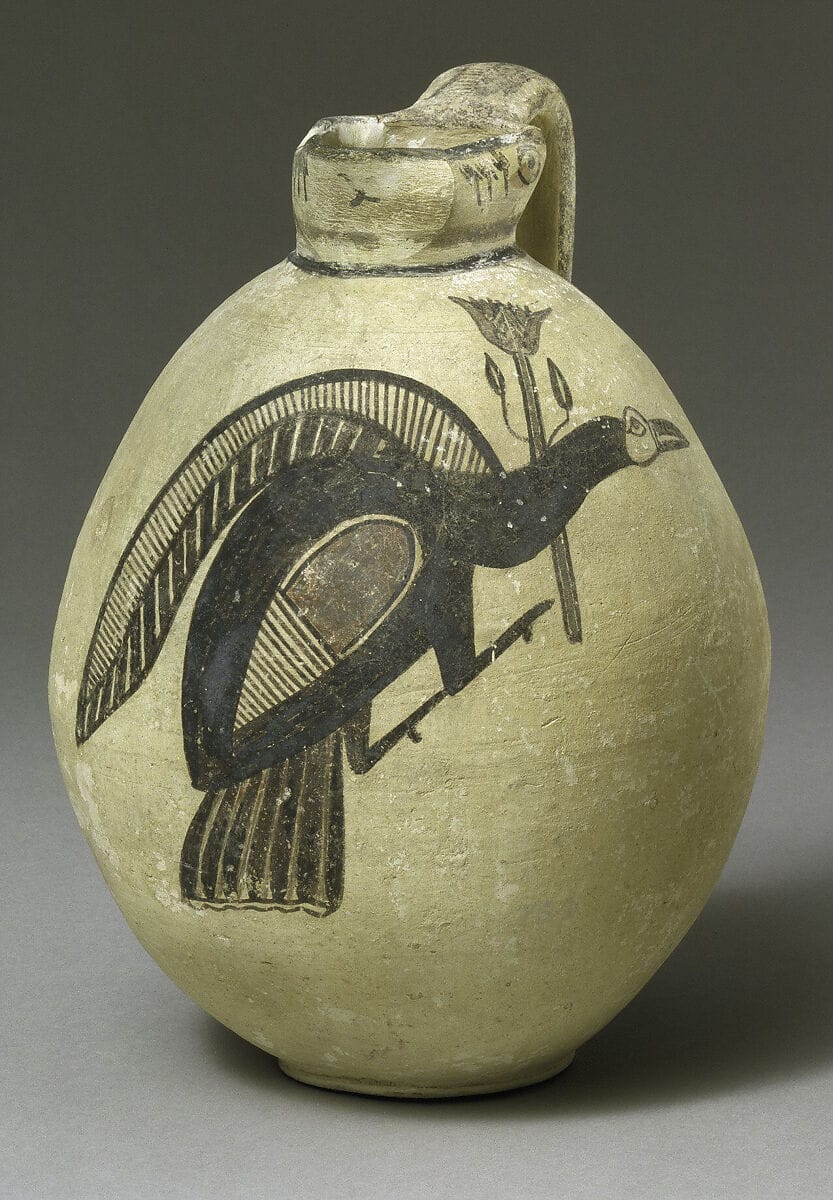
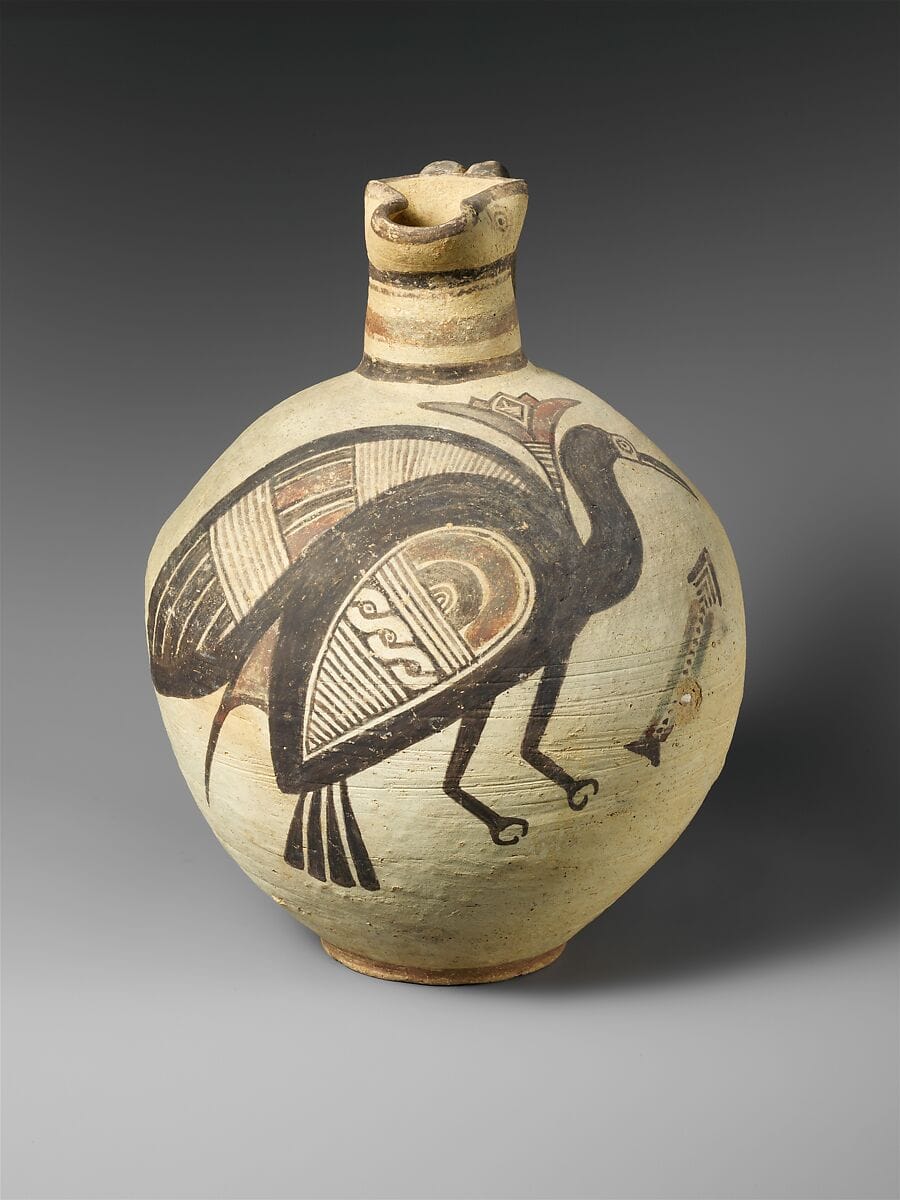
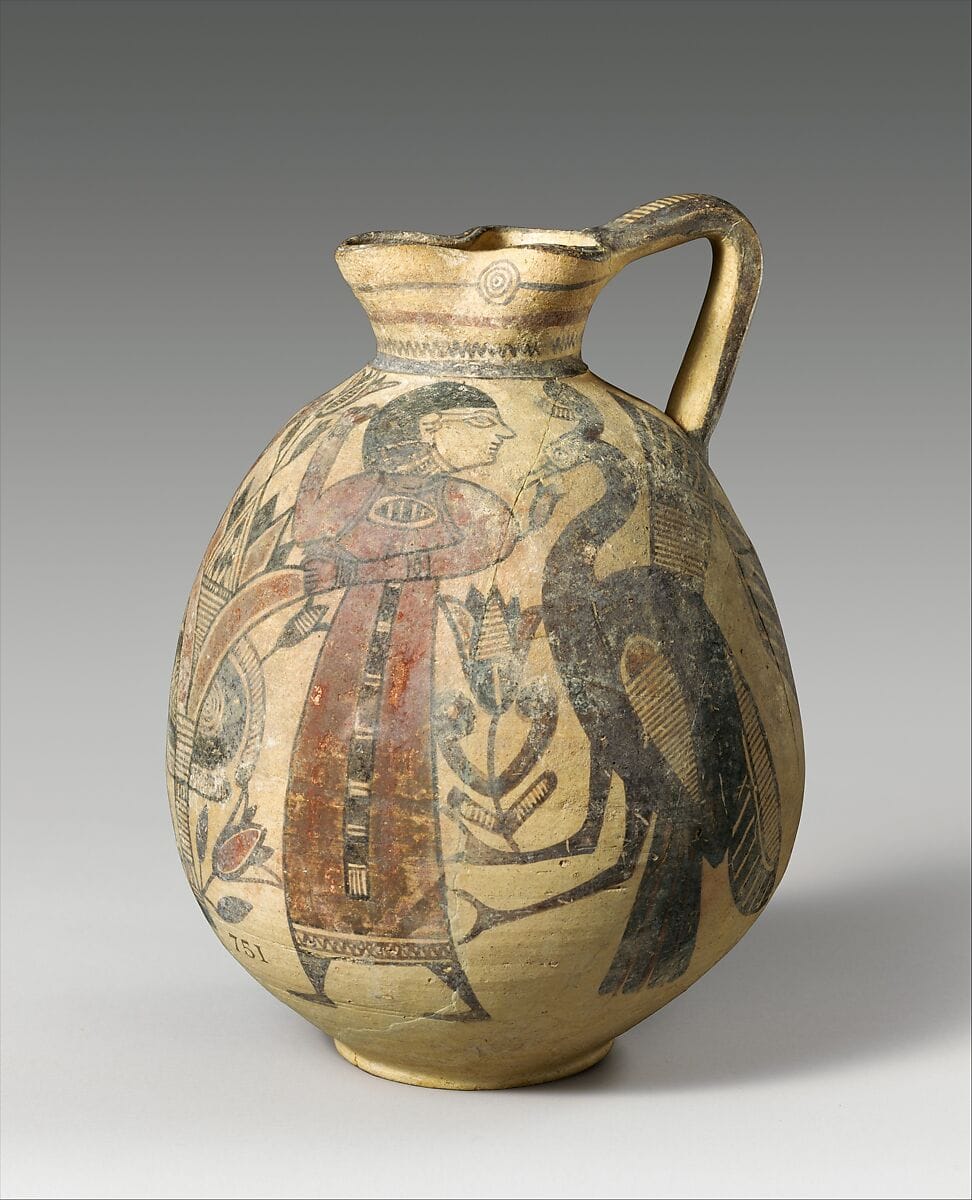
On free-field jugs the lotus is the commonest companion of the bird. Alicia Dissinger counted it on 89 of the bird vases she catalogued (her text gives 84), ahead of the swastika (79) and the chevron arrow (57) [4, p. 144]. A flower sometimes seems to grow from the bird's back; Dissinger reads such plants as a compressed Nile scene and points to a Bichrome V jug in the Cyprus Museum whose several lotuses make the Nilotic setting explicit [4, p. 145]. The Met's jug 74.51.503 (/artifact/2967), said to be from Ormidhia, belongs to "a group of vases, probably painted in a single workshop, that combine a highly stylized bird with a lotus flower" [2, cat. 160], and on 74.51.501 (/artifact/1232) the flower rises from between the bird's wings.
Bulls smell the lotus as well. Karageorghis's guide to the Cyprus Museum illustrates a seventh-century jug with "a bull sniffing a lotus flower," and calls the motif "popular in vase painting since the Mycenaean era," one that "succeeded in inspiring Near Eastern craftsmen who worked in ivory and metal as well" [5, p. 78]. A shoulder fragment of a Salaminian amphora found at Al Mina, on the Syrian coast, has bulls flanking a large lotus [3, p. 345].
The human version is the most discussed. On Met 74.51.509 (/artifact/2369) two human figures and two birds are arranged round a central lotus with smaller flowers, "strictly symmetrical" [2, cat. 157]. Georgiadou and Dikomitou-Eliadou list "female figures dancing, holding or smelling a lotus flower" among the everyday subjects of the Salaminian pictorial style, and a jug fragment from Al Mina shows a woman holding one [3, pp. 343, 345]. Dissinger describes a Bichrome V bowl on which each figure in a procession holds a bird by the neck in one hand and smells a lotus held in the other [4, p. 143]. The gesture has a long pedigree: the winged sphinx on the ninth- or eighth-century Hubbard amphora already "holds and sniffs a flower" [5, p. 77].
Not every lotus is a symbol. On a Met jug with a horse and a small running rider, Karageorghis remarked that "the lotus flower in front of the horse is also unusual; it may be just decorative" [2, cat. 153].
Where the lotus came from
The Cypriot potters did not invent the flower. Gjerstad counted the lotus with the guilloche, the rosette network, the open palmette, the sacred tree and sphinxes among the Cypro-Archaic I ornaments "of Oriental derivation," and suggested that Phoenician metal bowls in Cyprus served the potters as a model for some of them [1, pp. 182-183]. His two lotus types map onto two sources: the three-petalled flower onto Egypt, the flower with two lateral and three inner petals onto Phoenicia [1, p. 183]. Cypriot metalwork had the lotus before the painted pots were full of it: at Palaepaphos-Skales, publishing a bronze cauldron from a Cypro-Geometric I tomb, Karageorghis and Efstathios Raptou note that the handles of bronze bowls "are often decorated with stylised lotus flowers" [7, p. 33], and Gjerstad dated the earliest bronze bowl with lotus handles found in a safe context in Cyprus to about 950 BCE [1, p. 245].
The wider Near Eastern world used the flower as an emblem held in the hand. An eighth-century ivory furniture plaque from Nimrud in the Metropolitan Museum (59.107.7) shows a warrior holding lotuses; the Neo-Assyrian Empire entry covers Cyprus's relations with Assyria.
Georgiadou and Dikomitou-Eliadou call the elements of the Salaminian floral style, "lotus flowers, rosettes and guilloche motifs," together with the sphinxes, lions and winged creatures they frame, "indisputably of Near Eastern origin" [3, p. 341]. They also note that on Salaminian terracotta statues the same floral decoration is painted on the corselets and cuirasses of male figures, and that it has been suggested to imitate textiles [3, p. 341]. Gjerstad had made the textile argument for the rosette and guilloche, which appear on the painted dress of terracotta figures [1, p. 183].
The lotus travels west
The direction of influence reversed once the motif was established. Gjerstad argued that the Rhodian lotus was derived from the Phoenician five-petalled type, which was also represented in Cyprus, against E. Kunze, who preferred an Assyrian prototype; Gjerstad's point was that the Assyrian lotus "has usually nine petals, as the corresponding Egyptian prototype," while the Phoenician and Rhodian flowers belong "to the same typological category" [1, p. 189]. He was careful not to claim a Cypriot route for the Rhodian flower outright, and his general caution applies: the island's role between East and Aegean "should not be over-estimated as was usual in earlier days nor underrated as is often the case in our time" [1, p. 190].
In short
The lotus reached Cypriot pottery in Cypro-Geometric III, already present in bronze, and in Bichrome IV became the badge of the eastern workshops, especially Salamis; Amathus had its own pictorial style [3, p. 341]. It hung in friezes on amphorae, stood alone beside birds and goats on free-field jugs, and by Bichrome V covered whole pots. Beside it in the same repertoire sit the swastika, the chevron arrow and the circles of the Western style. The Met's lotus pieces come from the Cesnola collection; the Drakopoulos jug is listed with the collection.
Objects on this page
References
- 1.Gjerstad, E. (1948). The Swedish Cyprus Expedition, Vol. IV, Part 2: The Cypro-Geometric, Cypro-Archaic and Cypro-Classical Periods. Stockholm: The Swedish Cyprus Expedition. (Page numbers follow the digitised text consulted, which is not paginated like the printed volume.)
- 2.Karageorghis, V., Mertens, J. R., & Rose, M. E. (2000). Ancient Art from Cyprus: The Cesnola Collection in The Metropolitan Museum of Art. New York: The Metropolitan Museum of Art. (Cited by catalogue number.)
- 3.Georgiadou, A., & Dikomitou-Eliadou, M. (2022). The Iron Age pictorial pottery of Salamis within and beyond: An overview of ceramic styles, wares and fabrics. In G. Bourogiannis (Ed.), Beyond Cyprus: Investigating Cypriot connectivity in the Mediterranean from the Late Bronze Age to the end of the Classical Period (AURA Supplement 9, pp. 335-348). Athens: National and Kapodistrian University of Athens.
- 4.Dissinger, A. M. (2017). Cypro-Archaic bird iconography: Types, uses, and meanings [Doctoral dissertation, University of Virginia].
- 5.Karageorghis, V. (1989). The Cyprus Museum. Nicosia: C. Epiphaniou Publications.
- 6.Halbertsma, R. B., & Pilides, D. (Eds.). (2019). Cyprus: A Dynamic Island. Leiden: Sidestone Press / Rijksmuseum van Oudheden.
- 7.Karageorghis, V., & Raptou, E. (2016). Palaepaphos-Skales: Tombs of the Late Cypriote IIIB and Cypro-Geometric Periods (Excavations of 2008 and 2011), Text volume.