
Ancient Cypriot Pottery·Lesson 12
Decoration and Motifs
Incision, relief and paint on Cypriot pottery over four thousand years, the main motif families (zigzags, circles, crosses, swastikas, lotus, birds, painted eyes), and how a motif's technique and company date a pot when the motif alone cannot.
Alexis Drakopoulos·Across the periods·13 min read
Share


Lesson 12·Course contents, 15 lessons
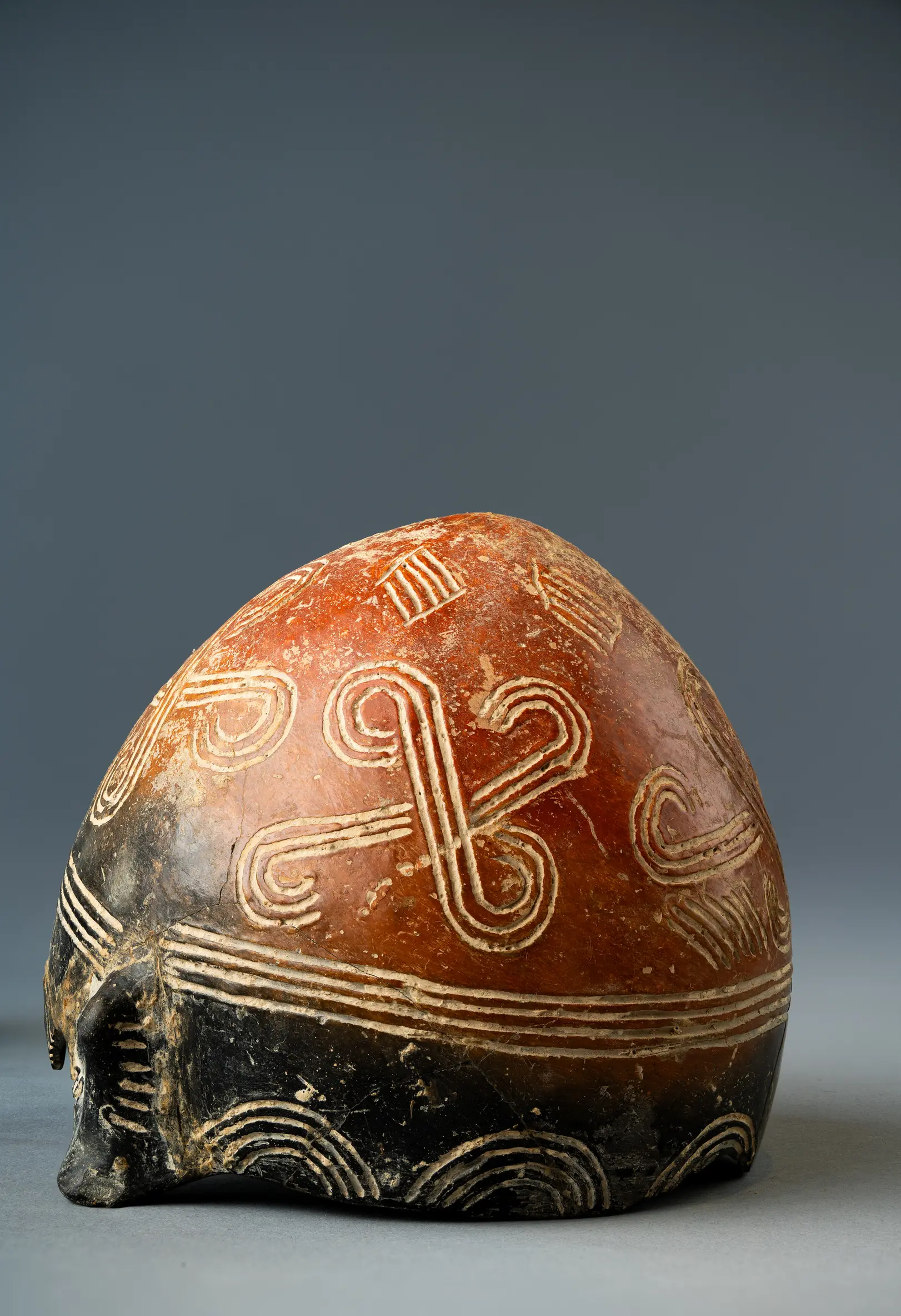
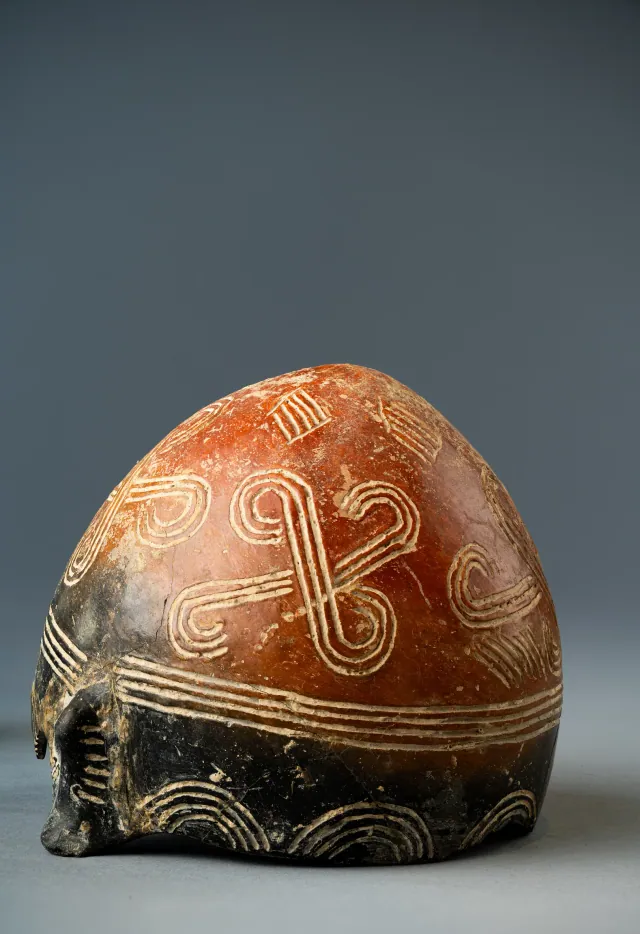
Some time between 2300 and 2000 BC a potter took a deep tulip bowl, still leather-hard, and cut into its side a cross whose four double-line arms bend at the ends and coil into spirals. The bowl was slipped, burnished and fired, and white paste was then pressed into the grooves so that the cross showed pale against the red [5, p. 298]. More than a thousand years later a painter with matt black paint set a small hooked cross on the bare body of a wheel-made jug, beside a column of dots capped by an arrowhead, and gave the jug's pinched mouth a pair of eyes. Both pieces are in the Drakopoulos collection, and a visitor seeing them in one case would pair them at once.
The sign they seem to share is the swastika. On Cypriot pottery it is an ancient geometric ornament, common in the Iron Age, with no connection to the emblem the 20th century made of it. Robert Merrillees has suggested that this later history is why Cypriot specialists have said so little about what the motif meant [1].
Whether the two crosses are one motif is harder to say. David Frankel and Jennifer Webb recorded what look like reversed swastikas on Red Polished I vases and spindle whorls from Vounous and Marki, and would say only that "while the significance of these elements is unclear, their complexity and careful incision suggest that they are more than merely decorative" [1]. Hooked crosses are rare in the Red Polished repertoire, and we know of no run of examples carrying the sign across the gap between the bowl and the jug. A motif is the first thing the eye catches on a Cypriot pot and, taken alone, the least reliable thing on it. How it was made, where it sits and what keeps it company date a pot far better.
Two painted cycles around a long incised interlude
Across four thousand years, Cypriot potters switched paint off and on twice. In the Chalcolithic, Red-on-White ware carried red patterns on a pale ground; the pottery of Erimi had geometric, abstract and floral motifs [8, p. 32]. By its end painting had faded, and for roughly a thousand years, through the Philia phase and the Early Cypriot, the most ambitious decoration on the island was cut into or built up on a burnished red surface. Paint came back with Middle Cypriot White Painted ware, linear geometric patterns first in glossy red and later in matt black [7, p. 33].
The Late Bronze Age added pictures: imported Mycenaean kraters brought chariots, bulls, birds and fish, and 13th-century Cypriot painters took up the bull in a pictorial style of their own [9]. The Iron Age travelled the same road, from a strict geometric order in the Cypro-Geometric (CG), built round the compass-drawn circle, to the free field of the Cypro-Archaic (CA), a single figure floating on the bare body of a jug.
| Period | Main decorated ware | Technique | Typical motifs |
|---|---|---|---|
| Chalcolithic, c. 4000 to 2400 BC | Red-on-White | Painted, red on a pale ground | Lattice, chequers, zigzags, curvilinear and floral patterns |
| Philia and Early Cypriot, c. 2400 to 2000 BC | Red Polished | Incised with lime fill; relief | Zigzags, chevrons, concentric circles, hatched bands; snakes, bull heads |
| Middle Cypriot, c. 2000 to 1650 BC | White Painted (handmade) | Painted, dark on light | Lattice, hatched triangles, pendent, wavy and crossing lines |
| Late Cypriot, c. 1650 to 1050 BC | White Slip, Base Ring, Mycenaean imports | Painted; relief; pictorial | Ladders, lattice, wavy lines; chariots, bulls, birds |
| Cypro-Geometric, c. 1050 to 750 BC | White Painted, Bichrome | Painted, with wheel and compass | Concentric circles, Maltese cross, lattice, swastika |
| Cypro-Archaic, c. 750 to 480 BC | Bichrome, White Painted | Painted; free field | Circle systems, lotus, birds, chevron arrow, swastika |
Cut and modelled: incision and relief
Incised decoration filled with white is, in Desmond Morris's words, "the most typical form of Red Polished ware" [4, p. 19]. The potter cut the lines into leather-hard clay before slipping, and the white lime paste went in after firing, so that the pattern stood out against the dark red.
Try the sequence on another tulip bowl in the Drakopoulos collection: cut its basketwork of diagonal strokes into the leather-hard clay, slip and burnish it, fire it, and only then press white paste into the lines.
In the Philia phase it was used sparingly: at Marki only 0.6 per cent of Philia Red Polished sherds are incised, almost all from flasks, juglets, amphorae and jars, and a higher share of tomb vessels was probably decorated [3, p. 23]. The Early Cypriot vocabulary that grew from it is geometric: zigzags joined into lozenges, chevrons, concentric circles, hatched bands, rows of punctured dots. On the tulip bowl from the opening, a band of four lines divides a black rim zone with an arcade of concentric semicircles from the red body with the spiral-armed cross.
Turn the bowl round. Its other side, photographed with the bowl resting on its rim, shows how the design was laid out; choose each number in turn, from the body down to the rim.
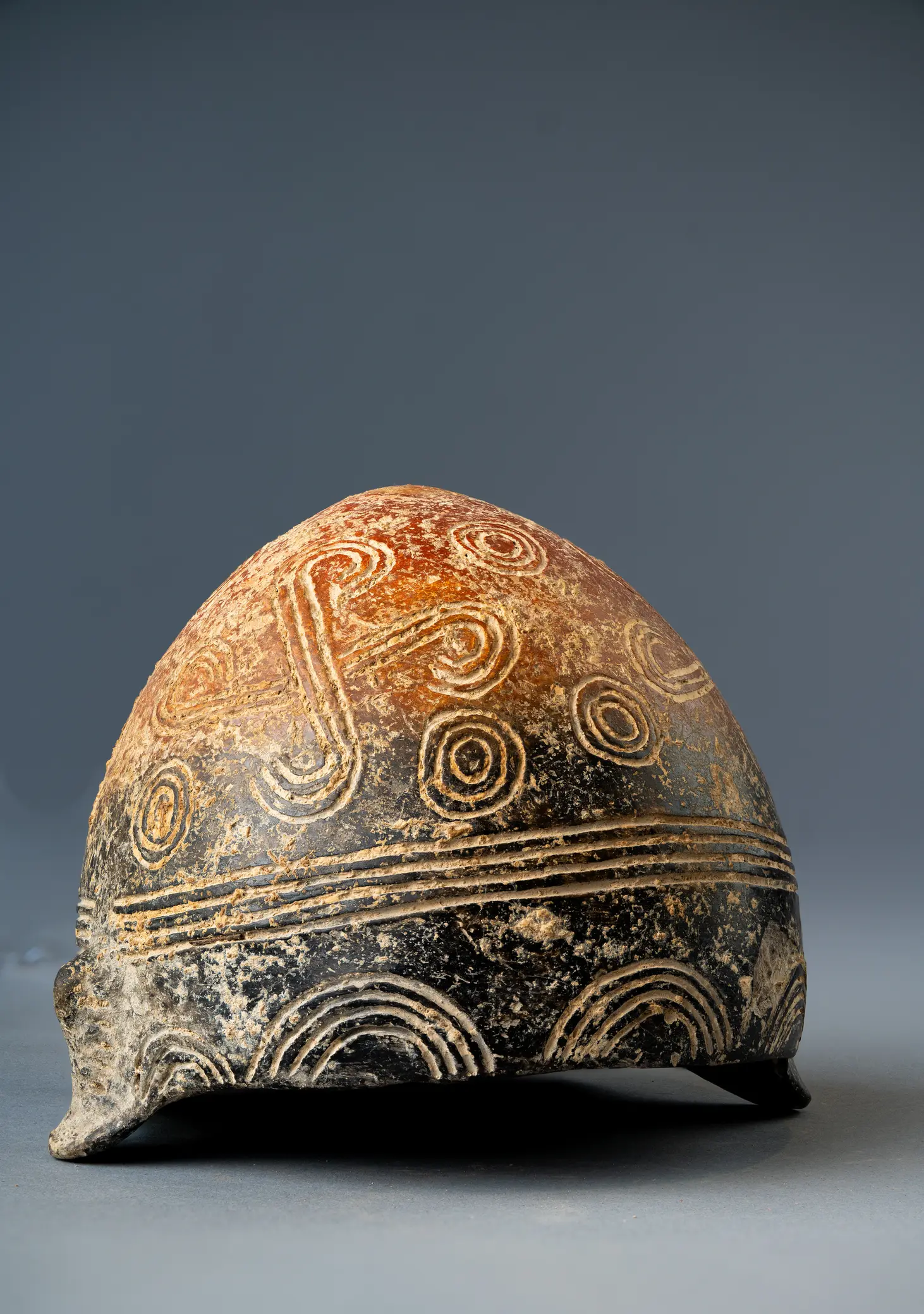
Tap a number on the photograph, or choose a note below, to look closer.
Looking closely
Black-topped Red Polished Tulip Bowl with Incised Spiral-armed Cross, Circles and Arcades
c. 2300 to 2000 BC · Drakopoulos collection
Choose a number on the photograph or a note below. Arrow keys step through them.
Each motif keeps to its zone, and the small circles fill the spaces round the one large figure, the cross.
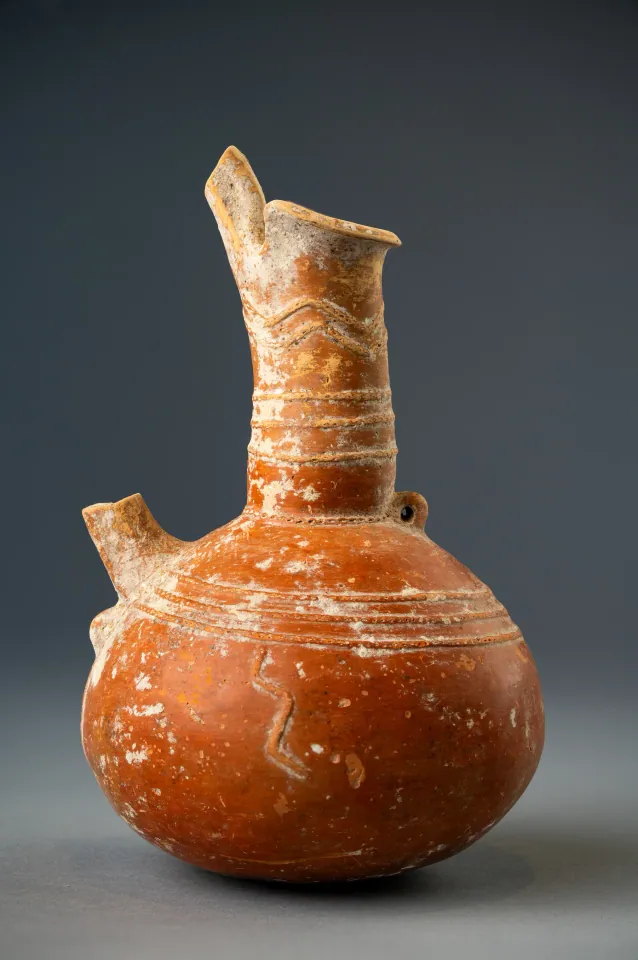
Relief was the second technique: clay added to the surface. The Red Polished spouted jug illustrated here, of Early Cypriot III to Middle Cypriot I (c. 2100 to 1850 BC), has notched raised bands round shoulder and neck, a doubled chevron laid on near the top of the neck, and on the body a single vertical zigzag of applied clay that reads as a snake. Modelled snakes, bulls' heads, birds and whole human figures appear on Early Cypriot pots, above all in the north-coast cemetery at Vounous. Porphyrios Dikaios, who excavated it, read snake and bull as a symbolic pair [6], and Vassos Karageorghis as religious symbols of life and death, an interpretation no text confirms [7, p. 27]. Morris was sceptical. Where Dikaios saw a snake hanging from the joined hands of two figures, Morris offered "a more logical but less exciting interpretation", the free end of a rope binding the hands, then added that his objections were "merely a reminder of the need for caution" [4, p. 231].
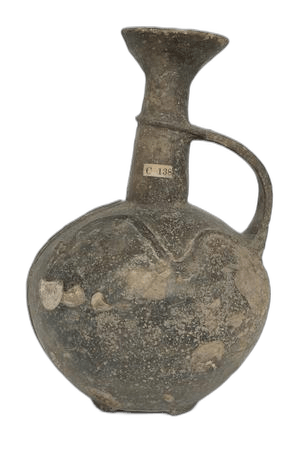
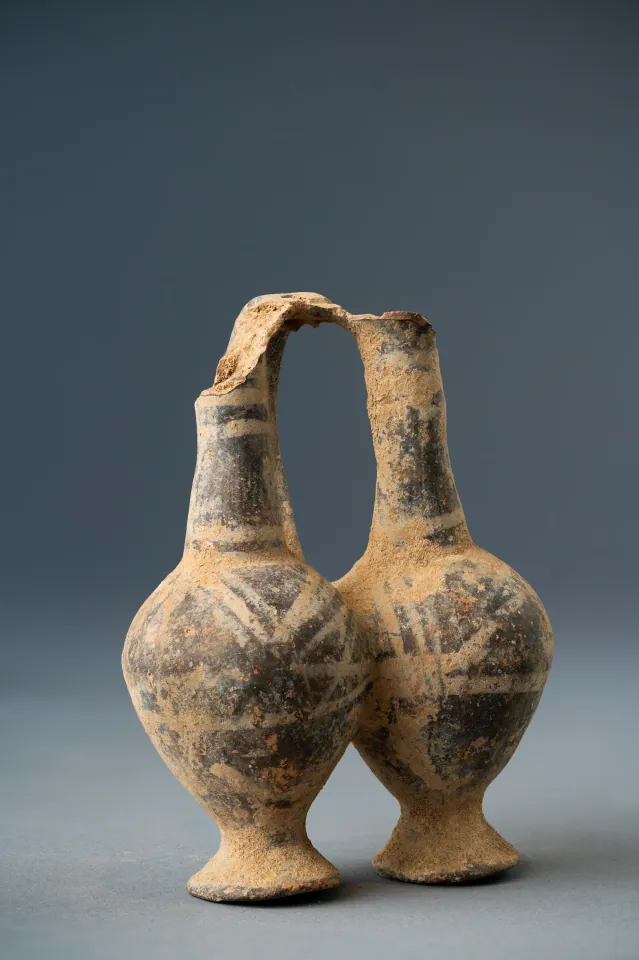
Relief outlived Red Polished. The juglet from Ayia Paraskevi beside this paragraph, Proto Base Ring or early Base Ring I (c. 1650 to 1450 BC) and 13 cm high, has two snakes in relief applied to its burnished body, as does the Proto Base Ring snake jug illustrated in Lesson 5. Base Ring I kept relief bands and scrolls, often grooved to look like rope [7, pp. 36, 39]; Base Ring II turned to thin lines of white paint.
Painted: matt paint, two colours and the compass
Most Cypriot ware names describe the surface, because the surface is the most visible part of a pot and the part the potter varied most deliberately [10, p. 238]. White Painted is dark paint on a light ground, Black-on-Red is black on a red slip, and Bichrome is black and red on a light ground. In the Iron Age the paint is matt. Even within one ware the painting sorted by region: David Frankel, who catalogued 81 motifs on Middle Cypriot White Painted, found eastern painters repeating one or two over a whole pot while Lapithos framed many on one vessel [11].
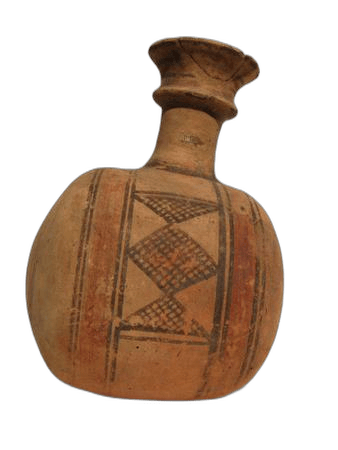
Bichrome has a logic of its own. In the Cypro-Geometric Bichrome style, Maria Iacovou observes, the red is secondary to the black and not meant to overlap it, used sparingly to fill areas the painter had marked out and often outlined in black [12, p. 202]. The barrel jug beside this paragraph, Bichrome II and 25 cm high, shows the order clearly. Concentric bands frame a Maltese cross on each end of the barrel, with hatched triangles and lozenges below the neck.
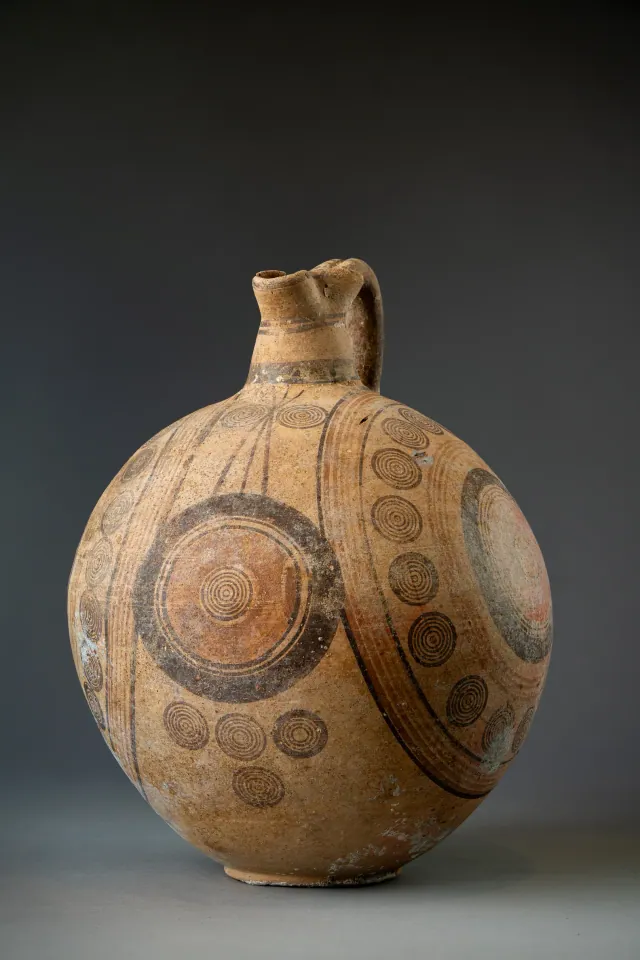
Those concentric bands were not drawn freehand. Bands running round a vessel could be painted while it turned on the wheel; circles standing on its side needed a compass-like tool. The pivoted multiple brush, which paints several rings in one turn, appeared in Athens at the transition from Submycenaean to Protogeometric [13, p. 332], and a belly-handled amphora from Salamis has "three concentric circles drawn with a multiple brush" [14, p. 229]. John Boardman, though, held that the small-circle pattern "might have reached Cyprus" from Syria and Palestine [15]. The Cypriot circle therefore has two possible ancestries, Aegean and Levantine, and the evidence does not choose between them. Einar Gjerstad saw the concentric circle arrive with White Painted III, where "the concentric circles are never connected" [2]; by Bichrome IV, in the west and north of the island, circle systems covered whole pots (Lesson 8).
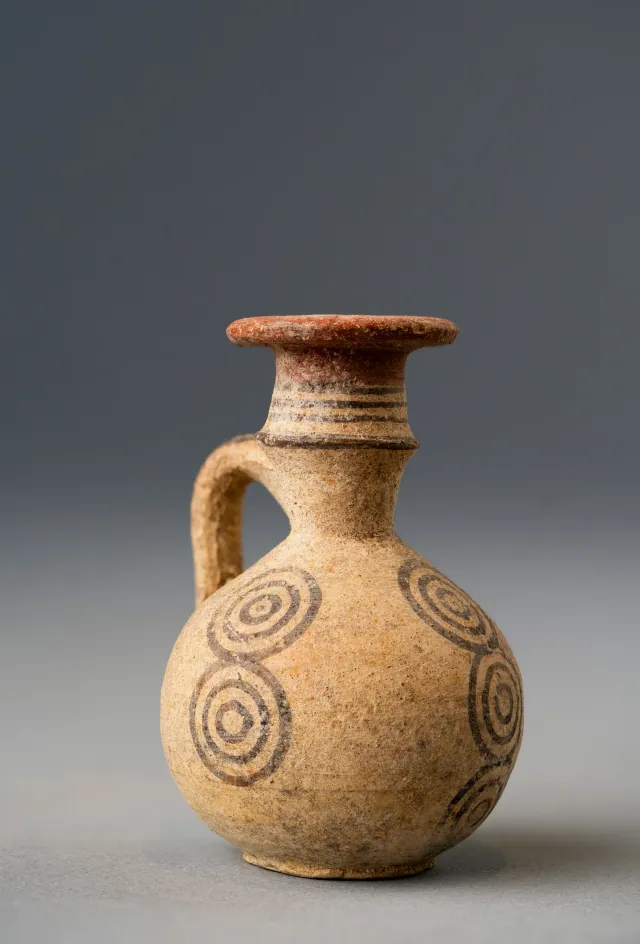
The handle-ridge juglet illustrated here, Bichrome IV of Cypro-Archaic I (c. 750 to 600 BC), shows the circle at small scale. The handle springs from a moulded ridge halfway up the neck, the flat disc rim is painted solid red, and the body is painted in black alone: on each side a vertical column of circle groups, three rings round a central dot, stacked so that they touch or nearly touch. Gjerstad described the circles of his Western style as "often connected in vertical or horizontal rows" [2]. The two columns are spaced slightly differently, and the lowest group on one side slides round the curve of the body, a sign of quick work with a multiple brush.
The motif families
Lines that bend come first. A zigzag and a wavy line differ only in the drawing: Laura Gagné calls one Middle Cypriot zigzag "really a sharp-angled version of the wavy line" [16, p. 190]. Both run from the Early Bronze Age to the Cypro-Archaic, so the line alone dates nothing. Incised and lime-filled on a red surface it is Red Polished; alternating with straight lines in black paint round a small bowl it is the Zigzag Style that Paul Åström found in the lowest layers of Middle Cypriot Kalopsidha [17, p. 88]. Wavy lines ending in a spiral hook are characteristic of Cypro-Archaic I White Painted IV juglets, the source that Rhodian potters copied in their so-called Spaghetti ware [18]. The label is a trap: White Painted IV is also the name of a handmade Middle Cypriot ware a thousand years older, and any description of a "White Painted IV" pot needs its period stated before it can be used.
Grids and crosses form a second family. Lattice (a net of crossing diagonals) and chequers fill triangles, lozenges and panels; the standard studies offer no meaning for them. The Maltese cross is four triangles meeting at their points, usually solid black and ringed with concentric circles; in the Cypro-Geometric it was a favourite centre for the bases of plates and bowls [2]. In the Cypro-Archaic its place among the small ornaments passed to the dotted cross, which Anna Georgiadou and Maria Dikomitou-Eliadou list among the small motifs of the Salamis workshops, "often very small" and appearing "individually in panels or as supplementary ornaments" [19, p. 344].
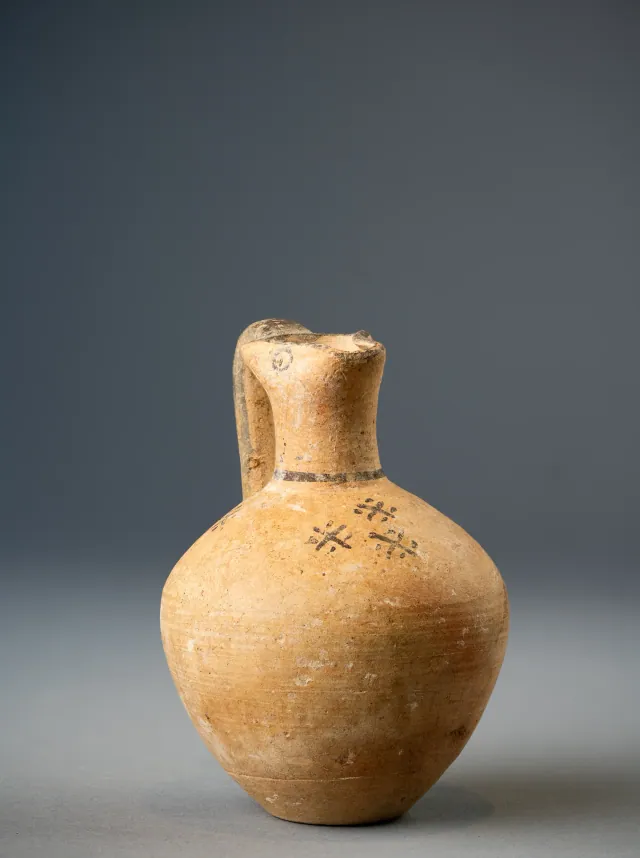
The small White Painted trefoil jug beside this paragraph, of Cypro-Archaic date (c. 750 to 480 BC), has that supplementary ornament as its only body decoration: three dotted crosses in a triangle on the shoulder, with a painted eye on each side of the mouth.
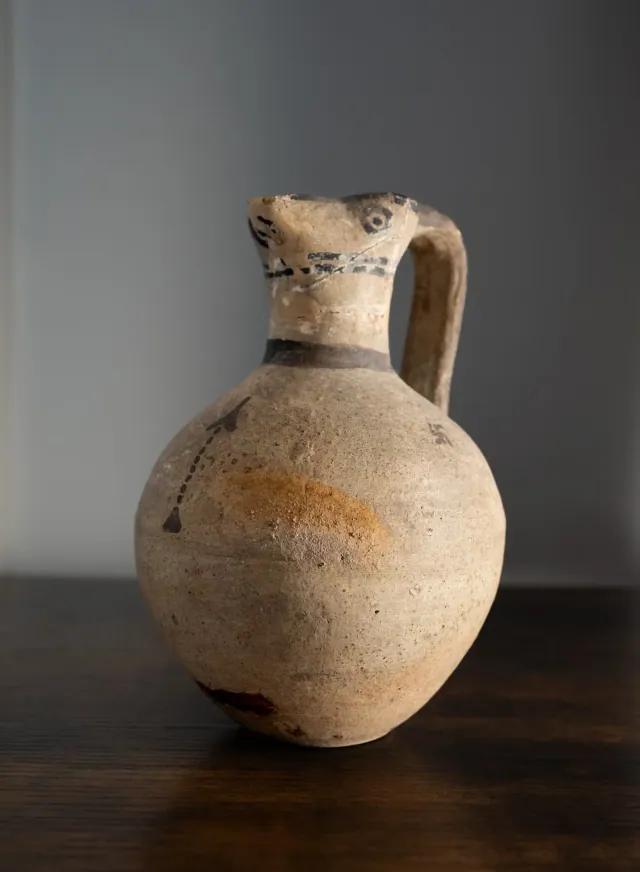
The jug from the opening, White Painted of the 9th to 7th century BC, pairs the swastika with the chevron arrow. Gjerstad noted that a White Painted III painter might set "some isolated circles and swastikas" on the plain body of a pinched-mouth jug, and he found the swastika very common on Cypro-Archaic I pottery [2]. The arrow is "a vertical chain of chevrons forming an arrow motif" [19, p. 344], here reduced to a column of dots with a point at the top and a solid triangle at the foot. A Cypro-Geometric III jug in the Metropolitan Museum (74.51.447) is close to a twin. On the Bichrome IV bird jugs that followed, Alicia Dissinger found the swastika the second most frequent companion of the bird after the lotus, and the arrow set below the beak pointing up; she calls such signs "typical Cypriot filler images or stock motifs" [20, p. 144].
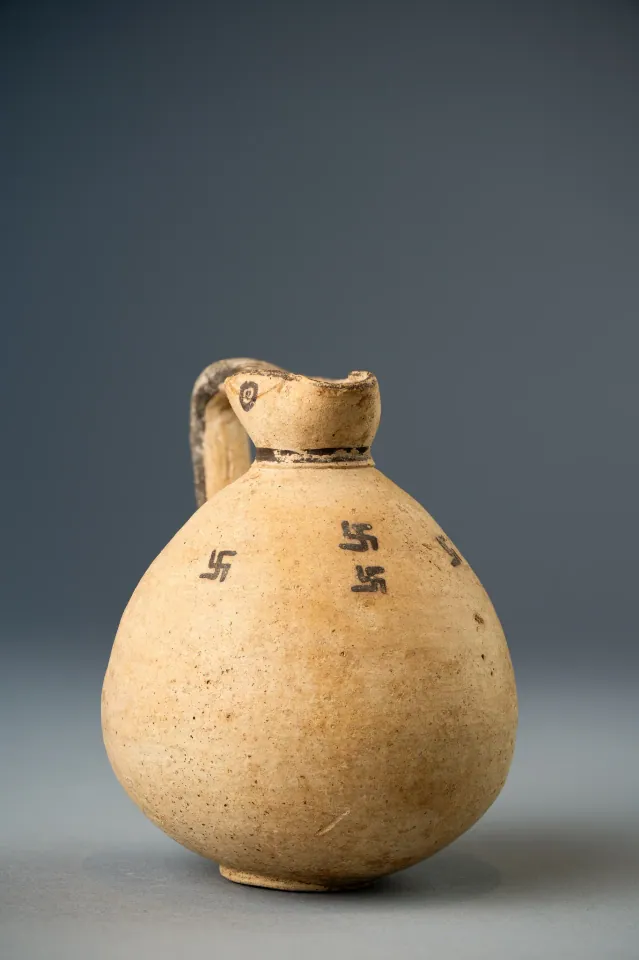
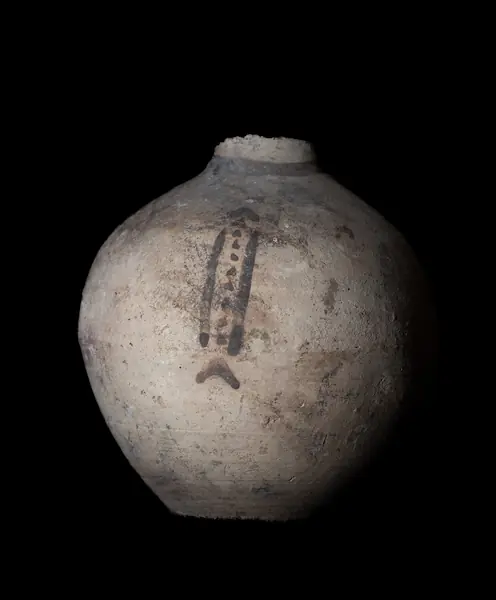
The two signs also appear apart, each as the only ornament on a pot. The first of the two White Painted pieces shown here, a small trefoil jug of the late 9th to 7th century BC, has a painted eye on the side lobe of its mouth and, on the bare shoulder, at least four small rectilinear swastikas scattered loosely with no band or panel to hold them. On the second, a globular juglet 11 cm high from the same span, the arrow stands alone on the front of the shoulder: two vertical strokes enclose a column of dots, a chevron caps it, and a second chevron points up a little below its foot. The chain of chevrons has shrunk to dots, and only the capping chevron keeps the column reading as an arrow.
Plants arrived late. Gjerstad placed the first lotus flowers on pottery in Cypro-Geometric III, common from Cypro-Archaic I, in two forms: a three-petalled flower of Egyptian derivation and a Phoenician type with two lateral and three inner petals [2]. The tree flanked by two wild goats came to the island as an imported icon, used mostly on Late Bronze Age seals and gold, and revived on Iron Age vases [21, pp. 65-72]. Its usual names, "sacred tree" and "Tree of Life", are modern and assume a religious meaning that no inscription on the vases confirms.
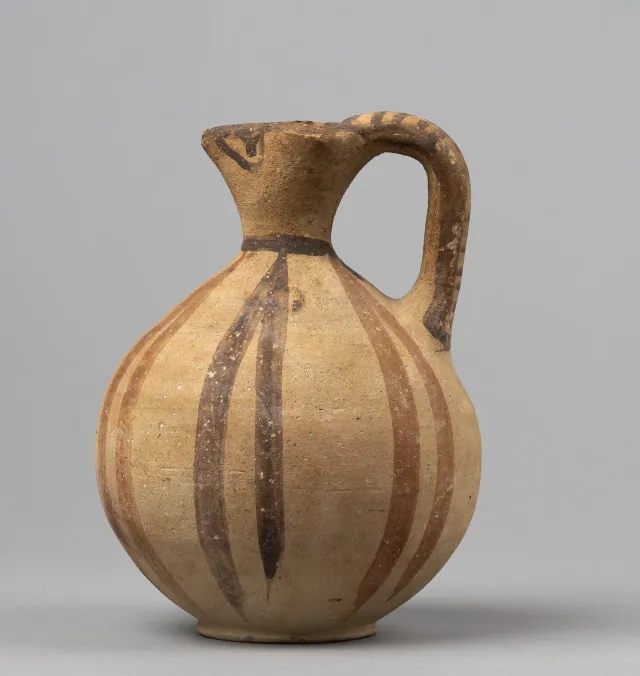
Late in the sequence the circle gave ground. In Bichrome V, Gjerstad wrote, "lines, criss-cross lines, and strokes" were commonly used, "partly in substitution for the circles" [2]. The Bichrome V jug beside this paragraph, of the 6th or early 5th century BC, has long leaf-shaped strokes falling from a black neck band, black at the centre and red on either side, with an eye on the spout. A Bichrome V jug from a tomb at Stylli near Salamis, published by the Swedish Cyprus Expedition, has "eye-ornaments below rim, and three red, leaf-shaped strokes as front ornament" [22].
Birds changed medium. In the Bronze Age they were modelled, perched on bowl rims or set between the necks of jugs; J. L. Benson found "little or no interest in the depiction of birds on the part of native Bronze Age potters" [23, p. 142]. The painted bird is an Iron Age habit, seeded by the Mycenaean pictorial krater. Of the modelled birds, Karageorghis wrote that it is "tempting to attribute a symbolic meaning" to them but "there is no justification for such a concept during the prehistoric period" [24, p. 171]. The free-field bird of Cypro-Archaic I, alone on the jug's shoulder, and the older geometric layout it grew from belong to Lesson 8.
The painted eye runs through all of this. Gjerstad lists an "eye" ornament among the new motifs of White Painted III [2], and four of the jugs in this lesson have eyes beside the spout, so that the pinched mouth becomes a face. On a Bichrome IV jug in the Cyprus Museum, "an 'eyelet' is painted on either side of the spout" [25, p. 288]. Such eyes are often read as protective, a charm against harm; that reading is an interpretation, and nothing on the pots or in their find-places confirms it. Morris raised the possibility for a Middle Cypriot jug whose painting includes "a pair of staring eyes": "this resemblance may be accidental, or it may indicate an apotropaic protective device" [4, p. 57].
What a motif can tell you, and what it cannot
A motif dates and places a pot through its company. The two crosses from the opening separate at the first test: one is cut and lime-filled on a handmade burnished bowl, the other painted in matt black on a wheel-made jug. The bowl's cross is the centrepiece of a zoned design; the jug's swastika is a filler beside an arrow. Set the two pieces side by side and apply the tests in order: how each cross was made, then where it sits and how large it is.
A · Cut, c. 2300 to 2000 BC
Black-topped Red Polished Tulip Bowl with Incised Spiral-armed Cross, Circles and Arcades
c. 2300 to 2000 BC · Drakopoulos collection
B · Painted, 9th to 7th century BC
White Painted Jug with Painted Eyes, Chevron Arrow and Swastika
c. 850 to 600 BC · Drakopoulos collection
Region shows the same way: circles point to Gjerstad's Western style, lotus and straight-line ornament to his Eastern one [2], and small dotted crosses, arrows and paired swastikas to the workshops of Salamis [19, p. 344].
Meaning is another matter, and the pots themselves argue for caution. At Palaepaphos-Skales, a White Painted I amphora 55 cm high from Tomb 191 has on one side of its neck "a large latticed 'maltese cross' in the middle of a panel". On the other side the painter repeated the scheme, except that "a horned quadruped (a bull)" stands "in the place of the 'maltese cross'" [26, p. 33]. Whatever the cross meant, the painter could put a bull in its place.
Quiz
Check yourself
Question
Look closely at the circles on this jug. What do they tell you?
Question
This Late Bronze Age double juglet is Base Ring. Which stage does its decoration point to?
Question
Put these ways of decorating a pot in the order they appeared on Cyprus, oldest first.
Tap an item, then tap its place. Or use the arrows
Question
In Cypro-Geometric Bichrome, how does the painter use the red?
Question
A list describes a pot only as “White Painted IV”. What do you need before you can date it?
Question
A zigzag is the only ornament you can see on a sherd. What does the zigzag alone date?
Question
Eyes painted either side of a pinched trefoil mouth: when?
Question
On a White Painted I amphora from Palaepaphos-Skales, one side of the neck has a Maltese cross in a panel and the other a bull in its place. What does that suggest?
What to look for
- Technique first. Lines cut into the surface and filled with white mean Red Polished of the Early to early Middle Bronze Age; added ridges, coils and snakes mean Red Polished or early Base Ring; paint means Chalcolithic Red-on-White, or Middle Cypriot and later.
- Paint colour and ground. Dark on light is White Painted (or White Slip on a thick white coat); black on red slip is Black-on-Red; black with sparing red fills inside black outlines is Bichrome.
- Look at circles closely. Perfectly even rings standing on the side of a pot were drawn with a compass or multiple brush and point to the Iron Age; incised rings on a red surface are Bronze Age.
- Read the layout. Bands and panels round the whole pot are Cypro-Geometric habits; one motif alone on a bare shoulder is the free field of late Cypro-Geometric and Cypro-Archaic jugs.
- Eyes painted either side of a pinched trefoil mouth mark Iron Age jugs, from Cypro-Geometric III into Bichrome V.
- Never date by one motif. Zigzags, wavy lines, circles and the swastika each run for centuries; date by the ware, the shape and the company the motif keeps.
Go deeper
The compendium's Motifs of Cypriot Pottery hub leads to an entry for each family: circles, zigzags, wavy lines, wavy hooks, triple crossing lines, lattice and checkerboards, the Maltese cross, the swastika, arrows, lotus flowers, plants and free-field art. For the free-field bird, read The Journey of a Free-Field Bird; for the trefoil-mouthed jug that carries so many of these motifs, The Cypriot Oinochoe.
References
- 1.Merrillees, R. S. (2017). Cypriote antiquities in Late Ottoman Istanbul and Smyrna II. Cahiers du Centre d'Études Chypriotes, 47, 121-164.
- 2.Gjerstad, E. (1948). The Swedish Cyprus Expedition, Vol. IV, Part 2: The Cypro-Geometric, Cypro-Archaic and Cypro-Classical Periods. Stockholm: The Swedish Cyprus Expedition.
- 3.Webb, J. M. and Frankel, D. (1999). Characterizing the Philia facies: material culture, chronology, and the origin of the Bronze Age in Cyprus. American Journal of Archaeology, 103(1), 3-43.
- 4.Morris, D. (1985). The Art of Ancient Cyprus, with a Check-list of the Author's Collection. Oxford: Phaidon.
- 5.Coleman, J.E., Barlow, J.A., Mogelonsky, M.K. and Schaar, K.W. (1996). Alambra: A Middle Bronze Age Settlement in Cyprus. Archaeological Investigations by Cornell University 1974–1985. Studies in Mediterranean Archaeology 118. Jonsered: Paul Åströms Förlag.
- 6.Dikaios, P. (1940). The Excavations at Vounous-Bellapais in Cyprus, 1931–2. Archaeologia 88, 1–174.
- 7.Karageorghis, V., Mertens, J. R., & Rose, M. E. (2000). Ancient Art from Cyprus: The Cesnola Collection in The Metropolitan Museum of Art. New York: The Metropolitan Museum of Art.
- 8.Karageorghis, V. (1982). Cyprus: From the Stone Age to the Romans. Ancient Peoples and Places 101. London: Thames and Hudson.
- 9.Vermeule, E. and Karageorghis, V. (1982). Mycenaean Pictorial Vase Painting. Cambridge, MA: Harvard University Press.
- 10.Merrillees, R. S. (1991). The principles of Cypriot Bronze Age pottery classification. In J. A. Barlow, D. L. Bolger & B. Kling (Eds.), Cypriot Ceramics: Reading the Prehistoric Record (University Museum Monograph 74, pp. 237–240). Philadelphia: The University Museum, University of Pennsylvania.
- 11.Frankel, D. (1974). Middle Cypriot White Painted Pottery: An Analytical Study of the Decoration. Studies in Mediterranean Archaeology 42. Göteborg: Paul Åströms Förlag.
- 12.Iacovou, M. (1991). Proto-White Painted pottery: A classification of the ware. In J. A. Barlow, D. L. Bolger, & B. Kling (Eds.), Cypriot Ceramics: Reading the Prehistoric Record (University Museum Monograph 74, pp. 199–205). Philadelphia: The University Museum, University of Pennsylvania.
- 13.Ruppenstein, F. (2009). The transitional phase from Submycenaean to Protogeometric: definition and comparative chronology. In S. Deger-Jalkotzy and A. E. Bächle (eds), LH III C Chronology and Synchronisms III: LH III C Late and the Transition to the Early Iron Age. Vienna: Austrian Academy of Sciences.
- 14.Vacek, A. (2012). Imitation or innovation? Style, decoration and syntax of Greek and Cypriot pottery during the Geometric period. In A. Georgiou (ed.), Cyprus: An Island Culture. Society and Social Relations from the Bronze Age to the Venetian Period. Oxford: Oxbow Books, 224-240.
- 15.Boardman, J. (1959). Greek potters at Al Mina? Anatolian Studies, 9, 163-169.
- 16.Gagné, L. A. C. (2012). Middle Cypriot White Painted Ware: A Study of Pottery Production and Distribution in Middle Bronze Age Cyprus. PhD dissertation, University of Toronto.
- 17.Åström, P. (1966). Excavations at Kalopsidha and Ayios Iakovos in Cyprus. Studies in Mediterranean Archaeology 2. Lund: Paul Åström.
- 18.Bourogiannis, G. (2019). Late Geometric, Subgeometric and Archaic pottery from Rhodes at Lund: a fresh look at some old finds. In S. Schierup (ed.), Documenting Ancient Rhodes: Archaeological Expeditions and Rhodian Antiquities. Aarhus: Aarhus University Press, 221-240.
- 19.Georgiadou, A., & Dikomitou-Eliadou, M. (2022). The Iron Age pictorial pottery of Salamis within and beyond: An overview of ceramic styles, wares and fabrics. In G. Bourogiannis (Ed.), Beyond Cyprus: Investigating Cypriot Connectivity in the Mediterranean from the Late Bronze Age to the End of the Classical Period (AURA Supplement 9), pp. 335-348. Athens: National and Kapodistrian University of Athens.
- 20.Dissinger, A. M. (2017). Cypro-Archaic Bird Iconography: Types, Uses, and Meanings. PhD dissertation, University of Virginia.
- 21.Bushnell, L. (2008). The wild goat-and-tree icon and its special significance for ancient Cyprus. In G. Papantoniou, A. Fitzgerald and S. Hargis (eds), POCA 2005: Postgraduate Cypriot Archaeology. BAR International Series 1803. Oxford: Archaeopress, 65-76.
- 22.Gjerstad, E., Lindros, J., Sjöqvist, E. and Westholm, A. (1935). The Swedish Cyprus Expedition II: Finds and Results of the Excavations in Cyprus 1927–1931. Stockholm: The Swedish Cyprus Expedition (Stylli tombs).
- 23.Benson, J. L. (1975). Birds on Cypro-Geometric pottery. In N. Robertson (ed.), The Archaeology of Cyprus: Recent Developments. Park Ridge, NJ: Noyes Press.
- 24.Karageorghis, V. (1991). The Coroplastic Art of Ancient Cyprus I: Chalcolithic to Late Cypriote I. Nicosia: A. G. Leventis Foundation.
- 25.Bombardieri, L. and Panero, E. (eds) (2021). Cyprus. Crossroads of Civilizations. Exhibition catalogue. Turin: Musei Reali.
- 26.Karageorghis, V., & Raptou, E. (2016). Palaepaphos-Skales: Tombs of the Late Cypriote IIIB and Cypro-Geometric Periods (Excavations of 2008 and 2011). Nicosia: The Cyprus Institute.