
Contents
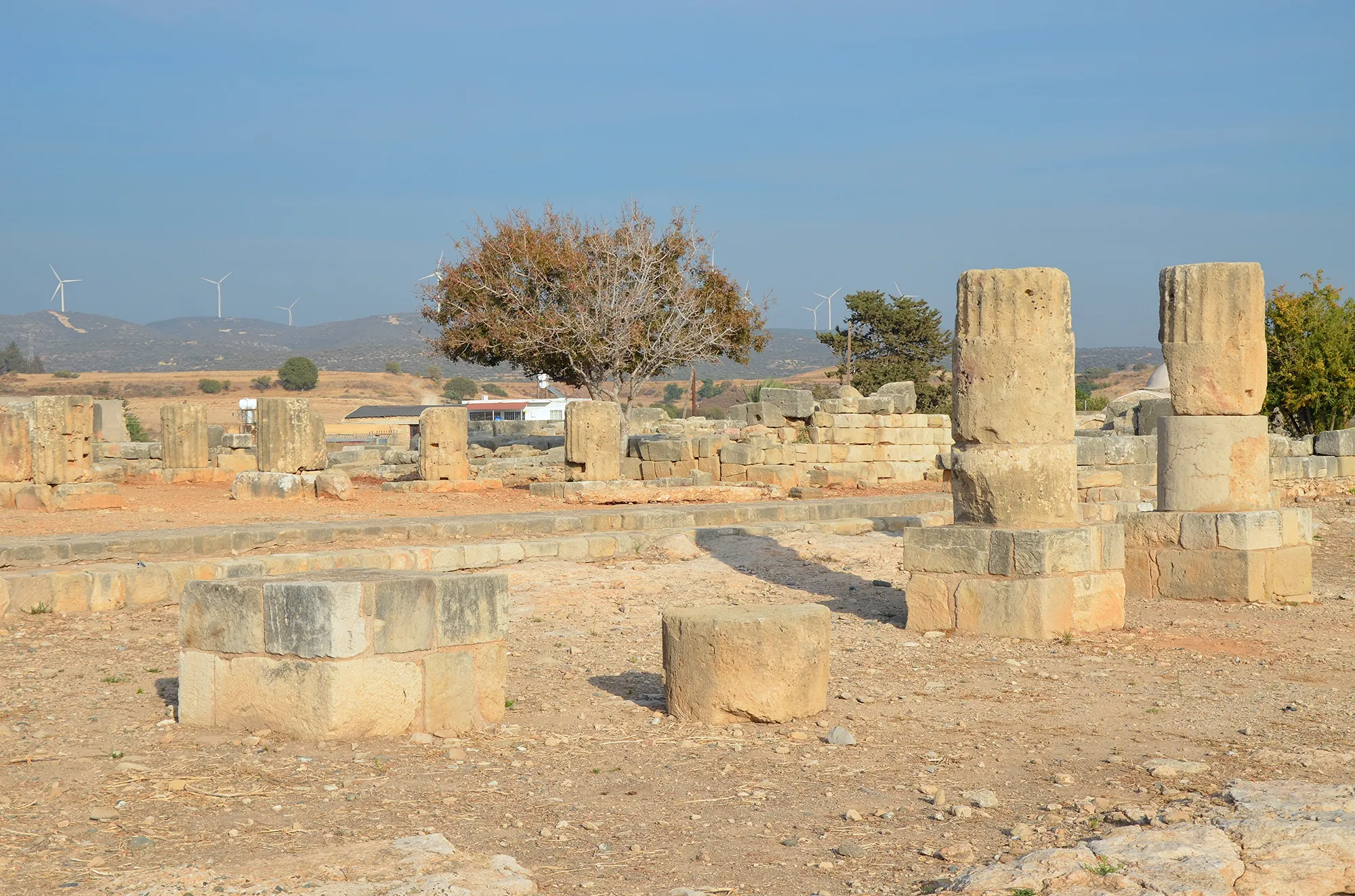
Palaepaphos, "Old Paphos", lies under and around the village of Kouklia in the Paphos District of western Cyprus. The town was founded towards the end of the Middle Bronze Age, and from the Late Bronze Age until early Hellenistic times it was the only large urban settlement in the south-west of the island [1, p. 12]. Its kings ruled a territory that reached from the Akamas peninsula towards Pissouri [1, p. 12], and its sanctuary of the Paphian goddess, the Aphrodite of the Greeks, was in use for more than 1,600 years, from about 1200 BC to the end of the 4th century AD [1, p. 40]. Together with Nea Paphos on the coast, the site was inscribed on the UNESCO World Heritage List in 1980 as "Paphos" [2].
The town on the Kouklia ridge
The ancient town occupied a low hill and a group of plateaus about 1.5 km from the sea, on the east side of the Dhiarizos river, some 16 km east of the modern town of Paphos. Maier called the distance to Nea Paphos "about ten miles" [1, p. 12]. The sanctuary stands on the Alonia plateau under the village itself. Higher ground to the north and east carries the Marcello hill, with the Northeast Gate of the city wall, and the Hadjiabdoulla and Laona plateaus, while the cemeteries lay on the slopes and spurs around the town: Evreti, Teratsoudhia, Asproyi, Kaminia, Eliomylia and, a little further off, Skales to the south-east and Plakes west of the Dhiarizos [3; 4].
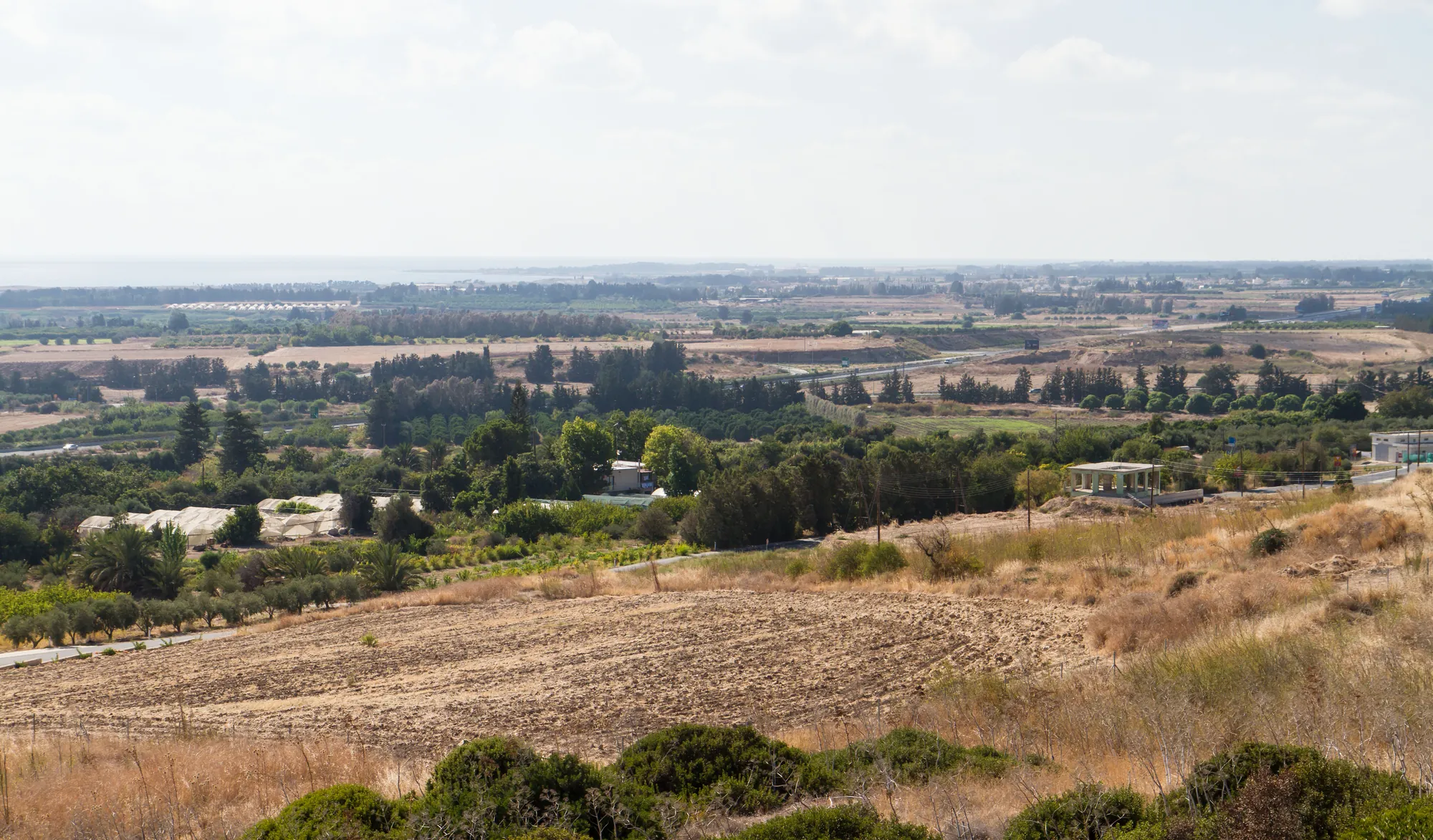
The modern name comes from the medieval estate. The Lusignan kings called it Couvoucle, a name derived from the Greek koubouklion, "canopy" or "royal chamber"; the excavators of 1888 already set aside the popular explanations from "dolls" or "dances" [5]. The town was simply Paphos in antiquity. It became Palaipaphos, Old Paphos, only after the foundation of Nea Paphos at the end of the 4th century BC [1, p. 22].
The area around Kouklia was settled long before the town. Chalcolithic villages and cemeteries lie a few kilometres to the west and south-west at Souskiou, and the Chalcolithic villages of Kissonerga and Lemba are on the coast north of Paphos. At Kouklia itself the earliest finds are Chalcolithic, all of them stray finds, and evidence for the Early Bronze Age is still lacking [6, pp. 42–46]. Ancient writers placed the birth of Aphrodite near Paphos without naming the spot. The rock of Petra tou Romiou on the coast, which takes its name from the Byzantine hero Digenis, has been shown as her birthplace only since the middle of the 20th century [7, p. 29].
Map of Cyprus
- Ground above 200, 500, 1,000 m
Sites on this map
- 1Palaepaphos (Kouklia)
- 2Souskiou-Vathyrkakas
- 3Nea Paphos
- 4Lemba-Lakkous
- 5Kissonerga
- 6Maa-Palaeokastro
Discovery and excavation
The sanctuary was never lost. Pilgrims and travellers described its ruins from the 16th century on, and the German scholar Ludwig Ross visited it in 1845. In 1862 Melchior de Vogüé took the royal funerary inscriptions of Timocharis and Echetimos to the Louvre. Luigi Palma di Cesnola claimed to have dug at Kouklia in the 1870s, a claim Maier treated as largely fanciful [8].
| Years | Excavators | Main work |
|---|---|---|
| 1888 | Cyprus Exploration Fund: E. A. Gardner, D. G. Hogarth, M. R. James, R. Elsey Smith | The sanctuary and many tombs |
| 1899 | F. B. Welch for the British Museum | A short season of tomb digging |
| 1950–1955 | British Kouklia Expedition: J. H. Iliffe and T. B. Mitford | The Marcello siege mound, the Evreti tombs and wells, Skales |
| 1966–1997 | Swiss-German mission: F. G. Maier, M.-L. von Wartburg | Northeast Gate and siege works, sanctuary, Hadjiabdoulla, House of Leda, sugar refinery |
| 1979–1981; from 2002 | Department of Antiquities: V. Karageorghis; E. Raptou | Rescue excavation of the Skales and Plakes cemeteries |
| from 2006 | Palaepaphos Urban Landscape Project: M. Iacovou | Survey, geophysics and excavation at Marcello, Hadjiabdoulla and Laona |
The first scientific excavation was the work of the Cyprus Exploration Fund in 1888, under Ernest Gardner with D. G. Hogarth, M. R. James and the architect R. Elsey Smith. They cleared much of the sanctuary and opened tombs around the town [5]. Most of the finds were divided among museums abroad, among them the British Museum and the Ashmolean Museum in Oxford [9]. In 1899 F. B. Welch dug tombs at Kouklia for the British Museum [9].
In 1950 the British Kouklia Expedition of the Liverpool City Museums and the University of St Andrews began work under J. H. Iliffe and T. B. Mitford [10; 11]. It excavated in the mound outside the Northeast Gate, which proved to be the Persian siege ramp, and in the tomb-fields of Evreti and elsewhere; the tombs it excavated were published by Hector Catling only in 2020 [12]. The government bought the medieval manor in the summer of 1951 [1, p. 31].
From 1966 to 1997 the Swiss-German mission directed by Franz Georg Maier, with Marie-Louise von Wartburg, excavated the Northeast Gate and the siege works, the sanctuary (1973 to 1979, 1993 to 1995 and 1997), the House of Leda and the medieval sugar refinery [1, p. 40; 13]. Its results appear in the series Ausgrabungen in Alt-Paphos auf Cypern [14; 15; 16; 17]. The Department of Antiquities under Vassos Karageorghis rescued the Skales cemetery from 1979, after land levelling exposed the tombs [18], and E. Raptou has excavated the Plakes cemetery and further tombs at Skales since 2002 [4; 19]. Since 2006 the Palaepaphos Urban Landscape Project of the University of Cyprus, directed by Maria Iacovou, has studied the town as a whole [20; 3].
The Swedish Cyprus Expedition of 1927 to 1931 did not excavate at Palaepaphos.
Phases of the town
Phases
- FoundationMiddle Cypriot III to Late Cypriot I, c. 1750–1550 BC
Middle Cypriot pottery in tombs is the first trace of the town. No earlier settlement is known on the site.
- Late Bronze Age townc. 1550–1050 BC
Tomb-fields at Evreti and Teratsoudhia; the first monumental sanctuary, Sanctuary I, is built about 1200 BC.
- Early Iron Agec. 1050–750 BC
Rich chamber tombs at Skales and Plakes; the Opheltau spit is inscribed in Greek.
- Kingdom of Paphosc. 750 BC to the late 4th century BC
City wall, Hadjiabdoulla and Laona; Persian siege of 498 BC; rebuilding in the 4th century; the last king, Nikokles, founds Nea Paphos.
- Hellenistic and Roman sanctuary townlate 4th century BC to AD 391
The sanctuary keeps its standing; Sanctuary II is built about AD 100; houses with mosaics, among them the House of Leda.
- End of the cultafter AD 391
The cult ends with the closure of pagan sanctuaries under Theodosius I.
- Royal sugar estate and manor13th century to c. 1600
The Lusignan crown builds a manor and a sugar refinery; the estate becomes an Ottoman farm after 1571.
The beginnings of the town are known from tombs, not houses. Maier and Karageorghis noted that evidence for the Early Bronze Age at Palaepaphos is still lacking and that there may have been a break between the Chalcolithic and Middle Cypriot phases of occupation [6, p. 46]. White Painted vessels of the Middle Cypriot period from the tombs show that people lived here before the Late Bronze Age, although nearly all the early evidence consists of stray finds or unstratified material [6, pp. 46–47]. The 1888 excavators already found Middle Cypriot pottery, now in the Ashmolean Museum.
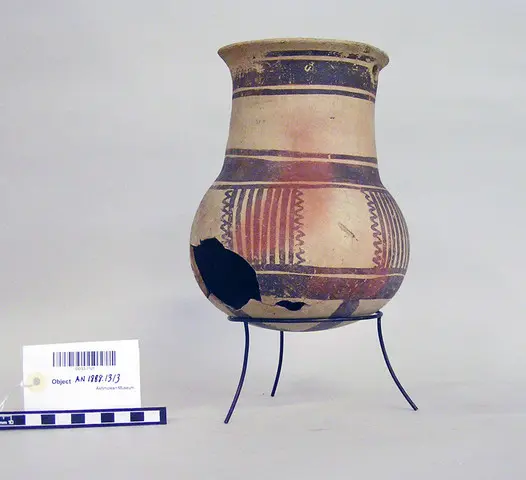 White Painted V round-bottomed and wide-necked jarMiddle Bronze Age III · 1750–1550 BCAshmolean Museum
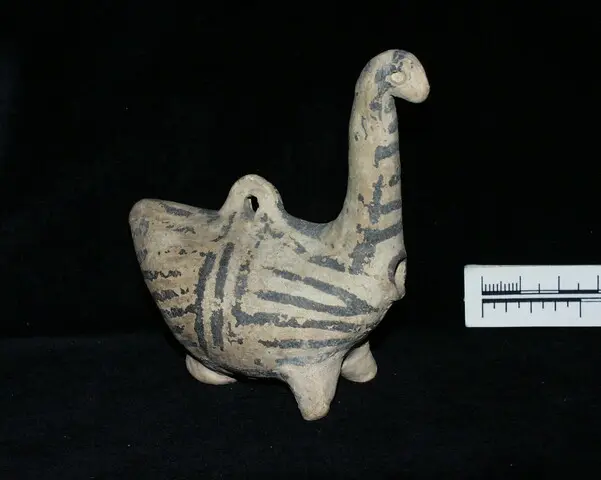 White Painted bird-shaped figurineMiddle Bronze Age II · 1850–1650 BCAshmolean Museum
The Late Bronze Age town
In the Late Bronze Age Paphos grew into the one town of the west. Its houses lie under the modern village and are little known; the evidence comes mainly from tombs and wells. At Evreti, the Swiss-German mission found wells filled with debris from workshops and households. One of them, TE III, held a bronze weight cast as a female head and filled with lead, weighing 169 g [6, p. 66]. Tomb KTE VIII at Evreti, of the 12th century BC, contained an ivory mirror handle 21.5 cm long, an ivory unguent spoon and an iron spatula with an ivory handle, now in the Cyprus Museum [6, p. 74].
The British expedition's tombs of 1951 to 1954 gave gold jewellery, seals, mirrors and carved ivory, much of it now in Liverpool [12]. At Teratsoudhia, Tomb 288 was in use from about 1650 to about 1200 BC [21]. The tomb groups end with the first Iron Age pottery: tomb 2 of the 1888 excavation held gold fibulae, earrings, a ring and a bulla with Proto-White Painted stirrup jars of about 1100 to 1050 BC.
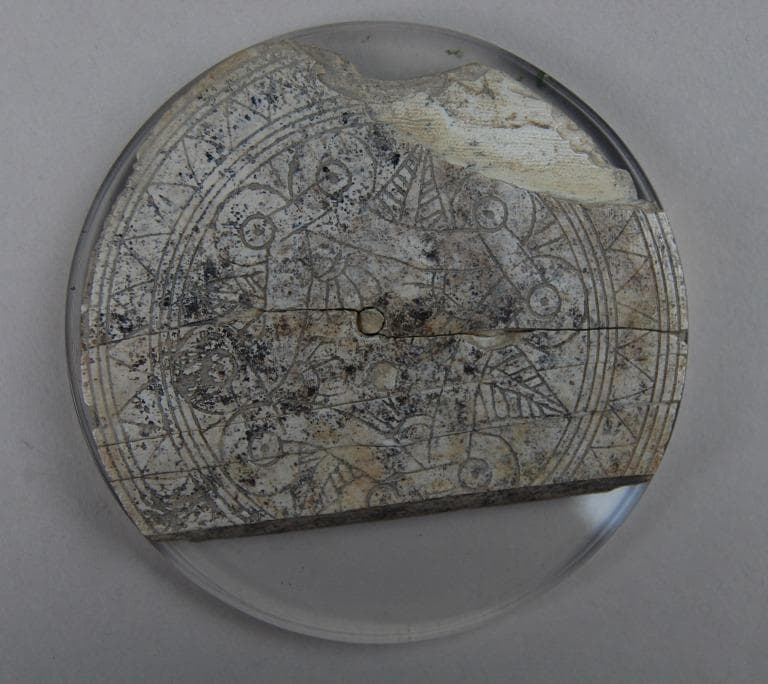 Disc Shaped LidLate Bronze Age II · 1350–1250 BCLiverpool Museum
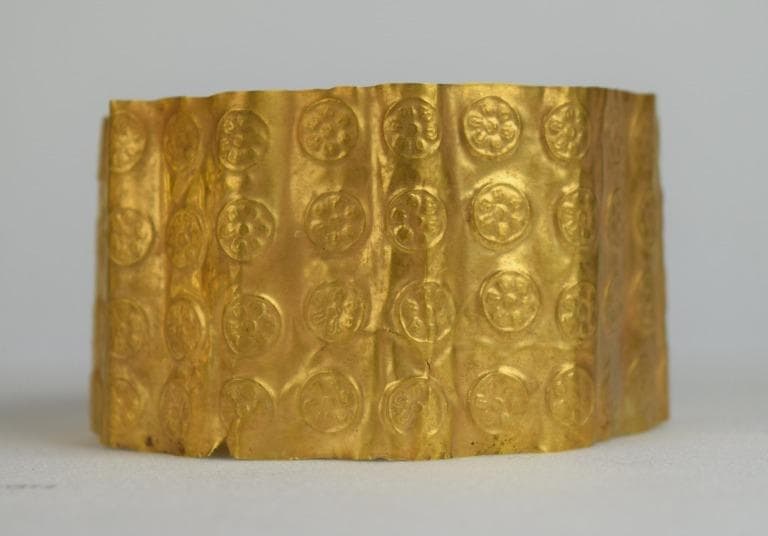 FrontletLate Bronze Age II · 1350–1250 BCLiverpool Museum
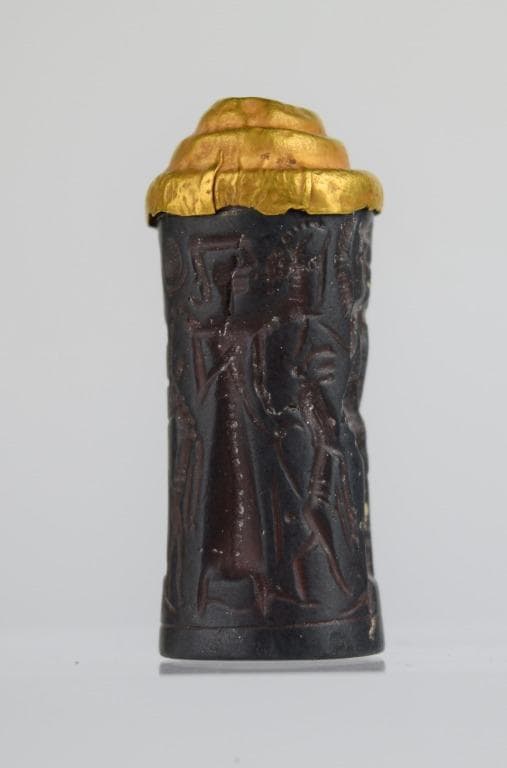 Cylinder SealLate Bronze Age II · 1350–1250 BCLiverpool Museum
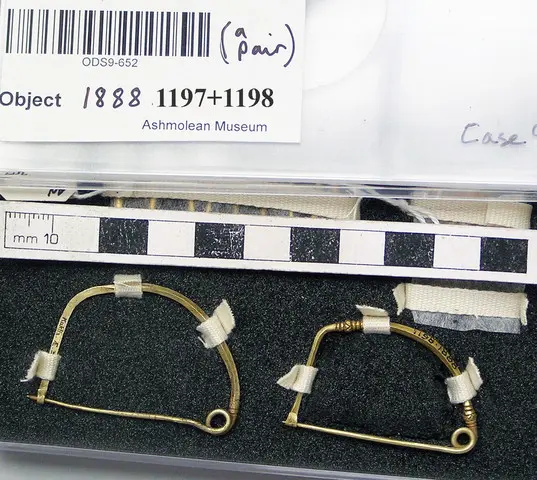 Bow-shaped gold fibulaLate Bronze Age III · 1100–1050 BCAshmolean Museum
).webp) Gold bow shaped fibulaLate Bronze Age III · 1100–1050 BCAshmolean Museum
Gold bow shaped fibulaLate Bronze Age III · 1100–1050 BCAshmolean Museum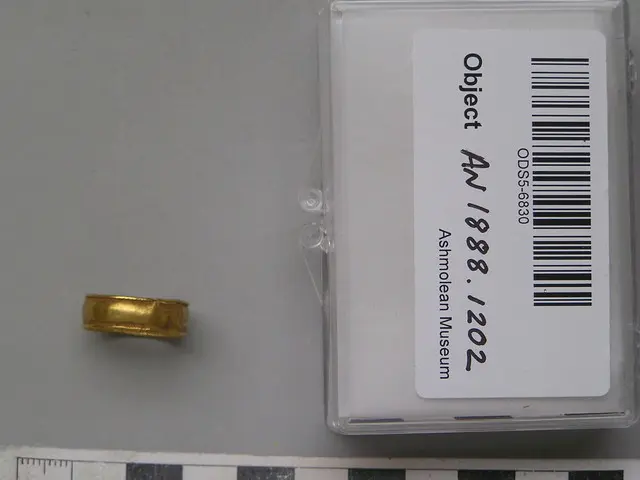 Gold finger ringLate Bronze Age III · 1100–1050 BCAshmolean Museum
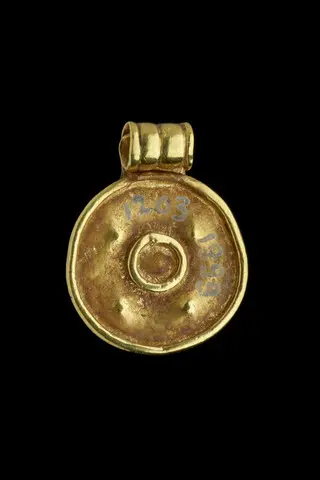 Circular pendant, Gold bulla: Plain on one side, the other with attached rim and central circle, five dots, op has barrel-shaped ring for suspensionLate Bronze Age III · 1100–1050 BCAshmolean Museum
The Sanctuary of Aphrodite
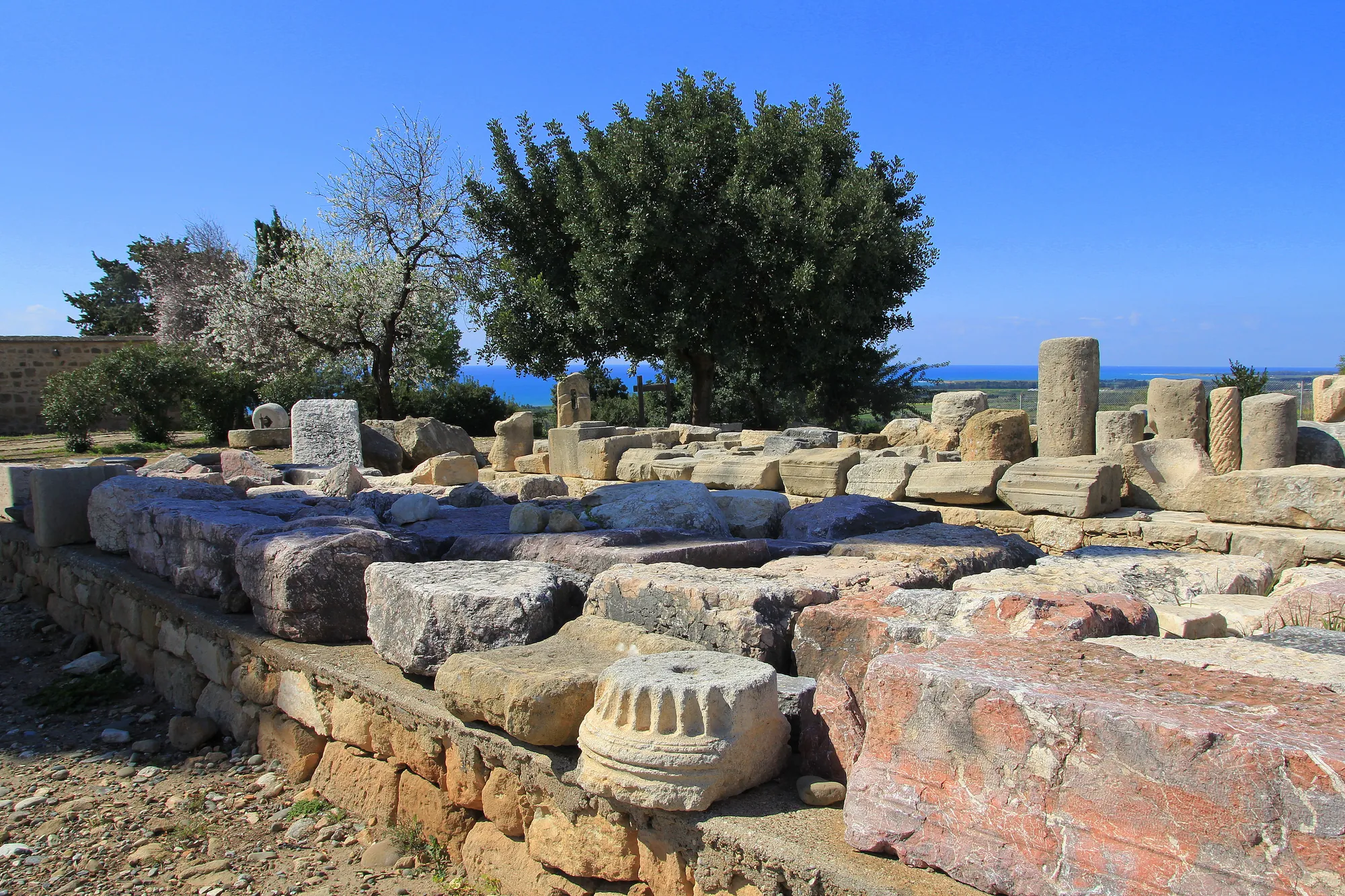
The sanctuary on the Alonia plateau consists of two groups of buildings on different axes: Sanctuary I in the south, of the Late Bronze Age, and Sanctuary II immediately north of it, of the Roman period [6, p. 91; 1, p. 40]. Almost everything between them in date was swept away by later rebuilding. In the Middle Ages the bedrock over much of the site was cut down for the installations of the sugar industry, which destroyed the eastern part of the Bronze Age sanctuary [6, p. 91].
Plan · about 1200 BC to the 4th century AD; a sugar refinery in the 14th to 16th centuries
The Sanctuary of Aphrodite at Palaepaphos
Kouklia, on the Alonia plateau
Sanctuary II: Roman, about AD 100, with Sanctuary I kept in use
1 of 9
The temenos wall of Sanctuary I
The open court of Sanctuary I was closed by a wall of huge, smoothly dressed limestone orthostats, up to 5.0 m long and 2.0 m high, set on a footing of smaller blocks laid flat. The west wall still stands for its whole length of 28.0 m; of the south wall only 4.50 m survive. Steps led down into the court from an entrance in the west wall. The rest of the court's walls, and the whole eastern part of the Bronze Age sanctuary, were destroyed when the bedrock was cut away for the medieval sugar works.
Maier and Karageorghis 1984, p. 93
Key
- Wall of the period shown
- Base or wall drawn in outline
- Where the stair or ramp joined
- Bronze Age walls kept in use
- Contours at 1 m
Sanctuary I, about 1200 BC
The first monumental sanctuary had two parts: an open court, the temenos, and a covered hall beside it [6, p. 91]. The temenos was closed by a wall of huge, smoothly dressed limestone orthostats up to 5.0 m long and 2.0 m high, set on a footing of smaller blocks laid flat. The west wall survives for its whole length of 28.0 m, the south wall for 4.50 m. Early travellers admired this "Cyclopean" wall, and it remains the most striking monument on the site. Deep, irregular holes in some blocks have never been explained [6, p. 91].
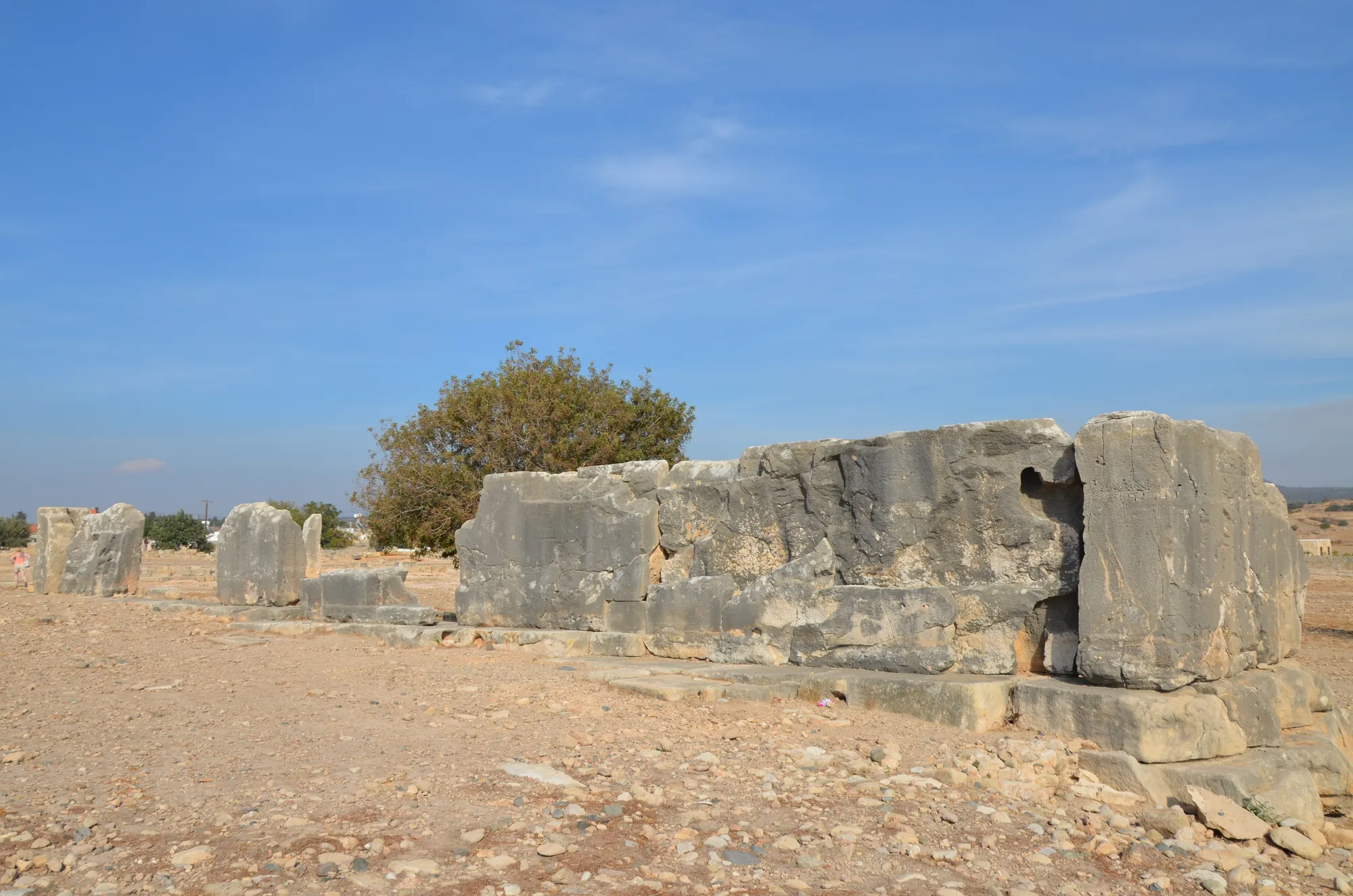
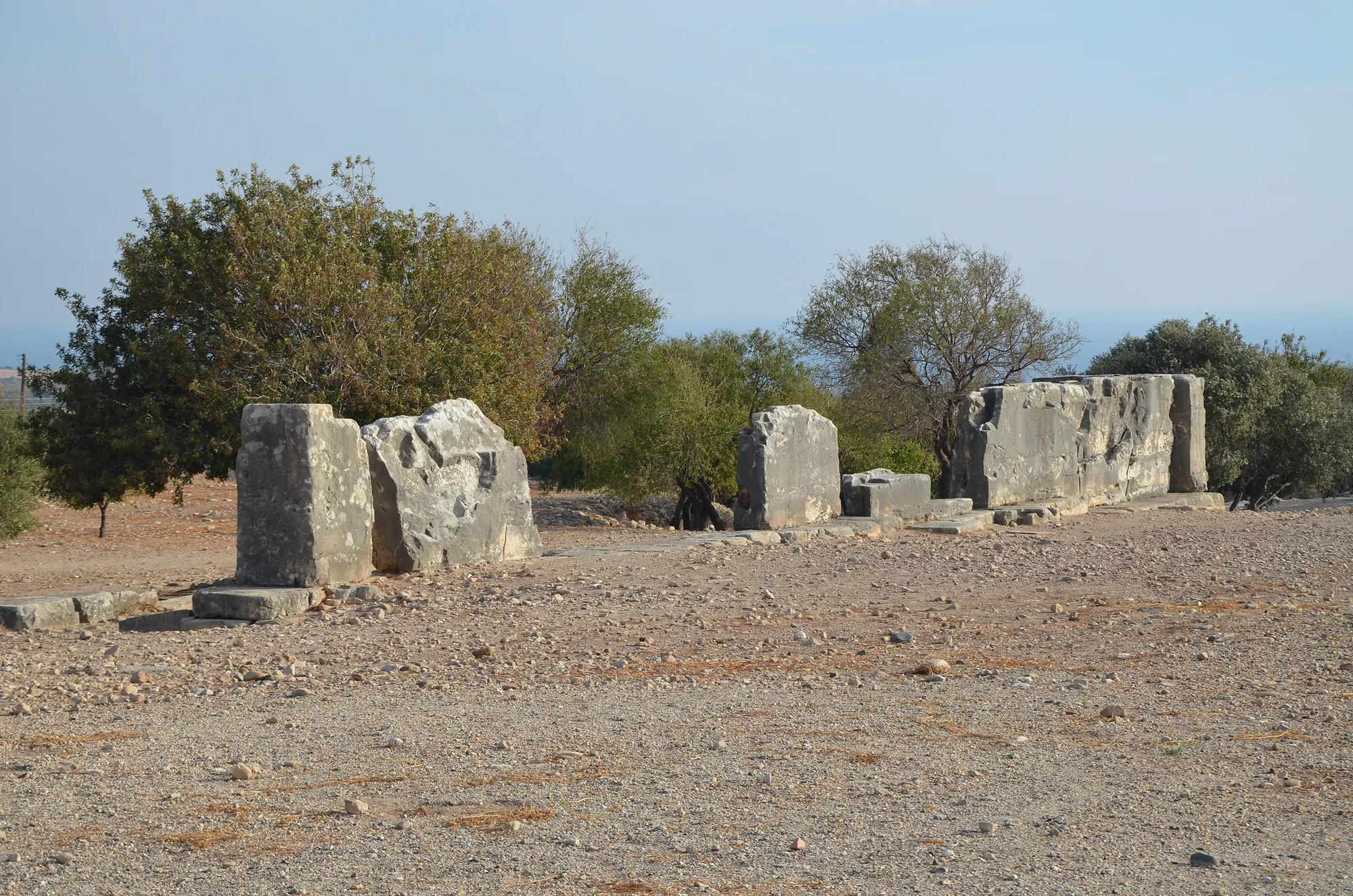
Steps led down into the court from an entrance in the west wall. Opposite it, 7.80 m away, a limestone slab with a low rim, 1.62 by 0.70 m, is set into the floor in its original position; it was probably a basin for washing on entering the precinct. No trace of the altar survives [6, p. 91].
The hall adjoined the north end of the temenos west wall. It measured 23.80 by 11.50 m. Two rows of square bases carried square monolithic limestone piers with drafted edges, and the north-easternmost pier still stands in place [6, p. 94]. Two deposits in rock-cut pits under the hall belong to the Late Bronze Age. One held a broken clay bathtub. The other held a storage jar still in place, 1.50 m high and 1.32 m across, one of the largest of its kind in Cyprus. One of its handles carries a frieze 5 cm high rolled out with a cylinder seal, showing a lion fighting a bull and a sphinx and a bird on either side of a tree [6, p. 96]. The jar and the bathtub came from an undisturbed Late Cypriot II/III context, and together with stepped limestone capitals and limestone horns of consecration of the kind found at Kition, Enkomi and Myrtou-Pigadhes, they date the first monumental shrine to about 1200 BC [6, p. 99].
Sanctuary I belongs to a type well known in Late Bronze Age Cyprus, an open court with a smaller covered building, and Maier and Karageorghis compared it with the temples of the same period at Kition [6, pp. 97–98]. Maier regarded the monumental temenos wall and the pillared hall as the two features that set Palaepaphos apart among the Late Cypriot sanctuaries [1, p. 45].
The goddess and her stone
The Paphian goddess had no temple of the classical kind and no statue [1, p. 51]. In her holiest place stood a conical stone [6, p. 84]. A large cone of local gabbro was found on the site and is now in the Kouklia museum [1, p. 40]. Roman coins of Paphos show the shrine as an open structure with the cone inside. Maier and Karageorghis read these pictures as a tall, canopy-like shrine of pillars rather than a solid building, and no remains of the shrine itself have been found in either sanctuary [6, p. 98].
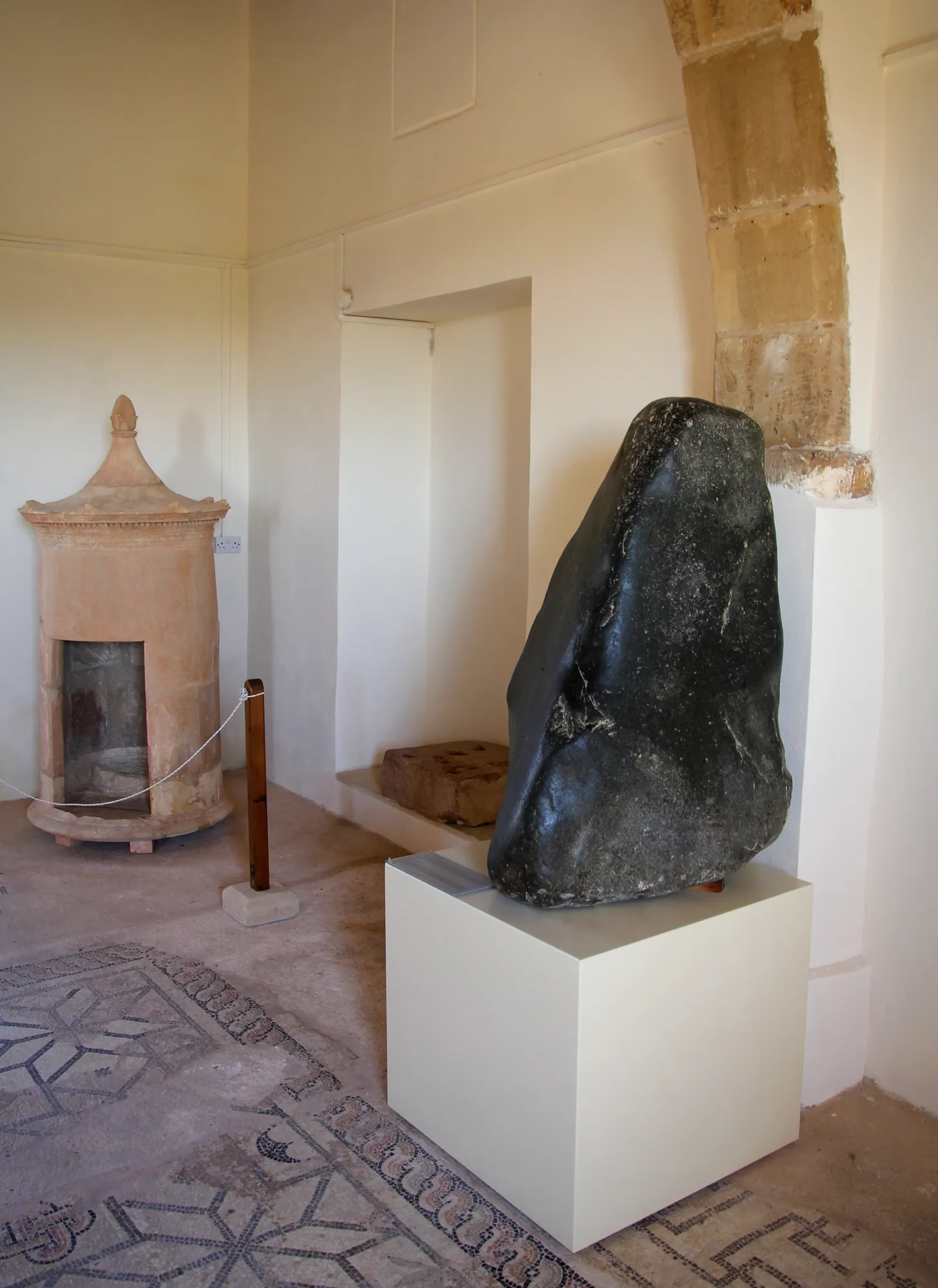
The name Aphrodite is a Greek one. In the local syllabic inscriptions the goddess is called wanassa, "the Lady", and the kings of Paphos styled themselves "King of Paphos and Priest of the Wanassa" [1, p. 22; 22]. Greek and Roman writers describe her festival: pilgrims walked in procession from Nea Paphos to the old sanctuary, no blood was shed on the main altar, which received only incense and pure fire, and initiates of her mysteries received a lump of salt and a phallus [6, p. 84]. Tacitus repeats a belief that rain never wetted the altar, although it stood in the open [6, p. 98].
The sanctuary of the Archaic, Classical and Hellenistic periods is known almost only from its votive offerings, among them thousands of terracotta figurines and fragments of limestone sculpture, published by Leibundgut Wieland and Frey-Asche [16]. One of the few objects from the 1888 excavation that the British Museum records as from the sanctuary itself is a bronze sistrum with a head of the Egyptian goddess Hathor.
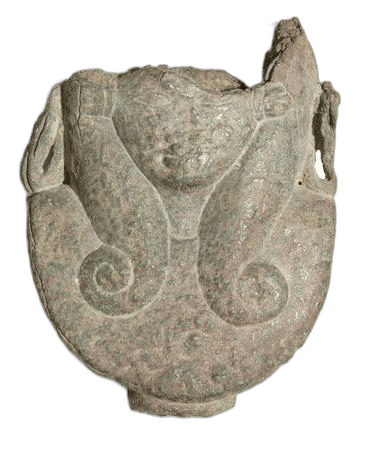 Bronze Hathor SistrumArchaic I · 750–500 BCBritish Museum
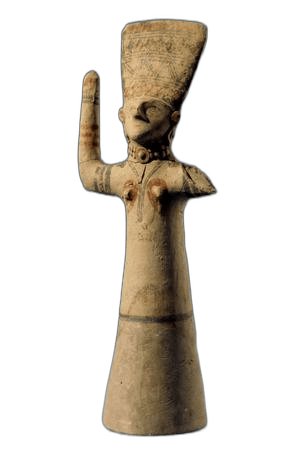 Elaborate Terracotta WorshipperArchaic I · 750–600 BCBritish Museum
Sanctuary II, about AD 100
The future emperor Titus visited the sanctuary in AD 69 on his way to Egypt and Syria; a marble altar he dedicated to the goddess was found in 1888, and Tacitus's account of his visit is the fullest ancient description of the sanctuary [6, p. 272]. Whatever Titus saw has gone. The Roman buildings excavated on the site form a single scheme of the end of the 1st or the beginning of the 2nd century AD, probably built after an earthquake of AD 76/77 had damaged the sanctuary [6, p. 272].
Sanctuary II was a rectangular complex of about 79 by 67 m. Long halls on the north and south and an east wing surrounded a large open court, entered from the east by a passage 5.50 m wide; how the west side was closed is not known, because modern houses have destroyed the remains. A ramp or stair led down from the middle of the South Stoa to the old temenos of Sanctuary I, which was repaved and kept in use [6, pp. 272–273]. The South Stoa had a mosaic floor of 56 by 11 m, framed by a low wall with a raised platform 3.0 m wide behind it and a row of Roman Doric columns along its axis. The North Hall was of the same type, with its platform and mosaic added in a second phase in the later 2nd or 3rd century [6, p. 273]. The same kind of hall stands in the sanctuary of Apollo Hylates at Kourion, rebuilt after the same earthquake; the long platforms were probably for cult banquets [6, p. 276].
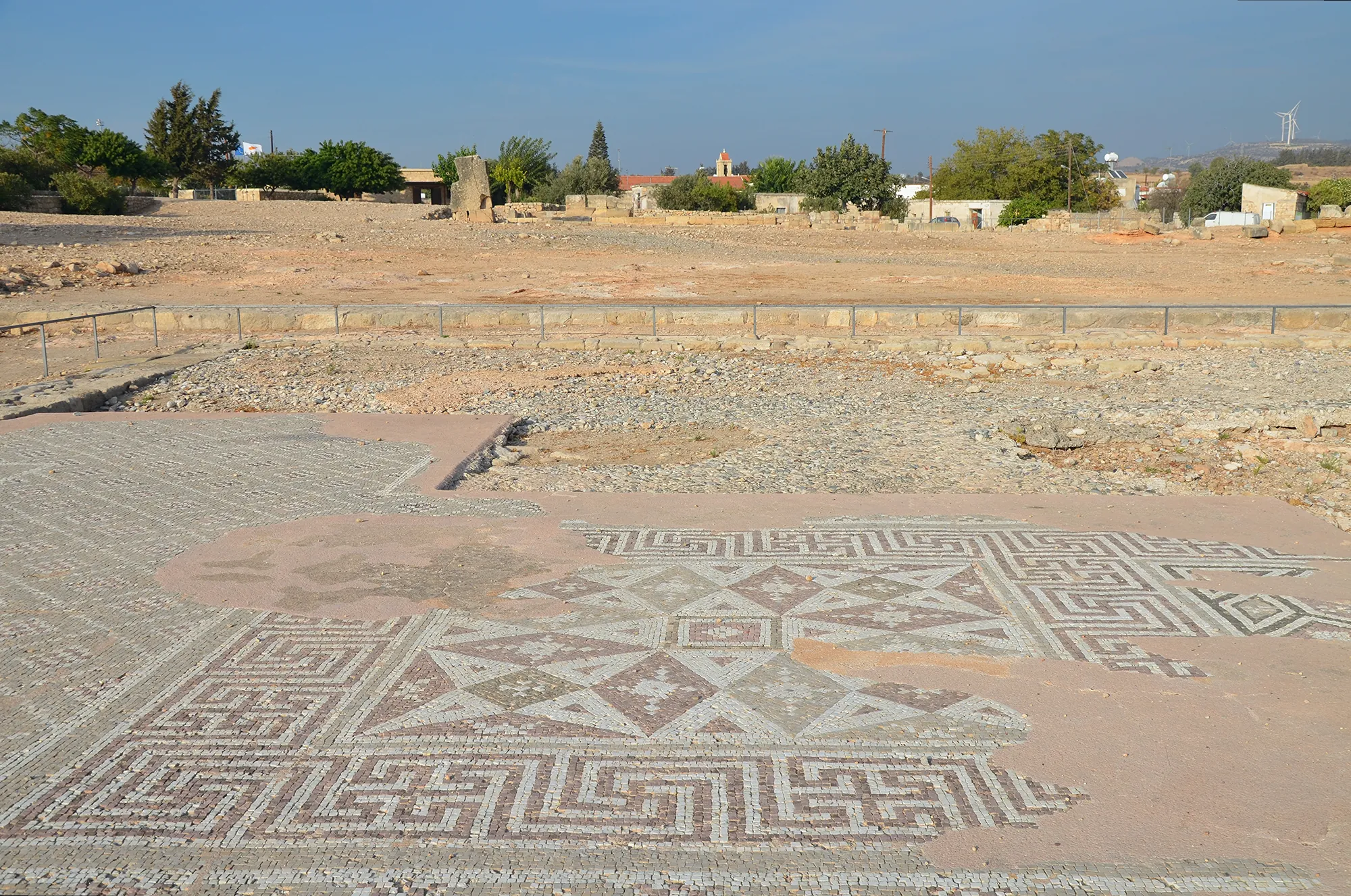
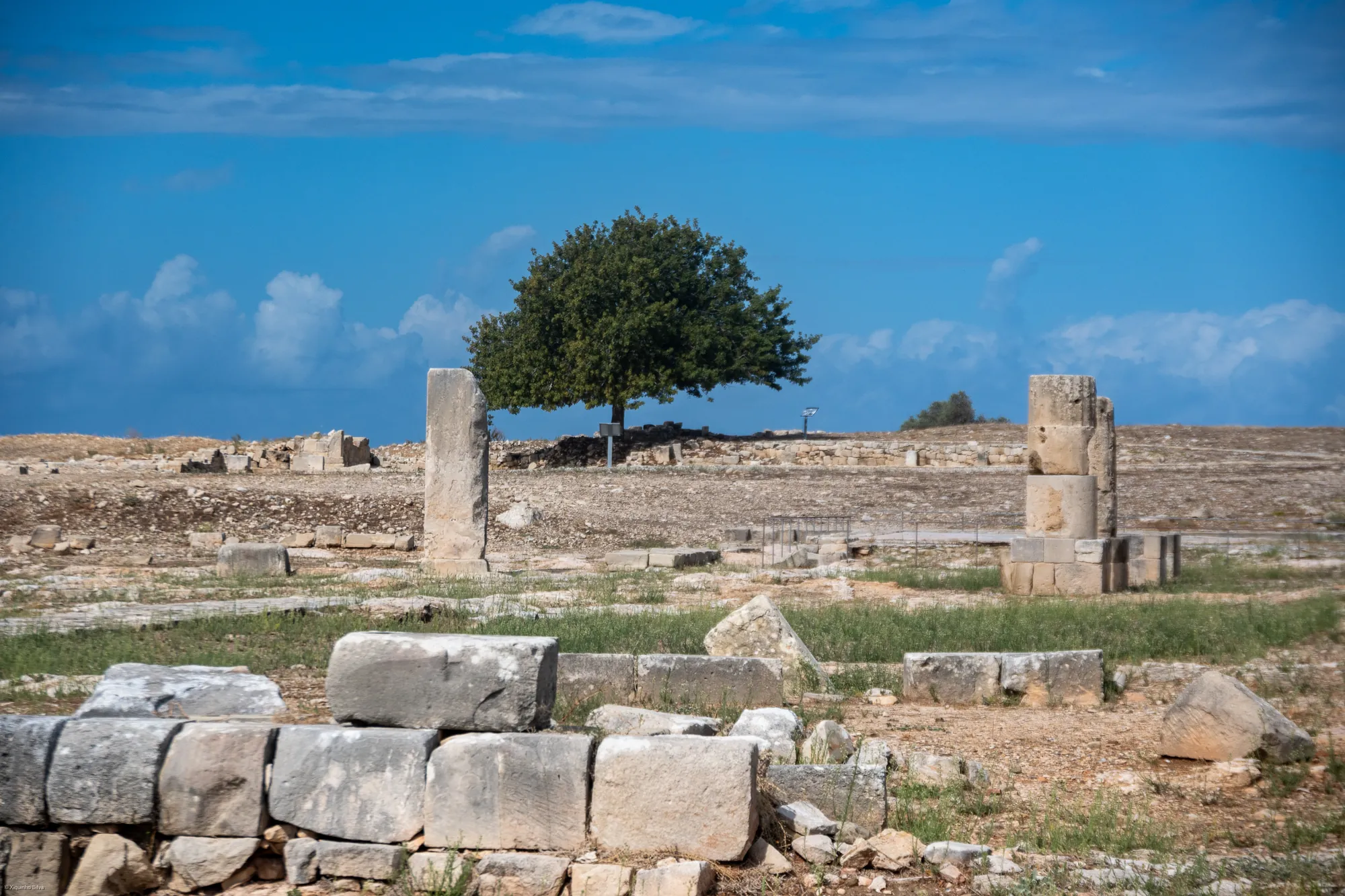
The end of the sanctuary is not dated by excavation. Medieval disturbance makes it impossible to say when the buildings were destroyed, or whether the earthquakes of the 4th century AD that struck Nea Paphos and Kourion played a part [1, p. 28]. The cult itself will have ended after the edicts of Theodosius I against pagan worship in AD 391 [1, p. 40].
The kingdom of Paphos
In the Cypro-Geometric and Cypro-Archaic periods Paphos was the capital of one of the island's kingdoms. An Assyrian list of the kings of Cyprus, inscribed for Esarhaddon in 673/672 BC, names Ituandar (Eteandros) of Paphos, the first king of the city known by name [1, pp. 21–22]. In 480 BC the king of Paphos sent twelve ships to the fleet of Xerxes [1, p. 22]. The kings wrote in the Paphian form of the Cypriot syllabary, and Iacovou has argued that the use of the script was itself an expression of royal authority [23]; see writing and literacy.
The city was first fortified in the early Archaic period and its defences were rebuilt shortly before the revolt of 499 BC [1, p. 67]. On the Hadjiabdoulla plateau, about ten minutes' walk east of the sanctuary, the Swiss-German mission excavated a large public building of the 6th or early 5th century BC, built against the inner face of the city wall [1, p. 75]. Maier thought it was lived in through the Classical period and fell into ruin towards the end of the 4th century BC [1, pp. 74–76]. The Palaepaphos Urban Landscape Project reads Hadjiabdoulla as part of a citadel with storerooms and workshops, gradually abandoned before the late 2nd century BC [3]. On Laona, a rampart of mudbrick and earth of the late 6th or early 5th century BC was buried under a great artificial mound, a tumulus raised in the 3rd century BC [24; 25]. Excavation in 2025 was reported to have uncovered towers of a Cypro-Classical fortification wall between Laona and Hadjiabdoulla, standing 1.40 to 2 m high [26].
The Northeast Gate and the siege of 498 BC
In 499 BC the Greek cities of Asia Minor rose against Persia, and all the kingdoms of Cyprus except Amathus joined the revolt. In 498 BC a Persian army landed in the Karpas, defeated the Cypriots in the plain of Salamis and then reduced the cities one by one [6, p. 193]. Herodotus says only that Soloi held out longest, and fell after five months when the Persians undermined its walls [6, p. 193; 1, p. 71]. At Paphos the attack fell on the Northeast Gate on the Marcello hill [6, p. 194]; see the Achaemenid Persian empire and fortifications.
Ramp and counter-mines
The excavators found glacis, ditch and berm buried under a vast heap of stones, rubble and earth, standing 4.50 m above the edge of the counterscarp and more than 7.0 m above the bottom of the ditch. They interpreted it as the ramp of the Persian siege army. It contained ash, burnt bone, charcoal and great quantities of broken limestone sculpture, the votive gifts of an Archaic sanctuary that had stood outside the wall [6, pp. 197–198]. That sanctuary seems to have been an open-air precinct full of statues, stelae and votive columns, with strong Phoenician traits; it may have been dedicated to Aphrodite-Astarte and to the Phoenician god Melqart [6, pp. 190–192].
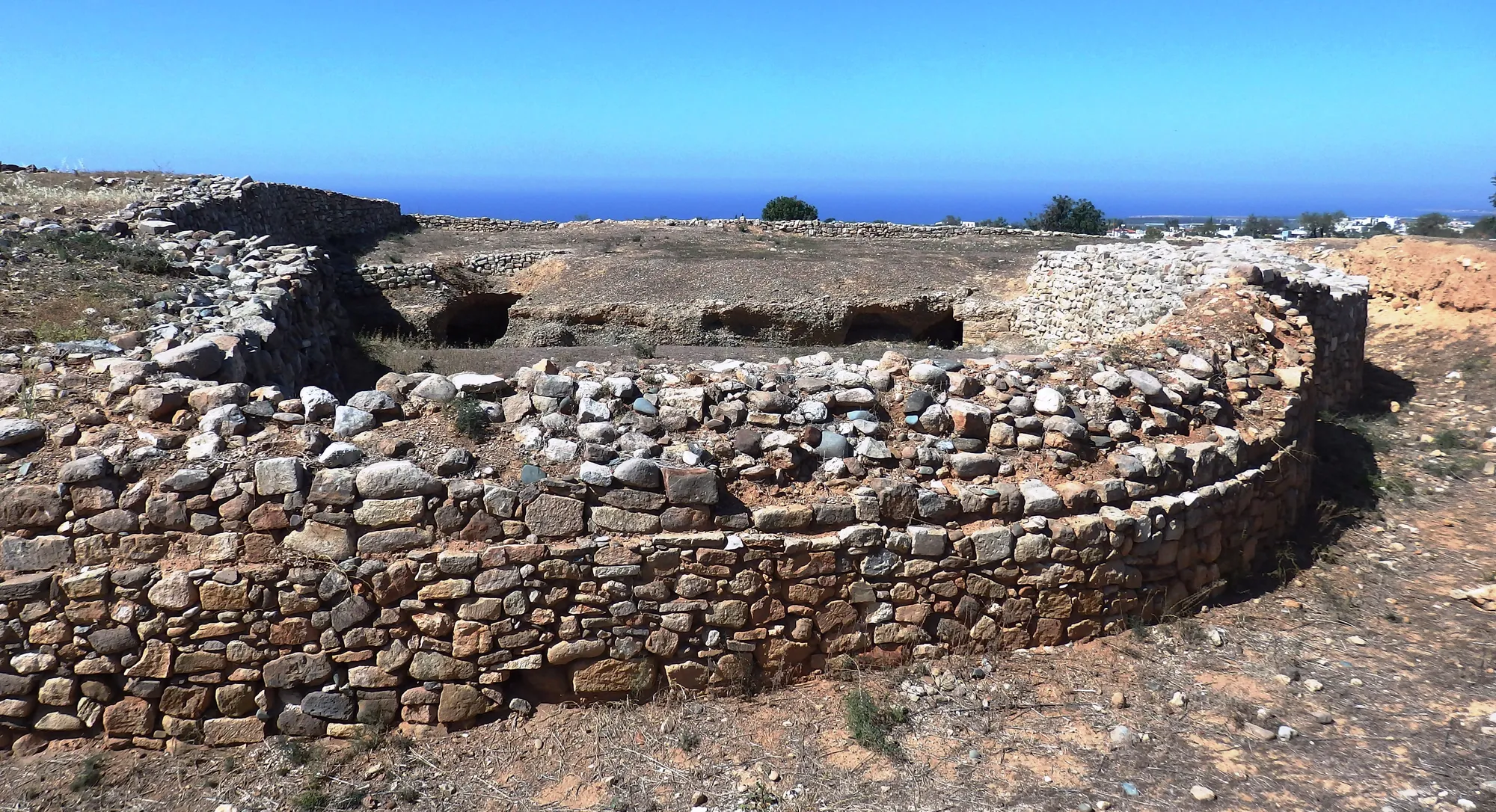
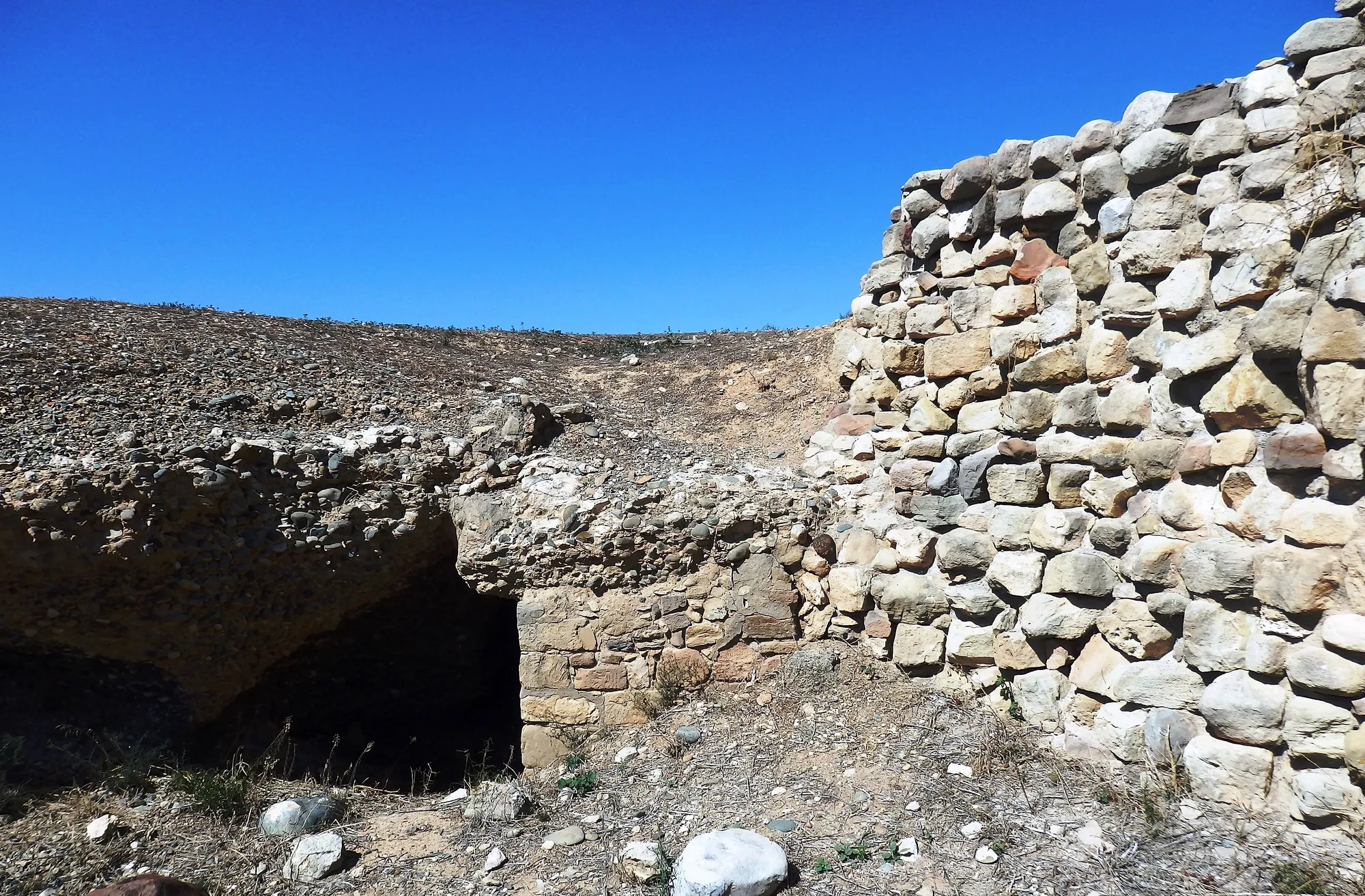
The defenders undermined the ramp from inside the city: by a passage cut through the berm and by four tunnels cut through the rock beneath the wall [6, p. 200]. Tunnel 1 is 1.20 to 1.70 m wide and 1.70 to 2.30 m high; open clay lamps stood in niches in its walls and a jug for water lay on its floor. Tunnels 2 and 4 were never finished [6, pp. 198, 200; 1, p. 70]. At the ends of the passage and of Tunnels 1 and 3, under the ramp, stood large bronze cauldrons on mudbrick bases, filled with charcoal and lime. Maier interpreted them as the means of firing the timbers that propped the tunnels, so that part of the ramp would collapse and overturn the attackers' wooden siege tower [6, pp. 200, 202; 1, p. 71].
The mound also held more than 500 iron and bronze javelin points, spearheads and arrowheads, fragments of an iron helmet, and a Late Archaic Greek bronze helmet of Corinthian type with striding lions on the cheekpieces, which Maier and Karageorghis described as the only Greek bronze helmet then known from a battle rather than a sanctuary or grave [6, p. 198]. More than 450 rounded limestone balls, weighing 2.7 to 21.8 kg, led the excavators to suggest that some kind of stone-throwing engine was used, a century before the first catapults recorded in the written sources [6, pp. 198–200]. The weapons and small finds were published by Erdmann, the stratigraphy and building history by Maier, and the sculpture by Leibundgut Wieland and Tatton-Brown [14; 15; 17].
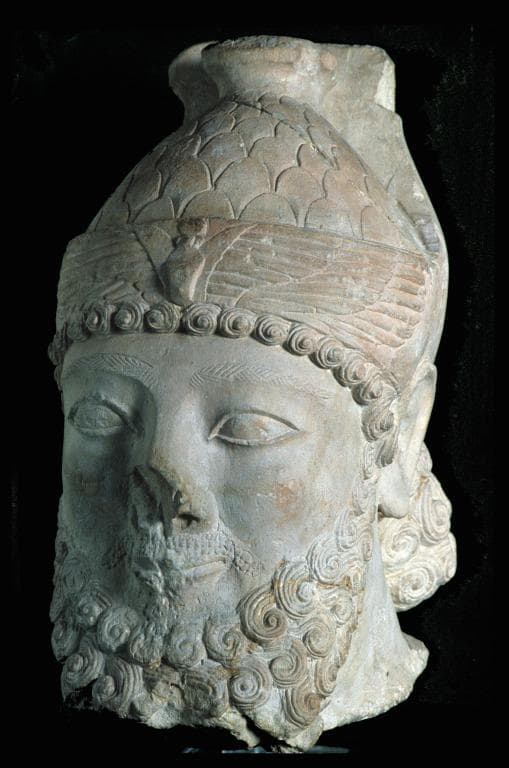 Sculpture of a Priest KingArchaic II · 575–475 BCLiverpool Museum
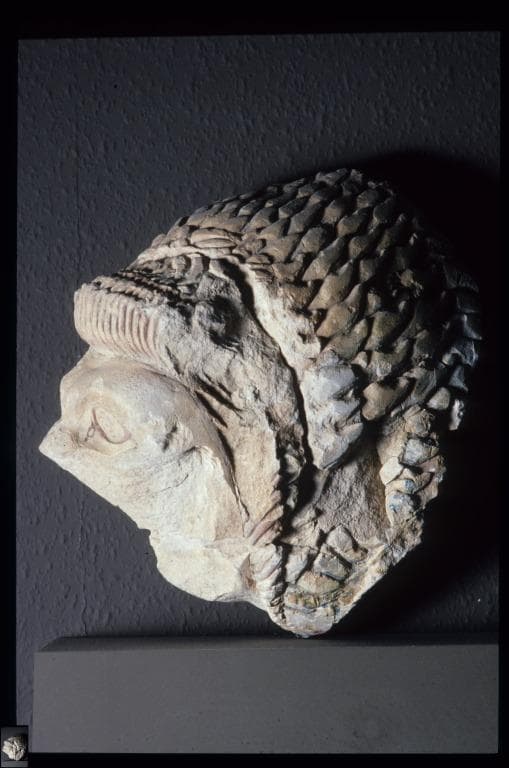 Sculpture of a Lion's HeadArchaic II · 575–475 BCLiverpool Museum
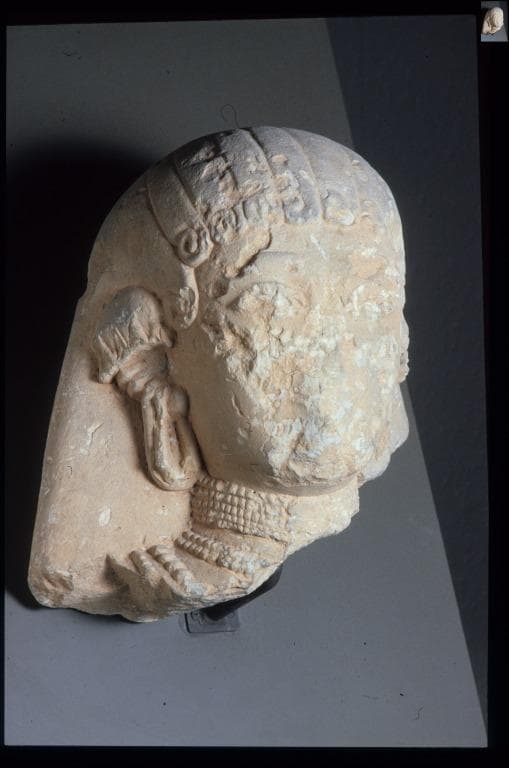 Sculpture of a WomanArchaic II · 575–475 BCLiverpool Museum
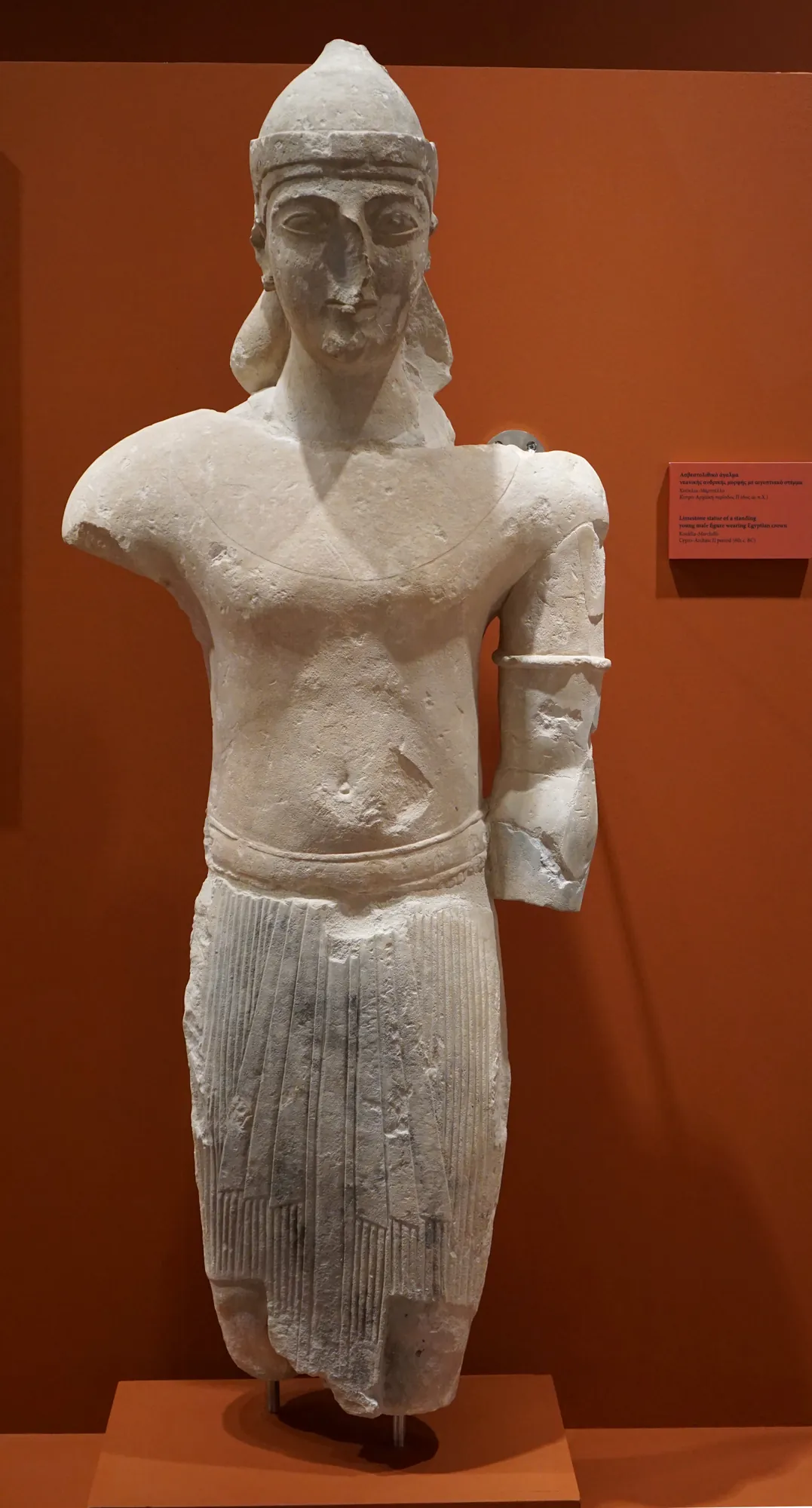
Another reading of the mound
Maier's reading of the Marcello mound as a Persian siege ramp is the standard account, but it has been questioned. The Palaepaphos Urban Landscape Project argues that the face of the wall against which the "ramp" leans is the inner side of the wall, not the outer, and that the mound is better understood as a votive deposit [27, p. 256; 20; 3]. On this view the Marcello structures need not be the town's outer defence at all. The question is open, and both readings rest on the same excavated evidence.
When the wall was rebuilt in the mid-4th century BC, possibly by the last king, Nikokles, who recorded that he "girded the city with a garland of towers", the mound was left in place and enclosed in the new defences [1, p. 67]. If Maier's reading is right, the Archaic limestone sculpture and the syllabic inscriptions buried in the mound are all older than 498 BC, a fixed point for dating both.
Cemeteries and the royal tomb
The town was ringed by cemeteries of rock-cut chamber tombs. Their use runs from the Middle Cypriot period to Roman times; see Bronze Age chamber tombs.
Skales, south-east of the village, is the richest Cypro-Geometric cemetery known in Cyprus. Its chamber tombs have long entrance passages, and their contents include gold, Canaanite transport amphorae, bronze bowls and tripods and iron swords [18]. The tombs of Palaepaphos stand out for their many bronze and iron weapons, helmets in two warriors' tombs, and bronze vessels [19, p. 59]. Tomb 49, of the first Cypro-Geometric phase (about 1050 to 950 BC), held three inscribed bronze spits (obeloi). One, 87 cm long, reads o-pe-le-ta-u, "of Opheltas", the earliest known text in the Greek language from Cyprus [23, p. 138; 28]. Whether its script is an early form of the Cypriot syllabary or still Cypro-Minoan is debated [23, p. 138; 28]. Karageorghis first dated the cemetery from Cypro-Geometric IA; the later excavations found Tomb 192, of pure Late Cypriot IIIB date, so the cemetery began in the last phase of the Late Bronze Age [19, p. 59]. Skales lies on private land, about 1200 m south-east of the village. Mechanical levelling has damaged it, and its gold has drawn looters, who are still active there [19, p. 59].
Plakes, west of the Dhiarizos, is a second Early Iron Age cemetery, excavated by Raptou from 2002 [4]. Evreti, Teratsoudhia and other localities around the town held the tombs of the Late Bronze Age [12; 21].
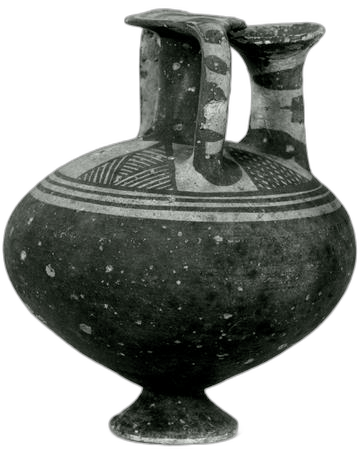 "Proto-White Painted Stirrup Jar"Late Bronze Age III · 1100–1000 BCBritish Museum
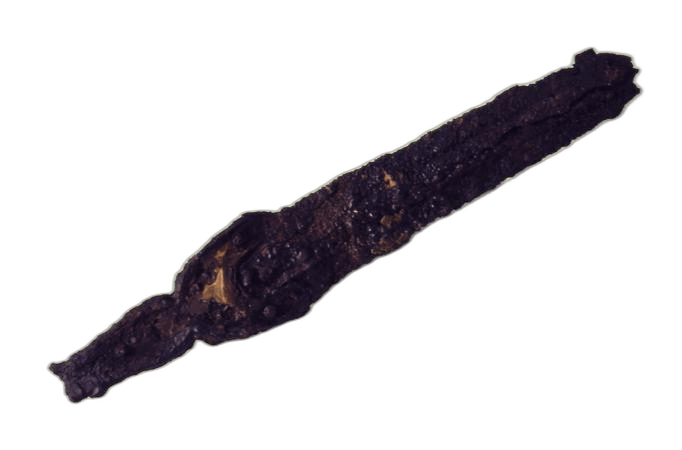 Naue II Iron DaggerGeometric · 1050–600 BCBritish Museum
The Spilaion tis Reginas, the "Queen's Cave", is the only true royal tomb known in the Paphos area. Its inscriptions in the syllabary name the kings Timocharis and Echetimos, who were buried here in the mid-4th century BC; the tomb was reused in Roman times and held 281 Roman lamps [1, p. 78].
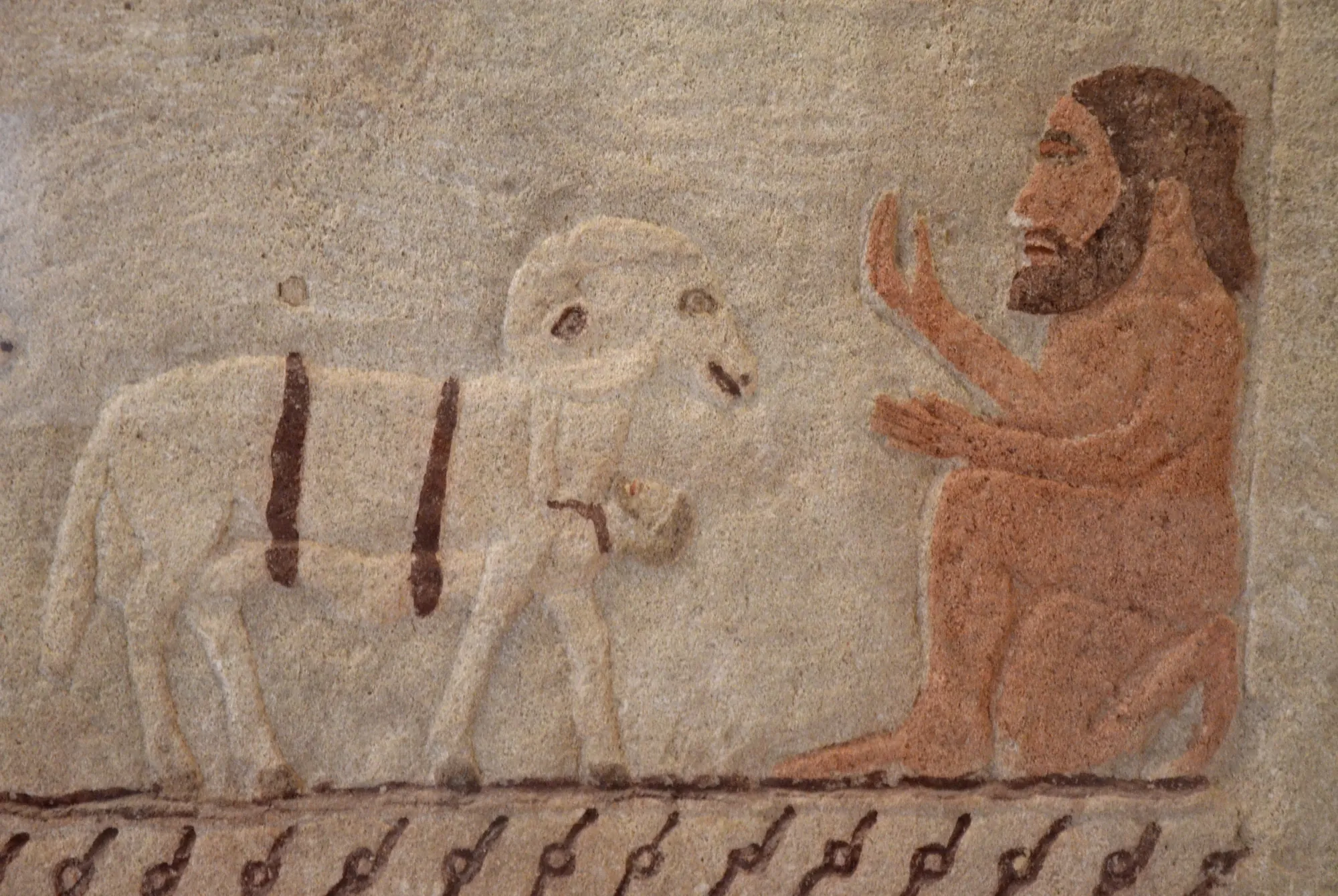
Hellenistic and Roman Palaepaphos
After Nikokles founded Nea Paphos as a harbour town and new capital, about 320 BC, the old city declined, but the sanctuary did not. After the Ptolemies took final control of Cyprus in 284 BC the kingdom lost its independence, but the old royal family kept the high priesthood of the goddess [1, p. 22]. The Hellenistic dedications from the sanctuary were published by Mitford [29]. Under Rome, Pomponius Mela counted Palaipaphos among the three chief cities of the island [1, pp. 27–28]; see the Hellenistic and Roman periods.
Roman houses with mosaic floors stood in the western part of the old town. In the house at Alonia found by the Swiss-German mission in 1972, the triclinium, 5.50 by 6.0 m, had a mosaic of geometric zones around one figured panel, 1.0 by 1.0 m, showing Leda and the swan [6, p. 280]. On grounds of style Maier and Karageorghis dated it to the late 2nd or early 3rd century AD [6, p. 281]. The panel now on the site is a modern copy [1, p. 52].
The Lusignan manor and the sugar estate
Under the Lusignan kings Kouklia became the centre of the royal sugar estates of the Paphos region. The manor was built in the 13th century as their administrative headquarters; after the Ottoman conquest of 1571 it became a farm, a çiftlik, and only parts of the gate tower and of the east and south wings are medieval [1, p. 57]. The east wing holds a Gothic hall of four rib-vaulted bays, 30.24 by 6.95 m [6, p. 329]. The government bought the manor in 1951 and restored it as a museum from the late 1950s [1, p. 31]; see the medieval period.
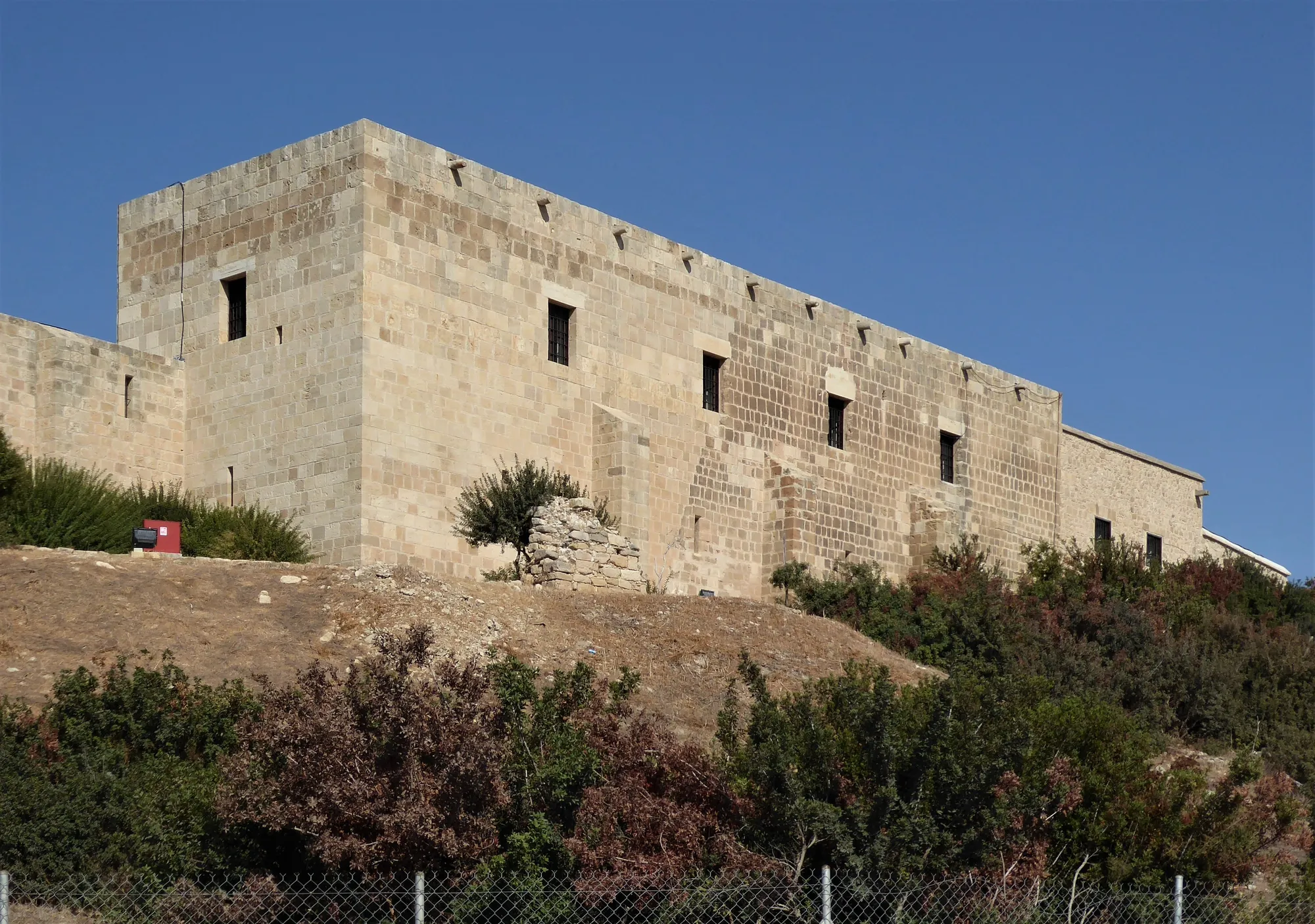
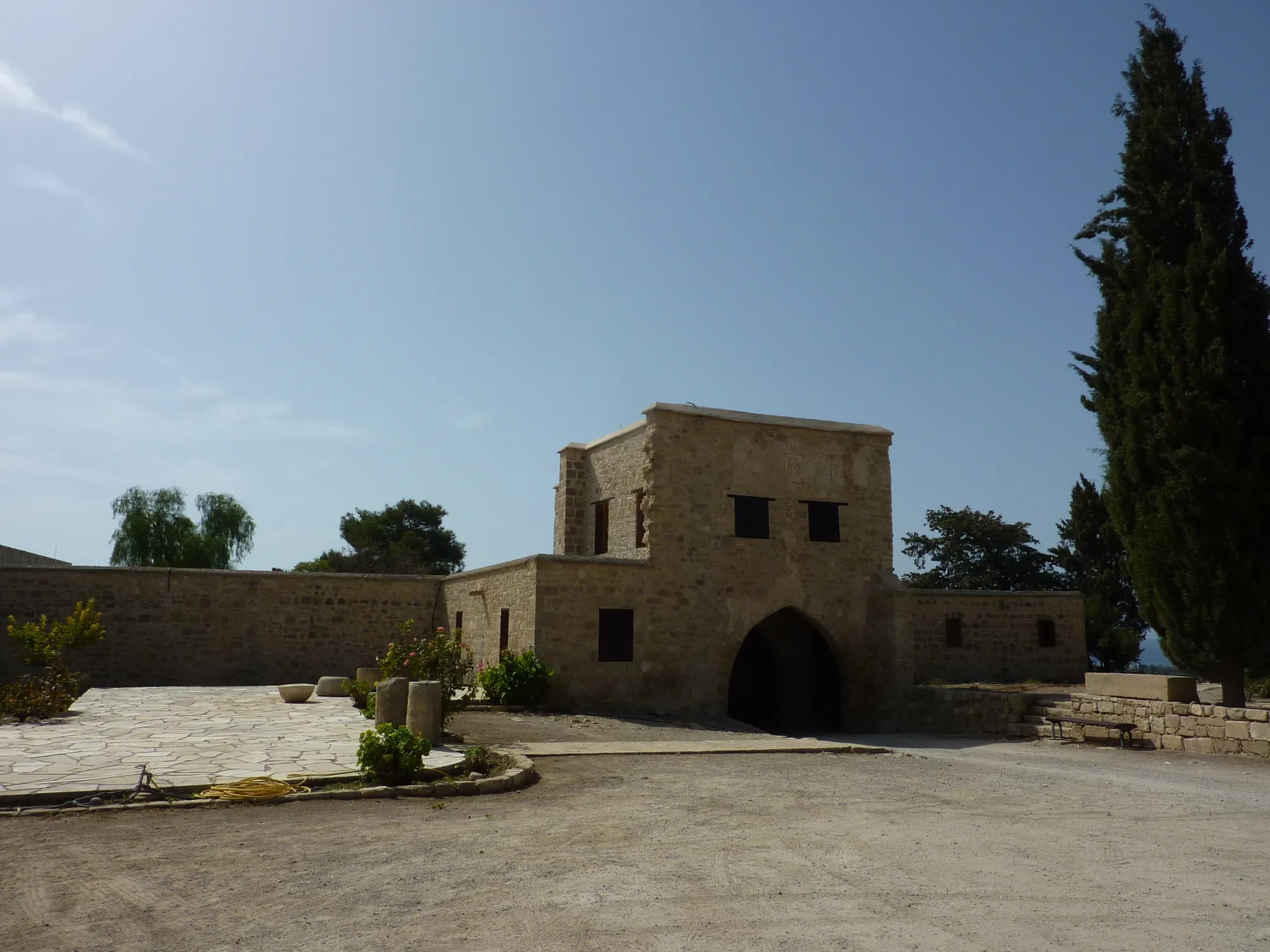
Below the manor, at Stavros, von Wartburg excavated the sugar refinery. Cane juice was boiled in large copper cauldrons over hearths fed from four stoke rooms outside the main hall [1, p. 99]. Near the village, two huge perforated calcarenite monoliths at Stillarka, long taken for prehistoric standing stones, were shown by Sophocles Hadjisavvas's excavation in 1990 to be the parts of an olive press [30].
Nea Paphos
Nikokles, the last king of Paphos, founded Nea Paphos on the coast about 16 km to the west, as a harbour town and new capital, about 320 BC [1, pp. 12, 22]. Under the Ptolemies and the Romans it was the capital of Cyprus, and it has the island's best-known Roman house mosaics and the rock-cut tombs called the Tombs of the Kings, which held the burials of its wealthy citizens. The two towns stayed linked through the cult. At the festival of the goddess, pilgrims landed at the harbour of Nea Paphos and walked in procession along the road to the old sanctuary [1, pp. 27–28; 6, p. 84]. Nea Paphos and Kouklia form the two parts of the UNESCO World Heritage Site of Paphos, inscribed in 1980 [2].
Visiting Palaepaphos
The site lies at Kouklia, beside the Paphos to Limassol road, and is managed by the Department of Antiquities. One ticket covers the Local Museum of Palaipaphos in the manor and the sanctuary beside it, with the Bronze Age temenos wall, the Roman halls and the copy of the Leda mosaic. The Northeast Gate on the Marcello hill and the Hadjiabdoulla plateau are a walk away across the fields; Tunnel 1 of the siege works is preserved and can still be entered [1, p. 70]. The museum shows the conical stone, finds from the sanctuary, the siege mound and the tombs, and sugar moulds from the refinery. Opening times and fees change; check the Department of Antiquities before you go.
Finds from Palaepaphos are also in the Cyprus Museum in Nicosia, the Paphos District Museum, the British Museum, the Ashmolean Museum and the World Museum in Liverpool, whose collection comes from the British Kouklia Expedition.
Pieces in the Drakopoulos collection of kinds found at this site. None of them comes from the site.
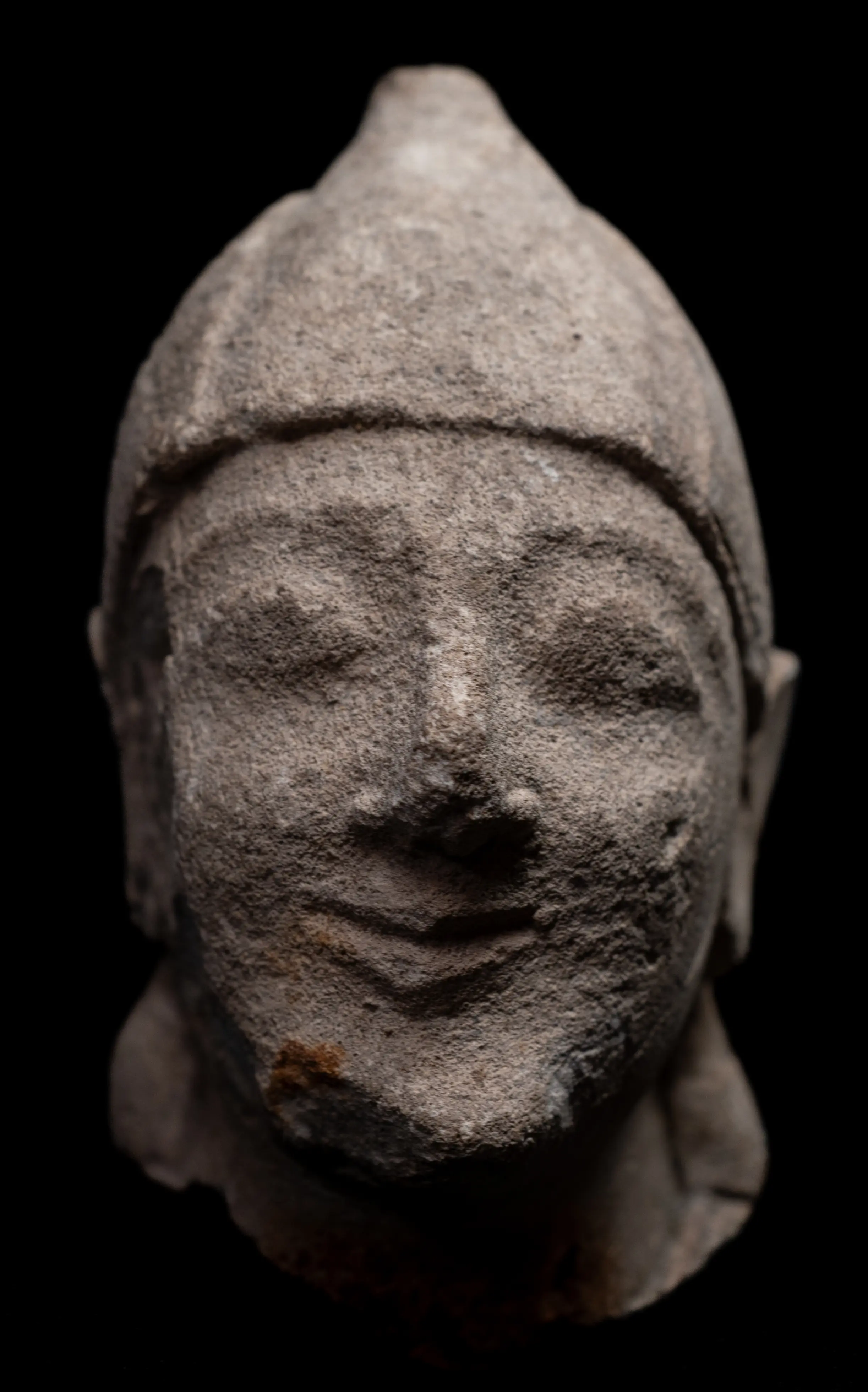 Limestone Head of a Beardless Votary in a Conical HelmetArchaic II · 600–500 BCDrakopoulos collection
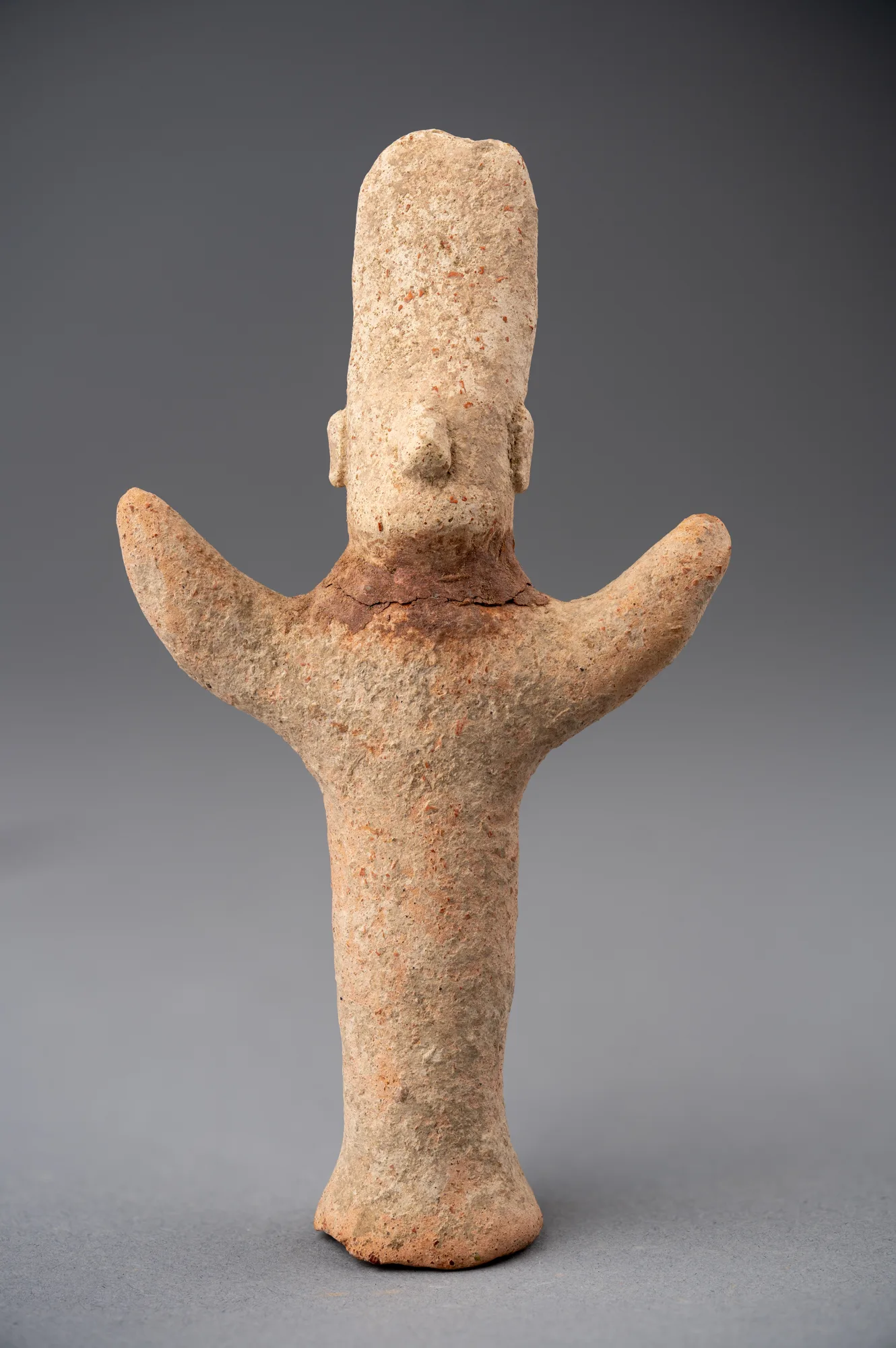 Terracotta Figure with Upraised Arms and Tall Cylindrical HeaddressArchaic · 750–480 BCDrakopoulos collection
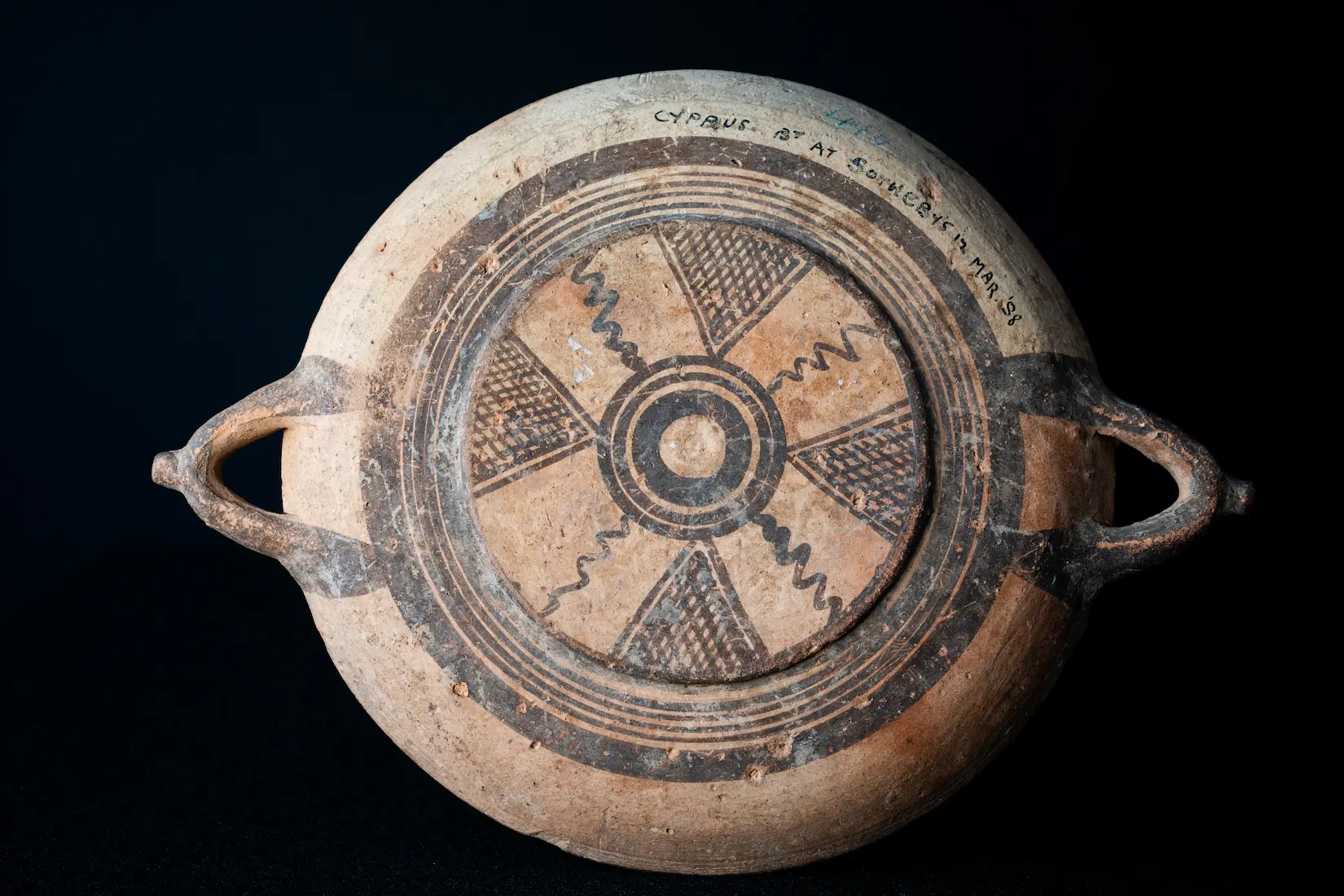 White Painted Plate with Latticed Triangles and Wavy Lines on the UndersideGeometric I · 1050–850 BCDrakopoulos collection
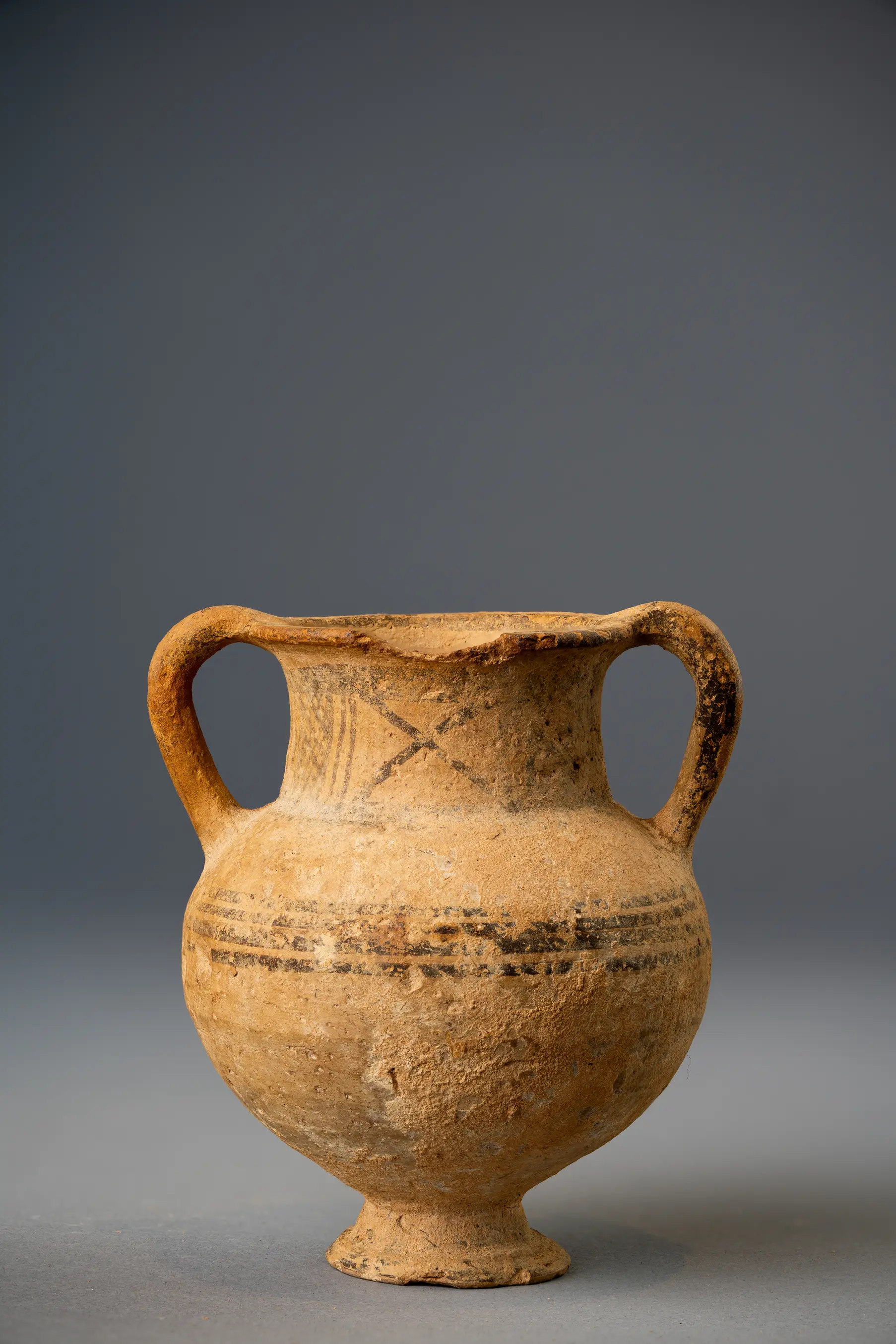 White Painted Amphoriskos on a Conical FootGeometric I · 1050–850 BCDrakopoulos collection
Finds from Palaepaphos (Kouklia)
- Bow-shaped gold fibulaLate Bronze Age III · 1100–1050 BCAshmolean Museum
- Gold bow shaped fibulaLate Bronze Age III · 1100–1050 BCAshmolean Museum
- Gold finger ringLate Bronze Age III · 1100–1050 BCAshmolean Museum
- Circular pendant, Gold bulla: Plain on one side, the other with attached rim and central circle, five dots, op has barrel-shaped ring for suspensionLate Bronze Age III · 1100–1050 BCAshmolean Museum
- White Painted V round-bottomed and wide-necked jarMiddle Bronze Age III · 1750–1550 BCAshmolean Museum
- White Painted bird-shaped figurineMiddle Bronze Age II · 1850–1650 BCAshmolean Museum
- Disc Shaped LidLate Bronze Age II · 1350–1250 BCLiverpool Museum
- FrontletLate Bronze Age II · 1350–1250 BCLiverpool Museum
- Cylinder SealLate Bronze Age II · 1350–1250 BCLiverpool Museum
- Bronze Hathor SistrumArchaic I · 750–500 BCBritish Museum
- Elaborate Terracotta WorshipperArchaic I · 750–600 BCBritish Museum
- Sculpture of a Priest KingArchaic II · 575–475 BCLiverpool Museum
and 4 more objects with a findspot here in the catalogue
In the Drakopoulos collection
Pieces in the Drakopoulos collection of kinds found at this site. None of them comes from the site.
- Limestone Head of a Beardless Votary in a Conical HelmetArchaic II · 600–500 BC
- Terracotta Figure with Upraised Arms and Tall Cylindrical HeaddressArchaic · 750–480 BC
- White Painted Plate with Latticed Triangles and Wavy Lines on the UndersideGeometric I · 1050–850 BC
- White Painted Amphoriskos on a Conical FootGeometric I · 1050–850 BC
Excavation history
- 1802Palaepaphos: Hammer-Purgstall and the Tigre's boat crewDirected by Joseph von Hammer-PurgstallClearance and early digging
- 1862Palaepaphos: de Vogue and the Spilaion tis ReginasDirected by Melchior de Vogüé and Edmond DuthoitClearance and early digging
- 1869–1875Palaepaphos: Cesnola's diggings at KoukliaDirected by Luigi Palma di CesnolaClearance and early digging
- 1885Ktima: Ohnefalsch-Richter's tomb clearanceDirected by Max Ohnefalsch-RichterClearance and early digging
- 1888Palaepaphos: the Cyprus Exploration Fund at KoukliaDirected by Ernest Arthur Gardner and David George HogarthExcavation
- 1899Palaepaphos: the British Museum tomb excavations at KoukliaDirected by Francis Bertram Welch and Percy ChristianExcavation
- 1950–1955Kouklia: the British Kouklia Expedition (Liverpool and St Andrews)Directed by Terence Bruce Mitford and John Henry (Harry) IliffeExcavation
- 1953–1955Ktima: the French Mission at the Iskender cemeteryDirected by Jean BérardExcavation
Show all 18 projects
- 1954–1993Kouklia: Department of Antiquities rescue excavations (Kouklia Museum)Directed by J. S. Last and Ioannis ViolarisRescue excavation
- 1961–1969Ktima: Department of Antiquities rescue work, 1961–1969Rescue excavation
- 1963Ktima-Shyrvallos: the early Christian basilicaDirected by Athanasios PapageorghiouExcavation
- 1966–2008Palaepaphos: the German-Swiss MissionDirected by Franz Georg Maier and Marie-Louise von WartburgExcavation
- 1979–1991Palaepaphos: the Canadian Palaipaphos Survey ProjectDirected by David W. RuppSurvey
- 1980–1981Iskender cemetery: Department of Antiquities rescue work, 1980–1981Rescue excavation
- 1990Palaepaphos-Styllarka: the Department's excavation of the monolithsDirected by Sophocles HadjisavvasExcavation
- 1999–2011Palaepaphos: Department of Antiquities excavations under E. RaptouDirected by Eustathios RaptouExcavation
- 2002–2003Palaepaphos Archaeological Atlas Project (GIS and geophysical survey)Directed by Maria Iacovou, Vassiliki Kassianidou, George Papasavvas and othersGeophysical survey
- 2006–todayPalaepaphos Urban Landscape Project (PULP)Directed by Maria Iacovou and J. TabolliExcavation
Reconstruction
In the news
·Fieldwork
Late Bronze Age tower found on the city wall of Palaepaphos, near Aphrodite's sanctuary·People
Malcolm Wiener, founder of the Institute for Aegean Prehistory, dies at 91·Events
Artemis Georgiou lectures in Toronto on Cypriot storage jars rolled with chariot hunts and griffins·Museums
Ashmolean Aphrodite curator Anja Ulbrich lectures in London on 21 November and Oxford on 13 December·Events
Maria Iacovou to speak on Cypriot archaeologists at a free GACUK 40th anniversary evening in London
Lectures and videos
2026·1 h 18 min
Recent finds and new directions in the epigraphy of ancient CyprusArtemis Karnava
2026·55 min
After Collapse: The World of the Early Iron Age2025·53 min·In Greek
German and German-Speaking Archaeologists and Other Scholars in Cyprus (19th and Early 20th Centuries)Yiannis Violaris
2025·56 min
Alashiya: Cyprus in the Bronze Age2025·43 min
Before Collapse: The Late Bronze Age World
63 more →
2025·40 min
Building Bronze Age Cyprus: An Integrative Approach to Monumental Architecture and Ashlar MasonryCaroline Barnes, Graham Braun
2025·57 min
Cypriot Archaeology between Classical and Near Eastern TraditionsCatherine Kearns
2025·15 min
How many Alashiyas were there?2024·11 min
The Last Kingdom Standing in the Bronze Age Collapse2024·53 min
Masons' Marks and the Circulation of Builders in the Bronze Age Aegean and CyprusMaud Devolder
2024·46 min
A new Greco-Roman temple in Cyprus? A set of decorated stone details from the Latsithkia site: Reconstruction potential and research prospectsAnna Urszula Kordas, Monika Rekowska, Aleksandra Brzozowska-Jawornicka, Szymon Popławski
2024·1 h
Cypro-Minoan and Other Potmarks on Late Bronze Age PotteryNicolle Hirschfeld
2023·53 min
The Political and Administrative Systems of the Classical Cypriot City-KingdomsBeatrice Pestarino
2023·1 h 5 min
Monumentality, Placemaking and Social Interaction on Late Bronze Age CyprusKevin Fisher
2023·1 h 5 min
Cypriot Antiquities in the Alexander Malios CollectionGabriele Koiner, Alexander Malios, Alexander Gatzsche
2023·1 h 3 min
Beyond Cyprus: Investigating Cypriot Connectivity in the Mediterranean from the Late Bronze Age to the End of the Classical PeriodLindy Crewe, Erin Walcek Averett, Giorgos Bourogiannis
2023·47 min
Cretan and Cypriot Writing in the 2nd and 1st Millennia BC: On Seeing and BelievingArtemis Karnava
2022·1 h
1st Graduate Forum for Mediterranean Archaeology: Merchants and mercantile elites in Late Bronze Age CyprusA. Bernard Knapp
2022·1 h 14 min
Writing, marking and trade in Late Bronze Age CyprusCassandra Donnelly
2022·55 min
Literary Cartographies: Hilarion's CyprusVirginia Burrus
2021·45 min
Maritime transport containers and the COMPASS project in Late Bronze and Early Iron Age CyprusArtemis Georgiou
2021·37 min
From Early Bronze to Early Iron Age Cyprus: A Diachronic Analytical Study of Copper-Based ArtifactsAndreas Charalambous
2021·1 h 18 min
Leonardo da Vinci's Alleged Visit to Cyprus in 1481 AD and Its Link to LefkaraRobert Merrillees
2021·1 h 31 min
The tumulus of Laona: an un-Cypriot monument in the landscape of the islandMaria Iacovou
2021·58 min
Cypriot copper production, consumption and trade in the 12th century BCVasiliki Kassianidou
2021·30 min
Cypriot Antiquities in the Antipodes: The Diaspora of Cypriot Material Culture to Australia during the Era of British ColonialismCraig Barker
2021·19 min
Meet the Locals: The Neglected Role of Local Cypriots in the Discovery of the Island's Material Past in Late Ottoman and Early British TimesThomas Kiely
2021·17 min
Dr Francis Henry Hill Guillemard (1852–1933): Ornithologist, Incidental Antiquarian and SnobRobert Merrillees
2020·51 min
Surveillance, Survey and Local Knowledge: Landscape Relations in Late 19th Century Cypriot ArchaeologyMichael Given, Stephen Lillie
2020·18 min
Historiography and Archaeological Theory in Cypriot PrehistoryBernard Knapp
2020·27 min
Diving into the Past: Archival Research Results of the Cyprus Coastal Assessment Project and the History of the First Underwater Archaeological Explorations in CyprusPanayiotis Theofanous, Maria Volikou, Despina Pilides
2020·57 min
Cylinder-seal impressions on storage vessels from Late Bronze Age Cyprus: exploring the materiality of an idiosyncratic mechanismArtemis Georgiou
2020·31 min
The Kingdom of Alashiya and the Bronze Age CollapseLouise Hitchcock
2020·48 min
The Diaspora of Cypriot Antiquities in SwanseaErsin Hussein
2020·16 min
Kingdoms of Ancient Cyprus2020·1 h 37 min·In Greek
To Ergon 2019: Pleistocene Cyprus, Salaminian Pottery, Modern Aphrodite and Ayios SozomenosTheodora Moutsiou, Anna Georgiadou, Giorgos Papantoniou, Ourania Perdiki
2020·1 h 29 min·In Greek
To Ergon 2019: Palaepaphos, the Protaras and Mazotos shipwrecks, the Xeros valley and the AegeanAthanasios Vionis, Tasos Christofides, Marina Solomidou-Ieronymidou, Maria Iacovou, Stella Demesticha, Ourania Kouka
2019·1 h 24 min
PORPHYRA Workshop: Hellenistic and Roman Purple Dye Workshops on Agathonisi and in Chania, and Concluding DiscussionPavlos Triantafyllidis, Angeliki Tsingou
2019·1 h 34 min
PORPHYRA Workshop: Purple Dye on Rhodes, at Palaepaphos and at EretriaSophia Sotiropoulou, Maria Iacovou, Dimitra Mylona, Sophie Horacek
2019·1 h 41 min
PORPHYRA Workshop, session 1: opening addresses and Bronze Age purple dye production on ChrysiMarina Solomidou-Ieronymidou, Maria Iacovou, Thomas Brogan
2019·1 h 15 min
Theatre architecture in Cyprus: The evidence from the excavations of the Nea Paphos theatreCraig Barker
2019·1 h 56 min
A Conference in Honour of A. Bernard Knapp: Souskiou-Laona, Iron Age Communities, the Troodos and Survey TheoryLindy Crewe, Catherine Kearns, Georgia Andreou, Michael Given
2019·1 h 34 min
A Conference in Honour of A. Bernard Knapp: Bronze Age Anchorages at Maroni-Tsaroukkas and Tell Abu Hawam, and the Late Roman Maritime LandscapeKerry Fulton, Michal Artzy, Stella Demesticha
2019·1 h 18 min
Metallic Status Symbols from Cypriot Early Iron Age Elite Burials (LCIIIB/CG)Christian Vonhoff
2019·1 h 10 min·In Greek
Art and Technique of the Construction of the Laona Tumulus: A Microstratigraphic ApproachPanagiotis Karkanas
2019·18 min·In Greek
The UnSaLa-CY Project on the Sacred Topography of CyprusGiorgos Papantoniou, Athanasios K. Vionis
2019·23 min·In Greek
Palaepaphos 2018: Preliminary data on the archaeo-environment and the builders of the polity of Ancient PaphosMaria Iacovou
2019·20 min·In Greek
Cypriot Polities in the Decentralised Trade of the 12th Century BCArtemis Georgiou
2018·1 h 3 min
Bronze Age Demise, Iron Age Regeneration on CyprusA. Bernard Knapp, Nathan Meyer
2018·23 min·In Greek
Welcome addresses: The Archaeological Work of the University of Cyprus, 2017Lina Kassianidou, Constantinos Constantinou, Charalambos Bakirtzis, Giorgos Philotheou
2018·20 min·In Greek
Plans for the Corpus of the Mosaics of CyprusDemetrios Michaelides
2018·15 min·In Greek
Palaepaphos 2017 and the MEANING Research ProjectMaria Iacovou
2018·20 min·In Greek
Lapithos-Vrysi tou Barba and Pyla-Kokkinokremos: A Study of Bronze Age Copper-Alloy ObjectsAndreas Charalambous
2018·19 min·In Greek
Analysing the External Contacts of Paphos in the Late Cypriot Bronze Age: Imported Objects from the Urban Centre and the PeripheryArtemis Georgiou
2018·1 h 46 min·In Greek
The Archaeological Work of the University of Cyprus 2017: Enkomi, Palaepaphos and the Heraion of SamosVasiliki Kassianidou, Giorgos Papasavvas, Artemis Georgiou, Maria Iacovou, Ourania Kouka
2018·1 h 24 min·In Greek
The Archaeological Work of the University of Cyprus, 2017: Neolithic stone, Bronze Age metals, field databases and medieval glazed waresTheodora, Andreas Charalambous, Charis Paraskeva, Carmen Ting
2018·52 min
Historical Perspectives of Jewish Presence: Jewish Colonisation Schemes and the Post-War Internment CampsMagdalini, Yonah
2018·1 h 42 min
Historical Perspectives of Jewish Presence in Cyprus and the Hellenic World: Cultural Diplomacy and Jewish Settlements in Cyprus (1883–1938)Michael Harari, Yossi Ben-Artzi, Constantinos Christofides
2017·1 h 39 min·In Greek
Study Day on Book 23 of the Iliad: Lines 570–897, Homeric Similes, and Death in BattleVassos Karageorghis, Michalis Pieris, Antonis Tsakmakis, Maria Ypsilanti
2017·2 h 16 min·In Greek
Study Day on Book 23 of the Iliad: Dramatic Form, Cypriot Burial Customs, and the Ghost of PatroclusVassos Karageorghis, Michalis Pieris, Menelaos Christopoulos
2017·1 h 37 min·In Greek
Study Day on Book 23 of the Iliad: Cremation Burials and Homeric Heirlooms in CyprusVassos Karageorghis, Efstathios Raptou, George Papasavvas
2017·1 h 7 min·In Greek
Innovative Educational Programmes in Museums: The Ministry of Education and the Leventis Municipal MuseumTereza Lambrianou, Jenny Lymperopoulou
2017·1 h 25 min
Images of Cyprus in Medieval RussiaYulia Buzykina
2017·1 h 22 min·In Greek
Mapping a moment in the agrarian economy of Cyprus: the first Ottoman census of 1572Antonis Hadjikyriacou
2017·3 h 5 min·In Greek
The Archaeological Work of the University of Cyprus, 2016 (Part 1)Vasiliki Kassianidou, Constantinos Christofides, Marina Solomidou-Ieronymidou, Maria Iacovou, Stella Diakou, Athanasios Vionis, Ourania Kouka, George Papasavvas, Andreas Charalambous
2017·1 h 18 min
Conviviality, resilience and control: the sugar and flour mills of Medieval and Ottoman CyprusMichael Given
2017·1 h 18 min·In Greek
Second Annual Study Day of the Archaeological Research Unit: Prehistoric Stone, Palaepaphos, and Ceramic StudiesArtemis Georgiou, Maria Dikomitou-Eliadou, Charis Paraskeva
2017·1 h 48 min·In Greek
Second Annual Study Day of the Archaeological Research Unit: Palaepaphos, the Kofinou survey and the Heraion of SamosConstantinos Christofides, Marina Solomidou-Ieronymidou, Maria Iacovou, Stella Diakou, Athanasios Vionis, Ourania Kouka
Nearby sites
- Palaepaphos-Sanctuary of Aphrodite0.0 km
- Palaepaphos0.2 km
- Palaepaphos-Hadjiabdoulla0.3 km
- Palaepaphos-Marchello0.3 km
- Kouklia-Achni0.3 km
- Kouklia-Evreti0.3 km
Straight-line distances.
References
- 1.F. G. Maier. 2004. Guide to Palaipaphos (Kouklia). Nicosia: Bank of Cyprus Cultural Foundation.
- 2.UNESCO World Heritage Centre. Paphos (no. 79). https://whc.unesco.org/en/list/79/
- 3.Maria Iacovou. 2019. Palaepaphos: Unlocking the Landscape Context of the Sanctuary of the Cypriot Goddess. Open Archaeology 5, pp. 204-234. https://doi.org/10.1515/opar-2019-0015
- 4.V. Karageorghis and E. Raptou. 2014. Necropoleis at Palaepaphos from the End of the Late Bronze Age to the Cypro-Archaic Period. Nicosia.
- 5.E. A. Gardner, D. G. Hogarth, M. R. James and R. Elsey Smith. 1888. Excavations in Cyprus, 1887-88. Journal of Hellenic Studies 9, pp. 147-271.
- 6.F. G. Maier and V. Karageorghis. 1984. Paphos: History and Archaeology. Nicosia: A. G. Leventis Foundation.
- 7.R. S. Merrillees. 2015. The Mythology Around a Myth: Aphrodite and Petra tou Romiou. Cahiers du Centre d'Études Chypriotes 45, pp. 29-43. https://doi.org/10.3406/cchyp.2015.1620
- 8.F. G. Maier. 1997. A hundred years after Hogarth: Digging at Aphrodite's Sanctuary at Palaipaphos. Cahiers du Centre d'Études Chypriotes 27, pp. 127-136.
- 9.T. Kiely. 2015. Finds from Kouklia in the British Museum. Cahiers du Centre d'Études Chypriotes 45, pp. 63-80.
- 10.T. B. Mitford and J. H. Iliffe. 1951. Excavations at Kouklia (Old Paphos), Cyprus, 1950. Antiquaries Journal 31, pp. 51-66.
- 11.J. H. Iliffe and T. B. Mitford. 1952. Excavations at Aphrodite's Sanctuary of Paphos (1951). Liverpool Bulletin 2, pp. 29-66.
- 12.H. W. Catling. 2020. Kouklia: Late Bronze Age and Early Iron Age Tombs at Palaepaphos 1951-1954. Edited by R. W. V. Catling. Oxford: BAR Publishing.
- 13.F. G. Maier and M.-L. von Wartburg. 1985. Reconstructing history from the earth, c. 2800 B.C.-1600 A.D.: excavating at Palaepaphos, 1966-1984. In V. Karageorghis (ed.), Archaeology in Cyprus 1960-1985, pp. 142-172. Nicosia.
- 14.E. Erdmann. 1977. Nordosttor und persische Belagerungsrampe. I. Waffen und Kleinfunde. Ausgrabungen in Alt-Paphos auf Cypern 1. Konstanz.
- 15.F. G. Maier. 2008. Nordost-Tor und Belagerungsrampe. II. Grabungs- und Baubefund. Ausgrabungen in Alt-Paphos auf Cypern 6. Mainz am Rhein.
- 16.D. Leibundgut Wieland and L. Frey-Asche. 2011. Weihgeschenke aus dem Heiligtum der Aphrodite in Alt-Paphos. Terrakotten, Skulpturen und andere figürliche Kleinvotive. Ausgrabungen in Alt-Paphos auf Cypern 7. Darmstadt and Mainz.
- 17.D. Leibundgut Wieland and V. Tatton-Brown. 2021. Nordost-Tor und persische Belagerungsrampe in Alt-Paphos. IV. Skulpturen, Votivmonumente und Bauteile in der Belagerungsrampe. Ausgrabungen in Alt-Paphos auf Cypern 9. Wiesbaden and Berlin: Deutsches Archäologisches Institut. https://doi.org/10.34780/ndwz-ai1b
- 18.V. Karageorghis. 1983. Palaepaphos-Skales: An Iron Age Cemetery in Cyprus. Ausgrabungen in Alt-Paphos auf Cypern 3. Konstanz.
- 19.V. Karageorghis and E. Raptou. 2016. Palaepaphos-Skales: Tombs of the Late Cypriote IIIB and Cypro-Geometric Periods (Excavations of 2008 and 2011). Nicosia: The Cyprus Institute.
- 20.M. Iacovou. 2008. The Palaepaphos Urban Landscape Project: Theoretical Background and Preliminary Report 2006-2007. Report of the Department of Antiquities, Cyprus, pp. 263-289.
- 21.V. Karageorghis and E. Raptou. 2021. Palaepaphos-Teratsoudhia Tomb 288 (c. 1650 BC–c. 1200 BC). Opuscula: Annual of the Swedish Institutes at Athens and Rome 14.
- 22.O. Masson and T. B. Mitford. 1986. Les inscriptions syllabiques de Kouklia-Paphos. Ausgrabungen in Alt-Paphos auf Cypern 4. Konstanz.
- 23.M. Iacovou. 2013. The Cypriot syllabary as a royal signature: The political context of the syllabic script in the Iron Age. In P. M. Steele (ed.), Syllabic Writing on Cyprus and its Context, pp. 133-152. Cambridge: Cambridge University Press.
- 24.M. Lorenzon and M. Iacovou. 2019. The Palaepaphos-Laona rampart. A pilot study on earthen architecture and construction technology in Cyprus. Journal of Archaeological Science: Reports 23, pp. 348-361.
- 25.M. Gkouma, P. Karkanas and M. Iacovou. 2021. A geoarchaeological study of the construction of the Laona tumulus at Palaepaphos, Cyprus. Geoarchaeology 36, pp. 601-616.
- 26.Cyprus Mail. 23 December 2025. Classical fortifications unearthed at ancient Palaepaphos (news report).
- 27.A. Cannavò. 2021. Cyprus. In B. Jacobs and R. Rollinger (eds), A Companion to the Achaemenid Persian Empire. Hoboken: Wiley Blackwell. https://doi.org/10.1002/9781119071860.ch19
- 28.Philippa M. Steele. 2018. Writing and Society in Ancient Cyprus. Cambridge: Cambridge University Press.
- 29.T. B. Mitford. 1961. The Hellenistic Inscriptions of Old Paphos. Annual of the British School at Athens 56, pp. 1-41.
- 30.S. Hadjisavvas. 1992. Olive Oil Processing in Cyprus from the Bronze Age to the Byzantine Period. Göteborg: Paul Åströms Förlag.