IV · Sharing it · News

Cypriot archaeology, as it happens

Live

The news reports what is new in the archaeology of Cyprus: excavation seasons and surveys, finds, papers and books, exhibitions, lectures and conferences, museum work, jobs and fellowships, and the looting, seizure and return of antiquities. Each piece is written in our own words from the announcement, paper or book it reports, which it names and links, and adds what the original leaves out: the history of the site, the earlier work there, the published literature, and the pages on this site.

Since 18 October 2026 we have published 177 pieces in 10 formats, from news stories and short briefs to notices, book notices, event listings and obituaries. A weekly roundup, This Week in Cypriot Archaeology, gathers each week’s news, and its issues now run back to week 1 of 2026.

pieces published
177
pieces published
weekly issues
37
weekly issues
formats
10
formats
original sources linked
395
original sources linked
register pages linked
501
register pages linked
references cited
107
references cited

Every piece

Every piece, by format, topic, period and week

All 177 pieces in one place. Narrow them by format, topic or period, or by a word (a site, a person, a museum), and choose a week on the strip to see what happened in it, with that week’s issue of the roundup. Pieces written up some time after the event are filed under the week the news happened and say so (“News of …”).

The newsFilter, choose a week, switch between pictures and the wire

Week by week, by when the news happened

Choose a week

a week with an issue of This Week in Cypriot Archaeology

Format

Topic

Period

The newest 12 of 177 pieces · loading the rest…

What is in it

What the news covers

Counted from the published pieces when the site is built, so these figures change with every new piece. A piece has one format and one topic, and may touch several periods.

By format

What a piece is, and so which card and page it gets.

  • NewsA news story in our words, with its context43
  • In briefOne fact, its source and a line of context41
  • This WeekThis Week in Cypriot Archaeology37
  • EventExhibitions, conferences, lectures28
  • Jobs & fundingJobs, fellowships, grants, calls, field schools19
  • New bookA new book, catalogue or volume5
  • FeatureThe big story, long and illustrated1
  • NoticeAn official notice: opening hours, tickets, rules1
  • TodayThe day's news in one bulletin1
  • ObituaryA life and its work1

By topic

The beat a piece belongs to. Each topic has its own page and feed.

By the month the news happened

Every piece but the weekly issues, by the month of the news it reports, from January 2026 to November 2026. Pieces on the earlier months were written up after the section began.

  1. 4January 2026
  2. 3February 2026
  3. 2March 2026
  4. 0April 2026
  5. 4May 2026
  6. 1June 2026
  7. 4July 2026
  8. 1August 2026
  9. 2September 2026
  10. 107October 2026
  11. 11November 2026

By period

The periods the news concerns, oldest first, each linked to its chronology page.

By dateline

Where the news comes from: the ten most frequent of 29 datelines.

  • Nicosia42
  • Paphos12
  • Limassol7
  • London7
  • Amman3
  • Chicago3
  • Paris3
  • Boston2
  • Jerusalem2
  • Larnaca2

What the pieces rest on

395 original sources, named and linked in each piece's source box, on 86 websites.

  • Official release194
  • Event76
  • Paper53
  • Social media41
  • Book26
  • Signed article5

Where the pieces lead

501 pages in our registers that the news links, each of which lists the pieces naming it.

The weekly series

This Week in Cypriot Archaeology

Each week’s news in one piece: the fieldwork, research, books, museums, events and calls of the week, in prose, with links to our pieces and to the originals. 37 issues so far, each with its own page and the weeks either side; every week with news also has a page of its own. Choose a week.

The issuesOne square per week
  1. Jan
  2. Feb
  3. Mar
  4. Apr
  5. May
  6. Jun
  7. Jul
  8. Aug
  9. Sep
  10. Oct
  11. Nov

an issue news, no issue nothing filed

How it is made

How a piece is made

We follow the publications of the excavation teams, journals, publishers, museums, universities and the authorities every day. Official releases, from the Department of Antiquities of the Republic of Cyprus and other institutions, are the largest share of what the pieces cite: 194 of their 395 sources. When a story reaches us through the press, we go back to the announcement, paper or person it rests on, and that is what we cite.

The rules each piece follows are set out on our editorial standards page. In brief:

  • Originals only

    We cite and link the paper, the book, the excavation team, the Department, the museum or the court: never another news outlet.

  • Our own words

    Every piece is written afresh, with at most one short quotation, in quotation marks and attributed.

  • Facts as the source gives them

    Names, numbers, dates and measurements exactly as printed; interpretations attributed; a “probably” stays a “probably”. No “first” or “oldest” unless the source says so, and then in its name.

  • Context, cited

    Where the site is, what was known before and who has worked there, from the published literature, with numbered references.

  • Linked into the registers

    The sites, excavation projects, people and institutions a piece names are linked to their pages, and the period to its chronology page.

  • Checked before publication

    Names, dates, places and figures are checked against the original source, sentence by sentence, before a piece goes out.

  • Corrections

    An error of fact is corrected in the piece, with a dated note at its end saying what was wrong.

  • Heritage crime

    We state the legal stage of every case, write of those arrested or charged as innocent until convicted, and publish nothing that could help looters.

One piece, taken apart

A fieldwork story as it appears on the site, its parts numbered and explained beside it. Every link in it is live.

News · Fieldwork

Hollows cut into a Bronze Age threshold at Erimi match a senet game board

The University of Siena's 2026 season at Erimi-Laonin tou Porakou exposed the full plan of a 250 m² courtyard building and dug three late Middle Bronze Age chamber tombs.

Limassol· News of 1 September 2026· Published 18 October 2026· By Alexis Drakopoulos
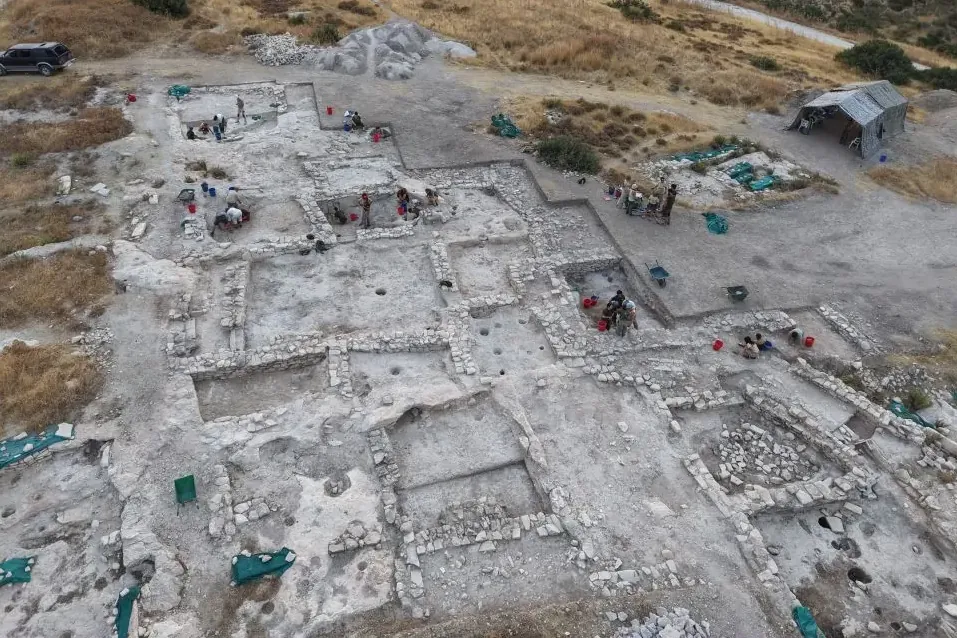
Aerial view of an excavated hilltop with a grid of low stone walls forming rectangular rooms on pale bedrock, round holes cut into the floors, and excavators at work with buckets and wheelbarrows
Photograph: Department of Antiquities, Cyprus

PeriodMiddle Bronze Age

References

  1. Bombardieri, L., & Monaco, M. (2019). Going over the common thread with a fine-tooth comb, Actors and interaction in a Middle Bronze Age textile start-up. Cahiers du Centre d'Études Chypriotes, 49, 81-102. https://doi.org/10.4000/cchyp.459
  2. Amadio, M. (2017). Architecture and Urbanisation in Bronze Age Cyprus: local and regional innovations in materials, technology and social representation. Doctoral dissertation, University of Reading.
  3. Knapp, A. B. (2013). Revolution within evolution: the emergence of a 'secondary state' on protohistoric Bronze Age Cyprus. Levant, 45(1), 19-44. https://doi.org/10.1179/0075891413Z.00000000015
  4. Crist, W., de Voogt, A., & Dunn-Vaturi, A.-E. (2016). Facilitating interaction: board games as social lubricants in the ancient Near East. Oxford Journal of Archaeology, 35(2), 179-196. https://doi.org/10.1111/ojoa.12084
  5. Swiny, S., Rapp, G., & Herscher, E. (Eds.). (2003). Sotira Kaminoudhia: An Early Bronze Age Site in Cyprus (CAARI Monograph Series 4). American Schools of Oriental Research.

  1. Format and topicEvery piece has a format, which decides its card and its page, and a topic, which decides its section and its feed. This one is a news story on fieldwork.
  2. HeadlineThe most striking true fact, plainly told: the place or the find first, an active verb, nothing held back to tease, and no claim stronger than the source makes.
  3. SummaryOne or two sentences that stand on their own (who, what, where) and add the next fact rather than repeat the headline.
  4. Dateline and datesWhere the news comes from, and two dates: when it happened (1 September 2026, the day of the announcement) and when we published our piece (18 October 2026).
  5. Picture and creditA photograph released with the news, credited as the institution asks. We never use pictures from photo agencies.
  6. Original sourceThe announcement, paper or book the piece reports, named, dated and linked. We cite the original only: when a story reaches us through the press, we go back to what it rests on.
  7. On ancientcyprus.comThe sites, excavation project, people and institutions the piece names, each linked to its page in our registers. Each of those pages lists the piece in turn, under “In the news”.
  8. PeriodThe period the news belongs to, linked to its page in the chronology.
  9. ReferencesThe published work the context is drawn from, numbered in order of first use: 5 references in this piece.
  10. Read the piece →

Start here

Pieces to start with

One of each kind: the latest weekly issue, a feature, fieldwork, research, a return of antiquities, an obituary, a new book and an exhibition.

Using it

Following the news, citing it and sending it

The news, like the rest of the site, is non-commercial and free to read. Every piece names and links its sources, so a reader can always go back to the original.

Feeds

RSS feeds for every piece and for each topic, with the summary and picture of each piece.

Other ways in

How to cite a piece

Drakopoulos, A. (2026, October 18). Hollows cut into a Bronze Age threshold at Erimi match a senet game board. Ancient Cyprus. https://www.ancientcyprus.com/news/erimi-laonin-tou-porakou-2026-middle-bronze-age-building

Our text may be reused for personal, educational and research purposes with a credit to the site, the address of the page and the date you read it (see the terms). The photographs in news pieces belong to the institutions credited under them.

Sending us news

An exhibition, a lecture, a conference, a job, a fellowship or a call for papers in Cypriot archaeology: send us the listing. A season’s results, a new paper or book, or a correction: write to us.

If you own a Cypriot antiquity and want to know more about it, or need advice on what to do with it, contact us. Our advice is confidential, unless the law requires us to share it.

What comes next

What comes next

The next pieces of work around the news.

  • The publications watch

    Every new publication on Cypriot archaeology (articles, books, chapters, theses and reports) entered in the document register within days of its appearance, with a full citation, a neutral summary and its links to sites, people and excavations; a weekly list for researchers, feeds by topic and an annual bibliography. Some 850 recent publications are already noted.

    The plan

  • A weekly newsletter

    This Week in Cypriot Archaeology sent by email each week.

  • Features for the largest stories

    The largest stories told at length, with maps, the excavation’s history season by season, the new find beside comparable objects, plans and reconstructions: a find that changes what we know of a site or period, a major return, a landmark exhibition or publication.

  • The major pieces in Greek

    Greek versions of the most important pieces.