
Contents
The seafarers of early Cyprus left almost no boats behind. Bernard Knapp states the paradox directly: although direct material evidence such as shipwrecks and ship representations is missing before about 2000 BCE, "there is no question that beginning at least by the eleventh millennium Cal BC (Late Epipalaeolithic), early seafarers sailed between the nearby mainland and Cyprus, in all likelihood several times per year" [1, p. 415]. The island's own record of seafaring is therefore indirect: the fact of arrival, marine shells found far inland, anchors reused in temples, clay models and scratched graffiti, cargoes found in foreign wrecks, harbour works and, from the Iron Age, the numbers of warships given in Greek texts. An older view held the opposite. Knapp quotes Stewart's remark of 1962 that "the Cypriote has never been a great sea-farer … nor has he been a keen fisherman, until the coming of dynamite", and notes that most archaeologists "passively accept the notion that the inhabitants of Cyprus turned their backs to the sea" between about 6800 and 2700 Cal BC; his own argument is that the island "was never truly isolated from the sea" [1, p. 415]. This entry follows the evidence from the Neolithic to the Cypro-Classical period and closes with the Kyrenia ship.
The first crossings
Cyprus has been an oceanic island since the Late Miocene and was never joined to the mainland in the time of human settlement [2, pp. 67, 182]. At present sea level the shortest gaps are 69 km from Cape Anamur in Anatolia to Cape Kormakiti, and 81 km from Cape Ovacik to the north coast [2, p. 67]. Simmons reports Held's calculations for the lower Pleistocene sea levels: the Karpas to Iskenderun gap shrinks to about 40 km, the Anamur and Ovacik crossings to about 65 and 64 km, and the Syrian crossing from Ras Ibn Hani or Ras al-Basit to about 81 km, with no islands in between to act as stepping stones [2, p. 68]. Even the short route may have been a "blind" crossing, since in Held's reading Cyprus "would not have been visible from the paleo-coastline" [2, p. 68]. Held's ratios of target size to distance make the island four to five times more accessible from southern Anatolia than from the northern Levant at present sea level, and only three times more at the Last Glacial Maximum; he called its occupation "a major feat" [2, p. 68].
The earliest site in the sequence is Aetokremnos, dated to the Late Epipalaeolithic, about 11,000 to 10,000 Cal BC in Knapp's table [3, p. 80]. It produced more than 222,000 bones, dominated by pygmy hippopotamus (a minimum of 505 individuals, about 95 per cent of the bones) with three pygmy elephants, and some 70,000 marine invertebrates [3, p. 87]. The same deposit gave about 160 shell beads and a chipped stone industry with parallels in the Natufian of the Levant, about 13,000 to 10,000 Cal BC [1, p. 421]. Knapp calls the bone dates "problematic" and treats the link between the visitors and the extinction of the dwarf fauna as open [3, p. 92]. Whatever the answer, the people who left the tools had crossed open water to get there. Le Brun argued in 2001 that reaching Cyprus required a mastery of boatbuilding and a working knowledge of waves and currents [1, p. 421].
By the Early Aceramic Neolithic the crossings carried animals as well as people. Knapp summarises the work of Vigne and colleagues (2013) on Aetokremnos, Klimonas and Shillourokambos: settlers transported "large ruminants and other semi-wild animals (cattle, goats, eventually Persian fallow deer)"; wild boar could have come in dugouts; and the seafarers were probably a specialised group distinct from the farmers [1, p. 421]. Vigne's team proposed two or more dugouts lashed together, "a configuration that generally resembles a catamaran", and suggested a sail would have speeded the transport of weaned livestock, while admitting "the lack of any evidence for such an early use of the sail" [1, p. 421]. The catamaran is a reconstruction inferred from the cargo; no such craft has been found. Bar-Yosef Mayer and colleagues (2015) went further and modelled return routes from watercraft performance, sea level, winds and currents [1, p. 421]; the site's article on simulating ancient seafaring voyages discusses that kind of modelling. Alan Simmons's Stone Age Sailors sets the Cypriot crossings in their Mediterranean context.
Early and Middle Bronze Age: specialists and doubtful models
Between the Neolithic crossings and the Late Bronze Age, most of the evidence for seafaring is circumstantial. Knapp points out that the use of Cypriot copper at Mari and Babylon in the early second millennium BCE implies maritime ventures involving people from Cyprus, which in turn required "groups or communities of specialist seafarers" [1, p. 436]. Marine produce reached the interior: dentalium shells at Marki-Alonia from the Philia phase to the Middle Bronze Age; triton, dentalium and murex at Alambra; 45 marine shells and two crabs at Politiko-Troullia, about 40 km from the coast; and shells, crabs and a single barracuda bone at Sotira-Kaminoudhia [1, p. 436].
The ship models of this period are few, and each is in doubt. Knapp lists three possible pre-Late Bronze Age examples [1, p. 436]. The first is an "enigmatic vessel" from Bellapais-Vounous Tomb 64 (no. 138), perhaps of Early Bronze Age date, which Lucien Basch in 1987 considered the earliest depiction of a Cypriot ship. The second is a largely reconstructed object of Red Polished III fabric, of unknown provenance, in the Louvre (Westerberg 1983 no. 4). The third is a White Painted II model of Middle Cypriot I date, also unprovenanced and also in the Louvre, possibly showing a rounded hull with projecting stem- and stern-posts. Knapp adds that Frankel, writing in 1974, "seems sceptical that any Early or Middle Cypriot model actually represents a boat" [1, p. 436]. The Metropolitan Museum's label for a later model states that terracotta ship models from Cyprus "are known from the early second millennium B.C." (74.51.1750); on the evidence Knapp assembles, that holds only if the doubtful Louvre pieces are accepted. The Red Polished evidence amounts to one heavily restored object without a findspot.
Late Bronze Age harbours and anchorages
"There are no physical remains of formal built harbours on Bronze Age Cyprus" [4, p. 139]. What survive are the settlements that must have worked as ports and the scatters of anchors and imported pottery off their beaches. Knapp's list of indicators runs from Maroni-Tsaroukkas and Tochni-Lakkia on the south coast to Enkomi, Kition and Hala Sultan Tekke in the east [4, p. 139]. Enkomi functioned as an emporion from the start of the Late Bronze Age and lay "only one day's sail from Syria or Cilicia". Kition-Kathari probably stood on a protected marine embayment with an inlet, and "Kition's role as a major coastal port and trading centre is not in doubt". Hala Sultan Tekke had a lagoon harbour with a navigable outlet, for which Devillers and colleagues (2015) proposed two possible channels [4, p. 139].
At Maroni-Tsaroukkas, underwater survey by Manning and colleagues recovered imported pottery and stone anchors that mark a Late Bronze Age anchorage, and Tochni-Lakkia was probably the outlet for the inland town of Kalavasos-Ayios Dhimitrios [4, p. 140]. Off Palaepaphos, the Kouklia-Achni underwater survey recorded 120 stone anchors, but their date is uncertain, and Iacovou places the main harbour of the Late Bronze Age town elsewhere, at Loures [4, pp. 139, 148]. The Tochni finds show a problem of identification. The excavators there reported "possible net weights" and a "possible stone anchor" [4, p. 140], because a pierced stone can be an anchor, a net weight or part of a press.
Stone anchors at Kition and elsewhere
Many of the stone anchors from Bronze Age Cyprus were found on land, built into later structures. Honor Frost, who studied them, insisted that anchors found at sea should be dated by stratified finds from land sites, and Kition, "entirely of LB date", became a reference assemblage used even to date anchors at Ugarit [4, pp. 138, 148]. Anchors are recorded at Hala Sultan Tekke, Kition, Maroni-Tsaroukkas and possibly Tochni-Lakkia [4, p. 148].
The Kition group is the largest. "Nearly 150 anchors were recovered in the 'temple precinct' at Kition ('Temples' 1, 4, 5)", reused as corner stones, paving, foundation courses and thresholds, and in five wells (Frost 1985) [4, p. 148]. Frost suggested that a composite anchor with a rounded triangular shape might be a Kition type, and thin sections showed that "all but three of the Kition anchors were made from local stone" [4, p. 148]. One anchor from Temple 2 carries a Cypro-Minoan sign; the site's article The Anchor with the Cypriot Mark discusses marked anchors. The contexts Frost recorded (paving, thresholds, foundations, well linings) show that these anchors ended their working lives as masonry in the sanctuary; whether any were first dedicated there as offerings is a separate question that the reuse cannot answer.
Ship graffiti and painted boats
The earliest secure ship pictures from Cyprus are Late Bronze Age graffiti. On the southern façade of Temple 1 at Kition, and on two limestone slabs in Temple 4, nineteen ships and four possible further scratchings were incised in the twelfth to early eleventh century BCE [4, p. 140]. Basch and Artzy, who published them in 1985, identified mostly "round boats" with one "long boat", a warship, all with their prows to the left. Wachsmann (1998) found the stone badly weathered and argued that ship "P" may face right, so that its "ram" would be a quarter rudder, and that its fan-shaped finial "bears more than a passing resemblance to an inward-facing bird's head" [4, p. 140]. If Basch and Artzy are right, two boatbuilding traditions were at work on Late Bronze Age Cyprus [4, p. 142]. Why ships were cut into temple walls is itself debated: as part of ceremonies, as a sign of the temple's patronage of seafarers, or as landmarks (Artzy 1999) [4, p. 59].
Two more graffiti come from ashlar buildings. A stele at Enkomi of Late Cypriot III date carries a ship which Wachsmann reads as facing right with a brailed rig and furled sail, and an ashlar block at Hala Sultan Tekke (N4007) carries one he calls "Syro-Canaanite" [4, p. 140]. Knapp's judgment is that "none of these representations seem intent on portraying nautical reality", and that it is misleading to attach them to particular ethnic groups [4, p. 142]. A Late Helladic IIIB krater from Enkomi shows two boats carrying warriors drawn larger than life [4, p. 59]. The Mycenaean connection is discussed under that culture.
Late Bronze Age boat models
The Late Cypriot models are better documented than the earlier ones. Knapp lists eight, with Wachsmann's readings [4, pp. 142–143]:
| Model | Fabric or findspot | Date | Features |
|---|---|---|---|
| Kazaphani-Ayios Andronikos T.2B no. 377 (Cyprus Museum) | White Painted IV | LC I–II | Deep hull, massive stern, mast socket |
| Maroni-Tsaroukkas A50 | Plain White Handmade | LC I–II | Not specified |
| Maroni-Tsaroukkas A49 | Plain White Handmade | LC I–II | Flat bottom, raised mast socket |
| Enkomi (Brussels, MRAH A1240) | Enkomi | Not specified | Symmetrical prow and stern; possibly 'Syro-Canaanite' |
| Louvre AM 636 | Unprovenanced | LC I–II (?) | Crescent hull |
| Maroni T.17 fragment (BM GR 1898,12-1.146) | Aegean-style painting | LH IIIA2, c. 1350 BCE | Hull and stern, possible quarter rudder |
| Maa-Palaeokastro no. 691 | Painted fragment | LC III, c. 1200 BCE | High prow |
| Sinda, two fragments | Sinda | LC III | Fragmentary |
Wachsmann suggested that the first three, the Kazaphani and the two Maroni models, may represent indigenous Cypriot merchant ships capable of sailing on the open sea [4, p. 143]. Several other models are hard to place. Two found in the sea near Amathus, now in private collections (Westerberg nos 8 and 11), have no context; Westerberg judged no. 11 "more likely, Cypro-Archaic". A bichrome model in the Israel National Maritime Museum, which Knapp puts in the mid-eleventh century, Westerberg assigned to the Cypro-Geometric period [4, p. 143]. Three Proto-White Painted askoi or rhyta from Lapithos have been read as ship models, and they repeat the graffiti problem exactly: Basch and Artzy saw "long ships" with a ram, and Wachsmann argued that the ship faces the other way and the "ram" is a quarter rudder [4, p. 143].
Uluburun: a Cypriot cargo in a foreign ship
Much of the cargo of the Uluburun wreck came from Cyprus. It carried about ten tons of copper in some 350 ingots (317 of them oxhide ingots), about a ton of tin, 175 glass ingots, ivory and ebony, terebinth resin in more than half of roughly 150 Canaanite jars, and around 150 Cypriot pots packed inside large pithoi [4, p. 158]. A gold scarab of Nefertiti gives a date after which it sank, and the Late Helladic IIIA2 pottery and the tree-ring dates on the dunnage and firewood place the sinking at the very end of the fourteenth century BCE [4, p. 158]. The copper links the wreck to the island's copper metallurgy and to the debate over Alashiya.
Knapp is explicit that "nobody doubts the Cypriot origin of the ten tons of copper ingots" [4, p. 159]. The ship is another matter. The route most scholars accept, argued by Pulak, ran from the southern Levant (the Carmel coast) north and then west along the Anatolian coast towards the Aegean [4, pp. 158–159]. The evidence for the ship's home points away from Cyprus: a house-mouse jaw of a north Syrian coastal population (Cucchi 2008); Goren's finding (2013) that the galley wares, about 80 per cent of the Canaanite jars and all 24 stone anchors came from the Carmel coast; and Pulak's suggestion of a home port near Tell Abu Hawam [4, pp. 159, 164]. Strontium analysis of the hull's cedar by Rich and colleagues (2016) found no match with the sampled forests of central and northern Lebanon, southern Anatolia or Cyprus, and pointed to the Amanus or the Syrian coastal range near Ugarit [4, p. 159]. A Cypriot origin for the ship has been argued by Hulin (2002), Muhly (2011) and Broodbank (2013), but it is a minority view [4, p. 159]. The crew may have been mixed and may have included Cypriots (Monroe 2009) [4, p. 194].
Uluburun is not an isolated case. Knapp counts Cypriot goods on five of the eight known shipwrecks of the Middle and Late Bronze Age and concludes that there is "no doubt that the ships and merchants of LB Cyprus were engaged in maritime trade" [4, p. 148]. Sherratt and Sherratt distinguished between large, heavily capitalised bulk carriers and small independent boats; in their scheme Uluburun is a bulk carrier and the Cape Gelidonya wreck a "tinker" [4, p. 178]. At Cape Gelidonya only one anchor has ever been associated with the wreck [4, p. 164]. The site's article on the copper kingdoms of ancient Cyprus follows the ingot trade on land.
Iron Age ship models and painted ships
Clay ship models are far commoner in the Iron Age than before. The Smithsonian catalogue states that "the largest amount of clay models of ships found all over Cyprus date to the Cypro-Archaic period" and that more than 90 per cent were found at Amathus; it suggests the custom of placing boat models in tombs "could come from Egypt" [5, cat. 135]. The Metropolitan Museum's own label goes further and says that all of the preserved ship models come from Amathus (74.51.1752). The site's page on the ancient city of Amathus describes the town.
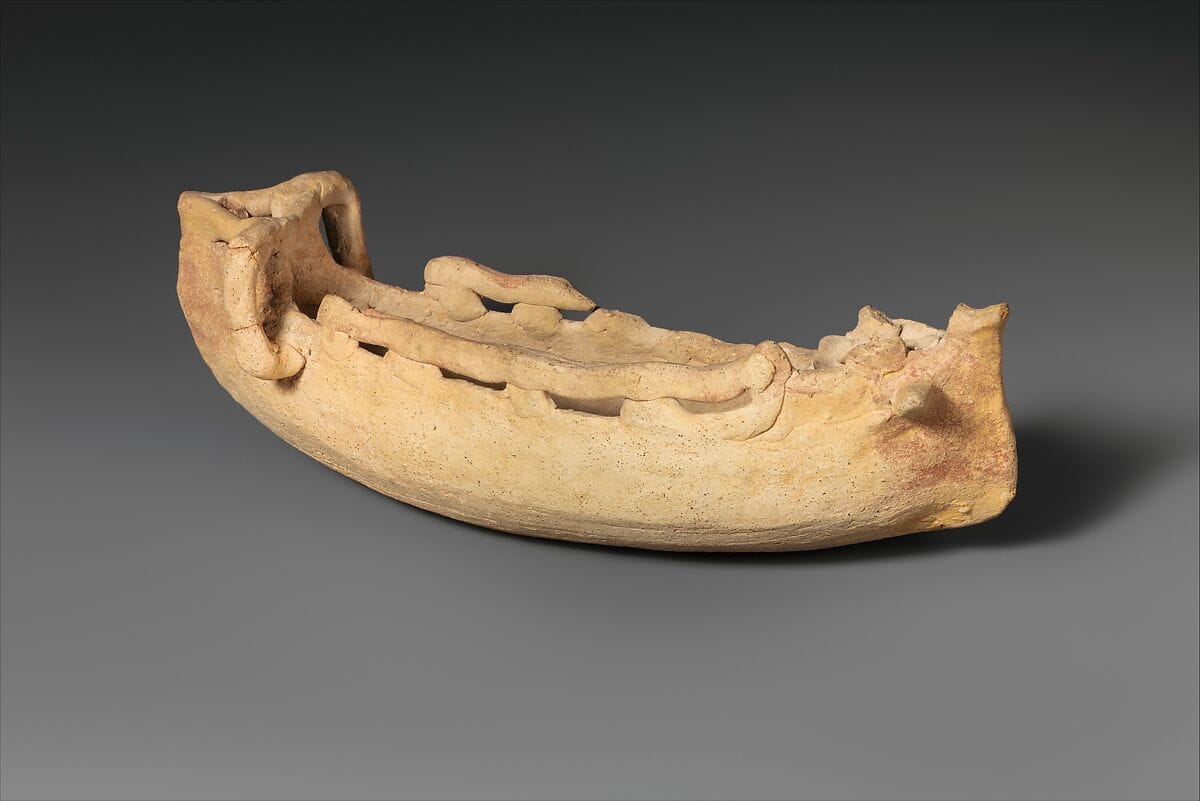
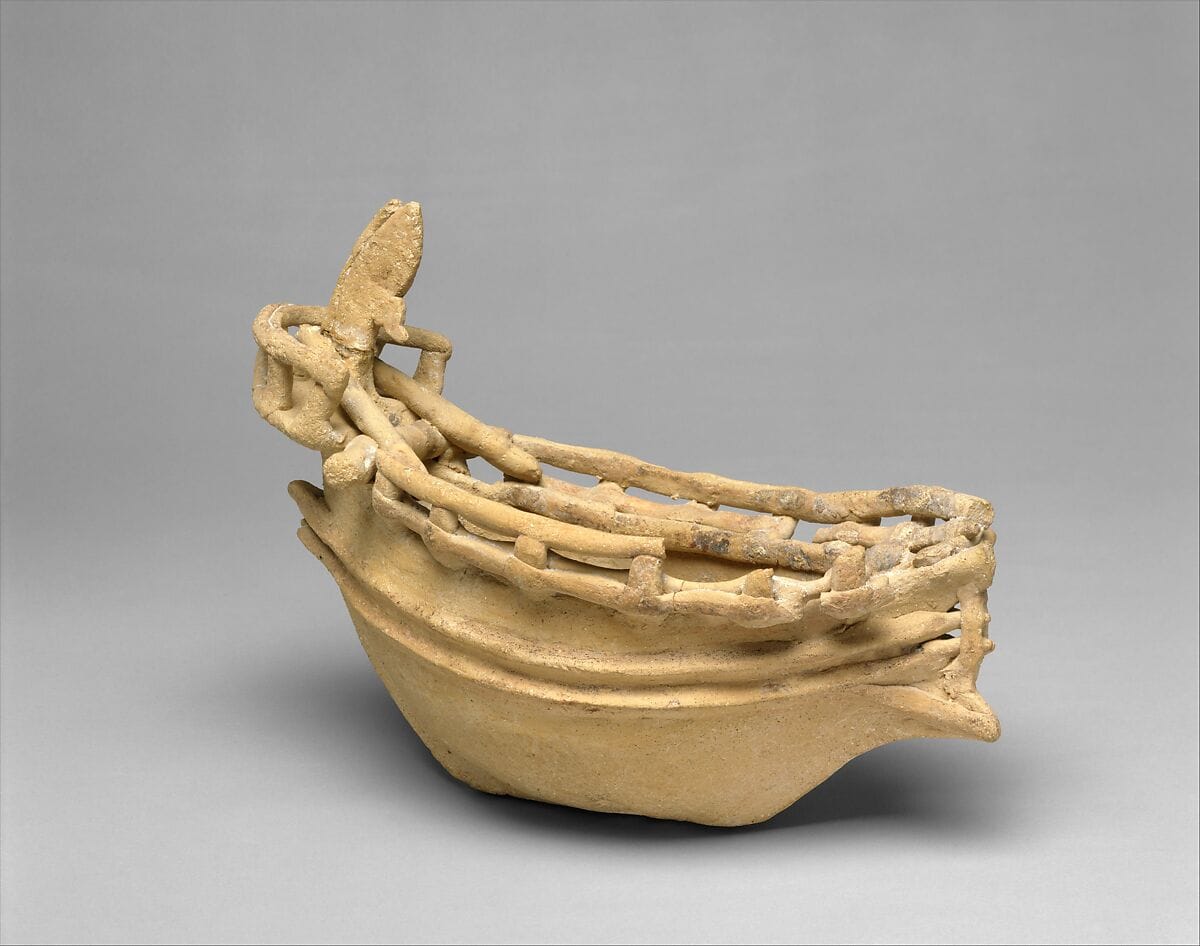
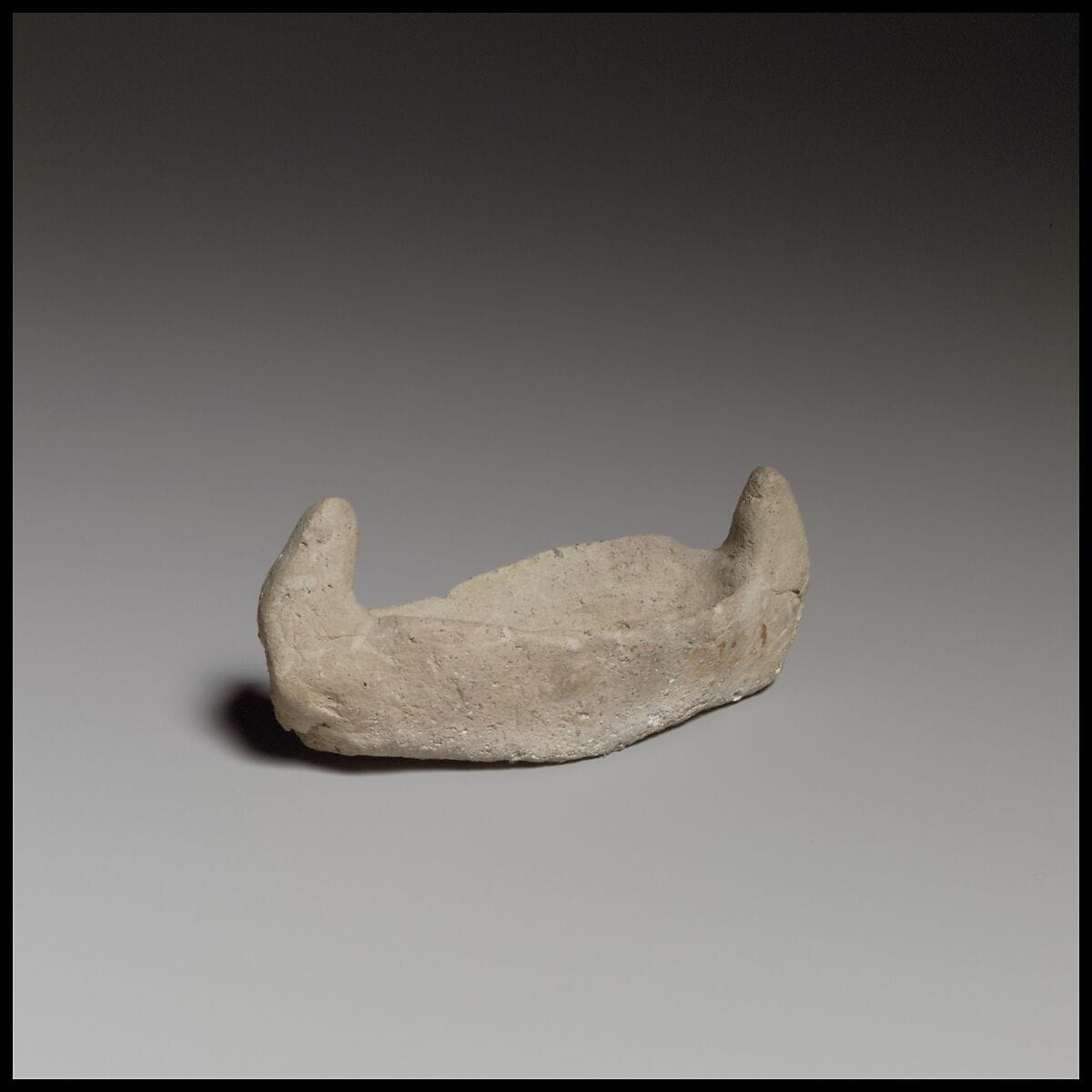
The Cesnola models in the Metropolitan Museum span the range of size. 74.51.1752, illustrated at the head of this entry, is 17.8 cm high, Cypro-Archaic II, and shows in some detail a contemporary vessel with a helmsman seated in the bow. 74.51.1750, pictured here, is 9.2 cm high, of the same date; the Met's label suggests that the quality of Archaic models and representations may reflect the maritime activity of the Phoenicians. At the other end of the scale 74.51.1751 is a small simple boat under 6 cm long, which the Met describes as the kind of craft used by ordinary people (Westerberg 1983 no. 52).
The British Museum holds a group of models from Amathus. GR 1894,1101.182 is a Cypro-Archaic merchant ship 31 cm long, with a raised poop deck, steering oars, a mast socket and a line of perforations that may be oar-ports or drainage. GR 1894,1101.282, 17.5 cm long and Cypro-Archaic II, is a Bichrome sailing ship with tall stems and a mast socket, and GR 1894,1101.186, 12.5 cm long, is a round-bottomed Bichrome boat with upright stem and sternposts. The British Museum series and the Met's Cesnola models together make Amathus the reference site for Iron Age model ships.
The most elaborate model is in the Thalassa museum at Ayia Napa: Cypro-Archaic II, 42.5 cm long and probably from the sea off Amathus. It shows a heavy galley with ports under the gunwale and a rounded hull like Phoenician merchantmen (gauloi), manned by seven figures, one of them larger and seated beside an incense burner, whom Basch identified as a priest [5, cat. 135]. Models recovered from the sea have no archaeological context, so whether they were made for tombs, for sanctuaries or for some other use cannot be decided for those pieces.
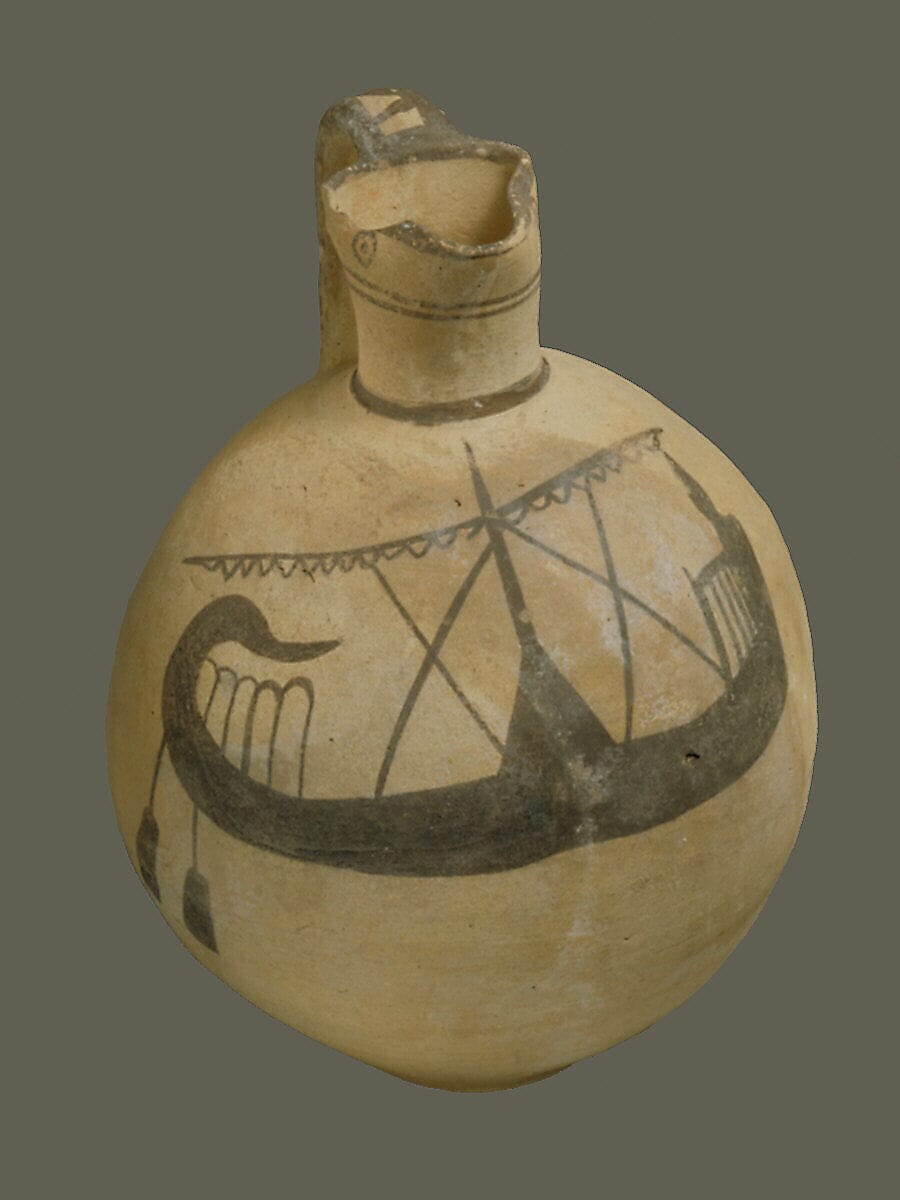
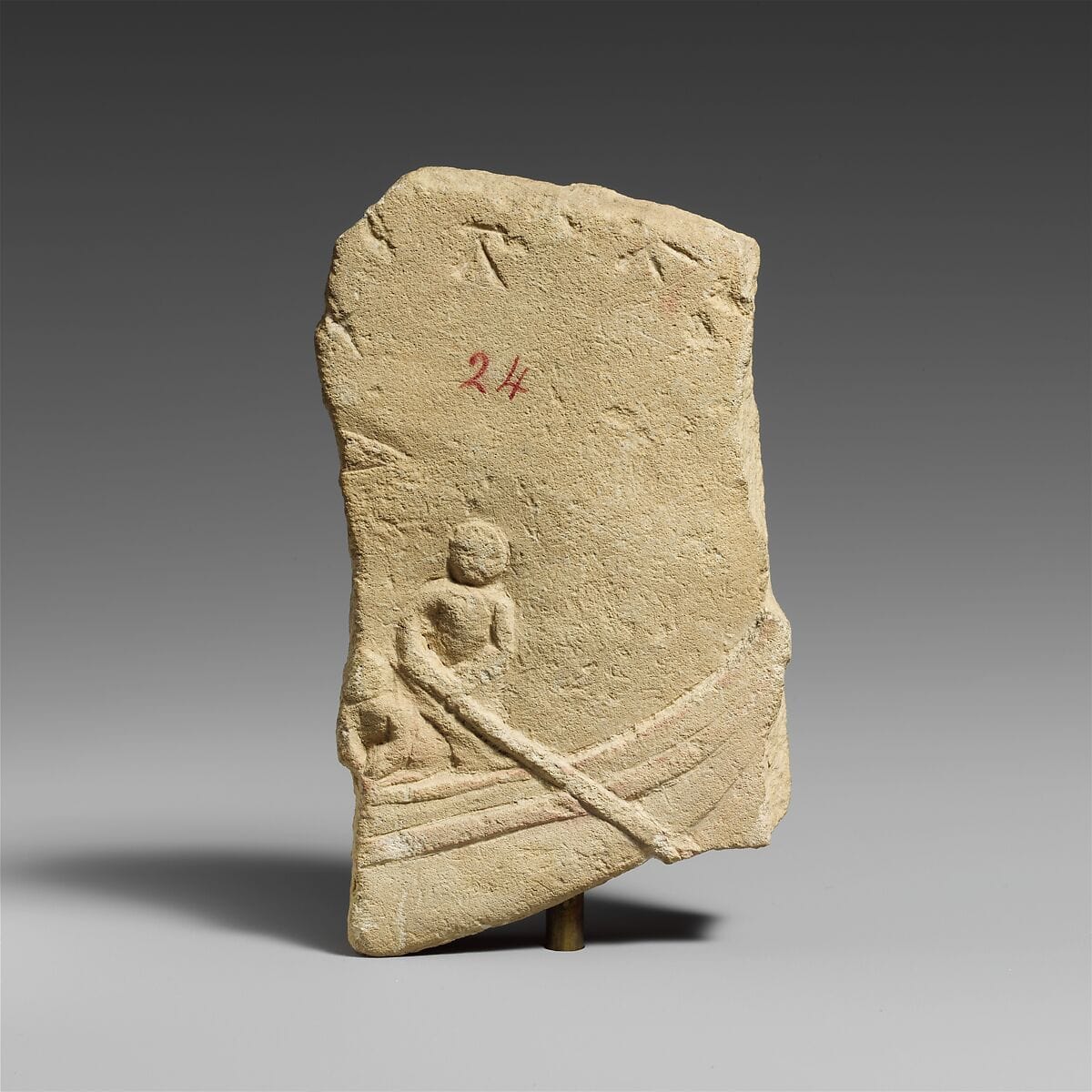
Painted ships also occur on pottery. A Cypro-Archaic I jug in the Metropolitan Museum, 74.51.511, shows a ship with a mast, a furled sail, a pair of steering oars and a bird's head on the stern, an ornament the Met traces to the prehistoric Aegean. The museum's label adds, "We do not know if the ship is Cypriot or foreign". The jug belongs with the single-motif compositions discussed under free-field art. A limestone relief fragment in the same collection, 74.51.2366, said to be from the sanctuary of Ayios Photios at Golgoi, shows the curved stern of a boat with a pilot at the rudder; the Met dates it, with a query, to the early Hellenistic period, after the range of this entry.
Harbours and fleets of the city-kingdoms
In the Cypro-Archaic period ships were still mostly beached or moored offshore. Andreas Parpas describes Archaic Marion as using a beach anchorage where ships were "run up or hauled onto the beach"; a closed harbour near Latsi belongs to the late fourth century BCE [6, p. 196]. Soloi had a closed harbour formed by two ashlar breakwaters about 110 m and 80 m long. Pseudo-Scylax calls the harbours of Marion, Lapethos, Amathus and Kyrenia "deserted", and the Hellenistic closed harbour at Nea Paphos could, on Vitas's estimate, hold up to 100 shipsheds of the Kition type [6, p. 196].
Those Kition shipsheds are the best built evidence for warships on Cyprus, and they are Classical. At Kition-Bamboula six neosoikoi are visible, probably part of a complex of ten to twelve, built in three phases: at the end of the fifth century BCE, after a destruction around 375 BCE, and at the end of the fourth century, perhaps after the Ptolemaic conquest [6, pp. 196–197]. Each shed measured about 5.2 m by 35 to 40 m, close to the sheds at Zea in Piraeus, "possibly indicating that the triereis stored there were built to Athenian standards" [6, p. 197]. A trireme weighed about 20 tons empty, and offshore mooring was common [6, p. 197].
The fleets themselves are known from texts. Herodotus records that in Xerxes' invasion of Greece in 480 BCE "the Cyprians furnished a hundred and fifty ships"; their princes wore turbans and the rest wore tunics but were otherwise equipped like Greeks [7, 7.90]. He names two Cypriots, Gorgus son of Chersis and Timonax son of Timagoras, among the most famous men on shipboard after the admirals [7, 7.98], and tells how the Paphian commander Penthylus son of Demonous brought twelve ships from Paphos, lost eleven in the storm off the Sepiad headland, and was captured with the last at Artemisium [7, 7.195]. Parpas cautions against reading such numbers as standing navies. Apart from the war of Evagoras, "there is no evidence, textual or otherwise, that the Cypriot kings had extensive fleets with fighting triereis of their own"; they built triremes and supplied crews to the Persian navy for particular campaigns, among them the expeditions against Greece, the battles of Lade, the Eurymedon and Knidos, and the campaigns in Egypt [6, p. 197]. The political frame is set out under Achaemenid Persia and the Cypro-Archaic period.
Coda: the Kyrenia ship
The Kyrenia wreck lies just outside the period of this entry, but it gives the measured hull against which the earlier models and pictures can be compared. Coins of Antigonus Monophthalmos and Demetrius Poliorketes date its loss to 310 to 300 BCE; most radiocarbon dates agree, though one (BM-1639) came out "impossibly old" [8, p. 232]. The hull was built mainly of Aleppo pine with tenons of Turkey oak and sheathed in lead below the waterline, and the ship carried a single sail. It measured 13.6 by 4.4 m, displaced 14 tons, and about 20 tons of cargo were found with it [8, p. 232]. Tableware in sets of four suggests a crew of four; food on board included almonds, olives and pistachios. The hull had been repaired at least three times, and spears found in the outer hull suggest to Parker that pirates captured and scuttled it [8, p. 232].
A full-size replica, Kyrenia II, was launched in 1985. In 1986 it sailed from Piraeus to Paphos with 9 tons of cargo, and on the return voyage in 1987 it averaged 2.85 knots over the whole trip while regularly exceeding 9 knots [8, p. 232]. A Hellenistic warship model at the Fitzwilliam Museum (Loan Ant.103.11) shows the military counterpart to this small merchantman.
Dating traps and open questions
Much of the evidence on this page is harder to date than it looks. The first boats remain hypothetical: the lashed-dugout "catamaran" and the early sail are reconstructions from the animals the settlers carried [1, p. 421]. The Early and Middle Cypriot "boat models" are few, mostly without findspots, and doubted as boats at all [1, p. 436]. Models recovered from the sea off Amathus cannot be dated by context, so a piece can move between the Late Cypriot and the Cypro-Archaic periods on style alone [4, p. 143]. Anchors found at sea, such as the 120 at Kouklia-Achni, are undated unless they match stratified land finds [4, p. 148]. Graffiti and askoi can be read facing either way, which turns a ram into a quarter rudder [4, pp. 140, 143]. The shipsheds and closed harbours belong to the Classical and Hellenistic periods; none is Archaic [6, pp. 196–197]. Finally, a Cypriot cargo does not make a Cypriot ship, as Uluburun shows. For the wider setting of Iron Age exchange, see early Iron Age trade networks and the Cypro-Geometric period.
Objects on this page
References
- 1.Knapp, A. B. (2020). Maritime narratives of prehistoric Cyprus: Seafaring as everyday practice. Journal of Maritime Archaeology, 15, 415–450.
- 2.Simmons, A. H. (2014). Stone age sailors: Paleolithic seafaring in the Mediterranean. Left Coast Press.
- 3.Knapp, A. B. (2010). Cyprus's earliest prehistory: Seafarers, foragers and settlers. Journal of World Prehistory. https://doi.org/10.1007/s10963-010-9034-2
- 4.Knapp, A. B. (2018). Seafaring and seafarers in the Bronze Age eastern Mediterranean. Sidestone Press. https://www.sidestone.com/books/seafaring-and-seafarers-in-the-bronze-age-eastern-mediterranean
- 5.Cyprus: Crossroads of civilizations (n.d.). Exhibition catalogue, National Museum of Natural History, Smithsonian Institution, Washington, DC.
- 6.Parpas, A. P. (2022). The maritime economy of ancient Cyprus in terms of the New Institutional Economics. Archaeopress.
- 7.Herodotus. (1938). Histories, Volume III: Books V–VII (A. D. Godley, Trans.; Loeb Classical Library). William Heinemann; Harvard University Press.
- 8.Parker, A. J. (1992). Ancient shipwrecks of the Mediterranean and the Roman provinces (BAR International Series).