
Contents
Bellapais-Vounous is a cemetery of rock-cut chamber tombs on a low hill below Bellapais abbey, about 2.5 km inland from the north coast of Cyprus [1, p. 21]. Three excavations between 1931 and 1938 opened 164 numbered tombs [1, p. 21; 2, p. 3] of the Early Bronze Age and the start of the Middle Bronze Age, and the pottery from them includes the Red Polished bowls with modelled bulls' heads, the incised jugs with snakes on their necks, the tulip bowls, the double-necked bird jugs, and the clay model known as the Vounous bowl. The settlement that buried its dead here has never been found, so everything known about the community comes from its graves. How the tombs were built, how bodies were handled inside them, the cattle bones and the debate over rank are set out in the companion entry on Bronze Age chamber tombs, which draws most of its Early Bronze Age examples from Vounous. This entry covers the site itself: the excavations, the date range, the figured grave goods, the Vounous bowl, the evidence for women and textile work, and the place of Vounous among the north-coast cemeteries. The site page and the article Vounous: A Bronze Age Society Known Only from Its Dead give a shorter introduction.
Three excavations, one numbering sequence
The cemetery came to archaeological attention in 1931, and Porphyrios Dikaios of the Cyprus Museum began excavating it that year [2, p. 1]. Money was short. Donations collected by R. Gunnis, A.D.C. to the Governor, and by Dikaios himself paid for about three weeks of work, in which Tombs 1 to 20 were cleared. A second season of about a fortnight in June 1931 added eleven more tombs, and in May of the following year a donation from J. C. Gaffiero of Nicosia paid for seventeen further tombs, bringing Dikaios's total to 48 [2, pp. 1, 3]. Most of his tombs lay in the western part of the hill, where the rock is of good quality [2, p. 3].
In 1933 Claude Schaeffer excavated for the French national museums, working jointly with Dikaios in the same western sector, and opened Tombs 49 to 79 [1, p. 21]. Schaeffer published only a summary, in a book he himself treated as a travel narrative, Missions en Chypre. The material waited decades. Robert Merrillees studied it in the 1950s, and in 1988 set out the obstacles to finishing the job: inaccessible documentation, dispersed finds and repeated numbering errors. Ten years later Annie Caubet passed the work to Dunn-Vaturi [1, p. 22]. Schaeffer's tombs run from the end of Early Cypriot I to Middle Cypriot II, with most falling in Early Cypriot III and Middle Cypriot I; two Iron Age vases were also recovered and are now in the Louvre [1, p. 22].
The third campaign, in 1937 and 1938, was led by James R. Stewart for the British School at Athens and opened Tombs 80 to 164 in two areas, Sites A and B [1, p. 21]. Stewart worked in the eastern part of the necropolis, which Dikaios had not touched and where nearly all the tombs had collapsed because the rock there is soft [2, p. 3]. Webb counts the total as 164 tomb complexes in two cemeteries, Sites A and B [3].
| Campaign | Excavator | Tomb numbers | Area |
|---|---|---|---|
| 1931-1932 | P. Dikaios (Cyprus Museum) | 1-48 | western part of the hill |
| 1933 | C. Schaeffer (French national museums), with Dikaios | 49-79 | same western sector |
| 1937-1938 | J. R. Stewart (British School at Athens) | 80-164 | eastern part, Sites A and B |
Stewart's finds left Cyprus in many directions, and single tomb groups are now split between museums. The British Museum holds a Red Polished bowl with bulls' heads on the rim and a tulip bowl, both from Site A, Tomb 105 [4]. The Nicholson Museum in Sydney has a tulip bowl from Tomb 127, excavated by Stewart in 1937 and accessioned in 1953 [5, p. 22]. The Ashmolean has a beak-spouted Red Polished jug catalogued as from Tomb 92. The Manchester Museum holds part of Tomb 139, and its records sort the vessels by interment, citing Stewart's report: a Red Polished I bowl of Early Cypriot I-II (35191) and a large Red Polished III jug of Early Cypriot III-Middle Cypriot I with a potter's mark on the neck (35196) are both assigned to the earlier burial. Two vessels dated a phase or more apart in the same interment is a discrepancy the records do not resolve, and it shows how much of the Vounous evidence depends on how excavators and later cataloguers read reused chambers.
Dating the cemetery
Dikaios divided his tombs into three periods and gave them absolute dates: period I at 2600 to 2500 BC, period II at 2500 to 2300, and period III at 2300 to 2100 [2, p. 163]. He then accepted Stewart's result from the eastern part of the hill. Nearly all the tombs of Stewart's Site A belonged to Early Cypriot I, Site B continued the sequence, and the necropolis as a whole therefore represented "an uninterrupted sequence from Early Cypriot I to the end of Early Cypriot III touching the Middle Bronze or Middle Cypriot I" [2, p. 164].
The relative sequence has held; the absolute dates have come down. Current museum catalogues place Early Cypriot I at about 2400 to 2150 BC [5, p. 22] and date a Site A tulip bowl of Early Cypriot I-II to 2200-2100 BC [4], well below Dikaios's figures. The end date has also moved later. Webb's summary of the north coast gives Vounous a span from Early Cypriot I to Middle Cypriot II, with Vasilia occupied in the preceding Philia phase and Lapithos from Early Cypriot II to Middle Cypriot III [3]. Vounous has no Philia phase of its own, so it begins after the horizon described under Red Polished Philia ware, and its latest tombs reach into the Middle Bronze Age.
Horned animals and birds on the grave goods
Not everything placed in a Vounous tomb was made for it. Webb and Frankel accept that some vessels were taken from household stock, but argue that others "display a strikingly rich and dynamic iconography and are likely to have been produced specifically for use during mortuary and perhaps other ceremonies" [6, p. 199]. That iconography "is almost entirely concerned with horned quadrupeds". Whole animals stand on the rims of large pedestal bowls, up to 53 cm high, and heads project from the rims of deep bowls, with complex incised decoration around them. "Cattle are in the great majority, with sheep, goats, deer and perhaps moufflon also depicted, as well as birds and, very occasionally, pigs" [6, p. 199]. On the pedestal bowls the animals alternate with miniature tulip bowls; on the deep bowls the heads alternate with incised disks, concentric or rayed circles that Stewart called sun-disks. Reversed swastikas, crosses, concentric rectangles, zigzag, chevron and herringbone fill the remaining space. The style is widespread in Early Cypriot I tombs at Site A and almost absent elsewhere: outside Vounous, Webb and Frankel list only a large jug and a tulip bowl from Tomb 2 at Karmi-Palealona [6, p. 200]. The British Museum's bull bowl from Tomb 105 [4] is an example of the deep-bowl class, with bulls' heads and spoon-shaped attachments on the rim over white-filled incision. The general ware is described under Red Polished and the shapes under bowl, jug and complex vessels.
Two vessels carry something stranger. A deep bowl and a large jug 79.4 cm high, Stewart's Tomb 91 no. 14 and Tomb 160A no. 16, are incised with frontal figures bearing antlers, bull horns or ram or mouflon horns, shown "in an attitude of display or movement suggestive of dancing" [6, p. 200]. David Frankel and Jennifer Webb review the readings: Morris took them for animals drawn in plan view; others see supernatural beings, humans wearing animal skins or masks, or a depiction of ritual transformation. Their own conclusion is that funerals at Vounous "were theatrically charged, involving feasting, dancing and other performances focused on horned animals" [6, p. 200].
They also argue that this imagery was new. Philia-phase incision was simple, and the Vounous repertoire is "unrelated to indigenous Late Chalcolithic iconography", in part because its main subject, cattle, had not been present on the island in the Late Chalcolithic. The figured style was a rapid, local development at Vounous, already complex by the middle of Early Cypriot I [6, pp. 201-202].
Dikaios found the same world in his own tombs. Tomb 36 held two clay models of ox horns, blackened except for red tips and incised with zigzags, chevrons, lozenges and hatched triangles [2, p. 118], and a large bowl with bulls' heads from whose throats relief snakes hang [2, p. 122]. He sorted the birds modelled on Vounous pots into three groups: birds with a bull or snake, birds with human figures, and birds alone [2, pp. 125-126]. A bowl from Tomb 36 combines a horned head, two birds and two relief snakes. A pyxis from Tomb 37 has birds on the body and a man and a woman on the lid. The most elaborate piece is a double-necked jug with a man and a woman in relief on one neck, horned animal heads, and "between the two necks … a bird modelled in the round, and in front of it … a small cup. The bird appears to drink or eat from the small cup" [2, p. 126]. His type list of bird-shaped vases includes a form "with one or two necks, basket handle, and a foot below" [2, p. 118].
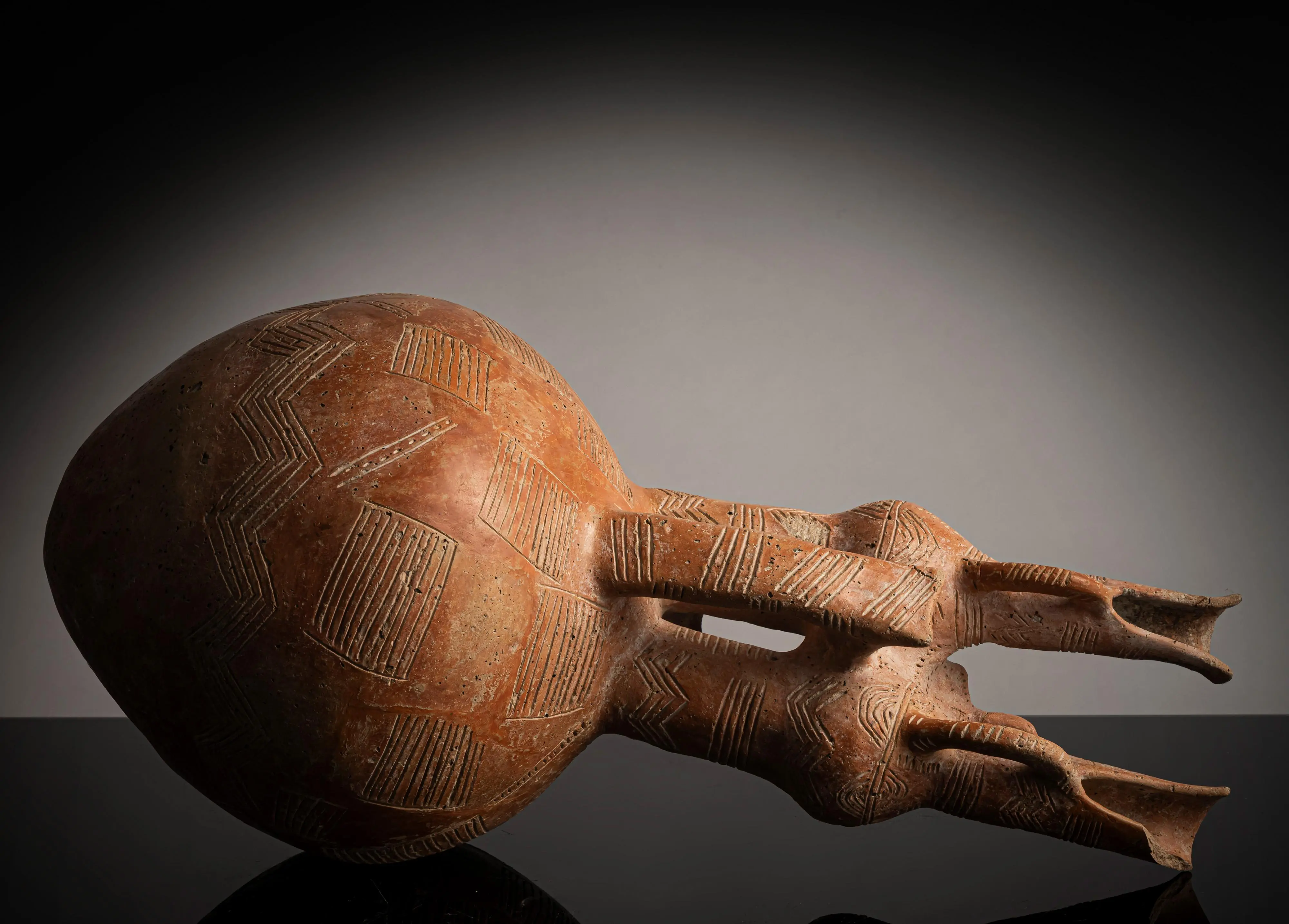
A double-necked bird jug of a type known from Vounous, Drakopoulos collection. Its reconstruction and parallels are discussed in Two Birds, Two Necks.
The Drakopoulos collection holds a jug of this double-necked type, reassembled from many fragments, with two birds projecting forward between the necks rather than the single bird of the jug Dikaios described. Its find-spot is not recorded, and it is shown here as an example of the type, not as a Vounous object; the comparison with the published Vounous jugs is set out in the article on the jug.
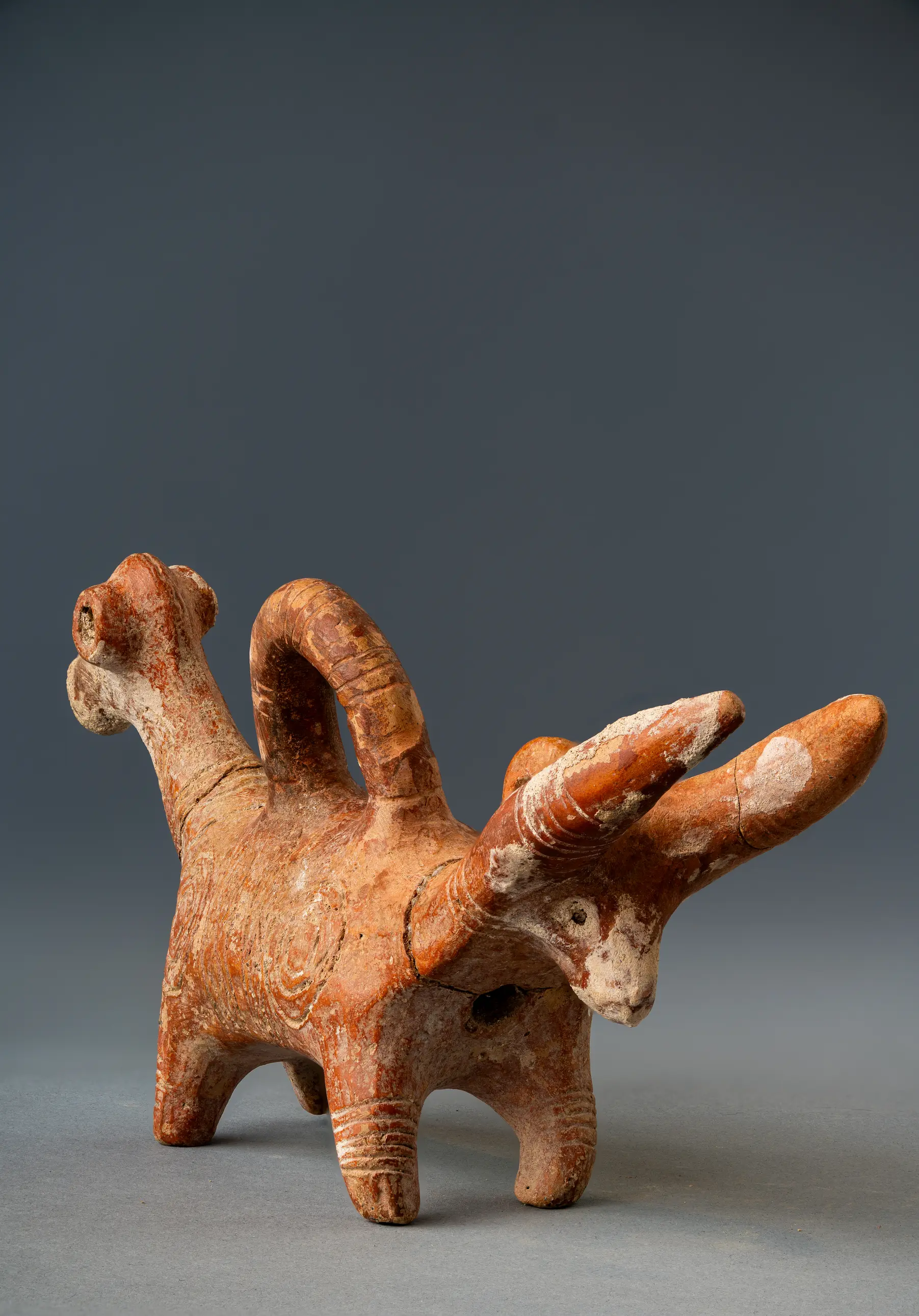
A two-headed Red Polished animal-shaped vessel with a bovine head, Drakopoulos collection (catalogue page). It has no Vounous provenance and is shown for comparison only.
A second collection piece belongs to the same broad world of horned animals in clay. It is a two-headed Red Polished animal-shaped vessel standing on four legs, with a long-horned bovine head at one end and a second animal head at the other, and incised decoration on the body. The catalogue page calls it a figurine; it is a vessel. It has no recorded provenance, Vounous or otherwise, and is useful here only as a comparison: the modelled cattle of the Vounous bowls and the animal-shaped vessels treated under Red Polished zoomorphic vessels draw on the same subject.
Snakes are the other recurrent motif. The British Museum's Red Polished I jug from Vounous, about 62 cm high when complete, has an applied snake running down either side of the neck. Dikaios read the snake as the sign of a chthonic cult; the counter-reading is taken up under the Vounous bowl below.
Tulip bowls and their use
The tulip bowl is the characteristic small vessel of the Early Cypriot I tombs: a deep, round- or pointed-based bowl, often fired black on the interior and upper exterior and red below, with lugs on the rim and white-filled incision [4; 5, p. 22]. Two readings of its use are in print. A catalogue entry on the British Museum's Tomb 105 bowl (H 14 cm) calls it a drinking cup. It places the shape in the expansion of eating and drinking vessels at funerary feasts, notes that the decoration is often individual even within one tomb, reads the rim lugs as probable bulls' heads, and records that Tomb 105 held several tulip bowls, plainer semicircular bowls, and the large bull bowl [4]. That entry cites Webb and Frankel's argument that the horned animals reflect cosmological beliefs or performances. The Nicholson Museum's catalogue takes the opposite view of its own example from Tomb 127 (H 10.5 cm), found with horn-lug bowls, an amphora and two other tulip bowls. "Although found in a tomb and despite its unusual shape", the vessel "probably had a practical purpose and could have been used for storage of dry items such as grains and seeds" [5, p. 22].
The two readings rest on different evidence. The drinking reading depends on the vessel groups in the tombs and on the case for graveside feasting, set out in the chamber-tomb entry. The storage reading depends on the shape and its fittings: the Nicholson bowl has two vertical rim lugs, one of them horizontally pierced [5, p. 22], and the British Museum's other Vounous tulip bowl also has a pierced lug. Neither has been tested by residue analysis. The class is described at length in Tulip bowls and cult vessels.
The Vounous bowl
The single best-known object from the cemetery is item 26 from Dikaios's Tomb 22, a Red Polished circular tray 37 cm across representing an enclosure with a low wall, published on his plates VII and VIII [2, p. 118]. It was recovered in many fragments from the tomb floor [2, p. 118]. Bernard Knapp dates it to Early Cypriot III-Middle Cypriot I and counts 19 human figures and four penned cattle. Most figures are modelled in the round, three are plank-like, and only one, holding an infant, is obviously female [7].
Dikaios called it a model of a sacred enclosure. He took the bull as a sacrificial animal, citing the finds from Tombs 13 and 36, read the relief figures on the wall as human bodies with bulls' horns holding snakes, and compared them to the terracotta "Minotaurs" from Ayia Irini. His conclusion was that "this important find reveals for the first time the existence in Cyprus in the Early Bronze Age of religious beliefs involving a cult of chthonian and fertility deities of which the attributes were the snake and the bull, and that rites and sacrifices were performed in special enclosures" [2, pp. 122-125]. He also reported Dussaud's suggestion that the enthroned figure might be the dead man himself.
Morris read the same scene as a village. The circular form, he argued, came from the bowl, not from any real enclosure, and the scene is "simply a peaceful village scene". His inventory lists two pairs of penned oxen, a woman with a baby, seated figures with folded arms, three bucranial poles with hanging "squiggles", a circle of six standing figures, a man in distinctive headgear on a large chair, a figure kneeling at a trough, and a figure peering over the wall. The hanging "snakes" could as easily be the free end of a rope, and the "High Priest" "need be no more than the village 'head-man'" [8, pp. 231, 281-282].
Knapp's survey of later readings shows how wide the range has stayed [7]:
| Reading | Scholar (as reported by Knapp 2008) |
|---|---|
| Sacred enclosure: a mortuary or fertility rite | Karageorghis 1991 |
| A ceremony held in a tomb dromos | Frankel and Tamvaki 1973 |
| A domestic or village scene | Morris 1985 |
| A group no larger than an extended household | Coleman 1996 |
| A specific aggrandiser | Manning 1993 |
| Prosperity generated by an elite | Steel 2004 |
| A building, and a legitimising device for emergent male elites | Peltenburg 1994 |
| Status differences not yet institutionalised into a rigid hierarchy | Keswani 2004 |
The social readings, from Sturt Manning, Louise Steel and Edgar Peltenburg, treat the bowl as a statement about authority. Priscilla Keswani set a limit on that: status differentials at the time "had not become institutionalized into a rigid social or political hierarchy" [7]. Knapp does not choose among them. He observes only that the bowl "must have held some special meaning for those who removed it from circulation and placed it in the Vounous tomb" [7]. Morris's warning applies to all the readings: whether such scenes reflect a larger religious system cannot be settled until Early Bronze Age settlements are excavated [8, p. 283].
Spindles, needles and the burial of women
Stewart's Tomb 164B is one of the wealthiest tombs at Vounous. It held 43 pots, including an imported Syro-Levantine jug, and two burials. With the earlier one were two copper-base needles, a hair ornament without parallel, a gold object and "a ceramic model of a spindle and whorl". Keswani described the person buried there as "a female of considerable wealth and prestige" [9, p. 48]. Model spindles also came from Tombs 29 and 92, and terracotta "comb figures" have been read as carding combs or weavers' beaters. Webb takes them together to "suggest the symbolic importance of cloth production in north coast communities" [9, p. 48]. Dikaios, publishing the Tomb 29 piece in 1940, was less sure what it was and called it "a model of spindle or staff", listing it with a model dagger and sheath from the same tomb as evidence for a habit of copying everyday objects in clay [2, p. 152]. Tomb 92 is the tomb from which the Ashmolean's beak-spouted jug is catalogued.
Schaeffer's Tomb 76 contained a plank figure, several multiple-bowl vessels and a jug with an attached figure. Webb reads this group with the Lapithos evidence as connected with mortuary ritual, and at Lapithos plank figures cluster with faience necklaces, which suggests female burials [9, p. 48]. The figures themselves are treated under plank figures and in the article Plank-shaped figures; the tools under spindle whorls and textile tools. The Vounous bowl's single woman holding a child is the only figure on it that is obviously female, which leaves the tomb goods of 164B and the spindle models as the better evidence for how women were marked in death.
Vounous between Vasilia and Lapithos
Webb places Vounous in a shifting pattern of north-coast centres. Settlement at Vasilia, the Philia-phase centre, ended "possibly abruptly, around 2250/2200 BC", and "following the demise of Vasilia, Vounous, 20 km to the east and 2.5 km inland, became the paramount centre on the north coast" [3]. Its tombs, "particularly those of EC I-II date at Site A, show a distinctive ceramic tradition, with high artefact diversity, a rich, diverse array of forms, and a complex iconography". Pottery, tomb elaboration and mortuary feasting were used in a fluid system of status negotiation, and ancestral relationships "were particularly important in the formation and legitimation of authority at Vounous". Webb describes the shift as one from the economic centrality of Vasilia to "ritual legitimacy and the elaboration of a highly localised material culture" [3]. Later, Vounous and Lapithos operated "as rivals in the narrow coastal strip" [3]. North-coast pottery occasionally reached Marki and Kissonerga, but the ceramic style zones were sharp, with the Pentadaktylos range as the boundary [3]. Access to copper, which the chamber-tomb entry discusses through Keswani's metal statistics, is taken up under copper metallurgy.
Stewart had his own explanation for the wealth of the cemetery. In Dunn-Vaturi's French rendering, the site "donne à penser que ce lieu était un centre religieux très important", perhaps owing its importance to a sanctuary of great renown, of which no trace has been found. He coined the phrase "culture de Vounous" early, and noted that Lapithos, Dhenia, Kochati and Margi produced similar but smaller assemblages [1, p. 27].
The British Museum's small tangless dagger from Vounous, with three rivets, is recorded by the museum as Catling type A.2.f. One blade stood apart. Dikaios's dagger Type IV, with a raised midrib, a flat top without a tang, two rivets at the side and three groups of three relief lines meeting at the point, "is evidently not a Cypriot type". He compared it closely with the long daggers of the Mesara plain in southern Crete, and above all with a fragment, no. 1499, from Tholos K, which has identical ornament [2, p. 137]. Whether it was imported from Crete, he wrote, "is quite possible", but he declined to say whether it showed direct contact, noting only that an Early Minoan III painted vase had been found in an Early Bronze Age tomb at Lapithos [2, p. 138]. The wider Cretan connection is covered under Minoan Crete.
The missing village
The settlement that used the Vounous cemetery "remains unknown" [3]. A settlement at a place called Gerani was linked to the cemetery but never excavated, and Dunn-Vaturi wrote in 2001 of her hope that conditions in Cyprus would one day allow survey in that part of the island [1, p. 27]. Without the houses, the question Webb and Frankel raise cannot be tested directly. They found no discrete ritual spaces in the Early and Middle Cypriot houses excavated elsewhere and concluded that "on the north central coast of Cyprus, and particularly at Vounous, burial was a key arena for ritualized practice" [6, p. 202].
That is the case the cemetery supports. The horned-animal bowls, the dancing figures, the tulip bowls and the clay enclosure were made for, or chosen for, funerals held on the hill below Bellapais from Early Cypriot I into the Middle Cypriot period. Dikaios's cult of bull and snake, Morris's village headman and Keswani's uninstitutionalised status differences are all readings of those same objects. The surrounding practice of the period is summarised in the mortuary practices hub, and the earlier background in Neolithic and Chalcolithic burial.
Objects on this page
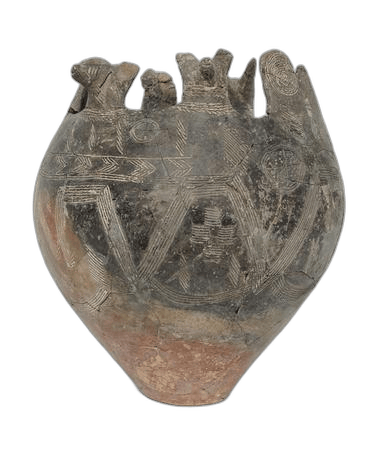 Red Polished Bull BowlEarly Bronze Age II · 2300–2100 BC
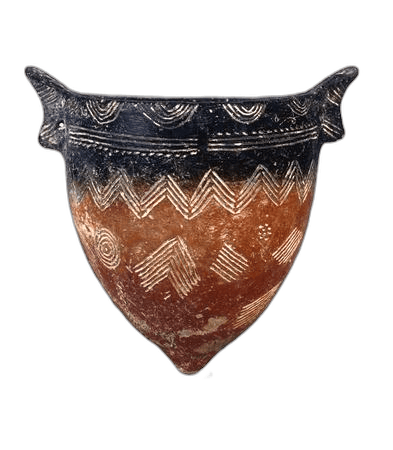 Red Polished 'Tulip' BowlEarly Bronze Age II · 2300–2100 BC
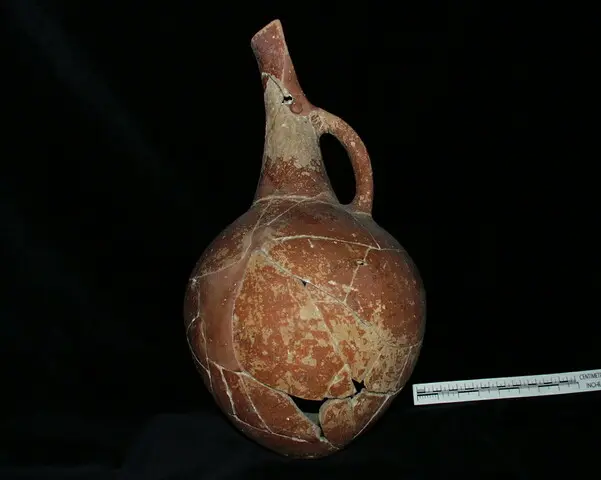 Beak-spouted Red Polished jug with cutaway spoutEarly Bronze Age I · 2300–2200 BC
- Red Polished Two-Headed Zoomorphic Askos with a Bull and a Long-Eared HeadEarly Bronze Age III · 2100–1850 BC
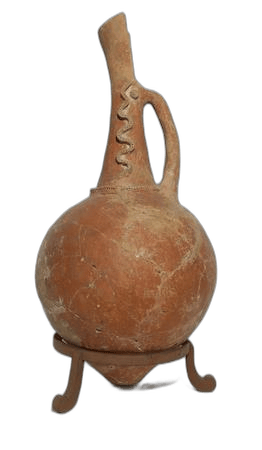 Red Polished Snake JugEarly Bronze Age II · 2300–2100 BC
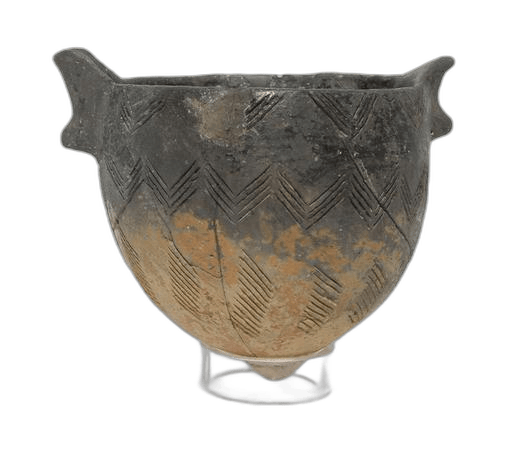 Red Polished Tulip BowlEarly Bronze Age II · 2300–2100 BC
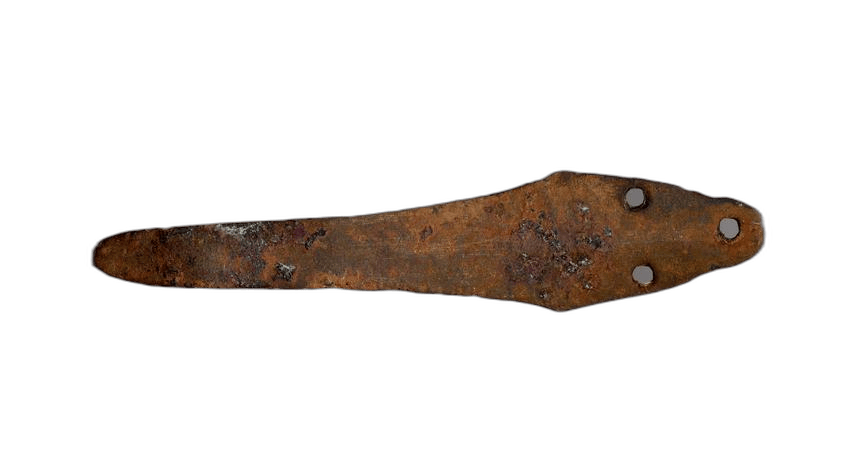 Tangless Copper DaggerEarly Bronze Age II · 2300–1900 BC
References
- 1.Dunn-Vaturi, A.-E. (2001). Les fouilles de Claude Schaeffer à Vounous en 1933. Cahiers du Centre d'Études Chypriotes, 31.
- 2.Dikaios, P. (1940). The excavations at Vounous-Bellapais in Cyprus, 1931-2. Archaeologia, 88, 1-174. https://doi.org/10.1017/S0261340900014557
- 3.Webb, J. M. (2018). Shifting centres: Site location and resource procurement on the north coast of Cyprus over the longue durée of the prehistoric Bronze Age. Land, 7, Article 64.
- 4.T. K. [entry signed] (2021). Red Polished ware drinking cup (tulip bowl), cat. 006. In Cyprus: Crossroads of civilizations (exhibition catalogue, Turin, Musei Reali, Sale Chiablese, 29 June 2021 to 9 January 2022), p. 241.
- 5.Barker, C. (2012). Aphrodite's island: Australian archaeologists in Cyprus. The Cypriot collection of the Nicholson Museum. The Nicholson Museum, The University of Sydney.
- 6.Webb, J. M., & Frankel, D. (2010). Social strategies, ritual and cosmology in Early Bronze Age Cyprus: An investigation of burial data from the north coast. Levant, 42(2), 185-209. https://doi.org/10.1179/175638010X12797237885776
- 7.Knapp, A. B. (2008). Prehistoric and protohistoric Cyprus: Identity, insularity, and connectivity. Oxford University Press.
- 8.Morris, D. (1985). The art of ancient Cyprus, with a check-list of the author's collection. Phaidon.
- 9.Webb, J. M. (2018). Lapithos Tomb 201: A singular Middle Bronze Age burial assemblage. In L. Hulin, L. Crewe, & J. M. Webb (Eds.), Structures of inequality on Bronze Age Cyprus: Studies in honour of Alison K. South (Studies in Mediterranean Archaeology Pocket-book 187, pp. 35-52). Åström Editions.