
For roughly two centuries, from the 540s or 520s BCE until the kings sailed to join Alexander at Sidon in 332, Cyprus belonged to the Persian Empire. It did so on unusual terms. No satrap was posted to the island, no Persian official is ever attested there, the city-kings kept their thrones, cults, laws and coinage, and their obligations were reduced to two: tribute, and ships whenever the Great King went to war. Almost everything known about the period comes from Greek authors who noticed Cyprus only when it touched their own story, above all Herodotus on the revolt of 498 and Diodorus on the war of Evagoras, so that the history is a handful of episodes separated by decades of silence [1, pp. 42-46]. The archaeology is thinner still. A siege ramp at Palaepaphos, a hilltop palace at Vouni, a bronze tablet from Idalion, four gold darics and a set of Achaemenid bracelets: that is close to the whole material record of Persian Cyprus, and each piece has been read in more than one way.
Submission and the terms of rule
Two ancient traditions date the island's entry into the empire. Xenophon makes the Cypriots allies of Cyrus already in the 540s, abandoning Amasis of Egypt after the fall of Sardis and serving against Caria and Babylon (Cyropaedia 7.4.1-2, 8.6.8). Herodotus has them join Cambyses' invasion of Egypt in 525 "after they surrendered by themselves to the Persians" (3.19.3). Stylianou follows Xenophon and puts the change of allegiance right after 546; the now more common view, which Cannavò adopts, treats the earlier date as back-projection and places the submission around or slightly before 525, once Persia had acquired the Phoenician fleet needed to reach the island [1, p. 42; 2]. Both agree on the essential point that the submission was voluntary and that the kings remained kings. Xenophon's formulation is the clearest: Cyrus "never sent a Persian satrap to either the Cilicians or the Cypriots, but the native rulers always sufficed for him; tribute, however, he took, and called up their armies whenever he had need" (Cyropaedia 7.4.2). Stylianou's gloss is "client kingdoms" [1, p. 43].
Herodotus complicates this with his list of Darius' twenty tribute districts, which puts Cyprus in the fifth, together with all Phoenicia and "Syria called Palestine," assessed at 350 talents a year (3.91.1) [3, p. 56]. The incorporation is widely repeated but rests on nothing else, and the list is demonstrably unreliable for this region: Herodotus' fourth district, Cilicia, was not a satrapy but a client kingdom exactly as Xenophon says [1, pp. 43-44]. No Persian official in Cyprus is attested, no Cypriot king is ever seen going through the satrap of "Beyond the River" to reach the court, and the transactions that survive all run directly between king and Great King: Evagoras negotiating his return to client status about 399, three Cypriot kings appealing against him in 392/391, and the terms of 380 by which he agreed to obey "as king to king" [1, pp. 44-45]. The 350 talents are a regional figure and no one knows the island's share [4, p. 278]. The most eloquent evidence of the arrangement is numismatic. When the Cypriot kings began to strike silver in the later sixth century, the figure of the Great King never appears on it and nothing in the types proves a political relation to the empire; Hill called it "a purely autonomous coinage," and Zournatzi makes the same point the centre of her argument that Persia recognised the Cypriot rulers as kings [5, p. 137; 8]. Cannavò's summary of the period is that its history "is essentially the history of inter-island conflicts based on internal dynamics" [2].
| Date BCE | Event | Principal source |
|---|---|---|
| c. 545 or c. 525 | Cypriot kings submit to Cyrus or Cambyses | Xenophon, Cyropaedia 7.4; Herodotus 3.19 |
| 525 | Cypriot ships join Cambyses against Egypt | Herodotus 3.19 |
| 499-498 | Onesilos seizes Salamis; all kingdoms but Amathus revolt | Herodotus 5.104-105 |
| 498 | Battle near Salamis; Onesilos and Aristokypros of Soloi killed | Herodotus 5.108-113 |
| 498-497 | Sieges of the rebel cities; Soloi falls in the fifth month | Herodotus 5.115 |
| 480 | 150 Cypriot triremes in Xerxes' fleet | Herodotus 7.90 |
| 478 | Pausanias' fleet expels Persian garrisons | Thucydides 1.94 |
| c. 478-470 | Persians and Kitians besiege Idalion | Idalion bronze tablet, ICS 217 |
| 450-449 | Kimon dies before Kition; Peace of Kallias | Thucydides 1.112 |
| c. 411 | Evagoras I takes Salamis | Isocrates, Evagoras |
| 391-380 | Evagoras' war against Artaxerxes II | Diodorus 14.98-15.9 |
| 387/386 | King's Peace assigns Cyprus to the Great King | Xenophon, Hellenica 5.1.31 |
| 332 | Cypriot kings bring 120 ships to Alexander at Sidon | Arrian, Anabasis 2.20 |
The Ionian revolt on Cyprus, 499-497 BCE
The first convulsion was dynastic before it was ideological. When news of the Ionian rising reached the island late in 499, Onesilos, younger brother of Gorgos king of Salamis, shut the city gates on his brother during his absence and seized the throne; Gorgos fled to the Persians (Herodotus 5.104). Onesilos then brought every Cypriot kingdom into the revolt except Amathus, which he besieged. Reyes stresses that Herodotus frames the spread of the revolt through the domestic politics of Salamis, not through any opposition of Greek freedom to Persian kingship [3, p. 59]. Stylianou adds a correction that older accounts missed: Herodotus' own narrative arrays the sides as Cypriots and Ionians against Persians and Phoenicians, and Phoenician Kition is unlikely to have joined the rebels at all, which would explain why Onesilos chose to besiege Amathus rather than the stronger Phoenician city [1, pp. 50-55].
The Persian response was amphibious. An army under Artybios crossed from Cilicia and landed in the Karpass while the Phoenician fleet rounded Cape Kleides into the bay of Salamis; an Ionian fleet arrived at Onesilos' request, and the two elements fought separately, the Ionians at sea and the Cypriots on land (Herodotus 5.108-110). The Ionians, the Samians above all, beat the Phoenicians. On land the Cypriots fought as hoplites, and Onesilos killed Artybios himself, his Carian shield-bearer hamstringing the general's horse, which had been trained to rear against shielded men (5.111-112). Victory was thrown away by defection: Stesenor of Kourion deserted with a large force, and the war-chariots of Salamis followed him (5.113). Onesilos fell, and so did Aristokypros of Soloi, son of the Philokypros whom Solon had praised in verse. The Amathusians hung Onesilos' head over their gate; when bees nested in the hollow skull an oracle told them to take it down and honour him as a hero (5.114). The Ionians sailed home. Gjerstad's older reading of the whole affair as a Greek-versus-Phoenician struggle has not survived; the alignments were determined by dynastic calculation, and Iacovou warns against reading the kingdoms' entire history "through the hourglass of a single episode" [4, pp. 278-279; 9].
The reduction of the cities followed through the winter. Salamis was simply handed back to Gorgos. The rest were besieged, and "Soloi held out longest; it fell only in the fifth month, after the Persians had undermined the walls all round" (Herodotus 5.115). Here the texts meet the spade. The Canadian excavators judged the Archaic town at Soloi to have been destroyed suddenly, the late Archaic temple of Aphrodite at Tamassos burned at about this time, and at Old Paphos the Persian siege works survive [1, pp. 56-57]. Herodotus' verdict on the year is that "after a year of freedom, the Cypriots were made slaves again" (5.116).
The siege of Palaepaphos: the ramp at Marchello
The one Persian siege that can be walked over is the assault on the northeast gate of Palaepaphos, on the Marchello hill above Kouklia, excavated by Franz Georg Maier for the German-Swiss expedition and published as the only ancient siege operation, apart from Masada, recovered in full [6, p. 204]. The Persians chose a strong point. The gate had been remodelled shortly before, perhaps in expectation of exactly this attack, with a narrow passage on a sharp double bend under crossfire from the bastions and an inner doorway only 2.90 m wide [6, p. 196]. The attackers demolished a late Archaic sanctuary outside the walls and used its wreckage, with earth and tree trunks, to fill the ditch and raise a ramp against the wall; the mound stood some 4.5 m above the counterscarp and more than 7 m above the bottom of the fosse [6, p. 199].
The contents of the ramp are the evidence. More than 500 bronze and iron arrowheads, javelin points and spearheads attest hard fighting during its construction. A late Archaic Corinthian helmet of about 500 BCE, with engraved lions on the cheekpieces, and fragments of an iron helmet are the only Greek helmets yet found in a battle context rather than a sanctuary or grave [6, p. 200]. Over a thousand fragments of limestone sculpture, votive stelai, capitals and incense altars, and more than 450 syllabic inscriptions, some still painted, came from the demolished sanctuary; with a terminus of 498 BCE they form a rare dated horizon for Archaic limestone sculpture and for the syllabary [6, pp. 199-200]. More than 450 rounded limestone blocks with one flattened side, weighing between 2.7 and 21.8 kg, were first suggested as ammunition for a stone-throwing engine, which would have pushed the invention of artillery a century before Dionysius of Syracuse; Maier later retreated from the idea, and the mainstream view is that the defenders threw or dropped them from the parapet [6, p. 202].
The defenders answered with mining. From inside the wall they drove a roofed passage through the berm and four rock-cut tunnels beneath the wall and out under the ramp, 1.2 to 1.7 m wide and 1.7 to 2.3 m high, lit by clay lamps in wall niches, with water jugs left on the floor; through them they dragged ramp material back into the city, hollowing the mound and propping the cavity with timber on mudbrick piers [6, p. 202]. At the ends of the passage and of two tunnels stood large bronze cauldrons on stacked mudbricks, filled with carbonised wood and lime: the props were fired, the tunnels acted as furnaces, and part of the ramp collapsed and fused into a block of burnt stone and lime [6, pp. 202-204]. Maier inferred from the localised collapses that the Persians were rolling wooden siege towers up the ramp in the Assyrian manner, since only towers would have justified trying to drop limited sections of the surface; the towers are an inference, not a find [6, pp. 203-204]. Two tunnels were never finished. The gate passage was strewn with weapons, missiles and burnt bone under collapsed bastion debris, the wooden doors were burnt, and Maier concluded that the assault parties forced the gate under crossfire and broke in [6, p. 205]. The walls then lay derelict for more than a century, the rebel cities apparently forbidden to rebuild, until a fourth-century king, probably Nikokles, "girded the city with a garland of towers" and revetted the unremovable mound as a bastion [6, pp. 209-214].
A recent reinterpretation should be registered. The Palaepaphos Urban Landscape Project under Iacovou has argued that the "siege mound" may be a votive deposit built against the inner rather than the outer face of the wall, which would remove the physical proof of the Persian assault of 498, and Cannavò notes that the older readings of Palaepaphos and Vouni as imperial control points "have lost much of their earlier appeal" [2]. The debate is unresolved. The weapons, the helmet and the counter-mines are not in dispute; what they were built against is.
Vouni: palace or garrison?
Vouni is a rock rising almost 270 m from the sea on the northwest coast, some 4 km west of Soloi. Alfred Westholm excavated it for the Swedish Cyprus Expedition in 1928 and 1929 and found the only completely preserved palace plan of Archaic or Classical Cyprus: well over a hundred ground-floor rooms around a great central court with a cistern, a monumental staircase about 17 m wide rising to a tripartite suite of state rooms, a girdling wall with towers, a sanctuary of Athena on the summit and a small necropolis below [7, pp. 111-290]. Two building periods were distinguished, about 500-450 BCE and about 450-380; in the second the orientation was reversed, the southern entrance blocked and an upper storey added. The ancient name is unknown. The Swedish expedition and its methods are described elsewhere on this site.
Gjerstad's interpretation became textbook fact for half a century. A pro-Persian dynast of Marion built Vouni I after the revolt to watch rebellious Soloi; a pro-Greek dynasty installed after Kimon's expedition converted it into a "megaron-like" Greek hall and added the Athena temple; Soloi destroyed it about 380 in revenge [7, pp. 286-288]. Every element has been attacked. Maier observed that none of the plausible-sounding story rests on unambiguous evidence. Metzler and Nielsen showed that the plan is Near Eastern throughout, a Babylonian courtyard house fused with north Syrian bit hilani units, closely paralleled by the Persian-period Residency at Lachish, so that the supposed Hellenisation dissolves; Reyes had already noted that the first phase is "more readily taken as traditional to Cyprus and other sites in the Near East outside of Persia" than to Pasargadae or Persepolis [3, p. 57]. The destruction date rested on eighteen coins of a "Demonikos" taken to be a king of Kition after 388, now recognised as issues of Demonikos II of Lapethos of uncertain date, which reopens the whole early fourth century, including the war of Evagoras and even an accidental fire. Several scholars now read the building not as a royal residence at all but as an Achaemenid fortress or naval station manned by local troops, which would explain the near-absence of Persian finds; Zournatzi, who treats it as a rare case study of provincial administration on the empire's western edge, finds "no obvious Achaemenid style elements" in the architecture and proposes a composite style in keeping with the eclecticism of Achaemenid building generally [8; 2]. Papantoniou notes that Vouni's role "remains enigmatic" because it has never been identified as the administrative centre of a named kingdom [10]. It remains, in Winbladh's phrase, our consolation for the loss of every other Cypriot palace.
The building's most famous find is the treasure hidden in a coarse jar under a staircase in Room 59 and sealed by ash: 248 silver coins, four gold darics of Artaxerxes I, three silver bowls, four gold and about fifteen silver bracelets, two silver pendants and four lumps of gold [7]. Most of the coins were struck at Marion, the rest at Lapithos, Kition, Paphos and Amathus, with one from Aspendos. The four solid gold bracelets, with finials in the form of calves' and goats' heads and weighing almost a kilogram together, are Achaemenid court work with close parallels in the Pasargadae treasure, and two of the silver bowls are of Achaemenid type paralleled on the Apadana tribute reliefs at Persepolis [8]. Zournatzi has proposed that coins and objects alike were forms of currency, perhaps tribute assembled for the Great King and manufactured locally, and supports the local manufacture with an unfinished limestone model of an Achaemenid bowl from the palace at Amathus whose shape and size match one of the Vouni bowls; Cannavò reports the proposal as a serious reading of the hoard [2]. The two limestone Hathor capitals from Vouni, one unfinished, belong with the Egyptianizing architectural sculpture of Amathus rather than with anything Persian, and the bronze cow from the Athena temple is usually taken as a copy of Myron's.
The Idalion tablet and the fifth century
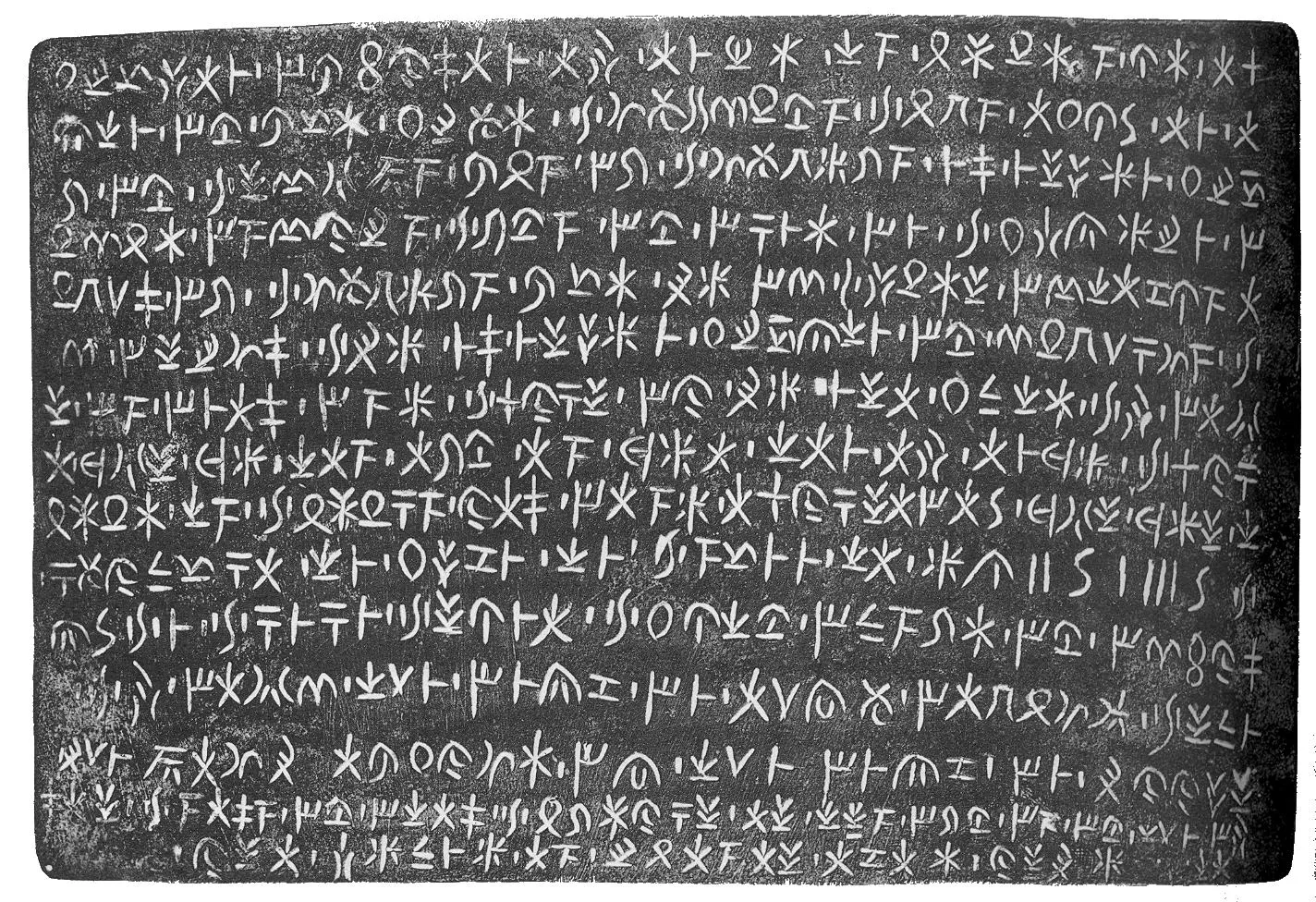
Persian victory in 497 translated into the advance of loyal Kition at the expense of a Greek neighbour, and the document that records it is the longest Cypro-syllabic text in existence. The bronze tablet of Idalion, found by treasure-diggers on the western acropolis in 1850 and now in the Bibliothèque nationale in Paris, records a decree of King Stasikypros "and the city": "when the Medes and the Kitians besieged the city of Idalion," the king and the city called the physician Onasilos son of Onasikypros and his brothers to treat the wounded without payment, and gave them, in place of a talent of silver from the king's house and the city's, a plot of royal land held free of tax forever [5, p. 178]. The story of that grant is told in an article on this site. Because Stasikypros was still reigning when the tablet was cut, the siege failed. Gjerstad put it just after the revolt, others in the 470s; the mainstream date is about 478-470, with Kition's successful conquest following somewhat later in the century, after which its Phoenician kings styled themselves "king of Kition and Idalion" [4, pp. 280-281; 1, p. 54]. Gjerstad read the Persian-and-Kitian coalition as the birth of an ethnic Greek-versus-Phoenician politics on the island; Maier dismissed that in 1985, and Cannavò admits that "since then no better explanation has been found" for why Persians and Kitians marched together against Idalion [2]. A recent survey of the history of Idalion's expeditions puts the tablet in the context of the site's rediscovery.
The rest of the century is naval. In 480 no fewer than 150 Cypriot triremes sailed with Xerxes, about an eighth of the nominal fleet, under Gorgos of Salamis, Timonax son of Timagoras and Penthylos of Paphos, who lost eleven of his twelve ships in the storm off Sepias and was captured with the last (Herodotus 7.90, 7.98, 7.195) [1, pp. 63-64]. At the battle of Salamis in Greece the Cypriots stood with the Phoenicians on the Persian right and shared the rout; Herodotus has Artemisia of Halicarnassus dismiss them, with the Egyptians, Cilicians and Pamphylians, as useless allies (8.68), a slur Stylianou reads as evidence that no non-Persian contingent had much appetite for the war [1, p. 64]. Within two years the picture reversed. Aeschylus' Persians, staged in 472, counts Paphos, Soloi and Salamis among the cities lost to Xerxes after the naval defeat, and in 478 the Hellenic League fleet under Pausanias sailed to Cyprus and, in Diodorus' words, "freed those cities which still had Persian garrisons" (Thucydides 1.94; Diodorus 11.44) [1, pp. 67-68]. Whether the Greek-Cypriot cities then joined the Delian League is disputed and probably undecidable; no Cypriot name survives in the tribute lists [1, pp. 70-72]. Persian garrisons on the island are mentioned by Diodorus only for 478 and, at Salamis, for 450, and Reyes suggests they were a consequence of the revolt rather than an original feature of Persian rule [3, p. 59]. Kimon's expedition of 451/450 with 200 ships took Marion, besieged Kition, lost its commander to disease before the walls, won a double victory off Salamis and withdrew; the Peace of Kallias of 449 left Cyprus Persian, and Athens never again committed a major force to it [1, pp. 82-86].
Evagoras' war, 391-380 BCE
The island re-enters the record with Evagoras I, who seized Salamis about 411, sheltered the Athenian admiral Conon after Aegospotami, and negotiated his way back to tributary status with Artaxerxes II about 399. His subsequent bid to unify the island under Salaminian rule is the best documented war in Cypriot history and the one that most clearly shows what Persian overlordship consisted of. Diodorus reports that "some cities he captured by force while others he persuaded to join him," but Soloi, Amathus and above all Kition resisted and sent embassies to the Great King offering to help Persia take the island (14.98) [1, pp. 100-101]. The configuration disproves any ethnic reading: Soloi was as Greek as Salamis, Kition Phoenician, Amathus Eteocypriot with Greek-named kings, and the war was a contest between Salaminian hegemony and the autonomy of the other kingdoms, who reached for the Persian umbrella exactly as Gorgos had done in 498. Athens sent ten triremes in 390 and, in 387, ten more with 800 peltasts under Chabrias; Evagoras allied with Akoris of Egypt, took footholds in Tyre, Sidon and Cilicia, and at his height held almost the whole island except Kition [1, pp. 101-102].
He was undone by diplomacy before arms. The King's Peace of 387/386 assigned "of the islands, Clazomenae and Cyprus" to the Great King (Xenophon, Hellenica 5.1.31), which in practice meant Evagoras; Athens withdrew Chabrias, and Artaxerxes could give the Cypriot war his full attention [1, pp. 104-105]. Tiribazus and Orontes brought a fleet that Diodorus numbers at more than 300 triremes, largely Ionian mercenaries. Evagoras raided the Persian grain supply from Cilicia and provoked a mutiny, raised his own fleet to 200, and gambled on a pitched battle off Kition against the royal fleet returning to base in disorder; he came near to winning and was defeated with heavy loss [1, pp. 105-106]. The Persians then besieged Salamis. The terms Tiribazus offered are the most discussed sentence of the reign: Evagoras was to evacuate the other cities, confine himself to Salamis, pay fixed tribute, and obey the King "as a slave his master." He accepted every clause but the last and insisted on obeying "as one king to another," and on that word the talks broke down (Diodorus 15.8) [1, pp. 106-107]. Stylianou reads the distinction as substantive, doulos answering to the Old Persian bandaka used of satraps and officials, so that acceptance would have turned a hereditary kingdom into a royal domain; Körner has since argued that bandaka carries no institutional demotion and that the Greek word was a humiliation rather than a change of status. Either way, after the revolt of the admiral Glos and a quarrel between the Persian commanders, Orontes granted the terms Tiribazus had refused, and Artaxerxes ratified them: Evagoras stayed king of Salamis, paying tribute, "as king to king" [1, p. 108]. He was murdered in 374/373 with his eldest son in a palace intrigue whose details differ in every source [1, p. 109].
Persian things in Cyprus
Set against two centuries of overlordship, the material trace of Persia on the island is, in Reyes' word, "very slim" [3, p. 56]. The buildings that once carried the argument no longer do. Vouni has been discussed; the "Persian building" at Hadji Abdullah on the Palaepaphos plateau, with its small rooms and corridors on symmetrical axes, was read as a garrison commander's residence echoing Persepolitan masonry, but symmetry and good ashlar are not enough to define Persian architecture, the multiple columns most characteristic of Achaemenid building are absent, and Maier himself came to read it as a Paphian king's palace built in imitation of Achaemenid models [3, p. 58]. Diodorus' garrisons of 478 and 450 are the only textual ones.
What survives is a prestige vocabulary rather than an administration, and Zournatzi's catalogue defines it [8]. Coined gold: the four darics from Vouni and a hoard of six found in the sea off Kiti in 1978. Plate: the two Achaemenid silver bowls and the omega-shaped gold bracelets from Vouni. Dress: terracotta figurines in Iranian costume, with hooded caps and trousers, dedicated in Cypriot sanctuaries, including examples from the temple of Apollo Hylates at Kourion dated before 490, and a small group of limestone statuettes in the full Iranian suit, lappeted hood, trousers and sleeved kandys coat, one with the akinakes dagger and a torque, among them a life-size headless statue from Pyla and a votive from Kourion in the Metropolitan Museum whose plinth carries a fourth-century syllabic dedication [8]. Glyptic: a single true Achaemenid cylinder seal with the "Persian hero" between two lions from a rural sanctuary at Peristeres near Marion, at least seven Neo-Babylonian-style pyramidal chalcedony seals, one inscribed in the syllabary, and a series of hybrid pyramidal stamps and scaraboids that combine Achaemenid shape with Greek or Near Eastern devices [8]. The Salamis capital with addorsed bull protomes, often cited as the conspicuous Persianizing monument, is probably Hellenistic. Three Archaic Cypriot silver coins in the foundation deposit of the Apadana at Persepolis hint at the island's role as a western supplier of bullion.
Two conclusions follow. Cannavò distinguishes the presence of Persian officers, "particularly difficult to assert because of the ambiguous and poor evidence," from the circulation of Persian models and objects "whose ideological value was particularly interesting for the self-definition and legitimization of the Cypriot elites," and it is the second that the record shows: the kings appropriated the visual language of imperial prestige as they had appropriated Egyptian and Greek forms, and the torque and earring on the last Salaminian gold issues show the taste reaching the royal house itself [2; 8]. The period was also prosperous. Diodorus describes an island that "had enjoyed peace for a long time" and was wealthy when the war of Evagoras broke it, and the mechanism was the symbiosis of the Cypriot maritime economy with the Persian fleet: the kings supplied manned triremes, as when Pharnabazos ordered them to make ready a hundred, and were paid in the trade and precious metal that the Vouni and Kiti hoards represent [8].
The end
After Issus in 333 the Cypriot kings were still nominally with Persia. Hearing of Darius' defeat and finding Phoenicia already in Alexander's hands, they brought about 120 ships to Sidon, were pardoned on the ground that they had served the Persian fleet "by necessity rather than by choice," and blockaded the northern harbour of Tyre through the seven-month siege of 332 (Arrian, Anabasis 2.20). Alexander left them their kingdoms and favoured Pnytagoras of Salamis with the territory of Tamassos. In Gjerstad's summary they had spent the Classical period in repeated and unsuccessful attempts to revolt from Persia and regain full independence; Alexander freed them from Persia once and for all, "but they did not obtain political independence. The result was only that they changed suzerains" [4, p. 294]. The abolition of the kingdoms under Ptolemy is told under Egypt and in the Hellenistic chronology entry.
References
- 1.Stylianou, P. J. (1989). *The age of the kingdoms: A political history of Cyprus in the Archaic and Classical periods* (Meletai kai Hypomnemata 2). Archbishop Makarios III Foundation.
- 2.Cannavò, A. (2021). Cyprus. In B. Jacobs & R. Rollinger (Eds.), *A companion to the Achaemenid Persian Empire* (Vol. 1, ch. 19). Wiley-Blackwell.
- 3.Reyes, A. T. (1994). *Archaic Cyprus: A study of the textual and archaeological evidence*. Clarendon Press.
- 4.Gjerstad, E. (1948). *The Swedish Cyprus Expedition, Vol. IV, Part 2: The Cypro-Geometric, Cypro-Archaic and Cypro-Classical periods*. Swedish Cyprus Expedition.
- 5.Hill, G. (1940). *A history of Cyprus, Vol. 1: To the conquest by Richard Lion Heart*. Cambridge University Press.
- 6.Maier, F. G., & Karageorghis, V. (1984). *Paphos: History and archaeology*. A. G. Leventis Foundation.
- 7.Gjerstad, E., Lindros, J., Sjöqvist, E., & Westholm, A. (1937). *The Swedish Cyprus Expedition, Vol. III: Finds and results of the excavations in Cyprus 1927-1931*. Swedish Cyprus Expedition.
- 8.Zournatzi, A. (2008). Cultural interconnections in the Achaemenid West: A few reflections on the testimony of the Cypriot archaeological record. In S. M. R. Darbandi & A. Zournatzi (Eds.), *Ancient Greece and ancient Iran: Cross-cultural encounters* (pp. 239-255). National Hellenic Research Foundation.
- 9.Iacovou, M. (2013). Cyprus during the Iron Age through the Persian period: From the 11th century BC to the abolition of the city-kingdoms (c. 300 BC). In M. L. Steiner & A. E. Killebrew (Eds.), *The Oxford handbook of the archaeology of the Levant, c. 8000-332 BCE* (pp. 795-824). Oxford University Press.
- 10.Papantoniou, G. (2013). Cypriot autonomous polities at the crossroads of empire: The imprint of a transformed islandscape in the Classical and Hellenistic periods. *Bulletin of the American Schools of Oriental Research, 370*, 169-205.