
Ancient Cypriot Pottery·Lesson 10
The Cypro-Classical and the End of a Tradition
How painted pottery faded from Cypriot tombs between 480 and 310 BC: the spare White Painted VI and VII jugs, figure-spouted jugs from Marion, Athenian black glaze, and the plain Hellenistic oil bottle that came next.
Alexis Drakopoulos·Period by period·11 min read
Share


Lesson 10·Course contents, 15 lessons
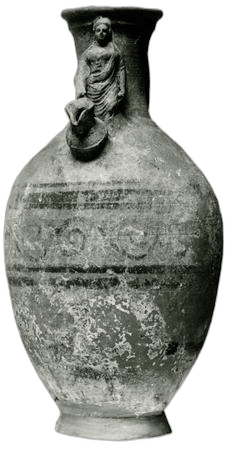
A jug in the British Museum, 32 centimetres tall and from the tombs of Marion on the north-west coast of Cyprus, has a small clay woman standing on its shoulder. She stands against the neck, opposite the handle, and holds a pitcher of her own, and her pitcher is the jug's spout: tip the vessel and the liquid pours from hers. The body was thrown on the wheel and coated in a thick white slip. A painter then ran a vine scroll round the belly and a myrtle wreath round the shoulder in red, now badly faded. Wreaths and scrolls of this kind were borrowed from Athenian vase-painting [1].
The jug is White Painted VII, the last painted class in the Swedish Cyprus Expedition's scheme, and it belongs to the 4th century BC. Einar Gjerstad, who built that scheme, had already passed sentence on its predecessor. White Painted VI, he wrote, "forms a very poor style. It marks the end of the artistically painted pottery of Cyprus and the beginning of the decadence" [1]. The woman on the shoulder suggests that Cypriot potters still cared how a jug looked. Their care had gone into the modelling.
Over the Cypro-Classical period (CC, c. 480 to 310 BC), the last two centuries of the island's kingdoms, the painted pottery followed through Lessons 7 to 9 thins out and stops. It stops without a date. Ptolemy, the Macedonian ruler of Egypt, ended the kingdoms around 310 BC; by then the painted jug had been fading for well over a century, pushed aside in the tombs by a cheap black cup from Athens and by the Cypriots' own plain jugs.
Reading the label: Types VI and VII
Gjerstad divided the Iron Age pottery of Cyprus into seven successive horizons, Types I to VII, and numbered every ware to match. The Cypro-Classical holds the last two. Type VI goes with Cypro-Classical I (CC I, c. 480 to 400 BC) and Type VII with Cypro-Classical II (CC II, c. 400 to 310 BC). So "White Painted VI" means White Painted ware of the CC I horizon, and "Plain White VII" means Plain White of CC II. The red wares carry their own class number with the horizon in brackets, as in Lesson 9: Bichrome Red III (VI) is the third class of Bichrome Red, made in Type VI times [1].
For this period the dates behind the labels come from Athens. Gjerstad set the line between CC I and CC II at about 400 BC by the Attic vases in the tombs of Marion, using dating evidence that Lucy Talcott supplied from the American excavations of the Athenian Agora [1]. He closed the period at 325 BC, the conventional start of the Hellenistic age; most scholars now close it at about 310, when the kingdoms ended, and a few at 294, when Ptolemy finally secured the island. This course uses 310.
Lay Gjerstad's Iron Age dates beside the ones used now and open the last line. The boundary at about 400 BC has held since he drew it; the end of the period has moved from 325 to 310.
Two chronologies
Gjerstad's Iron Age dates, and the dates used now
The order of the periods has survived seventy years of testing; some of the years under them have moved. Each line joins the same boundary in the two schemes. Choose a line, or a boundary in the list, to see why.
Gjerstad, 1948 · Swedish Cyprus Expedition IV:2
Used now · the dates in this course
End of the Cypro-Classical
325 310 BC
Gjerstad closed the period at 325 BC, the conventional start of the Hellenistic age. Most scholars now close it at about 310, when Ptolemy ended the kingdoms; a few at 294. The course uses 310.
Lesson 10: The Cypro-Classical and the End of a TraditionThe fifteen years at the end come from a choice of event: Gjerstad took the conventional start of the Hellenistic age, later scholars the end of the kingdoms.
Paint off: what the tombs show
Gjerstad counted. In the tombs he classified, decorated pottery made up 80.6 per cent of all the vases in Cypro-Archaic I. In the first half of CC I it was 24.2 per cent, and at the end of the period 9.1 per cent, while Plain White, the undecorated pale ware, rose from 43.7 to 73.1 per cent. "The pottery of the Geometric and Archaic periods is thus principally 'decorated'," he concluded, "but that of the Classical period is definitely 'plain'." He added a warning: these are tomb counts, and plain domestic and storage pottery always outnumbers everything else in settlements [1, pp. 202-206]. What changed was what the living chose to put in graves.
The retreat was uneven. Bichrome, the two-colour ware that had carried the free-field birds of Lesson 8, "suddenly falls off to a trifle." White Painted, already at a low ebb at the end of the Archaic, held its small share. On the red side the Archaic order turned over. Bichrome Red, black and white paint over a red slip, rose to 16.7 per cent of the tomb pottery in the first half of CC I against 3.5 for Black-on-Red, briefly the commonest decorated ware of all, and Red Slip, plain red-slipped bowls and jugs, made up almost a quarter [1, pp. 202-206].
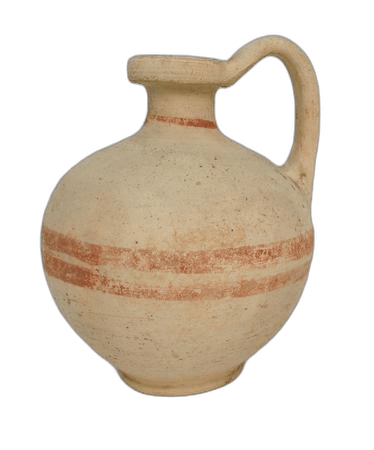
White Painted VI is wheel-made, with a buff or greenish-buff slip and brown or dark brown paint that keeps a slight sheen. Gjerstad called its decoration an "absolute break" with the Archaic: the circle systems are gone, leaving encircling lines and bands, single wavy lines and short strokes, with conventional lotus flowers only on the earliest pieces [1]. The sharp, biconical jugs of Type V soften into rounded ones. The oinochoe (wine jug) from Amathus beside this paragraph, 19 centimetres high, shows the whole programme: red bands round the neck and belly, a single plant hanging below the neck opposite the handle, and bare slip everywhere else.
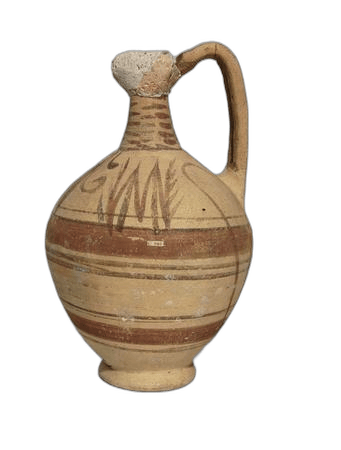
Bichrome VI uses the same clay and slip and adds a bright red; its ornaments are those of White Painted VI, and Gjerstad found it only on jars and jugs [1]. The edges of the classes blur. The Bichrome VI oinochoe from Amathus here, 26.5 centimetres high and painted in brown, red and purple, still has an inverted palmette on its shoulder between pointed leaves, and a pair of painted eyes on its spout, a late memory of the Archaic jugs.
In White Painted VII and Bichrome VII the slip is often brown or reddish brown, sometimes left off altogether, and the ornament stays as spare as before, with one new pattern, a panel filled with crossed lines [1]. The shapes tell you more than the paint. Jugs copy metal vessels: clay discs where the handle meets the neck imitate rivets, bases rise on angular moulded rings, and a ridge circles the foot of the neck [1, p. 68]. There is a new ovoid bottle, and some amphorae copy Athenian shapes. The painters borrowed from Athens as well: leaves, palmettes and ivy sprays from red-figure pottery, the source of the Marion jug's wreath and scroll [1].
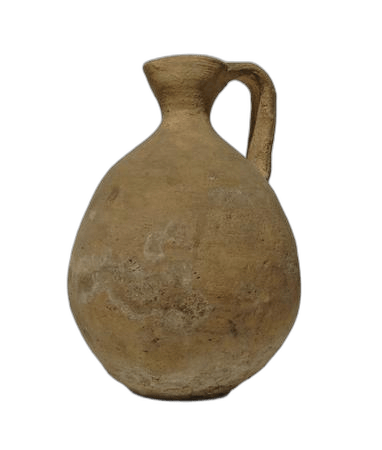
Plain White VI and VII, pale wheel-made jugs, amphorae and bowls with no decoration at all, follow the same drift. The oinochoe from Kourion shown here, 20 centimetres high in coarse buff clay with a trefoil (three-lobed) mouth and a single squared handle, is the kind of pot that filled a Cypro-Classical tomb.
The figure on the shoulder
The woman with the pitcher has a history. William Childs, who directed the Princeton excavations at Polis, the site of Marion, traces the type to Marion in the late 6th century BC, where the one-handled jug with modelled figures on the shoulder stayed in fashion into the 4th. With few exceptions the figure is a woman holding a pitcher that forms the spout; on other jugs a bull's head on the shoulder does the pouring. At Marion they turn up almost only in the tomb chambers and the dromoi, the sloping entrance passages. Childs notes that the type has rarely been found elsewhere on the island, and that Marion's tombs show an "almost total lack of Cypriot figured pottery" [2]. In a cemetery almost without painted figures, the figure on the shoulder was the picture.
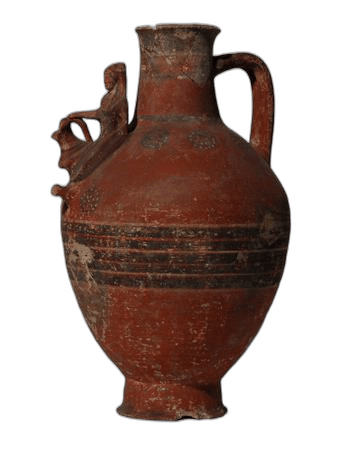
The idea crossed wares. Gjerstad records jugs with a woman on the shoulder in White Painted VI and VII, in Black-on-Red V (VII) and in Bichrome Red IV (VII) [1]: one shape in at least three wares, the "ware is not shape" rule from the start of the course played out on a single jug type. "Rarely" still allows a few: examples are reported from Kourion and Amathus [3]. The British Museum's Bichrome Red jug beside this paragraph, 34 centimetres high, comes from Amathus on the south coast; another in the same museum, on a tall hollow foot, comes from Kourion. On the Amathus jug the dark red slip carries black and white bands and black concentric circles with white dots; the woman's face and upper body were pressed in a mould, and the rest of her was shaped by hand.
Black cups from Athens
The tombs that lost their painted jugs filled with Athenian pottery. Gjerstad's figures for the datable Marion tombs give imported Attic ware 13.5 per cent of all the pottery in the first half of CC I, 39.1 per cent in the second, then 25.1 and 18.0 per cent in the two halves of CC II, a peak around 400 BC. In some graves Athens outnumbered Cyprus: Marion Tomb 41 held 10 Cypriot vases and 21 Attic, and one burial in Tomb 14 held 3 Cypriot and 10 Attic [1].
The Athenian pots most people picture, red-figure vases with painted scenes, were the minority. Of the 261 Attic vases in those tombs, 136 were plain black-glazed, coated all over in the glossy black of Athenian fine ware, 90 were black-glazed with stamped ornament, 33 were red-figure and 2 white-ground. Most of the red-figure pieces were gutti and lekythoi, small vessels for oil, and Gjerstad judged the whole import "second rate mass products." He drew a useful distinction. The lekythoi and gutti were probably containers for the real import, oil; the bowls, skyphoi (deep two-handled cups) and kantharoi held nothing for the voyage and "must have been imported for their own sake" [1]. Cypriots were buying Athenian tableware to drink and eat from, and taking it to the grave.
The pattern held beyond Marion. Attic pottery made up 20 to 25 per cent of the ceramic finds in the palace of Vouni, with a similar share in the sanctuary of Melqart at Kition. Distribution was uneven: the 16 Cypro-Classical tombs at Korakas, near Vouni, produced one Attic vase, a red-figure lekythos [1].
Earlier, in the Archaic period, the traffic had also run the other way. John Beazley picked out a small group of Athenian black-figure oinochoai with long necks and globular bodies, found at Marion and Amathus, that are modelled on Cypriot shapes and were perhaps made for the Cypriot market; he called them "Cypro-jugs" [3]. Athenian potters copied Cypriot jugs, and Cypriot painters copied Athenian leaves. Neither proves that Athenians lived at Marion. The best reading of all those black cups is Gjerstad's own: "a mass import of simple and standardized types" [1].
310 BC and a bottle with no country
The kingdoms ended in a few violent years. In 312 BC Ptolemy, fighting the other successors of Alexander for the island, executed the king of Kition, arrested the king of Lapithos, and treated Stasioikos of Marion worst of all: his city was destroyed and its people moved to Nea Paphos [4]. Within two years the royal house of Salamis or of Paphos (the sources disagree on which) had died by its own hand [4].
Nothing in the pottery marks those years. By the last phase of CC II, Type VII was "sovereign" in the tombs, nine vases in ten were plain, and "stray specimens of Hellenistic pottery" had already appeared in the latest burials [1, pp. 202-206]. Gjerstad's Types stop at VII; the pottery of the Hellenistic generations that followed needed a new system.
Walk the year from the 4th century BC across 310. Gjerstad's numbered classes end with Type VII, and the oil bottle that closes this lesson begins.
Chronology
The end of the Iron Age wares
Each bar is a ware, placed by the dates the lessons give it. Drag the red line, or use the arrow keys on its year, to see what was being made in any year; choose a bar for its cues and lesson.
Late Bronze Age wheel-made
Imports
Iron Age and Hellenistic
In use around
330 BCCypro-Classical II
330 BC: 7 wares in use.
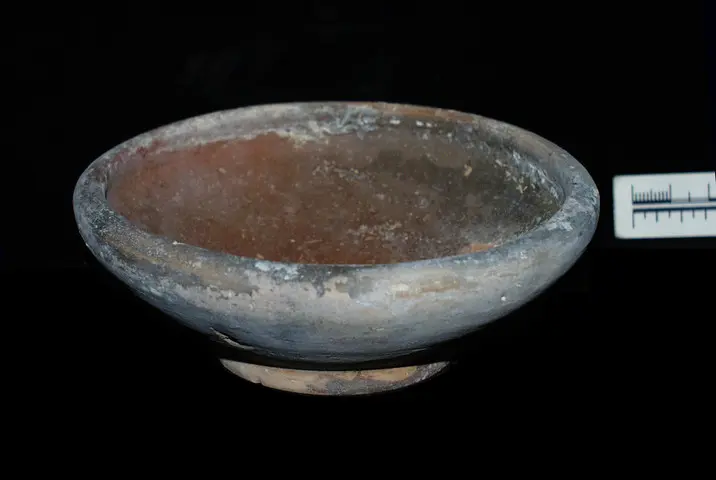
What replaced them was the koine, the shared repertoire of the Hellenistic eastern Mediterranean. Much of the fine tableware of the 3rd to 1st centuries BC in Cyprus is colour-coated ware: a semi-lustrous slip that runs from dark grey to reddish brown to red, without the deep gloss of Attic black glaze. It was made at several places on the island and turns up all over it, though rarely abroad [5]. The small bowl with an inturned rim shown here, from a tomb at Rizokarpaso-Tsambres in the Karpas, is a Cypriot copy of an Athenian black-gloss salt-cellar, its black now a dull wash. The Athenian cup had become a Cypriot shape.
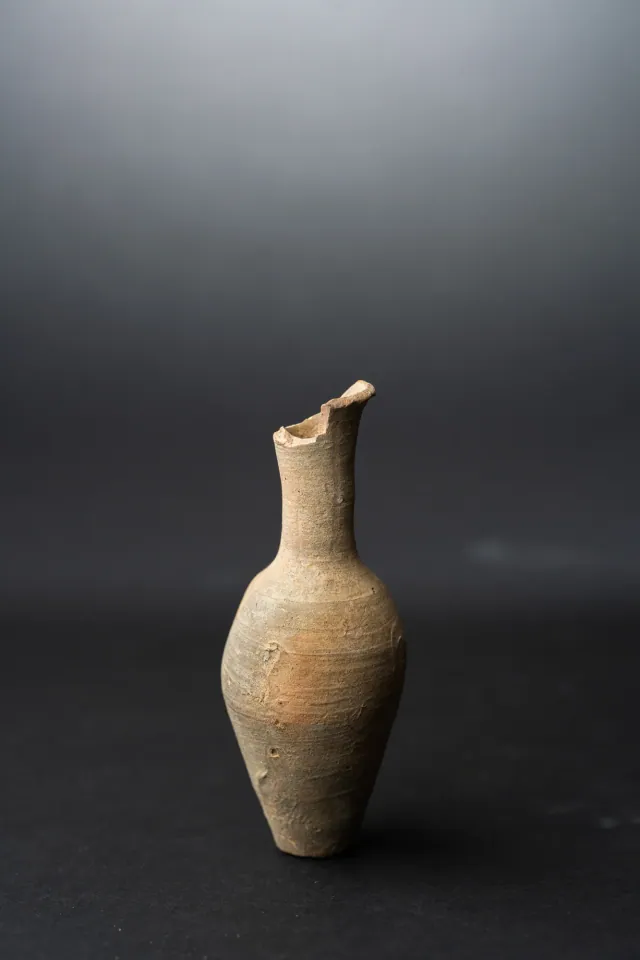
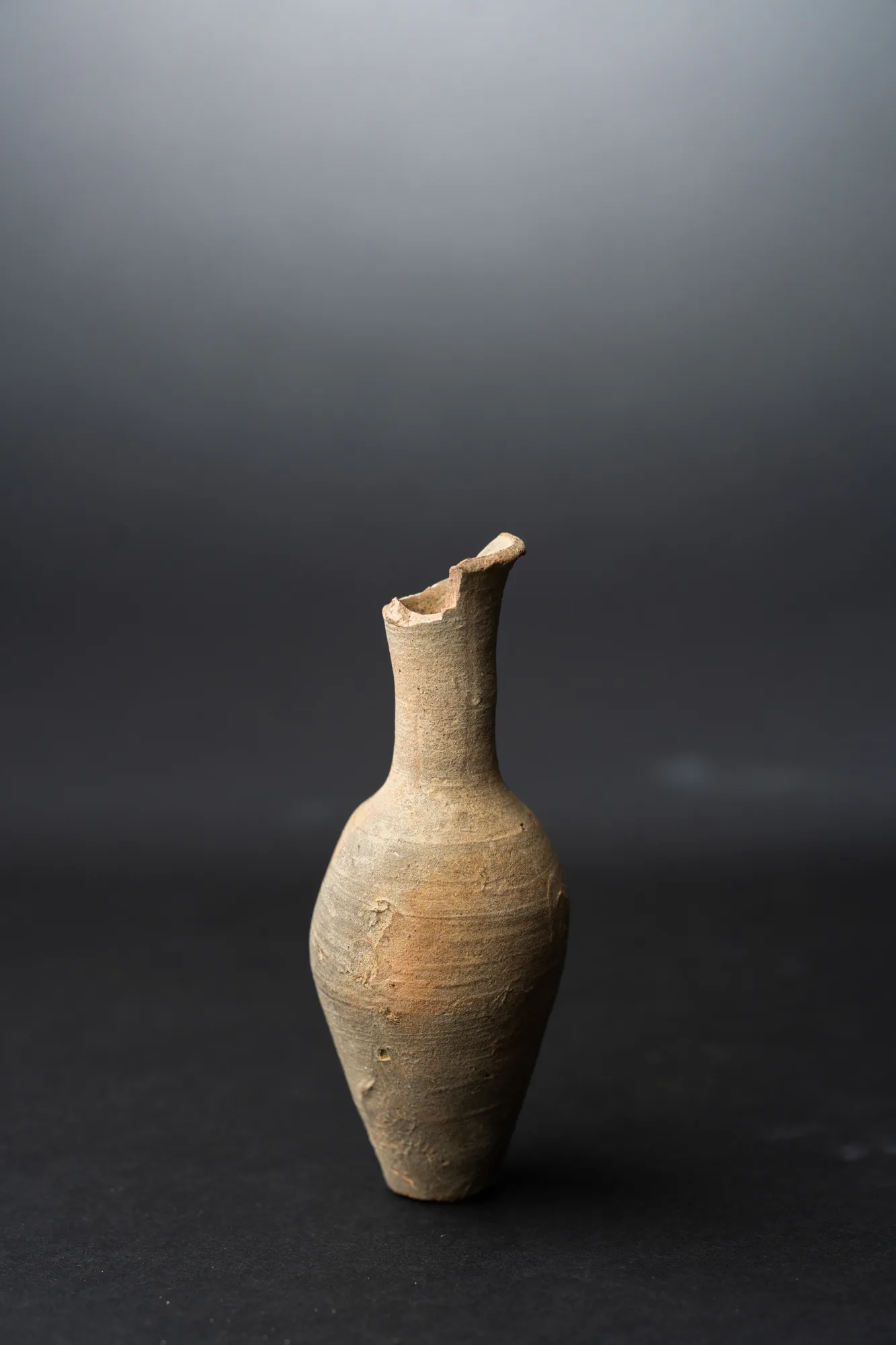
The last vessel in this lesson is a fusiform unguentarium in the Drakopoulos collection: a handleless oil bottle with a spindle-shaped body, a narrow neck now broken off at the top, and a tiny flat base. It is plain buff clay with no slip and no paint, and throwing ridges run unsmoothed from base to neck where the potter worked fast at the wheel. Bottles like it replaced the lekythos as the standard grave offering across the Hellenistic Mediterranean, and the early form, full in the body with almost no foot, does not appear in the east before the late 4th century BC [6]. They held scented oil for the dead; the old story that they caught mourners' tears has no support [6]. The oil that had come from Athens in red-figure lekythoi now went into the grave in a bottle anyone could make. The Swedish excavators found one of the same rounded profile, 12.7 centimetres high, in Marion Tomb 9 and recorded it as Plain White I, Hellenistic [7]: the numbering had gone back to one. Unguentaria were thrown in Greece, Asia Minor, the Levant, Egypt and Cyprus alike, so the shape cannot say which of them made this one [6]. Only the clay could.
Quiz
Check yourself
Question
A museum label reads Plain White VII. What does it tell you?
Question
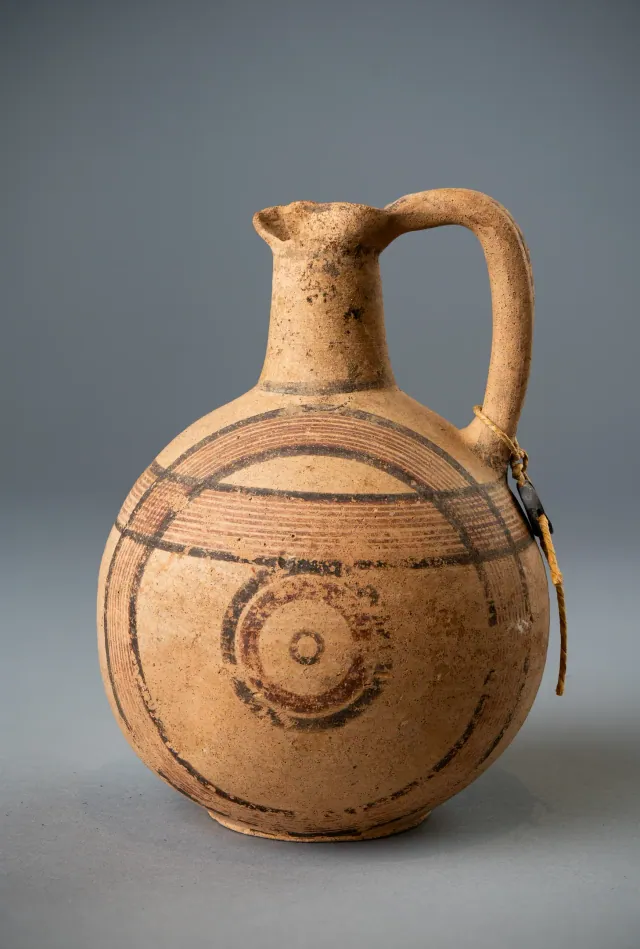
This jug is offered as Cypro-Classical. What does its painting say?
Question
In Gjerstad's tomb counts decorated pottery made up 80.6 per cent of the vases in Cypro-Archaic I. Roughly what share was it at the end of the Cypro-Classical?
Question
A Cypriot jug has clay discs where the handle meets the neck, an angular moulded base and a ridge round the foot of the neck. Which horizon does it belong to?
Question
What did most of the Attic pottery in Marion's Cypro-Classical tombs look like?
Question
Where was the jug with a woman on its shoulder, her pitcher forming the spout, at home?
Question
Put these changes in the tombs in order, earliest first.
Tap an item, then tap its place. Or use the arrows
What to look for
- Thin, spare paint on a wheel-made jug. Encircling bands, single wavy lines and short strokes in brown or red on a buff or greenish slip, with no circle systems, point to White Painted or Bichrome VI (CC I, c. 480 to 400 BC).
- Metal habits in clay. Clay discs at the handle root imitating rivets, angular moulded bases and a ridge at the foot of the neck are Type VII traits (CC II, c. 400 to 310 BC).
- Athenian borrowings. Leaves, ivy sprays, palmettes, vine scrolls or myrtle wreaths painted on a Cypriot jug mean late, usually 4th century BC.
- A figure on the shoulder holding a pitcher that is the spout. A type at home in the tombs of Marion from the late 6th to the 4th century BC, made in several wares.
- Plain pale jugs, amphorae and bowls with a trefoil or flaring mouth. Plain White VI or VII, the commonest pottery in Cypro-Classical tombs.
- Glossy black all over. Imported Attic black glaze; a duller black or grey-to-red wash on similar shapes suggests a local copy or Hellenistic colour-coated ware.
- A handleless spindle-shaped bottle with throwing ridges. A Hellenistic unguentarium, from the late 4th century BC onwards; fuller bodies with little foot are earlier, slim ones on tall stems later.
Go deeper
The compendium carries this material further in Iron Age White Painted, Bichrome, Bichrome Red (with Gjerstad's full frequency tables), Black-on-Red and Plain White, and in the period pages for the Cypro-Classical and Hellenistic periods. For the jug shapes behind this lesson, see the Cypriot oinochoe and the jug and bottle pages; for the scheme that numbered them, The Swedish Cyprus Expedition and its legacy.
References
- 1.Gjerstad, E. (1948). The Swedish Cyprus Expedition, Vol. IV, Part 2: The Cypro-Geometric, Cypro-Archaic and Cypro-Classical Periods. Stockholm: The Swedish Cyprus Expedition.
- 2.Childs, W. A. P. (2012). Marion: A City-Kingdom of Ancient Cyprus. In W. A. P. Childs, J. S. Smith, & J. M. Padgett (Eds.), City of Gold: The Archaeology of Polis Chrysochous, Cyprus (pp. 91–107). Princeton: Princeton University Art Museum.
- 3.Reyes, A. T. (1994). Archaic Cyprus: A Study of the Textual and Archaeological Evidence. Oxford: Clarendon Press.
- 4.Diodorus Siculus. Bibliotheca historica 19.79.4–5 and 20.21.1–3.
- 5.Caraher, W., Moore, R. S., & Pettegrew, D. K. (2014). Pyla-Koutsopetria I: Archaeological Survey of an Ancient Coastal Town (Archaeological Reports 21). Boston: American Schools of Oriental Research.
- 6.Anderson-Stojanović, V. R. (1987). The Chronology and Function of Ceramic Unguentaria. American Journal of Archaeology, 91(1), 105–122.
- 7.Medelhavsmuseet, Stockholm, M.009:001: unguentarium, Plain White I (Hellenistic), Marion Tomb 9, Swedish Cyprus Expedition. Collection record.