
Contents
Between the end of the thirteenth century and about 950 BCE the fine pottery of Cyprus changed in technique, in shape and in decoration. The two handmade wares that had marked the Late Cypriot period, Base Ring and White Slip, went out of use. A wheelmade, matt-painted pottery in an Aegean manner, now called White Painted Wheelmade III, took their place in Late Cypriot (LC) IIC and IIIA. In LC IIIB it was followed by Proto-White Painted, and around 1050 BCE by the White Painted I and Bichrome I of the Cypro-Geometric period. Ioannis Voskos and Bernard Knapp call the transition between LC IIC–IIIA and LC IIIB–Cypro-Geometric I, "between ca. 1300 and 1000 B.C.E.", "one of the better studied but still most controversial periods" in the archaeology of the island [1, p. 660]. Much of the controversy concerns what the pottery means. Scholars "have long argued that Cyprus had been colonized" in these years "by Mycenaeans (or 'Achaeans')", and the new pottery was the main evidence [1, p. 660]. This entry follows the sequence phase by phase and sends the reader to the individual ware entries for the detail.
The sequence at a glance
| Phase | Approx. date | Main fine and painted wares | Key sites and contexts |
|---|---|---|---|
| LC II to LC IIC | to the end of the 13th century BCE | Handmade Base Ring and White Slip; Mycenaean-style pottery, imported and locally made | Tombs and settlements across the island |
| LC IIC to IIIA | late 13th and 12th centuries BCE | White Painted Wheelmade III (a minor ware in LC IIC, dominant in LC IIIA); wheelmade Plain White and Bucchero; Handmade Burnished Ware in small amounts | Enkomi, Sinda, Kition, Maa-Palaeokastro, Hala Sultan Tekke, Kouklia, Alassa |
| LC IIIB | c. 1125/1100 to 1050 BCE | Proto-White Painted, with a bichrome variant | New chamber tombs with long dromoi at Lapithos, Salamis, Kourion-Kaloriziki, Idalion, Kition, Palaepaphos and Alaas; the Sanctuary of the Ingot God at Enkomi |
| Cypro-Geometric I | c. 1050 to 950 BCE | White Painted I, Bichrome I, Black Slip Painted | Palaepaphos-Skales, Lapithos, Salamis Tomb I |
The absolute dates are conventional. The boundary at about 1050 BCE goes back to John Myres, and Maria Iacovou calls it one "which remains a conventional but unshakable absolute date" for the end of the Cypriot Bronze Age [2, p. 199]. The start of LC IIIB is less fixed. The Ashmolean Museum dates a Proto-White Painted stirrup jar from Palaepaphos to LC IIIB, c. 1125/1100–1050 BCE (AN1888.1497), and the Metropolitan Museum's Cesnola catalogue places the ware at "the very end of the Late Bronze Age on Cyprus", in "the early eleventh century B.C." [3, intro. to cat. 74–78]. Cypro-Geometric I is dated "ca. 1050–ca. 950 B.C." throughout the same catalogue [3, cat. 126–129]. The period pages for the Late Bronze Age and Cypro-Geometric set these phases in their wider history.
The end of the handmade wares: Base Ring and White Slip
Base Ring and White Slip are the "two fabrics par excellence" that "epitomise the LC period" [4]. Both were local developments, both were popular tomb gifts, and both are "so distinctive ... as to be instantly identifiable, even in very small fragments" [4]. Their span is given in broad terms: "Both fabrics have long histories, from the beginning of LC at least, until the end of the 13th cent. BC" [4]. The sources used here give no more precise end date than that, and no site-by-site sequence of their disappearance.
The wares did not stop at a single stroke. Summarising Barbara Kling's work, Voskos and Knapp write that "The Base Ring and White Slip Wares so typical of LC II gradually disappeared, but some new wheelmade pottery wares imitated these earlier handmade forms", and give as an example the wheelmade Plain Ware carinated cups from Enkomi that copy canonical Base Ring II shapes [1, p. 668]. "Bucchero and Plain White Wares continued to be produced but were now wheelmade" [1, p. 668]. For a time, then, some of the old shapes outlived the handmade technique that had produced them. The Plain White entry and the entry on kilns and firing cover the plain wares and the technical side of Late Cypriot production; the articles on White Slip production and pottery production in Bronze Age Cyprus go further.
A Base Ring II jug from Larnaka-Laxia tou Riou in the Ashmolean (AN1960.918) shows the handmade ware at its LC II height. The Drakopoulos collection has a handmade Base Ring jug of the same tradition.
LC IIC–IIIA: White Painted Wheelmade III
The wheelmade, matt-painted pottery that replaced them has had many names: "Mycenaean IIIC1b, Late Mycenaean IIIB, Rude Style, Decorated LC III, Levanto-Helladic". Voskos and Knapp note that "most specialists now agree that, collectively, they should be termed White Painted Wheelmade III Ware" [1, p. 668]. The term follows Kling, who defined it to span LC IIC and IIIA and to take in "all matte-painted wheelmade pottery in use on the island at this time" [5, p. 309]. The history of the names, Paul Åström's WPWm I–III series and the look of the ware are set out in the White Painted Wheelmade entry.
Two points about its date matter for everything that follows. The ware "made its first appearance before any Cypriot towns were destroyed at the end of 13th century B.C.E." [1, p. 668]. After those destructions it took over. At Enkomi, in Level IIIA, alongside a new grid plan and ashlar building, "locally made White Painted Wheelmade III Wares, in part following Late Helladic prototypes, made their appearance and quickly became the predominant pottery in use (at Enkomi, it makes up about 90% of the total assemblage in some contexts)" [1, pp. 665–666]. A White Painted Wheelmade bowl from Enkomi, given to the Ashmolean by Claude Schaeffer (AN1958.64), and a White Painted Wheelmade bowl from the same site in the British Museum are typical of the class.
The ware mixes traditions. Penelope Mountjoy called the locally made twelfth-century pottery "a hybrid style, combining Mycenaean, Minoan and Cypriot elements", and others speak of a "blending of local, Levantine and Aegean elements" [1, p. 669]. A strainer jug from Kouklia pairs birds of Aegean and Levantine type with bulls in the Cypriot Rude or Pastoral Style. An amphoroid krater from Kition is laid out in panels like Levantine examples and carries Aegean birds and fish beside a Levantine butterfly motif; in Voskos and Knapp's words, "The end product, however, is purely Cypriot" [1, p. 669]. The amphoroid krater was itself at home in Cyprus in LC I–II "before they are ever found in the Aegean" [1, p. 669].
Chemistry shows where much of this pottery was made. Reviewing the neutron activation analyses (NAA) run at Bonn, Mountjoy found that several chemical groups "can be assigned to a Cypriot provenance. This in turn allows a picture to be built up of pottery types manufactured at different workshops on Cyprus" [6, p. 179]. Sherds from Sinda held at Uppsala fixed the large group CYPH to Sinda, and the group CypG rests on pottery from Kouklia [6, p. 180]. Cypriot-made pieces turned up at Beth Shan, Akko, Tell Dor, Tell Keisan, Tarsus and Tell Kazel [6, p. 180]. The results reached back into the thirteenth century. At Qantir-Piramesse in Egypt, 26 of 138 sherds of Late Helladic (LH) IIIB to IIIC Early style had a Cypriot provenance [6, p. 179]. Until then, in LH IIIB, "Cyprus was thought to produce Mycenaean style pottery only in terms of the Rude or Pastoral Style and small bowls"; with the Qantir results and the Simple Style finds (piriform jars, stirrup jars, a lentoid flask, banded in orange-red paint) from Egypt, Syria and Palestine, "the case for the production of Simple Style pottery on Cyprus was secured" [6, pp. 179–180].
The Levant took up the same pottery. Gunnar Lehmann writes that the "Mycenaean IIIC:1b" of Syria and Lebanon "has its closest parallels in Cyprus, in Enkomi, Sinda, and Kition. It is not simply a foreign product of Mycenaean settlers, but shares features of fabric, technique, shape, and decoration with White-Painted Wheelmade III wares. Its origins, thus, seem to be Cypriot" [5, p. 308]. He describes "the production of Aegean-style pottery" as having "shifted eastwards from Greece to Cyprus and finally to Syria-Palestine" [5, pp. 308–309]. The Philistines entry, the Ugarit and the Levant entry and the site's article on Philistine Bichrome follow this line.
A minor ware appears beside it. Handmade Burnished Ware is found in LC IIIA at Maa-Palaeokastro, Kition, Enkomi, Sinda and Hala Sultan Tekke and has been attributed to Aegean settlers. Vassos Karageorghis argued that it "could not have been imported for its own beauty"; Louise Steel points out that, like all the LH wares on Cyprus, it forms "a statistically insignificant percentage of the total LC ceramic repertoire" [1, p. 668].
The hero image of this entry shows what the new ware grew out of. The Drakopoulos Mycenaean-style piriform jar has three shoulder handles, running spirals on the shoulder, a banded lower body and a flaring foot, in orange-red paint on a buff ground. It belongs to the fourteenth-century Mycenaean-style repertoire of LC II, and it is older than White Painted Wheelmade III; it should not be called by that name. Whether it was made in the Aegean or on Cyprus is open. Mountjoy's review shows that Cypriot workshops were already making more Mycenaean-style pottery in LH IIIB, Simple Style piriform jars among it, than was once thought [6, p. 179], and no clay analysis of this jar has been published, so neither reading can be preferred. The White Painted Wheelmade entry and the article Cypriot Connections and Aegean Styles in the Late Bronze Age discuss it further.
LC IIIB: Proto-White Painted
Iacovou defines Proto-White Painted as "the last of the Late Bronze Age painted Cypriot wares, which was produced on the island as late as the inception of the White Painted pottery of the Cypro-Geometric I period" [2, p. 199]. John Myres had called the first examples "Native Imitations" of Mycenaean pottery in 1899, and Einar Gjerstad coined the present name in 1944 [2, p. 199]. The detail of the name, fabric, shapes and contexts is in the Proto-White Painted entry; the points below are those that place it in the sequence.
The paint is the easiest way to tell it from what came after. Its matt dark paint fired "into shades from light orange to brown", and Iacovou is convinced that the potters "tried, rather unsuccessfully, to achieve the fine, orange, light-color effect of local Mycenaean IIIC pottery". White Painted I of Cypro-Geometric I, by contrast, has "a uniform dull, matte black washy decoration" [2, p. 200].
The ware appears with a change in where people lived and buried their dead. Iacovou ties it to "a most significant shift of settlement and cemetery sites" [2, p. 203]. It is absent at Pyla, Maa, Episkopi-Bamboula, Sinda and Hala Sultan Tekke, "settlements destroyed or abandoned in the course of LC IIIA". Its main deposits are tomb groups from single use of a new tomb type, "the chamber with the long dromos", at Lapithos, Salamis, Kaloriziki and Kourion, Idalion, Kition and Palaepaphos, "the sites of the historical city-kingdoms" [2, p. 203]. The Sanctuary of the Ingot God at Enkomi went on "in a deserted city, the inhabitants of which had moved to Salamis", and Kition is "the only excavated settlement which was not abandoned in LC IIIA" [2, p. 203]. The chamber tomb entry covers the tomb form.
Iacovou sees the ware as "a very fine blend, an amalgamation of Aegean, local Cypriot and even Philistine ... ceramic traditions" [2, p. 204]. It derives from Mycenaean IIIC Middle and is contemporary with IIIC Late, and "Cyprus did not reach the Submycenaean stage stylistically or chronologically" [2, p. 204]. The Met catalogue makes the same point from its own vases: "Aegean elements predominate in the forms", with Levantine and local Cypriot traditions also present, and the mix "reflects the changing political and cultural climate on Cyprus during the early part of the eleventh century" [3, intro. to cat. 74–78]. The Ashmolean stirrup jar from Palaepaphos cited above, also catalogued on this site as a Proto-White Painted stirrup jar, is a standard example.
One question of sequence is unresolved. Kling (1989) held that Proto-White Painted and the wavy-line pottery of the so-called Granary Style at Enkomi were in use at the same time, and that Proto-White Painted had a special religious or funerary role [5, p. 309]. Iacovou argues that the Granary Style came first and that "Enkomi Level III did not produce Proto-White Painted" [2, p. 203]. Lehmann finds Kling's case the more convincing [5, p. 309]. The answer decides whether LC IIIA and LC IIIB overlapped at Enkomi or followed one another, and the published evidence does not settle it. The wavy lines motif entry follows the decoration itself.
Shapes that come and go
The clearest way to see the transition is in the shapes, and Iacovou's classification tracks them one by one [2, pp. 200–202].
The belly-handled amphora is "totally absent in LC IIIA". Of Mycenaean IIIC origin, it first appears in Proto-White Painted, becomes "the trademark of LC IIIB deposits" and is just as frequent in Cypro-Geometric I White Painted and Bichrome [2, p. 200]. The amphoriskos is hardly present in LC IIIA, flourishes in LC IIIB, and is common in Cypro-Geometric I "almost exclusively in White Painted ware", but "practically disappears by the end of this period" [2, p. 200].
Other shapes go the other way. The kylix and the stirrup jar, Late Bronze Age shapes of Mycenaean origin, "disappear by the end of LC IIIB", and the large stirrup jar is obsolete early in that phase [2, p. 200]. Only rare kylikes and small stirrup jars reach early Cypro-Geometric I tombs such as those at Palaepaphos-Skales, and neither appears in Salamis Tomb I [2, p. 202]. Kraters "become obsolete by the end of LC IIIA", with two exceptions: a pictorial Proto-White Painted krater from the Sanctuary of the Ingot God and a wavy-line krater from Alaas [2, p. 202]. The amphoroid krater stays pictorial into LC IIIA, is rare and never pictorial in LC IIIB, and has a second floruit in late Cypro-Geometric I with the scene "on the neck, not on the shoulder" [2, p. 202].
One shape is new. The plate or flat dish is "not found in Proto-White Painted; it did not exist in LC IIIB". It is "a shape of local inspiration" and first appears in White Painted, Bichrome and Black Slip Painted of advanced Cypro-Geometric I [2, p. 202]. Askoi and bird vases are "plentiful" in Proto-White Painted, while figurines are very rare in LC IIIB and tied to sanctuaries, as with the Proto-White Painted centaurs from the Sanctuary of the Ingot God [2, p. 202].
Cypro-Geometric I: White Painted I and Bichrome I
Proto-White Painted was gradually replaced by White Painted I, "with which it shares at first many similar shapes" [2, p. 204]. How Gjerstad defined White Painted I, and how Iacovou judged the early Cypro-Geometric style, are quoted in the Proto-White Painted entry. A White Painted I amphoriskos from Lapithos Tomb 420 in the Medelhavsmuseet, 11 cm high and excavated by the Swedish Cyprus Expedition in 1928 (L. 420:032), and a White Painted I ring kernos with a bull protome in the Metropolitan Museum (74.51.659; [3, cat. 127]) show the ware at this stage.
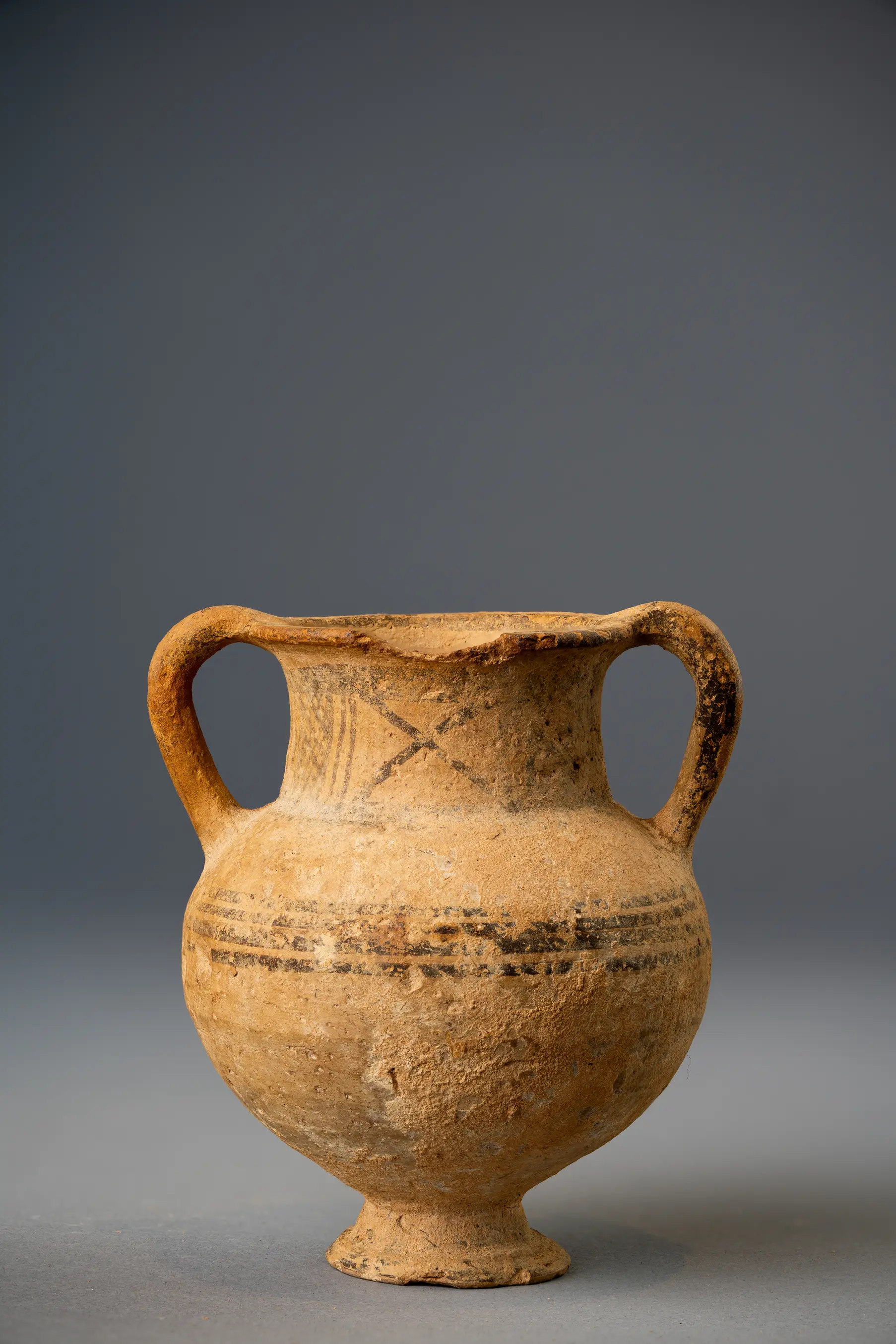
A small amphoriskos in the Drakopoulos collection (catalogue page), ex-Goodman collection since the 1960s. It is plausibly White Painted and probably Cypro-Geometric, but it is not securely Cypro-Geometric I.
The Drakopoulos collection's small White Painted jar is a two-handled amphoriskos with handles from rim to shoulder, a ring foot, a buff surface, dark matt bands round the belly and a hatched panel on the neck. The paint is dark brown-black, without the orange-brown that marks Proto-White Painted, so it reads as White Painted. The shape fits Iacovou's history of the amphoriskos, which peaks in LC IIIB and is common in Cypro-Geometric I White Painted before it fades out, and it is close in class and size to the Lapithos piece. That makes a Cypro-Geometric date probable, but the jar has not been matched to a published parallel, and an attribution to Cypro-Geometric I in particular would go beyond the evidence.
Bichrome decoration needs care, because there are two kinds. On Proto-White Painted, black and purple-red "interchange symmetrically ... it certainly looks as if the same brush was dipped into both pigments", mostly on Aegean shapes such as stirrup jars, pyxides, kalathoi, kylikes and belly-handled amphorae, or on shapes with Philistine links such as bird askoi and ring vases [2, p. 202]. In Cypro-Geometric Bichrome "the red color [is] secondary to the black with which it is not meant to overlap", "used sparingly to fill solid areas which have been carefully delineated" [2, p. 202]. Iacovou therefore rejects the label "Proto-Bichrome": bichrome Proto-White Painted "does not anticipate the development of the Cypro-Geometric Bichrome style", and Angeliki Pieridou had already called the two "wholly unconnected" [2, p. 202]. The LC IIIB bichrome was favoured "at the two opposite ends of the island". It makes up nearly half the Proto-White Painted at Alaas and is common at Palaepaphos, while none was found at the Sanctuary of the Ingot God, Idalion-Ayios Georghios Tomb 2 or Kaloriziki Tomb 40 [2, pp. 202–203].
Iacovou's "current belief" is that Cypro-Geometric Bichrome was "introduced to the Cypriot repertoire through the imported Near Eastern or Phoenician globular neck-ridged jug. Local imitations of this shape are numerous" [2, p. 202]. The jug does not occur in Proto-White Painted deposits, where the only imports of LC IIIB are lentoid flasks [2, p. 202]. A Bichrome I jug from Lapithos Tomb 411 in the Medelhavsmuseet, 24.4 cm high (L. 411:014), belongs to this new tradition. The Phoenicians entry treats the eastern contacts behind it. Some continuity with Proto-White Painted does run through: a Bichrome I tripod in the Metropolitan Museum (74.51.437), which imitates metal prototypes and has pictorial legs, "derives from a series that started in Proto-White Painted Ware" [3, cat. 129].
Pots and people
The belief that new pottery meant new people runs through the study of this period. Voskos and Knapp call the colonisation narrative "deeply ingrained in Cypriot archaeology" [1, p. 660]. Porphyrios Dikaios attributed the changes of Enkomi Level IIIA to "Achaean" colonists [1, p. 666]. The presence of White Painted Wheelmade III in the deposits laid down after the LC IIC destructions at Enkomi, Hala Sultan Tekke, Kouklia, Maa and Alassa "has been used to argue that such deposits herald the arrival of Aegean colonists" [1, p. 668].
That argument has lost its footing on several counts. Robert Merrillees "long ago criticized" the "pots equal people" idea and the "invasion syndrome" in Cypriot historiography [1, p. 661]. White Painted Wheelmade III was already in use before the destructions it was supposed to mark [1, p. 668]. Kling "argued against this colonization scenario and the pottery-driven methodology used to establish it" [1, p. 668]. The NAA results show that much of the Aegean-style pottery on Cyprus, and some of that found in the Levant and Egypt, was made on the island [6, pp. 179–180]. Iacovou concludes of the next ware that "Proto-White Painted could not have been suddenly imported to Cyprus by newcomers ...; it was the result of a local amalgamation" [2, p. 204].
None of this rules out newcomers, and the field has not settled how much they counted. Voskos and Knapp accept that people from the Aegean arrived; they describe the newcomers as "Neither colonists nor conquerors" and place them "alongside indigenous Cypriots", and the material culture of the twelfth and eleventh centuries "reflects an amalgamation of Cypriot, Aegean, and even Levantine trends" [1, p. 659]. They also criticise Iacovou's own account for a "Hellenization perspective" [1, p. 660]. The disagreement is over the weight of Greek-speaking migrants. The pottery alone cannot measure it. The evidence of language belongs to a separate argument, treated under writing and literacy and in the Proto-White Painted entry.
A painted pot of Aegean shape found on Cyprus may be an import, a Cypriot copy, or a Cypriot product in a style that Cypriot potters had long since made their own, and none of these says by itself who used it. The Mycenaean imports and local imitations entry sets out how the two are told apart, and the Mycenaean entry covers the wider question of Aegean contact. The Drakopoulos jar at the head of this page shows the problem in one object: its style is Mycenaean, and where it was made is still unknown.
Objects on this page
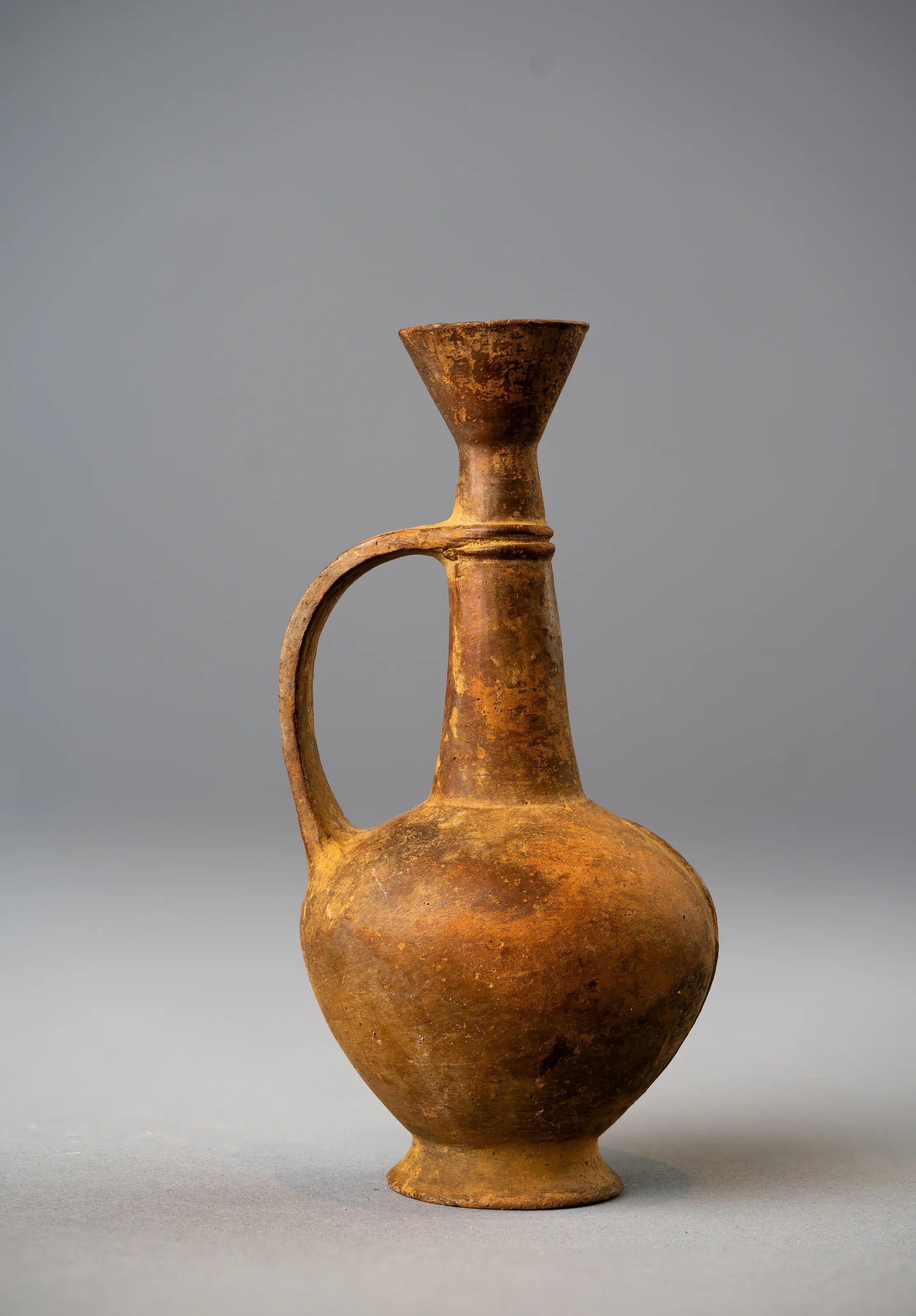 Base Ring Bilbil Juglet with Funnel Mouth and Neck RidgeLate Bronze Age II · 1550–1300 BC
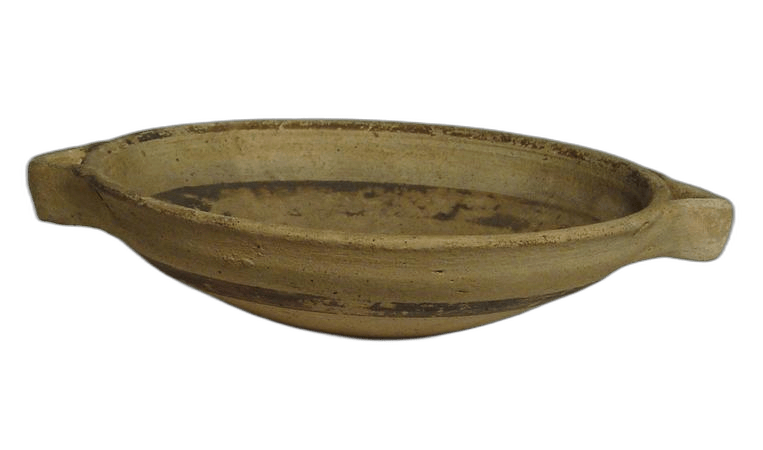 White Painted Wheelmade BowlLate Bronze Age III · 1340–1050 BC
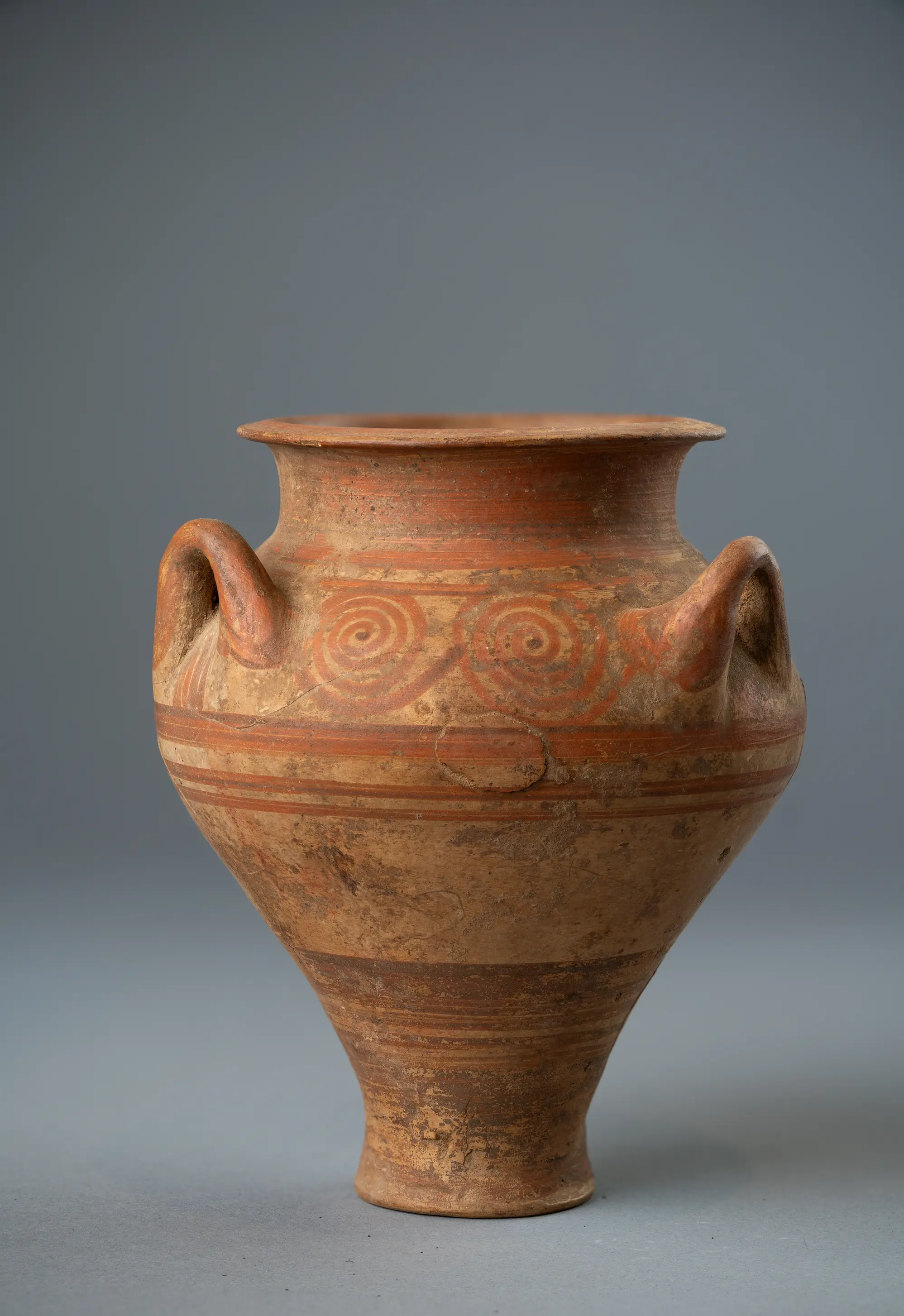 Cypriot Three-Handled Jar in the Mycenaean Style with Running SpiralsLate Bronze Age II · 1375–1300 BC
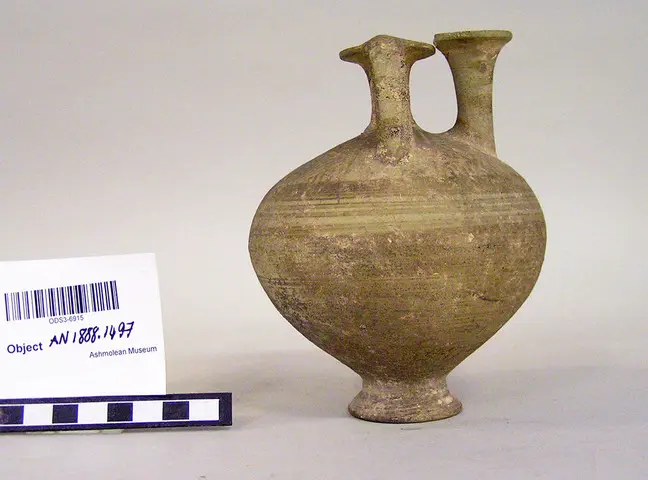 Proto-White Painted stirrup jarLate Bronze Age III · 1100–1050 BC
- White Painted Amphoriskos on a Conical FootGeometric I · 1050–850 BC
References
- 1.Voskos, I., & Knapp, A. B. (2008). Cyprus at the end of the Late Bronze Age: Crisis and colonization or continuity and hybridization? American Journal of Archaeology, 112(4), 659–684. https://www.jstor.org/stable/20627514
- 2.Iacovou, M. (1991). Proto-White Painted pottery: A classification of the ware. In J. A. Barlow, D. L. Bolger, & B. Kling (Eds.), Cypriot ceramics: Reading the prehistoric record (University Museum Monograph 74, pp. 199–205). University Museum, University of Pennsylvania.
- 3.Karageorghis, V. (2000). Ancient art from Cyprus: The Cesnola Collection in the Metropolitan Museum of Art. The Metropolitan Museum of Art.
- 4.Jones, R. E. (1986). Greek and Cypriot pottery: A review of scientific studies (with contributions by J. Boardman, H. W. Catling, C. B. Mee, W. W. Phelps, & A. M. Pollard; Fitch Laboratory Occasional Paper 1). British School at Athens.
- 5.Lehmann, G. (2013). Aegean-style pottery in Syria and Lebanon during Iron Age I. In A. E. Killebrew & G. Lehmann (Eds.), The Philistines and other "Sea Peoples" in text and archaeology (pp. 265–328). Society of Biblical Literature.
- 6.Mountjoy, P. A. (2011). An update on the provenance by neutron activation analysis of Near Eastern Mycenaean IIIC pottery groups with particular reference to Cyprus. In W. Gauß, M. Lindblom, R. A. K. Smith, & J. C. Wright (Eds.), Our cups are full: Pottery and society in the Aegean Bronze Age. Papers presented to Jeremy B. Rutter on the occasion of his 65th birthday (pp. 179–186). Archaeopress.