
The Cyprus Tomb Register: A Page-Cited Dataset of 3,837 Ancient Cypriot Tombs
We are publishing the first release of the Cyprus tomb register, a dataset of 3,837 tombs in which every catalogue entry, burial and measurement is cited to the page it was read from. This post describes what the register contains, how it was built and checked, what it can already show about iron, burial posture and the fate of the finds, and where it is still thin.

Alexis Drakopoulos
October 25, 2026·Archeology · Research · News·20 min read


Share


Alexis Drakopoulos is a Greek Cypriot Machine Learning Engineer working in Financial Crimes. He is passionate about Archeology and making it accessible to everyone. About Me.
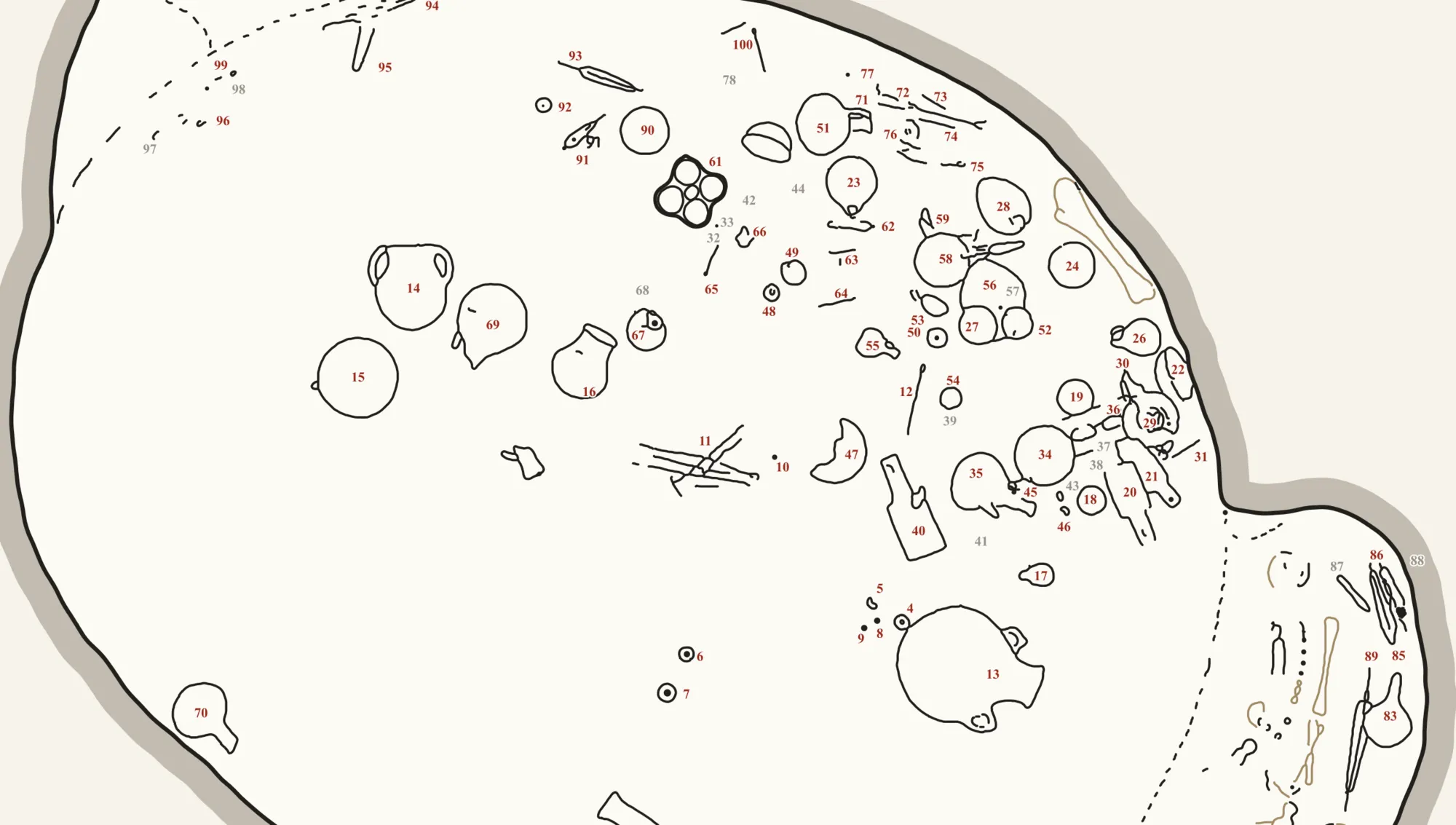
"In all sixty-two burials were traced in the tomb." The sentence closes the Swedish Cyprus Expedition's account of Tomb 8 at Ayios Iakovos, in the first volume of its results, published in 1934 [1, p. 330]. Three roughly circular niches open off the chamber's central pit, raised 70 to 80 cm above its floor, so that the plan "resembles a regular trefoil" [1, p. 325]. The bodies of the first burial period lay in the pit, "evidently swept down from the niches", and little more than their skulls survived. The second period brought thirty-five bodies, "mass-burials with a few tomb-gifts". The third brought eighteen more, the best preserved of them laid "in outstretched, dorsal positions". On the expedition's plan every one of the dead has a Roman numeral, from I to LXII [1, p. 330].
Few Cypriot tomb reports are this explicit. For about three tombs in four the report never says how many people were buried, and for nearly nine in ten it never says whether the tomb had been robbed before the excavators arrived. Tombs are nonetheless most of what we know about the island's Bronze Age and much of what we know about its Iron Age, and once a tomb has been emptied, what can be known of it is whatever was written down. That writing is spread over more than a century of monographs, journal reports, annual notices, museum catalogues and field diaries, in several languages. When Priscilla Keswani built her study of Bronze Age mortuary practice, Mortuary Ritual and Society in Bronze Age Cyprus (2004), she assembled her tomb-by-tomb tables from these books by hand [2].
The Cyprus tomb register is an attempt to do that for every tomb on the island with a published record. Today we are publishing its first release.
The register at a glance
The register's core is the set of tombs whose excavation report we have read entry by entry: 2,324 tombs from 178 excavations at 171 sites, dug between 1884 and 2015. In addition to that core set sit tombs that are known only from what later scholars wrote about them (sometimes because we have not yet processed the original excavation report). We differentiate from core excavation statements with direct quotations to avoid mistaking later or tertiary sources with primary excavation report data.
| Tombs in the register | 3,837 |
| read from their excavation report | 2,324 |
| known from later publications only | 1,447 |
| known by name only | 66 |
| Catalogue entries (objects) | 27,521 (32,281) |
| Burial records (of which individuals) | 2,093 (1,288) |
| Chambers, dromoi, shafts and niches | 4,718 |
| Measurements | 34,055 |
| Events in a tomb's history (burial phases, reuse, robbing) | 5,167 |
| Museum records traced to a tomb | 14,693, in 10 museums in 5 countries |
| Publications read | 153 (1890–2024), and 13 field-diary sources |
Pottery dominates, as anyone who has opened a Cypriot tomb report would expect: more than two thirds of the catalogued objects are pots, with the most common type being the Red Polished bowl, accounting for one object in fourteen! There are 1,550 gold objects, from 216 tombs. Only twenty tombs are known to have been found as they were left and then catalogued object by object. Another 509 are catalogued object by object, though we cannot definitively say whether these tombs are complete. These types of data distinctions impact analysis of mortuary wealth for example, so we try to keep rich data for each tomb.
Each tomb has its own page in the index at /tombs, with its contents entry by entry, its burials, chambers and measurements, its plan where we have redrawn one, what later publications say about it, and where its finds are now. The Tomb Explorer at /tombs/explore works across the whole register: choose a period, a site, a ware, a shape or a kind of burial, and it draws charts and a map for the tombs that match.
Sources and method
The register is built from our large library that we have been assembling and reading for this purpose, including: excavation monographs, articles and preliminary reports, the annual reports of the Department of Antiquities, the Chronique des fouilles of the Bulletin de correspondance hellénique, museum catalogues, and the field archive of the Swedish Cyprus Expedition. Working through it is an ongoing effort, with many excavation reports still in our pipeline. We did not want to wait until next year to announce this, so we are announcing it now, but expect the data to become more complete over the coming years.
Each publication was read page by page and turned into structured records. A catalogue line becomes an object with its ware, shape, material, count and measurements; a sentence about the dead becomes a burial with its posture, the direction of the head, sex and age where they are given; a description of the tomb becomes chambers, passages and niches with their dimensions. Every value carries the publication and page it was read from, and the tomb pages show that citation beside it. This should help archeologists and other interested parties in tracing the evidence to direct sources.
As we worked on this project we had to adjust our approach to recording data several times, to develop standardised chronologies, object typologies, to differentiate between missing data and data reported as None and so on. Where two publications describe the same tomb, both readings are kept. That happens for 380 tombs: We find disagreements on the type of tomb for about one in six tombs, and where both give a period they disagree for 61 of 125 tombs! In 43 of those 61 cases one date range lies inside the other, a later author narrowing an earlier one; in 14 the ranges overlap, and in only 4 do they not meet at all. Our analyses prefer the excavation report's reading in most cases, but both are reported on the tomb pages where they disagree.
How the readings were checked
A dataset of this size is only as useful as its error rate is known. Measuring error rate was difficult and required repeated data extraction on samples of tombs, so that we could measure how accurate our process was. A companion article, How accurate is the Cyprus tomb register?, gives the full account.
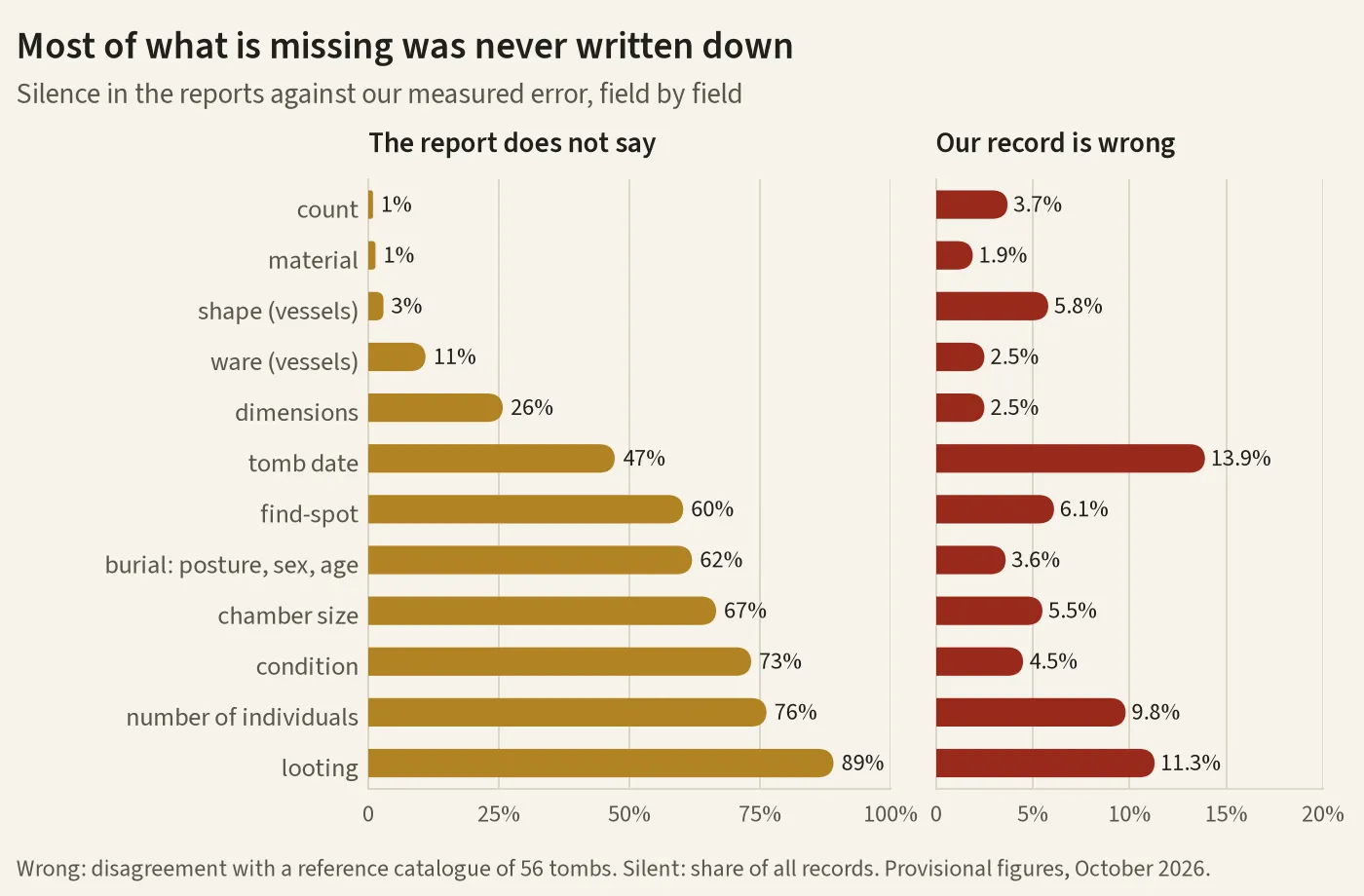
Every catalogue page, 3,552 in all, was read a second time. Comparing the two readings gives an agreement, measured as Cohen's kappa, of 0.89 to 0.92 on the main fields, and an estimated error in the register of 0.9% for material, 1.5% for shape, 2.5% for ware, 0.7% for counts and 2.5% for dimensions. Stated origin, where a report calls an object imported, is weaker (kappa 0.76), and we treat it with caution.
The register was also compared with a reference catalogue of fifty-six tombs from every kind of report, each catalogued slowly and carefully more than once. Across all fifty-six, 97.6% of the reference catalogue entries are found in the register and 93.8% of the register's entries for those tombs are correct. Sixteen of these tombs were drawn at random and set aside while our recording practice was worked out on the others; in those sixteen, every one of the 406 catalogue entries is in the register.
The only comparison against counts made entirely outside this project is with Keswani's tables. For Lapithos she tabulated pots and copper objects chamber by chamber from the Swedish publication [2, pp. 206–213]. All forty of her Swedish chambers match chambers in the register, with the same number of pots in thirty-two and the same number of copper objects in thirty, and across the chambers the two sets of counts correlate almost perfectly.
First results
The register was designed as infrastructure, but to announce this dataset and to investigate its power we asked it a few questions! Note that we are not archeologists and therefore our own conclusions may be wrong.
Iron arrived as blades
In 1954 D. H. F. Gray tabulated the Swedish expedition's Cypro-Geometric finds by type and by metal [4, p. 11]. Anthony Snodgrass, writing in 1980, summarised her table as showing "no fewer than 35 iron knives from Cypro-Geometric contexts against not a single bronze one" [5, p. 344], and observed that for brooches and pins bronze predominated "throughout the Cypro-Geometric period … and indeed for long afterward" [5, p. 345]. The early Iron Age smith, on this account, made cutting tools of the new metal and went on making dress ornaments of the old one.
The register can test the pattern on complete catalogues, and inside single tombs, so that differences between cemeteries or excavators cannot produce it. In forty tombs dated between the end of the Bronze Age and the Cypro-Classical period that contain both kinds of object, 99 of 122 blades and points are iron, against 14 of 132 pins, rings and brooches: 81% against 11%. The split holds separately in each of the five excavations with enough such tombs to test it. Over time, iron's share of blades and points rises from 24% in Late Cypriot III to 85% in the Cypro-Geometric and to every one of 74 in the Cypro-Archaic, while the ornaments stay at 8% or below until the Cypro-Classical, when iron finger-rings appear at Marion and Vouni. Of the Cypro-Geometric knives, 78 of 79 are iron; of the fibulae, the safety-pin brooches of the period, 3 of 109.
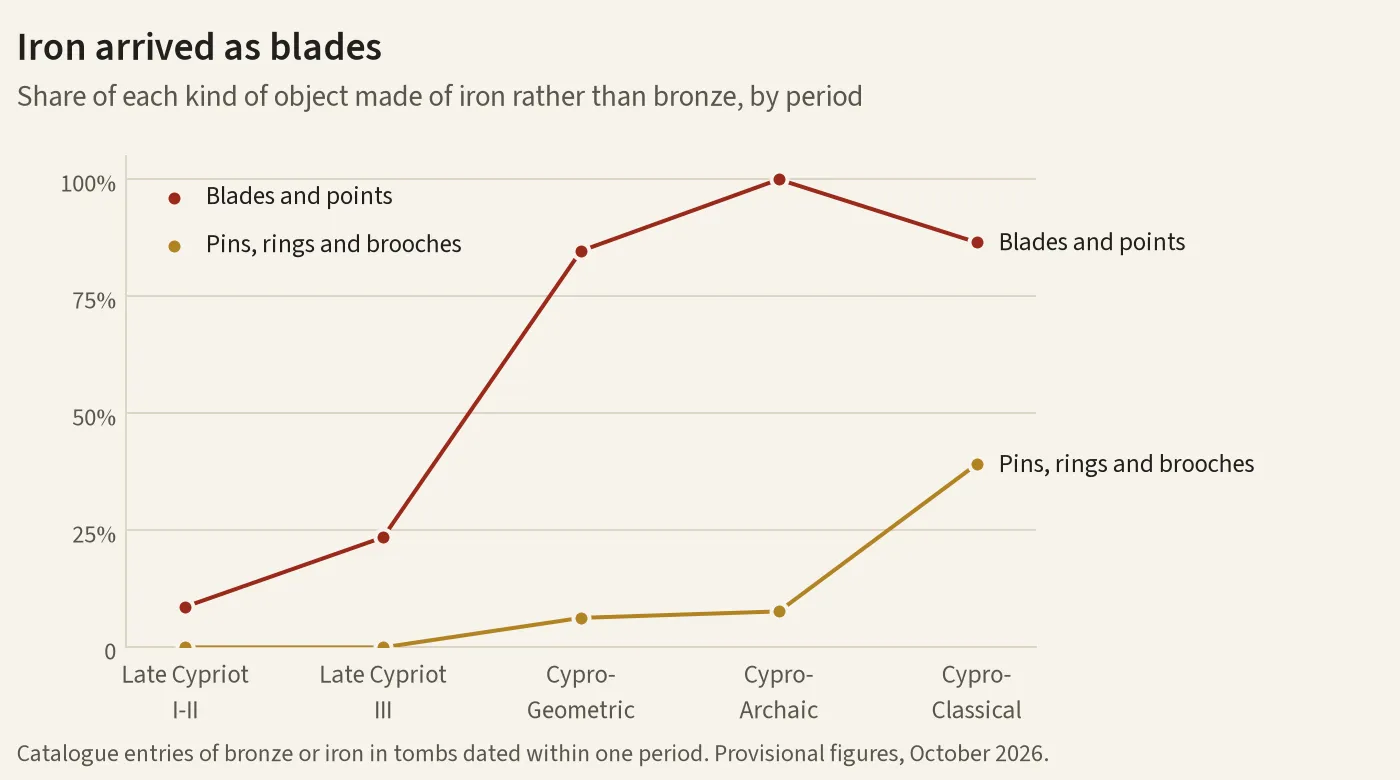
Because we know the error rates, we can also ask how wrong the data would have to be for the result to disappear. Within tombs, the odds that a blade is iron are about 75 times the odds that an ornament is. If the material of every object were misread at random one time in ten, about ten times the measured rate, the odds ratio would fall to around 7; at one time in five, to around 3, still clearly above parity. To erase the pattern by error alone, about 85 of the 99 iron blades would have to be bronze ones misread.
The earliest point on the chart needs a caution, it rests on two pieces of iron in tombs the register dates to Late Cypriot I–II, however both tombs saw later use. The iron dagger of Kouklia-Evreti Tomb IV lay with Late Cypriot III dishes, in a tomb its publication calls "a poorer representative of the LC III group" [6, p. 73]. The iron knife of Palaepaphos-Teratsoudhia Tomb 288 lay with a disturbed burial beside White Painted Wheelmade III pottery, and its authors compare it with Late Cypriot III iron [7]. The register's date ranges for both tombs are too broad to place the iron, and none of its iron is securely earlier than Late Cypriot IIC–IIIA.
From flexed to extended burial
Keswani also wrote about how the Bronze Age dead were laid in their tombs: "The appearance of extended burials, which were relatively uncommon in the EC–MC period, implies at the very least a change in the customs" [2, p. 103]. In her reading the Early and Middle Cypriot dead were rarely laid out straight, whereas the Late Cypriot dead usually were. Counted burial by burial, the register agrees. Of Early and Middle Cypriot burials whose posture is recorded, 12 of 60 are extended (20%); of Late Cypriot burials, 50 of 69 (72%). The Late Cypriot sample includes tombs Keswani did not have, at Palaepaphos, where 23 of 26 are extended.
The Middle Cypriot evidence is mixed, and site by site the variation is large. At Ayios Iakovos nine of the ten burials recorded as extended, flexed or contracted are extended; at Palaeoskoutella, none of five. Tomb 6 at Ayios Iakovos held fifteen dead buried seated [1, p. 317], with "only 70 × 90 cm per burial", as Keswani notes [2, p. 46]. By the Iron Age the Swedish volumes describe the dead of Lapithos in an "outstretched, dorsal position" [1, p. 265]. Of nine of Keswani's claims we have tested so far, four are supported, two are not, and three remain suggestive or rest on too few tombs to say.
The Swedish field diaries against the published volumes
The Swedish expedition's field diaries allow something rarely possible in Cypriot archaeology: a comparison of what was written at the tomb with what was later printed. Eleven diaries, covering 120 tombs, hold 6,497 entries, and 5,624 of them can be matched one to one with the same object in the published volumes. On what was found, diary and book agree almost entirely: on the number of objects in 98.9% of matched pairs, and on the material in 99.4%, where most differences are a more exact word in print, steatite for stone. The shape typology is the same in 88% of pairs, a dish or a kylix in one being a bowl in the other, and the ware family in only 77.5%. This is remarkable consistency for excavations that took place 100 years ago, though it can also point to how much we still depend and use terminology that may be quite dated.
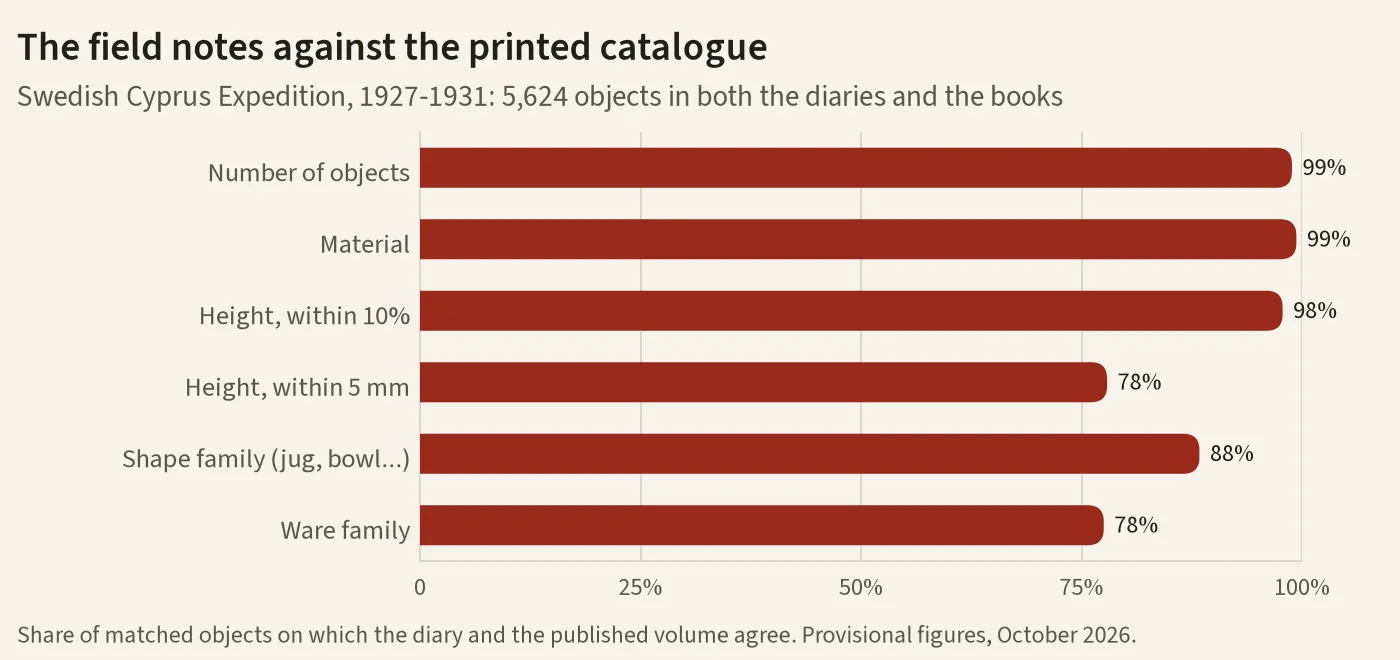
The ware figure records a change of mind by the excavators. Classifying the pottery was the work of publication, and the field labels were provisional, so the register gives each object its published ware. Each record adds something the other lacks. The volumes give a ware for 1,798 vessels the diaries left unnamed, and a find-spot for 3,111 objects; the diaries supply 223 find-spots, 570 links between an object and a particular burial, and 378 notes on condition that never reached print. The agreement also checks the reading itself, since a pencil diary in Swedish and a printed catalogue in English, read separately, turn out to describe the same objects.
Where the finds are now
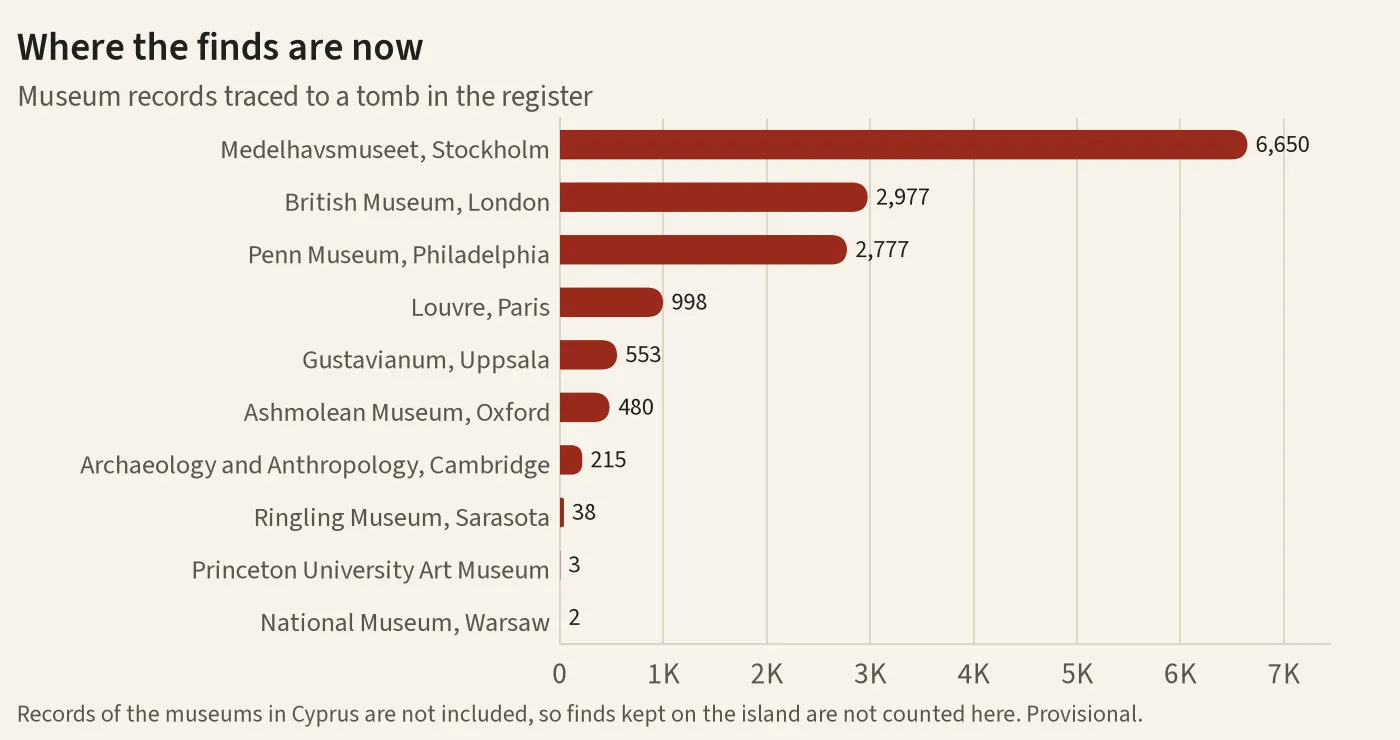
Medelhavsmuseet in Stockholm holds the largest share of the museum records traced so far, 6,650 from 231 tombs, followed by the British Museum with 2,977 and the Penn Museum in Philadelphia with 2,777. Of the Swedish expedition's catalogue entries, 55% are now tied to a museum record; of the excavations of the British period, 30%; of other foreign missions', 19%. For the Department of Antiquities' own excavations the figure is still nil, because the collections of the museums in Cyprus have not been publicly digitised and we do not hold the datasets, joining them manually is work to still be done, for example in the Pyrgos excavations where most of the finds are now in the Limassol museum. For now, the map of where the finds are is sadly only a map of foreign collections.
The Swedish records also show how the expedition's finds were divided between Cyprus and Sweden. In every large Swedish excavation about half the entries are now in Stockholm or Uppsala, but tomb by tomb the share is either low or high: the division was made by whole tombs. Within the tombs that were shared, gold and other metal stayed in Cyprus more often, and imported pieces went to Sweden more often.
What the reports did not record
The register's blanks are themselves data. For each field we can set the share left blank by the reports against the error rate measured for that field, and almost everywhere the silence of the source is far larger than the error of the reading. Whether a tomb was looted goes unrecorded for 89% of tombs, though we may be able to assume that this means they were undisturbed. The number of individuals is not recorded for 76% of tombs. Of the burial fields for posture, sex and age, 62% are not recorded; the size of the chamber is missing for two tombs in three, and the find-spot for 60% of objects. Where looting is recorded, it is a poor guide to what was lost: the tombs called looted hold no less metal than the others, and if anything they are the larger and richer ones.
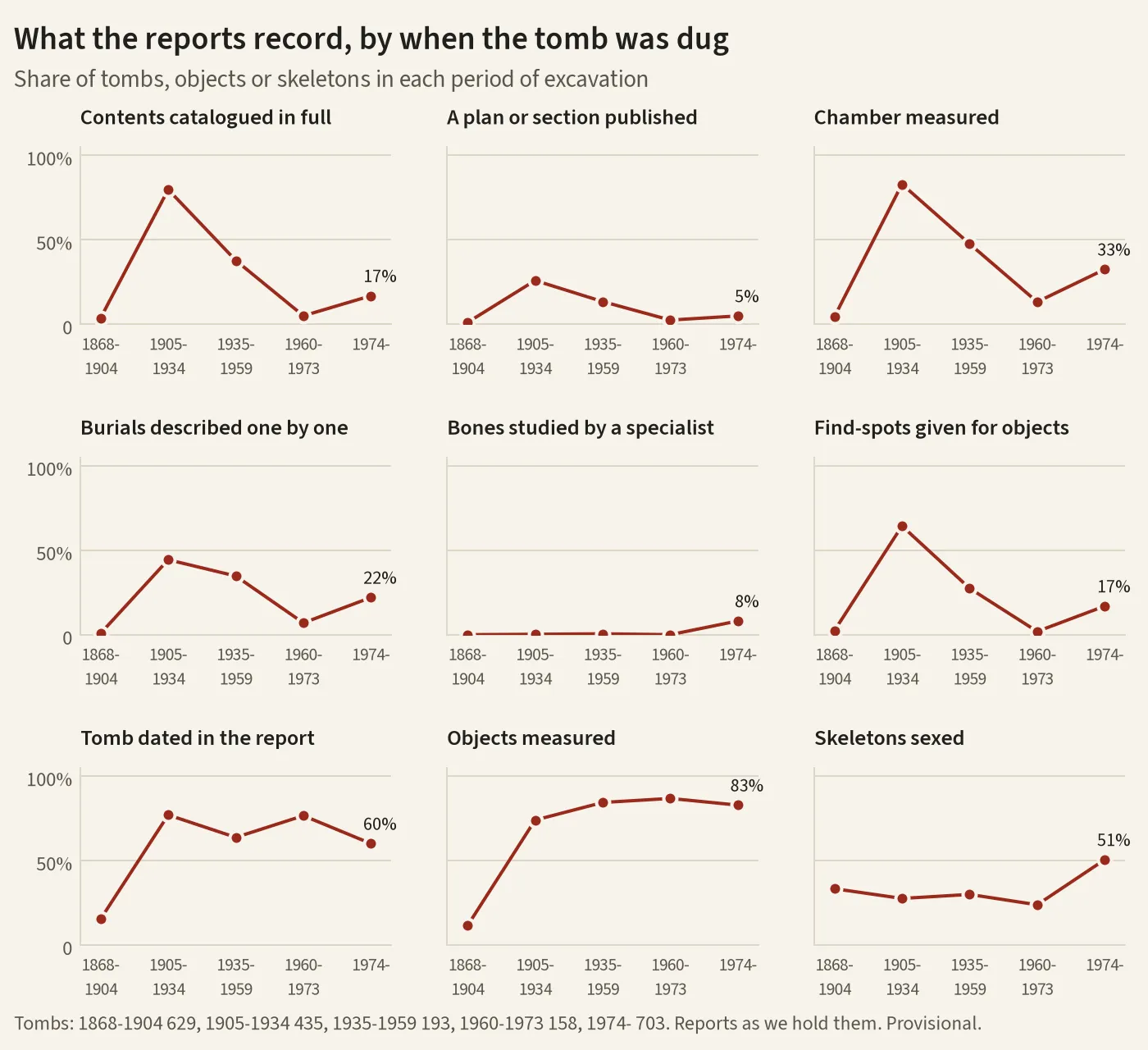
What was written down depended heavily on when a tomb was dug, and the best-recorded tombs in the register were dug ninety years ago. Of the 435 tombs dug between 1905 and 1934, most of them by the Swedish expedition, 80% have their contents catalogued in full, 83% a measured chamber, and 64% find-spots for their objects. Of the 629 dug before 1905, mostly by the British Museum in the 1890s and published as summary lists, 4% are catalogued in full. The figure is 5% for tombs dug between 1960 and 1973, and 17% for the 703 dug since 1974. The later figures reflect the reports we hold: for many recent excavations we have read only the short annual notices so far, and their final reports are among the publications still to come. Good catalogues can also arrive very late. Catling's Kouklia, on tombs dug at Palaepaphos in 1951–1954, appeared in 2020 [6]. One kind of record is almost wholly modern: human bone studied by a specialist, available for 8% of the tombs dug since 1974 and for almost none before.
Biases in the register
The register holds about 3,850 of the roughly 6,900 tombs in Cyprus that can realistically be counted as known, leaving aside Cesnola's round-number claims. Five excavations hold 47% of all catalogued objects: Palaepaphos-Skales, the Swedish expedition at Lapithos, Dikaios at Vounous, the Swedes again at Marion, and the Penn Museum at Kourion. The first Swedish volume alone accounts for 19%. Any island-wide figure drawn from the register is therefore mostly a figure about these cemeteries, and hence may be biased, which is why the iron and posture results above were also checked within single excavations. We hope to improve our data coverage in the coming years with more initiatives once funding allows.
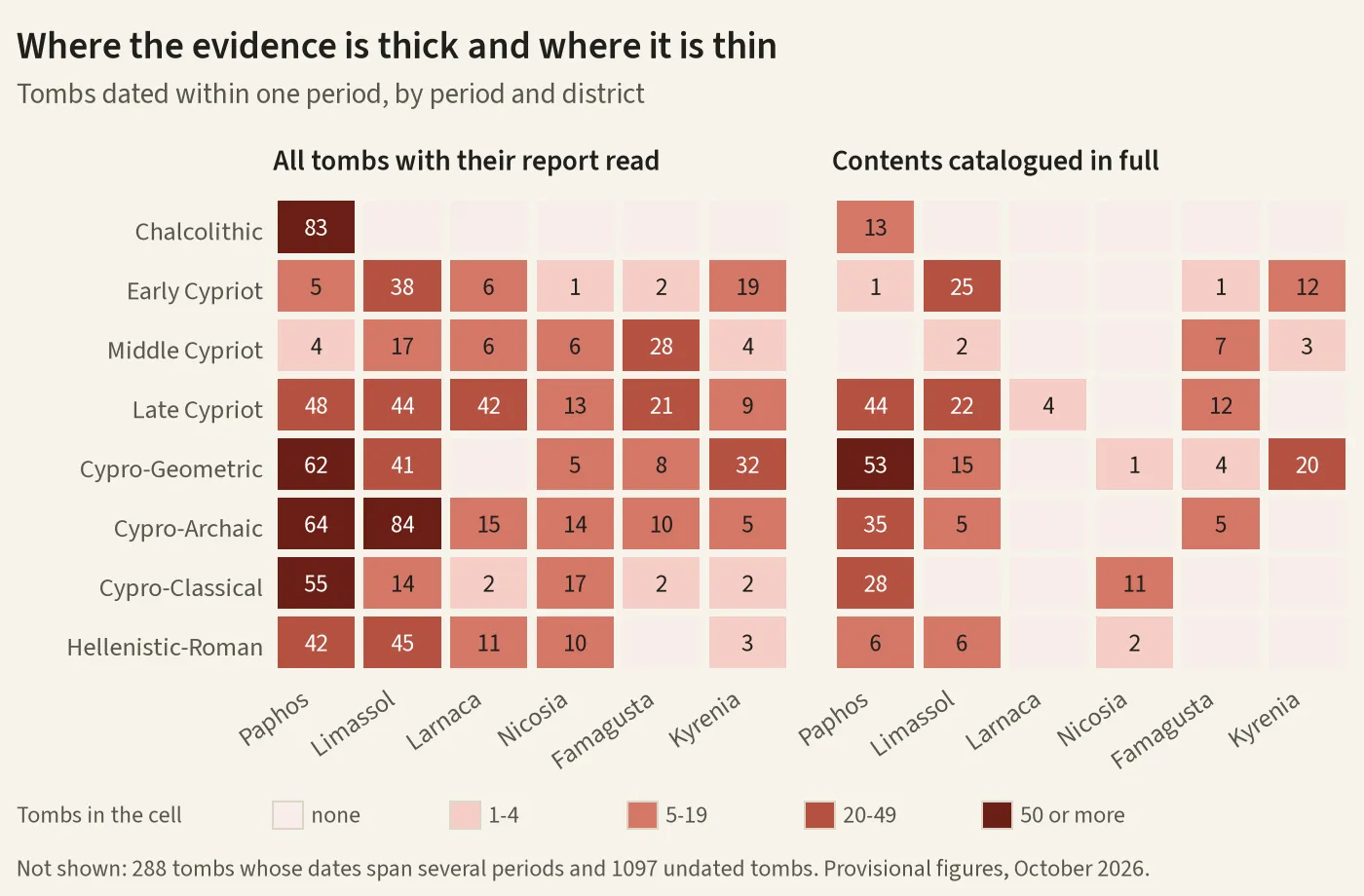
The geography is just as uneven. Of the 48 combinations of period and district, 23 have no tomb with a complete catalogue. Larnaca district has four such tombs, all Late Cypriot, and Nicosia fourteen, eleven of them Cypro-Classical. Every Chalcolithic tomb with a complete catalogue is in Paphos district, at Souskiou and Kissonerga, and the whole island has twelve Middle Cypriot tombs with a complete catalogue. Dating is thin as well: 47% of tombs are undated in their own report, the dated ones span a median of 270 years, and turning a printed date into a period is the least accurate step of the reading, correct for 86% of the reference tombs.
The register includes 476 tombs in the north of the island that were dug before 1974. Excavations carried out in the occupied north since the Turkish invasion of 1974 are not included due to their illegitimate nature.
Publications still to be read
For 1,447 tombs the register holds only what later authors said about them, because their primary report is not yet in our corpus. These are the publications that would change the register most, with the number of register tombs that are waiting on each. If you hold any of them, or can help us obtain a copy, we would be very glad to hear from you.
| Publication | Tombs waiting |
|---|---|
| E. and J. R. Stewart, Vounous 1937–38: Field-Report on the Excavations Sponsored by the British School of Archaeology at Athens (1950) | 86 |
| M. Markides, Annual Report of the Curator of Antiquities (1913–1916), with E. Gjerstad, Studies on Prehistoric Cyprus (1926) | 82 |
| V. Karageorghis, Excavations in the Necropolis of Salamis I–IV (1967–1978) | 73 |
| E. Herscher, The Bronze Age Cemetery at Lapithos, Vrysi tou Barba, Cyprus (dissertation, University of Pennsylvania, 1978) | 62 |
| J.-C. Courtois, Alasia II: Les tombes d'Enkomi, le mobilier funéraire (1981) | 48 |
| E. Peltenburg et al., The Chalcolithic Cemetery of Souskiou-Vathyrkakas, Cyprus (2006) | 42 |
| I. A. Todd, Vasilikos Valley Project 1: The Bronze Age Cemetery in Kalavasos Village (1986) | 41 |
| J. B. Hennessy et al., Ayia Paraskevi and Vasilia: Excavations by J. R. B. Stewart (1988) | 33 |
| A.-E. Dunn-Vaturi, Vounous. C.F.A. Schaeffer's Excavations in 1933: Tombs 47–79 (2003) | 31 |
| P. Dikaios, Enkomi: Excavations 1948–1958 (1969–1971) | 30 |
| J. Johnson, Maroni de Chypre (1980) | 28 |
| E. Dray and J. du Plat Taylor, Tsambres and Aphendrika: Two Classical and Hellenistic Cemeteries in Cyprus (1951) | 27 |
| P. Åström, Katydhata: A Bronze Age Site in Cyprus (1989) | 25 |
| J. M. Webb et al., The Bronze Age Cemeteries at Karmi Palealona and Lapatsa in Cyprus (2009) | 22 |
| S. Hadjisavvas, The Phoenician Period Necropolis of Kition I–II (2012, 2014) | 15 |
Several of these would fill exactly the holes in the evidence map. The Kition volumes and Hennessy's Ayia Paraskevi and Vasilia would give Larnaca and Nicosia districts their first substantial complete catalogues, and Herscher's Lapithos and the Stewarts' Vounous would add Early and Middle Cypriot tombs, the periods with the fewest complete catalogues. Other publications would tie objects already in museums back to their tombs: Dunn-Vaturi's Vounous gives the museum numbers of the objects from Schaeffer's tombs of 1933, about 300 of them now in the Louvre, and J. Deshayes's La nécropole de Ktima (1963) and A. Furumark and C. M. Adelman's Swedish Excavations at Sinda (2003) would do the same for several hundred objects in the Louvre and in the Gustavianum at Uppsala.
Predictions for the next publications
Each of these books is also a test. Before any of them has been read, we have written down what the register's results predict they will contain, together with the outcome that would count against each prediction. In the Salamis volumes, iron should make up at least 70% of the blades in the Cypro-Geometric and Cypro-Archaic tombs, and no more than 15% of the brooches and pins before the Cypro-Classical. In the Stewarts' Vounous, no more than 35% of the Early and Middle Cypriot dead should lie extended. When those volumes are read, we will report the results here, whichever way they fall.
The register is a work in progress, and corrections are part of the work. If you find an error on a tomb page, or know of a publication we have missed, please contact us.
References
- 1.Gjerstad, E., Lindros, J., Sjöqvist, E. and Westholm, A. (1934). The Swedish Cyprus Expedition: Finds and Results of the Excavations in Cyprus 1927–1931, Vol. I. Stockholm: The Swedish Cyprus Expedition. (Lapithos, the Cypro-Geometric dead in 'outstretched, dorsal position', p. 265; Ayios Iakovos Tomb 6, the seated burials, p. 317; Ayios Iakovos Tomb 8, the chamber, p. 325, and its three burial periods, 'In all sixty-two burials were traced in the tomb', p. 330.)
- 2.Keswani, P. (2004). Mortuary Ritual and Society in Bronze Age Cyprus. Monographs in Mediterranean Archaeology 9. London: Equinox. (Ayios Iakovos Tomb 6, p. 46; extended burial in the Early, Middle and Late Cypriot periods, p. 103; tomb-by-tomb counts of pots and copper objects at Lapithos, Tables 4.11a–c, pp. 206–213.)
- 3.Dikaios, P. (1940). The Excavations at Vounous-Bellapais in Cyprus, 1931–2. Archaeologia 88, 1–174. (Tomb 12 No. 54, p. 29.)
- 4.Gray, D. H. F. (1954). Metal-Working in Homer. Journal of Hellenic Studies 74, 1–15. (The Swedish Cyprus Expedition's Cypro-Geometric objects by type, bronze and iron, p. 11.)
- 5.Snodgrass, A. M. (1980). Iron and Early Metallurgy in the Mediterranean. In T. A. Wertime and J. D. Muhly (eds), The Coming of the Age of Iron, 335–374. New Haven and London: Yale University Press. (Gray's Cypro-Geometric knives, p. 344; bronze fibulae and pins, p. 345.)
- 6.Catling, H. W. (2020). Kouklia: Late Bronze Age and Early Iron Age Tombs at Palaepaphos 1951–1954. Edited by R. W. V. Catling. Oxford: BAR Publishing. (Kouklia-Evreti Tomb IV, p. 73.)
- 7.Karageorghis, V. and Raptou, E. (2021). Palaepaphos-Teratsoudhia Tomb 288 (c. 1650 BC–c. 1200 BC). Opuscula: Annual of the Swedish Institutes at Athens and Rome 14. https://doi.org/10.30549/opathrom-14-12. (The iron knife and its context in Chamber A, cat. nos. 1 and 4.)