
Roman Cyprus begins with an act of confiscation in 58 BCE and ends, depending on the criterion chosen, with the founding of Constantinople in 330 CE or the division of the empire in 395. For most of those four centuries the island was a small, unarmed, senatorial province governed by an annual proconsul at Nea Paphos, taxed for its copper and grain, and left to its own municipal life. It produced no wars of its own; the one recorded military operation is the suppression of the Jewish revolt of 115 to 117. What it did produce is the largest body of standing monuments on the island, the gymnasium and theatre of Salamis, the mosaic houses of Paphos, the sanctuary of Apollo at Kourion, the paved roads and milestones, along with a run of earthquakes that first rebuilt and finally levelled its cities. This entry follows the Hellenistic entry in the chronology of the island and sets out the annexation, the provincial administration, the economy, the religious changes, the cities and their art, and the seismic catastrophes of the fourth century, on which the site takes a definite position.
Annexation and the Republican province, 58 to 30 BCE
Rome took Cyprus by a tribunician law of 58 BCE, carried by Publius Clodius, which declared the island a province and sent Marcus Porcius Cato to seize the property of its Ptolemaic ruler. The pretexts were a disputed Ptolemaic will and a claim that Cyprus harboured pirates; the motive, as Ernst Badian showed, lay in Roman politics, since the mission removed Cato from the city and its proceeds were wanted for Clodius's grain law [3]. Ptolemy of Cyprus, a younger brother of the reigning king of Egypt, killed himself rather than accept the priesthood of Aphrodite at Paphos that Cato offered him in exchange for his kingdom. Cato met no resistance, auctioned the royal property, and brought some 7,000 talents to Rome [4, pp. 205–206]. Cicero later denounced the whole proceeding as a crime against a friend of the Roman people, and then, as proconsul of Cilicia in 51 to 50 BCE, found himself administering the island that the crime had produced.
Ersin Hussein's re-examination of these years makes two points that older accounts blur. Cato held extraordinary powers pro praetore but was never proconsul of Cyprus, and after his departure the island was simply attached to the province of Cilicia, its governors represented locally by subordinates [2, pp. 59–61]. The evidence for this Republican administration is dominated by a single scandal: the agents of Marcus Brutus, Scaptius and Matinius, had lent money to the council of Salamis at 48 per cent interest, and Cicero's letters record his refusal to enforce the rate and his failure to resolve the affair [2, p. 60]. Cicero never set foot on Cyprus. In 48/47 BCE Julius Caesar gave the island back to Cleopatra VII, and it stayed Ptolemaic, under a strategos in the old manner, through the donations of Mark Antony until Actium; a statue base of 38 BCE from the gymnasium at Salamis names the strategos Diogenes as "kinsman" of the queen [2, pp. 61–62]. After 30 BCE Cyprus was Roman for good.
The senatorial province: governors, koinon and cities
Augustus at first held Cyprus himself, governing through legates, and in 22 BCE handed it to the Senate, so that from that year the island was a public province governed by a proconsul of praetorian rank chosen by lot and normally serving one year [2, p. 62; 1, pp. 1295–1298]. Terence Mitford's survey of 1980, still the fullest account of the province in English, assembled the names of about fifty governors from inscriptions, coins and milestones between 22 BCE and the Severan period, a fraction of the three hundred or so who must have served [1, pp. 1298–1308]. David Potter's later treatment reviewed the same prosopography [6]. The governor's seat was Nea Paphos, which had been the Ptolemaic capital since the second century BCE and which Roman inscriptions style "Augusta Claudia Flavia Paphos, sacred metropolis of the cities of Cyprus" [9, pp. 251–252]. The calendar tells the same story: a Paphian calendar introduced under Augustus named its months after Aphrodite, the Julian house and the emperor's offices, while Salamis kept the Egyptian month-names of the Ptolemies [4, pp. 260–261]. For administrative and judicial purposes the island was divided into four districts, Paphos, Salamis, Amathus and Lapithos, and the geographer Ptolemy in the second century lists thirteen cities: Paphos, Salamis, Amathus, Arsinoe, Chytroi, Karpasia, Kyrenia, Kition, Kourion, Lapithos, Soloi, Tamassos and Tremithus [5, p. 182].
The cities kept their Hellenistic institutions, a council, an assembly and at Salamis a council of elders, but Hill noticed a peculiarity: there was no municipal coinage at all. Bronze was struck from the reign of Claudius in the name of the Koinon Kyprion, the league of Cypriots inherited from the Ptolemies, and the types show only two cults, the temple of Aphrodite at Paphos with its conical stone and the standing Zeus of Salamis [4, pp. 258–264]. Hill attributed this absence of civic rivalry to centuries of subjection to kings. The koinon's principal business was the imperial cult, and Takashi Fujii's study of the epigraphy shows how thoroughly the emperor entered Cypriot public life: the province swore an oath of loyalty to Tiberius in 14 CE, priests of the imperial house served alongside those of the old gods, and at Kourion Apollo Hylates acquired a partner, Apollo Kaisar, to whom Trajan's builders dedicated their work [7, pp. 141–176]. The headquarters of the koinon was the sanctuary of Aphrodite at Palaepaphos, now linked to the new city by a sacred way, and its annual festival remained the island's chief religious occasion [8, p. 54]. In 22 CE the Senate's inquiry into the right of asylum confirmed three Cypriot sanctuaries, Aphrodite at Paphos and Amathus and Zeus at Salamis, and in 69 the future emperor Titus consulted the Paphian oracle on his way to Judaea [4, p. 258]. Under Vespasian a silver mint was briefly transferred to the island, striking tetradrachms dated by a "new sacred year" in 76 to 79; Hill connected the move with relief after the earthquake of those years [4, pp. 259–260].
Copper, roads and trade
The mines that had belonged to the kings and then to the Ptolemies passed to the Roman state, and Josephus records that in 12 BCE Augustus gave Herod the Great half the revenue of the Cypriot copper mines and the management of the other half, Herod having presented the emperor with 300 talents. Hans Hauben's re-reading of the passage argues that this was a gift in the Hellenistic manner rather than a lease, that it covered all the island's mines and not only those of Soloi, and that nothing in it implies Jewish involvement in the workings [10]. Galen visited a mine about five kilometres from Soloi in 166 CE, almost certainly Skouriotissa or Mavrovouni, and left the only eyewitness account of ancient Cypriot mining: an imperial procurator in charge, a workforce largely of slaves, and the collection of copper-sulphate water in amphorae to be dried in basins and sold as medicine [11]. Vasiliki Kassianidou's survey-based archaeometallurgy concludes that the industry reached its greatest scale under Rome, with Pliny reporting that the imperial as was struck from Cypriot copper, and Hussein has argued that the metal remained central to the island's identity as well as its economy [11; 12]. Christian convicts from the Palestinian mines were transferred to Cyprus in 310, the last notice of the workings before the Byzantine silence [4, p. 263].
The road system is known from milestones and from the Peutinger map. Tønnes Bekker-Nielsen's study traces a circuit road round the coast, avoiding the Akamas and turning inland over the Kyrenia range to Chytroi and Salamis, with a cross-island route from Kition through Tremithus and Tamassos to Soloi; the two Hellenistic sub-networks, western around Paphos and eastern around Salamis, were only joined into a single system at about the time of the annexation [13; 4, pp. 261–263]. Milestones of 80 CE in the Karpas, of 198 between Pissouri and Kouklia, and of Aurelian renewed by Diocletian and Jovian near Kourion mark the maintenance of the southern coast road into the fourth century [4, p. 263].
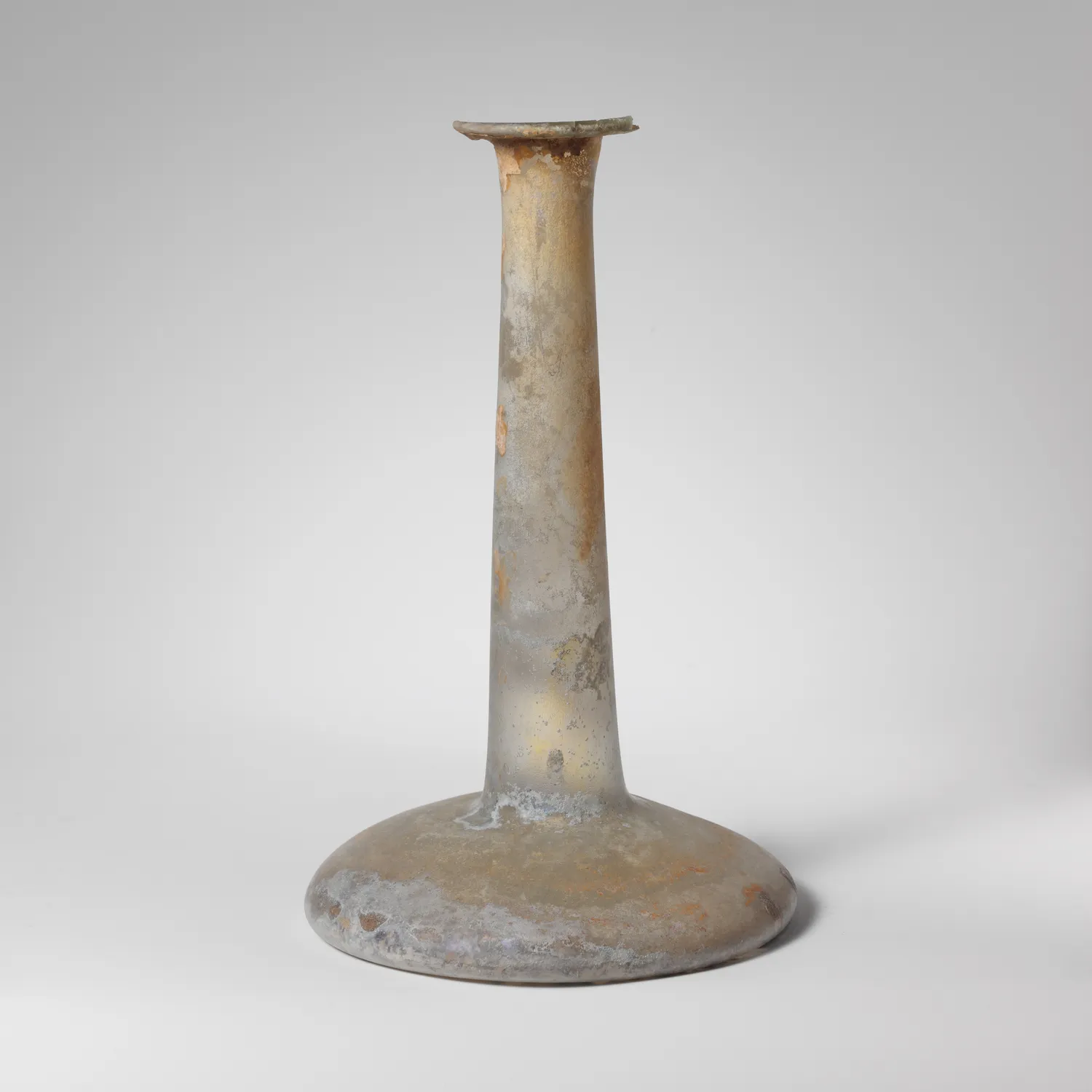
The pottery record has been reorganised by John Lund's study of ceramic circulation from the third century BCE to the third century CE. The island produced its own red-gloss table ware, which John Hayes isolated in 1967 as Cypriot Sigillata; it dominated the fine wares of Paphos from the Augustan period but reached south-eastern Cyprus only in the second century, and its production site has never been found, with Hayes favouring the Soloi region while conceding that a mainland source could not be excluded [15; 14, p. 168]. The island's transport amphorae, including the pinched-handle type, carried Cypriot wine to the Levant and Egypt [14]. A caution applies to the late period: the ware long called Cypriot Red Slip, the most common fine ware of the eastern Mediterranean from the fourth to the seventh century, has now been shown by kiln evidence in Pisidia to have been made in southern Asia Minor, so the "Cypriot" label is a misnomer for at least the main forms [16]. Demetrios Michaelides's survey of the Hellenistic and Roman economy sets copper, grain, wine, oil and timber as the island's exports and stresses how much of the evidence is still epigraphic rather than archaeological [17]. Glass is the one Roman product that reached every Cypriot tomb and every early collection; the small iridescent unguentaria of the second and third centuries, of which the Cesnola example illustrating this entry is typical, filled the shelves of the Cyprus Museum saleroom in the 1920s.
Paul, Barnabas and the Jewish revolt
The Acts of the Apostles (13:4–12) records that Paul and the Cypriot-born Barnabas sailed from Seleucia to Salamis about 45 to 47 CE, preached in its synagogues, crossed the island to Paphos, and there met the proconsul Sergius Paulus and the Jewish magus Bar-Jesus or Elymas, whom Paul struck blind, after which "the proconsul believed." The historicity of the governor rests on inscriptions, and it is weaker than the guidebooks suggest. A Lucius Sergius Paulus served as curator of the Tiber banks at Rome under Claudius in 47 CE, which would fit a man who had left Cyprus by then; a fragmentary Greek text from Soloi names a proconsul Paulus but probably belongs to a later reign; and a fourth inscription once read as Quintus Sergius Paulus under Caligula is too damaged for the name to be certain [18, p. 59]. Whether "believed" means conversion is doubted by historians, since the event leaves no trace, and no church at Paphos followed [18, p. 59]. The tradition of "St Paul's Pillar" at Chrysopolitissa in Paphos is medieval and inconsistent with Acts.
The Jewish community that Acts implies at Salamis is the background to the one act of war in Roman Cypriot history. In 115 to 117, under Trajan, the Jews of Cyrenaica, Egypt and Cyprus rose in the diaspora revolt; on Cyprus, according to Cassius Dio (68.32), they were led by a certain Artemion and killed 240,000 people, and according to Eusebius they destroyed Salamis and its inhabitants. Evanthia Polyviou's recent study stresses how thin the Cypriot evidence is: no inscriptions, papyri or coins support the literary notices, Eusebius's own church history omits Cyprus entirely, and Dio's figure, if not simple exaggeration, may include the dead of Egypt and the Jewish casualties of the suppression [19, pp. 581–582]. Hill had already observed that 240,000 exceeded twice the population the Salamis aqueduct could serve [4, p. 267]. A decree thereafter banned Jews from landing on Cyprus on pain of death, even when driven there by storm, though third- and fourth-century inscriptions show Jews on the island again [18, p. 51]. The rebuilding of Salamis under Hadrian, whom a theatre inscription hails as benefactor of the Salaminians, is the archaeological sequel [20, p. 199].
The monumental cities
What a visitor sees at Salamis today is a Roman provincial city that was never the provincial capital. Karageorghis, who excavated the northern sector from 1952 until the Turkish invasion of 1974 halted all work, was explicit that Paphos had replaced Salamis as the seat of government under the Ptolemies and that Salamis remained the largest and richest city because of its harbour [20, pp. 171–172]. The stone gymnasium and theatre are Augustan; the four-sided palaestra, the swimming pools and most of the marble statuary belong to the Trajanic and Hadrianic rebuilding after the earthquake of 76/77 and the revolt; the temple of Zeus, a podium temple of Greco-Roman type, was already standing in the second century BCE [20, pp. 177–200; 8, p. 54]. Pavlina Karanastasi's reappraisal of the sculpture counts more than eighty pieces and more than fifty statue bases from the gymnasium and theatre, and notes the island's turn to imported marble at the expense of the local limestone that had served every earlier period [21]. The only large Roman bronze from Cyprus is not from Salamis: the over-life-size Septimius Severus found at Chytroi, now in the Cyprus Museum, is the standard illustration of Severan prosperity, when relations between the province and the imperial house were close [4, p. 258].
At Nea Paphos the civic centre, an agora of about 95 by 95 m with an odeion and an Asklepieion, took its present form in the early second century, probably as reconstruction after 76/77 [9, p. 253]. The mosaic houses of the Maloutena quarter are the island's best evidence for Roman domestic life. The House of Dionysos, excavated from 1962, was built in the late second century over earlier structures and covers more than 2,000 square metres; its floors, published by Christine Kondoleon, run from the Hellenistic pebble mosaic of Scylla to the Triumph of Dionysos at the threshold of the dining room, with a Narcissus and the Four Seasons flanking the original entrance and the Greek greetings "Rejoice" and "You too" set into the frame [24; 23, pp. 20–28]. The Villa of Theseus, begun in the second half of the second century and enlarged into the fourth, is the largest residence known on the island, with some 9,600 square metres and more than a hundred rooms around a court roughly 60 m square; its excavators read it as the governor's residence, an argument from size, plan and a rare Latin inscription rather than from any naming text, and the identification remains an interpretation [23, p. 55; 9, pp. 290–292].
Kourion is the clearest case of building tied to imperial benefaction. The theatre was rebuilt under Nero, when an inscription names the proconsul Quintus Julius Cordus in 64/65, and again under Trajan, whose reign saw the renovation of the baths and nymphaeum, the stadium, and the sanctuary of Apollo Hylates two kilometres west of the city, whose visible remains Mitford's corpus of inscriptions showed to be "for the most part Trajanic" [22, p. 162]. Two Trajanic building texts record the emperor providing exedrae and paving the road from the sanctuary to the Paphos gate at the council's expense, and the same corpus shows civic finances tightly supervised by Rome from the Neronian period [22; 7, pp. 173–176]. At Amathus a small prostyle temple of Aphrodite with "Nabataean" capitals replaced the open-air sanctuary in the last quarter of the first century, and an inscription of Gordian III styles the city metropolis, a title otherwise Paphian. Kition, by contrast, has left almost no Roman fabric above ground; texts mention a gymnasium, a stadium and an aqueduct, but Larnaca lies on top of them.
Earthquakes and the fourth-century end
Cyprus sits on the Cyprus Arc, and the Roman centuries are bracketed by earthquakes whose dates the ancient chroniclers and the modern catalogues report differently. Cassius Dio (54.23) records that around 15 BCE Augustus gave money to the Paphians after an earthquake and allowed them to call their city Augusta; Eusebius places the event about 17 BCE [4, p. 257; 27]. In 76/77 three cities fell, Salamis and Paphos named by the Sibylline Oracles and the third, perhaps Kition, unnamed [4, p. 270; 28]. Seneca could write that Paphos had collapsed more than once. Salamis was struck again in 332 and about 342, on the second occasion, the chronicle tradition says, with a sea-wave; Constantius II relieved the survivors of tax for four years and rebuilt the city on a smaller scale as Constantia, which before 367 had replaced Paphos as metropolis of the island, since Epiphanius was ordained bishop of "the metropolis" in that year [4, p. 270; 29, p. 79]. The attribution of the refoundation to Constantius rather than Constantine rests on the sixth-century Malalas and is not confirmed by any inscription.
The south-coast catastrophe that ended Roman Kourion is the case on which this site takes a position. The University of Pennsylvania excavators of the 1930s attributed the collapse of the city and the abandonment of the Apollo sanctuary to the Salamis earthquakes of 332 or 342. David Soren's excavations of 1984 to 1987 in the house now called the Earthquake House disproved that: the sealed debris, with its crushed occupants, a girl of about thirteen and a couple sheltering an infant among them, contained coins running to the early issues of Valens of 364 to 365 and none of Procopius or Gratian, so the destruction cannot be earlier than mid-365 [25, pp. 77–112]. Soren then identified the event with the great earthquake and tsunami of 21 July 365 that Ammianus Marcellinus describes at Alexandria and Methone. That further step has not held. Ammianus names no Cypriot place; the modern fault modelling puts the 365 rupture off western Crete, some 860 km from Kourion, on a different segment of the plate boundary; and the coin ratio on which Soren relied depends on how fast new issues reached a Cypriot market town. Benjamin Costello's monograph on the house, the scholarly study that the popular book is not, concludes that Soren's hypothesis "has been convincingly challenged and largely invalidated," and that Kourion was destroyed by a separate earthquake of the Cyprus Arc "sometime during the later 4th century AD, possibly ca. AD 370–380" [26, p. 24]. Guidoboni's catalogue dates the Cypriot event to about 370, on the strength of Jerome's report that Hilarion found Paphos in ruins; Ambraseys preferred about 375 [27, pp. 277–278; 28, p. 157]. The same shock ruined the agora, odeion and House of Dionysos at Nea Paphos, which were never rebuilt [9, p. 287]. The defensible statement is that south-western Cyprus was destroyed between 365 and about 380 by a local earthquake, not by the Cretan event of 365, and that the exact year is unresolved.
Administratively the Roman period had already ended before the ground shook. Diocletian's reorganisation placed Cyprus in the Diocese of the Orient under the vicar at Antioch, and the proconsul gave way to a consularis of lower rank; the Verona List of the early fourth century records the arrangement [29, p. 79; 1, pp. 1375–1380]. Three Cypriot bishops attended the Council of Nicaea in 325, with Paphos still heading the list [9, p. 290]. Whether one closes the period at 330, when Constantinople became the capital, or at 395, when the empire divided, the island that emerges is the Constantia of Epiphanius, Christian, governed from Antioch, and built out of the column drums of the pagan city.
Assessment
Mitford summed up Roman Cyprus as three centuries of "serene anonymity," an unarmed province benefiting from the peace [29, p. 79]. The characterisation has been qualified rather than overturned. Hussein's work insists on the exploitation of the Republican decades, on the Cypriots' own uses of Roman institutions, and on how far the literary sources describe Roman politics rather than the islanders; Fujii's on the depth to which the imperial cult penetrated civic religion; Lund's and Kassianidou's on an economy of copper, wine and table ware that was larger than the texts admit. The material record is by far the richest of any period before the Byzantine, and for that reason the most datable, with coins, stamped amphorae and sigillata allowing a resolution that the Cypro-Classical archaeologist can only envy. What remains contested is the end: which emperor refounded Constantia, which earthquake buried Kourion, and in what year. On the last point the evidence supports a Cypriot event of the 370s, and the once-standard "365" should be read as a terminus rather than a date.
References
- 1.Mitford, T. B. (1980). Roman Cyprus. In H. Temporini & W. Haase (Eds.), *Aufstieg und Niedergang der römischen Welt, II.7.2* (pp. 1285–1384). De Gruyter. https://doi.org/10.1515/9783110860429-018
- 2.Hussein, E. (2021). *Revaluing Roman Cyprus: Local identity on an island in antiquity*. Oxford University Press.
- 3.Badian, E. (1965). M. Porcius Cato and the annexation and early administration of Cyprus. *Journal of Roman Studies, 55*, 110–121. https://doi.org/10.2307/297434
- 4.Hill, G. F. (1940). *A History of Cyprus, Vol. I: To the conquest by Richard Lion Heart*. Cambridge University Press.
- 5.Karageorghis, V. (1982). *Cyprus from the Stone Age to the Romans*. Thames and Hudson.
- 6.Potter, D. S. (2000). Η Κύπρος επαρχία της Ρωμαϊκής Αυτοκρατορίας [Cyprus as a province of the Roman Empire]. In T. Papadopoullos (Ed.), *Ιστορία της Κύπρου, Τόμος Β΄: Αρχαία Κύπρος* (pp. 763–864). Archbishop Makarios III Foundation.
- 7.Fujii, T. (2013). *Imperial cult and imperial representation in Roman Cyprus* (Heidelberger Althistorische Beiträge und Epigraphische Studien 53). Franz Steiner.
- 8.Tatton-Brown, V. (1987). *Ancient Cyprus*. British Museum Publications.
- 9.Maier, F. G., & Karageorghis, V. (1984). *Paphos: History and archaeology*. A. G. Leventis Foundation.
- 10.Hauben, H. (2005). Herod the Great and the copper mines of Cyprus. *Ancient Society, 35*, 175–195. https://doi.org/10.2143/AS.35.0.2003848
- 11.Kassianidou, V. (2011). The production of copper in Cyprus during the Roman period. In A. Demetriou (Ed.), *Πρακτικά του Δ΄ Διεθνούς Κυπρολογικού Συνεδρίου, Λευκωσία 29 Απριλίου–3 Μαΐου 2008, Τόμος Α΄2: Αρχαίο Τμήμα*. Εταιρεία Κυπριακών Σπουδών.
- 12.Hussein, E. (2021). Mapping metal rich Roman Cyprus: The case for object-centred approaches. *Études et Travaux, 34*, 167–181. https://doi.org/10.12775/EtudTrav.34.008
- 13.Bekker-Nielsen, T. (2004). *The roads of ancient Cyprus*. Museum Tusculanum Press.
- 14.Lund, J. (2015). *A study of the circulation of ceramics in Cyprus from the 3rd century BC to the 3rd century AD* (Gösta Enbom Monographs 5). Aarhus University Press.
- 15.Hayes, J. W. (1967). Cypriot sigillata. *Report of the Department of Antiquities, Cyprus, 1967*, 65–77.
- 16.Jackson, M., Zelle, M., Vandeput, L., & Köse, V. (2012). Primary evidence for Late Roman D Ware production in southern Asia Minor: A challenge to 'Cypriot Red Slip Ware'. *Anatolian Studies, 62*, 89–114. https://doi.org/10.1017/S0066154612000051
- 17.Michaelides, D. (1996). The economy of Cyprus during the Hellenistic and Roman periods. In V. Karageorghis & D. Michaelides (Eds.), *The development of the Cypriot economy from the prehistoric period to the present day* (pp. 139–152). University of Cyprus and Bank of Cyprus.
- 18.Nasrallah, L., Luijendijk, A., & Bakirtzis, C. (Eds.). (2020). *From Roman to Early Christian Cyprus: Studies in religion and archaeology* (Wissenschaftliche Untersuchungen zum Neuen Testament 437). Mohr Siebeck.
- 19.Polyviou, E. (2019). The upheaval of the Jews in 115–117 AD in Salamis and the proconsulate of C. Calpurnius Flaccus in 123 AD in Cyprus. In S. Rogge, C. Ioannou, & T. Mavrojannis (Eds.), *Salamis of Cyprus: History and archaeology from the earliest times to Late Antiquity* (Schriften des Instituts für Interdisziplinäre Zypern-Studien 13, pp. 581–590). Waxmann.
- 20.Karageorghis, V. (1969). *Salamis in Cyprus: Homeric, Hellenistic and Roman*. Thames and Hudson.
- 21.Karanastasi, P. (2019). Roman sculptures from Salamis: A reappraisal. In S. Rogge, C. Ioannou, & T. Mavrojannis (Eds.), *Salamis of Cyprus: History and archaeology from the earliest times to Late Antiquity* (Schriften des Instituts für Interdisziplinäre Zypern-Studien 13, pp. 591–606). Waxmann.
- 22.Mitford, T. B. (1971). *The inscriptions of Kourion* (Memoirs of the American Philosophical Society 83). American Philosophical Society.
- 23.Daszewski, W. A., & Michaelides, D. (1988). *Guide to the Paphos mosaics*. Bank of Cyprus Cultural Foundation.
- 24.Kondoleon, C. (1995). *Domestic and divine: Roman mosaics in the House of Dionysos*. Cornell University Press.
- 25.Soren, D., & James, J. (1988). *Kourion: The search for a lost Roman city*. Anchor Press/Doubleday.
- 26.Costello, B. (2014). *Architecture and material culture from the Earthquake House at Kourion, Cyprus: A Late Roman non-elite house destroyed in the 4th century AD* (BAR International Series 2635). Archaeopress.
- 27.Guidoboni, E., Comastri, A., & Traina, G. (1994). *Catalogue of ancient earthquakes in the Mediterranean area up to the 10th century*. Istituto Nazionale di Geofisica.
- 28.Ambraseys, N. (2009). *Earthquakes in the Mediterranean and Middle East: A multidisciplinary study of seismicity up to 1900*. Cambridge University Press.
- 29.Zavagno, L. (2017). *Cyprus between Late Antiquity and the Early Middle Ages (ca. 600–800): An island in transition*. Routledge.