
Ancient Cypriot Pottery·Lesson 9
The Red Wares of the Iron Age
Black-on-Red, Bichrome Red and Red Slip share one red slip and part company over a brushstroke of paint. Tell the three apart, recognise the export juglet and its bowls, and see why the ware once called Cypro-Phoenician was made in Cyprus.
Alexis Drakopoulos·Period by period·14 min read
Share


Lesson 9·Course contents, 15 lessons
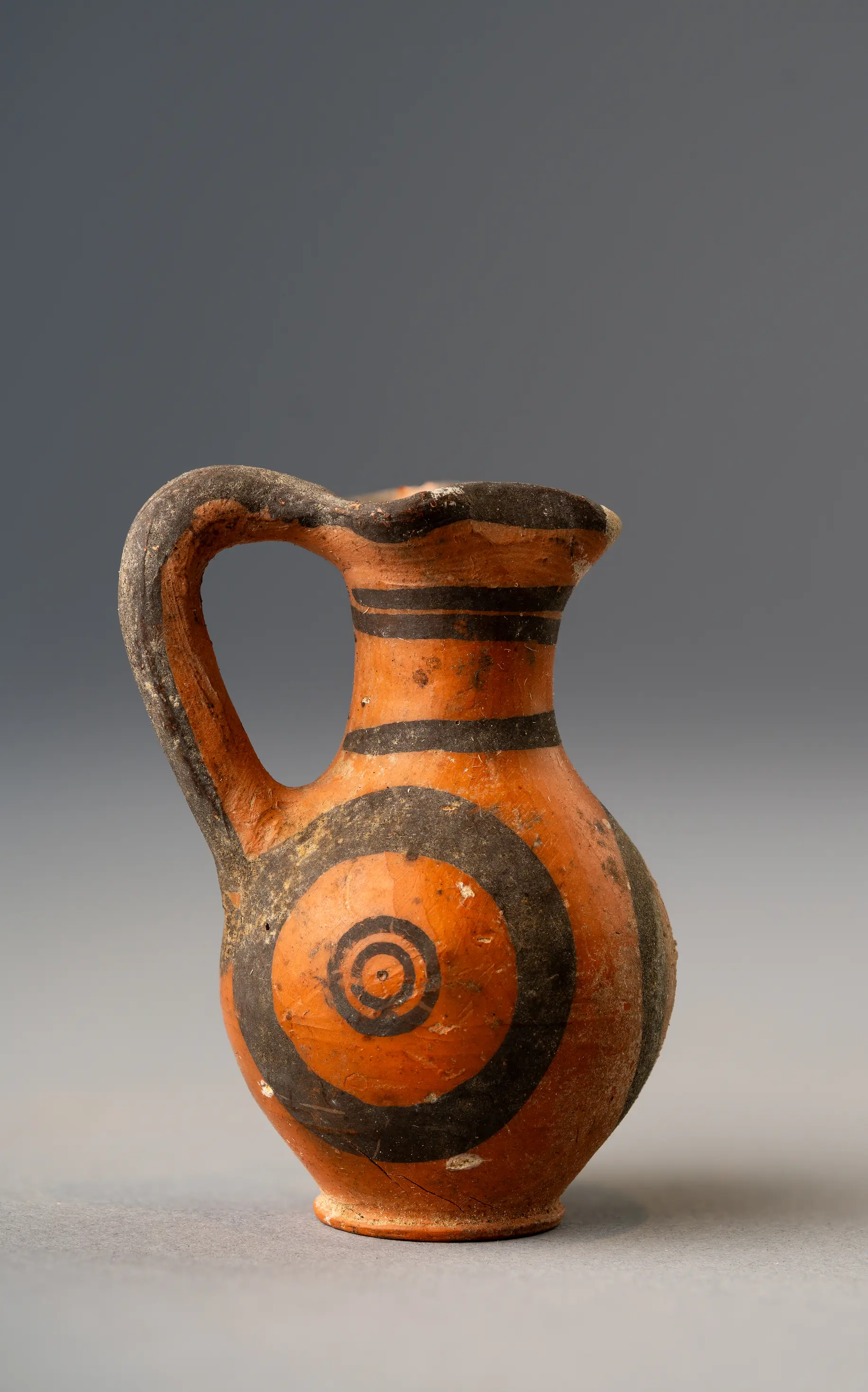
In 1932 William Foxwell Albright published a small juglet from room SE 22B-4 at Tell Beit Mirsim, in southern Palestine. His description is exact: "decorated in black paint on a continuously burnished light red slip; a band of paint also runs lengthwise of the handle." He also named it, the "imported Cypro-Phoenician perfume juglet," and declared that John Myres's date for the Cypriot examples, 700 to 500 BC, was "several centuries too low" [1, p. 72]. More than ninety years on, the description stands. Most specialists have dropped the name, and the date has settled between the two camps: earlier than the Cypriot scholars of his day allowed, later than Albright's own strata.
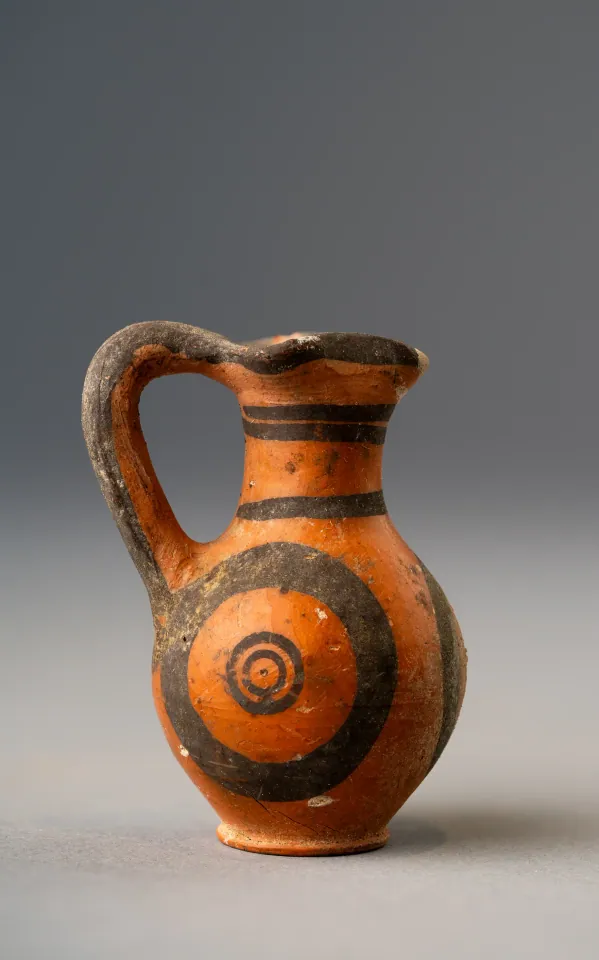
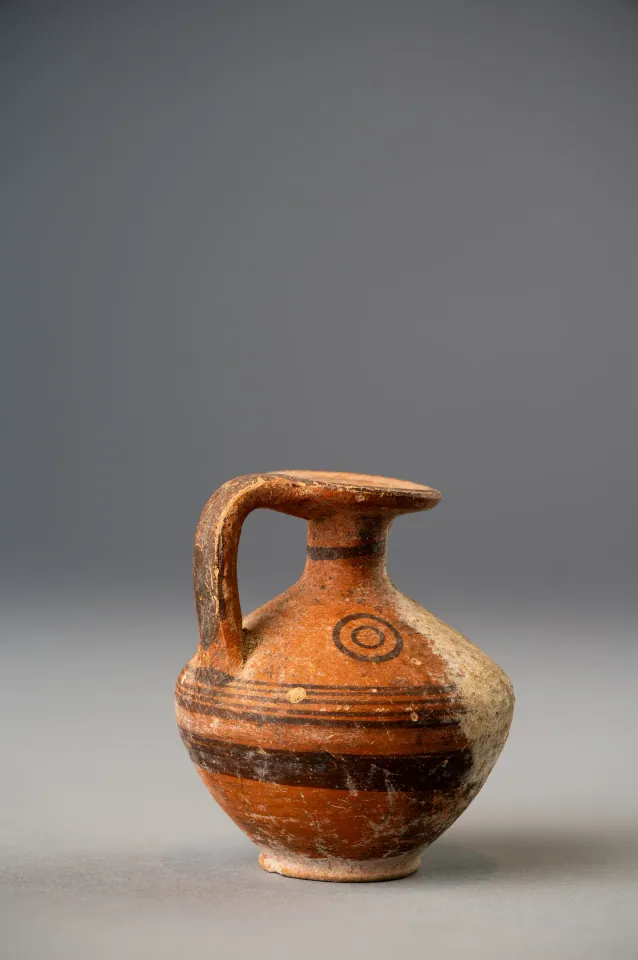
The juglet beside this paragraph, in the Drakopoulos collection, is the same kind of thing: a bright orange-red slip with a soft lustre, the lip and handle painted black, and on each side a heavy black ring round a tiny bull's-eye. Einar Gjerstad, who in 1948 gave the ware the descriptive name it carries in Cyprus, Black-on-Red, defined it by exactly these features. Nicola Schreiber, whose 2003 monograph is the standard study, remarked that the ware "has seldom been mistaken for another ware" [2, p. 1]. For most of the 20th century, everything else about it was mistaken: who made it, when, and what its presence abroad meant.
One slip, three wares
Gjerstad's Iron Age system, met in Lesson 7, defines a ware by its surface. Take a fine reddish clay, throw it on the wheel and coat it in a red slip, a liquid clay wash fired red. Leave it plain, or add a band or two, and Gjerstad called it Red Slip. Paint it in matt black and it is Black-on-Red. Paint it in black and add white, and it is Bichrome Red. His definitions run almost word for word together: Red Slip has clay and slip "the same as those of the Black-on-Red," and Bichrome Red keeps the clay and slip of Black-on-Red, with its ornaments "painted with black and supplementary white paint" [3].
Put the three on one timeline and move to about 700 BC. Notice which of them were being made side by side, and where the start of Bichrome Red fades into uncertainty.
Chronology
One slip, three wares
Each bar is a ware, placed by the dates the lessons give it. Drag the red line, or use the arrow keys on its year, to see what was being made in any year; choose a bar for its cues and lesson.
Iron Age and Hellenistic
In use around
700 BCCypro-Archaic I
700 BC: 3 wares in use.
From late in Cypro-Archaic I at the latest, all three were being made side by side from the same clay and slip, so only the surface can decide the name.
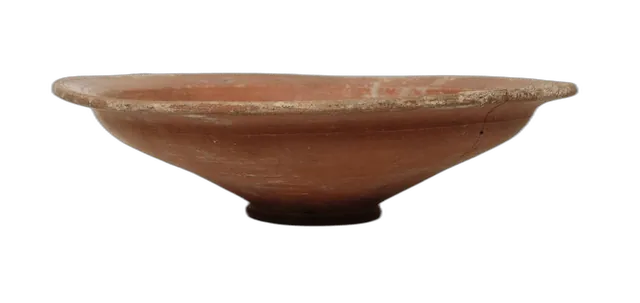
The carinated (sharp-shouldered) bowl from Kourion now in the British Museum is the plain member of the family: lustrous red slip, an everted rim pierced twice for hanging, no paint at all. Black-on-Red also has a twin across the ground-colour divide. Move the same black bands and circles onto a pale surface and you have White Painted, the ware of Lessons 7 and 8. So the first question to ask of a red Iron Age pot is whether the red is a slip or the clay.
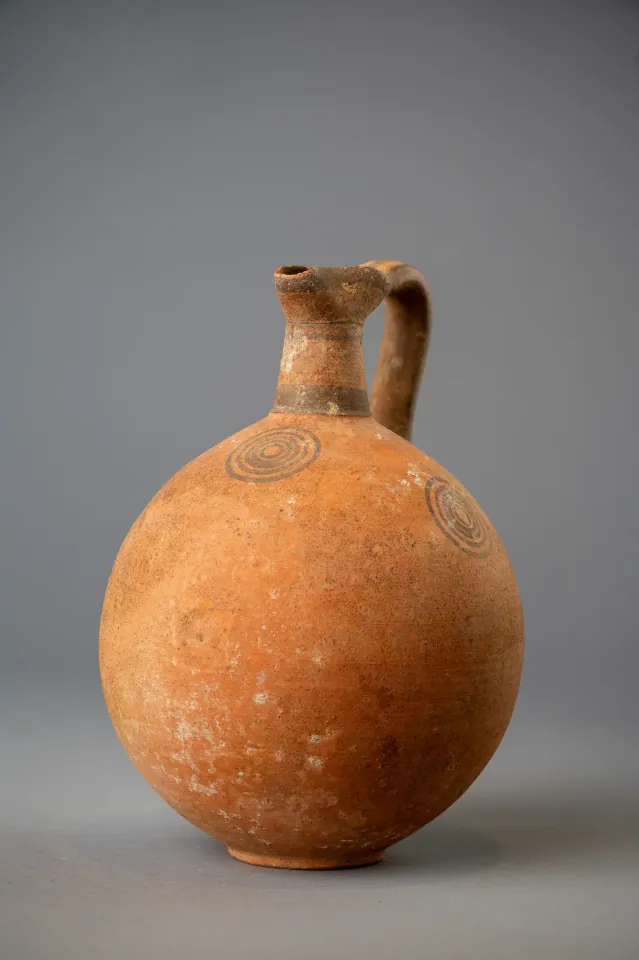
Look at a chip or a worn base, where the clay under a slip usually shows paler. The globular jug in the Drakopoulos collection illustrated here, its small mouth pinched into three lobes, was once described as "White Painted with a reddish hue." Its orange-red, now worn matt, covers the whole surface: it sits in a slip, which makes the jug Black-on-Red. The ornament is the ware's at its most restrained, a broad band at the base of the neck, a thin line under the mouth, and on each side of the shoulder a group of five fine concentric circles round a small central dot. No white shows anywhere on it, so Bichrome Red, the other red-slipped candidate, is the weaker reading.
The technique asked little of the kiln. The black is a manganese-rich paint that stays black through a single firing in an oxidising, air-rich atmosphere, so no smoke was needed to get black on red [2, pp. 242-243]. The concentric circles are compass-drawn [2, p. 4]. Gjerstad noted a change of finish: the slip of his first stage is "lustrous, or polished," that of the second "usually lustrous, but never polished and thinner" [3, pp. 68-71].
The juglet
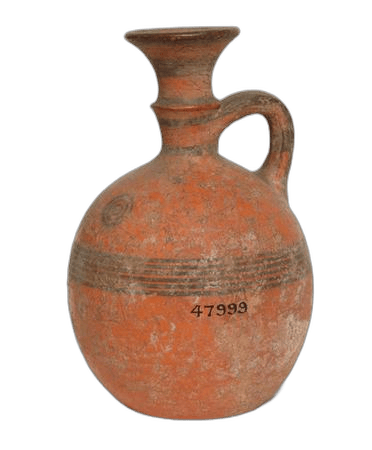
The ware's signature is the shape Albright found: a small juglet, usually about 6 to 13 cm high, with a round or ovoid body, a narrow neck and a flaring mouth, and on the classic form a small ridge round the neck where the handle meets it. Black bands circle neck and body; a group of concentric circles sits on the shoulder. The British Museum juglet here, 8.7 cm tall, has the full kit. Barrel-shaped, conical, trefoil-mouthed and two-handled juglets, and larger jugs, follow the same pattern [2, p. 250].
These juglets are almost always called perfume flasks. The narrow neck slows a viscous liquid; the sizes cluster around 8 to 10 cm, as a fixed measure of a costly product would; and on Rhodes and Cos the juglet was succeeded in the 7th and 6th centuries BC by the Corinthian aryballos, a small flask that chemical analysis has shown held perfumed oil [2, pp. 65-66]. For the juglets themselves the evidence is indirect. Schreiber wrote "in the absence, as yet, of Gas-Chromatography studies of the contents of BoR juglets" [2, p. 68], and we know of no residue study of a Cypriot Black-on-Red juglet published since. Perfumed oil is the best reading, and it remains an inference.
The juglet at the head of this lesson asks for very little equipment. Throw it, burnish its red slip, paint the lip and handle black and set a heavy ring round each small bull's-eye with a compass, then fire it once in a clean, airy kiln, which is all the black paint needs.
Bowls and plates
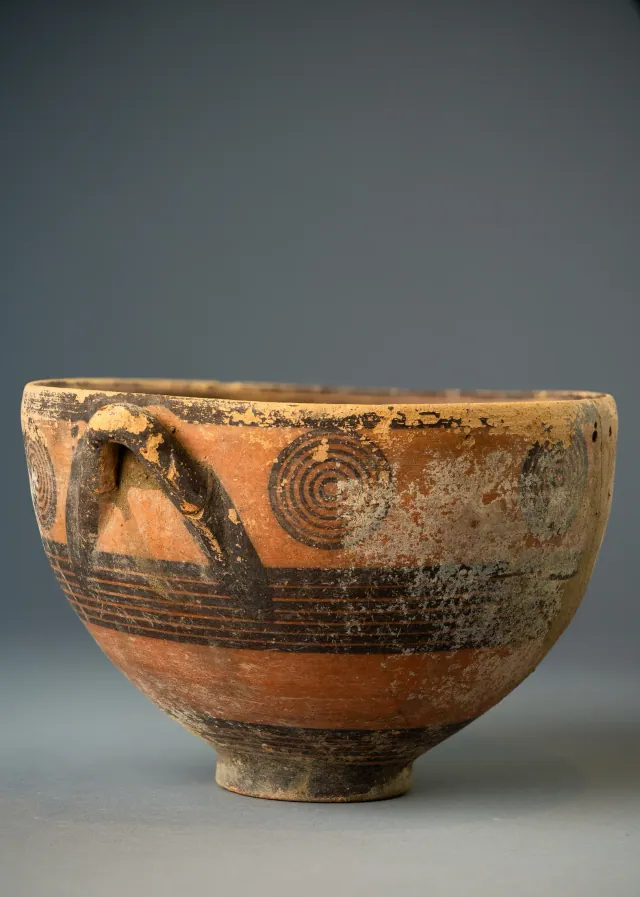
At home the open shapes were as common as the closed. The deep bowl in the Drakopoulos collection, with a lifted loop handle and large concentric circles spaced round the handle zone, is Gjerstad's first-stage deep bowl, a shape he called "of entirely Cypriote tradition." Its ornament is the one he named as the stage's most characteristic: "isolated, concentric circles, which are placed below the rim of the deep bowls and on the shoulder of the jars, jugs, amphorae, and hydriae" [3, pp. 68-69].
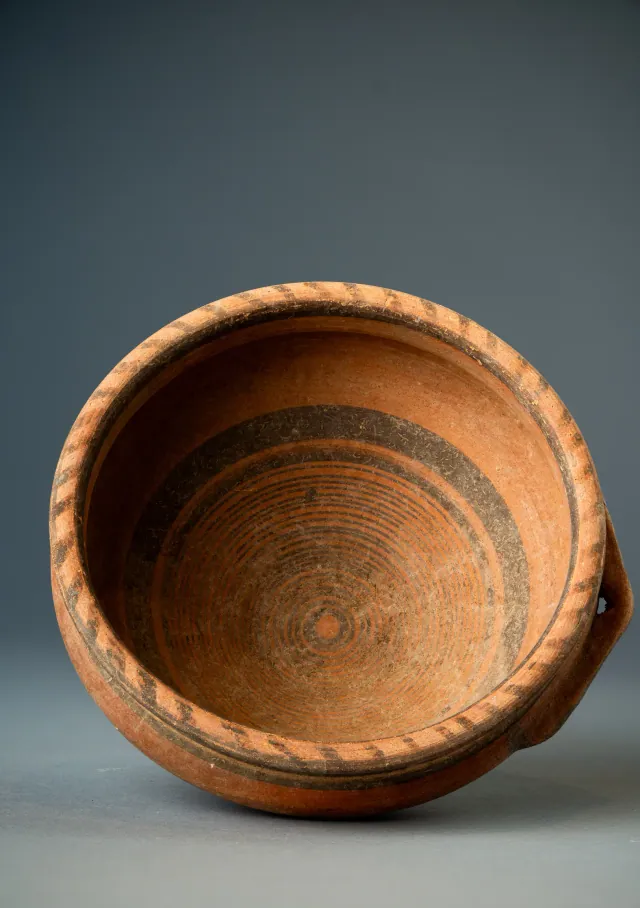
The one-handled bowl has the other kind of circle. Hair-fine rings fill its floor, struck while the pot turned on the wheel, closing on a small reserved dot. Its shape, a raised concave rim with a single handle, is one Gjerstad thought new to Cyprus, and the black wavy line on its rim is one of the "few instances" he noted of ornament borrowed from White Painted and Bichrome [3, pp. 68-69]. The rim zone is paler than the rest. If white paint were ever found there, the bowl would move into Bichrome Red: the boundary between these wares is one brushstroke wide.
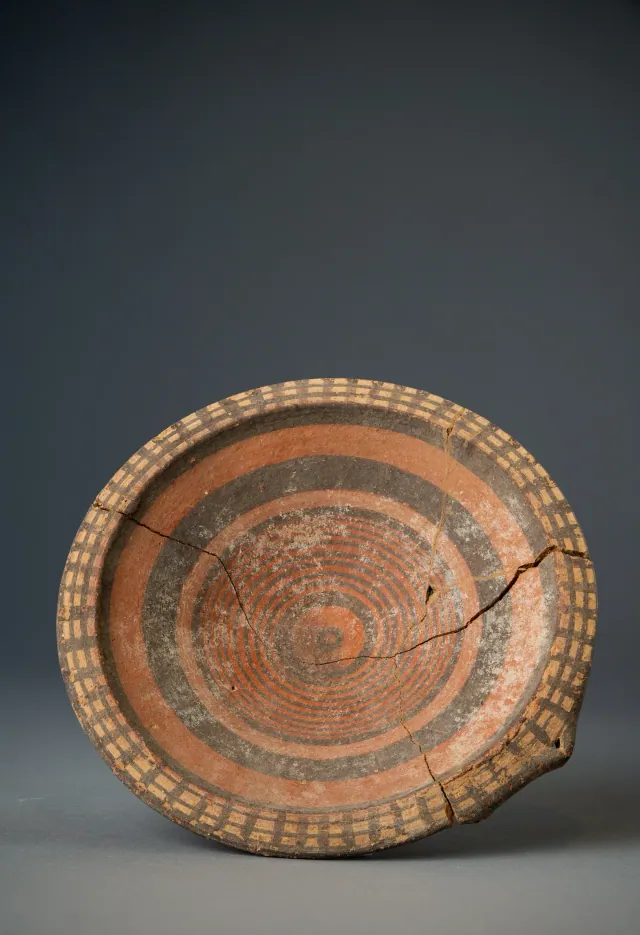
The plate with a barred rim belongs to Gjerstad's second stage, a flat-rimmed shallow bowl with one handle that he derived from flat-rimmed Red Slip bowls, so the plain ware supplied the shape and the painted ware dressed it [3]. The closest parallels for its rim bars are plates from the tombs at Kourion-Kaloriziki, all of the Cypro-Archaic I period (CA I, c. 750 to 600 BC) [9]. Sharp profiles and small handles like these are often read as copies of bronze vessels [2, p. 58].
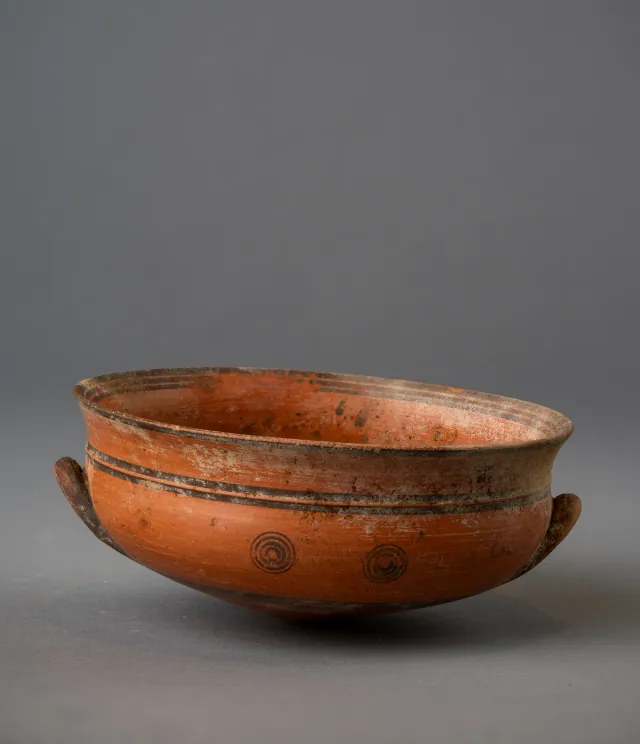
The two-handled bowl shows the borrowing most plainly. Its rounded lower wall turns at a firm shoulder into a tall rim that splays outward, and two small roll handles, tilted upward, sit right at the turn, the profile of a hammered bronze bowl. Gjerstad put raised-rim bowls with a pronounced shoulder in his second stage, as his Types 18a to c, and remarked that in these shapes "the metal prototypes are conspicuous" [3]. The paint is spare: fine bands at the lip, the inner edge of the rim and the shoulder, and small bull's-eyes on the lower body, a pair of them between the handles. Its nearest excavated match, a bowl of the same profile from Tomb 24 at Kaloriziki, has three concentric circles painted on its floor [9].
Reading the label: Black-on-Red I (III) to III (V)
As Lesson 0 showed, a ware that begins late in Gjerstad's sequence carries two numbers: the bare numeral is the ware's own stage, the bracketed one the island-wide period. Gjerstad believed that Black-on-Red began in Cypro-Geometric III (CG III), the last stage of the Cypro-Geometric period (CG, c. 1050 to 750 BC), so its first stage is Black-on-Red I (III), the second Black-on-Red II (IV), in CA I, and the third Black-on-Red III (V), in Cypro-Archaic II (CA II, c. 600 to 480 BC) [4, pp. 223-224; 2, p. 3]. On his own dates that start fell about 850 BC [3]; the radiocarbon from Megiddo, below, puts Black-on-Red there by about 900 BC [5], the date this course uses. "Black-on-Red I" on a label means the ware's first class, in CG III, and never the first Iron Age period.
The bracketed numeral is the Type, and each Type is a period. Pick a moment in the Iron Age and read off its Type, then switch to the evidence and see how unequal the periods are.
Reading a label
Is the numeral a date?
Part 2 · Iron Age
White Painted I to VII
Gjerstad numbered the Iron Age on purpose: his numerals are Types, and each Type is a period. Try the same test.
A pot of CG III is Type III in every ware: White Painted III, Bichrome III, Black-on-Red I (III).
Here the assumption is close to right. Switch to the evidence to see the steps on a real time scale.
Gjerstad's tomb counts show how suddenly the red wares arrived: imported red wares made up under 2 per cent of the pottery in CG I and II, while in CG III Black-on-Red and Red Slip together made 21.5 per cent [2, p. 223].
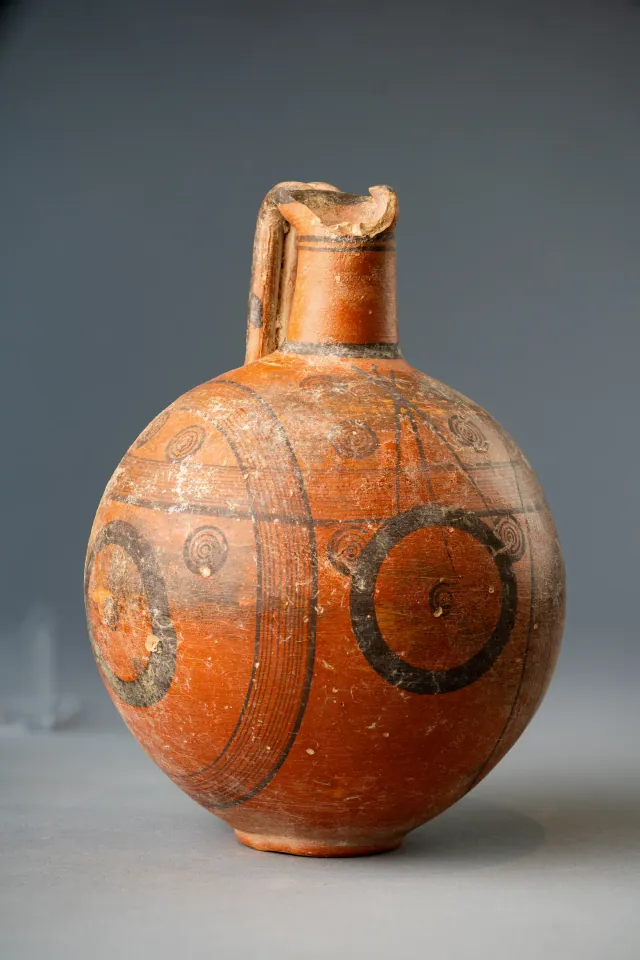
In the second stage, he wrote, the circles were grouped into rows and "the outer circle-line is sometimes thicker than the others" [3, pp. 70-71]. The large globular jug here has both: a heavy black ring on each side round a small central target, little circles strung round the shoulder, tall groups of arcs sweeping down between. It sits comfortably in Black-on-Red II (IV).
Comfortably is as far as it goes. Gjerstad built his sequence from the order of tomb groups. When Schreiber tested it against stratified settlements in the Levant, she found that "the two-handled juglet, the conical juglet and the trefoil-lipped juglet all appear in firm contexts in 'Phase 1' sites," her earliest horizon, along with the carinated bowl, though Gjerstad had put all of them in his second stage [2, p. 253]. At Megiddo, Black-on-Red first appears in a level radiocarbon-dated to about 900 BC, with vessels of Gjerstad's Types III and IV side by side [5]. The labels still sort pots by style; as a clock they are blunt, which is why the pieces illustrated here can be given only broad dates such as c. 850 to 600 BC.
Who made it, and why it was called Phoenician
The century of argument over the ware's origin began with Gjerstad, and he was no champion of a Cypriot invention. He held that Black-on-Red came from "the Syro-Anatolian region" and became Cypriot around 850 BC with "an influx of Syro-Anatolians into Cyprus and their gradual fusion with the Cypriotes," and that "there is no evidence whatsoever that this pottery... has any associations with the Phoenicians" [3].
The Phoenician label came from Palestine, where excavators found the juglets in strata they dated to the 11th and 10th centuries, earlier than anything Gjerstad allowed in Cyprus, and took the ware for mainland work carried by Phoenician trade [6; 2]. Nicolas Coldstream proposed Cypriot manufacture under Phoenician influence, perhaps at Kition [2]; Patricia Bikai, a specialist in Phoenician pottery, had "always been mystified by the suggestion that Black-on-Red is Phoenician" [6].
Schreiber's monograph turned the debate. She showed that the "foreign" Black-on-Red Gjerstad had set apart matched the Cypriot pieces, derived the early juglets from Cypriot White Painted and Bichrome barrel-juglets, and found "substantial evidence that this pottery is Cypriot in origin, manufactured in Cyprus and exported" [2, pp. 242-245, 273-274, 307]. The chemistry agrees. Neil Brodie and Louise Steel's analyses of 1996 judged its Black-on-Red Cypriot [2, p. 232], and the ten early sherds analysed from Megiddo were made in Cyprus [5]. Within the island the fabrics point west. Giorgos Bourogiannis concludes that Palaepaphos (Old Paphos, in the south-west) "probably was the chief supplier of BoR pottery to the Aegean during the 9th and 8th centuries BC, as it was also for the Levant" [8, p. 382], and Anna Georgiadou has suggested that the ware was invented in the workshops of Paphos [11]. One ingredient may be foreign: the idea of black lines on a red slip could have been prompted by a coarser mainland "Red Ware" found in earlier tombs at Palaepaphos-Skales [2, pp. 275-276]. Maria Iacovou's verdict on the old name is blunt: Black-on-Red "is not a Phoenician ware," and "Cypro-Phoenician" is "a misnomer" [7, pp. 804-805].
A juglet in every port
Schreiber counted 364 juglets on the mainland, 59 per cent of all the Black-on-Red there, spread from the Akko plain and Mount Carmel to the Negev; the bowls stayed mostly near the Carmel coast [2, pp. 28-34]. Phoenicia proper has little. The main cemeteries of Achziv, a Phoenician town close to the richest Carmel sites, have produced only 20 Black-on-Red vessels, and the Phoenician cemetery at Atlit none, which led Schreiber to conclude that "there are good indications that BoR pottery was not distributed by Phoenicians" [2, p. 51].
The first Black-on-Red in Greece is a juglet from a tomb at Lefkandi in Euboea, dated 875 to 850 BC. Crete and Cos have Cypriot imports from about the last quarter of the 9th century and Rhodes from about 800, and local potters on all three islands made copies [8, p. 382]. The Aegean took the closed, slow-pouring shapes almost exclusively, whereas in the Levant bowls travelled too [8, p. 382]. Found in dated layers abroad, the juglets became a clock running both ways, Levantine strata dating Cypriot styles and Cypriot styles dating strata, until radiocarbon from sites such as Megiddo broke the circle [2, pp. 7, 223-225; 5].
Follow the juglets on the map, from Megiddo and Tell Beit Mirsim to Lefkandi, Cos and Rhodes, and notice how little comes from the Phoenician towns themselves.
Cypriot pottery abroad
Black-on-Red abroad
Find-spots (8)Show the listHide the list
- 1MegiddoIsrael
- Black-on-Red. Black-on-Red from a level radiocarbon-dated to about 900 BC; the ten early sherds analysed were made in Cyprus. Lesson 9
- 2Tarsus (Gözlükule)Turkey
- Black-on-Red. Kilns with misfired Cypriot-style White Painted, Bichrome and Black-on-Red, read by Gjerstad as Cypriot potters working abroad. Lesson 1
- 3Tell Beit MirsimWest Bank
- Black-on-Red. The juglet Albright published in 1932 as Cypro-Phoenician. Lesson 9
- 4AchzivIsrael
- Black-on-Red. Only 20 Black-on-Red vessels from the main cemeteries of this Phoenician town. Lesson 9
- 5LefkandiGreece
- Black-on-Red. A juglet from a tomb, dated 875 to 850 BC: the first Black-on-Red in Greece. Lesson 9
- 6KnossosGreece
- Black-on-Red. Black-on-Red is the commonest Cypriot import here. Lesson 13
- 7CosGreece
- Black-on-Red. Cypriot imports from about the last quarter of the 9th century BC, and local copies. Lesson 9
- 8RhodesGreece
- Black-on-Red. Cypriot imports from about 800 BC, and local copies. Lesson 9
Bichrome Red: add white
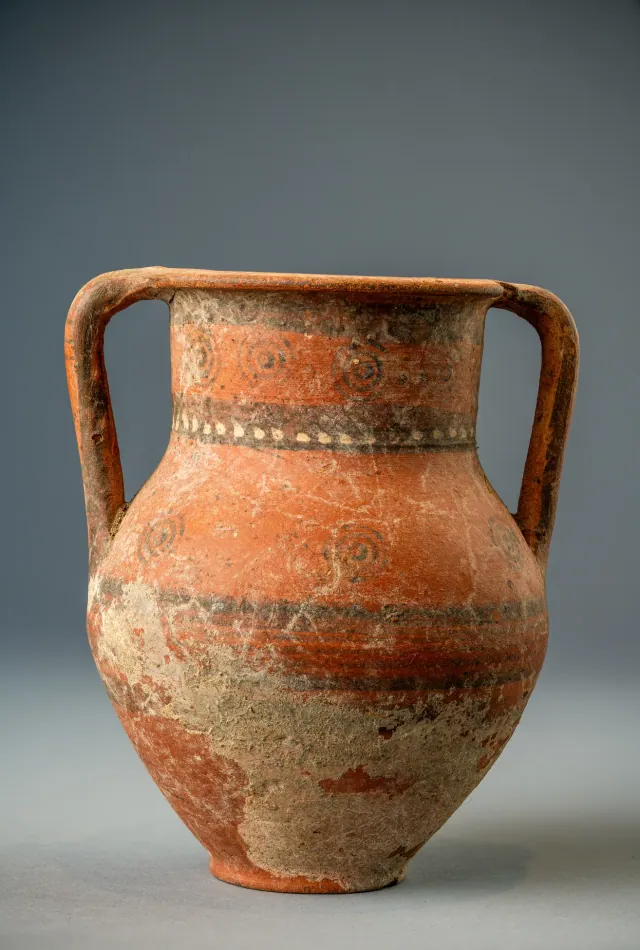
On the amphora in the Drakopoulos collection, the whole case for Bichrome Red rests on one row of small white dots set on the black band at the base of the neck. Everything else, the red slip and the black circles floating on neck and shoulder, would pass for Black-on-Red. That is typical: the white was painted over the slip and is the first colour to go.
In Gjerstad's tombs Bichrome Red first appears late in CA I, at 5.6 per cent of the pottery against 18.7 for Black-on-Red; by the Cypro-Classical period the order had reversed [3]. Joanna Smith notes that later work places its start earlier, in Gjerstad's Type III horizon [4, p. 224]. Unlike its parent, it scarcely left the island: Bichrome Red "is, however, almost never found on the Levantine mainland" [2, p. 253]. Its best-known products, jugs whose spout is a small pitcher held by a modelled woman, belong to Lesson 10.
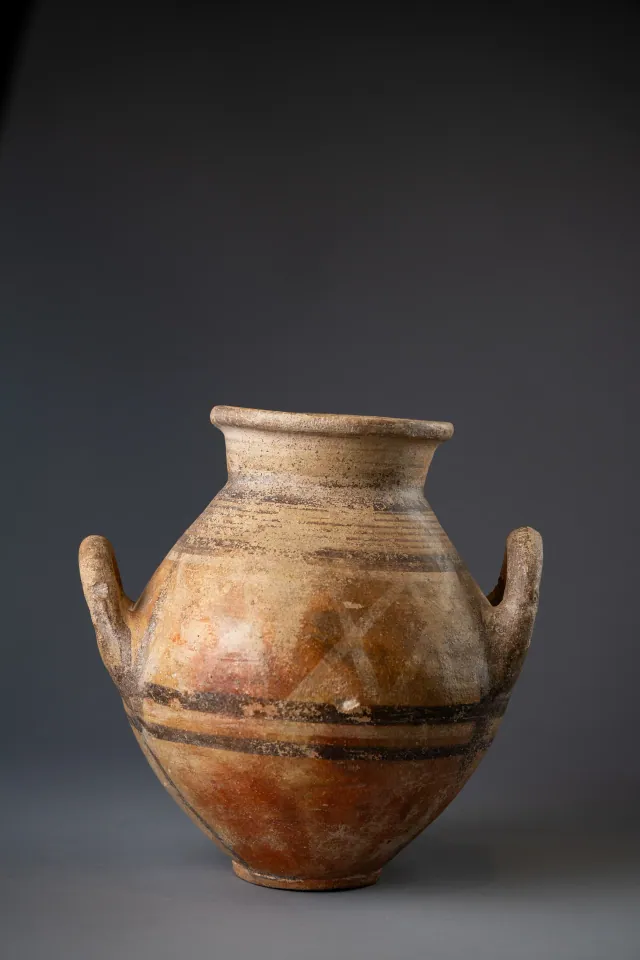
The second amphora shows the problem in reverse. White dots once recorded on its neck band can no longer be made out, and the large pale crosses on its shoulder may or may not be white paint. It is probably Bichrome Red, with Bichrome IV on a reddish ground as the alternative.
Kition and the Phoenician question
There was a real Phoenician presence on Cyprus, and its centre was Kition, under modern Larnaca, where a Phoenician temple of Astarte stood by the late 9th century BC [10, p. 106]. Gjerstad noted that in the 8th century a Phoenician type of jug, with a tapering neck and pinched mouth, appears in Cypriot Red Slip, and he read these as local copies of imported Phoenician metal jugs [3]. Red Slip handleless bowls of Phoenician type are concentrated at Kition in the Cypro-Archaic period [11].
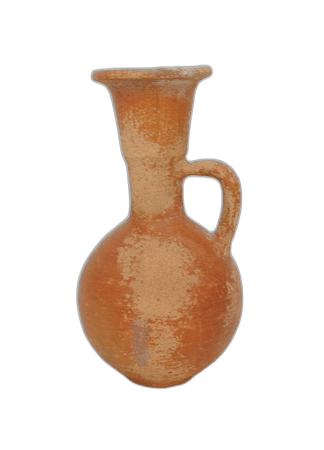
The jug beside this paragraph, recorded as probably from Amathus, is Phoenician Red Slip: a tall neck widening to a funnel above a ring, a lustrous red slip, no paint. Set it beside Albright's juglet, red, slipped, burnished and ridge-necked like it, and the old confusion is easy to understand.
Chronology and geography pull them apart. Black-on-Red was reaching Megiddo around 900 BC, before the earliest firm evidence for Phoenicians at Kition, from workshops at the other end of the island; and in Iacovou's reading, Kition's early Iron Age material culture is indistinguishable from that of other Cypro-Geometric sites [7]. A Black-on-Red juglet in a tomb at Megiddo or on Cos tells us where the container was made. Who carried it there, and who was buried with it, the pot cannot say.
Kition's own temple makes the point. In 1969 its excavators found, in the courtyard of the first temple, a fragmentary bowl of Phoenician Red Slip with a long Phoenician inscription cut after firing and dated by its letters to the end of the 9th century BC. It records that a man called ML, perhaps the Phoenician name Moula, had his hair shaved and prayed to Lady Astarte; he offered a sheep and a lamb, his family another lamb, and he filled the bowl with his hair. The prayer, the text says, was "made in Tamassos," an inland Cypriot town, and Karageorghis took ML to be probably one of its citizens [10, p. 106]. The bowl is Phoenician in ware and script, its dedicant's name probably Phoenician too, and the man who filled it with his hair had, if Karageorghis is right, come to the coast from a town in the middle of the island.
Quiz
Check yourself
Question
Which ware is this juglet?
Question
You pick up a red Iron Age pot. What is the first thing to settle?
Question
A label reads “Black-on-Red I (III)”. What does it mean?
Question
Radiocarbon dates the level with the first Black-on-Red at Megiddo to about when?
Question
A red-slipped amphora has black circles on neck and shoulder and one row of small white dots on the black band at the base of the neck. Which ware is it?
Question
Which of these count against calling Black-on-Red a Phoenician ware?
Tick every answer that applies
Question
What did the Black-on-Red juglets hold?
What to look for
- A red or orange slip, often lustrous, sometimes polished, over a fine, thin-walled, wheel-made body; at a chip or worn base the paler clay shows under the slip.
- Black paint only: Black-on-Red. Black plus white dots, bands or strokes: Bichrome Red. No paint, or plain bands only: Red Slip. The same black ornament on a pale ground: White Painted.
- Compass-perfect concentric circles on the shoulder of juglets and jugs, below the rim or on the floor of bowls. Circles linked in rows, or a heavy outer ring, suggest the second stage, Black-on-Red II (IV), in CA I.
- The small juglet, about 6 to 13 cm tall, with a narrow neck, flaring mouth and often a ridge where the handle meets the neck: the ware's export form.
- On any red-slipped pot, search worn areas and the black bands for traces of white before settling on Black-on-Red.
- Read "Black-on-Red I (III)" as "first class of the ware, in Cypro-Geometric III," and treat the stage numbers as style more than date.
Go deeper
The reference pages are Black-on-Red ware and Bichrome Red ware, with the motif at circles. The Megiddo radiocarbon study is discussed in The Enigma of Black-on-Red Pottery.
References
- 1.Albright, W.F. (1932). The Excavation of Tell Beit Mirsim I: The Pottery of the First Three Campaigns. Annual of the American Schools of Oriental Research 12. New Haven: American Schools of Oriental Research.
- 2.Schreiber, N. (2003). The Cypro-Phoenician Pottery of the Iron Age. Culture and History of the Ancient Near East 13. Leiden and Boston: Brill.
- 3.Gjerstad, E. (1948). The Swedish Cyprus Expedition, Vol. IV, Part 2: The Cypro-Geometric, Cypro-Archaic and Cypro-Classical Periods. Stockholm: The Swedish Cyprus Expedition.
- 4.Smith, J. S. (2009). Art and Society in Cyprus from the Bronze Age into the Iron Age. Cambridge: Cambridge University Press.
- 5.Kleiman, A., Fantalkin, A., Mommsen, H. and Finkelstein, I. (2019). The Date and Origin of Black-on-Red Ware: The View from Megiddo. American Journal of Archaeology 123.4, 531–555.
- 6.Bourogiannis, G. (2012). Pondering the Cypro-Phoenician Conundrum: The Aegean View of a Bewildering Term. In M. Iacovou (ed.), Cyprus and the Aegean in the Early Iron Age: The Legacy of Nicolas Coldstream. Nicosia: Bank of Cyprus Cultural Foundation, 183–205.
- 7.Iacovou, M. (2014). Cyprus during the Iron Age through the Persian Period: From the 11th Century BC to the Abolition of the City-Kingdoms (c. 300 BC). In M.L. Steiner and A.E. Killebrew (eds), The Oxford Handbook of the Archaeology of the Levant, c. 8000–332 BCE. Oxford: Oxford University Press, 795–824.
- 8.Bourogiannis, G. (2022). Cypriot Black-on-Red Pottery in Early Iron Age Greece: In Search of a Beginning and an End. In G. Bourogiannis (ed.), Beyond Cyprus: Investigating Cypriot Connectivity in the Mediterranean from the Late Bronze Age to the End of the Classical Period. AURA Supplement 9. Athens: National and Kapodistrian University of Athens, 365–388.
- 9.Benson, J. L. (1973). The Necropolis of Kaloriziki (Studies in Mediterranean Archaeology 36). Göteborg: Paul Åströms Förlag.
- 10.Karageorghis, V. (1976). Kition: Mycenaean and Phoenician Discoveries in Cyprus. London: Thames and Hudson.
- 11.Georgiadou, A. (2016). Pottery of Geometric, Archaic and Classical Periods in Cyprus. In G. Bourogiannis and C. Panagiotopoulou (eds), Kyprios Character: History, Archaeology and Numismatics of Ancient Cyprus. Athens: National Hellenic Research Foundation (online).