
Ancient Cypriot Pottery·Lesson 2
The First Pots of the Neolithic and Chalcolithic
Cypriot farmers used stone bowls for some fifteen centuries, and the first pots came only around 4750 BC. Meet the Neolithic and Chalcolithic wares that followed, and learn to tell a combed, a painted and a plain red sherd apart and date it.
Alexis Drakopoulos·Period by period·13 min read
Share


Lesson 2·Course contents, 15 lessons
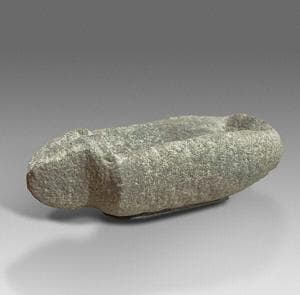
In one of the large round houses at Khirokitia, Porphyrios Dikaios found a burial, probably a woman's, with three stone bowls. They had been deliberately broken into several pieces and laid under and over the body, and on one of them the places where its two handles had broken away were smoothed from handling: the bowl had been used for some time before it was smashed at the grave [1]. A small spouted bowl of grey diabase from the same site, 4.5 cm high, shows the kind of vessel that did the work of pots here.
Khirokitia's people farmed, hunted deer and buried their dead under the floors of their houses for some fifteen centuries, from about 7000 to 5500 BC [4]. In all that time they made no pottery. Potters in the northern Levant had been firing clay since about 7000 BC [8]; on Cyprus the first true pottery dates to the first half of the 5th millennium BC, around 4750 BC [3; 4]. The islanders were neither isolated nor ignorant of clay: they kept up contact with the mainland [3] and left clay figures and a few low-fired sherds [4]. They knew how. For a very long time they chose not to, or saw no reason to.
Before pottery: the stone bowls
The Aceramic Neolithic, the "pre-pottery" farming period that the Khirokitia culture closes, carved its containers from grey andesite and diabase cobbles picked out of the riverbeds below the villages: bowls round, oblong and rectangular, spouted bowls, trays, ladles and mortars, some with ledge or loop handles, some incised or ribbed. Unfinished bowls show the method, pecking a hollow and then knocking out the central boss [1]. Baskets, skins, wood and gourds presumably did the rest.
Joanne Clarke argues that small, stable communities under little pressure on their resources had no reason to replace materials that worked: at a place like Khirokitia "there was little need" for pots [3, pp. 109-110]. Louise Steel adds that "choice and identity" matter when judging what looks like backwardness; these islanders took the mainland's crops and animals and left its pottery behind [5]. Either way, when pottery came it would have to do what the stone bowls already did.
To see where those bowls ended up, dig a house at Khirokitia yourself: lift the fallen walls, go down through floor after floor, and find the dead in pits beneath them, one of them with a stone bowl broken before it went into the grave.
There is not a single pot in the house: the only vessel in it is stone.
The first pots, around 4750 BC
Khirokitia was abandoned between about 5500 and 5200 BC, and the island's archaeological record then thins to almost nothing for five hundred to a thousand years [4]. Whether the island emptied or its people lived in flimsier houses is still argued. Chronological tables, including the one in Lesson 0, open the Ceramic Neolithic at about 5200 BC, where the Khirokitia culture ends, so the period's first centuries are this gap.
When the record resumes, around 4750 BC, pottery is there. The earliest comes from the lowest levels at three sites, Dhali-Agridhi in the central plain, Philia-Drakos A near Morphou Bay and Klepini-Troulli on the north coast, and it is of two kinds [3, pp. 43, 109]. One is a Coarse Ware whose commonest shape, a tray with a flanged base and a U-shaped gap in one wall, Clarke knows nowhere outside Cyprus [3, p. 117]. The other is Dark-Faced Burnished Ware, named by its excavator Trevor Watkins after a mainland ware it resembles: small, thin bowls and long-necked "tear-drop" flasks in a hard, dark fabric, burnished (rubbed with a smooth tool) to a shine inside and out [3, p. 117; 4].
The technology "seemingly appeared fully formed with no development or learning phase" [5], so the know-how probably came from outside. Clarke traces the closest match to Arjoune in central Syria, one of the last mainland places still making burnished dark wares, and concludes that the skills travelled while the pots became Cypriot at once, local in fabric and shape, with none of the mainland's incised decoration [3, pp. 110, 115-116]. Within a short time, at Philia, potters began to paint red designs straight onto the dark burnished surface [3, p. 118]. On Cyprus, painting is almost as old as pottery.
Scraped or painted: the wares of the Sotira culture
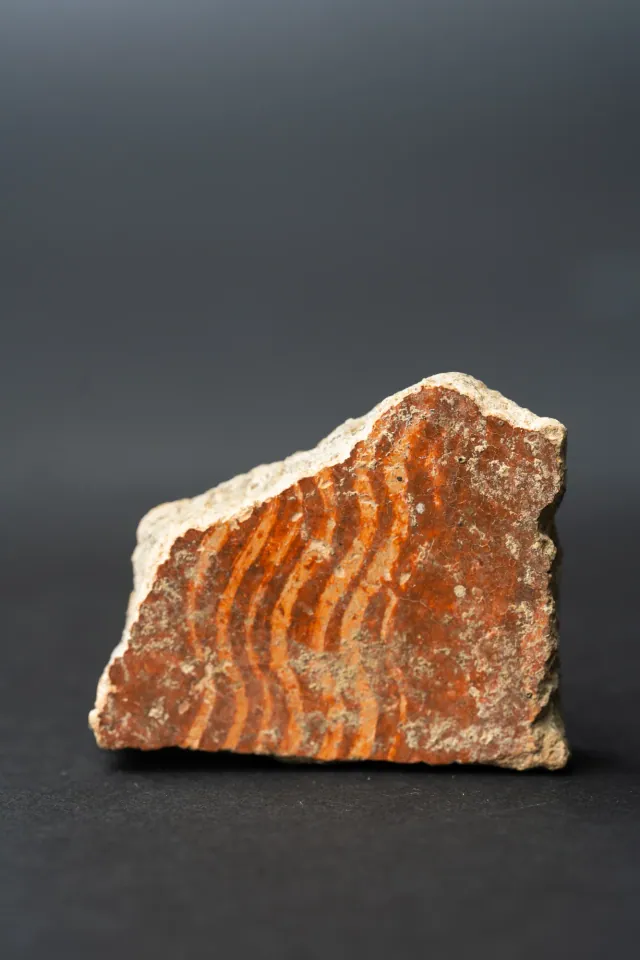
The settled villages of the later 5th millennium, the Sotira culture (c. 4500 to 4000 BC), are named after Sotira-Teppes, a hilltop above the Kouris valley that Dikaios excavated from 1947 [6]. He sorted its pottery into nine wares [6]. Two carry real decoration, and they do the same job in opposite ways.
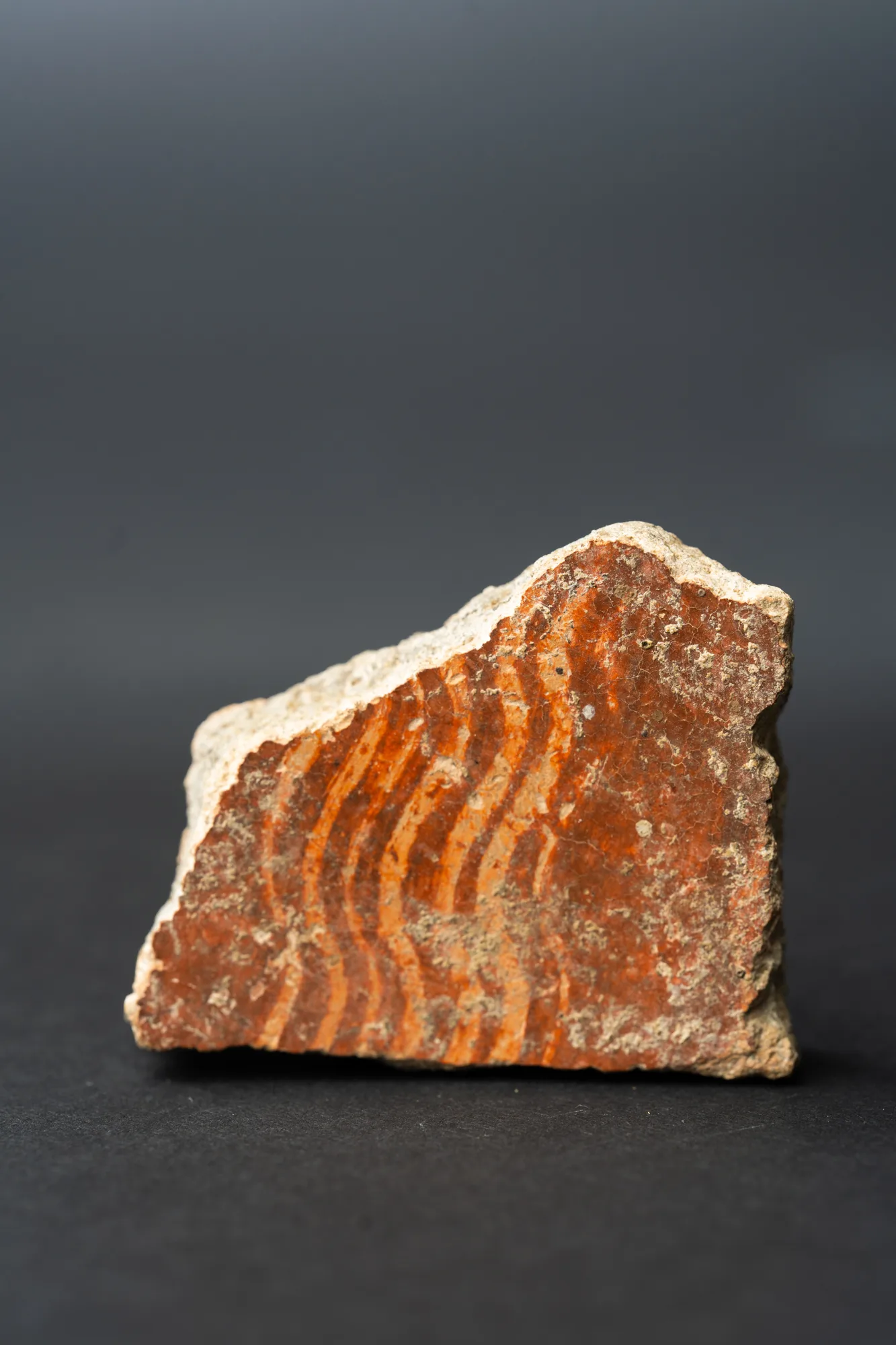
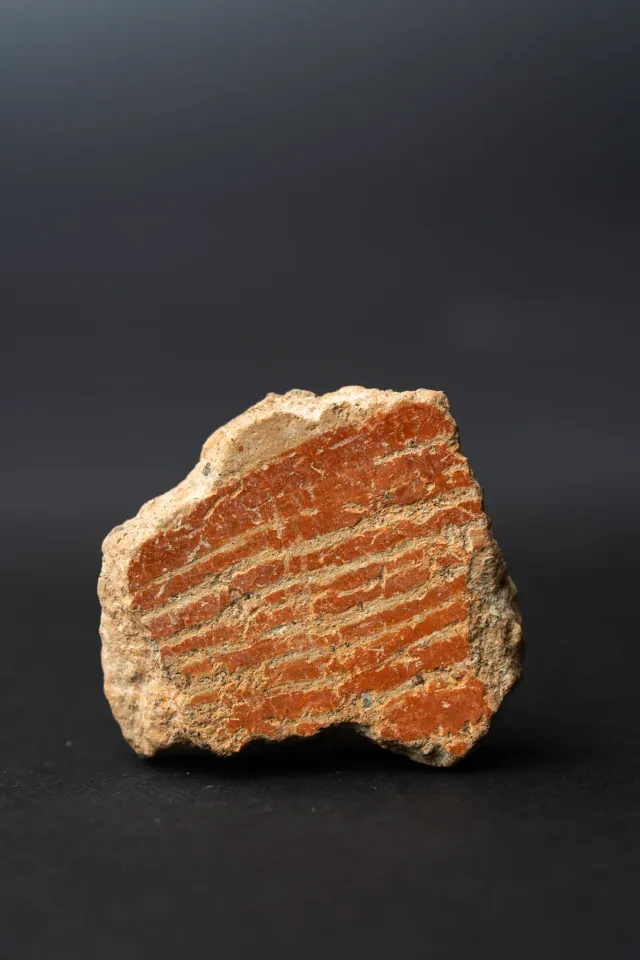
Combed Ware is the one that announces itself. The potter covered the vessel in a thick red slip, a coat of fine liquid clay, and while it was still wet dragged a toothed tool through it, "a shell, bone, or reed", so that the teeth "exposed the underlying surface... and thus produced alternating red and light colored bands"; the surface was then polished [6, p. 172]. The design is made by taking slip away, the technique the field calls reserve decoration. At Khirokitia, where the ware belongs to squatters who settled among the ruins of the abandoned village [6, p. 209], Dikaios found the traces of combs with eight, eleven, fifteen and more teeth, one of them as thin as a modern metal pin [1]. The fragment beside this paragraph, in the Drakopoulos collection, shows the ware at its best: six or seven pale lines, the clay of the pot showing through, ripple in step across a deep red slip, drawn by one pass of a many-toothed comb. Dikaios rated such multiple wavy bands the technical culmination of the style [6] and placed the best combing in Sotira's third phase, when "the combed or painted and combed patterns had then reached their greatest brilliance" [6, p. 209].
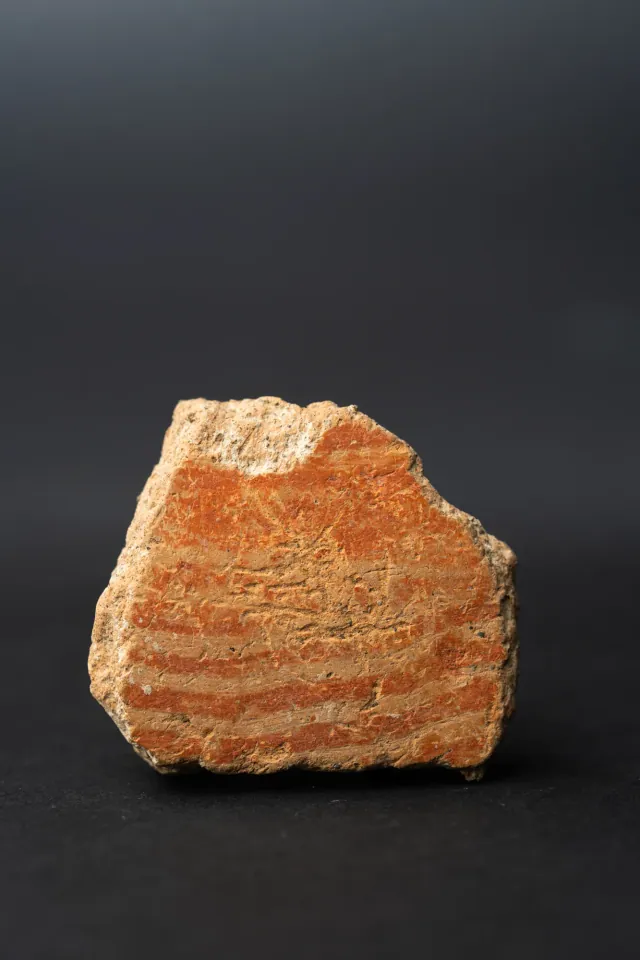
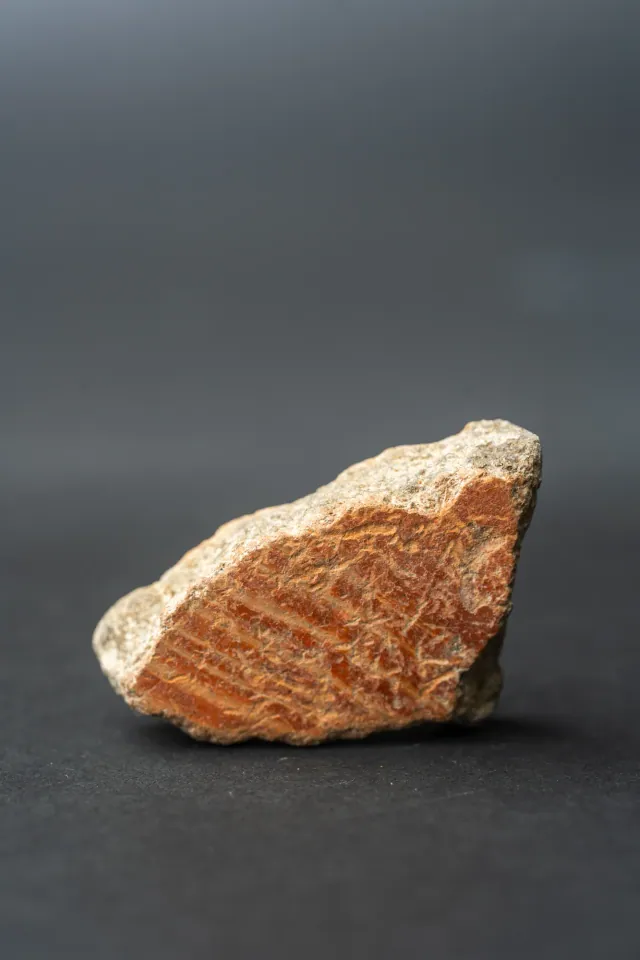
Combing appears on only two shapes, the bowl and the jug, and the jugs were combed only on the outside [6, pp. 172-176]. A fragment combed on both faces must therefore come from a bowl. The first of the two sherds above, from the same collection, is combed horizontally on one face and obliquely on the other, and its wall fits the 10 to 14 mm Dikaios gives for Combed Ware bowls; it probably comes from a deep hemispherical bowl, perhaps with a tubular spout at the rim, the spouted bowl the stone carvers had made [6, pp. 172-176]. The second, a wedge-shaped fragment, carries a group of straight parallel bands running diagonally, one of Dikaios's standard Sotira schemes [6], and faint banding on its other face marks it too as a bowl. Its slip is crazed like old varnish and has lifted and flaked in places, which shows why so much of this pottery survives badly: Combed Ware slip is soft enough, Dikaios found, to scratch with a fingernail [6, pp. 172-176].
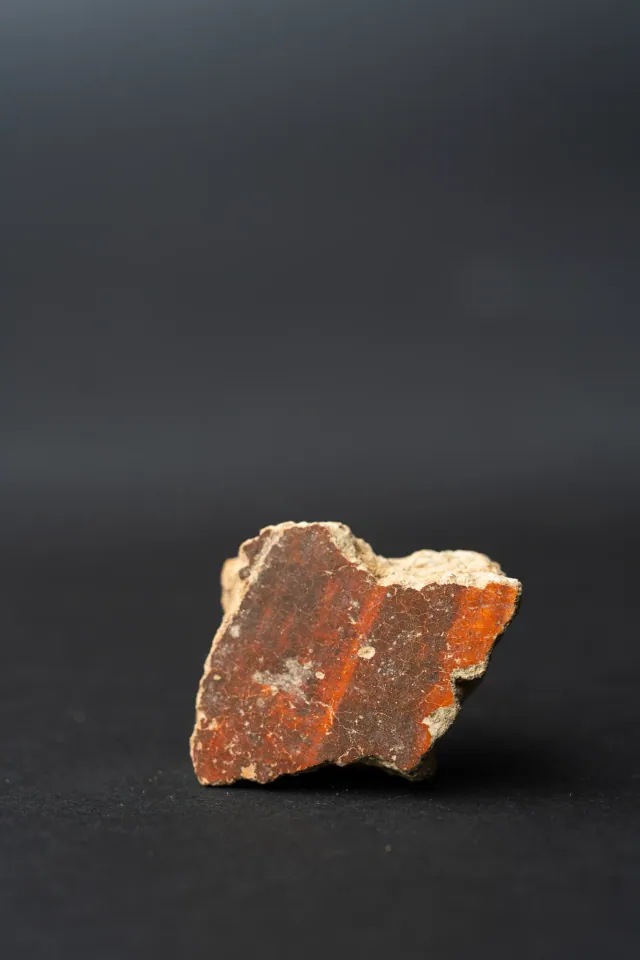
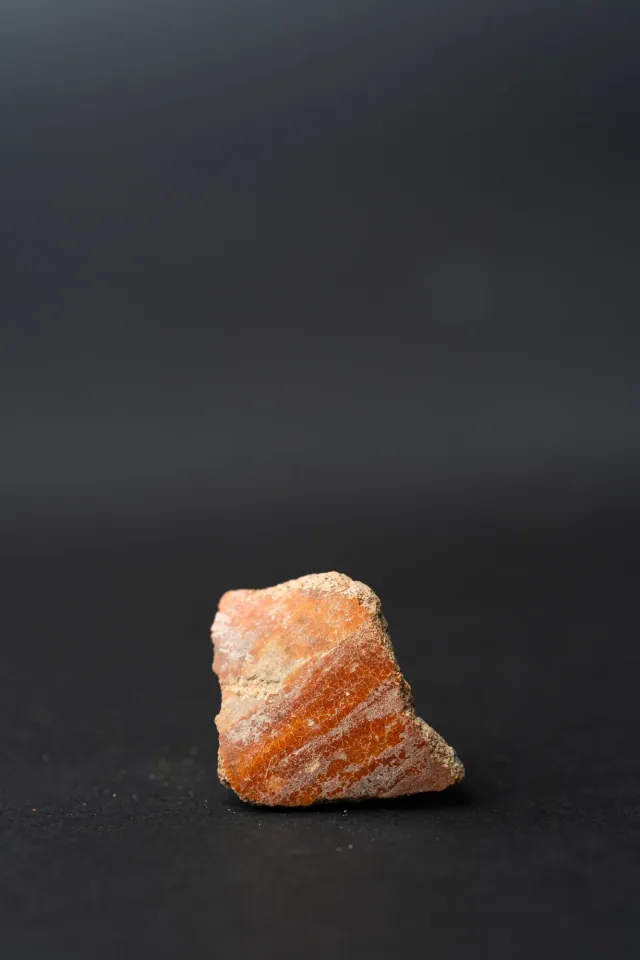
The combed pots are the famous ones. They were not the commonest. In Stanley Price's tabulation of all Sotira's phases, Red Lustrous Ware, a plain red slip burnished to a soft shine with no decoration at all, makes up nearly half the pottery (47.8 per cent), Combed Ware about a third (36.3), and painted wares barely 4 per cent [7, p. 14]. Red Lustrous shares the combed ware's fabric, with the same sandwich of grey core between red margins in the break [6, p. 184]. A thinner, streakier version Dikaios called Red Slip, which he thought "may actually be a variety" of Red Lustrous [6, p. 186]. Two plain sherds in the Drakopoulos collection, illustrated below, show the pair. The first, a thick Red Lustrous fragment, is clouded from orange-red to near black where fuel and smoke touched it in an open fire. The second, a small fragment, is Red Slip: a thin, translucent orange-red film brushed on in streaks, so that deeper tomato-red strips alternate with paler ones. Both are slipped on the outer face only, which suggests closed vessels, jugs or holemouth jars (neckless jars whose mouth is a plain opening in the shoulder), since bowls were slipped inside and out.
Painting, the second method, adds colour where combing removes it. Red-on-White Ware is matt red paint on a pale ground, the surface "smoothed to resemble a slip or... covered with a thin buff slip on which the pattern is painted in red and later burnished" [6, p. 181]. The pale ground is often the clay itself. Petrography, the study of thin slices of fired clay under the microscope, shows the potters ran two clays: iron-rich clays from the Troodos foothills for coarse and burnished monochrome pots, and lime-rich marls that fire pale for the painted and combed ones, so that red would read clearly against them [8].
At Sotira painting is rare. On the north coast it is almost everything. At Ayios Epiktitos-Vrysi, excavated by Edgar Peltenburg, nearly all the pottery is painted and combing never passes 5 per cent [9, p. 66]. Dikaios had read the wares as stages, combing first and free painting last [6]. Peltenburg read north and south as regional preferences within one culture [9], and Clarke's radiocarbon sequence reverses Dikaios's order: Dark-Faced Burnished first, Red-on-White in the north by about 4500 BC, and Combed Ware developing south of the Troodos only after about 4350 BC [3, p. 44]. Red-on-White sherds from Vrysi in the Hunterian Museum, Glasgow, show the northern manner: wavy lines and broad bands of red on a cream ground, the style called Broad Line.
Set the two manners on the island. Vrysi, where nearly everything was painted, lies on the north coast; Sotira, where most decoration was combed, sits south of the Troodos above the Kouris. The three sites of the first pots lie in the north and the central plain, and the Chalcolithic villages of the rest of this lesson run from Erimi on the Kouris west to Lemba and Kissonerga.
Map of Cyprus
The first pots
- Neolithic
- Chalcolithic
- Ground above 200, 500, 1,000 m
Sites on this map
- 1Khirokitia
- 2Dhali-Agridhi (approx.)
- 3Philia-Drakos A (approx.)
- 4Klepini-Troulli (approx.)
- 5Sotira-Teppes
- 6Ayios Epiktitos-Vrysi (approx.)
- 7Erimi-Pamboula
- 8Lemba
- 9Kissonerga-Mosphilia
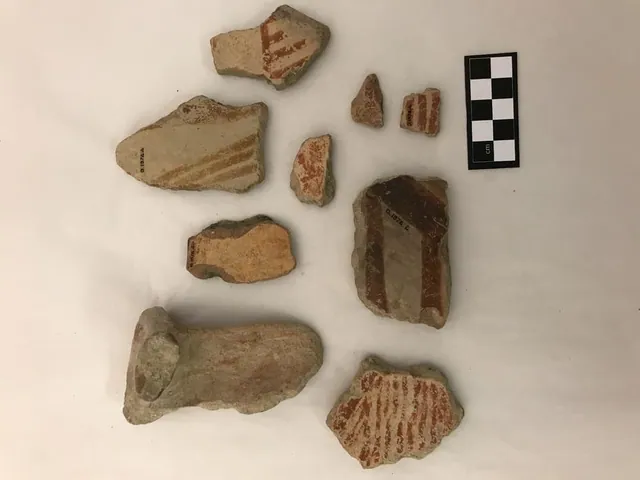
The five Drakopoulos sherds are kept with an old collector's label: "Neolithic. Painted and combed ware. c. 3500 BC." The period is right. The date was the estimate of the 1950s: the Cyprus Museum guide of 1953 placed Khirokitia at 4000 to 3600 BC and Erimi at 3200 to 2800 BC [2]. Calibrated radiocarbon has since pushed the Sotira culture back by about a thousand years and Khirokitia by some three thousand. A label's date belongs to the year it was written; its ware name is usually the safer guide.
The brush takes over: Erimi and the Chalcolithic
Between 1933 and 1935 Dikaios dug through five to six metres of superimposed houses at Erimi-Pamboula, above the Kouris river [2; 11]. In the lowest levels he found a handful of combed sherds, almost the last of their kind. Above them painting grew commoner the higher he went while the plain red wares declined [11], and in the upper levels he found copper and named the new period for it: Chalcolithic, copper and stone [2]. Combed Ware, as Catling put it, had been "the hallmark of Neolithic II" and "played no part in Chalcolithic I" [10, p. 21]. Apart from that thin tail, a sherd with true reserve combing is Neolithic, one of the firmest dating rules in Cypriot prehistory.
Whether Sotira and Erimi were one people or two is argued. Watkins saw "a fairly sharp cultural discontinuity" [7, p. 13], while Clarke's excavations at Kalavasos-Kokkinoyia, where combed ware lies with early Chalcolithic burnished wares, support a gradual change [3, p. 44]. The pots themselves kept a great deal. Stone vessels were now "abandoned almost entirely", the 1953 guide observed, and the clay shapes "show definite survival of those of Khirokitia" [2]: hemispherical and spouted bowls, flasks and coarse trays all carried on [4].
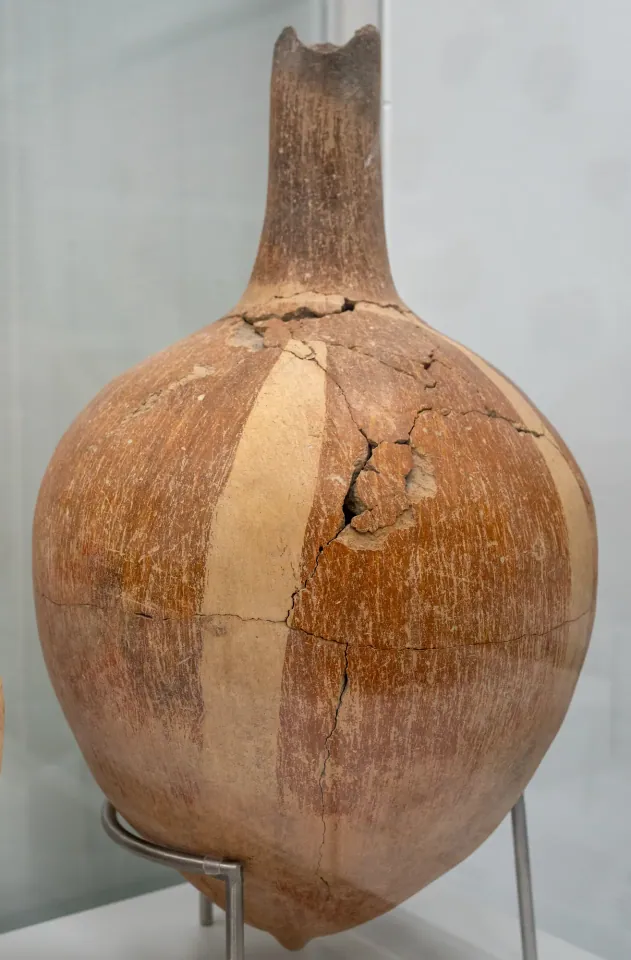
The Chalcolithic divides into Early (c. 4000 to 3400 BC), Middle (c. 3400 to 2800 BC) and Late (c. 2800 to 2400 BC), and the painted pottery keeps its own clock. Specialists distinguish an earlier Broad Line style, thick loosely spaced strokes and large areas of solid red, from a Close Line style of fine, closely set lines, often laid with a multiple brush so that the pale ground dominates [12, pp. 83-84]. Broad Line belongs to the Late Neolithic and the start of the Chalcolithic; Close Line is the Middle Chalcolithic. The two do not occur together at one site [12]. The tall vessel from Kalavasos in the Larnaca District Museum, with a long neck, a pointed base and broad red stripes on a pale body, fits the early, broad manner; the flask with a pointed base is one of the Early Chalcolithic shapes that potters kept making [4].
Move the year through these two thousand years and watch the wares change hands: Combed Ware stops as the Chalcolithic begins, Red-on-White runs on into its Close Line peak, and after 2800 BC the painted pottery gives way to red and black.
Chronology
Cypriot wares in time
Each bar is a ware, placed by the dates the lessons give it. Drag the red line, or use the arrow keys on its year, to see what was being made in any year; choose a bar for its cues and lesson.
Neolithic and Chalcolithic
Handmade Bronze Age
In use around
3200 BCMiddle Chalcolithic
3200 BC: 1 ware in use.
The surface is the clock here. The shapes, hemispherical and spouted bowls, flasks and holemouth jars, ran on through all of it.
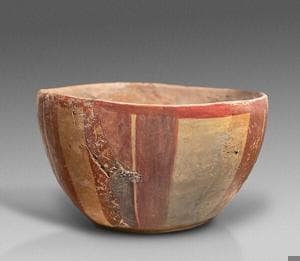
The great Chalcolithic sequences come from the Paphos district, dug by Peltenburg's Lemba Archaeological Project from 1976. At Kissonerga-Mosphilia, Early Chalcolithic pits held more than 30,000 sherds, mostly of a glossy burnished ware, with Red-on-White still a minor part; painted pottery then rose to its Close Line peak around 3200 to 2900 BC [13]. Each village had a manner. At Kissonerga lattice is everywhere; at nearby Lemba the painters left much of the pot blank; at Erimi no single motif dominates [12]. A Red-on-White bowl from Kissonerga, 13 cm across, shows the domestic scale of most of this pottery.
Middle Chalcolithic potters also made the first really large pots. Big storage jars appear at Erimi, with more deep bowls and holemouth jars, as households began to keep larger surpluses [4]. At Lemba, a roundhouse about 6 m across standing apart from the village held Red-on-White storage jars, bowls and flasks with a cache of stone axes and the limestone figure known as the Lemba Lady [5].
Red and black: the end of painting
After about 2800 BC the painted tradition collapsed. Late Chalcolithic potters turned to red monochrome pottery made from non-calcareous, better-cleaned clays, with thinner walls and more controlled firing [14, p. 83]. The signature ware is Red and Black Stroke-Burnished: bowls and jars burnished in visible strokes and deliberately mottled red and black in the firing, sometimes with small applied knobs, in new shapes such as bowls with tab handles and closed vessels with long pouring spouts [14, p. 83]. Similar pottery was made at Troy and in western Anatolia, and the change has been read both as local development and as new eating and drinking customs from Anatolia and the Levant [14, p. 83]; Peltenburg saw in its "highly standardised fabrics" a hint of centralised production [15]. Plain red had been the commonest pottery at Sotira some seventeen centuries earlier. Now, thinner, harder and fired with new control, it was the island's fine ware.
The clearest Late Chalcolithic deposit is a house that burned. Building 3 at Kissonerga-Mosphilia, the "Pithos House", a round stone house 9.1 m across from about 2700 to 2500 BC, collapsed in a fire onto at least 37 storage jars, enough by the excavators' estimate to hold some 4,000 litres; the tallest complete jar stands 95 cm [16]. Most are holemouth jars of Coarse Painted Ware, thinly streaked in red, on tiny dimpled bases that could not stand alone; they sat in stone-ringed hollows along the back wall or leaned on one another. Red and Black Stroke-Burnished bowls and spouted vessels lay near the hearth. There is no Red-on-White in the building at all [16].
Late in the village's life, sherds of a new red, polished, handmade pottery begin to appear in Kissonerga's houses. This is Red Polished (Philia) ware, conventionally dated from about 2400 BC, where the course chronology opens the Philia phase; radiocarbon dates from Kissonerga hint that the first of it was on the island a century or so earlier, by about 2500 BC [15]. Within a few generations it had replaced the whole Chalcolithic repertoire, the stroke-burnished bowls by the hearth and the painted jars along the wall alike.
Quiz
Check yourself
Question
Khirokitia's people farmed for some fifteen centuries without making pottery. What best explains it?
Question
When does the first true pottery appear on Cyprus? Give a year BC.
Question
This sherd is combed on both faces. Which ware is it, and what kind of pot did it come from?
Question
Which was the commonest pottery at Sotira, across all its phases?
Question
Which ware is this deep bowl?
Question
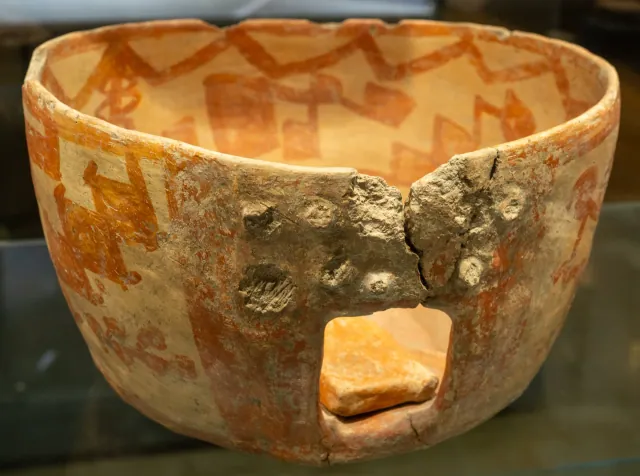
A Red-on-White sherd is painted with fine, closely set parallel lines and dense lattice, so that the pale ground dominates. When was it most likely made?
Question
A box of combed sherds carries an old label: “Neolithic. Painted and combed ware. c. 3500 BC.” What should you trust?
Question
Put these in the order in which they first appear on Cyprus.
Tap an item, then tap its place. Or use the arrows
What to look for
- Stone first. Heavy, grey spouted bowls of andesite or diabase are the containers of the Aceramic Neolithic (before about 5200 BC); a few stayed in use after pottery arrived, but by the Chalcolithic they had been abandoned almost entirely.
- Combing. Soft-edged pale channels running through a thick red slip, often in groups of fine wavy lines, sometimes on both faces: Combed Ware, Late Neolithic (the Sotira culture, c. 4500 to 4000 BC; by radiocarbon it developed in the south only after about 4350), and almost never later.
- Plain red, grey inside. A thick handmade sherd with a red slip and, in the break, a grey-black core between reddish margins: Red Lustrous or Red Slip of the Sotira culture. Plain red continued into the Early Chalcolithic, so date it cautiously.
- Red paint on a pale, chalky ground: Red-on-White. Broad, loose strokes and big areas of red suggest the Late Neolithic or Early Chalcolithic; fine, close, parallel lines and dense lattice suggest the Middle Chalcolithic (c. 3400 to 2800 BC).
- Thin, hard, burnished in visible strokes, mottled red and black: Red and Black Stroke-Burnished, Late Chalcolithic (c. 2800 to 2400 BC), often bowls with tab handles or vessels with long spouts.
- Undecorated pale sherds found with Red-on-White are usually the plain parts of painted pots.
- Shapes are conservative. Hemispherical and spouted bowls, long-necked flasks and holemouth jars run through the whole period, so date a piece by its surface and decoration.
Go deeper
The compendium's Combed Ware and Red-on-White Ware pages carry the full typologies and debates, and the Neolithic and Chalcolithic chronology pages set the pottery in its villages. For the five sherds and the box they came in, read The Judge, the Escape, and a Chocolate Box of Six-Thousand-Year-Old Sherds; for the sites, see Khirokitia, Sotira, Erimi, Lemba and Kissonerga. Lesson 3 picks up the Red Polished world that the Philia potters began.
References
- 1.Dikaios, P. (1953). Khirokitia: Final report on the excavation of a Neolithic settlement in Cyprus on behalf of the Department of Antiquities, 1936–1946. Oxford: Oxford University Press.
- 2.Dikaios, P. (1953). A guide to the Cyprus Museum (2nd, revised ed.). Nicosia: Cyprus Government Printing Office.
- 3.Clarke, J., McCartney, C., & Wasse, A. (2007). On the margins of Southwest Asia: Cyprus during the 6th to 4th millennia BC. Oxford: Oxbow Books.
- 4.Mantzourani, E., Roumpou, M., Kalogeropoulos, N., & Voskos, I. (2023). Exploring pottery function in Neolithic–Chalcolithic Cyprus through organic residue analysis. In I. Voskos, D. Kloukinas & E. Mantzourani (Eds.), Prehistoric lifeways in Cyprus from the Early Holocene to the Middle Bronze Age (Studies in Mediterranean Archaeology 155). Nicosia: Astrom Editions.
- 5.Steel, L. (2004). Cyprus before history: From the earliest settlers to the end of the Bronze Age. London: Duckworth.
- 6.Dikaios, P. (1961). Sotira: A Neolithic settlement in Cyprus. Philadelphia: University Museum, University of Pennsylvania.
- 7.Watkins, T. (1981). The Chalcolithic period in Cyprus: The background to current research. In J. Reade (Ed.), Chalcolithic Cyprus and western Asia (British Museum Occasional Paper 26). London: British Museum.
- 8.Boness, D., Clarke, J., & Goren, Y. (2015). Ceramic Neolithic pottery in Cyprus: Origin, technology and possible implications for social structure and identity. Levant, 47(3), 233–254.
- 9.Peltenburg, E. J. (1978). The Sotira culture: Regional diversity and cultural unity in Late Neolithic Cyprus. Levant, 10(1), 55–74.
- 10.Catling, H. W. (1966). Cyprus in the Neolithic and Bronze Age periods (Cambridge Ancient History, rev. ed., fasc. 43). Cambridge: Cambridge University Press.
- 11.Dikaios, P. (1936). The excavations at Erimi, 1933–1935: Final report. Report of the Department of Antiquities, Cyprus 1936, 1–81.
- 12.Bolger, D. L. (1991). The evolution of the Chalcolithic painted style. Bulletin of the American Schools of Oriental Research, 282/283, 81–93.
- 13.Peltenburg, E. (1991). Kissonerga-Mosphilia: A major Chalcolithic site in Cyprus. Bulletin of the American Schools of Oriental Research, 282/283, 17–35.
- 14.Hadjigavriel, M. (2020). A tale of red and black: Reconstructing transfer of knowledge in Late Chalcolithic Cyprus. Archaeological Review from Cambridge, 35(2), 81–86.
- 15.Peltenburg, E. (2018). The entry of Cyprus into the circum-Aegean world and the growth of regionalism on the island. In S. Dietz, F. Mavridis, Ž. Tankosić & T. Takaoğlu (Eds.), Communities in transition: The circum-Aegean area during the 5th and 4th millennia BC (Monographs of the Danish Institute at Athens 20, pp. 456–465). Oxford: Oxbow Books.
- 16.Peltenburg, E., et al. (1998). Lemba Archaeological Project II.1B: Excavations at Kissonerga-Mosphilia 1979–1992 (University of Edinburgh, Department of Archaeology Occasional Paper 19). Edinburgh: University of Edinburgh.