
Contents
For most of its existence Cyprus had no people on it. The island whose rocks later yielded copper ore was, through the Pleistocene, home to a small and peculiar set of animals: a dwarf hippopotamus, one or two species of dwarf elephant, a genet and an endemic mouse. No large predator hunted them, and three of the four had disappeared by about the time of the first human visits, some 12,000 years ago, or not long after. This entry covers the island's geological origins, the reasons it stayed an island, the endemic fauna, and the rock-shelter of Akrotiri-Aetokremnos, where the bones of hundreds of dwarf hippos lie in the same deposit as chipped stone tools. Whether the people who left those tools killed the hippos, or simply found and burned their bones, is one of the longest-running arguments in Cypriot archaeology. The story continues in the Neolithic entry; for the full sequence see the chronology hub.
An island raised from the sea floor
The core of Cyprus is a slab of ocean floor. The rocks of the Troodos massif are "pieces of a 90 million years old ophiolite", that is, "a piece of oceanic crust formed at a mid-oceanic spreading ridge" which "has been uplifted above sea-level and now forms the core of the Troodos Mountains" [1, p. 34]. The Troodos zone covers about 3,200 km², and its summit, Olympus, stands at 1,951 m [1, p. 34]. Geologists describe "the very rapid Plio-Quaternary uplift of the Troodos ophiolite", concentrated in the last five million years [1, p. 34]. According to Zomeni's summary for the Department of Antiquities, that uplift "increased markedly 2 million years ago", driven partly by serpentinisation of the ophiolite core, which swelled it into a dome, and partly by regional tectonics [1, p. 36].
Two features of this geology mattered to the island's later human history. The pillow lavas of the Troodos host the Cyprus-type sulphide deposits that became the island's copper ores [1, p. 34] (see copper metallurgy). The chalks and cherts of the Lefkara Formation, laid down until about 30 million years ago, "supplied the first settlers with raw material for the making of flint tools" [1, p. 34]; the chipped stone from Aetokremnos is made "primarily" of Lefkara chert [2, p. 8].
The Kyrenia range in the north formed later, through a collision dated "20-10 million years ago", and is built of karst limestone with caves and springs [1, p. 35]. Between about seven and five million years ago came the Messinian Salinity Crisis: Zomeni cites "a 2,000 m drop in the Mediterranean sea-level", recorded on Cyprus by the gypsum beds of the Kalavasos Formation. The sea returned about five million years ago [1, pp. 35–36].
Always an island
After the Messinian crisis the sea never again drained far enough to join Cyprus to the mainland. Antoine Zazzo and colleagues put it plainly: "Cyprus is a true oceanic island, since it has never been connected to any of the surrounding continents since the Messinian salinity crisis" [3, p. 2].
How wide the gap was is a matter on which the sources differ, partly because they measure different things. Jean-Denis Vigne writes that Cyprus was "always separated from the mainland by at least 70 km of open sea" [4, p. 71]. Athanassios Athanassiou, Alexandra van der Geer and George Lyras give "more than 60 km" [5, p. 11]. Zomeni, allowing for the low sea levels of glacial maxima, puts the shortest crossing at "as short as 30 km, for example between Cape Apostolos Andreas and the Bay of Iskenderun" [1, p. 37]. Vigne's 2023 team paper calls Cyprus simply an "80 km offshore island" [6, p. 1]. The figures are best read as a range of roughly 30 to 80 km, depending on the period, the sea level assumed and the stretch of coast chosen.
Whatever the exact distance, animals had to cross open water to reach the island. The large mammals are "believed to have made their way either by swimming or with the help of floating trees" [1, p. 36]. Athanassiou and colleagues suggest that the ancestors of the first Cypriot elephant came over "a very long 'sweep-stake route' from the Cilician coast (Asia Minor) to the northeast extremity of the island", and that the ancestor of the Cyprus mouse "arrived on Cyprus by rafting during the Middle Pleistocene" [5, p. 11]. The result on Cyprus was what Zazzo's team calls "reduced taxonomic diversity and a high degree of endemism" [3, p. 2], and what Athanassiou's team calls "an extremely impoverished mammal fauna" [5, p. 11].
The endemic fauna
By the Late Pleistocene the island's land mammals came down to four endemic species: a dwarf hippopotamus, a dwarf elephant, a genet and a mouse [4, p. 71; 3, p. 2]. There were no large carnivores [7, p. 7].
The hippopotamus has more than one scientific name in the literature, and the sources in this entry do not agree on which to use. Alan Simmons and Bernard Knapp call it Phanourios minutus [8, p. 857; 2, p. 9]; Zazzo's team and Elehna Bethune's team use Phanourios minor [3, p. 2; 7, p. 7]; Athanassiou's team and Vigne's 2023 paper place it in the genus Hippopotamus as Hippopotamus minor [5, p. 11; 6, p. 3]. This entry calls it the Cypriot dwarf hippo and uses Phanourios minor where a Latin name is needed, with P. minutus as the older form. The animal was about 1.5 m long and 0.75 m high [1, p. 37]. Bethune and colleagues describe it as "the smallest Mediterranean dwarf hippopotamus known, featuring a body mass of approximately 130 kg", with limbs "better adapted for walking and climbing on rough terrain rather than a semiaquatic lifestyle", and its lowered orbits and nostrils "confirm a more terrestrial lifestyle" [7, p. 7]. Hippos outnumber elephants in the fossil record "by a ratio of about 9:1" [1, p. 37], and "over 30 fossil sites containing the remains of pygmy hippopotamus and/or elephant are known from Cyprus" [8, p. 857; 9, p. 140].
The elephant is rarer and more complicated. Older works, including Simmons, Knapp and Vigne, call it Elephas cypriotes. Athanassiou and colleagues recognise two species in the genus Palaeoloxodon, descended from the European straight-tusked elephant. The earlier one, Palaeoloxodon xylophagou, was named in 2015; its founders arrived in the late Middle Pleistocene. The later one, P. cypriotes, first described by Bate in 1903, lived in the latest Pleistocene and was "characterised by extremely small body mass, about 2% of that of the mainland P. antiquus" [5, p. 11]. The same authors find that "no island supported more than one proboscidean species at any time" [5, p. 1], so the two Cypriot elephants followed one another. That the smaller species descended from the larger is, in their words, "the most parsimonious" reading, which leaves room for a second colonisation [5, p. 11]. Zomeni gives the dwarf elephant's height as "only 1 m" [1, p. 37]. A jaw of the pygmy elephant is registered in the Cyprus Museum, Nicosia, as no. 7812.
The genet, Genetta plesictoides, was also named by Bate in 1903. It rests on a slender basis: "about a dozen bones of two adult individuals" from Bate's 1902 collections at the cave of Kato Dhikomo Vokolosspilios, a site that also produced bones of rats, mice, pig, goat and birds. The same source adds, "There is some question as to the date of the genet and the other small animals at this site; they are likely to be Holocene intrusions" [10, p. 168]. A juvenile palate and tibia from Aetokremnos were first described as "possibly from a juvenile cat or fox" [8, p. 862] and later compared with the living genet [10, p. 168]; Knapp lists "a genet" among the Aetokremnos fauna [2, p. 10]. Vigne's team, who treat the genet as a genuine endemic, note that it is absent from the early Neolithic site of Klimonas, where cat is present, and suggest it "likely became extinct between 12,000 and 10,800 cal. BP" [6, p. 3]. The animal is best treated as real but poorly dated.
The fourth species is the only survivor. The Cyprus mouse, Mus cypriacus, has been on the island "likely ... since the Middle Pleistocene" and still lives there [6, p. 3; 4, p. 71]. At Klimonas it lived alongside the house mouse, Mus musculus domesticus, which people had brought over [6, p. 3].
All the larger animals grew smaller in isolation. "One of the major evolutionary changes of these Pleistocene island mammals was dwarfing" [1, p. 37]. Bethune's team link the hippo's small size to an environment with "few competition and a lack of predation" [7, p. 7]. Athanassiou's team, comparing the eastern Mediterranean elephants, found a threshold of about 6 to 10 km between island and mainland "below which no dwarfism evolved", and that island area correlates with the degree of dwarfing while other factors, such as competition, may limit it [5, p. 1]. Cyprus lay well beyond that threshold.
| Animal | Size | Date range | Key sites and notes |
|---|---|---|---|
| Dwarf hippo, *Phanourios minor* (older *P. minutus*; also *Hippopotamus minor*) | c. 130 kg [7]; c. 1.5 m long, 0.75 m high [1] | Pleistocene; extinct "at the latest about 12,500 cal. BP" [6] | 30+ fossil sites [8]; Akrotiri-Aetokremnos, minimum 505 individuals [2] |
| Dwarf elephant, *Palaeoloxodon cypriotes* (older *Elephas cypriotes*) | c. 1 m high [1]; c. 2% of mainland *P. antiquus* body mass [5] | Latest Pleistocene [5]; extinct with the hippo [6] | Aetokremnos: at least three sub-adults [8] |
| Earlier dwarf elephant, *Palaeoloxodon xylophagou* | Larger than *P. cypriotes* [5] | Founders arrived late Middle Pleistocene [5] | Named 2015 (Athanassiou et al.) |
| Genet, *Genetta plesictoides* | Not recorded here | Disputed; possibly extinct 12,000 to 10,800 cal BP [6] | Kato Dhikomo *Vokolosspilios* (Bate, 1902) [10] |
| Cyprus mouse, *Mus cypriacus* | Not recorded here | Middle Pleistocene to the present [6] | Still living; found at Klimonas [6] |
The land before people
Direct evidence for the Pleistocene vegetation is thin. Simmons, drawing on Swiny, describes the Akrotiri peninsula in antiquity as mostly "light forest or parkland". The Akrotiri salt lake was once open to the sea, though when it closed is unclear, and a marsh or lagoon near the site at the time of its use "would have been an attractive habitat for pygmy hippopotami" but "has not been confirmed" [8, p. 857]. The plant remains from Aetokremnos itself amount to "only traces of pine and possible legume" [8, p. 862].
The earliest charcoal assemblage comes from the early Neolithic site of Klimonas, though the taxa in it are "attested in the Epipaleolithic" too: pistachio (Pistacia), olive (Olea europaea), deciduous oak, buckthorn and the apple subfamily, "typical plant taxa of the Mediterranean maquis". Wild barley was indigenous; einkorn, emmer and Prunus arrived with people [6, p. 3].
Simmons concedes that palaeoenvironmental data for the period around 12,000 years ago "are rare and we must rely on substantial proxy data from the mainland" [9, p. 140]. The period in question overlaps the Younger Dryas, "ca. 12,700-11,500 cal. BP", a "cold and dry" episode [9, p. 140]. Sea level was also rising after the last glaciation, "between ca. 15,000 or 14,000 and 9,000 year ago", although local tectonics make the ancient Cypriot coastline hard to reconstruct [9, p. 140]. The height of Aetokremnos above the sea is reported differently in Simmons's two main accounts: in 1991 he described the sea as some 30 m below the shelter [8, p. 857]; in 2013 he gave the site as about 60 m above sea level [9, p. 140].
Akrotiri-Aetokremnos: the first visitors
Aetokremnos, "Eagle Cliff", also known as Site E, is a collapsed rock-shelter on the Akrotiri peninsula. Alan Simmons first saw it in 1986 [9, p. 139]; it was test-excavated in 1987 and dug more fully in 1988 and 1990 [8, p. 857]. The shelter covered under 40 m², and 55 m² were excavated [8, p. 859].
The deposit has four levels, later called strata. Level 2, near the top, is "clearly cultural" and held over 60% of the chipped stone. Level 3 is sterile sand. Level 4 is a bone bed, "literally more bone than matrix", with about 20% of the bone burned [8, pp. 859–860]. Knapp counts eleven features: nine in Stratum 2, and two in Stratum 4, both concentrations of burned hippo bone [2, p. 8].
The finds include 1,019 chipped stone artefacts, of which 128 are tools; small "thumbnail" scrapers make up 28% of the tools [8, pp. 860–861; 2, p. 8]. There are also more than 125 shell beads of Dentalium, Columbella and Conus, seven picrolite beads and pendants, and an incised, perforated stone disc [8, p. 862]. Simmons wrote in 1991 that the assemblage "has no known counterparts in Cyprus" [8, p. 860].
The animal bones are the centre of the site, and the counts vary with the stage of study:
- Simmons's interim report of 1991 gave more than 250,000 pieces of bone, about 95% of them hippo, from at least 200 animals [8, p. 862].
- The final report counted "nearly 300,000 remains" in all, of which "over 98% of the vertebrate remains, or about 218,000+ bones of 505+ individuals" were hippo; there were also 3,207 bird bones from 75 or more individuals and over 73,000 marine shell fragments [10, p. 153].
- Knapp's 2010 review gives "over 222,000 bones", with hippo making up about 95% of the bones and a minimum of 505 individuals, and three individual elephants [2, p. 9].
So the hippo total sits between about 218,000 and 250,000 bones, and the minimum number of individuals between 200 (interim) and 505 (final). The 1991 report describes the elephant material as at least three sub-adults [8, p. 862]. Alongside the hippos were birds (great bustard, dove, goose, grebe, shag, teal), crabs, sea urchins, limpets, topshells, fish, turtle and snake [8, p. 862; 2, pp. 9–10]. The shellfish and birds are an early part of the story told in the food and diet entry.
Small pigs also turned up at Aetokremnos. First taken for fallow deer, they were reidentified by Vigne and colleagues in 2009 as wild boar brought to the island by people [2, p. 10]. Zazzo's team regard "intentional introduction of the wild boar (Sus scrofa) by humans" as "the most parsimonious interpretation" [3, p. 2].
The site was dated by 29 radiocarbon determinations, and 26 of them gave a weighted average of 10,464 ± 25 b.p. (uncalibrated) [8, p. 865]; Sturt Manning discussed their treatment in the same issue of Antiquity. Knapp reports several calibrations: Wigand and Simmons's result "centred round a date of 9,825 cal BC", and Ammerman's recalculation giving a range of 12,000 to 9,200 cal BC, narrowed to 10,900 to 10,100 cal BC for the AMS subset [2, p. 9]. Simmons now describes the site as "well dated to the Late Epipaleolithic (ca. 12,000 cal. BP)" [9, p. 139]. Vigne puts the earliest unquestionable human presence on the island at "10,500 cal BC" [4, p. 71], and Alain Le Brun at "ca. 10500-10000 BC, or perhaps even earlier" [11, p. 38].
These people came and went. Le Brun describes groups who "visited the island periodically" [11, p. 38], and Knapp speaks of "relatively short-term 'occupation' or a series of periodic visits" [2, p. 9]. Other small open-air sites of similar type are known at Aspros in the Akamas and at Ayia Napa-Nissi Beach [11, p. 38].
Did they kill the hippos?
Before Aetokremnos the prevailing view, which Simmons attributes to Sondaar, was that the endemic animals had died out "before, or immediately after, the arrival of humans" [8, p. 858]. Aetokremnos seemed to put people and hippos in the same place at the same time.
Simmons argued from the start that humans were "at least partially responsible" for the extinction [8, p. 857]. His case, set out in 1991, is that the bone deposit "results from human activity" and that natural deposition is unlikely: the island had no predators to collect bones, and the bones at Aetokremnos are disarticulated, burned, unevenly distributed, less fossilised than bones from palaeontological sites and extremely abundant [8, p. 862]. The main objection was already clear then. Olsen examined about 20,000 bones and found "no clearly butchered bone". Simmons answered that thick-skinned, fatty animals that had never met a hunter need not leave cut marks [8, p. 862]. In his 2013 reassessment he held that Younger Dryas conditions "coupled with the presence of a new and efficient predator on the island, humans, conspired to eradicate these fauna", and closed "by affirming the integrity of Aetokremnos and our interpretation" [9, pp. 139–140]. The popular version of this account is told in the site's article on the extinction of Cyprus's hippos.
The critics are summarised by Bernard Knapp [2, p. 10]. Olsen herself concluded that the bones accumulated naturally and that people came later. Grayson (2000) objected to the lack of taphonomic assessment. Binford (2000) argued that the shells were intrusive and that the hippo bones in the upper layer had been "dug up" from Stratum 4. Bunimovitz and Barkai (1996) argued that pits and hearths had mixed the layers, that thumbnail scrapers were unsuited to butchery, and that Stratum 4 is a "natural, mass die-off site of pygmy hippos". Mithen (2003) was also sceptical. The distribution of material gives the critics their opening: 88% of the hippo remains lie in Stratum 4, while most of the other fauna lies in Stratum 2 [2, p. 10], as does most of the chipped stone [8, pp. 859–860].
In 2015 Zazzo, Lebon, Quiles, Reiche and Vigne tackled the problem through the burned bones themselves, in an open-access study in PLoS ONE. Most earlier bone dates were unreliable because "bone collagen is not preserved" [3, p. 2]. Their physico-chemical analysis, which detected bone turquoise, showed that the calcined bones "were not freshly burned" when they went into the fire. Bayesian modelling of the new dates put the accumulation of Stratum 4 "during the first half of the 13th mill cal BP", with the burning "several hundred years later". Their conclusion was that the "accumulation occurred naturally during the beginning of the Younger Dryas and that Epipaleolithic visitors subsequently used the bones as fuel", by which time the hippos were "probably already extinct or at least highly endangered" [3, p. 1]. On this reading the hippo bed is some centuries older than Simmons's date of about 12,000 cal BP, and the people used it as a source of fuel.
The debate has not closed. Zazzo's team themselves write that "there is still no agreement as to whether hippo extinction and human arrival are causally related" [3, p. 2], and Le Brun calls the question "much debated" [11, p. 38]. Vigne's 2023 paper, citing Zazzo, places the extinction of both hippo and elephant "at the latest about 12,500 cal. BP" [6, p. 3]. Simmons's 2013 reassessment predates the Zazzo study. The two positions agree that people used the shelter during the Younger Dryas and that the hippos were at or near extinction by then; they differ on whether people caused it and on whether the hippos were alive when the visitors came.
| Question | Simmons (1991, 1999, 2013) | Critics and Zazzo et al. (2015) |
|---|---|---|
| Origin of the Stratum 4 bone bed | Human hunting and processing [8] | Natural accumulation or die-off [2; 3] |
| Date of the bone bed | c. 12,000 cal BP [9] | First half of the 13th millennium cal BP [3] |
| Burning | Human activity at the site [8] | Old bone burned as fuel centuries later [3] |
| Cause of extinction | Climate plus human predation [9] | Hippos already extinct or endangered when people arrived [3] |
After the hippos: the Neolithic handover
After Aetokremnos there is a gap of about a millennium in the evidence, through the 10th millennium BC. The next sites are villages of the Pre-Pottery Neolithic A (PPNA), Ayia Varvara-Asprokremnos and Ayios Tychonas-Klimonas, of the early 9th millennium BC [4, p. 71; 11, p. 38]. Klimonas dates to about 10,800 cal BP. Wild boar make up 93% of its 6,600 animal bones, and these boar are 15% smaller than mainland ones, an endemic subspecies named Sus scrofa circus. Dogs, cats, house mice, einkorn and emmer had all been brought over by then [6, p. 3]. The Cypro-PPNB phase, represented by Shillourokambos, begins about 8400 to 8300 cal BC [4, p. 71]. Older accounts began the Cypriot Neolithic with the aceramic culture of Khirokitia about 7000 cal BC [9, p. 139]; the PPNA and PPNB sites push that start back by close to two millennia. Kalavasos-Tenta belongs to the same aceramic world.
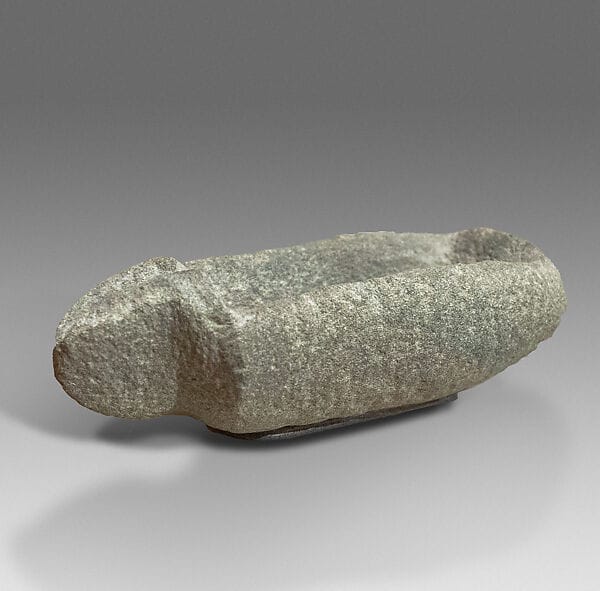
The Khirokitia culture made its vessels from stone before pottery came into use. A small diabase bowl with a spout, 4.5 cm high, excavated at Khirokitia in 1934 and now lent by the Cyprus Museum to the Metropolitan Museum, is cut from diabase, a hard, grey local stone. Before Aetokremnos was excavated, the only hippo bones from archaeological sites were two isolated finds from the Neolithic settlements of Cape Andreas-Kastros and Akanthou-Arkosyko, which Davis suggested might have been picked up by Neolithic "palaeontologists" [8, p. 858].
One more claim needs setting aside. Reports of Middle Palaeolithic tools on Cyprus, which would have put Neanderthals on the island, were made by Adovasio and colleagues in 1975, by Stockton and by Vita-Finzi. Simmons judges all of them unsubstantiated [9, p. 140]. On present evidence, the first people to set foot on Cyprus were the Late Epipalaeolithic visitors to Aetokremnos, and by the time they arrived the island's dwarf hippos and elephants were at or near the end of their existence.
References
- 1.Zomeni, Z. (2012). The geology of Cyprus. In D. Pilides & N. Papadimitriou (Eds.), Ancient Cyprus: Cultures in dialogue. Department of Antiquities, Cyprus.
- 2.Knapp, A. B. (2010). Cyprus's earliest prehistory: Seafarers, foragers and settlers. Journal of World Prehistory, 23, 79–120. https://doi.org/10.1007/s10963-010-9034-2
- 3.Zazzo, A., Lebon, M., Quiles, A., Reiche, I., & Vigne, J.-D. (2015). Direct dating and physico-chemical analyses cast doubts on the coexistence of humans and dwarf hippos in Cyprus. PLoS ONE, 10(8), e0134429. https://doi.org/10.1371/journal.pone.0134429
- 4.Vigne, J.-D. (2017). Archaeozoological techniques and protocols for elaborating scenarios of early colonization and Neolithization of Cyprus. In U. Albarella, M. Rizzetto, H. Russ, K. Vickers, & S. Viner-Daniels (Eds.), The Oxford handbook of zooarchaeology. Oxford University Press. https://doi.org/10.1093/oxfordhb/9780199686476.013.4
- 5.Athanassiou, A., van der Geer, A. A. E., & Lyras, G. A. (2019). Pleistocene insular Proboscidea of the Eastern Mediterranean: A review and update. Quaternary Science Reviews. https://doi.org/10.1016/j.quascirev.2019.06.028
- 6.Vigne, J.-D., Cucchi, T., Rousou, M., Bailon, S., Carrère, I., Devillers, B., Douché, C., Gourichon, L., Hadjikoumis, A., Mylona, P., Papayianni, K., Parès, A., Tengberg, M., Zazzo, A., Guilaine, J., & Briois, F. (2023). Historical dynamics of the human-environment interactions in Cyprus during the 12th-10th millennia cal. BP: The last 30 years contributions of the Amathous area (Limassol district). Journal of Archaeological Science: Reports, 104049. https://doi.org/10.1016/j.jasrep.2023.104049
- 7.Bethune, E., Kaiser, T. M., Schulz-Kornas, E., & Winkler, D. E. (2019). Multiproxy dietary trait reconstruction in Pleistocene Hippopotamidae from the Mediterranean islands. Palaeogeography, Palaeoclimatology, Palaeoecology. https://doi.org/10.1016/j.palaeo.2019.05.032
- 8.Simmons, A. H. (1991). Humans, island colonization and Pleistocene extinctions in the Mediterranean: The view from Akrotiri Aetokremnos, Cyprus. Antiquity, 65(249), 857–869. https://doi.org/10.1017/S0003598X00080571
- 9.Simmons, A. H. (2013). Akrotiri-Aetokremnos (Cyprus) 20 years later: An assessment of its significance. Eurasian Prehistory, 10, 139–156.
- 10.Simmons, A. H. (1999). Faunal extinction in an island society: Pygmy hippopotamus hunters of Cyprus. Kluwer Academic/Plenum (Springer reprint, 2002).
- 11.Le Brun, A. (2012). Neolithic period (10th–5th millennia BC). In D. Pilides & N. Papadimitriou (Eds.), Ancient Cyprus: Cultures in dialogue. Department of Antiquities, Cyprus.