
Ancient Cypriot Pottery·Lesson 5
Handmade by Choice in the Late Bronze Age
Base Ring and White Slip, the handmade fine wares that Late Bronze Age Cyprus exported by the thousand, beside Red Lustrous and the first wheel-made wares. Learn to tell Base Ring I from II, White Slip I from II, and a bilbil juglet at a glance.
Alexis Drakopoulos·Period by period·15 min read
Share


Lesson 5·Course contents, 15 lessons
When the Swedish Cyprus Expedition published its Late Bronze Age pottery in 1972, a few shallow Base Ring bowls went into the catalogue as wheel-made. Their walls were too even and their profiles too regular to look like anything else. Sarah Vaughan later examined the ware and found no sign of the force a spinning wheel puts into clay. They had been built by hand, then scraped, compacted and smoothed on a slow turntable while the clay was leather-hard [3]. Jugs of the same ware from Tomb 21 at Kalavasos-Ayios Dhimitrios stand 30 to 50 cm tall on walls 2 to 4 mm thick [4].
The potter's wheel had reached Cyprus around 1650 BC, at the very start of the Late Cypriot (LC) period, c. 1650 to 1050 BC; Lesson 1 follows how it arrived and how to spot its marks. Yet the two fine wares the island exported by the thousand, Base Ring and White Slip, were made by hand for four more centuries, until the end of LC IIC around 1200 BC [1]. And the one fine ware of the age made only on the wheel, the glossy Red Lustrous Wheel-made, is the ware whose Cypriot origin is still argued over.
Two new wares mark a new period
The Late Cypriot is defined by its pottery: where Proto Base Ring and Proto White Slip appear in a deposit, the deposit is by convention LC IA, no longer Middle Cypriot III. LC IA was a period of strong regional difference, and both wares grew out of local Middle Cypriot workshops before settling into island-wide types in LC IB [6].
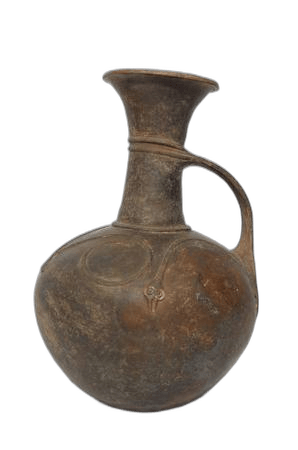
Proto Base Ring is a little coarser and thicker-walled than the mature ware, often flat-based, with relief bands and incision. Ellen Herscher traced it to two parents. On the south coast, around Episkopi-Phaneromeni, it grew out of Drab Polished Blue Core ware, already hard-fired and thin; in the north-west, around Toumba tou Skourou, out of Black Slip [6]. The jug beside this paragraph, in the British Museum, has the flat base and dark slip of the early ware, and a pair of applied coils and snakes on its shoulder that the next generation of potters would turn into a standard ornament.
Proto White Slip descends from the White Painted pottery of the north-west (Lesson 4). Its painters drew circles where later painters would use dots, and drew less tidily [8]. The small bowl beside this paragraph has the ware's essentials already: a pale cream slip over reddish clay, a horizontal handle below the rim, and orange-brown bands of rope pattern and festoons. The type travelled from the start, reaching Tell el-Dab'a in the Nile Delta under the Hyksos kings and Megiddo in Canaan [8].
Base Ring: thin, hard and dark
The name, given by John Myres, comes from the ring foot that nearly every Base Ring vessel stands on. Since the Philia phase, Cypriot pots had mostly sat on round or pointed bottoms; Base Ring was made for flat surfaces [7]. Its potters refined a fine, plastic clay, built each pot by hand (finger marks survive inside some closed vessels), and did the finishing on a turntable with as little water as they could manage. The firing began with plenty of air and was then sealed, so the pots finished in a low-oxygen atmosphere at about 750 to 850°C. That reducing finish produced the brown-grey to black surface and the grey core visible in a fresh break; the colour comes from shutting out the air, with no smoking [3].
Sealed as the fire died, the surface and the core go dark. Let the air back in at the end instead, and the same clay comes out orange-red, like the bilbil further on.
Try it · Firing
Base Ring: sealed while hot
Set the fire and see what it does to the pot. The colours on a Cypriot pot were made by the air around it as it fired and cooled; the bowl drawn here stands for any pot in the fire.
In the fire
Out of the fire
A · wall at the rim
B · wall lower down
Shut away from the air while hot, the wall darkened right through to a grey core.
Kilns and sealed firings: about 750 °C for Base Ring to above 1000 °C.
Base Ring
Dark grey-brown, grey inside
The firing began with air and was then sealed, so the pots finished hot in an oxygen-poor atmosphere: brown-grey to black surfaces and a grey core in any break. Analyses of Base Ring show this was done by shutting out the air, not by smoking.
 For exampleBase Ring II Jug with White-Painted Lattice Bandsc. 1450 to 1200 BC · Drakopoulos collection
In Base Ring the colour records how the firing ended, which is why the ware runs from black through brown to the occasional orange-red.
The ware is hard, 5 to 7 on the Mohs scale, and it rings when tapped. Collectors call this metallic; Vaughan points out that any thin, hard ware rings, Red Polished IV included [3]. Base Ring jugs carry ridges round the neck where a metal jug has a collar, and sometimes knobs like rivets, and Myres in 1914 and Vassos Karageorghis in 1981 read the whole ware as clay imitating metal vessels. Desmond Morris answered that late Middle Cypriot Black Slip already had the dark lustrous finish and even a rudimentary ring base, so the resemblance "may be little more than an exploited coincidence" [7].
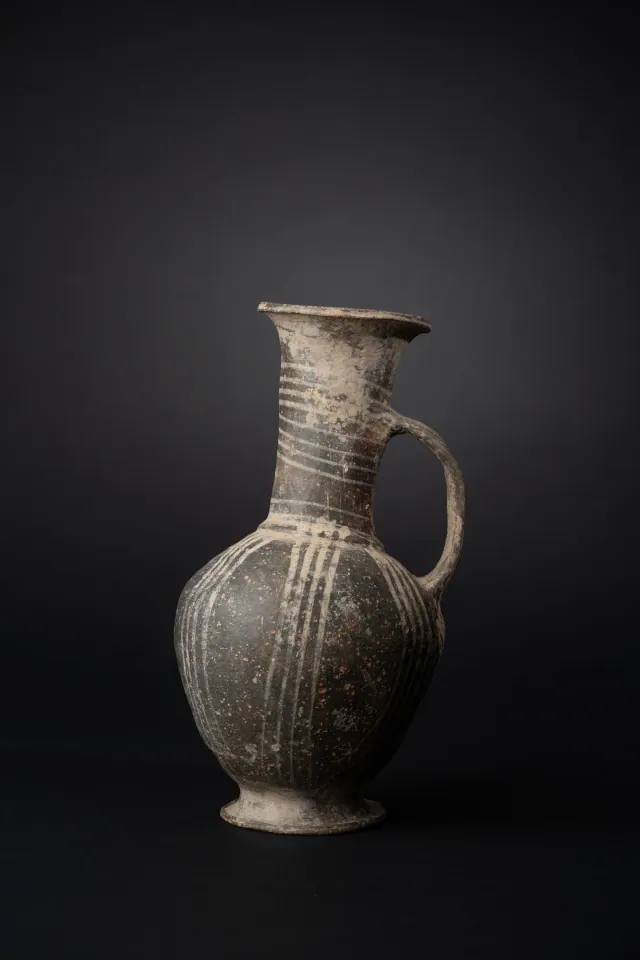
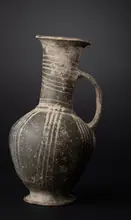
Decoration divides the ware in two. Base Ring I carries relief: paired rings on the neck, rope-like bands, wavy bands, and pairs of snakes coiling towards each other across the shoulder. Base Ring II replaces relief with thin white paint, applied fast. The jug beside this paragraph, in the Drakopoulos collection, is a standard Base Ring II piece: a matt grey-black surface, groups of four or five white lines round the long neck, parallel bundles running down one face of the body and two crossing bundles forming a lattice on the other. Its body leans slightly off the vertical, a common trait in a ware built by hand.
Turn the jug round to find both faces, then look underneath at the ring foot that gives the ware its name.
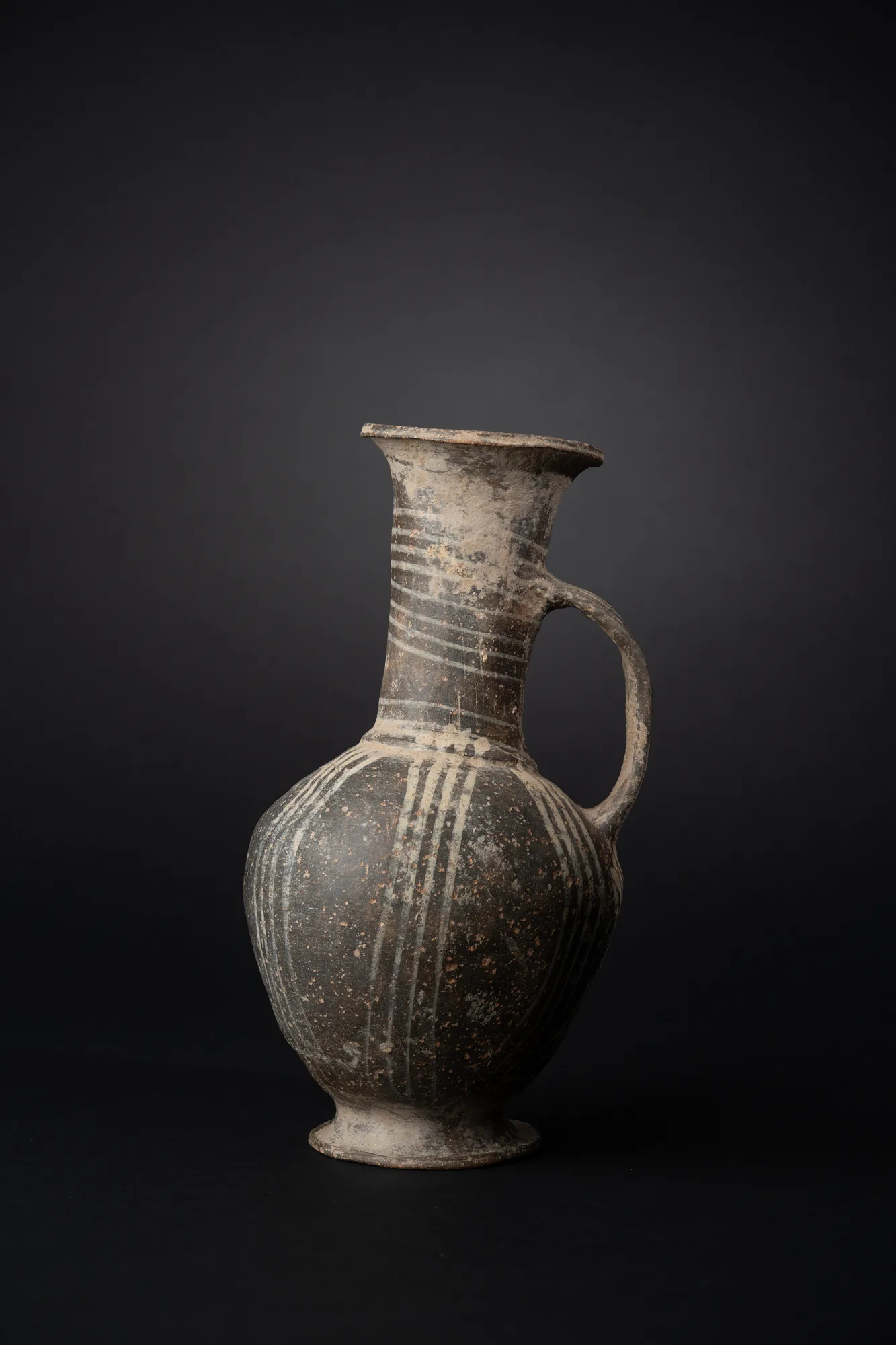
In profile, handle to the right, 1 / 7
In profile, handle to the right
Base Ring II Jug with White-Painted Lattice Bands
c. 1450 to 1200 BC · Drakopoulos collection
Base Ring II, handmade, with groups of lines painted in white on a matt grey-black surface.
Swipe, use the arrows, or press the left and right keys to turn the object.
The labels are older than the science, and they behave more like styles than periods. Base Ring I appears in the 16th century BC and Base Ring II by about 1400, but in Paul Åström's own charts the two overlap by half a century, and Vaughan's fabric groups cut across both [6][7]. Relief is earlier on average, paint later; a single pot can carry a Base Ring I shape and Base Ring II paint.
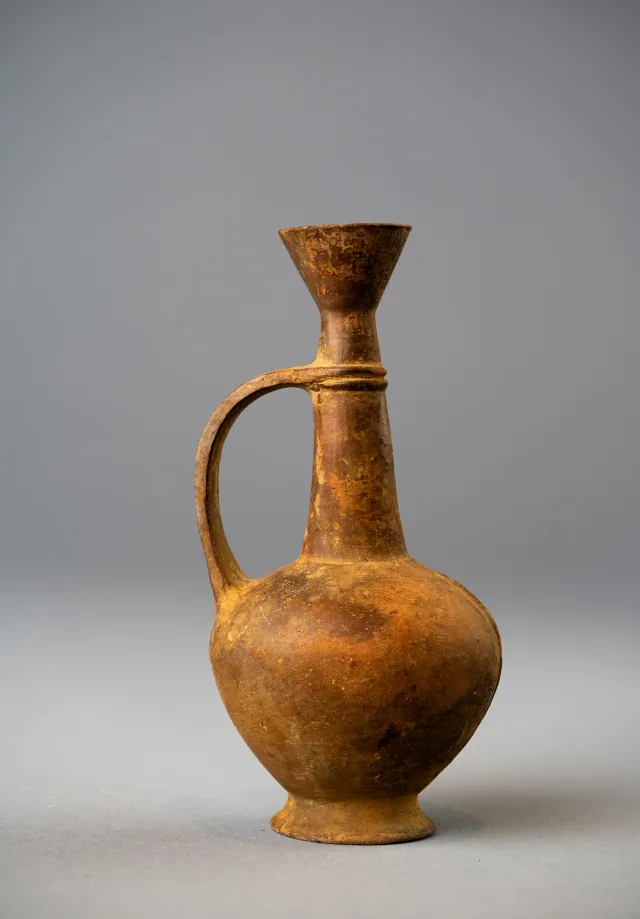
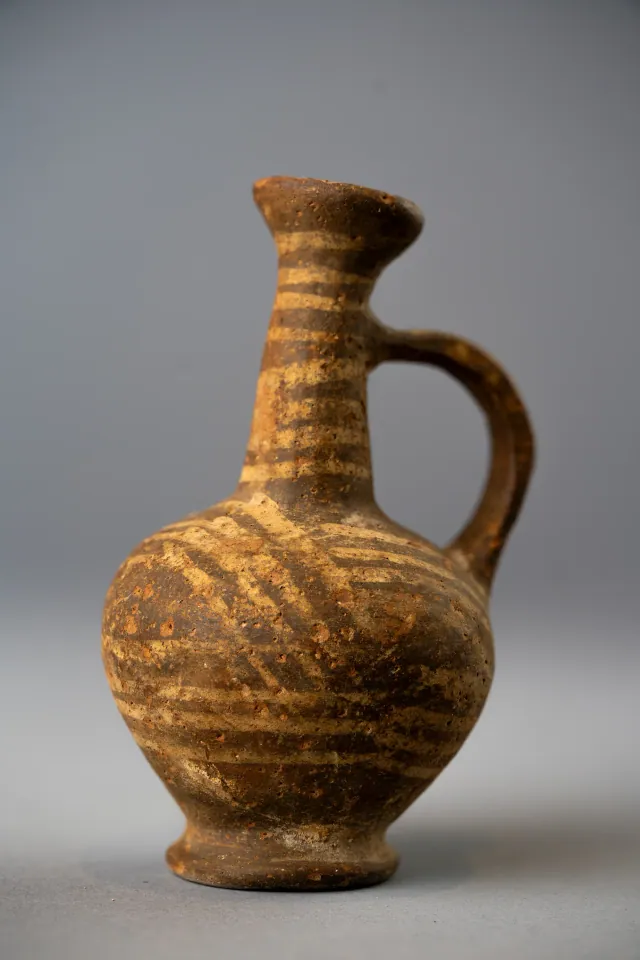
The best-known Base Ring shape is the small juglet that the trade and the field call a bilbil: a rounded body on a ring foot, a tall narrow neck, a funnel mouth, and a handle from mid-neck to shoulder. The bilbil beside this paragraph, also in the Drakopoulos collection, shows how far the I and II labels stretch. Its body is plain, with neither relief nor paint, so it belongs to neither group; the British Museum catalogues a near twin from Alalakh in Turkey as Base Ring II while dating it to the Base Ring I bracket. Its orange-red surface comes from a firing that stayed oxidising to the end, one of Vaughan's recognised fabric groups [3]. Turned upside down, a bilbil looks like the seed head of the opium poppy, and Robert Merrillees built on that likeness the idea that the juglets carried opium; Lesson 13 weighs the argument and the residue evidence. Their reach is certain. Base Ring makes up about two-thirds of the Cypriot pottery found in Egypt, overwhelmingly small closed vessels traded for what they held [9]. The same ware produced double juglets and hollow bulls whose muzzles serve as spouts, often painted with Base Ring II white stripes.
White Slip: a dark pot in a white coat
White Slip starts from a dark, gritty clay rich in iron, much of it from the Troodos mountains, covered all over with a thick, smooth white slip and then painted in dark brown to black [11]. X-rays of bowls from Kourion-Bamboula show how the typical hemispherical bowl was built: the lower body pressed as a slab over or into a mould, the upper wall and rim raised in coils [11]. The firing was hot, around 900 to 1100°C, to bond the slip to the body [5]. Almost every bowl has a single horizontal handle below the rim, the wishbone handle, which juts out from the wall like the forked bone it is named after.
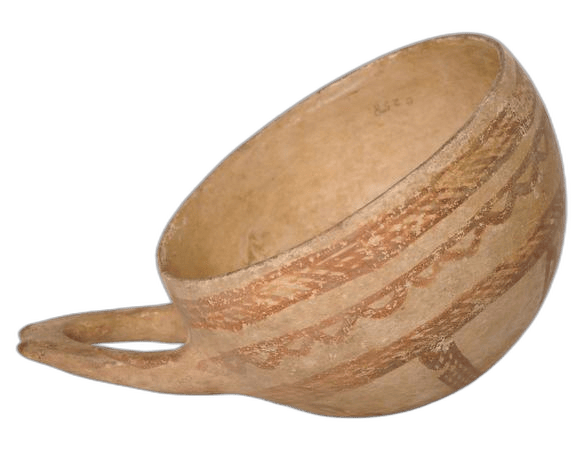
Mervyn Popham's classification of 1972 still organises the ware [10]. White Slip I, from LC IA into LC IB (roughly the later 16th and 15th centuries BC), is the finest stage: a glossy slip and fine single lines, a wavy line below the rim, framed wavy lines and rope lattice on the body, rows of dots. The British Museum bowl beside this paragraph shows the style in red-brown paint, with wavy lines framed by dotted lines. White Slip I paint was an iron-rich clay that fires black where the kiln starves it of air and red-brown where air reaches it [12]. White Slip II, from about 1450 BC, is heavier and more regular, and its signature is the ladder: two parallel lines joined by cross-strokes, used as bands and as hanging verticals. Its slip is a different clay, rich in mica and chlorite, and its paint a manganese-based earth that stays dark whatever the kiln does [11][12].
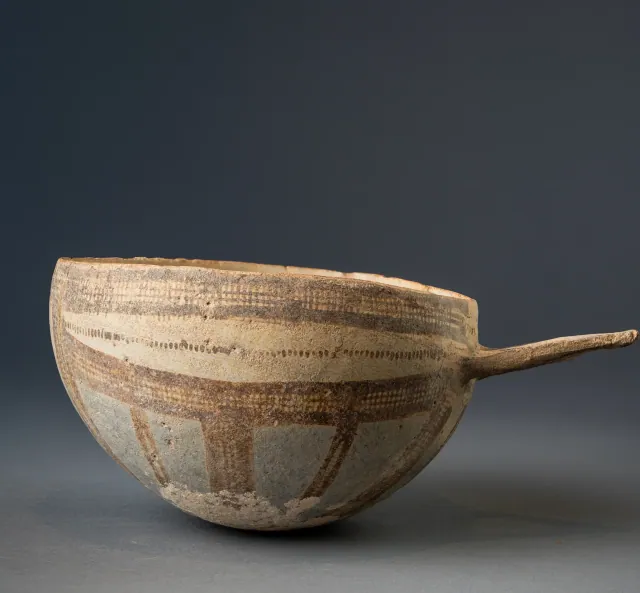
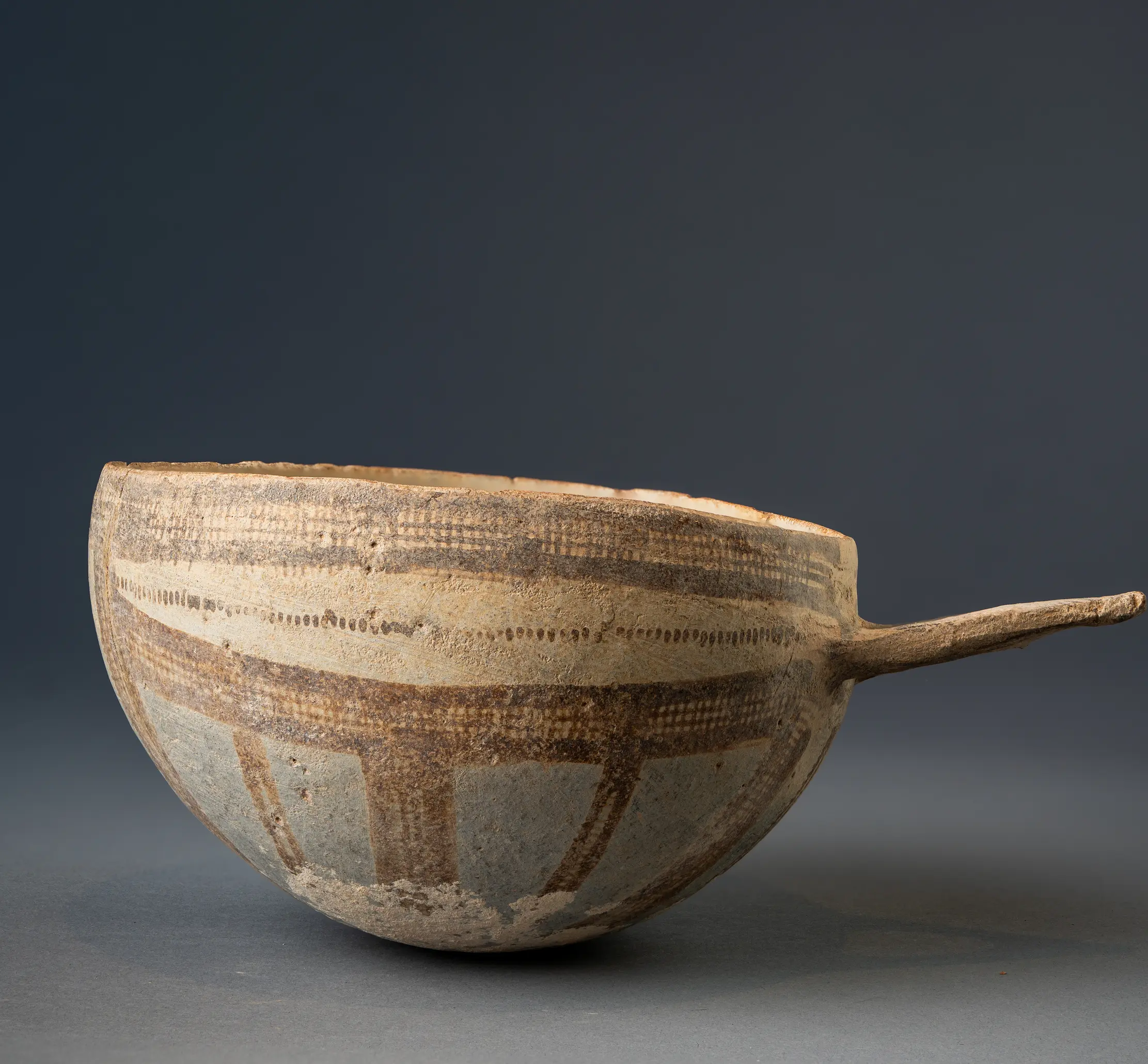
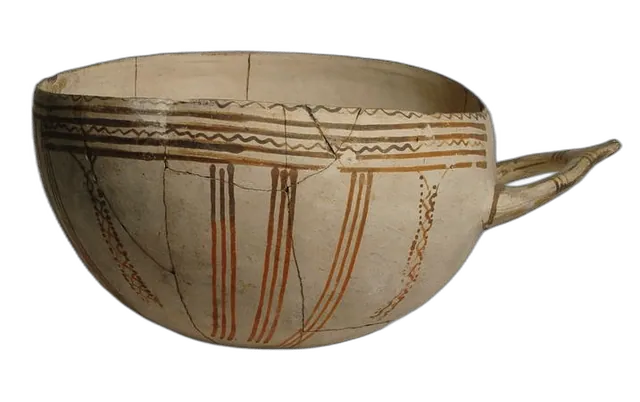
The bowl beside this paragraph, in the Drakopoulos collection, is a normal White Slip II bowl in Popham's terms. Under the rim runs a band of fine lattice and a single row of dots; below it a broad lattice band circles the body, and from it hang vertical bands to the base, some solid, some drawn as open ladders, all in matt brown. The slip is cream on the upper body and blue-grey towards the base, a shift common on White Slip that reflects uneven firing.
The field calls White Slip bowls "milk bowls", after the colour of the slip; the name says nothing about what they held. Nothing is known of the contents of this bowl. For the ware as a whole, residue analysis of White Slip sherds, from Proto White Slip to White Slip II, found stews of meat and vegetables cooked with plant oil and herbs, and wine flavoured with pine resin [13]. Abroad, the two great wares sold differently: on the Levantine coast open White Slip bowls were as common as Base Ring, while Egypt took mostly Base Ring juglets [14].
Follow White Slip abroad, then Base Ring. One White Slip find lies far to the west of the others, on the Aegean island of Thera.
Cypriot pottery abroad
Late Cypriot exports
White Slip I appears in Egypt and the Levant only in the early 18th Dynasty; on the Levantine coast open White Slip bowls were as common as Base Ring. 3 places on the map.
Find-spots (3)Show the listHide the list
- 1Tell el-Dab'a (Avaris)Egypt
- White Slip. Proto White Slip under the Hyksos kings, and later White Slip I of LC IB. Lesson 5
- 2MegiddoIsrael
- White Slip. Proto White Slip, which travelled from the start. Lesson 5
- 3Akrotiri, TheraGreece
- White Slip. A White Slip I bowl found in 1870 beneath the deposits of the great Bronze Age eruption. Lesson 5
A lost bowl under the ash of Thera
In 1870 the French excavators Gorceix and Mamet, digging near Akrotiri on Thera (Santorini), found a White Slip I bowl beneath the deposits of the great Bronze Age eruption [16]. The bowl is lost today, but nobody disputes that it was White Slip I or that it lay below the ash [15]. That makes it a fixed point: the eruption cannot be older than White Slip I.
The trouble is the date of White Slip I. Radiocarbon puts the eruption in the second half of the 17th century BC. The chronology built on Egyptian synchronisms puts it after about 1540 BC and probably near 1500, partly because White Slip I first appears in Egypt and the Levant only in the early 18th Dynasty [15]. Manfred Bietak called the ware "an obstacle" to the high chronology in the title of a 1998 paper [16]. Sturt Manning replied that the Thera bowl is very early White Slip I, of LC IA, while the White Slip I at Tell el-Dab'a belongs to a late phase in LC IB: two streams of trade, one from north-west Cyprus to the Aegean, the other later from eastern Cyprus to Egypt [16].
Sanidha, and the end of the handmade wares
White Slip is the one Late Cypriot fine ware with a known workshop. In 1988 a dense scatter of White Slip II sherds was spotted at Sanidha, 520 m up in the Troodos foothills, and Ian Todd excavated there from 1990 to 1992. The surface held more White Slip II than any other site on the island, with wasters (pots spoiled in firing), some 500 fragments of fired clay "bricks" of a kind used inside kilns elsewhere, and Monochrome, but almost no Base Ring. No kiln was found standing [17]. The clay came from weathered gabbro on the spot, and the site's White Slip II matches the style of the town at Kalavasos-Ayios Dhimitrios, about 10 km to the south-east. It remains the only attested White Slip production site [18]. For Base Ring no workshop is known at all, and the firing described above is reconstructed from the pots.
Find Sanidha in the foothills and the town whose White Slip matches it, then the two places where Proto Base Ring began, one on the south coast and one in the north-west.
Map of Cyprus
Where the Late Cypriot handmade wares were made
- White Slip made here
- Where Proto Base Ring began
- Other sites in this lesson
- Ground above 200, 500, 1,000 m
Sites on this map
- 1Sanidha (approx.)
- 2Episkopi-Phaneromeni (approx.)
- 3Toumba tou Skourou
- 4Kalavasos-Ayios Dhimitrios
- 5Kourion-Bamboula
- 6Kalopsidha (approx.)
- 7Enkomi
By LC IIC both wares had coarsened. Late White Slip II bowls carry a thin, uneven slip and a few hasty bundles of parallel lines; Base Ring shrank to a handful of shapes with dull surfaces. Both faded out early in the 12th century BC, as wheel-made tableware in the Aegean manner took over (Lesson 6) [5].
One tomb beneath a street of the town at Kalavasos-Ayios Dhimitrios was found still sealed, as it was closed in the 14th century BC. Excavate it and see which wares went into the ground together.
Monochrome and White Shaved
Two humbler handmade wares ran alongside. Monochrome is plain: bowls with wishbone handles, cups and jugs in a thin brown to black slip, sometimes trimmed with a blade. It was made at Sanidha with White Slip [17], and at Kalopsidha in eastern Cyprus it was one of the commonest wares of all, 23,202 sherds in Åström's counted strata [19].
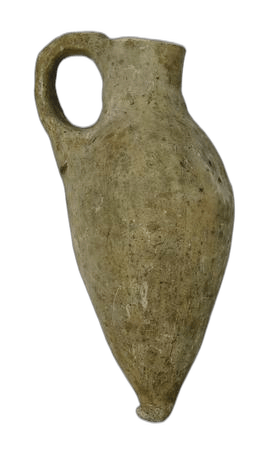
White Shaved is a ware of one shape. The juglets are spindle-shaped, with a pointed base, a short neck and a pinched or trefoil mouth, made of pale buff clay and pared vertically with a knife at the leather-hard stage, which leaves long flat facets. The handle is fixed by pushing a plug of clay through the body wall, a Cypriot habit [20]. The British Museum juglet beside this paragraph shows the facets and the handle pierced through the wall. The shape copies the Levantine dipper juglet, and the ware travelled: White Shaved juglets are frequent in excavations in Palestine and North Sinai in the 14th and 13th centuries BC, though rare in Egypt [20].
On the wheel: Plain White and Bichrome Wheel-made
The wheel's first Cypriot customers were plain pots. Plain White, a pale undecorated ware, was made both by hand and on the wheel, and its wheel-made form was long taken for a Levantine import. Lindy Crewe's study of the stratified material from Enkomi found its "wheel-made" pots built in coils and stages and then shaped with the help of rotation, with no evidence of true throwing. Handmade and wheel-made versions of the same types, in the same clay, were made side by side for some 400 years, in roughly equal numbers until about 1225 BC [2]. Crewe ties the early wheel-made kraters and serving jugs to Levantine habits of wine-drinking in the new coastal towns, and notes that over LC II the prestige drinking set went the other way, back to burnished and painted handmade wares [2].
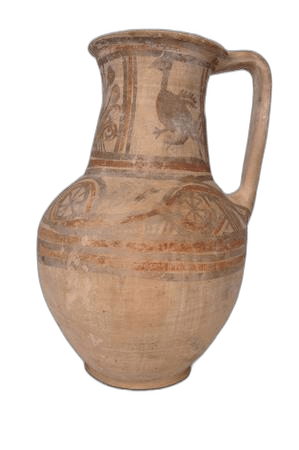
Bichrome Wheel-made shows how easily a Cypriot ware could be filed as foreign. A ware of LC I, painted in red and black on a light ground with birds, fish, bulls and wheel-like motifs, it was long called "Palestinian Bichrome", because it was wheel-made, its imagery looked Levantine and the best-known finds came from Flinders Petrie's excavations at Tell el-Ajjul near Gaza [31]. In 1973 Michal Artzy, Frank Asaro and Isadore Perlman used neutron activation analysis, which fingerprints a clay by its trace elements, to show that most of the Ajjul pieces they sampled had been made in eastern Cyprus [21]. Some was also made in the Levant, at Ajjul and Megiddo [31]. The tall jug beside this paragraph, in the British Museum, carries birds and plants in the ware's two colours.
Red Lustrous Wheel-made: the outsider
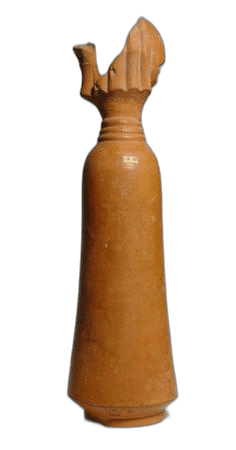
The clay of Red Lustrous Wheel-made is fine and red right through, the surface self-slipped (finished with a slurry of its own clay) and burnished to a gloss close to a glaze [26]. Its repertoire is small: the spindle bottle, a tall narrow body tapering to a small ring base under a long neck; the lentoid flask; and the arm-shaped vessel, a long tube ending in a hand that holds a small bowl, like the British Museum example beside this paragraph, which carries a mark incised on its base before firing. The ware appears in the 16th century BC and lasts into the early 12th [22]. It was never everyday pottery: at Kalavasos-Ayios Dhimitrios, which has added more of it to the Cypriot record than most sites, it comes mainly from the richest tombs [27].
Its consistency is the problem. Wherever it is found, in Cyprus, Anatolia, Syria, the southern Levant or Egypt, the fabric is the same, which points to a single source [22]. Early scholars put that source in north Syria. Kathryn Eriksson's 1993 study argued for Cyprus: more of the ware is found there than anywhere else, the full range of shapes occurs only there, it lasts longest there, and some of the marks scratched on bases resemble signs of the Cypro-Minoan script [23]. Carl Knappett and colleagues answered in 2005 that each reason is indirect and the script link far from conclusive, and noted that no production site for the ware has been found, on Cyprus or anywhere else [22]. In 2019 Mustafa Kibaroğlu, Ekin Kozal and colleagues analysed its fabric, chemistry and strontium and neodymium isotopes and proposed Rough Cilicia, on the southern coast of Anatolia [24]. A follow-up in 2025, with Lindy Crewe among the authors, found that the black version of the ware, Black Lustrous Wheel-made, was made from several clays in eastern Cyprus, while the chemically uniform red ware belongs with Anatolia [25].
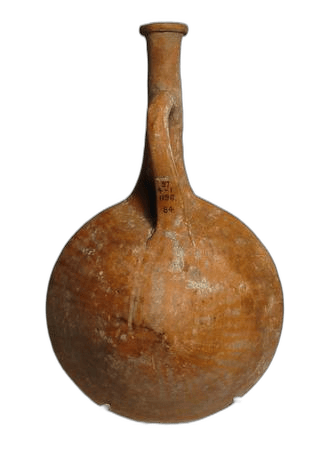
Anatolia had a particular taste for it. More arm-shaped vessels have been found there than on Cyprus, and the shape is prominent at the Hittite capital, Boğazköy [28]. The cups in the hands never show burning, which makes incense burners unlikely; libation is the likelier use, though nothing proves it [29]. The narrow bottles and flasks held liquids, mostly plant oil to judge by their residues; the beeswax, bitumen or resin in some may be part of the contents or a later treatment to seal the porous clay (Lesson 13 follows the residue evidence) [22][30]. The lentoid flask beside this paragraph, in the British Museum, shows the ware's red self-slip and its burnish, worked in several directions and not covering the whole surface.
The British Museum also holds a spindle bottle 13 cm tall with the long tapering body, tall neck and small ring base of the Red Lustrous shape. It is Base Ring I: built by hand, slipped red-brown, polished, and scored with hatched bands and zigzags.
Quiz
Check yourself
Question
A small juglet in the Drakopoulos collection. Which ware, and which group, is it?
Question
Most Base Ring is brown-grey to black, with a grey core in a fresh break. How did it get that colour?
Question
Which of these point to White Slip II rather than White Slip I?
Tick every answer that applies
Question
Put the stages of White Slip in order, earliest first.
Tap an item, then tap its place. Or use the arrows
Question
The field calls White Slip bowls “milk bowls”. What do we know about what they held?
Question
A White Slip I bowl was found beneath the ash of the Bronze Age eruption on Thera. What does that fix?
Question
The wheel reached Cyprus around 1650 BC. Until about when, BC, were Base Ring and White Slip still made by hand?
Question
Where do the clay analyses of 2019 and 2025 point for the making of Red Lustrous Wheel-made?
What to look for
- Base Ring: thin, hard walls in a dark brown, grey or black surface (sometimes orange-red), a grey core in any break, a ring foot. Relief rings, ropes and snakes mean Base Ring I; quick white-painted lines mean Base Ring II. The small funnel-mouthed bilbil juglet is its signature.
- White Slip: a thick white or cream slip over a dark body, painted in brown to black; almost always a hemispherical bowl with one wishbone handle. Fine wavy lines and dotted framing suggest White Slip I; ladders and heavy lattice, White Slip II; a few hasty parallel lines, late White Slip II.
- Proto wares: flatter bases, simpler relief or circles in place of dots, and orange-brown paint on Proto White Slip.
- White Shaved: a pale, pointed-based spindle juglet with long knife facets and a handle plugged through the wall.
- Red Lustrous Wheel-made: red clay all the way through, a glossy burnish, wheel marks, and a spindle bottle, lentoid flask or arm-shaped vessel. Some carry a sign scratched on the base before firing.
- Bichrome Wheel-made: red and black paint on a light, wheel-made body, often birds or fish on the shoulder.
- Handmade or wheel-made: use the marks from Lesson 1, but expect Base Ring and White Slip to be handmade however even they look; a Base Ring bowl smoothed on a turntable can pass for wheel-made.
Go deeper
The compendium carries each ware further: Base Ring Ware, White Slip Ware and Plain White Ware, with the period background in the Late Bronze Age. For how White Slip was built and fired, read Uncovering the Secrets of White Slip Ware and Pottery Production in Bronze Age Cyprus.
References
- 1.Bürge, T. and Recht, L. (eds) (2024). Dynamics and Developments of Social Structures and Networks in Prehistoric and Protohistoric Cyprus. London: Routledge.
- 2.Crewe, L. (2015). Plain wares and urban identities in Late Bronze Age Cyprus. In C. Glatz (ed.), Plain Pottery Traditions of the Eastern Mediterranean and Near East: Production, Use, and Social Significance. UCL Institute of Archaeology Publications 67. Walnut Creek, CA: Left Coast Press.
- 3.Vaughan, S.J. (1991). Material and technical characterization of Base Ring ware: a new fabric typology. In J.A. Barlow, D.L. Bolger and B. Kling (eds), Cypriot Ceramics: Reading the Prehistoric Record. University Museum Monograph 74. Philadelphia: University of Pennsylvania Museum, 119–130.
- 4.Steel, L. (2013). Materiality and Consumption in the Bronze Age Mediterranean. New York and London: Routledge.
- 5.Georgiou, A. (2018). From the hand to the wheel: revisiting the transformations of the Late Cypriot ceramic industry of finewares during the 13th-to-12th c. BC transition. In I. Caloi and C. Langohr (eds), Technology in Crisis: Technological Changes in Ceramic Production during Periods of Trouble. Aegis 16. Louvain-la-Neuve: Presses universitaires de Louvain, 177–200.
- 6.Bietak, M. and Czerny, E. (eds) (2007). The Synchronisation of Civilisations in the Eastern Mediterranean in the Second Millennium B.C. III. Contributions to the Chronology of the Eastern Mediterranean 9. Vienna: Verlag der Österreichischen Akademie der Wissenschaften.
- 7.Morris, D. (1985). The Art of Ancient Cyprus, with a Check-list of the Author's Collection. Oxford: Phaidon.
- 8.Eriksson, K.O. (2007). The Creative Independence of Late Bronze Age Cyprus: An Account of the Archaeological Importance of White Slip Ware. Denkschriften der Gesamtakademie 38. Vienna: Verlag der Österreichischen Akademie der Wissenschaften.
- 9.Merrillees, R.S. (1968). The Cypriote Bronze Age Pottery Found in Egypt (Studies in Mediterranean Archaeology 18). Lund: Paul Åströms Förlag.
- 10.Popham, M.R. (1972). White Slip ware. In P. Åström, The Swedish Cyprus Expedition, Vol. IV, Part 1C: The Late Cypriote Bronze Age. Architecture and Pottery. Lund: The Swedish Cyprus Expedition, 431–471.
- 11.Cordivari, B.W. and Boileau, M.-C. (2024). Characterizing the manufacturing practices of Late Bronze Age White Slip ware from Bamboula-Kourion, Cyprus. Journal of Archaeological Science: Reports 53, 104380.
- 12.Bassiakos, Y., Aloupi, E. and Facorellis, Y. (eds) (2001). Archaeometry Issues in Greek Prehistory and Antiquity. Athens: Hellenic Society of Archaeometry and Society of Messenian Archaeological Studies.
- 13.Beck, C.W., Stout, E.C., Wovkulich, K.M., Karageorghis, V. and Aloupi, E. (2004). The uses of Cypriote White-Slip ware inferred from organic residue analysis. Ägypten und Levante 14, 13–43.
- 14.Hulin, L. (2009). Embracing the new: the perception of Cypriot pottery in Egypt. In D. Michaelides, V. Kassianidou and R.S. Merrillees (eds), Egypt and Cyprus in Antiquity. Oxford: Oxbow Books, 40–47.
- 15.Höflmayer, F. (2012). The date of the Minoan Santorini eruption: quantifying the 'offset'. Radiocarbon 54(3–4), 435–448.
- 16.Manning, S.W. (1999). A Test of Time: The Volcano of Thera and the Chronology and History of the Aegean and East Mediterranean in the Mid Second Millennium BC. Oxford: Oxbow Books.
- 17.Todd, I.A. (1997). Sanidha. In E.M. Meyers (ed.), The Oxford Encyclopedia of Archaeology in the Near East, vol. 4. New York: Oxford University Press.
- 18.Renson, V., Martínez-Cortizas, A., Mattielli, N., Coenaerts, J., Sauvage, C., De Vleeschouwer, F., Lorre, C., Vanhaecke, F., Bindler, R., Rautman, M., Nys, K. and Claeys, P. (2013). Lead isotopic analysis within a multiproxy approach to trace pottery sources: the example of White Slip II sherds from Late Bronze Age sites in Cyprus and Syria. Applied Geochemistry. https://doi.org/10.1016/j.apgeochem.2012.10.025
- 19.Åström, P. (1966). Excavations at Kalopsidha and Ayios Iakovos in Cyprus. Studies in Mediterranean Archaeology 2. Lund: Paul Åström.
- 20.Hoffmeier, J.K. (ed.) (2014). Tell el-Borg I: Excavations in North Sinai. Winona Lake, IN: Eisenbrauns.
- 21.Artzy, M., Asaro, F. and Perlman, I. (1973). The origin of the 'Palestinian' Bichrome ware. Journal of the American Oriental Society 93(4), 446–461.
- 22.Knappett, C., Kilikoglou, V., Steele, V. and Stern, B. (2005). The circulation and consumption of Red Lustrous Wheelmade ware: petrographic, chemical and residue analysis. Anatolian Studies 55, 25–59.
- 23.Eriksson, K.O. (1993). Red Lustrous Wheel-made Ware. Studies in Mediterranean Archaeology 103. Jonsered: Paul Åströms Förlag.
- 24.Kibaroğlu, M., Kozal, E., Klügel, A., Hartmann, G. and Monien, P. (2019). New evidence on the provenance of Red Lustrous Wheel-made Ware (RLW): petrographic, elemental and Sr-Nd isotope analysis. Journal of Archaeological Science: Reports 24, 412–433.
- 25.Kibaroğlu, M., Kozal, E., Crewe, L., Martin, M.A.S., Hein, I., Monien, P. and Bergoffen, C.J. (2025). A comparative archaeometric study of Late Bronze Age Black Lustrous and Red Lustrous Wheel-made wares from the Eastern Mediterranean. Journal of Archaeological Science: Reports.
- 26.Artzy, M. (2007). On the origin(s) of the Red and White Lustrous Wheel-made ware. In I. Hein (ed.), The Lustrous Wares of Late Bronze Age Cyprus and the Eastern Mediterranean. Contributions to the Chronology of the Eastern Mediterranean 13. Vienna: Verlag der Österreichischen Akademie der Wissenschaften, 11–18.
- 27.South, A. and Steel, L. (2007). Red Lustrous Wheelmade ware from Kalavasos. In I. Hein (ed.), The Lustrous Wares of Late Bronze Age Cyprus and the Eastern Mediterranean. Contributions to the Chronology of the Eastern Mediterranean 13. Vienna: Verlag der Österreichischen Akademie der Wissenschaften, 179–190.
- 28.Eriksson, K.O. (2008). Feasting as part of the multiculturalism of Late Bronze Age Cyprus. In L.A. Hitchcock, R. Laffineur and J. Crowley (eds), Dais: The Aegean Feast. Aegaeum 29. Liège and Austin: Université de Liège and University of Texas at Austin, 297–307.
- 29.Schoop, U.-D. (2011). Hittite pottery: a summary. In H. Genz and D.P. Mielke (eds), Insights into Hittite History and Archaeology. Colloquia Antiqua 2. Leuven: Peeters, 241–273.
- 30.Steele, V.J. and Stern, B. (2017). Red Lustrous Wheelmade ware: analysis of organic residues in Late Bronze Age trade and storage vessels from the eastern Mediterranean. Journal of Archaeological Science: Reports 16, 641–657.
- 31.Charaf, H. (2010–2011). Cypriot imported pottery from the Middle Bronze Age in Lebanon. Berytus 53–54, 147–165.