
Ancient Cypriot Pottery·Lesson 0
How to Look at a Cypriot Pot
What a Cypriot pottery label means: how ware names describe a pot's surface, why shape is a separate question, and what the Roman numerals say about date, so that a label like Bichrome IV places a pot in time.
Alexis Drakopoulos·Getting started·11 min read
Share


Lesson 0·Course contents, 15 lessons
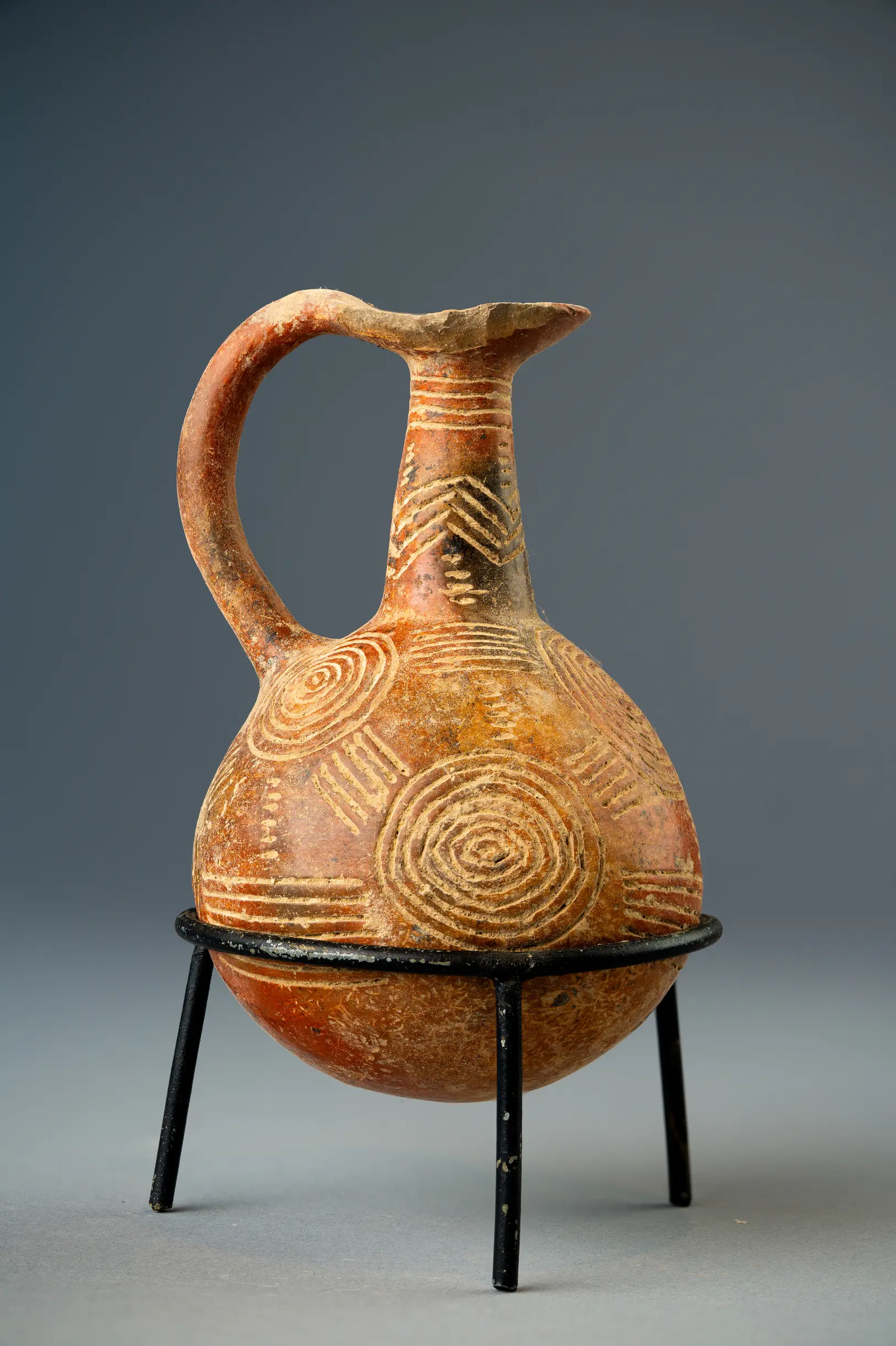
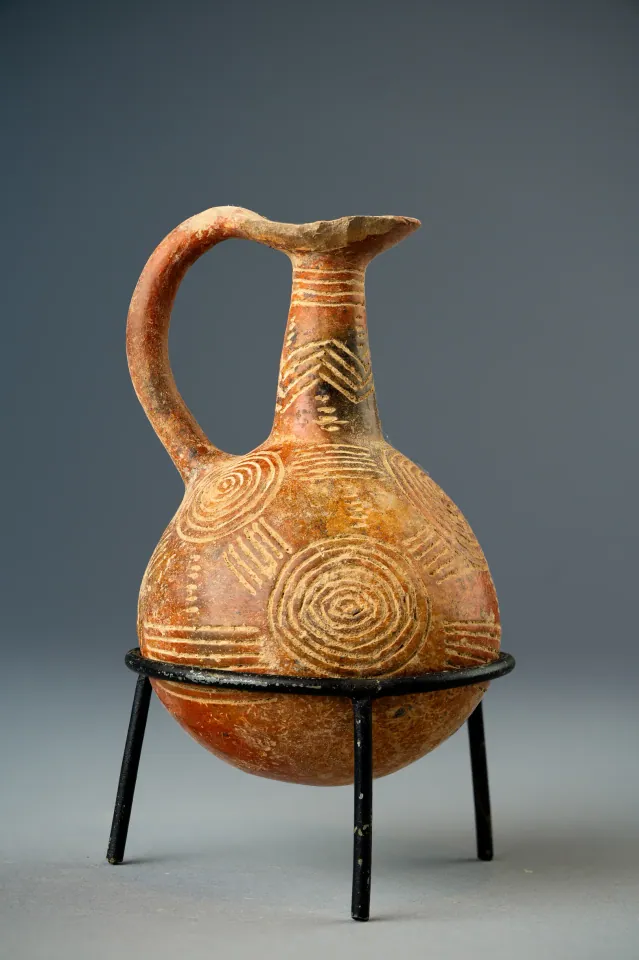
A museum label would call the jug beside this paragraph Red Polished III, and none of those three words says that it is a jug.
It was built by hand, without a wheel, some time between about 2100 and 1850 BC. Its base is round, so it will not stand on its own, and its neck rises to a mouth pulled up at the front into a short beak. The surface is a red slip, a coat of fine liquid clay, polished and then fired unevenly, so that it shades from orange to red-brown with a dark cloud on the neck. Rings, chevrons and concentric circles were cut into the clay and filled with white lime; one of the circles is a single continuous spiral.
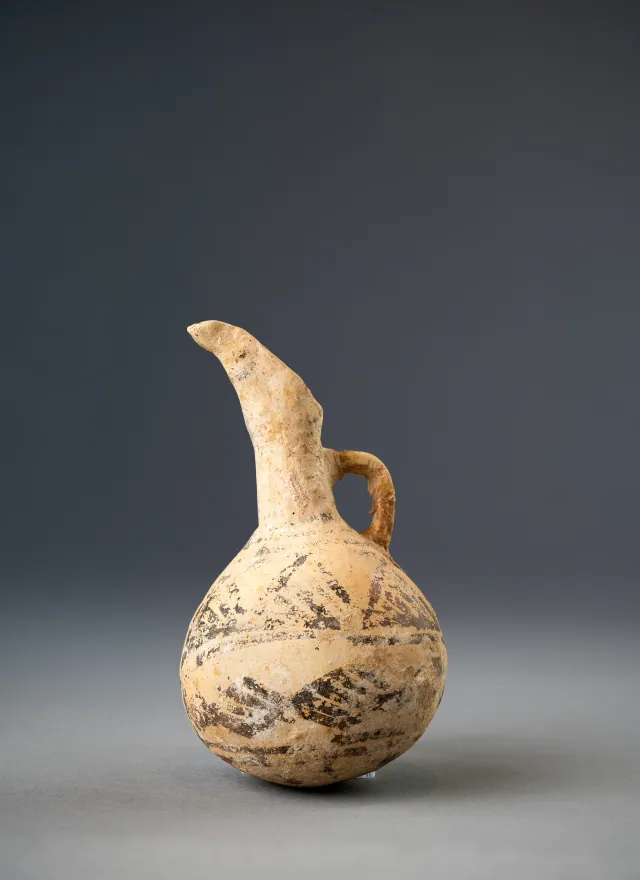
The juglet on the left is a few centuries younger, from about 1850 to 1650 BC. It too is handmade and round-based, and its neck ends in the same obliquely cut beak, a mouth inherited from the red jugs [11, p. 48]. Everything else has changed. The surface is pale buff, and the decoration is painted in dark matt paint: hatched triangles hang from the base of the neck and a double band rings the belly. Its label reads White Painted III to IV.
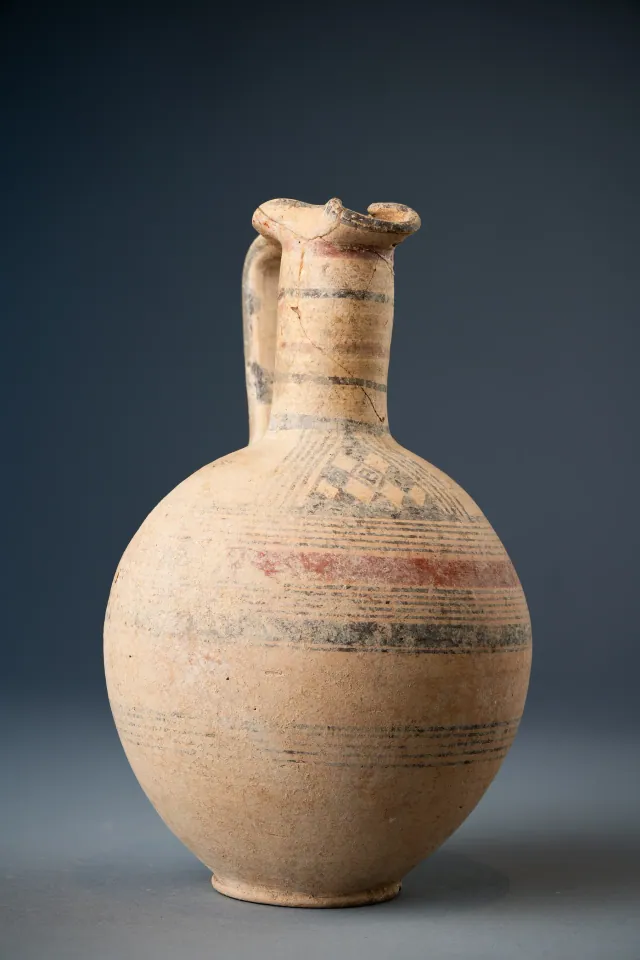
The third jug is about a thousand years younger again, made between 750 and 600 BC. It was thrown on a wheel, it stands on a narrow ring foot, and its mouth is pinched into three lobes, a trefoil. Thin black lines and a broad red band circle the body, and a small chequer panel sits on the shoulder opposite the handle. Its label reads Bichrome IV.
Three pourers, one basic shape (a body, a neck, one handle, a mouth to pour from) and three names. Each name describes the skin of the pot, and the number after it is, more often than not, a date.
Ware is not shape
In Cypriot archaeology a ware is a class of pottery defined by fabric and surface: the clay, the way the pot was built, and the way its outside was slipped, polished or painted. Robert Merrillees, in his 1991 essay on how the classes were drawn up, observed that nearly all the ware names in use "draw on the surface finish and/or decoration" [1, p. 238]. Red Polished means red-slipped and polished. White Painted means dark paint on a pale surface. Bichrome means two paints, black and red. The awkward exception is Base Ring, named after a ring foot that Merrillees calls "typical but by no means invariable" [1, p. 238].
Shape is a separate question, and it cuts across the wares. A jug, a bowl or a two-handled jar can be made in Red Polished, White Painted, Base Ring or Plain White, and early in the Late Bronze Age potters produced, in Merrillees's words, "a striking range of containers having much the same form but different wares" [1, p. 238]. Decoration is a third question: the Bichrome jug has a chequer panel where many jugs of its type have painted circles, and Einar Gjerstad, who classified the Iron Age pottery, filed the two under different styles [3]. Date is the fourth, and the other three usually answer it.
Shapes carry some information about date. Beaked and cutaway mouths like those on the first two jugs were popular through the Bronze Age and uncommon in the Iron Age [9, pp. 48, 54-55], and the trefoil mouth is an Iron Age habit. Drawn to the same height, the three jugs at the head of this lesson show the change: compare the mouths first, then what each pot stands on.
Point at, or tab to, a pot for its name and date; select it to open its page.
The beak gives way to the trefoil, and the round base to a ring foot. Yet a shape could live for many centuries and pass through many wares, while a ware, and still more a numbered stage of a ware, belongs to a far shorter span. That is why the field sorts by ware first.
Where the names come from
The names were assembled, never designed. In 1899 John Myres and Max Ohnefalsch-Richter, cataloguing the Cyprus Museum, gave each class of Bronze Age pottery a name that called up its look: Red Polished, White Slip [5]. In 1926 the Swedish archaeologist Einar Gjerstad, in his Uppsala dissertation Studies on Prehistoric Cyprus, kept those names "partly because these names are excellent in themselves, and partly because nothing is so meaningless and confusing as a continual changing of pottery names" [2, p. 88; 1, p. 237]. What he added was order. He numbered the classes (Red Polished I to IV, White Painted I to V) and divided the Bronze Age, on the Aegean model, into Early, Middle and Late Cypriot, each with three sub-phases. He warned that "this chronological scheme is not definitely fixed" [2, p. 263].
The following year he took the Swedish Cyprus Expedition (SCE) into the field, and between 1927 and 1931 it excavated some 21 sites across the island [14]. The results filled four volumes published between 1934 and 1972, and Volume IV, issued in parts, is still the reference system for Cypriot pottery. Part 1A (1962), by the Cypriot excavator Porphyrios Dikaios and the Australian James Stewart, covers the Stone Age and the Early Bronze Age [4]. Parts 1B to 1D (1972), the Middle and Late Cypriot volumes, are largely the work of Paul Åström and still the standard definitions of White Painted, Base Ring, White Slip and the other Bronze Age wares [7; 8]. Åström's dissertation of 1957 had already split Middle Cypriot White Painted into six types [6], and he refused to name wares after places, preferring "Coarse Monochrome Ware" to the site-name "Apliki Ware" [8, p. 103; 1, p. 238]. Part 2 (1948) is Gjerstad's own Iron Age: the Cypro-Geometric, Cypro-Archaic and Cypro-Classical periods [3].
Later fieldwork, settlement excavation above all, has corrected the system in detail and kept its vocabulary. A label that says "Red Polished III" or "Bichrome IV" is speaking SCE.
What the Roman numerals mean, and what they do not
The system was built mostly on whole pots from tombs, and that pulled the numbers towards date. Merrillees: "It is no coincidence that Red Polished is typical of Early Cypriot I, Red Polished II of Early Cypriot II, and Red Polished III of Early Cypriot III" [1, p. 239]. James Stewart admitted that "each class of the Red Polished series in fact includes several different fabrics" [4, p. 223; 1, p. 239]. The clearest case is Black Slip: Black Slip II and III are mostly the same pottery as Black Slip IV and V, numbered apart because the first pair turns up in Middle Cypriot deposits and the second in Late Cypriot ones [1, p. 239]. On a sherd the finer distinctions often vanish, and the find context decides the label [1, p. 239]. The juglet's "III to IV" comes from the same blur: catalogues draw the line between Åström's White Painted III and IV in different places.
Gjerstad made the Iron Age system chronological on purpose. His numerals name Types, "the first to the seventh morphological stages of the ceramic series," so that White Painted I and Bichrome I are both Type I [3], and each Type is a period: Type I is Cypro-Geometric I, Type IV Cypro-Archaic I, Type VII Cypro-Classical II [10, p. 24]. The "IV" in Bichrome IV says Cypro-Archaic I as plainly as a date would. Wares that start later carry two numbers: Black-on-Red I (III) is the first stage of Black-on-Red, belonging to Type III [3].
Test the two systems against each other. Take each numeral as a step in time, then switch to the evidence: the Red Polished classes pile up across the same centuries, while Gjerstad's Types line up one after another.
Reading a label
Is the numeral a date?
Part 1 · Early and Middle Bronze Age
Red Polished I, II, III, IV
Einar Gjerstad split Red Polished into four classes in 1926. Do the numerals tell you when a pot was made? Move the red marker, then switch to the evidence.
A Red Polished pot of EC III would be Red Polished III: one numeral, one step, like the hand of a clock. Most people read the labels this way, and, as Desmond Morris put it, “it is hard for some to believe that this was never intended to be the case.”
Part 2 · Iron Age
White Painted I to VII
Gjerstad numbered the Iron Age on purpose: his numerals are Types, and each Type is a period. Try the same test.
A pot of CG III is Type III in every ware: White Painted III, Bichrome III, Black-on-Red I (III).
Here the assumption is close to right. Switch to the evidence to see the steps on a real time scale.
A numeral is a stage in a sequence, and usually a date. It is no grade of quality, and it is not fixed: some Iron Age wares have since been shown to begin earlier than their brackets allow [10, pp. 223-224]. Joanna Smith adds that Gjerstad's typology presents the pottery "as if Cyprus were a single site" [10, p. 24]. Every period had its regional workshops, and later lessons meet them.
Oinochoe, amphora, kylix: the names of shapes
Ware names are settled. Shape names are not. Older catalogues borrow the vocabulary of Greek vases: oinochoe (Greek for wine-pourer) for an Iron Age jug, amphora for a two-handled jar, kylix for a footed drinking cup. Even the Metropolitan Museum's catalogue of its Cesnola Collection mixes plain "jugs" with amphora, kylix and askos [11, pp. 28, 91-93]. Each Greek name smuggles in a Greek use, and we have no evidence that a Cypriot trefoil jug poured wine.
This course uses the plain shape vocabulary set out by the zoologist and collector Desmond Morris in The Art of Ancient Cyprus (1985): jug (and its small version, the juglet), bottle, flask, jar, bowl, dish, box, dipper, basket and strainer, with composite vessels, several pots joined into one, sorted separately [9, p. 77]. The words claim nothing about use, and Morris said why that matters: calling the smallest bowls "cups" and the stemmed ones "goblets" "implies that they were drinking vessels, for which we have no hard evidence" [9, p. 69]. His scheme names shapes and leaves wares to the SCE system, so a full description uses both: a Bichrome IV jug with a trefoil mouth.
The parts of a pot have plain names too, and every later lesson uses them. Tap each term on the Bichrome jug to find the part and what to look for in it.
Hover over, or tap, a term to see the part on the drawing and what it means.
Bichrome IV Trefoil Jug with a Chequer Panel, c. 750 to 600 BC. In the Drakopoulos collection.
Exterior outline traced from the photograph; the wall thickness is not known, so no section is drawn. Its height has not been recorded, so the drawing has no scale. Parts are placed at heights measured on the traced outline.
- Mouth: The opening. Bronze Age jugs often have a mouth cut away or pulled up into a beak; a mouth pinched into three lobes, a trefoil, is an Iron Age habit.
- Rim: The edge of the mouth. Catalogues describe its profile: flaring, everted, thickened into a ring, or cut flat.
- Neck: The narrowing between body and mouth. Its width helps name the shape: a narrow neck makes a jug or bottle, a wide one a jar.
- Shoulder: The upper body, where the wall turns in towards the neck; handles are often joined and painters often decorate here.
- Body: The container itself, named for its shape: globular, ovoid (egg-shaped), biconical, or squashed flat into a flask.
- Base: What the pot stands on. Round bases dominate the Early and Middle Bronze Age, ring bases the Late Bronze Age, flat or ring bases the Iron Age.
How the course runs
Lesson 1 is about making: clay, hands, the wheel and fire. Lessons 2 to 10 walk forward in time from the first pots to the end of the Cypro-Classical kingdoms, with a Hellenistic coda. Lessons 11 to 14 cut across that sequence by theme: shapes, decoration, what pots were for, and a method for identifying and dating a pot.
A chronology to hang the pots on
Gjerstad's sequence of periods has survived; the absolute dates under it have moved. For prehistory they now rest on radiocarbon, which Sturt Manning gathered into a single modelled framework published with Bernard Knapp's The Archaeology of Cyprus (2013) [12; 13]. Later periods are dated mostly by cross-dating: Cypriot pots found in datable Egyptian, Levantine and Aegean contexts, and datable imports found in Cyprus. The table follows Knapp and Manning to the end of the Bronze Age, and Gjerstad's Iron Age scheme, as later adjusted, after that [3]. Older handbooks start the Neolithic around 7000 BC, some writers draw the line between Early and Middle Cypriot at 1900, and a "low" chronology starts the Late Cypriot about a century later than the date given here [13]. A period's start and its first pottery need not coincide: the Ceramic Neolithic opens where the Khirokitia culture ends, several centuries before the first pots. All dates are approximate.
| Period | Abbreviation | Dates (BC) | Pottery that marks it | Lesson |
|---|---|---|---|---|
| Aceramic Neolithic (incl. Khirokitia culture) | AN | c. 9000 to 5200 | No pottery: containers of stone | 2 |
| Ceramic Neolithic (Sotira culture) | CN | c. 5200 to 4000 (first pottery c. 4750) | Dark-Faced Burnished, the first pots; Red-on-White; Combed Ware; Red Lustrous | 2 |
| Chalcolithic (Early, Middle, Late) | EChal, MChal, LChal | c. 4000 to 2400 | Red-on-White; Red and Black Stroke-Burnished; the first large storage jars | 2 |
| Philia phase | Philia | c. 2400 to 2250 | Philia Red Polished; the first jugs | 3 |
| Early Cypriot I to III | EC | c. 2250 to 2000 | Red Polished I to III (incised, white-filled, mottled), Black Polished | 3 |
| Middle Cypriot I to III | MC | c. 2000 to 1650 | Handmade White Painted II to VI; late Red Polished; Black Slip; Drab Polished; Red-on-Black | 4 |
| Late Cypriot I to II | LC I to II | c. 1650 to 1200 | Base Ring; White Slip; Monochrome; White Shaved; Red Lustrous Wheel-made; Bichrome Wheel-made; Plain White; Mycenaean imports | 5, 6 |
| Late Cypriot III | LC III | c. 1200 to 1050 | White Painted Wheel-made III; local Aegean-style pottery; Proto-White Painted | 6 |
| Cypro-Geometric I to III | CG | c. 1050 to 750 | White Painted I to III; Bichrome I to III; Black Slip; Black-on-Red from CG III | 7, 9 |
| Cypro-Archaic I and II | CA | c. 750 to 480 | White Painted IV and V; Bichrome IV and V; the free-field style; Black-on-Red; Bichrome Red | 8, 9 |
| Cypro-Classical I and II | CC | c. 480 to 310 | White Painted and Bichrome VI and VII; Plain White; Red Slip; Attic imports | 10 |
| Hellenistic | c. 310 to 30 | Plain wheel-made wares; fusiform unguentaria; the local painted tradition has faded | 10 |
The same scheme drawn to scale shows what a table hides: how long each ware lasted and how many were in use at once. Pick a year, 1800 BC for the White Painted juglet or 700 BC for the Bichrome jug, and read off every ware being made in it.
Chronology
Cypriot wares in time
Each bar is a ware, placed by the dates the lessons give it. Drag the red line, or use the arrow keys on its year, to see what was being made in any year; choose a bar for its cues and lesson.
Neolithic and Chalcolithic
Handmade Bronze Age
Late Bronze Age wheel-made
Imports
Iron Age and Hellenistic
In use around
1900 BCMiddle Cypriot I to III
1900 BC: 5 wares in use.
The three jugs take three rows: the Red Polished jug on the line between Early and Middle Cypriot, the White Painted juglet inside the Middle Cypriot, the Bichrome jug in the first half of the Cypro-Archaic. Over those thousand years almost every technique changed: hand to wheel, round base to ring foot, cut lines to painted ones, one colour to two. The single handle, set at the back for the pouring hand, stayed where it was.
Quiz
Check yourself
Question
Red Polished, White Painted, Bichrome: what do most Cypriot ware names describe?
Question
Name the ware of this bowl from its surface.
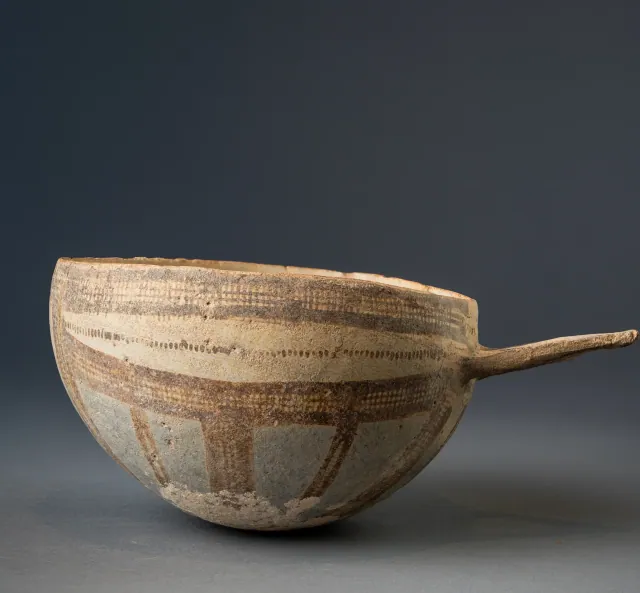
Question
This jug's label reads White Painted IV. Look at its mouth: when was it made?
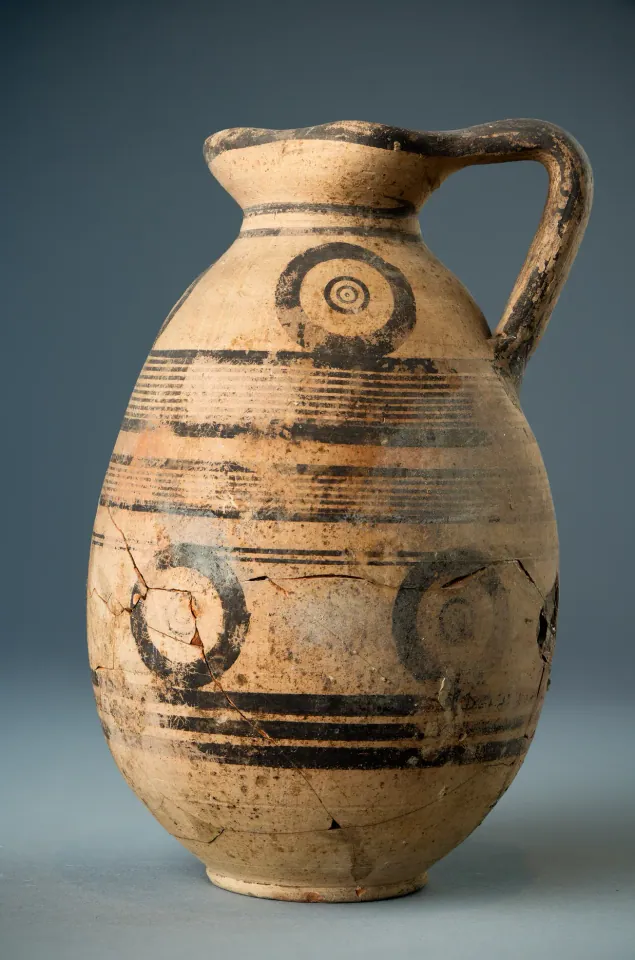
Question
Why are Black Slip II and III numbered apart from Black Slip IV and V?
Question
A label reads Black-on-Red I (III). What does the numeral in brackets give?
Question
Put these labels in the order the pots were made, earliest first.
Tap an item, then tap its place. Or use the arrows
Question
Throwing ridges point to the wheel, which in Cyprus means the Late Bronze Age or later. In the course table, about when does the Late Cypriot period begin?
Question
Why does this course call an Iron Age trefoil jug a jug rather than an oinochoe?
What to look for
- Name the ware first, from the surface: red and polished (Red Polished), dark matt paint on a pale ground (White Painted), black and red paint together (Bichrome), a thick white coat (White Slip), a ring foot with thin, hard, metallic-looking walls (Base Ring).
- Then name the shape in plain words (jug, juglet, bottle, flask, jar, bowl, dish, dipper, basket, strainer) and treat Greek names on old labels as conventions that say nothing about use.
- Check how it was made: a round base and slightly uneven walls point to the hand; even walls and fine horizontal throwing ridges, often visible inside the neck, point to the wheel, which in Cyprus means the Late Bronze Age or later.
- Read decoration separately: cut and white-filled lines on red are mostly Early Bronze Age; matt painted geometry on handmade pale pots mostly Middle Bronze Age; painted circles, bands and single floating motifs on wheel-made pots Iron Age.
- Read the Roman numeral on a label as a stage, usually a period: Bichrome IV means Cypro-Archaic I; Red Polished III usually means Early Cypriot III or early Middle Cypriot, though the Bronze Age numerals are looser guides than the Iron Age ones.
- Expect ranges ("White Painted III to IV") on careful labels, and be wary of a label that gives a precise numeral to a small sherd.
Go deeper
The chronology hub sets out every period with its evidence, and the ware pages and shape pages carry each class further, starting with Red Polished, White Painted, Bichrome and the jug. For the people behind the names, read The Swedish Cyprus Expedition and its legacy and the life of Paul Åström.
References
- 1.Merrillees, R. S. (1991). The principles of Cypriot Bronze Age pottery classification. In J. A. Barlow, D. L. Bolger & B. Kling (Eds.), Cypriot Ceramics: Reading the Prehistoric Record (University Museum Monograph 74, pp. 237–240). Philadelphia: The University Museum, University of Pennsylvania.
- 2.Gjerstad, E. (1926). Studies on Prehistoric Cyprus. Uppsala: Uppsala Universitets Årsskrift.
- 3.Gjerstad, E. (1948). The Swedish Cyprus Expedition, Vol. IV, Part 2: The Cypro-Geometric, Cypro-Archaic and Cypro-Classical Periods. Stockholm: The Swedish Cyprus Expedition.
- 4.Dikaios, P. & Stewart, J. R. (1962). The Swedish Cyprus Expedition, Vol. IV, Part 1A: The Stone Age and the Early Bronze Age in Cyprus. Lund: The Swedish Cyprus Expedition.
- 5.Myres, J. L. & Ohnefalsch-Richter, M. (1899). A Catalogue of the Cyprus Museum. Oxford.
- 6.Åström, P. (1957). The Middle Cypriote Bronze Age. Lund.
- 7.Åström, P. (1972). The Swedish Cyprus Expedition, Vol. IV, Part 1B: The Middle Cypriote Bronze Age. Lund: The Swedish Cyprus Expedition.
- 8.Åström, P. (1972). The Swedish Cyprus Expedition, Vol. IV, Part 1C: The Late Cypriote Bronze Age. Architecture and Pottery. Lund: The Swedish Cyprus Expedition.
- 9.Morris, D. (1985). The Art of Ancient Cyprus, with a Check-list of the Author's Collection. Oxford: Phaidon.
- 10.Smith, J. S. (2009). Art and Society in Cyprus from the Bronze Age into the Iron Age. Cambridge: Cambridge University Press.
- 11.Karageorghis, V., Mertens, J. R., & Rose, M. E. (2000). Ancient Art from Cyprus: The Cesnola Collection in The Metropolitan Museum of Art. New York: The Metropolitan Museum of Art.
- 12.Knapp, A. B. (2013). The Archaeology of Cyprus: From Earliest Prehistory through the Bronze Age. Cambridge: Cambridge University Press.
- 13.Manning, S. W. (2013). Appendix: A new radiocarbon chronology for prehistoric and protohistoric Cyprus, ca. 11,000–1050 cal BC. In A. B. Knapp, The Archaeology of Cyprus: From Earliest Prehistory through the Bronze Age (pp. 485–533). Cambridge: Cambridge University Press.
- 14.Göransson, K. (2012). The Swedish Cyprus Expedition. Cahiers du Centre d'Études Chypriotes, 42.