
Ancient Cypriot Pottery·Lesson 1
Clay, Hands, Wheel and Fire
How Cypriot potters chose clay, built pots by hand, burnished them and fired them in the open, and why the wheel came so late. Afterwards you can read a handmade rim, a fire-cloud, black-topping and throwing ridges on a pot.
Alexis Drakopoulos·Getting started·15 min read
Share


Lesson 1·Course contents, 15 lessons
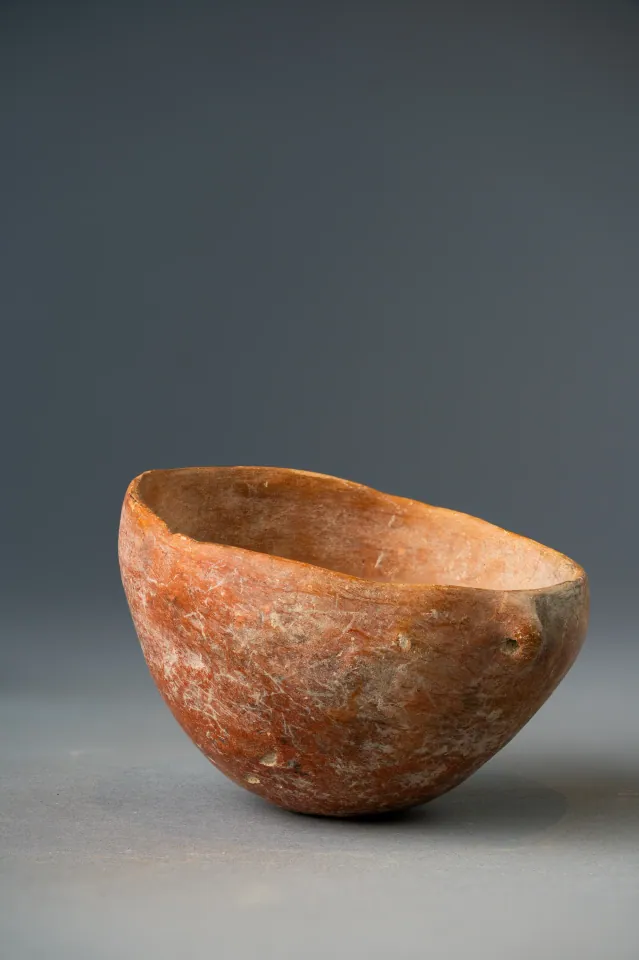
The rim of the small red bowl beside this paragraph does not run level. Follow it round and it rises, dips, and passes a knob of clay pressed on just below the lip and pierced sideways; one side of the bowl stands lower than the other. Next to the knob a grey stain spreads into the red. On a modern dinner plate these would be faults. On a Red Polished bowl of about 2200 to 1900 BC they are the most informative things about it. The rim records a pot built by hand, with no wheel to true it. The stain records a firing in the open, where a piece of fuel or a neighbouring pot pressed against that patch of wall and kept the air off it.
For more than two thousand years after the first pots were made on Cyprus, no potter on the island used a wheel, and for most of that time nobody built anything a ceramicist would call a kiln. When the wheel and the kiln did arrive, at the start of the Late Cypriot period, the island's two signature export wares went on ignoring the wheel for four centuries. Reading a Cypriot pot begins with reading the work of hands and fire on its surface.
Two clays from one island
Cypriot geology offers two kinds of clay. The sedimentary lowlands yield calcareous clays, rich in lime, pale-firing and naturally fine; the igneous Troodos mountains weather into iron-rich clays that fire red and carry volcanic grit. At Marki-Alonia, a Bronze Age village on the edge of the Troodos foothills, Jennifer Webb found potters using both "with some degree of selectivity": fine pale clays for thin incised vessels, dark gritty ones for large and coarse pots [1]. Red Polished, the burnished red pottery made from the Philia phase through the Early and Middle Cypriot periods (EC and MC), c. 2400 to 1650 BC, is mostly made on the north coast from soft, fine calcareous clay that takes an incised line cleanly; in the centre and south the same ware is harder and grittier, full of fragments of Troodos rock [2].
Where a sherd is broken, its section often shows a dark grey core between redder margins: carbon in the clay that a short, cool firing never burned out. About a quarter of the sherds from Marki have one [3].
Pinched, coiled and slabbed: building without a wheel
Broken pottery shows what whole tomb pots hide, and Webb's study of the sherds from Marki reconstructs how Red Polished vessels were raised [1]. Small round-based bowls were pinched up from a lump, or pressed into a concave support such as a sherd or another bowl, which also let the potter turn the pot by hand. Larger vessels were built from coils, which show as changes in wall thickness and as sherds that break along meandering lines, or from slabs, which split in layers parallel to the surface. The neck of a jug was made separately and pushed into the body at the leather-hard stage, when clay is firm enough to handle but still damp. The lower end of a handle was thrust right through the wall, so that its stub shows inside. Flat bases dried on mats kept the print of the weave.
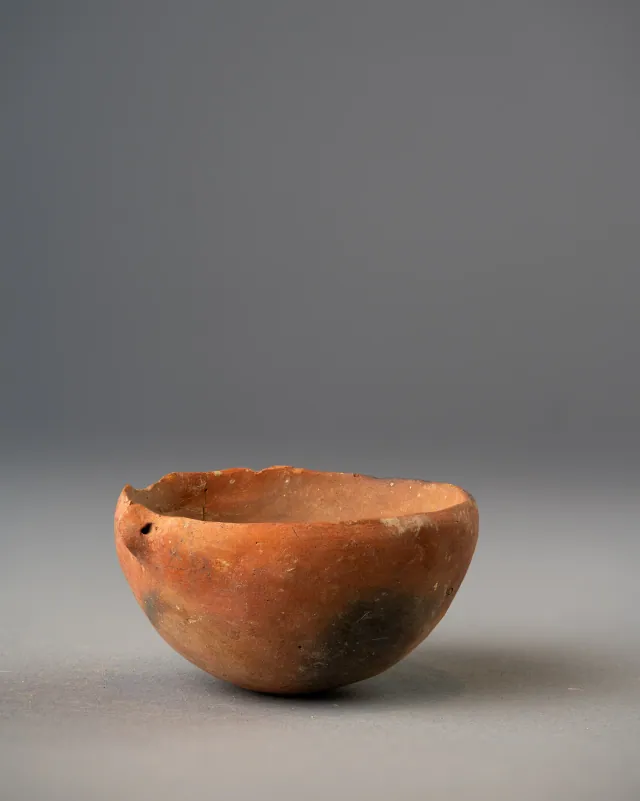
No wheel-made pot is known from Cyprus before about 1650 BC [8]. Every Red Polished vessel, multi-necked jugs and big storage jars included, was built by hand. The small bowl beside this paragraph shows how that looks at the rim: thinned by the fingers and wavering, thickening where a lug was added and pierced while the clay was soft.
Slip and burnish: what "Polished" means
The name Red Polished joins two operations. The slip is a coat of a separate, finer clay, richer in iron than the body, wiped or dipped onto the vessel [6]. The polish is burnishing: rubbing the slipped surface at the leather-hard stage with a pebble, a bone, a piece of horn or a smooth stick, which presses the fine clay particles flat and raises a lustre [1]. The shine is mechanical. Where the potter worked quickly the strokes survive as narrow, streaky facets. Cooking pots were never burnished [1].
Try the pebble on a slip that is still leather-hard, then let the pot dry too far and try again, and turn the light to find the facets your strokes leave.
Try it · Burnishing
Rub the slip to a shine
The red slip has just firmed to leather-hard. Drag the pebble over it, again and again, and turn the pot to the light.
Drag across the surface. With the keyboard, focus the surface and hold an arrow key.
The lustre comes only from pressure and timing: the same slip rubbed too late stays matt.
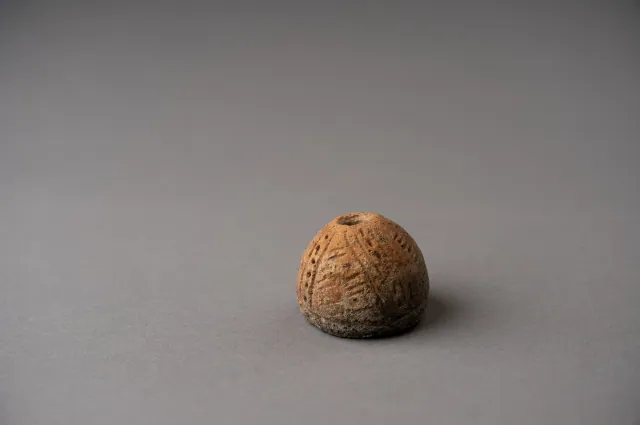
Ware names ending in "Polished" (Red Polished, Black Polished, Drab Polished) name a burnished slip, and "Lustrous" usually means the same thing done finely. A self-slipped surface is one whose skin is the vessel's own clay smoothed up wet, with no separate coat: a Plain White Wheel-made jug from Enkomi in the British Museum is catalogued as "self-slipped and slightly greenish from overfiring" [7], and a greenish tinge on a pale pot points to a hot firing. The spindle whorl beside this paragraph, a dome of clay that weighted a spindle for spinning thread, was probably made in Red Polished between about 2000 and 1725 BC and has lost most of its red coat. What shows through is the body clay, pale orange-buff, with patches of red where the slip clings: the clay that lies under the red of every Red Polished pot.
Incision, white lime and matt paint
The whorl also carries the period's favourite ornament. Lines were cut into the leather-hard clay with a pointed tool before slipping, so that the slip runs down into the grooves [1]. The grooves were then packed with white paste, at Alambra made of chalk, limestone and sometimes burnt bone [6]. Webb argues that the paste probably went in after firing, because in unfired clay the excess could not have been wiped off without spoiling the burnish [1]. The white is an addition to the finished pot, and it can fall out, wear away, or be renewed by a restorer.
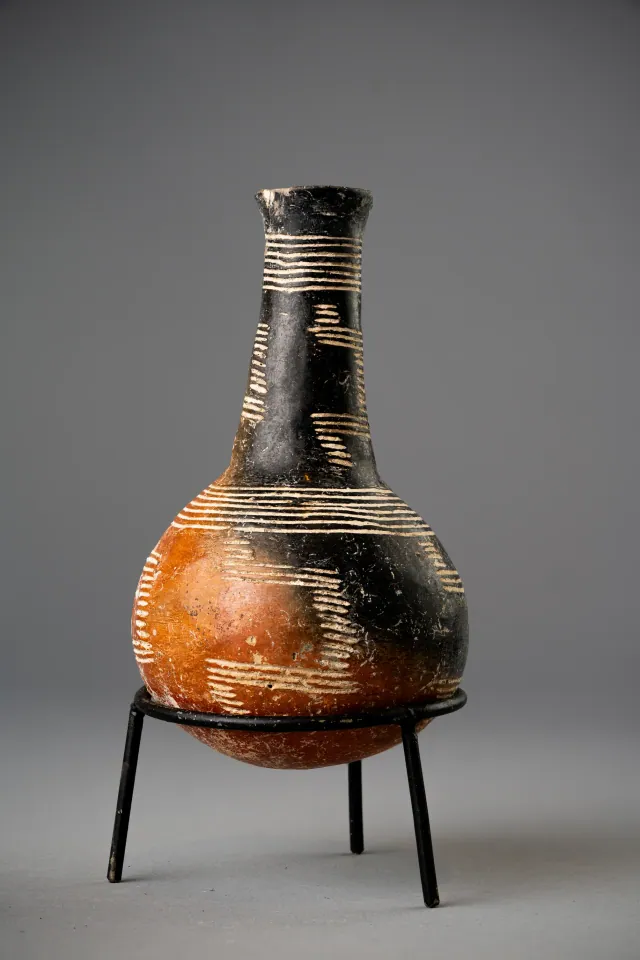
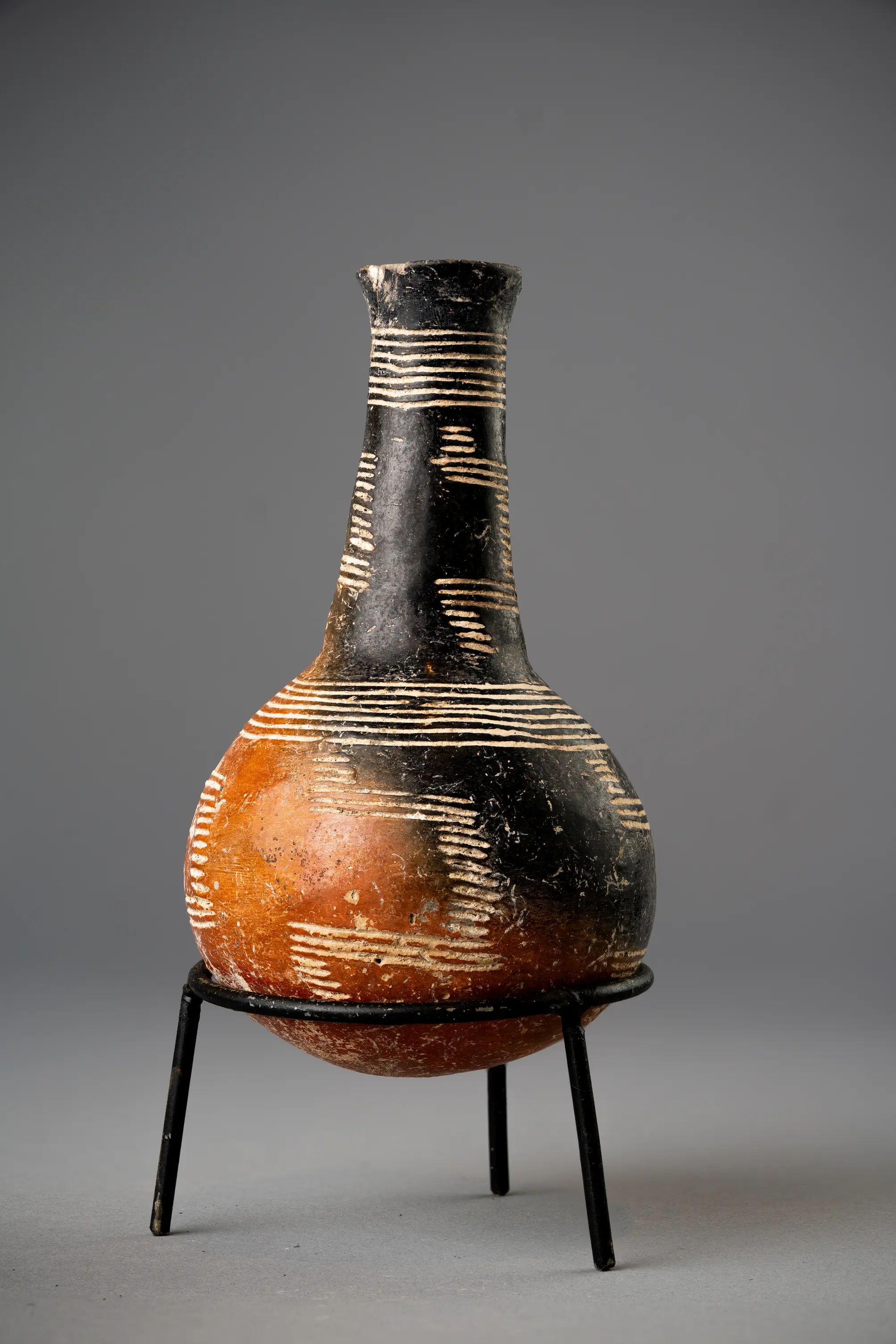
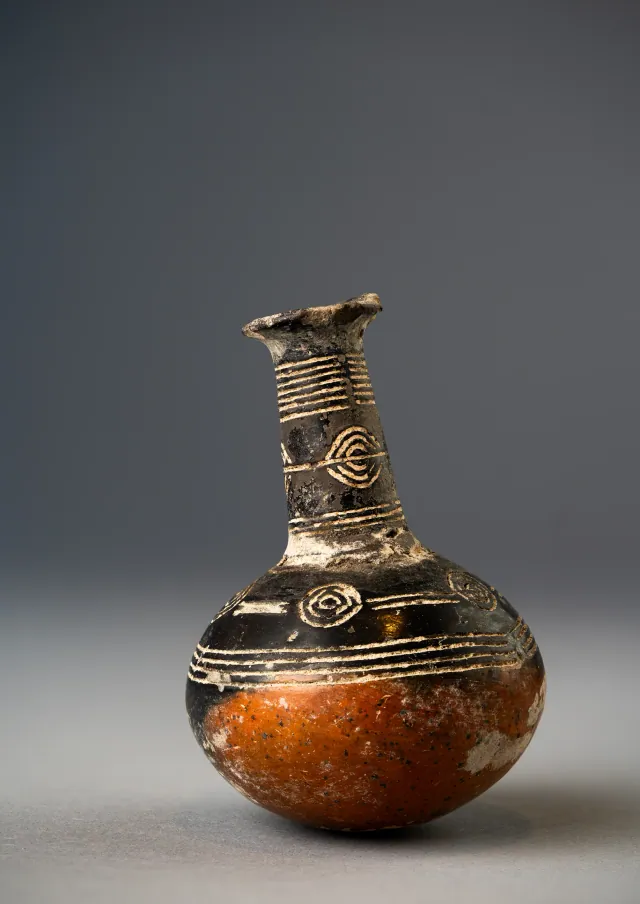
The incised lines on the black-topped bottle shown here, made on the north coast in about 2300 to 2000 BC, are filled bright white, and some of that unusually crisp fill may have been renewed when the bottle was cleaned in modern times. A clean, complete, brilliant fill on a pot four thousand years old deserves a second look.
Cut a motif, then try the steps in a different order: fill the lines before the firing, or slip the pot after the paste, and see what each order would do to the surface.
Try it · Incision and white fill
Cut it, slip it, fire it, fill it
The clay is leather-hard. Drag a point across it to cut lines, then work through the steps. Try them in another order too, and see what goes wrong.
The steps, in any order
- Your order
- Nothing yet
- Red Polished
- Cut → Slip → Burnish → Fire → Fill → Wipe
Drag across the clay to cut a line, or press “Cut a motif for me”.
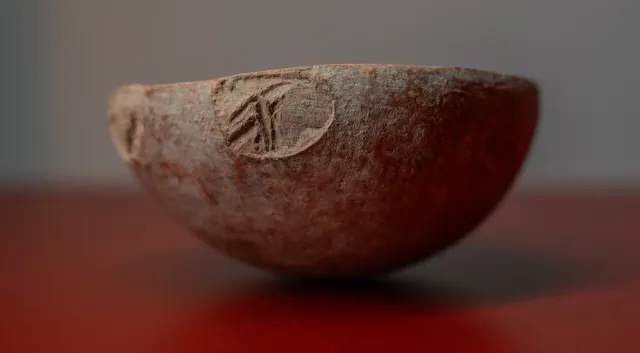
Some cuts were signs. A single mark scratched into the wet clay before firing turns up on many Red Polished pots, and Paul Åström, cataloguing the pot-marks of the Early and Middle Cypriot periods, found that on the knob-lug bowls of Lapithos and Vounous the mark sits near the lug [13]. He suggested one reason to mark a pot before it went into the fire: if several households fired together, each needed to know its own pots afterwards [13]. The worn bowl shown here, of about 2100 to 1750 BC, has lost most of its red slip to a granular grey-brown. Just below the rim, beside what is probably a lug, deep strokes make a long diagonal crossed by three or four short cuts, like a branch or a feather. The place fits Åström's pattern. The smoothed oval panel the sign sits in has no published parallel, so the safest name for it is an incised mark, possibly a potter's mark.
Paint sits differently. White Painted ware of the Middle Cypriot, the subject of Lesson 4, carries dark matt paint brushed onto a pale slip, so that the pattern lies on the surface. Analyses of Late Cypriot Bichrome Wheel-made found the black made from manganese-rich umber and the red from iron-rich ochre, on calcareous clay fired to a light colour [8]. Matt dark paint on a pale ground became the house style of the Iron Age.
Firing without kilns
Webb's verdict on Red Polished firing begins: "There is little direct evidence." Vessels were probably fired singly or in small batches in fire-pits or open hearths, starting low to drive out the last water so that pots did not crack or burst. Temperatures probably stayed below about 750°C; above that, grains of lime in calcareous clay break down, swell after cooling and pop small craters out of the surface, a fault that is rare at Marki [1]. Experimental bonfires and pit firings at Kissonerga-Mylouthkia reproduced Chalcolithic fabrics at about 700 to 800°C, and the excavation report states that "there is at present no archaeological evidence for built kilns in Cyprus prior to the late Bronze Age" [9].
The one excavated prehistoric pottery workshop on the island is at Ambelikou-Aletri, a Middle Cypriot copper-mining village dug by Porphyrios Dikaios in 1942 and published by Webb and David Frankel in 2013 [10]. It had basins for preparing clay, stone burnishers, wasters, and a store of 39 near-identical jugs with cutaway mouths: one firing's worth of a single shape. Dikaios called the firing structure a "primitive kiln". On the advice of the ceramicist Owen Rye, Webb and Frankel reconstruct it as an enclosure about 2.5 by 2.8 m, walled on three sides and open above, with fuel and pots stacked in alternating layers and temperatures up to about 800°C. The excavators call such structures "a viable technique in their own right" [10].
Excavated traces of potting before the Iron Age are this thin across the whole island. Find Marki, where the potters chose between two clays, and Ambelikou; the potters' quarter at Toumba tou Skourou and the single kiln at Tochni-Lakkia return below, with the coming of the wheel, and Sanidha, where White Slip was made, belongs to Lesson 5.
Map of Cyprus
Where Cypriot pots were made
- Ground above 200, 500, 1,000 m
Sites on this map
- 1Ambelikou-Aletri
- 2Toumba tou Skourou
- 3Sanidha (approx.)
- 4Tochni-Lakkia (approx.)
- 5Marki-Alonia
Fire-clouds, mottling and black tops
The colours of a handmade Cypriot pot are mostly made in the fire. Iron in the clay turns red where there is plenty of oxygen and grey to black where the fire is starved of it, so one clay can come out red, brown, grey or black depending on where the pot sat and how it cooled [3]. A fifth of the Marki sherds show colour variation or mottling, which Webb puts down to pots stacked against one another or smouldering fuel lying against the wall [1].
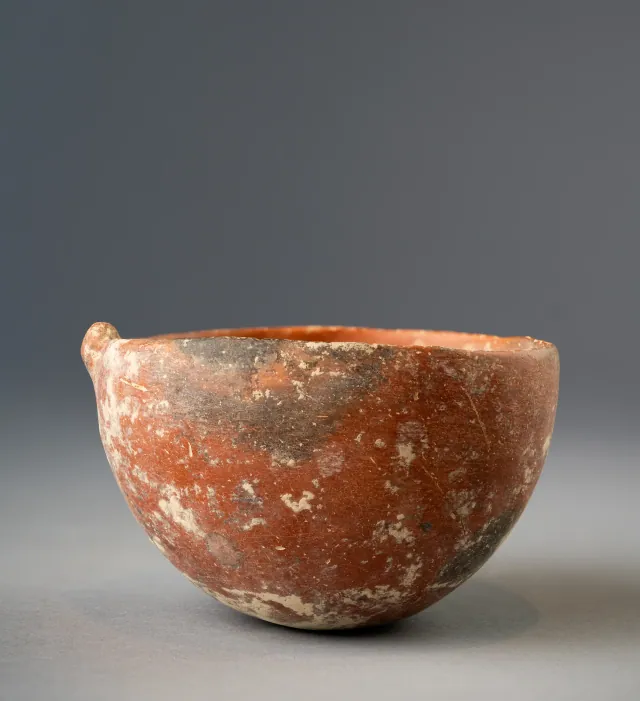
Those dark patches are fire-clouds. On the small pinched bowl shown earlier, a sooty cloud sits low on one side with a fainter one opposite, which suggests it was fired lying on its side or mouth-down against other pots. The deep bowl beside this paragraph has a broad grey-black cloud below the rim and a darker patch near the base. Catalogues call this "mottled", and some excavators made Red Polished Mottled a named sub-ware, though David Frankel's study of colour on Red Polished shows how loosely the label has been applied [3].
Black-topping is the same chemistry under control. On black-topped Red Polished bowls the interior and a band below the rim are black, the rest red; on bottles the neck and shoulder are black. Webb lists three ways it could have been done: firing the pot rim-down in ash, covering it with wet leaves near the end of the firing, or pulling it out red-hot and setting it mouth-down in smouldering material [1]. None has been observed in a Bronze Age firing, and the technique was already old, known from the Chalcolithic [1]. A Mössbauer study found the black fired into the clay itself, iron starved of oxygen together with carbon at the surface, and its authors favour methods that expose the black parts evenly [22]; mouth-down in ash is one candidate among several. Some regions never had it. At Sotira-Kaminoudhia, Ellen Herscher found that south-coast potters appear never to have mastered controlled black-topping or true Black Polished, the wholly black version [11]. Black-topped pots also travelled: one small black-topped bowl from Marki matches a fabric made at Deneia [12].
Fire a bowl mouth-down in ash, then upright in the open with less air, then smother the fire as it dies. Watch the rim and the section through the wall: the clay is the same each time, and only the air changes.
Try it · Firing
Colour made in the fire
Set the fire and see what it does to the pot. The colours on a Cypriot pot were made by the air around it as it fired and cooled; the bowl drawn here stands for any pot in the fire.
In the fire
Out of the fire
A · wall at the rim
B · wall lower down
Under the ash the black runs below the surface into the clay. A dark core: carbon from the clay never burned out of the middle of the wall, because the firing was short, cool or short of air. About a quarter of the sherds from Marki have one.
Try
An open fire on Cyprus reached about 600 to 800 °C.
Black-topped Red Polished
Black top, red body
Set mouth-down in the ash, one proposed method, the rim and the inside were starved of air, so the iron there stayed black; the upturned body burned in open air and fired red. The black is fired into the clay itself, with carbon at the surface.
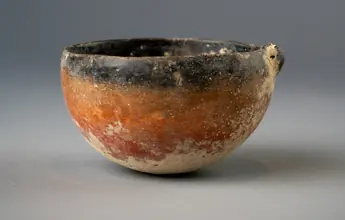 For exampleBlack-topped Red Polished Bowl with Pierced Knob Lugc. 2200 to 1900 BC · Drakopoulos collection
A black top, a red body, a cloud and an all-black pot can all come from one clay; what differs is how much air reached each part of the wall.
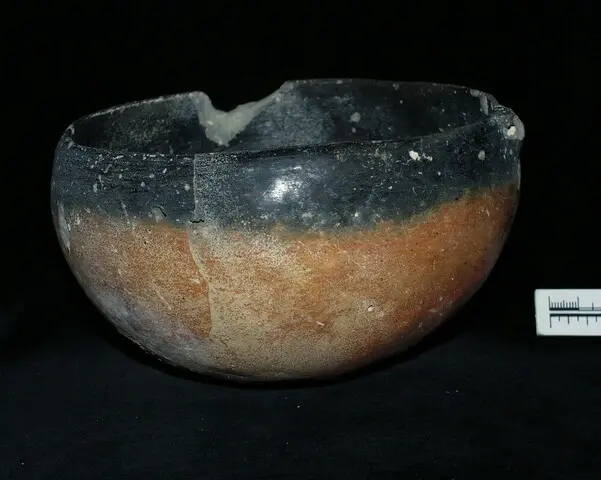
The black-topped bowl beside this paragraph was found at Deneia and is now in the Ashmolean Museum. Control was never complete, and the edge between black and red shows it. On the black-topped bottle shown earlier, the line runs low on one side and climbs almost to the shoulder on the other. Åström, describing a similar bottle from a tomb at Kalopsidha, found only the base and one side of the lower body red and the rest black, "as is usual on this type" [13]. A wandering black-top line is normal for the class: if the pot was set mouth-down in ash, the line is the edge of the ash it was pushed into.
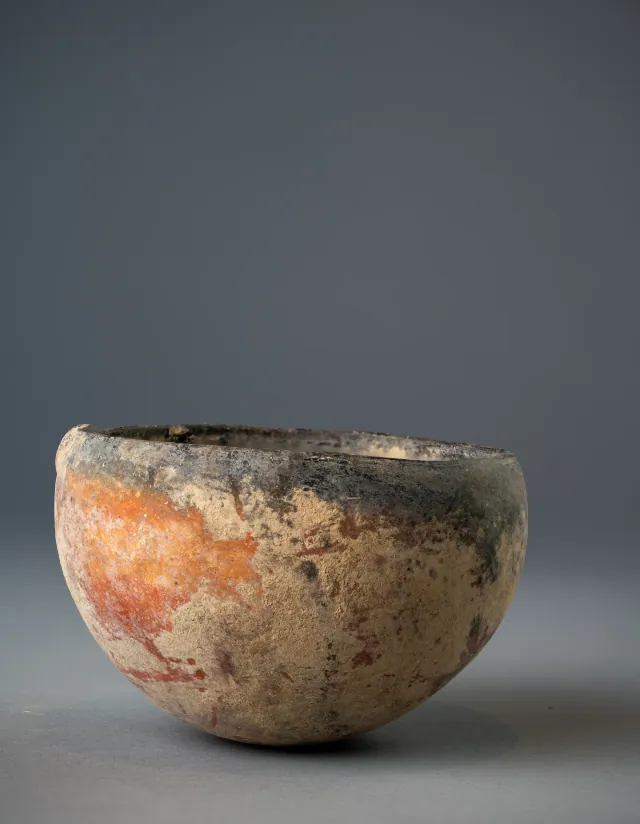
The deep bowl beside this paragraph, made between about 2200 and 1900 BC, is one of the plain hemispherical bowls that were among the commonest vessels in Early Cypriot tombs. Its upper body is a smoky grey-black that fades unevenly into the red, and on one side the black bleeds down the wall in long tongues, the mark of an uneven firing. Over most of the outside lies a thick buff crust of lime from the soil, and the burnished red shows only through windows in it, glossy where it does. The crust covers the very thing a reader of the firing wants to see, the edge between black and red: on a crusted pot the extent of the black-topping and the quality of the burnish can be judged only where the slip shows through.
Now make one from the lump: a black-topped bowl of the same kind, pinched by hand, slipped and burnished at leather-hard, and fired in the open.
The wheel arrives late
The potter's wheel reached Cyprus around 1650 BC, at the start of the Late Cypriot period (LC), much later than in neighbouring regions [4]. The first wheel-made vessels on the island were Levantine-inspired pieces of Plain White ware used in communal feasting. Only a few wares went onto the wheel, and the same shapes in the same fabrics were often made both ways. Only Red Lustrous Wheel-made was always wheel-made [4].
).webp)
The small carinated cup here, from a tomb at Kalopsidha excavated by John Myres in 1894, belongs to that first wheel-made Plain White. Then the wheel lost ground. From LC IIA, about 1450 BC, the feasting set that had been wheel-made was replaced by handmade bowls in Base Ring and White Slip, the export wares whose potters used rotation only to scrape and smooth (Lesson 5) [4]. White Slip bowls were often fired above 800°C and stacked one inside another, so that paint from the outside of one bowl transferred onto the inside rim of the bowl it sat in. Braden Cordivari and Marie-Claude Boileau argue that kiln firing came in around LC IB, yet count only one Late Bronze Age kiln for the whole island, recently found at Tochni-Lakkia on the south coast [16]. The excavators of Toumba tou Skourou, a potters' quarter on Morphou Bay, reported kilns of LC I date there [17], and that claim remains disputed.
The wheel became the normal way to make fine pottery only at the end of the 13th century and through the 12th, with the Aegean-style wares of Lesson 6; even then larger jugs and amphorae still show coil seams. Proto-White Painted, in the 11th century BC, was the first fully standardised fine ware made on the island's wheels [4].
Throwing ridges and the missing kilns of the Iron Age
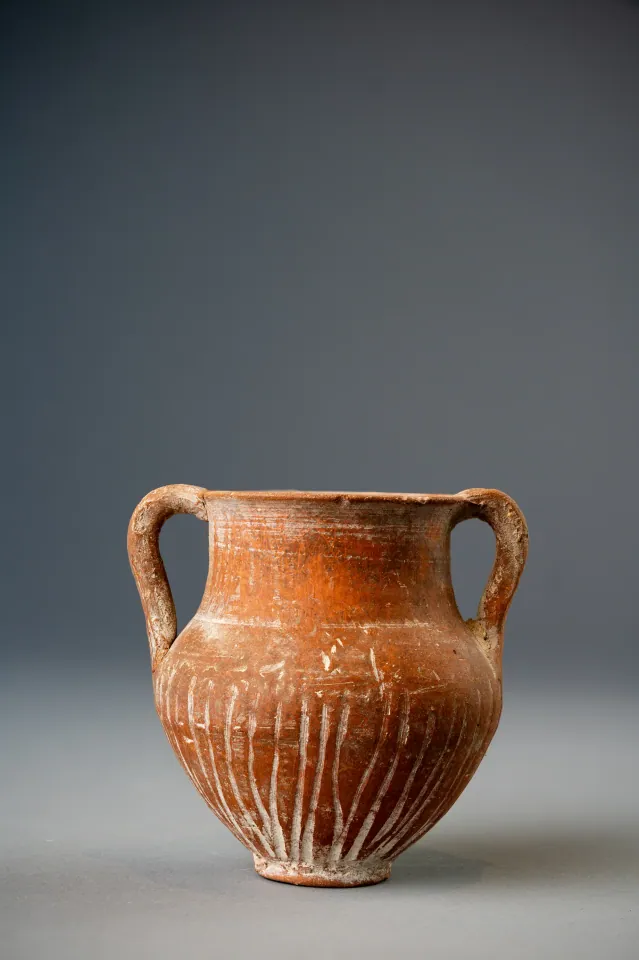
By the Cypro-Geometric period (CG, c. 1050 to 750 BC) the fine wares were wheel-made. The small two-handled jar beside this paragraph, made between about 950 and 600 BC, has fine horizontal rilling on its neck, the ridges left by fingers drawing the clay up as it spun; its lower body was cut with close vertical grooves above a low ring foot. Rilling proves a wheel, though not how much the wheel did: Ina Berg's X-rays of Bronze Age pots from Knossos show the same ripples on pots built from coils and only finished on a wheel, and only a radiograph separates the two [18].
Iron Age kilns were of the updraught type, a firebox below a pierced floor with the pots stacked above, firing at about 900°C, give or take a hundred degrees [19]. Not one securely Iron Age pottery kiln has been excavated on Cyprus. The kilns that Einar Gjerstad could point to for Cypriot-style Iron Age pottery, with misfired and unfired White Painted, Bichrome and Black-on-Red beside them, were at Tarsus in Cilicia, in southern Turkey, which he read as Cypriot potters working abroad [20].
Compare the two ways of firing in section, and look for where the fuel burns: against the pots in the open, in a chamber below a pierced floor in an updraught kiln.
Diagram · Firing
Two ways to fire a pot
Open firing · schematic
- 1Fuel heaped round and over the pots, in a fire-pit or an open hearth, one pot or a few at a time.
- 2One proposed way to black-top a bowl: set it mouth-down in the ash, so the rim and the inside are starved of air and fire black.
- 3Where smouldering fuel lies against a wall, it leaves a dark fire-cloud.
- 4Air reaches the rest from every side and fires it red. The heat peaks at about 600 to 800 °C and soon falls away.
Updraught kiln · Sarepta, Kiln G · to scale
- 1Firing chamber, dug into the ground and fed from a stoking room to the south (behind this section). Inside it measures 1.85 by 2.40 m, 1.30 to 1.36 m high.
- 2A tongue wall, 0.60 m thick, divides the chamber into two lobes and carries the roof.
- 3Clay roof, 0.30 to 0.40 m thick, pierced by 33 flues; those round the edge slant outwards to spread the heat.
- 4Clay lining, 0.12 to 0.16 m thick, fired hard.
- 5Wall of fieldstones about 0.60 m wide, packed against the sides of the pit.
- 6Ash of the last firing, 0.10 to 0.12 m deep.
- 7Pots were stacked on the roof, probably inside a temporary clay wall. Not preserved: drawn dashed, height unknown.
In the open, the air reaches every pot and the potter can steer it only with fuel and covering. In a kiln the fire burns apart from the pots, and the potter can close it: at the end of Kiln G’s last firing the door had been blocked with a temporary wall and some flues plugged with stones. Kilns like this fired at about 900 °C, give or take a hundred degrees.
The one Late Bronze Age kiln known on Cyprus · Tochni-Lakkia, as found · same scale
- 1Ash on the slope of the cut.
- 2Edge of the chamber-like cut.
- 3Fire-damaged pottery (black) among stones.
- 4Fire-cracked stones.
- 5Burnt, petrified surface.
All that survived of it was the base of a chamber about one and a half metres across, cut in the face of an eroding sea cliff on the south coast; the sea has since taken it. Kilns reported at Toumba tou Skourou remain disputed, so this is the only Late Bronze Age kiln yet known on the island, though kiln firing seems to have begun there around 1500 BC. No securely Iron Age pottery kiln has yet been excavated on Cyprus.
The Iron Age pots carry their own record of the stacking. Nancy Reid Hocking, a potter who reproduced ancient Cypriot wares near Paphos, argued that much of the pale buff surface Gjerstad described as a slip on White Painted and Bichrome was made in the kiln: calcareous clay that fires pink in oxygen turns buff when the fire is starved of air in its last stage [21]. With no kiln shelves, pots were piled up, presumably large below and small above, and wherever one pot leaned on another the smoky air could not reach, so the clay stayed pink. Hocking calls these patches ruddy blushes, and they are very common on Cypriot Iron Age pottery [21]. A pink blush on the shoulder of a buff jug is the print of a neighbour in a kiln that no one has yet found on the island.
Quiz
Check yourself
Question
Put the making of an incised Red Polished pot in order.
Tap an item, then tap its place. Or use the arrows
Question
Before about when is no wheel-made pot known from Cyprus?
Question
The neck and shoulder of this bottle are black, the lower body red. What made the black?
Question
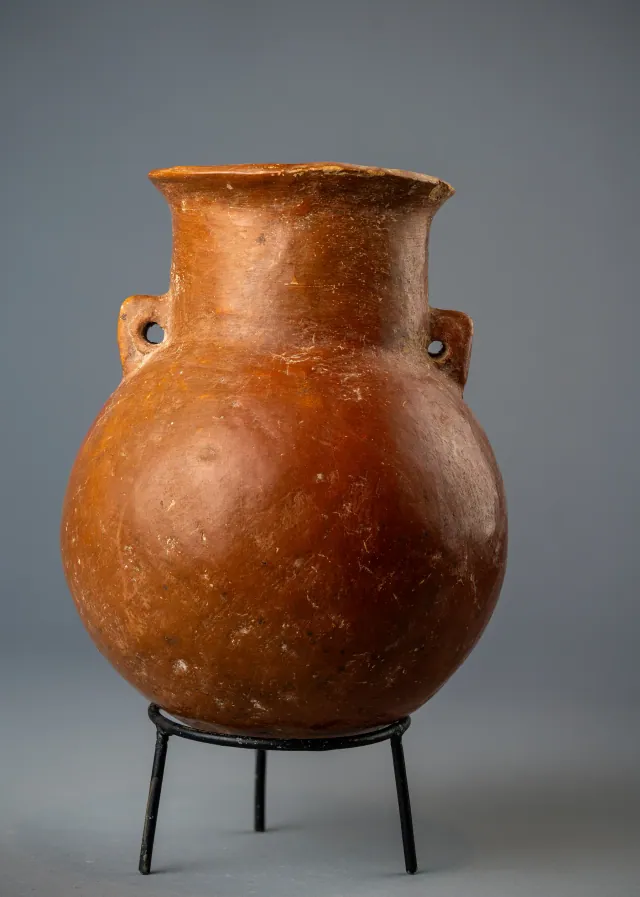
This jar was never glazed. What gives its red surface the sheen?
Question
A broken Red Polished sherd shows a dark grey core between redder margins. What does that tell you?
Question
How do Webb and Frankel reconstruct the firing structure at Ambelikou-Aletri, the one excavated prehistoric pottery workshop on Cyprus?
Question
The neck of an Iron Age jar has fine horizontal ridges. What can you safely say?
Question
A buff White Painted jug has a pink blush on its shoulder. What made it?
What to look for
- Rim and wall: a rim that rises and dips, or walls that vary in thickness, mean a handmade pot; before about 1650 BC every Cypriot pot is handmade.
- Inside the pot: a handle stub showing on the interior, finger marks behind applied ornament, or a join where the neck was pushed in all point to hand-building; fine horizontal ridges inside a neck (rilling) point to the wheel.
- Surface sheen: a soft lustre with streaky tool facets is burnish, and any ware called "Polished" or "Lustrous" has it; a dull, chalky ground with dark paint is a matt-painted ware.
- White in incisions: lime paste put in after firing; brilliant, complete fill on an Early Cypriot pot may have been renewed.
- Dark patches: irregular grey-black clouds anywhere on the body are accidents of an open firing; a black rim, interior or neck above a red body is deliberate black-topping, and its boundary is rarely level.
- Broken edges: a grey core between redder margins means a short, low firing; a greenish tinge on pale ware usually means a hot firing.
- Iron Age buff ware: pink blushes on a buff surface show where pots touched in the kiln.
Go deeper
For the firing evidence site by site, see Pottery kilns and firing; for the wares named here, Red Polished, Base Ring, White Slip, Plain White and Wheel-made White Painted. The spindle whorl has its own context in Spindle whorls and textile tools. Two articles follow the science further: Pottery production and distribution in Bronze Age Cyprus on clay fingerprinting, and Uncovering the secrets of White Slip ware on the Bamboula-Kourion study.
References
- 1.Webb, J.M. (1994). Techniques of pottery manufacture at Marki, Cyprus. Archaeologia Cypria 3, 12–21.
- 2.Frankel, D. and Webb, J.M. (2012). Pottery production and distribution in prehistoric Bronze Age Cyprus. An application of pXRF analysis. Journal of Archaeological Science 39(5), 1380–1387.
- 3.Frankel, D. (1994). Color variation on prehistoric Cypriot Red Polished pottery. Journal of Field Archaeology 21(2), 205–219.
- 4.Georgiou, A. (2018). From the hand to the wheel: revisiting the transformations of the Late Cypriot ceramic industry of finewares during the 13th-to-12th c. BC transition. In I. Caloi and C. Langohr (eds), Technology in Crisis: Technological Changes in Ceramic Production during Periods of Trouble. Aegis 16. Louvain-la-Neuve: Presses universitaires de Louvain, 177–200.
- 6.Coleman, J.E., Barlow, J.A., Mogelonsky, M.K. and Schaar, K.W. (1996). Alambra: A Middle Bronze Age Settlement in Cyprus. Archaeological Investigations by Cornell University 1974–1985. Studies in Mediterranean Archaeology 118. Jonsered: Paul Åströms Förlag.
- 7.British Museum, London, 1897,0401.879. Plain White Wheel-made jug from Enkomi (collection record).
- 8.Crewe, L. (2007). Early Enkomi: Regionalism, Trade and Society at the Beginning of the Late Bronze Age on Cyprus. BAR International Series 1706. Oxford: Archaeopress.
- 9.Peltenburg, E. et al. (2003). The Colonisation and Settlement of Cyprus: Investigations at Kissonerga-Mylouthkia, 1976–1996. Lemba Archaeological Project III.1. Studies in Mediterranean Archaeology 70:4. Sävedalen: Paul Åströms Förlag.
- 10.Webb, J.M. and Frankel, D. (2013). Ambelikou Aletri: Metallurgy and Pottery Production in Middle Bronze Age Cyprus. Studies in Mediterranean Archaeology 138. Uppsala: Åströms Förlag.
- 11.Swiny, S., Rapp, G. and Herscher, E. (eds) (2003). Sotira Kaminoudhia: An Early Bronze Age Site in Cyprus. CAARI Monograph 4. Boston: American Schools of Oriental Research.
- 12.Dikomitou-Eliadou, M. (2013). Ceramic Production, Distribution and Social Interaction in Early and Middle Bronze Age Cyprus. PhD thesis, University College London.
- 13.Åström, P. (1966). Excavations at Kalopsidha and Ayios Iakovos in Cyprus. Studies in Mediterranean Archaeology 2. Lund: Paul Åström.
- 16.Cordivari, B.W. and Boileau, M.-C. (2024). Characterizing the manufacturing practices of Late Bronze Age White Slip ware from Bamboula-Kourion, Cyprus. Journal of Archaeological Science: Reports 53, 104380.
- 17.Vermeule, E.T. and Wolsky, F.Z. (1990). Toumba tou Skourou: A Bronze Age Potter's Quarter on Morphou Bay in Cyprus. Cambridge, MA: Harvard University Press, 141–142.
- 18.Berg, I. (2009). X-radiography of Knossian Bronze Age vessels: assessing our knowledge of primary forming techniques. Annual of the British School at Athens 104, 137–173.
- 19.Jones, R.E. (1986). Greek and Cypriot Pottery: A Review of Scientific Studies. Fitch Laboratory Occasional Paper 1. Athens: British School at Athens.
- 20.Gjerstad, E. (1948). The Swedish Cyprus Expedition, Vol. IV, Part 2: The Cypro-Geometric, Cypro-Archaic and Cypro-Classical Periods. Stockholm: The Swedish Cyprus Expedition.
- 21.Hocking, N.R. (2001). Lessons from the kiln: reduction firing in Cypriot Iron Age pottery. Near Eastern Archaeology 64(3), 132–139.
- 22.Makundi, I.N., Waern-Sperber, A. and Ericsson, T. (1989). A Mössbauer study of the black colour in Early Cypriote and Nubian C-Group black-topped pottery. Archaeometry 31(1), 54–65.