
Ancient Cypriot Pottery·Lesson 8
Bichrome and the Free-Field Style
Bichrome and White Painted pots of c. 750 to 480 BC: the circle jugs of the west, the lotus amphorae of Salamis, and the free-field jugs with a single bird, fish or goat on a bare body, and how to tell stage IV from V.
Alexis Drakopoulos·Period by period·17 min read
Share


Lesson 8·Course contents, 15 lessons
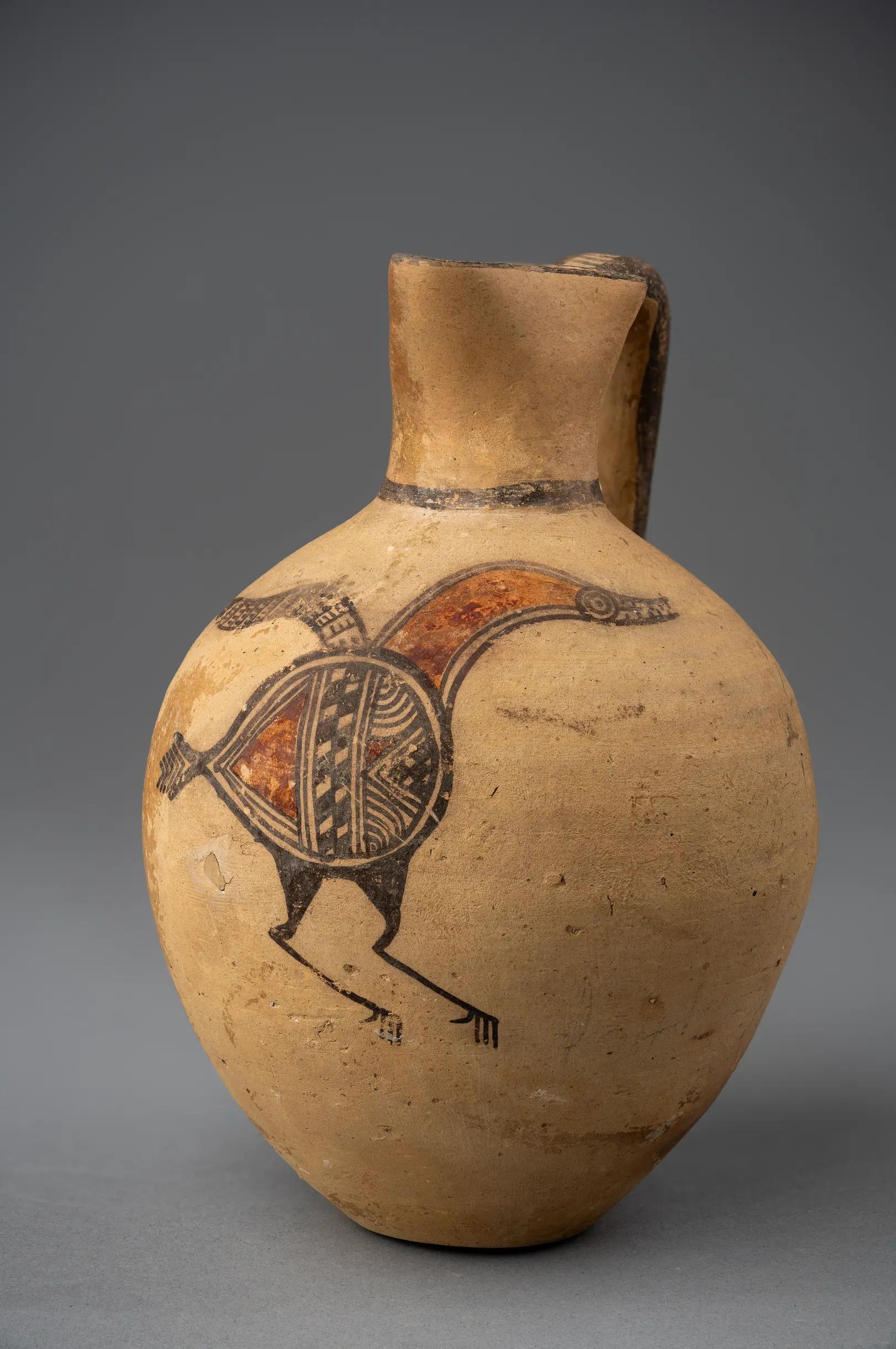
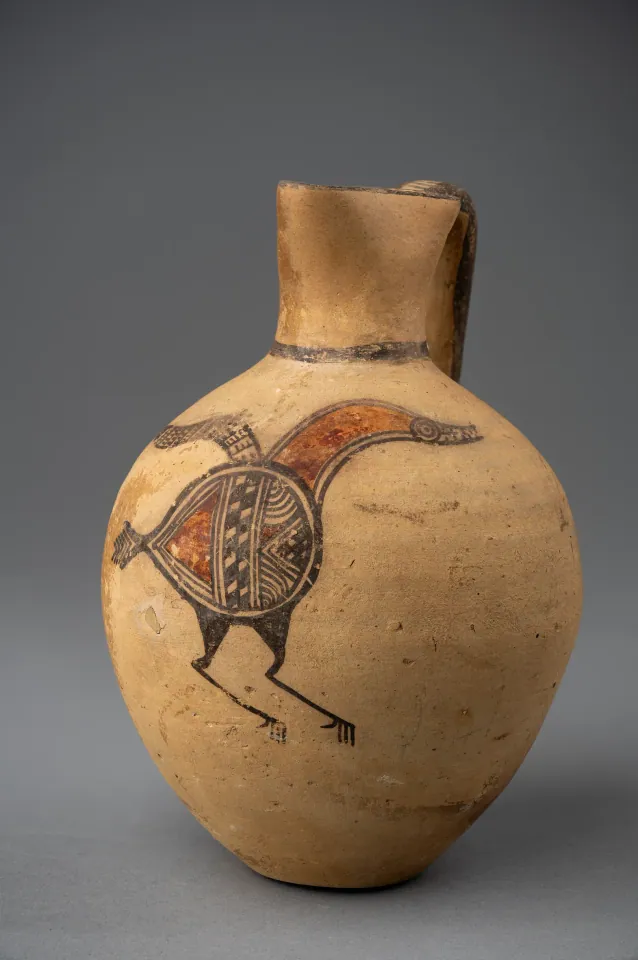
In June 1883 General Pitt-Rivers bought lot 277 at the London sale of the Lawrence-Cesnola collection: two painted Cypriot jugs, one with a horse-like animal, one with a bird. His manuscript catalogue lists the smaller as "a bird flying", seven and a half inches high. It is the jug beside this paragraph, 19 cm tall, and it stayed with his family for more than ninety years. The bird is built from a compass-drawn disc divided into wedges of chequer, hatching, concentric arcs and solid red, with a long red neck, a ringed eye, an open toothed beak and thin legs ending in comb-like feet. Apart from a black band at the base of the neck and a ladder on the handle, the rest of the pot is bare buff clay.
That bare clay is the subject of this lesson. Einar Gjerstad called the arrangement the free-field style: one motif set on the open body of a jug, with no bands or panels to hold it. Its pots now stand for Cypriot Iron Age art in museum cases. In its own time it was a minority practice, far rarer than geometric ornament [4, p. 343], worked out mainly by eastern painters over about a century and a half. Gjerstad traced its origins to a jug left almost empty.
Same clay, new numerals: what changes after 750 BC
The Cypro-Archaic period (CA), c. 750 to 480 BC, is the age of the island's city-kingdoms. Its painted pottery continues the Cypro-Geometric (CG) wares of Lesson 7 without a break, and so does Gjerstad's numbering. White Painted IV and Bichrome IV belong to Cypro-Archaic I, c. 750 to 600 BC; White Painted V and Bichrome V to Cypro-Archaic II, c. 600 to 480 BC. As Lesson 0 explained, the numeral is a date [1]. Bichrome, like White Painted, runs from I to VII, one numeral for each of Gjerstad's seven Types from Cypro-Geometric I to Cypro-Classical II [1]; this lesson covers IV and V. Gjerstad himself began the period at 700 BC; J. N. Coldstream's cross-dating with Greek Geometric pottery moved the start to about 750, the date modern catalogues use [2][3].
The fabric changes little. Bichrome IV is wheel-made, and Gjerstad noted that its "clay and slip are the same as those of White Painted IV": a pale buff or slightly greenish body, sometimes under a light slip, painted in matt colours [1]. White Painted (WP) uses one dark paint; Bichrome adds a second, a matt red, beside the black. Where the red has faded the two are hard to tell apart; hence labels that read "White Painted IV (possibly Bichrome IV)".
The shapes grow. Large amphorae with two handles on the shoulder, some approaching a metre high, become showpieces, their necks the main field for ornament [1]. The jug with a pinched, trefoil mouth, the oinochoe of museum labels (a Greek name that does not fix what it held), is the standard pouring vessel. Barrel jugs, lying on their sides with the neck rising from the middle of the barrel, turn up mainly in eastern tombs.
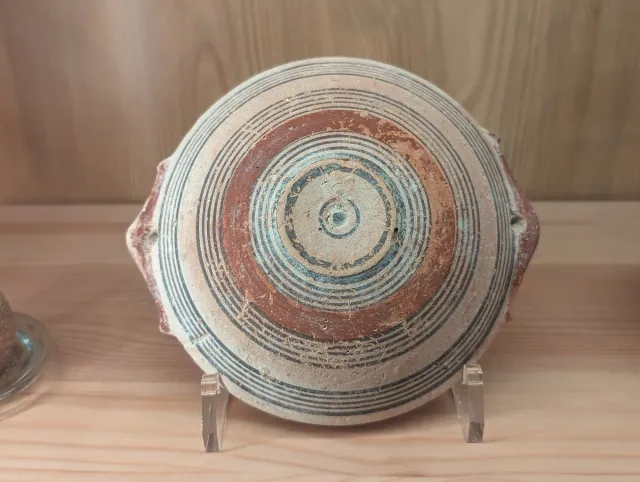
Plates and small bowls continue. The bowl beside this paragraph, about 15 cm across and shown from below, has two lug handles painted red and pierced with string-holes, a type the Swedish excavators found among the Bichrome IV plates in the tombs at Stylli near Salamis [17]. Most of its paint is on the outside: groups of fine black rings, drawn while the bowl turned on the wheel round a dot at the centre of the base, broken by one broad red band. A cord through the holes could hang it, which may be why the underside was the face worth painting.
The circle dance: the Western style
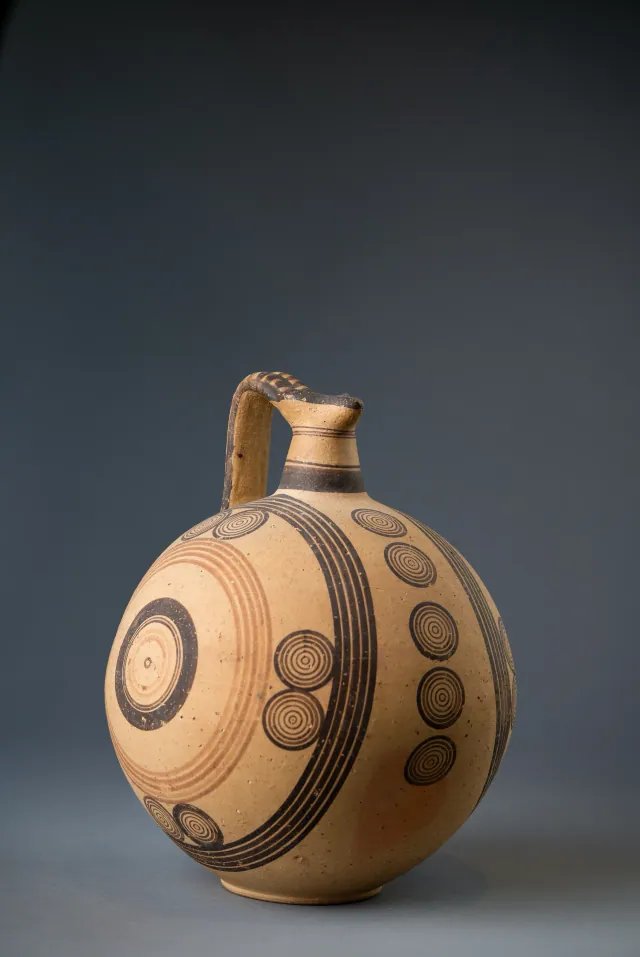
Most Cypro-Archaic painted pottery carries no figures at all. Its commonest ornament is the concentric circle, drawn with a multiple brush pivoted on a fixed centre, so that every ring of a system is evenly spaced. The large jug beside this paragraph, 31 cm high, carries on each side a great vertical circle system: a bull's-eye of fine rings, a heavy black ring, a band of fine red rings and a sweeping black band that curves over the shoulder and under the belly. Between the two systems the painter stacked small black circle groups in a column, each placed by hand and each slightly different in size.
Gjerstad's description is still the best guide. "There is a veritable circle dance on the pots," he wrote of Bichrome IV, adding that "the outer line of the concentric circles is sometimes thicker than the others, and the circles are often connected in vertical or horizontal rows" [1]. Every element of it can be checked on the jug. Turn it round to find the second great system on the far side and the column of small groups that stands between the two.
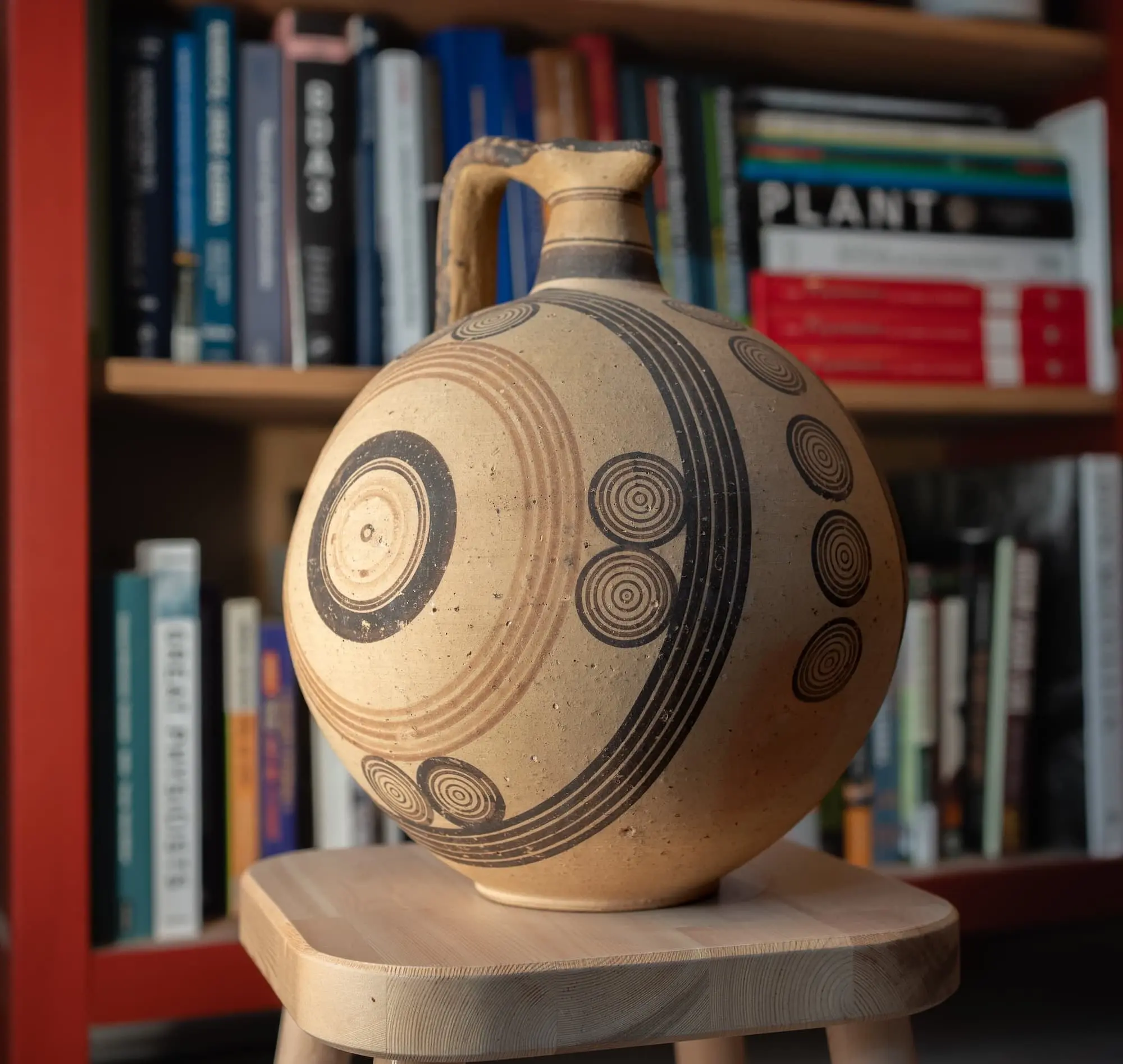
Large Bichrome IV Jug with Vertical Circle Systems
Open the full 3D viewDrakopoulos collection
31 cm high. The great systems are even because a multiple brush turned on a fixed centre; the small groups between them vary because the painter placed each one by hand.
A photogrammetry model, made from many photographs of the real object. Nothing loads until you press the button.
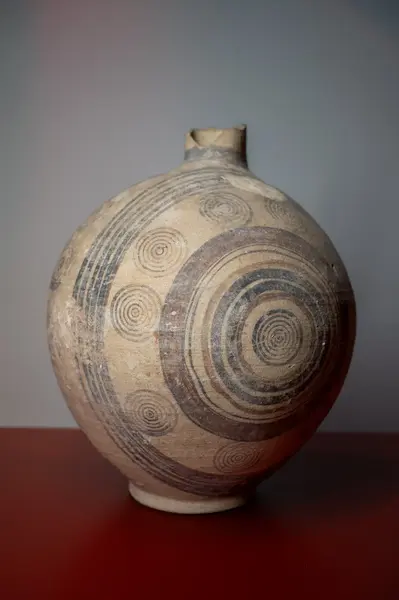
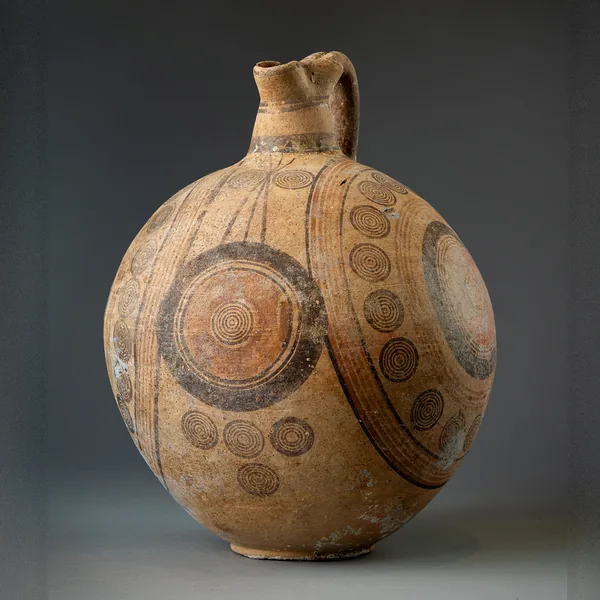
Two more jugs in the Drakopoulos collection, shown below, keep the same rules and arrange them differently. On the first, 28 cm high even with its mouth lost, a ring of about ten small circle groups surrounds each great system, bundles of arcs sweep round the ring from shoulder to base, and more small groups climb in a vertical row between the two sides. The second winds seventeen small groups into a wreath round a disc washed solid red. Most circle-style painters used red only for rings between black ones; filling the centre turns each side of this jug into a red boss framed in black. The Swedish excavators found the scheme in a tomb at Stylli: two Bichrome IV jugs with "black and red vertical circles" on the body and rows of concentric circles "in their interstices", both from the later of the tomb's two burials, which also held Bichrome V [17].
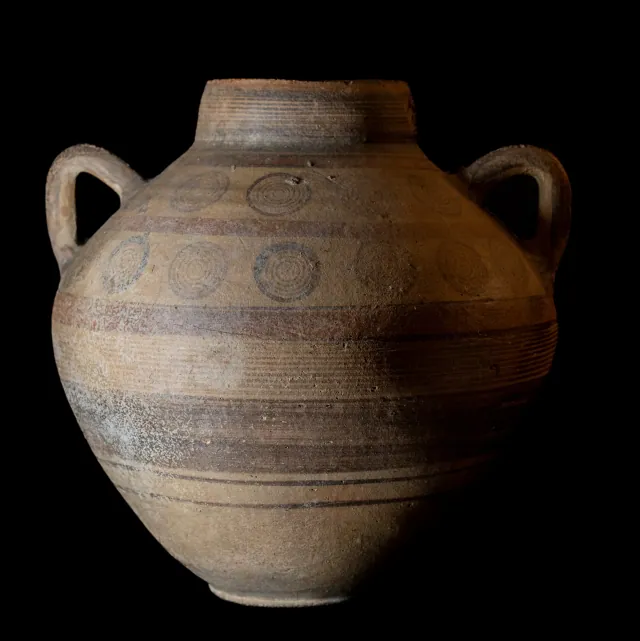
The horizontal version reads best on amphorae. The broad amphora beside this paragraph carries two registers of concentric circles on its shoulder, each a row of discs of five or six rings, divided by a red band framed in black, above a wide belt of fine lines. Gjerstad localised this circle style to the west and north of the island, the country of Marion and Lapithos, and called it the Western style; most White Painted IV belongs to it [1]. Andres Reyes later confirmed the division in broad terms, with circles found as far east as Aradippou [9].
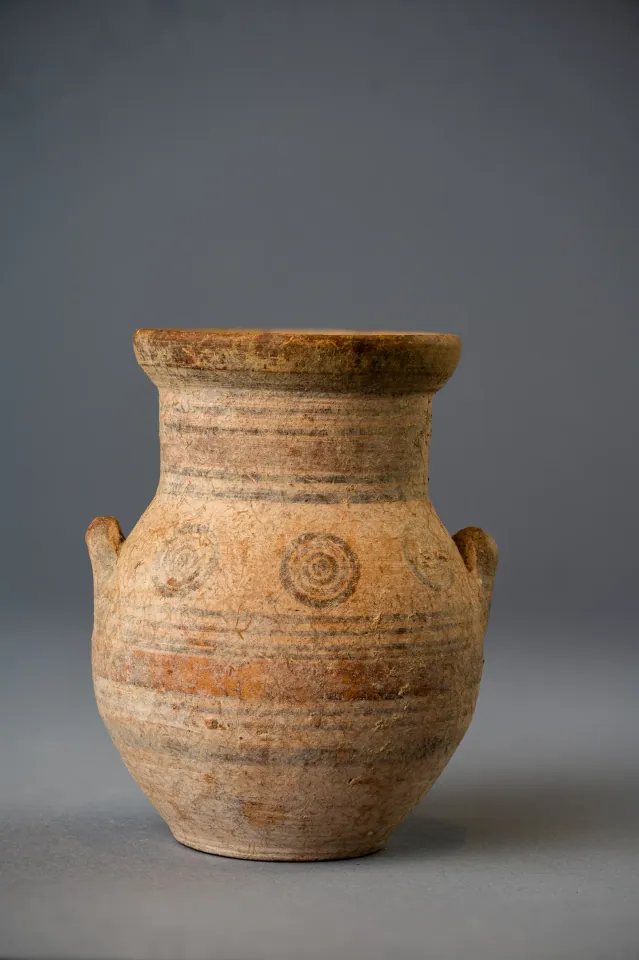
The amphoriskos beside this paragraph, a small amphora with a broad disc rim, uses the circles sparingly. Between its handles float single groups of concentric circles, each drawn with a multiple brush round a central dot and no two quite the same size; below them, fine black lines frame a broad band of orange-red. The Swedish expedition excavated Bichrome IV amphorae with circle groups on the shoulder in two tombs at Marion, both graves of Cypro-Archaic II and both now in the Medelhavsmuseet, Stockholm, so the type stayed in use after 600 BC. Excavated finds like these are what Gjerstad's map rests on. For a pot with no recorded find-spot, such as this one, the circle style points to a likely region, short of proof.
Lotus and rosette: the Eastern style and Salamis
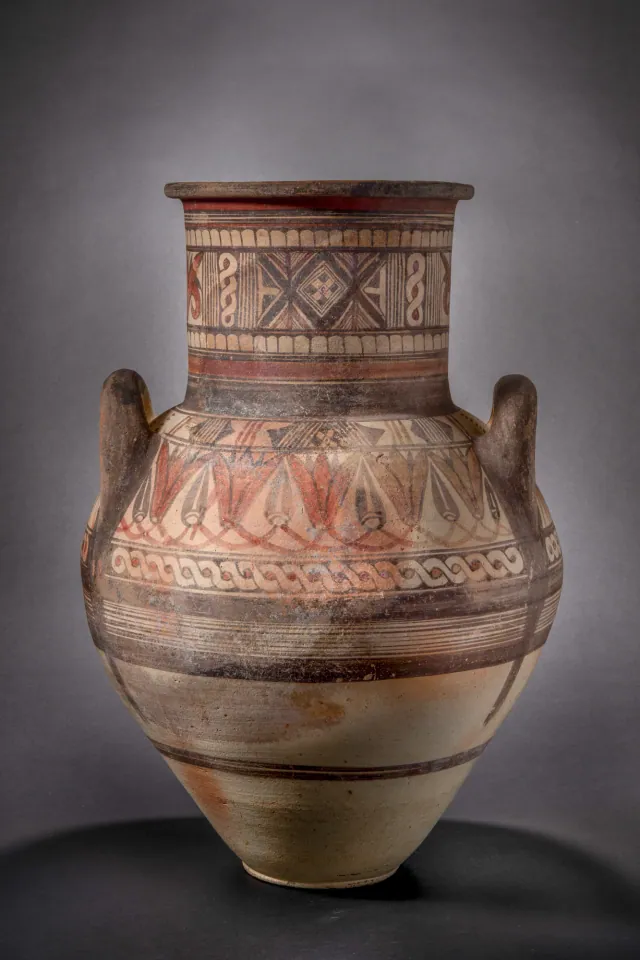
The east painted differently. Gjerstad's Eastern style, localised to the eastern and southern parts of the island, replaced circles with rectilinear panels and with ornaments he listed as "lotus buds and flowers, rosettes, sacred tree, aquatic birds, quadrupeds, and human figures" [1]. The amphora beside this paragraph shows it at full scale. It is Gjerstad's Bichrome IV "Amphora 2", its tall neck divided into panels: on one face a St Andrew's cross over concentric lozenges, on the other a red volute flower, flanked by running spirals. Round the shoulder hangs a frieze of lotus flowers alternating with buds, outlined in dark paint and washed with red and brown.
Its closest published twin is a Cesnola amphora in the Metropolitan Museum, New York (74.51.972), 80.3 cm high and said to be from Ormidhia. Its catalogue sets out the formula: "Large amphorae decorated in the Bichrome IV technique were common to the eastern part of Cyprus. The shoulder zone of each side is usually ornamented with a frieze of lotus flowers alternating with buds. On the neck, lotus flowers in panels alternate with geometric motifs" [3, no. 143]. The lotus, the Egyptian water-lily, probably reached Cypriot potters by way of the decorated metal bowls of the period [1]. Desmond Morris put the chronology in one line: "It was in the Cypro-Archaic period that the lotus flowered on the island's vessels" [5, p. 239]. On the amphora it has already become pattern, hung like a fringe.
The frieze is easier to understand once you have painted one. Build the amphora, then hang the flowers and buds round its shoulder, the outlines in dark paint first and the red washed in after, and notice how quickly the lotus turns into a repeat.
Recent work has given Gjerstad's "east" an address. Anna Georgiadou and Maria Dikomitou-Eliadou, studying about 1,100 vessels from Salamis and its hinterland, argue that the pictorial style "was conceived and developed in the workshops of Salamis and prevailed in the eastern part of the island during the CA period. Amathus is the only other contemporary production centre where a pictorial style developed" [4, pp. 337, 341]. They name the large shoulder-handled amphora with lotus friezes as a typical series of the Salaminian "floral style", and note that the same ornament appears on the corselets of Salaminian terracotta statues, as if potters and coroplasts shared workshops [4, pp. 341-342]. Amathus on the south coast had its own bird jugs, small and squat, with long-legged, spread-winged birds, of the late Cypro-Archaic I [3, no. 155][9].
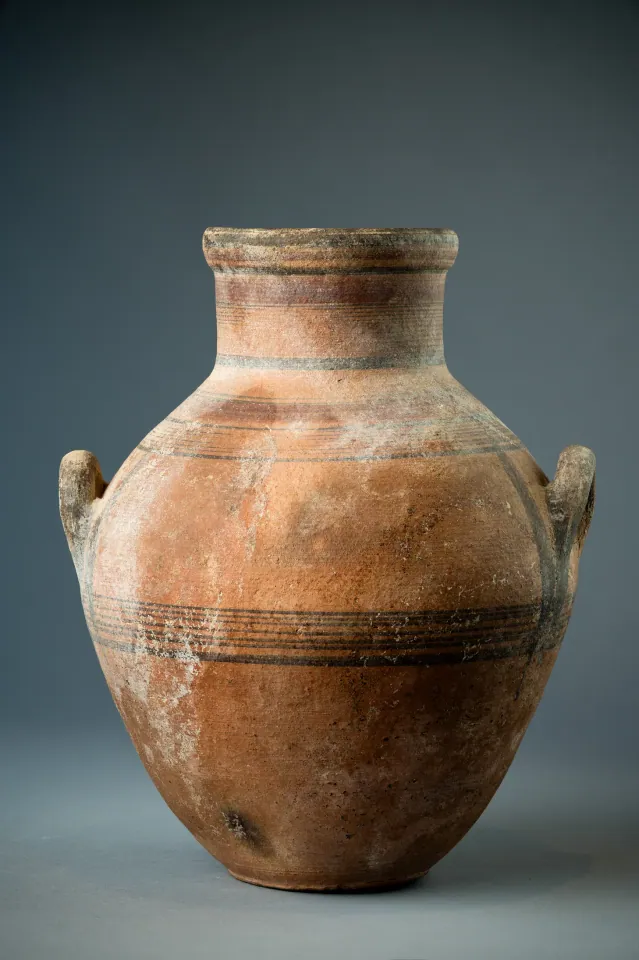
Plenty of pots belong to neither style. The amphora beside this paragraph, 32 cm high, has the shoulder handles of the eastern showpieces, yet its painter used bands alone: black lines with a red band on the upper shoulder, a belt of close-set lines at the widest point, and a single black stroke dropping from the root of each handle across it. Banded ornament changed little between Cypro-Geometric III and Cypro-Archaic I, so the date has to come from the shape. The greatest width has moved up towards the shoulder, the neck is a tall, almost straight cylinder, and the rim is rolled into a thick ring, all features of Cypro-Archaic I. Its clay fired a warm orange-pink, close enough to red that the label depends on the surface: a burnished red slip under the same paint would move it to the red wares of Lesson 9.
One figure on an empty pot
Gjerstad coined "free-field style" in 1948, and he coined it for a geometric ornament. In White Painted III, late in the Cypro-Geometric, he saw "a new style... which occurs especially on the jugs with pinched rim. It is to be considered as a decorated variety of the plain-bodied style of White Painted I and II: on the free surface of the vase a single ornament is applied", a chequered triangle, say, or a few isolated circles and swastikas [1]. The plain-bodied jug, banded at rim, neck and base and blank between, went back to the start of the Iron Age; the free-field style dropped one thing onto the blank.
By Bichrome IV the formula was settled: "The free-field style is generally employed on the jugs with pinched mouth, both for geometrical and pictorial designs, and the zone and panel-style on the other vases" [1]. The circle jugs above are, in Gjerstad's terms, free-field as well; his Western style includes "isolated circles or a vertical row of connected circles... painted on the plain body of the vase" [1]. Set the bird jug from the start of this lesson beside the large circle jug at their true sizes and look at what the two painters share: a body left open, with no zones or panels to hold the ornament.
A · One bird
Bichrome IV Trefoil Jug with a Striding Bird
c. 750 to 600 BC · Drakopoulos collection · H. 19 cm
B · Circle systems
Large Bichrome IV Jug with Vertical Circle Systems
c. 750 to 600 BC · Drakopoulos collection · H. 31 cm
What made the Cypro-Archaic jugs famous was the second possibility in his sentence: a bird, a goat or a bull in the slot where a chequered triangle had been, the painter "freed from the spatial restrictions of encircling bands, lines, and panel divisions", as Karageorghis put it [3, p. 108]. The bird jug shows how little that took. Go round it one feature at a time, and notice how much of the pot the painter left alone.
Tap a number on the photograph, or choose a note below, to look closer.
Looking closely
Bichrome IV Trefoil Jug with a Striding Bird
c. 750 to 600 BC · Drakopoulos collection
Choose a number on the photograph or a note below. Arrow keys step through them.
The chequered triangle of White Painted III has become a creature, and the bare clay round it was as much the painter's choice as the bird.
Two terms are easily confused. Free-field describes the layout. "Pictorial style", or style figuré in the title of the standard corpus by Vassos Karageorghis and Jean des Gagniers (1974, supplement 1979), describes the subject matter, however it is arranged [7]. A pictorial pot need not be free-field. The Hubbard amphora in the Cyprus Museum, rescued from illicit diggers in the Famagusta district and published by Porphyrios Dikaios in 1937, is painted with a seated woman, a sphinx, dancers and a lyre player [6][16]. Gjerstad made it the type-piece of a Bichrome III group whose outline figures show "a marked tendency to escape from the geometrical schema" [1], yet they still march round the pot in a continuous frieze. As Bichrome III it belongs to Cypro-Geometric III (c. 900 to 750 BC): an ancestor of the free-field jugs, outside their style.
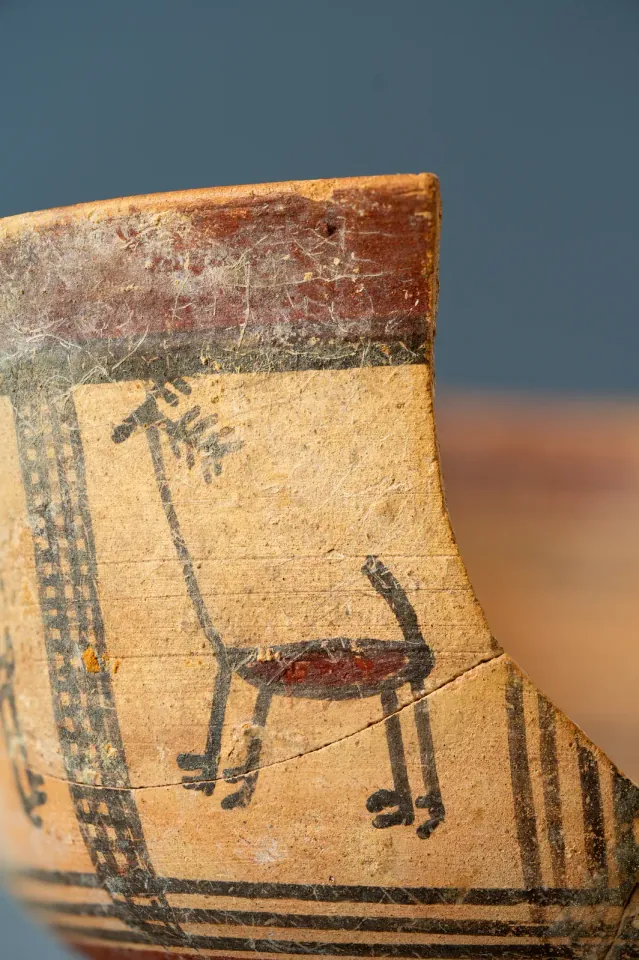
The older panelled arrangement survived beside the new one. The cup beside this paragraph is a skyphos, the deep Greek drinking cup with horizontal handles that Cypriot potters copied from Euboean and Attic imports through the 8th and 7th centuries BC [8]. Its painter boxed a stag into each metope between ladders and a chequerboard, each animal a red-filled lozenge on stick legs under a sprig of antlers. Georgiadou and Dikomitou-Eliadou date the three Salaminian modes in sequence, all three overlapping: pictorial scenes in panels from Cypro-Geometric III, the free-field style from the beginning of the Cypro-Archaic, and the dense floral style in the 7th and 6th centuries [4, p. 342].
Birds, fish, goats: the free-field repertoire
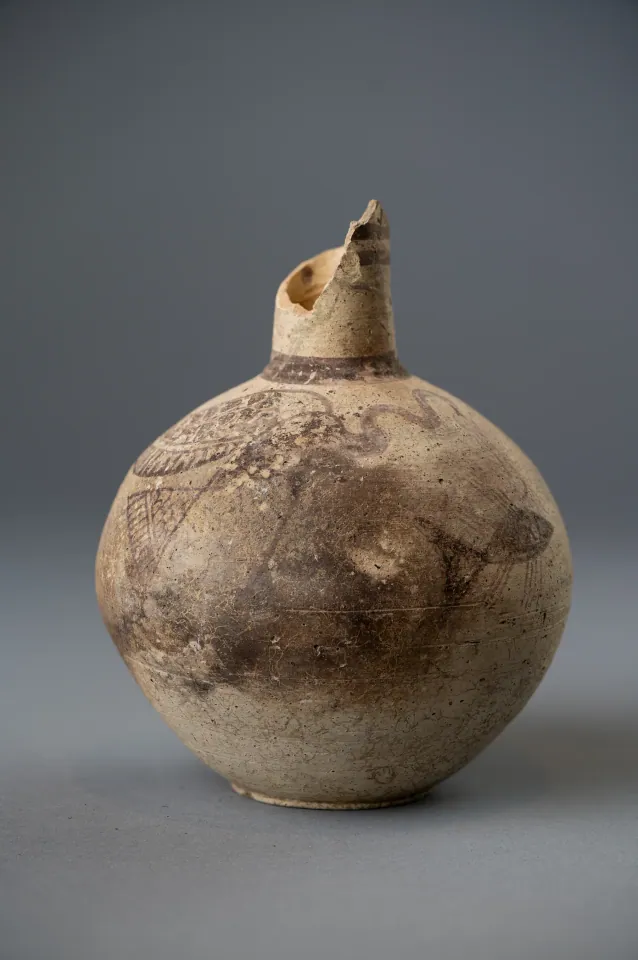
Birds outnumber every other subject. Georgiadou and Dikomitou-Eliadou describe waterbirds "alone or in pairs, with lotus flowers, with a branch or catching a fish" [4, p. 343]. The small jug beside this paragraph shows the fish version. A hatched waterfowl stretches its neck across the whole shoulder in tight S-bends and drops its beak toward a dark fish with a forked tail and fins drawn as bundles of red strokes. A Cesnola jug in the Metropolitan Museum (74.51.527) shows the same encounter; its catalogue suggests that such jugs came from one or two eastern workshops and that the subject may be Nilotic, adapted to Cypriot taste [3, no. 161]. Annie Caubet observed that Bichrome IV painters built bird and fish from the same pointed oval, adding legs to one and fins to the other; neither animal on this jug can be named to species [11][5].
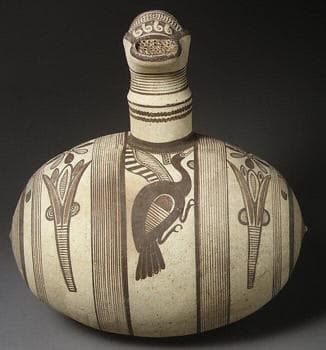
The barrel jug offered the broadest field of all. On the Cesnola example beside this paragraph a large bird flies with its talons drawn up between two lotus flowers; the Metropolitan Museum notes that barrel jugs come mainly from tombs in eastern Cyprus. Bird and lotus together form one of the standard compositions, along with the bull sniffing a lotus and the man raising a lotus flower to his nose [3][16].
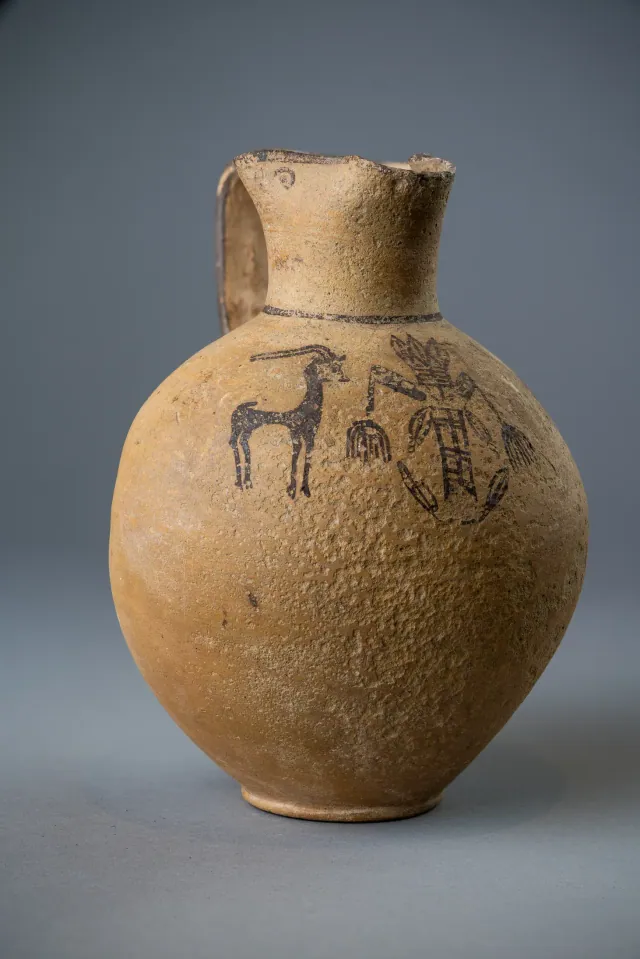
White Painted painters used the style too. The trefoil jug beside this paragraph is White Painted IV, its decoration in black alone. On the shoulder opposite the handle a wild goat stands in silhouette, horns swept back, the eye left in reserve. Beside it rises a larger composite figure: a fan of feathery leaves above a ladder-like stem, with paired leaves and two comb-like pendants hanging from angled branches. It is most simply read as a stylised tree. A goat beside a tree is one of the oldest schemes in Cypriot imagery; Lesley Bushnell traces it into the Iron Age, where it appears in a highly stylised form on Bichrome IV pottery, and Morris describes how painters turned the lotus into a huge, fantastic tree, usually flanked by deer or large birds that seem to feed on it [12][5, p. 247]. Here the painter used one goat where the scheme usually has a pair.
What the birds meant is harder to settle. Gjerstad wrote that they "may be interpreted as soul-birds", and offered no argument [1]. Alicia Dissinger's study of Cypro-Archaic bird images finds that waterfowl make up 55 per cent of the clearly identified types, that most birds placed in tombs are waterfowl, and that a waterfowl painted on a vase in a grave is usually on Bichrome [10, pp. 181, 265]. Songbirds, among them the doves held by female worshippers in terracotta and limestone, were offered mainly in sanctuaries [10, p. 189]. The goddess's dove and the long-necked bird on a grave jug are different birds in different places.
Then paint one. Throw the striding bird jug, give it its single neck band and its laddered handle, and draw the bird on the bare front: the compass disc first, its wedges filled in black, the red laid in last inside the black lines.
Eyes on the spout, a face on the neck
Turn a free-field jug to face its mouth. On the Salaminian jugs, Georgiadou and Dikomitou-Eliadou write, "the mouth is always decorated with eye motifs, arranged on each side of the pinched opening, with added eyebrows... emphasising the anthropomorphic character of the vessel" [4, p. 343]. The habit goes back to the "eye-ornament" Gjerstad recorded at the rims of White Painted III vessels [1]. Seen from the front, the pinched spout becomes a beak or a nose and the jug looks back at the person pouring. Whether the eyes were meant to protect is an open question (Lesson 12).
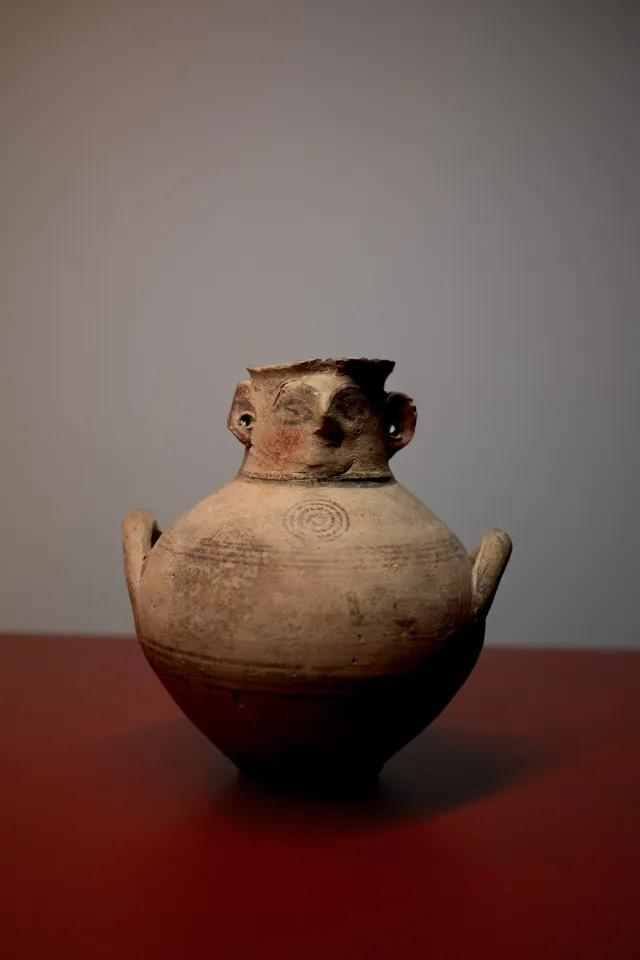
A few potters made the neck a head. The small jar beside this paragraph belongs to a group of Bichrome IV face-neck vessels from the Kourion region that Karageorghis recorded in the 1970s and called hydriae, though this one has only two handles. The nose is pinched out of the clay, the eyes are concentric rings under arched brows, a single stroke makes the mouth, and two round ears are applied, pierced and painted red. Two such vessels were registered in the Cyprus Museum in 1974 [13]; a third, only 17 cm high, came "from the region of Kourion, of a style represented by several other specimens from the same region", and Karageorghis dated it to the 7th century BC [14]. The eyes are the same concentric circles that cover the circle-style jugs, and a single circle hangs beneath the chin like a pendant.
Bichrome V: the field fills in
In Cypro-Archaic II the empty ground disappears. Gjerstad saw in Bichrome V "the beginning of the decadence of the painted wares, either by superabundant or impoverished ornamentation" [1]. In the west the circles thinned out or spread over the whole vase. In the east "there is... a superabundance of the lotus decoration, so that the ornaments cover the whole surface of the vase in a carpet-like pattern" [1]. Amathus developed its own crowded manner, the "Amathus style" of Cypro-Archaic II, which Sabine Fourrier has studied in an Archaic deposit by the town's north rampart [15].
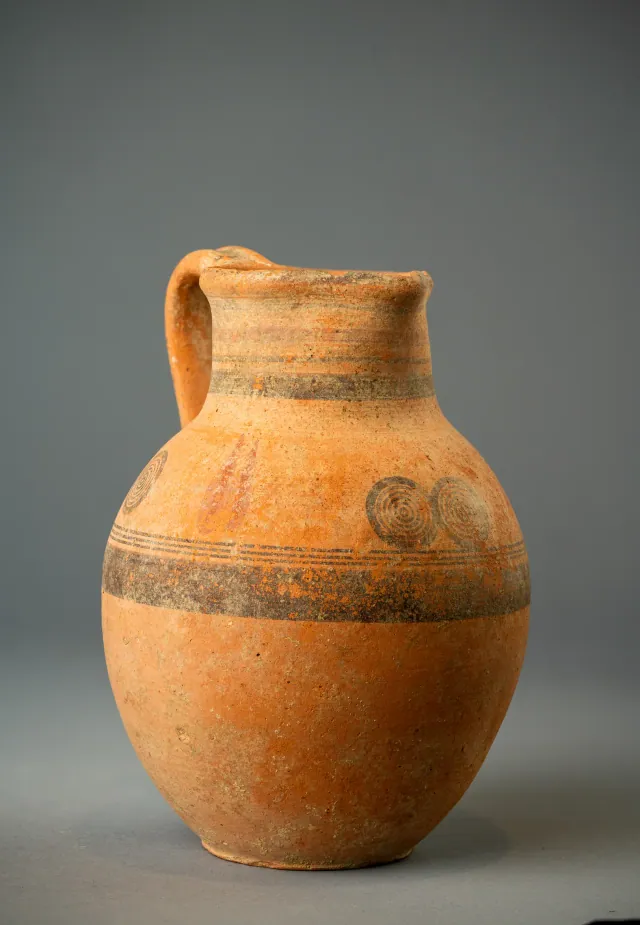
The jug beside this paragraph shows the thinning. Its neck is wide, one of the features Gjerstad lists for Type V, though it does not flare, and the handle stops level with the rim where his Type V handles rise above the mouth [1]. The painter kept the scheme spare: bands round the neck and belly, a few small circle groups set singly and in pairs on the shoulder, two red leaf-shaped strokes towards the handle, now pale, and a bare lower body. The strokes have an excavated match. In the Stylli tomb that held the circle jugs, a Bichrome V jug carries "three red, leaf-shaped strokes as front ornament" [17]. With one foot in each stage, the jug can be dated no closer than c. 700 to 500 BC.
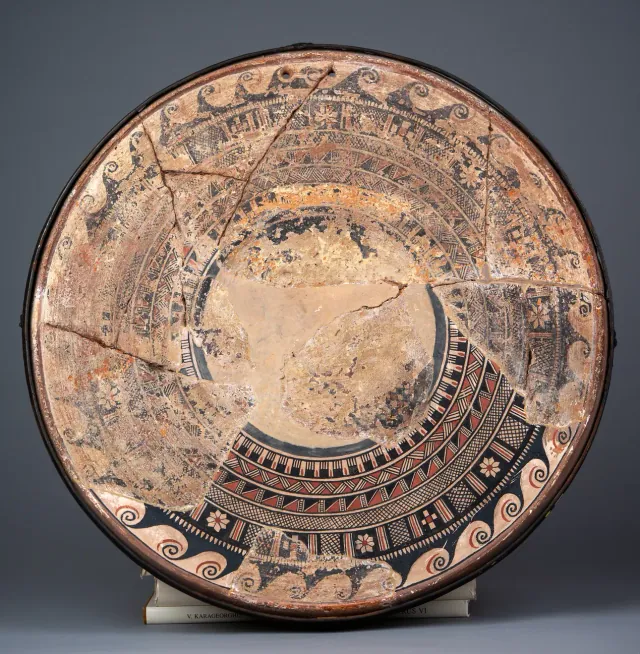
The plate beside this paragraph shows the opposite course at Salamis. It is 53 cm across, many times the size of the plates from the Stylli tombs, and pierced near the rim for hanging. A wave band of breaking crests runs round the edge, then a frieze of eight-petalled rosettes in metopes alternating with chequer, then dog-tooth, lattice and hatched triangles, each zone framing the one inside it. The crowded zoning belongs to the late stages of Bichrome IV and the turn to Bichrome V, the 7th or early 6th century BC. All of it was a frame. The tondo at the centre held a figure, probably a face, and a single painted eye survives inside the rings of rosettes and waves.
Quiz
Check yourself
Question
Gjerstad began the Cypro-Archaic period at 700 BC. Where do modern catalogues start it?
Question
A museum label reads “Bichrome V”. What does the numeral tell you?
Question
What separates Bichrome IV from White Painted IV?
Question
Which of these belong to Gjerstad's Eastern style?
Tick every answer that applies
Question
The Hubbard amphora is painted with a seated woman, a sphinx, dancers and a lyre player. Why is it outside the free-field style?
Question
Put the three Salaminian ways of painting in the order they began. All three overlapped.
Tap an item, then tap its place. Or use the arrows
Question
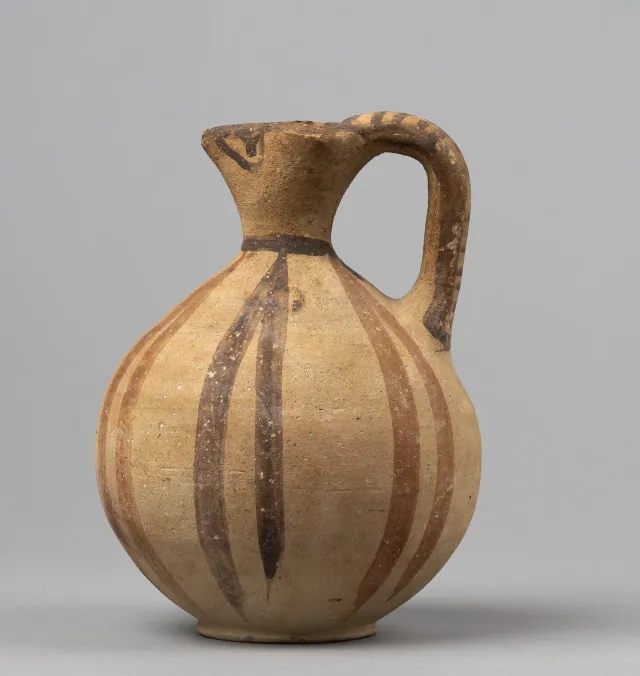
Which label fits this jug? Look at the paint, then at the neck and the handle.
Question
A dove held by a worshipper in limestone, and a long-necked waterbird painted on a jug in a grave. What does the evidence say about them?
What to look for
- A pale buff to greenish body, wheel-made, painted in matt black (White Painted) or matt black and red (Bichrome). The numeral IV means Cypro-Archaic I (c. 750 to 600 BC), V means Cypro-Archaic II (c. 600 to 480 BC).
- Concentric circles drawn with a pivoted multiple brush, big vertical systems on jug sides or horizontal rows on amphora shoulders, with small hand-placed circle groups between them: the Western circle style.
- Lotus flowers and buds in a frieze, rosettes and panelled necks on large shoulder-handled amphorae: the Eastern style, centred on Salamis.
- One figure (a bird, a fish, a goat, a bull) on the bare front of a pinched-mouth or barrel jug, opposite the handle, with a few small fillers and no framing bands: the free-field style, at its height in Bichrome IV.
- A pair of painted eyes either side of a pinched spout, often with brows; on a few Kourion-region jars, a whole face modelled on the neck.
- Ornament spreading over the whole surface, dense lotus "carpets" or circles everywhere, with looser drawing: think Bichrome V.
Go deeper
The compendium pages on the free-field style, lotus flowers, concentric circles, Bichrome and Iron Age White Painted ware, and the amphora and jug shapes carry this lesson further. The striding bird jug has its own history in A Bird in the Hand and a page of its own in the Drakopoulos collection, as does the lotus amphora.
References
- 1.Gjerstad, E. (1948). The Swedish Cyprus Expedition, Vol. IV, Part 2: The Cypro-Geometric, Cypro-Archaic and Cypro-Classical Periods. Stockholm: The Swedish Cyprus Expedition.
- 2.Coldstream, J. N. (1968). Greek Geometric Pottery. London: Methuen, pp. 318-320.
- 3.Karageorghis, V., Mertens, J. R., & Rose, M. E. (2000). Ancient Art from Cyprus: The Cesnola Collection in The Metropolitan Museum of Art. New York: The Metropolitan Museum of Art.
- 4.Georgiadou, A., & Dikomitou-Eliadou, M. (2022). The Iron Age pictorial pottery of Salamis within and beyond: An overview of ceramic styles, wares and fabrics. In G. Bourogiannis (Ed.), Beyond Cyprus: Investigating Cypriot Connectivity in the Mediterranean from the Late Bronze Age to the End of the Classical Period (AURA Supplement 9), pp. 335-348. Athens: National and Kapodistrian University of Athens.
- 5.Morris, D. (1985). The Art of Ancient Cyprus, with a Check-list of the Author's Collection. Oxford: Phaidon.
- 6.Dikaios, P. (1937). An Iron Age painted amphora in the Cyprus Museum. The Annual of the British School at Athens, 37, 56-72.
- 7.Karageorghis, V., & des Gagniers, J. (1974). La céramique chypriote de style figuré: Âge du Fer (1050-500 av. J.-C.). Rome: Consiglio Nazionale delle Ricerche; Supplément 1979.
- 8.Coldstream, J. N. (2009). Cypriot taste in early Greek ceramic imports. Ancient West & East, 8, 21-36.
- 9.Reyes, A. T. (1994). Archaic Cyprus: A Study of the Textual and Archaeological Evidence. Oxford: Clarendon Press.
- 10.Dissinger, A. M. (2017). Cypro-Archaic Bird Iconography: Types, Uses, and Meanings. PhD dissertation, University of Virginia.
- 11.Caubet, A. (2005). Le lotus, le tilapia et le rouget barbet. Cahiers du Centre d'Études Chypriotes, 35, 89-97.
- 12.Bushnell, L. (2008). The wild goat-and-tree icon and its special significance for ancient Cyprus. In G. Papantoniou, A. Fitzgerald and S. Hargis (eds), POCA 2005: Postgraduate Cypriot Archaeology. BAR International Series 1803. Oxford: Archaeopress, 65-76.
- 13.Karageorghis, V. (1975). Chronique des fouilles et découvertes archéologiques à Chypre en 1974. Bulletin de correspondance hellénique, 99, 801-869.
- 14.Karageorghis, V. (1976). Chronique des fouilles et découvertes archéologiques à Chypre en 1975. Bulletin de correspondance hellénique, 100, 839-906.
- 15.Fourrier, S. (2008). Le dépôt archaïque du rempart Nord d'Amathonte. VI. Vases du style d'Amathonte. Bulletin de correspondance hellénique, 132, 555-585.
- 16.Karageorghis, V. (1989). The Cyprus Museum. Nicosia: C. Epiphaniou Publications.
- 17.Gjerstad, E., Lindros, J., Sjöqvist, E. and Westholm, A. (1935). The Swedish Cyprus Expedition II: Finds and Results of the Excavations in Cyprus 1927–1931. Stockholm: The Swedish Cyprus Expedition (Stylli tombs).