
Copper is the material around which the archaeology of Cyprus has been written for a century, and the reason is geological before it is historical. The Troodos massif, a slab of ancient ocean floor pushed above sea level, carries sulphide ore bodies in its pillow lavas that rank among the richest in the Mediterranean, clustered in the districts of Skouriotissa, Mitsero, Tamassos, Kalavasos and Limni [1, p. 84]. The metal was worked on the island for well over three thousand years before the end of the Cypro-Archaic period, and the way it was worked changed profoundly: from a handful of hammered native-copper ornaments in the Chalcolithic, through open-mould casting in the Early and Middle Bronze Age, to the multi-stage sulphide smelting and standardised oxhide ingots of the Late Bronze Age, and finally to the large-scale mining that fed the Iron Age city-kingdoms. This entry follows that technical sequence and marks where the evidence is thin, where the dating has moved, and where scholars still disagree. The broader economic and political story is told in the articles on the copper kingdoms and on metal in ancient Cyprus; the weapons cast from the metal have their own entry.
The ore and the name
Cypriot copper occurs almost entirely as chalcopyrite, a copper-iron sulphide, in massive sulphide bodies formed around hydrothermal vents on the sea floor some ninety million years ago [1, p. 84]. Where these bodies weather at the surface they are capped by gossans, the rust-red and ochre-yellow iron oxide zones that gave ancient prospectors their first sign of metal beneath and that also supplied the island's umbers and ochres. Ore grades run from under one to about five per cent copper, with local zones of secondary enrichment far richer. The sulphide chemistry matters for everything that follows: a sulphide ore cannot simply be reduced to metal in one heat, as an oxide or carbonate ore can, and the Cypriot copper industry is in large part the history of learning to deal with sulphur.
The etymology usually repeated, that the island gave its name to the metal, is correct but late. Classical Latin called copper aes; the phrase aes cyprium, "Cypriot copper", was shortened to cyprium and then to cuprum, a form not attested before Pliny the Elder, and it is from cuprum that the English, French and German words descend [2, pp. 26–27]. The Greek word was chalkos, unrelated to the island. The derivation runs from the place to the metal, and it belongs to the Roman period, when Cyprus was still a principal supplier.
The Chalcolithic: a cold craft in the copper-poor west
The first metal on Cyprus is small, late and provincial. Annealed native copper was in use in Anatolia in the ninth millennium BCE; on Cyprus the first objects appear only in the Middle Chalcolithic, around 3400 BCE, and the entire excavated corpus of the period, on Peltenburg's 2011 count, is eighteen objects, all from the copper-poor southwest around Paphos: chisels, awls, a hook, pins, spiral beads and pendants from Erimi, Souskiou, Lemba, Kissonerga and Chlorakas-Palloures [4]. A broken chisel from Erimi-Pamboula Layer IX is the earliest secure piece; the awl with a bone handle from Kissonerga-Mosphilia (KM 416) is the best known; and the copper axe from Chlorakas-Palloures, about 75 mm long and 119 g, cached inside a jar together with a stone axe, is the heaviest [5, p. 672].
Technologically this is a cold craft. The objects were made by hammering and annealing, at temperatures of a few hundred degrees, a process conceptually closer to the working of chert and picrolite than to smelting [3]. Whether any of the metal was smelted rather than native has been argued back and forth for thirty years. Noël Gale's lead-isotope work in 1991 suggested imported, smelted copper, resting on an axe fragment from Kissonerga (KM 457); Peltenburg later showed that the piece came from disturbed deposits containing Bronze Age material and could not be dated to the Chalcolithic at all [3]. The most recent isotope study, by Düring and colleagues in 2021, points the other way again: the Chlorakas-Palloures objects match Taurus ores in Anatolia, and two objects long cited as Cypriot exports, the Pella axe and the Ayia Photia fish-hook, are more likely Anatolian too [5, pp. 678–682]. The safest summary is that Middle Chalcolithic ornaments were native copper, that some Late Chalcolithic tools may have been smelted or imported, and that there is no evidence for extractive metallurgy on the island before the Bronze Age [5, p. 670].
Philia and the Early Bronze Age: casting begins
The break comes with the Philia facies, around 2500/2400 BCE. Metal objects suddenly increase in number and variety, and for the first time they are cast in open moulds and then hammered and annealed to harden the edges [3]. The Philia repertoire is coherent and largely without local ancestors: spiral earrings, toggle pins, tweezers, flat-tanged knives and daggers, hook-tang weapons, flat axes with polygonal butts, awls, needles and scrapers. Its closest parallels lie in Early Bronze Age Anatolia and Cilicia, and the change is one of the principal arguments for the migration of people from southwestern Anatolia that Webb and Frankel have proposed for the start of the Cypriot Bronze Age, though internal adoption through contact remains a minority reading [3].
The alloy of the Early Cypriot period is arsenical copper, with arsenic usually between 0.1 and 2.8 per cent. Because Cypriot sulphide ores carry arsenic only as a trace, the arsenic had to be added, probably from the polymetallic ores of the Limassol Forest, either in the smelting charge or to the molten metal [3]. Tin bronze appears earlier than once thought but remains rare: Webb, Frankel, Stos and Gale identified three tin bronzes among the Philia-period objects attributed to Vasilia, two of them a spearhead and a sword of foreign type whose lead isotopes point to the Taurus, and the third an axe of Cypriot type made of Cypriot copper, which shows that tin was already being imported and alloyed on the island [6]. Four tin-bronze spiral rings from Sotira-Kaminoudhia Tomb 6 seem to have been chosen for their gold-like colour. Tin bronze did not become common until after 2000 BCE, and even in Middle Cypriot III only about half of the analysed objects contain tin [3].
Production evidence for the Early Bronze Age is meagre. No slag heap of the period exists anywhere on the island. What the villages yield is evidence of melting and casting, not smelting: at Marki-Alonia three chalk moulds, one of them (S850) built into a Philia-phase wall, were used to cast bar-shaped ingots and flat axes with perforated butts, axes that could be strung together for transport and that probably served as ingots as well as tools [7, pp. 215–217]. The graded weights of these axe-ingots hint at standard units of exchange from the very beginning of Cypriot metallurgy [3]. Two Cesnola axeheads of this general class are on the site: 74.51.5391 and 74.51.5399.
The Middle Bronze Age: Ambelikou-Aletri and the first mines
The one site that shows the whole chain of Middle Cypriot production is Ambelikou-Aletri, in the northwestern Troodos foothills about six kilometres from the Skouriotissa mines. Porphyrios Dikaios excavated it in a rescue campaign in 1942; Webb and Frankel published it in full only in 2013, redating it from Dikaios's Early Cypriot III to Middle Cypriot I, around the late twentieth or early nineteenth century BCE [8, pp. 14–15]. Red Polished sherds and stone hammers were found in the ancient galleries intercepted by the modern mine, the earliest direct evidence of mining on Cyprus; a fragment of furnace lining with adhering slag proves that smelting took place; a crucible with a pinched spout (no. 494, in the Cyprus Museum) was used for melting under charcoal with a blowpipe; and a double-sided clay mould with axe-shaped matrices on both faces, unique in the eastern Mediterranean, cast axe-shaped ingots rather than finished tools [8, pp. 113–116]. Only two finished metal objects were found on the whole site, a needle and a blade fragment. Aletri made metal for export, not for its own use.
Two corrections attach to this site and recur in older books. The first concerns bellows. There is no certain evidence for tuyères or bellows anywhere on Cyprus before Late Cypriot I; the D-shaped tuyère that R. F. Tylecote paired with the Aletri crucible in his influential reconstruction actually comes from the Late Bronze Age mining village of Apliki [8, p. 113; 9]. Middle Cypriot furnaces were probably small natural-draught structures placed on higher ground to catch the wind, helped by blowpipes. The second concerns efficiency. Middle Cypriot slag is small, irregular and crusted with copper carbonates, which means the smiths never reached a temperature or charge that would let slag and metal separate cleanly; the slag had to be crushed mechanically to pick out the copper prills [9]. Kassianidou's phrase for the Middle Bronze Age is "the formative years": the foundations of the industry were laid, and sulphide ores were already being worked, but on a village scale and with a technology that the Late Bronze Age would leave behind [9]. Other Middle Cypriot sites with moulds, crucibles or slag include Alambra, Pyrgos-Mavroraki, Politiko-Troullia and Kalopsidha, a pattern of many small dispersed centres near the ore bodies [8, p. 113].
The Late Bronze Age: roasting, matte and the furnace at Politiko-Phorades
The technical transformation of the Late Cypriot period can be read at a single site. Politiko-Phorades, discovered by the Sydney Cyprus Survey Project in 1996 and excavated by Bernard Knapp and Vasiliki Kassianidou in 1997–2000, is the earliest primary smelting workshop excavated on the island, dated by White Slip I and Base Ring I pottery and by radiocarbon to the sixteenth and fifteenth centuries BCE [10, p. 559; 11, p. 141]. It is an open-air workshop on the bank of a creek, with no architecture; the smelters built an artificial platform of river pebbles and piled their waste against the bank. Three seasons recovered more than 3.5 tons of slag, almost 6,000 fragments of furnace rims, walls and bases, fifty nearly complete tuyères and over 600 tuyère fragments, the largest such assemblage from any Cypriot site [10, p. 563; 11, p. 141].
What the Phorades material shows is a multi-stage process for sulphide ore. The ore was crushed and roasted elsewhere to drive off sulphur. In the furnace, a free-standing cylinder of chaff-tempered clay about 42–44 cm across and at least 30 cm high, capable of withstanding 1200 °C, the roasted ore was smelted with charcoal of Pinus brutia to produce matte, an intermediate copper-iron sulphide, while an iron-silicate slag was tapped off as large plano-concave cakes of about 20 kg [11; 14, p. 33]. A small lump of matte, silver-blue in colour, analysed at 73.5 per cent copper, 2.6 per cent iron and 23.9 per cent sulphur; its presence "demonstrates beyond doubt" that Phorades was a primary smelter [10, p. 563]. The matte then had to be roasted and re-smelted to black copper and refined again to reach the purity found in finished ingots, work done elsewhere, probably in the coastal towns [10, p. 563; 12]. The tuyères, inserted from the top of the furnace rather than the side, and the pot-bellows that fed them were the decisive Late Cypriot innovation; the liquid separation of slag from matte superseded the crush-and-pick method of the Middle Bronze Age [9; 14, p. 33]. Phorades was a small operation. Its estimated lifetime output of roughly 300–350 kg of copper would fill about ten oxhide ingots, so dozens of such workshops were needed for a single large cargo [10].
The other end of the chain is Apliki-Karamallos, a Late Cypriot IIC mining village of the thirteenth century sitting on the northwestern ore bodies, excavated by Joan du Plat Taylor in 1938–39 before the modern mine destroyed it and restudied by Kling and Muhly in 2007 [13]. It produced tap slag, large tuyères, ore-crushing tools and crucible fragments, and its House A, with bronze styli, may have housed whoever administered the mine. It produced no oxhide ingot fragment at all, which is telling: the ingots were cast where the copper was refined, at the coast, not where it was mined.
| Period | Approximate date BCE | Technology | Key evidence |
|---|---|---|---|
| Middle and Late Chalcolithic | 3400–2400 | Hammering and annealing of native copper; no smelting | About eighteen small objects, all from the southwest; Chlorakas-Palloures axe |
| Philia and Early Cypriot | 2500/2400–2000 | Open-mould casting; arsenical copper; sporadic imported tin bronze | Marki-Alonia moulds and axe-ingots; Vasilia tin bronzes |
| Middle Cypriot | 2000–1650 | Natural-draught furnaces; crucible melting; slag crushed for prills | Ambelikou-Aletri mine, crucible and double mould; Alambra, Pyrgos |
| Late Cypriot | 1650–1050 | Tuyères and bellows; matte smelting; tapped slag; refined copper cast as oxhide ingots | Politiko-Phorades; Apliki; Enkomi and Kition workshops; Uluburun and Cape Gelidonya |
| Cypro-Geometric and Cypro-Archaic | 1050–480 | Iron smithing alongside bronze; large-scale copper smelting begins | Bimetallic knives; Ayia Varvara-Almyras; radiocarbon-dated slag heaps |
Ingots, ships and letters: the copper of Alashiya
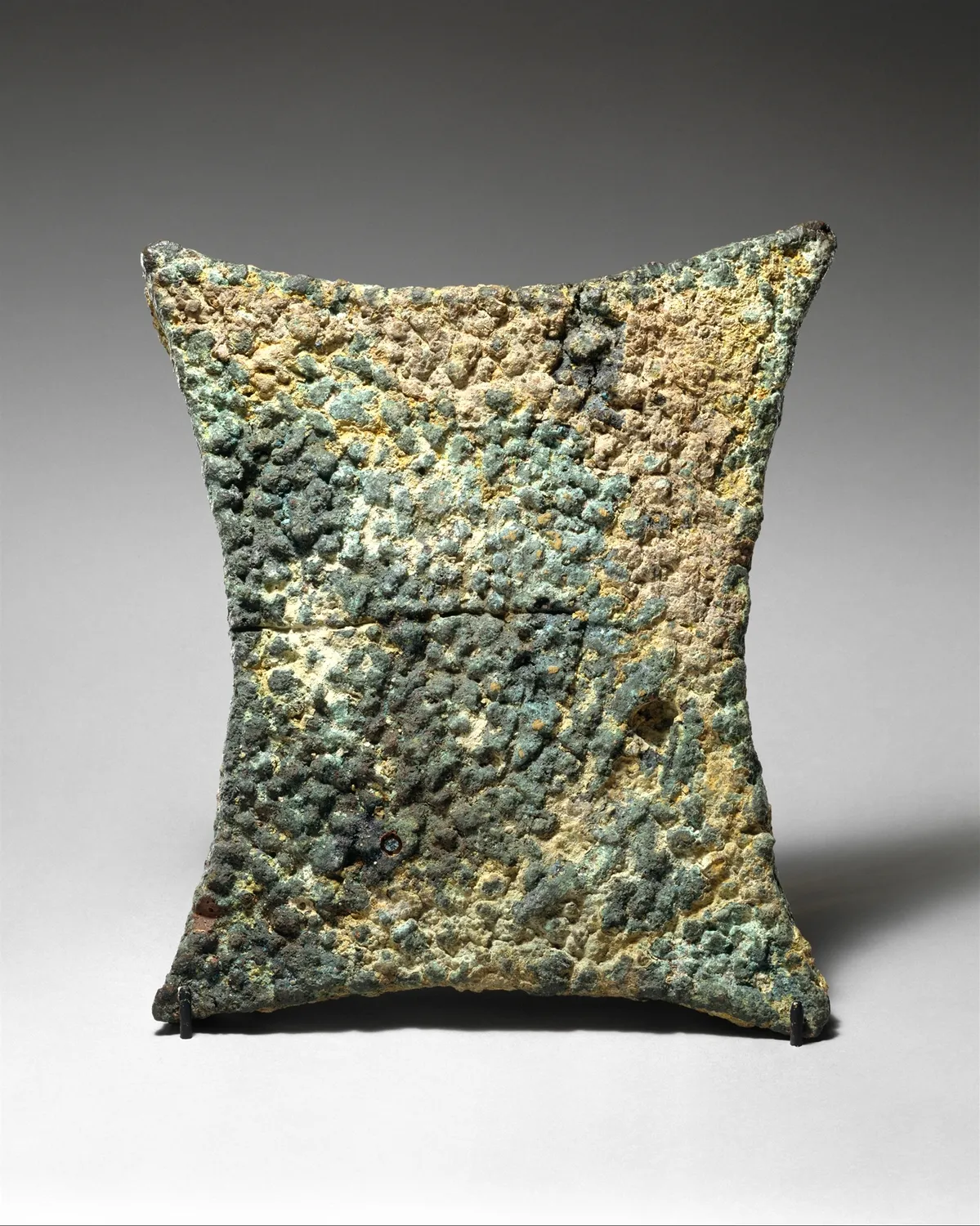
The export form of Late Cypriot copper was the oxhide ingot, a flat slab with four projecting handles, usually 30–60 cm long and around 24–30 kg, close to a talent in the weight systems of the period [14, p. 88]. The handles are for carrying; the resemblance to a stretched hide is incidental, and the weights are too inconsistent for the ingots to have served as money. They were cast in a single pour of refined copper into an open mould of sand or clay, which is why one face is rough and gas-pitted and why no moulds survive. Many carry marks, some of them signs of the Cypro-Minoan script. A Late Cypriot III example from Enkomi in the British Museum bears an impressed sign near one edge; another Enkomi ingot in the Cyprus Museum is 73 cm long and weighs 39.18 kg; the Metropolitan Museum's ingot 11.140.7 is on this site.
That these ingots are Cypriot copper is now settled, though it was fought over. Lead isotope analysis, developed for Cyprus by Noël Gale and Zofia Stos-Gale from 1982, matches essentially all analysed oxhide ingots dated after about 1400 BCE, from Crete, Sardinia, Anatolia and the two shipwrecks, to the Apliki ore region in the north of the island [1, pp. 118–120]. Budd, Pollard and colleagues argued in 1995–96 that the ore data were too sparse to support any such match and that recycled scrap would have blurred the signal; the Gales replied with nearly two hundred new analyses from twenty-six Cypriot mines and with the observation that on a single wreck the artefacts show a broad isotopic spread while the ingots are homogeneous, which is not what mixing would produce [1; 14, pp. 86–88]. The earliest ingots, from Late Minoan IB hoards on Crete, are not Cypriot, and their source is still unknown [14, p. 88]. Two cargoes give the scale of the trade. The Uluburun ship, wrecked off the Lycian coast around 1300 BCE, carried some ten tons of copper as 354 oxhide ingots and about 121 bun ingots, nearly all of it Cypriot, together with roughly a ton of tin [15, pp. 188–195]. Cape Gelidonya, around 1200 BCE, carried under a ton of ingots and scrap with the tools of a travelling smith [16]. One such ingot sold at auction in recent years.
The written record names the exporter. The kingdom of Alashiya appears in cuneiform texts from Mari, Alalakh and Babylon in the nineteenth to seventeenth centuries, always in connection with copper or bronze; a Mari text defines Alashiyan bronze as a seven-to-one alloy of copper and tin [3]. In the mid-fourteenth century eight Amarna letters (EA 33–40) from the king of Alashiya address the pharaoh as "my brother" and accompany shipments of copper, in one case 500 talents, sent with an apology that the amount is small because "the hand of Nergal", a plague, has killed the copper-workers [17, pp. 105–111]. Whether Alashiya was Cyprus was, in Muhly's phrase, an old conundrum until 2003, when Goren and colleagues showed by petrography that the Alashiya tablets were made of clays from the southern margin of the Troodos, closest to the area of Alassa and Kalavasos [18, pp. 245–250]. The identification is now accepted; the location of the capital is not.
Workshops, temples and gods: Enkomi and Kition
Refining and casting were urban work. Enkomi had metallurgical installations from its earliest levels around 1650 BCE, and by the thirteenth century an industrial quarter near the north gate and later in the central blocks, with an 80 m² slag dump that Dikaios described as mass production; Kassianidou reads these installations as refining matte and black copper and casting ingots, not as primary smelters [14, p. 33]. At Kition, by the end of the thirteenth century, three copper workshops stood directly against the twin ashlar temples and communicated with them, and hundreds of kilograms of slag, tuyères, crucibles and stone moulds were recovered from the sacred precinct [19]. The same association recurs at Athienou, an inland sanctuary that may have served as a secondary processing node.
How this industry was controlled is the central interpretative argument of Late Cypriot archaeology. Hector Catling in 1971 proposed a temple-based industry. Bernard Knapp, in Copper Production and Divine Protection (1986), reframed it as an industry managed by secular elites who used religious ideology to legitimise their control, and he has since stressed that his point was the link between copper and elite ideology, not a priestly monopoly [20]. Priscilla Keswani's settlement and mortuary work describes a heterarchy of regional polities rather than a single centre. The evidence that copper and cult were bound together is not in dispute. The Ingot God, a 35 cm bronze warrior in a horned helmet found by Schaeffer in a twelfth-century sanctuary at Enkomi, stands on a base shaped as an oxhide ingot; George Papasavvas has shown by X-ray that the figure began as a striding "smiting god" of Near Eastern type and was later reworked, by a less skilled hand, to stand still upon the ingot [21]. The smaller "Bomford goddess" in the Ashmolean stands on an ingot too. Whether these were a divine couple presiding over the mines, as Catling argued, is contested; that Cypriots chose to picture their gods standing on copper is not.
The finished bronzes of the same centuries are the technical summit of the Cypriot industry: rod tripods and four-sided openwork stands cast by the lost-wax method, some on wheels, their panels showing ingot-bearers, lyre-players and sphinxes, exported to Crete, the Aegean, the Levant and Sardinia [22]. Catling's 1964 monograph remains the type-series for these and for the swords, spearheads and greaves discussed under weapons. A caution on scale: the four million tons of slag that survive around the Troodos are overwhelmingly later than the Bronze Age. Every one of the radiocarbon dates from the great heaps falls between about 500 BCE and 500 CE, and the Skouriotissa heap is Late Roman [25]. Bronze Age slag is scarce and dispersed, found in settlements and at small workshops like Phorades.
Iron, and the Archaic copper boom
Copper did not lose its place when iron arrived. Cyprus was among the first regions of the eastern Mediterranean to make iron a working metal: single-edged iron knives with bronze rivets appear in Late Cypriot IIIA tombs at the start of the twelfth century, earlier and in greater numbers than in the Aegean, and Maria Iacovou describes the island as preeminent in the exploitation of functional iron [23, p. 632]. The majority view, held by Snodgrass, Sherratt, Muhly and Iacovou, makes Cyprus the pioneer; Jane Waldbaum's 1978 monograph dissented, seeing the island enter the Iron Age at the same pace as its neighbours under pressure from a tin shortage [24]. The claim that a knife from Idalion of about 1100 BCE is the earliest quenched steel in the region rests on a context now considered unreliable. The Metropolitan Museum's bronze-and-iron knife 74.51.5356, of about 1150–1100 BCE, is an example of the bimetallic horizon.
Bronze remained the metal of vessels, stands, votives, fibulae and jewellery through the Cypro-Geometric period, and the paradox of the first millennium is that the intensive, industrial phase of Cypriot copper production belongs to the Archaic and Classical periods rather than to the Bronze Age. The radiocarbon-dated slag heaps and mine timbers begin in the seventh and sixth centuries: supports at Mitsero-Kokkinoyia, timbers from the Tamassos mines dated around 660, 540 and 410 BCE, and Ayia Varvara-Almyras, the only fully excavated primary smelting workshop of the period, working from about 600 BCE and probably supplying Idalion [25]. Ore mined around Tamassos, smelted at Idalion and shipped through Kition is the economic geography behind the wars between Kition and Idalion recorded on the Idalion tablet. At Tamassos a smelting workshop was physically attached to the temple of Astarte, with slag in the temple pits, the Bronze Age pairing of metallurgy and cult surviving into the kingdoms [25]. The wealth that the ore produced is most visible in the royal tombs of Salamis, where cauldrons, chariot fittings, iron spits and a silver-studded sword accompanied the dead of the late eighth and seventh centuries [26, pp. 68–92], and it was the reason the island's kings appear in Assyrian tribute lists; the price of that metal in the first millennium is treated separately.
What remains uncertain
Three problems stay open. The first is smelting before the Late Bronze Age: not one Early Cypriot smelting installation has been excavated, and the inference that Philia and Early Cypriot copper was smelted locally rests on isotope matches, moulds and settlement siting rather than on furnaces [3]. The second is the source of tin, which Cyprus never had; the Uluburun tin ingots point to both the Taurus and Central Asia, and the Mari caravan texts to sources east of Mesopotamia [2; 15]. The third is control. The Phorades smelters and the Apliki miners worked at the ore; the refiners and ingot-casters worked at Enkomi and Kition beside the temples; the king of Alashiya wrote to Egypt from clay dug on the southern slopes of the Troodos. Whether a single authority linked those three places, or several regional ones competed, is the question on which the reading of Late Cypriot society still turns.
References
- 1.Stos-Gale, Z. A., Maliotis, G., Gale, N. H., & Annetts, N. (1997). Lead isotope characteristics of the Cyprus copper ore deposits applied to provenance studies of copper oxhide ingots. *Archaeometry, 39*(1), 83–123.
- 2.Muhly, J. D. (1973). *Copper and tin: The distribution of mineral resources and the nature of the metals trade in the Bronze Age* (Transactions of the Connecticut Academy of Arts and Sciences, 43). Archon Books.
- 3.Kassianidou, V. (2013). Metals. In E. Peltenburg (Ed.), *ARCANE II: Cyprus* (Associated Regional Chronologies for the Ancient Near East and the Eastern Mediterranean). Brepols.
- 4.Peltenburg, E. (2011). Cypriot Chalcolithic metalwork. In P. P. Betancourt & S. C. Ferrence (Eds.), *Metallurgy: Understanding how, learning why. Studies in honor of James D. Muhly* (Prehistory Monographs 29). INSTAP Academic Press.
- 5.Düring, B. S., De Ceuster, S., Degryse, P., & Kassianidou, V. (2021). Transformative copper metallurgy in Chalcolithic Cyprus: A reappraisal. *Antiquity, 95*(381), 670–685. https://doi.org/10.15184/aqy.2020.171
- 6.Webb, J. M., Frankel, D., Stos, Z. A., & Gale, N. (2006). Early Bronze Age metal trade in the eastern Mediterranean: New compositional and lead isotope evidence from Cyprus. *Oxford Journal of Archaeology, 25*(3), 261–288.
- 7.Frankel, D., & Webb, J. M. (2006). *Marki Alonia: An Early and Middle Bronze Age settlement in Cyprus. Excavations 1995–2000* (Studies in Mediterranean Archaeology 123:2). Paul Åströms Förlag.
- 8.Webb, J. M., & Frankel, D. (2013). *Ambelikou Aletri: Metallurgy and pottery production in Middle Bronze Age Cyprus* (Studies in Mediterranean Archaeology 138). Åströms Förlag.
- 9.Kassianidou, V. (2008). The formative years of the Cypriot copper industry. In I. Tzachili (Ed.), *Aegean metallurgy in the Bronze Age: Proceedings of an international symposium held at the University of Crete, Rethymnon, 19–21 November 2004*. Ta Pragmata.
- 10.Knapp, A. B. (2003). The archaeology of community on Bronze Age Cyprus: Politiko Phorades in context. *American Journal of Archaeology, 107*(4), 559–580.
- 11.Hein, A., Kilikoglou, V., & Kassianidou, V. (2007). Chemical and mineralogical examination of metallurgical ceramics from a Late Bronze Age copper smelting site in Cyprus. *Journal of Archaeological Science, 34*(1), 141–154. https://doi.org/10.1016/j.jas.2006.04.005
- 12.Knapp, A. B., & Kassianidou, V. (2008). The archaeology of Late Bronze Age copper production: Politiko Phorades on Cyprus. In Ü. Yalçın (Ed.), *Anatolian Metal IV* (Der Anschnitt, Beiheft 21, pp. 135–147). Deutsches Bergbau-Museum.
- 13.Kling, B., & Muhly, J. D. (Eds.). (2007). *Joan du Plat Taylor's excavations at the Late Bronze Age mining settlement at Apliki Karamallos, Cyprus, Part 1* (Studies in Mediterranean Archaeology 134:1). Åströms Förlag.
- 14.Kassianidou, V., & Papasavvas, G. (Eds.). (2012). *Eastern Mediterranean metallurgy and metalwork in the second millennium BC: A conference in honour of James D. Muhly, Nicosia, 10th–11th October 2009*. Oxbow Books.
- 15.Pulak, C. (1998). The Uluburun shipwreck: An overview. *International Journal of Nautical Archaeology, 27*(3), 188–224.
- 16.Bass, G. F. (1967). *Cape Gelidonya: A Bronze Age shipwreck* (Transactions of the American Philosophical Society, 57:8). American Philosophical Society.
- 17.Moran, W. L. (1992). *The Amarna letters*. Johns Hopkins University Press.
- 18.Goren, Y., Bunimovitz, S., Finkelstein, I., & Na'aman, N. (2003). The location of Alashiya: New evidence from petrographic investigation of Alashiyan tablets from El-Amarna and Ugarit. *American Journal of Archaeology, 107*(2), 233–255.
- 19.Karageorghis, V., & Demas, M. (1985). *Excavations at Kition V: The pre-Phoenician levels*. Department of Antiquities, Cyprus.
- 20.Knapp, A. B. (1986). *Copper production and divine protection: Archaeology, ideology and social complexity on Bronze Age Cyprus* (Studies in Mediterranean Archaeology Pocket-book 42). Paul Åströms Förlag.
- 21.Papasavvas, G. (2011). From smiting to smithing: The transformation of a Cypriot god. In P. P. Betancourt & S. C. Ferrence (Eds.), *Metallurgy: Understanding how, learning why. Studies in honor of James D. Muhly* (Prehistory Monographs 29). INSTAP Academic Press.
- 22.Catling, H. W. (1964). *Cypriot bronzework in the Mycenaean world*. Clarendon Press.
- 23.Iacovou, M. (2008). Cultural and political configurations in Iron Age Cyprus: The sequel to a protohistoric episode. *American Journal of Archaeology, 112*(4), 625–657.
- 24.Waldbaum, J. C. (1978). *From bronze to iron: The transition from the Bronze Age to the Iron Age in the eastern Mediterranean* (Studies in Mediterranean Archaeology 54). Paul Åströms Förlag.
- 25.Kassianidou, V. (2013). The production and trade of Cypriot copper in the Late Bronze Age: An analysis of the evidence. *Pasiphae, 7*.
- 26.Karageorghis, V. (1969). *Salamis in Cyprus: Homeric, Hellenistic and Roman*. Thames & Hudson.