
Ancient Cypriot Pottery·Lesson 6
Mycenaean Pots and the End of the Bronze Age
Imported Mycenaean chariot kraters, the Cypriot three-handled jars that copied Aegean perfume jars, and the Aegean-style wares Cyprus made after 1200 BC. Learn to tell an import from a local product, and why these pots do not prove a Greek invasion.
Alexis Drakopoulos·Period by period·12 min read
Share


Lesson 6·Course contents, 15 lessons
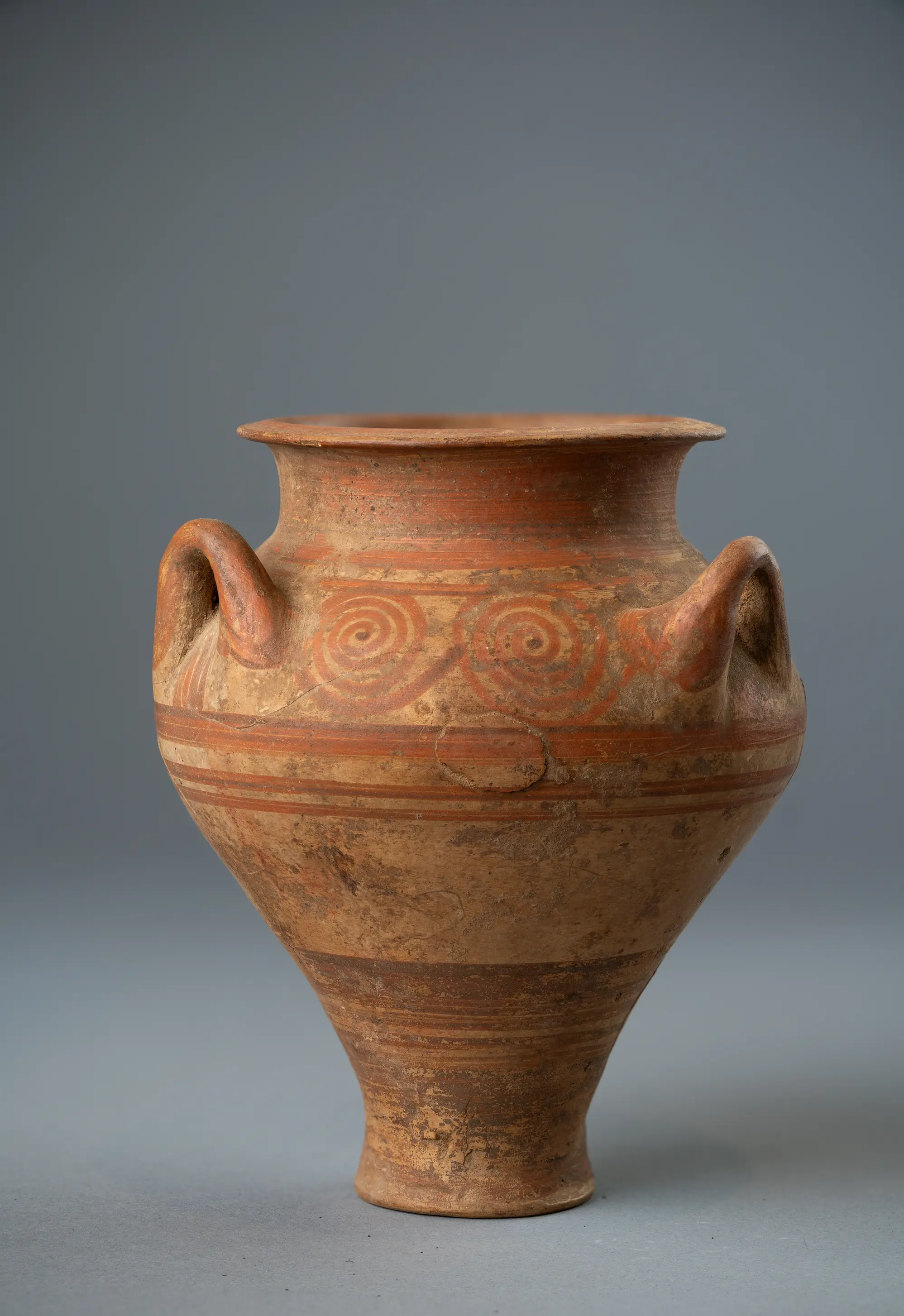
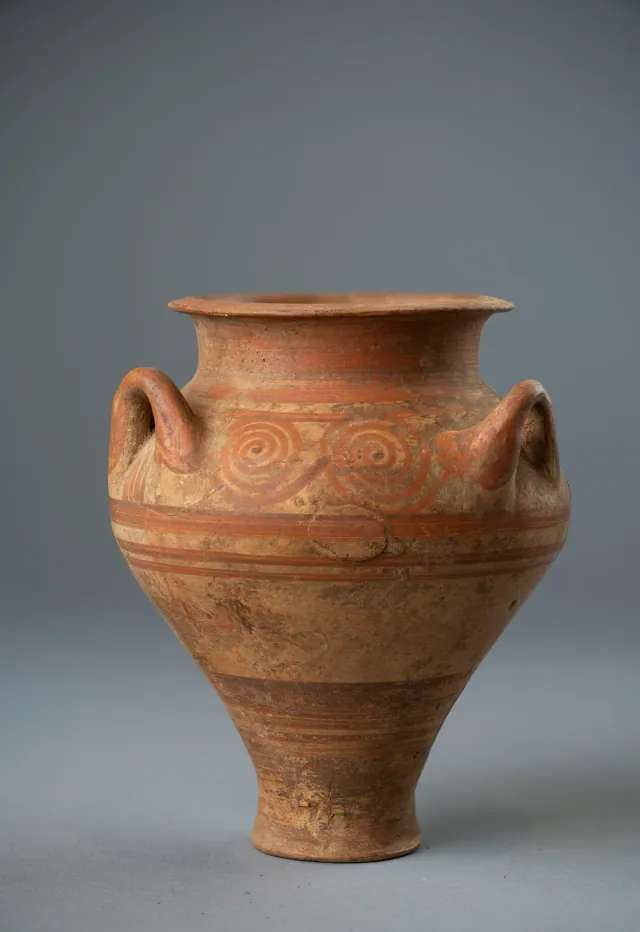
The small jar beside this paragraph, in the Drakopoulos collection, was thrown on the wheel in a buff to pinkish clay. It swells to a rounded shoulder and stands on a tall, narrow foot that splays at the base. Three small loop handles sit high on the shoulder, and between them runs a frieze of linked spirals in matt orange-red to brown paint, each coil drawn in two or three turns. On the far side most of the spirals have flaked away with the surface. The jar was once described as an import from the Aegean islands, dated loosely to somewhere between 1400 and 1050 BC. It was made in Cyprus, in the 14th century BC [1].
That correction came out of a laboratory, and laboratories had earlier delivered the opposite verdict on the most famous Mycenaean pots ever found on the island: clay analysis took the great painted chariot kraters away from Cyprus and gave the modest jars back to it. After 1200 BC Cypriot workshops made Aegean-looking pottery in such quantity that generations of scholars read it as proof that Greeks had moved to the island.
Chariot kraters: wanted in Cyprus, made in the Argolid
The Mycenaeans were the palace societies of the Greek mainland, and their pottery is dated by its own scheme, Late Helladic (LH). Its peak of export, LH IIIA2 and LH IIIB, corresponds to Late Cypriot (LC) IIA to IIC, roughly the 14th and 13th centuries BC. From LH IIIA2 onward large quantities of Mycenaean pottery reached all parts of the island. Enkomi, Kition and Hala Sultan Tekke have each produced more than 500 pieces, and a single Swedish tomb at Enkomi held 22 Mycenaean kraters [3].
Two families dominate. The first is the small closed container, above all the stirrup jar, a squat jar whose real spout sits to one side of a solid false neck bridged by two handles, made to hold scented oil. The second is the drinking set, centred on the amphoroid krater, a large wine-mixing bowl with a jar-like body, most often painted with a pair of robed figures riding in a horse-drawn chariot amid birds, bulls and stylised trees. Maria Iacovou has a plain explanation for the island's appetite: its own fine pottery in this period, handmade Base Ring and White Slip (Lesson 5), carried no pictures, and a newly urban society "was attracted to pictorial vases because their own pottery had no imagery" [4].
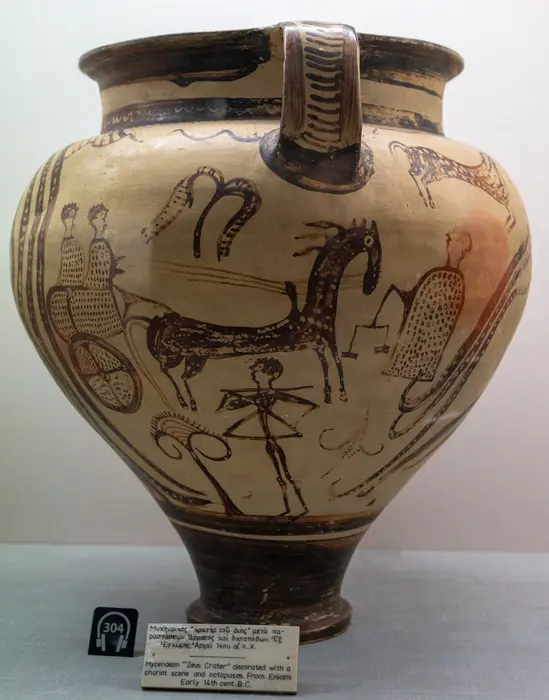
So many of these vases came out of Cypriot tombs that early scholars assumed they had been painted there: John Myres wrote of a "local Cypriote school" [6], and Frank Stubbings in 1951 imagined colonies of Mycenaean potters on the island [3]. In the early 1960s Hector Catling's team at Oxford found that the trace elements in most Mycenaean sherds from Cyprus matched the clay of the Peloponnese. Vassos Karageorghis doubted the method and in 1966 sent the analysts a box of 25 numbered fragments, their find-spots in a sealed envelope that stayed shut until the work was done. Some had been dug at Mycenae and Tiryns, the rest at Kition and Enkomi, and Karageorghis's selection, the analysts reported, "was made up entirely of material which, though found in Cyprus, was not made there" [5]. Neutron activation analysis, which fingerprints a clay by some thirty trace elements, later pinned most of the imports to workshops in the Argolid around Mycenae [3].
The verdict holds for the chariot krater in the Cyprus Museum illustrated here. Laerke Recht and Christine Morris, whose 2021 catalogue counts nearly 400 chariot kraters, conclude that all were made in mainland Greece and exported to Cyprus and the Levant. The Cypriot examples almost rival the Greek ones in number, and the very earliest, of early LH IIIA2, have all been found outside Greece: 22 in Cyprus and two in the Levant [6]. These were export goods, and they were a sliver of what Cypriots used. At Kalavasos-Ayios Dhimitrios, Mycenaean wares make up less than 1 per cent of all the pottery, and the island as a whole is little different [7].
The first copies: three-handled jars
The jar that opened this lesson belongs to a class the Swedish scholar Arne Furumark numbered FS 46 and 47 in his Mycenaean shape system (FS stands for Furumark Shape): small, conical, three-handled cousins of the imported piriform jars that held perfumed oil. Gianfranco Graziadio's 2017 study catalogues 122 of them. Almost all come from Cyprus, a handful from the Levant and Egypt, and none from the Aegean [1]. In 2003 neutron activation analysis of an FS 47 jar from Hala Sultan Tekke showed it had been made on the island [2], and a portable X-ray fluorescence programme on the whole class then separated these jars chemically from the genuine imports [1]. They were made from late in LH IIIA1 through LH IIIA2, which in Cypriot terms is LC IIA to IIB, about 1375 to 1300 BC: more than a century before Cypriot workshops began producing Aegean-style pottery in bulk.
Set the Cypriot jar beside a small piriform jar made in the Argolid and found on Cyprus. The three handles sit on the shoulder in the same way and both stand on a tall, narrow foot; the Cypriot body is more conical, and its frieze is a row of spirals.
A · Made in Cyprus
Cypriot Three-Handled Jar in the Mycenaean Style with Running Spirals
c. 1375 to 1300 BC · Drakopoulos collection
B · Made in the Argolid, found on Cyprus
c. 1350 to 1250 BC · Ontario Museum, 920.39.5
Imported Mycenaean jars carry a lustrous paint; the Cypriot ones are painted matt, as here. Cypriot painters also drew their running spirals backwards, linking each coil from its top to the bottom of the next, the reverse of Aegean habit, and Graziadio finds this "reversed" spiral throughout the class [1]. Chemistry fingerprints clay, though, and leaves the potter anonymous. In 1973 Paul Åström took the jars' soft, gritty fabric as a sign that they were made in Cyprus "possibly by Mycenaeans who settled in the island for a short time" [1]. A whole class with its spiral convention turned round reads more naturally as the work of Cypriot potters with their own workshop habits. The jars went into tombs, often beside imported piriform jars, and Graziadio sees no sign that families regarded them as poorer substitutes [1].
Bulls without chariots: the Pastoral Style
In the 13th century, LC IIC, Cypriot workshops began to paint their own pictures on Aegean-type kraters. Furumark, finding them crude beside the mainland vases, called them the "Rude Style" in 1941; Emily Vermeule and Karageorghis renamed them the "Pastoral Style" in 1982, after their subjects [8]. The usual shape is the bell krater, a deep wine-mixing bowl with flaring sides and two handles, and the usual subject is a bull: grazing, fighting, or browsing on the leaves of a bush, drawn in bold outline with its body filled with scales or curved lines. Goats and birds appear too [4].
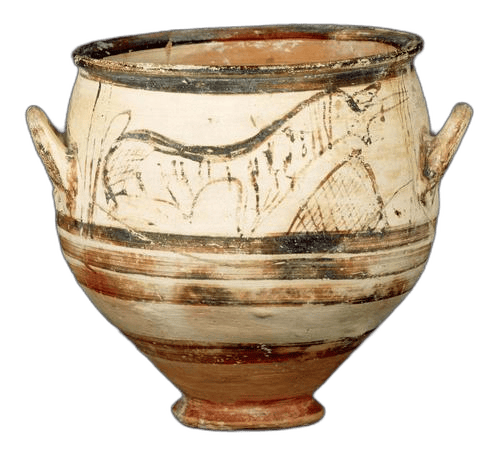
What the painters left out tells us most about them. Imported chariot kraters had been going into Cypriot tombs for generations, yet these painters never drew a chariot, and the human figure is absent altogether. In Iacovou's words, narrative scenes "are conspicuously absent from the first true pictorial style of Cyprus" [4]. The small bell krater from Enkomi beside this paragraph shows the formula reduced to its essentials: a sketchy bull on each side with a hatched mound under its muzzle, probably fodder. The Pastoral kraters were Cypriot products, and a few were exported to the Levant [4].
White Painted Wheel-made III, the ware with too many names
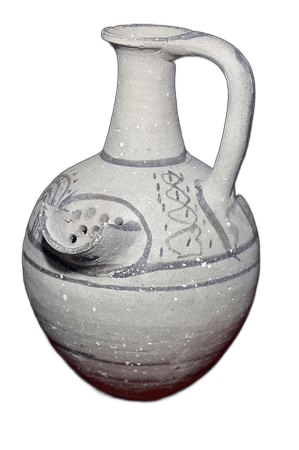
From the late 13th century Cypriot potters made Aegean-style tableware on a scale that eventually pushed Base Ring and White Slip off the table. The ware is wheel-made in a light, fine clay and painted in a dark matt paint, usually brown to black. Its signature shape is the deep bowl or skyphos, a drinking bowl with two horizontal handles; beside it come bell kraters, kylikes (stemmed cups), stirrup jars and the strainer jug, a jug with a perforated spout for straining wine [10]. The commonest motif is the spiral, running or in antithetic (mirror-image) pairs, often with panels of zigzags or lozenges between. The strainer jug from Episkopi-Bamboula near Kourion, beside this paragraph, has its shoulder ringed with concentric semicircles filled with rows of dots.
This one body of pottery has carried a string of names, from "matte-painted Levanto-Helladic" to "Submycenaean" and "Decorated Late Cypriot III" in Barbara Kling's list [9]. The one that stuck in museums is "Mycenaean IIIC:1b", borrowed from Furumark's Aegean sequence by Porphyrios Dikaios for the pottery of his post-destruction level at Enkomi. Paul Åström proposed the neutral White Painted Wheel-made III in 1972, and Kling argued for it because the old labels had smuggled in a history: pottery was classed by the events it was thought to follow, and "once assigned on the basis of these historical interpretations, the pottery classifications then served to confirm them" [9].
Two findings took the weight off that history. The ware appeared gradually. A few Aegean-style bowls already turn up at sites abandoned before the end of the 13th century, such as Kalavasos-Ayios Dhimitrios and Maroni-Vournes; output then grew steeply until, by the middle of the 12th century, it had replaced the old handmade wares [12]. In the experimental years between, Susan Sherratt found what she called "unclassified horrors": Base Ring and White Slip vessels thrown on the wheel [11]. And the ware was Cypriot. Penelope Mountjoy and Hans Mommsen's neutron activation study of 2015 identified eight production centres on the island, including Paphos, Kourion, Kition, Enkomi and Sinda, and traced some of their output to the Levant and Egypt [13].
Move through the decades either side of 1200 BC and watch the handmade wares fade as the wheel-made one grows; then look back to the three-handled jars, a century and more earlier.
Chronology
From handmade to wheel-made
Each bar is a ware, placed by the dates the lessons give it. Drag the red line, or use the arrow keys on its year, to see what was being made in any year; choose a bar for its cues and lesson.
Handmade Bronze Age
Late Bronze Age wheel-made
Imports
In use around
1200 BCLate Cypriot I to II
1200 BC: 4 wares in use.
The change was gradual, from a few bowls before 1200 BC to the end of the old handmade wares by the middle of the 12th century, and it happened in Cypriot workshops.
The twelfth century and the theory of two waves
At Enkomi, Dikaios found that his Level IIB, the town of LC IIC, ended in destruction at the close of the 13th century. Level IIIA above it was rebuilt in ashlar, masonry of squared and dressed blocks, and Mycenaean IIIC:1b was its dominant painted pottery. Furumark's fortified town at Sinda, inland in the Mesaoria plain, showed a similar sequence of destruction and rebuilding. Because an earlier Aegean stage of the pottery seemed to be missing, Dikaios inferred a pause of a decade or two and then the arrival of a second wave of Aegean settlers, Achaeans, who rebuilt the towns [10].
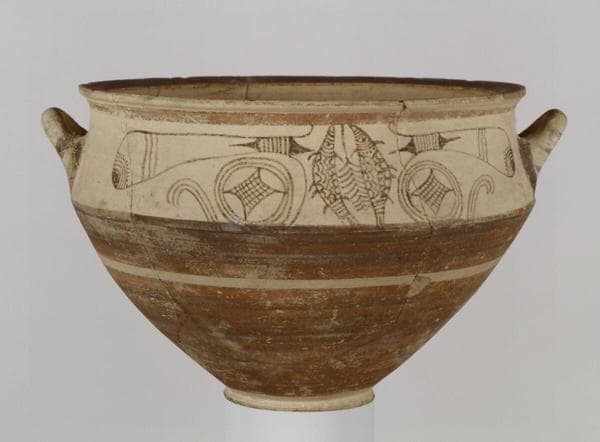
Two short-lived sites seemed to clinch it. Maa-Palaeokastro, on a promontory on the west coast, and Pyla-Kokkinokremos, on a plateau near Kition, were both founded on empty ground at the very end of LC IIC behind defensive walls, and both were abandoned within a few decades; Maa had a life of perhaps fifty years [15]. Karageorghis read Maa's later floors, laid with Mycenaean IIIC:1b, as the mark of permanent Achaean settlers [18]. Iacovou counters that both sites were "defensive or military outposts" [14, p. 632], and nearby Kition shows no catastrophe between its two LC IIIA floors [18]. The old reading survives on museum labels. The Metropolitan Museum's krater beside this paragraph, said to come from Idalion, is described as derived from Aegean models of the Mycenaean IIIC:1b period, and its label adds that manufacture of such pottery in Cyprus "may be associated with the settlement of Achaeans from the Aegean at this time" [19].
Find Maa and Pyla, then the centres where the new ware was made, which run from Paphos in the west to Enkomi in the east and inland to Sinda.
Map of Cyprus
Cyprus around 1200 BC
- Aegean-style ware made here
- Founded c. 1200, abandoned within decades
- Aegean-style bowls before 1200
- Ground above 200, 500, 1,000 m
Sites on this map
- 1Paphos
- 2Kourion
- 3Kition
- 4Enkomi
- 5Sinda
- 6Maa-Palaeokastro
- 7Pyla-Kokkinokremos
- 8Kalavasos-Ayios Dhimitrios
- 9Maroni-Vournes
Pots are not people
Robert Merrillees long ago named the habit "pots equal people" and called the resulting historiography the "invasion syndrome" [7]. Ioannis Voskos and Bernard Knapp describe how the prominence of this pottery in 12th-century deposits "seems to have cemented a notion that it takes a Mycenaean to make or even use a Mycenaean pot" [7]. Two facts undo that notion: the ware was made in Cypriot workshops, and it began before any proposed colonists arrived. Kling concluded that its mixed sources, drawn over a long period from the Cyclades, the Dodecanese, Crete, the Levant and Cyprus's own repertoire, "do not support interpretations that view this pottery as evidence for the arrival of a massive influx of new settlers from one Aegean source at one time" [10]. Sherratt reads it instead as import substitution: when Aegean supply failed, Cypriot workshops made their own [11].
Greek speakers did come. By the Iron Age the island spoke a Greek dialect related to Arcadian and wrote it in its own syllabary, and the case for migration rests on that language [7]; Lesson 7 meets its earliest written example. What the pots record is a Cypriot industry taking up the wheel and an Aegean look on its own terms.
Proto-White Painted: the hinge into the Iron Age
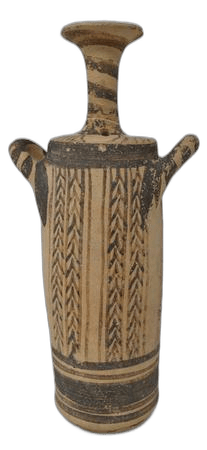
In the 11th century, LC IIIB (about 1125/1100 to 1050 BC), the island's painted pottery settled into one ware. Einar Gjerstad named it Proto-White Painted in 1944, because it leads into the White Painted of the Iron Age (Lesson 7) [16]. Its greenish or brownish clay looks the same as later White Painted. The test is the paint. Applied as a dark, washy matt pigment, it fired unevenly into shades from light orange to brown. Marguerite Yon suggested this was deliberate, an attempt to imitate the warm colour of Mycenaean pottery, and Iacovou, after comparing it with local Mycenaean-style cups from Palaepaphos, wrote: "Personally, I no longer doubt that this is the case" [16]. By the latest groups the paint has turned the uniform dull black of White Painted I. The bottle illustrated here, with files of chevrons on a cylindrical body, shows the orange-to-brown effect.
Shapes date a deposit more reliably than colour. The belly-handled amphora, with its handles set on the widest part of the body, is "totally absent in LC IIIA" and became "the trademark of LC IIIB deposits"; the kylix and the stirrup jar, both Mycenaean in origin, die out by the end of the phase [16]. Bird-shaped askoi (pouring vessels shaped like a bird) are common, and flat plates have not yet appeared. Almost every complete vessel comes from a tomb, because the settlements of the time were abandoned or moved: Enkomi was given up for Salamis on the coast [7], and the cemetery at Alaas gave the ware its first closed, dated assemblage [17].
The Aegean had by now slid into the plain, picture-poor pottery called Submycenaean. Cyprus never passed through that stage. Proto-White Painted carried on the Aegean shapes and grammar of the 12th century, and Iacovou can write that the island "claims the finest pottery the Mediterranean was to have for some time" [4]. She calls the phenomenon à contretemps, out of step.
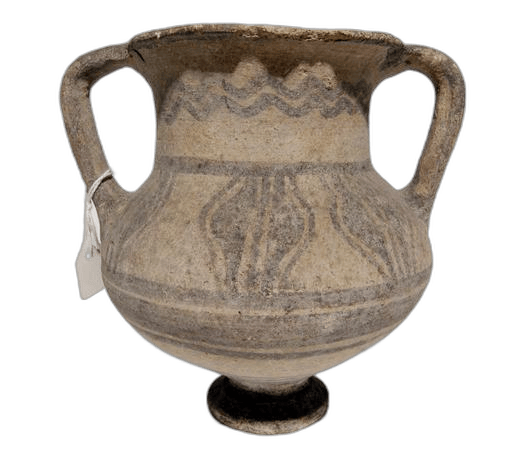
Nobody can draw the line between Proto-White Painted and White Painted I on a single pot with confidence. The shapes pass across unchanged, and the paint shifts by degrees. The amphora from Kourion beside this paragraph, banded in black with a frieze of plants on its shoulder and wavy lines between the handles, is catalogued by the British Museum as transitional Proto-White Painted/White Painted I: by convention a Bronze Age pot or an Iron Age one, depending on which side of 1050 BC its painter worked.
Quiz
Check yourself
Question
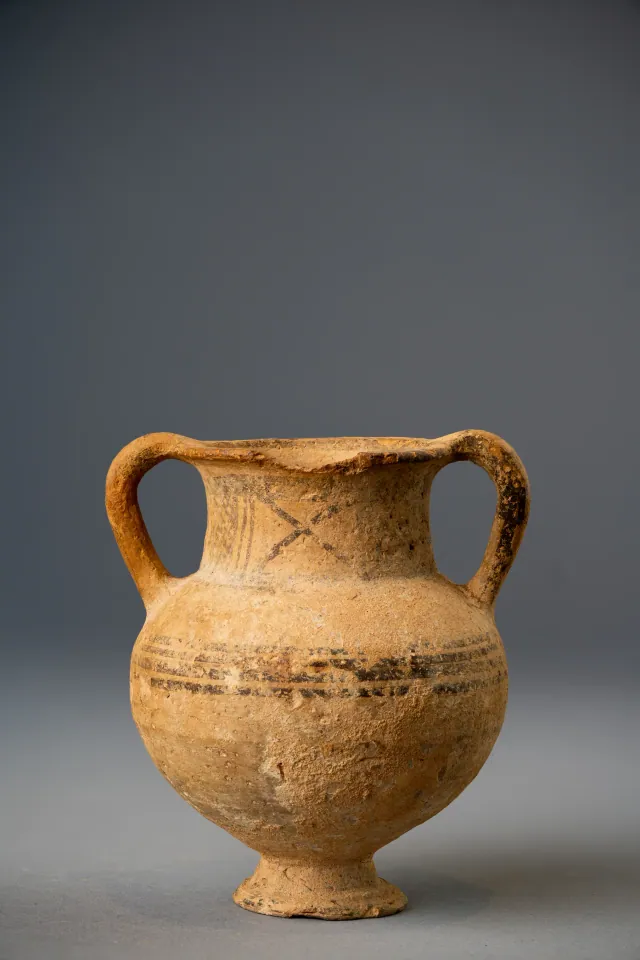
A small wheel-made amphora in the Drakopoulos collection, painted in matt paint on a pale ground. Which ware is it?
Question
A large krater painted with robed figures in a horse-drawn chariot comes from a tomb at Enkomi. Where was it most likely made?
Question
You are holding a small three-handled jar on a tall foot with a spiral frieze. Which signs say it was made in Cyprus?
Tick every answer that applies
Question
Around what year BC were Cypriot potters making the three-handled jars of Furumark’s shapes 46 and 47? Any year in the range will do.
Question
Put these Cypriot pots in order, earliest first.
Tap an item, then tap its place. Or use the arrows
Question
What will you never find on a Pastoral Style krater?
Question
Why does White Painted Wheel-made III no longer count as proof that Greek settlers arrived around 1200 BC?
Question
On what does the case for Greek speakers coming to Cyprus rest?
What to look for
- Lustrous paint on a fine, smooth, pale clay suggests an imported Mycenaean vase; matt paint on a softer buff clay suggests a Cypriot Aegean-style product.
- A small three-handled jar on a tall, narrow foot, with a spiral frieze in matt paint, is a Cypriot FS 46/47 jar of the 14th century BC. Where the frieze survives, check how the coils join: Cypriot painters usually ran the link from the top of one coil to the bottom of the next.
- Chariots and robed figures on a large krater point to an import from the Argolid; bulls or birds in bold outline, with no people, point to the Cypriot Pastoral Style.
- Wheel-made deep bowls, bell kraters and strainer jugs in dark matt paint with spirals and panels belong to White Painted Wheel-made III (labels may say "Mycenaean IIIC:1b"), late 13th and 12th centuries BC.
- Paint that has fired patchily orange to brown on a pale wheel-made pot, especially on a belly-handled amphora, kylix or bird askos, marks Proto-White Painted of the 11th century BC.
- Uniform dull black paint on the same shapes points to White Painted I of the early Iron Age.
Go deeper
The compendium carries each ware further: Mycenaean Imports and Local Imitations, White Painted Wheel-made, Proto-White Painted Ware, and the overview From Bronze to Iron: Cypriot Pottery, c. 1300 to 950 BC. For the wider relationship, see The Mycenaeans and Cyprus.
References
- 1.Graziadio, G., with Pezzi, E., Dikomitou-Eliadou, M. and Georgiou, A. (2017). The Earliest Production of Aegean-Type Pottery in Cyprus. Pisa: Pisa University Press, pp. 16–25, 157–170.
- 2.Mommsen, H., Beier, Th. and Åström, P. (2003). Neutron Activation Analysis Results of Six Mycenaean Sherds from Hala Sultan Tekke, Cyprus. Archaeology and Natural Science 2, pp. 5–10.
- 3.van Wijngaarden, G. J. (2002). Use and Appreciation of Mycenaean Pottery in the Levant, Cyprus and Italy (ca. 1600–1200 BC). Amsterdam: Amsterdam University Press, pp. 133–136, 162–164, 269–270.
- 4.Iacovou, M. (2006). À contretemps: The Late Helladic IIIC syntax and context of Early Iron Age pictorial pottery in Cyprus. In E. Rystedt and B. Wells (eds), Pictorial Pursuits: Figurative Painting on Mycenaean and Geometric Pottery. Stockholm: Swedish Institute at Athens, pp. 191–203.
- 5.Millett, A. and Catling, H. W. (1966). Composition and provenance: a challenge. Archaeometry 9, pp. 92–97.
- 6.Recht, L. and Morris, C. E. (2021). Chariot kraters and horse–human relations in Late Bronze Age Greece and Cyprus. Annual of the British School at Athens 116, pp. 95–132.
- 7.Voskos, I. and Knapp, A. B. (2008). Cyprus at the end of the Late Bronze Age: crisis and colonization or continuity and hybridization? American Journal of Archaeology 112(4), pp. 659–684.
- 8.Vermeule, E. and Karageorghis, V. (1982). Mycenaean Pictorial Vase Painting. Cambridge, MA: Harvard University Press.
- 9.Kling, B. (1991). A terminology for the matte-painted, wheelmade pottery of Late Cypriot IIC–IIIA. In J. A. Barlow, D. L. Bolger and B. Kling (eds), Cypriot Ceramics: Reading the Prehistoric Record. Philadelphia: University Museum, pp. 181–184.
- 10.Kling, B. (2000). Mycenaean IIIC:1b and related pottery in Cyprus: comments on the current state of research. In E. D. Oren (ed.), The Sea Peoples and Their World: A Reassessment. Philadelphia: University Museum, pp. 281–295.
- 11.Sherratt, E. S. (1991). Cypriot pottery of Aegean type in LC II–III: problems of classification, chronology and interpretation. In J. A. Barlow, D. L. Bolger and B. Kling (eds), Cypriot Ceramics: Reading the Prehistoric Record. Philadelphia: University Museum, pp. 185–198.
- 12.Georgiou, A. (2018). From the hand to the wheel: revisiting the transformations of the Late Cypriot ceramic industry of finewares during the 13th-to-12th c. BC transition. In I. Caloi and C. Langohr (eds), Technology in Crisis: Technological Changes in Ceramic Production during Periods of Trouble. Aegis 16. Louvain-la-Neuve: Presses universitaires de Louvain, 177–200.
- 13.Mountjoy, P. A. and Mommsen, H. (2015). Neutron activation analysis of Aegean-style IIIC pottery from 11 Cypriot and various Near Eastern sites. Ägypten und Levante 25, pp. 421–508.
- 14.Iacovou, M. (2008). Cultural and political configurations in Iron Age Cyprus: the sequel to a protohistoric episode. American Journal of Archaeology 112(4), 625–657.
- 15.Karageorghis, V. and Demas, M. (1988). Excavations at Maa-Palaeokastro 1979–1986. Nicosia: Department of Antiquities, Cyprus.
- 16.Iacovou, M. (1991). Proto-White Painted pottery: A classification of the ware. In J. A. Barlow, D. L. Bolger, & B. Kling (Eds.), Cypriot Ceramics: Reading the Prehistoric Record (University Museum Monograph 74, pp. 199–205). Philadelphia: The University Museum, University of Pennsylvania.
- 17.Karageorghis, V. (1975). Alaas: A Protogeometric Necropolis in Cyprus. Nicosia: Department of Antiquities, Cyprus.
- 18.Karageorghis, V. (1982). Cyprus: From the Stone Age to the Romans. Ancient Peoples and Places 101. London: Thames and Hudson.
- 19.Metropolitan Museum of Art, New York. Terracotta krater, accession no. 74.51.429 (The Cesnola Collection), object description.