
Contents
In Cypriot Iron Age pottery an amphora is a closed jar with two opposed handles, and the placing of those handles is what separates one type from another. Two painted series fill the tombs of the Cypro-Geometric and Cypro-Archaic periods. The belly-handled amphora carries two horizontal loop handles on the body and is, in the words of the Lapithos catalogue, "a very common shape of all Cypriot workshops" [1, pp. 85-86]. The second series has two vertical handles running from the rim to the shoulder [1, p. 87]. Both reached Cyprus from the Aegean at the end of the Bronze Age. The belly-handled type was painted in White Painted and Bichrome ware, and in eastern Cyprus the belly-handled type grew into tall Bichrome IV jars with lotus friezes on neck and shoulder. A third relative, the transport amphora with basket handles rising above the rim, carried oil and wine to the Levant and Egypt [2, pp. 170-172]. This entry treats the painted amphora as a shape. Pithoi, Canaanite jars and residue analysis are covered under jars, and the transport jars have their own article.
Handles and the two painted types
The Greek text of the Lapithos chapter describes the belly-handled amphora as having "two loop-handles on the belly", and the English text calls the same vessels "amphorae with horizontal handles" [1, pp. 85-86]. The handles lie horizontally, looping out from the widest part of the body or from high on the shoulder, and the neck rises clear between them. The other series is defined by "two vertical handles from the rim to the shoulder". The same chapter notes that these vessels are "known also as amphoroid kraters" and that they "constitute another common production series in the family of amphorae" [1, p. 87]. Museum catalogues are less particular. Karageorghis, Mertens and Rose's catalogue of the Cesnola collection in New York uses the plain label "Amphora" for its Cypro-Archaic belly-handled jars, and the Metropolitan Museum's records follow it [3, p. 91].
The two series have separate histories. The belly-handled amphora was made without a break through the Iron Age. The vertical-handled series began as an unpainted vessel modelled on metal and reappeared, painted, in the Cypro-Geometric period (see the next section). The handle term also carried over to a third vessel: the Cypriot transport jar is known in the literature as "the transport amphora with horizontal handles", although its handles are "large loop or basket-handles rising high above the rim", set crosswise to the handles of a Greek amphora [2, p. 170].
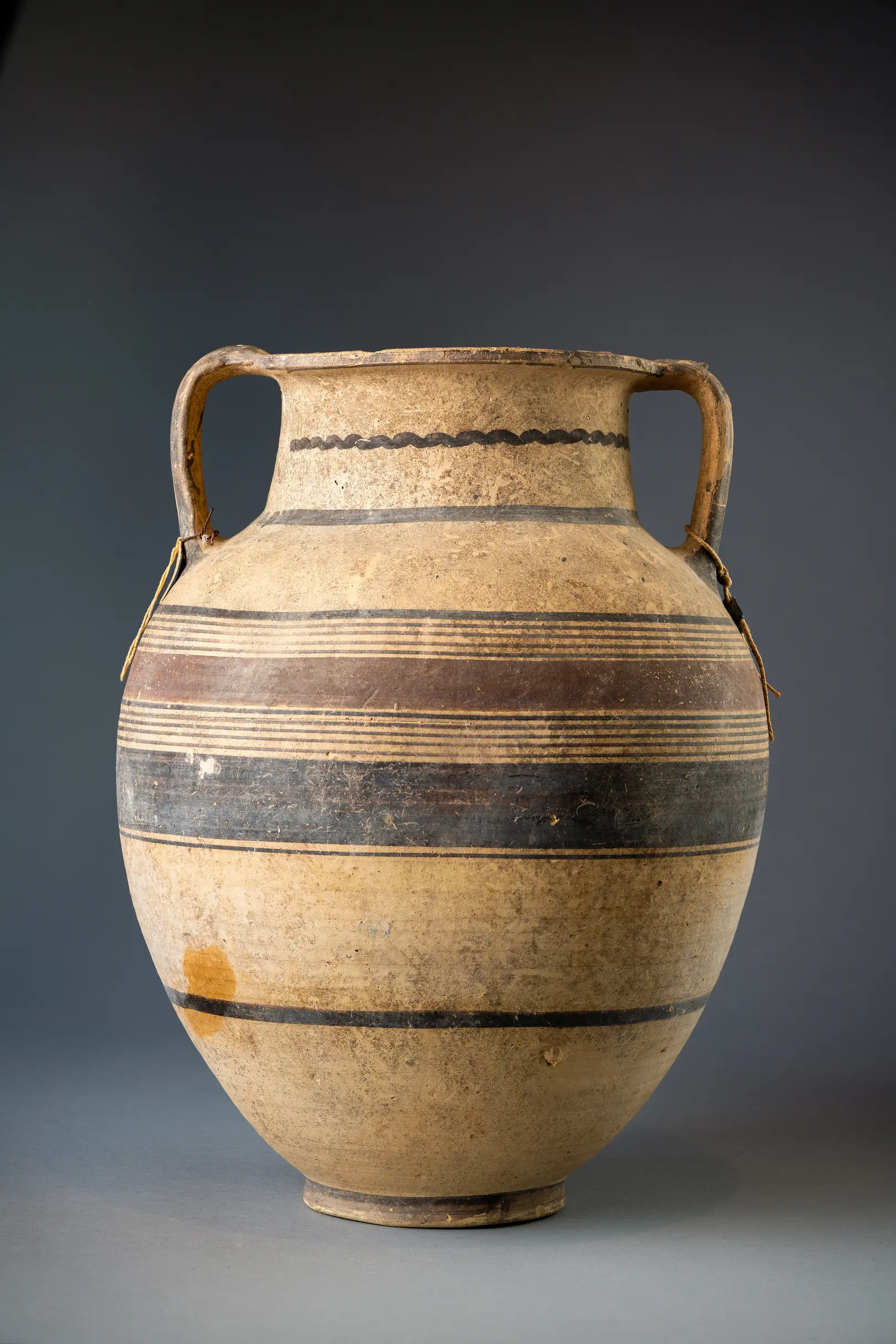
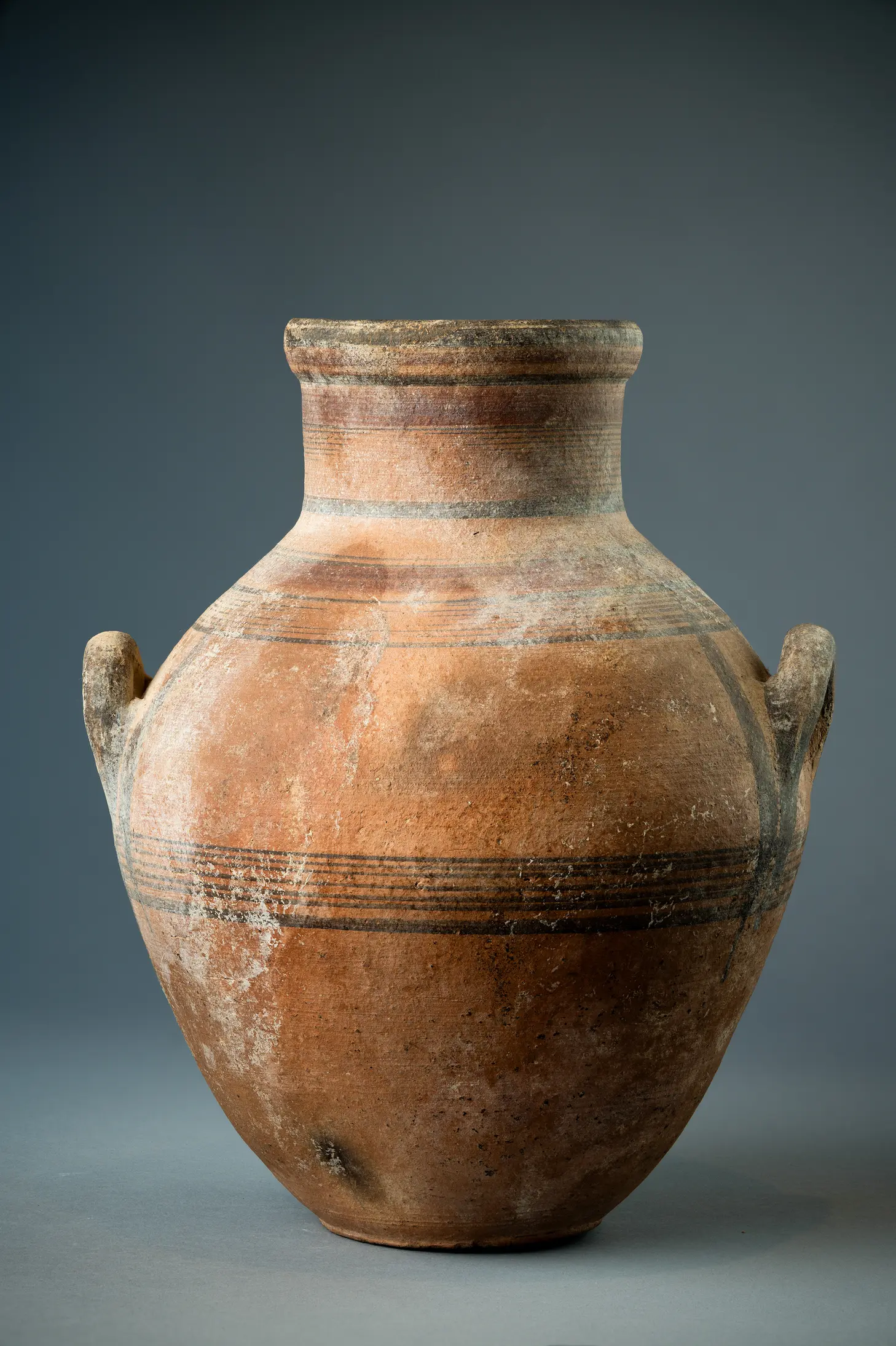
The Drakopoulos collection has one amphora of each painted type. The 32 cm Bichrome amphora shown at the head of this entry came from the Severis collection (its catalogue says the Leto-Severis Collection). It has an ovoid body on a low base, a cylindrical neck ending in a thickened, ridged ring rim, and two horizontal loop handles on the shoulder, which makes it a belly-handled amphora. The paint survives as faded dark and red bands on neck, shoulder and belly over a pinkish-buff surface, partly under encrustation. Red and black banding makes Bichrome likely, but banding alone does not narrow the date, and the catalogue range (c. 1050 to 600 BC) is kept here. The 42 cm Bichrome amphora, pictured here, is the vertical-handled counterpart: an ovoid body on a ring base, a tall wide neck, and two vertical strap handles from rim to shoulder. It is painted with black and red horizontal bands, groups of fine lines on the shoulder and belly, and a wavy line round the neck, and it has been repaired at one handle. Its catalogue records a sale through the Cyprus Museum Sales Register (SR 3477/65) and export in 1969, under the system described in legal export of Cypriot antiquities.
| Type | Handles | First appearance | Ware or technique | Remarks |
|---|---|---|---|---|
| Belly-handled amphora | Two horizontal loop handles on belly or shoulder | Late Cypriot IIIB (Lapithos chapter); Sub-Mycenaean repertoire (pigments study) | White Painted, less often Bichrome; Bichrome IV in the eastern series | Made continuously through the Iron Age; the tall lotus-frieze amphorae belong here |
| Vertical-handled amphora (amphoroid krater) | Two vertical handles, rim to shoulder | Late Cypriot IIIB, in Plain White; reappears in Cypro-Geometric | Plain White first, later painted | Profile and pedestal copy metal vessels; Lapithos examples stand on a high foot |
| Transport amphora | Two large basket handles rising above the rim | About 700 BC (Salamis royal tomb series) | Built up on a slow turntable | Oil and wine; not made in Cyprus after the 4th century BC |
The table summarises the Lapithos chapter for the two painted series [1, pp. 85-89], the pigments study for the alternative starting point [4] and Jacobsen's paper for the transport jar [2, pp. 170-173].
Origins at the end of the Bronze Age
The sources agree that the painted amphora came from the Aegean and differ on when it arrived. The Lapithos chapter states that the belly-handled amphora "first appeared in the Late Cypriot IIIB period, following Aegean prototypes, and it is characterized by a continuous and steady production in Cyprus throughout the Iron Age" [1, p. 85]. The archaeometric study "Black: A tale of two pigments in Cyprus" puts it differently: "Some of the shapes of Aegean origin which include the belly-handled and the neck-handled amphora, the belly handled amphoriskos, the oinochoe and the skyphos first occur in the Sub-mycenaean repertoire" [4]. The same study lists "the small amphora" among the Aegean-type shapes "not encountered in the shape repertoire of the Late Cypriot IIC period but were added during the Late Cypriot IIIA period", together with the kalathos, the strainer jug and the pyxis [4].
Two readings are possible. If the Late Cypriot IIIA "small amphora" is a different vessel from the belly-handled type, the two accounts agree that the full belly-handled amphora belongs to the last phase of the Late Bronze Age. If it is an early form of the same shape, then an amphora of Aegean type was already in use in Late Cypriot IIIA, a phase earlier than the Lapithos chapter allows. Neither source settles which is meant, and both treat the shape as part of the wider arrival of Aegean forms in the island's repertoire.
The pigments study sets these shapes against the rise of Proto-White Painted pottery, which "is connected with a series of new grave types", among them "the chamber tomb with dromos at sites such as Lapithos, Salamis, Kourion-Kaloriziki, Idalion, Kition and Palaepaphos" [4]. The site entries for Lapithos, Salamis, Kourion, Idalion, Kition and Palaepaphos describe these cemeteries. The study also describes a difference in paint. Proto-White Painted has "a black, dull paint which exhibits color variations depending on the firing conditions", whereas the White Painted I ware of Cypro-Geometric I "has a uniform dark, matt black color" [4].
The vertical-handled amphora has a different start. The Lapithos chapter calls it "a shape of Aegean origin, very popular during the Late Cypriot period, which reappeared in the Cypro-Geometric, imitating metal vessels". Its earliest examples, "dating to the Late Cypriot IIIB period, are of Plain White Ware (without painted decoration)", and their burnished surface, angular profile and pedestal "point to a strong influence from metal vessels" [1, pp. 87-89]. The earliest vertical-handled amphorae were therefore unpainted Plain White vessels, and painted versions followed in the Cypro-Geometric period.
Cypro-Geometric amphorae
In Cypro-Geometric I, the belly-handled "type of amphora with everted rim has a spherical body and a neck widening upwards". Its decoration, "carried out in White Painted Ware, involves two continuous bands of cross-hatched triangles and lozenges on the shoulder and two or three parallel wavy lines on the belly, while the lower part of the belly is decorated with two wide horizontal bands, bordered by groups of thinner parallel lines" [1, p. 87]. The scheme divides the pot by its structure: a patterned band where the shoulder turns, a looser motif on the belly and heavy bands towards the base.
Bichrome versions of this early type are rare. The Lapithos chapter cites one from tomb P.74 at Lapithos on which "three schematised birds, with their body painted in red colour" are "inserted above the wavy lines on the belly" [1, p. 87]. The added red is what makes it Bichrome. Birds are also among the motifs of the later eastern pictorial style described below (see free-field art and the article on a free-field bird).
In Cypro-Geometric II and III the type "evolved both morphologically and decoratively into more simplified forms". The characteristic motif of these later amphorae is "a wide, cross-hatched triangle, crowned by a small, solid painted, inverted triangle or lozenge, with the entire pattern surrounded by a multiple frame", and they "are usually of White Painted Ware and to a lesser extent, of Bichrome Ware" [1, p. 87]. The cross-hatched triangle is thus a rough dating guide: the continuous bands of triangles and lozenges belong earlier, the single framed triangle later.
Lapithos made its own versions of both series. Its belly-handled amphorae with "a short rim either bevelled outwards or rounded" are smaller than the everted-rim type and were "a characteristic shape of the Lapithos regional production throughout the Cypro-Geometric period, but not as widespread as the one with the everted rim" [1, p. 87]. Its vertical-handled amphorae stand on "a wide, high foot, instead of the usual base-ring", and their decoration is "arranged on the neck" [1, p. 89]. A rim profile or a foot can therefore point to a Lapithos workshop before any painted detail is considered.
Jacobsen connects these small painted jars to the later trade vessel: "A Cypriot preference for horizontal handles demonstrated in the small white painted and bichrome amphorae from the Early Iron Age ... seems to have influenced the development of the local transport amphora" [2, p. 170]. The link is one of handle placement. In size and purpose the painted amphorae and the transport jars are different vessels.
The Bichrome IV amphorae of eastern Cyprus
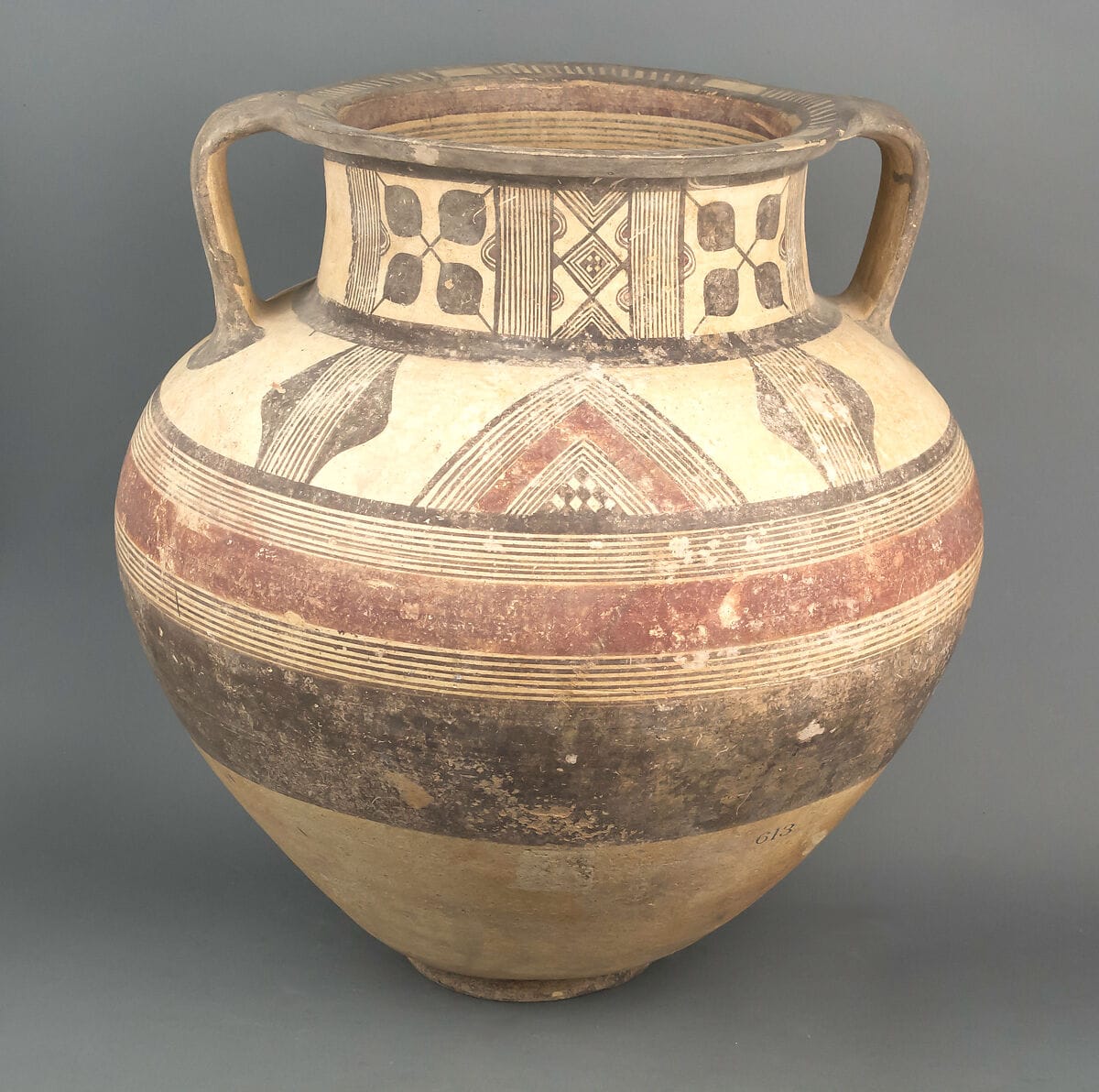
The largest painted amphorae belong to the Cypro-Archaic period. A Bichrome IV amphora in the Metropolitan Museum (74.51.972), from the collection of Luigi Palma di Cesnola and said to be from Ormidhia, stands 80.3 cm high and is dated Cypro-Archaic I, about 750 to 600 BC. Vassos Karageorghis and his co-authors describe the class: "Large amphorae decorated in the Bichrome IV technique were common to the eastern part of Cyprus. The shoulder zone of each side is usually ornamented with a frieze of lotus flowers alternating with buds. On the neck, lotus flowers in panels alternate with geometric motifs. The lotus motif is oriental in origin, and it appears frequently in the arts and crafts of the Cypro-Archaic period" [3, cat. 143, p. 91]. The British Museum has a smaller example, 67.8 cm high and dated 750 to 600 BC, whose record describes a wheel-made Bichrome amphora "decorated with lotus flowers, buds and geometric motifs" (BM 1925,1231.3).
Where this style was made is a matter of labels as much as evidence. According to a chapter in the 2022 volume Beyond Cyprus, Gjerstad proposed in the 1960s that Cypro-Archaic vase-painting fell into two zones: a geometric style of concentric circles in the west, and in the east a pictorial style with "lotus buds, flowers, rosettes, sacred tree, birds, quadrupeds and human figures" [5, p. 341]. The label "eastern style" derives from this geographical division. The authors of the chapter narrow it: they "argue that the pictorial style ... was conceived and developed in the workshops of Salamis and prevailed in the eastern part of the island during the CA period", with Amathus as the only other pictorial centre [5, p. 341]. Within that pictorial production they separate a "floral style", "exclusively realised in Bichrome Ware", which combines lotus flowers, rosettes and guilloches, often with sphinxes, lions and other creatures "indisputably of Near Eastern origin" [5, p. 341]. Karageorghis, Mertens and Rose and the Cultures in Dialogue catalogue use neither term; they place the large lotus amphorae in "the eastern part of Cyprus" [3, p. 91; 6, p. 236]. This entry uses "Salaminian floral style" only where the Beyond Cyprus chapter is the source.
For that chapter, "a typical series in Salaminian 'floral style' are the belly-handled amphorae", and its type specimen is a Bichrome IV amphora from Peristerona in the Famagusta district. "Of particularly large dimensions (90 cm in height), this amphora has a large neck that widens upwards and is topped by an everted horizontal rim; the horizontal handles are placed high on the shoulder zone of its large ovoid body. As a rule, the decoration appears on the neck and in the shoulder zone, emphasising the amphora's size and structure" [5, p. 341]. The lotus flowers "vary in size and form" and are "combined with recurrent zones of rosettes and guilloches, very densely arranged" [5, p. 342]. The same floral decoration appears on the corselets of Salaminian terracotta statues, and "it has been suggested that it imitates textiles" [5, p. 341]. The lotus flowers entry follows the motif across other shapes.
The Cultures in Dialogue catalogue, edited by Despina Pilides and Nikolas Papadimitriou, describes an amphora of the same series with a "flat everted rim, cylindrical neck slightly widening upwards, ovoid body, flat base and two horizontal loop handles on either side of the shoulder", and "a frieze of interlocked lotus flowers and buds" between the handles. The entry states that "large amphorae of this type are typical of tomb contexts in the eastern part of Cyprus" and dates the piece by its ornament: "The combination of a lotus frieze and panels filled with reserved rosettes in the ornamentation scheme points to a date around 600 BC" [6, p. 236]. On the same page is a smaller Bichrome IV amphora in the Cyprus Museum (1935/B 2009, cat. 231), 47.5 cm high, Cypro-Archaic I, find context unknown. It shows "two opposed sphinxes that herald a schematically rendered lotus flower ... inspired by Levantine prototypes", while "the meander motif underlining the scene is an influence from the Greek Geometric style" [6, p. 236]. One amphora thus combines Levantine figures with a Greek border.
The three sources date the floral amphorae differently. Karageorghis, Mertens and Rose give the New York amphora the whole of Cypro-Archaic I, about 750 to 600 BC [3, p. 91]. The Beyond Cyprus chapter puts the "floral style" in the seventh and sixth centuries BC [5, p. 342]. The Cultures in Dialogue entry dates one example "around 600 BC" [6, p. 236]. These ranges overlap in the seventh century and part company at both ends. The chapter also sets the floral style in a sequence of decorative modes:
| Decorative mode | Start (Beyond Cyprus chapter) |
|---|---|
| Panelled style | Cypro-Geometric III, about the 9th century BC |
| Free-field style | Beginning of Cypro-Archaic, about the 8th century BC |
| Floral style (Salaminian, Bichrome only) | 7th and 6th centuries BC |
"All these decorative modes overlap in the CA period" [5, p. 342], so the mode gives a starting date and no more. The free-field mode is treated at length in the article on Cypriot free-field art.
Smaller Cypro-Archaic amphorae were made alongside the lotus series. The Metropolitan Museum has a 44.6 cm amphora of Cypro-Archaic I, about 750 to 600 BCE, also from the Cesnola collection (Met 74.51.979); its entry on this site describes vertical handles, bands and geometric panels.
Transport amphorae with basket handles
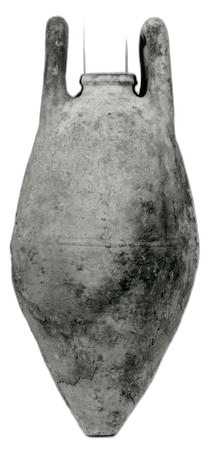
The transport amphora was developed in Cyprus as "a different and unique shape" [2, p. 170], and only an outline is given here; the full account is in the article on Cypriot transport amphorae. According to Jacobsen, the oldest identified examples are "an impressive series of 34 amphorae from one of the royal tombs at Salamis, dated around 700 BC". They have a "large biconical body and a small flat, shaved base", a "very short" neck with a high everted rim, and "powerful horizontal handles rising from the shoulder high above the rim". The earliest average 65 cm in height, "but they range from 45 to 85 cm", and in the Cypro-Classical period they became taller, slimmer and ovoid [2, p. 170]. They were built up on a slow turntable, and cord impressions round the belly record cords used to "prevent the walls from collapsing while drying" [2, pp. 170-171].
Petrography and neutron activation analysis link examples from Tell Keisan to "South Eastern Cyprus, in the area around Salamis" [2, p. 169]. The jars travelled to south-west Turkey, western Rhodes, the Levantine coast and Egypt, "though never in very large numbers and never further away" [2, p. 172]. A British Museum example, 82.5 cm high and dated 650 to 300 BC, was excavated at Kamiros on Rhodes (BM 1864,1007.32; on this site as Cypriot transport amphora). What they held is "not known" in general, but a painted inscription on one from a Salamis royal tomb of about 600 BC indicates oil, and Jacobsen concludes that they carried "both wine and oil" [2, pp. 171-172]. "Transport amphorae with horizontal handles were not produced in Cyprus after the 4th century BC", while Levantine production continued into the Hellenistic period [2, p. 173].
In the tomb
Most painted amphorae known today come from graves. The belly-handled amphorae of the Lapithos workshops are "found in tomb-groups in Lapithos" [1, p. 87], and the large Bichrome IV amphorae "are typical of tomb contexts in the eastern part of Cyprus" [6, p. 236]. The transport jar entered the same contexts: the 34 amphorae from the royal tomb at Salamis are the earliest group of the type [2, p. 170], and Sophocles Hadjisavvas, as cited by Jacobsen, remarked on "the number of amphorae with horizontal handles in Archaic and Classical tombs" [2, p. 172]. Jacobsen adds that the transport jars were also "used locally, as documented by the many finds all over Cyprus" [2, p. 172]. For the general setting of these burials see mortuary practices.
No direct evidence for the contents of the painted amphorae is reported in these sources, and the shape alone does not establish them. The decoration allows one inference. On the floral amphorae the ornament is concentrated on the neck and shoulder, "emphasising the amphora's size and structure" [5, p. 341]. That placement suits a vessel meant to be seen, but it is an inference from the painting and not a documented use.
Reading a Cypriot amphora
The handles come first. Two horizontal loops on the body mark the belly-handled amphora, the commonest painted type; two vertical handles from rim to shoulder mark the vertical-handled series, which the Lapithos chapter also calls the amphoroid krater [1, pp. 85-87]. Handles that rise high above a short rim on a large biconical body belong to a transport jar [2, p. 170].
Rim and foot come next. A short rim, bevelled outwards or rounded, on a small belly-handled amphora, or a wide, high foot under a vertical-handled one, points to the Lapithos workshops of the Cypro-Geometric period [1, pp. 87-89]. An everted rim on a spherical body with a neck that widens upwards is the island-wide Cypro-Geometric I form.
Then the decoration. Continuous bands of cross-hatched triangles and lozenges over wavy lines suggest Cypro-Geometric I; a single cross-hatched triangle with a small solid triangle above it, inside a multiple frame, suggests Cypro-Geometric II or III [1, p. 87]. Lotus friezes with buds, rosettes and guilloches in Bichrome belong to the Cypro-Archaic period, with the dates given by the individual sources above [3, p. 91; 5, p. 342; 6, p. 236].
Size is the last clue. The 80 to 90 cm lotus-frieze amphorae are an eastern Cypriot series, attributed by the Beyond Cyprus chapter to the workshops of Salamis [5, p. 341]. The two Drakopoulos amphorae, at 32 and 42 cm, are banded examples of the two painted types and belong to the ordinary production that the Lapithos chapter describes as common to all Cypriot workshops.
Objects on this page
References
- 1.Georgiadou, A. (2019). Aspects of pottery production of the workshops of Lapithos during the Early Iron Age. In D. Papanikola-Bakirtzi (Ed.), Αγγείων τέχνη από τη γη της Λαπήθου / Ceramic art from the soil of Lapithos (parallel Greek and English text, pp. 77–104). Leventis Municipal Museum of Nicosia and Lapithos Municipality.
- 2.Jacobsen, K. W. (2002). Cypriot transport amphorae in the Archaic and Classical period. In A. Rathje, M. Nielsen, & B. B. Rasmussen (Eds.), Pots for the living, pots for the dead (Acta Hyperborea 9). Museum Tusculanum Press.
- 3.Karageorghis, V., Mertens, J. R., & Rose, M. E. (2000). Ancient art from Cyprus: The Cesnola Collection in the Metropolitan Museum of Art. The Metropolitan Museum of Art. Cat. 143.
- 4.Aloupi-Siotis, E., & Lekka, A. (2017). "Black," a tale of two pigments in Cyprus: The chemistry of decoration and the Late Cypriot III–Cypro-Geometric pottery production. In V. Vlachou & A. Gadolou (Eds.), Terpsis: Studies in Mediterranean archaeology in honour of Nota Kourou (Études d'archéologie 10, p. 121). CReA-Patrimoine.
- 5.Georgiadou, A., & Dikomitou-Eliadou, M. (2022). The Iron Age pictorial pottery of Salamis within and beyond: An overview of ceramic styles, wares and fabrics. In G. Bourogiannis (Ed.), Beyond Cyprus: Investigating Cypriot connectivity in the Mediterranean from the Late Bronze Age to the end of the Classical period (AURA Supplement 9, pp. 335–351, esp. 341–342). National and Kapodistrian University of Athens.
- 6.Pilides, D., & Papadimitriou, N. (Eds.). (2012). Ancient Cyprus: Cultures in dialogue (exhibition catalogue). Department of Antiquities, Cyprus. Entries signed K.N.