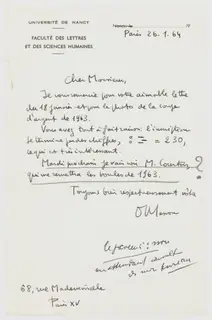
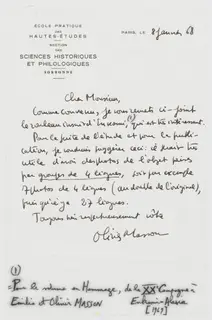
Scholar of Greek philology and dialects whose corpus of the Cypriot syllabic inscriptions appeared in 1961, who founded the Centre d'Études Chypriotes in 1983 and traced the Cesnola letters.
Key factsBorn 23 April 1922, Paris; died 23 February 1997, ParisShowHide
Universite de Paris X NanterreProfessor of ancient Greek; director of the Institut d'etudes grecques; founder of the Cahiers du Centre d'Etudes Chypriotes, 1972–1990
Olivier Masson, Directeur d'Études in Greek philology and dialectology at the École pratique des Hautes Études, wrote the corpus of the syllabic inscriptions of Cyprus published in 1961, and in his last years turned more and more to the history of scholarship on the island1,12,42. The sources disagree on the day of his birth, 3 or 23 April 19221,14,43. Maurice Sznycer, his colleague and neighbour, gives 23 April; Wikidata and the German national library's authority file give 3 April1,14,43.
He studied in Paris, at a lycée and then at the Sorbonne, and passed the agrégation de grammaire in 19471. He taught at Nancy from 1951 until 1965, when he was elected Directeur d'Études at the EPHE, and from 1972 to 1990 he was also professor of ancient Greek at Paris X (Nanterre)1. Of more than 400 items in his bibliography, nearly 240 concern Cyprus, and his first Cypriot articles date from 1951 and 19521.
The syllabic inscriptions
Masson told an interviewer in 1986 that chance brought him to Cyprus: Schaeffer, excavating at Enkomi, asked the Sorbonne for a young researcher with an interest in inscriptions to work on those of Enkomi, and his first visit to the island was in 195430. Antoine Hermary describes the 1950s as marked by Masson's research for his thesis, published in 1961 as the first volume of the École française d'Athènes's series Études chypriotes, created on the initiative of its director Georges Daux42.
Les Inscriptions chypriotes syllabiques gathers every syllabic inscription of any importance, arranged by where it came from, district by district and locality by locality1,34. In Sznycer's judgement Masson was the first to establish the Cypriot syllabary definitively, with sound translations and detailed commentaries1. In April 1962 Roger Milliex wrote to Schaeffer that a copy had been presented officially to Archbishop Makarios on his first visit to the French Cultural Centre, which he came to inaugurate on 7 March35. A second edition with supplementary content followed in 198330. After 1978, Masson said, he was entrusted with publishing the inscriptions locality by locality: The Syllabic Inscriptions of Rantidi, in English, came out in 1983, and a book on Kouklia, in French, was expected towards the end of 198630.
On the ground in Cyprus
From 1957 he was interested in where the Dhrymou inscriptions had been found, and an inquiry at Dhrymou by an employee of the Antiquities Service allowed him to write on it37. In 1960 V. Antoni Litras led him to the site at Golgoi, where Masson placed the principal sanctuary most probably about 500 metres south-east of the chapel of Ayios Photios36. In 1973 he asked Annie Caubet, then a member of the French mission at Salamis, to make a rapid survey of the Trapeza region38.
Preparing the Rantidi publication gave him in 1979 his first more than fleeting visit to Kouklia, and he returned to stay there with Sznycer in 1981, checking the original inscriptions for his Kouklia volume12. Sznycer remembered that trip above all: for two weeks, in the company and car of Jacques-Claude Courtois, they criss-crossed the island visiting its archaeological sites1. Only in 1988 could Masson make a rapid visit to the Dhrymou region, with Dimitris Michaelidis, then responsible for antiquities in the Paphos district; setting out from Kouklia, they stopped first at Ayia Moni37. At the Pierides Foundation's symposium in Larnaca in 1986 he spoke on the ancient dialect of Paphos30.
The Chronique and Amathus
Vassos Karageorghis remembered him as a colleague and very close friend who came often to Cyprus and worked with him and Jacqueline Karageorghis on varied subjects of Cypriot archaeology10. The acknowledgements of the annual Chronique des fouilles et découvertes archéologiques à Chypre show him rereading the typescript for 1963, completing the epigraphy for 1977, and still rereading the whole French text for 199239,40,41. Hermary recalls that when the French mission at Amathus was set up in 1975, Masson put at its disposal all his files on the earlier excavations of the site, the inscriptions in particular, and in 1979 published with Pierre Aupert the first article of the series "Inscriptions d'Amathonte"45.
The Centre d'Études Chypriotes
According to the foreword of the first Cahier, the idea of a Centre d'études chypriotes in Paris was born among a few friends of Cyprus at a colloquium of the Musée de l'Homme in November 198228. The Centre was founded at Paris X-Nanterre in 1983, announced by a circular of May 1983 signed by Masson28. He was its first president, from 1983 to 1997, and the founder, director and principal writer of the Cahiers du Centre d'Études Chypriotes, two issues a year from 19841,29. His foreword to the first number asked for a field as wide and multidisciplinary as possible, covering the island's culture in all periods, and excluded all political debate28.
The editors of the 1997 Cahier wrote that for several years the Centre had no office and each member worked at home; Annie Caubet obtained a space for it in the Louvre's Department of Oriental Antiquities44. Despite some criticism Masson kept to a somewhat home-made presentation, and he saw the Cahiers as a means of making known unpublished documents on Cyprus, which, in the editors' words, he tracked down as a tireless hunter in museums and libraries across the world44.
Consuls, collectors and their letters
Sznycer wrote that Masson loved like no one else to search archives, museum stores and private collections, with the soul of a detective, and that his favourite figures were the Colonna-Ceccaldi brothers and still more the Cesnola brothers, on whom he amassed period photographs and autographs1. Anna G. Marangou writes that he studied Cesnola's character more than anyone else, going through thousands of letters scattered across Europe and the United States and the archives of the Metropolitan Museum, the British Museum, the Hermitage, the Berlin Museums and the Louvre32. In his last essay he wrote that in 1960 he had known only a very few pages of Cesnola's letters; he began to use them in a short article of 1988 and found a series written to the publisher John Murray at the time Murray brought out Cesnola's Cyprus2.
The last months
About the middle of November 1996, Emilia Masson writes, he learned that his life was nearing its end, and his one concern was to write as much as possible2. Near the end of his life he found that a granddaughter of Cesnola was living in the United States and suggested to Joan Mertens of the Metropolitan Museum and to Karageorghis that they visit her2. He added the date 5 February 1997 at the bottom of the last page of his Cesnola essay2. None of the pieces of his last three months reached a final version, and his pupil Laurent Dubois, his colleague Thomas Drew-Bear and Emilia Masson did their best to complete them2.
The Société française d'Égyptologie reported that he died of a cancer declared late31. The sources disagree on the day of his death32,33,43. A colloquium in his memory at the 99th annual meeting of the Archaeological Institute of America gave it as 23 February 1997, as does Wikidata; Marangou wrote that he died on 3 February 1997, and the German authority file gives 2 March 199714,32,33,43. Marangou's day stands against the date of 5 February 1997 that he wrote on his essay2.
Cahier 27, of 1998, became the Mélanges Olivier Masson1. Its editors wrote that dedicating it to him joined the wish of his closest friends, and that it included unpublished articles of his, one under the pseudonym Léon Fivel, which he had sometimes used44. The documents he used over his years of work on 19th-century archaeology, among them his notes and copies of the letters and articles on the Cesnola collections, are in the Library of the Archaeological Research Unit of the University of Cyprus, to which his widow gave his archives32.
Life and work
50 events, 1554–2020
1554
Named in the École française d'Athènes reports on Amathus (BCH): Gave remarks on the five-sign syllabic inscription of vase AM 1554: «Olivier Masson a bien voulu nous communiquer à son sujet les remarques suivantes»
French professor who has worked on Cypriot syllabic script for thirty years; deciphered the Cypro-syllabic script; first visited Cyprus in 1954 at Engomi.
Read and commented new syllabic, Cypro-Minoan and bilingual inscriptions for Karageorghis's annual BCH Chronique (Marion plaque, Kourion bilingual with Sznycer, Golgoi sherds etc.); Karageorghis: close friend and colleague who often helped.
Studied the Cypro-Minoan inscribed bronze bowl acquired by the Cyprus Museum 1959; co-authored Kourion Cypro-Minoan inscriptions; published Les Inscriptions chypriotes syllabiques (1961).
Les inscriptions chypriotes syllabiques: recueil critique et commentaire, the corpus that fixed the syllabary and edited every important syllabic inscription by findspot (including the Idalion bronze tablet); reprinted later.
Author of Les inscriptions chypriotes syllabiques (1961), cited throughout for the Kourion syllabic texts; analysed the provenance of Cesnola's Kourion Treasure.
Epigrapher of the Cypriot syllabary (Inscriptions chypriotes syllabiques, 1961); frequent visitor who worked with the Karageorghises on varied subjects and helped with the BCH Chronique.
Epigrapher who commented new Cypro-Minoan, Cypro-syllabic and bilingual inscriptions for the Chronique 1968-1976 (Enkomi, Kourion bilingual with Sznycer, Golgoi sherds, Phylaktou-collection vase).
Presented observations on Cypriot syllabic epigraphy (16 April 1969). Claude Schaeffer reported new discoveries at Enkomi-Alassia, and Pieridou presented Protogeometric archaeological evidence for Cyprus's links with eastern lands.
Discussed Late Bronze Age Cypriot cult, citing sanctuaries and two bronze gods found at Enkomi (29 March 1972). Eight papers were delivered on the second day of the International Archaeological Symposium, covering Mycenaean settlement of Cyprus and related topics.
Named in the École française d'Athènes reports on Amathus (BCH): Previous publication of an inscription from the site, cited for its reading of the name: «O. Masson, RDAC 1975, p. 143»
Visited Kouklia/Rantidi in 1979 and stayed in 1981 (with Sznycer) to check the syllabic inscriptions; published Rantidi (1983, with Mitford) and Kouklia syllabic inscriptions (1986).
Charged after T. B. Mitford's death with publishing the Archaic syllabic inscriptions of Rantidi and the Kouklia siege ramp (Ausgrabungen in Alt-Paphos); read a new coin legend (1980); revised the 1981 Chronique.
With Hermary published Ohnefalsch-Richter's 1894 Idalion excavation from his Times article of 7 Nov 1894 ('Excavations in Cyprus for the Berlin Museum'); O-R's planned Tamassos und Idalion never appeared, typescript chapters at Berlin.
Found and used Cesnola's letters to Samuel Birch (BM Western Asiatic dept, copied by Barnett 1977) and to Hitchcock (Dartmouth) to date his finds; published Colonna-Ceccaldi and Cesnola letters to Froehner (Weimar Goethe- und Schiller-Archiv) showing the consuls commissioning peasant 'excavations'.
La dispersion des antiquites chypriotes: les deux collections Cesnola, tracing both brothers' collections through sale catalogues and museums (Pitt Rivers, Turin, BM, etc.), including Alessandro's Lawrence collection sold at Sotheby's in four sales, 1883, 1884, 1888, 1892, which brought Lawrence only 975 pounds.
Dying, wrote a last Cesnola essay (dated 5 Feb 1997), defending Cesnola over the Feuardent suit and the Curium 'Treasure' as an inflation of tombs, and on Isaac H. Hall as probable collaborator on the Descriptive Atlas; completed by E. Masson, Dubois and Drew-Bear and published 2001.
Said in the recorded talk «O Max Ohnefalsch-Richter και η αρχή της επιστημονικής αρχαιολογικής έρευνας στην Κύπρο – νέα στοιχεία» (Archaeological Research Unit - University of Cyprus, 2017-02-28): Realized the Reinach correspondence could hold information on Ohnefalsch-Richter but died before he could use the letters.
Said in the recorded talk «Max Ohnefalsch-Richter's research on the built tombs of Idalion» (Archaeological Research Unit - University of Cyprus, 2018-04-16): His archives contain a photocopy of Ohnefalsch-Richter plans that ended up at the Archaeological Research Unit of the University of Cyprus.
Said in the recorded talk «Η Επιγραφική της Κύπρου υπό το φως της έκδοσης των Inscriptiones Graecae (IG XV)» (Archaeological Research Unit - University of Cyprus, 2018-10-08): Dated the Mitford-disputed Lapithos or Golgoi-area Sanctuary of Apollo Melanthios inscription with a very different approach, about two centuries apart from Mitford.
Said in the recorded talk «Surveillance, Survey and Local Knowledge: Landscape Relations in Late 19th Century Cypriot Archaeology» (CAARI Cyprus, 2020-11-17): Was a major biographer of Cypriot archaeology and epigraphy; his activities on history of archaeology went back to the 1950s.
French epigrapher of the Cypriot syllabary and historian of 19th-century Cypriot archaeology; published the Colonna Ceccaldi and Cesnola letters to Froehner and analysed the Curium Treasure; his archive is at the University of Cyprus.
Said in the recorded talk «The archaeology of Polis Chrysochous during the British colonial period» (CAARI Cyprus, 2020-11-17): Published the inscriptions from Markides' excavations and the Corpus of Cypriot Syllabic Inscriptions (1961).
on an excursion with Courtois; arrived in Cyprus two days before and made a brief visit to the excavation in Claude Schaeffer's papers (Collège de France), 24 documents, 1952–1969.
Named in the École française d'Athènes reports on Amathus (BCH): His curiosity helped correct the attribution of the tablets to Kourion: «L'erreur d'attribution ayant été éventée grâce à la curiosité d'Olivier Masson et aux recherches de Donald Bailey»
Named in the École française d'Athènes reports on Amathus (BCH): Studied certain coins found by Cypriot Department of Antiquities excavations: «Olivier Masson certaines monnaies mises au jour par les fouilles»
Named in the École française d'Athènes reports on Amathus (BCH): Read the digraphic inscription as to-ra-na: «d'après Olivier Masson, to-ra-na, mot susceptible d'être étéochypriote»; communicated information that a letter in the inscribed tablet fragment is probably mi: «selon O. Masson que nous remercions vivement de nous avoir communiqué cette information, probablement un mi»
Named in the «Archaeology in Cyprus» survey (JHS / Archaeological Reports): Studied the Cypro-Minoan bronze bowl acquired by the Cyprus Museum: «which has been studied by O. Masson (BCH lxxxiv 259) who thinks that it comprises two words»; Studied the fragmentary bronze bowl with Cypro-Minoan inscription (BCH lxxxiv 259): «has been studied by O. Masson (BCH lxxxiv 259) who thinks that it comprises two words»
Corresponded with Maria HadjicostiOlivier Masson and Maria Hadjicosti exchanged letters about an article on Ormideia antiquities and her research for it. Hadjicosti 2001, p. 531996–1997
Worked with Terence Bruce MitfordOlivier Masson took over and edited the manuscript of the Rantidi inscriptions initially drafted by Terence B. Mitford. Karnava 2019, p. 201955–1986
Worked with Franz Georg MaierO. Masson and F. G. Maier prepared the definitive publication of the Rantidi finds using T. B. Mitford’s manuscript. Karageorghis 1980, p. 7931979–1991
Perdrizet's activity and the acquisitions he made on the island reached the Louvre; Hermary refers to two studies by Masson on them. After two articles on his…
Olivier Masson is directeur d'études in Greek philology and dialectology, a post that accompanied his Cypriot work on Cypro-Minoan, the Cypriot syllabary and…
Olivier Masson was professor of ancient Greek at Paris-Nanterre and director of the Institut d'études grecques; he founded the Cahiers du Centre d'Études…
The documentation of Olivier Masson (d. 3 Feb 1997), much of it on Luigi Palma di Cesnola, was donated by his widow Emilia Masson to the ARU and is held in…
20.A. Hermary (2012). “L'École française d'Athènes et Chypre : 135 ans d'histoire”. p. 231.
21.V. A. Tatton-Brown (review) (1991). “Cyprus and the East Mediterranean in the Iron Age: Proceedings of the Seventh British Museum Classical Colloquium, April 1988”. p. 745.
22.A. Hermary (1990). “Histoire des études sur la sculpture chypriote”. p. 22.
23.P. Flourentzos (2015). “New Evidence about Theos Hypsistos cult in Roman Cyprus”. p. 387.
24.V. Karageorghis (1962). “Le cratère mycénien aux taureaux des Musées de Berlin”. p. 11.
25.L. Bonato (1999). “Discovering Edmond Duthoit”. Along the most beautiful path in the world, Edmond Duthoit and Cyprus, 31-71. Nicosia, Bank of Cyprus Group.
26.V. Tatton-Brown (ed.) (2005). “Cyprus in the 19th Century AD: Fact, Fancy and Fiction: Papers of the 22nd British Museum Classical Colloquium”. p. 109.
27.Bibliothèque nationale (France) (1990). “Bibliographie nationale française, 14 March 1990”. p. 241.
28.Robert S. Merrillees (1998). “Cahier ou Bulletin d'études chypriotes ? Une revue des périodiques”. Cahiers du Centre d'Études Chypriotes 28.
29.Marguerite Yon (2012). “(introduction, CCEC 42)”. Cahiers du Centre d'Études Chypriotes 42. Online
30.Christophoros Christophorou (1986). “The History of the Greek Language in Cyprus (with 'An Interview with Professor Olivier Masson')”. Cyprus Today XXIV, no. 4 (October-December 1986), 23-28.
31.Société française d'Égyptologie (1997). “Nécrologie”. Bulletin de la Société française d'Égyptologie 138. Online
33.Archaeological Institute of America (1998). “The 99th Annual Meeting of the Archaeological Institute of America (abstracts)”. American Journal of Archaeology 102, no. 2, 355-420.
34.Bibliothèque nationale. Catalogue général des livres imprimés: Auteurs 1960-1964, vol. 7.
35.Roger Milliex (1962). “Letter to C. F. A. Schaeffer about the donation of a library (French Embassy, Nicosia, 16 April 1962)”. Fonds Schaeffer, Collège de France.
41.Department of Antiquities, Cyprus (1993). “Chronique des fouilles et découvertes archéologiques à Chypre en 1992”. Bulletin de correspondance hellénique 117.2. Online
42.Antoine Hermary (2012). “L'École française d'Athènes et Chypre : 135 ans d'histoire”. Cahiers du Centre d'Études Chypriotes 42. Online
43.Deutsche Nationalbibliothek (2026). GND authority record 123029694: Masson, Olivier. Online
44.Michel Amandry; Hélène Cassimatis; Annie Caubet; Antoine Hermary (1997). “Préface”. Cahiers du Centre d'Études Chypriotes 27 (Mélanges Olivier Masson) 27. Online
45.Antoine Hermary (1997). “Nouveaux documents sur le sanctuaire d'Aphrodite à Idalion (Ohnefalsch-Richter 1885)”. Cahiers du Centre d'Études Chypriotes 27 (Mélanges Olivier Masson) 27, 97-108. Online
112.A. Hermary (2015). “Amathus, Capital of the Kingdom and City-State”. Lemesos: A History of Limassol in Cyprus from Antiquity to the Ottoman Conquest, 1-48. Newcastle upon Tyne, Cambridge Scholars Publishing.
113.Dikaios, 'Archaeology in Cyprus, 1959–61', AR 8 (1961–62).
115.Karageorghis, Chronique des fouilles ... à Chypre en 1963, BCH 88 (1964); Karageorghis, Chronique des fouilles ... à Chypre en 1964, BCH 89 (1965); Karageorghis, Chronique des fouilles ... à Chypre en 1965, BCH 90 (1966); Karageorghis, Chronique des fouilles ... à Chypre en 1966, BCH 91 (1967).
116.Karageorghis, Chronique des fouilles ... à Chypre (BCH 93-101, 1969-1977): 1969:; 1972:; 1973:; 1975:; 1976:.
117.Karageorghis, Chronique des fouilles ... à Chypre (BCH 102-112, 1978-1988): 1979:; 1980:; 1981:; 1983:.
118.Tatton-Brown 2003, 'Enkomi: The Notebook in the British Museum', CCEC 33.
119.Ulbrich & Kiely 2012; Tatton-Brown 1997.
120.Masson & Hermary 1988, CCEC 10.
121.Karageorghis 1996, 'L'École française d'Athènes à Chypre', BCH 120.
122.Mitford 1971, The Inscriptions of Kourion.
123.Karageorghis 2015, Aspects peu connus de la contribution de Jacqueline Karageorghis, CCEC 45.
124.Marangou 2000, Life and Deeds: The Consul Luigi Palma di Cesnola.
125.Robertson (ed.) 1975, The Archaeology of Cyprus: Recent Developments.
126.Press and Information Office, Republic of Cyprus, press release of 16 April 1969, «Εργασίαι του πρώτου Διεθνούς Κυπρολογικού Συνεδρίου κατά το απόγευμα της Τρίτης 15.4.69».
127.Press and Information Office, Republic of Cyprus, press release of 29 March 1972, «Αι Εργασία του Διεθνούς Αρχαιολογικού Συμποσίου».
128.Maier 1997, "A hundred years after Hogarth", CCEC 27.
129.O. Masson and M. Sznycer, 1972, Recherches sur les Phéniciens à Chypre.
130.Centre of Visual Arts and Research (CVAR), Costas and Rita Severis Foundation, Nicosia, online catalogue: ARF_00098, “Zeitschrift fur Papyrologie und Epigraphik”, 1997, ARF_00183, “Domenico Sestini a Larnaca en 1782”, 1986, ARF 00364, “Diplomats et amatuers d' antiquites a Chypre vers 1866-1878”, 1992, and 1 more records. Online
131.Christophoros Christophorou, "The History of the Greek Language in Cyprus", Cyprus Today vol. 24, no. 4 (October–December 1986).
133.Stephan G. Schmid, «O Max Ohnefalsch-Richter και η αρχή της επιστημονικής αρχαιολογικής έρευνας στην Κύπρο – νέα στοιχεία», recorded lecture, Archaeological Research Unit - University of Cyprus, published on YouTube 2017-02-28, at 1:17:04. Online
134.Stephan G. Schmid, «Max Ohnefalsch-Richter's research on the built tombs of Idalion», recorded lecture, Archaeological Research Unit - University of Cyprus, published on YouTube 2018-04-16, at 0:38:32. Online
135.Maria Kantirea, «Η Επιγραφική της Κύπρου υπό το φως της έκδοσης των Inscriptiones Graecae (IG XV)», recorded lecture, 50th Public Lecture Series, Archaeological Research Unit - University of Cyprus, published on YouTube 2018-10-08, at 0:35:59. Online
136.Joanna Smith, «The archaeology of Polis Chrysochous during the British colonial period», recorded conference paper, Empire and Excavation: Critical Perspectives on Archaeology in British-Period Cyprus, 1878-1960, CAARI Cyprus, published on YouTube 2020-11-17, at 0:18:04. Online
137.Michael Given and Stephen Lillie, «Surveillance, Survey and Local Knowledge: Landscape Relations in Late 19th Century Cypriot Archaeology», recorded keynote lecture, Empire and Excavation: Critical Perspectives on Archaeology in British-Period Cyprus, 1878-1960, CAARI Cyprus, published on YouTube 2020-11-17, at 0:13:57. Online
138.Penn Museum Archives, Kourion Expedition records (PU-Mu 1050), Box 2, folder 5.
139.Collège de France, Paris, Fonds Claude Schaeffer (34 CDF), 34 CDF art. 134-1, «[Carnet de fouilles Enkomi, 1965, R. Kuss]», 1965of 176, Collège de France, Paris, Fonds Claude Schaeffer (34 CDF), 34 CDF art. 134-2a, «[Carnet de Fouilles Enkomi 1965 XVIIe campagne]», 1965of 214, Collège de France, Paris, Fonds Claude Schaeffer (34 CDF), 34 CDF art. 145, «[Inventaire Enkomi 1955, 1957, 1959]», 1955–1959of 232, Collège de France, Paris, Fonds Claude Schaeffer (34 CDF), 34 CDF art. 158, «[Coupure de presse, The Guardian, Manchester, "A new light on old Cyprus scripts"]», 18 January 1969of 2, Collège de France, Paris, Fonds Claude Schaeffer (34 CDF), 34 CDF art. 168-3, «[Lettre de Schaeffer à Megaw à propos des objets à retourner à Chypre avec la liste des colis et de ce qu'ils contiennent]», 19 May 1952of 4, and 19 more. Online
140.«Edith Porada zum 100. Geburtstag», Orbis Biblicus et Orientalis 268 (2014).
141.Pierre Aupert, «Rapport sur les travaux de la mission de l'École française à Amathonte en 1976», Bulletin de correspondance hellénique 101 (1977).
142.Pierre Aupert and Antoine Hermary, «Rapport sur les travaux de la mission de l'École française à Amathonte en 1980», Bulletin de correspondance hellénique 105 (1981).
143.Antoine Hermary and Pierre Aupert, «Rapport sur les travaux de la mission de l'École française à Amathonte en 1981», Bulletin de correspondance hellénique 106 (1982).
144.Antoine Hermary, Thierry Petit and Martin Schmid, «Rapport sur les travaux de l'école française à Amathonte de Chypre en 1987», Bulletin de correspondance hellénique 112 (1988).
145.Antoine Hermary, Martin Schmid, Annie Pralong, Jean-Michel Saulnier, May Touma, Frini Hadjichristophi, Pierre Aupert, Pierre Leriche, C. Petit, C. Dieulafait, E. Guillet, Pierre-Yves Péchoux, Françoise Alabe and Thierry Petit, «Rapport sur les travaux de la mission de l'École française à Amathonte en 1988», Bulletin de correspondance hellénique 113 (1989).
146.P. Dikaios, «Archaeology in Cyprus, 1959-61», Archaeological Reports 8 (1961-1962).
147.Megaw, 'Archaeology in Cyprus, 1954', Archaeological Reports 1 (1954).
148.Masson 1990, 'Cesnola à Amathonte, 1874-1875', CCEC 13.
149.Centre of Visual Arts and Research (CVAR), Costas and Rita Severis Foundation, Nicosia, online catalogue: ARF 00398, “Le Second Vase D’Amathonte”, 1990. Online
150.Olivier Masson, Avant-propos (1990).
151.Pavlos Flourentzos, New Evidence about Theos Hypsistos cult in Roman Cyprus (2015).
152.O. Masson, 1990, Correspondances chypriotes, nn. 60, 63.
153.J. L. Benson; O. Masson, 1960, Cypro-Minoan Inscriptions from Bamboula, Kourion.
154.American Journal of Archaeology 1960-04: Vol 64 Iss 2 (1960).
155.The Antiquaries Journal July-October 1960: Vol 40 Iss 3-4 (1960).
156.American Journal of Archaeology 1960: Vol 64 Table of Contents.
157.J. L. Benson; Edith Porada; E. A. Catling; H. W. Catling, The Necropolis of Kaloriziki (1973).
158.O. Masson and A. Hermary, 1988, (Idalion article), n. 27.
159.Maurice Sznycer, 2001, Olivier Masson (1922-1997) - un tribute.
160.Anne-Elizabeth Dunn-Vaturi, 2007, Le récolement des antiquités chypriotes dans les collections françaises. Nouvelles perspectives vingt ans après le catalogue d'Antoinette Decaudin.
161.A.-E. Dunn-Vaturi, 2007, Le récolement des antiquités chypriotes dans les collections françaises. Nouvelles perspectives vingt ans après le catalogue d'Antoinette Decaudin.
162.Antoine Hermary, Histoire des études sur la sculpture chypriote (1990).
163.Olivier Masson; Annie Caubet, Un chapiteau du Musée du Louvre provenant de Trapeza (1995).
164.Dunn-Vaturi 2007, 'Le récolement des antiquités chypriotes dans les collections françaises', CCEC 37.
165.Antoine Hermary, Une tête de Bès chypriote au Musée de Cannes (1995).
166.M. Sznycer, 2001, Olivier Masson (1922-1997) - un tribute.
167.Vassos Karageorghis, 1996, L'Ecole francaise d'Athenes a Chypre.
168.Antoinette J. Decaudin, 1993, Musée de Cannes. Chypre dans l'antiquité. Catalogue.
169.Decaudin 1993, 'Musée de Cannes, Chypre dans l'Antiquité, Catalogue', CCEC 19.
170.Markus Egetmeyer, Le dialecte grec ancien de Chypre (2010).
171.مجلة الحوليات الاثرية السورية 4.
172.O. Masson (ed. E. Masson) 2001, 'Luigi Palma di Cesnola – ultimes considérations', in Tatton-Brown (ed.), Cyprus in the 19th Century AD.
173.O. Masson (ed. E. Masson), 2001, Luigi Palma di Cesnola - ultimes considérations.
174.V. Tatton-Brown (ed.), 2001, Cyprus in the 19th Century AD: Fact, Fancy and Fiction. Papers of the 22nd British Museum Classical Colloquium, December 1998.
175.O. Masson, 1996, Les deux collections Cesnola: quelques compléments.
176.Antoine Hermary, 1988.
177.Lucie Bonato, Edmond Duthoit à Chypre (1862 et 1865) : l'exploration de l'île et la découverte des monuments gothiques des Lusignan (1999).
178.G. B. Bazemore, 2000, Erotica from the Sanctuary in Rantidi Forest, Cyprus.
179.Hadjicosti 2001, 'Ormideia: tracing Cesnola's footsteps', in Tatton-Brown (ed.), Cyprus in the 19th Century AD.
180.M. Hadjicosti, 2001, Ormideia: tracing Cesnola's footsteps. Archaeological research and finds.
181.R. S. Merrillees (per folder name), 2017, Cypriote antiquities in late Ottoman Istanbul (bibliography lines).
182.O. Masson, 1990, Correspondances chypriotes.
183.Léon Fivel, 1990, Le second vase d'Amathonte, p. 13; Antoine Hermary, 1988, Nouvelles découvertes sur la mission Vogüé de 1862, p. 15; Antoine Hermary, 1997, Nouveaux documents sur le sanctuaire d'Aphrodite à Idalion (Ohnefalsch-Richter 1885).
184.O. Masson and A. Hermary, 1988, Les fouilles d'Ohnefalsch-Richter à Idalion en 1894.
185.Olivier Masson; Antoine Hermary, À propos du "Prêtre à la colombe" de New York (1993).
186.Jacqueline V. Karageorghis, Les noms de la Grande Déesse dans les inscriptions syllabiques chypriotes (1997).
187.Amandry et al., Les premières antiquités chypriotes du Cabinet des Médailles et la mission Mas Latrie en 1845-1846, 1987.
188.Jean-Baptiste Cayla, 1996, À propos de Kouklia-Paphos, site de Xylinos.
189.Jean-Baptiste Cayla, 1996, A propos de Kouklia-Paphos, site de Xylinos.
190.Antoine Hermary, 2014, The "Priest with dove" did not belong to the Paphian Goddess.
191.Jacqueline Karageorghis et al., 1962, Syllabic Inscriptions from Cyprus 1959-1961.
192.Vassos Karageorghis (trans. Clio Karageorghis), 2015, Aspects peu connus de la contribution de Jacqueline Karageorghis à l'archéologie chypriote, p. 3; multiple (J. Karageorghis, 'Jean Pouilloux le Salaminien', pp. 32-36), 2019, Salamis of Cyprus: History and Archaeology from the Earliest Times to Late Antiquity, bibliography 'Masson 1988'.
193.O. Masson (ed. E. Masson) 2001, 'Luigi Palma di Cesnola – ultimes considérations', in Tatton-Brown (ed.), Cyprus in the 19th Century AD, frontispiece.
194.Neue Ephemeris Für Semitische Epigraphik.
195.Neue Ephemeris für semitische Epigraphik [1, 2, 3].
196.A. Hermary, 2014, In memoriam: Franz-Georg Maier (1926-2014); F. G. Maier, 1992, A tomb of Paphian Kings: the 'Spilaion tis Regainas' at Kouklia-Arkalon.
197.Marcel Le Glay, 1986, Une inscription latine d'Amathonte pour la Vénus chypriote.
198.Antoine Hermary, The “Priest with dove” did not belong to the Paphian Goddess (2014).
199.Y. Duhoux, 2012, The most ancient Cypriot text written in Greek: The Opheltas' spit.
200.Anna G. Marangou, 2000, Life and Deeds: The Consul Luigi Palma di Cesnola 1832-1904.
201.John Killen, The New Documents in Mycenaean Greek (2024).
202.Julian Chrysostomides; Charalambos Dendrinos, “Sweet Land …” Lectures on the History and Culture of Cyprus (2006).
203.Jean-Pierre OLIVIER, MYKENAIKA: Actes du IXe Colloque international sur les textes mycéniens et égées (1992).
204.Maier 1992, "A tomb of Paphian Kings: the Spilaion tis Regainas", CCEC 18.
205.Karageorghis, "Chronique des fouilles … à Chypre en 1958", BCH 83 (1959); Karageorghis, "Chronique des fouilles à Chypre en 1962", BCH 87 (1963).
206.Karageorghis, Chronique des fouilles ... à Chypre en 1963, BCH 88 (1964).
207.Karageorghis, Chronique des fouilles ... à Chypre en 1964, BCH 89 (1965).
208.Karageorghis, Chronique des fouilles ... à Chypre en 1976, BCH 101 (1977).
209.Karageorghis, Chronique des fouilles ... à Chypre en 1980, BCH 105 (1981).
210.Karageorghis, Chronique des fouilles ... à Chypre en 1981, BCH 106 (1982).
211.Masson & Hermary 1988, CCEC 10, n. 21–22.
212.O. Masson (ed. E. Masson) 2001, 'Luigi Palma di Cesnola – ultimes considérations', in Tatton-Brown (ed.), Cyprus in the 19th Century AD, Sznycer 2001.
213.R. S. Merrillees, 2010, Another Cesnola Puzzle: A pair of reproduction bracelets from Kourion in the Musée-château.
214.V. Karageorghis, 1970, Chronique des fouilles et découvertes archéologiques à Chypre en 1969, p. 201; F. G. Maier, 1997, A hundred years after Hogarth: Digging at Aphrodite's Sanctuary at Palaipaphos, p. 131; Maurice Sznycer, 1997, Nouvelle lecture d'un mot dans l'inscription phénicienne de Larnaka-Tis-Lapithou.
215.Olivier Masson et al., 1995, Un chapiteau du Musée du Louvre provenant de Trapeza.
216.E. Fontan, 2007, Chypre au Louvre: Présentation des collections dans les galeries du musée.
217.O. Masson, 1997, À propos des inscriptions syllabiques de Dhrymou (Paphos) et du site antique correspondant.
218.D. Bolger et al., 2002, Engendering Aphrodite: Women and Society in Ancient Cyprus.
219.Antoine Hermary, 1990, Cinq ex-voto d'Arsos retrouvés au Musée du Louvre.
220.Antoine Hermary, 1997, Nouveaux documents sur le sanctuaire d'Aphrodite à Idalion (Ohnefalsch-Richter 1885).
221.V. Karageorghis, 1980, Chronique des fouilles et découvertes archéologiques à Chypre en 1979.
222.V. Karageorghis, 2015, Aspects peu connus de la contribution de Jacqueline Karageorghis à l'archéologie chypriote.
223.Olivier Masson et al., 1990, Les monnaies chypriotes imaginaires de Goltzius (XVIe s.).
224.Maurice Sznycer, 1997, Nouvelle lecture d'un mot dans l'inscription phénicienne de Larnaka-Tis-Lapithou, p. 150; Maurice Sznycer, 1997, Nouvelle lecture d'un mot dans l'inscription phénicienne de Larnaka-Tis-Lapithou.
225.Veronica Tatton-Brown, 2003, Enkomi: The Notebook in the British Museum.
226.O. Masson, A. Hermary, 1988, Les fouilles d'Ohnefalsch-Richter a Idalion en 1894.
228.E. Masson (ed.), 2001, Olivier Masson: 'Luigi Palma di Cesnola - ultimes considerations'; O. Masson, 1996, La dispersion des antiquites chypriotes: les deux collections Cesnola.
229.O. Masson, 1996, La dispersion des antiquites chypriotes: les deux collections Cesnola.
230.O. Masson, 1990, Correspondances chypriotes: lettres des freres Colonna-Ceccaldi et de L. Palma di Cesnola a W. Froehner.
231.O. Masson, 1985, Les visites de Max Ohnefalsch-Richter a Kouklia (Ancienne-Paphos), 1890 et 1910; O. Masson, A. Hermary, 1988, Les fouilles d'Ohnefalsch-Richter a Idalion en 1894.
232.P. Flourentzos, 2015, New Evidence about Theos Hypsistos cult in Roman Cyprus.
233.A. Hermary, 1990, Histoire des études sur la sculpture chypriote.
234.L. Bonato, 1999, Edmond Duthoit à Chypre (1862 et 1865).
235.V. Karageorghis, 1991, A Cypriote centaur figurine rediscovered.
236.A. Hermary, 2012, L'École française d'Athènes et Chypre : 135 ans d'histoire.
237.Seals and Signs. Anatolian Stamp Seals of the Persian Period Revisited (1998).
238.Edward Lipiński, Itineraria Phoenicia (2004).
239.bskn-ketabpedia, ktp2019-bskn12115 (2019).
240.Roger D Woodard, Greek Writing From Knossos To Homer, A Linguistic Interpretation Of The Origin Of The Greek Alphabet And The Continuity Of Ancient Greek Literacy By Roger D Woo.
241.T. B. Mitford, The Inscriptions of Kourion (1971).
242.Philippa M. Steele, Syllabic Writing on Cyprus and its Context (2013).
243.Sabine Fourrier, La coroplastie chypriote archaïque. Identités culturelles et politiques à l'époque des royaumes (2007).
244.A. T. Reyes, Archaic Cyprus: A Study of the Textual and Archaeological Evidence (1994).
245.Archaeology in Cyprus, 1959-61 (1961).
246.Vassos Karageorghis, Chronique des fouilles à Chypre (1960).
247.Vassos Karageorghis, A Cypriote centaur figurine rediscovered (1991).
248.Gender in the Ancient Near East (2023).
249.Hélène Cassimatis, Le XIIe colloque classique du British Museum "Chypre et la Méditerranée orientale à l'âge du fer" (19-20 avril 1988) (1988).
250.T. B. Mitford†, O. Masson: The Syllabic Inscriptions of Rantidi- Paphos. (Ausgrabungen in alt-Paphos auf Cypern, 2.) Pp. xii + 102; 24 plates. Constance: Univer (1985).
251.Rethinking some alphabetic and syllabic Cypriot inscriptions (2013).
252.<i>Cyprus and the East Mediterranean in the Iron Age: Proceedings of the Seventh British Museum Classical Colloquium, April 1988</i>. By Veronica A. Tatton-Brow (1991).
253.A Mycenaean Vase in Toronto (1968).
254.Antoine Hermary, Un nouveau vase inscrit de Kafizin (2006).
256.Nederlands Instituut voor het Nabije Oosten, Bibliotheca Orientalis 31 (1974) (1974).
257.Stones of the Suez Canal: A Discourse of Absence and Power in Cyprus and Egypt (2012).
258.Antoine Hermary, L'École française d'Athènes et Chypre : 135 ans d'histoire (2012).
259.Michel Amandry; Hélène Cassimatis; Annie Caubet; Antoine Hermary, Cahiers du Centre d'Etudes Chypriotes, Volume 27, 1997: Mélanges Olivier Masson (1997).
260.Olivier Masson, Andres T. Reyes, Archaic Cyprus, A Study of the Textual and Archaeological Evidence, 1994 (1995).
261.Antoine Hermary, Nouveaux documents sur le sanctuaire d'Aphrodite à Idalion (Ohnefalsch-Richter 1885) (1997).
262.Olivier Masson, Quelle est la déesse des oboles d'Idalion ? (1996).
263.A Token of Personal Religion brought to Cyrene<i>c.</i>525 BC (2002).
264.Olivier Masson, Deux nouvelles inscriptions chypriotes syllabiques (1996).
265.Maier 2004, Guide to Palaipaphos (Kouklia)and bibliography.
266.D. Leibundgut Wieland and L. Frey-Asche, 2011, Weihgeschenke aus dem Heiligtum der Aphrodite in Alt-Paphos. Terrakotten, Skulpturen und andere figürliche Kleinvotive.
267.Dimos Christou, «Chronique des fouilles et découvertes archéologiques à Chypre en 1994», Bulletin de correspondance hellénique 119 (1995).
268.Masson and Hermary, Le chapiteau Hathorique de Paphos (Bapho, 1865), 1986.
269.Masson and Amandry, Les monnaies chypriotes imaginaires de Goltzius (XVIe s.), 1990.
270.Masson et al., Bibliographie thématique des travaux d'Olivier Masson concernant Chypre, 1997.
271.M. Amandry, A. Hermary, O. Masson, 1987, Les premières antiquités chypriotes du Cabinet des Médailles et la mission Mas Latrie en 1845-1846, p. 3; 2019, Salamis of Cyprus: History and Archaeology from the Earliest Times to Late Antiquity, bibliography.
272.Masson 1985, "Les visites de Max Ohnefalsch-Richter à Kouklia", CCEC 3, p. 21; n. 16, Masson 1985, "Les visites de Max Ohnefalsch-Richter à Kouklia", CCEC 3.
273.Karageorghis, Chronique des fouilles ... à Chypre en 1979, BCH 104 (1980).
274.Masson & Hermary 1988, CCEC 10, n. 32.
275.A. Karnava, 2019, Old inscriptions, new readings: A god for the Rantidi sanctuary in South-West Cyprus.
276.V. Karageorghis, 1980, Chronique des fouilles et decouvertes archeologiques a Chypre en 1979.
277.Maria Iacovou, Palaepaphos: Unlocking the Landscape Context of the Sanctuary of the Cypriot Goddess (2019).
278.Vassos Karageorghis, 1977, Chronique des fouilles et découvertes archéologiques à Chypre en 1976.
279.O. Masson (ed. E. Masson), 2001, Luigi Palma di Cesnola - ultimes considerations.
280.Rina Margos, 1991, Les ateliers de Kition à travers les figurines de terre cuite du Chypro-Archaïque II des Musées Royaux d'Art et d'Histoire (Bruxelles).
281.O. Masson, 1992, Diplomates et amateurs d'antiquités à Chypre vers 1866-1878.
282.Karageorghis, Chronique des fouilles ... à Chypre en 1969, BCH 94 (1970).
283.Hermary, Yon & Caubet, "In memoriam Maurice Sznycer (1921–2010)", CCEC 40 (2010), 13–16.
284.A. Hermary et al., 2010, In memoriam Maurice Sznycer (1921-2010), p. 13; Vassos Karageorghis, 1994, A travers les royaumes de Chypre, p. 6; Maurice Sznycer, 1997, Nouvelle lecture d'un mot dans l'inscription phénicienne de Larnaka-Tis-Lapithou.
285.A. Hermary, M. Yon, A. Caubet, 2010, In memoriam Maurice Sznycer (1921-2010), p. 13; M. Sznycer, 2001, Olivier Masson (1922-1997) - un tribute.
286.Tatton-Brown 1997, 'Excavations in Cyprus: original manuscripts and correspondence in the British Museum', CCEC 27.
287.Olivier Masson, 1990, Correspondances chypriotes, n. 40, n. 65; Olivier Masson, 1996, Les deux collections Cesnola: quelques compléments, p. 20; Veronica Tatton-Brown, 1997, Excavations in Cyprus: original manuscripts and correspondence in the British Museum.
288.A. Hermary et al., 2014, The Cesnola Collection of Cypriot Art: Stone Sculpture.
289.Yves Calvet and Olivier Masson, 1988, Un nouveau timbre amphorique à légende syllabique de Kition.
290.Calvet and Masson, Un nouveau timbre amphorique à légende syllabique de Kition, 1988.
291.O. Masson, 1985, Les visites de Max Ohnefalsch-Richter à Kouklia (Ancienne-Paphos), 1890 et 1910, p. 22; F. G. Maier, 2004, Guide to Palaipaphos (Kouklia).
Corrections and additions
Did you know this person?
We would like to hear from relatives, colleagues and anyone who knows more about this person's life and work.