French archaeologist of Ras Shamra-Ugarit who dug Vounous with Dikaios in 1933 and found the Late Bronze Age town at Enkomi, which his mission dug until the 1970s.
Key factsBorn 6 March 1898, Strasbourg; died 25 August 1982, Saint-Germain-en-LayeShowHide
Born
6 March 1898, Strasbourg
Died
25 August 1982, Saint-Germain-en-Laye
Nationality
France
Roles
Excavator, Scholar, Collector, Donor
Institutions
Musée du Louvre1933 Vounous mission conducted in its name, 1933–1933
Claude F.-A. Schaeffer (1898-1982), born at Strasbourg, studied European prehistory there and dug in Alsace before he was put in charge in 1929, on René Dussaud's proposal, of the French excavations at Minet el-Beida and Ras Shamra on the Syrian coast3,65,66,67. The evidence for trade with Cyprus drew him to the island, and in 1933 he and Porphyrios Dikaios directed the excavation of the Early Bronze Age cemetery of Vounous3,5. In 1934 he identified, beside the cemetery of Enkomi, what he called a quarter of the long-sought Mycenaean town17. He resumed Enkomi in 1946; a joint expedition with the Department of Antiquities ended at his request in July 1951, mainly over the town's chronology4,68. His French mission, which found the Ingot God in 1963, dug on until Olivier Pelon took over in 1970 or 197169,70,71. From 1954 he held a chair of Near Eastern archaeology created for him at the Collège de France, and he died at Saint-Germain-en-Laye on 25 August 19823,66,159. Stuart Swiny calls him "arguably the most renowned French archaeologist of his generation"3. Bernard Knapp, quoting George Papasavvas, finds the French Enkomi publications "seriously compromised" by poor stratigraphic observation and a preconceived historical reconstruction72.
Contents 8 chapters · 11,300 words · about 48 minutesShowHide
Strasbourg, Ras Shamra and the Cypriot question, to 1932
Strasbourg and the Haguenau tumuli
Claude Schaeffer was born in Strasbourg on 6 March 1898, the son of Henri Schaeffer (Heinrich in The International Who's Who), an industrialist, and of Irma Wiernsberger65,73. The Oxford Encyclopedia of Archaeology in the Near East says that Alsace had been annexed by Germany in 1871 and that Schaeffer was drafted into the Kriegsmarine as a cryptographer in the First World War3. He was educated at the Lycée Kléber and at the universities of Strasbourg and Paris65,73. The same encyclopedia says that in the early 1920s he studied European prehistory at Strasbourg, excavated in Alsace and was soon offered a museum post in the city3.
He married Odile Forrer, eldest daughter of the archaeologist Robert Forrer3. The sources differ on the year of the marriage: two editions of Who's Who give 192465,74, and The International Who's Who gives 192373. They had one son and two daughters65,73. According to the encyclopedia, Odile became "the able camp manager of all his expeditions"3.
The dates of his Strasbourg posts also differ between the sources. Who's Who makes him keeper of the Archaeological Museum from 1924 to 1933 and of the university coin cabinet from 1926 to 193365,74. The International Who's Who has him curator of the prehistoric, Roman and early medieval museum in the Palais Rohan from 1921 to 1932, and of the university's coins and medals from 1926 to 193273. He published Les haches de pierre néolithiques du musée de Haguenau in 1924, and the two volumes of Les tertres funéraires dans la forêt de Haguenau, on the Bronze Age tumuli in 1926 and the Iron Age tumuli in 193075. The encyclopedia says that this study earned him a reputation as one of the best and most productive French prehistorians of his generation, and that his part in exposing the inscriptions said to come from Glozel as fraudulent caught the eye of René Dussaud3.
Minet el-Beida and Ras Shamra, 1929
In 1928 a corbelled burial vault holding Mycenaean and Cypriot pottery of the thirteenth century BC was found by accident at Minet el-Beida, on the Syrian coast76. The Palestine Exploration Fund Quarterly Statement says that Charles Virolleaud, director of antiquities at Beirut, sent Léon Albanèse to report and then visited the site himself, recovering a bowl and platter "similar to those found at Enkomi (Salamis) in Cyprus"35. Gabriel Saadé says that on Dussaud's proposal the Académie des Inscriptions decided to work the site, that Dussaud obtained the funds and that he chose Schaeffer to lead the mission67. The mission was funded by the Académie and by the State of the Alaouites, and Schaeffer's assistant was Georges Chenet77.
The sources give different starts for the work: the Revue archéologique says it began in March 1929 and lasted more than two months77, and Saadé dates the start of digging at Minet el-Beida to 2 April 192967. The Quarterly Statement says that Schaeffer and Chenet arrived in April 192935. When he presented his find to the Académie, Comoedia called him "the young and already famous" curator of the Strasbourg prehistoric museum78. A reporter for L'Intransigeant described him at the camp in 1931 as a tall young fair-haired man in scout shorts79.
The Cypriot pottery and the copper trade
Schaeffer reported a jar holding an intact painted Mycenaean platter "exactly like" the one Virolleaud had picked up from the tomb found in 192880. On the floor of the plundered tomb III he found, in great disorder, a quantity of Cypriot bowls, cornet vases and Mycenaean hydriae80. Schaeffer placed Ras Shamra "facing Cyprus, the greatest metallurgical centre of the ancient world"80, and wrote that copper from the Cyprus mines "must have played an important part" in the port's trade81.
Schaeffer wrote that the harbour's position facing Cyprus gave Dussaud the idea of a Mycenaean colony from Cyprus importing copper for the interior and Mesopotamia76. In a note added to the 1929 report Dussaud argued that the civilisation of the region depended on the neighbouring Cypriot coast, "in other words Salamis and Citium"82. On 18 October 1932 Schaeffer told the Hellenic Society, meeting in the Rooms of the British Academy, that the beehive tombs of Minet el-Beida, filled with objects from Cyprus, Rhodes and Mycenaean Greece, held people probably of Greek, Cyprio-Greek or Creto-Greek origin, and that the city's commerce rested entirely on copper from Cyprus83.
Enkomi and the slag
The encyclopedia says that the evidence for trade with Cyprus led him to visit the island in 1932 to look for parallels3. In a note printed in Syria in 1931, however, Schaeffer wrote that at Enkomi, "thanks to M. Gjerstad", he attended the opening of two tombs of the Late Bronze Age cemetery84. He could hardly tell several of their vase types, among them conical vases, bilbils and handled bowls, from those that he and Chenet had taken from the ground at Minet el-Beida "a few months earlier"84. The Swedish Cyprus Expedition of Einar Gjerstad dug 22 tombs at Enkomi between June and July 193085, and Annie Caubet also says it worked there briefly in 193086. In Missions en Chypre (1936) Schaeffer mentions, besides his work of 1933 and 1934, short stays on the island in 1932 and 193587.
Schaeffer found the classic Cypriot bowls and the stirrup jars "the same" at both sites, but judged that the Enkomi grave goods as a whole showed Cyprus more closely tied to Greece and Asia Minor in the thirteenth century84. The chariot vase that he and Chenet had found at Minet el-Beida, he wrote, came from Cyprus "and probably from Enkomi"84. Copper slag lay in the spoil of Gjerstad's tombs, and Gjerstad entrusted him with a sample, which Brun, director of the Aciéries de la Marine at Homécourt, analysed84. Brun's note, dated Homécourt, 28 October 1930, concluded that the Enkomi slag "perhaps" fixed a date in the evolution of copper metallurgy88. Schaeffer called the tool types shared by a founder's workshop found near Enkomi and a deposit at Ras Shamra "yet another link" between ancient Sapouna and Enkomi84. In 1932 he was one of the two sponsors of Porphyrios Dikaios, curator of the museum at Nicosia, for the Société préhistorique française89.
Chapter II6 minutes
Skouriotissa, the survey and Vounous, 1932-1933
The grant and the purpose
In Missions en Chypre he writes that the Académie des Inscriptions et Belles-Lettres, on the proposal of René Dussaud, granted him the income of the foundation set up by Mme Marius Fontane in memory of her husband17. By the donor's wish that income was meant for archaeological journeys and for publishing their results17. In 1933, after his fifth campaign at Ras Shamra, the grant let him carry out research and excavations in Cyprus, and some enquiries left unfinished were taken up again in 1934 with a grant from the Conseil des Musées Nationaux17.
Stanley Casson gave the reason as he saw it: Schaeffer, the excavator of Ras Shamra, came to Cyprus in 1933 "to find out if there was any connexion between his site and the Mycenaean sites of the island"90. An Académie account of 1933 calls him conservateur adjoint des Musées nationaux, and Anaïs Boucher writes that his appointment in 1933 changed the situation for the Cypriot collections at the Musée des Antiquités nationales at Saint-Germain37,91. Dunn-Vaturi instead has him assistant curator at Saint-Germain from 193492.
Stubbs and Dikaios
Schaeffer thanked the British authorities of Cyprus for the excavation permits and their help, and in particular the High Commissioner, Sir Reginald Stubbs17. The Académie record of his report says the mission was greatly eased by the interest Stubbs never ceased to show in it38. The same record says that Porphyrios Dikaios, curator of the Nicosia museum, gave the mission his collaboration for the whole of the research38.
Schaeffer wrote that Dikaios assisted him at Vounous and also took part in most of his journeys across the island, and that his knowledge of the country and his courtesy opened doors everywhere17.
Skouriotissa and the copper mines
The 1933 work dealt first with the ancient copper mines of Cyprus, worked from high antiquity to the present37. For his study of their age Schaeffer chose Skouriotissa, in the Troodos foothills behind Morphou Bay17. Mr Bruce, director of the American company that held the mining concession, let him go through the underground galleries with a guide17.
Schaeffer held that the mines had been worked in antiquity mainly in two periods, the first Roman17. Below the black Roman slag heaps he found large deposits of red and green slag that pointed to great earlier activity, and he printed M. Brun's chemical analysis of one of the pre-Roman slags17. He told the Académie that the earlier period probably went back to the second millennium BC, and supported the date with the mention of Cypriot copper in the annals of Thutmose III from the 16th century BC37,38. Boucher records that in 1933 Schaeffer gave the Saint-Germain museum ancient ores from the Skouriotissa mines (inv. 76619-76626), and the museum's record of inv. 76619 gives a surface find at the mine in 1933, with Schaeffer as finder91,93.
Episkopi, Erimi and the survey
Near Episkopi on the south coast the mission studied several sites running from the Neolithic to the Roman period37. One of them, dug by Dikaios, gave very archaic stone and bone tools beside painted pottery of a style then unknown37. Schaeffer visited Dikaios's main excavation, Erimi, several times17.
Other research went on near Larnaca, at Enkomi, in the Karpas peninsula and along the north coast37. His car's meter totalled more than 6,000 km on these journeys17. At Enkomi, by his own account, the work of summer 1933 was surface research over the whole area, from which he became convinced that the town before Greek Salamis did not lie in the lowlands of the Pediaeos17. The sources differ on whether he dug there that year: Priscilla Keswani writes of "Schaeffer's 1933 excavations at Enkomi", while his own book describes surface research there in summer 193317,94. Casson writes that "renewed excavations at damaged Enkomi were the sequel"90.
Vounous
The mission's main excavation was in the Early Bronze Age cemetery of Vounous, which the 1933 account calls "Vouni", 8 km south-east of Kyrenia37. Schaeffer writes that in 1931 peasants were selling striking red vases, sometimes with figures in the round, at Kyrenia, and that villagers of Kazaphani and Bellapais had opened and emptied prehistoric tombs by moonlight17. Anne-Elizabeth Dunn-Vaturi writes that in 1931-1932 Dikaios uncovered tombs 1 to 48 in the western part of the site92.
Dikaios wrote that year that part of the work was under the joint direction of Schaeffer, representing the National Museums of France, and himself, representing the Cyprus Museum, and that it was the opening of some tombs at Vounous-Bellapais, following the Museum's discoveries of 1931 and 193295. In his 1940 volume Dikaios put it the same way: the National Museums of France obtained permission to excavate at Vounous in collaboration with the Cyprus Museum, "and Mr. Claude F. Schaeffer and myself directed the operations"5. René Dussaud, writing as R. D. in Syria in 1935, also said Schaeffer worked there in collaboration with Dikaios96. Schaeffer writes that the excavation lasted more than six weeks, and a dagger blade at Saint-Germain carries a label for tomb 65 dated 20 June 1933, though the museum's record notes that its attribution to that tomb is uncertain17,93.
The sources disagree on the number of tombs: the Académie accounts of 1933 say the mission found more than 40 tomb chambers of the late third millennium BC and collected more than 1,400 vases, 750 of them intact37,38. Dunn-Vaturi writes that Schaeffer, in the name of the Louvre and with Dikaios's collaboration, cleared about thirty tombs in the same sector, some of them looted, numbered 49 to 79, and Stuart Swiny also gives thirty tombs, 49-7992,97.
The sources also disagree on where J. R. B. Stewart dug in 1937: Dikaios says Stewart's area, in the eastern part of the cemetery, had never been touched by him and Schaeffer, while Swiny says Stewart's tombs lay in Cemeteries A and B, the latter dug before by Dikaios and Schaeffer5,97. Dikaios wrote that their excavations saved a good part of the cemetery, and that most of the tombs they dug lay in its western part, where the good rock made looting easy5.
What Schaeffer found and how he read it
Schaeffer described the tomb chambers as roughly circular, 2 to 6 m across and 1.5 to 2.5 m high17. From the homogeneity of the grave goods he took them to be family tombs17. The Académie account says men were buried with bronze daggers and women with dress pins, and that the red polished vases were partly decorated in relief or in the round with the mother goddess, bulls and snakes, which in its words "révèlent un culte fort compliqué"37. Schaeffer also described multi-necked vases joined by tubes, through which libations poured into them could run into the ground38.
Schaeffer took the bronze tanged spatulae from men's graves for razors, showing the care men of the time gave to their persons17. Dunn-Vaturi notes that about ten of the "poignards chypriotes" came from his tombs, which he interpreted as spearheads, and that he preferred to see the incised plank objects as a comb rather than female figurines92. Dussaud wrote that "la variete des representations divines en forme de plaquette est remarquable"96. Dunn-Vaturi dates the tombs of the mission from late Early Cypriot I to Middle Cypriot II, most of them Early Cypriot III / Middle Cypriot I; she records only one child burial from his excavations, in side chamber 50b, and writes that his finds largely confirmed the richness that Dikaios's first work had shown92.
The report of 10 November 1933
Schaeffer reported to the Académie at its session of 10 November 1933 on the research and excavations he had undertaken that year thanks to the Fondation Fontane38. On Dussaud's proposal the Académie, owner of the objects that the Cyprus Government had attributed to the excavator, decided to offer them to the Louvre38.
Missions en Chypre
Schaeffer called Missions en Chypre (1936) a travel account that gave only the main results, keeping the full report for a later publication17. Swiny writes that, apart from that preliminary report, the tombs remain unpublished, and Caubet that the Vounous objects are incompletely published97,98. The reviewer G. H., in the Journal of Hellenic Studies in 1938, wrote that the Ras Shamra excavators had taken "busmen's holidays" in Cyprus with Fontane and Conseil des Musées Nationaux subsidies, and that the results were "attractively and unpretentiously set forth"; he said the book ought to be reviewed by an excavator and that his notice was a layman's99. G. H. reported Schaeffer's dating of the Vounous pottery to about 2500-2100 BC, accepted from its metalwork that the copper industry was well developed in Early Cypriot times, and wrote that the chapter on the mines showed Davies's view, that the island had no prehistoric metallurgy, to be unacceptable99. He called the book "the most convenient scientific presentation of the existing materials for the archaeology of Cyprus before the Iron Age"99.
Chapter III5 minutes
Enkomi found, 1934-1939
Aims and money
In 1934, after his sixth Ras Shamra campaign that spring, Schaeffer went to Cyprus to dig at Enkomi near Famagusta, as René Dussaud told the Académie22. An Académie report of that year says he was charged, with the authorisation of the British government, with excavations at Enkomi to study the relations between Cyprus and the Syrian coast22. Dussaud described the aim as a methodical survey of the east coast of Cyprus to test the contacts reported between the island and Phoenicia22. Dussaud also recalled that when he proposed sending Schaeffer to Enkomi, he was told that the British and Swedish missions and the clandestine diggers had probably exhausted the site22.
His own notebook says the digging was done for both the Académie and the Musées Nationaux, under his direction as assistant curator of the Musées Nationaux100.
Among his aims at Enkomi Schaeffer named comparative material for Ras Shamra, to check the origin and date of objects thought in Syria to be Cypriot imports, and the site of the town to which the necropolis belonged, which had not yet been found; he says his aims were met17. He thanked the High Commissioner, Sir Reginald Stubbs, and wrote that after Stubbs left for Ceylon in 1934, Sir Herbert Palmer renewed the Enkomi concession17.
The 1934 season
The sources disagree on when the season began. Missions en Chypre gives 10 June to 21 July 1934, while his notebook gives 16 June to 21 July17,100. In the absence of Porphyrios Dikaios that summer, the acting curator Joan du Plat Taylor helped organise the campaign17.
Diamantis Christodoulides, drawing teacher at Nicosia, drew the plans and interpreted, and Jeorgios Anastasiou of the Cyprus Museum served as foreman17. Mogabgab of the Famagusta land registry, later an inspector of antiquities, helped survey the ground and the plan of the Maison des Bronzes17. Schaeffer recorded 42°C in the tent, the only shade on the burnt plain, in a summer the Cypriots called one of the hottest17.
The town beside the tombs
Before him, after failed searches, the town was assumed to lie under the alluvium of the Pediaeos17. Schaeffer wrote that earlier excavators had often uncovered house foundations but usually abandoned a trench once walls appeared, expecting no intact tombs there, and took the remains for Byzantine and of no interest17. Schaeffer also doubted the find-spot of several post-Bronze Age objects Murray published as from Enkomi, and suggested that the earlier dig's methods let in pieces brought by clandestine diggers tempted by the promised reward; he says he made conclusive experiments of this on the site17.
When he began in 1934, Schaeffer wrote, he was sure the town lay right by the necropolis, and the first trial trenches confirmed it17. A foreman and workmen who had served his predecessors lost heart when picks struck foundations and urged him to stop17. Of about two hundred trial trenches, nearly half gave remains of buildings, and among several thousand sherds from the layers around the foundations none was later than the very end of the Bronze Age17. He found that in the 12th century BC houses had spread over the part of the cemetery with the oldest tombs, and identified the buildings as a quarter of the long-sought Mycenaean town17.
The sources disagree on whether the town was found in 1934: in July 1934 Dussaud announced to the Académie that Schaeffer had found the Mycenaean town whose cemetery the tombs were101. Courtois says he identified the town in 1934 on the very spot where his predecessors had worked only the necropolis beneath, and calls 1934 the decisive campaign102. The Illustrated London News in 1949 said instead that the town had not been definitely located in 1934, only "tentatively identified"103. The Department of Antiquities' guide of 1958 says the 1946-47 work confirmed his 1934 results104.
Gjerstad wrote that his Ugarit experience of burial inside the settlement freed Schaeffer of the false idea that this was unthinkable at Enkomi105. Crewe suggests he probably would not have made the connection had he not recently made the same error at Minet el-Beida106. Graziadio calls him the first to understand that the town of the dead coexisted with the town of the living107.
The Maison des Bronzes and the seal
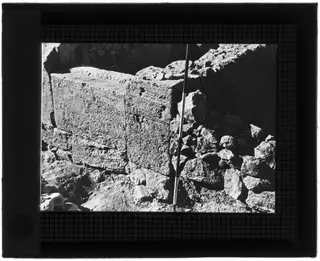
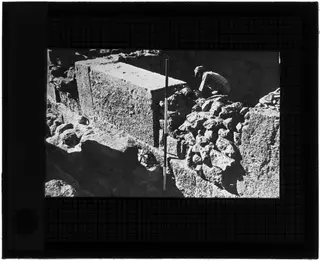
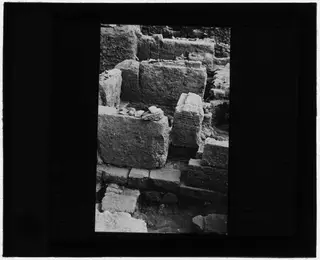
His means let him clear only one building, so large he could not reach its limits, with outer walls of dressed stone, some blocks three metres long17. His trench notebook records the hoard on 22 June 1934: nested bowls with an axe, a two-handled basin and a bronze table or altar on ring feet108. In print he described two nested bronze bowls, 20 and 22 cm across, with a hoe or adze in the inner one, a pan 33 cm across and a low table on ring feet, and named the building the Maison des Bronzes17. He called the table unique among finds in Cyprus and the largest bronze object of its period found there17. Schaeffer was inclined to date the hoard to the 12th century BC, and, finding a mass of copper slag nearby, asked whether a bronze-smith of the town had laid it down17. In 1948 he dated the building's founding to the beginning of Late Cypriot II109. The table was shown in the Cyprus Museum, which its guide listed as from "Louvre Excavations, 1934"110.
Another building nearby gave a fine haematite cylinder seal in Aegeo-Mycenaean style17. Graziadio places it in Trench 37 and notes its kilted male figure and the "Minoan Genius" with an ewer107. Buchholz and Karageorghis date it to Late Cypriot II and place it in the Cyprus Museum111.
Tombs, pots and daggers
Schaeffer found 19 new tombs in the necropolis, while Graziadio credits him with 37 more17,107. He dated the oldest, Tomb 11, to the first half of the second millennium BC and asked whether it held Asiatic immigrants17. Merrillees judges that hypothesis untenable, since the Tell el-Yahudiyeh juglets could have come by trade, and finds the rest of the tomb's pottery Cypriot-made112. A Louvre Mycenaean krater with bull protomes comes from Tomb 12, which Schaeffer put in the 14th century BC17,113. From potters' marks shared by Enkomi and Ras Shamra, and the likeness of their Mycenaean pottery, he argued that Mycenaean vases were made in Cyprus17. Stanley Casson says the two of them worked on the painted signs at the same time, and that Schaeffer let him see his material90.
Schaeffer also argued that all "Cypriot" daggers said to be found in Europe were recent imports through the antiquities trade or by collectors back from the East, and could date no European Bronze Age deposit17.
Missions en Chypre and after
In 1935 the Louvre received a lot of Cypriot objects, including gold jewellery, from his Enkomi campaign20. Charles Picard praised the Enkomi exploration and credited Schaeffer's excellent scientific methods with the discovery of the settlement114. Schaeffer asked, through Dikaios, whether Enkomi could be reserved for him for five years; the Department of Antiquities replied on 16 March 1936 that the law did not allow it, but that he would be consulted before any other licence was issued115.
Missions en Chypre, 1932-1935 appeared from Paul Geuthner in Paris in 1936116. The Revue historique in 1937 called it "remarkable"117. John Franklin Daniel judged that Schaeffer argued convincingly for foundries at Enkomi, but pointed out that the book dated the house's construction to the 12th century on one page and to the "Mycenaean period" on another, and wrote that the hoard's context was unclear and the dates would be clearer with more attention to stratification and pottery116. Daniel still called it an instructive and readable book116. Schaeffer himself wrote that his Syrian digs and then wartime naval service kept him from Enkomi until summer 1946109.
Chapter IV4 minutes
War and the road back to Cyprus, 1939-1946
The sources describe his war service in two ways: Swiny writes that Schaeffer spent much of the Second World War in England as head of Charles de Gaulle's Free French Historical Service3. Edward Bacon and the Illustrated London News speak instead of service with the Free French Navy, or the Free French Naval Forces118,119. Swiny also says that skills learned as a cryptographer in the German navy in the First World War served him in the French navy in the Second3. Powell writes that he spent four years with the Free French1. A July 1944 letter reached him at St John's College, Oxford, and his 1945 licence styled him M.A., D.Litt. h.c. Oxford, and Fellow of St John's120,121. French budgets of February 1946 call him Commandant122,123.
Cyprus and Ambelikou, 1944
Some time before June 1944 Schaeffer made a short stay in Cyprus, which Porphyrios Dikaios called a very pleasant surprise120. Schaeffer later recalled the week he had spent in Dikaios's house120. He thanked A. H. S. Megaw for his reception in Nicosia and for offprints sent before he left the island124. His letters do not say why he came; to Dikaios he wrote that after Cyprus he had continued "ma mission" in Egypt and Palestine, then Morocco and Algiers124. To Megaw he wrote the same day that he was preparing to return to London to put into action "the prepared protection service for the french historic monuments in the battlezone"124.
In 1944 he visited Ambelikou, where a copper-mining company prospecting in the mountains had found Early Cypriot Red Polished fragments, at the place Dikaios called site B44. Schaeffer wrote in 1949 that he had satisfied himself there that the settlement went back to the Red Polished period, between 2300 and 2000 on his chronology44. He saw ash mixed with slag and sherds with copper traces still in place, and picked up a piece of ore in the bank of the new road built for the modern mine44. Against Oliver Davies, who held that the mines were no earlier than the Mycenaean period, Schaeffer said the Ambelikou B finds confirmed that they were found and worked in prehistoric times44. A 1953 review in Antiquity says the last chapter of Dikaios's Khirokitia incidentally corrected Schaeffer's remarks on Ambelikou125.
Reserving Enkomi
On 15 June 1944 Schaeffer told Dikaios that, on his proposal, the Centre National de la Recherche Scientifique had decided to resume the Ras Shamra excavations as soon as circumstances allowed124. He asked that Enkomi, where he had found the first house of the Bronze Age town, be reserved for the Ras Shamra Mission so that he could clear it on a large scale124. Research proper was planned for spring 1945, but to Megaw he added: "Meantime, Hitler must be down first"124. On 18 July 1944 the Acting Director of Antiquities replied that no licence for the site would be granted without prior reference to him120.
Back in London on 23 November 1944, Schaeffer wrote to Dikaios that his house at Saint-Germain had been looted120. Half his library, he wrote, had been burnt in the stove by the Gestapo, who had occupied the house since 1943 after a German general had lived there from 1940; the English books, Dikaios's among them, had been destroyed, and rugs, paintings and their Cypriot embroideries were gone120. "Mais nous allons reconstruire et retourner fouiller," he added120. Powell later gave the same account of the books burnt for heating1.
The licence of 1945 and the postponement
On 15 June 1945 Schaeffer applied to reopen the Enkomi work begun in 1934, with funds from the CNRS126. He argued that Ras Shamra had yielded Cypriot copper ore imported from Enkomi, that Enkomi was "quite likely" a trade and shipping centre between Cyprus and Syria, and that it might yield cuneiform letters126. He proposed plots 260 to 265 and 330 to 334, a survey and trial trenches in the autumn after the harvest, the architect Pironin, and perhaps the draughtsman Christodoulides126. Dikaios, as Acting Director, granted a two-year licence, personal and not transferable, dated 9 August 1945, and Schaeffer signed it on 3 September121.
On 17 October 1945 Schaeffer telegraphed that he had to postpone the start to spring 1946127. In a letter dated 20 November he gave his reasons: the meetings of five excavation commissions in November, the lack of sea transport, and his request to move the credits to the next year128. The two letters disagree slightly on its date, since Dikaios's reply of 7 December thanks him for a letter of 19 November129. Schaeffer hoped to begin early in March, then go to Ras Shamra if possible and to Malatya; meanwhile they had returned to the devastated house and begun to rebuild128. Dikaios answered that Megaw was back from England and in charge of the department, and asked Schaeffer to review his book on Vounous129. Swiny records that in 1946 Schaeffer began excavating at Enkomi and directed the first of four seasons at Arslantepe3.
Stratigraphie comparée
Swiny writes that research in London and Oxford led to Schaeffer's major volume of 1948, a sweeping vision of interdependent cultures from the Mediterranean to the Caucasus3. In 1945 Schaeffer told Dikaios that his chronology of Cyprus formed part of it, then in press at Oxford128. Dikaios called the book monumental and "epoch-making", found its Cyprus chapter methodical and clear, and thanked him for giving so much space to his own work130. George M. A. Hanfmann judged in 1951 that, regardless of its theories, it had great value as an archaeological encyclopedia, taking the sites of Cyprus and other regions one by one131. Hanfmann also found its Table of Destructions not wholly consistent131, and thought part of the disagreement over Schaeffer's re-dating of Late Bronze and Early Iron Age Cyprus verbal, part real131.
Chapter V9 minutes
Enkomi and the joint expedition, 1946-1951
The town, the wall and the hoard, 1946-1947
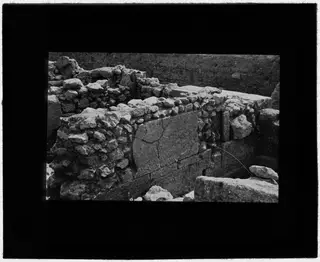
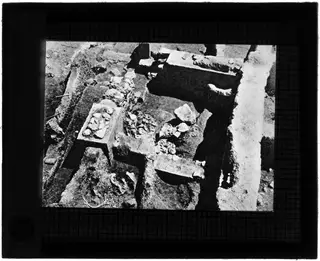
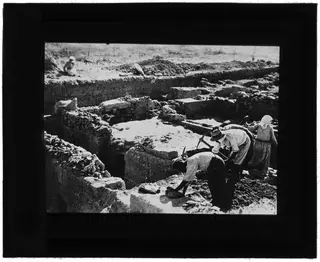
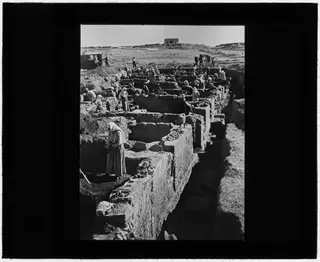
In September 1946 Schaeffer resumed his excavations at the Late Bronze Age town site on behalf of the French Centre of Scientific Research, as the colonial Annual Report on Cyprus put it68. The same report said the season revealed occupation from the Middle Bronze Age to the end of the Late Bronze Age and "the establishment of the Achæans"68. Tatton-Brown writes that he found in the south an important part of the surrounding wall of Cyclopean masonry, and that only at the end of the 1946 excavation did he realise the extent of the settlement4.
In his report on the 1946 season Schaeffer put the end of the Bronze Age and of the Mycenaean period at Enkomi towards the middle of the 13th century, "and not only about 1200"132. He held that the last period was "certainly under new masters", shown by new burial rites, new architecture, a pottery unknown until then in Cyprus and the appearance of iron objects132.
The French mission resumed work in October 1947, laying bare a large stretch of the town wall and extensive residential areas; the colonial report listed among the finds "a hoard of implements and other objects of bronze"133. Tatton-Brown dates the discovery of a treasure of bronzes, in a large building in the northern area, to 19 November 19474. Schaeffer wrote that in 1947 he cleared the Cyclopean wall for 160 metres along the southern edge of the town and followed it further by soundings43. His "present impression" was that the wall dated from the end of the 14th and the 13th century, when the city needed protection43. Tatton-Brown adds that he explored an area in the north-west where, by hearsay, bronzes and copper ingots had been found years before, and uncovered evidence of an industrial quarter4.
The joint expedition and its terms, 1946-1948
The sources give three dates for the start of the partnership: a memorandum by A. H. S. Megaw, Director of Antiquities, proposing collaboration is filed with his letter to Schaeffer of 1 October 1946, which recorded "the salient points of our discussions during the week end"134. Schaeffer signed it on 29 November 1947, writing that it "truly reflects the idea of the combined expedition we have discussed together", and Tatton-Brown dates the agreement to November 19474,135. A copy of the proposals signed by Megaw as Director of Antiquities, dated Famagusta, 21 November 1947, also puts Dikaios in charge of the Department's excavations and says that of their finds "only the normal half-share would be claimed from the Cyprus Museum"136. Emily Vermeule says the Department was invited to form a Joint Expedition "in 1948"137.
Under the memorandum the Department of Antiquities would join the excavation of the Bronze Age town on Schaeffer's invitation, Schaeffer holding the licence, and the venture would be styled "the French Archaeological Mission and Cyprus Government Department of Antiquities joint Expedition to Enkomi"134. The Department would nominate Porphyrios Dikaios, Curator of the Cyprus Museum, to lead its share134. The memorandum argued that digging to the rock across the whole site would sacrifice "the impressive remains of the Mycenaean period now being laid bare", the expedition's main aim being the layout of the town, so the Department would do that work in limited areas, in seasons of two to three months with about forty workmen134. In Schaeffer's absence Dikaios could exercise general supervision, and every report would appear in the name of the joint expedition, with Schaeffer and Dikaios named in that order as joint authors134. Schaeffer sent Megaw two signed copies, one to be countersigned, and promised a covering letter for the Commission des Fouilles once the Cyprus Government had decided135.
The sources disagree on how the finds were to be shared: the memorandum says the Department would claim no more than "its normal half-share"134. The Mercure de France wrote in 1949 that general direction and publication stayed with the French mission, which as concessionaire was entitled to half of its own finds and half of those from the "British" digs58. The Mercure explained the partnership by the pace of the campaigns, which risked lasting some twenty years, and called Dikaios Schaeffer's deputy58.
A draft announcement Schaeffer sent to the Colonial Secretary in 1948 said five successive town levels and a town wall with square projecting towers had been identified, and that the combined work would start in 1948, "or in 1949 if Mr. Dikaios is not available this year"138. Dikaios later reported that the Department's first campaign ran in December and January, on ground between the French North and Workshops areas139. Tatton-Brown writes that the Cypriot team usually worked in late summer or early autumn and the French in October and November4. John Linton Myres wrote that Schaeffer "most prudently" concerted operations with the Department "so that larger areas might be excavated in so extensive and complex a site"140.
Alasia and the horned god, 1949
Schaeffer had allotted his associates a zone beside his own digs, that of the "palace" and its dependencies with a sanctuary, and the Mercure remarked that he seemed to have given them the best share, since in his first campaign Dikaios found in a back room of the sanctuary an intact bronze statue of a standing god58. George Papasavvas notes that the find came in the very first days of Dikaios's work, a short distance from the French trenches141. Le Monde described it as 55 centimetres high, with a kilt, a pointed cap and bull's horns142. On 19 April 1949 Megaw told Schaeffer the corner of the room where the statue lay would be kept as found until he came in September143.
The sources differ on whose identification of Enkomi as Alasia it was: the Mercure says René Dussaud proposed the identification at the Académie des Inscriptions on 29 January, and the colonial report for 1949 also credits it to Dussaud58,144. Le Monde, reporting the sitting of 1 April 1949, presents Alasia as the conclusion of the report Schaeffer had brought the Académie on his excavations142. The colonial report said the identification of the site as the capital of the Kingdom of Alasia had raised the importance of the joint enterprise144.
Schaeffer proposed to identify the statue with Apollo Alasiotas, "great god of Cyprus", and Le Monde reported that it would be the oldest image of Apollo Lykeios, of the 13th or 12th century BC142. The Mercure said it "seems to be" an Apollo Alasiotas, god of the Lukki or Lycians who occupied Enkomi-Alasia in the 13th century, and that it would remain the property of the "British mission"58. The colonial report was more guarded: "perhaps the Bronze Age ancestor of Apollo Alasiotas"144.
Tatton-Brown records several intact tombs found in 1949 and a large building named Building 184.
The breach of 1950
Papasavvas says that Schaeffer's chronology rested on his soundings in Building 18, which he attributed to Mycenaean colonisers and dated to the 14th century141. By his account Dikaios at first accepted that dating but then found 12th-century pottery of Mycenaean types in the earliest layers of his own Ashlar Building, which he too attributed to arriving Mycenaeans, dated to the 12th century141. In 1950, Papasavvas says, Dikaios sent Schaeffer a report of some 200 pages for the Enkomi series, and "when Schaeffer read this report, he declared war"141.
On 12 June 1950 Schaeffer telegraphed Megaw that the report was a "serious misinterpretation of stratigraphy and chronology main building" and asked that digging be postponed until agreement; two days later he asked that the dig stop at the level of floor one, with "no objection" to work on the town wall145,146. Papasavvas says Megaw accepted the request, after which Schaeffer claimed, "as the inventor of Enkomi", exclusive rights over its excavation and interpretation, and that Megaw "firmly rejected" this and a claim to supervise any further Department digging141.
In a letter to Megaw Schaeffer wrote that Dikaios's mistake lay "at the basis of his stratigraphy" and that, if the report were published as it stood, judgement on him as a scholar would be "very severe and unfavourable"147. He claimed overall scientific responsibility for Enkomi, a "site discovered by me", and said further work would decide "who is right, Dikaios or I"147. He asked Megaw to explain to Dikaios that his "sometimes harsh corrections" were the reaction of a scholar whose main result "has suddenly been torpedoed by a newcomer he has invited to his field"147.
On 28 June Schaeffer recalled that in February 1949 Dikaios's contribution had been estimated at about 30 pages, 6 figures and at most 10 plates, while the finished report, as he counted it, ran to 366 pages of text, which "throws the whole first volume out of balance"148. He proposed printing at once his own studies of the 1946, 1947 and most of the 1949 seasons, Dussaud's study of the Alasia identification and Coche de la Ferté's report on the Mycenaean pottery, with Dikaios's report as volume III, financed by the Cyprus side148.
Megaw offered his view as that of "a third party"149. On the date of the original building and floor V he was "really puzzled", feeling "neither view can be wholly wrong", since the lack of finds on that floor "robs both interpretations of proof"; he suggested a 14th-13th-century building rebuilt on new lines by LC III newcomers149. He welcomed Schaeffer's proposal that Dikaios's report be published separately149.
Papasavvas says Schaeffer, in a report to Megaw on the arrival of the Mycenaeans, accused Dikaios of being led by "philhellenic sentiments", and that Megaw dismissed the charge and criticised Schaeffer for "this unkind innuendo"141. He says that Megaw later, after reading Schaeffer's 1951 Académie paper and Enkomi-Alasia I, protested in two letters that Schaeffer had failed to acknowledge the Department's contribution and that his publications replicated Dikaios's ideas, a charge Papasavvas reads as plagiarism; Schaeffer denied any plagiarism and accused Dikaios of taking his ideas, and in 12 pages called him "your curator" 27 times without naming him141. Papasavvas judges Schaeffer "more self-centred than colonial", fighting because "he believed that his achievements were laid on the line", and calls him "a colonialist by opportunity"141.
The end of the partnership and Enkomi-Alasia I, 1950-1952
In 1950 Schaeffer and Dikaios both still carried forward the joint excavation, and an unsigned review of that year records that Schaeffer found evidence of re-use after a fire, "evidently in the twelfth century", and two seated bronze statuettes, one on a throne150. In a résumé for the Académie of 1 June 1951 Schaeffer said his 1950 campaign went mainly to the large building found in 1949 in the west of the town, which he was "now certain" was the palace of the later 14th and 13th centuries BC151. It covered 1,900 square metres, by far the largest and finest ashlar building yet found there, and he dated its building to between 1350 and 1250 and said it remained in use until about 1225 BC151. A press report on his account said the fall of Troy should therefore be put back by nearly a century and a half, as hellenists had recently proposed, and that Mycenaeans settling after the Trojan War renamed Alasia as Salamis152.
On 15 June 1951 Schaeffer told Megaw and Dikaios that Enkomi-Alasia I was at the printers, nearly 400 pages with 150 text figures and about 100 plates, and that he had kept his 1949 and 1950 digs out of the Illustrated London News until the book appeared153. He asked when Dikaios would resume at Enkomi, adding that little money or time would be left that year for his own work there153.
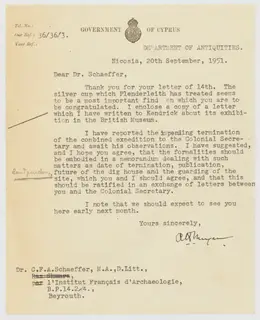
The sources describe the end in two ways: Tatton-Brown writes that the agreement "came to an end at Schaeffer's request on 30 July 1951", mainly over the chronology of the city's urban phase, and that after his suggestion that he undertake the recording of the finds communally was rejected the Cypriot team published separately4. Papasavvas says Schaeffer and Megaw agreed to end their collaboration and sign another memorandum to take effect in 1954141. On 5 January 1952 Megaw returned a countersigned copy of a new memorandum Schaeffer had signed154.
Schaeffer returned objects lent to the Louvre to the Cyprus Museum on 17 October 1951, among them a bronze statue with its throne155. The silver cup from an intact tomb of 1949, treated by H. J. Plenderleith, was to be shown at the British Museum, by Megaw's agreement, under a label naming the "Franco-British Combined Expedition to Enkomi, with C.F.A.Schaeffer in charge"; Schaeffer stipulated that no other archaeologist photograph or draw it, and Megaw told Sir Thomas it was the Cyprus Government's property pending division156.
Tatton-Brown writes that the volume, published in 1952, covered the seasons of 1946 to 19504. Myres, reviewing it, found in it Dussaud's "very strong case" for Enkomi as Alasia, read Schaeffer as seeming to ascribe the final destruction to the Dorians, and congratulated him on "this lucid and full interpretation of a peculiarly complicated and tantalizing site", adding that his "Cypriote colleagues' share" was still to come140. Vermeule later noted that Schaeffer used Dikaios's stratigraphic sections, "although the Cypriote excavations do not appear on the French plans"137. At a congress in 1972, Papasavvas says, Schaeffer lamented losing Dikaios's friendship over a scientific argument141.
Chapter VI7 minutes
The French mission alone, 1951-1974
Autumn seasons, 1952-1970
In 1951 the Department of Antiquities worked the parts of the Late Bronze Age town at Enkomi assigned to it in the joint investigations with the French Mission under Schaeffer, while the French Mission planned to resume its own digging in 1952157. By 1955 the Department was doing supplementary work in the areas it had dug "during its association with the mission"158. Swiny writes that Schaeffer became a member of the French Academy in 1953, and that in the following year a chair in Near Eastern archaeology was created for him at the Collège de France3. The International Who's Who gives him as Director of Research at the CNRS from 1946 to 1954 and Professor at the Collège de France from 1954 to 1969, and lists his Cyprus expeditions as 1932, 1934, 1935, 1946, 1947 and 1949-70159.
The 1953 season was mainly directed to working out the plan of the town158. In 1953 the French Mission uncovered substantial sections of the west wall for the first time and identified seven parallel east-west streets inside the walls158. That year Schaeffer also found a Cypro-Minoan tablet, the third so far discovered, according to the Colonial report158. A note in Antiquity in 1956 counted four tablets from Enkomi, including the one found by Schaeffer in 1953160. In the autumn of 1954 the Mission traced the west wall, which had now been followed all round the town except on the east, and found a gate of dog-leg plan where one of the east-west streets met it158. Schaeffer asked that his press communiqué on that September-October season be held until 22 October, so that the French Academy and the French press were told at the same time as the Cyprus papers and The Times161. He, his wife and his assistants W. Forrer and J. C. Schaeffer, architect, then left for Ras Shamra, and he announced that the Expedition would return in 1955161. In 1955 the Mission uncovered in the central area "an important new public building of very fine construction"158.
The 1958 work was more limited than earlier seasons, the Bulletin de correspondance hellénique (BCH) reported, and Schaeffer went straight on to Ras Shamra without yet publishing a report on it162. Most of that season was given to the "archaeomagnetism" of J. Aitken, of the Oxford Research Laboratory for Archaeology, applied at several points of the site162. Aitken's survey revealed a considerable part of the street grid of the ancient town163. With seven collaborators from France and one member of the Cyprus Department of Antiquities, the Expedition made its 13th season in September-October 1960, concentrated along the main north-south street in the centre of the town164. In the northern quarter the 14th campaign, in the autumn of 1961, identified important industrial establishments, most of them working copper, bronze and iron, Schaeffer reported165.
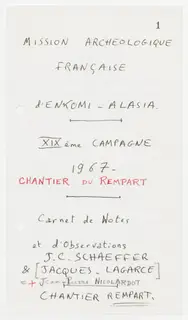
Work resumed in 1965 with a 17th campaign, whose first part explored a large stretch of the west town wall north and south of the gate located in 1954166. The 19th campaign followed in 1967167. In November and early December 1969, with J.-C. Courtois, M. and Mme J. Lagarce and J.-P. Nicolardot, all of the CNRS, Schaeffer made a 20th campaign, now as honorary professor of the Collège de France168.
The Ingot God, 1963
The 16th campaign, in the autumn of 1963, had M. and Mlle Courtois of the CNRS, J. Lagarce, J.-P. Nicolardot of the Collège de France, W. Johnstone of Aberdeen and R. Tamassia of Padua among its collaborators69. Courtois reported that it completed the clearing of the large sanctuary of the Cypriot Iron I period69. On 4 October, Schaeffer's communiqué says, a bronze statue 35 cm high in all was found69. Six days later Vassos Karageorghis of the Department of Antiquities sent him the weights of the two objects just found: the bronze statue, 2,108 g before treatment, and a silver hemispherical bowl of 239 g169.
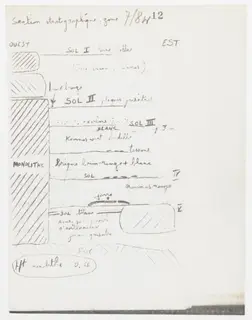
In his draft report Schaeffer described the god wearing a bull-horned helmet and greaves, brandishing a spear in his right hand and holding an oval shield on his left arm170. Schaeffer wrote that the statue stood upright between 0.80 and 1.10 m deep, in a carefully made cache under two later floors found intact, and dated the sanctuary by its stratigraphy and pottery to Cypriot Iron I, Late Cypriot III170. He wrote that the god received a fervent cult, attested by nearly a hundred bull skulls found in the sanctuary170. Schaeffer placed it, probably, in the same immediately post-Mycenaean period as the statue of the horned god found some 75 metres away69. National Geographic History says the find of a bronze god standing on a copper ingot "seemed to support" the identification of Enkomi with Alashiya60.
Jennifer M. Webb, writing in 2001 from Schaeffer's report of 1971, places the statue upright on Sol III, just inside and to the right of the entrance to the north-east adyton171. Webb reports Schaeffer's view that the builders of Sol II removed the statue from circulation and sealed it in the fill to protect the god from flood and earthquake, and that he saw no problem in the cult going on through Sols II and I with the image underground171. Webb argues that the sanctuary's architectural and depositional history had not been well understood, that it was dedicated to two deities, and that the Ingot God "cannot, therefore, have served as a visible cult image for either Sol II or Sol I"171. Earthquakes run through other readings of the late town: Cook cites Schaeffer, with Dikaios and Karageorghis, for traces of earthquake and flood in or on its buildings, and reports from Schaeffer's 1971 account a smiting-god figurine found on Floor II in the debris of a house that collapsed, "probably due to an earthquake"172.
Publication and its critics
In 1971 Schaeffer published Alasia I, which the BCH notes appeared in 1972159,173. Stuart Swiny describes it as eighteen field reports and studies by an international group of scholars in honour of the twentieth season3. Lindy Crewe calls the French Mission's publication incomplete, and judges that Schaeffer's goal at Enkomi was to find a parallel to Ugarit, that he began with "a set of preconceived notions" and meant to tie the site to mainland chronologies and events70. Swiny wrote in 2020 that the French reports under Schaeffer give little systematic information on the metal finds: hoards and other notable pieces were singled out, no standard report covering all finds was published, and the precise context of many finds is unrecorded, so they carry only a broad date174. By contrast, Swiny calls the Enkomi results of Porphyrios Dikaios, published between 1969 and 1971, "detailed in the extreme"174.
Pelon, Karageorghis and the end, 1970-1974
The sources disagree on when Olivier Pelon took over70,71. Schaeffer's own note dates the Mission's reorganisation from 1 January 1971, when, at his request, the Foreign Ministry's Commission des Recherches Archéologiques named Pelon, lecturer in Near Eastern archaeology at Lyon, director of excavations, and Schaeffer kept only the roles of scientific adviser and director of publications71. Crewe and National Geographic History put the hand-over in 1970, and Thély has Schaeffer working at Enkomi from 1946 to 1970 with Pelon directing from the following year60,70,175. In October and November 1970 Schaeffer still had general direction of the season, with Pelon first among the collaborators examining two domed tombs in the centre of the town176.
The campaign numbers also disagree176,177. The BCH calls the 1970 season the 21st, the 1971 draft report calls the season of 15 March to 10 April 1971 the 21st, and the 1971 notebook, whose original was handed to Pelon on 14 April 1971, is headed "XXIIe campagne"176,177,178. In 1971 the team was directed by Pelon, with Schaeffer present only at the start of the work, and Karageorghis, Director of the Department of Antiquities, visited the site several times173,177.
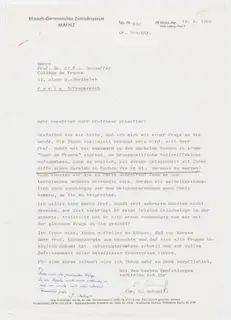
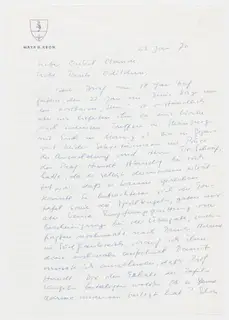
Relations with Karageorghis then soured, as Schaeffer's letters tell it179. In 1972, having sent no text for the Acts of the symposium, Schaeffer withdrew his contribution, wrote of "an unfair treatement by one of those younger and ambitious colleagues who are not objectively interested in the work of their prédecessors", and closed that when Karageorghis had another twenty years of fieldwork behind him "you will perhaps come to understand my attitude"179.
In a memorandum of 1973, Schaeffer records that in August Karageorghis told the French Foreign Ministry that publication of the Enkomi discoveries should be finished before new excavations began180. Schaeffer answered that the main discoveries were already in four volumes and Alasia II ready for 1974, conceding that the town's many private houses remained unpublished and would need control excavations and five to seven years180. By his account, when he asked in October whether Pelon would get a permit for autumn 1974, Karageorghis "replied sharply" that he would discuss it with the present director, not with Schaeffer and Pelon; Pelon then told Schaeffer that Karageorghis meant to take the matter up directly with the Paris archaeological authorities, which Schaeffer called "degrading the French Enkomi Expedition to a mere executive branch"180. In a postscript to K. Nicolaou, Schaeffer wrote that he had heard Karageorghis had no objection to forwarding a new application from Pelon, and that he had asked Pelon to apply at once to dig in 1974181.
Crewe has Pelon digging until 1973, after which the Turkish invasion ended excavation70. Hermary dates the end of the Enkomi mission to 1974, after which the Bronze Age has been "une lacune regrettable" in French work in Cyprus182.
Chapter VII6 minutes
The finds: divisions, gifts and the Vounous catalogue
Vounous and Lefkoniko, 1933-1934
Annie Caubet writes that Schaeffer's finds from the Early Bronze Age cemetery of Vounous were divided between the Cyprus Museum, the Louvre (for example AO 17512, 17513 and 17517) and the museum of Saint-Germain183. Anne-Elizabeth Dunn-Vaturi records that the objects were allotted in part to the Cyprus Museum, citing its Annual Report for 1933, and to the Louvre by a decree of 6 December 193492. A lot went to the Musée des Antiquités Nationales at Saint-Germain-en-Laye, and he kept a study collection at his home, the Castel Blanc92. In Dunn-Vaturi's judgement the division "did not respect the coherence of the tombs", and no tomb group stayed together for good; she adds that the route of the material after the dig could not always be traced92. The Louvre records two such pieces, the jug AO 17539 from tomb 76 and the small bowl AO 17532 from tomb 65, as gifts after excavation entered in 1934184.
The sources disagree on where Schaeffer's Lefkoniko material came from93,183. Caubet writes that John Linton Myres offered Schaeffer material from his 1913 excavations at Lefkoniko, and that Schaeffer gave it to the Saint-Germain museum183. The French state's Joconde record of a miniature crater at Saint-Germain (inv. 76839) instead names Schaeffer as the finder at Lefkoniko, by excavation, in 193393.
Deposits and the Beirut vases
Dunn-Vaturi writes that from the 1930s material from Schaeffer's Vounous and Enkomi digs served as "samples" for deposits in France, such as the Musée de la France d'Outre-Mer, and abroad, at the National Museum of Beirut185. Searching in Beirut for the deposit of Vounous and Enkomi vases destroyed in the conflicts, she found another Enkomi group: about ten vases from his 1949 excavations, registered there as a "Don de M. Schaeffer" in 1958185. In the Louvre's records AO 17539 carries the depositary number D.2006-0-58, and AO 17532 the number 2007-0-46, with a citation of Antoinette Decaudin's catalogue of the Musée de Cannes184.
The half-share and the Enkomi divisions, 1947-1957
On 31 August 1952 Schaeffer wrote to Megaw that he would have to report to his body in Paris on the finds of his partner expedition, "half of which, after division, shall revert to the French Mission"186. All his own material and inventories, he wrote, were in the Department's hands at the end of each season, and he asked for reciprocity186. Schaeffer complained that when he had asked Dikaios the year before to see the Department's finds, Dikaios answered that he had not been told, had been away in Turkey, and that the material was packed or in the laboratory; in the end Schaeffer had seen only a few pieces of the first season186.
For the division of 1957 Schaeffer prepared notes covering the French mission's finds of 1946, 1947, 1949, 1950, 1952 to 1955 and 1957, and noted that the passage on the division in the joint mission's charter was to be reviewed187. He graded the finds as outstanding, important, noteworthy and current, on the principle that "no amount of current antiquities can balance important finds"187. Side questions to settle were compensation for J. Bérard's broken vases, the donation of the Stylianou bronzes to the Louvre and the sending of the Vounous antiquities to Stewart187. On 15 November 1957 he told Megaw that he found it hard to discuss a division from a list of 19 selected objects, "a good deal of which I have never seen", and asked for the complete inventories of the Department's Enkomi finds, since only the tomb material had been shown in the Museum188.
The share assigned to Schaeffer was set out in the Director's letter No. 82/56 of 28 November 1957; a receipt signed by Dikaios on 27 November shows bronze sceptre No. 3774 from the Enkomi hoard, part of that share, lent to the Cyprus Museum for exhibition189. In November 1957 Schaeffer exported objects under export licences No. 3318, 3323 and 3327, among them two painted wooden Egyptian figurines, a terracotta dog and a bronze statuette, some taken on loan with an undertaking of 30 November to insure them and return them within a year190,191. In 1958 the Cyprus Museum received back through M. Kuss objects lent to him in 1957, among them pieces allotted to it in the division, a Close Style jug from "Maison 18" and an oval gold pectoral from Tomb 2192.
Palma, the ingots, the seals and the Stylianou bronzes
Schaeffer's notebook and his 1952 account, as Merrillees gives it, differ in what they say about the copper ox-hide ingots found at Enkomi2,193. In his notebook for 23 September 1946 Schaeffer wrote that peasants had found two ingots, one now in the Nicosia museum and the other sold to America, and had sold them "for 11 shill. to Palma, the pharmacist-antiquarian of Famagusta"193. In his 1952 account, as Robert Merrillees gives it, Schaeffer said that the second ingot was acquired by a Famagusta dealer for 11 shillings and sold to the County Museum in Los Angeles2. Robert Merrillees judges that the dealer "most likely" was Palma and that Schaeffer "was misinformed" about the destination, since there is no Cypriot copper ingot in the Los Angeles County Museum of Art2.
Merrillees writes that Schaeffer acquired two cylinder seals from George Basil Palma, one in 19492. On 7 January 1949 Kyriaco Stylianou of Larnaca offered the French mission a set of Bronze Age tools which, he wrote, a villager had found near Enkomi and sold to Palma, who sold them to George Pavlides, from whom Stylianou bought them194. The French consular agent at Larnaca reported on 14 November 1949 that Stylianou said he had paid £35, and that he would give the collection to the Louvre if his name appeared on the showcase as donor195. On 16 December 1957 Megaw wrote that four pieces, of types not adequately represented in the Cyprus Museum, could not have an export permit and that the Department wished to acquire them, while the rest could go196.
The gifts of 1958
In an undated list Schaeffer recorded Enkomi antiquities handed to the Louvre as a gift, subject to the approval of the Commission des Fouilles, beginning with a large gold pectoral from Tomb 2 of 1949, gold diadems and a sceptre sheath197. Caubet writes that under the policy of sharing finds Mycenaean pottery, weapons, tools and the bronze banqueting god from Building 18 entered the Louvre183. The Gazette des Beaux-Arts reported in 1958 that Saint-Germain showed among its new acquisitions forty-two objects "from the Cypriot cemetery of Enkomi", given by Schaeffer23. The Ashmolean Museum's records credit him with a Plain White Wheelmade I bowl from French tomb II and a Mycenaean cup from Tomb 5, both presented in 1958198. Earlier, on 7 June 1950, the Paris firm Maison André had invoiced him 1,500 francs for cleaning a silver statue from Enkomi199.
Vounous to Australia
Judith Powell writes that the Stewarts were told in Paris of "unusual arrangements" at Vounous: "Apparently" the agreement with the Department gave Schaeffer half of all that Dikaios dug, which Schaeffer thought explained why Dikaios no longer worked there1. Caubet and Dunn-Vaturi describe Schaeffer's own Vounous finds as divided among the Cyprus Museum, the Louvre and Saint-Germain, and the half-share clause of the 1947 proposals concerns Enkomi92,136,183. At that meeting, Powell says, Schaeffer agreed to hand all his Vounous finds to J. R. B. Stewart to be mended and studied at Bathurst1. Dunn-Vaturi writes that 174 objects that had stayed in Cyprus were sent to Australia; Alexander Cambitoglou dated the sending to 1960 and wrote that Stewart took the pottery to his estate at Mount Pleasant because the University of Sydney lacked facilities92,200. Stewart and Merrillees worked for five weeks in the Louvre storeroom on the 1933 material, which Powell calls "never completely published", and on material stored in the basement of Schaeffer's house; Powell places their work in Paris in 19591.
The sources tell the 1962 outcome differently1,201. Powell writes that after Stewart's death Cambitoglou asked Eve Stewart to return Schaeffer's Vounous material1. The letters record a gift instead: Alexander Cambitoglou asked on 3 July 1962 whether Schaeffer still meant to give the collection to Sydney, and on 30 July Schaeffer confirmed "my intention to donate the collection of my Vounous pottery to the Nicholson Museum"200,201,202. Schaeffer asked for a copy of the catalogue, to be consulted before vases went to other institutions, and for a label in memory of Stewart201. On 6 November Cambitoglou thanked him and wrote that the University would recover the material from Stewart's estate, and that Merrillees's catalogue was almost complete202.
Dunn-Vaturi writes that Merrillees made the project the subject of a university essay at Sydney in 1959, and in 1988 set out its limits: inaccessible records, dispersed material and many numbering errors92. Ten years later Annie Caubet proposed that Dunn-Vaturi prepare the catalogue92.
The gifts of 1983
In 1983 Odile Schaeffer-Forrer gave the Louvre a limestone stamp seal with the excavation number Enk. 50 (AO 28026) and a cylinder seal from Enkomi or Ras Shamra (AO 28029)184.
Chapter VIII5 minutes
Assessments and legacy
The anniversary that did not happen
In January 1973 Vassos Karageorghis wrote that 1974 would mark forty years of excavation at Enkomi and that he would propose to the government to honour Schaeffer "as the discoverer of Enkomi and all those who worked at Enkomi since 1934"203. Schaeffer replied that he hesitated to accept the date, because "the discovery of the townsite goes back, in reality, to 1930"204. By his own account, on a visit to the Swedish excavations that year he became convinced that the walls the excavators dismantled above the tombs and dated to the Byzantine period were the ruins of the Late Bronze Age city to which the tombs belonged204. He added that he tried in vain to convince Erik Sjöqvist, and could begin his own excavations only in June 1934, after the Swedish Expedition had given up its licence204. On 9 February 1973 Karageorghis accepted his reasons and hoped to be still in his post in 1980 to honour him then205.
Death and the obituaries
In the preface to Ugaritica VII in 1978 Schaeffer announced that he wished to join to his own the name of his teacher, Robert Forrer66. Jean Vercoutter records that it was as Claude Schaeffer-Forrer that he died of cancer at Saint-Germain-en-Laye on 25 August 198266. He had spent his last years on the corpus of cylinder seals from Ras Shamra-Ugarit and Enkomi-Alasia, which, in the obituary in Syria, he had the joy of finishing before he died206. Vercoutter wrote that the corpus joined the names of the two sites that had made him "l'archéologue français le plus célèbre de sa génération"66.
The Syria notice was introduced in a note signed E. W., which reproduced in substance the text that Jacques-Claude Courtois, one of Schaeffer's main collaborators, had written for Universalia 1983206. He closed by calling Schaeffer an archaeologist "exceptionnellement heureux dans ses découvertes"206. Jean-Jacques Hatt's obituary in the Cahiers alsaciens called the career "extraordinaire et paradoxale" for a man who held only an Abitur, the equivalent of the French baccalauréat207. Other notices appeared from P. Amiet in the Revue d'Assyriologie in 1983, while K. Bittel had written on him in 1979 for the Ugarit-Forschungen volume marking his eightieth birthday208. In 1983 the Académie des Inscriptions et Belles-Lettres elected Jean Marcadé to the seat of Claude Schaeffer-Forrer209.
Judgements
Emily Vermeule wrote in 1974 that he "was the first to recognize the true situation, after sondages in 1934"210. According to Vercoutter, a Swedish mission that included Arne Furumark could only acknowledge that his discovery was well founded66. Annie Caubet writes that Schaeffer, alerted by Ugarit, recognised a walled city with sanctuaries and official buildings where, as in the Levant, the dead were buried under the houses86. Bernard Knapp also credits him with showing that the Late Cypriot tombs and the houses above them were contemporary72.
Courtois judged the Enkomi finds crucial for reconstructing the civilisation and history of Cyprus in the second millennium BC206. Vermeule said that Enkomi-Alasia (1952) brought the site to public attention, established its strong links with Ugarit and "raised interesting problems of history and stratigraphy"210. Swiny calls him "arguably the most renowned French archaeologist of his generation", a man of great energy who for many years directed two major field projects at once, and also responsible for "novel and often controversial interpretations"3.
The sources disagree on how he published: the Dictionary of the Ancient Near East says he published preliminary reports promptly, with volumes of essays by himself and others on particular aspects of his sites211. Swiny notes that Enkomi-Alasia is not a comprehensive excavation report, "as none was ever published by Schaeffer"3. Lindy Crewe writes that the only French areas published in detail are of LC IIC/III date, Bâtiment 18 and the Sanctuary of the Ingot God, while the earlier occupation, reached only in soundings and some early tombs, remains largely unpublished70.
On method, Knapp quotes Antoniadou that the rapid clearance of large areas "proved to be less a productive than a destructive procedure of excavation"72. Knapp, following Papasavvas, says Schaeffer dug primarily to recover significant finds and to build a general historical reconstruction, and adds in his own words that in Cyprus, especially after 1946, Schaeffer brought prejudgements from his chronological scheme about what he would find72. Knapp quotes Papasavvas's conclusion that the French publications "are seriously compromised by a lack of close stratigraphic observation, a reliance on a preconceived historical reconstruction and on some chronological misinterpretations"72. Knapp sums up, citing Papasavvas, with "a lack of methodological rigour and the selective publication of finds that he considered to be of historical significance for his interpretations"72. Knapp points to Lagarce 1993 for an alternative view72. Anastasia Leriou and Giorgos Vavouranakis judge that the expedience of the early Enkomi reports "seems to have characterised Schaeffer's methodology as a whole", and suggest that the more systematic post-war reports may be attributed to his associates, above all Courtois, who according to Karageorghis long remained in Schaeffer's shadow208.
Dates and Alasia
The sources also disagree on his dating: Knapp says Schaeffer eventually came round to Porphyrios Dikaios's 13th-century date for Enkomi's Mycenaean pottery but "never acknowledged his debt" to Dikaios's more careful stratigraphy72. Jacques Lagarce held in 1997 that 13th-century ashlar at Kition and Kalavasos had "in the main confirmed" Schaeffer's reconstruction, which put the planned town well before the end of that century, against Dikaios212. Lagarce added that the two stratigraphies cannot be precisely correlated212. At the Nicosia symposium of 1972 the date of the ashlar buildings set Schaeffer against Hector Catling in what Robert Merrillees called a "never-to-be forgotten dispute"213. On Alasia, Lagarce wrote that the equation of Enkomi with Alashiya, proposed by René Dussaud and by Schaeffer, "is generally rejected, but final decision must await new textual evidence"212.
What remains
His Vounous tombs were published by Dunn-Vaturi in 2003208. Matthew Neale Dalton's Egkomi Mapping Project redraws the architecture on a 2004 satellite image from the French mission's "accurately surveyed 1969 site plan"214. Dalton also notes that Schaeffer began a new tomb-numbering sequence each season, and that the mission's methods of 1946 to 1973 severely limit any picture of tomb distribution, above all in the earlier levels214. Since the Turkish invasion of 1974 Enkomi has lain in the occupied north, as Maria Iacovou records215.
Charles U. Harris writes that by 1985 the Cyprus American Archaeological Research Institute (CAARI) needed larger quarters, one factor being "the unexpected acquisition of the extensive library of Claude F. Schaeffer", in memory of John I. Wylde216. Its 2,500 works, "conservatively valued at $100,000", overflowed the institute's modest commons room216. Thomas W. Davis says the library was "purchased in memory of F. I. Wylde", and a 1990 correction names the library the Claude F. Schaeffer Library, in memory of John Irton Wylde217,218. Gus Feissel, CAARI's president, wrote in 2008 that the acquisition in 1985, under Swiny's direction, turned CAARI into "a major international research center for Cypriot archaeology"219.
Life and work
194 events, 1929–2026
1929
The spring 1929 excavation by Schaeffer and Chenet found at Minet el-Beida a vaulted tomb (tomb III) whose pottery is Cypriot of the second half of the second millennium BCE (Cypriot bowls with triangular handles, painted geometric ware, jugs) together with ivories; Schaeffer's report to the Académie appeared in Syria 10 (1929), p. 285, with tomb III on pp. 291-293.
Began, with G. Chenet, the excavation of a large tell at Minet el-Beida (Ras Shamra) on the Syrian coast north of Latakia, where an important necropolis yielded Cypriot antiquities of the second-millennium Bronze Age; he was then conservator of the Strasbourg archaeological museum.
Agent or excavator for 3 objects (among them 'cruche à bec pincé', inv. 76828) (1929); now in musée d'archéologie nationale (des origines à l'an mille) - château de Saint-Germain-en-Laye, Saint-Germain-en-Laye.
Agent or excavator for 2 objects (among them 'cruche-tonneau', inv. 76830) (1929); now in musée d'archéologie nationale (des origines à l'an mille) - château de Saint-Germain-en-Laye, Saint-Germain-en-Laye.
Was charged by the Académie des Inscriptions et Belles-Lettres in 1932 with an archaeological mission to Cyprus: «Académie des Inscriptions et Belles-Lettres me chargea, en 1932, d’une mission archéologique dans l’ile»
Directed, in the name of the Louvre and with Dikaios, the Vounous excavation (tombs 49-79, about thirty tombs, some looted). Published as a travel-style account in Missions en Chypre (1936); the full tomb catalogue stayed unpublished until Dunn-Vaturi (2003).
The 1933 mission was facilitated by the British High Commissioner, Sir Reginald Stubbs, and Dikaios, conservator of the Nicosia museum, collaborated throughout the research.
Reported to the Académie des inscriptions on the Cyprus work of 1933, made possible by the Fondation Fontanes (printed Fontane in one account): the ancient copper mines (two periods of great activity at Skouriotissa, one Roman, one probably of the second millennium BCE); several sites of the Episkopi region from the Neolithic to the Roman period, one of them dug by Dikaios and giving an unknown painted pottery; further work near Larnaca, at Enkomi, in the Karpas and along the north coast; and as the main excavation an Early Bronze Age necropolis near Kyrenia (printed 'Vouni' in one account and 'Kirania' in another) with more than 40 vaulted tombs of the end of the third millennium and 1,400 vases, red, with relief or modelled decoration. The Académie decided to give the objects found to the Louvre, which would pass to provincial museums the pieces it did not wish to keep.
Gave 1 object (among them 'cruche à bec pincé', inv. 76826) (1933); now in musée d'archéologie nationale (des origines à l'an mille) - château de Saint-Germain-en-Laye.
Agent or excavator for 39 objects (among them 'cruche à bec pincé', inv. 76826) (1933); now in musée d'archéologie nationale (des origines à l'an mille) - château de Saint-Germain-en-Laye, Saint-Germain-en-Laye.
Agent or excavator for 2 objects (among them 'pierre (fragment)', inv. 76619) (1933); now in musée d'archéologie nationale (des origines à l'an mille) - château de Saint-Germain-en-Laye, Saint-Germain-en-Laye.
Agent or excavator for 1 object (among them 'vase (anthropomorphe)', inv. 83437.b ; 83437 (Ancien numéro) ; 72 (N° de fouille)) (1933 (2 juin)); now in musée d'archéologie nationale (des origines à l'an mille) - château de Saint-Germain-en-Laye, Saint-Germain-en-Laye.
Agent or excavator for 1 object (among them 'cruche à panse ovoïde', inv. 83437.a ; 41 (N° de fouille)) (1933 (28 juin)); now in musée d'archéologie nationale (des origines à l'an mille) - château de Saint-Germain-en-Laye, Saint-Germain-en-Laye.
After the sixth Ras Shamra campaign went to Cyprus to dig at Enkomi near Famagusta. Dussaud told the Académie that the Académie's proposal to send him there had met the objection that an English and a Swedish mission, and clandestine diggers, had probably exhausted the site; the aim was a methodical prospection of the east coast to test the contacts shown by the Ras Shamra finds between Cyprus and Phoenicia, to separate Cypriot from Phoenician ceramics in the second half of the second millennium BCE and to establish Cyprus's share in the Mycenaean pottery at Ras Shamra.
The Académie's summary of the 1934 campaigns says that Schaeffer, with the authorisation of the British Government, was charged with the excavations at Enkomi north of Famagusta to study the relations between Cyprus and the Syrian coast; he uncovered the first houses of the town and found in the necropolis a series of tombs dated from the sixteenth to the twelfth century; the report notes that the necropolis had been explored forty years earlier by an English mission and recently by a Swedish one.
As assistant conservator at the Saint-Germain museum, reported on recent discoveries in Cyprus (the Neolithic and an Early Bronze Age with objects of European type) and warned that the daggers with narrow blade and curved handle found in Cyprus and in Hungary, Austria and Switzerland should no longer be regarded as Cypriot: the report says they were introduced into those countries by the modern trade in antiquities, a proof of how far to distrust work resting on objects received from dealers.
Gave 2 objects (among them 'pointe de lance', inv. 77124.a2 ; 77124.a (Ancien numéro) ; 77124 (Ancien numéro)) (1934); now in musée d'archéologie nationale (des origines à l'an mille) - château de Saint-Germain-en-Laye.
Began digging at Enkomi in 1934, fresh from Ugarit, and found the town among the tombs; worked in partnership with the Cyprus Department's excavation under P. Dikaios; French publication slow and piecemeal.
The Louvre received in 1935 a lot of Cypriot objects, among them gold jewellery, from the Enkomi campaign Schaeffer had led (the page does not date the campaign itself, which may be that of 1934); he is also reported to have found Mycenaean houses matching the known necropolis.
Illustrated London News: Schaeffer, leader of the French expedition, described in the paper (his article on p. 246) the Vounous pottery from further excavations, among it a ritual vase with a woman bearing a cradle and a drinking cup with a stylised bull's head.
Missions en Chypre 1932-1935 reviewed as the full account of his Cyprus missions, an exploration of the island crowned by the discovery of an important Early Bronze Age necropolis at Vounous; the reviewer praised the tomb plans and inventories. Schaeffer is styled assistant curator of the Saint-Germain-en-Laye museum.
Visited Ambelikou B in the Morphou hills (a site found by a prospecting mining company and called B by Dikaios), where a surface mine and ore-working area with ash, slag and sherds with adhering copper remained; he judged it contemporary with the red lustrous ware (2300-2000 BCE by his chronology) and picked up a piece of ore from the bank of the new mine road. He took this to confirm his argument in Missions en Chypre (p. 94 ff.) that Cypriot copper mining is prehistoric, against Oliver Davies, who had put the mines no earlier than the Mycenaean period.
First post-war Enkomi campaign: found a Cyclopean-type enclosure wall protecting the town to which the known Enkomi necropolis belongs; preliminary report in Revue archéologique 1947, I, pp. 129-149.
Resumed Enkomi for the CNRS; found the Cyclopean wall (1946-47) and, on 19 November 1947, a hoard of bronzes in a large building in the northern area; explored the north-west industrial quarter where bronzes and ingots had reportedly been found earlier.
Dr. Claude F. A. Schaeffer resumed his excavations at the Late Bronze Age town site of Engomi in September 1946 for the French Centre of Scientific Research, revealing several occupation periods.
Dr. Schaeffer issued the first volume of the joint expedition's publications describing excavation results from 1946 to 1950, including the silver bowl exhibited on loan in the British Museum.
Named in the «Archaeology in Cyprus» survey (JHS / Archaeological Reports): Published results of campaigns at Enkomi 1946-1950: «Dr. C. F. A. Schaeffer published the most important results of his campaigns between 1946 and 1950»
Led the French side of the joint Enkomi exploration with the Department (Dikaios), 1946–57: town wall, public buildings, Building 18; excavated at Vounous earlier; Suez crisis stopped his 1956 season.
In the second campaign cleared the Mycenaean enclosure over 160 m along the south side of the town and traced it further by soundings; described in a note in Revue archéologique 1948 (Mélanges Charles Picard), pp. 926-935. Coche de la Ferté took part in the 1946 and 1947 campaigns.
Examined the Ambelikou vases in the Nicosia Museum and judged the material then available insufficient to settle whether Erimi painted ware ended before or overlapped Early Cypriot red lustrous ware.
Agreement with the Cypriot authorities (Megaw as Director) to form a joint Franco-Cypriot mission at Enkomi; the Department's side was led by Dikaios from 1948.
In October 1947 the French Mission under Dr. C. F. A. Schaeffer resumed work at the Late Bronze Age town site at Engomi, uncovering a large stretch of town wall and residential areas.
'Fouilles à Enkomi (Chypre) et à Arslan Tépé', Comptes rendus de l'Académie des Inscriptions 1948, pp. 338-345: excavation of the Mycenaean ramparts and the northern quarters (a princely residence of the 15th century, remodelled later) and a hoard of intact bronze objects.
The Department of Antiquities, collaborating with the French Mission under Dr. C. F. A. Schaeffer, uncovered a considerable area in the northern part of the Engomi site from November. (1948)
Before WWII excavated part of the Vounous cemetery and discovered the Enkomi settlement; wrote Stratigraphie comparée (1948); Enkomi now continued by Pelon.
Article 'Chronologie et origine de la civilisation du Bronze ancien de Chypre', Revue archéologique 6e série 33 (April-June 1949), pp. 129-149, discussing Dikaios's Ambelikou and Philia finds and proposing an intrusion of Anatolian-type red lustrous ware c. 2300.
'Nouvelles découvertes à Enkomi (Chypre)', Comptes rendus de l'Académie des Inscriptions 1949, pp. 88-95: identified Enkomi with Alasia and the bronze horned god found in an ashlar building with Apollon Alasiotas, the town's protector after its conquest by the Lukki, rather than Nergal; dated late 13th or 12th century.
Described in the press as intending to locate the city to which the Enkomi tombs belonged; he showed the city wall and tombs built under houses, supported Dussaud's identification of Enkomi with Alasia, and brought a British (Department of Antiquities) mission into the work because campaigns might otherwise have lasted twenty years.
Joint French Mission and Department of Antiquities excavations at Engomi continued in 1949, including Dikaios's spring clearance of a building and Schaeffer's autumn trenches, which revealed a street plan, a large building facade and intact tombs.
Agent or excavator for 40 objects (among them 'guttus (fragment)', inv. 81228 ; encre jaune 958.47 (N° de collection antérieure) ; 2393, t. 8. (N° de fouille)) (1949); now in musée d'archéologie nationale (des origines à l'an mille) - château de Saint-Germain-en-Laye, Saint-Germain-en-Laye.
head of the French Archaeological Mission at Enkomi/Alasia; excavation director in autumn; leader of the French Archaeological Mission at Enkomi (Alasia excavations) in Claude Schaeffer's papers (Collège de France), 2 documents, 1949.
Lecture in Paris on his Cypriot finds, reported in The Times of 21 March 1950 (as relayed by Spanuth, a later and partisan author): a palace with a cult place of Apollo at Enkomi in 1948-49, four undisturbed tombs and seal impressions with ships and feathered headgear.
Agent or excavator for 3 objects (among them 'écuelle', inv. 81231 ; Encre jaune 958.50 (N° de collection antérieure) ; Encre noire 'ENK. 50 tombe 501, n°25, 5620' (N° de fouille)) (1950); now in musée d'archéologie nationale (des origines à l'an mille) - château de Saint-Germain-en-Laye, Saint-Germain-en-Laye.
Coche de la Ferté's Essai de classification de la céramique mycénienne d'Enkomi (campaigns of 1946 and 1947; Beirut and Paris, Geuthner, 1951) opened the publication of the excavations carried out since 1946 under Schaeffer's direction by a double French and Cypriot mission; Bérard reports that Schaeffer's Enkomi-Alasia I was then just being completed.
A review of Stewart's Vounous 1937-38 lists four excavated areas at Vounous: two by the Stewarts, one by Dikaios for the Cyprus Museum, and one by Schaeffer for the Louvre (Missions en Chypre, 1936).
Director of French Mission (1951). The Department of Antiquities cleared an area between the north wall and an east-west street at the Late Bronze Age town site at Engomi, and laid bare a massive tower foundation in joint investigations with the French Mission.
French excavator who worked at Enkomi (identified with ancient Alasia) and in 1951 transferred to Ras Shamra in Syria: «the distinguished French excavator. Dr Claude F, A. Schaefifer after working at Entoml (near Famagusta in Cyprus)»
Reported the Enkomi ingot hoard story: Schaeffer states the Cyprus Museum ingot (CM 1939/VI-20/4, Palma's gift) was 'saved' from a hoard of full-size ingots found clandestinely some years before 1952 at Enkomi Ayios Iakovos, which also included the Claremont ingot. Merrillees thinks he was misinformed on the ingot's later destination and notes the object has no authenticated provenance.
Illustrated London News 24 May 1952 (pp. 885-887, supplement II-III) article on Enkomi-Alasia, 'the 14th-century B.C. capital of Cyprus'; a silver bowl with inlays from it is reproduced in A History of Technology, vol. 1. A second article, on Achaean and Sea People cultures at Alasia, appeared on 31 May 1952 (pp. 936-938).
Director of joint French Mission excavation (1952). The Department of Antiquities resumed joint excavation with the French Mission of remains inside the north wall of the late Bronze Age town near Engomi, recovering a fragment of inscribed baked clay tablet.
Director of joint French Mission excavation (1952). A fragment of a large tablet of baked clay inscribed on both faces, the first of its kind found in Cyprus, was recovered at the Engomi site.
director of the French Mission at Enkomi; signs the letter; director-general of the Enkomi excavation, the author of the draft in Claude Schaeffer's papers (Collège de France), 3 documents, 1952–1966.
Enkomi-Alasia reviewed as the first volume of the report of the French Archaeological Mission and Cyprus Government Joint Mission, covering the French campaigns of 1946-50, to be followed by Dikaios's.
The French Mission under Dr. C. F. A. Schaeffer excavated at Engomi later in the year, finding a third Cypro Mycenaean tablet and uncovering parts of the town plan and west wall. (1953)
Director of French Mission (1953). The French Mission spent an autumn season tracing the town wall on the west side at Engomi, finding a dog-leg entrance gate, while the Department of Antiquities investigated the north wall area.
The French Mission under Dr. C. F. A. Schaeffer uncovered an important new public building in the central area of the Late Bronze Age town site at Engomi in a further campaign. (1953)
excavator who proposed a date of about 1352 for the Enkomi cup; leader of the mission whose excavations at Enkomi revealed the necropolis; author of the book Enkomi-Alasia in Claude Schaeffer's papers (Collège de France), 1 document, 1953.
director of the French expedition, writing the notebook; director of the French expedition (Enkomi-Alasia), signatory of the draft in Claude Schaeffer's papers (Collège de France), 3 documents, 1954–1963.
Professor C. F. A. Schaeffer resumed excavation at the Bronze Age site at Enkomi, extending the excavation of Building 18 and finding two intact tomb chambers. (1956)
The French Expedition under Professor Schaeffer resumed excavation at the Bronze Age site at Engomi, with Dr. M. J. Aitken applying archaeomagnetic survey over a large area. (1956)
Presented Enkomi pottery to the Ashmolean Museum (AN1958.57, .59, .60 and others); c. ten Enkomi vases of his 1949 dig are registered at the National Museum, Beirut as 'Don de M. Schaeffer' (1958).
The French Expedition under Professor Schaeffer resumed excavation at the Bronze Age site at Engomi, where Dr. M. J. Aitken applied archaeomagnetic survey and trial trenching. (1958)
Gave 5 objects (among them 'guttus (fragment)', inv. 81228 ; encre jaune 958.47 (N° de collection antérieure) ; 2393, t. 8. (N° de fouille)) (1958); now in musée d'archéologie nationale (des origines à l'an mille) - château de Saint-Germain-en-Laye.
Directed the French (CNRS) excavations at Enkomi through 1959–71 (bar 1964, 1968), finding ingot god, cult places, workshops, Cypro-Minoan cylinder; handed over to Olivier Pelon in 1972.
Director of the French Archaeological Mission at Enkomi-Alasia (13th–15th seasons 1960–62); claimed the Alasia palace site in 1959; supplied his own season reports to the chronicle.
Schaeffer's French mission resumed excavation at Engomi, identified as Alasia, clearing new areas either side of the main street and finding a large stone-paved area that may have fronted the Royal Palace. (1959)
The French Archaeological Expedition under Professor Claude Schaeffer conducted the autumn 1962 campaign at Engomi (ancient Alasia) and identified three phases of occupation in the second part of the Iron Age I.
Named in the «Archaeology in Cyprus» survey (JHS / Archaeological Reports): Carried out fifteenth season at Enkomiasia in autumn 1962; sanctuary excavation continued 1963: «In autumn of 1962 Professor Cl. F. A. Schaeffer carried out his fifteenth season of excavations at the Late Bronze Age city of Enkomiasia.»
The French archaeological mission under C.F.A. Schaeffer conducted its 16th season of excavations at Enkomi (ancient Alasia), with French, English and Italian archaeologists taking part.
The French Archaeological Expedition under G.F.A. Schaeffer is carrying out its 16th campaign of excavations at Enkomi, the ancient Alasia, with several archaeologists including five French, one English and one Italian.
Director of the French Archaeological Expedition, leading the 16th excavation campaign at Enkomi (12 October 1963). Excavators found a large Iron Age sanctuary at Enkomi and, in its northeast corner, an intact bronze statue of a warrior god, 35 cm high, standing on a copper ingot.
Director of the French archaeological mission at Enkomi-Alasia; led its 16th (1963), 17th (1965), 18th (1966) and 19th (1967) campaigns and sent the reports printed in the Chronique.
director of the French archaeological expedition at Enkomi-Alasia, professor at the Collège de France, member of the Académie des Inscriptions in Claude Schaeffer's papers (Collège de France), 1 document, 1963.
French mission of the French National Centre for Scientific Research, under Academic Professor Siauffer, continued excavations at Enkomi-Alassia, revealing Mycenaean civilisation in Cyprus.
Professor leading French Centre of Scientific Research mission continuing excavations at Enkomi (23 September 1966). The French mission of the Centre of Scientific Research of France, under Professor Siafer, will continue its excavations at Enkomi in September and October 1966.
A French mission of the Centre National de la Recherche Scientifique... under Professor Schiagfer continues excavations at Enkomi begun over thirty years earlier.
The French Archaeological Mission, under Claude F. A. Schaeffer, completed its 19th excavation season at Enkomi-Alasia from September to December 1967.
The French Archaeological Expedition under Professor Claude F.A. Schaeffer completed its 19th excavation campaign at Engomi-Alasia, September to October 1967.
Academician who introduced Karageorghis at College de France lectures and praised his work (15 March 1968). Vassos Karageorghis, Director of Antiquities, gave three lectures at the College de France in Paris on excavations and discoveries at ancient Kition and the Salamis necropolis, and on recent archaeological discoveries in Cyprus.
Academician who introduced Karageorghis at College de France lectures and praised his work (15 March 1968). On 8 March 1968 Karageorghis presented a communication with slide projections to the French Academy of Fine Arts in Paris on recent discoveries at the Royal Necropolis of Salamis, which made a deep impression on the Academy.
Named in the «Archaeology in Cyprus» survey (JHS / Archaeological Reports): Continued excavations at Enkomi, except for 1968: «Professor Cl. F. A. Schaeffer continued regularly, except for 1968, his excavations at Enkomi.»
Directed the 20th campaign at Enkomi-Alasia (1969); the volume XXe campagne de fouilles à Enkomi-Alasia, 1969 (Mission archéologique d'Alasia, Paris, Brill/Klincksieck, 1971; XII + 573 pp.) was written with Martin Aitken, Paul Åström, Pierre Ducos, H. W. Catling and others.
French mission leader who excavated at Salamis and discovered the settlement at Engomi, per summary; release text not stated (14 April 1969). A French mission under Cl. Schaeffer excavated in the Salamis area and discovered the settlement at Engomi.
Led French National Centre for Scientific Research mission excavating at Enkomi (7 May 1970). French archaeological mission of the National Centre for Scientific Research, led by Professor Siaifer, excavated at Enkomi in 1969.
Claude Schaeffer reported new discoveries at Enkomi-Alassia, and Pieridou presented Protogeometric archaeological evidence for Cyprus's links with eastern lands.
The French Archaeological Mission led by Professor C.F.A. Schaefer started excavations at the Mycenaean town of Engomi in Famagusta District, as announced by the Department of Antiquities.
Minister, Secretary General and Director of Antiquities visited Professor Schaeffer's French archaeological mission excavating the prehistoric city near Enkomi, now in its twentieth year of digging.
Schaeffer's excavations at Enkomi yielded gold ornaments, Mycenaean vessels, bronze tools, copper slag indicating large-scale metalworking, public buildings and Cypro-Minoan tablets, dated to the Mycenaean period and the end of the 13th century BC.
The French Archaeological Mission, headed by Professor C. F. A. Shaeffer, started excavations at the Mycenean town of Enkomi in the Famagusta District; no start date is given.
The French Expedition of the Commission des Fouilles completed the 21st season of excavations at Enkomi in October and November 1970, under the direction of Prof. C.F.A. Schaeffer.
21st campaign at Enkomi-Alasia (March-April 1971): summary report by O. Pelon, J.-C. Courtois, E. and J. Lagarce and Schaeffer, published by Geuthner (13 pp.), listed in Bibliographie de la France in November 1972.
Minister Nicolaos Roussos opened the International Archaeological Symposium 'The Mycenaeans in the Eastern Mediterranean' in Nicosia on 27 March 1972; Dr. Vassos Karageorghis, Director of the Department of Antiquities, presided, and Professor C.F.A. Schaeffer thanked the Government and the Department for organising it.
Symposium members toured Kition and the Royal Tombs of Salamis, guided by Dr Vas. Karageorghis, and Enkomi, guided by Schaeffer, and visited the Pierides collection in Larnaca and other antiquities in Salamis.
Professor C.F. Schaeffer gave observations and conclusions on the excavation work so far carried out on Mycenaean archaeology of Cyprus, focusing on the arrival and settlement of Greeks in Cyprus in the 13th and 12th centuries BC.
Assigned dates to the cylinder seals from Enkomi as published in 1983: «the dates assigned by Schaeffer-Forrer to the cylinder seals from Enkomi as published in 1983»
Said in the recorded talk «Cypriot copper production, consumption and trade before and during the 12th century BC» (Archaeological Research Unit - University of Cyprus, 2021-02-09): Directed the French mission at Enkomi excavations.
Said in the recorded talk «1st Graduate Forum for Mediterranean Archaeology: Ceramic Technology and Provenance in Cyprus and the Eastern Mediterranean» (Archaeological Research Unit - University of Cyprus, 2022-12-10): Co-directed the 1940s-1950s excavations at Enkomi with Porphyrios Dikaios.
Said in the recorded talk «Babbling Pots» (Archaeological Research Unit - University of Cyprus, 2024-03-29): Excavated at Ugarit and identified painted marks as Cypro-Minoan made before firing in the 1930s.
Said in the recorded talk «Ceramic Production and the Introduction of the Potter's Wheel in Bronze Age Cyprus» (CAARI Cyprus, 2026-05-28): Co-excavated the Late Bronze Age city at Enkomi with Porphyrios Dikaios.
Owned 36 objects (among them 'pilon', inv. 81205 ; 958.24 (N° de collection antérieure) ; 'ENK 49 T.5 N° 302 5017' (N° de fouille)); now in musée d'archéologie nationale (des origines à l'an mille) - château de Saint-Germain-en-Laye, Saint-Germain-en-Laye.
Owned 31 objects (among them 'pierre (fragment)', inv. 76623); now in musée d'archéologie nationale (des origines à l'an mille) - château de Saint-Germain-en-Laye, Saint-Germain-en-Laye.
Owned 23 objects (among them 'coupe (à deux anses)', inv. 81239 ; Tombe 501, n°20' (recto), '5622' (N° de fouille)); now in musée d'archéologie nationale (des origines à l'an mille) - château de Saint-Germain-en-Laye, Saint-Germain-en-Laye.
Owned 1 object (among them 'pierre (fragment)', inv. 76619); now in musée d'archéologie nationale (des origines à l'an mille) - château de Saint-Germain-en-Laye, Saint-Germain-en-Laye.
Said in the recorded talk «Cyprus, an Archaeological Crossroads» (The Institute for the Study of Ancient Cultures, 2025-03-12): Proposed a joint French-Cypriot expedition to excavate Enkomi in 1948.
Said in the recorded talk «A clash of empires at Enkomi: A French excavator, a British director, and a Cypriot curator» (CAARI Cyprus, 2021-02-02): French excavator at Enkomi; recognised in 1934 that the late sepulchral tombs were contemporary with the architectural remains.
Said in the recorded talk «From Early Bronze to Early Iron Age Cyprus: A Diachronic Analytical Study of Copper-Based Artifacts» (Archaeological Research Unit - University of Cyprus, 2021-10-19): Led a French team that began excavations at Enkomi in 1934 and invited Dikaios to collaborate after the war.
Excavated Bellapais-Vounos in Cyprus in 1933 and discovered the Late Bronze Age town of Enkomi on the east coast of Cyprus the next year; returned to Enkomi in 1946 until 1971.
Director of the French Excavations in Cyprus and Ras Shamra; reported on recent excavations in Cyprus by the Academie des Inscriptions et Belles-Lettres with the Louvre.
Led the French mission at Enkomi, from which the Ashmolean received objects: «notably the French mission under Professor C. F. A. Schaeffer at Enkomi.»
Joint direction of the year's archaeological work in Cyprus as representative of the National Museums of France: «under the joint direction of Mr. F. A. Claude Schaeffer, as representative of the National Museums of France»
Named in the «Archaeology in Cyprus» survey (JHS / Archaeological Reports): Devoted an autumn season to tracing the Enkomi town wall on the west side: «Dr. C. F. A. Schaeffer devoted an autumn season to the tracing of the town wall on the west side.»
Named in the «Archaeology in Cyprus» survey (JHS / Archaeological Reports): Directed further campaign at Enkomi town site, uncovering a new public building: «In a further campaign at the town site at Enkomi, Prof. C. F. A. Schaeffer directed his attention to the central area»
Named in the «Archaeology in Cyprus» survey (JHS / Archaeological Reports): Planned to resume Enkomi work but returned to France after Suez crisis: «Professor C. F. A. Schaeffer had planned to resume work at Énkomi on the conclusion of his autumn campaign»
Named in the «Archaeology in Cyprus» survey (JHS / Archaeological Reports): Professor, resumed excavations at Énkomi: «The French expedition under Professor C. F. A. Schaeffer resumed work at Énkomi»
Director of the French (CNRS) mission at Enkomi-Alasia, which he discovered in 1934; reported the 19th-21st campaigns (1967-70). AIBL member, honorary professor at the Collège de France.
signatory; Direct of the R. S. Exp. (Director of the Ras Shamra Expedition); signs the draft as Member of the Institut, Professor at the Collège and Director of the French Archaeological Mission at Enkomi-Alasia in Claude Schaeffer's papers
1934–1974Enkomi: the French MissionWith Olivier Pelon, Jacques-Claude Courtois (sector director) and Jacques Lagarce (sector director)Director · Excavation
NoteClaude Schaeffer acted as intermediary in the entry into the Musée d'Archéologie nationale of twenty-one vases from John Myres's Lefkoniko excavations.
Excavated with Jacques LagarceJacques Lagarce participated in several excavation campaigns at Enkomi with Claude Schaeffer. Caubet 2015, p. 111962–1970
Material published by Carl-Herman HjortsjöC.-H. Hjortsjö published a paper on skulls from C.F.A. Schaefer's excavations in Enkomi. Fischer 1986, p. 51947
Field director (1946–1970), object from them · 1930
Under the French partage policy (repealed after the Ktima finds of the 1950s per Caubet), Enkomi material went to the Louvre and Saint-Germain-en-Laye as well…
Dussaud chose Schaeffer to dig at Enkomi from 1932. The Louvre received a set of Mycenaean pottery and bronzes including the banqueting-god statuette from…
Caubet 1993; Caubet 2012, p. 146; Fontan 2007, p. 59
Claude Schaeffer starts excavating at Enkomi on behalf of the Académie (1934 on); he is elected a member in 1953. His reports appear in the Comptes rendus of…
Tatton-Brown 2003; Given 2025, p. 62; Stager & Walker 1989, p. 514
Schaeffer's 1933 Cyprus mission (Vounous and the Kyrenia-region necropolis), reported to the Académie des inscriptions on 10 November 1933; the Académie…
Meyers 1997; Comptes rendus des séances de l'Académie des inscriptions et belles-lettres 1933, p. 1325; Dunn-Vaturi 2001
29.J. S. Smith (2008). “Views from Phlamoudhi, Cyprus”. book, p. 41.
30.G. Bourogiannis (2022). “Beyond Cyprus”. book, p. 205.
31.A. Caubet, R. S. Merrillees (2014). “Cahiers du Centre d'Etudes Chypriotes 44”. CCEC, p. 420.
32.A. Hermary (2008). “Introduction”. Cahiers du Centre d'Etudes Chypriotes 38 38, pp. 19-32.
33. (1929). “Le Petit Parisien : journal quotidien du soir, 11 April 1929”. Le Petit Parisien.
34. (1929). “Les Annales coloniales, 13 April 1929”. Les Annales coloniales.
35. (1932). “Palestine Exploration Fund Quarterly Statement for 1932”. Palestine Exploration Fund Quarterly Statement.
36. (1930). “Gazette des beaux-arts, July 1930 (article on the Minet el-Beida ivories)”. Gazette des beaux-arts.
37.[Anon.] (1933). “Académie des inscriptions et belles-lettres [proceedings]”. Revue archéologique 6e série, 2 (1933), 317-318.
38.Claude F.-A. Schaeffer (1933). “Compte rendu des fouilles sur l'île de Chypre en 1933”. Comptes rendus des séances de l'Académie des Inscriptions et Belles-Lettres 77, no. 4, 420-421. Online
39. (1933). “Journal des savants, 1933 (Académie des inscriptions, session report)”. Journal des savants.
40. (1934). “Journal des débats politiques et littéraires, 24 September 1934”. Journal des débats.
41. (1934). “Le Matin : derniers télégrammes de la nuit, 17 November 1934”. Le Matin.
42. (1935). “The Illustrated London News, 16 February 1935”. The Illustrated London News 186.
43.C. F. A. Schaeffer (1948). “Note sur l'enceinte mycénienne d'Enkomi (Chypre)”. Revue archéologique (Mélanges Charles Picard) 1948, II, 926-935.
44.C. F. A. Schaeffer (1949). “La civilisation du Bronze Ancien de Chypre [chronologie et origine]”. Revue archéologique, 6e série, 33, 129-149.
45. (1950). “Historia 1, no. 2 (periodical survey)”. Historia 1.
46.Bibliothèque d'art et d'archéologie (Paris) (1948). Répertoire d'art et d'archéologie: dépouillement de périodiques français et étrangers.
47.Jean Bérard (1953). “Review of E. Coche de la Ferté, Essai de classification de la céramique mycénienne d'Enkomi”. Revue des Études anciennes 55 (Bibliographie) 55.
48.Jürgen Spanuth (1980). Die Philister: Lehrmeister und Widersacher der Israeliten.
49.Cercle de la librairie (France) (1972). Bibliographie de la France: Biblio, journal officiel de la librairie.
50.Cercle de la librairie (France) (1974). Bibliographie de la France: Biblio, journal officiel de la librairie.
51. (1954). Art Index November 1950-October 1953.
52.Charles Singer; E. J. Holmyard; A. R. Hall (1954). A History of Technology, vol. 1.
54. (1933). Lyon daily newspaper, 11 November 1933, column 'A l'Académie des Inscriptions'.
55.“Review of C. F. A. Schaeffer, Missions en Chypre 1932-1935 (Geuthner, 1936)”. Revue des arts asiatiques.
56. (1951). “Review of E. and J. Stewart, Vounous 1937-38”. Antiquity 25, no. 97 (March 1951), p. 97.
57. (1953). “Review of C. F. A. Schaeffer, Enkomi-Alasia”. Antiquity 27, no. 105 (March 1953).
58. (1949). “Enkomi-Alasia, capitale de Chypre au IIe millénaire avant J.-C.”. Mercure de France, no. 1030, 1 June 1949 (Institut et sociétés savantes), 344-345.
59.Juergen Spanuth (1989). Die Rueckkehr der Herakliden.
60. (2017). “[Article on Enkomi and Alashiya]”. National Geographic History, March/April 2017.
61.Louis Pirot (ed.). Dictionnaire de la Bible, supplément, t. 3, article 'Fouilles en Phénicie'. cols. 472-476 (as printed).
62.Bibliothèque nationale (France) (1986). Bibliographie de la France, 28 May 1986.
63.H. Frankfort. Cylinder Seals.
64.Hellenosemitica.
65. (1959). “Who's Who 1959”. Who's Who.
66.Jean Vercoutter (1989). “Notice sur la vie et les travaux de Claude Schaeffer-Forrer, membre de l'Académie”. Comptes rendus des séances de l'Académie des Inscriptions et Belles-Lettres 133, no. 1, 178-188. Online
67.Gabriel Saadé. Ougarit et son royaume, des origines à sa destruction.
68. (1946). “Annual Report on Cyprus for the Year 1946”. Colonial Office, 45.
69.V. Karageorghis (1964). “Chronique des fouilles et découvertes archéologiques à Chypre en 1963”. Bulletin de correspondance hellénique 88.
71.C. F. A. Schaeffer (1971). “Note on the reorganisation of the Mission Archéologique Française d'Enkomi-Alasia from 1 January 1971 [with the draft report on the 21st campaign]”. Fonds Claude Schaeffer, Collège de France, 34 CDF art. 158.
93.Ministère de la Culture, base Joconde (POP). Musée d'Archéologie nationale, Saint-Germain-en-Laye: Joconde records of Cypriot objects (Lefkoniko, Vounous). Online
95.[Compiled report; Cyprus section from P. Dikaios] (1933). “Archaeology in Greece, 1932-1933 [Cyprus section]”. Journal of Hellenic Studies 53.
96.R. D. [René Dussaud] (1935). “Les fouilles de M. Cl. Schaeffer à Vounous et à Enkomi (Chypre)”. Syria 16, 224-225. Online
97.Stuart Swiny (1997). “Vounous”. The Oxford Encyclopedia of Archaeology in the Near East, vol. 5. Oxford University Press, New York.
98.Annie Caubet (2012). “Les collections d'antiquités chypriotes au musée du Louvre”. Cahiers du Centre d'Études Chypriotes 42, 141-157. Online
99.G. H. (1938). “[Review of C. F. A. Schaeffer, Missions en Chypre, 1932-1935]”. Journal of Hellenic Studies 58, 100-101.
100.Claude F.-A. Schaeffer (1934). “Enkomi notebook 1934, 1946, 1947 and Enkomi continuation of the 1946 inventory”. Fonds Claude Schaeffer, Collège de France 34 CDF art. 141.
101.Académie des inscriptions et belles-lettres (1934). “Le Journal des savants (1934)”.
102.Jacques-Claude Courtois (1984). “Enkomi-Alasia, un des principaux sites de l'Âge du Bronze récent chypriote (1650-1100 av. J.-C.)”. Cahiers du Centre d'Études Chypriotes 1.
103. (1949). “The romance of archaeology illustrated by an important discovery: uncovering the site of Alasia”. The Illustrated London News 215.
104.Department of Antiquities, Cyprus (1958). A Brief History and Description of the Remains of the Bronze Age City Enkomi-Alasia. Government Printer, Nicosia.
108.Claude F.-A. Schaeffer (1934). “First season at Enkomi, excavation notebook, trial trenches 1 to 66”. Fonds Claude Schaeffer, Collège de France 34 CDF art. 121.
109.Claude F.-A. Schaeffer (1948). “Enkomi”. American Journal of Archaeology 52.
115.J. R. Hilton (1936). “[Letter to Schaeffer on reserving the Enkomi site, 16 March 1936]”. Fonds Claude Schaeffer, Collège de France.
116.John Franklin Daniel (1939). “[Review of] Missions en Chypre, 1932-1935, by Claude F. A. Schaeffer”. American Journal of Archaeology 43.
117. (1937). “[Note on Schaeffer, Missions en Chypre]”. Revue historique.
118.Edward Bacon (1960). Digging for History.
119.C. F. A. Schaeffer (1949). “The discovery of the ancient capital of Cyprus: Alasia, a town of the 2nd millennium, found at Enkomi, near Famagusta”. The Illustrated London News, vol. 215, no. 5757, 20 August 1949, 278.
120.P. Dikaios; C. F.-A. Schaeffer (1944). “[Correspondence between Dikaios and Schaeffer on the exclusive right to excavate at Enkomi, June-November 1944]”. Fonds Claude Schaeffer, Collège de France, 34 CDF art. 168-3.
121.P. Dikaios (1945). “[Licence to excavate at Enkomi granted to C. F. A. Schaeffer under Section 14 of the Antiquities Law, 9 August 1945]”. Fonds Claude Schaeffer, Collège de France, 34 CDF art. 168-3.
122.Direction des Relations Culturelles (1946). “[Budget of the Mission de Chypre for spring 1946, dated 2 February 1946]”. Fonds Claude Schaeffer, Collège de France, 34 CDF art. 168-3.
123.Direction Générale des Relations Culturelles (1946). “[Budget of the Mission de Chypre for spring 1946, dated 5 February 1946]”. Fonds Claude Schaeffer, Collège de France, 34 CDF art. 168-3.
124.C. F.-A. Schaeffer (1944). “[Letters of 15 June 1944 from Schaeffer to A. H. S. Megaw and to P. Dikaios]”. Fonds Claude Schaeffer, Collège de France, 34 CDF art. 168-3.
125.[unsigned in the text read] (1953). “[Review of P. Dikaios, Khirokitia (1953)]”. Antiquity 27, no. 108 (December 1953).
126.C. F.-A. Schaeffer (1945). “[Letter from Schaeffer to the Director of Antiquities, Cyprus, 15 June 1945, applying to reopen Enkomi]”. Fonds Claude Schaeffer, Collège de France, 34 CDF art. 168-3.
127.C. F.-A. Schaeffer (1945). “[Telegram from Schaeffer to Dikaios, 17 October 1945]”. Fonds Claude Schaeffer, Collège de France, 34 CDF art. 168-3.
128.C. F.-A. Schaeffer (1945). “[Letter from Schaeffer to Dikaios, 20 November 1945, on postponing the Enkomi campaign]”. Fonds Claude Schaeffer, Collège de France, 34 CDF art. 168-3.
129.P. Dikaios (1945). “[Letter from Dikaios to Schaeffer, 7 December 1945]”. Fonds Claude Schaeffer, Collège de France, 34 CDF art. 168-3.
130.P. Dikaios (1948). “[Letter from Dikaios to Schaeffer on Stratigraphie comparée, 24 November 1948]”. Fonds Claude Schaeffer, Collège de France, 34 CDF art. 169.
131.George M. A. Hanfmann (1951). “[Review article on C. F. A. Schaeffer, Stratigraphie comparée et chronologie de l'Asie occidentale]”. American Journal of Archaeology 55, no. 4 (October 1951).
132.C. F. A. Schaeffer (1947). “Nouvelles archéologiques de Chypre. I. Découverte d'une ville du Bronze à Enkomi”. Revue archéologique 1947, I, 129-149.
133. (1947). “Annual Report on Cyprus for the Year 1947”. Colonial Office.
134.A. H. S. Megaw (1946). “Memorandum. Enkomi excavations. Proposal for collaboration of the Cyprus Government Department of Antiquities with the French Archaeological Mission”. Fonds Claude Schaeffer, Collège de France, 34 CDF art. 168-2.
135.C. F. A. Schaeffer (1947). “Letter to A. H. S. Megaw, Famagusta, 29 November 1947”. Fonds Claude Schaeffer, Collège de France, 34 CDF art. 168-4.
136.A. H. S. Megaw and C. F. A. Schaeffer (1947). “Enkomi Excavations: Proposals for collaboration of the Cyprus Government Department of Antiquities with the French Archaeological Mission (21 November 1947)”. Fonds Claude Schaeffer, Collège de France (34 CDF).
137.Emily Vermeule (1974). “[Review of] Enkomi, Excavations 1948-1958, by Porphyrios Dikaios”. American Journal of Archaeology 78, no. 1, 86-88.
138.C. F. A. Schaeffer (1948). “Letter to the Colonial Secretary, with draft announcement of the joint expedition”. Fonds Claude Schaeffer, Collège de France.
139.P. Dikaios (1949). “Communication to the Académie des Inscriptions on the 1948 Enkomi season (typescript)”. Fonds Claude Schaeffer, Collège de France.
140.J. L. Myres (1953). “[Review of] Enkomi-Alasia, by Claude F. A. Schaeffer”. Antiquity 27, 54-55.
141.George Papasavvas (2021). “A Clash of Empires at Enkomi: A French Excavator, a British Director, and a Cypriot Curator”. CAARI and British Museum conference, 29-30 January 2021 (recorded lecture). Online
142. (1949). “Académie des Inscriptions et Belles-Lettres: Une capitale du deuxième millénaire”. Le Monde, 3 April 1949.
143.A. H. S. Megaw (1949). “Letter to C. F. A. Schaeffer, Nicosia, 19 April 1949”. Fonds Claude Schaeffer, Collège de France.
144. (1949). “Report on Cyprus for the Year 1949”. Colonial Office.
145.C. F. A. Schaeffer (1950). “Telegram to A. H. S. Megaw, 12 June 1950 (draft)”. Fonds Claude Schaeffer, Collège de France.
146.C. F. A. Schaeffer (1950). “Telegram to A. H. S. Megaw, 14 June 1950 (draft)”. Fonds Claude Schaeffer, Collège de France.
147.C. F. A. Schaeffer (1950). “Letter to A. H. S. Megaw on Dikaios's report”. Fonds Claude Schaeffer, Collège de France, 34 CDF art. 168-3.
148.C. F. A. Schaeffer (1950). “Letter to A. H. S. Megaw on the publication of Enkomi and Dikaios's report, 28 June 1950, with mock-up title pages”. Fonds Claude Schaeffer, Collège de France.
149.A. H. S. Megaw (1950). “Letter to C. F. A. Schaeffer on divergent interpretations of the chronology”. Fonds Claude Schaeffer, Collège de France, 34 CDF art. 168-4.
150. (1950). “Extract: Archaeology in Cyprus, 1950 (typescript)”. Fonds Claude Schaeffer, Collège de France, 34 CDF art. 168-3.
151.C. F. A. Schaeffer (1951). “Nouvelles découvertes à Enkomi en Chypre (campagne de fouilles 1950): résumé for the Académie, 1 June 1951 (typescript)”. Fonds Claude Schaeffer, Collège de France.
152. (1951). “Les fouilles d'Enkomi à Chypre permettent de reculer d'un siècle et demi la date de la chute d'Ilion”. [unidentified French newspaper, 1951; press cutting in the Fonds Claude Schaeffer, Collège de France, 34 CDF art. 25].
153.C. F. A. Schaeffer (1951). “Letter to A. H. S. Megaw and P. Dikaios, 15 June 1951”. Fonds Claude Schaeffer, Collège de France, 34 CDF art. 169.
154.A. H. S. Megaw (1952). “Letter to C. F. A. Schaeffer, Nicosia, 5 January 1952”. Fonds Claude Schaeffer, Collège de France.
155.P. Dikaios (1951). “List of objects from Enkomi excavations given on loan to the Louvre Museum and returned to the Cyprus Museum, 17 October 1951”. Fonds Claude Schaeffer, Collège de France.
156.A. H. S. Megaw (1951). “Letter to Sir Thomas Kendrick, Nicosia, 20 September 1951”. Fonds Claude Schaeffer, Collège de France.
157.Colonial Office (1952). Report on Cyprus for the Year 1951. HMSO.
158.Colonial Office. Cyprus: Annual Reports for the Years 1953, 1954 and 1955. HMSO.
159.“The International Who's Who”. The International Who's Who (Europa Publications), edition of c. 1979-1981.
160. (1956). “[Note on an inscribed Cypro-Minoan clay tablet from Enkomi]”. Antiquity 30, 40.
161.C. F. A. Schaeffer (1954). “Letter and press communiqué on the 1954 season, Enkomi-Alasia Expedition house, 10 October 1954”. Fonds Claude Schaeffer, Collège de France, 34 CDF art. 142-2.
162.V. Karageorghis (1959). “Chronique des fouilles et découvertes archéologiques à Chypre en 1958”. Bulletin de correspondance hellénique 83.
163.Colonial Office. Cyprus: Reports for the Years 1956, 1957 and 1958. HMSO.
164.C. F. A. Schaeffer (1960). “French Archaeological Expedition to Enkomi-Alasia, 1960 season [press summary]”. Fonds Claude Schaeffer, Collège de France, 34 CDF art. 172.
165.V. Karageorghis (1962). “Chronique des fouilles et découvertes archéologiques à Chypre en 1961”. Bulletin de correspondance hellénique 86.
167.V. Karageorghis (1968). “Chronique des fouilles et découvertes archéologiques à Chypre en 1967”. Bulletin de correspondance hellénique 92.
168.V. Karageorghis (1970). “Chronique des fouilles et découvertes archéologiques à Chypre en 1969”. Bulletin de correspondance hellénique 94.
169.V. Karageorghis (1963). “Letter to C. F. A. Schaeffer, Nicosia, 10 October 1963, on the weights of two objects found at Enkomi”. Fonds Claude Schaeffer, Collège de France, 34 CDF art. 149.
170.C. F. A. Schaeffer (1963). “La XVIe campagne de fouilles de la Mission Archéologique Française à Enkomi-Alasia, en Chypre. Un dieu au lingot de Chypre [typescript]”. Fonds Claude Schaeffer, Collège de France.
171.J. M. Webb (2001). “The Sanctuary of the Ingot God at Enkomi: A New Reading of its Construction, Use and Abandonment”. P. M. Fischer (ed.), Contributions to the Archaeology and History of the Bronze and Iron Ages in the Eastern Mediterranean. Studies in Honour of Paul Åström, 69-82.
173.V. Karageorghis (1972). “Chronique des fouilles et découvertes archéologiques à Chypre en 1971”. Bulletin de correspondance hellénique 96.
174.S. Swiny (2020). “The Rag-and-Bone Trade at Enkomi”. A. Gilboa and A. Yasur-Landau (eds), Nomads of the Mediterranean: Trade and Contact in the Bronze and Iron Ages. Studies in Honor of Michal Artzy. Brill.
175.L. Thély (2014). “La naissance de la mission”. Cahiers du Centre d'Études Chypriotes 44, 53-73. Online
176.V. Karageorghis (1971). “Chronique des fouilles et découvertes archéologiques à Chypre en 1970”. Bulletin de correspondance hellénique 95.
177.O. Pelon, J.-C. Courtois, E. and J. Lagarce, C. F. A. Schaeffer (1971). “Rapport sommaire sur la XXIe campagne de fouille à Enkomi-Alasia (Chypre), mars-avril 1971 [draft]”. Fonds Claude Schaeffer, Collège de France, 34 CDF art. 158.
178. (1971). “Enkomi 1971, XXIIe campagne [excavation notebook]”. Fonds Claude Schaeffer, Collège de France, 34 CDF art. 139-11.
179.V. Karageorghis; C. F. A. Schaeffer (1972). “Correspondence on the 1972 Cyprus symposium and its Acts”. Fonds Claude Schaeffer, Collège de France, 34 CDF art. 169.
180.C. F. A. Schaeffer (1973). “Démarche by Mr V. Karageorghis at the French Ministry of Foreign Affairs in Paris, 5 August 1973. A memorandum submitted to His Beatitude Monseigneur Makarios and the Cyprus Government”. Fonds Claude Schaeffer, Collège de France.
181.C. F. A. Schaeffer (1973). “Letter to K. Nicolaou on the Salamis head and the Ingot God, with postscript”. Fonds Claude Schaeffer, Collège de France.
182.A. Hermary (2012). “L'École française d'Athènes et Chypre : 135 ans d'histoire”. Cahiers du Centre d'Études Chypriotes 42, 227-235. Online
186.C. F. A. Schaeffer (1952). “[Letter to A. H. S. Megaw on the finds of the Department's excavations at Enkomi, 31 August 1952]”. Fonds Claude Schaeffer, Collège de France (34 CDF art. 168-3).
187.C. F. A. Schaeffer (1957). “Préparation du partage des antiquités d'Enkomi en 1957”. Fonds Claude Schaeffer, Collège de France (34 CDF art. 176).
188.C. F. A. Schaeffer (1957). “[Letter to A. H. S. Megaw on the division of the Enkomi finds, 15 November 1957]”. Fonds Claude Schaeffer, Collège de France (34 CDF art. 176).
189.P. Dikaios (1957). “[Receipt for a bronze sceptre from the Enkomi hoard lent to the Cyprus Museum, 27 November 1957]”. Fonds Claude Schaeffer, Collège de France (34 CDF art. 176).
190.Government of Cyprus, Department of Antiquities (1957). “Licence to Export Antiquities No. 3318, 21 November 1957”. Fonds Claude Schaeffer, Collège de France (34 CDF).
191.C. F. A. Schaeffer (1957). “[Undertaking to the Director of Antiquities, Cyprus, on objects taken on loan, 30 November 1957]”. Fonds Claude Schaeffer, Collège de France (34 CDF art. 176).
192. (1958). “[Receipt for objects lent to Schaeffer in 1957 and returned through M. Kuss]”. Fonds Claude Schaeffer, Collège de France (34 CDF art. 176).
193.C. F. A. Schaeffer (1946). “[Enkomi excavation notebook, second season, 1946]”. Fonds Claude Schaeffer, Collège de France (34 CDF art. 122-1).
194.Kyriaco Stylianou (1949). “[Letter to the Curator, Cyprus Museum, offering Bronze Age tools to the French Archaeological Mission, 7 January 1949 (translation)]”. Fonds Claude Schaeffer, Collège de France.
195.Agence consulaire de France à Larnaca (Lapierre) (1949). “[Letter to Claude Schaeffer on the Stylianou collection, 14 November 1949]”. Fonds Claude Schaeffer, Collège de France.
196.A. H. S. Megaw (1957). “[Letter to Schaeffer on Stylianou's gift, with photographs C.4809 and C.4810]”. Fonds Claude Schaeffer, Collège de France.
197.C. F. A. Schaeffer. “Antiquités des fouilles de M. C. F. A. Schaeffer, à Enkomi (Alasia), Ile de Chypre. Don remis au Musée du Louvre”. Fonds Claude Schaeffer, Collège de France (34 CDF art. 176).
199.Maison André (1950). “[Invoice to Claude Schaeffer for cleaning a silver statue from Enkomi, 7 June 1950]”. Fonds Claude Schaeffer, Collège de France (34 CDF art. 168-4).
200.Alexander Cambitoglou (1962). “[Letter to C. F. A. Schaeffer on the Vounous pottery at Sydney, 3 July 1962]”. Fonds Claude Schaeffer, Collège de France (34 CDF art. 188).
201.C. F. A. Schaeffer (1962). “[Letter to Alexander Cambitoglou on the donation of the Vounous pottery to the Nicholson Museum, 30 July 1962]”. Fonds Claude Schaeffer, Collège de France (34 CDF art. 188).
202.Alexander Cambitoglou (1962). “[Letter to C. F. A. Schaeffer on his donation of the Vounous pottery, 6 November 1962]”. Fonds Claude Schaeffer, Collège de France (34 CDF art. 188).
203.V. Karageorghis (1973). “[Letter to C. F.-A. Schaeffer on forty years of excavation at Enkomi, 2 January 1973]”. Fonds Schaeffer, Collège de France, 34 CDF art. 169.
204.C. F.-A. Schaeffer (1973). “[Letter to V. Karageorghis on the date of the discovery of the Enkomi town site, February 1973]”. Fonds Schaeffer, Collège de France, 34 CDF art. 169.
205.V. Karageorghis (1973). “[Letter to C. F.-A. Schaeffer, 9 February 1973]”. Fonds Schaeffer, Collège de France, 34 CDF art. 169.
207.Jean-Jacques Hatt (1982). “Claude Schaeffer (1898-1982)”. Cahiers alsaciens d'archéologie, d'art et d'histoire, 147-. Société pour la conservation des monuments historiques d'Alsace.
209.Académie des Inscriptions et Belles-Lettres (1983). “[Ordre du jour of a session of the Académie, 1983]”. Comptes rendus des séances de l'Académie des Inscriptions et Belles-Lettres 127. Online
210.Emily Vermeule (1974). “[Review of P. Dikaios, Enkomi: Excavations 1948-1958]”. American Journal of Archaeology 78, no. 1, 86-88.
211.[Piotr Bienkowski and Alan Millard, eds] (2000). Dictionary of the Ancient Near East.
212.Jacques Lagarce (1997). “Enkomi”. The Oxford Encyclopedia of Archaeology in the Near East, ed. Eric M. Meyers.
218.[Editors] (1990). “[Correction notice, following N. Hirschfeld, The Ship of Saint Paul: Historical Background]”. The Biblical Archaeologist 53, no. 1.
219.Gus Feissel (2008). “CAARI at Thirty: A Message from the President”. CAARI News 35.
292.G. F. Bass (1967). “Cape Gelidonya: A Bronze Age Shipwreck”. Transactions of the American Philosophical Society, new series 57, 1-177. Philadelphia, American Philosophical Society. Online
322.Dikaios, 'Archaeology in Cyprus, 1959–61', AR 8 (1961–62), pp. 32, 33, 34; Nicolaou, 'Archaeology in Cyprus, 1961–66', AR 12 (1965–66), pp. 27, 29, 30; Nicolaou, 'Archaeology in Cyprus, 1966–69', AR 15 (1968–69), pp. 40, 41, 42; Nicolaou, 'Archaeology in Cyprus, 1969–76', AR 22 (1975–76).
323.E. Herscher, 'Archaeology in Cyprus', AJA 99 (1995), p. 259, E. Herscher, 'Archaeology in Cyprus', AJA 99 (1995).
324.Hermary 2008, 'Les recherches de Jean Bérard à Chypre (1950-1953)', CCEC 38.
325.Karageorghis, "Chronique des fouilles … à Chypre en 1958", BCH 83 (1959); Karageorghis, "Chronique des fouilles à Chypre [1959]", BCH 84 (1960); Karageorghis, "Chronique … à Chypre en 1960", BCH 85 (1961); Karageorghis, "Chronique … à Chypre en 1961", BCH 86 (1962); Karageorghis, "Chronique des fouilles à Chypre en 1962", BCH 87 (1963).
328.Colonial Office, Annual Report on Cyprus for 1946.
329.Colonial Office, Annual Report on Cyprus for 1947.
330.Colonial Office, Annual Report on Cyprus for 1948.
331.Colonial Office, Annual Report on Cyprus for 1949.
332.Colonial Office, Annual Report on Cyprus for 1951.
333.Colonial Office, Annual Report on Cyprus for 1952.
334.Colonial Office, Reports on Cyprus for 1953–1955 (bound together).
335.Colonial Office, Reports on Cyprus for 1956–1958 (bound together).
336.Colonial Office, Reports on Cyprus for 1958–1959 (bound together).
337.Colonial Office, Annual Report on Cyprus for 1959.
338.Musée du Louvre collection online.
339.Medelhavsmuseet, Stockholm collection online, inv. E.hr:11; E.hr:04; E.hr:08.
340.Medelhavsmuseet, Stockholm collection online, inv. E.hr:17; E.hr:15; E.hr:19.
341.Robertson (ed.) 1975, The Archaeology of Cyprus: Recent Developments, pp. 10–11, 20–23, 32).
342.Press and Information Office, Republic of Cyprus, press release No. 3 of 23 September 1966, «Αρχαιολογικαί αποστολαί εις Κύπρον».
343.Press and Information Office, Republic of Cyprus, press release of 14 April 1969, «Address by H.E. Dr. Constantinos Spyridakis, Minister of Education Cyprus and President of the Society of Cypriot studies at the official opening of the First International Congress of Cypriot studies on 14th April 1969 at the Hilton Hotel in Nicosia».
344.Press and Information Office, Republic of Cyprus, press release of 7 May 1970, «Ξέναι Αρχιολογικαί αποστολαί διανεργήσασαι ανασκαφάς εν Κύπρω κατά το 1969».
345.Press and Information Office, Republic of Cyprus, press release No. 1 of 22 September 1965, «Αι εν Κύπρω ξέναι αρχαιολογικαί αποστολαί».
346.Press and Information Office, Republic of Cyprus, press release No. 15 of 2 December 1965, «Η αρχαιολογική δραστηριότης εν Κύπρω».
347.Press and Information Office, Republic of Cyprus, press release No. 1 of 16 September 1967, «Αι εν Κύπρω αρχαιολογικαί αποστολαί».
348.Press and Information Office, Republic of Cyprus, press release No. 1 of 16 February 1963, «Ανασκαφαί εις Έγκωμιν 1962».
349.Press and Information Office, Republic of Cyprus, press release No. 2 of 15 August 1968, «Ανασκαφαί της Γαλλικής αρχαιολογικής αποστολής Έγκωμης-Αλάσιας κατά το 1967».
350.Press and Information Office, Republic of Cyprus, press release No. 2 of 15 August 1968, «Excavations of the French archaeological expendition at Engomi-Alasia 1967».
351.Press and Information Office, Republic of Cyprus, press release of 16 April 1969, «Εργασίαι του πρώτου Διεθνούς Κυπρολογικού Συνεδρίου κατά το απόγευμα της Τρίτης 15.4.69».
352.Press and Information Office, Republic of Cyprus, press release No. 1 of 12 October 1963, «Σημαντικαί ανακαλύψεις εις Έγκωμην. Χάλκινον άγαλμα Θεου-Πολεμιστού, Προστάτου των μεταλλείων της Κύπρου».
353.Press and Information Office, Republic of Cyprus, press release No. 8 of 7 November 1969, «Ανασκαφαί εις Έγκωμην».
354.Press and Information Office, Republic of Cyprus, press release of 11 November 1969, «Ο Υπουργός Συγκοινωνιών και Έργων εις αρχαίαν Έγκωμην».
355.Press and Information Office, Republic of Cyprus, press release No. 1 of 3 January 1970, «Ανασκαφεί εις Έγκωμη - Αλάσιαν».
356.Press and Information Office, Republic of Cyprus, press release No. 1 of 3 January 1970, «Excavations at Egkomi - Alasia».
357.Press and Information Office, Republic of Cyprus, press release No. 1 of 7 May 1969, «Foreign archaeological expeditions which carried out excavations in Cyprus in 1969».
358.Press and Information Office, Republic of Cyprus, press release No. 5 of 23 October 1970, «Ανασκαφαί».
359.Press and Information Office, Republic of Cyprus, press release No. 1 of 12 February 1971, «Αι ανασκαφαί εις Εγκωμην».
360.Press and Information Office, Republic of Cyprus, press release No. 1 of 12 February 1971, «Excavations at Enkomi».
361.Press and Information Office, Republic of Cyprus, press release of 15 March 1968, «Ο Δρ Βάσος Καραγεώργης έδωσεν εις Παρισίους τρεις διαλέξεις περί Κύπρου».
362.Press and Information Office, Republic of Cyprus, press release No. 3 of 27 March 1972, «Minister of Communications and Works Opens International Archaeological Symposium».
363.Press and Information Office, Republic of Cyprus, press release of 31 March 1972, «Αι Εργασίαι του Διεθνούς Αρχαιολογικού Συμποσίου».
364.Press and Information Office, Republic of Cyprus, press release of 1 April 1972, «Έληξαν αι εργασίαν του Διεθνούς Αρχαιολογικού Συμποσίου».
365.Press and Information Office, Republic of Cyprus, press release No. 1 of 16 February 1963, «Excavations at Engomi 1962».
366.Press and Information Office, Republic of Cyprus, press release No. 1 of 12 October 1963, «Sensational discoveries at Engomi, a bronze statue of a warrior God, Patron of the copper mines of Cyprus».
367.Press and Information Office, Republic of Cyprus, press release No. 9 of 23 May 1973, «Ο Πρόεδρος της Δημοκρατίας παρέθεσε δείπνον προς τιμήν εξεχουσών προσωπικοτήτων εκ Γαλλίας».
368.Press and Information Office, Republic of Cyprus, press release No. 9 of 23 May 1973, «The President of the Republic gives dinner in honour of outstanding personalities from France».
369.Press and Information Office, Republic of Cyprus, press release No. 1 of 30 January 1962, «Αι πρόσφατοι ανασκαφαί εις Έγκωμην υπό της Γαλλικής Αρχαιολογικής αποστολής».
370.Joconde, Ministère de la Culture (POP), notice for musée d'archéologie nationale (des origines à l'an mille) - château de Saint-Germain-en-Laye (Saint-Germain-en-Laye), 'cruche à bec pincé'. Online
371.Joconde, Ministère de la Culture (POP), notice for musée d'archéologie nationale (des origines à l'an mille) - château de Saint-Germain-en-Laye (Saint-Germain-en-Laye), 'cruche à bec pincé'. Online
372.Joconde, Ministère de la Culture (POP), notice for musée d'archéologie nationale (des origines à l'an mille) - château de Saint-Germain-en-Laye (Saint-Germain-en-Laye), 'cruche à bec pincé', inv. 76826; 77120.15 ; 77120 (Ancien numéro); 76842. Online
373.Joconde, Ministère de la Culture (POP), notice for musée d'archéologie nationale (des origines à l'an mille) - château de Saint-Germain-en-Laye (Saint-Germain-en-Laye), 'guttus (fragment)', inv. 81228 ; encre jaune 958.47 (N° de collection antérieure) ; 2393, t. 8. (N° de fouille); 81218 ; Encre jaune 958.37 (N° de collection antérieure) ; Encre noire 'ENK. 49, Tomb 5, n°66, 4565' (N° de fouille) ; Etiquette attachée à l'objet 'ENK.49, Tombe 5, n°66 F (recto), '4565' (verso) (N° de fouille); 81211 ; encre jaune 958.30 (N° de collection antérieure) ; encre noire 'ENK 49, TOMBE 23, N°8, 4863' (N° de fouille). Online
374.Joconde, Ministère de la Culture (POP), notice for musée d'archéologie nationale (des origines à l'an mille) - château de Saint-Germain-en-Laye (Saint-Germain-en-Laye), 'guttus (fragment)', inv. 81228 ; encre jaune 958.47 (N° de collection antérieure) ; 2393, t. 8. (N° de fouille); 81218 ; Encre jaune 958.37 (N° de collection antérieure) ; Encre noire 'ENK. 49, Tomb 5, n°66, 4565' (N° de fouille) ; Etiquette attachée à l'objet 'ENK.49, Tombe 5, n°66 F (recto), '4565' (verso) (N° de fouille); 81205 ; 958.24 (N° de collection antérieure) ; 'ENK 49 T.5 N° 302 5017' (N° de fouille). Online
375.Joconde, Ministère de la Culture (POP), notice for musée d'archéologie nationale (des origines à l'an mille) - château de Saint-Germain-en-Laye (Saint-Germain-en-Laye), 'pilon', inv. 81205 ; 958.24 (N° de collection antérieure) ; 'ENK 49 T.5 N° 302 5017' (N° de fouille); 76842; 76832. Online
376.Joconde, Ministère de la Culture (POP), notice for musée d'archéologie nationale (des origines à l'an mille) - château de Saint-Germain-en-Laye (Saint-Germain-en-Laye), 'pierre (fragment)', inv. 76623; 77120.15 ; 77120 (Ancien numéro); 77120.14 ; 77120 (Ancien numéro). Online
377.Joconde, Ministère de la Culture (POP), notice for musée d'archéologie nationale (des origines à l'an mille) - château de Saint-Germain-en-Laye (Saint-Germain-en-Laye), 'pointe de lance', inv. 77124.a2 ; 77124.a (Ancien numéro) ; 77124 (Ancien numéro); 77124.a3 ; 77124.a (Ancien numéro) ; 77124 (Ancien numéro). Online
378.Joconde, Ministère de la Culture (POP), notice for musée d'archéologie nationale (des origines à l'an mille) - château de Saint-Germain-en-Laye (Saint-Germain-en-Laye), 'écuelle', inv. 81231 ; Encre jaune 958.50 (N° de collection antérieure) ; Encre noire 'ENK. 50 tombe 501, n°25, 5620' (N° de fouille); 81229 ; encre jaune 958.48 (N° de collection antérieure) ; étiquette attachée à l'objet 'ENK. 50, Tombe 501, n°25' (recto) ; '5620' (verso) (N° de fouille); 81230 ; encre jaune 958.49 (N° de collection antérieure) ; encre noire 'ENK. 50, Tombe 501, n°22, 5631 (N° de fouille). Online
379.Joconde, Ministère de la Culture (POP), notice for musée d'archéologie nationale (des origines à l'an mille) - château de Saint-Germain-en-Laye (Saint-Germain-en-Laye), 'cruche-tonneau', inv. 76830; 77120.01 ; 77120 (Ancien numéro). Online
380.Joconde, Ministère de la Culture (POP), notice for musée d'archéologie nationale (des origines à l'an mille) - château de Saint-Germain-en-Laye (Saint-Germain-en-Laye), 'pierre (fragment)'. Online
381.Joconde, Ministère de la Culture (POP), notice for musée d'archéologie nationale (des origines à l'an mille) - château de Saint-Germain-en-Laye (Saint-Germain-en-Laye), 'vase (anthropomorphe)', inv. 83437.b ; 83437 (Ancien numéro) ; 72 (N° de fouille). Online
382.Joconde, Ministère de la Culture (POP), notice for musée d'archéologie nationale (des origines à l'an mille) - château de Saint-Germain-en-Laye (Saint-Germain-en-Laye), 'cruche à panse ovoïde', inv. 83437.a ; 41 (N° de fouille). Online
383.Joconde, Ministère de la Culture (POP), notice for musée d'archéologie nationale (des origines à l'an mille) - château de Saint-Germain-en-Laye (Saint-Germain-en-Laye), 'coupe (à deux anses)', inv. 81239 ; Tombe 501, n°20' (recto), '5622' (N° de fouille); 81245 ; ENK 49, T. 11, 22 (N° de fouille); 81231 ; Encre jaune 958.50 (N° de collection antérieure) ; Encre noire 'ENK. 50 tombe 501, n°25, 5620' (N° de fouille). Online
389.Anon., "The International Archaeological Symposium", Cyprus Today vol. 10, no. 2 (March–April 1972).
390.Michalis Pappas and Maria Alonetou, «Ceramic Production and the Introduction of the Potter's Wheel in Bronze Age Cyprus», recorded workshop talk, CraftCY Workshop, CAARI Cyprus, published on YouTube 2026-05-28, at 0:27:50. Online
391.Nicolle Hirschfeld, «Babbling Pots», recorded keynote lecture, Marks, Marketing and Markets: Investigating the intersection of marking practices and commercial strategies in the Bronze Age and Early Iron Age Eastern Mediterranean, Archaeological Research Unit - University of Cyprus, published on YouTube 2024-03-29, at 0:38:13. Online
392.Catherine Kearns, «Cyprus, an Archaeological Crossroads», recorded lecture, ISAC Member Lecture, The Institute for the Study of Ancient Cultures, published on YouTube 2025-03-12, at 0:37:49. Online
393.Giorgos Papasavvas, «A clash of empires at Enkomi: A French excavator, a British director, and a Cypriot curator», recorded conference paper, Empire and Excavation: Critical Perspectives on Archaeology in British-Period Cyprus, 1878-1960, CAARI Cyprus, published on YouTube 2021-02-02, at 0:00:00. Online
394.Vasiliki Kassianidou, «Cypriot copper production, consumption and trade before and during the 12th century BC», recorded lecture, 55th Public Lecture Series, Archaeological Research Unit - University of Cyprus, published on YouTube 2021-02-09, at 0:11:54. Online
395.Sarah, Chase Minos, Timothée Ogier, Christiana Kelepeshi and Theodoros Lambropoulos, «1st Graduate Forum for Mediterranean Archaeology: Ceramic Technology and Provenance in Cyprus and the Eastern Mediterranean», recorded conference paper, 1st Graduate Forum for Mediterranean Archaeology, Archaeological Research Unit - University of Cyprus, published on YouTube 2022-12-10, at 0:16:02. Online
396.Andreas Charalambous, «From Early Bronze to Early Iron Age Cyprus: A Diachronic Analytical Study of Copper-Based Artifacts», recorded lecture, 56th Public Lecture Series, Archaeological Research Unit - University of Cyprus, published on YouTube 2021-10-19, at 0:11:55. Online
397.Collège de France, Paris, Fonds Claude Schaeffer (34 CDF), 34 CDF art. 168-4, «[Une page du journal "Neos Kypriakos Phylax"]», 13 October 1949of 2, Collège de France, Paris, Fonds Claude Schaeffer (34 CDF), 34 CDF art. 168-4, «[Coupures du journal "Ethnos"]», 13 October 1949of 4. Online
398.Collège de France, Paris, Fonds Claude Schaeffer (34 CDF), 34 CDF art. 168-4, «[Coupures du journal "Demokratis"]», 1 October 1949of 4. Online
399.Collège de France, Paris, Fonds Claude Schaeffer (34 CDF), 34 CDF art. 168-4, «["Sunday Mail, Cyprus Radio Times"]», 16 October 1949of 20. Online
400.Collège de France, Paris, Fonds Claude Schaeffer (34 CDF), 34 CDF art. 168-4, «["Excavations at Engomi, Fascinating Discoveries"]», 22 November 1947of 2. Online
401.Collège de France, Paris, Fonds Claude Schaeffer (34 CDF), 34 CDF art. 172, «["A brief History and Description of the Remains of the Bronze Age City Enkomi-Alasia"]», 1958of 8. Online
402.Collège de France, Paris, Fonds Claude Schaeffer (34 CDF), 34 CDF art. 179, «[Tiré à part "De Midea à Salamis de Chypre à propos de deux coupes d'or et d'argent"]», 1953of 28. Online
403.Eric M. Meyers; William G. Dever; Carol L. Meyers; James D. Muhly; Dennis Pardee; James A. Sauer (1997). The Oxford Encyclopedia of Archaeology in the Near East. p. 241.; Eric M. Meyers; William G. Dever; Carol L. Meyers; James D. Muhly; Dennis Pardee; James A. Sauer (1997). The Oxford Encyclopedia of Archaeology in the Near East. p. 496.; Eric M. Meyers; William G. Dever; Carol L. Meyers; James D. Muhly; Dennis Pardee; James A. Sauer (1997). The Oxford Encyclopedia of Archaeology in the Near East. p. 322..
404.Ayelet Gilboa; Assaf Yasur-Landau (2020). Nomads of the Mediterranean: Trade and Contact in the Bronze and Iron Ages. In Culture and History of the Ancient Near East 112. Brill. p. 305..
405.Brian Janeway (2017). Sea Peoples of the Northern Levant? Aegean-Style Pottery from Early Iron Age Tell Tayinat. p. 29..
406.Brian Janeway (2017). Sea Peoples of the Northern Levant? Aegean-Style Pottery from Early Iron Age Tell Tayinat. In Studies in the Archaeology and History of the Levant. p. 29..
407.William G. Dever; Carol L. Meyers; James D. Muhly; Dennis Pardee; James A. Sauer; Eric M. Meyers (1997). The Oxford Encyclopedia of Archaeology in the Near East. New York Oxford, Oxford University Press. p. 496..
408.Eric M. Meyers; William G. Dever; Carol L. Meyers; James D. Muhly; Dennis Pardee; James A. Sauer; Paul Corby Finney; John S. Jorgensen (1997). The Oxford Encyclopedia of Archaeology in the Near East. New York Oxford, Oxford University Press. p. 322..
409.Charles Gates; Neslihan Yilmaz (2011). Ancient Cities: The Archaeology of Urban Life in the Ancient Near East and Egypt, Greece, and Rome. p. 154..
410.Walter Baucum (2008). Bronze Age Atlantis: The International Nautical Empire of the Sea Peoples. p. 13..
411.Frank H. Stubbings (1972). Prehistoric Greece. p. 61..
412.Piotr Bienkowski; Alan Millard (2000). Dictionary of the Ancient Near East. p. 254..
413.George M. A. Hanfmann (1951). The Bronze Age in the Near East: A Review Article. In American Journal of Archaeology. pp. 355-365. Archaeological Institute of America. p. 355.. Online
414.David M. Robinson; Elizabeth Pierce Blegen (1935). Archaeological News and Discussions. In American Journal of Archaeology. pp. 254-270. Archaeological Institute of America. p. 262.. Online
415.Marc Van De Mieroop (2007). A History of the Ancient Near East, ca. 3000-323 BC. In Blackwell History of the Ancient World. p. 192..
416.Elizabeth Pierce Blegen; Claude F.-A. Schaeffer; P. Dikaios (1949). Archaeological News. In American Journal of Archaeology. pp. 365-387. Archaeological Institute of America. p. 373.. Online
417.Collège de France, Paris, Fonds Claude Schaeffer (34 CDF), 34 CDF art.25, «[Les nouvelles découvertes d'Enkomi en Chypre, campagne de fouilles, automne 1950]», 1 June 1951of 36, Collège de France, Paris, Fonds Claude Schaeffer (34 CDF), 34 CDF art.25, «[Les nouvelles découvertes d'Enkomi en Chypre, campagne de fouilles, automne 1950 et un résumé]», 1 June 1951of 42, Collège de France, Paris, Fonds Claude Schaeffer (34 CDF), 34 CDF art. 136-2, «[Carnet de fouilles Enkomi 1963 Courtois]», 1963of 380, Collège de France, Paris, Fonds Claude Schaeffer (34 CDF), 34 CDF art. 136-3, «[Carnet de Fouilles Enkomi 1963]», 1963of 87, Collège de France, Paris, Fonds Claude Schaeffer (34 CDF), 34 CDF art. 136-5, «[Notes de Lagarce, XVIe campagne de fouilles, Enkomi-Alasia, 1963, 1er carnet, suite de 1962]», 1963of 170, and 663 more. Online
418.via Coldstream, review of Yon (ed.), Kinyras: l'archéologie française à Chypre (Lyon 1993), JHS 115 (1995).
419.Nicolaou, 'Archaeological News from Cyprus, 1967', AJA 72 (1968) 369–380.
420.Claude F. A. Schaeffer, «Nouvelles archéologiques de Chypre. I. Découverte d'une ville du Bronze à Enkomi», Revue archéologique 27 (6e série) (January-June 1947).
421.Archaeologia, Or, Miscellaneous Tracts Relating to Antiquity 88 (1940).
422.S. L. Budin, The Origin of Aphrodite (2003).
423.A. C. Brown; H. W. Catling, Ancient Cyprus (1975).
424.Macmillan, Journal Of Hellenic Studies Vol.53 (1933).
425.E. Bacon, Digging for History. A Survey of Recent World Archaeological Discoveries 1945—59 (1960).
426.A. H. S. Megaw, «Archaeology in Cyprus, 1952», Journal of Hellenic Studies 73 (1953).
427.A. H. S. Megaw, «Archaeology in Cyprus, 1954», Archaeological Reports 1 (1954).
428.A. H. S. Megaw, «Archaeology in Cyprus, 1955», Archaeological Reports 2 (1955).
429.A. H. S. Megaw, «Archaeology in Cyprus, 1956», Archaeological Reports 3 (1956).
430.A. H. S. Megaw, «Archaeology in Cyprus, 1957», Archaeological Reports 4 (1957).
431.K. Nicolaou, «Archaeology in Cyprus, 1961-66», Archaeological Reports 12 (1965-1966).
432.K. Nicolaou, «Archaeology in Cyprus, 1966-69», Archaeological Reports 15 (1968-1969).
433.Leriou & Vavouranakis 2025, 'Communicating archaeology in British-period Cyprus: from Ohnefalsch-Richter to Dikaios', in Kiely, Reeve & Crewe (eds), Empire & Excavation; Schmid 2025, 'Was there an official German interest in the archaeology of Cyprus between 1878 and 1914?', in Kiely, Reeve & Crewe (eds), Empire & Excavation.
434.Eric M. Meyers; William G. Dever; Carol L. Meyers; James D. Muhly; Dennis Pardee; James A. Sauer (1997). The Oxford Encyclopedia of Archaeology in the Near East. p. 71..
435.Emily Vermeule (1974). <i>Enkomi, Excavations 1948-1958</i>. By Porphyrios Dikaios.. In American Journal of Archaeology. pp. 86-88. Archaeological Institute of America. p. 86.. Online
436.T. B. MITFORD (1952). Essai de classification de la céramique mycénienne d'Enkomi (campagnes 1946 et 1947). Par É. Coche de la Ferté, avec une préface de C. F. A. Schaeffer. 11¼ × 8¾. Pp. 66. Institut français d'Archéologie de Beyrouth, Bibliothèque archéologique et historique, tome 54. Paris: Librairie Orientaliste Paul Geuthner, 1951. <i>Fr.</i> 1,000.. p. 208.. Online
437.Kiely 2017.
438.Caubet 2001, 'Les Antiquités de Chypre au Louvre: entre l'Orient et l'Occident', in Tatton-Brown (ed.), Cyprus in the 19th Century AD, p. 147 | Steel 2001, 'The British Museum and the invention of the Cypriot Late Bronze Age', in Tatton-Brown (ed.), Cyprus in the 19th Century AD.
439.Powell, Love's Obsession (2013).
440.Collège de France, Paris, Fonds Claude Schaeffer (34 CDF), 34 CDF art. 175, «[Lettre de Schaeffer à un destinataire inconnu au sujet des dessins exécutés par Courtois]», 20 May 1963of 2. Online
441.Barker et al. 2012, The Cypriot Collection of the Nicholson Museum (Aphrodite's Island exh. cat., Sydney).
442.Collège de France, Paris, Fonds Claude Schaeffer (34 CDF), 34 CDF art. 113, «[Lettre de Schaeffer à Hundt à propos d'Enkomi]», 12 November 1969of 4. Online
443.Dikaios, 'Archaeology in Cyprus, 1939–45', JHS 65 (1945), p. 104; Megaw, 'Archaeology in Cyprus, 1949–1950', JHS 71 (1951), p. 258; Megaw, 'Archaeology in Cyprus, 1952', JHS 73 (1953); Megaw, 'Archaeology in Cyprus, 1954', Archaeological Reports 1 (1954), p. 28; Megaw, 'Archaeology in Cyprus, 1955', Archaeological Reports 2 (1955), p. 42; Megaw, 'Archaeology in Cyprus, 1956', Archaeological Reports 3 (1956); Megaw, 'Archaeology in Cyprus, 1957', Archaeological Reports 4 (1957)–3).
444.Karageorghis, Chronique des fouilles ... à Chypre en 1963, BCH 88 (1964); Karageorghis, Chronique des fouilles ... à Chypre en 1965, BCH 90 (1966); Karageorghis, Chronique des fouilles ... à Chypre en 1966, BCH 91 (1967); Karageorghis, Chronique des fouilles ... à Chypre en 1967, BCH 92 (1968).
445.Karageorghis, Chronique des fouilles ... à Chypre (BCH 93-101, 1969-1977): 1968:; 1969:; 1970:.
446.Collège de France, Paris, Fonds Claude Schaeffer (34 CDF), 34 CDF art. 169, «[Une lettre de Schaeffer à Karageorghis à propos de l'architecte et de la construction de la maison de fouille]», 21 November 1964of 4. Online
447.Ashmolean Museum, Oxford.
448.Collège de France, Paris, Fonds Claude Schaeffer (34 CDF), 34 CDF art. 157, «[The XXIe Campaign of Excavations of the French Archeological Mission at Enkomi-Alasia (Cyprus) in 1970, a preliminary report]», 1970of 8. Online
449.Collège de France, Paris, Fonds Claude Schaeffer (34 CDF), 34 CDF art. 136-3, «[Carnet de Fouilles Enkomi 1963]», 1963of 87, Collège de France, Paris, Fonds Claude Schaeffer (34 CDF), 34 CDF art. 172, «[Brouillon "Découverte archéologique dans lÎle de Chypre"]», 6 October 1963of 4, Collège de France, Paris, Fonds Claude Schaeffer (34 CDF), 34 CDF art. 126-1, «[Carnet de fouille, 7e campagne Enkomi-Alasia]», 1954of 72. Online
450.Collège de France, Paris, Fonds Claude Schaeffer (34 CDF), 34 CDF art. 136-3, «[Carnet de Fouilles Enkomi 1963]», 1963of 87. Online
451.Collège de France, Paris, Fonds Claude Schaeffer (34 CDF), 34 CDF art. 168-3, «[Lettre de Schaeffer à Megaw à propos des délais de la Mission]», 20 November 1945of 2, Collège de France, Paris, Fonds Claude Schaeffer (34 CDF), 34 CDF art. 169, «[3 documents portant des notes de Schaeffer - brouillons]», undatedof 6. Online
452.Collège de France, Paris, Fonds Claude Schaeffer (34 CDF), 34 CDF art. 168-3, «[Lettre de Schaeffer à Megaw à propos des objets trouvés par Dikaios]», 31 August 1952of 2, Collège de France, Paris, Fonds Claude Schaeffer (34 CDF), 34 CDF art. 172, «[Brouillon "Enkomi - Résultats des fouilles : Enceinte-Ville dégâts par inondation"]», 1966of 4, Collège de France, Paris, Fonds Claude Schaeffer (34 CDF), 34 CDF art. 242, «[Cahier de notes concernant Chypre, Gaza, Jéricho, l'Egypte, la Syrie (chronologies)]», undatedof 107. Online
453.Collège de France, Paris, Fonds Claude Schaeffer (34 CDF), 34 CDF art. 168-3, «["Consignment Note/Air Waybill issued by Cyprus Airways, Limited" to Schaeffer by Megaw]», 31 May 1950of 2. Online
454.Collège de France, Paris, Fonds Claude Schaeffer (34 CDF), 34 CDF art. 169, «[Lettre de Karageorghis à Schaeffer à propos du permis de fouille et de la reprise du chantier en 1966]», 26 July 1966of 2. Online
455.Michel Lejeune (1956). Études mycéniennes : actes du colloque international sur les textes mycéniens (Gif-sur-Yvette, 3-7 avril 1956). Centre National de la Recherche Scientifique. p. 200..
456.I. E. S. Edwards (1951). Vounous, 1937–38: Field Report of the excavations sponsored by the British School of Archaeology at Athens. By Eleanor and James Stewart. 12 × 9. Pp. 394. Skrifter Utgivna av Svenska Institutet i Rom XIV. Lund: Gleerup, 1950.. In The Antiquaries Journal. Lund, Gleerup. PDF p. 1.. Online
457.Anon. (2007). Studien zu Ritual und Sozialgeschichte im Alten Orient / Studies on Ritual and Society in the Ancient Near East. In Studien zu Ritual und Sozialgeschichte im Alten Orient / Studies on Ritual and Society in the Ancient Near East. Berlin · New York, Walter de Gruyter. p. 70.. Online
458.Anon. (1968). Late Bronze Age news from Cyprus (1967—1968). In Mitteilungen. p. 100.. Online
459.Anon. (1975). SYRIA, THE PHILISTINES, AND PHOENICIA. p. 509.. Online
460.Collège de France, Paris, Fonds Claude Schaeffer (34 CDF), 34 CDF art. 178, «[Lettre de Schaeffer à Ankner à propos des analyses du dieu au lingot]», 18 November 1976of 2. Online
461.Collège de France, Paris, Fonds Claude Schaeffer (34 CDF), 34 CDF art. 168-4, «[Lettre de Lapierre à Schaeffer à propos des crédits avancés pour une prolongation de la campagne]», 12 October 1949of 2. Online
462.Collège de France, Paris, Fonds Claude Schaeffer (34 CDF), 34 CDF art. 168-4, «[Lettre de Lapierre à Schaeffer en réponse à sa lettre du 3 janvier]», 16 January 1948of 2. Online
463.Collège de France, Paris, Fonds Claude Schaeffer (34 CDF), 34 CDF art. 168-4, «[Six pages de brouillon]», undatedof 12. Online
464.Collège de France, Paris, Fonds Claude Schaeffer (34 CDF), 34 CDF art. 136-2, «[Carnet de fouilles Enkomi 1963 Courtois]», 1963of 380. Online
465.Collège de France, Paris, Fonds Claude Schaeffer (34 CDF), 34 CDF art. 168-2, «[Correspondance entre Schaeffer et Foster, Directeur du Service Scientifique British Council, Paris, à propos d'un bol en bronze de Chypre]», 12 June 1952. Online
466.Collège de France, Paris, archives, Fonds Claude Schaeffer: Correspondence, 1930–1949: 34 CDF art. 168-4 (10 October 1947); 34 CDF art. 168-4 (20 March 1948).
467.Karageorghis, "Chronique des fouilles … à Chypre en 1958", BCH 83 (1959).
468.V. Karageorghis, 1959, Chronique des fouilles et découvertes archéologiques à Chypre en 1958.
469.Collège de France, Paris, Fonds Claude Schaeffer (34 CDF), 34 CDF art. 188, «[Lettre de Cambitoglou à Schaeffer à propos des collections concernant Vounous]», 3 July 1963. Online
470.Collège de France, Paris, Fonds Claude Schaeffer (34 CDF), 34 CDF art. 87-2, «[Lettre de Parrot à Schaeffer l'informant de l'attribution des subventions à Enkomi et Ras Shamra]», 30 December 1968. Online
471.Anne-Elizabeth Dunn-Vaturi, 2001, Les fouilles de Claude Schaeffer à Vounous en 1933.
472.Dunn-Vaturi 2001, CCEC 31.
473.Collège de France, Paris, Fonds Claude Schaeffer (34 CDF), 34 CDF art. 179, «[Lettre de Ashmole à Schaeffer à propos des publications dans the Illustrated London News et dans le Times]», 22 April 1952. Online
474.Collège de France, Paris, Fonds Claude Schaeffer (34 CDF), 34 CDF art. 176, «[Lettre de Bérard à Schaeffer à propos du partage des fouilles]», 22 December 1956. Online
475.Collège de France, Paris, Fonds Claude Schaeffer (34 CDF), 34 CDF art. 168-2, «[Correspondance entre Schaeffer et Braidwood à propos de la venue d'élève de Braidwood, Robert Dyson, sur le chantier de Schaeffer]», 1 December 1952. Online
476.Collège de France, Paris, archives, Fonds Claude Schaeffer: Correspondence, 1930–1949: 34 CDF art. 174 (1 October 1930); 34 CDF art. 174 (28 October 1930); 34 CDF art. 174 (23 March 1934); 34 CDF art. 174 (1935) | Permits, accounts and mission administration: 34 CDF art. 174 (28 October 1930); 34 CD.
477.C. F.-A. Schaeffer, 1936, Missions en Chypre, 1932-1935.
478.Collège de France, Paris, Fonds Claude Schaeffer (34 CDF), 34 CDF art. 174, «["Analyses de Chypre" : une lettre de Léon Brun avec des résultats d'analyses, une lettre de Léon Brun sur un fragment métallique provenant d'Erimi, une lettre de Léon Brun avec des résultat d'analyse et deux feuillets de croquis]», 1935. Online
479.Hartmut Matthäus, 2011, In memoriam Hans-Günther Buchholz.
480.Hans-Günter Buchholz, 1999, Ugarit, Zypern und Ägäis: Kulturbeziehungen im zweiten Jahrtausend v.Chr..
481.Collège de France, Paris, Fonds Claude Schaeffer (34 CDF), 34 CDF art. 168-3, «[Lettre de Colonial Secretary de Nicosie à Schaeffer à propos de la fin de la Mission conjointe]», 6 February 1952. Online
482.E. Herscher, 'Archaeology in Cyprus', AJA 99 (1995).
483.Karageorghis, "Chronique des fouilles à Chypre en 1962", BCH 87 (1963).
484.Karageorghis, Chronique des fouilles ... à Chypre en 1963, BCH 88 (1964).
485.Karageorghis, Chronique des fouilles ... à Chypre en 1970, BCH 95 (1971).
489.Eliezer D. Oren, 2000, The Sea Peoples and Their World: A Reassessment.
490.E. Herscher, 1995, Archaeology in Cyprus.
491.Eliezer D. Oren, The Sea Peoples and Their World: A Reassessment (2000).
492.Christopher Pare, Iron and the Iron Age. The Introduction of Iron in Europe and Western Asia.
493.Collège de France, Paris, Fonds Claude Schaeffer (34 CDF), 34 CDF art. 138-1b, «[Carnet Enkomi 1966 Courtois et Carnet mission Îles Egéennes 1966 Courtois]», 1966. Online
494.Collège de France, Paris, Fonds Claude Schaeffer (34 CDF), 34 CDF art. 176, «[Lettre de Henri de Contenson à Schaeffer à propos des objets sélectionnés par lui au musée]», 8 November 1957. Online
495.A. Leriou and G. Vavouranakis, 2025, Communicating archaeology in British-period Cyprus: from Ohnefalsch-Richter to Dikaios.
496.Leriou & Vavouranakis 2025, 'Communicating archaeology in British-period Cyprus: from Ohnefalsch-Richter to Dikaios', in Kiely, Reeve & Crewe (eds), Empire & Excavation.
497.D. Bolger, 2002, Gender and mortuary ritual in Chalcolithic Cyprus, p. 81; D. Bolger et al., 2002, Engendering Aphrodite: Women and Society in Ancient Cyprus.
499.The Illustrated London News 1953-12-26: Vol 223 Iss 5984 (1953).
500.The Illustrated London News 1952-05-24: Vol 220 Iss 5901 (1952).
501.Revue Archeologique 1946-1955 (1946).
502.Eric M. Meyers; William G. Dever; Carol L. Meyers; James D. Muhly; Dennis Pardee; James A. Sauer, The Oxford Encyclopedia of Archaeology in the Near East (1997).
503.Bacon, Edward, Digging for history (1960).
504.Collège de France, Paris, Fonds Claude Schaeffer (34 CDF), 34 CDF art. 168-1, «[Lettre de Dikaios à Schaeffer à propos de la publication sur ses fouilles à Enkomi]», 2 February 1964. Online
505.Joanna S. Smith, Views from Phlamoudhi, Cyprus (2008).
506.Collège de France, Paris, Fonds Claude Schaeffer (34 CDF), 34 CDF art. 113, «[Correspondance entre Schaeffer et D.Ankner]», 1 December 1968. Online
507.A. Caubet, 1993, Les antiquités chypriotes au Musée du Louvre, p. 15; (anon.), 1997, Dussaud, René (entry); Enkomi (entry).
508.Crawford,O.G.S., Antiquity : A Quarterly Review of Archaeology (1930).
509.Antiquity, Vol-27, Issue no.-105-108.
510.O.G.S Crawford, ANtiquity (1930).
511.Antoine Hermary, Introduction. In: Cahiers du Centre d'Etudes Chypriotes. Volume 38, 2008. pp. 19-32 (2008).
512. (1949). Mercure de France.
513.Aubert, Marcel, Repertoire D’art Et D’archeologie 1929 (1930).
514.Collège de France, Paris, archives, Fonds Claude Schaeffer: Correspondence, 1930–1949: 34 CDF art. 168-4 (12 October 1947); 34 CDF art. 168-4 (9 November 1947); 34 CDF art. 168-3 (29 November 1947); 34 CDF art. 168-4 (21 April 1948); 34 CDF art. 168-4 (5 November 1948) | Correspondence, undated: 34.
515.C. F. A. Schaeffer, 1953, Enkomi-Alasia: Nouvelles missions en Chypre 1946-1950.
516.Journal of Hellenic studies vol.73 (1953).
517.Revue des Etudes Anciennes 1953: Vol 55 (1953).
518.Enkomi-Alasia. Nouvelles Missions en Chypre 1946–50. (French Archaeological Mission and Cyprus Goverment Joint Expedition to Enkomi, I.) By C. F. A. Schaeffer. (1953).
519.Collège de France, Paris, Fonds Claude Schaeffer (34 CDF), 34 CDF art. 168-4, «[Une lettre signée Pironin et Forrer, un morceau d'enveloppe, un reçu de Barclay et quatre photographies du chantier]», 25 October 1947. Online
520.Collège de France, Paris, Fonds Claude Schaeffer (34 CDF), 34 CDF art. 168-4, «[Lettre de Coche de la Ferté à Schaeffer à propos de son travail à Chypre]», 5 November 1948. Online
521.S. Swiny, 1997, Schaeffer, Claude F.-A..
522.Collège de France, Paris, Fonds Claude Schaeffer (34 CDF), 34 CDF art. 169, «[Correspondance entre Schaeffer le ministre de l'éducation chypriote, Vrachas, et un éditeur au sujet d'un résumé sur les fouilles que Schaeffer devait fournir pour le Congrès chypriote]», 1 February 1969. Online
523.1929, Syria: revue d'art oriental et d'archéologie, tome 10; 1931, Syria: revue d'art oriental et d'archéologie, tome 12, p. 66; 1933, Syria: revue d'art oriental et d'archéologie, tome 14.
524.La Revue de Paris (1929-07).
525.Jaloux, Edmond, Revue des arts Asiatiques vol.11 (1935).
526.Syria revue Dʼart oriental et Dʼarcheologie tome.10 (1929).
527.Revue des arts asiatiques.
528.Le Petit Parisien : journal quotidien du soir (1929-04-11).
529.Collège de France, Paris, Fonds Claude Schaeffer (34 CDF), 34 CDF art. 175, «[Notes et lettre Georges Ort-Geuther, Directeur des Editions Geuthner à propos des changements de titre du volume DANEL de Virolleaud]», 25 January 1936. Online
530.E. Gjerstad, 1931, Summary of Swedish excavations in Cyprus; Bibliotheca Orientalis, 1949, Review of Schaeffer's chronology of the Cypriot Bronze Age.
531.Bibliothèque d'art et d'archéologie (Paris), Répertoire d'art et d'archéologie : dépouillement de périodiques français et étrangers (1931).
532.Aubert, Marcel, Repertoire D’art Et D’archeologie 1931 (1932).
533.Nederlands Instituut voor het Nabije Oosten, Bibliotheca Orientalis 6 (1949) (1949).
534.Palestine exploration fund quarterly Statement for 1931 (1931).
535.Palestine exploration fund: patron-the king quarterly statement for 1931.
536.Peter M. Fischer, 1986, Prehistoric Cypriot Skulls: A medico-anthropological, archaeological and micro-analytical investigation.
537.Karageorghis, Chronique des fouilles ... à Chypre en 1969, BCH 94 (1970).
538.V. Karageorghis, 1970, Chronique des fouilles et découvertes archéologiques à Chypre en 1969; 2012, Cahiers du Centre d'Études Chypriotes 42 (survey of Cypriot antiquities in German museums).
539.Collège de France, Paris, Fonds Claude Schaeffer (34 CDF), 34 CDF art. 113, «[Lettre de Hundt à Schaeffer à propos des objets déposés à Mayence]», 7 February 1968. Online
540.Collège de France, Paris, Fonds Claude Schaeffer (34 CDF), 34 CDF art. 169, «[Correspondance entre Schaeffer et Karageorghis à propos des publications et d'une attestation pour le CNRS]», 5 March 1959. Online
541.Collège de France, Paris, Fonds Claude Schaeffer (34 CDF), 34 CDF art. 174, «[Correspondance avec le Dr. Karl Andrée à propos des analyses]», 8 November 1955. Online
542.Collège de France, Paris, archives, Fonds Claude Schaeffer: Correspondence, 1950–1959: 34 CDF art. 179 (23 October 1951); 34 CDF art. 179 (12 November 1951); 34 CDF art. 179 (23 February 1952).
543.Collège de France, Paris, Fonds Claude Schaeffer (34 CDF), 34 CDF art. 179, «[Lettre de Kendrick à Schaeffer à propos de l'exposition de la coupe aux taureaux]», 12 November 1951. Online
544.V. Karageorghis, 1971, Chronique des fouilles et découvertes archéologiques à Chypre en 1970.
545.Caubet, "In Memoriam: Élisabeth Lagarce (1941–2015)", CCEC 45 (2015), 11–13.
546.Annie Caubet, 2015, In Memoriam : Élisabeth Lagarce (1941-2015).
547.V. Karageorghis, 1963, Chronique des fouilles et decouvertes archeologiques a Chypre en 1962; V. Karageorghis, 1964, Chronique des fouilles et decouvertes archeologiques a Chypre en 1963; V. Karageorghis, 1971, Chronique des fouilles et decouvertes archeologiques a Chypre en 1970.
548.Collège de France, Paris, archives, Fonds Claude Schaeffer: Correspondence, 1930–1949: 34 CDF art. 168-4 (15 November 1947); 34 CDF art. 168-4 (16 January 1948); 34 CDF art. 168-4 (20 March 1948); 34 CDF art. 168-4 (16 December 1948); 34 CDF art. 168-4 (23 December 1948) and 4 more | Correspondence.
549.Collège de France, Paris, Fonds Claude Schaeffer (34 CDF), 34 CDF art. 168-3, «[Lettre de l'Agent consulaire de France à Larnaca à Schaeffer à propos des crédits]», 11 September 1946. Online
550.Collège de France, Paris, Fonds Claude Schaeffer (34 CDF), 34 CDF art. 168-4, «[Lettre de Lapierre à Schaeffer avec un reçu de la banque Barclay]», 15 November 1947. Online
551.Collège de France, Paris, Fonds Claude Schaeffer (34 CDF), 34 CDF art. 113, «[Lettre de Maja D. Kron à Schaeffer à propos d'Enkomi]», 23 January 1970. Online
552.Edward Bacon, 1960, Digging for history.
553.Collège de France, Paris, Fonds Claude Schaeffer (34 CDF), 34 CDF art. 168-1, «[Lettre de Megaw à Schaeffer à propos d'un bol envoyé par poste et le coupon des PTT]», 16 July 1951. Online
554.Sabine Fourrier, Cahiers du Centre d'Etudes Chypriotes (2004).
555.Collège de France, Paris, Fonds Claude Schaeffer (34 CDF), 34 CDF art. 188, «[Lettre de Merillees à Schaeffer à propos des matériaux trouvés à Cnossos]», 19 August 1961. Online
556.Collège de France, Paris, Fonds Claude Schaeffer (34 CDF), 34 CDF art. 169, «[Correspondance entre Schaeffer et Vaios à propos d'un document certifiant que ce dernier a bien travaillé pour Schaeffer de 1946 à 1971]», 1971. Online
557.Collège de France, Paris, archives, Fonds Claude Schaeffer: Correspondence, 1960–1969: 34 CDF art. 169 (16 April 1962) | Press cuttings and printed matter: 34 CDF art. 172 (23 November 1961).
558.Collège de France, Paris, Fonds Claude Schaeffer (34 CDF), 34 CDF art. 169, «[Correspondance entre Schaeffer et Milliex, attaché culturel auprès de l'Embassade de France à Chypre, à propos du don d'une bibliothèque au Président de la Chambre Communale Grecque]», 16 April 1962. Online
559.Leriou & Vavouranakis, 2025, Communicating archaeology in British-period Cyprus: from Ohnefalsch-Richter to Dikaios.
560.Annie Caubet, 1993, Les antiquités chypriotes au Musée du Louvre.
561.Annie Caubet, 2012, Les collections d'antiquités chypriotes au musée du Louvre.
562.A. Caubet, 1993, Les antiquites chypriotes au Musee du Louvre.
563.Annie Caubet, Les antiquités chypriotes au Musée du Louvre / Cypriote antiquities in the Louvre (1993).
564.Collège de France, Paris, Fonds Claude Schaeffer (34 CDF), 34 CDF art. 169, «[Lettre de Nicolaou à Schaeffer à propos d'un cylindre inédit]», 18 March 1969. Online
565.Vassos Karageorghis, 1963, Chronique des fouilles à Chypre en 1962; Vassos Karageorghis, 1964, Chronique des fouilles et découvertes archéologiques à Chypre en 1963.
566.Collège de France, Paris, Fonds Claude Schaeffer (34 CDF), 34 CDF art. 138-4, «[Enkomi-Alasia, journal de Nicolardot, 1966, XVIIIe campagne]», 1966. Online
567.Collège de France, Paris, Fonds Claude Schaeffer (34 CDF), 34 CDF art. 138-2, «[Carnet de fouilles Enkomi 1966, Forrer]», 1966. Online
568.Leriou and Vavouranakis, 2025, Communicating archaeology in British-period Cyprus: from Ohnefalsch-Richter to Dikaios.
569.Collège de France, Paris, archives, Fonds Claude Schaeffer: Correspondence, 1950–1959: 34 CDF art. 174 (28 October 1953); 34 CDF art. 174 (1 April 1954).
570.Collège de France, Paris, Fonds Claude Schaeffer (34 CDF), 34 CDF art. 174, «[Lettre de Helmut à Schaeffer à propos des analyses de métaux]», 28 October 1953. Online
571.Robert Stuart Merrillees, 2014, George Basil Palma, Chemist and Collector of Cypriote Antiquities in Famagusta, Cyprus, in the 20th Century A.D..
572.R. S. Merrillees, 2014, George Basil Palma, Chemist and Collector of Cypriote Antiquities in Famagusta, Cyprus, in the 20th Century A.D..
573.Merrillees 2014, George Basil Palma, Chemist and Collector, CCEC 44.
574.Collège de France, Paris, Fonds Claude Schaeffer (34 CDF), 34 CDF art. 168-4, «[Lettre de Paul Pironin à Schaeffer à propos des frais de la Mission]», 12 October 1947. Online
575.Nicolaou, 'Archaeology in Cyprus, 1969–76', AR 22 (1975–76).
576.Lindy Crewe, 2007, Early Enkomi: Regionalism, Trade and Society at the Beginning of the Late Bronze Age on Cyprus.
577.K. Nicolaou, 1973, Archaeological News from Cyprus, 1972; K. Nicolaou, 1976, Archaeology in Cyprus, 1969-76; 1975, The Archaeology of Cyprus: Recent Developments (ed. Robertson); E. M. Meyers (ed.), 1997, The Oxford Encyclopedia of Archaeology in the Near East; V. Karageorghis, 1972, Chronique des fouilles et decouvertes archeologiques a Chypre en 1971.
578.V. Karageorghis, 1971, Chronique des fouilles et decouvertes archeologiques a Chypre en 1970.
579.Cercle de la librairie (France), Bibliographie de la France, Biblio : journal officiel de la librairie (1972-11-01).
580.National Geographic History Mar/Apr 2017 (2026).
581.Collège de France, Paris, archives, Fonds Claude Schaeffer: Correspondence, 1950–1959: 34 CDF art. 179 (1 August 1951); 34 CDF art. 179 (23 August 1951); 34 CDF art. 179 (28 September 1951); 34 CDF art. 179 (9 November 1951); 34 CDF art. 179 (18 January 1952) and 10 more.
582.Vassos Karageorghis, 1969, Ancient Civilizations: Cyprus.
583.Nature, Vol-186, Issue no.-April-June.
584.Phyllis Williams Lehmann; J. Walter Graham; T. Leslie Shear, Jr.; Emily Townsend Vermeule; Sterling Dow, A Land Called Crete: A Symposium in Memory of Harriet Boyd Hawes 1871-1945 (1968).
585.Collège de France, Paris, Fonds Claude Schaeffer (34 CDF), 34 CDF art. 179, «[Lettre de Plenderleith à Schaeffer accusant réception de la coupe]», 1 August 1951. Online
586.V. Karageorghis, 1964, Chronique des fouilles et découvertes archéologiques à Chypre en 1963.
587.Collège de France, Paris, Fonds Claude Schaeffer (34 CDF), 34 CDF art. 113, «[Lettre de Joffroy à propos des fouilles]», 24 September 1969. Online
588.Vassos Karageorghis, Chronique des fouilles et des découvertes archéologiques à Chypre en 1965 (1966).
589.Collège de France, Paris, Fonds Claude Schaeffer (34 CDF), 34 CDF art. 134-1, «[Carnet de fouilles Enkomi, 1965, R. Kuss]», 1965. Online
590.Collège de France, Paris, Fonds Claude Schaeffer (34 CDF), 34 CDF art. 172, «[Correspondance entre Schaeffer et Kuss à propos de la mission de 1958]», 1 October 1958. Online
591.Collège de France, Paris, Fonds Claude Schaeffer (34 CDF), 34 CDF art. 169, «[Correspondance entre Seydoux et Schaeffer à propos de l'avenir des fouilles à Enkomi et des échanges avec l'archevêque Makarios]», 25 April 1959. Online
592.R. S. Merrillees, 2007, The ethnic implications of Tell el-Yahudiyeh Ware for the history of the Middle to Late Bronze Age in Cyprus.
593.Judy Powell, 2013, Love's Obsession: The Lives and Archaeology of Jim and Eve Stewart.
594.Anne-Elizabeth Dunn-Vaturi, 2001, Les fouilles de Claude Schaeffer à Vounous en 1933, p. 21; R. D., 1935, Note on Schaeffer's Cyprus excavations.
595.Giampaolo Graziadio, 2025, The Aegean and Cyprus: Interaction Between Two Distinct Cultural Mediterranean Areas from the Third Millennium to ca. 1200 BC.
596.M. Dikomitou, 2012, Ceramic production, distribution, and social interaction. An analytical approach to the study of Early and Middle Bronze Age pottery from Cyprus.
597.R. S. Merrillees, 2014, George Basil Palma, Chemist and Collector.
598.P. Dikaios, 1940, The Excavations at Vounous-Bellapais in Cyprus, 1931-2; A.-E. Dunn-Vaturi, 2001, Les fouilles de Claude Schaeffer à Vounous en 1933.
599.V. Tatton-Brown, 2003, Enkomi: The Notebook in the British Museum; A. H. S. Megaw, 1951, Archaeology in Cyprus, 1949-1950.
600.V. Tatton-Brown, 2003, Enkomi: The Notebook in the British Museum.
601.Powell, Judith, 2013, Love's Obsession: The Lives and Archaeology of Jim and Eve Stewart; Barker et al., 2012, The Cypriot Collection of the Nicholson Museum.
602.Powell, Judith, 2013, Love's Obsession: The Lives and Archaeology of Jim and Eve Stewart; A.-E. Dunn-Vaturi, 2001, Les fouilles de Claude Schaeffer à Vounous en 1933.
603.A. Caubet, 1993, Les antiquités chypriotes au Musée du Louvre.
605.K. Nicolaou, 1976, Archaeology in Cyprus, 1969-76.
606.H. W. Catling (?), n.d., The Bronze Age (item on Internet Archive).
607.T. Kiely, A. Reeve, L. Crewe, 2025, Empire & Excavation: Critical perspectives on archaeology in British-period Cyprus, 1878-1960.
608.A. Hermary, 2008, Introduction.
609.1929, Les Annales coloniales, 13 April 1929, p. 13; 1930, Gazette des beaux-arts, July 1930 (article on the Minet el-Beida ivories).
610.1933, Comptes rendus des séances de l'Académie des inscriptions et belles-lettres, 1933, p. 1325; 1933, Revue archéologique, 1933 (Académie des inscriptions, session of 10 November 1933).
611.Académie des inscriptions et belles-lettres, 1934, Comptes-rendus des séances de l'année 1934; 1949, Article on the Enkomi excavations (Chypre).
612.1933, Comptes rendus des séances de l'Académie des inscriptions et belles-lettres, 1933.
613.Jean Bérard, 1953, Review of E. Coche de la Ferté, Essai de classification de la céramique mycénienne d'Enkomi, Bérard review.
614.Cercle de la librairie (France), 1972, Bibliographie de la France: Biblio, journal officiel de la librairie.
615.Revue Biblique 1892-1968: 1-75.
616.The Antiquaries Journal 1971: Vol 31-40 Index (1971).
617.NICHOLAS CHR. STAMPOLIDIS; VASSOS KARAGEORGHIS, ΠΛΟΕΣ Sea Routes Interconnections in the Mediterranean 16th-6th Centuries BC: Proceedings of the International Symposium held at Rethymnon, Crete, September 29t (2003).
618.Thomas Kiely; Anna Reeve; Lindy Crewe, Empire & Excavation: Critical perspectives on archaeology in British-period Cyprus, 1878–1960 (2025).
619.The Bronze Age in the Near East: A Review Article (1952).
620.Palestine Exploration Quarterly 1932 (1932).
621.Librairie Paul Geuthner, Syria Revue Dart Oriental Et Darcheologie Tome.10 (1929).
622.The Antiquaries Journal July-October 1953: Vol 33 Iss 3-4 (1953).
623.Les Annales coloniales : organe de la "France coloniale moderne" (1929-04-13).
624.American Journal of Archaeology 1952-04: Vol 56 Iss 2 (1952).
625.Annie Caubet; Robert Stuart Merrillees, Cahiers du Centre d'Etudes Chypriotes, Volume 44, 2014 (2014).
626.Giorgos Bourogiannis, Beyond Cyprus: Investigating Cypriot Connectivity in the Mediterranean from the Late Bronze Age to the End of the Classical Period (2022).
627.Marguerite Yon, Aux échelles du Levant. Échanges commerciaux au Bronze Récent (2016).
628.Références bibliographiques (« La France et l’archéologie chypriote ») (2012).
629.(C. F. A.) Schaeffer and Colleagues. Ugaritica IV Paris: Imprimerie Nationale 1962. Pp. 673. Plates and figures numbered by chapters. 1 plan. 4 sections and err (1966).
630.Pirot, Louis, Dictionnaire de la Bible : supplément. T. 3.
631.G.C. IOANNIDES, ΑΦΙΕΡΩΜΑ ΣΤΟ ΒΑΣΟ ΚΑΡΑΓΙΩΡΓΗ / Studies in Honour of Vassos Karageorghis (1992).
632.Fiona Richards, The Anra Scarab: An archaeological and historical approach (2001).
633.Revue archéologique (1949-01).
634.El Nacimiento de la Arqueología Moderna, 1798-1945.
635.Marguerite Yon, Review of Ann-Elizabeth Dunn-Vaturi, Vounous. C. F.-A. Schaeffer's Excavations in 1933: Tombs 47-79, SIMA 130, 2003 (2004).
636.Einar Gjerstad: Ages and Days in Cyprus. (Studies in Mediterranean Archaeology, Pocket-book 12.) Pp. 174; 1 map and some 10 drawings and 80 photos scattered thr (1983).
637.Gazette des beaux-arts : courrier européen de l'art et de la curiosité (1930-07).
638.Revue générale des sciences pures et appliquées (1930).
642.Horst Klengel, Syria:3000 to 300 BC A Handbook Of Political History (1992).
643.OEANE 1997, s.v. 'Schaeffer, Claude F.-A.'.
644.Daniel 1939, AJA 43.
645.Collège de France, Paris, Fonds Claude Schaeffer (34 CDF), 34 CDF art.25, «[Coupures de presse sur les fouilles et découvertes d'Enkomi]», 1951of 4. Online
646.Collège de France, Paris, Fonds Claude Schaeffer (34 CDF), 34 CDF art. 142-2, «[Enkomi-Alasia, 7e campagne de fouilles, 1953]», 1953. Online
647.Collège de France, Paris, Fonds Claude Schaeffer (34 CDF), 34 CDF art. 146-3, «[Inventaire Enkomi 1960]», 1960. Online
648.Collège de France, Paris, Fonds Claude Schaeffer (34 CDF), 34 CDF art. 168-1, «[Lettre de Shaeffer à Dikaios à propos de la publication des résultats de la mission menée conjointement avec le gouvernement chypriote]», 28 January 1964. Online
649.Collège de France, Paris, Fonds Claude Schaeffer (34 CDF), 34 CDF art. 168-1, «[Correspondance entre Megaw et Schaeffer à propos de l'exposition d'un bol en argent au British Musuem et de la fin de la collaboration, jointe, une copie d'une lettre de Megaw à Haynes]», 1951. Online
650.Collège de France, Paris, Fonds Claude Schaeffer (34 CDF), 34 CDF art. 168-3, «[Lettre de Schaeffer à Wooley lui faisant un compte-rendu préliminaire des fouilles]», 6 September 1946. Online
651.Collège de France, Paris, Fonds Claude Schaeffer (34 CDF), 34 CDF art. 168-3, «[Lettre de Schaeffer à Westholm à propos des publications récentes et pour demander des photographies avec la carte de visite de Westholm]», 25 May 1939. Online
652.Collège de France, Paris, Fonds Claude Schaeffer (34 CDF), 34 CDF art. 168-4, «[Lettre de Schaeffer à Lapierre à propos du crédit pour Enkomi]», 2 June 1950. Online
653.Collège de France, Paris, Fonds Claude Schaeffer (34 CDF), 34 CDF art. 168-4, «[Lettre de Schaeffer à M. Mac Agutte, T.L, consul de France, à propos de ses rapports sur la Mission d'Enkomi et concernant le calendrier de Schaeffer ; avec la lettre de la Commission des Fouilles et la lettre de J. Lapierre]», 20 March 1948. Online
654.Collège de France, Paris, Fonds Claude Schaeffer (34 CDF), 34 CDF art. 168-4, «[Lettre de Schaeffer à Pironin à propos des paiements]», 1 October 1947. Online
655.Karageorghis 1989, The Cyprus Museum Nicosia.
656.Karageorghis, Chronique des fouilles ... à Chypre en 1965, BCH 90 (1966).
657.Collège de France, Paris, archives, Fonds Claude Schaeffer: Vounous 1933: letters and papers: 34 CDF art. 188 (27 August 1960); 34 CDF art. 188 (21 April 1962).
658.Collège de France, Paris, Fonds Claude Schaeffer (34 CDF), 34 CDF art. 188, «[Lettre de Schuster à Schaeffer à propos des photographies envoyées par Stewart]», 27 August 1960. Online
659.The Antiquaries Journal January-April 1953: Vol 33 Iss 1-2 (1953).
660.Collège de France, Paris, Fonds Claude Schaeffer (34 CDF), 34 CDF art. 168-3, «[Lettre de Wooley à Schaeffer à propos de ses fouilles en Chypre]», 12 September 1946. Online
661.American Journal of Archaeology 1952-01: Vol 56 Iss 1 (1952).
662.Collège de France, Paris, Fonds Claude Schaeffer (34 CDF), 34 CDF art. 188, «[Lettre de Eve Stewart à Schaeffer à propos des publications de son époux]», 19 June 1962. Online
663.Diane Bolger; Nancy Serwint, Engendering Aphrodite: Women and Society in Ancient Cyprus (2002).
664.Collège de France, Paris, Fonds Claude Schaeffer (34 CDF), 34 CDF art. 188, «[Lettre de Stewart à propos des photographies des matériaux de Vounous]», 30 January 1960. Online
665.Collège de France, Paris, Fonds Claude Schaeffer (34 CDF), 34 CDF art. 175, «[Lettre de S. Swiny à Schaeffer à propos des "water levels", avec un résumé de son rapport]», 20 December 1969. Online
666.Collège de France, Paris, Fonds Claude Schaeffer (34 CDF), 34 CDF art. 169, «[Invitation au Premier Congrès International des Etudes Chypriotes destinée à Schaeffer]», 29 January 1969. Online
667.Collège de France, Paris, Fonds Claude Schaeffer (34 CDF), 34 CDF art. 168-4, «[Lettre de Forrer à Schaeffer à propos de son arrivée en Chypre]», 2 February 1950. Online
668.Collège de France, Paris, Fonds Claude Schaeffer (34 CDF), 34 CDF art. 144, «[Inventaire tombe 5]», 1950. Online
669.Collège de France, Paris, Fonds Claude Schaeffer (34 CDF), 34 CDF art. 179, «[Lettre de Wheeler (Rik) à Schaeffer lui demandant de présenter la coupe aux taureaux pendant l'une des réunions de la Society of Antiquaries à Burlington House]», 3 January 1952. Online
670.Collège de France, Paris, Fonds Claude Schaeffer (34 CDF), 34 CDF art. 174, «[Correspondances et notes à propos du transport des objets à analyser]», 1 April 1954. Online
Corrections and additions
Did you know this person?
We would like to hear from relatives, colleagues and anyone who knows more about this person's life and work.