
Excavator · Collector · Consul / diplomat · Cataloguer
Alessandro (Alexander) Palma di Cesnola
1840–1914 · Italy
Younger brother of Luigi who dug at Salamis and Enkomi from 1876, was convicted of illicit excavation in October 1878, and saw his collection sold at Sotheby's in four sales from 1883.

Biography
In October 1878 the new British administration of Cyprus convicted Alessandro Palma di Cesnola of illicit excavation, and the finds seized from him formed the proposed nucleus of a Cyprus Museum, while the rest of his Salamis and Enkomi collection went to London and was sold at Sotheby's3. He was the youngest brother of Luigi Palma di Cesnola. Alessandro's own notice gives his birth as 26 December 1840 at Rivarolo Canavese, near Turin, the seventh and last child of Maurizio Palma di Cesnola; Masson and Stanley-Price give 1839 instead1,3,4.
From the Bersaglieri to Paphos
By his own account he joined the Bersaglieri in 1855, served in the Crimea and in the wars of 1859 and 1866, and retired as a captain in 1869. He then went to South America, where he took part in an expedition in the Plata and Mato Grosso region and held a rank in the Uruguayan army1. In April 1873 he sailed to New York and went on to Cyprus with Luigi. In July 1873 Luigi asked the State Department to appoint him consular agent at Paphos, and the request was approved within two days3,8. Later writers, and his own 1884 notice, call him vice-consul. Stanley-Price, working from State Department records, shows that the post was that of consular agent, that no exequatur is recorded for it, and that his American citizenship was never established. The consulate was abolished in 18763.
He lived at Larnaca and rented a house at Ormidia from Nicolaos Vondiziano3. Late in 1874 or 1875 he left Cyprus, on Stanley-Price's account against his will and for reasons that are not disclosed. In London he studied at the British Museum, met Samuel Birch and found a backer in the financier Edwin Henry Lawrence1,3.
Salamis and Enkomi
He returned to Cyprus on 22 July 1876 and dug on his own account with Lawrence's money. Hadjicosti places him at Ormidia and Xylotymbou in 1876 and at Rizokarpaso in 18771,10. At Kourion he stopped work in 1877, according to Stanley-Price, after opposition from villagers and an Ottoman complaint to the Italian government9. In November 1877 a workman brought him finds from Salamis, and he moved all his diggers there; he wrote later that his collection at that date was not a third of what it became. He applied at Constantinople for a firman, received no positive answer and dug without one, and he gave this as the reason he obtained few large sculptures1. About sixty men worked at Enkomi for six months under his servant Lazaris Philippi3. He put the total at 14,000 objects and said that he had sold none, only given some to visitors1,3. In 1877 he gave a small collection to the Societa Piemontese di Archeologia e Belle Arti in Turin4.
The trial of 1878
Sir Garnet Wolseley banned excavation in August 1878, possibly at the prompting of Charles Newton at the British Museum. Alessandro went to Nicosia, was told by Colonel Greaves that digging was forbidden, and carried on3. Achilleus Vondiziano of Ormidia reported him on 2 October, and Lieutenant Spencer seized finds at Enkomi on 4 October. Alessandro gave himself up at Larnaca on 6 October and spent the night in the konak. He then wrote to the American consul at Beirut as "Late Vice-Consul at Papho, and Acting Consul". Wolseley thought that William Hepworth Dixon, a friend who had stayed with him at Ormidia, had drafted the letter3.
The case was heard before the Mejlis-i-Daavi at Larnaca, with the assessor H. G. White presiding, Henry Brackenbury prosecuting and Claude Delaval Cobham interpreting; Alessandro had asked for Italian. He was found guilty and fined four liras, which Wolseley remitted, and the antiquities were confiscated. More than 1,500 further items were removed from the Ormidia house after the verdict. He said that only 36 of the objects were his and the rest his brother's, which Stanley-Price reads as an attempt to minimise his share3. The confiscated finds were proposed as the nucleus of a Cyprus Museum but stayed for about eleven years in White's and then Cobham's house, and some later went to the museum3,9. He left Cyprus on a Lloyd steamer in February 1879 and did not return1.
London and the sales
He reached London on 22 May 1879, and the collection was arranged in two rooms of Lawrence's house at 84 Holland Park. That year he married Augusta, Lawrence's younger daughter1,4. A photographic album of the collection, with photographs by Henri Claudet, appeared in 1880 and again in 1881, and Salaminia followed in 1882, with a second edition in 1884 and an Italian edition in 18872,4.
In May 1880 he wrote to the British Museum offering his services. Newton advised the Trustees against, on grounds of cost and because he hoped that Kitchener would excavate; Stanley-Price adds that Newton was sympathetic to his account of the events of 18783,6. In 1881 the South Kensington Museum offered six small cases, which he declined, and his proposal to lend most of the collection to the British Museum was not concluded1.
Lawrence then consigned the collection to Sotheby, Wilkinson and Hodge, which sold it on 1 June 1883, 15 May 1884, 12 March 1888 and, after Lawrence's death in 1891, on 25 April 1892, 3,463 lots in all3,4. Pitt Rivers bought 693 items, and other buyers included Rollin of Feuardent, Ready, Mason, Jackson, Dana Estes and William Ransom4,5. The British Museum bought ten inscribed stones directly from Lawrence in April 18844. Masson puts the total proceeds at 975 pounds, Ulbrich and Kiely at about 2,5004,5. The catalogue of 1892 credits the contents to General Cesnola and omits Alessandro's name4.
Masson and Ulbrich and Kiely describe the collection as disparate and commercial in aim, and Ulbrich and Kiely explain the failure of the British Museum and South Kensington to buy it by its mixed archaeological value. Barker and Merrillees call both brothers "opportunistic plunderers"5,7. Pieces from the sales are now in the British Museum (accession numbers 1884,0419.1-10 and 1892.5-19.1), the Antikensammlung in Berlin, the Victoria and Albert Museum, the Pitt Rivers Museum and the Ashmolean, Bowdoin College in Maine and the Nicholson Museum in Sydney4,7.
From about 1884 he lived in Italy, at Florence. His preface says that a royal decree of 5 December 1883 named him a major in the Italian army, and that he was a Fellow of the Society of Antiquaries of London1,4. He died in 1914. A small collection of Cypriot objects stayed in the family4.
Life and work
- 1855Enrolled in the 5th Battalion of Bersaglieri; served in the Crimea and in the wars of 1859 and 1866 (self-reported biography).
- 1869Retired from the army; went to South America in March 1870 (Buenos Aires, Montevideo, the Paraguay and Mato Grosso expedition).
- April 1873Resigned in Uruguay, sailed to New York, spent three months there with Luigi, then left with him for Cyprus.
New YorkCesnola 1884Stanley-Price 2018
- July 1873Luigi asked the State Department to appoint Alessandro US Consular Agent at Paphos; approved within two days. Luigi wrote that he 'has declared his intention to become an American citizen'.
WashingtonMarangou 2000Stanley-Price 2018
- 1875–1876Left Cyprus (late 1874 or late 1875; 'against his will' on Stanley-Price's account, for undisclosed reasons) and spent the months until mid-1876 in London studying Cypriot archaeology at the British Museum, where he met Samuel Birch; found Edwin H. Lawrence as sponsor.
- 22 July 1876Returned to Cyprus; for six months acted for the absent Luigi until the US consulate was abolished; then dug on his own account, funded by Lawrence.
LarnacaCesnola 1884Hadjicosti 2001
- 1877Gave a small collection to the Societa Piemontese di Archeologia e Belle Arti, transferred to the Museo di Antichita, Turin.
TurinMasson 1996
- November 1877After a workman brought finds from Salamis, moved all his diggers there; the Salamis tombs produced most of what became the Lawrence-Cesnola collection (his own account: 'not a third' of the collection existed before this).
- 1877NamedOfficial complaint by the Ottoman authorities to the Italian government about his activities (Curium); reported by Stanley-Price 2001 from Cesnola's own statement.
- 4 October 1878Lt E. Spencer, acting on orders from Greaves, went to Enkomi and seized pottery and glass in Panagia Hadji Cristofi's house; later removed over 1,500 items from the Ormidia house.
EnkomiStanley-Price 2018
- 6 October 1878Formally arrested at Commissioner White's house in Larnaca, held overnight in the konak; wrote to the US consul at Beirut as 'Late Vice-Consul at Papho, and Acting Consul in Cyprus'.
LarnacaStanley-Price 2018
- October 1878Tried before the Mejlis-i-Daavi court at Larnaca (Assessor H. G. White, Brackenbury prosecuting, C. D. Cobham interpreting); found guilty under Art. 7 of the 1874 Ottoman antiquities law; fined four liras (remitted by Wolseley) and the antiquities seized at Enkomi and Ormidia confiscated.
LarnacaStanley-Price 2018
- October 1878ConvictedRegina v. Cesnola: tried at the Mejlis-i-Daavi court, Larnaca, for excavating at Enkomi/Salamis without a firman or permit in breach of Art. 7 of the 1874 Ottoman antiquities law and of the High Commissioner's August 1878 ban; found guilty, fined four liras (remitted by Wolseley), antiquities confiscated.
- December 1878NamedSir Charles Dilke asked in the House of Commons about 'Mr de Cesnola, an American citizen', tried for digging without a firman; the Under-Secretary confirmed the fine and confiscation.
- February 1879Left Cyprus by Lloyd steamer and never returned; reached London 22 May 1879.
- 1879Married Augusta, younger daughter of Edwin H. Lawrence.
LondonCesnola 1884Masson 1996
- 1880–1881Published the photographic album 'Cyprus Antiquities' (Lawrence-Cesnola Collection), photographed by Henri Claudet; two states, 1880 and 1881 (62 plates per Stanley-Price).
- May 1880Wrote to the British Museum offering his experience; asked for the equivalent of a Keeper's salary; Newton advised the Trustees against.
- 1881Donated Cypriot objects to the Museo Craniologico of the Accademia di Medicina, Turin (Nota of 1881).
TurinMarangou 2000
- 1881–1882Offered to exhibit the collection at the South Kensington Museum (offered six small cases, declined) and to lend most of it to the British Museum (not concluded).
LondonCesnola 1884
- 1882Published Salaminia (Cyprus): the History, Treasures and Antiquities of Salamis (Trubner, 1882); second revised edition with biographical notice and Birch introduction 1884; Italian edition 'Salamina (Cipro)' 1887.
- 1 June 1883First of four Sotheby, Wilkinson & Hodge sales of the Lawrence-Cesnola collection (property of E. H. Lawrence); further sales 15 May 1884, 12 March 1888 and 25 April 1892.
- 1884Left England and settled in Italy (Florence); in Turin by 1884 and elected to the Philotechnic Society.
Through their hands
57 recordsCame from
Went to
and 7 more in the ledger
- 1876–1877Export
ExportAlessandro di Cesnola shipped a large number of antiquities from Cyprus to London.
- 1876Record
RecordAlexander continued the same style of antiquities operations in and about Salamis.
- 1877Gift
GiftAlessandro Palma di Cesnola donated ceramics, lamps, and glass items to the Royal Museum of Antiquities through the Piedmontese Society.
Gave to Royal Museum of Antiquitiesabout 200 ceramic vases and lamps, and about fifty glass itemsBombardieri & Panero 2021, p. 23
- 1877Gift
GiftAlessandro gave a small collection of antiquities to the Société Piémontaise d'archéologie et Beaux-arts.
Gave to Société Piémontaise d'archéologie et Beaux-artsa small collection of Cypriot antiquitiesTurinMasson 1996, p. 10Soldi 2025, p. 98Stanley-Price 2018, p. 312
- 1877Gift
GiftAlexander gave fifty glass objects from Salamis tombs to the museum in Turin.
Gave to Museo di Antichità di Torinofifty glass objects from tombs excavated at SalamisLightfoot 2017, p. 20
- 1877Purchase
PurchaseCesnola bought four inscribed stones at a village near Paphos-Nova.
- 1877Acquisition
AcquisitionCesnola obtained a three-line Cypriote inscription at a village near Paphos-Nova.
a beautiful Cypriote inscription of three linesCesnola 1884, p. xvi
- 1878Seizure
SeizureMany of Alessandro Palma di Cesnola's finds were confiscated, ending his activity on the island.
many of his findsCyprusBombardieri & Panero 2021, p. 22Given 2001, p. 256
- 1878Seizure
SeizureThe antiquities Cesnola had dug up at Enkomi and Ormidia were confiscated at his trial.
all the antiquities he had dug up at Enkomi and OrmidiaLarnacaHill 1952, p. 608Tatton-Brown 2001, p. 269
- 1878Seizure
SeizureAfter his Enkomi excavations, all of Alessandro di Cesnola's finds were confiscated; his £4 fine was later remitted.
all of his findsPilides 2008, p. 7
- 1881Note
NoteCesnola offered to exhibit the collection at the South Kensington Museum, but declined after the authorities offered six small cases.
Connected with South Kensington MuseumCesnola 1882, p. xixCesnola 1884, p. xix
- 1883–1888Note
NoteAlessandro Palma di Cesnola sold antiquities at Sotheby's in partnership with Edwin Henry Lawrence.
Connected with Edwin Henry LawrenceCypriot antiquitiesSotheby's, LondonReeve & Waite 2020Ulbrich & Kiely 2012, p. 327
Show 45 moreShow fewer
- 1883–1892Dispersal
DispersalObjects obtained from Alessandro Palma di Cesnola’s excavations were sold in a series of auctions at Sotheby’s in London.
With unnamed auction buyersobjects obtained from his excavations in CyprusReeve 2021, p. 79
- 1883–1888Auction
AuctionObjects collected by Alessandro Palma di Cesnola and some collected by his brother were sold at Sotheby's.
Cypriot antiquities, including objects collected by Luigi Palma di CesnolaSotheby's, LondonReeve & Waite 2020
- 1883–1892Auction
AuctionThe Lawrence-Cesnola collection was sold in four lots between 1883 and 1892.
With unnamed buyersLawrence-Cesnola collection of more than 14,000 objectsaround £2500Ulbrich & Kiely 2012, p. 328
- 1884Transfer
TransferprobablyThe inscribed stones purchased by Alessandro di Cesnola were eventually acquired by the British Museum.
Passed objects to British Museuminscribed stones found in clandestine excavations near PolisChilds et al. 2012, p. 28
- 1892Auction
AuctionA further sale of Cesnola antiquities took place in 1892 after Edwin Henry Lawrence’s death.
Cypriot antiquitiesSotheby's, LondonReeve & Waite 2020
- 1893Sale
SalepossiblyThe jug from the Alexander Palma di Cesnola Collection was bought by the Berlin Museums at a London auction.
Sold to Berlin MuseumsBlack-on-Red II (IV) ware jugKarageorghis 2011, p. 173
- n.d.Gift
GiftpossiblyThe authors tentatively identified a final donation by Alessandro Palma di Cesnola, including skulls from Salamina and Paphos.
Gave to Royal Academy of Medicinea series of skulls from Salamina and PaphosSalamina; PaphosBombardieri & Cannavò 2016, p. 40
- n.d.Transfer
TransferCesnola packed unearthed relics for conveyance to Lawrence in England and dispatched them in his first cargo.
Passed objects to Edwin Henry Lawrencethe relics which had then been unearthedCesnola 1882, p. xvStanley-Price 2018, p. 312
- n.d.Note
NoteEdwin H. Laurence became the de facto co-owner of Alessandro Palma di Cesnola's collection.
Connected with Edwin Henry LawrenceBombardieri & Panero 2021, p. 22
- n.d.Transfer
TransferpossiblyMichael Soutsos may have acquired his collection from Cesnola.
Passed objects to Michael SoutsosLund 2015, p. 302
- n.d.Purchase
PurchaseAlexander Palma di Cesnola bought a glass vessel belonging to “M. Mattei, de Larnaca”.
Bought from Adrien Santi Matteicylindrical glass vessel with a Greek inscriptionMerrillees 2016, p. 366
- n.d.Agency
AgencyAlessandro Palma di Cesnola returned to Cyprus to acquire antiquities for Edwin H Lawrence.
- n.d.Seizure
SeizureSpencer seized pottery and glass objects found in Panagia’s house during his investigation.
Had antiquities seized by E. SpencerPanagia's house, EnkomiStanley-Price 2018, p. 305Stanley-Price 2018, p. 312
- n.d.Gift
GiftCesnola gave three tablets without precise provenance to Senator Fabretti of Turin.
- n.d.Purchase
PurchaseCesnola bought ancient Greek glass from the man excavating for him at Salamis.
With the man who was excavating there for meCesnola 1882, p. xvii
- n.d.Purchase
PurchaseCesnola bought four inscribed stones at a village near Paphos-Nova.
- n.d.Purchase
PurchaseCesnola paid workmen for objects they had found, at a rate fixed beforehand by his foreman and the workmen.
With the workmenantiquities found by the workmenCesnola 1882, p. xv
- n.d.Export
ExportCesnola dispatched his first cargo of six large cases of relics in an Austrian Lloyd's steamer.
EnglandCesnola 1882, p. xv
- n.d.Gift
GiftCesnola presented many antiquities, principally to English and American visitors passing through Cyprus.
With English and American visitorsCesnola 1882, p. xix
- n.d.Collection
CollectionCesnola gathered a collection of engraved cones and signets from the tombs of Salamis.
- n.d.Export
ExportCesnola sent six cases of excavated antiquities from Cyprus toward London.
six large cases of antiquitiesCyprus to London, via Alexandria and LiverpoolCesnola 1884, p. xv
- n.d.Purchase
PurchaseCesnola bought ancient Greek glass from a man excavating at Salamis for him.
With the man excavating there for meCesnola 1884, p. xvii
- n.d.Purchase
PurchaseCesnola paid the workmen for objects they found at a rate fixed in advance.
With workmenobjects found by the workmenCyprusCesnola 1884, p. xv
- n.d.Offer
OfferpossiblyCesnola agreed to offer the collection to England before any other country if it proved sufficiently important.
With Englanda collection of antiquitiesCesnola 1884, p. xii
- n.d.Gift
GiftCesnola presented antiquities to visiting English and American visitors in Cyprus.
With English and American visitorsmany antiquitiesCesnola 1884, p. xix
- n.d.Acquisition
AcquisitionAlexander Palma di Cesnola secured the statuette for his collection while a stonecutter was damaging it.
With an ignorant stonecutterCesnola 1884, p. 92
- n.d.Collection
CollectionAlexander Palma di Cesnola gathered a collection of antiquities from the tombs of Salamis.
antiquities gathered from the tombs of SalamisCesnola 1884, p. 130
- n.d.Seizure
SeizureAntiquities from storehouses in Enkomi and Ormidia were confiscated after Alessandro was tried.
- n.d.Purchase
PurchaseAlessandro Palma di Cesnola purchased materials at sites in Cyprus.
Salamis, Timbu, Ormideia, Kourion, Soli, Paphos, Limassol and MarionBombardieri & Panero 2021, p. 22
- n.d.Export
ExportAlessandro brought many of his finds to London, where the collection became known as the Lawrence-Cesnola collection.
- n.d.Acquisition
AcquisitionAlessandro Palma di Cesnola acquired a funerary relief from Tremithousha.
relief funéraire du début de l’époque impérialeNo. British Museum, C 431Hermary 2004, p. 50
- n.d.Record
RecordCesnola reported extracting glassware, sepulchral bas-reliefs and Roman-period pottery from the necropolis at Tremetousha.
glassware, sepulchral bas-reliefs and pottery of the Roman periodTremetousha/TrémithousHermary 2004, p. 50
- n.d.Collection
CollectionThe handleless bowls were previously owned by A. Palma di Cesnola.
No. 4039, 4066Lund 2015, p. 282
- n.d.Seizure
SeizureScott-Stevenson reported that his discoveries were confiscated and held at the Commissioner's house.
LarnacaMarangou 2000, p. 351
- n.d.Transfer
TransferAlessandro sent most of his collection to London before the British arrived in Cyprus.
- n.d.Purchase
PurchaseAlexander di Cesnola bought two jars at Idalium.
- n.d.Export
ExportA second shipment of relics reached England; some were confiscated and stored in the Commissioner's house in Larnaca.
a mass of relicsPilides 2008, p. 7
- n.d.Collection
CollectionThe Ormidia house contained large quantities of antiquities associated with Alessandro Palma di Cesnola.
antiquities held at the Ormidia houseStanley-Price 2018, p. 311
- n.d.Seizure
SeizureBritish authorities seized antiquities stored at Enkomi and Ormidia.
pottery, glass and other antiquitiesStanley-Price 2018, p. 312
- n.d.Export
ExportThe first shipment of antiquities left for London in the winter of 1876–7.
first shipment ('six large cases')Stanley-Price 2018, p. 312
- n.d.Gift
GiftAlessandro Palma di Cesnola said he gave antiquities to visitors.
With visitorsStanley-Price 2018, p. 312
- n.d.Gift
GiftAlessandro Palma di Cesnola donated some antiquities to members of his family in Italy.
With members of his familyStanley-Price 2018, p. 312
- n.d.Seizure
SeizurePolice removed over 1,500 items from the Ormidia house after the trial.
over 1,500 antiquitiesStanley-Price 2018, p. 312
- n.d.Collection
CollectionpossiblyAlessandro Palma di Cesnola was associated with a private collection preserved by his family in Florence.
the private collection of Alessandro Palma di CesnolaSteele 2013, p. 7
- n.d.Seizure
SeizureAlexander was tried and sentenced to a fine and confiscation of objects he had found; the fine was later remitted.
With district court in LarnacaLarnacaTatton-Brown 2001, p. 20
Excavations
3 projects- 1876–1877Kourion: Alessandro Palma di Cesnola's diggingDirector · Clearance and early digging
- 1876Ormidhia and Xylotymbou: Alessandro Palma di Cesnola's explorations (1876)Director · Clearance and early digging
- 1876–1878Salamis and Enkomi: Alessandro Palma di Cesnola's excavationsWith Lazaris Philippi (supervisor on Cesnola's behalf)Director · Clearance and early digging
In the field
75 recordsWhere they worked in the field
- Ground above 200, 500, 1,000 m
Cyprus
1870–1881
Financed by · 1870–1879Lawrence supplied Cesnola with money to begin excavating on his own account.
Financed by Edwin Henry Lawrencea sum of moneyCesnola 1881Cesnola 1882, p. xiiCesnola 1884, p. xiiBombardieri & Panero 2021, p. 22
Dug for · 1873Alessandro assisted his brother as chief digger and partner.
Dug for Luigi Palma di CesnolaCypriot antiquitiesMasson 1996, p. 18
Excavated · 1876–1879Alessandro carried out archaeological research and collecting between 1876 and 1879.
Cypriot antiquitiesCesnola 1884, p. xxivMasson 1996, p. 18Lightfoot 2017, p. 52Lightfoot 2017, p. 70
Connected with · 1880–1881Alessandro Palma di Cesnola offered to direct excavations for the British Museum, which declined his offer.
Connected with British Museumproposed excavations in CyprusCesnola 1882, p. xixCesnola 1884, p. xxStanley-Price 2018, p. 313
Connected with · 1880Alessandro Palma di Cesnola applied to Newton to direct excavations in Cyprus for the British Museum.
Connected with Charles Newtonproposed excavations in CyprusStanley-Price 2018, p. 313
HelpedMajor di Cesnola assisted General di Cesnola in explorations in Cyprus.
Connected withCesnola sought to appoint his brother to share the finds and oversee the excavations.
Connected with Luigi Palma di Cesnolafinds from ongoing excavationsMarangou 2000, p. 239
Student ofLuigi Palma di Cesnola instructed Alessandro Palma di Cesnola in his methods and how to manage workmen and local Turkish officials.
Salamis
1870–1879
Excavated · 1870Alexander Palma di Cesnola excavated at Salamis in the late 1870s.
antiquitiesTatton-Brown 2001, p. 170
Excavated · 1876–1878Alessandro excavated at Salamis.
Excavated · 1876Cesnola dug near the ruins of Salamis with help from natives of two villages.
Recorded · 1876Cesnola gave money to two local landowners and promised further payments to encourage digging at Salamis.
With two intelligent native landownersCesnola 1884, p. xiii
Found · 1876–1879possiblySome clay lanterns found by Alexander Palma di Cesnola may have come from Salamis.
Excavated · 1876–1879The book entry attributes antiquities excavated in Salamina and Cyprus from 1876 to 1879 to Major Alexander Palma di Cesnola.
Directed excavations · 1877After his workman brought finds from Salamis, Cesnola ordered his men there and followed.
Excavated · 1877Cesnola sent all his men to Salamis and continued excavations there.
antiquities from SalamisCesnola 1884, p. xviii
Excavated · 1878A. P. di Cesnola excavated surreptitiously at Salamis.
Unspecified excavated objectsMyres & Ohnefalsch-Richter 1899, p. 11
FoundA. P. di Cesnola found a coin of Massicytes at great depth in Salamis.
coin of Massicytes, in LyciaNo. fig. 343Cesnola 1882, p. 265
FoundCesnola found a coin of Massicytes at a great depth in Salamis.
No. fig. 343Cesnola 1884, p. 100Cesnola 1884, p. 157Cesnola 1884, p. 265
FoundAlexander Palma di Cesnola discovered cylinders during his work in the district of Salamis.
ExcavatedAllegedBeaudoin and Pottier’s report accused Alexandre de Cesnola of poorly directed excavations at Salamis.
FoundAlexander Palma di Cesnola discovered some syllabic inscriptions at Salamine.
inscriptions syllabiquesKarageorghis & Masson 1965, p. 146
FoundAt least one more example of this type of large container was found by Alexander Palma di Cesnola at Salamis.
Lightfoot 2017, p. 141Lightfoot 2017, p. 184Lightfoot 2017, p. 292Lightfoot 2017, p. 310
FoundAlexander Palma di Cesnola found a terracotta statuette at Salamis.
terracotta statuette in the form of a cock with a child riding itRogge et al. 2019, p. 495
especially the area around Salamis
1876
Excavated · 1876Alessandro Palma di Cesnola resumed large-scale clearing of ancient tombs and sites, especially around Salamis, in 1876.
Kourion
1876–1877
Directed excavations · 1876Cesnola sent two parties of five men to dig at Kurium and Soli; they returned with few finds.
Excavated · 1877Alessandro di Cesnola said he stopped digging at Curium because local villagers opposed his work.
antiquitiesTatton-Brown 2001, p. 269
ExcavatedMajor di Cesnola unearthed numerous statue fragments near the temple of Apollo at Kurium.
fragments of statuesCesnola 1881
FoundA. P. di Cesnola found two vessels in the ground at Kurium.
two archaic insular-style vesselsNo. figs. 281–282Cesnola 1882, p. 235Cesnola 1882, p. 236
ExcavatedCesnola dug at Kurium with ten men and recovered ornaments and other relics.
gold and silver objects, fibulae, rings, earrings, and a necklaceCesnola 1884, p. xvii
FoundCesnola found two archaic-style vessels in the ground at Kurium.
Two archaic vesselsCesnola 1884, p. 235Cesnola 1884, p. 236
near the ruins of Salamis
1876
Excavated · 1876Cesnola dug near the ruins of Salamis with the aid of natives from two villages.
Ormideia
1876–1877
Surveyed · 1876Alexander Palma di Cesnola explored the area of Ormideia and Xylotymbou.
Surveyed · 1876–1877Alexander explored Ormideia and Xylotymbou in 1876, and Rizokarpaso in 1877.
Ormidhia
1876
Excavated · 1876Cesnola excavated at Timbo, Ormidia, and other villages, collecting vases and glass.
a square well about two miles from Salamis
1877
Found · 1877Cesnola found a well filled with fractured statuettes and assembled about two hundred of them.
about two hundred statuettesCesnola 1884, p. xvii
about two miles distant from Salamis
1877
Found · 1877Cesnola found a square well full of fractured statuettes and later put together about two hundred of them.
between the sites of the ancient towns of Salamis and Constanzia
1877
Excavated · 1877Cesnola dug between Salamis and Constanzia and found a remarkable group carved in stone.
Enkomi
1877–1878
Excavated · 1877–1878Alessandro excavated at Enkomi and Salamis.
Excavated · 1878In his defence, Alessandro di Cesnola claimed that he applied for a firman but continued excavating after not receiving it.
Had digging done byLazaris Philippi supervised excavations on Alessandro Palma di Cesnola’s behalf.
Had digging done by Lazaris PhilippiStanley-Price 2018, p. 309
Had digging done byAlessandro Koukomo dug for Alessandro Palma di Cesnola at Enkomi before being employed to fill excavation pits.
Had digging done by Alessandro KoukomoStanley-Price 2018, p. 302
ExcavatedCesnola excavated antiquities at Enkomi and Ormidia.
Directed excavationsMajor Alexander di Cesnola kept a band of diggers working among the tombs between the monastery and Encomi.
ExcavatedAlexander di Cesnola explored the cemetery west of Enkomi.
ExcavatedMajor Alexander Palma di Cesnola discovered and explored tombs at Enkomi, though not in a scientific way.
some tombsTatton-Brown 2003, p. 9
Directed excavationsAlessandro Palma di Cesnola and his brother used a band of diggers among the tombs.
land between the sites of Salamis and Constanzia
1877
Found · 1877While digging between Salamis and Constanzia, Alexander Palma di Cesnola found a group carved in stone.
Palaepaphos (Kouklia)
1877
Excavated · 1877Cesnola dug at several places in Paphos and found gold objects and vases.
Riso-Carpazzo
1877
Excavated · 1877Cesnola extended his excavations to Riso-Carpazzo and collected antiquities there.
gold, glass, vases, and inscriptionsCesnola 1882, p. xviiCesnola 1884, p. xvii
a tomb at Salaminia
1878
Found · 1878Major A. P. Di Cesnola found two examples of the goddess in a tomb at Salaminia.
two examples of this goddessCesnola 1883, p. 125
near Engomi (Enkomi)
1878
Directed excavations · 1878Alessandro di Cesnola was commissioning excavations near Engomi.
Famagosta
FoundMajor di Cesnola found tombs near a ruined church at Famagosta.
Idalion
FoundAlexander Palma di Cesnola found the jug at Idalion.
Black-on-Red II (IV) ware jugKarageorghis 2011, p. 173
Kition
Directed excavationsA. P. di Cesnola conducted excavations at Kitium that disclosed an aryballos.
aryballos in form of a SilenusNo. fig. 288Cesnola 1882, p. 242
ExcavatedCesnola conducted excavations at Kitium that disclosed an aryballos.
Larnaca
EmployedAlessandro Palma di Cesnola engaged Georgi Zoneno, who worked until 2 October 1878.
ExcavatedScott-Stevenson reported that Major Cesnola continued excavations and was summoned before the court.
tombs and their contentsMarangou 2000, p. 351
near Throni
FoundMajor di Cesnola discovered an inscribed urn in a tomb near the supposed site of Throni.
cinerary urn with an inscriptionCesnola 1881
Nicosia
Refused a permit byGreaves told Cesnola that excavation was forbidden when he requested permission to dig.
Refused a permit by George Greavesexcavation permitStanley-Price 2018, p. 302
perhaps in the region of Salamis
FoundAlessandro Palma di Cesnola was reported to have found the terracotta figurine, perhaps in the region of Salamis.
No. Inv. n°1990/I-23/1Karageorghis 1991, p. 25
region of ancient Salamis
ExcavatedAlexander Palma di Cesnola excavated in the region of ancient Salamis, and his excavations yielded 14,000 objects.
ruined building at Salamis
FoundAlexander Palma di Cesnola found six statuettes in a ruined building at Salamis.
six terra-cotta statuettesCesnola 1884, p. 191
Salines of Lamocca
FoundMajor di Cesnola and his predecessors found terra-cotta heads and gold staters at the Salines of Lamocca.
Salines of Larnaca
FoundAlexander Palma di Cesnola and earlier workers found terra-cotta heads at the Salines of Larnaca.
the ancient cemeteries and ruins of Cyprus
ExcavatedMajor A. P. Di Cesnola excavated ancient cemeteries and ruins in Cyprus, where he found the gold jewellery he exhibited.
Phenico-Cypriote golden jewellery, about fifteen hundred piecesCesnola 1883, p. 127
Timpou
FoundMajor di Cesnola found a painted terra-cotta lion and copper coins in a tomb near Timpou.
small painted terra-cotta lion and copper coinsCesnola 1881
Tremetousia
FoundAlexander Palma di Cesnola found a stone cippus at Tremitusa.
Tremithous (Tremetousia)
ExcavatedMajor A. P. Di Cesnola excavated at Tremitus and found glass he identified as ordinary glass burnt by fire.
Fieldwork
1876–1879
Excavated · 1876–1879Alexander Palma di Cesnola excavated some of the pig-shaped rattles between 1876 and 1879.
No. 1665-1677Christofi 2024, p. 115Lund 2015, p. 147Lund 2015, p. 254Lightfoot 2017, p. 287
Connected withWolseley had Cesnola jailed for employing labourers to excavate contrary to orders.
Connected with Garnet Joseph WolseleyHill 1952, p. 607
EmployedLazaris Philippi was Alessandro Palma di Cesnola’s servant.
ExcavatedAlessandro Palma di Cesnola excavated examples of jugs with gouged decoration.
No. 1154-1159Lund 2015, p. 132
FoundpossiblyThe catalogue suggested Alexander Palma di Cesnola probably found the lagynos.
No. 164Lund 2015, p. 258
FoundAlessandro Palma di Cesnola found a jug of a late type, probably Hellenistic.
brocca piriforme avec une figurine féminine portant un petit vaseNo. fig. 294-295Vandenabeele 1994, p. 30
In the Archive
9 items9 documents.
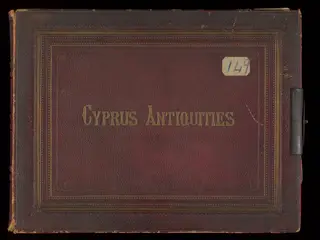 Binding and titleBinding and title page
 fol. 13v–21v"Antiquities from Cyprus": a review reprinted from The Athenaeum, 26 June 1880
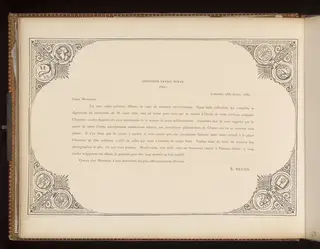 fol. 22v–24vLetters from Ernest Renan, April and May 1880
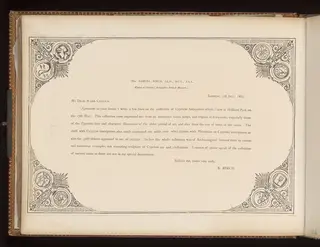 fol. 25vLetter from Samuel Birch, 3 July 1880
 fol. 26vLetter from A. H. Sayce, 20 August 1880
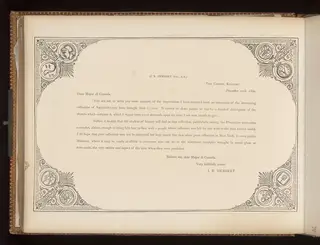 fol. 27vLetter from J. R. Herbert, 10 December 1880
 fol. 28v–29v"Hittite inscriptions": A. H. Sayce in The Academy, 27 November 1880
 fol. 51vLetter from the Académie des Inscriptions et Belles-Lettres, 31 May 1881
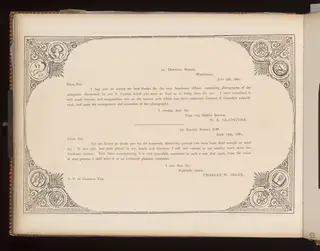 fol. 52vLetters from W. E. Gladstone and Charles W. Dilke, 1881
Photographs: Lawrence-Cesnola album, Wellcome Collection, London (Public domain)
Connections
57 peopleSales, gifts & bequests
- Financed by Edwin Henry LawrenceLawrence supplied Cesnola with money to begin excavating on his own account. Cesnola 1881Cesnola 1882, p. xiiCesnola 1884, p. xiiBombardieri & Panero 2021, p. 221870–1879
- Bought from Adrien Santi MatteiAlexander Palma di Cesnola bought a glass vessel belonging to “M. Mattei, de Larnaca”. Merrillees 2016, p. 3661878
- Sold to Augustus Henry Lane Fox Pitt Rivers1883–1892
- Gave to William Ewart Gladstone1884
- Sold to Frank Ransompossibly1888
- Sold to William Ransom1888
- Gave to Ariodante FabrettiCesnola gave three tablets without precise provenance to Senator Fabretti of Turin. Wilburn 2012, p. 202
- Passed objects to Edwin Henry LawrenceCesnola packed unearthed relics for conveyance to Lawrence in England and dispatched them in his first cargo. Cesnola 1882, p. xvStanley-Price 2018, p. 312
- Agent for Edwin Henry LawrenceAlessandro Palma di Cesnola returned to Cyprus to acquire antiquities for Edwin H Lawrence. Stanley-Price 2018, p. 301
- Passed objects to Michael SoutsospossiblypossiblyMichael Soutsos may have acquired his collection from Cesnola. Lund 2015, p. 302
Family
- Married to Augusta LawrenceCesnola married Augusta, the younger daughter of Edwin H. Lawrence. Cesnola 1882, p. xxivCesnola 1884, p. xxiv1879
- Left property to Arturo Palma di Cesnola
- Sibling of Luigi Palma di CesnolaLuigi Palma di Cesnola and Alessandro Palma di Cesnola were brothers. Barker & Merrillees 2017, p. 51Bettelli & Schiavo 2010, p. 86Bombardieri & Cannavò 2016, p. 37Christofi 2024, p. 115
- Child of Maurizio Palma di CesnolaMaurizio Palma di Cesnola was Alexander's father. Cesnola 1884, p. xxi
Fieldwork & employment
- Dug for Luigi Palma di CesnolaAlessandro assisted his brother as chief digger and partner. Masson 1996, p. 181873
- Employed by Luigi Palma di Cesnola1873–1879
- Excavated with Luigi Palma di Cesnola1873–1876
- Dug for Edwin Henry Lawrence1876–1879
- Employed Alessandro Koukomo1878
- Had digging done by Christodoulos Georgi1878
- Employed Georgi ZonenoAlessandro Palma di Cesnola engaged Georgi Zoneno, who worked until 2 October 1878. Stanley-Price 2018, p. 3031878
- Employed Lazaris PhilippiLazaris Philippi was Alessandro Palma di Cesnola’s servant. Stanley-Price 2018, p. 3031878
- Employed Henri Claudet1879–1880
- Had digging done by Alessandro KoukomoAlessandro Koukomo dug for Alessandro Palma di Cesnola at Enkomi before being employed to fill excavation pits. Stanley-Price 2018, p. 302
- Had digging done by Lazaris PhilippiLazaris Philippi supervised excavations on Alessandro Palma di Cesnola’s behalf. Stanley-Price 2018, p. 309
- Employed Theocharis Koutsocheris
- Had digging done by Theocharis Koutsocherispossibly
Disputes & the law
- Subject of testimony by Achilleus Vondiziano1878
- Subject of testimony by Christophi Andrea1878
- Had antiquities seized by Claude Delaval Cobham1878
- Had antiquities seized by E. SpencerSpencer seized pottery and glass objects found in Panagia’s house during his investigation. Stanley-Price 2018, p. 305Stanley-Price 2018, p. 3121878
- In litigation with Garnet Joseph Wolseley1878
- Prosecuted by Garnet Joseph Wolseley1878
- Refused a permit by George GreavesGreaves told Cesnola that excavation was forbidden when he requested permission to dig. Stanley-Price 2018, p. 3021878
- Prosecuted by George Greaves1878
- Prosecuted George Greaves1878
- Prosecuted by Henry Brackenbury1878
- In litigation with Henry Brackenbury1878
- In litigation with Henry G. White1878
- Subject of testimony by Johannes Kyriaki1878
- Subject of testimony by Panagia Hadji Cristofi1878
Scholarship
- Corresponded with Charles Newton1880
- Corresponded with Ernest RenanMajor di Cesnola exchanged letters and photographs with Ernest Renan about inscriptions in the collection. Cesnola 18811880
- Corresponded with J. R. Herbert1880
- Corresponded with Charles W. Dilke1881
- Corresponded with M. J. P. Six1884
- Wrote with Samuel Birch1884
- Material published by William Chappell1884
- Material published by F. G. Lo Porto1986
- Material published by Olivier MassonOlivier Masson described Major Alexander Palma di Cesnola’s excavation at Enkomi. Tatton-Brown 2003, p. 111996
- Collection catalogued by M. Sternini1998
- Material published by Paul Hetheringtonprobably2000
- Material published by Vassos KarageorghisVassos Karageorghis published details of Aegean artifacts recovered by Alessandro and his brother. Graziadio 2025, p. 72000
- Material published by D. M. Metcalf2008
- Corresponded with Demetrios Pierides
Show 2 moreShow fewer
- Student of Luigi Palma di CesnolaLuigi Palma di Cesnola instructed Alessandro Palma di Cesnola in his methods and how to manage workmen and local Turkish officials. Stanley-Price 2018, p. 300
- Corresponded with Samuel Birch
Colleagues & contacts
- Connected with Mustapha (of Galinoporni)1870
- Worked with Luigi Palma di Cesnola1873–1876
- Worked with Samuel Birch1875–1884
- Met Demetrios Pierides1876–1884
- Worked with Edwin Henry Lawrence1876–1892
- Connected with Louis Castanprobably1877
- Connected with Achilleus Vondiziano1878
- Connected with Charles W. Dilke1878
- Connected with Claude Delaval Cobham1878–1892
- Connected with E. Spencer1878
- Connected with Edmond Pottier1878
- Connected with Garnet Joseph WolseleyWolseley had Cesnola jailed for employing labourers to excavate contrary to orders. Hill 1952, p. 6071878
- Connected with Henry Brackenbury1878
- Connected with Henry G. White1878
Show 23 moreShow fewer
- Connected with Nicolaos Vondiziano1878
- Connected with Richard L. Hippisley1878
- Met William Hepworth Dixon1878
- Connected with Edwin Henry LawrenceAlessandro Palma di Cesnola sold antiquities at Sotheby's in partnership with Edwin Henry Lawrence. Reeve & Waite 2020Ulbrich & Kiely 2012, p. 3271879–1888
- Met Mr. WallisCesnola invited Wallis to view the antiquities in the collection. Cesnola 1884, p. xix1879–1881
- Met Thompson1879–1881
- Worked with Archibald Henry Sayce1880–1884
- Connected with Charles NewtonAlessandro Palma di Cesnola applied to Newton to direct excavations in Cyprus for the British Museum. Stanley-Price 2018, p. 3131880
- Connected with Samuel BirchDr. Samuel Birch inspected Major di Cesnola's collection of Cypriote antiquities at Holland Park. Cesnola 1881Stanley-Price 2018, p. 3141880
- Connected with Very Rev. Archimandrite Jeronimos Myriantneus1881
- Connected with F. G. Stephensprobably1884
- Worked with Walter de Gray Birchprobably1884
- Connected with William Ransomprobably1888
- Connected with Alexis Drakopoulos2025
- Connected with Archibald Henry SayceA. H. Sayce examined Major di Cesnola's collection of seals and intaglios and described an intaglio. Cesnola 1881
- Connected with Arturo Palma di CesnolaArturo Palma di Cesnola was Alessandro Palma di Cesnola's grandson. Bombardieri & Panero 2021, p. 23
Also: Charles Newton, Demetrios Pierides, Henry Carte, J. R. Herbert, Luigi Palma di Cesnola, R. Carte, Samuel Birch.
Recording and study
12 records- Published2
1882–1884Alexander Palma di Cesnola published the inscription on the funerary stele in Salaminia.
Inscription on small funerary stele (No. 7)No. Estes Coll. Acc. no. 1902.22Cesnola 1882, p. xxivBombardieri & Panero 2021, p. 20Herbert, p. 385Herbert, p. 386
1887Alessandro Palma di Cesnola published the jug in Salamina (Cipro).
brocca piriforme avec figure féminineNo. fig. 294-295TorinoVandenabeele 1994, p. 30
- Studied5
Cesnola studied the Oriental antiquities in the British Museum during his stay in London.
British Museum, LondonCesnola 1882, p. xi
Major A. P. Di Cesnola examined glass from Tremitus and concluded that it was ordinary glass burnt by fire.
Cesnola sorted, arranged, and studied the antiquities in his collection.
the antiquities he had collectedLarnakaCesnola 1884, p. xv
Alexander Palma di Cesnola described an ancient wall bounding the harbour area.
SalamineRogge et al. 2019, p. 303
Alessandro Palma di Cesnola spent several months studying the Oriental collections at the British Museum.
British Museum, LondonStanley-Price 2018, p. 301
- Restored1
Major di Cesnola reconstructed about two hundred terra-cotta statuettes found in an enclosure near Throni.
- Held a post1
1874Alessandro was appointed honorary United States vice-consul at Paphos.
- Connected with1
Major A. P. Di Cesnola offered to show the Association ancient gold ornaments he had found in Cyprus.
Connected with British Archaeological AssociationCesnola 1883, p. 119
- Other work2
Alexander Palma di Cesnola instructed that the inscribed upper part of the stone be sawn off and preserved.
upper part of the stone containing the inscriptionKitiumCesnola 1884, p. 106
Alessandro provided one more jug, which could not then be traced.
No. [305.X]Vandenabeele 2001, p. 186
Objects
Whole Lawrence-Cesnola collection (c. 14,000 objects, dug or bought 1876-78): shipped in two consignments to London, shown at 84 Holland Park, offered to the BM and South Kensington Museum, sold in four Sotheby's sales 1883-1892 (3,463 lots)
From Salamis, Enkomi, Kourion, Paphos area, Soli, Marion, Rizokarpaso and other sites (provenances often uncertain)1876–1878Stanley-Price 2018Ulbrich & Kiely 2012Cesnola 1884
Seized antiquities (pottery, glass, 1,500+ items from the Ormidia house plus Enkomi finds), kept in Commissioner White's, then Cobham's house in Larnaca; some later went to the Cyprus Museum
From Enkomi / SalamisCyprus Museum, NicosiaOctober 1878Stanley-Price 2018Tatton-Brown 2001
Ten inscribed stones, mostly Cypriot syllabic (BM 1884.4-19.1-10), including four epitaphs from Marion
From Marion (attributed by Cesnola to 'Paphos'); two probably ChytroiBritish Museum 1884,0419.1-10April 1884Masson 1996
Bronze patera engraved with Phoenician and Egyptian subjects (sale lot 285, 1892), bought by Rollin
British Museum 1892.5-19.125 April 1892Masson 1996
Bronze mirror with the facade of the temple of Paphos (sale 1892 lot 284, bought by Ready; Salaminia fig. 66)
Antikensammlung, Berlin 839425 April 1892Masson 1996
Medieval tympanum from a church at Larnaca (sale 1892 lot 625, 31 pounds, Pitt Rivers; later K. Digby-Jones)
Victoria and Albert Museum A.2-198225 April 1892Masson 1996
Terracotta bath, 11th century BC (from a lot via Rollin, labelled Lawrence-Cesnola; probably part of 1892 lot 623)
British Museum 1981.8-10.825 April 1892Masson 1996
Items bought by Pitt Rivers at the Lawrence-Cesnola sales (693 items in total); Pitt Rivers Museum, Oxford, holds Cypriot pieces; his 'second' collection was later sold off and partly passed to the Ashmolean (oenochoe with swan, 1892 lot 607)
Pitt Rivers Museum, Oxford; Ashmolean Museum1883–1892Ulbrich & Kiely 2012Masson 1996
Lots 401, 402, 407 (inscribed marble and stone, Salaminia figs 90, 93) and other objects bought at the 1892 sale by Dana Estes, bequeathed 1902 to Bowdoin College, Brunswick, Maine
Bowdoin College Museum of Art25 April 1892Masson 1996
At least 28 Cypriot items marked 'R.C.' in the Nicholson Museum, Sydney, from the Ransom collection bought at the Lawrence-Cesnola sale of 1888 (via Cambridge loan 1947)
Nicholson Museum, University of Sydney NM47.xxx series12 March 1888Barker & Merrillees 2017
White Painted juglet, Cypro-Geometric, said to be from the Lawrence-Cesnola collection, donated by Thomas Hollings
Leeds Museums (LEEDM.D.1988.0004) LEEDM.D.1988.0004Reeve 2021
Cast bronze Osiris figure, 'Ex Lawrence-Cesnola collection'
World Museum Liverpool 1961.202.180Osiris Figure, World Museum…
Cylindrical glass vessel with a Greek inscription, bought in 1878 from a Mattei of Larnaca (recorded by Pottier Aug.-Nov. 1878)
From Cyprus1878Merrillees 2016
Discussed in documents
- Karageorghis and Karageorghis (1956). Some Inscribed Iron-Age Vases from CyprusPublished drawings of vases
- Karageorghis et al. (1999). The Art of Ancient Cyprus in the Fitzwilliam Museum, CambridgeFormed the Lawrence Cesnola Collection
- Edbury (2001). Cyprus in the 19th century: perceptions and politicsTried over antiquities dug up without a firman
- Kiely and Perna (2010). Four Unpublished Inscriptions in Cypriot Syllabic Script in the British MuseumExcavated and collected objects in Cyprus
- Papantoniou (2016). Rethinking the portrait-like sculpture of Hellenistic CyprusProposed rows of statues at Golgoi
Also named in
- Karageorghis (1969). Salamis in Cyprus: Homeric, Hellenistic and Roman
- Lawall and Lund (2013). The Transport Amphorae and Trade of Cyprus
On Ancient Cyprus
1 pageSources
- 1.Alexander Palma di Cesnola (1884). Salaminia (Cyprus): The History, Treasures, and Antiquities of Salamis in the Island of Cyprus. London, Whiting and Company.
- 2.A. P. di Cesnola (1881). Lawrence-Cesnola Collection. Cyprus Antiquities excavated by Major Alexander Palma di Cesnola, 1876 to 1879. London, W. Holmes & Son.
- 3.Nicholas Stanley-Price (2018). “Illicit excavation: the trial of Alessandro Palma di Cesnola in Cyprus in 1878”. The Antiquaries Journal 98, 297-317.
- 4.Olivier Masson (1996). “La dispersion des antiquités chypriotes: les deux collections Cesnola”. Cahiers du Centre d'Études Chypriotes 25, 3-32. Online
- 5.Anja Ulbrich, Thomas Kiely (2012). “Britain and the Archaeology of Cyprus. I. The long 19th century”. Cahiers du Centre d'Études Chypriotes 42. Online
- 6.T. Kiely (2010). “Charles Newton and the archaeology of Cyprus”. Cahiers du Centre d'Études Chypriotes 40, 231-251. Online
- 7.Craig Barker, Robert S. Merrillees (2017). “Cypriot Antiquities from the Cesnola Collections in the Nicholson Museum at the University of Sydney”. Mediterranean Archaeology 30, 51-71.
- 8.A. G. Marangou (ed.) (2000). The Consul Luigi Palma di Cesnola 1832-1904: Life and Deeds.
- 9.Veronica Tatton-Brown (ed.) (2001). Cyprus in the 19th Century AD: Fact, Fancy and Fiction. Oxford, Oxbow.
- 10.M. Hadjicosti (2001). “Ormideia: tracing Cesnola's footsteps. Archaeological research and finds”. Cyprus in the 19th Century AD: Fact, Fancy and Fiction, 53-69.
- 11.Robert Stuart Merrillees (2016). “Studies on the provenances of the stele of Sargon II from Larnaca (Kition) and the two so-called Dhali (Idalion) silver bowls in the Louvre”. Cahiers du Centre d'Études Chypriotes 46, 349-386. Online
- 12.Anna Holly Reeve (2021). “Ancient Cyprus in Leeds: Objects, Networks and Museums from 1870 to 1947”. PhD thesis, University of Leeds.
- 13.W. A. P. Childs (ed.), J. S. Smith (ed.), J. M. Padgett (ed.) (2012). City of Gold: The Archaeology of Polis Chrysochous, Cyprus. Princeton, Princeton University Art Museum.
- 14.Alessandro Palma di Cesnola (Wikidata Q1167420; GND 120475294). Online
- 15.“Alessandro Palma di Cesnola”. Wikipedia. Online
- 16.“Alessandro Palma di Cesnola”. Wikipedia (it). Online
- 17.Osiris Figure, World Museum Liverpool 1961.202.180. Online
- 18.L. Bombardieri (ed.), E. Panero (ed.) (2021). Cyprus: Crossroads of Civilizations. Turin.
- 19.Sebastiano Soldi (2025). “The Italian entomologist Giacomo Cecconi and Cyprus: a step towards the formation of the Cypriot collection in the National Archaeological Museum of Florence”. Empire & Excavation: Critical perspectives on archaeology in British-period Cyprus, 1878-1960, 93-.
- 20.C. S. Lightfoot (2017). The Cesnola Collection of Cypriot Art: Ancient Glass. New York, The Metropolitan Museum of Art.
- 21.A. P. di Cesnola (1882). Salaminia (Cyprus): The History, Treasures, and Antiquities of Salamis in the Island of Cyprus. London, Trübner & Co.
- 22.A. Reeve, S. Waite (2020). “Re-collecting Cypriot antiquity: The Kent collection in Harrogate”. Journal of the History of Collections. Online
- 23.Vassos Karageorghis (2011). “A Cypro-Archaic I Vase Rediscovered”. Levant 43, 173-177.
- 24.L. Bombardieri, A. Cannavò (2016). “A Phoenician inscription from Cyprus in the Cesnola Collection at the Turin University Museum of Anthropology and Ethnography”. Kadmos 55, 37-48. Online
- 25.J. Lund (2015). A Study of the Circulation of Ceramics in Cyprus from the 3rd Century BC to the 3rd Century AD. Aarhus, Aarhus University Press.
- 26.Andrew T. Wilburn (2012). Materia Magica: The Archaeology of Magic in Roman Egypt, Cyprus, and Spain. Ann Arbor, University of Michigan Press.
- 27.Giampaolo Graziadio (2025). The Aegean and Cyprus: Interaction Between Two Distinct Cultural Mediterranean Areas from the Third Millennium to ca. 1200 BC.
- 28.M. Bettelli, F. Lo Schiavo (2010). “La raccolta del Museo archeologico di Firenze nel quadro della storia del collezionismo di antichità cipriote in Italia”. Researches in Cypriote History and Archaeology, 85-94. Florence University Press.
- 29.Alex Christofi (2024). Cypria: A Journey to the Heart of the Mediterranean. Bloomsbury Continuum.
- 30.T. Kiely (2019). “From Salamis to Bloomsbury: Transporting the Bull's Head Capital to the British Museum in 1891”. Salamis of Cyprus: History and Archaeology from the Earliest Times to Late Antiquity, 51-76. Waxmann.
- 31.A. P. di Cesnola (1883). “On Specimens of Ancient Goldsmiths' Art Found in Cyprus”. Journal of the British Archaeological Association 39, 119-128.
- 32.Kevin Herbert. “Greek and Latin Inscriptions at Bowdoin”. American Journal of Archaeology. Online
- 33.George Hill (1952). A History of Cyprus. Volume 4: The Ottoman Province, The British Colony, 1571-1948. Cambridge University Press.
- 34.Veronica Tatton-Brown (2003). “Enkomi: The Notebook in the British Museum”. Cahiers du Centre d'Études Chypriotes 33, 9-66. Online
- 35.Anna Cannavò (2012). “I. Chypre dans les études historiques des XIXe et XXe siècles. Découverte de l'antique, construction du passé”. Cahiers du Centre d'Études Chypriotes 42, 423-457. Online
- 36.S. Fourrier (2007). La coroplastie chypriote archaïque. Identités culturelles et politiques à l'époque des royaumes. Lyon.
- 37.Michael Given (2025). “Over the landscape, in the landscape? Knowledge and agency in Cypriot archaeology, 1870-1910”. Empire & Excavation: Critical perspectives on archaeology in British-period Cyprus, 1878-1960. Leiden, Sidestone Press.
- 38.Despina Pilides (2008). “"Welcome, Sir, to Cyprus": The Local Reaction to American Archaeological Research”. Near Eastern Archaeology 71, 6-15.
- 39.Michael Given (2001). “The fight for the past: Watkins vs. Warren (1885-6) and the control of excavation”. Cyprus in the 19th Century AD: Fact, Fancy and Fiction, 255-260. London, British Museum.
- 40.J. L. Myres, M. Ohnefalsch-Richter (1899). A Catalogue of the Cyprus Museum. Oxford, Clarendon Press.
- 41.Frieda Vandenabeele (1994). “Ohnefalsch-Richter - Cesnola: ou la recherche des cruches à terres cuites tenant une oinochoe”. Cahiers du Centre d'Études Chypriotes 22, 19-31.
- 42.Cyprus.
- 43.Alexander Gatzsche (2023). “From Cyprus to Leipzig: Provenance Research”. Alexander Malios Collection, Volume 1: Cypriot Antiquities, 20-31. Leipzig, AMRICHA.
- 44.A. Hermary (2004). “Autour de Golgoi : les cités de la Mesaoria à l'époque hellénistique et sous l'Empire”. Cahiers du Centre d'Études Chypriotes 34, 47-68. Online
- 45.Antoine Hermary (2012). “L'École française d'Athènes et Chypre : 135 ans d'histoire”. Cahiers du Centre d'Études Chypriotes 42.
- 46.Vassos Karageorghis (1991). “A Cypriote centaur figurine rediscovered”. Cahiers du Centre d'Études Chypriotes 15.
- 47.Vassos Karageorghis, Olivier Masson (1965). “Quelques vases inscrits de Salamine de Chypre”. Kadmos 4, 146-153.
- 48.J. A. R. Munro, H. A. Tubbs, W. Wroth (1891). “Excavations in Cyprus, 1890: Third Season's Work: Salamis”. Journal of Hellenic Studies 12, 59-198. Online
- 49.John L. Myres (1945). “The Topographical History of Enkomi, Salamis, and Famagusta”. The Annual of the British School at Athens 41, 68-72.
- 50.Max Ohnefalsch Richter (1884). “On a Phoenician Vase Found in Cyprus”. The Journal of Hellenic Studies 5, 102-104.
- 51.S. Rogge (ed.), C. Ioannou (ed.), T. Mavrojannis (ed.) (2019). Salamis of Cyprus: History and Archaeology from the Earliest Times to Late Antiquity. Münster, Waxmann.
- 52.Philippa M. Steele (ed.) (2013). Syllabic Writing on Cyprus and its Context. Cambridge, Cambridge University Press.
- 53.F. Vandenabeele (2001). “Collecting vases with figurines/protomes in the nineteenth century AD”. Cyprus in the 19th Century AD: Fact, Fancy and Fiction, 184-188. Oxford, Oxbow.
- 54.L. Zavagno (2014). “'A wonderful city of palms and dates': Salamis-Constantia in transition from Late Antiquity to the early Middle Ages (ca. 600–ca. 800 CE)”. Mediterranean Historical Review. Online