
Max Ohnefalsch-Richter: The Excavator Who Recorded Cyprus and Scattered It
A self-taught German farmer's son, he came to Cyprus in 1878 to file newspaper copy and stayed twelve years, taking the island's first archaeological photographs and emptying its sanctuaries into a dozen European museums. The records he made are now the chief means scholars use to put back what he sold.
Alexis Drakopoulos
May 5, 2026·History · Archeology · Collecting·16 min read


Share


Alexis Drakopoulos is a Greek Cypriot Machine Learning Engineer working in Financial Crimes. He is passionate about Archeology and making it accessible to everyone. About Me.
Sometime before January 1887, Max Ohnefalsch-Richter posted a photograph to Paris. It showed two limestone statues he had dug from a sanctuary at Voni, near Kythrea, north of Nicosia, stood up side by side for the camera. Under the left-hand figure he had written a correction in his own hand: the head did not belong to the body. The man who would soon be accused of every sin in the excavator's catalogue, of haste, of looting, of selling the gods by the lot, had taken the trouble to tell the recipient which parts of his own find did not go together. [6]
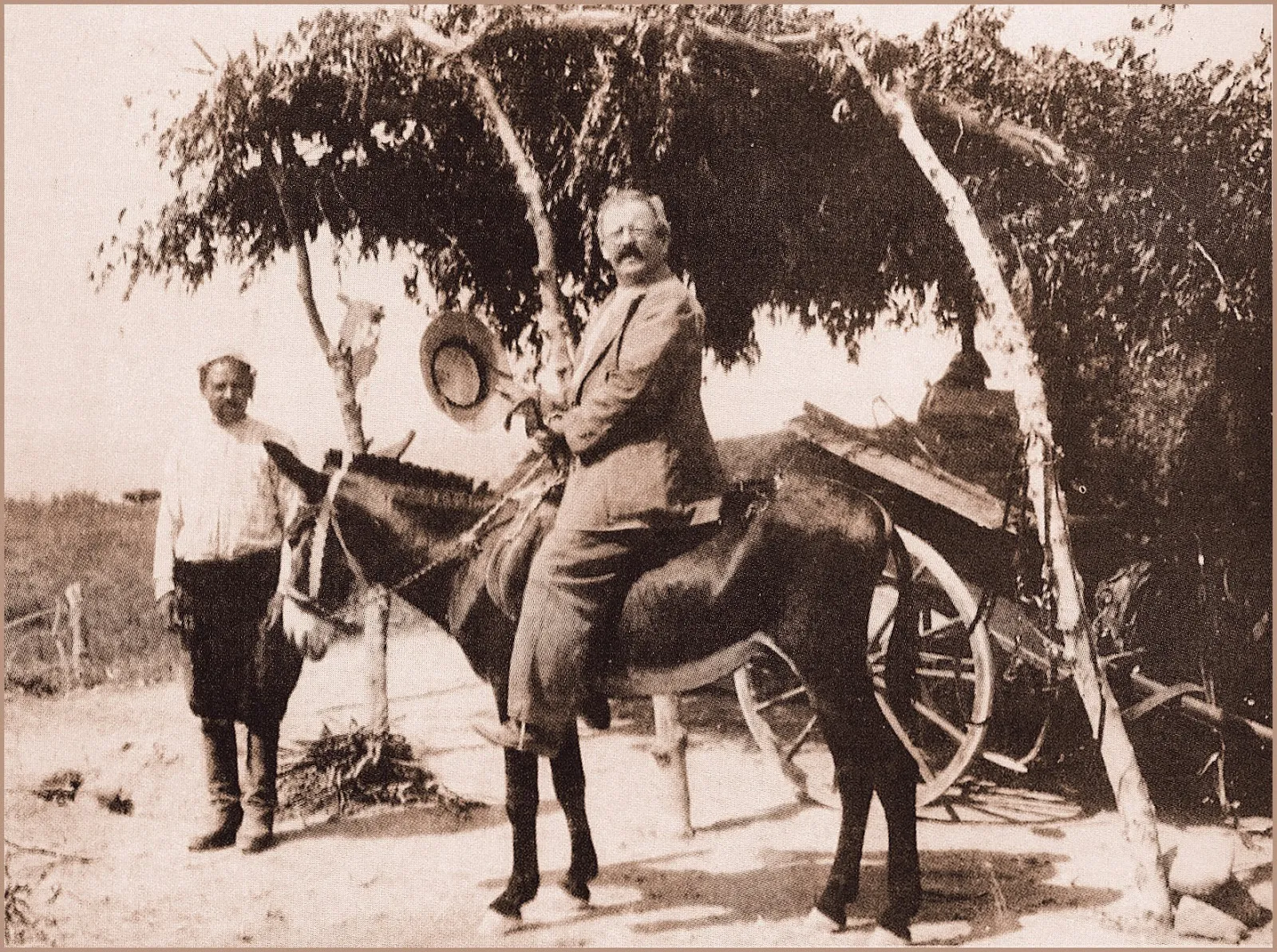
He had come to Cyprus eight years before to write newspaper copy. He left it the most prolific digger the island had seen. Over twelve years he emptied sanctuaries and cemeteries the length of it, Idalion and Tamassos, Achna and Marion, Kition and Salamis and dozens more, and fed the finds to Berlin, London, Vienna, Paris, Leipzig, Mainz and the auction room. He amassed a body of Cypriot antiquities second in size only to the one taken by the Cesnola brothers, and then, as Robert Merrillees puts it, off-loaded his acquisitions as soon as he could, so that they now sit scattered across Europe, North America and Australia, very often with no record of where on the island they came from. [2] Trace a nineteenth-century Cypriot object in almost any European collection and, more often than not, you run back into his name.
The photograph and the scattering were the same career. He recorded Cypriot sites more carefully than anyone before him and dispersed their contents more widely than anyone after Cesnola, and he did both with the same hands, often in the same season. The records he left, the plans and the photographs and one book he never managed to publish, are now the chief means by which scholars try to reattach the objects he sold to the ground they came out of.
The journalist who stayed
Ohnefalsch-Richter was trained for none of it. He was born in 1850 at Sohland am Rotstein, a village in the Saxon Oberlausitz, on his father's estate, and was meant to be a farmer. He studied agriculture, political economy and natural science at Halle, did his stints of practical farming, washed out of a Guard dragoon regiment on health grounds, and spent most of the 1870s in Italy, painting, photographing and learning to write. In 1878, in Munich, perfecting his photography under a court photographer, he heard that Britain had taken over the administration of Cyprus. He went that September as a press correspondent, carrying a recommendation from the German Imperial Chancellery, to report on the handover. [1]
The political story burned out fast. He began looking, in his own words, for material other than political, which on Cyprus in 1878 meant antiquities. He applied to the High Commissioner for a permit to dig and waited about two years, because Wolseley had banned all excavation that August and the ban only lapsed when Wolseley left the island. [7] By his own dating his career as an archaeologist began in 1880, with work at Salamis for Sir Charles Newton of the British Museum. Newton kept him on for a string of small digs over the next few years. Much of what they produced was entered in the British Museum's register under the name of Claude Cobham, the commissioner of Larnaca who acted as Newton's local agent, so that the excavator's own name often does not appear at all. [13]
From then on he dug for everyone at once. He worked for the British Museum under Newton, for the Cyprus Museum after its founding in 1882, for the Berlin museums, for the Kaiser, and for private permit-holders who paid better than any institution. He admitted in print that the combination "sometimes led to a conflict of interest." [3] By 1885 he was styling himself Superintendent of Excavations for the Cyprus Museum, a grand-sounding title with no salary behind it and, on inspection, no clear authority either.
He fit nowhere. A German national in a British colony, self-taught among Oxford and Cambridge men, a tradesman among gentlemen, he never properly mastered English, and colonial society used his services while looking down on him. He was, in Merrillees's phrase, "always short of money," depending on his self-taught trade to make a precarious living, which no other antiquarian on the island had to do; for the consuls and bank managers who dug alongside him, archaeology was a hobby. [2] George Jeffery, the colonial architect, later dismissed him as "the notorious M.O. Richter who became a sort of professional grave digger for 'antikas,'" employed in spite of "his very unprepossessing manners and unfortunate antecedents." The contempt followed him to the grave, and it shaped what he dug, why he sold, and how the establishment chose to remember him.
What he did that Cesnola did not
To see why he mattered, set him against what came before. The French expeditions of the 1860s, de Vogüé and Duthoit among them, had lifted sculpture off the surface, dug holes more or less at random, published almost nothing, and let the pieces disappear into the Louvre. [5] Luigi Palma di Cesnola, the American consul who shipped some thirty-five thousand objects to New York and became the first director of the Metropolitan Museum, kept records his own cataloguers would later call worthless: he joined fragments that looked convincing but did not belong together, and for his celebrated "Curium Treasure" he invented coherent find-groups and even plans. [9]
Against that, Ohnefalsch-Richter's apparatus was a real advance. He drew stone-by-stone topographical plans of his sanctuary sites, marking where each structure and sculpture had lain, at Achna, Dali, Voni and Tamassos-Frangissa. [5] He photographed and drew the sculpture, sometimes recording its colour, and sorted it by type and by what he took to be its stylistic development. For one site on the Yalias river at Dali he illustrated the dig at successive stages and tried to set particular pieces back where the context said they had stood. [5] At Achna in 1882, digging for the British Museum, he took out over a thousand figures in stone and terracotta, from statues some three and a half metres high down to small statuettes, all of them female but for one fragment of a priest, many still carrying their paint. [3] The handwritten note under the Voni statues was the same instinct in miniature. Cesnola assembled what looked right; Ohnefalsch-Richter, at his best, recorded what did not. [6]
Much of this we know from his own account, and his own account is not a neutral witness. He said he worked according to the principles and methods of natural science, observing every detail, and a careful reader has to separate the boast from the practice. [5] The independent evidence, the Voni photograph and others like it, supports the practice better than the boast deserves. It does not make him what he later claimed to be.
The field has settled on a cooler word: transitional. [8] He raised the documentary standard of digging in Cyprus, above all for sanctuaries, and he wrote the first comparative study of the island's cults. He did not invent scientific archaeology there. The first modern classification of Cypriot pottery, and the chronology built on it, belong to John Linton Myres, his own co-author, not to him; [8] genuinely stratigraphic excavation waited for the Swedish Cyprus Expedition of 1927 to 1931. [8] And the gentle verdict has a harsher one beside it. Merrillees, who has read the field notes, calls his technique "on the whole dire" and the man "less of a pioneer than a poseur." [2]
Seventeen days at Frangissa
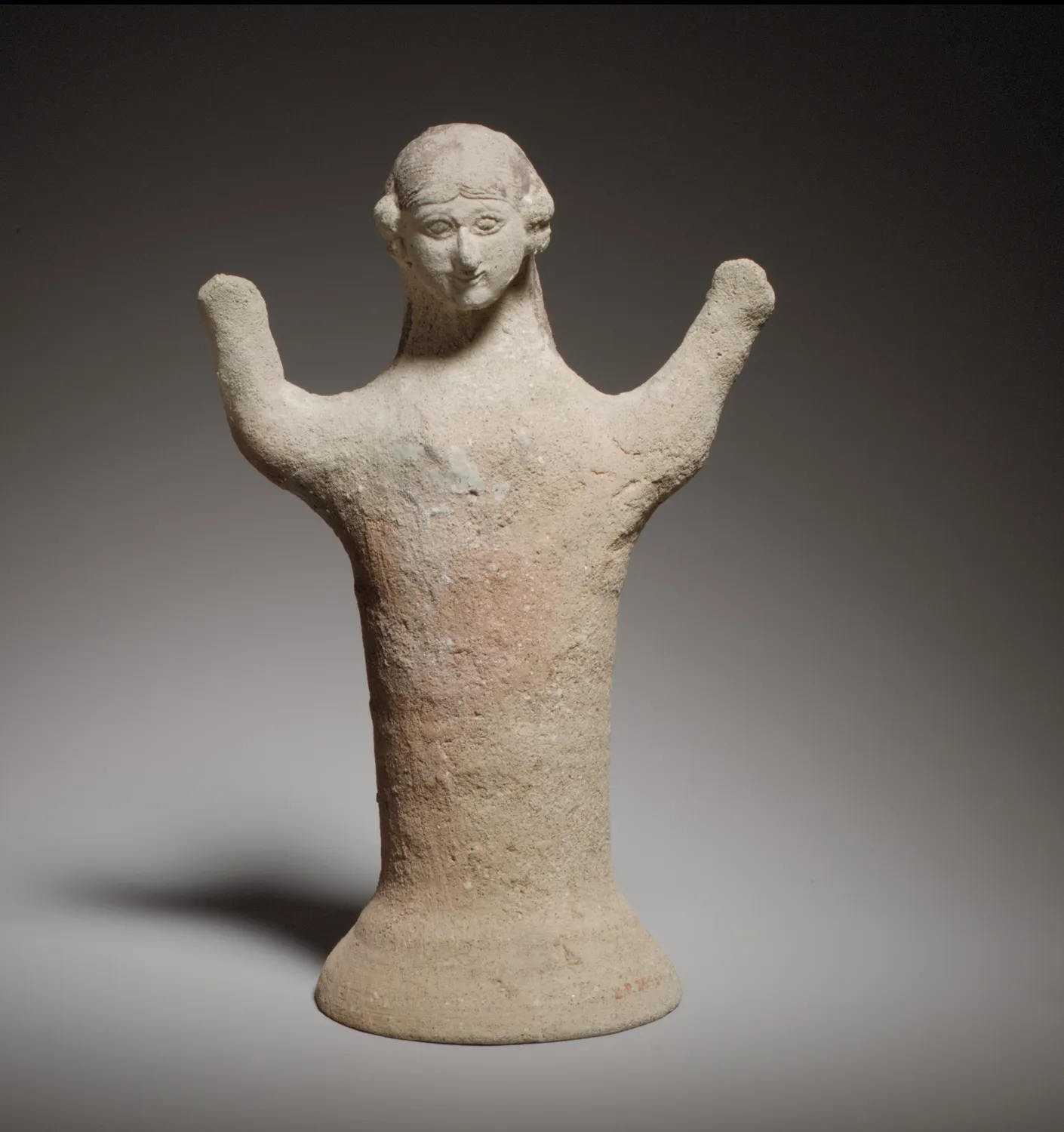
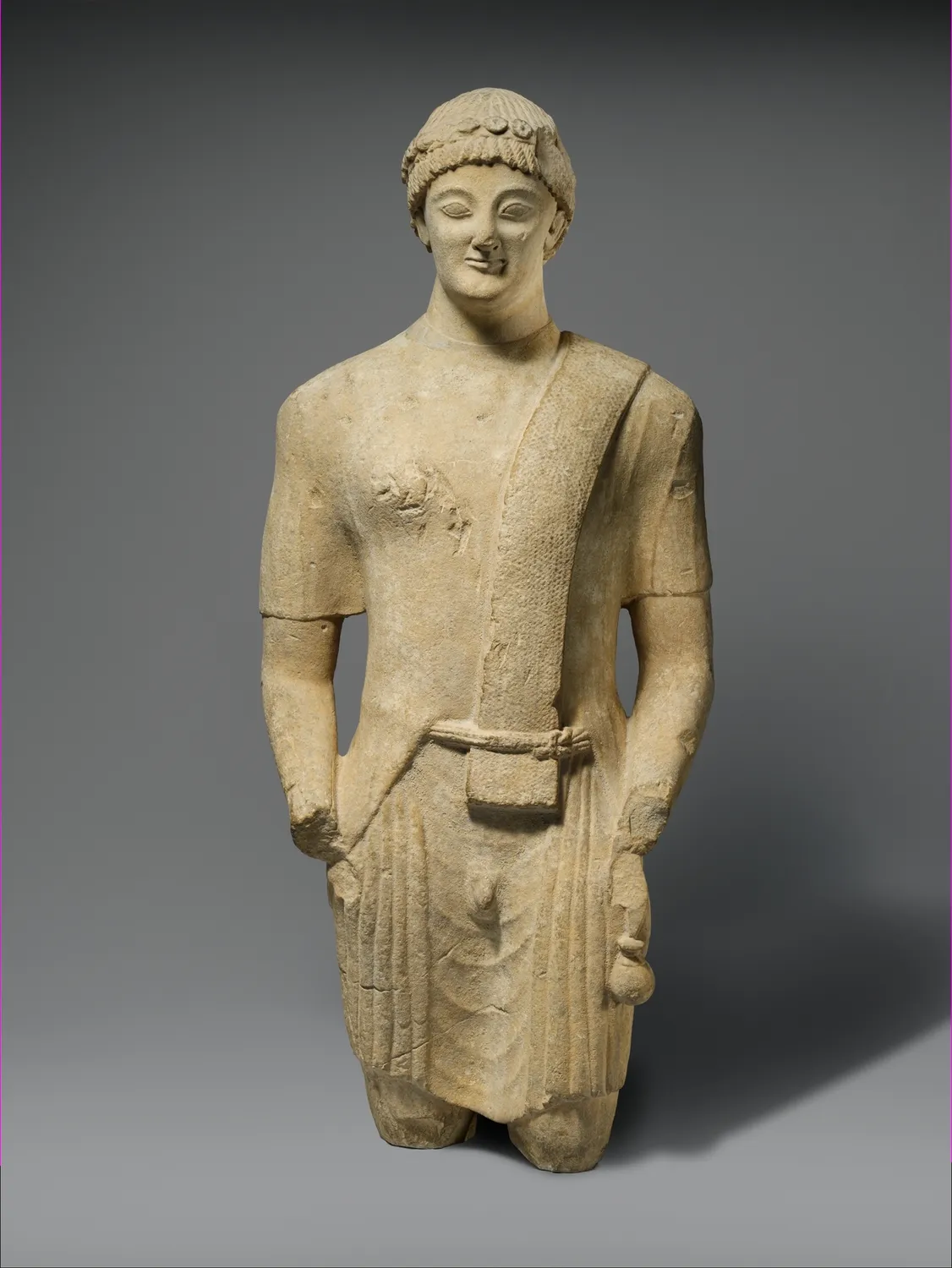
The case against him stands, above all, at Frangissa. In 1885 he dug a rural sanctuary of Apollo near Tamassos, three miles west of a village called Ayia Mnasos, and it proved to be one of the densest votive deposits ever found on the island. Limestone and terracotta statues lay piled so thick that the local English-language paper described them, in a phrase that has stuck to him ever since, as packed "like herrings in a barrel." [1] Some of the terracotta figures, reassembled, stood around three and a half metres tall, and life-sized statues were propped against the village houses while the work went on. [4]
He cleared the whole sanctuary in about seventeen days. He kept no diary, made no find-lists, and took no photographs, having run out of the chemicals. [6] The single richest context of his career is the one for which he left almost no record, and the reason was money: the men who paid for the dig wanted the finds, not the paperwork.
Frangissa also shows the machinery he worked inside. He was digging at Tamassos on the payroll of Colonel Falkland Warren, the colony's Chief Secretary and in effect his superior. When he struck the temple he kept it quiet from Warren and wrote instead to the banker Charles Watkins, who paid him better. [1] Warren found out. "That fellow Richter," he complained to the British Museum, "while excavating for me at Tamassus while paid by me, he found this temple kept it secret from me but wrote to Mr. Watkins as he paid him better." [1] The quarrel went to court as Watkins v. Warren in December 1886: two of his patrons suing each other over the spoils of a sanctuary he had dug for both.
You want temples, I give you temples
Selling was the business, and the lawsuit was a symptom of it. He never pretended otherwise in private. At the Watkins v. Warren trial he described his stock-in-trade to the Nicosia court with a frankness that reads almost as a creed: "You want glasses, I give you a piece with glasses, you want pottery, I give you a piece where pottery is to be found, you want tombs, I give you tombs, you want temples, I give you temples." [10]
The dealing ran on debt. He had no private income and no salary worth the name, and he sold antiquities, as Léon Fivel put it, simply to improve his resources. [10] He worked two tracks at once and blurred the line between them on purpose. On the first he excavated as a contractor for institutions and patrons, who then divided the finds with the Government and the landowner under the Ottoman antiquities law of 1874, still in force on Cyprus, which uniquely allowed the excavator to export his share. [7] As Superintendent of Excavations he once arranged for Watkins to buy out the landowner's claim and the Government's too, so that almost an entire find could leave the island legally and only a few duplicates reached the Cyprus Museum. [7]
On the second track he ran a private dealing business, buying tomb-groups from local diggers and selling them on. In the spring of 1895 he circulated typed sales letters from Nisou, near Dali, offering lots of two dozen to two hundred objects each; in one he wrote, "I bought this tomb myself against cash here at the spot." [10] One letter offered the contents of "a very important tomb" from near the village of Pyla. His own museum catalogue, published four years later, describes that same Pyla tomb as one "plundered by peasants in 1895." [10] He was selling the output of looting and condemning looting in the same decade, sometimes about the same tomb.
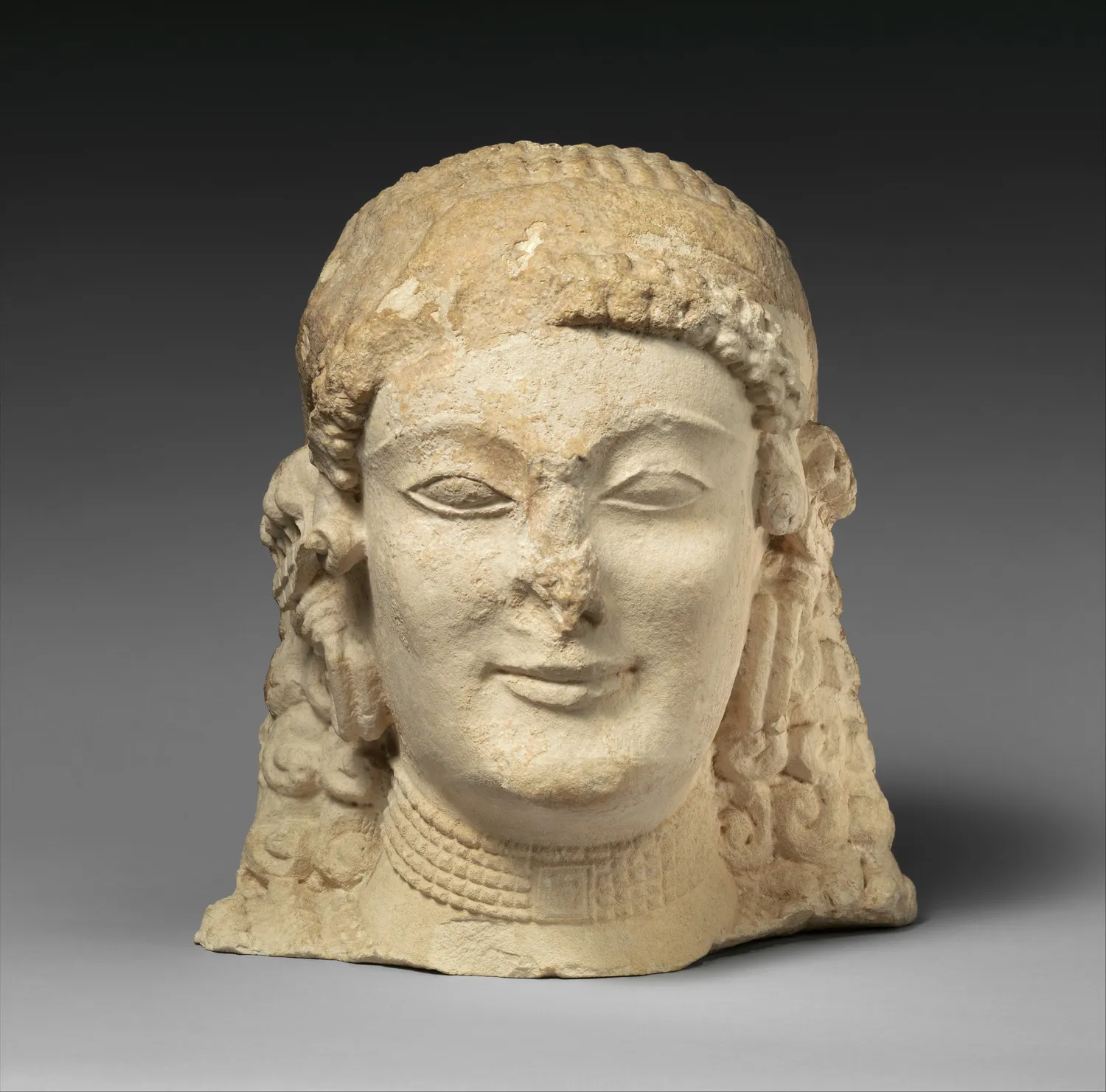
Cesnola had sold in one giant block, mostly to a single museum. Ohnefalsch-Richter sold piecemeal, to many buyers, in pre-packaged sets he labelled by grade, Elite and Gute and Typen collections, sized for a quick sale. [11] The result is the harder problem. A single tomb-group or sanctuary deposit could be, and was, split between Nicosia, Berlin, Vienna, Oxford, Cambridge and London, its find-spot shed somewhere in transit. The paperwork on thousands of objects now reads only "Cyprus, Ohnefalsch-Richter," and reuniting them is the labour his career left behind.
Kypros, the Bible and Homer
For all the digging, he wanted to be taken for a scholar. In 1891 the University of Leipzig awarded him a doctorate, a real one, earned by dissertation on the cult-places of Cyprus, and he signed himself "Dr." from then on. [1] Two years later came the work he had been building toward, a two-volume folio issued at once in German and English: Kypros, the Bible and Homer. [4]
It was the most heavily illustrated corpus of Cypriot material then in print, hundreds of plates, many worked up from his own watercolours, and it arrived with the trappings of importance. A facsimile letter from Gladstone, the former Prime Minister and amateur Homerist, served as frontispiece; Heinrich Schliemann had supplied a section on metrology before his death. [4] The argument set Cyprus as the hinge between two worlds, the Phoenician Orient of the Old Testament and the Greek world of Homer, with the cult of Aphrodite traced back to Astarte, and the sacred trees and pillars of the Cypriot sanctuaries read as the Ashera and Masseba named in the Hebrew Bible. [4]
The theory belonged to its decade and has not outlived it. [8] The diffusionism, the literal mapping of Cypriot shrines onto the Old Testament's "high places," the confident Homeric identifications, all sit inside the Victorian comparative-religion paradigm that has since been displaced. What survives is the record. Arthur Evans cited the book repeatedly in his 1901 study of Mycenaean tree and pillar cult, the seedbed of his later work on Minoan religion, drawing his Cypriot parallels straight from Ohnefalsch-Richter's plates. [12] And because so many of the objects and contexts it illustrates are now dispersed or destroyed, Kypros reads today as a primary archive of sites no longer in the state he saw them.
He was, at the same time, an unreliable witness on his own importance. He claimed to have founded the Cyprus Museum, by getting Gladstone to lean on the High Commissioner. No contemporary document supports it. His name appears nowhere on the founding committee and enters the minutes only in December 1883, as an honorary member, and the initiative is generally credited to Kitchener, then surveying the island. [7]
Pushed on one side
The wound that never closed was the Cyprus Exploration Fund. Founded in London in 1887 to put Cypriot archaeology on a systematic, institutional footing, it was the very kind of operation that defined itself against the private, casual digging of the previous decade, which is to say against his. He believed he had caused it to be started and had the Cyprus Museum's backing to represent the Government at its excavations. He was passed over. [2] The work went to two Englishmen of the right class and training: Ernest Gardner, the new director of the British School at Athens, and David Hogarth, a Fellow of Magdalen.
Writing in 1893 he was still nursing it: "I, who was the cause of it being started, was pushed on one side." [4] The line is the purest statement of his position. He held the long title and the paper rights, Consulting Archaeologist and Superintendent of Excavations, and no employment, while younger men with university degrees ran the digs on sites he counted as his.
Where Britain held him at arm's length, Germany embraced him and then let go. After Schliemann's death in 1890 he entered the Berlin circle of the pathologist and prehistorian Rudolf Virchow, and through Virchow reached the Kaiser's brother-in-law and, by 1893, Kaiser Wilhelm II, who funded a return campaign at Idalion and Tamassos in 1894 and 1895. [1] The Berlin museums supervised him closely, sending established scholars such as Adolf Furtwängler to oversee the fieldwork and regulate the dispatch of finds, because they had already spent money on him and did not entirely trust him.
The mistrust ran high. Asked by the Prussian state to assess his application for funding, Theodor Mommsen called him "der erbärmliche O.-R.," the wretched O.-R., "whom distinguished connections and scholarly weakness have helped to a level of support that disgraces science." [1] Salomon Reinach, the recipient of the Voni photograph, put it more gently and just as finally: Ohnefalsch-Richter's observations were worth more than his opinions.
The catastrophe year
The imperial money did not hold, and neither did he. The work meant to justify it, a volume on Tamassos and Idalion, never appeared; even with a Prussian subsidy and an editor brought in to salvage it, the manuscript was judged unprintable. [1] In 1896, near ruin, he rented a pavilion in the Cairo special exhibition of the Berlin trade fair and tried to sell his collection off the stand. He sold poorly. [11] By July he was on the edge of bankruptcy, and a Berlin banker, Valentin Weisbach, relieved him by buying the lot, sorted into the same sales-ready "collections," for about 35,434 Marks, well below the value he had put on it himself. Weisbach gave most of the material to the ethnographic museum in Leipzig, and the survivors of the Second World War eventually passed from there to Berlin. [11]
His last act on Cyprus was a disgrace. In 1910, on a final visit, he dug without authorization at Rantidi, was caught, convicted of attempting to smuggle antiquities, and barred from any further excavation. [6] When the Rantidi inscriptions needed proper publication, the Prussian Academy sent someone else. He died in Berlin in February 1917, impoverished and ill, and was buried outside the city at Stahnsdorf. [6]
What he left was scattered, and most of it lost its address on the way out. [2] The recovery has been slow, and it has come mostly from German, French and Cypriot scholars rather than British ones: Hans-Günter Buchholz, who excavated Tamassos and in 1989 wrote the first year-by-year reconstruction of the digs; [1] Stephan Schmid and his Berlin collaborators, who edited the dedicated volume that finally took the man's measure a century after his death. [6] They gave the book the self-doubting title he had handed them in one of his own letters: I don't know what am I myself, it is so very difficult to explain.
Their raw material is the archive he could not sell. The unpublished "Tamassos und Idalion" survives in part. So do his glass negatives, a cache of them rediscovered in a Berlin university institute, and his Cyprus photographs in Reinach's papers at Saint-Germain-en-Laye, the album that holds the Voni picture. [6] The work now is to lay the plates and the plans against the objects in a dozen museums and put each find back where it came from. The photograph that recorded, in his own hand, which head did not belong to which body has outlasted the sanctuary, the patrons and the lawsuits, and it is now among the documents being used to undo the scattering he spent his life on.
References
- 1.Buchholz, H.-G. (1989). Max Ohnefalsch-Richter als Archäologe auf Zypern. Cahiers du Centre d'Études Chypriotes 11–12, 3–28.
- 2.Merrillees, R. S. (2000). Max Ohnefalsch-Richter and the British, in Periplus. Festschrift für H.-G. Buchholz (Studies in Mediterranean Archaeology 127), Göteborg, 107–117; and Merrillees, R. S., Cypriote Antiquities in Late Ottoman Istanbul and Smyrna.
- 3.Myres, J. L. & Ohnefalsch-Richter, M. (1899). A Catalogue of the Cyprus Museum, with a Chronicle of Excavations Undertaken Since the British Occupation. Oxford: Clarendon Press.
- 4.Ohnefalsch-Richter, M. (1893). Kypros, the Bible and Homer: Oriental Civilization, Art and Religion in Ancient Times. London: Asher & Co. (German edition: Kypros, die Bibel und Homer, Berlin).
- 5.Ulbrich, A. (2001). An Archaeology of Cult? Cypriot Sanctuaries in 19th-Century Archaeology, in V. Tatton-Brown (ed.), Cyprus in the 19th Century AD: Fact, Fancy and Fiction, Oxford: Oxbow, 115–124.
- 6.Schmid, S. G. & Horacek, S. G. (eds.) (2018). 'I don't know what am I myself, it is so very difficult to explain.' Max Ohnefalsch-Richter (1850–1917) und die Archäologie Zyperns. Studia Cyprologica Berolinensia 1. Berlin: Logos Verlag.
- 7.Stanley-Price, N. (2001). The Ottoman Law on Antiquities (1874) and the Founding of the Cyprus Museum, in V. Tatton-Brown (ed.), Cyprus in the 19th Century AD, Oxford: Oxbow, 289–297.
- 8.Bourogiannis, G. (2018). The Swedish Cyprus Expedition: A Unique Landmark in the Archaeology of Cyprus, in the Swedish Cyprus Expedition exhibition catalogue.
- 9.Karageorghis, V. (2000). Ancient Art from Cyprus: The Cesnola Collection in the Metropolitan Museum of Art. New York: Metropolitan Museum of Art.
- 10.Fivel, L. (1996). Ohnefalsch-Richter vendeur d'antiquités chypriotes (1895). Cahiers du Centre d'Études Chypriotes 25, 29–35.
- 11.Brönner, M. (2001). The Ohnefalsch-Richter Collection in the Museum für Vor- und Frühgeschichte, Berlin, in V. Tatton-Brown (ed.), Cyprus in the 19th Century AD, 198–206; with Brönner, M. (1999), Ausstellung und Verkauf zyprischer Altertümer auf der Berliner Gewerbeausstellung 1896, Acta Praehistorica et Archaeologica 31, 107–123.
- 12.Evans, A. J. (1901). Mycenaean Tree and Pillar Cult and its Mediterranean Relations. Journal of Hellenic Studies 21, 99–204.
- 13.Kiely, T. (2010). Charles Newton and the Archaeology of Cyprus. Cahiers du Centre d'Études Chypriotes 40.