
Curator · Museum buyer · Epigrapher · Scholar
Samuel Birch
1813–1885 · United Kingdom
British Museum Egyptologist who concluded in 1872 that the Cypriot language was a form of Greek, and who reported to the Trustees on the Lang and Cesnola collections from 1869 to 1876.
Key factsBorn 3 November 1813, London; died 27 December 1885, London
- Born
- 3 November 1813, London
- Died
- 27 December 1885, London
- Nationality
- United Kingdom
- Roles
- Curator, Museum buyer, Epigrapher, Scholar
- Institutions
- British MuseumKeeper of Oriental Antiquities (Egyptian and Oriental), from 1866 in the oriental department, 1866–1885
- Society of Biblical Archaeologyannounced the Greek reading of the Cypriot script at the Society, 1872–1872
- Places
- Amathus, Idalion (Dali), Kourion
- Also known as
- Dr. Samuel Birch; S. Birch
- Elsewhere
Biography
1,300 words · about 5 minutes
Samuel Birch (1813-1885), Egyptologist and Orientalist at the British Museum, concluded in a paper of January 1872 that the Cypriot language "must be a form of the Greek", and reported to the Museum's Trustees on the Cypriot collections of Robert Hamilton Lang and Luigi Palma di Cesnola17,18,19.
The son of the rector of St Mary Woolnoth in London, he entered the Museum's department of antiquities in 1836 for his knowledge of Chinese, and when the department was divided he was given charge of its Egyptian and Assyrian branch17. The sources date his posts three ways: Thomas Kiely makes him Keeper of Oriental Antiquities from 1861 to 1885, Olivier Masson places him in the oriental department from 1866, and Veronica Tatton-Brown has him Assistant Keeper from 1844 until his death1,18,20. In November 1870 he and Joseph Bonomi called the meeting that began the Society of Biblical Archaeology, and he became its President21,22.
The Cypriot script, 1871-1872
Lang writes that the only squeeze of his bilingual inscription from Dali that he gave was to Birch, who entrusted its study to George Smith8. Smith's paper says that Cesnola had placed his copies of the Golgoi inscriptions in Birch's hands and that Smith copied them for the Museum under Birch's directions23. He thanked Birch, "without whom I should have done nothing in the matter", for encouraging him when he despaired of success and lending him books, and recorded that Birch had pointed out the close analogy of one formula to the Greek23.
Birch's own paper, on the bronze plate of Dali (Idalium), was read to the Society on 2 January 187219. He called Lang's discovery of the bilingual "the first step in the right direction" and credited Lang with finding the word for "king" in the inscription and on the coins19. Smith, he went on, had "simultaneously, but independently" found the same word and 40 of the 51 or 54 characters of the syllabary19. His conclusion was that "the Cypriote must be a form of the Greek, for the first line transcribed into Greek characters is good Greek"19.
A German yearly review of the work of 1873 credited Smith with seeing that the script was syllabic and fixing 33 signs, and Birch with reading a number of Cypriot words and establishing that the language was Greek24. Isaac H. Hall put Birch's work next after Smith's, "indispensable in importance": his material was not enough to decipher the bronze tablet, but he showed that it could not be later than 353 BC and that the language was substantially Greek25. "Just one mistake, apparently," Hall wrote, kept him from anticipating Johannes Brandis, whose main success came from taking a hint in Birch's remark and correcting his mistake25. Artemis Karnava and Evangeline Markou write that after Smith, Birch "further established that the language was Greek", and that Brandis gave wrong values to some signs Birch had identified correctly26. Markus Egetmeyer names "the Egyptologist Samuel Birch (1872 and 1876)" among the further contributors once the syllabic system was established27.
Lang's collection, 1869-1872
The Trustees met on 13 November 1869 with Birch's report on Lang's collection and that of Charles Newton before them, and decided, Newton told Lang, to send Stuart Poole to Cyprus to advise them8,18. On 2 February 1872 Birch could tell Lang that the revised estimates had gone to the Treasury without objection and that "it may be assumed that the purchase of your collection is approved"8. By Tatton-Brown's list of the Trustees' minutes, on 13 July 1872 they considered his report of 5 July and completed the purchase of the collection18. Lang thanked Newton, Birch and Poole, who "indefatigably laboured to reserve" his finds for the Museum8.
Luigi Palma di Cesnola, 1870-1876
The Museum's Original Letters for 1868-1881 hold Cesnola's correspondence with Birch from December 1870 to July 188118. On Birch's advice Cesnola wrote to Newton on 9 January 1871, and three days later Birch sent Newton photographs of the collection18,20. Anna Marangou writes that Newton, Keeper of Greek and Roman Antiquities, rejected Cesnola's proposal of the collection to the Museum2. In 1872, on Birch's advice, Cesnola sent it to the London firm of Rollin and Feuardent, though Birch could not advise on its value beyond warning of the effect of selling so many antiquities at once20. In January 1876, by Kiely's account, Cesnola complained that Birch had returned his chapter on Amathus "uncorrected and probably unread"20.
The sources disagree over a paper by D. Pierides on the gold armlets from Kourion: Kiely writes that Cesnola forced Birch to withdraw it from the Society's Transactions, fearing it would draw the attention of the Ottoman authorities20. Pierides' "Notes on Cypriote Palaeography" in the Transactions, read on 4 January and 4 July 1876, open with the inscription on the gold armlets found at Kourion, and quote Birch asking whether Ituander, king of Paphos under Assurbanipal, "might be the monarch whose bracelets have been found"28.
The purchases of 1876
Tatton-Brown's list of the Trustees' minutes records Birch's reports on Cesnola's collection of 12 April and 7 October 187518. The sources disagree on when George Smith was sent for: Tatton-Brown has the Trustees authorise him on 9 October 1875 to visit Cyprus and report on the collection, Marangou has them ask him at the beginning of March 1876, and Kiely writes that he never reached the island, one reason why Birch tried to persuade Cesnola to send the collection to London2,18,20. On 30 November 1875 Cesnola shipped six boxes to Birch; Kiely counts some 300 items, which stayed unpacked until July 18762,20.
By the same list, the Trustees considered Birch's report of 7 July 1876 on 8 July, and on 22 July, with his report of 21 July before them, resolved not to purchase the collection18. Birch selected only 127 items, Kiely writes, because he felt that many of the pieces were already represented in the Museum from Lang, Pierides and Sandwith20. The price is given two ways: Marangou writes that Birch told Cesnola the Trustees would buy his selection for 213 pounds, Masson that the negotiations ended in September with the purchase of a lot for 300 pounds2,29. The series was registered in September 1876 as 1876.9-9, 1-127, above all vases of various periods1. At Birch's suggestion the Museum held the leftover material so that other institutions might acquire some of it, and Masson writes that the two London museums shared the lot20,29.
On 9 November Birch and Newton reported on Cesnola's collection from a temple at Kourion, 1,500 objects, and recommended its purchase, though they had not found out whether he would take less than his price of 12,000 pounds2. The Trustees resolved that Newton should tell Cesnola they would recommend the purchase to the Treasury for not more than 10,000 pounds2. Kiely judges that Birch usually acted "in concert with Newton", who was "by far the more dynamic figure" in collecting Cypriot antiquities for the Museum4.
Alessandro Palma di Cesnola and the 1880s
Alessandro Palma di Cesnola met Birch while studying at the Museum and wrote that the acquaintance "ripened, on my part at least, into a very devoted friendship"3. In a letter of 3 July 1880 Birch wrote that the collection he had seen at Holland Park most impressed him by its vases, lamps and terracottas "of the Cypriote type and character illustrative of the older period of art"9. He joined Newton in nominating Alessandro, successfully, as a Fellow of the Society of Antiquaries, and wrote the introduction to his Salaminia, which held that the dominant civilisation of the island "was undoubtedly Greek, and so was the language of the principal cities"30,31.
At the Lawrence-Cesnola sales Birch bought from the dealer William Talbot Ready in 1883, including metalwork and Cypro-Classical terracotta figures; in 1884 he bought a series of Cypro-syllabic inscriptions20. Birch died on 27 December 1885 at his home in Caversham Road and was buried in Highgate cemetery17,32.
Life and work
23 events, 1872–1884
1872
2 January
Announced at the Society of Biblical Archaeology, backed by Lang and George Smith, that the Cypriot script was a form of Greek, after Lang had handed him the Dali bilingual.LondonA. G. Marangou (ed.) (2000). The Consul Luigi Palma di Cesnola 1832-1904: Life and Deeds, p. 49
1873
- Keeper of Oriental Antiquities, British Museum; saw that the Cypriot script wrote Greek and published a reading of the Idalion bronze tablet (Trans. Soc. Biblical Archaeology i.2, 1873).
Cesnola 1878, Cyprus: Its Ancient Cities, Tombs, and Temples (2nd ed.)
1874
29 August
Cesnola wrote to Birch from Kourion describing the large Amathus vases and a second vase left in place; further letters 24 Mar, 14 Jun, 24 Jun 1875 and 4 Apr 1876 sent photographs and drawings of Amathus finds (incl. the Amathus sarcophagus).KourionO. Masson (1990). Cesnola à Amathonte, 1874-1875. Cahiers du Centre d'Études Chypriotes 13, 15-18
- British Museum recipient of Cesnola's 29 August 1874 letter describing two further broken stone vases at Amathus.
1875
30 November
Received six boxes of antiquities shipped by Cesnola to the BM; the list of contents survives in the Cesnola-Birch correspondence.LondonA. G. Marangou (ed.) (2000). The Consul Luigi Palma di Cesnola 1832-1904: Life and Deeds, p. 273
April
Sent, through M. Mohl, to the Académie des inscriptions et belles-lettres the impressions of four Phoenician inscriptions found at Idalion, the marbles themselves being in the British Museum; reported in the Parisian press of 12-13 April 1875.Paris(1875). Journal des débats politiques et littéraires, 12 April 1875. Journal des débats, 12, p. 12; (1875). Journal officiel de la République française, 13 April 1875. Journal officiel, 50, p. 50
- Isaac H. Hall (1875) reported: Birch's material was not sufficient to decipher the bronze tablet, but he showed its date could be no later than 353 B.C: «his material was not suffi- cient to enable him to decipher the bronze tablet, but he showed that its date could not be later than 353 B. C»
1876
9 November
Birch and Newton reported to the Trustees (reports dated 9 November; Trustees' minute of 11 November 1876) on the Curium collection (c. 1,500 objects) and recommended purchase; asking price £12,000.LondonA. G. Marangou (ed.) (2000). The Consul Luigi Palma di Cesnola 1832-1904: Life and Deeds, p. 279
- Selected, from Cesnola's offer, the series later registered 1876.9-9, 1-127 (over eighty vases plus terracottas and other pieces) for the BM; the £300 paid was split in two instalments of £213 and £87.
LondonOlivier Masson (1996). La dispersion des antiquités chypriotes: les deux collections Cesnola. Cahiers du Centre d'Études Chypriotes 25, 3-32; A. G. Marangou (ed.) (2000). The Consul Luigi Palma di Cesnola 1832-1904: Life and Deeds, p. 275
- Isaac H. Hall (1876) reported: Of the British Museum; received the author and afforded him facilities for studying the Cypriote monuments there: «I was received with great kindness by Dr. Samuel Birch, of the British Museum, by whom I was»
1878
- The Builder (1878) reported: Samuel Birch's paper concerned the reading of the inscription on the Bronze Plate of Dali: «The Reading of the Inscription on the Bronze Plate of Dali»
- The Quarterly Review (1878) reported: Named among the English scholars who found the clue to the Cyprian script: «Dr. Birch, of the British Museum; and the late Mr. George Smith, of Assyrian renown—may claim the credit of finding»
«Ancient Cyprus», The Quarterly Review 146 no. 292 (October 1878), pp. 413-442, p. 432
1880
- Wrote a letter of 3 July 1880 assessing the Cesnola collection of Cypriote antiquities he had seen at Holland Park.
1882
- Supplied Richard Carl Meister, from the British Museum, with paper impressions of Cypriot inscriptions nos. 26 and 41; Meister names him as the late Dr. Samuel Birch.
LondonR. Meister. Die griechischen Dialekte auf Grundlage von Ahrens' Werk De Graecae linguae dialectis
- British Museum keeper who argued in 1882 that Cypriot antiquities mattered as a link between the Greek and Phoenician civilisations.
1883
- Curator in the BM Oriental Department; received Cesnola's letters on Amathus (to 1883); interested in deciphering the Cypriot syllabary and collaborated with George Smith.
1884
- Announced in the trade press as the author of a special preface to volume I (marble, alabaster and stone) of the Cesnola Cypriote antiquities atlas for the Metropolitan Museum of Art; volume II to be prefaced by A. S. Murray.
London(1884). The Builder, 6 September 1884, vol. 47, no. 2170. The Builder 47, 318, p. 318
- Dated the gold-mounted cuneiform cylinder found by Ohnefalsch-Richter at Ayia Paraskevi (1884, Cyprus Museum) to before 1500 BC.
- Saw the author's ring in London in 1884 and believed it to be an ancient Babylonian one.
- Keeper of Oriental Antiquities, BM; worked with the Cesnola brothers (introduction to A.P. di Cesnola's Salaminia, 1884) and on Lang's epigraphic material.
Undated
n.d.
- BM Egyptologist/Orientalist, Assistant Keeper from 1844; reported to Trustees on Lang's Idalion collection (1869–72) and Cesnola's collection (1875–6); long correspondence with Cesnola and Lang.
- Advanced the decipherment of the Cypriot script after Smith's discovery; judged certain Cypriot double vases Phoenician by comparison with finds from Tyre.
Lang 1878, Cyprus: its History, its Present Resources, and Future Prospects, pp. 334
- The Transactions of the Society of Biblical Archaeology reported: escribed the Cypriote antiquities discovered by General di Cesnola at Golgoi: «On some Cypriote Antiquities discovered hy General di Cesnola. Described by S. Birch, LL.D»
Study
2 records of study
Recording and study
2 records- Published1
1876probablyBirch published a note on inscribed objects that Masson thought was probably the earliest mention of the lamp.
quelques objets inscrits, dont ICS 329No. ICS 329Masson 1990
- Employed by1
Dr. Samuel Birch was identified as Keeper of Oriental Antiquities at the British Museum.
Employed by British MuseumCesnola 1881Cesnola 1884
Trade and objects
1 record · 1 object
Through their hands
1 record- n.d.Agency
AgencyBirch acted as intermediary for the British Museum’s direct purchase from Cesnola.
Agent for British Museuma series of antiquitiesNo. 1876.9-9, 1 à 127300 livresLondonMasson 1996, p. 9
Objects
1 object127 Cypriot objects (vases of various periods, some terracottas, miscellany) bought from L. P. di Cesnola
British Museum 1876.9-9,1-1271876
Connections
17 people
Sales, gifts & bequests
- Received from Robert Hamilton LangDali bilingual (squeeze/inscription); Idalion Phoenician-syllabic bilingual Anna G. Marangou, 2000, Life and Deeds: The Consul Luigi Palma di Cesnola 1832-1904, p. 49; [A. Marangou], Life and Deeds: The Consul Luigi Palma di Cesnola 1832–1904 (2000), p. 491869–1871
- Received from Luigi Palma di Cesnolacopies of the Golgoi inscriptions; letters at the British Museum Society of Biblical Archæology (London , England), Walter L . Nash, Transactions of the Society of Biblical Archæology (1872); Olivier Masson, Avant-propos (1990), p. 41872–1977
- Bought from Luigi Palma di CesnolaBM 1876.9-9,1-127 (£300) O. Masson, 1996, La dispersion des antiquités chypriotes: les deux collections Cesnola; Anna G. Marangou, 2000, Life and Deeds: The Consul Luigi Palma di Cesnola 1832-1904, p. 2751876
Fieldwork & employment
- Employed George Smithstudy of the Dali bilingual Lang 1905, 'Reminiscences — Archaeological Researches in Cyprus', Blackwood's Magazine 177, p. 629, p. 6301869–1871
- Employed Augustus ReadyTatton-Brown 2001, 'Excavations in ancient Cyprus: original manuscripts and correspondence in the British Museum', in Tatton-Brown (ed.), Cyprus in the 19th Century AD, p. 179 n. 4; V. Tatton-Brown, 2001, Excavations in ancient Cyprus: original manuscripts and correspondence in the British Museum, p. 179 n. 4
Disputes & the law
- Rival of Johannes BrandisCypriote decipherment Journal of the American Oriental Society 1871-10-12: Vol 10 (1871)
Scholarship
- Corresponded with Luigi Palma di CesnolaManuscriptsL. Palma di Cesnola's letter to Samuel Birch included observations about two large stone vases at Amathunta. Fivel 1990, p. 12Lemesos: A History of…, p. 25Marangou 2000, p. 273Masson 1984, p. 31865–1883
- Corresponded with Demetrios Pieridesoffer of 18 pounds for the pottery, later 20 T. Kiely, R. S. Merrillees, 2020, A unique Late Cypriote Bronze Age jar from Demetrios Pierides' excavations in Cyprus, formerly in the Joseph Altounian Collection, Macon, France, and the circulation of Cypriote antiquities in the 19th century AD, p. 4711867–1869
- Corresponded with Robert Hamilton LangManuscriptsSamuel Birch regularly exchanged letters with Robert Hamilton Lang. Kiely et al. 2025, p. 2871869–1876
- Published material of Alessandro (Alexander) Palma di CesnolaCypriote antiquities discovered at Golgoi Avery Library; Prescott, Harriet Beardslee, Catalogue of the Avery architectural library. A memorial library of architecture, archæology, and decorative art (1895)1875
- Published material of Luigi Palma di CesnolaBirch, S. wrote about Cypriote antiquities discovered by Gen. di Cesnola at Golgoi. Cobham 1908, p. 5081875
- Corresponded with Alessandro (Alexander) Palma di CesnolaManuscriptsAlessandro wrote letters to Samuel Birch in 1880 and 1881. Tatton-Brown 1989, p. 861880–1881
- Wrote with Alessandro (Alexander) Palma di CesnolaSalamis (Cyprus): The History, Treasures, & Antiquities of Salamis in the Island of Cyprus di Cesnola and Birch, Salamis (Cyprus): The History, Treasures, & Antiquities of Salamis in the Island of Cyprus, 18841884
- Material published by Olivier MassonCesnola letters to Birch at the British Museum E. Masson (ed.), 2001, Olivier Masson: 'Luigi Palma di Cesnola - ultimes considerations'1988
- Published material of Robert Hamilton LangDali bilingual; Lang's inscriptions Kiely 2010, 'Charles Newton and the archaeology of Cyprus', CCEC 40, p. 233; Reeve 2021, Ancient Cyprus in Leeds (PhD, Leeds), p. 62
Colleagues & contacts
- Worked with Alessandro (Alexander) Palma di Cesnolafriendship and help; wrote the introduction to Salaminia; helped select pieces for the Lawrence-Cesnola album; Salaminia; Cypriot inscriptions in Salamis A. Palma di Cesnola (with S. Birch), 1884, Salaminia (Cyprus): the History, Treasures, & Antiquities of Salamis in the Island of Cyprus (2nd ed.); A. Palma di Cesnola (with S. Birch), 1884, Salaminia (Cyprus): the History, Treasures, & Antiquities of Salamis in the Island of Cyprus (2nd ed.); Journal of the British Archaeological Association (1845); Bursian, Konrad, 1830-1883, [from old catalog] ed; Müller, Iwan Philipp Eduard, Ritter von, 1830-1917, [from old catalog] ed; Seyffert, Oskar, 1841-1906, [from old catalog] ed, Jahresbericht über die Fortschritte der klassischen Altertumswissenschaft (1892)1813–1887
- Worked with Charles NewtonBirch generally worked in concert with Newton on archaeological matters. Kiely 2010, p. 2331813–1885
- Connected with George SmithCypriot inscriptions Société bibliographique , Société bibliographique (France), Polybiblion : Revue bibliographique universelle (1868)1840–1876
- Worked with George SmithCypriot syllabary decipherment; decipherment of Cypriot syllabary; entrusted Smith with the Dali bilingual; joint announcement of 2 Jan 1872 O. Masson (ed. E. Masson) 2001, 'Luigi Palma di Cesnola – ultimes considérations', in Tatton-Brown (ed.), Cyprus in the 19th Century AD, p. xii; Kiely 2010, 'Charles Newton and the archaeology of Cyprus', CCEC 40, p. 233; Anna G. Marangou, 2000, Life and Deeds: The Consul Luigi Palma di Cesnola 1832-1904, p. 491867–1876
- Worked with George Smithbi-lingual inscription; Cypriote syllabary; Cypriote syllabary decipherment Blackwood's Edinburgh magazine (1817); Schliemann, Heinrich, 1822-1890, Troy and its remains : a narrative of researches and discoveries made on the site of Ilium, and in the Trojan Plain (1875); Schliemann, Heinrich, 1822-1890, Troy and its remains; a narrative of researches and discoveries made on the site of Ilium, and in the Trojan Plain (1875)1869
- Worked with Reginald Stuart PooleTrustees minutes list reports by Birch, Newton and Poole on the Lang collection V. Tatton-Brown, 2001, Excavations in ancient Cyprus: original manuscripts and correspondence in the British Museum, p. 1731869–1872
- Worked with Luigi Palma di CesnolaGreat Album of the New York Collections; Descriptive atlas of the Cesnola collection of Cypriote antiquities; Salaminia Journal of the British Archaeological Association (1845); Verzeichniß der Bücher, Landkarten &c 174.1885,1; John Foster Kirk, A Supplement To Allibone S Critical Dictionary Of English Literature And British And American Authors Volume I (1899)1872–1885
- Connected with John RuskinpossiblyCesnola's letters to Birch mention Ruskin's offer; no direct link between Ruskin and Birch shown Anna G. Marangou, 2000, The Consul Luigi Palma di Cesnola 1832-1904: Life and Deeds, p. 2461873–1875
- Connected with Alessandro (Alexander) Palma di CesnolaDr. Samuel Birch inspected Major di Cesnola's collection of Cypriote antiquities at Holland Park. Cesnola 1881Stanley-Price 2018, p. 3141875–1884
- Connected with Luigi Palma di CesnolaCesnola sent Birch photographs of the Amathus sarcophagus. Hermary & Mertens 2014, p. 3531875
- Worked with Robert Hamilton LangDali inscriptions Ulbrich 2001, 'An Archaeology of Cult? Cypriot sanctuaries in 19th century archaeology', in Tatton-Brown (ed.), Cyprus in the 19th Century AD, p. 95–118)1878
- Connected with Edwin Henry LawrenceLawrence funded A. P. di Cesnola's second dig; Birch advised on the resulting collection (indirect) A. Palma di Cesnola (with S. Birch), 1884, Salaminia (Cyprus): the History, Treasures, & Antiquities of Salamis in the Island of Cyprus (2nd ed.)1879
- Worked with C. W. KingSalamis collection Abraham, Fritz, 1841- [from old catalog] ed; Hermann, Johann, 1842- [from old catalog] ed; Meyer, Edmund, 1840-1905, [from old catalog] ed, Jahresberichte der geschichtswissenschaft; im auftrage der Historischen gesellschaft zu Berlin herausgegeben .. (1880)1880
- Worked with P. Le Page RenoufBritish Museum catalogue (1886) Society of Biblical Archæology (London, England), Proceedings (1878)1886
Show 7 moreShow fewer
- Helped Alessandro (Alexander) Palma di CesnolaBirch helped Alessandro Palma di Cesnola in his earlier studies in London. Stanley-Price 2018, p. 314
- Met Alessandro (Alexander) Palma di CesnolaCesnola invited Birch to view the antiquities in the collection. Cesnola 1884, p. xix
- Worked with Archibald Henry Saycewith Newton and Birch, selected pieces for the Lawrence-Cesnola album A. Palma di Cesnola (with S. Birch), 1884, Salaminia (Cyprus): the History, Treasures, & Antiquities of Salamis in the Island of Cyprus (2nd ed.)
- Connected with Georges Colonna CeccaldiPersian-period Cypriote sarcophagus The Encyclopaedia Americana: A Supplemental Dictionary of Arts, Sciences, and General Literature. Illustrated. 2
- Connected with Johannes Brandisas above R. H. Lang, 1878, Cyprus: Its History, Its Present Resources and Future Prospects, p. 334; L. P. di Cesnola, 1878, Cyprus: Its Ancient Cities, Tombs, and Temples (2nd ed.)
- Helped Robert Hamilton LangBirch helped Lang with the decipherment and translation of inscriptions. Tatton-Brown 2001, p. 96
- Connected with Robert Hamilton LangIdalion Phoenician-syllabic bilingual Lang 1878, Cyprus, preface pp. v-vi (IA leaf 12), leaf 61, 73; Nature 18 (1878) review; Marangou 2000, Life and Deeds: The Consul Luigi Palma di Cesnola, pp. 68-74
Archive and mentions
Where else on Ancient Cyprus this person appears
In the Archive
1 itemDocuments by Samuel Birch
1 document.
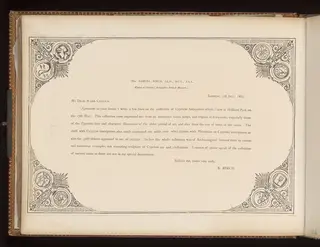
Photographs: Lawrence-Cesnola album, Wellcome Collection, London (Public domain)
Mentioned in
38 mentionsDocuments · 18
- Excerpta Cypria: Materials for a History of Cyprus
Published · 1875 · p. 508
Birch, S. wrote about Cypriote antiquities discovered by Gen. di Cesnola at Golgoi.
Cobham 1908
- L'inscription syllabique ICS 329 rendue à Amathonte
Probably · 1876
Birch published a note on inscribed objects that Masson thought was probably the earliest mention of the lamp.
Masson 1990
- Illicit excavation: the trial of Alessandro Palma di Cesnola in Cyprus in 1878
Helped · 1880 · p. 314
Dr. Samuel Birch inspected Major di Cesnola's collection of Cypriote antiquities at Holland Park.
Stanley-Price 2018
Also in Cesnola 1881
- Salaminia (Cyprus): The History, Treasures, and Antiquities of Salamis in the Island of Cyprus
Employed · 1884
Dr. Samuel Birch was identified as Keeper of Oriental Antiquities at the British Museum.
Cesnola 1884
- Cesnola et le trésor de Curium (II)
1984
recipient of Cesnola's letters
Masson 1984
Also in Masson 1990
- La dispersion des antiquités chypriotes: les deux collections Cesnola
Agent · 1996 · p. 9
Birch acted as intermediary for the British Museum’s direct purchase from Cesnola.
Masson 1996
Lectures and videos · 1
On Ancient Cyprus · 1
Institutions · 2
- British Museum
Keeper (1866–1885) · 1866
127 objects, mostly vases (BM 1876.9-9.1-127), bought directly from Cesnola through Samuel Birch for 300 pounds, Newton's largest Cypriot expenditure after…
Masson 1996; Kiely 2010
- Society of Biblical Archaeology
1870
Samuel Birch and Joseph Bonomi invited interested gentlemen to Bonomi's rooms in Lincoln's Inn Fields; a meeting resolved to form a Society of Biblical…
Archaeology 1872, p. ii-iii; Archaeology 1872, pp. 7-8; Marangou 2000, p. 49
- People · 16listed under Connections
- Archivelisted under In the Archive
Sources
118 works and documents
- 1.Olivier Masson (1996). “La dispersion des antiquités chypriotes: les deux collections Cesnola”. Cahiers du Centre d'Études Chypriotes 25, 3-32. Online
- 2.A. G. Marangou (ed.) (2000). The Consul Luigi Palma di Cesnola 1832-1904: Life and Deeds.
- 3.Alexander Palma di Cesnola (1884). Salaminia (Cyprus): The History, Treasures, and Antiquities of Salamis in the Island of Cyprus. London, Whiting and Company.
- 4.T. Kiely (2010). “Charles Newton and the archaeology of Cyprus”. Cahiers du Centre d'Études Chypriotes 40, 231-251. Online
- 5.O. Masson (1990). “Cesnola à Amathonte, 1874-1875”. Cahiers du Centre d'Études Chypriotes 13, 15-18.
- 6.Wikidata / GND (2026). Samuel Birch (Q2742058; GND 116188839). Online
- 7.Veronica Tatton-Brown (ed.) (2001). Cyprus in the 19th Century AD: Fact, Fancy and Fiction. Oxford, Oxbow.
- 8.R. H. Lang (1905). “Reminiscences: Archaeological Researches in Cyprus”. Blackwood's Magazine 177, 622-639.
- 9.Alexander Palma di Cesnola (1881). Lawrence-Cesnola Collection. Cyprus Antiquities excavated by Major Alexander Palma di Cesnola, 1876 to 1879.
- 10.W. Fröhner (1879). La verrerie antique: description de la collection Charvet. p. 537.
- 11.A. Hermary (2010). VI. Les sculptures en calcaire. p. 90.
- 12.H. B. Prescott (1895). Catalogue of the Avery architectural library. leaf 209.
- 13. (1875). “Journal des débats politiques et littéraires, 12 April 1875”. Journal des débats, 12.
- 14. (1875). “Journal officiel de la République française, 13 April 1875”. Journal officiel, 50.
- 15. (1884). “The Builder, 6 September 1884, vol. 47, no. 2170”. The Builder 47, 318.
- 16.R. Meister. Die griechischen Dialekte auf Grundlage von Ahrens' Werk De Graecae linguae dialectis.
- 17.[unsigned] (1910). “Birch, Samuel”. The Encyclopaedia Britannica, 11th edition 3.
- 18.Veronica Tatton-Brown (ed.) (2001). Cyprus in the 19th Century AD: Fact, Fancy and Fiction. Oxford, Oxbow.
- 19.Samuel Birch (1872). “Cypriote Inscriptions. On the Reading of the Inscription on the Bronze Plate of Dali [Idalium]”. Transactions of the Society of Biblical Archaeology 1.
- 20.Thomas Kiely (2021). “From Turin to London. The Cesnolas and the British Museum”. Cyprus: Crossroads of Civilizations.
- 21. (1872). “[Account of the foundation of the Society of Biblical Archaeology]”. Transactions of the Society of Biblical Archaeology 1.
- 22.E. A. Wallis Budge (1925). The Rise and Progress of Assyriology.
- 23.George Smith (1872). “On the Reading of the Cypriote Inscriptions”. Transactions of the Society of Biblical Archaeology 1.
- 24. (1876). “[Review of J. Brandis, Versuch zur Entzifferung der kyprischen Schrift]”. Jahresbericht über die Fortschritte der classischen Alterthumswissenschaft, ed. Conrad Bursian 1 (1873), Bd. 2, 1240. S. Calvary & Co., Berlin.
- 25.Isaac H. Hall (1875). “The Cypriote Inscriptions”. Proceedings of the University Convocation of the State of New York, 1875.
- 26.Artemis Karnava and Evangeline Markou (2020). “Cypriot kings and their coins: new epigraphic and numismatic evidence from Amathous and Marion”. Cahiers du Centre d'Études Chypriotes 50.
- 27.Le dialecte grec ancien de Chypre.
- 28.D. Pierides (1876). “Notes on Cypriote Palaeography”. Transactions of the Society of Biblical Archaeology 5.
- 29.Olivier Masson (1996). “La dispersion des antiquités chypriotes: les deux collections Cesnola”. Cahiers du Centre d'Études Chypriotes 25, 3-32. Online
- 30.Nicholas Stanley-Price (2018). “Illicit excavation: the trial of Alessandro Palma di Cesnola in Cyprus in 1878”. The Antiquaries Journal 98, 297-317.
- 31.Samuel Birch (1884). “Introduction”. A. Palma di Cesnola, Salaminia (Cyprus): The History, Treasures, and Antiquities of Salamis in the Island of Cyprus (2nd ed.).
- 32. (1886). “[Obituary notice of Samuel Birch]”. Le Livre: revue mensuelle (Angleterre).
- 33.Léon Fivel (1990). “Le second vase d'Amathonte”. Cahiers du Centre d'Études Chypriotes 13. Online
- 34.Lemesos: A History of Limassol in Cyprus from Antiquity to the Ottoman Conquest.
- 35.O. Masson (1984). “Cesnola et le trésor de Curium (II)”. Cahiers du Centre d'Études Chypriotes 2.
- 36.Olivier Masson (1994). “L. Palma di Cesnola, H. Schliemann et l'éditeur John Murray”. Cahiers du Centre d'Études Chypriotes 21, 7-14.
- 37.V. Tatton-Brown (ed.) (1989). Cyprus and the East Mediterranean in the Iron Age: Proceedings of the Seventh British Museum Classical Colloquium, April 1988. London, British Museum Publications.
- 38.C. D. Cobham (1908). Excerpta Cypria: Materials for a History of Cyprus. Cambridge, Cambridge University Press.
- 39.A. Hermary, J. R. Mertens (2014). The Cesnola Collection of Cypriot Art: Stone Sculpture. New York, Metropolitan Museum of Art.
- 40.A. Hermary (2015). “Amathus, Capital of the Kingdom and City-State”. Lemesos: A History of Limassol in Cyprus from Antiquity to the Ottoman Conquest, 1-48. Newcastle upon Tyne, Cambridge Scholars Publishing.
- 41.A. P. di Cesnola (1881). Lawrence-Cesnola Collection. Cyprus Antiquities excavated by Major Alexander Palma di Cesnola, 1876 to 1879. London, W. Holmes & Son.
- 42.T. Kiely (ed.), A. Reeve (ed.), L. Crewe (ed.) (2025). Empire & Excavation: Critical perspectives on archaeology in British-period Cyprus, 1878-1960. Leiden, Sidestone Press.
- 43.Olivier Masson (1990). “L'inscription syllabique ICS 329 rendue à Amathonte”. Cahiers du Centre d'Études Chypriotes 13.
- 44.Masson & Hermary 1988, CCEC 10.
- 45.O. Masson (ed. E. Masson) 2001, 'Luigi Palma di Cesnola – ultimes considérations', in Tatton-Brown (ed.), Cyprus in the 19th Century AD.
- 46.Tatton-Brown 2001, 'Excavations in ancient Cyprus: original manuscripts and correspondence in the British Museum', in Tatton-Brown (ed.), Cyprus in the 19th Century AD, p. 168, 175–176–198) | Kiely 2010, 'Charles Newton and the archaeology of Cyprus', CCEC 40.
- 47.Lang 1878, Cyprus: its History, its Present Resources, and Future Prospects.
- 48.Fivel 1990, 'Le second vase d'Amathonte', CCEC 13n. 19.
- 49.Nikolaou 2017, JHG 57, pp. 8–9–9).
- 50.Alexander Palma di Cesnola, Lawrence-Cesnola Collection. Cyprus Antiquities excavated by Major Alexander Palma di Cesnola, 1876 to 1879 (1881).
- 51.Max Ohnefalsch-Richter, Kypros, the Bible and Homer: Oriental Civilization, Art and Religion in Ancient Times. Vol. I: Text (1893).
- 52.Reeve 2021, Ancient Cyprus in Leeds (PhD, Leeds).
- 53.Isaac H. Hall, «The Cypriote Inscriptions», Proceedings of the University Convocation of the State of New York (1875).
- 54.Isaac H. Hall, «Cypriote Antiquities and Inscriptions», Proceedings of the University Convocation of the State of New York (1876).
- 55.«The Society of Biblical Archaeology: «The Cypriote Inscription»», The Builder 36 no. 1824 (19 January 1878).
- 56.«Ancient Cyprus», The Quarterly Review 146 no. 292 (October 1878).
- 57.Society of Biblical Archæology (London, England), Transactions of the Society of Biblical archæology. v. 1-9 (1872).
- 58.Cesnola 1878, Cyprus: Its Ancient Cities, Tombs, and Temples (2nd ed.).
- 59.Tatton-Brown 2001, 'Excavations in ancient Cyprus: original manuscripts and correspondence in the British Museum', in Tatton-Brown (ed.), Cyprus in the 19th Century AD.
- 60.Kiely 2010, 'Charles Newton and the archaeology of Cyprus', CCEC 40.
- 61.C. D. Cobham, 1908, Excerpta Cypria: Materials for a History of Cyprus.
- 62.A. P. di Cesnola, 1881, Lawrence-Cesnola Collection. Cyprus Antiquities excavated by Major Alexander Palma di Cesnola, 1876 to 1879; Nicholas Stanley-Price, 2018, Illicit excavation: the trial of Alessandro Palma di Cesnola in Cyprus in 1878.
- 63.T. Kiely, 2010, Charles Newton and the archaeology of Cyprus.
- 64.T. Kiely et al., 2025, Empire & Excavation: Critical perspectives on archaeology in British-period Cyprus, 1878-1960.
- 65.Nicholas Stanley-Price, 2018, Illicit excavation: the trial of Alessandro Palma di Cesnola in Cyprus in 1878.
- 66.Veronica Tatton-Brown, 2001, Cyprus in the 19th Century AD: Fact, Fancy and Fiction.
- 67.O. Masson, 1996, La dispersion des antiquités chypriotes: les deux collections Cesnola; Anna G. Marangou, 2000, Life and Deeds: The Consul Luigi Palma di Cesnola 1832-1904.
- 68.Anna G. Marangou, 2000, Life and Deeds: The Consul Luigi Palma di Cesnola 1832-1904.
- 69.T. Kiely, 2010, Charles Newton and the archaeology of Cyprus, pp. 233-234; Anna G. Marangou, 2000, Life and Deeds: The Consul Luigi Palma di Cesnola 1832-1904.
- 70.A. Palma di Cesnola (with S. Birch), 1884, Salaminia (Cyprus): the History, Treasures, & Antiquities of Salamis in the Island of Cyprus (2nd ed.); A. Palma di Cesnola (with S. Birch), 1884, Salaminia (Cyprus): the History, Treasures, & Antiquities of Salamis in the Island of Cyprus (2nd ed.).
- 71.A. Palma di Cesnola (with S. Birch), 1884, Salaminia (Cyprus): the History, Treasures, & Antiquities of Salamis in the Island of Cyprus (2nd ed.).
- 72.Journal of the British Archaeological Association (1845).
- 73.Society of Biblical Archæology (London , England), Walter L . Nash, Transactions of the Society of Biblical Archæology (1872).
- 74.Blackwood's Edinburgh magazine (1817).
- 75.Schliemann, Heinrich, 1822-1890, Troy and its remains : a narrative of researches and discoveries made on the site of Ilium, and in the Trojan Plain (1875).
- 76.Schliemann, Heinrich, 1822-1890, Troy and its remains; a narrative of researches and discoveries made on the site of Ilium, and in the Trojan Plain (1875).
- 77.Bursian, Konrad, 1830-1883, [from old catalog] ed; Müller, Iwan Philipp Eduard, Ritter von, 1830-1917, [from old catalog] ed; Seyffert, Oskar, 1841-1906, [from old catalog] ed, Jahresbericht über die Fortschritte der klassischen Altertumswissenschaft (1892).
- 78.A catalogue of printed books in European languages in the library of the Asiatic Society of Bengal (1908).
- 79.Verzeichniß der Bücher, Landkarten &c 174.1885,1.
- 80.Scientific American Supplement 1884-06-07: Vol 17 Iss 440 (1884).
- 81.John Foster Kirk, A Supplement To Allibone S Critical Dictionary Of English Literature And British And American Authors Volume I (1899).
- 82.Journal of the American Oriental Society 1871-10-12: Vol 10 (1871).
- 83.Anna Holly Reeve, Ancient Cyprus in Leeds: Objects, Networks and Museums from 1870 to 1947 (2021).
- 84.Thomas Kiely; Anna Reeve; Lindy Crewe, Empire & Excavation: Critical perspectives on archaeology in British-period Cyprus, 1878–1960 (2025).
- 85.Olivier Masson, Avant-propos (1990).
- 86.Abraham, Fritz, 1841- [from old catalog] ed; Hermann, Johann, 1842- [from old catalog] ed; Meyer, Edmund, 1840-1905, [from old catalog] ed, Jahresberichte der geschichtswissenschaft; im auftrage der Historischen gesellschaft zu Berlin herausgegeben .. (1880).
- 87.Société bibliographique , Société bibliographique (France), Polybiblion : Revue bibliographique universelle (1868).
- 88.Avery Library; Prescott, Harriet Beardslee, Catalogue of the Avery architectural library. A memorial library of architecture, archæology, and decorative art (1895).
- 89.Lang 1905, 'Reminiscences — Archaeological Researches in Cyprus', Blackwood's Magazine 177.
- 90.[A. Marangou], Life and Deeds: The Consul Luigi Palma di Cesnola 1832–1904 (2000).
- 91.The Encyclopaedia Americana: A Supplemental Dictionary of Arts, Sciences, and General Literature. Illustrated. 2.
- 92.R. H. Lang, 1878, Cyprus: Its History, Its Present Resources and Future Prospects, p. 334; L. P. di Cesnola, 1878, Cyprus: Its Ancient Cities, Tombs, and Temples (2nd ed.).
- 93.Ulbrich 2001, 'An Archaeology of Cult? Cypriot sanctuaries in 19th century archaeology', in Tatton-Brown (ed.), Cyprus in the 19th Century AD, p. 95–118).
- 94.T. Kiely, 2020, Robert Hamilton Lang and the Archaeology of Cyprus.
- 95.Lang 1878, Cyprus, preface pp. v-vi (IA leaf 12), leaf 61, 73; Nature 18 (1878) review; Marangou 2000, Life and Deeds: The Consul Luigi Palma di Cesnola.
- 96.A. P. di Cesnola, 1884, Salaminia (Salamis), 2nd ed..
- 97.E. Masson (ed.), 2001, Olivier Masson: 'Luigi Palma di Cesnola - ultimes considerations'.
- 98.T. Kiely, 2010, Charles Newton and the archaeology of Cyprus, p. 234; V. Tatton-Brown, 2001, Excavations in ancient Cyprus: original manuscripts and correspondence in the British Museum; R. Hamilton Lang, 1905, Reminiscences: Archaeological Researches in Cyprus, pp. 638-639; 1876, La Genese babylonienne (column).
- 99.Journal officiel de la République française (1876-01-08).
- 100.Blackwood's Magazine 1905-05: Vol 177 Iss 1075 (1905).
- 101.Society of Biblical Archæology (London, England), Proceedings (1878).
- 102.Alexander Palma di Cesnola, 1884, Salaminia (Cyprus): The History, Treasures, and Antiquities of Salamis in the Island of Cyprus.
- 103.Alexander Palma di Cesnola, 1884, Salaminia (Cyprus): the History, Treasures, & Antiquities of Salamis in the Island of Cyprus (2nd ed., with a biographical notice and introduction by S. Birch); Nicholas Stanley-Price, 2018, Illicit excavation: the trial of Alessandro Palma di Cesnola in Cyprus in 1878.
- 104.1885, Journal of the British Archaeological Association, vol. 41 (Birch obituary).
- 105.A. P. di Cesnola, 1881, Lawrence-Cesnola Collection. Cyprus Antiquities excavated by Major Alexander Palma di Cesnola, 1876 to 1879, testimonial letters.
- 106.Geldart, Edmund Martin, 1844-1885, Simplified grammar of Modern Greek (1883).
- 107.Bursian, Konrad, 1830-1883, [from old catalog] ed; Müller, Iwan Philipp Eduard, Ritter von, 1830-1917, [from old catalog] ed; Seyffert, Oskar, 1841-1906, [from old catalog] ed, Jahresbericht über die Fortschritte der klassischen Altertumswissenschaft (1884).
- 108.Cesnola, Alexander Palma di, 1837-; Birch, Samuel, 1813-1885, Salaminia (Cyprus) : the history, treasures, & antiquities of Salamis in the island of Cyprus.
- 109.V. Tatton-Brown, 1989, Cyprus and the East Mediterranean in the Iron Age: Proceedings of the Seventh British Museum Classical Colloquium, April 1988.
- 110.di Cesnola and Birch, Salamis (Cyprus): The History, Treasures, & Antiquities of Salamis in the Island of Cyprus, 1884.
- 111.Masson 1990, 'Cesnola à Amathonte, 1874-1875', CCEC 13, pp. 15–18, p. 15–16–3): letters of 29 Aug 1874, 24 Mar, 14 Jun, 24 Jun 1875, 4 Apr 1876.
- 112.Masson 1996, "La dispersion des antiquités chypriotes: les deux collections Cesnola", CCEC 25; Masson 1996, "La dispersion des antiquités chypriotes: les deux collections Cesnola", CCEC 25.
- 113.A. Hermary et al., 2014, The Cesnola Collection of Cypriot Art: Stone Sculpture.
- 114.T. Kiely, R. S. Merrillees, 2020, A unique Late Cypriote Bronze Age jar from Demetrios Pierides' excavations in Cyprus, formerly in the Joseph Altounian Collection, Macon, France, and the circulation of Cypriote antiquities in the 19th century AD.
- 115.V. Tatton-Brown, 2001, Excavations in ancient Cyprus: original manuscripts and correspondence in the British Museum.
- 116.Anna G. Marangou, 2000, The Consul Luigi Palma di Cesnola 1832-1904: Life and Deeds.
- 117.Anna G. Marangou, 2000, Life and Deeds: The Consul Luigi Palma di Cesnola 1832-1904; A. P. di Cesnola, 1884, Salaminia (Salamis), 2nd ed..
- 118.Lee, Sidney, Sir, 1859-1926; Nicholls, C. S. (Christine Stephanie); Stephen, Leslie, Sir, 1832-1904, The dictionary of national biography : founded in 1882 by George Smith (1901).
Corrections and additions
Did you know this person?
We would like to hear from relatives, colleagues and anyone who knows more about this person's life and work.
Missing from this record
- No photograph
We would like to hear about
- Dates and places of birth and death
- Other spellings or names they used
- Photographs, letters or papers
- Their work, collections or excavations
- A mistake in what we say
If this page is about you, write to us and we will correct it or take it down. Tell us if you would like to be thanked by name on the page.