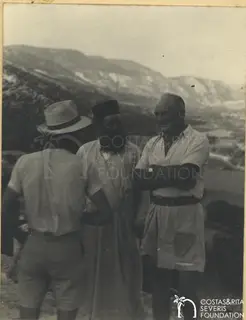
St Andrews Latin lecturer who worked on the inscriptions of Cyprus from the 1930s, dug Kafizin in 1949 and co-led the Kouklia expedition at Old Paphos from 1950 to 1955.
Key factsBorn 11 May 1905, Yokohama; died 8 November 1978ShowHide
Terence Bruce Mitford taught Latin at the University of St Andrews and, after his first travels in Cyprus in the mid-1930s, gave most of his energy to research on the island's inscriptions43. In 1949 he excavated the cave shrine on Kafizin hill with Porphyrios Dikaios, and from 1950 to 1955 he and J. H. Iliffe led the Liverpool and St Andrews expedition to Palaepaphos4,16,44.
Contents 6 chapters · 1,900 words · about 8 minutesShowHide
The sources differ on the day of his birth: F. G. Maier's British Academy memoir gives 15 May 1905, at Yokohama, and Wikipedia gives 11 May 19058,43. He was the eldest son of C. E. Bruce Mitford, journalist and writer, and of Beatrice Jean, née Allison43. From Dulwich College he won a scholarship in Classics to Jesus College, Oxford, and took a First in Mods, but sport took up so much of his time (he very nearly won a Rugby blue) that his final degree, in Maier's phrase, "could not exactly be described as a good one"43.
He went to St Andrews as temporary assistant to the Latin scholar W. M. Lindsay, Professor of Humanity there until 1936, the start of half a century with its Department of Humanity43. After four years as Warden of St Salvator's Hall he was made Lecturer in Humanity in 1936, and in the same year he married Margaret, who was herself on the university's staff as a Demonstrator in Anatomy43. They had five children43. As Lecturer and, from 1952, Reader in Humanity and Classical Archaeology, he taught almost nothing but Latin prose composition and Latin texts, and he never applied for another post43.
Chapter II1 minute
The war, in Maier's account
The London Gazette lists Terence Bruce-Mitford under the Dorset Regiment from 15 October 193945. Maier, who writes that he rarely spoke of the war, has him sent to serve under Pendlebury in Greece and, during the German attack on Crete in 1941, commanding a troop of raiders based on an island in the mouth of Suda Bay, then escaping to Egypt as one of the last to leave43. Transferred to the Special Operations Executive, he raised a force of Kurds in Syria, trained to sabotage the Turkish railway route into Iraq if Turkey joined the Axis43. Maier also counts him among the preliminary invaders of Sicily, and has him leading a Special Boat Service patrol of four in a small caique that captured Patmos, where his rule lasted a few days43.
Late in 1944 he returned to Crete by parachute, landing at night on the Omalo plain, and in the last phase of the German occupation he led a group of Greek partisans in the White Mountains43. He trained them with the machine gun, cleared mines around Chania and Rhethymnon and looked for inscriptions at the same time: "Pistol in one pocket, squeeze paper in another," he told Maier43.
Chapter III1 minute
The corpus and Kafizin
His first article, "Contributions to the Epigraphy of Cyprus" in the Journal of Hellenic Studies for 1937, announced his plan to study the island's Greek and Roman inscriptions and to produce a small corpus of them43. On 7 March 1940 the Society of Antiquaries of London elected him a Fellow, at the same meeting as Dikaios46.
In the summer of 1948 he covered much of the island for his projected corpus of Cypriot inscriptions47. He also gave some three weeks that summer to the Kafizin material assembled in Nicosia, and the outcome was the formal excavation of the site in June and July 1949 by Dikaios, Curator of the Cyprus Museum, and himself4. The foreman was Chrysostomos Paraskeva of Dhali, who in the following years spent many months restoring the pots4.
In 1949 Michael H. Kattis told Mitford that he and three partners had begun digging at Kafizin by night between 1916 and 1918 and had gone on at irregular intervals for twenty years4. In Mitford's account Kattis sold his finds locally to tourists, apart from some pieces smuggled out of Cyprus soon after the First World War by a Lefkara lace merchant, long dead by 1949, who in Mitford's words had "no doubt" served both Philadelphia and Copenhagen4. In the Classical Quarterly of 1950 Mitford corrected the dating of Mrs Dohan and Professor Kent, placing the inscriptions in the Cyprus of Euergetes and Philopator rather than that of Cicero4.
Every year from 1950 to 1955 he gave two to three weeks to the Kafizin material in Nicosia4. Maier adds that an English hotel proprietor in Nicosia would rush his "slightly inebriated customers" out in a fleet of taxis when heavy rains had washed inscribed sherds down the hill43. Dikaios was to write a brief report on the archaeology of the site, an agreement the two confirmed in Heidelberg in July 1971, but Dikaios died on 23 August4.
Chapter IV2 minutes
The Kouklia expedition
Mitford had met Iliffe, director of the Palestine Archaeological Museum, in the Middle East during the war43. Maier puts in August 1949 the bicycle tour on which the two men learnt of Archaic limestone statues found in a mound outside the village of Kouklia, while G. H. McFadden's Kourion notebook records, just before an entry of 15 June 1948, "Iliffe and Mitford leave on bicycles for Paphos"43,48. Maier writes that they decided to dig there, obtained a licence and persuaded the Liverpool Museums and the University of St Andrews to foot the bill10.
Kiely gives their stated aims as the topography of the ancient settlement and the sanctuary of Aphrodite, with the hope of syllabic inscriptions in datable contexts14. The 1950 season was directed jointly by Mitford, mainly responsible for the organisation, and Iliffe, responsible for the archaeological direction, with help from the University of Sydney through J. R. Stewart2. West of the area of the sanctuary cleared in 1887 the team found superimposed remains nearly four metres deep, and in 1951 a licence was issued for two years, renewable10,49.
Mitford chose the staff and the sites and arranged labour and supplies, Maier writes, while Iliffe held the overall archaeological direction43. In 1952 Mitford invited Maier to join the dig and set him to work on the Marcello hill50. In Maier's words he was "the driving spirit of the Expedition, both respected and beloved in the village by Greeks and Turks alike"43. Though not trained as an archaeologist, he dug in the Late Bronze Age necropolis and a Roman house next to the Temple of Aphrodite43.
It seems that late in the 1953 season he and his assistant Ethel Hunter came upon the graves of the Kaminia cemetery; Hunter wrote that they "found a LC III cemetery, four days before the end, so Terence and I carried on"12,16. Maier remembers the camp as simple, with long working days and sometimes rough manners, yet "an exhilarating feeling" in the air12. The digging went on until 1955, when it had to be suspended because of the growing unrest of the Enosis movement43. Maier credits the expedition with the first Late Bronze Age cemeteries of Old Paphos and a siege ramp built by a Persian army outside the North-East Gate in 498 BC, in which more than 250 syllabic texts were found43.
Chapter V1 minute
Nea Paphos and Jean Bérard
The Director of Antiquities, A. H. S. Megaw, sent Mitford the correspondence of Jean Bérard about soundings at Kato Paphos so that he would be "forewarned if Bérard approaches you"12. On 13 March 1951 Mitford told Megaw that he had put Bérard off politely, but Bérard had "returned to the charge with the proposition that we do his sondage at New Paphos and he pays us"51. He secured a licence for soundings at New Paphos, and in 1951, under his direction, the team dug 28 trial pits13,51. In January 1952 he reported that the French Commission des Fouilles had, at Bérard's instigation, "stumped up £ 200" for renewed soundings, the work to be done by the British team51.
The two men first met in Paris in April 1952, and Mitford described Bérard, who had a tenth of the use of one eye, as "a charming and pathetic person to whom I took a strong liking"13,51. Mitford proposed that Bérard bring Jean Deshayes from the French School at Athens, and in June 1952 Iliffe's diary records Mitford surveying with Bérard and Deshayes the area east of the "Tombs of the Kings"12,51. Maier noted in his diary that the French evidently did not get on with Mitford and Ethel at Evreti and found the expedition's ways too uncivilised, "perhaps rightly"12.
Chapter VI2 minutes
Rantidi, the books and the last years
The accounts of the 1955 work at Rantidi differ on who did it and what it found: Maier writes that in his last Kouklia campaign Mitford carried out a survey, with the help of M. R. Popham, that produced twenty-two new inscriptions, while Brice writes that Mervyn Popham rediscovered and examined the site afresh in 1955 and found a further 2543,52. Mitford had the surviving 1910 texts assembled at the Kouklia Museum to study them, and Brice writes that of the 170 inscriptions catalogued by the site's several explorers he recovered and studied 10243,52.
Maier writes that the Enosis crisis was the main reason he moved his fieldwork to Turkey, where from the late 1950s he collected the inscriptions of Rough Cilicia for the Tituli Asiae Minoris of the Austrian Academy, travelling at first with G. E. Bean43. In 1958 he invited Hector Catling to publish all the tombs the expedition had found, a project Catling was still working on when he died14,16.
He did not reach his original aim, a corpus of all Cyprus that would have formed volume xv of Inscriptiones Graecae, but he edited the inscriptions of Kourion (1971) and, with I. Nicolaou, those of Salamis (1974)43. For Kourion he owed access to the Kourion Expedition's inscriptions to McFadden and the invitation to publish them to Roger Edwards, and the book was completed at the Institute for Advanced Study, Princeton1. Maier found him "direct, commanding, sometimes incisive, often laconic", and wrote that once convinced of a reading he could not easily be moved by other scholars' arguments10,43.
He retired in 1973 as Honorary Emeritus Professor and Research Fellow; Oxford gave him a D.Litt. that year, the British Academy made him a Fellow in 1974, and a few months before his death the Austrian Academy elected him a Corresponding Fellow43.
On his last visit to Kouklia, in April 1977, mosaic restorers in the North Hall of the Temple of Aphrodite found a large fragment of a syllabic text from the reign of King Nikokles, which he published in the Bulletin de correspondance hellénique for 197843. That year he asked Maier to arrange the publication of his Rantidi work should he be unable to see it through the press52. He left a nearly complete manuscript of the Rantidi texts and a thorough documentation of the siege-mound inscriptions, both to be edited, Maier wrote, by Olivier Masson, and the Rantidi volume appeared under Masson's editing43,53.
The sources disagree on whether he saw the proofs of the Kafizin book, which he regarded as his magnum opus: Maier writes that, already battling ill health, he was able to see them through, while Brice writes in the book that he died "when first proofs were beginning to come through"4,43. He died suddenly at his home in Fife on 8 November 1978, and the burial service in Kilmany church ended with a lament of pipes4,43.
Life and work
73 events, 1935–2021
1935
In a letter of 1935: «I am sending a telegram to enquire»
First of his epigraphic visits to Kourion; further visits 1949, 1954, 1958 (squeezes, hand-copies, photographs of inscriptions, including the rock-cut texts nos. 6-12)
In the Kourion expedition papers of 1939: «I failed to give you a letter to post to Mr. Mitford, but I have no doubt that both you and John know that there is no objection on my part or George's to his examination of the inscriptions from Apollo»
In the Kourion expedition papers of 1954: «I have heard from Mitford that the doctor thinks he will be well enough to travel by the end of June and that he expects now to be with us for about two weeks after July 15. He says that he had had in England the information about all our inscriptions discovered up to 1947 and that these are now written up.»
In the Kourion expedition papers of 1948: «I was glad that you are agreeable to giving Mitford access to the Kourion inscriptions for inclusion in his Corpus»
In the Kourion expedition papers of 1948: «While removing block at entrance square room on Street 1, east side. Looking s.e. Under direction Mitford & Mrs Hill.»
Asked by the British Museum to identify the Bulwer Cypro-Syllabic clay tablet (ICS 327); noted it had been missing for almost forty years (the BM bought it in 1950 from the Rev. W. C. Hall)
«Mr. T. Bruce Mitford, in association with the Department, examined the cave shrine in Kaphizin hill, near Nicosia, where bowls inscribed with syllabic and alphabetic dedications had been found.» (1949)
Co-directed the British Kouklia Expedition at Palaepaphos from 1950 (St Andrews/Liverpool Museums): city defences, Persian siege mound, LC tombs; 1951 soundings at Saranda Kolones; fieldwork suspended 1955.
Co-directed the joint St Andrews and Liverpool Museum excavations at Kouklia (Old Paphos) in 1950-2: «directed by Mr T* B, Mitford and Mr J, H. Iliffc conducted excavations during 1950—2»
Licence for a maximum two years, with first refusal of other sites in the area; 28 trial pits dug at Nea Paphos in the Saranda Kolones area, the first soundings there
Mr. T. B. Mitford of St. Andrews University led trial excavations at Kouklia (Paphos), finding superimposed remains and a possible earliest city wall of Palae-Paphos, with further work planned for 1951.
Co-directed with J. H. Iliffe the 1951 St Andrews / Liverpool Museums mission that dug tombs at Skales and elsewhere at Palaepaphos (Kouklia Expedition 1952-53: Evreti, Asproyi, Kaminia).
With E. M. Hunter directed the Asproyi and Kaminia cemetery excavations after a limited search for more Evreti tombs; P. L. Shinnie conducted a trial excavation at Site F, 3-27 July
Search for further Evreti tombs and excavation of ten Late Cypriot tombs at Asproyi (JHS 74); the Illustrated London News of 26 December 1953 pictures him as of St Andrews, associated with Iliffe in a series of excavations at Kouklia
Final Kafizin campaign carried out by the Department of Antiquities with funds secured by Mitford; total of restorable inscribed vases raised to nearly 100
In the Kourion expedition papers of 1954: «Kafizin where Mitford was digging again and finding more pieces. He wrote thereafter that he had "wedded" every single one of our pieces to new ones.»
Examined the Rantidhi syllabic inscriptions (dug by Zahn in 1910, unpublished, held in the Cyprus Museum, some moved to Kouklia); expedition operations restricted to the siege-mound area
In the Kourion expedition papers of 1957: «Alternatively I think of Terence Mitford, who is more nearly within the fold, since he is engaged in publishing the Curium inscriptions.»
In the Kourion expedition papers of 1958: «if Terence Mitford is to "judge" he wants in the way of a final Acropolis grid plan" (as you put it) he can do so just as well from a contact sunprint»
In the Kourion expedition papers of 1958: «to keep T. Mitford from snapping at my heels. He needs grid references for the find-spots of the inscriptions he is publishing.»
Was at Kouklia when an inscribed find was made and gave a preliminary commentary on an inscription acquired by the Kouklia Museum (1977); dead by 1979, when O. Masson took over the Rantidi and Kouklia siege-ramp syllabic inscriptions.
Published the Nymphaeum of Kafizin (1980); inscribed Kafizin vases and sherds found before the British excavations are in the National Museum of Denmark.
Named the syllabic inscription ICS 327 the 'Bulwer Tablet' after its one-time owner; co-author with Masson of Inscriptions syllabiques de Kouklia-Paphos (1986).
Said in the recorded talk «Unlocking the Sacred Landscapes of Cyprus (UnSaLa-CY) and Landscape Archaeology in the Xeros River Valley in Larnaca» (Archaeological Research Unit - University of Cyprus, 2019-02-14): Allocated the area east of the Pentaskhinos river to Kition on the basis of later textual evidence.
Said in the recorded talk «The tumulus of Laona: an un-Cypriot monument in the landscape of the island» (Archaeological Research Unit - University of Cyprus, 2021-02-23): Worked in Palaepaphos in the early 1950s and assumed a city wall girdled the sanctuary.
Epigrapher of the Paphos region (Kouklia inscriptions ABSA 1961; Rantidi syllabic inscriptions with Masson 1983); co-directed the 1951 Kouklia excavations with Iliffe.
Named in the BCH Chronique des fouilles à Chypre: Transcribed the Theodoros inscription (the largest of three fragments of a statue base found in 1888) and had copied the built-in fragment in 1936.
Said in the recorded talk «Η Επιγραφική της Κύπρου υπό το φως της έκδοσης των Inscriptiones Graecae (IG XV)» (Archaeological Research Unit - University of Cyprus, 2018-10-08): Published the Kourion inscriptions in 1971 and the Salamis and Kafizin epigraphic sets; his restorations of damaged texts have been challenged; he dated the Kafizin set to the reign of Ptolemy III Euergetes.
Scholar who showed the authors his unpublished material of dedicatory inscriptions from Cypriot Kafizin, which the authors were much indebted to him for.
In the Kourion expedition papers: «Mr. T. Bruce Mitford of the University of St. Andrews in association with the Department of Antiquities has found inscribed fragments of bowls»
Named in the École française d'Athènes reports on Amathus (BCH): Published lead plaques as coming from Kourion (Inscr. of Kourion nos 127-142): «Elles font partie du même lot que les plaques de plomb publiées par T. B. Mitford»
Named in the École française d'Athènes reports on Amathus (BCH): Studied and published the inscription recording the stoa of thirteen capitals, now in Limassol museum: «Une stoa de treize colonnes est mentionnée dans une inscription étudiée par T. B. MITFORD11 et conservée au musée de Limassol (RR 165-10).»
Named in the École française d'Athènes reports on Amathus (BCH): Read a stele in the village of Aghios Tykhonas: «que ce soit celle jadis lue par T. B. Mitford dans le village d’Aghios Tykhonas»
Archaic sculpture and syllabic-inscription finds from the Kouklia 'Persian siege mound' and tombs; the St Andrews share later went to the National Museum of Scotland
From Kouklia (Palaipaphos)National Museum of Scotland
Excavated with Jean BérardJean Bérard excavated alongside T.B. Mitford at Paphos, identifying the city of Agapénor and its necropolis. Bérard 2008, p. 741950–1952
Excavated with H. J. HilfeT. B. Mitford and H. J. Hilfe excavated the tomb at Kouklia in which the bird-shaped vessel was found. Karageorghis 1979, p. 684
On a bicycle tour in the summer (August, per the Guide) of 1949 Iliffe and Mitford heard of Archaic sculpture found in a mound outside Kouklia and decided to…
Mr. T. Bruce Mitford examined the cave shrine on Kaphizin hill near Nicosia, finding disturbed deposits and many new inscribed fragments from the 3rd century…
Iliffe and Mitford decided to dig at Kouklia after hearing of Archaic sculpture found there, and persuaded Liverpool Museums and the University of St Andrews…
Miss L. V. Hodgson, of the Education Department, Nigeria, gave assistance to the 1950 Mitford and Iliffe trial excavation at Old Paphos (Kouklia) while on…
Co-sponsored, with St Andrews University, the Palaepaphos (Kouklia) expedition directed by J. H. Iliffe (Liverpool) and T. B. Mitford (St Andrews). Kiely…
Karageorghis et al. 1999, p. xii; Wright & White 2005, p. 25; Kiely 2017
41.P. Jacobsthal (1956). Greek Pins and Their Connexions with Europe and Asia. p. 153.
42. (1960). “Inscriptions from Cyprus”. p. 9.
43.Franz Georg Maier. “Terence Bruce Mitford 1905-1978”. Proceedings of the British Academy 67, 433-442. Online
44.Colonial Office. Report on Cyprus for the Year 1949.
45.The London Gazette (1939). The London Gazette, issue 34725, p. 7476. Online
46.Society of Antiquaries of London (1940). “Proceedings of the Society”. The Antiquaries Journal 20.
47.Colonial Office. Annual Report on Cyprus for the Year 1948.
48.G. H. McFadden. “Kourion Complex Apollo (extracted from McFadden's notebooks), 1 of 2”. Penn Museum Archives, Kourion Expedition records (PU-Mu 1050), Box 5, folder 1.
49.Colonial Office. Report on Cyprus for the Year 1950.
50.Maria Iacovou. “Kouklia - Palaepaphos: a history of excavations. An interview with Professor F. G. Maier”. Cyprus Today, 30-34.
51.Antoine Hermary (ed.) (2008). “Dossier Bérard: 1. Correspondance 1950-1953”. Cahiers du Centre d'Études Chypriotes 38.
52.William C. Brice. Review of T. B. Mitford and O. Masson, The syllabic inscriptions of Rantidi-Paphos (Ausgrabungen in Alt-Paphos 2, Konstanz 1983). 245.
59.V. Karageorghis (ed.), M. True (ed.) (1991). “Chalcolithic Cyprus”. Bulletin of the American Schools of Oriental Research. Malibu, American Schools of Oriental Research, with the J. Paul Getty Museum.
120.Masson 1985, "Les visites de Max Ohnefalsch-Richter à Kouklia", CCEC 3, p. 24; n. 4, 16, 17, 22, Masson 1985, "Les visites de Max Ohnefalsch-Richter à Kouklia", CCEC 3, p. 26–10; Maier 1992, "A tomb of Paphian Kings: the Spilaion tis Regainas", CCEC 18.
121.Karageorghis, Chronique des fouilles ... à Chypre (BCH 102-112, 1978-1988): 1977:; 1979:.
122.Masson & Hermary 1988, CCEC 10, n. 5, n. 32.
123.Colonial Office, Annual Report on Cyprus for 1948.
124.Colonial Office, Annual Report on Cyprus for 1950.
125.OEANE 1997, s.v. 'History of the Field: Archaeology in Cyprus' (E. Peltenburg)–1082.
126.Krierer, review of Schmid & Horacek (eds) 2018 [summarising Pilides, Recke, Lewandowski, Summa chapters].
127.Maier & Karageorghis 1984, Paphos: History and Archaeology, pp. 18–19–21), n. 13 p. 22.
128.V. Karageorghis, "Excavating at Salamis: 1952–1974", in Salamis of Cyprus (2019).
129.Costello 2014, Earthquake House at Kourion (BAR 2635), pp. 18–19, 21–28, 30).
130.Centre of Visual Arts and Research (CVAR), Costas and Rita Severis Foundation, Nicosia, online catalogue: pht_01546, “T.B. Mitford and J. H. Iliffe”, ca. 1950-1952. Online
131.Colonial Office, Annual Report on Cyprus for 1949.
132.Athanassios Papageorghiou, «Chronique des fouilles et découvertes archéologiques à Chypre en 1990», Bulletin de correspondance hellénique 115 (1991).
134.Anon., "Kouklia-Palaepaphos. An interview with Professor F.G. Maier", Cyprus Today vol. 25, no. 2 (April–June 1987).
135.Giorgos Papantoniou and Athanasios K. Vionis, «Unlocking the Sacred Landscapes of Cyprus (UnSaLa-CY) and Landscape Archaeology in the Xeros River Valley in Larnaca», recorded lecture, Archaeological Research Unit - University of Cyprus, published on YouTube 2019-02-14, at 0:33:52. Online
136.Maria Iacovou, «The tumulus of Laona: an un-Cypriot monument in the landscape of the island», recorded lecture, 30 Years of Research at the ARU, 55th Public Lecture Series, Archaeological Research Unit - University of Cyprus, published on YouTube 2021-02-23, at 0:29:57. Online
137.Maria Kantirea, «Η Επιγραφική της Κύπρου υπό το φως της έκδοσης των Inscriptiones Graecae (IG XV)», recorded lecture, 50th Public Lecture Series, Archaeological Research Unit - University of Cyprus, published on YouTube 2018-10-08, at 0:06:01. Online
138.Zissis Parras (2004). The Biological Affinities of the Eastern Mediterranean in the Chalcolithic and Bronze Age: A Regional Dental Non-metric Approach. In BAR International Series 1305 1305. Oxford, BAR Publishing. p. 4..
139.Brian A. Sparkes; Lucy Talcott; Gisela M. A. Richter (1970). Black and Plain Pottery of the 6th, 5th and 4th Centuries B.C. Part 1: Text. In The Athenian Agora, Vol. 12. pp. ii-v+vii-ix+xi-xix+1-382. The American School of Classical Studies at Athens. p. 4.. Online
140.Sarah B. Pomeroy (1984). Women in Hellenistic Egypt: From Alexander to Cleopatra. Schocken Books. p. 44..
141.T. B. Mitford (1962). Cyprian Texts - T. B. Mitford: Studies in the signaries of South-western Cyprus. (Bulletin Supplement, No. 10.) Pp. v+55; 28 plates. London: University of London Institute of Classical Studies, 1961. Paper.. In Bulletin Supplement. pp. v+55. London, University of London Institute of Classical Studies. p. 251.. Online
142.Penn Museum Archives, Kourion Expedition records (PU-Mu 1050), Box 4, folder 11.
143.Penn Museum Archives, Kourion Expedition records (PU-Mu 1050), Box 4, folder 7.
144.Penn Museum Archives, Kourion Expedition records (PU-Mu 1050), Box 1, folder 4.
145.Penn Museum Archives, Kourion Expedition records (PU-Mu 1050), Box 5, folder 1.
146.Penn Museum Archives, Kourion Expedition records (PU-Mu 1050), Box 2, folder 1.
147.Penn Museum Archives, Kourion Expedition records (PU-Mu 1050), Box 2, folder 4.
148.Penn Museum Archives, Kourion Expedition records (PU-Mu 1050), Box 2, folder 12.
149.Penn Museum Archives, Kourion Expedition records (PU-Mu 1050), Box 2, folder 14.
150.Penn Museum Archives, Kourion Expedition records (PU-Mu 1050), Box 1, folder 10.
151.Penn Museum Archives, Kourion Expedition records (PU-Mu 1050), Box 10, folder 11.
152.Penn Museum Archives, Kourion Expedition records (PU-Mu 1050), Box 1, folder 16.
153.Penn Museum Archives, Kourion Expedition records (PU-Mu 1050), Box 8, folder 15.
154.Penn Museum Archives, Kourion Expedition records (PU-Mu 1050), Box 8, folder 5.
155.Penn Museum Archives, Kourion Expedition records (PU-Mu 1050), Box 9, folder 10.
156.Penn Museum Archives, Kourion Expedition records (PU-Mu 1050), Box 5, folder 2.
157.Penn Museum Archives, Kourion Expedition records (PU-Mu 1050), Box 2, folder 10.
158.Penn Museum Archives, Kourion Expedition records (PU-Mu 1050), Box 2, folder 8.
159.E. Bacon, Digging for History. A Survey of Recent World Archaeological Discoveries 1945—59 (1960).
160.Pierre Aupert and Antoine Hermary, «Rapport sur les travaux de la mission de l'École française à Amathonte en 1980», Bulletin de correspondance hellénique 105 (1981).
161.Jean-Paul Prête, Isabelle Tassignon, Tony Kozelj, Manuela Wurch-Kozelj, Béatrice Blandin and Sabine Fourrier, «Rapport sur les travaux de l'École française à Amathonte en 2001», Bulletin de correspondance hellénique 126 (2002).
162.Antoine Hermary, Pierre Aupert, Béatrice Blandin, Catherine Petit-AUPERT, Martin Schmid and Isabelle Tassignon, «Chypre», «Amathonte», Bulletin de correspondance hellénique 135 (2011).
163.Maier 2001, 'From Hammer von Purgstall to F. B. Welch. The archaeology of Old Paphos, 1802–1899', in Tatton-Brown (ed.), Cyprus in the 19th Century AD.
164.Karageorghis 1983, Palaepaphos-Skales: An Iron Age Cemetery in Cyprus.
166.Collège de France, Paris, Fonds Claude Schaeffer (34 CDF), 34 CDF art. 179, «[Lettre de Megaw à Schaeffer à propos de la réplique de la coupe aux taureaux et de la reprise des fouilles à Enkomi]», 19 May 1952of 2. Online
167.T. B. Mitford, 1971, The Inscriptions of Kourion.
168.Mitford 1971, The Inscriptions of Kourion; 124; 202; 404.
169.Mitford 1971, The Inscriptions of Kourion.
170.H. W. Catling (ed. R. W. V. Catling), 2020, Kouklia: Late Bronze Age and Early Iron Age Tombs at Palaepaphos 1951-1954.
171.Hermary 2008, 'Les recherches de Jean Bérard à Chypre (1950-1953)', CCEC 38.
172.Jean Bérard, 2008, La colonisation grecque de Chypre et la date de la guerre de Troie (article inédit).
173.Antoine Hermary, 2008, 1. Les recherches de Jean Bérard à Chypre (1950-1953): la correspondance, archives du Département des Antiquités de Chypre et de l'École Française de Rome.
174.Antoine Hermary, Introduction. In: Cahiers du Centre d'Etudes Chypriotes. Volume 38, 2008. pp. 19-32 (2008).
175.H. W. Catling (ed. R. W. V. Catling), 2020, Kouklia. Late Bronze Age and Early Iron Age Tombs at Palaepaphos 1951-1954. Excavations of the Liverpool City Museum and St Andrews University Expedition to Palaepaphos, Acknowledgements.
176.H. W. Catling (ed. R. W. V. Catling), Kouklia. LBA and EIA Tombs at Palaepaphos 1951-1954 (BAR 2020), Acknowledgements.
177.A. Hermary, 2008, Les recherches de Jean Bérard à Chypre (1950-1953).
178.O. Masson, 1985, Les visites de Max Ohnefalsch-Richter à Kouklia, n. 17.
179.T. B. Mitford, 1937, Contributions to the Epigraphy of Cyprus.
180.Macmillan, Journal Of Hellenic Studies Vol.57.
181.F. G. Maier, 2008, Jean Bérard à Chypre (Bérard in Cyprus; reading of the Department of Antiquities archive and Mitford's diary); A. Hermary, 2008, Les recherches de Jean Bérard à Chypre (1950-1953): la correspondance, archives du Département des Antiquités de Chypre et de l'École Française de Rome.
182.T. B. Mitford, 1950, Kafizin and the Cypriot Syllabary, p. 100; Terence B. Mitford, 1980, The Nymphaeum of Kafizin: The Inscribed Pottery.
183.Terence B. Mitford, 1980, The Nymphaeum of Kafizin: The Inscribed Pottery.
184.B. Costello IV, 2014, Architecture and Material Culture from the Earthquake House at Kourion.
185.T. B. Mitford and J. H. Iliffe, 1951, Excavations at Kouklia (Old Paphos), Cyprus, 1950.
186.A. Hermary, 2014, In memoriam: Franz Georg Maier (1926-2014).
187.H. W. Catling, 2020, Kouklia: Late Bronze Age and Early Iron Age Tombs at Palaepaphos 1951-1954, p. 91; H. W. Catling, 2020, Kouklia: Late Bronze Age and Early Iron Age Tombs at Palaepaphos 1951-1954.
188.H. W. Catling, 2020, Kouklia: Late Bronze Age and Early Iron Age Tombs at Palaepaphos 1951-1954.
189.H. W. Catling (ed. R. W. V. Catling), Kouklia. LBA and EIA Tombs at Palaepaphos 1951-1954 (BAR 2020), Acknowledgements; H. W. Catling (ed. R. W. V. Catling), Kouklia. LBA and EIA Tombs at Palaepaphos 1951-1954 (BAR 2020).
190.Mitford 1971, The Inscriptions of Kourion; 62; 262; 425.
191.Mitford 1971, The Inscriptions of Kourion, Ack..
192.G. B. Bazemore, 2000, Erotica from the Sanctuary in Rantidi Forest, Cyprus.
193.F. G. Maier, 2008, Archaeology in Cyprus in the Fifties: Jean Bérard's work at Nea Paphos in context.
194.David Noy; Hanswulf Bloedhorn, Inscriptiones Judaicae Orientis Volume III Syria and Cyprus (2004).
195.Maurice Sznycer, Nouvelle lecture d'un mot dans l'inscription phénicienne de Larnaka-Tis-Lapithou (1997).
196.Inscriptions from Cyprus (1960).
197.Hermary, "In memoriam: Franz Georg Maier (1926–2014)", CCEC 44 (2014), 11–16.
198.D. Bolger, 2002, Gender and mortuary ritual in Chalcolithic Cyprus, p. 73; D. Bolger et al., 2002, Engendering Aphrodite: Women and Society in Ancient Cyprus, p. 73; Lindy Crewe et al., 2002, Contexts for cruciforms: figurines of prehistoric Cyprus.
199.A. H. S. Megaw, 1951, Archaeology in Cyprus, 1949-1950; F. G. Maier, 1997, A hundred years after Hogarth: Digging at Aphrodite's sanctuary at Palaipaphos; F. G. Maier, 2004, Guide to Palaipaphos (Kouklia).
200.T. B. Mitford and J. H. Iliffe, 1951, Excavations at Kouklia (Old Paphos), Cyprus, 1950; F. G. Maier, 2004, Guide to Palaipaphos (Kouklia).
201.Journal Of Hellenic Studies Vol.79 (1959).
202.Journal of Hellenic studies vol.74.
203.Journal of Hellenic studies vol.73 (1953).
204.Journal of Egyptian archaeology vol.40 (1954).
205.T. B. Mitford, 1971, The Inscriptions of Kourionn. 1.
206.T. B. Mitford; J. Karageorghis, 1964.
207.Markus Egetmeyer, Le dialecte grec ancien de Chypre (2010).
208.Sabine Fourrier; Antoine Hermary; Anna Cannavò; Thomas Kiely; Stephan Schmid; Philippe Trélat; Marguerite Yon, Cahiers du Centre d'Études Chypriotes 49, 2019 (2019).
209.Megaw, 'Archaeology in Cyprus, 1954', Archaeological Reports 1 (1954).
210.T. B. Mitford and J. H. Iliffe, 1951, Excavations at Kouklia (Old Paphos), Cyprus, 1950; T. B. Mitford, 1971, The Inscriptions of Kourion.
211.Three Milestones of Western Cyprus (1966).
212.A. Hermary, 2014, In memoriam: Franz-Georg Maier (1926-2014).
213.Paphos. Ausgrabungen in Alt-Paphos auf Cypern. Ed. F. G. Maier. 2. <i>The syllabic inscriptions of Rantidi-Paphos</i>. By T. B. Mitford and O. Masson. Constance (1985).
214.T. B. Mitford†, O. Masson: The Syllabic Inscriptions of Rantidi- Paphos. (Ausgrabungen in alt-Paphos auf Cypern, 2.) Pp. xii + 102; 24 plates. Constance: Univer (1985).
215.Mitford 1971, The Inscriptions of Kourion; 289.
216.D. Bolger et al., 2002, Engendering Aphrodite: Women and Society in Ancient Cyprus.
217.Roger D Woodard, Greek Writing From Knossos To Homer, A Linguistic Interpretation Of The Origin Of The Greek Alphabet And The Continuity Of Ancient Greek Literacy By Roger D Woo.
218.T. B. Mitford, The Inscriptions of Kourion (1971).
219.Sabine Fourrier, La coroplastie chypriote archaïque. Identités culturelles et politiques à l'époque des royaumes (2007).
220.Antoine Hermary, Un nouveau vase inscrit de Kafizin (2006).
221.Maier 2004, Guide to Palaipaphos (Kouklia)and bibliography.
222.D. Leibundgut Wieland and L. Frey-Asche, 2011, Weihgeschenke aus dem Heiligtum der Aphrodite in Alt-Paphos. Terrakotten, Skulpturen und andere figürliche Kleinvotive.
223.David Soren, The Sanctuary of Apollo Hylates at Kourion, Cyprus (1987).
224.F. G. Maier, 1997, A hundred years after Hogarth: Digging at Aphrodite's Sanctuary at Palaipaphos.
225.F. G. Maier, 2008, Archaeology in Cyprus in the Fifties: Jean Berard's work at Nea Paphos in context, p. 55; A. Hermary, 2008, Les recherches de Jean Berard a Chypre (1950-1953): la correspondance.
226.Maier 2008, CCEC 38.
227.Maier 1997, "A hundred years after Hogarth", CCEC 27.
228.T. B. Mitford, 1980, The Nymphaeum of Kafizin: The Inscribed Pottery; T. B. Mitford, 1950, Kafizin and the Cypriot Syllabary.
229.Masson 1985, "Les visites de Max Ohnefalsch-Richter à Kouklia", CCEC 3, p. 21; n. 16, Masson 1985, "Les visites de Max Ohnefalsch-Richter à Kouklia", CCEC 3.
230.Maier 1992, "A tomb of Paphian Kings: the Spilaion tis Regainas", CCEC 18.
231.Karageorghis, Chronique des fouilles ... à Chypre en 1979, BCH 104 (1980).
232.Masson & Hermary 1988, CCEC 10, n. 32.
233.D. Bolger et al., 2002, Engendering Aphrodite: Women and Society in Ancient Cyprus, p. 73; S. Fourrier, 2007, La coroplastie chypriote archaïque. Identités culturelles et politiques à l'époque des royaumes, p. 79; S. Fourrier, 2007, La coroplastie chypriote archaïque. Identités culturelles et politiques à l'époque des royaumes.
234.A. Hermary, 2008, Les recherches de Jean Bérard à Chypre (1950-1953): la correspondance, archives du Département des Antiquités de Chypre et de l'École Française de Rome, p. 44; A. H. S. Megaw, 1954, Archaeology in Cyprus, 1953, p. 172; T. B. Mitford et al., 1951, Excavations at Kouklia (Old Paphos), Cyprus, 1950.
235.C. Balandier et al., 2009, Nouvelles recherches archéologiques à Paphos. Premiers résultats de la mission française sur la colline de Fabrika (2008-2009).
236.H. W. Catling, 2020, Kouklia: Late Bronze Age and Early Iron Age Tombs at Palaepaphos 1951-1954, p. 1; H. W. Catling, 2020, Kouklia: Late Bronze Age and Early Iron Age Tombs at Palaepaphos 1951-1954.
237.R. S. Merrillees, 2010, Another Cesnola Puzzle: A pair of reproduction bracelets from Kourion in the Musée-château.
238.A. Karnava, 2019, Old inscriptions, new readings: A god for the Rantidi sanctuary in South-West Cyprus.
239.A. Hermary, 2008, Les recherches de Jean Bérard à Chypre (1950-1953): la correspondance, archives du Département des Antiquités de Chypre et de l'École Française de Rome.
240.A. M. Honeyman, 1939, The Phoenician Inscriptions of the Cyprus Museum.
241.V. Karageorghis, 1979, Chronique des fouilles et découvertes archéologiques à Chypre en 1978.
242.S. Mitchell et al., 2019, Early Christianity in Asia Minor and Cyprus: From the Margins to the Mainstream, p. 226; S. Rogge et al., 2019, Salamis of Cyprus: History and Archaeology from the Earliest Times to Late Antiquity.
243.T. Kiely, 2017, Britain and the archaeology of Cyprus II: 1914 to the present day, bibliography.
244.H. W. Catling (ed. R. W. V. Catling), 2020, Kouklia: Late Bronze Age and Early Iron Age Tombs at Palaepaphos 1951-1954, Acknowledgments; Asproyi section.
245.H. W. Catling (ed. R. W. V. Catling), 2020, Kouklia: Late Bronze Age and Early Iron Age Tombs at Palaepaphos 1951-1954, Acknowledgments; Evreti section.
246.H. W. Catling (ed. R. W. V. Catling), 2020, Kouklia: Late Bronze Age and Early Iron Age Tombs at Palaepaphos 1951-1954, Acknowledgments.
247.F. G. Maier, 1997, A hundred years after Hogarth.
248.A. Hermary, 2008, Les recherches de Jean Berard a Chypre (1950-1953).
249.A. Hermary, 2008, Les recherches de Jean Berard a Chypre (1950-1953); F. G. Maier, 1997, A hundred years after Hogarth; D. Powell, 2013, Love's Obsession: the lives and archaeology of Jim and Eve Stewart.
250.T. B. Mitford, 1971, The Inscriptions of Kourion; A. Hermary, 2008, Les recherches de Jean Berard a Chypre (1950-1953).
251.V. Karageorghis, 1980, Chronique des fouilles et decouvertes archeologiques a Chypre en 1979.
252.Ptolemies and Cypriots: Imitation and Dis(tinction).
253.T. Kiely, 2017, Britain and the archaeology of Cyprus II: 1914 to the present day.
254.T. B. Mitford, 1971, The Inscriptions of Kourion, Acknowledgments.
255.T. Kiely and R. S. Merrillees, 2012, The archaeological interests of Samuel Brown, government engineer, and his circle of acquaintances in late 19th century Cyprus.
256.Review of Mitford and Masson, 1985, Review of The Syllabic Inscriptions of Rantidi-Paphos (Ausgrabungen in Alt-Paphos 2).
257.S. Fourrier et al., 2019, Cahiers du Centre d'Études Chypriotes 49.
258.V. Karageorghis, 1963, Chronique des fouilles à Chypre en 1962.
259.1960, Inscriptions from Cyprus.
260.Derek Krueger, Symeon the Holy Fool Leontius's Life and the Late Antique City (1996).
261.John Millard, Liverpool’s museum: the first 150 years (2010).
262.Maurice Sartre, Sartre, Maurice. El Oriente Romano [ocr] [1994] (1994).
263.Vassos Karageorghis, Chronique des fouilles à Chypre en 1962 (1963).
264.Maria Iacovou, Palaepaphos: Unlocking the Landscape Context of the Sanctuary of the Cypriot Goddess (2019).
265.Sarah B. Pomeroy, Women in Hellenistic Egypt: From Alexander to Cleopatra (1984).
266.An Inscription from Karpasia in Cyprus (1957).
267.American Journal of Archaeology 1950-04: Vol 54 Iss 2 (1950).
268.Nederlands Instituut voor het Nabije Oosten, Bibliotheca Orientalis 32 (1975) (1975).
271.T. B. Mitford, J. H. Iliffe, 1951, Excavations at Kouklia (Old Paphos), Cyprus, 1950.
272.Nicolaou, 'Archaeology in Cyprus, 1969–76', AR 22 (1975–76).
273.K. Nicolaou, 1975, Archaeology in Cyprus, 1969-76.
274.Sabine Rogge; Christina Ioannou; Theodoros Mavrojannis, Salamis of Cyprus: History and Archaeology from the Earliest Times to Late Antiquity (2019).
275.<i>The Inscriptions of Kourion</i>. By T. B. Mitford. (1972).
276.Kiely 2017.
277.T. B. Mitford, 1960, A Cypriot Oath of Allegiance to Tiberius.
278.P. M. Fraser, Review of T. B. Mitford and O. Masson, The Syllabic Inscriptions of Rantidi-Paphos (1983).
279.Journal of Hellenic studies vol.62 (1942).
280.Macmillan, The journal of Hellenic studies (1942).
281.Megaw, 'Archaeology in Cyprus, 1956', Archaeological Reports 3 (1956).
282.Mitford 1971, The Inscriptions of Kourion–223, 234, 244.