
Early Bronze Age II
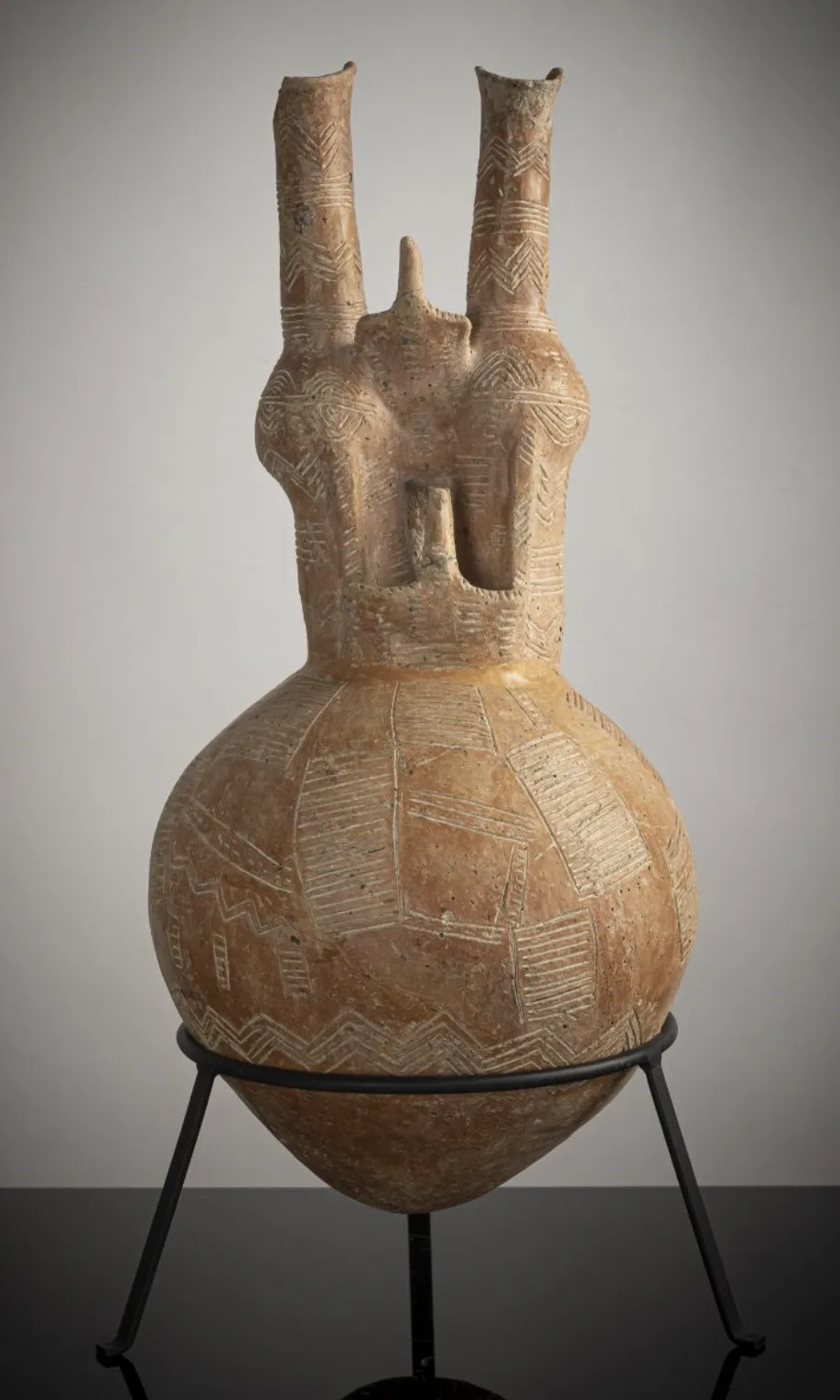
Red Polished Double-Necked Jug with Two Modelled Birds
A large Red Polished jug from Early Bronze Age Cyprus with two tall necks, two flat birds modelled between them and white-filled incised panels. Vounous type, c. 2300–2000 BCE.
Date
2300 - 2000 BC
Accession No.
JUG-BA-024
Collection
Alexis Drakopoulos
Early Cypriot II–III, c. 2300–2000 BCE · Red Polished ware · Handmade, incised, with modelled additions · H. c. 57 cm
A large jug with a near-spherical body drawn down to a rounded, pointed base. Two tall tapering necks rise side by side from the shoulder, each swelling into a knob halfway up and ending in an obliquely cut mouth; a handle joins them at the back. Between the necks at the front stand two flat, plank-like birds, one above the other. The lower springs from the shoulder and is tied to each neck by a short strut; the upper, at the level of the swellings, lifts a small pointed head clear of the necks. The body is covered in a loose patchwork of hatched panels set at angles to one another, above a band of zigzags; chevrons and hatched rings climb the necks. The incision is white-filled. The slip has worn thin and pale over much of the surface, and the burnish is dull between the necks, where a polishing pebble could not reach. Reassembled from about thirty fragments; the necks and both birds survive.
Commentary
The jug belongs to the class Dikaios called "big incised jugs", Type II c, in its double-necked form with a bird between the necks. His type-piece from Vounous Tomb 46A (no. 23) is described as "oval, with pointed rounded base, two tapering necks, and upper part of bird between the two necks in front", a description that fits this jug closely [1]. Karageorghis placed jugs of this kind in his group XII, and singled out three on which "the birds are fused to the body of the vase, without any support" [2]. The two stacked birds here are of that fused kind. The published parallels each carry a single bird.
The nearest of them is in the Louvre (AO 17526), a double-necked jug 50 cm high from Vounous Tomb 54, excavated by Schaeffer in 1933 and assigned to France at the division of finds; it is Karageorghis XII.15 [3][2]. It shares the globular body, close-set necks and all-over incision, with one bird at the front where this jug has two, and its decoration leans more on curved and concentric lines. The same tomb produced a second, larger double-necked jug, also in the Louvre (AO 31609, H. 69.2 cm) [4]. For the patchwork of hatched panels, the closest matches are Dikaios's double-necked jugs from Tombs 15 and 34 [1]. A smaller double-necked jug from Alambra in the British Museum (1871,0210.1) shows the same two-necked form without birds, from the centre of the island [6].
The fabric and finish point to the north coast. Frankel and Webb's analysis distinguishes the soft, fine north-coast clays, "well suited to the fine incision", from the hard, gritty and mottled wares of the centre and south, where fine incision is rare [7]. The rounded base, plank-like birds and crisp incision also separate it from the south-coast double-necked jugs, which have flat bases, mottled surfaces and animals perched on cross-bars. Morris assigned the north-coast group to "a single Vounous artist" and recorded heights of 53 to 58 cm [5]. At about 57 cm this jug stands at the top of that range. It has no recorded find-spot, and its attribution to the Vounous–Lapithos workshops rests on type and style.
Dikaios placed Tomb 46A early in his sequence, and double-necked incised jugs run through his middle periods [1]. His absolute dates predate radiocarbon and are now lowered by two to three centuries [8]. The Louvre dates its Tomb 54 jug to Early Cypriot, 2300–2000 BCE; a span into Middle Cypriot I cannot be excluded [3].
Jugs of this size and complexity were made for the tomb, set among the massed offerings of the Vounous chamber burials. Dikaios suggested that the plainer birds "may be simply of ornamental character", and Karageorghis saw "no justification" for reading prehistoric Cypriot birds as symbols [1][2]. Why this potter doubled a motif that the known parallels carry singly is unexplained.
References
- 1.Dikaios, P. (1940) The Excavations at Vounous-Bellapais in Cyprus, 1931–2. Archaeologia 88: 1–174, Type II c; Tomb 46A no. 23, pl. xxv c; Tombs 15 and 34, pl. xxiii; pp. 125–27.
- 2.Karageorghis, V. (1991) The Coroplastic Art of Ancient Cyprus I: Chalcolithic–Late Cypriote I. Nicosia: A. G. Leventis Foundation, group XII, nos XII.13–15, p. 171.
- 3.Musée du Louvre, Paris, inv. AO 17526: Red Polished double-necked jug with modelled bird, Vounous Tomb 54, excavated by C. F. A. Schaeffer 1933, H. 50 cm, dated Early Cypriot (2300–2000 BCE).
- 4.Musée du Louvre, Paris, inv. AO 31609: large double-necked jug, Vounous Tomb 54, H. 69.2 cm.
- 5.Morris, D. (1985) The Art of Ancient Cyprus. Oxford: Phaidon, pp. 86–88.
- 6.British Museum, London, inv. 1871,0210.1: Red Polished double-spouted jug, Alambra, Stewart Class I Group A3 Type b, H. 30.48 cm.
- 7.Frankel, D. and Webb, J. M. (2012) Pottery production and distribution in prehistoric Bronze Age Cyprus: an application of pXRF analysis. Journal of Archaeological Science 39.5: 1380–1387.
- 8.Knapp, A. B. (2013) The Archaeology of Cyprus: From Earliest Prehistory through the Bronze Age. Cambridge: Cambridge University Press.
More from the Catalogue
Browse related objects
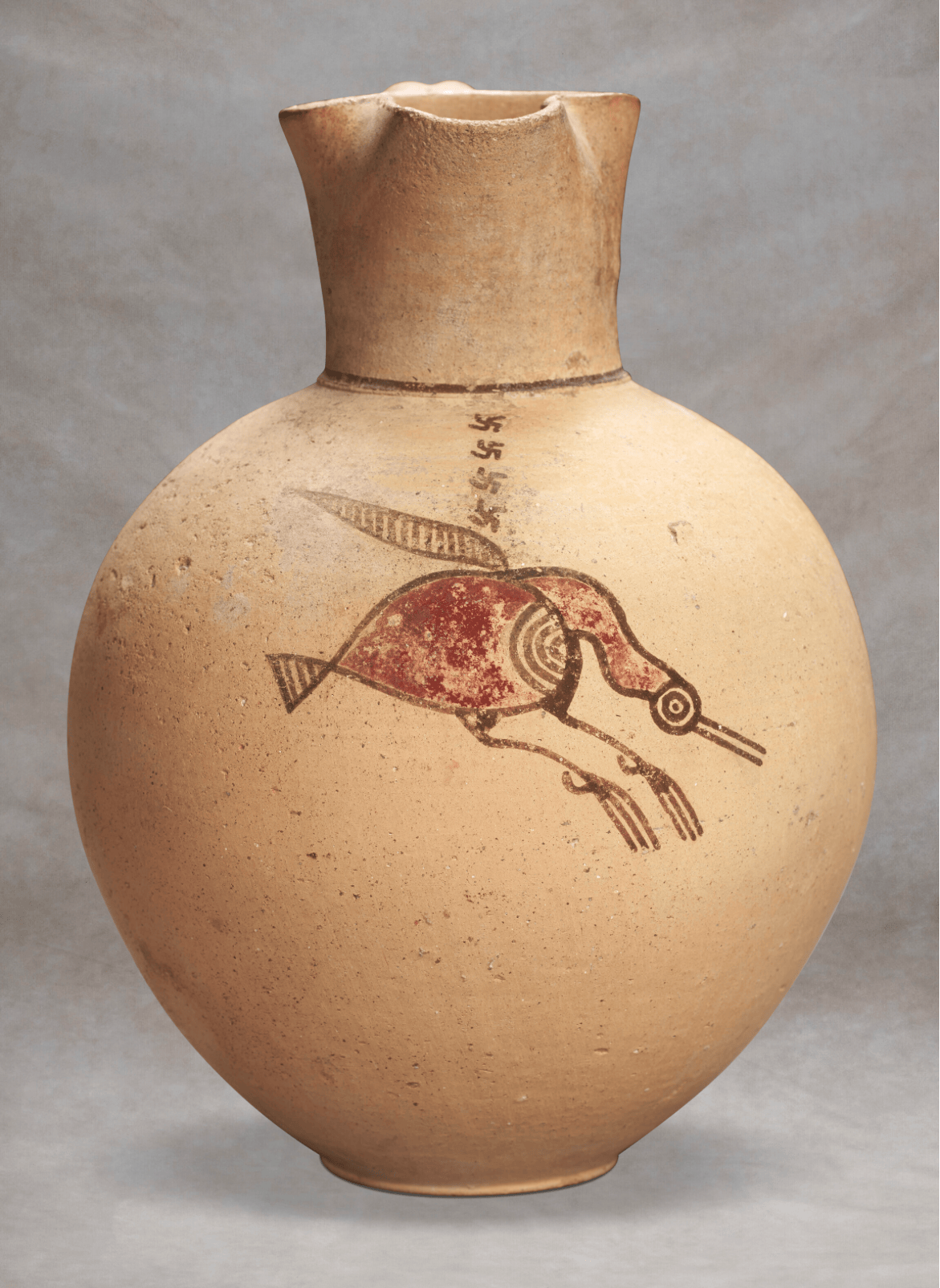
Bichrome Oinochoe
Archaic I
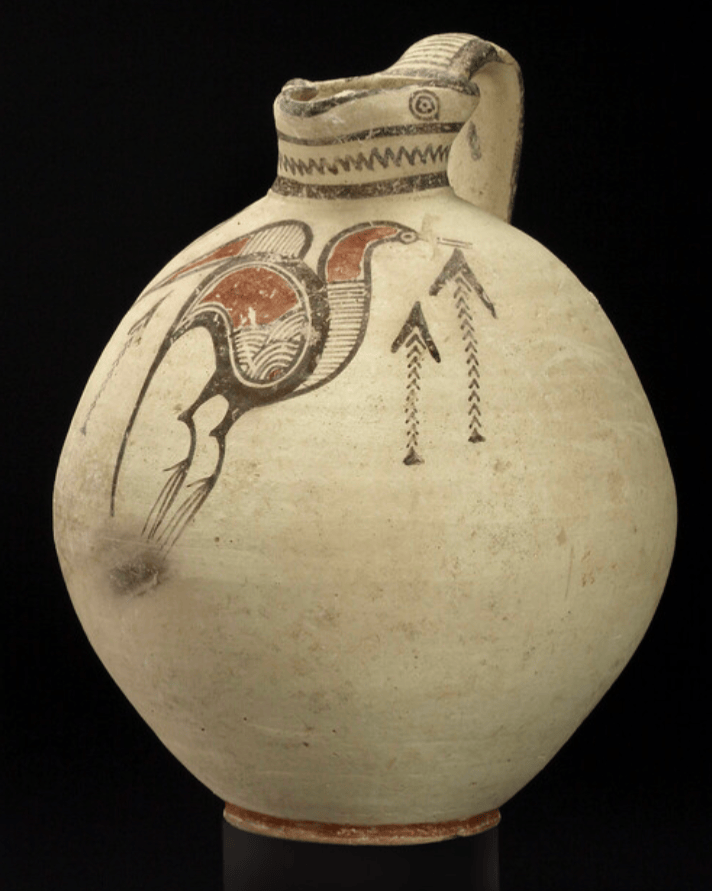
Free-field bichrome jug with image of an Ibis bird and reeds
Archaic
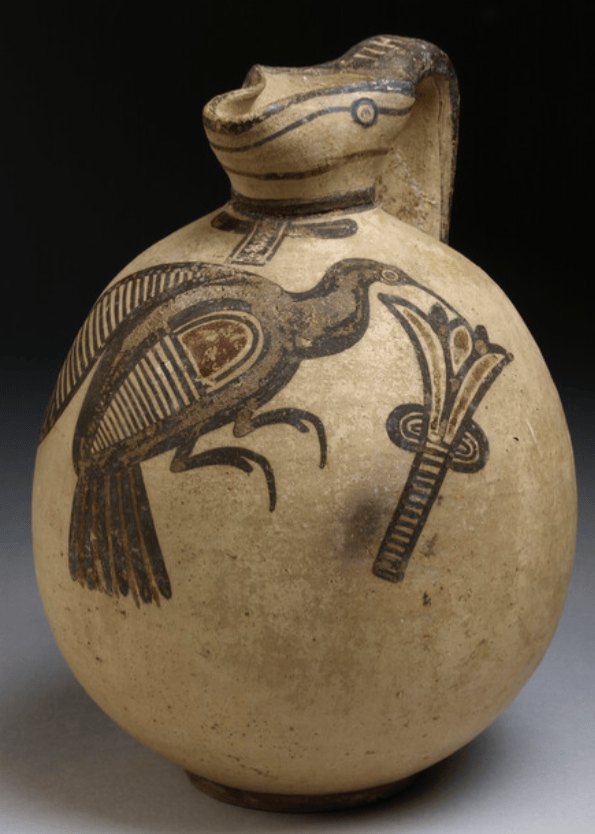
Squat bichrome jug in free-field style with image of bird picking a lotus flower
Archaic
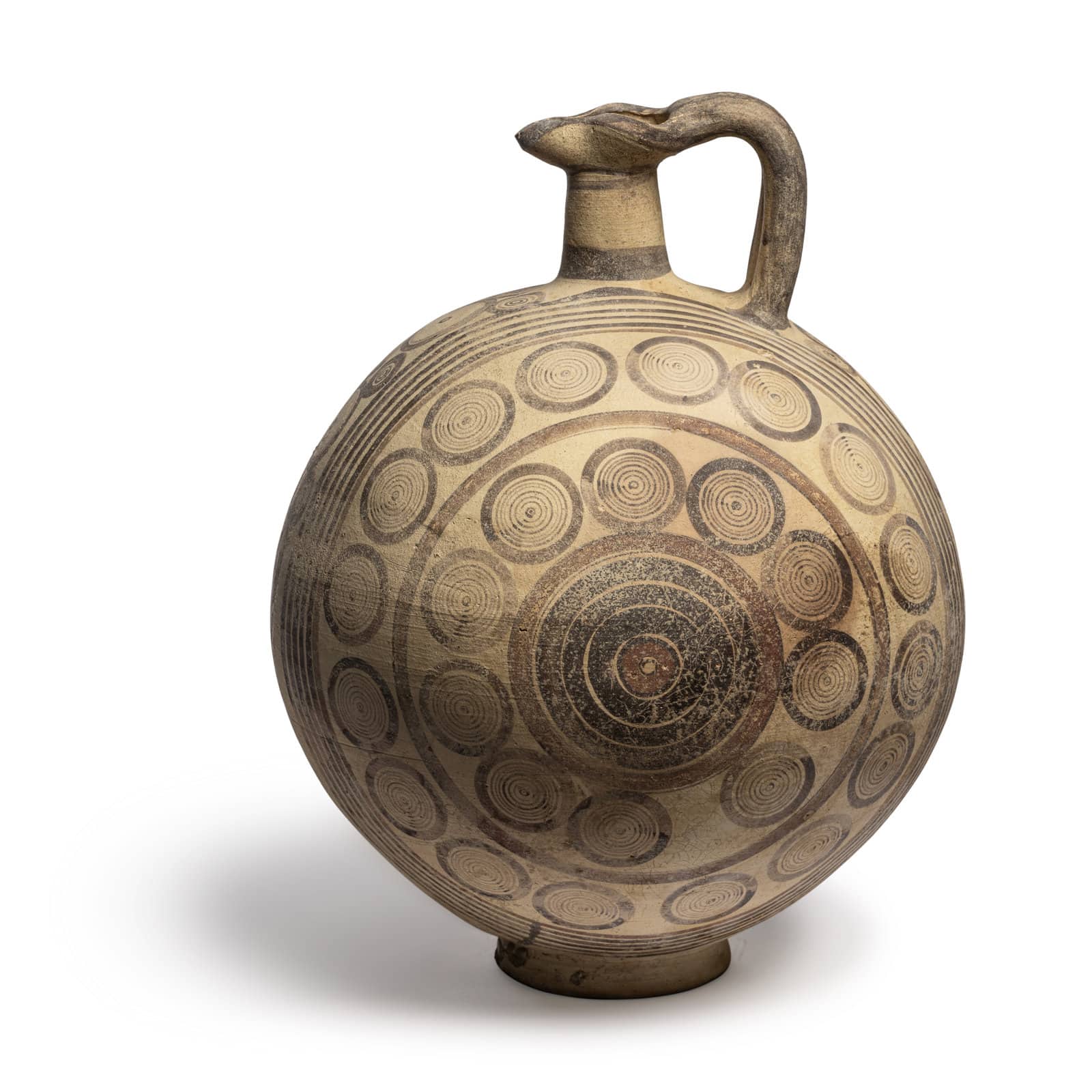
A Cypriot Bichrome-Ware Oinochoe Jug
Archaic I
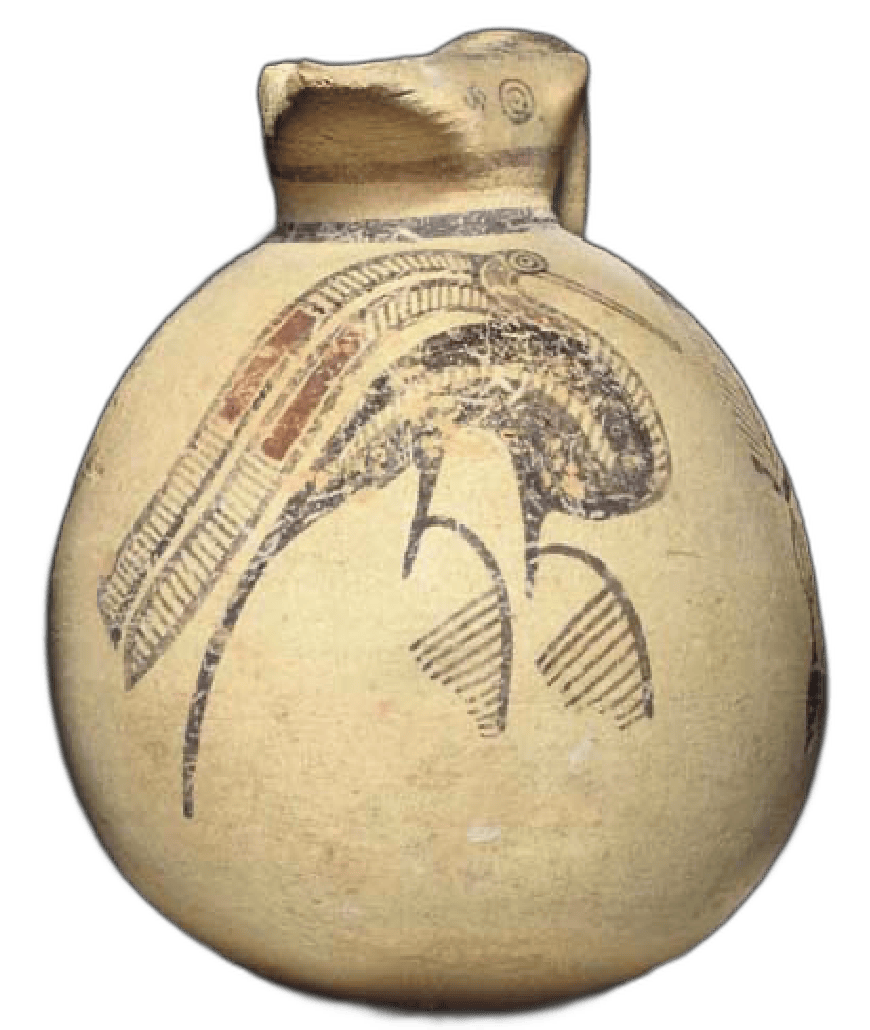
Oinochoe with Free Field Bird
Archaic I
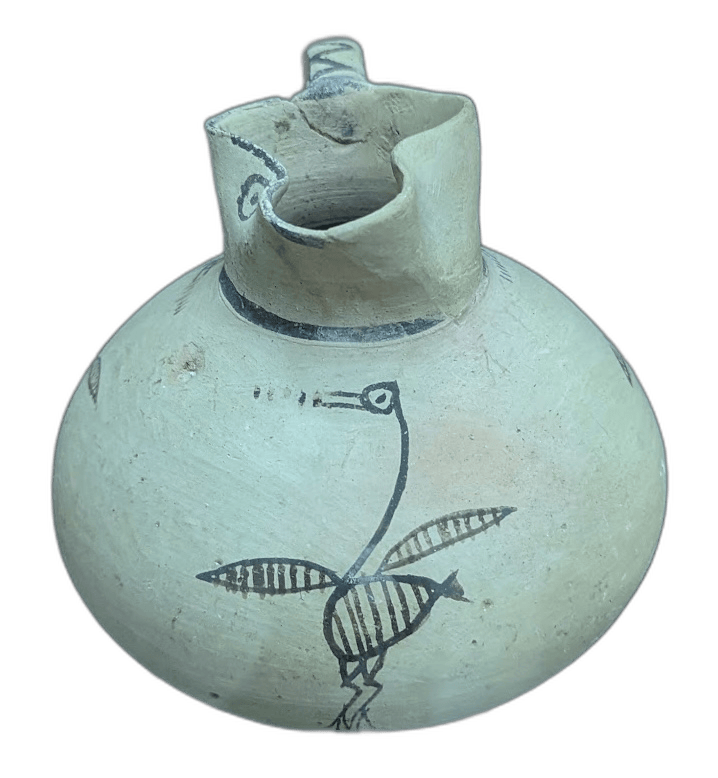
Small Oinochoe with Free Field Bird
Archaic I
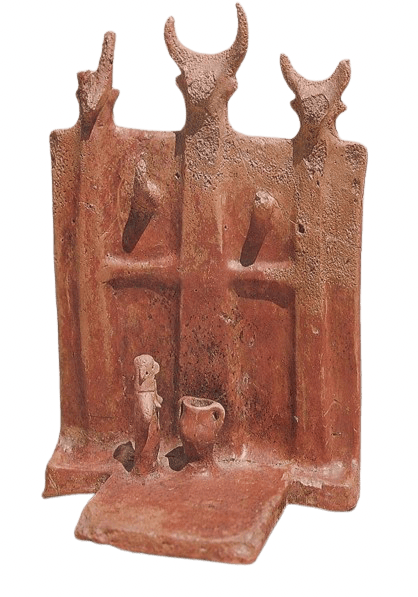
Red Polished Shrine
Middle Bronze Age I
Black-On-Red Geometric Jug Sherd
Geometric II
Bichrome Jug
Geometric
Bichrome Juglet
Geometric
Bichrome Oinochoe
Geometric
Juglet
Archaic II
Oinochoe
Geometric III
Jug
Archaic I
Juglet
Archaic I
Jug
Geometric I
Terracotta jug
Early Bronze Age I
Juglet
Geometric I