Excavator for the University Museum, Philadelphia, at Kourion from 1934, who dug the Bamboula settlement, wrote on the Cypro-Minoan script and died in Turkey in 1948.
Key factsBorn 1910; died 17 December 1948, Turkey (reconnaissance trip)ShowHide
John Franklin Daniel excavated at Kourion for the University Museum in Philadelphia from 1934, and the Bamboula site, where he supervised the work, was the source of the material discussed in his 1941 study of the Cypro-Minoan script10,25,38. Between his first season and his last he served in the O.S.S. during the war, and became curator of the Mediterranean Section of the University Museum and editor-in-chief of the American Journal of Archaeology25. He died in Turkey in December 1948, aged 38, on a reconnaissance trip that followed a final campaign at Bamboula2,25.
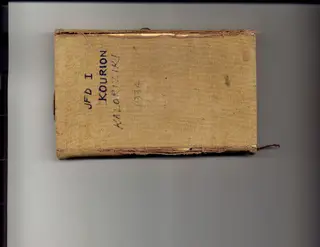
Daniel was born in Ann Arbor, Michigan, on 8 June 191017,25. He received his early education in California and abroad, studied in France and, for a semester each, at the universities of Freiburg in 1928-29 and Munich in 1932-33, and took his A.B. at the University of California in 193225,29. In 1933-34 he was in Greece as a member of the American School at Athens25,28. He signed his first Kourion notebook "John Franklin Daniel Jr.", and the staff list that Bert Hodge Hill sent to the Director of Antiquities for approval in 1935 names him the same way, while the title of his obituary, as Despina Pilides cites it, calls him John Franklin Daniel III29,35,40.
Contents 5 chapters · 2,700 words · about 12 minutesShowHide
On 3 May 1934 a letter from Corinth told H. H. F. Jayne, Director of the University Museum, that the expedition had asked Daniel to be the third member of its staff and that he was joining George H. McFadden at Candia that day; Dikaios, it added, reported the permit for Curium in order28. In Daniel's own account the staff was Hill as director, with McFadden and Daniel each in charge of a section of the excavations10. Benjamin Costello IV writes that the project was technically under Hill's direction, while the actual excavation was carried out by McFadden, the expedition's financial backer, and his assistant Daniel5.
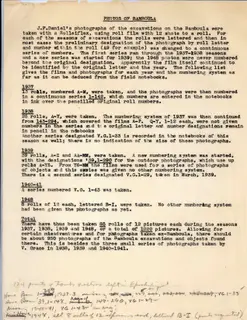
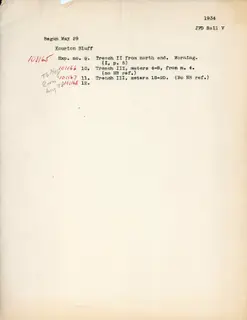
Daniel's first notebook runs from 28 May to 15 August 1934, and on 29 May he recorded in his field notebook a trench 24 m long and 1.5 m wide, oriented roughly north to south, known as Trench III5,35. Seeing no evidence of fire in the structure he found there, Daniel believed, in Costello's account, that an earthquake was most likely responsible for its destruction, and the position of the victims and the objects around them led him to conclude that they did not belong to a burial5.
Costello writes that Trench III was abandoned in favour of monumental structures such as the basilica, the theatre and the "palace", all of which could potentially provide objects for the University Museum5. He judges Daniel's recording imprecise: his plans were general, stylised rough sketches of the architecture, not drawn to scale5. On the city site, in Costello's account, Daniel discovered and excavated the theatre, the main basilica, the House of Achilles and the House of Eustolios, and the basilica, found by his first trial trench in 1934, had only been cleared to its eastern end when the work ceased5. T. B. Mitford's edition of the Kourion inscriptions records one mosaic inscription, which disintegrated, from Daniel's Field Book II and a photograph taken at the time of excavation4.
Daniel also dug tombs: a third notebook records tombs in the Mersinoudhia and Kaloriziki lots from 6 November to 3 December 193535. For that third season, November to December 1935, Miss Dorothy H. Cox joined as architect, and Daniel thanked her for "rendering presentable" his plans10. From March to July 1936 he dug at Tarsus with the Bryn Mawr expedition to Cilicia25.
In "Two Late Cypriote III Tombs from Kourion" (1937) he called the period Late Cypriote III, reserved "sub-Mycenaean" for pots that imitate the L.H. III style, and wrote that the "sub-Mycenaean" style was thoroughly established in Cyprus years before the fall of Mycenae10. As for a migration, he concluded that if one took place it came after the Late Cypriote III style was fully developed and was not vigorous enough to leave its mark on the pottery of the island10.
Chapter II4 minutes
Bamboula and the Cypro-Minoan script
His notebooks start on Bamboula on 1 March 1937, and the seventh covers the "third season", 13 March to 8 June 193935. By his own statement of 1941 the Bamboula work, part of the University Museum's excavations at Kourion under Hill, was supervised by Daniel, and by then five main sections of the settlement had been cleared and thirty-seven tombs excavated38. Saul S. Weinberg wrote in 1952 that the excavations on the Bamboula ridge had uncovered for the first time considerable remains of a Cypriote settlement of the Late Bronze Age, and called the site the clearest picture yet available of Cypriote town life in the last half of the second millennium BC48.
Daniel had first suggested reading the bisyllabic word on the rims of the inscribed pithoi from Kourion as Kuri, an early form of the name of the city, but it was difficult, he wrote later, to explain why the city's name should be inscribed on ordinary storage ware in private houses46. The jars were sunk into the ground with their necks two or three inches above the floor, and were used for storage, probably of oil46.
In a note in the American Journal of Archaeology in 1939 he read the word instead as a second aorist imperative of a verb meaning "to cover quite up", common in Homer: "Put the cover on!"46,47. That reading took away the early evidence for the city's name, but, he wrote, "if this new reading is correct we know that Greek was spoken in Cyprus before the Trojan war"47. The British Museum's record of the krater known as the "Window Crater" says that Daniel found around 35 further pieces of it at Bamboula in 1939, in Tombs 17 and 17A; the fragments from both excavations were brought together in a single restoration in 1955, and the British Museum's pieces were lent to the Cyprus Museum in August 196927.
A. Leriou and G. Vavouranakis say that his preliminary reports on Bamboula, with drawings drafted by Daniel himself, anticipate the mostly post-war tradition of detailed description of architecture and artefacts, and that in the most detailed of them, in 1938, he attempted to reconstruct the history of the Kourion region from a synthesis of the expedition's finds8. An expedition report of 1949-51 gives Daniel's view that after the fall of Mycenae some refugees settled in the Bronze Age settlement near Curium and others on the bluff34.
In "Social Continuities in Cyprus" (1943) he wrote that while excavating the remains of a city inhabited from 1600 till about 1000 BC he was frequently struck by resemblances in detail between it and the nearby village43. The workmen told him that a white clay he had found was still used to waterproof earth roofs, and pointed out the only bed in the neighbourhood where it was obtained43. He saw every reason to believe in a direct continuity in the ethnic and cultural traditions of the village, and thought the excavator might hope to explain some of his archaeological mysteries from the conditions of the present day43.
He signed his review of S. Casson's Ancient Cyprus in the American Journal of Archaeology of 1939 from Kourion; the book, he wrote, seemed to have a secondary purpose, "to praise Myres and to defame the members of the Swedish Cyprus Expedition", and Casson had breached archaeological etiquette by using without permission material to which others had publication rights12. R. S. Merrillees later called the review withering41.
His review of 1942 of E. Sjöqvist's Problems of the Late Cypriote Bronze Age is, for Merrillees, "masterly"41. He argued that burial customs did not change at Kourion, where no shaft graves had been found, and found Sjöqvist's arguments for the Achaean leadership of the invaders "most unsatisfactory"13. Merrillees quotes his view that Kourion "was not touched by the invasion" and that the Mycenaean tradition there survived the L.C. IIIA period41.
On 1 May 1941 Daniel wrote to McFadden that his final examination for the Ph.D. was less than a month away and that his dissertation, "Prolegomena to the Cypro-Minoan Script", was in press in the A.J.A.45. He had given up his original plan of using the full Bamboula publication, because the University demanded 150 free copies, "which would be financially prohibitive"45. The University of Pennsylvania, which had twice given him its Harrison Fellowship, awarded him the Ph.D. that year25. The Prolegomena added eighty-six new inscriptions found at Kourion by the University Museum's expedition, for a total of one hundred and eighty-five; as recently as 1935, he noted, Evans's list of Cypro-Minoan signs had contained only sixteen38.
When Dikaios showed him a handle in the Cyprus Museum, Daniel could not see writing on it: the incisions, an irregular running zigzag, seemed to him purely decorative38. He concluded that his Classes I and II were two totally distinct scripts, both dependent on the Minoan, and that Class II should not be called Cypro-Minoan38. Sterling Dow wrote in 1954 that the dissertation had contributed more to the Cypro-Minoan script than any work in decades, and that in method and finish it was superior to any37. For Nicolle Hirschfeld it established a sober methodology for progress in analysis and decipherment: Daniel advocated considering an inscription within the context of its medium, and Hirschfeld faults Masson's tables of signs for ignoring "Daniel's precepts"42.
Chapter III1 minute
War service
In 1940 Daniel was named Assistant Curator of the Mediterranean Section of the University Museum, and in the same year he married Ellen Alix Du Poy25. In the letter of May 1941 he had written that he often thought of McFadden in Episkopi and wished he were there: "I only know that I will go on the first opportunity"45.
He was given leave for war service in 1942, entered the O.S.S. in Washington in July and was commissioned a Captain, A.U.S., in August25. In March 1943, the obituary says, he was sent overseas and became "Commanding Officer, U.S.A., in Cyprus"25. That year he signed a review of A. Furumark's two books on Mycenaean pottery "Army of the United States, Near East", crediting Furumark with organising an unwieldy mass of important material44. He rose to Major in 1944 and to Lieutenant Colonel in 194525.
The sources disagree on where he served at the end of the war30,40. Pilides says that he was sent to Cyprus and served there until 194640. The expedition's papers place him in Greece: a memorandum of 9 January 1946 says that Daniel was then doing intelligence work in Greece, and a letter of 5 March 1946 on the letterhead of the Department of Antiquities says that its writer had not seen him for about 18 months, but that he had written lately that he was still in Florina30. In January McFadden had written that Daniel should return to Cyprus to complete the work he had begun there and to make a division of the finds from his own site with the British Government30.
Chapter IV2 minutes
Curator and editor
On his return to America in 1946 Daniel was appointed Curator of the Mediterranean Section of the University Museum, and in June of that year he became editor-in-chief of the American Journal of Archaeology25. A. A. Donohue, in a history of the journal, calls the new editor, a specialist in Mycenaean and Cypriot archaeology, "immensely energetic and full of ideas"39. His first business was to find a press, and Banta was selected; partly in response to the disruption of European journals during and after the war, he started a section of "Archaeological News"39. He held that the journal had an obligation to publish the work of Americans, and Donohue counts as his most striking accomplishment the special number of 310 pages devoted to Homer in 194839.
In July 1946 Percy C. Madeira Jr. wrote to McFadden that Daniel would like to be present at the division with the Cyprus authorities of the antiquities excavated under his charge, though for many reasons he was not likely to be able to return to Cyprus for another year30. The division was made acting on his memorandum, and on 11 June 1947 a letter from Curium Excavations, Episkopi, reported that the Director of Antiquities had received a cable from Daniel "expressing dissatisfaction with the division of finds"31.
On 8 March 1948 Daniel sought approval for a gift of three vases from the University Museum to the Cyprus Museum, among them an Early Minoan II bowl from Vasiliki in Crete33. They were to be partial recompense for the award to the Museum of a very important vase from tomb 39 at Kourion, which the Cyprus government had originally retained as "essential for the scientific complement of the Cyprus Museum" until negotiations were undertaken to have the allocation revised33.
In 1948 he was named Professor of Classical Archaeology at the University of Pennsylvania, and the obituary counts his organisation of a Department of Archaeology there among his latest achievements25. Accounts differ on a centre for the study of Minoan writing at the University of Pennsylvania37,50. A history of the Program in Aegean Scripts and Prehistory at Austin says that in the late 1940s Alice Elizabeth Kober and Daniel succeeded briefly in setting one up50. Dow wrote that the attempt to create the centre in the University Museum had no great success, and that Kober was not appointed37.
Chapter V2 minutes
The fourth season at Bamboula
Daniel sailed for Greece, Cyprus and Turkey on 10 September 194825. That autumn, in Hill's absence, he directed the University Museum's excavations at Curium, and according to a report sent by De Coursey Fales Jr. in March 1949 he had two principal objectives: to finish his site of Bamboula, and to hand over to Fales the excavation of the "Palace", on which he had worked before the war32. He worked at Bamboula from 21 October to 23 November, with Christo Gregoriou as foreman and about twenty men under him, and his ninth and last notebook calls it the fourth Bamboula season32,35. There were few small finds; a well was discovered under a later wall, and the most striking find was a Mycenaean stairway made of clay32.
His last conclusion, Fales's report says, was that the houses of the Geometric and Archaic periods spread out eastward from the Late Bronze Age site32. Published accounts disagree on the Bamboula seasons: Pilides, citing the obituary, gives 1937 to 1939, while Weinberg wrote that the site was dug from 1937 to 1939 "and again in 1948", the season the last notebook records35,40,48. The obituary says that he considered excavation his particular forte, and that his letters were filled with the joy of excavation and with reports of exciting new discoveries25.
From Cyprus he went on to Turkey with Rodney Young25. According to the obituary, he was on a reconnaissance trip for the University Museum to select a site for excavation when he fell ill near Antalya, became unconscious almost immediately and never regained consciousness; death was apparently due to heart failure25. He died on 17 December 1948, aged 38, having expected to return to his posts at the Museum and University by 1 February 194925.
He was buried on 22 December at Episkopi, which the Colonial Report for 1948 calls the Expedition's headquarters in Cyprus25,26. Thomas W. Davis writes that the villagers repaid their debt to the excavation by permitting Daniel to be buried in the Episkopi churchyard49. He was survived by his wife, his mother, a brother and two sisters25.
J. L. Benson writes that a career of brilliant promise was cut short, and that Daniel's work was not taken up again until the summer of 1951, when S. S. Weinberg went to Cyprus with a grant from the American Philosophical Society2. Benson's own chief task in Cyprus was the inventorying and study of the material, especially the voluminous quantity of sherds, excavated by Daniel, while Edith Porada had already made a preliminary study of the Kourion seals during Daniel's lifetime2.
Merrillees wrote that Daniel's premature death robbed Cypriote archaeology of its brightest American student and one of the most outstanding scholars ever to have worked in the island41. Mitford dedicated The Inscriptions of Kourion (1971) to his memory, and Dow inscribed his "Minoan Writing" of 1954 to it4,36. Benson's Bamboula at Kourion: The Necropolis and the Finds (1972) is also dedicated to him2, a separate volume covered the necropolis at Kaloriziki, and the finds themselves were divided among Curium House, the Cyprus Museum and the University Museum2.
Life and work
216 events, 1895–2004
1895
Explored the Kaloriziki cemetery (with Dikaios) and Bamboula at Kourion in the 1930s–40s, more scientifically than Walters's 1895 BM dig.
In the Kourion expedition papers of 1935: «John Franklin Daniel, Jr., A.B.; University of California, 1932; student at the University of Freiburg, 1928-29, and Munich, 1932-33»
In the Kourion expedition papers of 1934: «we have asked Mr. J. Franklin Daniel,University of California 1932,and at present member of the American School at Athens.»
In the Kourion expedition papers of 1935: «John Franklin Daniel, Jr., A.B., University of California; 1932; student at the University, 1932-33, one semester each»
Began work at Kourion for the University Museum expedition, which Costello says was technically under the direction of Bert Hodge Hill, with George McFadden as chief excavator and financial backer and Daniel as his assistant. First trial trench found the main basilica; Trench III uncovered the first Earthquake House victims (House 1, Room 1).
Seasons at Kourion (Episkopi) with McFadden; Daniel concentrated on the city site: theatre, main basilica, House of Achilles, House of Eustolios (which he first called 'The Palace'); McFadden mainly at the Apollo sanctuary; ancillary work at the stadium and cemeteries. Field expeditions ran 1934-1954 except 1942-46.
Found an inscribed altar (Trench VIII, 1934) and an inscription (12 Dec 1935) in the Baths of Eustolios, and copied a mosaic inscription in the Annex of Eustolios (21 March 1935) alongside B. H. Hill's notebook copy; Mitford edited them in The Inscriptions of Kourion from Daniel's Field Books.
McFadden's assistant: dug Kourion's city site (theatre, basilica, House of Achilles, House of Eustolios) and in 1934 Trench III, the first Earthquake House victims.
Excavated the Kourion Palace/Eustolios complex for the University of Pennsylvania Museum in the 1930s; also excavated 'Romeo and Juliet' skeletons in 1934.
In the Kourion expedition papers of 1934: «Athens, August 1 1934. Dear Pete: This is in very tardy and incomplete continuation of my letter of July 18.»
In the Kourion field records of 1935: «British archeologists, Dr. Hill, Mr. Daniel and Mr MacFadden, have discovered the ruins of a magnificent palace with fine mosaic and other buildings»
In the Kourion expedition papers of 1935: «British archeologists, Dr. Hill, Mr. Daniel and Mr MacFadden, have discovered the ruins of a magnificent palace»
Published 'Two Late Cypriote III Tombs from Kourion' (AJA 41, 56-85) on Kaloriziki tombs 25 and 26A (and, per McFadden 1954, Kaloriziki 26A:17 etc.); and the first Bamboula notice in University Museum Bulletin 7(1), 15-18.
Spring 1937: continued excavation of Kourion city, opened a large area in the precinct of Apollo Hylates, and investigated the Late Bronze Age settlement on the north and east slopes of Bamboula (ten trial trenches, then fortification wall and two groups of houses, LC II-III; Cypro-Minoan signs recorded). Tombs opened there earlier by the BM (Walters, 1895) are visible on the west slopes.
In the Kourion expedition papers of 1937: «If Daniel wants to have a try for next year, it would be well, they tell me, for him to make application now. I can, however, pay him, as earlier arranged, fifty dollars a month for any period up to ten months»
Published 'Excavations at Kourion: The Late Bronze Age Settlement - Provisional Report', AJA 42(2), 261-275, with architecture and stratified LC III sequence, and an argument for the date of the Greek foundation of Kourion from sub-Mycenaean pottery.
In the Kourion expedition papers of 1938: «tombs excavated by J.F.Daniel under the auspices of the Curium Excavations of the University Museum, Philadelphia, during the years 1938-1939»
In the Kourion expedition papers of 1939: «I have heard nothing from Pete, and so suppose that he has held to his original plan and returned to Cyprus via Alexandria»
In the Kourion expedition papers of 1940: «the problem of John Daniel for next year. As you know his fellowship is not renewable, so that if we can do nothing for him he will have to seek elsewhere for support.»
On leave from the University for war service; entered the OSS and was sent to Cyprus, where he served until 1946. On his return he was appointed professor of classical archaeology and editor-in-chief of the American Journal of Archaeology (the source's own account).
Reviewed Sjöqvist's Problems of the Late Cypriote Bronze Age in AJA, observing that the migrations affected eastern Cyprus but probably not the whole island.
In the Kourion expedition papers of 1945: «Daniel reported finding in addition to the sherds one fragment of a black glaze lamp and two fragments of Roman lamps»
In the Kourion field records of 1946: «Mr. Daniel tells me that he will probably not want all of the material coming from our share of the Geometric tombs.»
In the Kourion expedition papers of 1946: «Mr. Daniel tells me that he will probably not want all of the material coming from our share of the Geometric tombs.»
In the Kourion expedition papers of 1946: «As you know, Mr. Daniel has offered to publish my paper on the necropolis in the American Journal of Archeology.»
In the Kourion expedition papers of 1946: «Dr. Daniel is run ragged with his work on the Archaeological Journal and setting up a special exhibition on the spread of Greek Culture»
In the Kourion expedition papers of 1946: «Thank you for your news of Dr. Daniel. It is great to hear that the Classical Section is to be opened up again.»
In the Kourion expedition papers of 1946: «Mr. Daniel agreed with your view that he would like to be present at the division with the Cyprus authorities»
In the Kourion expedition papers of 1946: «Dr. Daniel should return to Cyprus before coming home, unless he wished to do so, and have his wife join him out there; as this has before this might not be advisable or even possible now. I feel sure, however, he will want to return to Cyprus eventually.»
archaeologist who observed the earthquake effects at Curium (Ourlum); scholar cited (Prolegomena, AJA) in Claude Schaeffer's papers (Collège de France), 7 documents, 1946–1951.
Last (terminal) Bamboula campaign, finished just before he died; the material was not analysed. His death on a reconnaissance trip in Turkey in 1948; Episkopi villagers allowed him to be buried in the Episkopi churchyard.
In the Kourion expedition papers of 1947: «as a stipent to Mr. Daniel to make possible his continuing h is association with the Museum as Assistant Curator»
In the Kourion expedition papers of 1947: «My thought was that Mr. Daniel might be interested in implimenting this phase, if additional funds could be raised»
In the Kourion expedition papers of 1947: «Dr. Daniel has sent me a copy of his letter of June 4th to the Director of Antiquities in Cyprus regarding the recent division of finds.»
In the Kourion expedition papers of 1947: «it is likely that upon the return of the excavator, Dr. Daniel, they will be found and can be turned over to you»
In a letter of 1947: «I have drawn up and attached hereto a series of proposed regulations which I consider desirable for the regulation of the relations of the museum with its field expeditions»
In the Kourion expedition papers of 1947: «I am discussing the question of final publication with Dr. Daniel who, I understand, is in touch with you in this regard.»
In the Kourion expedition papers of 1947: «Pete Daniel, a colonel in OSS with a distinguished record, died suddenly in Turkey while prospecting for a new site there in 1947.»
In the Kourion expedition papers of 1947: «I have had a recent discussion with Dr. Daniel. In his letter to the Director of Antiquities in Cyprus he writes, "By criteria of aesthetic and scholarly interest, the share I allotted to us is considerably less than half"»
scholar cited (AJA XLV); author of provisional report on Kourion/Kouklia Late Bronze Age settlement, cited in notes in Claude Schaeffer's papers (Collège de France), 2 documents, 1947–1949.
American archaeologist who published important research on the Cypro-Minoan script in the early 1940s; he was taken to Cyprus and buried at Episcopi after dying in 1948.
In the Kourion expedition papers of 1948: «Dr. Daniel, who would conduct the survey will then have an opportunity to complete certain sections of the site at Kourion during the same period.»
In the Kourion expedition papers of 1948: «this was money paid out by Pete Daniel in October 1948 for the transport of deC. Fales from Athens to Cyprus»
In the Kourion expedition papers of 1948: «Exact figures were often not obtainable for differentiation of plain wares, as much of this category was discarded by Daniel in the field»
In the Kourion expedition papers of 1949: «the excavations of the University Museum at Curium were, in the absence of Mr. Hill, directed by John F. Daniel.»
In the Kourion expedition papers of 1949: «all the personal effects of my husband, John Franklin Daniel, were left in your charge by Mr. Edwards and Mr. Young»
In the Kourion expedition papers of 1949: «Mr. Daniel's other personal effects would be sent down here as soon as the rest of his clothes arrived from Turkey»
In the Kourion expedition papers of 1949: «This is the surface as left by Daniel. It is obvious from stones on top of soil along west wall that he has cut one floor level.»
Posthumous publication of his Kourion work: Weinberg studied the Bamboula architecture in 1951; G. R. Edwards and J. L. Benson went to Cyprus in 1953-54 to settle McFadden's affairs and inventory Daniel's finds; Benson published Bamboula at Kourion: The Necropolis and the Finds (1972) and The Necropolis of Kaloriziki (1973). Finds were divided among Curium House, the Cyprus Museum and the University Museum.
In the Kourion expedition papers of 1952: «On this bench we found pottery of the same period as Pete Daniel's most prized tomb, and of the finest in quality. It was the tomb which Pete hoped very much the Department would let us have»
In the Kourion field records of 1955: «In excavating the Late Bronze Age site of Bamboula, J.F.Daniel brought to light six sherds, examples of the practice of impressing pottery with cylinder seals»
In the Kourion expedition papers of 1955: «In excavating the Late Bronze Age site of Bamboula, in Episkopi Cyprus, J.F.Daniel brought to light six sherds»
In the Kourion expedition papers of 1956: «I have kept to Daniel's arrangement and ideas throughout Areas A-D, altering only where it was really necessary»
In the Kourion expedition papers of 1982: «Are they Pete Daniel's notebooks? Or Fales? In the case of Pete's the problem has been, although his records are excellent, that he wrote in light blue ink»
Named in the BCH Chronique des fouilles à Chypre: Earlier excavated two walls at the summit of the hill above the Koursi river.; Earlier excavator whose finds at the Episkopi site are compared with the 2004 results.
Said in the recorded talk «Babbling Pots» (Archaeological Research Unit - University of Cyprus, 2024-03-29): Published a 1941 article on Cypro-Minoan prolegomena arguing that isolated marks must be distinguished from writing.
In the Kourion field records: «In Area D - the closest to Tomb 4 - excavated by Daniel, sherds of Greek black glaze (of all periods) constituted a little under 1% of the total of topsoil sherds.»
In the Kourion expedition papers: «John F. Daniel stated that in his part of the building, he found no coins later than the reigns of Honorius and Arcadius.»
In the Kourion expedition papers: «Daniel also investigated the two towers of the late wall in order to trace the course of the LC wall where not visible under the later»
In the Kourion field records: «Daniel originally classified the following pieces as Minoan, and apparently got some encouragement in this from Hutchinson.»
In the Kourion expedition papers: «That part of this building which adjoins the theater was excavated before the War by the late Professor John Franklin Daniel of the Expedition staff.»
Named in the «Archaeology in Cyprus» survey (JHS / Archaeological Reports): Late excavations at the Late Cypriote settlement of Bamboula, Kourion: «is a forerunner of the final publication of the late Daniel's excavations at the Late Cypriote settlement of Bamboula»; Directed the excavations at the Late Cypriote settlement of Bamboula, Kourion; final publication pending: «the final publication of the late Daniel's excavations at the Late Cypriote settlement of Bamboula»
Material published by Edith PoradaEdith Porada published nine cylinder seals found at Bamboula, at Daniel's suggestion, in an earlier article. Benson 1972, p. 141
Kourion expedition begins: Hill titular director, McFadden financial backer and field excavator, J. F. Daniel his assistant; aim to trace the city's history…
Kourion expedition papers, 15 August 1934: «Limassol District. Public Works Department. [...] Received into Store the following Articles returned from works…
Kourion Expedition records (PU-Mu 1050), Box 1, folder 3, p. 75
23.B. Janeway (2017). Sea Peoples of the Northern Levant? Aegean-Style Pottery from Early Iron Age Tell Tayinat. p. 82.
24.T. Kiely, A. Reeve, L. Crewe (eds) (2025). Empire & Excavation: Critical perspectives on archaeology in British-period Cyprus, 1878-1960. p. 438.
25.M. H. S. [M. H. Swindler] (1948). “John Franklin Daniel 1910-1948”. American Journal of Archaeology 52. Archaeological Institute of America.
26.Colonial Office (1948). “Annual Report on Cyprus for the year 1948”. Colonial Office Annual Reports. HMSO.
27.British Museum. “Krater (the 'Window Crater'), registration 1896,0201.26”. British Museum Collection Online. Online
28.University Museum Kourion Expedition (1934). “Kourion Expedition records, correspondence December 1933–June 1934”. Penn Museum Archives, Kourion Expedition records (PU-Mu 1050), Box 1, folder 2. Penn Museum Archives, Philadelphia. Online
29.University Museum Kourion Expedition (1935). “Kourion Expedition records, correspondence January–July 1935”. Penn Museum Archives, Kourion Expedition records (PU-Mu 1050), Box 1, folder 4. Penn Museum Archives, Philadelphia. Online
30.University Museum Kourion Expedition (1946). “Kourion Expedition records, correspondence 1946”. Penn Museum Archives, Kourion Expedition records (PU-Mu 1050), Box 1, folder 13. Penn Museum Archives, Philadelphia. Online
31.University Museum Kourion Expedition (1947). “Kourion Expedition records, correspondence July–December 1947”. Penn Museum Archives, Kourion Expedition records (PU-Mu 1050), Box 1, folder 15. Penn Museum Archives, Philadelphia. Online
32.University Museum Kourion Expedition (1949). “Kourion Expedition records, correspondence 1949”. Penn Museum Archives, Kourion Expedition records (PU-Mu 1050), Box 2, folder 1. Penn Museum Archives, Philadelphia. Online
33.University Museum Kourion Expedition (1948). “Kourion Expedition records, correspondence 1948”. Penn Museum Archives, Kourion Expedition records (PU-Mu 1050), Box 1, folder 16. Penn Museum Archives, Philadelphia. Online
34.University Museum Kourion Expedition (1949). “Excavation Reports 1949–1951”. Penn Museum Archives, Kourion Expedition records (PU-Mu 1050), Box 4, folder 7. Penn Museum Archives, Philadelphia. Online
35.J. F. Daniel. “Field notebooks, Kourion, Books I-IX (1934-1948)”. Penn Museum Archives, Kourion Expedition records (PU-Mu 1050), Box 6, folders 2-10. Penn Museum Archives, Philadelphia. Online
36.Sterling Dow (1954). “Minoan Writing”. American Journal of Archaeology 58(2). Archaeological Institute of America.
37.Sterling Dow (1954). “Necrology: Alice Elizabeth Kober”. American Journal of Archaeology 58(2). Archaeological Institute of America.
38.John Franklin Daniel (1941). “Prolegomena to the Cypro-Minoan Script”. American Journal of Archaeology 45, 249-282. Archaeological Institute of America.
39.A. A. Donohue (1985). “One Hundred Years of the American Journal of Archaeology: An Archival History”. American Journal of Archaeology 89(1), 3-30. Archaeological Institute of America. Online
40.Despina Pilides (2008). “"Welcome, Sir, to Cyprus": The Local Reaction to American Archaeological Research”. Near Eastern Archaeology 71(1/2), 6-15. American Schools of Oriental Research. Online
41.R. S. Merrillees (1975). “Problems in Cypriote History”. N. Robertson (ed.), The Archaeology of Cyprus: Recent Developments, 15-38. Noyes Press.
42.Nicolle Hirschfeld (2010). “Cypro-Minoan”. E. H. Cline (ed.), The Oxford Handbook of the Bronze Age Aegean, chapter 28. Oxford University Press.
43.John Franklin Daniel (1943). “Social Continuities in Cyprus”. The Scientific Monthly 56, 78-80. American Association for the Advancement of Science.
44.John Franklin Daniel (1943). “Review of A. Furumark, The Mycenaean Pottery: Analysis and Classification, and The Chronology of Mycenaean Pottery”. American Journal of Archaeology 47(2). Archaeological Institute of America.
45.University Museum Kourion Expedition (1941). “Kourion Expedition records, correspondence 1941-1945”. Penn Museum Archives, Kourion Expedition records (PU-Mu 1050), Box 1, folder 12. Penn Museum Archives, Philadelphia. Online
46.University Museum Kourion Expedition (1938). “Kourion Expedition records, 1938 (including J. F. Daniel's typescript 'The Kourion Inscribed Pithoi', revised version)”. Penn Museum Archives, Kourion Expedition records (PU-Mu 1050), Box 1, folder 9. Penn Museum Archives, Philadelphia. Online
47.John Franklin Daniel (1939). “The Inscribed Pithoi from Kourion”. American Journal of Archaeology 43(1), 102-103. Archaeological Institute of America.
48.Saul S. Weinberg (1952). “Kourion-Bamboula: The Late Bronze Age Architecture (abstract of a paper at the AIA General Meeting)”. American Journal of Archaeology 56(3). Archaeological Institute of America.
50.Program in Aegean Scripts and Prehistory (PASP), University of Texas at Austin. Unlocking the Secrets of Ancient Writing (PASP brochure, 'A Brief History of the Program in Aegean Scripts and Prehistory'). University of Texas at Austin.
56.Jane C. Biers (ed.), David Soren (ed.) (1981). Studies in Cypriote Archaeology. Los Angeles, Institute of Archaeology, University of California, Los Angeles.
81.Leriou & Vavouranakis 2025, 'Communicating archaeology in British-period Cyprus: from Ohnefalsch-Richter to Dikaios', in Kiely, Reeve & Crewe (eds), Empire & Excavation–26.
82.Colonial Office, Annual Report on Cyprus for 1948.
83.Costello 2014, Earthquake House at Kourion (BAR 2635), pp. 17–21, 23–24–33).
84.Penn Museum (University of Pennsylvania Museum of Archaeology and Anthropology), film collection, F16-0716, «Kourion», Kourion Collection, 35 min, shot list on the Internet Archive, (no timecodes in the shot list).
85.Pavlos Flourentzos, «Chronique des fouilles et découvertes archéologiques à Chypre en 2003 et 2004», Bulletin de correspondance hellénique 128 (2004).
86.C. Spyridakis; G. Tenekides; Criton G. Tornaritis; K. TALARIDES; Tornaritis; Elias Ypsarides; Stanley Casson, "Compendium of Authoritative Essays on the Cyprus Problem", Cyprus Today vol. 2, no. 3-4 (May–August 1964).
87.Nicolle Hirschfeld, «Babbling Pots», recorded keynote lecture, Marks, Marketing and Markets: Investigating the intersection of marking practices and commercial strategies in the Bronze Age and Early Iron Age Eastern Mediterranean, Archaeological Research Unit - University of Cyprus, published on YouTube 2024-03-29, at 0:21:59. Online
88.Margalit Fox (2013). The Riddle of the Labyrinth: The Quest to Crack an Ancient Code. p. 177..
89.Hans Hauben; Peter Van Nuffelen (2012). Studies on the Melitian Schism in Egypt (AD 306–335). p. 273..
90.Anon. (1939). Archaeology in Greece 1938–39. p. 209.. Online
91.Archaeological Institute of America (1952). Fifty-Third General Meeting of the Archaeological Institute of America (1951). In American Journal of Archaeology. pp. 171-178. Archaeological Institute of America. p. 178.. Online
92.Penn Museum Archives, Kourion Expedition records (PU-Mu 1050), Box 1, folder 2.
93.Penn Museum Archives, Kourion Expedition records (PU-Mu 1050), Box 24, folder 13.
94.Penn Museum Archives, Kourion Expedition records (PU-Mu 1050), Box 3, folder 12.
95.Penn Museum Archives, Kourion Expedition records (PU-Mu 1050), Box 3, folder 16.
96.Penn Museum Archives, Kourion Expedition records (PU-Mu 1050), Box 4, folder 15.
97.Penn Museum Archives, Kourion Expedition records (PU-Mu 1050), Box 4, folder 16.
98.Penn Museum Archives, Kourion Expedition records (PU-Mu 1050), Box 4, folder 17.
99.Penn Museum Archives, Kourion Expedition records (PU-Mu 1050), Box 4, folder 19.
100.Penn Museum Archives, Kourion Expedition records (PU-Mu 1050), Box 4, folder 23.
101.Penn Museum Archives, Kourion Expedition records (PU-Mu 1050), Box 4, folder 7.
102.Penn Museum Archives, Kourion Expedition records (PU-Mu 1050), Box 1, folder 3.
103.Penn Museum Archives, Kourion Expedition records (PU-Mu 1050), Box 1, folder 4.
104.Penn Museum Archives, Kourion Expedition records (PU-Mu 1050), Box 3, folder 1.
105.Penn Museum Archives, Kourion Expedition records (PU-Mu 1050), Box 1, folder 5.
106.Penn Museum Archives, Kourion Expedition records (PU-Mu 1050), Box 6, folder 3.
107.Penn Museum Archives, Kourion Expedition records (PU-Mu 1050), Box 1, folder 6.
108.Penn Museum Archives, Kourion Expedition records (PU-Mu 1050), Box 1, folder 8.
109.Penn Museum Archives, Kourion Expedition records (PU-Mu 1050), Box 1, folder 9.
110.Penn Museum Archives, Kourion Expedition records (PU-Mu 1050), Box 4, folder 12.
111.Penn Museum Archives, Kourion Expedition records (PU-Mu 1050), Box 4, folder 10.
112.Penn Museum Archives, Kourion Expedition records (PU-Mu 1050), Box 1, folder 10.
113.Penn Museum Archives, Kourion Expedition records (PU-Mu 1050), Box 6, folder 8.
114.Penn Museum Archives, Kourion Expedition records (PU-Mu 1050), Box 6, folder 9.
115.Penn Museum Archives, Kourion Expedition records (PU-Mu 1050), Box 1, folder 11.
116.Penn Museum Archives, Kourion Expedition records (PU-Mu 1050), Box 1, folder 13.
117.Penn Museum Archives, Kourion Expedition records (PU-Mu 1050), Box 1, folder 12.
118.Penn Museum Archives, Kourion Expedition records (PU-Mu 1050), Box 2, folder 10.
119.Penn Museum Archives, Kourion Expedition records (PU-Mu 1050), Box 8, folder 3.
120.Penn Museum Archives, Kourion Expedition records (PU-Mu 1050), Box 4, folder 24.
121.Penn Museum Archives, Kourion Expedition records (PU-Mu 1050), Box 3, folder 13.
122.Penn Museum Archives, Kourion Expedition records (PU-Mu 1050), Box 3, folder 15.
123.Penn Museum Archives, Kourion Expedition records (PU-Mu 1050), Box 1, folder 14.
124.Penn Museum Archives, Kourion Expedition records (PU-Mu 1050), Box 1, folder 15.
125.Penn Museum Archives, Kourion Expedition records (PU-Mu 1050), Box 2, folder 4.
126.Penn Museum Archives, Kourion Expedition records (PU-Mu 1050), Box 1, folder 16.
127.Penn Museum Archives, Kourion Expedition records (PU-Mu 1050), Box 2, folder 1.
128.Penn Museum Archives, Kourion Expedition records (PU-Mu 1050), Box 4, folder 22.
129.Penn Museum Archives, Kourion Expedition records (PU-Mu 1050), Box 6, folder 10.
130.Penn Museum Archives, Kourion Expedition records (PU-Mu 1050), Box 6, folder 12.
131.Penn Museum Archives, Kourion Expedition records (PU-Mu 1050), Box 24, folder 1.
132.Penn Museum Archives, Kourion Expedition records (PU-Mu 1050), Box 7, folder 2.
133.Penn Museum Archives, Kourion Expedition records (PU-Mu 1050), Box 7, folder 3.
134.Penn Museum Archives, Kourion Expedition records (PU-Mu 1050), Box 7, folder 6.
135.Penn Museum Archives, Kourion Expedition records (PU-Mu 1050), Box 9, folder 2.
136.Penn Museum Archives, Kourion Expedition records (PU-Mu 1050), Box 2, folder 3.
137.Penn Museum Archives, Kourion Expedition records (PU-Mu 1050), Box 10, folder 8.
138.Penn Museum Archives, Kourion Expedition records (PU-Mu 1050), Box 2, folder 5.
139.Penn Museum Archives, Kourion Expedition records (PU-Mu 1050), Box 3, folder 10.
140.Penn Museum Archives, Kourion Expedition records (PU-Mu 1050), Box 2, folder 12.
141.Penn Museum Archives, Kourion Expedition records (PU-Mu 1050), Box 2, folder 14.
142.Penn Museum Archives, Kourion Expedition records (PU-Mu 1050), Box 2, folder 15.
143.Penn Museum Archives, Kourion Expedition records (PU-Mu 1050), Box 4, folder 9.
144.Penn Museum Archives, Kourion Expedition records (PU-Mu 1050), Box 3, folder 2.
145.Collège de France, Paris, Fonds Claude Schaeffer (34 CDF), 34 CDF art. 168-1, «["Contribution fo Enkomi I, Text, Preliminary Report on the Cyprus Department of Antiquities excavations at Enkomi, The Bronze Statue of a Horned God" annoté et commenté par Schaeffer]», 1949of 438, Collège de France, Paris, Fonds Claude Schaeffer (34 CDF), 34 CDF art. 175, «["Enkomi C.F.F Schaeffer Plates IV-VII"]», 1947of 48. Online
146.P. Dikaios, «Archaeology in Cyprus, 1959-61», Archaeological Reports 8 (1961-1962).
147.Megaw, 'Archaeology in Cyprus, 1954', Archaeological Reports 1 (1954), p. 29; Megaw, 'Archaeology in Cyprus, 1955', Archaeological Reports 2 (1955).
148.Dikaios, 'Archaeology in Cyprus, 1959–61', AR 8 (1961–62).
149.Penn Museum (University of Pennsylvania Museum).
150.Ulbrich & Kiely 2012, 'Britain and the Archaeology of Cyprus I: the long 19th century', CCEC 42.
151.Collège de France, Paris, Fonds Claude Schaeffer (34 CDF), 34 CDF art.25, «[Les nouvelles découvertes d'Enkomi en Chypre, campagne de fouilles, automne 1950]», 1 June 1951of 36. Online
152.Collège de France, Paris, Fonds Claude Schaeffer (34 CDF), 34 CDF art.25, «[Les nouvelles découvertes d'Enkomi en Chypre, campagne de fouilles, automne 1950 et un résumé]», 1 June 1951of 42. Online
153.Collège de France, Paris, Fonds Claude Schaeffer (34 CDF), 34 CDF art.25, «[Les nouvelles découvertes d'Enkomi en Chypre, campagne de fouilles, automne 1950 et un résumé]», 1 June 1951of 42, Collège de France, Paris, Fonds Claude Schaeffer (34 CDF), 34 CDF art. 168-1, «[Inventaire des objets trouvés à Enkomi (partiel)]», undatedof 300, Collège de France, Paris, Fonds Claude Schaeffer (34 CDF), 34 CDF art. 168-1, «[Lettre de Schaeffer à Dikaios et Megaw à propos de la mission commune avec analyse précise des résultats de fouilles de Dekaios par Schaeffer]», 20 June 1950of 36, Collège de France, Paris, Fonds Claude Schaeffer (34 CDF), 34 CDF art. 168-2, «[Lettre de Megaw à Schaeffer à propos d'une potentielle collaboration]», 18 September 1946of 2, Collège de France, Paris, Fonds Claude Schaeffer (34 CDF), 34 CDF art. 168-3, «[Lettre de Schaeffer à Megaw à propos des travaux de Dikaios]», 22 June 1950of 38, and 2 more. Online
154.Collège de France, Paris, Fonds Claude Schaeffer (34 CDF), 34 CDF art. 175, «["Enkomi C.F.F Schaeffer Plates IV-VII"]», 1947of 48. Online
155.Brian M. Fagan (1996). Eyewitness to Discovery: First-Person Accounts of More Than Fifty of the World's Greatest Archaeological Discoveries. New York, Oxford University Press. p. 208..
156.Anon. (1938). Archaeology in Greece 1937-1938. p. 238.. Online
157.Collège de France, Paris, Fonds Claude Schaeffer (34 CDF), 34 CDF art. 168-3, «[Lettre de Schaeffer à Dikaios à propos d'un cachet en stéatite et d'autres cylindres]», 7 February 1950of 2. Online
158.J. L. Benson, 1973, The Necropolis of Kaloriziki, excavated by J. F. Daniel and G. H. McFadden for the University Museum, University of Pennsylvania.
159.J. L. Benson, 1972, Bamboula at Kourion: The Necropolis and the Finds; J. L. Benson, 1973, The Necropolis of Kaloriziki Excavated by J. F. Daniel and G. H. McFadden for the University Museum, University of Pennsylvania.
160.J. L. Benson; Edith Porada; E. A. Catling; H. W. Catling, The Necropolis of Kaloriziki (1973).
161.Benson 1973, The Necropolis of Kaloriziki.
162.Megaw, 'Archaeology in Cyprus, 1954', Archaeological Reports 1 (1954).
163.J. L. Benson, 1960, A Syrian Krater from Bamboula at Kourion, p. 64; J. L. Benson, 1961, The White Slip Sequence at Bamboula, Kourion, p. 62; Lindy Crewe, 2007, Early Enkomi: Regionalism, Trade and Society at the Beginning of the Late Bronze Age on Cyprus.
164.J. L. Benson, 1972, Bamboula at Kourion: The Necropolis and the Finds.
165.American Journal of Archaeology 1961-10: Vol 65 Iss 4 (1961).
167.Lindy Crewe, Early Enkomi: Regionalism, trade and society at the beginning of the Late Bronze Age on Cyprus (2007).
168.(J. L.) Benson Bamboula at Kourion: the necropolis and the finds. Excavated by J. F. Daniel. By J. L. Benson [with] E. Porada and J. L. Angel. (Museum monograph (1975).
169.Charlotte R. Long, The Ayia Triadha Sarcophagus: A Study of Late Minoan and Mycenaean Funerary Practices and Beliefs (1974).
170.Enkomi. Excavations 1948–58. By P. Dikaios. 1. The architectural remains. The tombs. 2. Chronology, summary and conclusions, catalogue, appendices. 3a b. Plates (1975).
171.[American Anthropologist], 1948, American Anthropologist 50 (Oct-Dec 1948), bibliography, bibliography.
172.American Anthropologist October-December 1948: Vol 50 Iss 4.
173.Eric M. Meyers; William G. Dever; Carol L. Meyers; James D. Muhly; Dennis Pardee; James A. Sauer, The Oxford Encyclopedia of Archaeology in the Near East (1997).
174.John Franklin Daniel, 1937, Two Late Cypriote III Tombs from Kourion.
175.T. B. Mitford, 1971, The Inscriptions of Kourion; B. Costello IV, 2014, Architecture and Material Culture from the Earthquake House at Kourion, Cyprus (BAR International Series 2635).
176.Mitford 1971, The Inscriptions of Kourion.
177.J. L. Benson, 1972, Bamboula at Kourion.
178.J. L. Benson, 1973, The Necropolis of Kaloriziki, excavated by J. F. Daniel and G. H. McFadden for the University Museum, University of Pennsylvania; D. Soren, 1985, An Earthquake on Cyprus: New Discoveries from Kourion.
179.B. Costello IV, 2014, Architecture and Material Culture from the Earthquake House at Kourion, Cyprus (BAR International Series 2635); T. W. Davis, 1989, A History of American Archaeology on Cyprus.
180.B. Costello IV, 2014, Architecture and Material Culture from the Earthquake House at Kourion, Cyprus (BAR International Series 2635); T. B. Mitford, 1971, The Inscriptions of Kourion.
181.T. B. Mitford, 1971, The Inscriptions of Kourion.
182.J. L. Benson (excavated by J. F. Daniel), 1972, Bamboula at Kourion: The Necropolis and the Finds.
183.T. Kiely, A. Reeve, L. Crewe (eds), 2025, Empire & Excavation: Critical perspectives on archaeology in British-period Cyprus, 1878-1960.
184.Davis 1989, BA 52.
185.Library of Congress. Copyright Office., Catalog of Copyright Entries, Third Series. Part 1: Books and Pamphlets Jul-Dec 1974: Vol 28 No 2 Sec 2 Current and Renewal Registrations (1974).
188.R. S. Merrillees, Trade and Transcendence in the Bronze Age Levant: Three Studies (1974).
189.American Journal of Archaeology 1907 - 1966: Vol 11-70 Index.
190.R. Scranton, 1967, The Architecture of the Sanctuary of Apollo Hylates at Kourion, Transactions of the American Philosophical Society 57(5).
191.J. Lawrence Angel, 1972, Late Bronze Age Cypriotes from Bamboula: the Skeletal Remains.
192.Benjamin Costello IV, 2014, Architecture and Material Culture from the Earthquake House at Kourion; J. L. Benson, 1973, The Necropolis of Kaloriziki excavated by J. F. Daniel and G. H. McFadden for the University Museum, University of Pennsylvania, title.
193.Benjamin Costello IV, Architecture and Material Culture from the Earthquake House at Kourion, Cyprus: A Late Roman Non-Elite House Destroyed in the 4th Century AD (2014).
194.J. L. Benson, 1973, The Necropolis of Kaloriziki (Studies in Mediterranean Archaeology 36).
195.Costello 2014, Earthquake House at Kourion (BAR 2635).
196.Benson 1973, The Necropolis of Kaloriziki, title/Ack..
197.NICHOLAS CHR. STAMPOLIDIS; VASSOS KARAGEORGHIS, ΠΛΟΕΣ Sea Routes Interconnections in the Mediterranean 16th-6th Centuries BC: Proceedings of the International Symposium held at Rethymnon, Crete, September 29t (2003).
198.J. L. Benson, 1972, Bamboula at Kourion: The Necropolis and the Finds Excavated by J. F. Daniel.
199.Leriou and Vavouranakis, 2025, Communicating archaeology in British-period Cyprus: from Ohnefalsch-Richter to Dikaios.
200.Daniel 1939, AJA 43.
201.V. Karageorghis, 1988, Chronique des fouilles et découvertes archéologiques à Chypre en 1987.
202.Jane C. Biers et al., 1981, Studies in Cypriote Archaeology.
203.S. S. Weinberg, 1983, Bamboula at Kourion: The Architecture, University Museum, University of Pennsylvania.
204.Benson 1972, Bamboula at Kourion.
Corrections and additions
Did you know this person?
We would like to hear from relatives, colleagues and anyone who knows more about this person's life and work.