
Contents
Plain White is the name Cypriot archaeology gives to the first undecorated, pale-surfaced pottery made on the island, and it is the ware in which Cypriot potters first used the wheel. It appears in the east of the island at the end of the Middle Bronze Age, around 1700 BC, and by the Late Bronze Age it is the bulk ware of most settlements and many tombs: jugs, kraters, bowls, storage jars and lamps in a buff to pink fabric, sometimes covered with a thick white or cream slip, sometimes left with only a wet-smoothed surface [1, pp. 116–117]. Because it carries no painting it is rarely illustrated, yet the switch from decorated to plain pottery, and from handmade to wheel-shaped, tracks the period in which Cyprus entered the trading world of the Levant.
The classification has two branches, Plain White Handmade (PWHM) and Plain White Wheelmade (PWWM), the second divided into an earlier PWWM I and a later PWWM II. This entry also covers three related monochrome or plain classes that sit beside Plain White in the Middle and Late Cypriot sequence: Black Slip, Red Slip and Bucchero.
Definition and terminology
The terms go back to Einar Gjerstad, who coined "Plain White" in his Studies on Prehistoric Cyprus of 1926. Paul Åström refined the categories and fixed them in the final volumes of the Swedish Cyprus Expedition (SCE IV:1B, 1C and 1D, all 1972), and his divisions remain the working vocabulary [1, p. 117]. The name misleads: the surface of Plain White is not necessarily white. Lindy Crewe estimates that roughly equal quantities were made with and without a white slip, and surface colour runs from pale cream to pink or buff; the surface may be wet-smoothed, lightly burnished or left unfinished [1, pp. 116–117].
What unites the class is absence. Every other Middle Cypriot fine ware, Red Polished, White Painted, Red Slip, Black Slip and the Red-on-Red and Red-on-Black wares, was given an all-over colour finish or painted, relief or incised linear decoration, and usually further elaborated with multiple handles, string-holes or animal and human features [3, p. 79]. A plain pale pot with a single handle was, in Crewe's words, alien to the visual template of earlier Cypriot pottery [1, p. 125].
Crewe also identifies two weaknesses in the classification. The typologies were built on multi-period tomb groups at eastern sites such as Enkomi and on poorly stratified settlement layers at Kalopsidha and Nitovikla, all now in the north of the island and inaccessible since 1974. And the division into "handmade" and "wheelmade" was made from surface features, such as horizontal striations left by wet-smoothing, that do not reliably show how a pot was formed [1, pp. 117–118]. Both points recur below.
Plain White Handmade
The earliest Plain White is a regional phenomenon of the Karpas Peninsula and the eastern Mesaoria. Crewe re-examined every published example that could be relocated in the Medelhavsmuseet, Stockholm, and the Cyprus Museum, and found only six sites with Plain White Handmade attributable to the Middle Cypriot period: Lapithos, Ayios Iakovos, Paleoskoutella, Kalopsidha, Galinoporni and (unverified) Nicosia-Ayia Paraskevi [3, pp. 80–81]. On closer inspection several of Åström's Middle Cypriot "Plain White" pots are something else: a Lapithos vessel from Tomb 313B is a mottled experiment, a Lapithos jar from Tomb 50 is coarse ware, a Kalopsidha juglet may be completely worn White Painted, and four vessels from Ayios Iakovos and Paleoskoutella are Red-on-Red or Red-on-Black left unpainted or with the paint lost [3, pp. 81–85]. Only two vessels, an amphora from Lapithos Tomb 10B and a stray find from Ayios Iakovos, have a true Plain White finish in a fabric related to the later ware, and they still carry Red Polished-style incision [3, p. 85].
The late Middle Cypriot potter did not always know in advance which ware a pot would become. Crewe cites a tankard that its maker began to decorate in the White Painted style and then finished with an all-over slip, producing a Black Slip vessel [3, p. 85]. The boundaries between wares in this period are the analyst's, and several of them were drawn in 1972 on pots that have never been re-examined.
The first vessel type made in the new finish and in a new form was probably the Plain White Handmade pithos: a handleless jar with a flat base and a relief band at the shoulder, developed in the Karpas and inland eastern Cyprus probably at the end of MC III and made through LC IA, about 1750 to 1550 BC [1, p. 124]. These jars stood 33 to 56 cm high, much smaller than the metre-high Red Polished pithoi that preceded them, and their shape copies earlier Levantine storage jars of Middle Bronze IIA type rather than the contemporary Canaanite jar [5, pp. 236–237]. Imported Canaanite jars and local PWHM pithoi occur side by side in Galinoporni Tomb 1 (1956), in a storeroom in Kalopsidha Trench 3, in sherds at Enkomi and Nitovikla, and offshore in the Maroni sea-bed deposit, and Plain White Handmade pithoi have been identified as exports at Tell el-Dab'a in the Nile Delta and at Ugarit [5, p. 237]. Crewe reads the pithos as the first plain pottery made in Cyprus because Cypriot communities wanted to take part in bulk commodity exchange with the Levant, using the mainland's visual shorthand for packaged goods [1, pp. 124–125].
By Late Cypriot I, Plain White Handmade was produced across the island [1, p. 125]. At Kalopsidha, the settlement Åström excavated in 1959, it was the commonest ware of all: 30,040 sherds in the counted strata, ahead of Monochrome (23,202) and White Painted Cross Line Style (21,021) [6, p. 141]. Åström treated PWHM as a fabric "made in Cyprus mainly for everyday, local use", noted deformed pots at Enkomi as evidence of manufacture there, and found little that could be traced as export without clay analysis [2, p. 747].
Plain White Wheelmade I and II
Plain White is also the ware in which Cypriot potters first used rotary forming. Until provenance studies of the 1970s, the first wheelmade pots on the island were assumed to be Levantine imports; Sjöqvist had doubted this in 1940 because of the quantities involved [1, p. 123]. Åström's own Kalopsidha report still counts Plain White Wheel-made among the "foreign wheel-made wares", at 1,072 sherds or about 1.1 per cent of the total [6, p. 141]. It is now accepted as Cypriot.
What "wheelmade" means has changed. Crewe's study of Dikaios's stratified Enkomi material found coil-building, base patching, manufacture in stages and some use of rotative kinetic energy to shape the walls, so the SCE label should be read as "wheel-shaped", and none of the Cypriot techniques qualifies as throwing [1, pp. 121, 126]. Priscilla Keswani had already observed that several bowls published as Plain White Wheelmade at Enkomi and at Kalavasos-Ayios Dhimitrios were probably shaped on a tournette rather than thrown [4, p. 115]. Crewe also stresses a Cypriot peculiarity: handmade and wheelmade versions of the same types, in the same fabric, were made side by side for about 400 years, in roughly equal proportions until about 1225 BC, when wheel forming became the commoner mode [1, p. 126]. At Enkomi the local cream-buff-pink calcareous marl used for both is visually indistinguishable between the two [1, p. 127].
The subdivision into I and II is chronological. PWWM I belongs to LC I–IIA (about 1650 to 1375 BC) and PWWM II to LC IIB–III (about 1375 to 1050 BC); the distinction rests on fairly minor typological change and on harder firing in the later group, and neither category captures the regional variants [1, p. 121]. Keswani describes PWWM II as "very different" from PWWM I: a very thin, hard fabric of metallic quality, often dark reddish brown, with a thick yellowish white or pinkish slip [4, p. 99].
The new shapes are the point. The Plain White repertoire includes kraters with ring bases and hook rims and carinated bowls that owe their inspiration to Levantine forms, alongside traditional Cypriot features such as the round-based juglet whose handle is pushed through the body wall [3, p. 79]. The krater, similar to Middle Bronze II Levantine examples, was a new addition to the Cypriot repertoire, and the earliest kraters occur only in wheelmade wares [1, pp. 128–129]. At Enkomi, Plain White pots are about 24 per cent of all published tomb pottery, more than 800 vessels [4, p. 99]. Keswani's analysis of 197 bowls and 156 jugs from Enkomi tombs divided the bowls by handle type and the jugs by mouth form; trefoil jugs in PWHM and PWWM I ran from LC I until nearly the end of LC II, with wheelmade examples up to 37.9 cm high, and PWWM II jugs reached 48 cm [4, pp. 101, 104–108]. She found that bowls with strap handles, bowls with pierced stringholes and PWWM II bowls were highly standardised, and that the PWWM I trefoil jugs may have been the successors of White Painted Wheelmade II jugs, differing from them often only in the absence of paint [4, p. 104].
Comparanda in public collections include a Plain White Wheel-made carinated cup and a dish from J. L. Myres's 1894 excavations at Kalopsidha, now in the Ashmolean (AN1896-1908.C.34 and C.33), and a Plain White Wheelmade I bowl from Enkomi given by Claude Schaeffer (AN1958.57). The Medelhavsmuseet holds a restored Plain White pithos 160 cm high from the LC II cult building at Ayia Irini (MM Acc 0680), and the Ashmolean has a Plain White basket-handle sherd from Enkomi (AN1953.1203), a reminder that the ware also carried the arched handles discussed under baskets.
Chronology and subclasses
| Class | Approximate date | Main shapes | Notes |
|---|---|---|---|
| Plain White Handmade, earliest | MC III to LC IA (c. 1750 to 1550 BC) | Handleless pithoi with relief shoulder band; a few amphorae and juglets | Karpas and eastern Mesaoria; Lapithos, Ayios Iakovos, Paleoskoutella, Kalopsidha, Galinoporni |
| Plain White Handmade, standard | LC I to LC III | Large jugs and jars, bowls and kraters, small bowls, lamps, pithoi | Island-wide by LC I; commonest ware at Kalopsidha |
| Plain White Wheelmade I | LC I to IIA (c. 1650 to 1375 BC) | Kraters, trefoil and round-mouthed jugs, carinated and lugged bowls | Wheel-shaped, coil-built; more variable fabric |
| Plain White Wheelmade I/II | Later LC IIC | Round-mouthed jugs with ring or disc base | Keswani's intermediate group at Enkomi; possibly one workshop |
| Plain White Wheelmade II | LC IIB to III (c. 1375 to 1050 BC) | Large jugs with grooved bases, small handleless bowls, kraters | Thin, hard, metallic fabric; dominant ware of LC IIIA–B deposits |
| Black Slip (I–V) | MC to LC I, survivors later | Juglets, jugs, amphorae, bowls | Dark slip over buff clay; Black Slip Wheel-made in LC |
| Red Slip (III–V) | MC to LC I | Jugs, amphorae, bottles, ladles | Red version of the same slipped tradition; Red Slip Wheel-made in LC |
| Bucchero Handmade and Wheelmade | LC II to LC III | Jugs with vertically ribbed body | Wheelmade variety new in LC IIIA at Enkomi |
The absolute dates follow Crewe's table (MC III 1750–1650, LC IA 1650–1550, LC IB 1550–1450, LC IIA–B 1450–1340, LC IIC 1340–1200, LC III 1200–1050 BC) [1, p. 117]; the ware dates are drawn from Crewe, Keswani and Åström [1, pp. 119–121; 4, pp. 101–108; 2, pp. 694–698].
The later history is one of rise and relegation. Crewe argues that during LC I at Enkomi Plain White was a multi-purpose ware that supplied the full range of storage and serving vessels, and that the new wheelmade kraters, large jugs and small cups and bowls amount to a drinking set modelled on Levantine wine consumption [1, pp. 128–129]. During LC IIA–B the individual drinking cups were replaced by handmade Base Ring and White Slip bowls and by imported Mycenaean wares, while Plain White kept the communal kraters and jugs and slid towards storage and domestic use [1, p. 129]. Crewe, following Keswani, notes that plain wares had lost their cachet in tombs by LC IIC [1, p. 129]. In settlements the ware kept its dominance: at Idalion, Periods 2 and 3 of the Swedish excavations produced 64.6 per cent PWWM II against 30.7 per cent White Painted Wheel-made III [2, p. 697], and by LC IIB Åström could describe a settlement assemblage in which Plain White Wheel-made had entirely replaced Black Slip and Red Slip [2, p. 686].
The Swedish Cyprus Expedition reused the name for the Iron Age. Gjerstad's sequence includes numbered Plain White wares of the Cypro-Geometric and later periods: at Palaepaphos-Skales a common dipper type "always occurs in Plain White I ware" in drinking sets of LC IIIB and CG I [8, p. 46], and the Medelhavsmuseet has a 101 cm Plain White VI pithos from the palace at Vouni (V. 267). These Iron Age classes are a separate series and should not be read as a continuation of PWWM II.
Distribution, production and export
Plain White Handmade began as a north coast and eastern phenomenon and became island-wide in LC I, when it was made in both handmade and wheelmade forms at new coastal centres including Enkomi, Toumba tou Skourou, Maroni and the fortress at Nitovikla [1, p. 125]. Later studies have added the southern sites of Kalavasos-Ayios Dhimitrios, Alassa-Pano Mandilaris and Maa-Palaeokastro, although their material is mostly late in the sequence [1, p. 117]. At Kourion-Bamboula plain ceramics made up as much as 60 to 80 per cent of finds in some areas and levels [4, p. 99].
No Plain White workshop has been excavated. The LC I potting areas at Toumba tou Skourou and Phlamoudhi-Melissa and the LC II production site at Sanidha made no plain or wheelmade varieties; wasters at Kalopsidha and Kourion-Bamboula suggest production there, and the misshapen but usable pots from Enkomi imply specialised workshops in the vicinity of the town rather than within it [1, p. 127]. Keswani's reading of the Enkomi evidence is that handmade and wheelmade jugs came from different workshops, that some types were probably the product of a single workshop, and that nothing indicates mass production [4, pp. 101–106; 1, p. 127].
Exports are hard to see because plain pots look alike everywhere. Åström listed possible PWWM exports and parallels: PWWM II jugs from Kourion-Kaloriziki compared with Aegean jugs from Late Mycenaean IIIB onward; probable Cypriot jugs from the Cape Gelidonya wreck; wide bowls from an early Eighteenth Dynasty tomb at Deir el-Dallah that "look Cypriote, but may be Egyptian"; general resemblances at Alalakh and Ugarit; and bowls at Hazor, Tell Abu Hawam, Jerusalem, Lachish and Megiddo that recall Cypriot types but usually lack their lugs [2, pp. 747–748]. For the Levant and Egypt the exported Plain White that can be shown with confidence is the PWHM pithos of the seventeenth and sixteenth centuries BC [5, p. 237].
Interpretation and debates
Three debates run through the literature. The first is origin. Crewe regards the introduction of plain wares as a Levantine borrowing beyond doubt, but notes that the specific sites and mechanisms remain unknown and that stylistic change (the plain finish) preceded technological change (wheel-shaping) [1, p. 125]. The second is classification: whether the Middle Cypriot pieces are Plain White at all, and whether a surface-based "handmade/wheelmade" split survives technological study [3, pp. 79–85; 1, p. 118]. Keswani's alternative typology for Enkomi, grouping pots by handle, mouth and profile to isolate workshop products, was designed because Åström's system sometimes lumps disparate types and splits near-identical ones [4, p. 99].
The third is meaning. Crewe's reading, developed across her 2007 monograph on Early Enkomi and later papers, links plain wheelmade serving vessels to the adoption of Levantine wine-drinking etiquette in the new coastal towns, and their later demotion to a Cypriot preference reasserting itself for fine, burnished or decorated drinking vessels [1, pp. 129–131]. The argument depends on Enkomi, where the settlement and tomb data are best; Crewe herself notes that inland Kalopsidha kept its handmade painted traditions until LC II [1, p. 130]. Readers interested in how Cypriot potters built and fired these vessels will find background in Pottery Production in Bronze Age Cyprus and The Making of Ancient Cypriot Pottery.
Black Slip ware
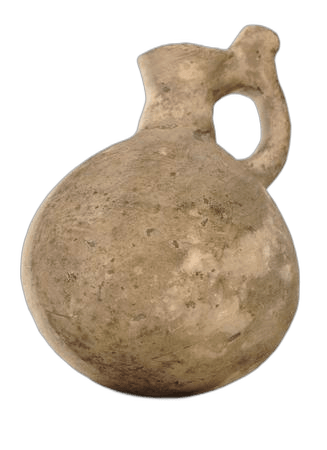
Black Slip is a handmade Middle Cypriot ware with a dark slip over a light fabric. At Kalopsidha Åström described Black Slip III as a homogeneous buff clay, usually hard, with a matt black slip "toning to red", decorated with incised parallel lines, zigzags, network and chevrons, and found only as juglets [6, p. 64]. Recent work on the west coast at Kissonerga-Skalia describes Black Slip fabrics as variable in preparation and inclusions, the surface colour ranging from red to black as a function of firing, and the slip matt or lightly lustrous and often worn thin enough for sherds to be mistaken for Plain White Handmade [7, p. 162]. Åström once linked Black Slip with Base Ring as "Red and Black Slip Proto Base Ring", but Sarah Vaughan's fabric analysis showed the two to differ in material and firing [7, p. 162].
The ware ran on into the Late Bronze Age. Åström reclassified several Kalopsidha juglets as Late Cypriot Black Slip IV types, and defined a Black Slip Wheel-made ware, mostly large jugs with pinched or round spouts, that is "very rare in tombs, while it is common in settlements" [6, pp. 63–64]. At Enkomi in LC I, Crewe found Black Slip, Red Slip and White Painted Wheelmade II made in the same local fabric as Plain White and almost exclusively as large trefoil jugs, which suggests that the same potters made the plain and the slipped versions [1, pp. 127–128]. A British Museum example on this site, a Black Slip II juglet with a horned handle, shows the handmade Middle Cypriot form.
Red Slip ware
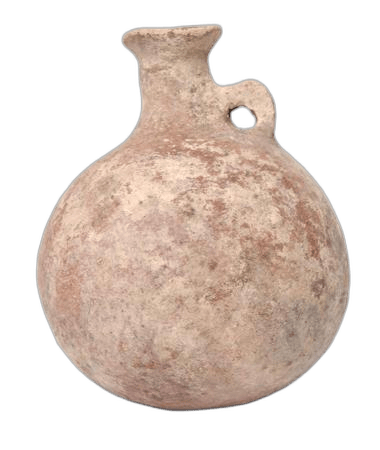
Red Slip is the red member of the same slipped tradition. Black Slip surfaces range from red to black with firing, and excavators often count the two together as "Red/Black Slip" [7, p. 162; 3, p. 82]. In the MC III pit at Ayios Iakovos-Dhima, some 300 sherds, all handmade, Plain White and Red or Black Slip were the most numerous classes, ahead of Red-on-Red/Black, a little Red Polished and a single White Painted sherd [3, p. 82]. Crewe records that a Lapithos Plain White amphora has an exact parallel in Red Slip from Lapithos Tomb 702, dated late MC III; Åström thought the Red Slip pot copied the Plain White one, and Crewe considers the reverse, or contemporaneity, just as likely [3, p. 85]. Among the earliest securely Middle Cypriot Plain White pieces are amphorae of types known in Red Slip versions [1, pp. 121–122], which places the two wares in the same workshops at the moment Plain White was being invented. A handmade British Museum Red Slip juglet with a string-hole projection at the neck base illustrates the small closed forms. The wheelmade successor, Red Slip Wheel-made, belongs to the Late Cypriot group of large jugs described above [1, p. 128].
Bucchero ware
Bucchero is a Late Cypriot ware of jugs whose bodies are vertically ribbed or grooved, made in handmade and wheelmade versions. At Kalopsidha Åström found a single Bucchero Hand-made fragment, the shoulder of a jug with six ribs to 3.3 cm, in hard brown clay with a grey core and matt brown slip; the ribbing, he noted, "was applied as a second coating and has partly flaked off" [6, p. 64]. In Dikaios's Enkomi Level IIIA (LC IIIA) Bucchero Hand-made made up 1 to 1.2 per cent of the pottery, while "the new ware Bucchero Wheel-made" reached 3 to 3.5 per cent [2, p. 694]. In LC IIIB tombs at Enkomi Bucchero jugs were buried with Plain White Wheelmade II jugs: Swedish Tomb 16 held four Bucchero Hand-made and three PWWM II jugs [2, p. 698].
Bucchero rarely left the island. Åström recorded an early jug at Alalakh in Level IV, six jugs at Ras Shamra and Minet el-Beida "of Base-ring II fabric", an alleged handmade jug from Byblos, and finds at Hazor, Megiddo, Jerusalem, Tell el-Hesi, Lachish, Tell el-'Ajjul and Tell el-Far'ah; sherds from the Cape Gelidonya wreck are either Bucchero or Base Ring II [2, p. 751]. The Ashmolean has a small Cypriot bucchero jug with ribbed body (AN1959.370), catalogued as LC II.
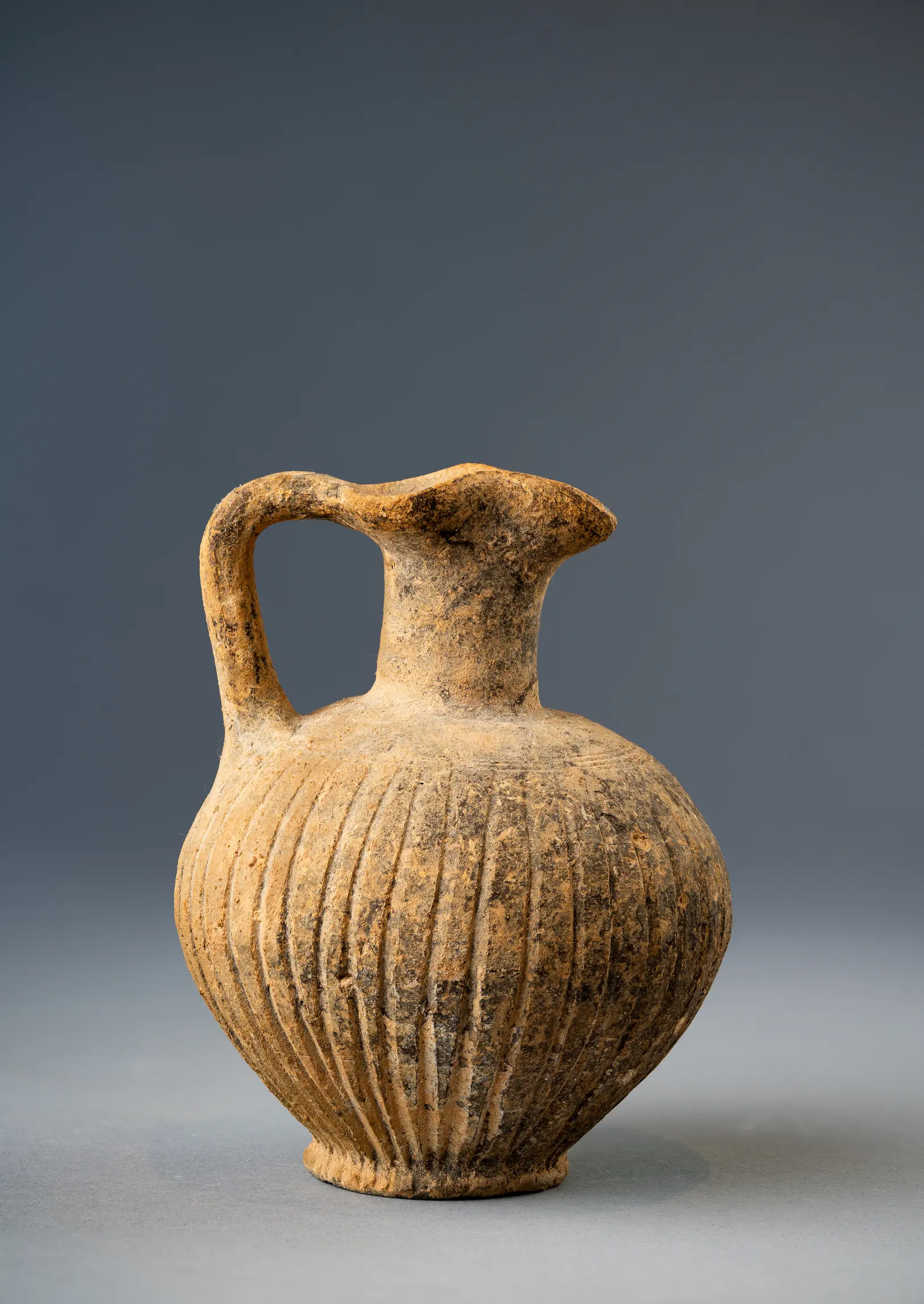
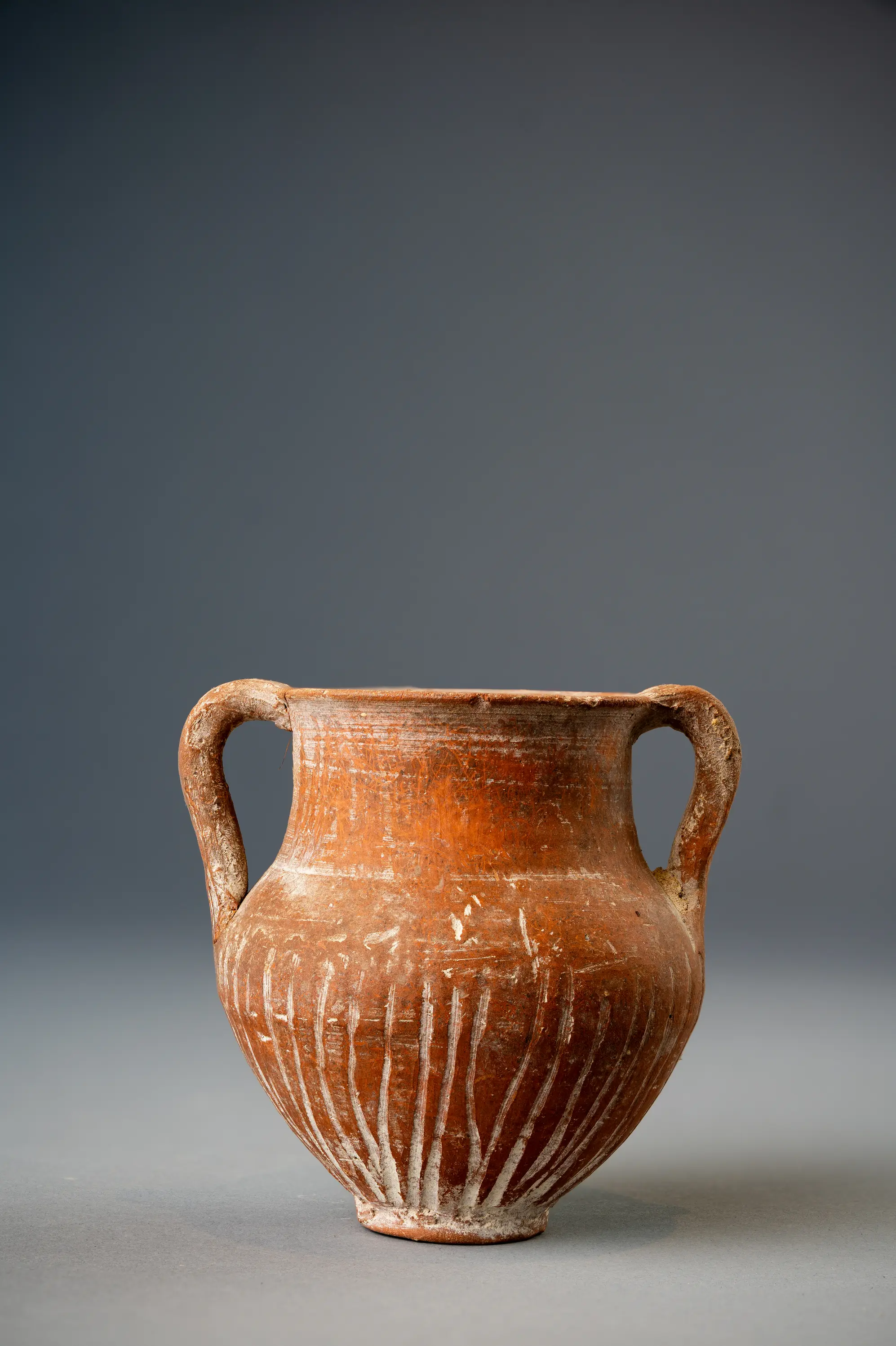
Two pieces in the Drakopoulos collection belong here. The Bucchero ribbed jug illustrated above has a globular body with close vertical ribs, a trefoil mouth, a strap handle from rim to shoulder and a low ring base, and matches the SCE description of Late Cypriot Bucchero jugs. The Bucchero-style jar is a small two-handled, wide-mouthed jar with a red surface and vertical grooves on the lower body. The collection catalogue dates it to Late Cypriot III; its class and date have not yet been tested against published parallels. For the handmade fine wares that replaced plain drinking vessels in LC II, compare the collection's Base Ring jug.
Summary
Plain White is defined by a pale, undecorated surface, not a single fabric, and its classes were fixed by Åström in 1972 on material from eastern Cyprus. The handmade pithos of MC III–LC IA is the first securely Plain White type and was exported to the Levant and Egypt; Plain White Wheelmade I and II, dated LC I–IIA and LC IIB–III, are the first Cypriot pottery shaped with rotary force, though not thrown. Black Slip and Red Slip are the slipped Middle Cypriot contemporaries from which Plain White emerged, and Bucchero is a small Late Cypriot family of ribbed jugs buried alongside PWWM II. For the vessels themselves see the entries on jugs, jars and bowls; for the scholar behind the classification, Paul Åström and Cypriot archaeology.
Objects on this page
 Black Slip JugletEarly Bronze Age II · 2300–1650 BC
 Red Slip JugletMiddle Bronze Age I · 1950–1650 BC
- Black Slip Bucchero Jug with Trefoil Mouth and Fluted BodyGeometric I · 1050–850 BC
 Two-Handled Amphoriskos with Grooved Bucchero BodyGeometric II · 950–600 BC
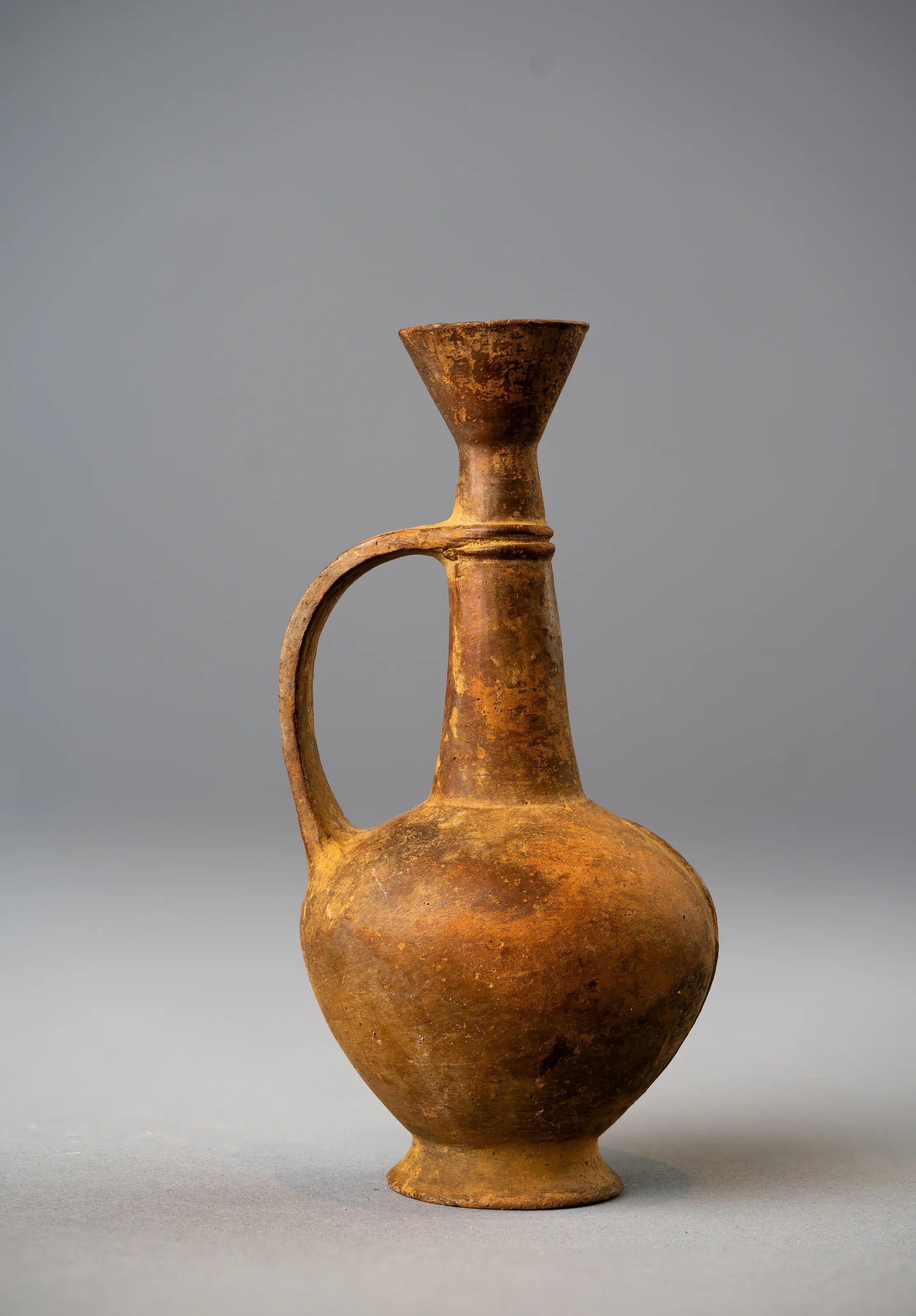 Base Ring Bilbil Juglet with Funnel Mouth and Neck RidgeLate Bronze Age II · 1550–1300 BC
References
- 1.Crewe, L. (2015). Plain wares and urban identities in Late Bronze Age Cyprus. In C. Glatz (Ed.), Plain pottery traditions of the eastern Mediterranean and Near East: Production, use, and social significance (UCL Institute of Archaeology Publications 67). Left Coast Press (reissued Routledge, 2016). https://doi.org/10.4324/9781315422572
- 2.Åström, P. (1972). The Swedish Cyprus Expedition, Vol. IV, Part 1D: The Late Cypriote Bronze Age. Relative and absolute chronology, foreign relations, historical conclusions. Swedish Cyprus Expedition.
- 3.Crewe, L. (2009). Regionalism and the first appearance of Plain White Handmade ware in the Middle Cypriot Bronze Age. In I. Hein (Ed.), The formation of Cyprus in the 2nd millennium B.C.: Studies in regionalism during the Middle and Late Bronze Ages (Contributions to the Chronology of the Eastern Mediterranean 20, pp. 79–90). Austrian Academy of Sciences.
- 4.Keswani, P. S. (1991). A preliminary investigation of systems of ceramic production and distribution in Cyprus during the Late Bronze Age. In J. A. Barlow, D. L. Bolger, & B. Kling (Eds.), Cypriot ceramics: Reading the prehistoric record (University Museum Monograph 74, pp. 97–118). University of Pennsylvania Museum.
- 5.Crewe, L. (2012). Beyond copper: Commodities and values in Middle Bronze Cypro-Levantine exchanges. Oxford Journal of Archaeology, 31(3), 225–243. https://doi.org/10.1111/j.1468-0092.2012.00387.x
- 6.Åström, P. (1966). Excavations at Kalopsidha and Ayios Iakovos in Cyprus (Studies in Mediterranean Archaeology 2). Lund.
- 7.Johnston, C., Crewe, L., & Oikonomou, A. (2023). Innovation and adaptation: Ceramic development across the Middle to Late Cypriot horizon. In T. Bürge & L. Recht (Eds.), Dynamics and developments of social structures and networks in prehistoric and protohistoric Cyprus. Routledge.
- 8.Karageorghis, V. (1983). Palaepaphos-Skales: An Iron Age cemetery in Cyprus (Ausgrabungen in Alt-Paphos auf Cypern 3). Universitätsverlag Konstanz.