
Contents
White Shaved ware is the pottery of a single shape. Its potters made small, spindle-shaped juglets with a pointed base, a short narrow neck and a pinched or trefoil mouth, then pared the body vertically with a knife until it tapered to a point. The ware appears at the start of the Late Cypriot period, about 1650 BCE, and lasts until the end of Late Cypriot IIIA, about 1200 to 1150 BCE [1]. The juglets copy a Levantine shape, the dipper juglet, and they went back to the Levant in large numbers: more White Shaved juglets have been found in Palestine than on Cyprus itself [4, p. 54]. A foreign form, made in a Cypriot way and sold back to the region that invented it, has made the ware a standard case in studies of Late Bronze Age trade. You can see all White Shaved ware in the catalogue.
How to recognise White Shaved ware
The fabric is pale: buff or greenish clay, fired soft to medium-hard [1][2]. At Tell el-Borg in North Sinai the excavators describe it as medium-soft and fairly dense, firing a matt pale brown (Munsell 7.5YR 7/4) with no visible core, tempered with fine sand and a few black and red grits [3]. The fabric is close to that of the Plain White handmade and wheel-made wares; what earned the juglets a ware of their own was the shaving [1].
Three features identify a piece, even a sherd:
- Vertical knife facets. The body was pared from shoulder to base at the leather-hard stage, leaving long flat facets. The paring is what forms the point of the base [1][2].
- A plugged handle. The single loop handle runs from rim to shoulder, sometimes slightly raised above the rim. It was fixed by pushing a dowel-like piece of clay through the body wall, a Cypriot habit seen on other handmade wares of the period [3].
- Finger marks inside. Because the vessel was built by hand and only the outside was shaved, the interior keeps the potter's finger impressions [3].
Paul Åström's type description in the Swedish Cyprus Expedition volumes, quoted by the Tell el-Borg team, sums up the standard juglet: "Spindle shaped juglet; short narrow neck; handle, sometimes somewhat raised, from the rim to the shoulder; pinched or trefoil mouth; pointed base" [3]. A more elongated variant with a flat base also exists [3]. Because the fabric is so distinctive, White Shaved is easy to pick out even among small sherds [5].
Date
The standard dating, following Åström (1972) and Hector Catling (1957), puts the first White Shaved ware in Late Cypriot IA (c. 1650 to 1550 BCE) and the last at the end of Late Cypriot IIIA (c. 1200 to 1150 BCE) [1]. The earliest phase is thin. In practice the ware was most popular from LC IB to LC IIB, roughly the 15th to the 13th centuries BCE [5], and it is in those centuries that it turns up abroad.
| Phase | Approximate date | White Shaved ware |
|---|---|---|
| LC IA | c. 1650–1550 BCE | First appearance, rare [1] |
| LC IB to LC IIB | c. 15th to 13th century BCE | Main period of production and export [5] |
| LC IIIA | c. 1200–1150 BCE | Last production [1] |
The ware also helps date Levantine sites. Gittlen showed that the order in which Cypriot wares reach Palestine closely follows the Cypriot sequence: White Shaved began to arrive late in Late Bronze I, after the trade in Base Ring and White Slip wares was already running [4, pp. 51, 54].
Where the shape came from
There is no forerunner for the pointed juglet in any Middle Cypriot ware, and no other Late Cypriot ware repeats the form [1]. The model lies in the southern Levant, where wheel-made dipper juglets were common in Middle Bronze Age burials. Murat Akar links the arrival of the shape in Cyprus to the early Late Cypriot sea contacts with the southern Levant, around 1650 to 1600 BCE, and notes that the shaving technique gives the copy "an indigenous character" [1]. Bevan (2007) has also suggested that the form and pale colour imitate Levantine dipper juglets made of gypsum [1].
The Cypriot potters did not copy the wheel: they built the juglet by hand and shaped it with a knife. The pottery course lesson on the handmade wares of the Late Bronze Age sets White Shaved beside Monochrome in that context.
Made for export? The Gittlen debate
In a 1981 article Barry Gittlen argued that White Shaved juglets were made for the Palestinian market. On Cyprus, he wrote, their distribution was limited to the area around Enkomi, "apparently the site of their manufacture", while the number found in Palestine was triple the Cypriot total. His conclusion was that the juglets "were manufactured specifically to meet the demands of the existing Palestinian market" for a vessel like the Canaanite dipper [4, p. 54]. In Palestine itself 61 per cent of the White Shaved found came from a small group of sites [4, p. 51].
Later work has softened this. Akar points out that White Shaved juglets are found in Cyprus in burials, ritual places and houses, so they were used at home as well as exported, and he thinks it unlikely that Cypriot potters made them only for the export trade [1]. In the Levant too, imported juglets come from cult buildings, houses and tombs [1]. The catalogue Ancient Cyprus: Cultures in Dialogue (2012) takes a middle position: the juglets were found "mostly in tombs throughout Cyprus" but were also exported, "most probably from eastern Cyprus" [2], which keeps Gittlen's eastern focus without the claim that Cypriots had no use for them.
What the juglets carried has not been established by residue analysis. The 2012 catalogue calls them "most probably" commodity containers [2]; a dipper juglet is small enough to take a measure of liquid from a larger jar, but that is an inference from shape.
Where they are found
On Cyprus, early excavated groups come from Enkomi in the east, and examples in museum collections are recorded from sites across the island, including Kourion-Bamboula and Larnaca-Laxia tou Riou (the Ashmolean juglet below). Abroad, the range is wide:
- Palestine. White Shaved is very common in the southern Levant [4]. A juglet from Tomb 1003 at Lachish, now in the Royal Museums of Art and History, Brussels (O 1514), is 16.2 cm high, with a trefoil mouth and clear vertical trimming marks [2]. See also the Levant.
- North Sinai and Egypt. Nine examples came from the fort at Tell el-Borg. The excavators note that the ware is frequent in Palestine and North Sinai in the late 18th and 19th Dynasties but rare in Egypt proper [3]. Further west, the Late Bronze Age trading post on Bates's Island at Marsa Matruh produced six White Shaved sherds, probably all from pointed juglets [5].
- Alalakh. At Tell Atchana in the Amuq, imported White Shaved juglets appear in the Late Bronze IIA period (c. 1400 to 1300 BCE), alongside small pointed juglets of a central Anatolian tradition. Local potters then began to shave their own pointed juglets, producing a hybrid of the two [1].
- The Uluburun ship. The ship wrecked off southern Turkey carried at least 41 White Shaved juglets among its Cypriot pottery [1].
In the catalogue
None of the White Shaved juglets on this site belongs to the Drakopoulos collection. The clearest examples are museum pieces.
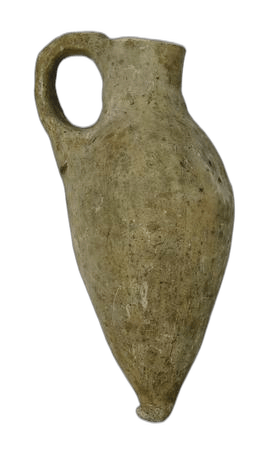
- A British Museum juglet shows all three marks of the ware: the long vertical facets, the pointed base, and the handle plugged through the wall. Further British Museum examples are 3849, 3853 and 4011.
- The Metropolitan Museum juglet 74.51.426, 16.5 cm high and dated by the museum to the Late Cypriot period, is the hero image of this page.
- The Ashmolean juglet with pointed foot (AN1896-1908.C.82) is from Larnaca-Laxia tou Riou, dated LC II (c. 1550 to 1200 BCE), 12.8 cm high: a small one, with a provenance.
- A juglet in the Cyprus Museum, Jacksonville, 6.75 inches high, was formerly in the Desmond Morris collection.
Other museum examples include an Ashmolean juglet from Myrtou-Pigades (AN1963.76, LC II) and a Late Cypriot I juglet in the Yale Peabody Museum, 15.5 cm high.
Confusions
Pale, pointed juglets are not all White Shaved. Levantine Middle Bronze Age dipper juglets, which are wheel-made and lack the knife facets, are sometimes catalogued as Cypriot; the shaving is the test. At Alalakh the local shaved imitations blur the line from the other side [1]. A White Shaved juglet is also easy to confuse with plain handmade Plain White ware, whose fabric is almost identical; again, look for the vertical facets. For the wider family of dipper shapes across the Bronze Age, see the dipper and jug pages, and for the other wares of the period, the pottery types hub.
Objects on this page
- White Shaved JugletLate Bronze Age I · 1550–1340 BC
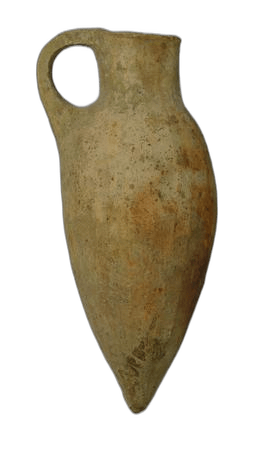 White Shaved JugletLate Bronze Age I · 1550–1340 BC
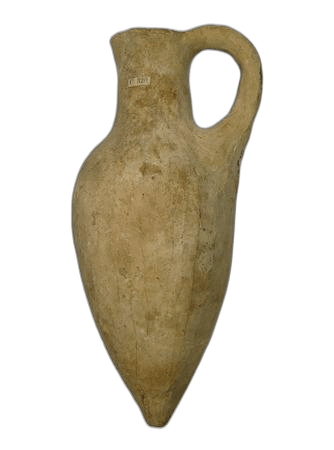 White Shaved JugletLate Bronze Age I · 1550–1340 BC
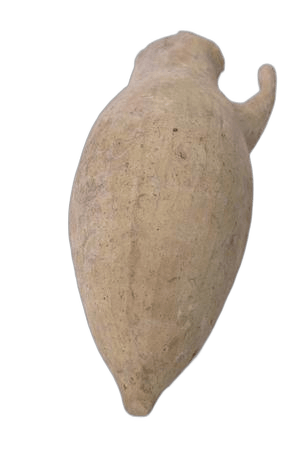 White Shaved JugletLate Bronze Age II · 1450–1300 BC
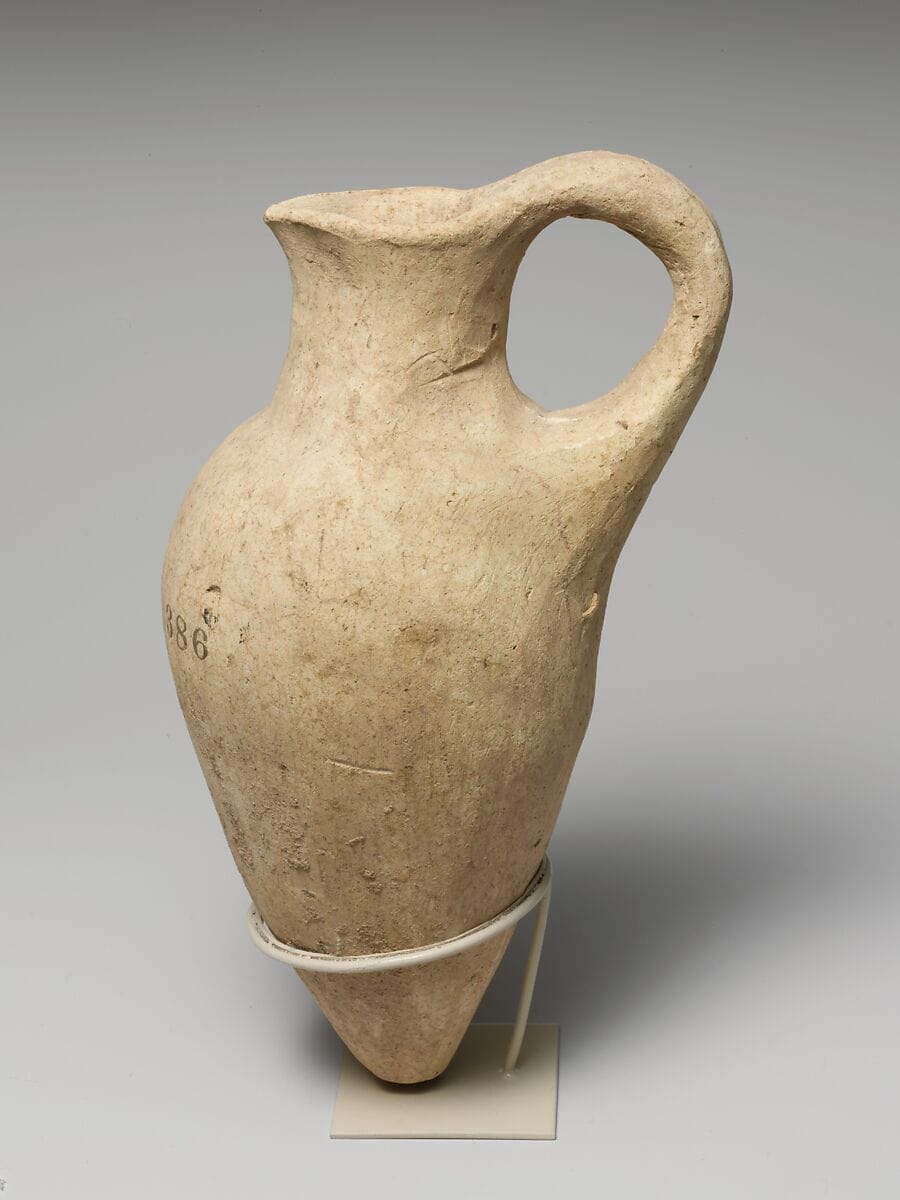 Terracotta white-shaved jugletLate Bronze Age II · 1600–1050 BC
).webp) White Shaved juglet with pointed footLate Bronze Age II · 1550–1200 BC
White Shaved juglet with pointed footLate Bronze Age II · 1550–1200 BC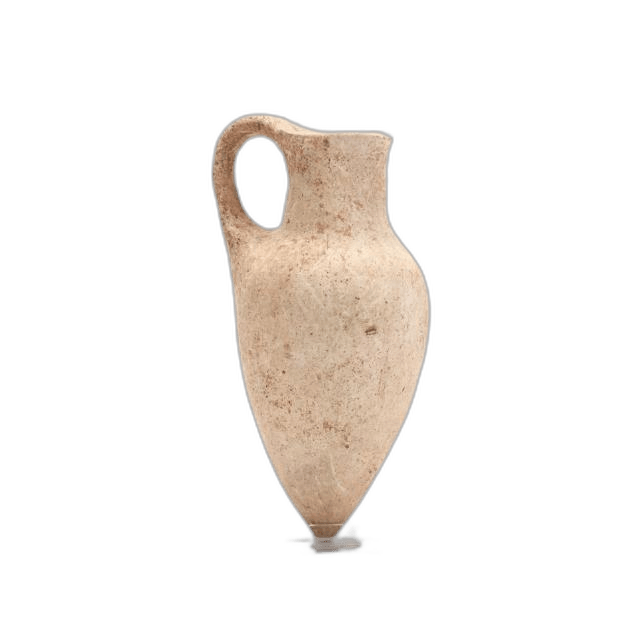 Cypriot Late Bronze Age White Shaved Ware JugLate Bronze Age I · 1575–1325 BC
In the catalogue
References
- 1.Akar, M. (2017). Pointed juglets as an international trend in Late Bronze Age ritual practices: A view from Alalakh. In Ç. Maner, M. T. Horowitz, & A. S. Gilbert (Eds.), Overturning certainties in Near Eastern archaeology: A festschrift in honor of K. Aslıhan Yener (Culture and History of the Ancient Near East 90). Brill.
- 2.Pilides, D., & Papadimitriou, N. (Eds.). (2012). Ancient Cyprus: Cultures in dialogue. Department of Antiquities, Cyprus.
- 3.Hoffmeier, J. K. (Ed.). (2014). Excavations in North Sinai: Tell el-Borg I. Eisenbrauns.
- 4.Gittlen, B. M. (1981). The cultural and chronological implications of the Cypro-Palestinian trade during the Late Bronze Age. Bulletin of the American Schools of Oriental Research, 241, 49–59. https://www.jstor.org/stable/1356710
- 5.White, D. (Ed.). (2002). Marsa Matruh II: The objects (Prehistory Monographs 2). INSTAP Academic Press.