
Contents
Mycenaean pottery is the largest body of foreign fine ware found in Late Bronze Age Cyprus. Cypriots imported Mycenaean vessels from the beginning of the Late Cypriot period, and by the fourteenth and early thirteenth centuries BC "Mycenaean finewares were found on the island by the hundreds" [1, p. 403]. Most were made in the north-east Peloponnese, "predominantly, though not exclusively" [1, p. 403]. They came in two main groups: small closed containers, above all stirrup jars and piriform jars, bought for what they held; and the drinking set of cups, bowls and large pictorial kraters, bought as vessels for feasting and for the grave. Alongside them, Cypriot potters began making their own versions of a few Aegean shapes, first in the fourteenth century and then on a much larger scale in the thirteenth and twelfth. This entry covers the imports themselves, the long argument over where the pictorial kraters were painted, and the earliest local copies. The later, fully local Aegean-style ware of Late Cypriot IIC to IIIA has its own entry under White Painted Wheelmade. For the period as a whole see the Late Bronze Age; for the people who made the imports, Mycenaean culture.
What arrived: containers and the drinking set
Georgiou, in her contribution to Graziadio's 2025 survey of Aegean–Cypriot contact, divides the imports into two classes. The first is "slow-pouring closed vessels, mostly stirrup jars, imported as receptacles for their contents (possibly scented oils or unguents)"; the second is "the drinking set, which encompassed a large variety of drinking bowls and cups, kylikes and kraters of the pictorial type" [1, p. 403]. A stirrup jar of Late Helladic IIIA2 from Dhali, near Idalion, in the British Museum, painted with a foliate band, is a standard example of the first class, and a three-handled piriform jar from Enkomi, also in the British Museum, decorated with bands and spirals and dated LH IIIB, represents the other common container shape. Both are catalogued as made in Greece. On the island itself, the Larnaca District Museum holds a stirrup jar catalogued as a likely Mycenaean import.
The drinking set changed Cypriot tableware. Cypriot elites took it up "to a great extent", and the local handmade repertoire of Base Ring and White Slip shrank as a result: "mixing and serving utensils (kraters and tankards) that were common in the local, handmade fabrics during the previous periods, were largely replaced by the imported Mycenaean finewares" [1, p. 403, citing Steel 1998]. Amphoroid and bell kraters, "often decorated with elaborate pictorial scenes depicting chariots or animals in procession, became an essential component of LC feasting activities". Georgiou, following Louise Steel and Keswani, reads them as the centrepiece of social gatherings and mortuary rituals and an "emblem of the prominence and the consolidation of power" of the island's elites [1, p. 403].
Graziadio's catalogue tables give find contexts. They record, among many others, a piriform jar from Kition Tomb 9, deep bowls from Kition Tombs 4 and 5, a wide-mouthed jar from Hala Sultan Tekke and a stemmed krater from Enkomi Swedish Tomb 18 [1, p. 341]. The lower layers of Kition Tomb 9 contained a group of LH IIIA2 vases that included two piriform jars and a further piriform jar of Furumark Shape (FS) 39 [1, p. 218]. Not every import came from the Greek mainland: Enkomi Swedish Tomb 3 held a Late Minoan IIIA2 krater and Hala Sultan Tekke Tomb IX a Late Minoan II krater, both Cretan [1, p. 161]; see Minoan culture.
The tombs also show who used these pots. When the Swedish Cyprus Expedition excavated chamber tombs at Enkomi, Mycenaean pottery turned out to be "only a fraction of the tomb goods deposited in these Cypriote chamber tombs, the bulk of the pottery being local Cypriote". Immerwahr drew the conclusion in 1993: "Obviously these were not the tombs of Mycenaean colonists, as known at Ialysos on Rhodes, but those of wealthy Cypriotes" [2].
Where the pictorial kraters were made
The pictorial kraters raised the longest-running question in the study of Mycenaean pottery abroad. By the mid-twentieth century Cyprus "had yielded dozens of amphoroid kraters with chariot scenes, some dating back to the early fourteenth century, and numerous open kraters decorated with bulls, birds, etc. assignable to the 13th century, whereas the Greek Mainland had apparently produced only a few fragments that were contemporary" [2]. Many survived whole because they had been placed in tombs. A fragment of an LH IIIA2 chariot krater from Enkomi in the British Museum, showing driver and horses, and a large krater with a chariot scene in the Cyprus Museum are typical of the amphoroid series. The thirteenth-century open kraters are represented by a bell krater from Enkomi in the British Museum, 36 cm high, with a bull on each side, fanged fish and palm trees. The Metropolitan Museum's Cesnola Collection includes a chariot krater of LH IIIA:1, c. 1375–1350 BC (74.51.964) and another of LH IIIB, c. 1300–1230 BC (74.51.966); both are catalogued as made in Greece.
The distribution led scholars of the 1930s and 1940s to place the style in the east. Myres called it "Cypro-Mycenaean", Furumark "Levanto-Mycenaean", and Sjöqvist and the Swedish expedition "Levanto-Helladic". They argued from where the pots were found and from shapes rarely seen in Greece, such as a shallow bowl with a wishbone handle and an angular jug with a trefoil mouth [2]. Others read the same labels differently: Gjerstad in 1926, Forsdyke in 1927 and, at first, Wace took them as markers of how popular the exports were in the east, without implying that they were made there [2].
In 1982 Vermeule and Vassos Karageorghis published Mycenaean Pictorial Vase Painting. They favoured "some kind of flexible interchange of pottery, potters and even clay", with "a strong bias in favor of Cypriote manufacture" [2]. One of their arguments was the Cypro-Minoan signs found on many kraters. Immerwahr answered that these marks were painted after firing, in a different paint from the decoration, and prove only that the pots "passed through Cypriote hands, probably being the marks of dealers" [2].
The painters themselves pointed the other way. Vermeule and Karageorghis identified about 37 painters, and the work of at least eight "cuts across geographical boundaries" [2]. Their Painter 19 decorated a krater from Klavdia, now in the British Museum, with a bull and a man with two dogs; the same hand has since been recognised at Tiryns and on at least three vases from Berbati [2]. Finds on the mainland grew too. A chariot krater came to light at Corinth in 1948, and in 1971 two amphoroid chariot kraters were found in tombs at Nauplion, which Immerwahr described as "the only examples of chariot kraters used as funerary offerings on the Mainland" [2].
The decisive find was a workshop. At Berbati in the Argolid, Åkerström excavated a potters' quarter with misfired Pictorial Style wasters: about 50 fragments of amphoroid chariot kraters and about 20 open kraters with strap handles, "obviously intended for the market abroad" [2]. Even the supposedly Levantine shapes occurred at Berbati, perhaps "a concession to Cypriote taste" [2].
Laboratory work pointed the same way. Petrographic study found the Pictorial Style fabric matched standard mainland Mycenaean and differed both from local Cypriot wares and from Furumark's "Rude Style". Optical emission spectroscopy by Hector Catling and colleagues at Oxford, and by Jones at the Fitch Laboratory, matched the kraters to the Peloponnesian "Type A" composition, and neutron activation analysis at Berkeley "again strongly supported Mainland manufacture" [2]. There were anomalies, such as a fragment with a woman from Kouklia, the site of Palaepaphos [2]. Immerwahr's verdict was cautious but firm: "scientific analyses favor, if they do not absolutely prove, Mainland manufacture for the bulk of Pictorial Style vases found in Cyprus ... the only production center for Pictorial vases yet located is in the Argolid at Berbati. The burden of proof is with those who would still claim Cyprus as its home" [2]. She also rejected the idea that two celebrated kraters, the "Zeus" krater from Enkomi and the Pyla krater, were painted on the island by Minoan émigrés or by "early Mycenaean settlers in Cyprus" [2].
An export trade aimed at the east
If the kraters were made in the Argolid, the next question is why so many ended up in Cyprus. Georgiou notes that the amphoroid krater's frequency in the east Mediterranean, against its "sparse presence in the Greek mainland", may indicate "an export market specifically targeting Eastern Mediterranean clientele" [1, pp. 403–404, citing Steel 1998]. The Cypro-Minoan pot-marks, and a Levantine distribution "almost identical with that of BR and WS wares", suggest that Cypriot merchants handled much of the onward trade to the Levant [1, p. 404, citing Hirschfeld 1992 and Sherratt 1998].
The "Levanto-Helladic" shapes, the group that first persuaded scholars of an eastern origin, have since been split. Chemical analyses by Mountjoy and Mommsen show that "some of these vessels were produced in the Greek mainland, while others were products of Cypriot workshops" [1, p. 405, citing Mountjoy and Mommsen 2015 and Mountjoy 2018]. The Aegean-made examples, in shapes "rarely found in Greece", were "especially made to be exported to the eastern markets" [1, p. 405]. The two sides of the 1930s argument were each partly right: the pictorial kraters were painted in Greece for buyers in the east, while some of the eastern shapes were made in Cyprus.
The first copies: fourteenth-century three-handled jars
Cypriot potters copied Mycenaean shapes long before the wheelmade Aegean-style industry of the late thirteenth century. Graziadio lists several one-off imitations. Van Wijngaarden reviewed three local imitations of LH IIIA2 vessels from Enkomi and concluded that "Mycenaean pottery was imitated as early as LC IIA"; a Base Ring II three-handled jar imitates the Mycenaean shape; kraters were imitated in Limassol Tomb 322 and at Maroni Tsaroukkas Tomb 4; and the amphoroid krater was taken into Plain White Wheelmade in LC IIB [1, p. 301]. The Ashmolean Museum's Base Ring II imitation of a Mycenaean pithoid jar shows how such a copy looks when the shape is taken over into a local handmade fabric. These pieces "do not seem to be indicative of the production of Aegean-type vessels on a large scale" [1, pp. 301–302].
The small three-handled jars are a different matter. Graziadio's 2017 study, The Earliest Production of Aegean-Type Pottery in Cyprus, catalogued "at least 122 cataloged three-handled jars of conical or conical-piriform shape manufactured in the fourteenth century BC and inspired by LH IIIA1 and LH IIIA2 jars FS 44 and FS 45"; in Furumark's system the copies are FS 46 and FS 47 [1, p. 302]. Following Paul Åström, he describes their fabric as "generally made of micaceous and gritty buff clay, with a slip that easily flakes off" [1, p. 302]. The British Museum's three-handled piriform jar from Hala Sultan Tekke, an FS 45 jar of LH IIIA2 with lattice decoration in lustrous paint and catalogued as made in Greece, is the kind of imported model the Cypriot potters were working from.
The case for local manufacture rests on analysis. Neutron activation of a fragmentary jar from Hala Sultan Tekke (Mommsen, Beier and Åström 2003) "confirmed that this vase was manufactured on Cyprus". A portable X-ray fluorescence study of 30 samples by Dikomitou-Eliadou and Georgiou (2017) found no significant difference in composition between FS 46 and FS 47 jars, so that "all the small jars of both FS 46 and FS 47 may be regarded as Cypriot products" [1, p. 302]. That settles an older question. Sherratt had written that Cyprus "did not on the whole attempt to reproduce piriform jars and alabastra", a view Åström questioned in 1998 [1, p. 301]; the FS 46/47 corpus shows that for the small piriform jar, at least, Cypriot workshops did reproduce the shape, and in quantity.
The jars had a narrow use and a narrow range. They are found "only on Cyprus and in a few Levantine and Egyptian sites", and "almost exclusively recovered from burial contexts, being probably used as ointment containers for the body of the deceased" [1, p. 302]; see mortuary practices. Their production "began more than a century before the appearance of the so-called 'Levanto-Helladic' pottery in the late thirteenth century BC" and long before White Painted Wheelmade III [1, p. 302]. Close parallels with FS 44 and FS 45 jars from Achaea, Elis and Messenia suggest that the models came in part from the western Peloponnese, not only from the Argolid [1, pp. 302–303].
Telling an import from a copy
Graziadio lists the decorative habits that mark the Cypriot jars as "local adaptations from the Mycenaean decorative repertoire": "reversed curved-stemmed spirals, spirals with the stems descending from the top of the coils, additional details in the running spiral decoration, panel decorations ..., oblique strokes, and scale pattern with double outline" [1, p. 302, citing Graziadio 2017]. A locally made piriform jar of Mycenaean type with a dotted scale pattern from Tomb RR at Hala Sultan Tekke (Fischer and Bürge 2021, N 295) is one published example [1, p. 302].
Surface is the second guide. For the later Aegean-style finewares of Cyprus, Georgiou gives the general rule that their slip and paint are matt, which "sets them apart from the lustrous slip and paint that characterizes the ceramic production in the Greek mainland, by and large" [1, p. 410, citing Kling 2000]. Clay is the third: the micaceous, gritty buff fabric and flaking slip of the FS 46/47 jars [1, p. 302] are another local marker. None of these traits is conclusive on its own, and the only firm answer comes from chemical or petrographic analysis of the individual pot.
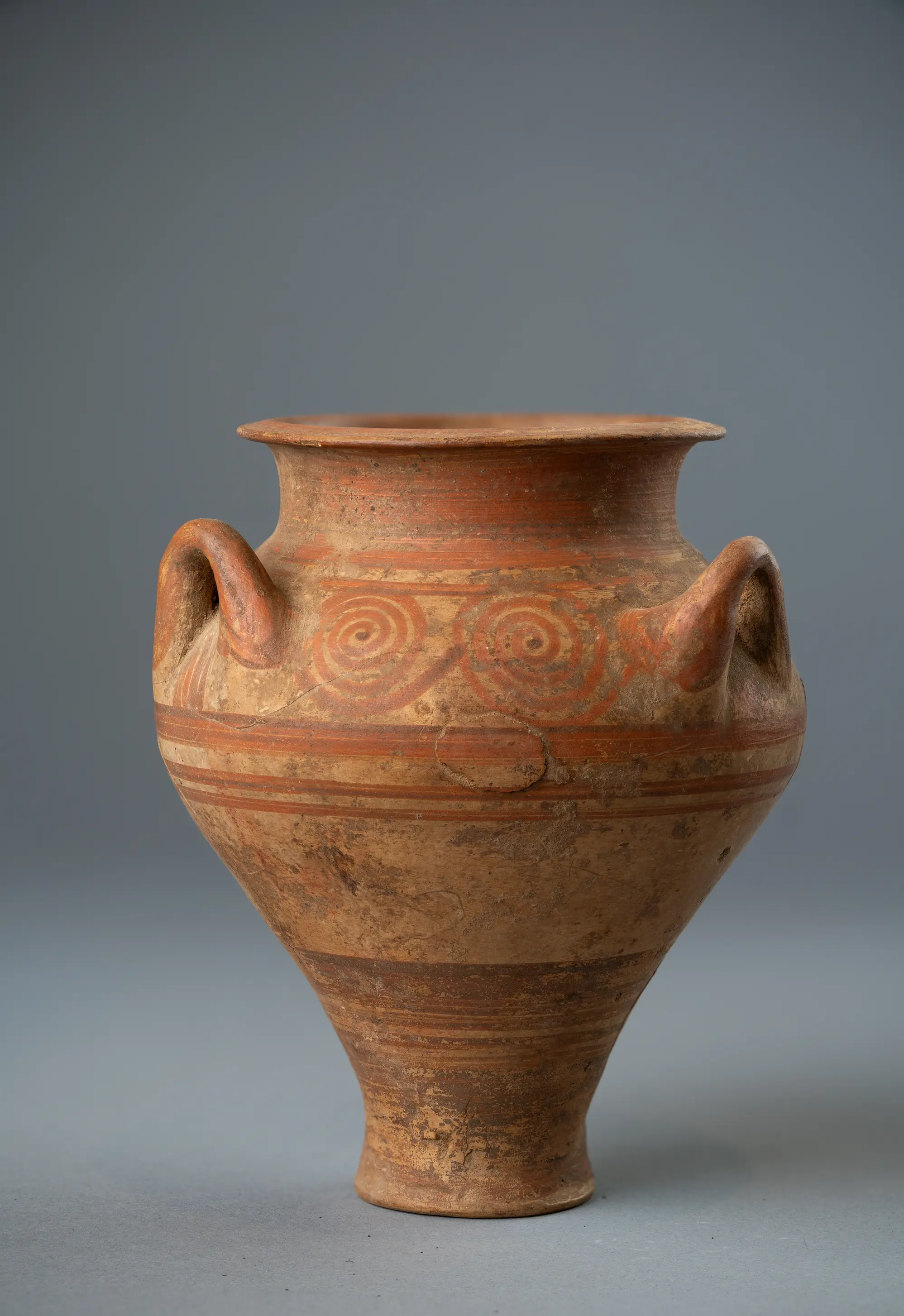
The Drakopoulos collection's piriform jar in the Mycenaean manner, said to have been found in Cyprus, has not been analysed. Whether it is an Aegean import like the British Museum's FS 45 jar from Hala Sultan Tekke or a Cypriot FS 46/47 copy depends on the features listed above: lustrous or matt paint, a fine or a micaceous and gritty clay, and the direction of the spiral stems [1, p. 302]. The article Cypriot Connections and Aegean Styles in the Late Bronze Age discusses the piece.
From copying to making: Aegean-style pottery made on Cyprus
In the thirteenth century local production widened. Georgiou describes wheelmade finewares inspired by imported Mycenaean shapes that incorporated Cypriot and some Levantine elements; by the end of the century they were "overwhelmingly popular", and by the mid-twelfth century they had fully replaced the handmade wares, although only in a limited range, "mostly open shapes and much fewer closed forms" [1, p. 404]. Among the first large-scale products were "locally produced ring-base kraters", smaller and narrower-rimmed than the imported LH IIIB bell kraters they followed [1, pp. 405–406]. Furumark called them the "Rude Style", a judgement of quality; Vermeule and Karageorghis renamed them "Pastoral Style" after their grazing bulls [1, pp. 405–406]. A Pastoral Style bell krater shows the class. Their painters also used birds with trees (at Idalion, Kition Bamboula and Maroni), goats (at Enkomi, Kition, Angastina, Hala Sultan Tekke and Maroni) and, rarely, sphinxes, as on an Enkomi krater with two heraldic male sphinxes [1, p. 449].
The names given to this pottery have changed almost as often as the theories about it, and each name carried an interpretation.
| Label | Coined or used by | What it covered | Problem |
|---|---|---|---|
| Cypro-Mycenaean / Levanto-Mycenaean / Levanto-Helladic | Myres; Furumark; Sjöqvist and the Swedish Cyprus Expedition | Pictorial kraters and eastern shapes found in Cyprus and the Levant | Implied eastern manufacture; most pieces were made in the Argolid [2] |
| Rude Style, later Pastoral Style | Furumark; renamed by Vermeule and Karageorghis (1982) | Locally made ring-base kraters with bulls, birds and goats | 'Rude' judged quality, not origin [1, pp. 405–406] |
| Mycenaean IIIC:1b | Furumark at Sinda; Dikaios at Enkomi | Local Aegean-style pottery of the early twelfth century | The same vessels were called IIIC:1b in one publication and Late Mycenaean IIIB in another [1, p. 405] |
| Decorated Late Cypriot III; Submycenaean; Quasi-Mycenaean Linear | Various excavators | The same local wheelmade ware at different sites | Several names for one class [1, p. 405] |
| White Painted Wheelmade III | Åström (1972) | All locally made Aegean-style fine ware | Removes the historical label, but 'III' wrongly suggests LC III only [1, p. 406] |
| CypIIIC | Mountjoy (2018) | Cypriot Aegean-style pottery phased on the Mycenaean sequence | Criticised as a Mycenaean-centred perspective [1, pp. 406–407] |
| Aegean-style (IIC, IIIA) | Georgiou, in Graziadio (2025) | Local production named by Cypriot phase | Preferred by Georgiou [1, pp. 406–407] |
Georgiou's criticism is that the older labels bound the pottery to Aegean events: "Mycenaean IIIC:1b" was used by Furumark at Sinda and by Porphyrios Dikaios at Enkomi, while "the same vessels were termed Mycenaean IIIC:1b in one publication and Late Mycenaean IIIB in another" [1, p. 405]. Åström's White Painted Wheelmade III "eradicates historical connotations" but its numeral misleads; Mountjoy's "CypIIIC" labels bring the Aegean frame back, and Georgiou prefers the neutral "Aegean-style" with Late Cypriot phase names [1, pp. 406–407]. The full account of this ware, and of how it leads into the Iron Age, is in the entries on White Painted Wheelmade and Proto-White Painted.
Pots and people
For much of the twentieth century the start of local Aegean-style production was read as the arrival of Aegean people. Sjöqvist in 1940, Furumark in 1965 and Catling in 1975 saw the change to wheelmade Aegean-style pottery as a divide that "signified the presence of Mycenaean populations on Cyprus" [1, p. 404]. The imports and early copies described in this entry complicate that reading in three ways. The imported Mycenaean pots at Enkomi lay in Cypriot tombs, among mostly local pottery [2]. The pictorial kraters were made in the Argolid, apparently for an eastern market [2; 1, pp. 403–404]. And Cypriot potters were copying Mycenaean jars in the fourteenth century, more than a century before any proposed migration [1, p. 302]. None of this rules out Aegean settlers in the twelfth century, which remains a separate debate, covered under Mycenaean culture and in Maria Iacovou's argument against a Cypriot "Dark Age" (Maria Iacovou and the Case Against a Dark Age). It does mean that the presence of Mycenaean-looking pottery is not, by itself, evidence of Mycenaeans. How the Aegean-style wares fed into the pottery of the early Iron Age is traced in From Bronze to Iron.
Summary
Mycenaean imports in Cyprus fall into perfume and oil containers and a feasting set dominated by pictorial kraters. The kraters were long thought to be Cypriot or Levantine work; the Berbati workshop and the clay analyses placed most of them in the Argolid, made for eastern buyers, with Cypriot merchants probably carrying them onward. Cypriot potters made occasional copies from LC IIA and a sizeable series of small three-handled FS 46/47 jars in the fourteenth century, identified as local by their clay, their spiral variants and by analysis. Wheelmade Aegean-style production on a large scale followed in the thirteenth century. For related material see Base Ring, White Slip, the Late Bronze Age, and the British Museum and Metropolitan Museum collections.
Objects on this page
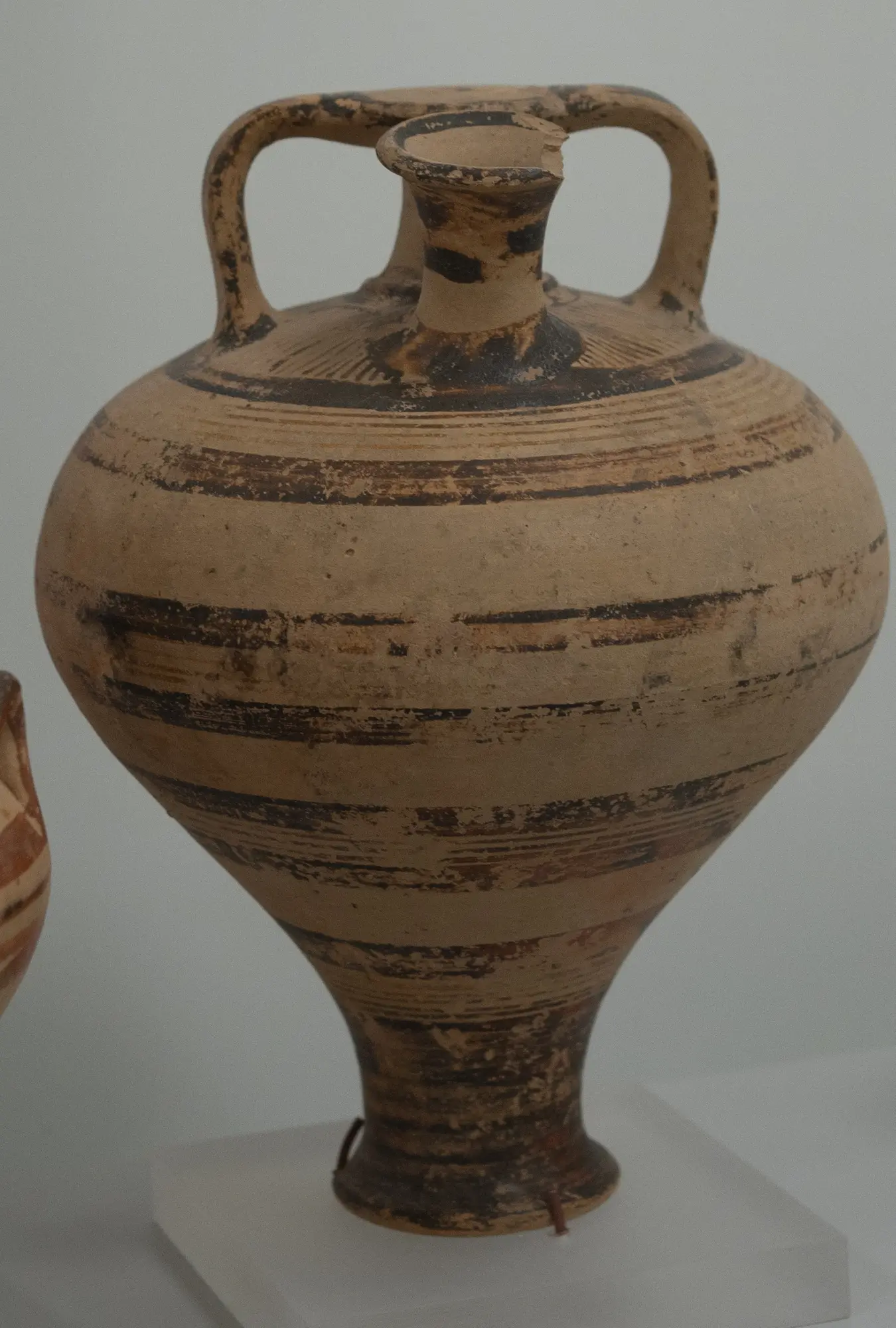 Stirrup JarLate Bronze Age II · 1500–1050 BC
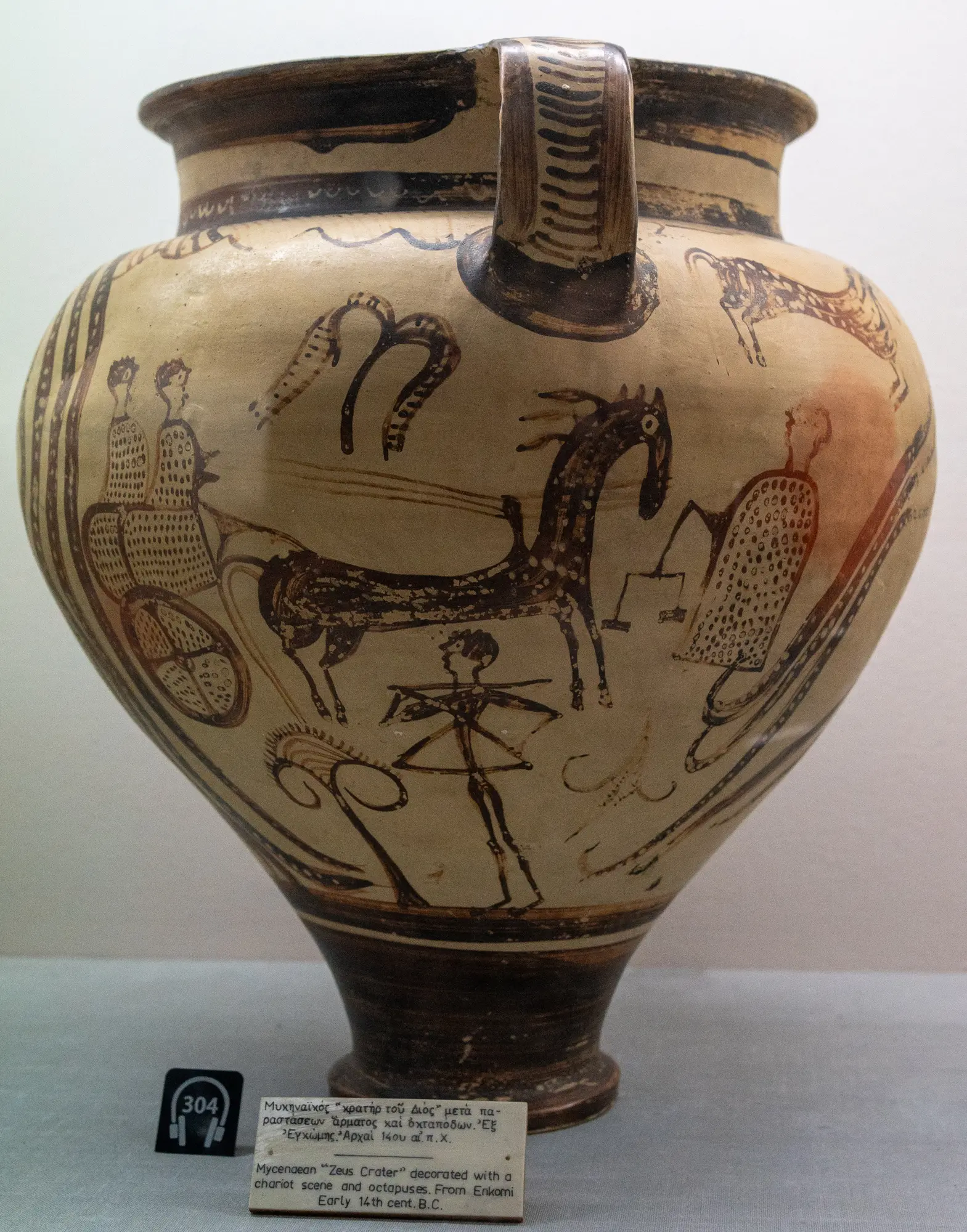 Mycenaean KraterLate Bronze Age I · 1550–1400 BC
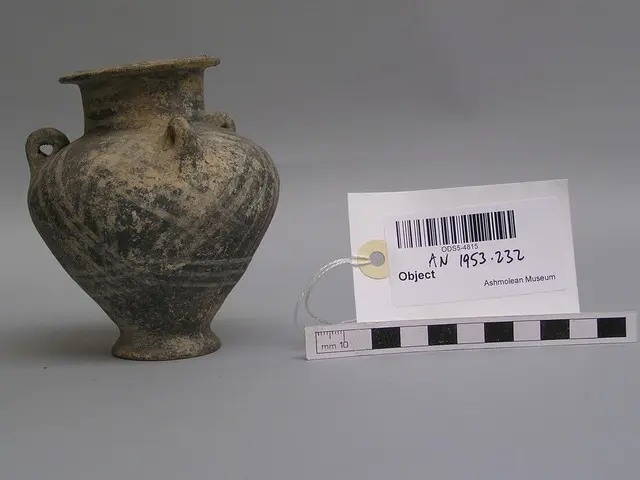 Base Ring II imitation of a Mycenaean pithoid jarLate Bronze Age II · 1550–1200 BC
- Cypriot Three-Handled Jar in the Mycenaean Style with Running SpiralsLate Bronze Age II · 1375–1300 BC
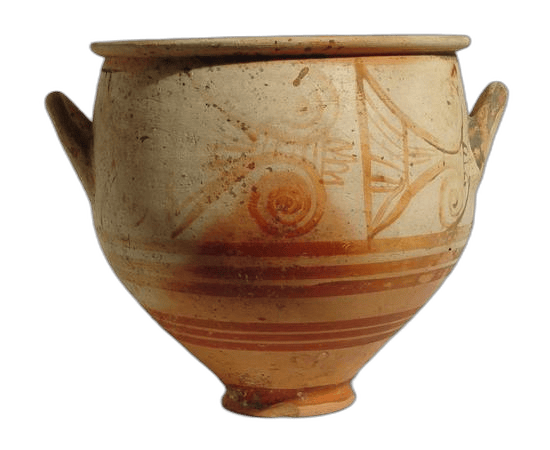 Pastoral Style Bell KraterLate Bronze Age II · 1250–1200 BC
References
- 1.Graziadio, G. (2025). The Aegean and Cyprus: Interaction between two distinct cultural Mediterranean areas from the third millennium to ca 1200 BC (Studi ciprioti). Edizioni Ca' Foscari. With contributions by A. Georgiou, L. Mazzotta, F. Nani, L. Recht and A. Querci; § 6.4.3, "Local Production of Aegean-Style Pottery During the Late Cypriot IIC Period", is by Artemis Georgiou.
- 2.Immerwahr, S. A. (1993). The Mycenaean Pictorial Style 50 years later. In C. Zerner, P. Zerner, & J. Winder (Eds.), Wace and Blegen: Pottery as evidence for trade in the Aegean Bronze Age, 1939–1989 (pp. 217–223). J. C. Gieben.