
Contents
"Red Slip" is a surface description that Cypriot pottery studies have attached to three different wares, separated by centuries. The first is a handmade Middle Cypriot ware, the red member of the Black Slip family, made from about the 19th century BCE and carried on into Late Cypriot I. The second is Red Slip Wheelmade, a small Late Cypriot class of large jugs and a few odd goblets. The third is the Iron Age Red Slip of Einar Gjerstad's Swedish Cyprus Expedition system, the undecorated sister of Black-on-Red, which runs from Cypro-Geometric III to the end of the Cypro-Classical period. The three share a red slipped surface and almost nothing else, and the numbering of each has its own traps. None of them should be confused with the Hellenistic and Roman red-slip tablewares, or with the red-slipped Late Neolithic Combed ware. You can see all Red Slip ware objects in the catalogue for the Bronze Age class and all Iron Age Red Slip for the later one.
Middle Cypriot Red Slip
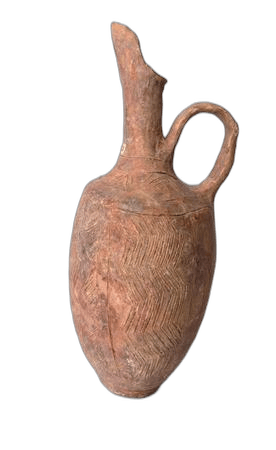
Definition. Paul Åström defined the Middle Cypriot slipped wares in the Swedish Cyprus Expedition volume on the Middle Cypriot Bronze Age, and he treated Red Slip as a red variant of Black Slip. Publishing his own excavation at Kalopsidha, he wrote that Red Slip (III) Hand-made ware "differs from Black Slip III only in the red colour of the slip", and recalled that he had already hesitated to call some juglets Black Slip III when they were red with black patches [2, p. 84]. The Kalopsidha fragments, 17 sherds in all, are of buff, sometimes grey, clay under a matt red slip, with incised encircling lines and zigzags on the body [2, p. 84].
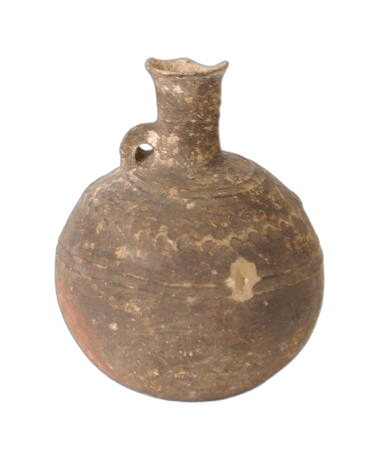
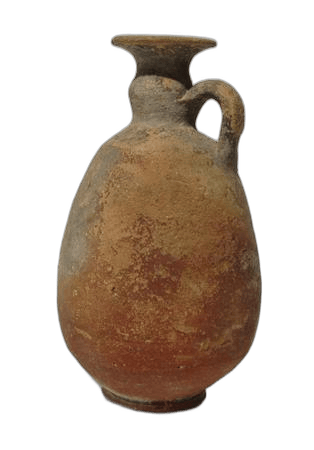
Lindy Crewe groups the whole family as Red/Black Slip, a class that "encompasses all the variants of Red Slip and Black Slip, including the Reserve Slip styles" and takes its name from an all-over slip of red, brown or black colour [1, p. 44]. Åström recognised that these form a continuum whose only difference is surface colour, most probably the result of firing conditions, and a single vessel can show a mottled surface running from red through brown to black [1, p. 44]. Alice Reeve, cataloguing the Leeds collection, reaches the same view: the difference "may be due simply to variations in firing", and she records a Leeds juglet with a horned handle that could be called either Black Slip or Red Slip [3, p. 46]. A British Museum juglet in the catalogue is labelled Red Slip/Black Slip for this reason: handmade, 8.2 cm high, with a string-hole handle and relief lines on a reddish-brown slip.
Sequence and dating. The family has a numbered run, Red/Black Slip I to V, set out in Crewe's summary of Åström. Stage I first appears in MC I. Stage II belongs to MC II and peaks in MC III. Stage III is an MC III finer variant with incised decoration, "with shapes and decorative style influenced by the appearance on Cyprus of imported TEY [Tell el-Yahudiyeh] juglets" [1, p. 44]. The ware is "primarily an MC ware", but it continued into LC I as stages IV and V, the Late Cypriot versions of II and III, and flat bases are the main criterion that separates stage IV from stage II [1, p. 44]. Earlier Red/Black Slip II has a lustrous slip and usually rounded or knob bases [1, p. 44]. In Middle Bronze Age terms the handmade ware runs from MC I, broadly the 19th century BCE, to the end of LC I in the 16th.
The numbering moved in print. In the addenda to the Kalopsidha report, Åström notes that the Late Cypriot wares he there called Red Slip III and Black Slip III had been called Red Slip V and Black Slip V in the Swedish Cyprus Expedition volume, and that his Red Slip (II) Hand-made appears there as Red Slip IV [2, p. 237]. Older labels on museum objects therefore need reading with the publication date in mind.
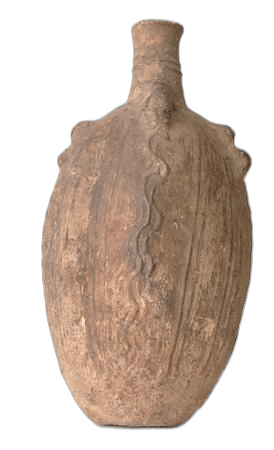
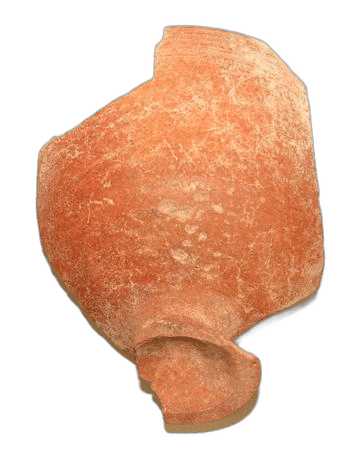
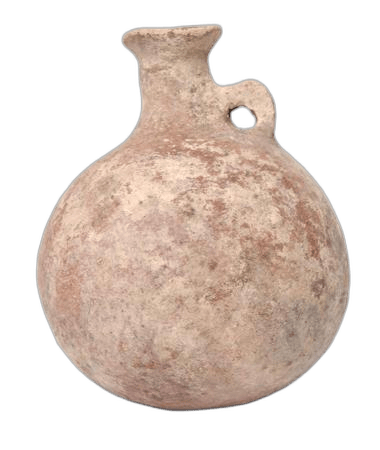
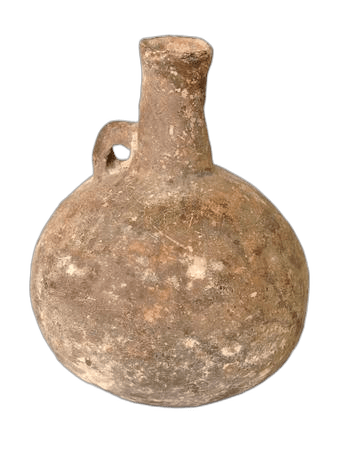
Shapes and regional styles. Middle Cypriot shapes are shallow bowls, jugs, juglets, tankards, bottles and amphorae, with a few cups and ring-vases; in Late Cypriot I the repertoire narrows to jugs and juglets [1, p. 44]. The ware is strongly regional. It is "often decorated at Lapithos but usually plain in Eastern Cyprus"; bowls are common at Ayios Iakovos and Kalopsidha, while the full range of forms occurs only at the northwestern sites [1, p. 44]. Misfired Black Slip sherds from Kalopsidha Trench 9 led Åström to conclude that the ware was made at the site [1, p. 44]. The British Museum Red Slip amphora in the catalogue shows the larger closed shape: handmade, 20 cm high, with a spherical body on a round base, two arched horizontal handles and raised bands and wavy lines on a lustrous reddish-brown slip. A Red Slip flask of flattened ovoid shape, 15.2 cm high, carries vertical wavy and parallel lines and paired lugs on the shoulder.
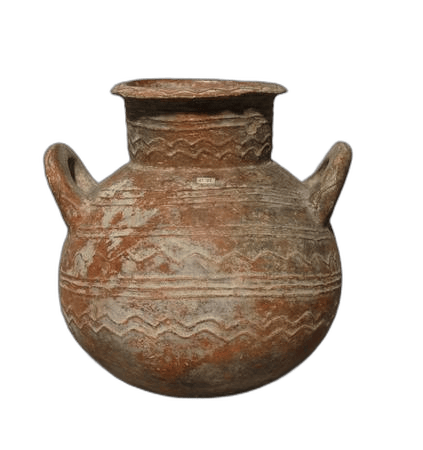
At Lapithos Tomb 702 a Plain White amphora handle form has an exact parallel in Red Slip, dated to late MC III. Åström thought the Red Slip pot copied the Plain White one; Crewe considers the reverse just as likely, or more likely that the two were contemporary [4, p. 87]. That relationship is set out further in the entry on Plain White ware, which also covers Black Slip.
Museum examples. The Ashmolean holds a Red Slip juglet with incised decoration from Kalopsidha (AN1896-1908.C.369), 10.1 cm high, from the Cyprus Exploration Fund excavations of 1894 under John Myres and dated MC II to III, and a Red Slip gourd-juglet from Nicosia-Ayia Paraskevi (AN1896-1908.C.15), 8.5 cm high, of MC III. In Leeds, LEEDM.D.1964.0330 is a Red Slip II to III jug with applied relief and punctured dots [3, p. 46].
Red Slip Wheelmade
Definition. Red Slip Wheelmade (RSWM) is the wheel-made counterpart of the handmade class, and like it has a black twin, Black Slip Wheelmade. At Kalopsidha Åström found "very few fragments", mainly from closed vessels, one with a flat base; the clay is buff, pinkish buff, brown or grey and the slip "matt red to red-brown, occasionally yellowish brown" [2, p. 84]. Crewe describes the wheelmade Red/Black Slip as made "from the same fabric and in the same forms as the handmade version throughout LCI" [1, p. 44]. At Enkomi she found Red Slip, Black Slip, some White Painted and White Painted Wheelmade II made in typologically identical forms, mainly large trefoil-mouthed jugs, which suggests that the same potters made the plain and the decorated styles [5, p. 127]. The catalogue on this site holds no objects of this ware at present, so the catalogue page for Red Slip Wheelmade is empty.
Dating. The ware first appears in tomb groups at Paleoskoutella Tomb 7, Enkomi (French Tomb 11 and Swedish Tomb 20) and Stephania Tombs 10 and 13 [1, p. 44]. It does not occur in the MC III levels and was once thought most frequent in LC IIA to B, while at Nitovikla it is very common in the earliest phase and rises in Period I [1, p. 44]. Crewe concludes that production "seems likely to belong largely, if not completely, to LCI" [1, p. 44]. The Late Bronze Age dating is therefore loose at its lower end: the ware thins out after LC I, and the latest examples are hard to date.
Local or imported? The question has not been settled. Crewe's Enkomi evidence points to local potters working one fabric. Åström, at Kalopsidha, observed that large closed vessels with golden mica in the clay "were probably not made at Kalopsidha", and raised the possibility that "all the wheel-made wares may be imported" to that site [2, p. 84]. A small group of Red Slip Wheelmade goblets complicates the picture: reviewing the Kazaphani tomb publication, Hector Catling noted their "Anatolian features" and credited J. B. Hennessy, publisher of the Stephania cemetery, with first isolating the ware and suggesting the direction it may have come from [6]. The Kazaphani tombs spanned the MC III to LC I transition, when, in Catling's words, new pottery classes evolved from antecedent ones [6].
Hybrids show the ware sitting among other Late Cypriot classes. A shallow conical bowl in Palaepaphos-Teratsoudhia Tomb 288 is Plain White Wheel-made I outside and Red Slip Wheelmade inside [7]. Red Slip Wheelmade should also be kept apart from Red Lustrous Wheelmade, a different Late Bronze Age ware with its own Anatolian question.
Iron Age Red Slip
Definition and place in Gjerstad's system. In the Iron Age volume of the Swedish Cyprus Expedition, Gjerstad wrote that "Red Slip begins in Cypro-Geometric III contemporaneously with the introduction of its decorated counterpart, Black-on-Red". It succeeded Black Slip as the main plain ware of the coloured class, increased through the Cypro-Archaic period, and reached its maximum only in Cypro-Classical I; in Cypro-Classical II Stroke Polished ware took over as the predominant coloured plain ware [8, p. 141]. The fabric is the same as Black-on-Red, with a red slip and at most a few encircling bands in place of painted decoration.
Gjerstad's notation gives each vessel a ware stage, then his Type in brackets, so that Red Slip I (III) is the first stage of the ware, in his Type III of Cypro-Geometric III. Black-on-Red and Bichrome Red use the same scheme. Joanna Smith points out that earlier catalogues used other names entirely: Myres and Ohnefalsch-Richter's 1899 Cyprus Museum catalogue had "Red Ware" beside "Black Slip" and "White Ware", and Black-on-Red was once "Red Painted" [9, p. 238]. She also notes that the notation "has the disadvantage of fossilizing a ware within the Type system", since later work showed Red Slip occurring before Type III, and that fabric played little part in Gjerstad's typology [9, p. 240]. Excavated material can be mis-typed in print: at Kition-Bamboula a Red Slip I (III) vessel was published as Type IV [9, p. 327].
| Series | Gjerstad Type | Period | Approx. date |
|---|---|---|---|
| Red Slip I (III) | III | Cypro-Geometric III | c. 850–750 BCE |
| Red Slip II (IV) | IV | Cypro-Archaic I | c. 750–600 BCE |
| Red Slip III (V) | V | Cypro-Archaic II | c. 600–480 BCE |
| Red Slip IV (VI) | VI | Cypro-Classical I | c. 480–400 BCE |
| Red Slip V (VII) | VII | Cypro-Classical II | c. 400–310 BCE |
The approximate dates in the table follow the current period conventions used on this site's Cypro-Geometric, Cypro-Archaic and Cypro-Classical pages, not Gjerstad's own absolute dates of 1948.
Red Slip I (III). The catalogue's one example is a Liverpool miniature amphora, 7 cm high, on a conical splaying foot, with a glossy pale golden-red burnished surface. Nicola Schreiber's corpus illustrates a Red Slip I (III) jug from Gjerstad's plates [10, p. 16].
When does Iron Age red slip begin? At Palaepaphos-Skales a separate, earlier class called Red Slip Burnished was dated by Vassos Karageorghis to Cypro-Geometric II to III. Amphoriskoi with conical feet in this fabric, found with White Painted I in Tomb 199, led Karageorghis and Raptou to ask "whether this fabric may have started earlier" [12, pp. 60–61]. They note that red-slipped and hand-burnished pottery appeared in Iron Age I in the Levant and peaked around 1000 to 800 BCE, that "the Cypriots may have borrowed the technique from the Levant", and that Red Slip Burnished appears to be a peculiarity of Palaepaphos [12, pp. 60–61]. One Skales dish in this ware has convex sides, two pierced lugs and a ring base, 24.9 cm across [12, p. 54].
Red Slip II (IV) and the Phoenician question. Red Slip II (IV) overlaps with what Levantine specialists call Phoenician Red Slip. Patricia Bikai, studying the Phoenician pottery of Cyprus, found that by the square-rimmed jug stage red slip decoration "has become important" and that "the form of the two types, bichrome and red slipped, is identical" [11, p. 27]. Schreiber notes that the classic mushroom-lipped jug, which Gjerstad places in Red Slip II (IV), is dated by Bikai to her "Kition" horizon of c. 750 to 700 BCE, and that a biconical trefoil-lipped jug Gjerstad put in Red Slip I (III) falls in Bikai's later "Amathus" horizon [10, p. 315]. The labels are not interchangeable, and the dating of the two systems does not line up.
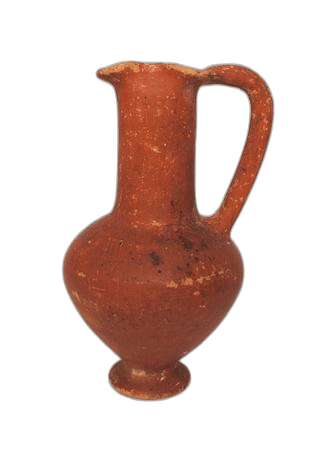
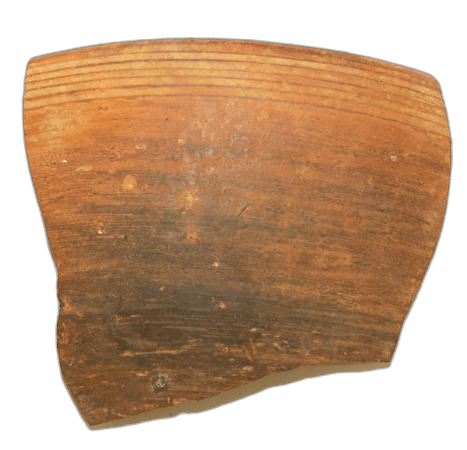
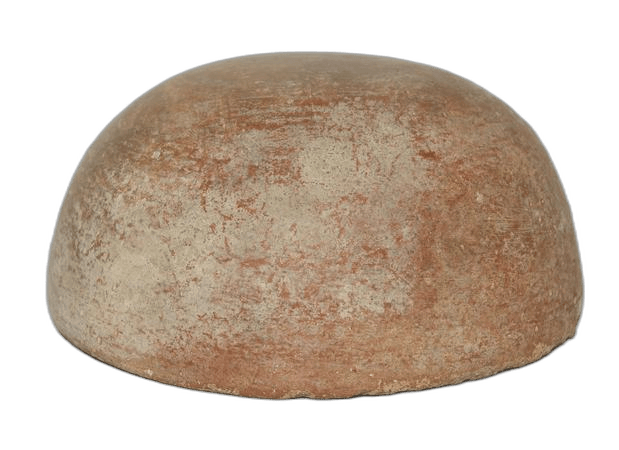
The British Museum's Red Slip oinochoe in the catalogue is catalogued as "Red Slip ware or Phoenician Red Slip ware", series Red Slip II: wheel-made, 18.7 cm high, with an ovoid body on a splaying foot, trefoil spout and matt red slip on buff clay. A closely similar British Museum jug (1876,0909.48), 23.2 cm high, is described in "Phoenician Red Slip ware" with a thin matt slip showing signs of polishing. A smaller biconical Red Slip II jug in the British Museum, 12.2 cm high, has a trefoil mouth, a ring base and traces of polishing. Open shapes include the carinated bowl and the Ashmolean's shallow Red Slip dish with two lug handles (AN1953.563), 22 cm across, of Cypro-Archaic date. See also the entries on jugs and bowls.
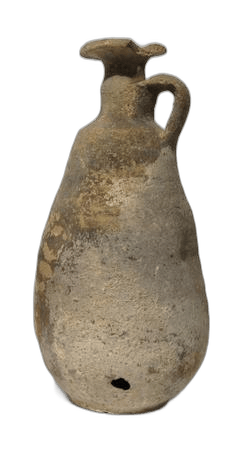
Red Slip III (V) to V (VII). Red Slip III (V) is represented in the catalogue by small juglets such as a mushroom-rimmed juglet, 7.1 cm high, with a ridge at mid-neck and a lustrous red slip on fine buff clay. The catalogue has no Red Slip IV (VI) or V (VII). A well-dated late piece is a jug of Red Slip V (VII) in the National Archaeological Museum, Athens (inv. 19545), 39.7 cm high and of Cypro-Classical II date, with a seated draped woman modelled in the round on the shoulder holding a miniature jug, under a "red to dark brown washy slip" [13, p. 79].
A note on catalogue titles. Not every object called "Red Slip" in a museum database is an Iron Age Red Slip vessel. The British Museum's Purplish Red Slip head, for example, is a head in red-slipped clay, a terracotta that shares the surface and not the ware.
Summary
Red Slip is three wares. The Middle Cypriot class is a firing variant of Black Slip, numbered I to V by Åström across MC I to LC I, and best known in its incised and relief forms from Lapithos and the northwest. Red Slip Wheelmade is a short-lived LC I class whose origin, local or partly imported, is still argued. Iron Age Red Slip is Gjerstad's plain partner of Black-on-Red, numbered I (III) to V (VII), overlapping with Phoenician Red Slip in the 8th and 7th centuries BCE and reaching its peak in the 5th. In every case the label describes the surface, so the date of an object depends on its shape, fabric and context, and on which numbering its publisher used. For the people behind the classifications see Paul Åström and Cypriot archaeology and the Swedish Cyprus Expedition and its legacy.
Objects on this page
 Red Slip/Black Slip JugletMiddle Bronze Age II · 1850–1650 BC
- Red Slip AmphoraMiddle Bronze Age II · 1850–1650 BC
 Red Slip FlaskMiddle Bronze Age II · 1850–1650 BC
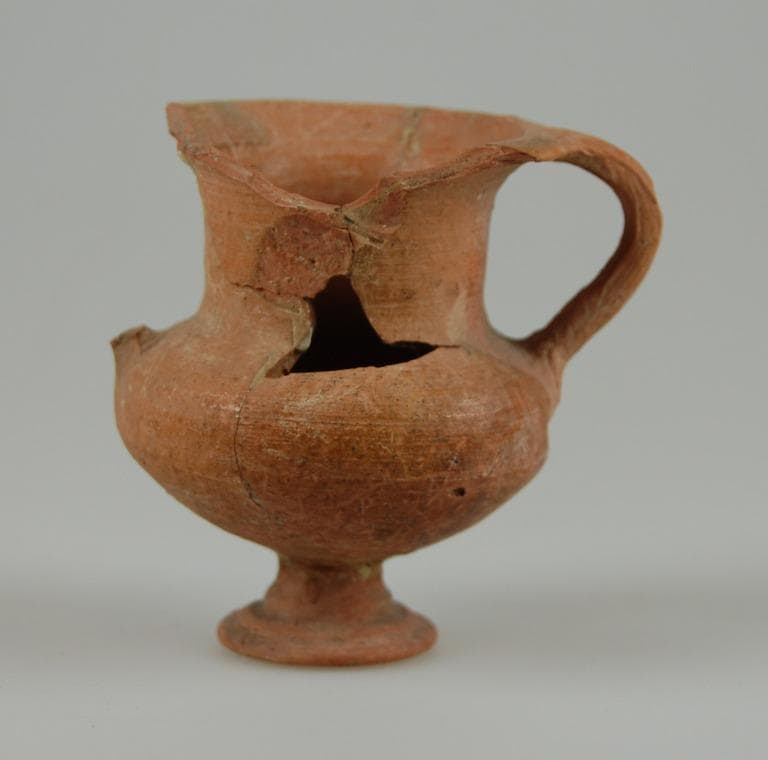 Miniature AmphoraGeometric II · 900–750 BC
- Phoenician Red Slip OinochoeArchaic I · 750–600 BC
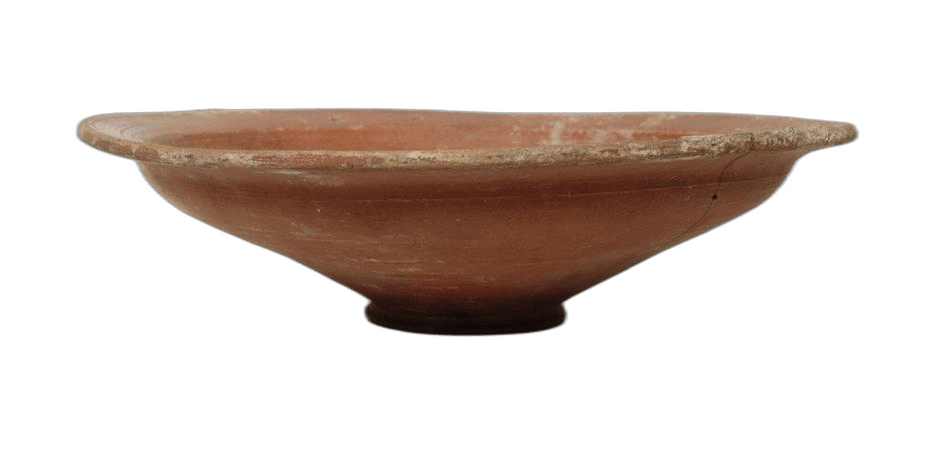 Red Slip Carinated BowlArchaic I · 750–600 BC
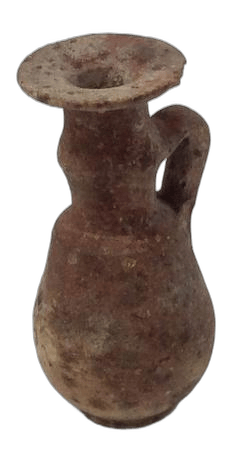 Red Slip JugletArchaic II · 600–475 BC
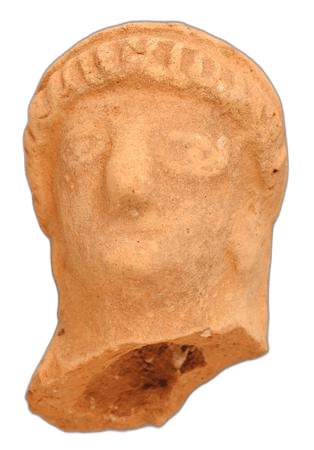 Purplish Red Slip HeadArchaic II · 600–450 BC
In the catalogue
References
- 1.Crewe, L. (2007). Early Enkomi: Regionalism, trade and society at the beginning of the Late Bronze Age on Cyprus (BAR International Series 1706). Archaeopress.
- 2.Åström, P. (1966). Excavations at Kalopsidha and Ayios Iakovos in Cyprus. Carl Bloms Boktryckeri.
- 3.Reeve, A. H. (2021). Ancient Cyprus in Leeds: Objects, networks and museums from 1870 to 1947 [Doctoral dissertation, The University of Leeds].
- 4.Crewe, L. (2009). Regionalism and the first appearance of Plain White Handmade ware in the Middle Cypriot Bronze Age. In I. Hein (Ed.), The formation of Cyprus in the 2nd millennium B.C.: Studies in regionalism during the Middle and Late Bronze Ages (Contributions to the Chronology of the Eastern Mediterranean 20, pp. 79–90). Austrian Academy of Sciences.
- 5.Crewe, L. (2015). Plain wares and urban identities in Late Bronze Age Cyprus. In C. Glatz (Ed.), Plain pottery traditions of the eastern Mediterranean and Near East: Production, use, and social significance (UCL Institute of Archaeology Publications 67). Left Coast Press (reissued Routledge, 2016). https://doi.org/10.4324/9781315422572
- 6.Catling, H. W. (n.d.). [Review of the Kazaphani tomb publication, ed. I. Nikolaou]. The Classical Review. https://doi.org/10.1017/S0009840X00254346
- 7.Karageorghis, V., & Raptou, E. (2021). Palaepaphos-Teratsoudhia Tomb 288 (c. 1650 BC–c. 1200 BC). Opuscula: Annual of the Swedish Institutes at Athens and Rome, 14. https://doi.org/10.30549/opathrom-14-12
- 8.Gjerstad, E. (1948). The Cypro-Geometric, Cypro-Archaic and Cypro-Classical Periods (The Swedish Cyprus Expedition, Vol. IV, Part 2). The Swedish Cyprus Expedition.
- 9.Smith, J. S. (2009). Art and society in Cyprus from the Bronze Age into the Iron Age. Cambridge University Press.
- 10.Schreiber, N. (2003). The Cypro-Phoenician pottery of the Iron Age (Culture and History of the Ancient Near East 13). Brill.
- 11.Bikai, P. M. (1987). The Phoenician pottery of Cyprus. A. G. Leventis Foundation.
- 12.Karageorghis, V., & Raptou, E. (2016). Palaepaphos-Skales: Tombs of the Late Cypriote IIIB and Cypro-Geometric periods (excavations of 2008 and 2011). The Cyprus Institute.
- 13.Karageorghis, V. (2003). Ancient Cypriote art in the National Archaeological Museum of Athens. A. G. Leventis Foundation; National Archaeological Museum of Athens.